
Article

Applications of Enzymatic-Ultrasonic Treatment for the Integrated Processing of Secondary Fish Raw Materials and the Production of Food Ingredients

1
Department of Food and Biotechnology, South Ural State University (National Research University), 76 Lenin Avenue, Chelyabinsk 454080, Russia
2
Faculty of Biotechnology, ITMO University, Kronverksky Prospect, 49, A., St. Petersburg 197101, Russia
*
Author to whom correspondence should be addressed.
Fermentation 2025, 11(12), 670; https://doi.org/10.3390/fermentation11120670
Submission received: 5 October 2025 / Revised: 22 November 2025 / Accepted: 22 November 2025 / Published: 28 November 2025
(This article belongs to the Section Fermentation for Food and Beverages)

Abstract

The rapidly developing food industry necessitates the efficient use of raw materials, which can be achieved through the production of functional ingredients with high nutritional value. Secondary fish raw materials generated during the filleting of Atlantic cod (Gadus morhua), including vertebral bones with residual muscle tissue, skin, tails, and fins, represent a promising source of both biologically active compounds and highly digestible protein substances. The aim of this study was to evaluate the properties of protein hydrolysates obtained from secondary Atlantic cod raw materials by conventional enzymatic hydrolysis and combined enzymatic-ultrasonic treatment. The best results were achieved at a power of 320 W and a treatment duration of 3.5 min prior to the addition of the enzyme preparation (Protozyme C). The application of ultrasound enhanced the degree of hydrolysis by 4–5% while simultaneously reducing the amount of enzyme used. Electrophoretic analysis demonstrated a predominance of smaller peptides in the 10–15 kDa range compared to the control sample (43–95 kDa). Infrared spectroscopy confirmed structural changes in the samples under study, manifested in an increase in the number of terminal groups and partial disaggregation of the peptide mixture. Particle size distribution analysis revealed a more uniform distribution and a decrease in the median particle size in samples with ultrasonic pretreatment. The safety and antioxidant activity assessment did not show any toxic effects, but manifested a significant increase in antioxidant indicators (2.5–3.2 times) compared to the control sample. The results obtained show the enzymatic-ultrasonic treatment to be promising for the integrated processing of fish raw materials and the production of functional food ingredients with improved properties.

1. Introduction

Deep processing of fish and non-fish seafood is currently developing worldwide. In the fish processing sector, more than 60% of the total catch is generated as by-products (secondary raw materials: heads, skin, vertebral bones with attached muscle, fins, tails, entrails, and roe) [1,2,3]. Only 40% is directed to human consumption in the form of fillets and other semi-finished products [4,5], while the remaining portion is used for producing low-value products or even discarded [6,7].
These significant quantities of by-product pose a considerable challenge to environmental sustainability and disposal management in both developed and developing countries [8,9]. The by-products contain a substantial number of protein-rich components, which could be reutilized as valuable food ingredients in food products, animal feed, fishmeal, and fertilizers, to name a few applications [10,11,12].
One promising method for processing secondary fish raw materials is enzymatic hydrolysis, which enables the extraction of valuable proteins and yields products with high biological value [13,14,15]. The application of enzymatic preparations in this process facilitates the development of novel technologies for the valorization of fish raw materials. Almost 80% of secondary raw materials can be hydrolyzed into peptides and free amino acids. [16,17]. However, conventional enzymatic hydrolysis is often limited by several factors, such as low substrate conversion, inefficient enzyme utilization, and suboptimal process efficiency [16,18]. Combining those conventional methods with such non-conventional food processing methods such as ultrasound, microwave irradiation [19], high pressure [20], and pulsed electric fields can help address the above issues.
A comprehensive approach to hydrolysate production, which integrates modern pre-treatment methods with subsequent hydrolysis, can facilitate a more complete extraction of protein ingredients [21]. Ultrasonic treatment represents one such effective and environmentally friendly methodology. In the context of enzymatic hydrolysis, ultrasound can be applied in three principal ways: ultrasonic treatment of enzymes, ultrasonic treatment of the reaction process, and ultrasonic pretreatment [22].
According to the studies in [23,24,25,26,27], the use of ultrasonic exposure increases the efficiency of enzymatic reactions in the hydrolysis process. Thus, the use of ultrasonic exposure raises the degree of hydrolysis and antioxidant activity of the protein hydrolysates obtained from pork liver, the biological activity of plant proteins and the functional properties of milk hydrolysates.
The propagation of ultrasound through a liquid medium induces cavitation, a phenomenon characterized by the formation, growth, and implosive collapse of microscopic gas bubbles or cavities. The cavitation zones generated by high-power ultrasound can create extreme local conditions of pressure and temperature. These transient, high-energy environments are responsible for inducing significant alterations in the properties, microstructure, and molecular reactivity of food raw materials, including secondary fish resources [16,17,18,19]. Properly selected ultrasonic exposure modes can provide positive cavitation effects, improving protein solubility, increasing adsorption capacity at the phase boundary, and making hydrophobic protein groups more accessible to enzymatic hydrolysis [20].
The above approach has been effectively applied in the processing of secondary fish resources and increasing the yield of protein hydrolysates from mackerel and trout by-products, which has been confirmed by numerous studies [25,28,29]. The cavitation effects during ultrasonic pretreatment can unfold substrate structures and change their conformation for easier enzymatic action [30]. In addition, particle size reduction can also enhance mass transfer and accelerate enzymatic hydrolysis reactions [31]. However, the effect of the combination of ultrasound and specific enzyme systems, particularly Protozyme C, on the hydrolysis of fish proteins has not been amply studied yet. The effect of ultrasound on the structure of plant and meat proteins has been described in [23,25,28,29,31], but very few studies that have examined the synergistic effect of ultrasonic pretreatment and the alkaline protease Protozyme C in the processing of secondary codfish raw materials. It does not appear to be explained how cavitation effects influence the catalytic activity of this enzyme, the degree of hydrolysis, and the formation of peptide fractions under real biosubstrate conditions. Thus, it is relevant to investigate the possibility of using ultrasonic pretreatment to intensify and improve the efficiency of the enzymatic hydrolysis process and obtain hydrolysates from secondary fish raw materials.
Fish protein hydrolysates (FPH) are food ingredients produced from fish or secondary fish raw materials through protein hydrolysis, a process involving the breakdown of tissue proteins into peptides and amino acids. In our research, this was accomplished via a combined enzymatic-ultrasonic treatment. Thus, FPH is a mixture of hydrolyzed proteins [32] whose properties are superior compared to the original protein, namely, they feature pronounced functional [33] and bioactive properties, such as antioxidant [34,35] or antihypertensive activity. Recently, FPHs have also found application as cryoprotective agents in frozen fish products [36,37].
Thus, the integration of ultrasonic treatment into enzymatic hydrolysis represents a promising strategy for enhancing process efficiency and producing functional protein ingredients with improved technological and bioactive properties. However, the combined effects of ultrasonic pre-treatment on the subsequent hydrolysis of secondary fish raw materials and the production of food hydrolysates have not been amply explored in the literature and are of scientific interest.
Our research hypothesis posits that ultrasonic pretreatment of cod fish waste prior to enzymatic hydrolysis with Protozyme C protease induces structural alterations in the protein substrate. These changes destabilize intramolecular bonds, increase the accessibility of peptide cleavage sites, and consequently enhance the catalytic efficiency of the enzyme.
The aim of the study was to evaluate the properties of protein hydrolysates obtained from secondary fish raw materials of Atlantic cod (Gadus morhua) both by conventional enzymatic hydrolysis and combined enzymatic-ultrasonic treatment.

2. Materials and Methods

2.1. Materials

The following types of secondary fish raw materials and enzymatic preparations were used in this study:
1.
Secondary fish raw materials obtained from Atlantic cod (Gadus morhua) filleting residues (backbones with meat trimmings, skin, tails, fins).
Frozen (single freezing during fish cutting) secondary fish raw materials obtained from the remains of Atlantic cod (Gadus morhua) filleting were used, provided by Agama Istra LLC (Russia, Moscow Region, Istrinsky District, Pavlo-Slobodsky Rural District, Leshkovo village), caught in the Barents Sea. Cod caught in 2022–2024 was used for the study, in accordance with GOST 814-2019 «Chilled fish. Technical conditions». The harvested chilled cod was used to obtain skinless pressed frozen cod fillets in accordance with GOST 32006-2012 «Skinless pressed frozen cod fillets. Technical conditions». Frozen secondary raw materials were supplied in the form of whole dense blocks with a clean, even surface. They were defrosted once at a temperature of 4–6 °C, with a mass (juice) loss of 3–5%. The shelf life of frozen secondary fish raw materials was no more than 6 months, according to current regulatory documentation (GOST 32366-2013 «Frozen fish. Technical conditions» and MUK 4.2.1847-04 «Sanitary and epidemiological assessment of the justification of shelf life and storage conditions for food products»).
For research purposes, all raw materials were separated into two fractions:
Atlantic cod skin with meat trimmings (AcS);
Vertebrae and rib bones with meat trimmings; fins with meat trimmings; and the tail section with the tail fin (SRF).
Fish heads and gills tend to rapidly deteriorate, whereas the entrails are highly contaminated; therefore, these components were not used for our research. The secondary fish raw materials from Atlantic cod were manually fractioned into components after defrosting for subsequent processing and hydrolysate production. After defrosting, the secondary fish raw materials had the smell of fresh fish and a clean surface without any mucus, blood clots, or entrails. The components of secondary fish raw materials obtained after filleting Atlantic cod were classified in accordance with the classification of GOST 34190-2017 «Frozen fish by-products. Technical conditions».
2.
Enzyme preparation: alkaline fungal protease (Fungal protease) «Protozyme C», obtained by culturing the fungus strain Acremonium chrysogenum, followed by purification and concentration, declared enzyme activity 50,000 units/g; optimal pH values 8.0–10.5 units; activity temperature 50–60 °C. The enzyme preparation was purchased from the manufacturer, the biotechnology company Biopreparat, Voronezh, Russian Federation. Protozyme C has collagenolytic, elastolytic, and keratinolytic effects, acts on connective tissue, and reduces its strength during subsequent heat treatment.

2.2. Obtaining Protein Hydrolysates from Secondary Fish Raw Materials

To obtain protein hydrolysates, all secondary fish raw materials defrosted at a temperature of 4–6 °C were classified into the two fractions mentioned above and processed in a grinder with a grid hole diameter of 2–3 mm. The minced material was then subjected to a treatment with 1% acetic acid, constantly stirred for 30 min, and then washed for 5 min under running water. This treatment with dilute acetic acid was used to loosen collagen-mineral complexes, facilitate the removal of soluble impurities, and improve the accessibility of protein substrates for subsequent enzymatic hydrolysis. After washing, the AcS or SRF was blended with water in a ratio of 1:4.5, and the pH was adjusted to 8.5–9.0 by adding a sodium hydroxide solution. Before the subsequent stages, preliminary trials were carried out to determine the optimal enzyme concentration and hydrolysis duration. During these studies, a range of enzyme concentrations (from 1% to 5%) and hydrolysis times (from 3 to 8 h) were tested. Based on these preliminary results, the enzyme concentration of 3% and hydrolysis time of 6 h were selected for further experiments. These preliminary experiments served as the basis for defining the parameters used in the subsequent traditional and ultrasound-assisted hydrolysis methods.
The subsequent process was carried out according to the following stages:
(i)
In the traditional method for producing hydrolysates (Sample 1 and Sample 2), the enzyme Protozyme C was added to the AcS or SRF and water (1:4.5) solution at a concentration of 3% of the initial raw material mass. Enzymatic hydrolysis was conducted for 6 h at a temperature of 55 ± 3 °C. After enzymatic hydrolysis, the enzyme was inactivated by heating the hydrolysate solution to 90 °C for 10 min. The hydrolysate solution was then centrifuged at 4000 rpm, filtered, and dried to a moisture content not exceeding 8%.
(ii)
To obtain the experimental hydrolysate samples (Sample 3 and Sample 4), the following technology was used: the prepared aqueous solution of AcS or SRF and water (1:4.5) was subjected to ultrasonic treatment with the following parameters: frequency 22 ± 1.6 kHz, intensity 10 W/cm2, maximum power 400 W/L. The volumetric energy density was calculated based on the heat capacity and volume of the processed medium (1 L). An ultrasonic unit (UZT “Volna-M UZTA-0.40/22-OM”, Biysk, Russia) [38] was used for the treatment. The exposure was carried out by immersing a mushroom-shaped transducer into the aqueous solution containing the secondary fish raw material under constant stirring.
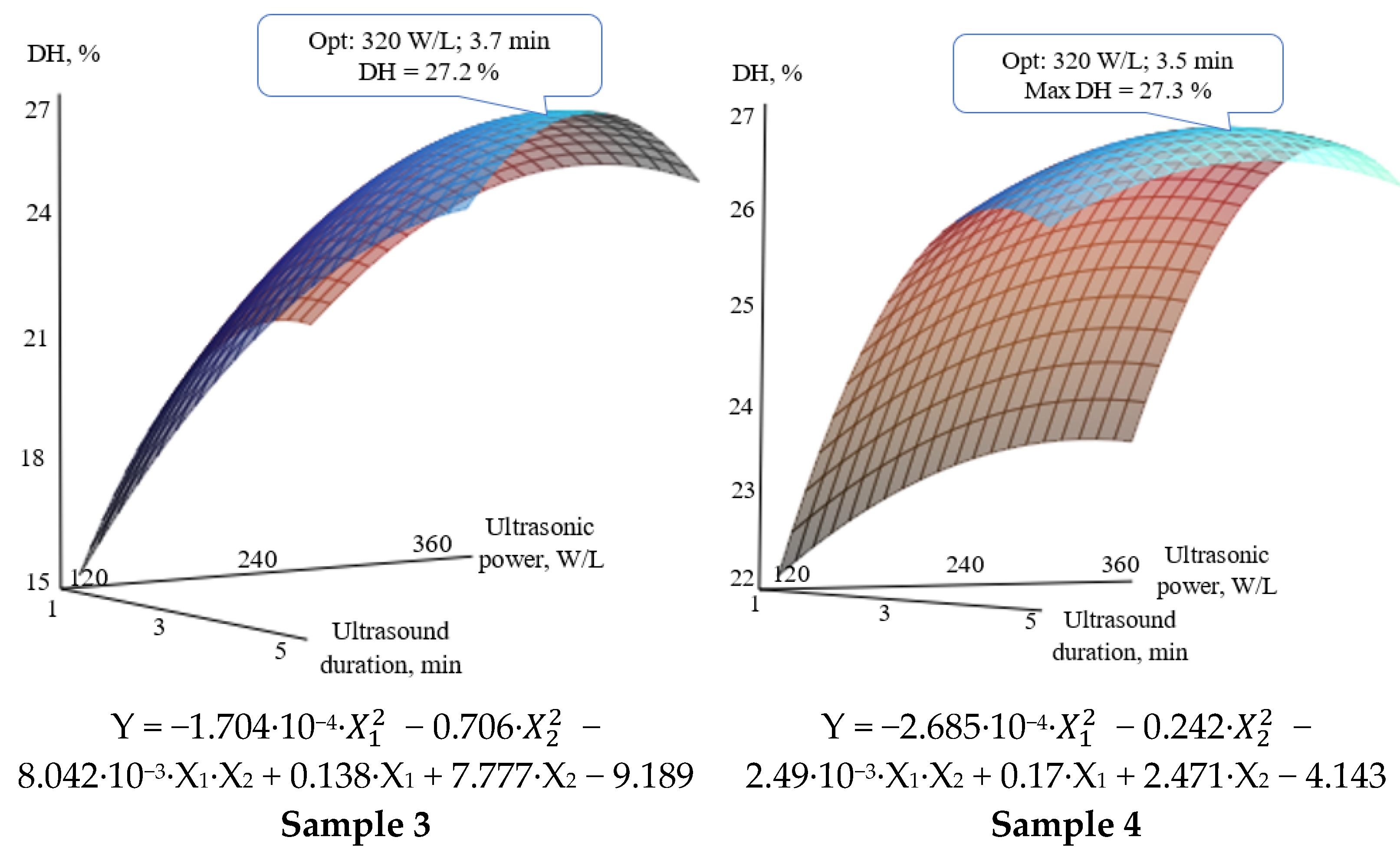
At the initial research stage, the ultrasonic treatment parameters were optimized by varying the power level (120, 240, and 360 W/L, X1) and the treatment duration (1, 3, and 5 min, X2). The degree of hydrolysis (%) was used as the response variable to assess the efficiency of the hydrolysis process. The experiments were carried out according to a two-factor design, where each combination of power and duration was tested in triplicate. The obtained data were analyzed to determine the most effective combination of ultrasonic parameters providing the highest degree of hydrolysis while preventing excessive denaturation of proteins. Based on these results, the optimal parameters of ultrasonic treatment were established at a power of 320 W/L and a duration of 3.5 min.
After determining the optimal ultrasonic parameters, the enzyme preparation Protozyme C was added to the pre-treated mixture for enzymatic hydrolysis. Enzymatic hydrolysis was performed under the following conditions: enzyme concentration of 2.5%, temperature 50 ± 2 °C, pH 8.5–9.0, and duration of 3.5 h under constant stirring. The lower enzyme concentration compared to the traditional method (3%) was chosen because ultrasonic treatment enhances the accessibility of protein substrates by disrupting collagenous and mineral-protein structures, thus allowing effective hydrolysis at a reduced enzyme dosage. Following hydrolysis, the enzyme was inactivated by heating the mixture to 90 °C for 10 min, and the hydrolysate obtained was recovered following the methodology described above for (i).
After optimization, the hydrolysates obtained under the selected conditions were characterized and compared in terms of their physicochemical and functional properties.
Sample 1: Hydrolysate obtained from a suspension of AcS and water at a 1:4.5 ratio, followed by enzymatic hydrolysis with Protozyme C at 3.5% of the dry raw material mass, according to the traditional technology described above.
Sample 2: Hydrolysate obtained from a suspension of SRF and water at a 1:4.5 ratio, followed by enzymatic hydrolysis with Protozyme C at 3.5% of the dry raw material mass, according to the traditional technology described above.
Sample 3: Hydrolysate obtained from a suspension of AcS and water at a 1:4.5 ratio. The process included preliminary ultrasonic treatment (320 W/L for 3.5 min) prior to enzymatic hydrolysis with Protozyme C at 2.5% of the dry raw material mass.
Sample 4: Hydrolysate obtained from a suspension of SRF and water at a 1:4.5 ratio. The process included preliminary ultrasonic treatment (320 W/L for 3.5 min) prior to enzymatic hydrolysis with Protozyme C at 2.5% of the dry raw material mass.
Control sample—powder obtained by spray drying concentrated fish broth from secondary Atlantic cod fish raw materials (no enzymatic hydrolysis was performed).
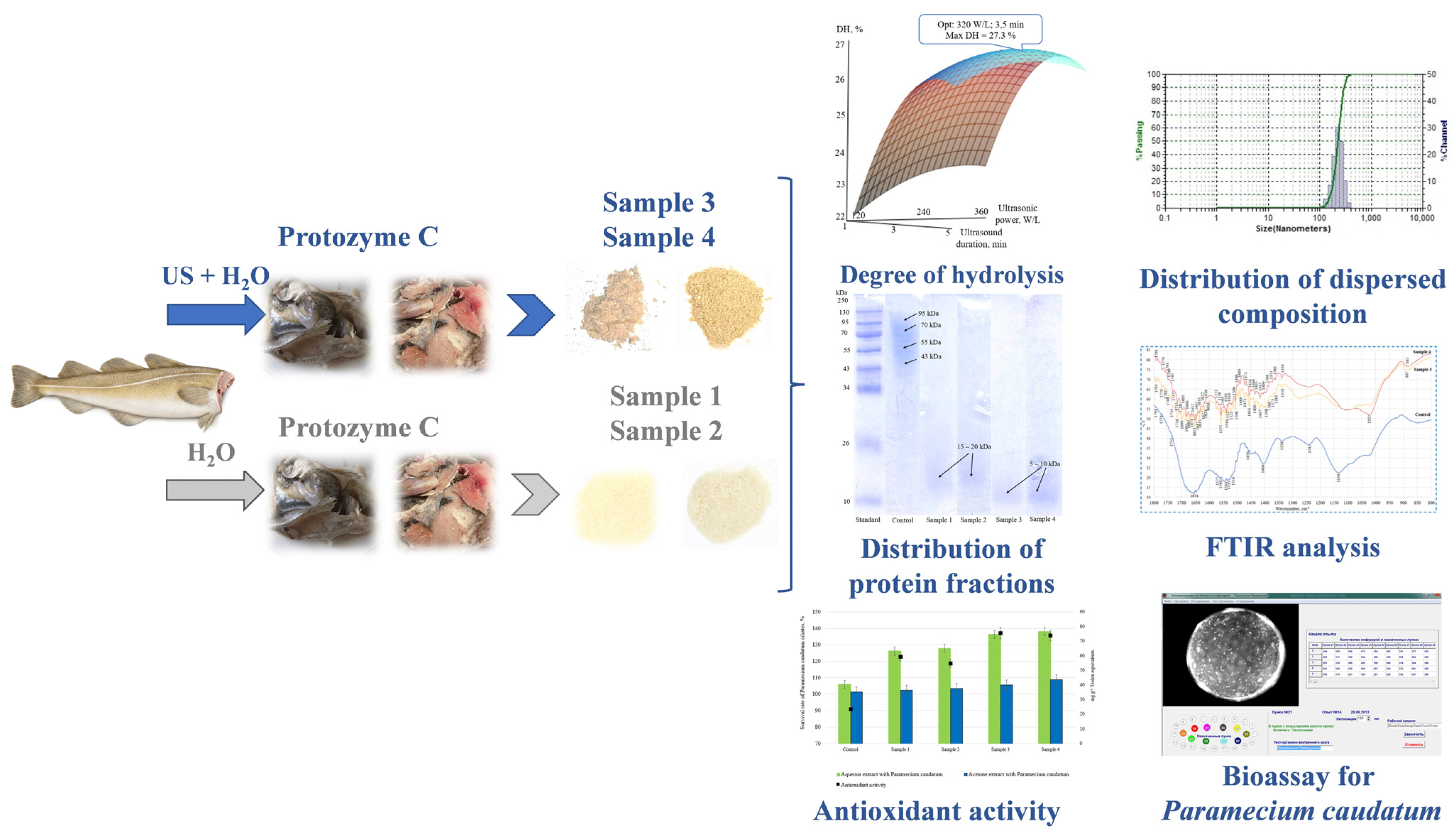
A graphical scheme of the samples and the experimental procedure is presented in Figure 1.
The amount of enzyme added was determined in advance during preliminary studies. It was demonstrated that using the enzyme preparation Protozyme C at concentrations exceeding 3.5% is ineffective, as the enzymatic hydrolysis values reach a plateau between 19.86% and 23.01%. This suggests that part of the enzyme preparation remains unbound and unused in the hydrolysis process due to its excess relative to the available secondary fish raw materials over the given period.

2.3. Evaluation of Food Ingredient Properties

The degree of hydrolysis (DH) was quantified using the formal titration method and expressed as the percentage of free amino groups relative to the total nitrogen content of the sample, which had previously been determined by the Kjeldahl procedure [39]. DH calculation was performed following the methodology described in [24,40] and is presented in Equation (1):
D H = N A A     N A A 0 N O A     N A A 0 × 100 %
where NOA is the total nitrogen content, %; NAA0 is the amine nitrogen in a non-hydrolyzed sample, %; NAA is the content of amine nitrogen in the hydrolysate after hydrolysis for a certain period of time, %.
Approximately 0.0002 g of dried protein hydrolysate was applied onto infrared-transparent silicon plates. For each hydrolysate, five replicate aliquots were prepared to ensure measurement reproducibility. FTIR spectra were acquired using an IRAffinity-1S Fourier transform infrared spectrometer (Shimadzu, Japan, Kyoto) over the wavenumber range of 4000–400 cm−1, with a resolution of 4 cm−1 and an aperture width of 5.0 mm. Each spectrum represented an average of 20 accumulated interferograms.
Prior to analysis, all spectra were subjected to baseline correction and normalization to minimize background interference and intensity variations. Spectral data processing was conducted using LabSolutions IR software 2.2 (Shimadzu, Japan, Kyoto). Peak positions were identified and labeled according to characteristic absorption bands of peptide bonds and functional groups typical for protein hydrolysates.
Changes in band intensity and position were used to assess structural alterations in protein secondary structure and the degree of peptide bond cleavage during enzymatic hydrolysis. Comparative spectral analysis evaluated the combined effects of ultrasonic pretreatment and enzymatic hydrolysis on the molecular conformation and chemical environment of the resulting hydrolysates.
Denaturing polyacrylamide gel electrophoresis with sodium dodecyl sulfate (SDS-PAGE) (Servicebio, Wuhan, China) was used to study the distribution of protein fractions in the hydrolysate samples in a Mini-PROTEAN Tetra Cell vertical electrophoresis chamber with a PowerPac Basic Power Supply (Bio-Rad, Hercules, CA, USA). The results were visualized using highly sensitive staining methods (Kumassi G-250 according to Neuhoff, Sisco Research Laboratories Pvt. Ltd., Mumbai, India), followed by densitometric analysis and comparison with molecular weight markers.
The overall toxicity of the obtained hydrolysates was assessed using a bioassay on the protozoan Paramecium caudatum, with an initial concentration of no less than 500 ± 100 cells/mL in Petri dishes. Counting of Paramecium cells was performed using the «BioLaT-3.2» device coupled with the Auto Ciliata XP software (Russia). The tests were conducted in accordance with GOST 31674-2012 «Methods for Determination of General Toxicity».
Two types of solutions were prepared from the dried hydrolysates for bioassay purposes:
(i)
Aqueous solution: 10 g of hydrolysate was placed into a 250 mL extraction flask with a ground glass stopper, then 100 mL of distilled water was added. The mixture was shaken for 30 min in a laboratory shaker (AVU-6S, Russia, Rostov Region, Medical Products Plant), followed by centrifugation at 3000 rpm for 15 min using an Eppendorf MiniSpin centrifuge (Hamburg, Germany). At least 15 mL of the supernatant (aqueous solution) was decanted into a clean beaker and used for the bioassay.
(ii)
Acetone solution: 10 g of hydrolysate was placed into a 100 mL extraction flask with a ground glass stopper, then 15 mL of acetone (98% purity, AO “Vekton”, Russia) was added. The mixture was shaken for 20 min in the laboratory shaker (AVU-6S, Kemerovo, Russia). Subsequently, 0.5 mL of the supernatant was taken and added to a beaker containing 20 mL of bidistilled water to prepare the acetone solution used for bioassay testing on the protozoan.
The dispersion composition of the solutions of the obtained hydrolysates was studied using the laser dynamic light scattering method on a Nanotrac Ultra analyzer (Microtrac Inc., Montgomeryville, PA, USA).
The antioxidant capacity of the hydrolysates was determined using the 2,2-diphenyl-1-picrylhydrazyl (DPPH) radical scavenging assay [41]. For the test, 0.5 mL of each aqueous hydrolysate solution was mixed with 3.6 mL of DPPH working solution (0.025 g DPPH dissolved in 100 mL ethanol). The reduction in absorbance at 515 nm, indicative of radical scavenging activity, was measured with a Jenway UV/Vis spectrophotometer (Model 6405, Staffordshire, UK). A calibration curve was constructed using Trolox (6-hydroxy-2,5,7,8-tetramethylchroman-2-carboxylic acid) over a concentration range of 10–100 mg/L (R2 = 0.988). The antioxidant activity was expressed as milligrams of Trolox equivalent per milliliter of hydrolysate solution.

2.4. Statistical Processing of Results

The experiments were conducted in triplicate. Enzymatic hydrolysis and the extraction of food components were performed under consistent conditions to ensure the reliability of the results. Experimental data were analyzed using statistical methods applied via Microsoft Excel and MathCad 14.0 software. All reported values are presented with a confidence level of 95%.

3. Results and Discussion

Samples 1 and 2, subjected to enzymatic hydrolysis of Atlantic cod secondary raw materials using the Protozyme C enzyme at pH 8.5–9 and 55 °C without ultrasonic pretreatment, achieved a degree of hydrolysis of 22–24% within 6 h. Extending the hydrolysis duration or increasing the enzyme dosage did not significantly enhance the degree of hydrolysis, indicating a limited accessibility of protein substrates within the raw material matrix (DH values were 23.7 ± 0.4% for Sample 1 and 22.3 ± 0.3% for Sample 2).
The results of two-factor experimental design in MathCad 14.0 software for the combination of parameters are shown in Figure 2.
Ultrasonic treatment for 3.5 min at 320 W/L yielded the maximum degree of hydrolysis (DH), with values ranging from 27.2% to 27.3 ± 0.3%. The use of longer (more than 3.5 min) ultrasonic exposure of fish raw materials at a power of 320 W/L causes a significant increase in the temperature of the system, denaturating protein and decreasing the degree of hydrolysis of the resulting hydrolysates.
Ultrasonic treatment is widely regarded as one of the most promising techniques for enhancing biotechnological processes involved in food raw material processing. The action of ultrasonic waves is primarily attributed to cavitation phenomena, involving the formation and implosion of microbubbles within the liquid medium [41,42].
For protein substrates, including secondary fish raw materials, ultrasound plays a key role in increasing the availability of macromolecules for enzymatic action. The cavitation processes increase the permeability of food matrices and ensure more efficient penetration of the aqueous phase into cellular structures, which contributes to improved interaction between the enzyme solution and the substrate. An additional factor is the loosening of tissues and partial modification of the conformation of protein molecules under the action of mechanical impulses arising during cavitation [43,44]. Figure 3 shows the results of optimizing the ultrasonic effect on solutions of secondary fish raw materials and water.
These changes significantly increase mass transfer efficiency and internal diffusion dynamics, which accelerates enzymatic hydrolysis. The reduction in particle size and change in microstructure also contribute to an increase in the interaction surface area, thereby intensifying hydrolysis processes and increasing the yield of target products.
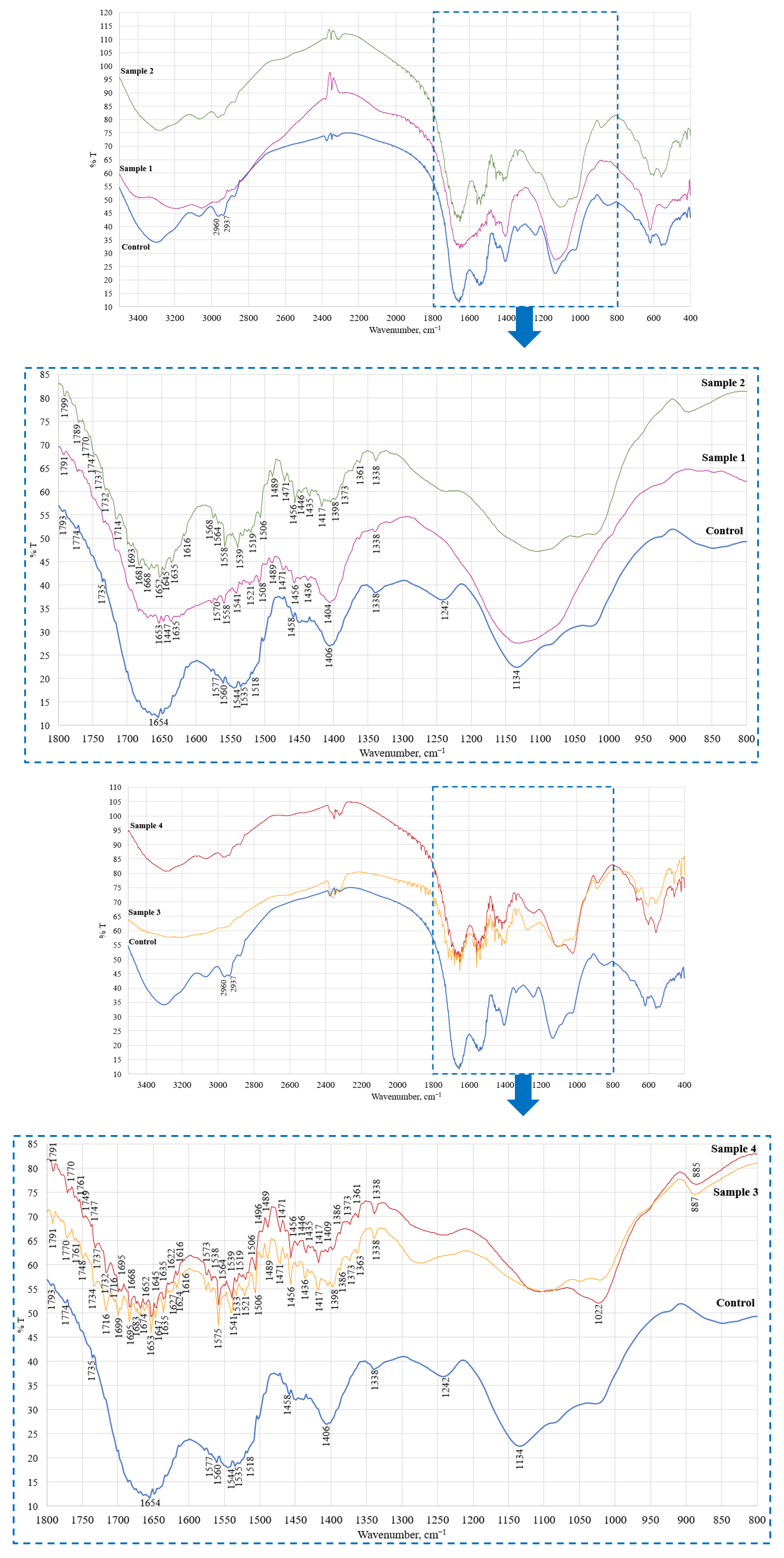
For all samples in the spectral range 3500–2800 cm−1, bands typical of protein matrices are observed: a broad N–H/O–H stretching band at ~3300–3270 cm−1 and ~2930–2920 cm−1, and asymmetric CH2 stretching bands. In the «finger» region of 1700–1200 cm−1, bands are clearly visible that are possibly characteristic of: amide I (~1650–1630 cm−1, C=O), amide II (~1550–1530 cm−1), and amide III (~1245–1235 cm−1), corresponding to the peptide backbone (–CONH–) and reflecting the secondary structure of protein hydrolysates. These values are consistent with the literature data describing the IR spectra for collagen [42]. In all hydrolysates, the intensity of the bands associated with the terminal groups of low-molecular-weight peptides increases: –COO (~1400–1410 cm−1) and –NH3+ (~1516 cm−1), which may indicate the cleavage of peptide bonds and the accumulation of free amino groups.
According to [13,21], the vibrations of atoms that are part of the functional groups of protein molecules, peptides, and low-molecular-weight hydrolysate products are characteristic of absorptions in the long-wave region of the electromagnetic spectrum (1800–800 cm−1).
The spectrum of the Control sample is characterized by amide bands of moderate intensity, suggesting a prevalence of longer polypeptide chains or gelatinized proteins with a lower proportion of terminal functional groups. In contrast, the spectra of the experimental samples exhibit a marked increase in the relative intensity of the amide I (~1650–1643 cm−1) and amide II (~1545–1535 cm−1) bands, accompanied by a more pronounced –COO band at ~1400 cm−1. This reflects an increase in the degree of hydrolysis and an increase in the number of terminal groups in the collagen-containing skin sample.
Compared to Sample 1, Sample 3 shows: (i) relative intensification of the –COO (~1400 cm−1) and –NH3+ (~1516 cm−1) bands; (ii) a slight broadening/shift of amide I to ~1646–1643 cm−1 and a decrease in the amide III/1450 cm−1 ratio, which in turn may indicate a deeper disaggregation of collagen structures and an increase in the proportion of low-molecular-weight peptides. These changes are consistent with the known effect of ultrasonic cavitation: increased substrate accessibility and degree of FPH hydrolysis [24].
Samples 3 and 4 show a significant number of peaks: 1338–1430 cm−1 which may correspond to the presence of compounds of the type (NH4+ group in amines); 1489–1539 cm−1 which corresponds to the presence of OH groups in the composition of COOH groups; 1506–1616 cm−1, which may correspond to compounds of the type (CH3, C-H), peaks of 1647 cm−1, 1653 cm−1, 1645 cm−1, 1653 cm−1 are registered, associated with the stretching of the C=O bond. Compared to Sample 2, Sample 4 shows an increase in –COO and –NH3+ and a slight decrease in the relative area of amide II, which may indirectly characterize a more intense proteolysis process of the protein-collagen matrix [45].
In Samples 3 and 4 subjected to ultrasonic pretreatment, the FTIR spectra frequently exhibit more resolvable components in the 1200–900 cm−1 and 1400–1000 cm−1 regions. This suggests the presence of a more complex mixture of low-molecular-weight peptides and modifications to side-chain conformations. These observations are consistent with several experimental studies, which report that ultrasonic pretreatment increases the proportion of low-molecular-weight fractions, a change that manifests spectrally as an intensification of specific features in these wavenumber ranges [46].
Enzymatic hydrolysis significantly influences the molecular weight distribution of peptide fractions formed during protein cleavage [13,21,47]. According to Quan et al. [21], additional ultrasonic treatment can change the conformation of the protein matrix, decrease the strength of intermolecular interactions, and, as a result, increase the accessibility of peptide bonds for enzymatic action.
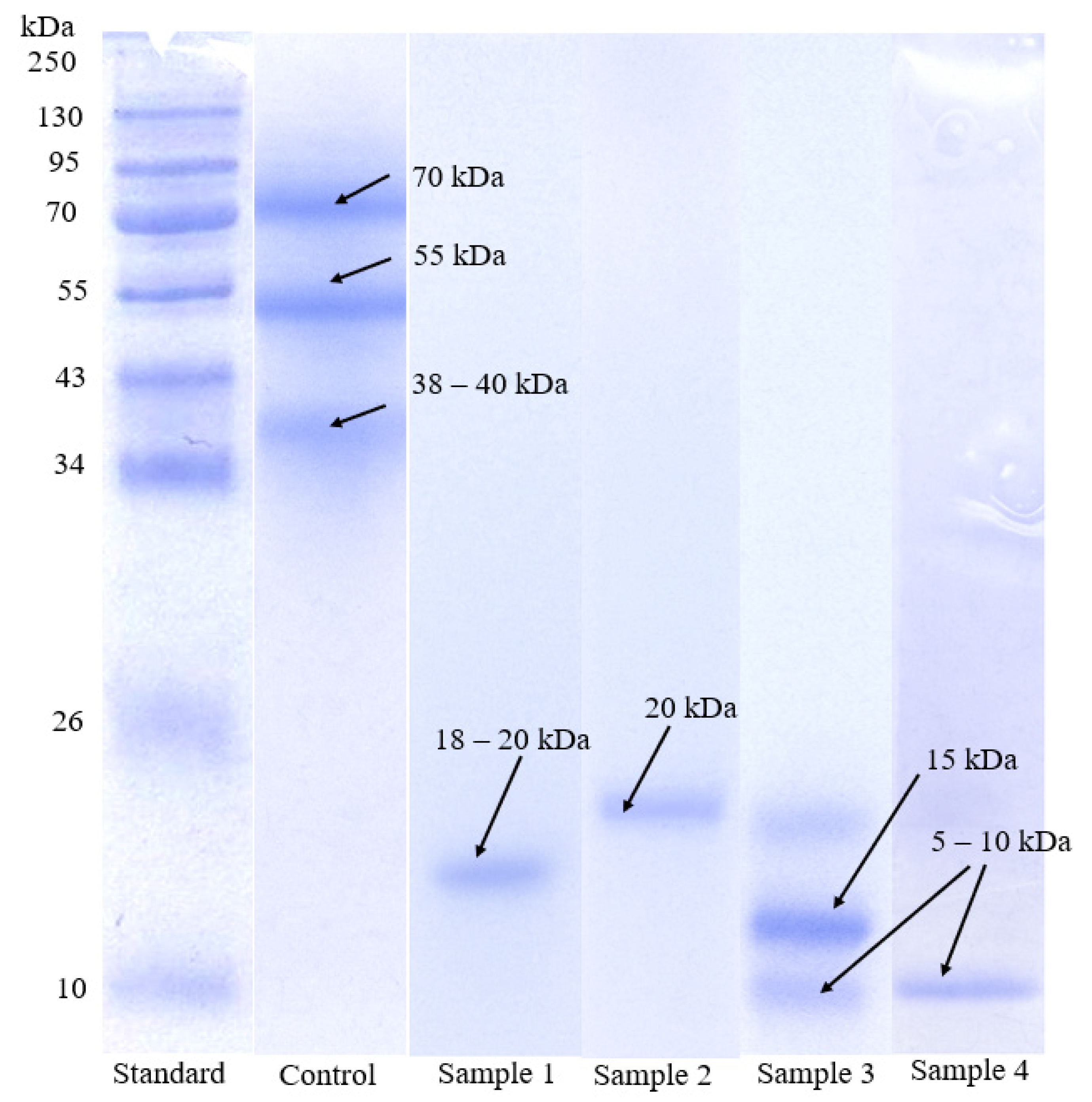
This study used one-dimensional polyacrylamide gel electrophoresis to confirm the identified patterns and evaluate the effect of different treatment methods on the structure of protein complexes, the molecular weight profile (Figure 4).
The electrophoretic profile of the Control sample is dominated by bands corresponding to high-molecular-weight protein components (43–95 kDa). In contrast, Samples 1 and 2 are characterized by the appearance of bands in the range of 15–20 kDa, which indicates the formation of smaller peptides during enzymatic hydrolysis. The combined enzymatic-ultrasonic approach provided a further shift in the distribution towards smaller fractions: thus, peptides with a mass of 5–10 kDa were detected in the spectrum of Samples 3 and 4, which indicates the increased efficiency of this technology. It has been previously reported that ultrasonic pretreatment increases the sensitivity of fish proteins to proteolytic cleavage [48,49]. This effect is related to the disruption of interchain interactions and weakening of the protein matrix structure, together with an increase in the degree of hydrolysis [48]. According to Zaky et al. [47], acoustic exposure facilitates tissue disaggregation and increases the permeability of raw materials to enzyme solutions, which ensures a more efficient transition of high-molecular-weight proteins into smaller peptide fractions.
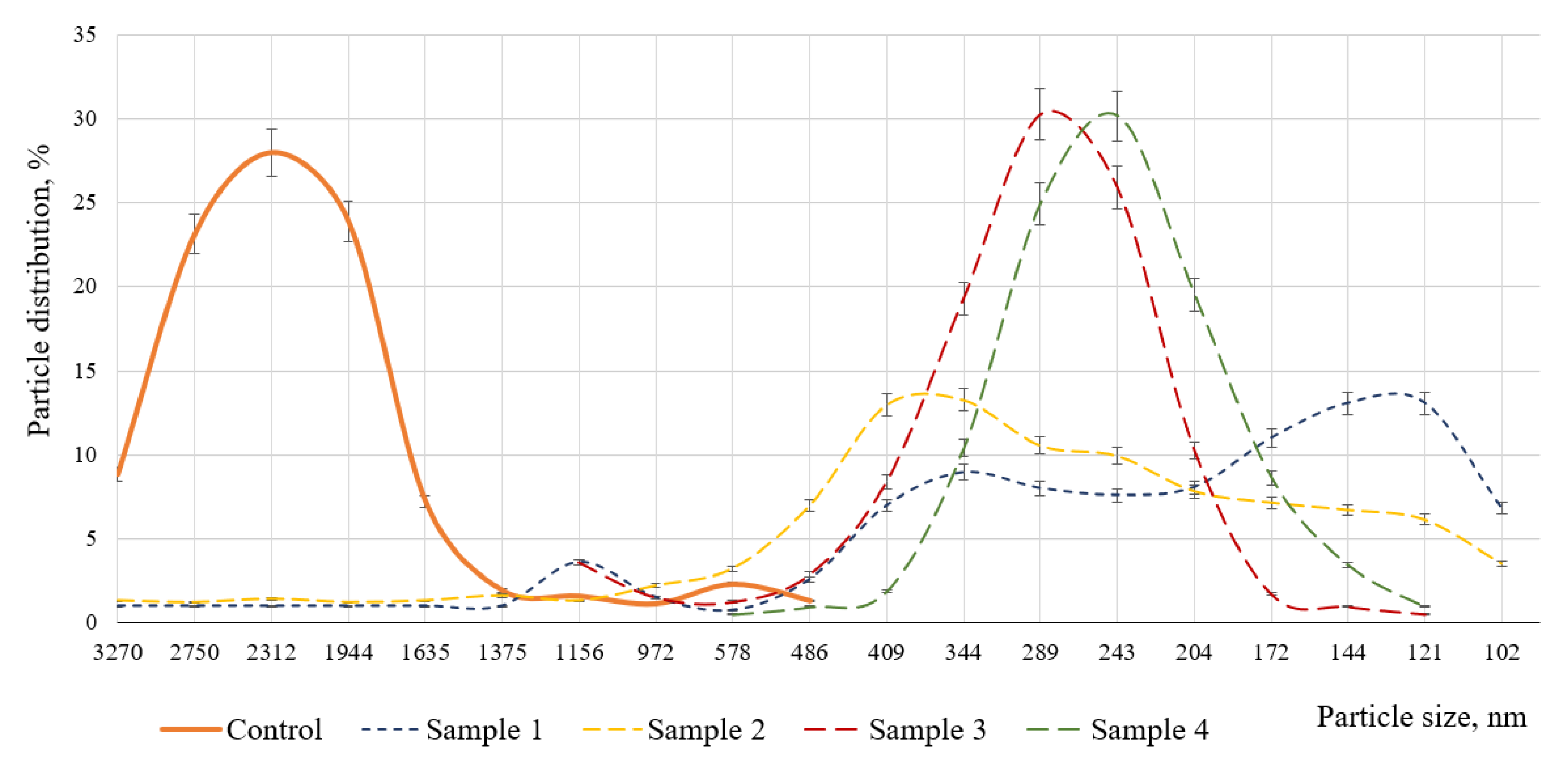
The dispersed composition of hydrolysate solutions is a critical parameter, as it influences their uniform distribution within a food matrix. Laser dynamic light scattering method was used for the research; the typical results for the samples are shown in Figure 5.
The results of the distribution of the dispersed composition of the control sample and hydrolysates have slightly different values; namely, for the control sample, the average median particle distribution is (2122 ± 25) nm, with most of the particles in the size range of 3270–1944 nm (87.9%). The average particle distribution of Sample 1 is characterized by groups of smaller ranges of values: (3200–1156) nm—11.7%; (972–204) nm—44.4%; (172–102) nm—43.9%. Sample 2 is characterized by the following range of values: (3200–1156) nm—9.3%; (972–204) nm—66.9%; (172–102) nm—23.8%. The median values for Sample 1 are 435 ± 25 nm and for Sample 2—234 ± 25 nm [50,51].
The average particle distribution of Sample 3 is characterized by groups of small ranges of values: (1156–409) nm—17–20%; (344–121) nm—80–83%. Sample 4 is characterized by the following more uniform range of values: (578–289) nm—38–42%; (243–121) nm—58–62%. The median values for Sample 3 are 259 ± 25 nm and for Sample 4—226 ± 25 nm. Although the median particle size of Sample 3 was slightly higher than that of Sample 2, the particle size distribution of Sample 3 was narrower and more uniform, indicating a higher degree of dispersion stability and better potential for homogeneous incorporation into food systems. This fact suggests that the incorporation of Samples 3 and 4 of hydrolysates into the food product system will be faster due to their finer dispersion composition [52,53,54].
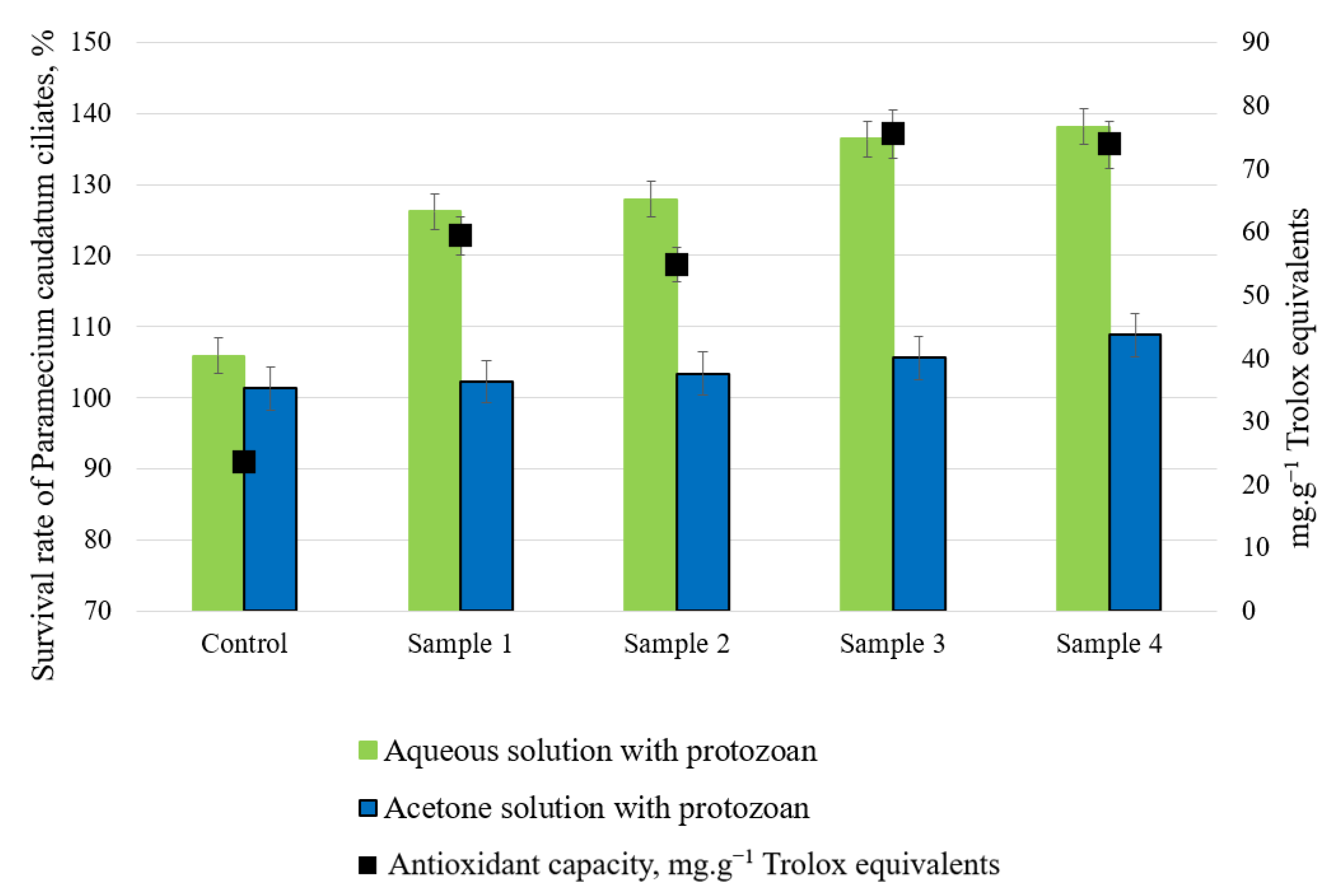
The safety and antioxidant activity of the obtained protein hydrolysates are critical evaluation parameters, as their incorporation into food formulations offers a pathway for developing functional products with enhanced nutritional value and a guaranteed safety profile (Figure 6).
The data obtained demonstrates that the developed hydrolysate samples under study are safe, since during the experiment (2 h) when they were added to the protozoa culture, a pronounced increase in the latter was observed in both aqueous and acetone solutions. Compared to the Control sample, the experimenters observed a significant increase in the protozoa colony at the end of the experiment [55,56]. The growth for aqueous solutions averaged 23.5–31.0%; for acetone solutions, it averaged 1.5–7.5%. These data indicate an increase in the potential bioavailability of the hydrolysates obtained. In addition, their antioxidant activity was found to exceed the control values by 2.5–3.2 times, which proves these products to be promising ingredients for the creation of food systems with improved functional properties.

4. Conclusions

The results of the studies confirmed the effectiveness of the combined enzymatic-ultrasonic approach for processing secondary fish raw materials from Atlantic cod. The ultrasonic pretreatment in the optimal mode (320 W/L, 3.5 min) was shown to provide a 4–5% increase in the degree of hydrolysis compared to conventional enzymatic hydrolysis, while simultaneously reducing the consumption of the enzyme preparation. Electrophoretic analysis revealed a shift in the molecular weight distribution towards peptides of a smaller size (5–15 kDa), indicating intensified proteolysis and the formation of more digestible protein fractions.
IR spectroscopy data confirmed structural changes in the protein matrix, together with an increase in the number of terminal groups and enhanced signs of protein structure disaggregation. The study of the dispersed composition showed that hydrolysates obtained using ultrasound are characterized by a smaller median particle size and a more uniform distribution, which increases their technological compatibility and hydration rate when incorporated into food matrices.
Safety and antioxidant activity indicators are of particular importance. Biotests confirmed the absence of any toxic effects and increased bioavailability of the obtained hydrolysates. The antioxidant activity of the samples studied exceeded the control values by 2.5–3.2 times, which indicates their promise as functional ingredients for the food industry.
Thus, the integration of ultrasonic pretreatment into the enzymatic hydrolysis technology of secondary fish raw materials allows for increased processing efficiency and the production of food ingredients with improved functional and biological characteristics. This opens up opportunities for the development of safe food ingredients that can expand the range of foods with increased nutritional value.
Thus, the integration of ultrasonic pretreatment into the enzymatic hydrolysis technology for secondary fish raw materials significantly enhances process efficiency and enables the production of safe food ingredients with improved functional, biological, and nutritional value. The developed technology provides a basis for creating valuable protein hydrolysates suitable for the food industry to expand the range of products with enhanced nutritional profiles.
It should be noted that the challenges of scaling up the ultrasonic treatment, while crucial for industrial implementation, were beyond the scope of this study and require separate investigation. A preliminary economic assessment indicates potential cost reduction due to a decreased enzyme dosage and shorter hydrolysis time. However, comprehensive engineering and techno-economic analyses—including energy consumption, heat transfer, and cavitation uniformity in large-scale reactors—are necessary for successful commercialization. These aspects will be the primary focus of our further research.

Author Contributions

Conceptualization, N.N.; Methodology, N.N., R.F. and I.K.; Investigation, N.N. and R.F.; Data curation and analysis, R.F.; Supervision, N.N.; Writing—original draft R.F., A.A. and I.K.; Writing—article and editing R.F., I.K. and N.N. All authors have read and agreed to the published version of the manuscript.

Funding

This research received no external funding.

Institutional Review Board Statement

Not applicable.

Informed Consent Statement

Not applicable.

Data Availability Statement

Data will be made available on request to the corresponding author.

Acknowledgments

We would like to thank the managers of the Nanotechnology Research and Education Center and the Higher Medical and Biological School of South Ural State University (Chelyabinsk, Russia) for technical support during the work.

Conflicts of Interest

The authors declare no conflicts of interest. The funders had no role in the design of the study; in the collection, analyses, or interpretation of data; in the writing of the manuscript, or in the decision to publish the results.

References

  1. Rudovica, V.; Rotter, A.; Gaudêncio, S.P.; Novoveská, L.; Akgül, F.; Akslen-Hoel, L.K.; Alexandrino, D.A.M.; Anne, O.; Arbidans, L.; Atanassova, M.; et al. Valorization of Marine Waste: Use of Industrial By-Products and Beach Wrack Towards the Production of High Added-Value Products. Front. Mar. Sci. 2021, 8, 723333. [Google Scholar] [CrossRef]
  2. Jimenez-Champi, D.; Romero-Orejon, F.; Jáuregui, A.; Ramos-Escudero, F. The Revalorization of Fishery By-Products: Types, Bioactive Compounds, and Food Applications. Int. J. Food Sci. 2024, 2024, 6624083. [Google Scholar] [CrossRef]
  3. Panwar, S.; Sindhu, R.; Arora, S. Fishery By-product Valorization. In Food Processing Waste and Utilization; CRC Press: Boca Raton, FL, USA, 2022. [Google Scholar] [CrossRef]
  4. Dekkers, E.; Raghavan, S.; Kristinsson, H.G.; Marshall, M.R. Oxidative stability of mahi mahi red muscle dipped in tilapia protein hydrolysates. Food Chem. 2011, 124, 640–645. [Google Scholar] [CrossRef]
  5. Nag, M.; Lahiri, D.; Dey, A.; Sarkar, T.; Pati, S.; Joshi, S.; Bunawan, H.; Mohammed, A.; Edinur, H.A.; Ghosh, S.; et al. Seafood Discards: A Potent Source of Enzymes and Biomacromolecules with Nutritional and Nutraceutical Significance. Front. Nutr. 2022, 9, 879929. [Google Scholar] [CrossRef]
  6. Ghalamara, S.; Brazinha, C.; Silva, S.; Pintado, M. Valorization of Fish Processing By-Products: Biological and Functional Properties of Bioactive Peptides. Curr. Food Sci. Technol. Rep. 2024, 2, 377–391. [Google Scholar] [CrossRef]
  7. Venugopal, V. Valorization of Seafood Processing Discards: Bioconversion and Bio-Refinery Approaches. Front. Sustain. Food Syst. 2021, 5, 611835. [Google Scholar] [CrossRef]
  8. Hassoun, A.; Cropotova, J.; Trollman, H.; Jagtap, S.; Garcia-Garcia, G.; Parra-López, C.; Nirmal, N.; Özogul, F.; Bhat, Z.; Aït-Kaddour, A.; et al. Use of Industry 4.0 Technologies to Reduce and Valorize Seafood Waste and By-Products: A Narrative Review on Current Knowledge. Curr. Res. Food Sci. 2023, 6, 100505. [Google Scholar] [CrossRef]
  9. Xia, F.L.W.; Supri, S.; Djamaludin, H.; Nurdiani, R.; Seng, L.L.; Yin, K.W.; Rovina, K. Turning Waste into Value: Extraction and Effective Valorization Strategies of Seafood By-Products. Waste Manag. Bull. 2024, 2, 84–100. [Google Scholar] [CrossRef]
  10. Niloo, M.; Regenstein, J.M.; Yasemi, M. Protein Hydrolysates from Fishery Processing By-Products: Production, Characteristics, Food Applications, and Challenges. Foods 2023, 12, 4470. [Google Scholar] [CrossRef]
  11. Yusoff, M.A.; Mohammadi, P.; Ahmad, F.; Sanusi, N.A. Valorization of Seafood Waste: A Review of Life Cycle Assessment Studies in Biorefinery Applications. Sci. Total Environ. 2024, 952, 175810. [Google Scholar] [CrossRef]
  12. Hsu, K.-C. Purification of antioxidative peptides prepared from enzymatic hydrolysates of tuna dark muscle by-product. Food Chem. 2010, 122, 42–48. [Google Scholar] [CrossRef]
  13. Vilkova, D.D.; Novichenko, O.V.; Belova, M.A.; Kutuzov, M.N.; Nikitin, I.A. Infrared Spectroscopy as a Rapid Method the Assessment of the Shelf-Life and Freshness of Refrigerated Rainbow Trout. Storage Process. Farm Prod. 2024, 32, 85–94. [Google Scholar] [CrossRef]
  14. Mezenova, O.Y.; Agafonova, S.V.; Romanenko, N.Y.; Kalinina, N.S.; Volkov, V.V. Ultrasound for separation of fat from fish processing waste. J. Int. Acad. Refrig. 2025, 2, 82–91. (In Russian) [Google Scholar] [CrossRef]
  15. Derkach, S.R.; Kuchina, Y.A.; Kolotova, D.S.; Grokhovsky, V.A.; Dubrovin, S.Y.; Petrova, L.A.; Dyakina, T.A.; Voronko, N.G. Properties of fish gelatin from the skin of Atlantic cod (Gadus morhua). In Proceedings of the All-Russian Scientific and Practical Conference with International Participation “Science and Innovations in the Arctic”, Murmansk, Russia, 4–9 December 2023; Murmansk Arctic University: Murmansk, Russia, 2024; pp. 578–580. (In Russian). [Google Scholar]
  16. Ramakrishnan, V.V.; Ghaly, A.E.; Brooks, M.S.; Budge, S.M. Extraction of proteins from mackerel fish processing waste using Alcalase enzyme. J. Bioprocess. Biotech. 2013, 3, 2–9. [Google Scholar] [CrossRef]
  17. Zinina, O.; Neverova, O.; Sharaviev, P.; Neverova, E.; Aleksandrina, E. Determination of the functional properties of protein hydrolysates by the in silico method. E3S Web Conf. 2023, 395, 03004. [Google Scholar] [CrossRef]
  18. Zhou, C.; Hu, J.; Yu, X.; Yagoub, A.E.A.; Zhang, Y.; Ma, H.; Otu, P.N.Y. Heat and/or ultrasound pretreatments motivated enzymolysis of corn gluten meal: Hydrolysis kinetics and protein structure. LWT 2017, 77, 488–496. [Google Scholar] [CrossRef]
  19. Viji, P.; Madhusudana Rao, B.; Debbarma, J.; Ravishankar, C.N. Research developments in the applications of microwave energy in fish processing: A review. Trends Food Sci. Technol. 2022, 123, 222–232. [Google Scholar] [CrossRef]
  20. Zhang, Y.; Sun, Q.; Liu, S.; Wei, S.; Xia, Q.; Ji, H.; Hao, J. Extraction of fish oil from fish heads using ultra-high pressure pre-treatment prior to enzymatic hydrolysis. Innov. Food Sci. Emerg. Technol. 2021, 70, 102670. [Google Scholar] [CrossRef]
  21. Quan, T.H.; Benjakul, S. Production and characterisation of duck albumen hydrolysate using enzymatic process. Int. J. Food Sci. Technol. 2019, 54, 3015–3023. [Google Scholar] [CrossRef]
  22. Zou, Y.; Kang, D.; Liu, R.; Qi, J.; Zhou, G.; Zhang, W. Effects of ultrasonic assisted cooking on the chemical profiles of taste and flavor of spiced beef. Ultrason. Sonochem. 2018, 46, 36–45. [Google Scholar] [CrossRef]
  23. Naumenko, N.; Potoroko, I.; Kalinina, I. Stimulation of antioxidant activity and γ-aminobutyric acid synthesis in germinated wheat grain Triticum aestivum L. by ultrasound: Increasing the nutritional value of the product. Ultrason. Sonochem. 2022, 86, 106000. [Google Scholar] [CrossRef]
  24. Cropotova, J.; Kvangarsnes, K.; Rustad, T.; Stangeland, J.; Roda, G.; Fanzaga, M.; Bartolomei, M.; Lammi, C. Effect of ultrasound treatment on quality parameters and health promoting activity of fish protein hydrolysates extracted from side streams of Atlantic mackerel (Scomber scombrus). Front. Nutr. 2024, 11, 1446485. [Google Scholar] [CrossRef]
  25. Chemat, F.; Rombaut, N.; Sicaire, A.-G.; Meullemiestre, A.; Fabiano-Tixier, A.-S.; Abert-Vian, M. Ultrasound assisted extraction of food and natural products. Mechanisms, techniques, combinations, protocols and applications. A review. Ultrason. Sonochem. 2017, 34, 540–560. [Google Scholar] [CrossRef] [PubMed]
  26. Chemat, F.; Huma, Z.; Khan, M.K. Applications of ultrasound in food technology: Processing, preservation and extraction. Ultrason. Sonochem. 2011, 18, 813–835. [Google Scholar] [CrossRef] [PubMed]
  27. Wang, B.; Meng, T.; Ma, H.; Zhang, Y.; Li, Y.; Jin, J.; Ye, X. Mechanism study of dual-frequency ultrasound assisted enzymolysis on rapeseed protein by immobilized Alcalase. Ultrason. Sonochem. 2016, 32, 307–313. [Google Scholar] [CrossRef] [PubMed]
  28. Krasulya, O.; Bogush, V.; Trishina, V.; Potoroko, I.; Khmelev, S.; Sivashanmugam, P.; Anandane, S. Impact of acoustic cavitation on food emulsions. Ultrason. Sonochem. 2016, 30, 98–102. [Google Scholar] [CrossRef] [PubMed]
  29. Ashokkumar, M.; Lee, J.; Kentish, S.; Grieser, F. Bubbles in an acoustic field: An overview. Ultrason. Sonochem. 2007, 14, 470–475. [Google Scholar] [CrossRef]
  30. Pu, Y.; Zou, Q.; Hou, D.; Zhang, Y.; Chen, S. Molecular weight kinetics and chain scission models for dextran polymers during ultrasonic degradation. Carbohydr. Polym. 2017, 156, 71–76. [Google Scholar] [CrossRef]
  31. Wang, D.; Yan, L.; Ma, X.; Wang, W.; Zou, M.; Zhong, J. Ultrasound promotes enzymatic reactions by acting on different targets: Enzymes, substrates and enzymatic reaction systems. Int. J. Biol. Macromol. 2018, 119, 453–461. [Google Scholar] [CrossRef]
  32. Damodaran, S.; Parkin, K.L.; Fennema, O.R. (Eds.) Fennema’s Food Chemistry, 4th ed.; CRC Press: Boca Raton, FL, USA, 2007. [Google Scholar] [CrossRef]
  33. Kristinsson, H.G.; Rasco, B.A. Fish Protein Hydrolysates: Production, Biochemical, and Functional Properties. Crit. Rev. Food Sci. Nutr. 2000, 40, 43–81. [Google Scholar] [CrossRef]
  34. Chalamaiah, M.; Kumar, B.D.; Hemalatha, R.; Jyothirmayi, T. Fish protein hydrolysates: Proximate composition, amino acid composition, antioxidant activities and applications: A review. Food Chem. 2012, 135, 3020–3038. [Google Scholar] [CrossRef]
  35. Sarmadi, B.H.; Ismail, A. Antioxidative peptides from food proteins: A review. Peptides 2010, 31, 1949–1956. [Google Scholar] [CrossRef]
  36. He, S.; Franco, C.; Zhang, W. Functions, applications and production of protein hydrolysates from fish processing co-products (FPCP). Food Res. Int. 2013, 50, 289–297. [Google Scholar] [CrossRef]
  37. Jenkelunas, P.J.; Li-Chan, E.C.Y. Production and assessment of Pacific hake (Merluccius productus) hydrolysates as cryoprotectants for frozen fish mince. Food Chem. 2018, 239, 535–543. [Google Scholar] [CrossRef] [PubMed]
  38. Khmelev, V.N.; Lebedev, A.N.; Khmelev, M.V. Ultrasonic Drying and Presowing Treatment of Seeds. Int. Workshops Tutor. Electron Devices Mater. 2006, 3, 251–253. [Google Scholar] [CrossRef]
  39. ISO 5983-2:2009; Determination of Nitrogen Content and Calculation of Crude Protein Content. International Organization for Standardization: Geneva, Switzerland, 2009.
  40. Okuskhanova, E.; Yessimbekov, Z.; Suychinov, A.; Rebezov, M.; Semenova, N.; Rebezov, Y.; Gorelik, O.; Zinina, O. Study of water binding capacity, pH, chemical composition and microstructure of livestock meat and poultry. Annu. Res. Rev. Biol. 2017, 14, 34413. [Google Scholar] [CrossRef]
  41. Jambrak, A.R.; Mason, T.J.; Lelas, V.; Paniwnyk, L.; Herceg, Z. Effect of ultrasound treatment on particle size and molecular weight of whey proteins. J. Food Eng. 2014, 121, 15–23. [Google Scholar] [CrossRef]
  42. Jafarpour, R.M.; Gomes, S.; Gregersen, S.; Sloth, J.J.; Jacobsen, C.; Sørensen, A.-D.-M. Characterization of cod (Gadus morhua) frame composition and its valorization by enzymatic hydrolysis. J. Food Compos. Anal. 2020, 89, 103469. [Google Scholar] [CrossRef]
  43. Perera, C.O.; Alzahrani, M.A.J. Ultrasound as a pre-treatment for extraction of bioactive compounds and food safety: A review. LWT 2021, 142, 111114. [Google Scholar] [CrossRef]
  44. Zou, Y.; Yang, H.; Li, P.; Zhang, M.; Zhang, X.; Xu, W.; Wang, D. Effect of different time of ultrasound treatment on physicochemical, thermal, and antioxidant properties of chicken plasma protein. Poult. Sci. 2019, 98, 1925–1933. [Google Scholar] [CrossRef]
  45. Boskey, A.; Pleshko Camacho, N. FT-IR imaging of native and tissue-engineered bone and cartilage. Biomaterials 2007, 28, 2465–2478. [Google Scholar] [CrossRef]
  46. Wang, Y.; Tang, X.; Luan, J.; Zhu, W.; Xu, Y.; Yi, S.; Li, J.; Wang, J.; Li, X. Effects of ultrasound pretreatment at different powers on flavor characteristics of enzymatic hydrolysates of cod (Gadus macrocephalus) head. Food Res. Int. 2022, 159, 111612. [Google Scholar] [CrossRef]
  47. Mezenova, O.Y.; Agafonova, S.V.; Romanenko, N.Y.; Kalinina, N.S.; Volkov, V.V. Comparative evaluation of methods for extracting fat from secondary fish raw materials intended for the synthesis of biotechnology products. Sci. Works Dalrybvtuz. 2025, 71, 59–71. (In Russian) [Google Scholar]
  48. Zaky, A.A.; Simal-Gándara, J.; Eun, J.B.; Shim, K.; Abd El-Aty, A.M. Bioactivities, applications, safety, and health benefits of bioactive peptides from food and by-products. Front. Nutr. 2022, 8, 815640. [Google Scholar] [CrossRef]
  49. Phongthai, S.; Lim, S.T.; Rawdkuen, S. Optimization of microwave-assisted extraction of rice bran protein and its hydrolysates properties. J. Cereal Sci. 2016, 70, 146–154. [Google Scholar] [CrossRef]
  50. Hong, H.; Fan, H.; Chalamaiah, M.; Wu, J. Preparation of low-molecular-weight, collagen hydrolysates (peptides): Current progress, challenges, and future perspectives. Food Chem. 2019, 301, 125222. [Google Scholar] [CrossRef] [PubMed]
  51. Ji, Q.; Yu, X.; Yagoub, A.E.A.; Chen, L.; Mustapha, A.T.; Zhou, C. Enhancement of lignin removal and enzymolysis of sugarcane bagasse by ultrasound-assisted ethanol synergized deep eutectic solvent pretreatment. Renew. Energy 2021, 172, 304–316. [Google Scholar] [CrossRef]
  52. Kristoffersen, K.A.; Måge, I.; Wubshet, S.G.; Böcker, U.; Dankel, K.R.; Lislelid, A.; Rønningen, M.A.; Afseth, N.K. FTIR-based prediction of collagen content in hydrolyzed protein samples. Spectrochim. Acta A Mol. Biomol. Spectrosc. 2023, 301, 122919. [Google Scholar] [CrossRef] [PubMed]
  53. Kang, D.; Zhang, W.; Lorenzo, J.M.; Chen, X. Structural and functional modification of food proteins by high power ultrasound and its application in meat processing. Crit. Rev. Food Sci. Nutr. 2021, 61, 1914–1933. [Google Scholar] [CrossRef]
  54. Li, X.; Liu, Y.; Wang, Y.; Wang, J.; Xu, Y.; Yi, S.; Li, J. Combined ultrasound and heat pretreatment improve the enzymatic hydrolysis of clam (Aloididae aloidi) and the flavor of hydrolysates. Innov. Food Sci. Emerg. Technol. 2021, 67, 102596. [Google Scholar] [CrossRef]
  55. Esua, O.J.; Sun, D.-W.; Cheng, J.-H.; Wang, H.; Chen, C. Hybridising plasma functionalized water and ultrasound pretreatment for enzymatic protein hydrolysis of Larimichthys polyactis: Parametric screening and optimization. Food Chem. 2022, 385, 132677. [Google Scholar] [CrossRef] [PubMed]
  56. Gomez, B.; Munekata, P.E.S.; Gavahian, M.; Barba, F.J.; Martí-Quijal, F.J.; Bolumar, T.; Lorenzo, J.M. Application of pulsed electric fields in meat and fish processing industries: An overview. Food Res. Int. 2019, 123, 95–105. [Google Scholar] [CrossRef] [PubMed]
Figure 1. The experimental procedure.
Fermentation 11 00670 g001
Figure 2. Optimizing the hydrolysis of secondary fish raw materials by the «Degree of hydrolysis, %» indicator based on the power and duration of ultrasonic exposure.
Fermentation 11 00670 g002
Figure 3. Characteristic appearance of the IR spectra of hydrolysates obtained by FTIR analysis: Control: 1134; 1242; 1339; 1406; 1458; 1530; 1535; 1545; 1560; 1578; 1655; 1736; 1775; 1794; Sample 1: 1339; 1404; 1437; 1456; 1472; 1489; 1508; 1522; 1541; 1558; 1570; 1636; 1647; 1653; 1792; Sample 2: 1339; 1362; 1373; 1398; 1404; 1418; 1435; 1447; 1456; 1472; 1489; 1506; 1520; 1539; 1558; 1564; 1568; 1574; 1616; 1636; 1645; 1653; 1668; 1682; 1694; 1699; 1715; 1732; 1738; 1748; 1755; 1771; 1790; 1800; Sample 3: 887; 1027; 1338; 1363; 1373; 1386; 1398; 1417; 1436; 1456; 1471; 1489; 1506; 1521; 1533; 1541; 1575; 1616; 1624; 1627; 1635; 1647; 1653; 1674; 1683; 1695; 1699; 1716; 1734; 1748; 1761; 1770; 1791; Sample 4: 885; 1022; 1339; 1362; 1373; 1387; 1398; 1404; 1410; 1418; 1435; 1447; 1456; 1472; 1489; 1497; 1506; 1516; 1520; 1539; 1558; 1564; 1568; 1574; 1616; 1622; 1628; 1636; 1645; 1653; 1668; 1682; 1695; 1699; 1717; 1732; 1738; 1748; 1755; 1761; 1771; 1790.
Fermentation 11 00670 g003
Figure 4. Typical appearance of a one-dimensional electropherogram of the distribution of protein fractions in the studied hydrolysate samples.
Fermentation 11 00670 g004
Figure 5. Typical distribution of the dispersed composition of hydrolysates obtained using the laser dynamic light scattering method.
Fermentation 11 00670 g005
Figure 6. Results of determining the safety and antioxidant activity of the obtained hydrolysates.
Fermentation 11 00670 g006
Disclaimer/Publisher’s Note: The statements, opinions and data contained in all publications are solely those of the individual author(s) and contributor(s) and not of MDPI and/or the editor(s). MDPI and/or the editor(s) disclaim responsibility for any injury to people or property resulting from any ideas, methods, instructions or products referred to in the content.