Article

Contribution of Debaryomyces hansenii to Microbial, Lipidome, and Flavor Properties of Sichuan Bacon

by
Song Wang
1,2,*,
Kaidi Hu
2,
Wanshu Pan
1,
Ling You
1,
Yong Yang
2 and
Shuliang Liu
2,*
1
Solid-State Fermentation Resource Utilization Key Laboratory of Sichuan Province, Yibin University, Yibin 644000, China
2
College of Food Science, Sichuan Agricultural University, Ya’an 625014, China
*
Authors to whom correspondence should be addressed.
Fermentation 2025, 11(11), 636; https://doi.org/10.3390/fermentation11110636
Submission received: 10 October 2025 / Revised: 30 October 2025 / Accepted: 4 November 2025 / Published: 7 November 2025
(This article belongs to the Section Fermentation for Food and Beverages)

Abstract

Debaryomyces hansenii has the potential to enhance the flavor profile of traditional fermented meat products. This study investigates the impact of the D. hansenii LY090 strain on the microbial community, lipidome, flavor profiles, and sensory properties of Sichuan bacon. Inoculation with LY090 significantly inhibited the relative abundance of other yeasts, except for Debaryomyces, and altered bacterial community composition. The presence of LY090 led to a notable reduction (p < 0.05) in the levels of ceramide and phosphatidylcholine, resulting in an excessive inhibition of lipid degradation. This further affected the development of flavor and color in Sichuan bacon. However, the concentrations of aldehydes (249.80 μg/kg), ethyl 3-methylbutyrate (81.01 μg/kg), and acetoin (223.91 μg/kg) were all found to be abundant, and the bacon achieved the highest overall acceptance scores when inoculated with both LY090 and commercial starter culture FAST301. Correlation analysis indicated that the differential metabolites exhibited a stronger association with the yeast community, which plays a vital role in the flavor development of Sichuan bacon. These detailed investigations provide meaningful implications for D. hansenii LY090 implementation strategies in the Sichuan bacon industry.

1. Introduction

In recent years, meat industries worldwide have been working to reduce fat and salt content during meat processing [1]. These new formulations have led to significant sensory changes in traditional meat products, especially a weakening of their characteristic flavors [2]. Previous studies have shown that artificial starter cultures can improve the quality and safety of fermented meat products, especially in developing flavor compounds [3,4,5]. The inoculation of flavor-producing yeasts into these new formulations can enhance the flavor of fermented meat products, increase their diversity, and mitigate some of the adverse effects associated with reformulated recipes [6].
Yeasts can improve the flavor of meat products due to their robust extracellular enzyme activities, including lipase, protease, and catalase. They can also metabolize carbohydrates and amino acids and synthesize ethyl esters, with Debaryomyces hansenii being particularly effective in this regard [7]. This yeast is the most prevalent and plentiful in fermented meat products and well adapted to the internal and external environment of meat products due to its strong tolerance to salt, low oxygen concentration, and limited respiratory conditions [8].
As early as 1994, D. hansenii was employed as a starting culture by Hammes and Kauf to produce industrial fermented sausage [9], and since then, it has been applied in various fermented meat products globally [10,11,12]. Generally, D. hansenii as a fermentation agent can significantly increase the levels of esters, acids, and branched-chain alcohols/aldehydes in fermented meat products while reducing linear aldehydes, improving consumer acceptability. However, several studies have also revealed that the improvement of sensory characteristics of fermented meat products by D. hansenii varies greatly among different strains [6,13,14]. In addition, factors including inoculum size, interaction with other starter cultures, and local meat processing technology parameters such as raw meat piece size, spice addition, and ripening time also have significant effects [15,16,17]. Therefore, the traditional meat industry must screen D. hansenii strains based on their specific metabolic abilities to produce volatile organic compounds (VOCs) and validate and optimize these strains for local meat production.
Sichuan bacon is part of the class of dry-cured meats that is considered to be among the most popular in the home market. With over 2000 small- to medium-sized meat processing enterprises, the pork industry in Sichuan province is valued at more than CNY 70 billion annually [18]. Sharing Sichuan bacon among family members is a cherished culinary cultural tradition during the Chinese Spring Festival. In recent years, researchers have focused on studying the microbial community of Sichuan bacon and screening functional strains to promote standardized production. Their findings reveal the presence of diverse bacterial and fungal communities closely associated with the creation of the flavor complexity evolution of Sichuan bacon [19,20]. Nevertheless, material on the utilization of D. hansenii as a starting culture in Sichuan bacon is scarce.
D. hansenii LY090 was isolated from traditional Sichuan bacon in previous studies [21,22]. In order to further explore the application potential of D. hansenii LY090 in Sichuan bacon, high-throughput sequencing technology combined with lipidomic analysis was applied to elucidate the relationship between the yeast population and flavor compounds after inoculation with artificial starter cultures. This study investigates the role of D. hansenii LY090 to improve our comprehension of the industrial production of Sichuan bacon.

2. Materials and Methods

2.1. Raw Material

A total of 52 fresh belly muscle pieces, each averaging 1.2 ± 0.2 kg, were sourced from Duroc × Landrace crossbreed pigs that weigh 90–110 kg and are sold commercially. These pieces were purchased from a local pork processing plant (Sichuan Jinzhong food Co. Ltd., Meishan, China). The slaughterhouse facilities were completely compliant with the requirements set forth by the Institute of Animal Care and Use Committee (IACUC).

2.2. Starters

The starter culture FAST301, comprising Lactobacillus sakei, Staphylococcus carnosus, and Staphylococcus xylosus, was obtained from Chr. Hansen A/S (Hørsholm, Denmark). D. hansenii LY090 was isolated from traditional Sichuan bacon and submitted to the China General Microbiological Culture Collection Center (CGMCC NO.21374).

2.3. Sichuan Bacon Processing

After chilling for 24 h at 4 °C, four pieces were randomly designated as the control group. The remaining pieces were divided into four batches, each containing 12 pieces. The bacon was processed following traditional Sichuan methods. Initially, the green bacons were salted for 5 days using a traditional formula, which involved salting each 50 kg of raw meat with 1.2 kg of salt, 250 g of Hanyuan Zanthoxylum, 250 g of Chinese liquor (55% v/v), and 2 g of nitrite. This salting process was conducted under controlled conditions (6–8 °C, 80–90% relative humidity), with 1–2 turnovers performed during the curing period. Before mixing with the marinades, different starter cultures were added to the marinades for each treatment group: C (no starter culture), Y (D. hansenii LY090, 106 cfu/g raw meat), LS (FAST301, experiments were performed according to the manufacturer’s protocol), and YLS (both LY090 and FAST301). After curing, the pieces were removed, brushed, hung on shelves, and subsequently transferred to an aging room (13 °C, 70–75% relative humidity) for 14 days. Samples of lean meat were collected after salting (day 5) and during aging (days 7 and 14). All experimental and control samples were minced using a high-speed mincer (DFY-1000D; Linda Machinery Co., Ltd., Wenling, China) and stored at −80 °C for subsequent analysis.

2.4. Physiochemical Characteristics of Sichuan Bacon

Moisture content was measured following the direct drying method in AOAC 925.04 (AOAC, 1995) [23]. The pH value was determined using a pH meter (PHS-3C, INESA, Shanghai, Chia) as previously described by [24]. Additionally, thiobarbituric acid reactive substances (TBARSs) and peroxide value (POV) of Sichuan bacon samples were analyzed following the methodology of Huang et al. [25].
The bacons were stored at 25 °C for 30 min, following which their color (L*, a*, and b* values) was assessed using a DS-700D Colorimeter (Caibao Technology Co., Ltd., Hangzhou, China) including measurement (8 mm diameter) and illumination (40 mm diameter) areas. After calibrating with white ceramic tiles, each meat sample was measured six times in duplicate.
The TA-XT plus Texture Analyzer (Stable Micro System, Godalming, UK) was utilized to conduct texture profile analysis (TPA) with a P-50 aluminum cylindrical probe (50 mm diameter). Briefly, the bacon samples were prepared as 20 mm diameter × 30 mm height cylinders and subjected to a two-cycle compression test. The bacons were compressed by 50% with a 25 kg load cell at a speed of 2.0 mm/s to determine hardness, springiness, cohesiveness, and chewiness. A total of six repetitions were run for each measurement.

2.5. Volatile Compound Analysis

Minced bacon (3.0 g) and 10 µL of 2,4,6-trimethylpyridine (0.02 mg/mL, internal standard) were sealed in a 20 mL headspace vial. An aging 75 µm Car/PDMS fiber (Supelco, Bellefonte, PA, USA) was equilibrated in headspace (30 min, 50 °C), and then directly desorbed at 230 °C for 3 min in the GC injection port. Volatile compounds were identified and quantified using a gas chromatography–mass spectrometry (GC/MS) system (7890–5975, Agilent Technologies Inc., Santa Clara, CA, USA) furnished with a DB-WAX capillary column (30 m × 0.25 mm × 0.25 µm, Agilent Technologies Inc.), under the following operational settings: helium as carrier gas at 1.0 mL/min; oven temperature from 40 °C (3 min holding period) to 120 °C at 5 °C/min (1 min holding period), and then to 230 °C at 10 °C/min (3 min holding period); electron ionization (EI) source operating at 70 eV; MS source temperature set at 230 °C; and mass scan range from m/z 45 to 500. The volatile compounds were identified by matching the experimental mass spectra with entries in the NIST 11 library and/or by computing the linear retention indices (LRIs) in relation to a series of standard alkanes (C8–C20) and comparing them with published data. Compounds were accepted only when the similarity index was at least 80%. Quantification of volatile compounds was performed using the internal standard method, with concentrations derived from peak area ratios. The formula was as follows:
RCVC = PAVC   ×   CIS PAIS
where RCVC corresponds to relative concentration of volatile compounds, PAVC represents peak area of volatile compounds, PAIS represents peak area of internal standard, and CIS represents concentration of internal standard.

2.6. Sensory Evaluation

Sensory evaluation (color, aroma, chewiness, acid taste, and overall acceptability) was conducted according to the method reported by Liu et al. [15] by 20 trained panelists based on seven-point rating scales (1 = lowest intensity; 7 = highest intensity) with modifications in the number of panelists (20 vs. 12). All Sichuan bacon samples (fermented for 20 days, cooked at 90 °C/30 min, 3 mm sliced) were coded with four-digit random numbers and evaluated at a constant temperature of 25 °C. The rating criteria were as follows: color (1 = dark and dull; 7 = red and shiny), aroma (1 = light; 7 = strong), chewiness (1 = soft; 7 = hard), acid taste (1 = light acid taste; 7 = strong acid taste), and overall acceptability (1 = low; 7 = high).

2.7. Microbial Diversity Analysis

Microbial DNA was extracted from Sichuan bacon samples using the CTAB/SDS method of Wang et al. [18]. Bacterial 16S rRNA genes of distinct regions (16S V3–V4) were amplified using specific primers 338F (5′-ACTCCTACGGGAGGCAGCAG-3′) and 806R (5′-GGACTACHVGGGTWTCTAAT-3′), while the fungal ITS1 region was amplified using primers ITS1F (5′-CTTGGTCATTTAGAGGAAGT AA-3′) and ITS2R (5′-GCTGCGTTCTTCATCGAT GC-3′). PCR products were purified from 2% agarose gels using the AxyPrep DNA Gel Extraction Kit (Axygen Biosciences, Union City, CA, USA) and subsequently re-checked on 2% agarose. The PCR products were quantified (QuantiFluor TM-ST, Promega, Madison, WI, USA), pooled, and used to construct a PE 2 × 300 library for sequencing on the Illumina MiSeq platform (Shanghai Meiji Biomedical Technology Co., Ltd., Shanghai, China). Chimeras were removed using the UCHIME algorithm; sequences were clustered into OTUs (97% similarity) and taxonomically assigned against the SILVA database. The sequence data were analyzed on the Majorbio Cloud Platform (https://www.majorbio.com/tools, accessed on 19 December 2022), an online bioinformatics platform for microbial diversity analysis.

2.8. Lipid Extraction and Data Processing

Lipid extraction of Sichuan bacon was assessed using the method of Jia et al. [26]. Specifically, approximately 50 mg of bacon sample and 20 µL of an internal standard (L-2-chlorophenylalanine, 0.3 mg/mL in methanol) were added to an EP tube (1.5 mL), followed by the addition of lipid extract (600 µL, methanol–water 4:1, v/v). The mixture was subsequently precooled in a −20 °C refrigerator for 2 min, and then ground in a grinder for 2 min at 60 Hz. The precooled mixture (−20 °C, 2 min) was ground (JXFSTPRT-CL, Shanghai JingXin Co., Ltd., Shanghai, China) at 60 Hz for 2 min, sonicated in an ice-water bath at 40 kHz for 10 min, and then stored at −20 °C for 30 min to promote protein precipitation. Afterward, the mixtures were centrifuged (13,000 r/min, 10 min) at 4 °C, and the supernatant was filtered through a filter membrane (0.22 µm organic membrane), followed by storage at −80 °C prior to UHPLC-MS/MS analysis.
Chromatographic separations were carried out on a UHPLC system (Thermo Fisher Scientific, Santa Clara, CA, USA) using an ACQUITY UPLC HSS T3 column (100 mm × 2.1 mm × 1.8 m). The mobile phases consisted of water (A) and acetonitrile (B), each containing 0.1% (v/v) formic acid, and the gradient conditions were as follows: 0–2 min, 95% A; 2–4 min, 70% A; 4–8 min, 50% A; 8–10 min, 20% A; 10–14 min, 0% A; 14–15 min, 0% A, 15–15.1 min, 95% A; and 15.1–16 min, 95% A. The mobile phase flow rate was set at 0.35 mL/min, and the sample injection volume was 2 µL. MS analysis was performed with a scan range of m/z 100–1200 using full MS/data-dependent MS2 (dd-MS2) acquisition. The mass spectrometer (MS) parameters were set as follows: resolution (FWHM), 70,000 for full-scan spectra and 17,500 for the fragment spectra; auxiliary gas flow rate, 8 arb; sheath gas flow rate, 35 arb; heater temperature, 350 °C; and capillary temperature, 320 °C.
Raw data preprocessing was conducted via Progenesis QI v2.3 (Waters Corporation, Milford, MA, USA) for baseline filtering, peak identification, integration, retention time correction, peak alignment, and normalization prior to pattern recognition analysis. The main parameters were set as follows: precursor tolerance, 5 ppm: product ion tolerance, 10 ppm; and product ion threshold, 5%. Compounds were identified based on exact mass numbers, MS/MS fragmentation patterns, and isotope patterns using the Edinburgh Mass Spectrometry Data Base (EMDB). Lipid molecules with missing values > 50% and relative standard deviation (RSD) > 30% were excluded from analysis, followed by peak area normalization. Multivariate statistical analysis was performed using MetaboAnalyst 5.0 for volcano plot analysis. The significantly differential lipids between control and treatment groups were selected using the criteria of p < 0.05, fold change (FC) > 2.0 or <0.5, and variable importance in projection (VIP) > 1.0 (Wei, Rong, & Lin, 2022) [27]. Lipid metabolic pathway analysis in Sichuan bacon was performed using the Kyoto Encyclopedia of Genes and Genomes (KEGG) database.

2.9. Statistical Analysis

Data were subjected to one-way analysis of variance (ANOVA) followed by Duncan’s multiple range test, with significance set at p < 0.05. All statistical analyses were conducted using SPSS 22.0 (SPSS Inc., Chicago, IL, USA).

3. Results and Discussion

3.1. Effects of LY090 Inoculation on Physicochemical Properties

Moisture content and pH value are important indicators of Sichuan bacon quality. The moisture levels across the four groups ranged from 28% to 30%, with no significant differences observed, consistent with previous studies, as shown in Table 1 [28]. In terms of pH, all samples fell between 5.8 and 6.1, aligning with other reports [29]. However, the C group (6.02 ± 0.08) had a notably higher pH than the LS group (5.84 ± 0.05, p < 0.05). The lactic acid bacteria introduced by FAST301 produced more acid, effectively lowering the pH, which enhanced the flavor and ensured product safety [30].
POVs and TBARSs showed the same trend. Significant differences were observed, with C and YLS exceeding Y and LS groups (p < 0.05). LY090 and FAST301 exhibited favorable catalase activity, which could effectively inhibit lipid oxidation. However, the expression of catalase activity was inhibited in the presence of LY090 and FAST301. Total protein carbonyl content (TCC), a primary product of protein oxidation, increased throughout processing. While no significant differences were found among the four groups (p > 0.05), the YLS group had slightly higher TCC levels than the others. The use of mixed starters may promote protein oxidation due to peroxide production, which further generates highly reactive hydroxyl radicals through microbial metabolism.
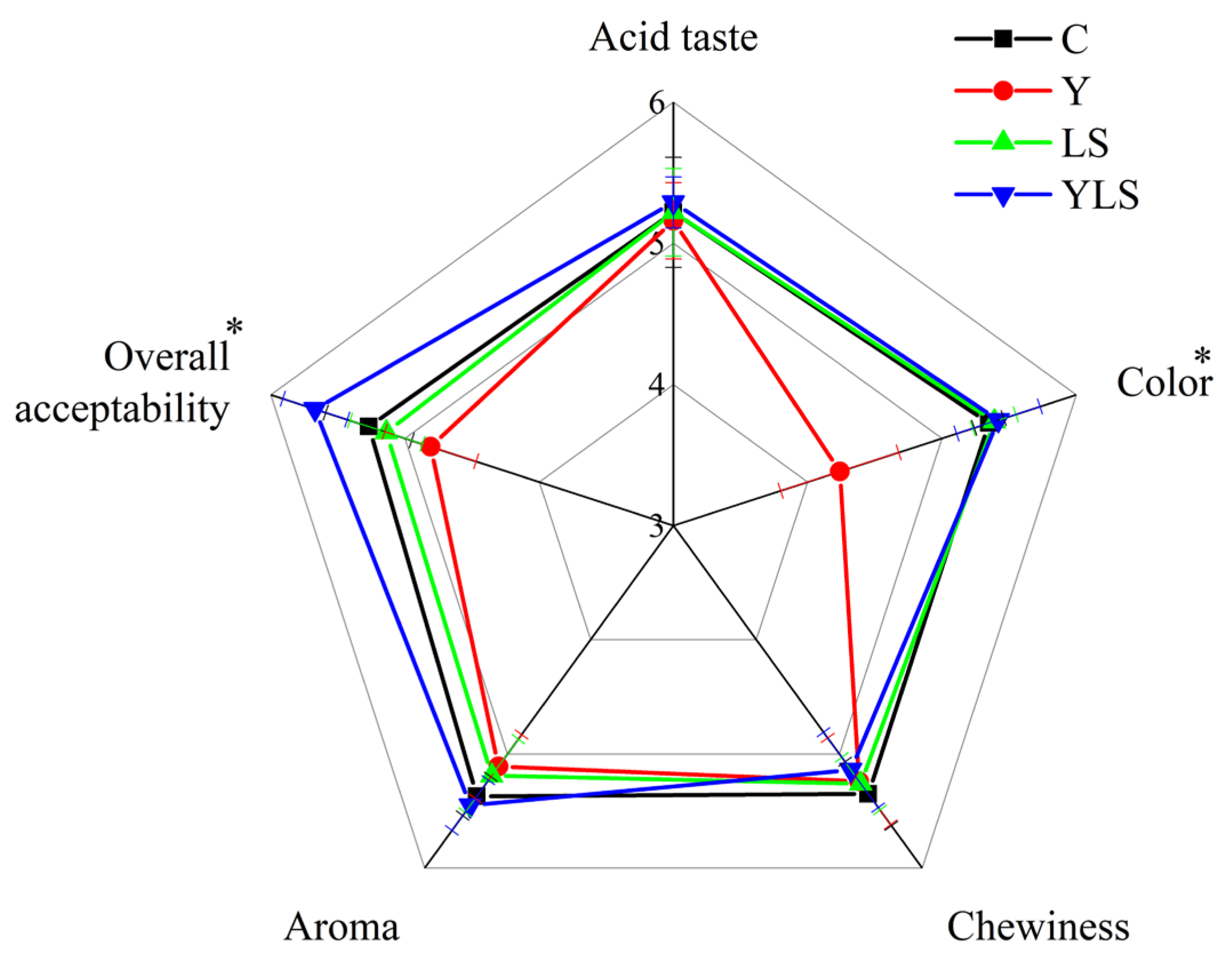
No significant differences were seen in L* and b* values among the four groups (p > 0.05); however, the a* value in the Y group was notably lower than that in other groups (p < 0.05). Li et al. [5] reported a significant reduction in a* values in sausages with D. hansenii. Most staphylococci species can reduce nitrate to nitrite through nitrate reductase, subsequently chemically reducing nitrite to nitric oxide (NO), which enhances the desirable red color of meat products [31]. The inferior color of the sample inoculated solely with LY090 is likely due to inhibition of coagulase-negative Staphylococci’s growth and metabolism. Additionally, the hardness of the C group showed a significant increase compared with the other group, which may be attributed to the starters’ ability to reduce water loss during the ripening period [13]. LY090 has strong protease activity, which can hydrolyze myofiber, leading to significantly lower chewiness in the Y group compared to the other groups (p < 0.05). The sensory scores for factors such as color, aroma, chewiness, acid taste, and overall acceptability are presented in Figure 1. The color score of the Y group was significantly lower than that of the other groups (p < 0.05), which is consistent with the results of color analysis. Members of the sensory evaluation panel generally agreed that the overall acceptability of Sichuan bacon was highest in the YLS group and lowest in the Y group. This suggests that the singular and excessive use of LY090 has a negative impact on the overall acceptability of Sichuan bacon, contrasting with findings from an Iberian cured pork loin study where inoculation with Debaryomyces hansenii Lr1 positively influenced the physicochemical and sensory characteristics [32].

3.2. Effects of LY090 Inoculation on Volatile Flavor Compounds

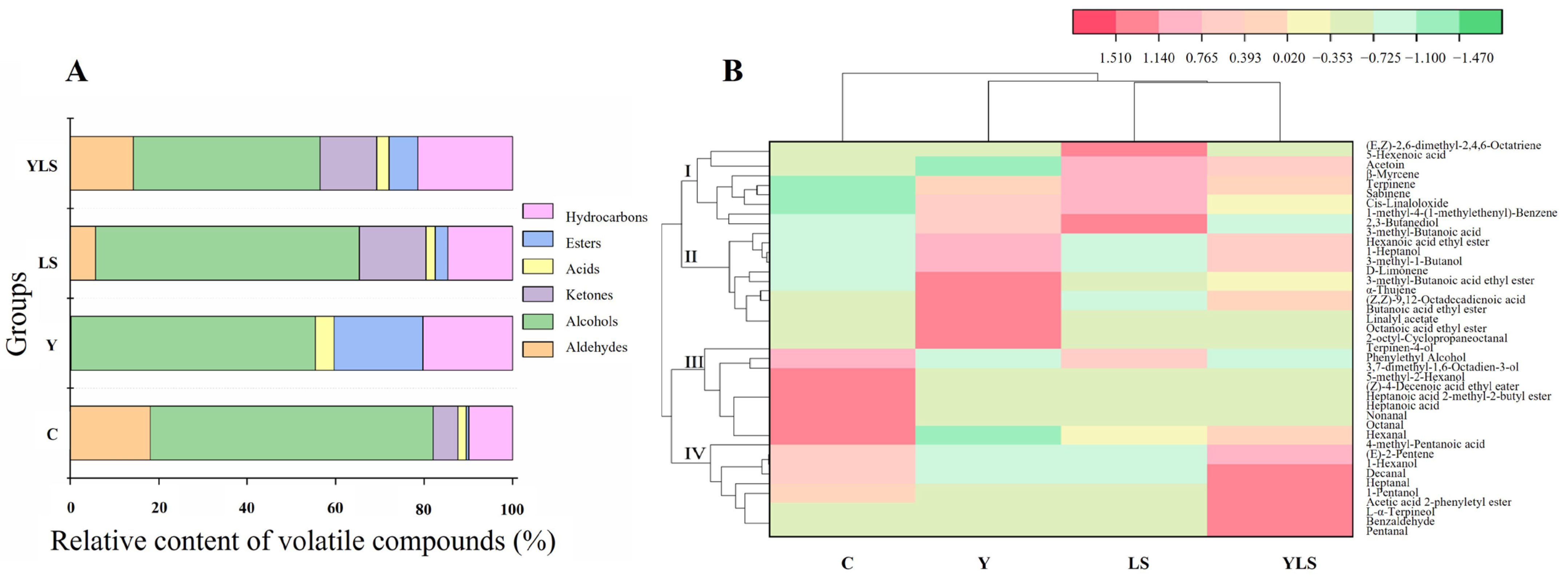
A total of 41 volatile flavor substances were identified, including 8 hydrocarbons, 8 aldehydes, 11 alcohols, 8 esters, 5 acids, and 1 ketone. Among these, the YLS group had the highest number of volatile flavor compounds detected (27), followed by the Y group (21), the C group (19), and the LS group (17). However, total volatile compound concentrations remained statistically comparable (p > 0.05) across all treatments (1774.66, 1623.69, 1683.71, and 1748.17 μg/kg for C, Y, LS, and YLS, respectively). Alcohols were the most abundant volatile flavors across all four groups, with concentrations ranging from 738.05 to 1132.80 μg/kg, as shown in Figure 2A. Notably, the C and LS groups had significantly higher alcohol concentrations compared to the Y and YLS groups (p < 0.05). The concentration of aldehydes in the C group (320.03 μg/kg) was significantly higher than in the other three groups (p < 0.05). In contrast, the Y group had a significantly higher concentration of esters (325.56 μg/kg) compared to the other groups (p < 0.05), while the LS group had the highest concentration of ketones (253.10 μg/kg). In addition, the aroma profile of the YLS group exhibited a more balanced composition, with concentrations of aldehydes, esters, and ketones at 249.8 μg/kg, 113.81 μg/kg, and 223.91 μg/kg, respectively.
The 41 volatile flavor compounds were classified into four groups based on their concentration (Figure 2B). Group I included nine volatile compounds, the most notable being 3-hydroxy-2-butanone, which is known for its pleasant milky and strawberry aroma and is commonly found in fermented foods [33]. Acetoin concentrations were significantly elevated in the LS and YLS groups (213.10 and 223.91 μg/kg, respectively) compared to the C group (p < 0.05). This compound is predominantly generated through the metabolic processes of carbohydrates by lactic acid bacteria and Staphylococcus delivered by FAST301. Hu et al. [34] reported that acetoin concentrations in Harbin sausage significantly increased after inoculation with L. curvatus, P. pentosaceus R1, and S. xylosus A2. Interestingly, acetoin was not detected in the Y group, possibly due to metabolic inhibition by LY090 or its further conversion into other flavor compounds such as 2,3-butanediol (33.97 μg/kg).
Group II consisted of 12 substances, predominantly esters, with a smaller number of alcohols. The most important compound was ethyl 3-methylbutyrate, which had the highest concentration in the Y group (202.19 μg/kg), followed by the YLS (81.01 μg/kg) and LS (49.12 μg/kg) groups; however, it was not detected in the C group. The content of esters depends on microbial esterase activity and substrate availability [35]. During the fermentation of meat, Staphylococcus and yeast metabolize amino acids into 3-methylbutyric acid, which then esterifies with ethanol to generate ethyl 3-methylbutyrate. Studies have demonstrated that this compound can be detected in fermentation broth or meat products supplemented with 3-methylbutyric acid and ethanol by D. hansenii [35,36]. This compound imparts an apple-like aroma and has the potential to enhance the sensory profile of meat products. The concentrations of ethyl 3-methylbutyrate in the Y and YLS groups were significantly higher than in the LS group (p < 0.05), confirming that this compound originated from the metabolism of LY090 in this experiment. In addition, esters such as ethyl butyrate, ethyl caproate, and ethyl caprylate were detected in the Y group, with their concentrations significantly higher than in the C and LS groups, reaffirming that strain LY090 significantly increases ester content while minimally affecting the accumulation of esters by FAST301 alone.
Group III included 10 compounds, with linalool and several linear aldehydes being the most notable. Linalool, a volatile organic compound, exhibited the highest concentration across all samples, accounting for 32.52% to 59.27%. This compound is primarily found in natural spices and exhibits strong floral, woody, and fruity aromas. The results showed that the concentration of the C group was significantly higher than in the other three groups (p < 0.05). We attribute this difference to the overall underdevelopment of flavor in the samples, where microbial metabolic activity was relatively low (uninoculated), and lipid oxidation occurred more slowly in the stable experimental environment compared to natural air-drying. Even so, the concentrations of hexanal, nonanal, and octanal in the C group were 218.79, 46.81, and 40.63 μg/kg, respectively. These values were significantly higher than those in the other three groups (p < 0.05), suggesting that the inoculated starter cultures inhibited lipid oxidation or allowed these linear aldehydes to be further metabolized by microorganisms.
Group IV also contained 10 volatile components, primarily aldehydes such as pentanal, heptanal, and decanal. The YLS (249.80 μg/kg) group demonstrated significantly higher concentrations of aldehydes compared to both the Y (3.74 μg/kg) and LS (96.66 μg/kg) groups (p < 0.05). This trend was exemplified by hexanal, which reached 112.10 μg/kg in the YLS group—markedly higher than in the other two groups. This indicates that the inoculated strains FAST301 and LY090 greatly inhibit lipid oxidation, especially LY090, as nearly no aldehydes were detected in the Y group.
Some researchers have reported that D. hansenii inoculation can maintain low TBARS values during the ripening period, indicating minimal lipid oxidation [14,37,38]. Furthermore, studies have shown that yeasts are generally more effective than lactic acid bacteria in inhibiting lipid oxidation [14,15]. However, the inoculation of both FAST301 and LY090 significantly weakened this inhibition, possibly due to the strong lipase activity of the strains.

3.3. Analysis of Microbial Community Inoculated with Different Starter Cultures

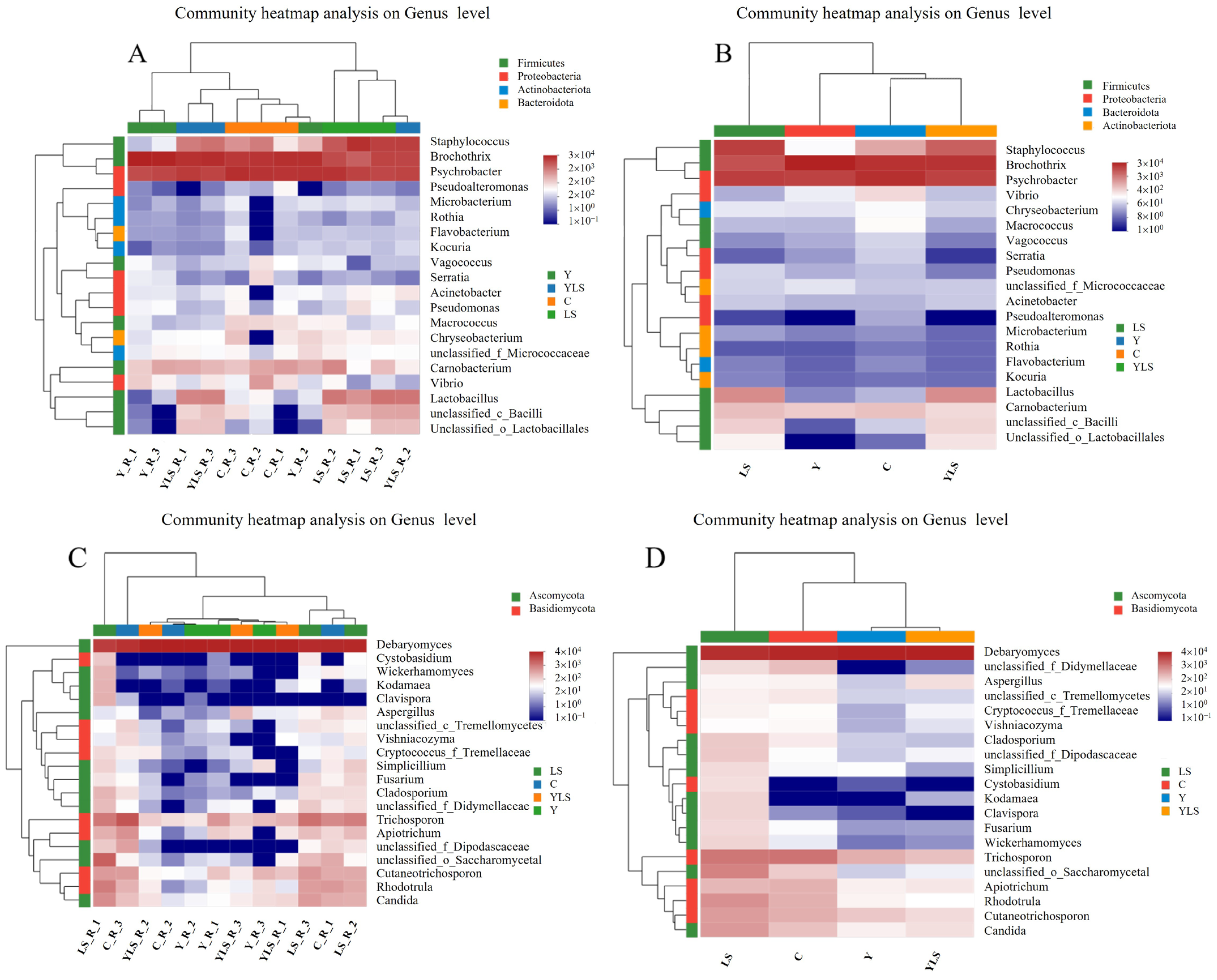
A total of 11 phyla and 126 genera of bacteria were identified across all samples. At the phylum level, only Firmicutes and Proteobacteria had an average relative abundance greater than 1%. The relative abundance of Firmicutes significantly increased under inoculation with starter cultures, showing values of 50.41%, 67.20%, 64.63%, and 67.73% in the C, Y, LS, and YLS groups, respectively. In contrast, Proteobacteria exhibited a significant decrease, with abundances of 48.83%, 32.05%, 34.75%, and 31.79% in those groups. At the genus level, Brochothrix and Psychrobacter were the dominant bacteria in all samples (Figure 3A,B). Specifically, in groups C, Y, LS, and YLS, Brochothrix accounted for 44.67%, 65.13%, 21.85%, and 43.72%, respectively, while Psychrobacter accounted for 47.18%, 31.46%, 34.23%, and 31.43%, respectively. These two genera are commonly recognized as non-pathogenic spoilage bacteria found in chilled meat and meat products [39,40], and their prevalence may be attributed to the cold storage environment.
Compared with the C group, the relative abundance of Brochothrix significantly increased in the Y group but significantly decreased in the LS group, with little effect observed in the YLS group. Conversely, the relative abundance of Psychrobacter was significantly reduced in three groups inoculated with starter cultures. Interestingly, the relative abundance of Staphylococcus in the C, Y, LS, and YLS groups was 3.07%, 0.37%, 33.14%, and 15.54%, respectively. The inoculation with FAST301 markedly increased the relative abundance of Staphylococcus, while inoculation with LY090 resulted in a significant reduction. Many researchers believe that Staphylococcus is the dominant bacterial genus and is significantly associated with flavor development in traditional Sichuan bacon [41,42]. These findings suggest that the presence of a single specimen or excessive amounts of D. hansenii may be detrimental to the flavor development of Sichuan bacon. Meanwhile, the relative abundance of Lactobacillus in LS and YLS was 5.81% and 5.51%, respectively; however, that in both C and Y was less than 1%, which may also affect the lipid oxidation and flavor development of Sichuan bacon [15].
The heatmap indicates that a total of five phyla and 132 genera were found in all the samples. At the phylum level, only Ascomycota and Basidiomycota had an average relative abundance of over 1% in all the groups, accounting for more than 99%. At the genus level (Figure 3C,D), the most abundant genera were Debaryomyces at 83.39%, followed by Trichosporon at 6.05%, unclassified_Saccharomycetales at 1.72%, Rhodotorula at 1.62%, Cutaneotrichosporon at 1.54%, and Candida at 1.25%. Debaryomyces was the dominant genus in all samples, especially in Y and YLS groups, over 96%. On the other hand, the average relative abundance of Debaryomyces in C and LS groups was more than 65%, even though they were not inoculated with LY090. Previous studies have shown that D. hansenii, with many important technological properties, could be a part of functional starter culture, as it was the most abundant population throughout the entirety of processing. Asefa et al. [43] isolated 401 yeast strains from Norwegian dry-cured meat, of which D. hansenii accounted for 63.0%. Our previous work [21] also showed that D. hansenii is one of the dominant yeast populations in traditional Sichuan bacon. However, we assume that the reason is related to the fact that the production cycles have been completed several times by inoculated D. hansenii in the same environment. C and LS groups also displayed other genera exceeding 1% such as Trichosporon, Rhodotorula, Candida, and Cutaneotrichosporon. Conversely, the absence of other dominant genera in Y and YLS groups means that inoculated D.hansenii inhibited other genera of yeast. Furthermore, despite being the predominant mold genus, Aspergillus maintained low relative abundance across all treatment groups, with values of 0.34%, 0.04%, 0.19%, and 0.41% for C, Y, LS, and YLS groups, respectively. Many researchers have demonstrated that D.hansenii can effectively inhibit molds and mycotoxins in traditional meat products [44,45,46]. However, further research is needed to explore the mechanism by which D.hansenii inhibit molds in Sichuan bacon.

3.4. Lipidome and Analysis

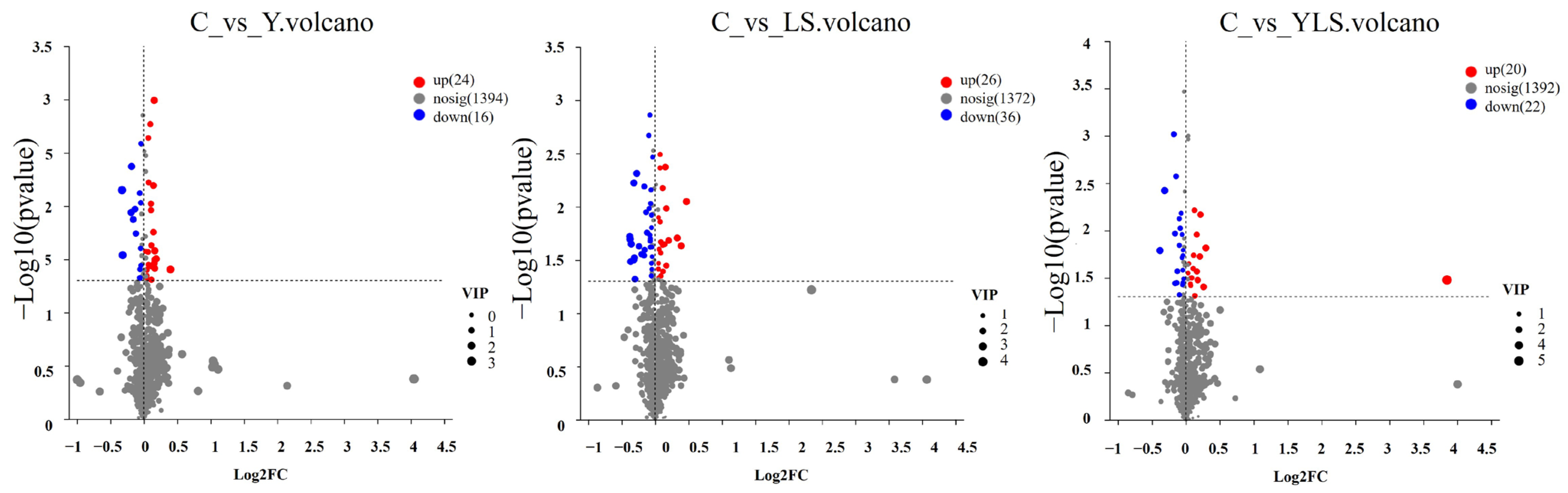
T-tests and fold change (FC) analysis were employed to compare the differences in metabolites between two groups. Metabolites with p < 0.05 and |log2(FC)| > 1 were considered differentially expressed. Their P and FC values were visualized using a volcano plot, as shown in Figure 4. Results showed that there were 30, 62, and 42 differentially expressed metabolites in C vs. Y, C vs. LS, and C vs. YLS, respectively. There were 22 up-regulated metabolites and 6 down-regulated metabolites in C vs. Y, 26 up-regulated metabolites and 36 down-regulated metabolites in C vs. LS, and 20 up-regulated metabolites and 22 down-regulated metabolites in C vs. YLS.
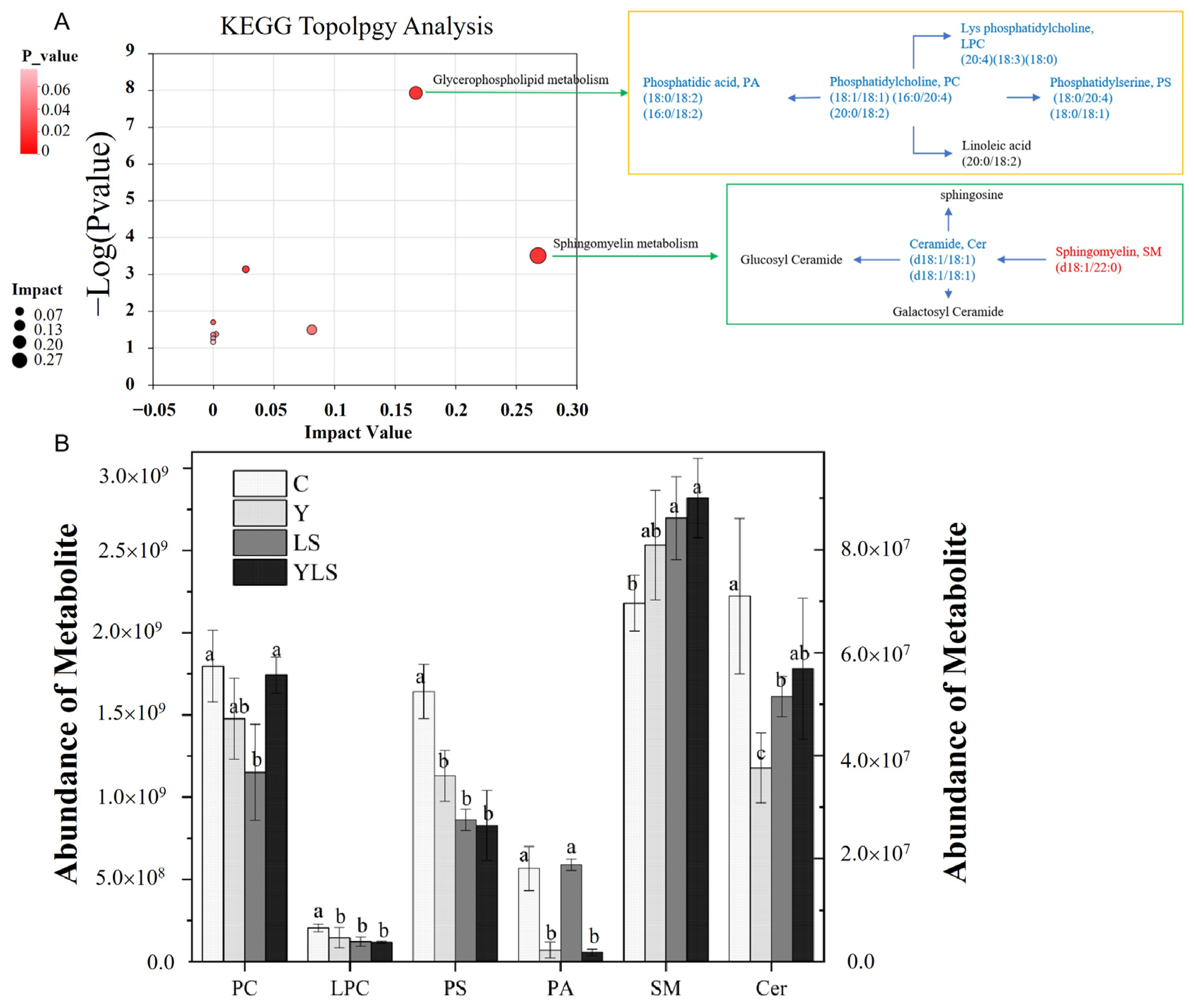
A total of 42 differential metabolites were screened from four groups through qualitative identification in online databases such as HMDB and LipidMaps. A total of 21 of the 42 differential metabolites were annotated and enriched in nine lipid metabolic pathways in the KEGG database and are displayed in bubble charts (Figure 5A). The findings revealed significant differences in seven metabolic pathways, particularly in glycerophospholipid, sphingomyelin, and glyceride metabolism (p < 0.01). Moreover, the impact values of sphingomyelin and glycerophospholipid metabolism pathways exceeded 0.1, indicating their dominance in lipid metabolism of Sichuan bacon. Jia et al. [26] found similar results in preservative treatment of Hengshan goat meat sausages.
Phospholipids are a main source of flavor in dry meat products in terms of richness in unsaturated fatty acids. As shown in Figure 5A, sphingomyelin metabolism includes the conversion between sphingomyelin (SM, C00500) and ceramide (Cer, C00195). SM is generally generated by the catalytic reaction of Cer via sphingomyelin synthase and also can be degraded to Cer by sphingomyelinase [47]. The SM content is much higher than Cer (p < 0.05), indicating that the major metabolic pathway is SM to Cer during the processing of Sichuan bacon, and SMs not only are cell membrane phospholipids but also can be used as a reserve for Cer [48]. Interestingly, the content of SM in the C group was lower than that in the other three groups; however, the content of Cer was higher than that in the other three groups (Figure 5B). The pathway of SM degradation into Cer was probably significantly inhibited by the inoculum because of its antioxidant effect. Glycerophospholipid metabolism involves the conversion between phosphatidylcholines (C00157, PCs) and Lysophosphatidylcholine (C04320, LPC), Phosphatidic acid (C00416, PA), or Phosphatidylserine (C02737, PS). PC, known as an important component of the cell membrane, is one of the phospholipids that is widely distributed in biological cells, and can be degraded into unsaturated fatty acids such as oleic acid, linoleic acid, and arachidonic acid, following participation in the subsequent reaction. Results showed that PC content is much higher than LPC, PA, and PS; as Jia et al. [26] revealed a similar relationship between PC and LPC in glycerophospholipid metabolism, we presumed that PC is an important flavor precursor in Sichuan bacon. Meanwhile, the content of PC in C and YLS groups was significantly higher than that in Y and LS groups (p < 0.05), indicating that more PC was released from the muscle cell membrane by lipid degradation. This result indicated that lipid degradation was slowed down during the ripening period of Sichuan bacon by inoculation with LY090 or FAST301; however, it posed little effect on lipid degradation by inoculation with LY090 and FAST301.

3.5. Correlation Analysis Between Yeast, Lipidome, and Flavor Compounds

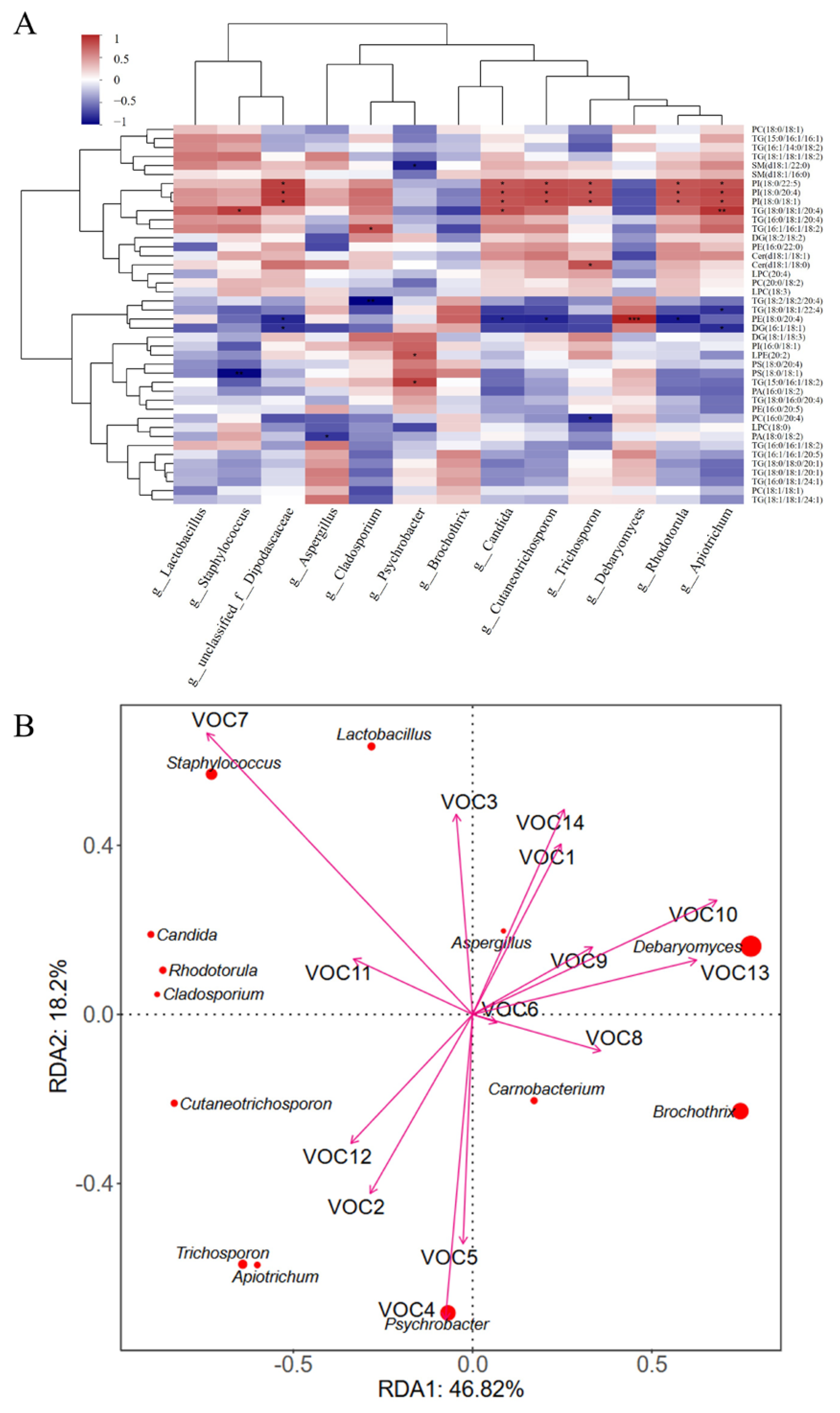
Correlation analysis between microbial genera and lipidome metabolites was performed using Pearson’s correlation coefficient (Figure 6A). The results showed that several differential metabolites, such as TG (18:0/18:1/20:4), TG (18:0/18:1/22:4), PI (18:0/18:1), PI (18:0/20:4), PI (18:0/22:4), PE (18:0/20:4), and DG (16:1/18:1), were significantly correlated with dominant yeast genera (|r| > 0.6), especially TG (18:0/18:1/20:4), which was significantly correlated with almost all of the dominant genera (|r| > 0.6). For instance, many yeasts including Debaryomyces, Candida, Trichosporon, Rhodotorula, and Yarrowia were involved in lipid metabolism by favorable lipolytic activity that can hydrolyze triglycerides to diacylglycerol, monoglyceride, and free fatty acids [6]. Some of these metabolites, like arachidonic acid, are important flavor precursors in dry meat products [49]. The observed metabolic characteristics primarily stem from the catalysis of endogenous enzymes in meat and extracellular enzymes secreted by microorganisms [50]. Notably, PE (18:0/20:4) showed a strong positive correlation with the relative abundances of Debaryomyces (r = 0.9392, p < 0.001) and a negative correlation with the relative abundances of Candida, Trichosporon, Rhodotorula, and Cutaneotrichosporon (|r| > 0.6, p < 0.05). Conversely, other differential metabolites such as TG (18:0/18:1/22:4), PI (18:0/18:1), PI (18:0/20:4), and PI (18:0/22.5) were negatively correlated with Debaryomyces but positively correlated with other yeast genera (|r| > 0.6, p < 0.05). Interestingly, correlation analysis showed that the bacterial community had a lesser effect on differential metabolites than the fungal community. However, Wang et al. [20] demonstrated that in traditional Chinese bacon, dominant bacteria such as Salinivibrio, Vibrio, Cobetia, and Staphylococcus were significantly positively correlated with several metabolites, including three fatty acids, five dipeptides, two amino acids, and four glycerophospholipids.
As shown in Figure 6B, redundancy analysis of microbial communities and volatile flavor compounds demonstrated that Debaryomyces was significantly positively correlated with 3-methylbutyric acid (r = 0.773, p = 0.0032), ethyl 3-methylbutyrate (r = 0.676, p = 0.0158), and ethyl hexanoate (r = 0.743, p = 0.0057). Previous studies have reported that 3-methyl butanoic and ethyl 3-methylbutyrate are mainly produced in sausages when D. hansenii is inoculated [37,51,52]. Sausages inoculated with D. hansenii not only exhibited high lipolytic activity but also demonstrated the highest production of ester compounds [45]. In contrast, Rhodotorula, Candida, Cutaneotrichosporon, and Cladosporium were negatively associated with (p < 0.05) 3-methyl butanoic and ethyl hexanoate, indicating that the dynamic changes in the yeast community play an important role in the formation of branched-chain acid and ethyl ester, though the detailed mechanism needs to be further studied. Moreover, Staphylococcus (r = 0.958, p < 0.0001) and Lactobacillus (r = 0.831, p = 0.0008) were significantly correlated with acetoin, suggesting that these bacterial communities are instrumental in metabolizing carbohydrates and promoting the degradation of lipids to form flavor compounds in fermented meat.
Interestingly, Psychrobacter was significantly correlated with octanal and nonanal, while Aspergillus was significantly correlated with pentanal and heptanal. It is well recognized that microbial communities significantly influence flavor development in fermented meat products. Some researchers have suggested that bacteria play a crucial role in regulating and shaping the flavor of these products [19]. Conversely, other researchers have confirmed that the fungal community is also an integral part of the microbiome, contributing to more stable and heterogeneous environments compared to the bacterial community during ripening [53]. It is widely recognized that some sub-abundances of the microbial community, including Psychrobacter, Brochothrix, Pseudomonas, Acinetobacter, Penicilium, Candida, Cladosporium, and Alternaria, play a role in flavor formation in fermented meat products. Moreover, the concurrent fermentation of multiple microorganisms facilitates the formation of the artisanal flavors characteristic of these products. This may explain why the flavor is notably enhanced under inoculation with LY090 and FAST301.

4. Conclusions

In summary, this work provides insights into the significant impact of D. hansenii LY090 on the microbial community composition, lipid metabolism, volatile flavor compounds, and sensory properties in Sichuan bacon. However, the singular and excessive use of D. hansenii was not conducive to desirable flavor development in Sichuan bacon. In contrast, co-inoculation of D. hansenii with lactic acid bacteria and Staphylococcus prevented excessive suppression of lipid degradation, enhanced the formation of desirable volatiles, and promoted superior sensory quality. These findings suggest that mixed starter cultures are more effective than single D. hansenii application and provide a reference for optimizing D. hansenii LY090 use in industrial fermentation.

Author Contributions

S.W.: Methodology, Investigation, Formal analysis, Writing—original draft, Writing—review and editing, Visualization. K.H.: Writing—review and editing, Methodology, Investigation. W.P.: Formal analysis, Writing—review and editing, Investigation. L.Y.: Resources, Project administration, Writing—review and editing. Y.Y.: Conceptualization, Writing—review and editing, Supervision. S.L.: Conceptualization, Resources, Writing—review and editing, Funding acquisition, Supervision. All authors have read and agreed to the published version of the manuscript.

Funding

This research was funded by the National Institutes of Health, grant number 2019YF0900050SN; Solid-state Fermentation Resource Utilization Key Laboratory of Sichuan Province, grant number 2022GTYY07; Solid-state Fermentation Resource Utilization Key Laboratory of Sichuan Province, grant number 2022GTYY01; and Scientific Research Project of Yibin University, grant number 2023QH21.

Institutional Review Board Statement

The animal experiment and sensory evaluation were conducted in accordance with the guidelines of the Animal Ethics Committee of Yibin University (Approval No. 20221208001) on 15 November 2022.

Informed Consent Statement

Not applicable.

Data Availability Statement

The data presented in this study are available on request from the corresponding author. The data are not publicly available due to ongoing commercial applications and intellectual property considerations related to the industrial production of Sichuan bacon.

Acknowledgments

During the preparation of this manuscript, the authors used ChatGPT-4 for the purposes of language polishing and improving English grammar. The authors have reviewed and edited the output and take full responsibility for the content of this publication.

Conflicts of Interest

The authors declare no conflicts of interest.

Abbreviations

The following abbreviations are used in this manuscript:
VOCsVolatile organic compounds
IACUCJInstitute of Animal Care and Use Committee
CGMCCChina General Microbiological Culture Collection Center
TBARSsThiobarbituric acid reactive substances
TPATexture profile analysis
GC/MSGas chromatography–mass spectrometry
EIElectron ionization
LRIsLinear retention indices
MSMass spectrometry
EMDBEdinburgh Mass Spectrometry Data Base
RSDRelative standard deviation
FCFold change
VIPVariable importance in projection
KEGGThe Kyoto Encyclopedia of Genes and Genomes
TCCTotal protein carbonyl content
NONitric oxide

References

  1. Flores, M. Understanding the implications of current health trends on the aroma of wet and dry cured meat products. Meat Sci. 2018, 144, 53–61. [Google Scholar] [CrossRef]
  2. Laranjo, M.; Elias, M.; Fraqueza, M.J. The use of starter cultures in traditional meat products. J. Food Qual. 2017, 2017, 9546026. [Google Scholar] [CrossRef]
  3. Ferrocino, I.; Bellio, A.; Giordano, M.; Macoro, G.; Romano, A.; Rantsiou, K.; Decastelli, L.; Cocolin, L. Shotgun metagenomics and volatilome profile of the microbiota of fermented sausages. Appl. Environ. Microbiol. 2018, 84, e02120-17. [Google Scholar] [CrossRef] [PubMed]
  4. Laranjo, M.; Potes, M.E.; Elias, M. Role of starter cultures on the safety of fermented meat products. Front. Microbiol. 2019, 10, 853. [Google Scholar] [CrossRef]
  5. Li, X.-A.; Kong, B.; Wen, R.; Wang, H.; Li, M.; Chen, Q. Flavour compensation role of yeast strains in reduced-salt dry sausages: Taste and odour profiles. Foods 2022, 11, 650. [Google Scholar] [CrossRef] [PubMed]
  6. Flores, M.; Corral, S.; Cano-García, L.; Salvador, A.; Belloch, C. Yeast strains as potential aroma enhancers in dry fermented sausages. Int. J. Food Microbiol. 2015, 212, 16–24. [Google Scholar] [CrossRef]
  7. Ozturk, I. Presence, changes and technological properties of yeast species during processing of pastirma, a Turkish dry-cured meat product. Food Control 2015, 50, 76–84. [Google Scholar] [CrossRef]
  8. Prista, C.; Michán, C.; Miranda, I.M.; Ramos, J. The halotolerant Debaryomyces hansenii, the Cinderella of non-conventional yeasts. Yeast 2016, 33, 523–533. [Google Scholar] [CrossRef] [PubMed]
  9. Hammes, W.; Knauf, H. Starters in the processing of meat products. Meat Sci. 1994, 36, 155–168. [Google Scholar] [CrossRef]
  10. Corral, S.; Salvador, A.; Belloch, C.; Flores, M. Improvement the aroma of reduced fat and salt fermented sausages by Debaromyces hansenii inoculation. Food Control 2015, 47, 526–535. [Google Scholar] [CrossRef]
  11. Martín, A.; Córdoba, J.J.; Aranda, E.; Córdoba, M.G.; Asensio, M.A. Contribution of a selected fungal population to the volatile compounds on dry-cured ham. Int. J. Food Microbiol. 2006, 110, 8–18. [Google Scholar] [CrossRef]
  12. Purriños, L.; Carballo, J.; Lorenzo, J.M. The influence of Debaryomyces hansenii, Candida deformans and Candida zeylanoides on the aroma formation of dry-cured “lacón”. Meat Sci. 2013, 93, 344–350. [Google Scholar] [CrossRef]
  13. Ramos-Moreno, L.; Ruiz-Pérez, F.; Rodríguez-Castro, E.; Ramos, J. Debaryomyces hansenii is a real tool to improve a diversity of characteristics in sausages and dry-meat products. Microorganisms 2021, 9, 1512. [Google Scholar] [CrossRef]
  14. Yang, X.; Xiao, S.; Wang, J. Debaryomyces hansenii strains from traditional Chinese dry-cured ham as good aroma enhancers in fermented sausage. Fermentation 2024, 10, 152. [Google Scholar] [CrossRef]
  15. Liu, Y.; Wan, Z.; Yohannes, K.W.; Yu, Q.; Yang, Z.; Li, H.; Liu, J.; Wang, J. Functional characteristics of Lactobacillus and yeast single starter cultures in the ripening process of dry fermented sausage. Front. Microbiol. 2021, 11, 611260. [Google Scholar] [CrossRef]
  16. Perea-Sanz, L.; Montero, R.; Belloch, C.; Flores, M. Nitrate reduction in the fermentation process of salt reduced dry sausages: Impact on microbial and physicochemical parameters and aroma profile. Int. J. Food Microbiol. 2018, 282, 84–91. [Google Scholar] [CrossRef]
  17. Van Ba, H.; Seo, H.-W.; Kim, J.-H.; Cho, S.-H.; Kim, Y.-S.; Ham, J.-S.; Park, B.-Y.; Kim, H.-W.; Kim, T.-B.; Seong, P.-N. The effects of starter culture types on the technological quality, lipid oxidation and biogenic amines in fermented sausages. LWT 2016, 74, 191–198. [Google Scholar] [CrossRef]
  18. Wang, S.; Wang, X.; Pan, W.; Liu, A.; Liu, S.; Yang, Y.; Zhou, L. Evaluation of bacterial diversity and quality features of traditional sichuan bacon from different geographical region. Appl. Sci. 2021, 11, 9738. [Google Scholar] [CrossRef]
  19. Yang, L.; Li, H.; Wu, H.; Su, C.; He, Z. Quality relationship between smoked and air-dried bacon of Sichuan-Chongqing in China: Free amino acids, volatile compounds, and microbial diversity. Food Res. Int. 2023, 164, 112274. [Google Scholar] [CrossRef]
  20. Wang, Y.; Wang, Z.; Han, Q.; Xie, Y.; Zhou, H.; Zhou, K.; Li, X.; Xu, B. Comprehensive insights into the evolution of microbiological and metabolic characteristics of the fat portion during the processing of traditional Chinese bacon. Food Res. Int. 2022, 155, 110987. [Google Scholar] [CrossRef]
  21. Wang, S.; Tang, L.; Guo, K.; Liu, S.; Yang, Y. Studies on the Diversity and Technological Properties of Yeast Isolated from Sichuan Bacon. J. Chin. Inst. Food Sci. Technol. 2023, 23, 334–344. [Google Scholar]
  22. Zeng, X.; Wei, C.; Li, D.; Cao, W.; Lin, Q. Comparative Analysis of the Microbial Community Profiles of Sichuan and Guizhou Smoke-Cured Sausages Using a High-Throughput Sequencing Approach. Microorganisms 2025, 13, 1096. [Google Scholar] [CrossRef]
  23. AOAC. Official Methods of Analysis of AOAC International, 16th ed.; Method 925.04; AOAC International: Gaithersburg, MD, USA, 1995. [Google Scholar]
  24. Jin, G.; Zhang, J.; Yu, X.; Zhang, Y.; Lei, Y.; Wang, J. Lipolysis and lipid oxidation in bacon during curing and drying–ripening. Food Chem. 2010, 123, 465–471. [Google Scholar] [CrossRef]
  25. Huang, Y.; Li, H.; Huang, T.; Li, F.; Sun, J. Lipolysis and lipid oxidation during processing of Chinese traditional smoke-cured bacon. Food Chem. 2014, 149, 31–39. [Google Scholar] [CrossRef]
  26. Jia, W.; Li, R.; Wu, X.; Liu, S.; Shi, L. UHPLC-Q-Orbitrap HRMS-based quantitative lipidomics reveals the chemical changes of phospholipids during thermal processing methods of Tan sheep meat. Food Chem. 2021, 360, 130153. [Google Scholar] [CrossRef]
  27. Wei, J.; Wu, X.X.; Zhang, R.; Shi, L. UHPLC-Q-Orbitrap-based lipidomics reveals molecular mechanism of lipid changes during preservatives treatment of Hengshan goat meat sausages. Food Chem. 2022, 369, 130848. [Google Scholar]
  28. Jin, G.; He, L.; Li, C.; Zhao, Y.; Chen, C.; Zhang, Y.; Zhang, J.; Ma, M. Effect of pulsed pressure-assisted brining on lipid oxidation and volatiles development in pork bacon during salting and drying-ripening. LWT-Food Sci. Technol. 2015, 64, 1099–1106. [Google Scholar] [CrossRef]
  29. Guo, X.; Huang, F.; Zhang, H.; Zhang, C.; Hu, H.; Chen, W. Classification of traditional Chinese pork bacon based on physicochemical properties and chemometric techniques. Meat Sci. 2016, 117, 182–186. [Google Scholar] [CrossRef]
  30. Ammor, M.S.; Mayo, B. Selection criteria for lactic acid bacteria to be used as functional starter cultures in dry sausage production: An update. Meat Sci. 2007, 76, 138–146. [Google Scholar] [CrossRef]
  31. Ras, G.; Leroy, S.; Talon, R. Nitric oxide synthase: What is its potential role in the physiology of staphylococci in meat products? Int. J. Food Microbiol. 2018, 282, 28–34. [Google Scholar] [CrossRef]
  32. Ramos-Moreno, L.; Ruiz-Castilla, F.J.; Bravo, C.; Martínez, E.; Menéndez, M.; Dios-Palomares, R.; Ramos, J. Inoculation with a terroir selected Debaryomyces hansenii strain changes physico-chemical characteristics of Iberian cured pork loin. Meat Sci. 2019, 157, 107875. [Google Scholar] [CrossRef]
  33. Cui, Z.; Wang, Z.; Zheng, M.; Chen, T. Advances in biological production of acetoin: A comprehensive overview. Crit. Rev. Biotechnol. 2022, 42, 1135–1156. [Google Scholar] [CrossRef]
  34. Hu, Y.; Chen, Q.; Wen, R.; Wang, Y.; Qin, L.; Kong, B. Quality characteristics and flavor profile of Harbin dry sausages inoculated with lactic acid bacteria and Staphylococcus xylosus. LWT 2019, 114, 108392. [Google Scholar] [CrossRef]
  35. Corral, S.; Salvador, A.; Flores, M. Salt reduction in slow fermented sausages affects the generation of aroma active compounds. Meat Sci. 2013, 93, 776–785. [Google Scholar] [CrossRef]
  36. García-Béjar, B.; Sánchez-Carabias, D.; Alarcon, M.; Arévalo-Villena, M.; Briones, A. Autochthonous yeast from pork and game meat fermented sausages for application in meat protection and aroma developing. Animals 2020, 10, 2340. [Google Scholar] [CrossRef]
  37. Perea-Sanz, L.; López-Díez, J.J.; Belloch, C.; Flores, M. Counteracting the effect of reducing nitrate/nitrite levels on dry fermented sausage aroma by Debaryomyces hansenii inoculation. Meat Sci. 2020, 164, 108103. [Google Scholar] [CrossRef]
  38. Liu, Y.; Cao, Y.; Yohannes Woldemariam, K.; Zhong, S.; Yu, Q.; Wang, J. Antioxidant effect of yeast on lipid oxidation in salami sausage. Front. Microbiol. 2023, 13, 1113848. [Google Scholar] [CrossRef]
  39. Wagner, E.M.; Fischel, K.; Rammer, N.; Beer, C.; Palmetzhofer, A.; Conrady, B.; Roch, F.; Hanson, B.; Wagner, M.; Rychli, K. Bacteria of eleven different species isolated from biofilms in a meat processing environment have diverse biofilm forming abilities. Int. J. Food Microbiol. 2021, 349, 109232. [Google Scholar] [CrossRef]
  40. Wang, X.; Zhang, Y.; Ren, H.; Zhan, Y. Comparison of bacterial diversity profiles and microbial safety assessment of salami, Chinese dry-cured sausage and Chinese smoked-cured sausage by high-throughput sequencing. LWT 2018, 90, 108–115. [Google Scholar] [CrossRef]
  41. Wen, K.-Y.; Wang, Y.; Wen, P.-C.; Zhu, Y.; Yang, M.; Zhang, Z.-M.; Zhang, W.-B. Study on microbial community structure in Sichuan traditional bacon. Food Ferment. Ind. 2020, 46, 36–42. [Google Scholar]
  42. Yi, L.; Su, G.; Hu, G.; Peng, Q. Diversity study of microbial community in bacon using metagenomic analysis. J. Food Saf. 2017, 37, e12334. [Google Scholar] [CrossRef]
  43. Asefa, D.T.; Møretrø, T.; Gjerde, R.O.; Langsrud, S.; Kure, F.C.; Sidhu, M.S.; Nesbakken, T.; Skaar, I. Yeast diversity and dynamics in the production processes of Norwegian dry-cured meat products. Int. J. Food Microbiol. 2009, 133, 135–140. [Google Scholar] [CrossRef]
  44. Simoncini, N.; Virgili, R.; Spadola, G.; Battilani, P. Autochthonous yeasts as potential biocontrol agents in dry-cured meat products. Food Control 2014, 46, 160–167. [Google Scholar] [CrossRef]
  45. Peromingo, B.; Andrade, M.J.; Delgado, J.; Sanchez-Montero, L.; Nunez, F. Biocontrol of aflatoxigenic Aspergillus parasiticus by native Debaryomyces hansenii in dry-cured meat products. Food Microbiol. 2019, 82, 269–276. [Google Scholar] [CrossRef]
  46. Iacumin, L.; Arnoldi, M.; Comi, G. Effect of a Debaryomyces hansenii and Lactobacillus buchneri starter culture on Aspergillus westerdijkiae ochratoxin A production and growth during the manufacture of short seasoned dry-cured ham. Microorganisms 2020, 8, 1623. [Google Scholar] [CrossRef]
  47. Taniguchi, M.; Okazaki, T. Role of ceramide/sphingomyelin (SM) balance regulated through “SM cycle” in cancer. Cell. Signal. 2021, 87, 110119. [Google Scholar] [CrossRef]
  48. Bienias, K.; Fiedorowicz, A.; Sadowska, A.; Prokopiuk, S.; Car, H. Regulation of sphingomyelin metabolism. Pharmacol. Rep. 2016, 68, 570–581. [Google Scholar] [CrossRef]
  49. Domínguez, R.; Purriños, L.; Pérez-Santaescolástica, C.; Pateiro, M.; Barba, F.J.; Tomasevic, I.; Campagnol, P.; Lorenzo, J.M. Characterization of volatile compounds of dry-cured meat products using HS-SPME-GC/MS technique. Food Anal. Methods 2019, 12, 1263–1284. [Google Scholar] [CrossRef]
  50. Wang, Y.; Zhou, H.; Zhou, K.; Han, Q.; Wang, Z.; Xu, B. Study on the roles of microorganisms and endogenous enzymes in the evolution of metabolic characteristics of lean portion during traditional Chinese bacon processing. Food Res. Int. 2022, 162, 112087. [Google Scholar] [CrossRef]
  51. Andrade, M.J.; Córdoba, J.J.; Casado, E.M.; Córdoba, M.G.; Rodríguez, M. Effect of selected strains of Debaryomyces hansenii on the volatile compound production of dry fermented sausage “salchichón”. Meat Sci. 2010, 85, 256–264. [Google Scholar] [CrossRef]
  52. Cano-García, L.; Belloch, C.; Flores, M. Impact of Debaryomyces hansenii strains inoculation on the quality of slow dry-cured fermented sausages. Meat Sci. 2014, 96, 1469–1477. [Google Scholar] [CrossRef] [PubMed]
  53. Zwirzitz, B.; Thalguter, S.; Wetzels, S.U.; Stessl, B.; Wagner, M.; Selberherr, E. Autochthonous fungi are central components in microbial community structure in raw fermented sausages. Microb. Biotechnol. 2022, 15, 1392–1403. [Google Scholar] [CrossRef] [PubMed]
Figure 1. Sensory evaluation of Sichuan bacon with different starter cultures. * Means differ significantly among four groups (p < 0.05).
Fermentation 11 00636 g001
Figure 2. Percentage stacking chart (A) and clustering heatmap (B) of volatile flavor components.
Fermentation 11 00636 g002
Figure 3. Microbial community heatmap based on genus level with different starter cultures ((A): samples of 16 S; (B): groups of 16 S; (C): samples of ITS; (D): groups of ITS).
Fermentation 11 00636 g003
Figure 4. Volcanic maps of groups. Red dots represent significantly up-regulated metabolites, blue dots represent down-regulated, and gray dots represent not significant.
Fermentation 11 00636 g004
Figure 5. Bubble diagram of KEGG enrichment analysis (A) and relative content of some phospholipid compounds (B). Red indicates that the concentration of metabolites is increased, and blue indicates a decrease. Black metabolites are related metabolites or pathways. Boxes with different colors indicate divergent pathways. Error bars refer to the standard deviations obtained from triplicate sample analysis. Different letters (a–c) indicate significant differences among the values (p < 0.05).
Fermentation 11 00636 g005
Figure 6. Correlation between lipidomic metabolites (A) and volatile flavor compounds (B) and microbial community. VOC1 to VOC14 are pentanal, hexanal, heptanal, octanal, nonanal, decanal, acetoin, ethyl butyrate, ethyl 3-methylbutyrate, ethyl hexanoate, 2, 3-butanediol, linalool, 3-methylbutyrate, and D-limonene, respectively. * p < 0.05, ** p < 0.01, *** p < 0.01.
Fermentation 11 00636 g006
Table 1. Comparison of color, texture, and physicochemical properties of Sichuan bacon inoculated with different starter cultures.
ItemControlYLSYLS
moisture (%)28.37 ± 1.78 a29.23 ± 2.10 a29.34 ± 2.11 a29.51 ± 1.58 a
pH6.02 ± 0.08 a5.95 ± 0.07 ab5.84 ± 0.05 b5.92 ± 0.04 ab
POV7.50 ± 0.72 a5.72 ± 0.30 b6.06 ± 0.44 b7.44 ± 0.82 a
TBARS0.733 ± 0.064 a0.617 ± 0.044 b0.669 ± 0.034 ab0.742 ± 0.067 a
L36.29 ± 3.83 a35.39 ± 3.36 a38.43 ± 4.03 a37.54 ± 4.00 a
a22.01 ± 3.15 a17.25 ± 3.20 b23.24 ± 2.57 a22.70 ± 3.27 a
b12.98 ± 1.90 a10.77 ± 2.08 a13.32 ± 1.32 a12.88 ± 2.23 a
hardness (kg)1.79 ± 0.14 a1.68 ± 0.13 b1.66 ± 0.18 b1.65 ± 0.13 b
springiness0.63 ± 0.04 a0.64 ± 0.04 a0.66 ± 0.06 a0.67 ± 0.06 a
chewiness (kg × mm)0.53 ± 0.06 ab0.49 ± 0.03 b0.55 ± 0.02 a0.58 ± 0.05 a
gumminess (kg)0.94 ± 0.11 a0.84 ± 0.09 a0.89 ± 0.04 a0.91 ± 0.08 a
cohesiveness0.47 ± 0.05 a0.44 ± 0.04 a0.46 ± 0.03 a0.45 ± 0.04 a
Results are expressed as means of three replicates. POV: peroxide value, expressed as mmol O2/kg muscle. TBARS: thiobarbituric acid reactive substances, expressed as mg MDA/kg muscle. a,b Means in the same column with different superscripts differ significantly (p < 0.05).
Disclaimer/Publisher’s Note: The statements, opinions and data contained in all publications are solely those of the individual author(s) and contributor(s) and not of MDPI and/or the editor(s). MDPI and/or the editor(s) disclaim responsibility for any injury to people or property resulting from any ideas, methods, instructions or products referred to in the content.