Article

In Vitro Characterization of Veillonella atypica ATCC 17744 Regarding Its Functional Properties

by
Julia Cristina Fernandes
,
Fernanda Weber Bordini
,
Anuj Kumar Chandel
and
Ismael Maciel de Mancilha
*
Department of Biotechnology, Lorena School of Engineering, University of São Paulo, Lorena 12602-810, SP, Brazil
*
Author to whom correspondence should be addressed.
Fermentation 2025, 11(11), 612; https://doi.org/10.3390/fermentation11110612
Submission received: 9 September 2025 / Revised: 22 October 2025 / Accepted: 23 October 2025 / Published: 28 October 2025
(This article belongs to the Special Issue Microbial Metabolism Focusing on Bioactive Molecules)

Abstract

The growing demand for functional foods has stimulated the search for novel microbial strains with probiotic potential, such as Veillonella atypica ATCC 17744, which has been emerging as a promising strain. Therefore, the present study aimed to perform an in vitro characterization of this strain, focusing on safety aspects and functional properties such as stress tolerance (pH, bile salts, and simulated gastrointestinal conditions), adhesion capacity (hydrophobicity, auto-aggregation, and biofilm formation), anti-pathogenic activity, antioxidant activity, antibiotic susceptibility, and enzymatic synthesis ability (gelatinase, lipase, catalase, and hemolytic activity). Stress tolerance assays revealed that this strain is sensitive to pH values below 4.00; however, no reduction in cell viability was observed at pH 3.00 in the presence of pepsin or 0.3% and 0.6% bile salts. Hydrophobicity testing showed moderate tolerance to toluene and low tolerance to xylene. Regarding biofilm synthesis, this strain formed a weak biofilm after 48 h of incubation. No anti-pathogenic activity was observed against Streptococcus aureus or Escherichia coli, and it exhibited low antioxidant activity in the DPPH assay. Regarding its safety properties, this strain was sensitive to all tested antibiotics and did not synthesize gelatinase, lipase, catalase, or exhibit β-hemolytic activity. Therefore, Veillonella atypica ATCC 17744 presents promising characteristics supporting its potential application in the development of functional food formulations, although further studies are required to ensure its safety for human consumption.

1. Introduction

In recent years, there has been an increasing concern about quality of life and well-being, focusing on changes in lifestyle that include regular physical exercise and dietary care. Therefore, the demand for foods that bring health benefits has grown, leading to a special interest in functional foods containing probiotic microorganisms and prebiotic compounds, as well [1]. This type of food has been widely studied not only for its effects on human gut health but also for its potential to modulate systemic functions, including immune response, metabolism, and even physical performance.
In this context, the gut–muscle axis has emerged as a novel field of interest, suggesting that the composition of the gastrointestinal microbiota (GIM) may influence exercise capacity and recovery [2,3]. Several studies have shown that the GIM of athletes undergoes compositional shifts in response to intense physical activity. In this regard, research conducted with high-performance athletes, including marathon runners, revealed an increased abundance of Veillonella atypica in fecal samples collected post-race, particularly in those who demonstrated high athletic performance [3]. This finding suggests a potential role of Veillonella in enhancing endurance and metabolic efficiency.
This hypothesis was further supported by animal experiments, in which Veillonella atypica was administered to mice via oral gavage. The results showed a 13% improvement in running time compared to control animals, whose effect was attributed to the ability of V. atypica to metabolize lactate into propionate, an energy substrate that may be beneficial during prolonged physical activities [3]. This study opened new perspectives on how microbial metabolites, such as short-chain fatty acids (SCFAs), can improve physical performance.
Recent studies have supported the interaction between gut microbiota and physical exercise physiology. As demonstrated by a recent systematic review, probiotic supplementation has been shown to significantly enhance physical performance, attenuate fatigue, and accelerate recovery in humans, with proposed mechanisms including the modulation of mitochondrial function and reduction in oxidative stress [4]. Moreover, Marttinen et al. [5] highlighted that certain SCFA-producing bacteria, including species of Veillonella, play a crucial role in regulating systemic inflammation and oxidative stress, which are key factors in athletic performance and recovery.
In this context, Veillonella atypica ATCC 17744 was selected for the present study as it is a reference strain deposited in the American Type Culture Collection (ATCC), ensuring taxonomic accuracy and reproducibility of results, reported by different laboratories. Although previous studies with Veillonella spp. have demonstrated its association with improvement in physical activity performance and lactate metabolism [3], there are no details regarding the in vitro characterization of its functional and safety properties of this particular strain. Therefore, this study aimed to investigate its potential probiotic attributes, contributing to the scientific understanding to support future applications in functional foods formulations addressed to high-performance athletes.
Due to the growing evidence regarding the role of gut microbes in physical exercise physiology, the main goal of this work was to contribute to the development of functional foods addressed to athletes, particularly those engaged in high-performance sports modality. Specifically, a series of in vitro assays was undertaken to evaluate the functional properties of Veillonella atypica ATCC 17744, including characteristics related to the Generally Recognized As Safe (GRAS) status. These safety characterizations are essential before any microbial strain can be considered for use in food products, particularly in formulations intended to support or enhance an athlete’s physical activity performance. By confirming the absence of virulence factors and undesirable antibiotic resistance profiles, this study will support the development of novel functional food formulations targeted to high-performance athletes.

2. Materials and Methods

2.1. Microorganism: Activation and Inoculum Preparation

Veillonella atypica ATCC 17744 (American Type Culture Collection) was activated in Falcon tubes (15 mL) containing brain heart infusion (BHI) medium, supplemented with 10% lactate (Pantec®, Ruggell, Liechtenstein, 60%), called BHIL, and then incubated at 37 °C for 48 h. The BHI medium consisted of (g/L) brain heart infusion (17.0), peptone (10.0), dextrose (2.0), sodium chloride (5.0), disodium phosphate (2.5), and distilled water (1.0 L). This medium was autoclaved at 121 °C for 15 min, and the stock cultures were prepared in BHI medium and glycerol (70 + 30) and stored at −6 °C.
The inoculum was prepared by transferring 0.5 mL from the stock culture to 9.5 mL of BHI medium (15 mL Falcon tubes), followed by incubation at 37 °C for 48 h under anaerobic conditions. Anaerobiosis was achieved by submerging the medium containing tubes in an ice bath immediately after sterilization to induce a vacuum, according to Wolfe and Metcalf [6]. Anaerobiosis was confirmed by using thioglycolate medium, composed of (g/L): tryptone 15.0, yeast extract 5.0, dextrose 5.5, NaCl 2.5, L-cystine 0.5, sodium thioglycolate 0.5, sodium resazurin 0.001, pH 7.10 ± 0.2 at 25 °C. This medium turns red in the presence of oxygen and remains yellow under anaerobic conditions.

2.2. Performance of Veillonella atypica ATCC 17744 in BHIL Medium

In order to study the behavior of V. atypica ATCC 1774 in BHIL medium, 0.5 mL from the stock cell culture was transferred to 9.5 mL of BHIL, and then incubated at 37 °C for 24 h. Afterwards, 0.5 mL of this cell suspension was transferred to 9.5 mL of BHIL medium contained in 15 Falcon tubes (15 mL), followed by incubation at 37 °C. Samples, consisting of 1 tube, were collected every 12 h for 48 h, then every 24 h until pH stabilization. Each tube was vortexed (20 s), and 1 mL of its content was diluted in 9.0 mL saline solution (NaCl 9 g/L), followed by serial dilutions up to 109 rate. Viable cells (CFU/mL) were determined by using the pour-plate method in BHIL agar (15 g/L agar), at 37 °C for 48 h. The remaining cell suspension was used for pH measurement (GEHAKA®, São Paulo, Brazil, model PG1800). This assay was performed in duplicate.

2.3. In Vitro Functional Properties Characterization of Veillonella atypica ATCC 17744

2.3.1. Stress Tolerance: pH Resistance, Bile Salt Tolerance, and Gastrointestinal Tract Survival

The ability of V. atypica ATCC 17744 to grow in acidic conditions was studied following the protocol described by De Oliveira Coelho et al. [7]. The activated cells were cultured in BHIL medium adjusted to pH 2.00, 3.00, 4.00, and 7.00 using 0.1 M HCl or 0.1 M NaOH. Falcon tubes (15 mL), containing 9.5 mL of each pH-adjusted medium, were inoculated with 0.5 mL of activated cell suspension and incubated at 37 °C for 24 h. Samples were collected at 0, 1, 2, 3, and 4 h, and submitted to a serial dilution procedure, and the CFU/mL count was determined by cultivation on pour-plate, containing BHIL agar, at 37 °C for 48 h.
V. atypica ATCC 17744 bile salt tolerance was tested based on the methodology described by the mentioned authors. Therefore, Falcon tubes (15 mL), containing 9.0 mL of BHIL medium, supplemented with 0.3 and 0.6% (w/v) bovine bile (Sigma-Aldrich®, St. Louis, MO, USA), were inoculated with 1.8 mL of activated cell suspension followed by incubation at 37 °C. Samples were collected at 0, 1, 2, 3, and 4 h of incubation, and the CFU/mL count was determined as described before.
Simulated gastrointestinal survival of V. atypica ATCC 17744 was evaluated following the methodology described by the same author. Here, gastric juice (10.0 mL of 0.5% NaCl + 0.03 g pepsin, pH 3.00) and pancreatic juice (10.0 mL of 0.5% NaCl + 0.01 g pancreatin, pH 8.00) were prepared and filtered through 0.22 µm membranes (Merk®, Burlington, MA, USA). Afterwards, 0.8 mL of this juice mixture was transferred to sterile Eppendorf tubes, followed by inoculation with 0.2 mL of activated V. atypica ATCC 17744, cell suspension, and incubation at 37 °C. Samples were taken at 0, 1, 2, 3, and 4 h of incubation, and the CFU/mL count was determined as described before. These assays were performed in duplicate and repeated trials.

2.3.2. Adhesion Capacity: Hydrophobicity, Auto-Aggregation, and Biofilm Formation

The adhesion capacity of V. atypica ATCC 17744, expressed in hydrophobicity, was evaluated according to the methodology described by De Oliveira Coelho et al. [7] and Vitola [8]. Therefore, Falcon tubes (50 mL), containing 40 mL of BHIL medium, were inoculated with 2.0 mL of activated V. atypica ATCC 17744 cell suspension and incubated at 37 °C for 24 h. Afterwards, the resulting culture was centrifuged at 1500× g for 5 min (NOVA TECNICA®, Castelo Branco, Portugal, model NT820), at room temperature, and the pellet was washed three times with PBS buffer (0.234 g/L NaH2PO + 0.4330 g/L NaHPO4 at pH 7.20), and then resuspended in the same buffer. This cell suspension was diluted in PBS buffer in order to obtain an initial absorbance (A0) between 0.6 and 0.8 at 600 nm.
In parallel, three test tubes containing 1.0 mL of xylene (PA, Synth, Diadema, São Paulo, Brazil) and three others containing 1.0 mL of toluene (PA, Synth, Diadema, São Paulo, Brazil) were each inoculated with 5.0 mL of the activated cell suspension. These mixtures were vortexed for 1.0 min and incubated at 37 °C. Absorbance measurements (At) at 600 nm were taken after 30, 60, and 90 min. The hydrophobicity percentage was calculated using Equation (1) [8]
% Hydrophobicity = [(A0 − At)/At] × 100
V. atypica ATCC 17744 auto-aggregation property was determined based on the methodology described by Kos B et al. [9]. So, an activated cell suspension of V. atypica ATCC 17744 grown in BHIL medium at 37 °C for 24 h was centrifuged at 1500× g for 5.0 min (NT820 NOVA TECNICA®). The resulting pellet was washed four times with PBS buffer (pH 7.20) and resuspended in 4.0 mL of the same buffer. This cell suspension was vortexed for 10 s, and the initial absorbance (A0) at 600 nm was recorded. Afterwards, this suspension was incubated at 37 °C, and 0.1 mL aliquots were collected at 0.0, 2.0, 5.0, and 24.0 h and transferred to test tubes containing 3.9 mL of PBS in order to record the absorbance (At) at 600 nm. The capacity of auto-aggregation was determined using Equation (2). These assays were performed in duplicate and repeated trials
% Auto-aggregation = [1 − (A0/At)] × 100
The ability of Veillonella atypica ATCC 17744 to form biofilm was evaluated according to the methodology described by Hooshdar et al. [10], with adaptations. For each replicate, two sterile 96-well polystyrene microplates were used. In each plate, 200 µL of the activated inoculum was added to 15 wells, and 200 µL of sterile BHIL medium was added to 3 wells as blanks. The plates were incubated under anaerobic conditions (anaerobic jar + Probac® system, São Paulo, Brazil) at 37 °C for 24 and 48 h. After incubation, the wells were emptied and washed three times with phosphate-buffered saline (PBS, pH 7.2) and air-dried under a laminar flow hood. Then, 200 µL of 1% crystal violet solution was added to each well for 10 min, followed by three washes with sterile distilled water. Subsequently, 200 µL of 33% glacial acetic acid solution was added to solubilize the retained dye, and the absorbance was measured at 492 nm. The optical density (OD) values corresponding to the inoculated wells (ODs) were compared with those of the blanks (ODb), and the biofilm formation capacity was classified according to the following criteria:
  • OD600 ≤ OD600: No biofilm formation capacity;
  • OD600 ≤ 2 × OD600: Weak biofilm formation capacity;
  • 2 × OD600 < OD ≤ 4 × OD600: Moderate biofilm formation capacity;
  • OD600 > 4 × OD600: Strong biofilm formation capacity.

2.3.3. Anti-Pathogenic Activity

The anti-pathogenic activity of Veillonella atypica ATCC 17744 was evaluated following the method described by Tagg and McGiven [11]. A 15 mL Falcon tube containing a cell suspension, previously activated in BHIL medium at 37 °C for 24 h, was centrifuged at 3500× g for 5.0 min at 4 °C, in order to obtain the supernatant and pellets.
The assays were performed in triplicate using inocula of Staphylococcus aureus ATCC 6538 and Escherichia coli ATCC 11229 as pathogenic strains, each one standardized to 106 CFU/mL according to the McFarland scale.
One milliliter of each pathogen inoculum was deeply inoculated on Petri dishes containing TSA (15 g/L pancreatic digest of casein, 5 g/L enzymatic digest of soybean meal, 5 g/L NaCl, 15 g/L agar), followed by the addition of three drops of either the supernatant or the pellet of V. atypica ATCC 17744. Plates were incubated at 37 °C for 24 h, and inhibition halos were measured to evaluate the antimicrobial activity.

2.3.4. Functional Characteristics—Antioxidant Activity

Antioxidant activity of Veillonella atypica ATCC 17744 was evaluated according to the method described by Bian et al. [12]. So that, 1.0 mL aliquot of a previously activated cell suspension in BHIL medium (37 °C, 24 h) was mixed with 10 μL of a 0.1 mM 1,1-difenil-2-picril-hidrazil (DPPH) solution in ethanol PA. The mixture was incubated at room temperature in a dark room for 30 min. A control test was prepared by replacing the sample with distilled water. Absorbance was measured at 517 nm using ethanol as a blank. Results were expressed as Trolox Equivalent Antioxidant Capacity (TEAC, μM), based on a standard curve and on the following equation:
Antioxidant Activity (%) = (Abs_control − Abs_sample)/Abs_control

2.3.5. Safety Characterization: Antibiotic Resistance; Gelatinase, Lipase, and Catalase Synthesis; and Hemolytic Activity

The antibiotic resistance of V. atypica ATCC 17744 was assayed in triplicate using the disk diffusion method [13]. Five milliliters of the culture activated for 24 h in BHI broth (9.0 mL BHI + 1.0 mL of a pre-activated inoculum) were transferred to a sterile test tube, and the turbidity was adjusted with 0.85% saline solution to match 0.5 on the McFarland scale. This standardized inoculum was then evenly spread onto Mueller-Hinton agar Petri dishes. Antibiotic-containing disks were placed on the inoculated surface, followed by incubation at 35 °C for 18–24 h. The inhibition zone diameters were measured to determine antibiotic susceptibility.
The ability of V. atypica ATCC 17744 to synthesize gelatinase was evaluated based on the methodology described by Hall and Mangels [13]. This assay was performed in duplicate with repetition. A culture medium was prepared consisting of 3.7 g of brain heart infusion (BHI), 12 g of unflavored, colorless powdered gelatin (Dr. Oetker), 1.0 mL of 60% sodium lactate solution, and 100 mL of distilled water. After autoclaving, 4.0 mL of this medium was dispensed into 20 mL screw-cap test tubes, followed by inoculation with 200 µL of the cell suspension previously activated in BHIL medium at 37 °C for 24 h, while an uninoculated tube was considered as the negative control. The tubes were incubated at 37 °C for 24 h under both aerobic and anaerobic conditions (anaerobic jar). After incubation, the tubes were placed in an ice bath for 30 min for gelatin solidification, which indicates that the strain did not synthesize gelatinase, whereas liquefaction suggests enzyme activity.
The lipase synthesis ability of Veillonella atypica ATCC 17744 was evaluated according to the methodology described by Hall and Mangels [14]. This assay was performed in duplicate with repetition. A lipase detection medium was prepared by dissolving 3.7 g of brain heart infusion (BHI), 0.2 g of calcium chloride (CaCl2), 1.0 mL of 60% sodium lactate, 1.0 mL of Tween 80, 1.5 g of agar, and 100 mL of distilled water. After autoclaving, the medium was poured into sterile Petri dishes. Once solidified, the plates were point-inoculated with 10 µL aliquots of an activated cell suspension at four distinct points on the agar surface. An uninoculated plate was used as the negative control. Plates were then incubated at 37 °C for 24 and 48 h. Lipase activity was determined by the presence of clear or opaque halos around the inoculation sites, indicating hydrolysis of the substrate Tween 80.
Catalase synthesis was assessed by placing a drop of V. atypica ATCC 17744 activated cell suspension on a glass slide and adding two drops of 3% hydrogen peroxide. The presence of air bubbles indicates catalase activity.
Hemolytic activity was evaluated by streaking V. atypica ATCC 17744 on blood agar plates prepared with tryptic soy agar (TSA) supplemented with 5.0% (v/v) defibrinated sheep blood, according to the method described by CLSI [15]. Plates were inoculated with 10 µL of an activated cell suspension and incubated at 37 °C for 48 h under aerobic conditions. Hemolytic patterns were assessed based on the presence of zones surrounding the colonies: alpha-hemolysis (partial) was indicated by a greenish halo, beta-hemolysis (complete) by a clear zone, and gamma-hemolysis (non-hemolytic) by the absence of any discoloration or clearing.

3. Results and Discussion

3.1. Veillonella atypica ATCC 17744 Performance in BHIL Medium

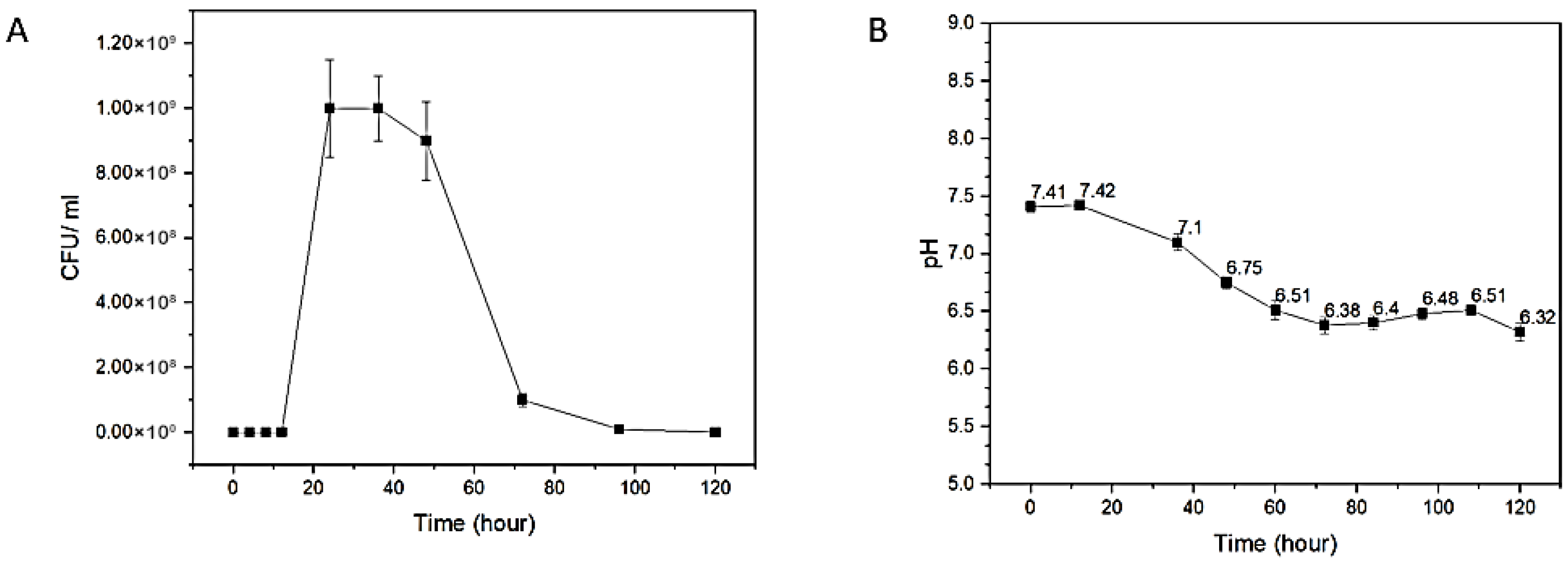
The growth performance of Veillonella atypica ATCC 17744 in BHIL medium at 37 °C is shown in Figure 1A. A lag phase is observed during the first 12 h of growth, followed by an exponential phase lasting up to 24 h, reaching a population of 6 × 10⁸ CFU/mL. After that, it can be observed as clearly defined stationary and death phases. Considering that, according to the Food and Agriculture Organization [16], a probiotic food must contain >106 CFU/mL to achieve the desired functional effects.
Therefore, V. atypica ATCC 17744 exhibited satisfactory growth in BHIL medium (Figure 1A), demonstrating its ability to adapt and multiply efficiently in a nutrient-rich environment. Although these findings support the strain’s viability and potential for further in vitro evaluation, additional studies considering alternative and cost-effective industrial media would be required to assess its large-scale growth performance in order to evaluate its potential probiotic applications.
Regarding the pH variation during growth, the results (Figure 1B) show only a slight decrease from 7.40 at the initial time to 6.32 after 120 h of incubation. This behavior indicates that V. atypica ATCC 17744 does not acidify the medium, confirming that it is not an acid-producing microorganism like lactic acid bacteria. In fact, species of the genus Veillonella are known to utilize lactate as a carbon and energy source rather than producing it. This metabolism establishes syntrophic interactions with lactate-producing bacteria such as Lactobacillus or Streptococcus species in natural environments [17,18]. Therefore, the slight pH variation observed reflects the metabolic characteristics of V. atypica, rather than any sensitivity to acidic conditions. The strain’s tolerance to low pH was further assessed in the stress-tolerance assays (Figure 2A).

3.2. Functional Properties Evaluation of Veillonella atypica ATCC 17744 “In Vitro”

3.2.1. Stress Tolerance: pH Resistance, Bile Salt Tolerance, and Gastrointestinal Tract Survival

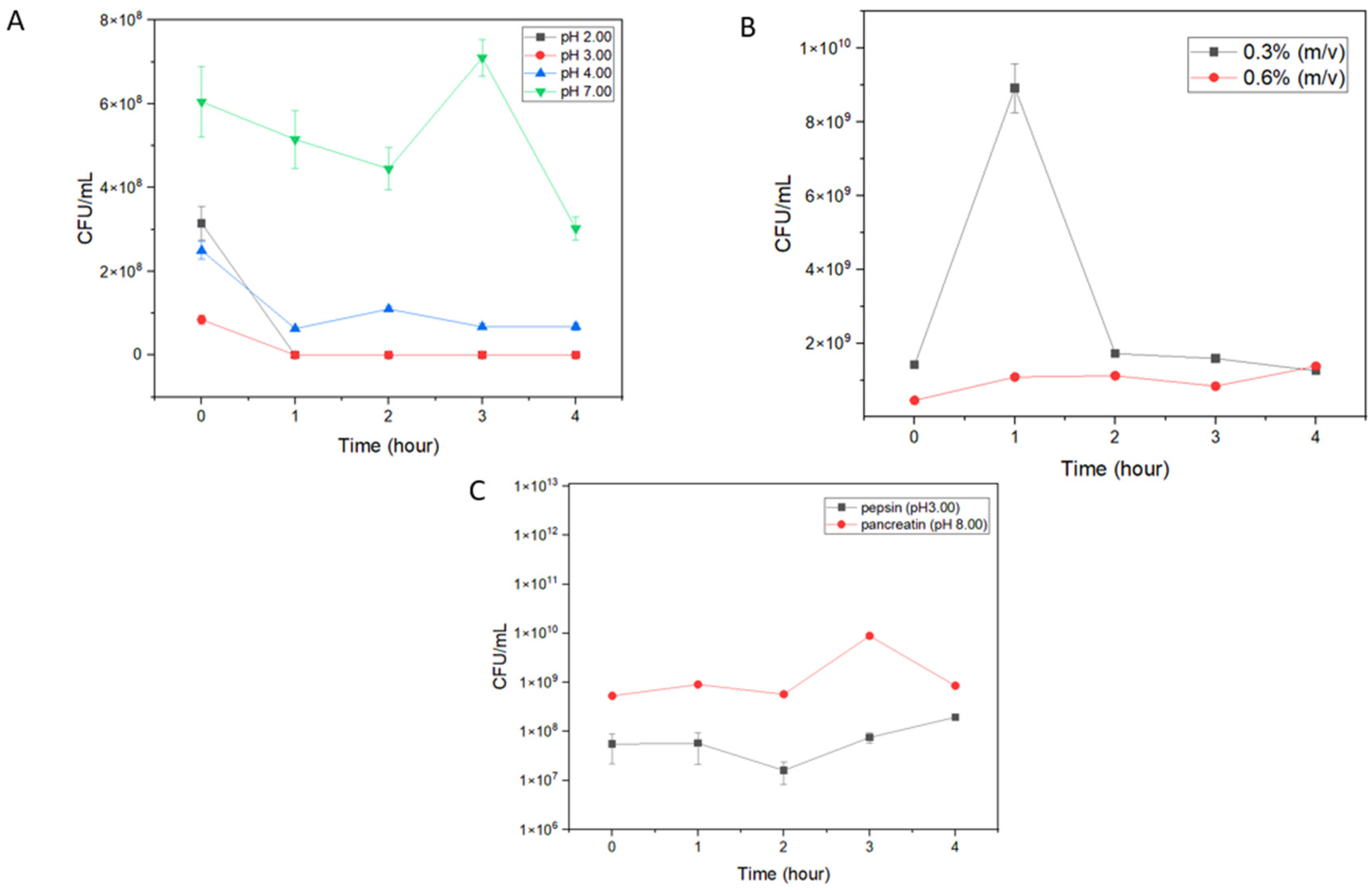
Following ingestion, probiotic cells must withstand several adverse conditions in the gastrointestinal tract, including exposure to low pH and pepsin in the stomach, as well as pancreatin and bile salts in the intestine. Therefore, Veillonella atypica ATCC 17744 was assayed for its ability to survive under these conditions, and the results are presented in Figure 2.
Regarding pH tolerance, Figure 2A shows that there was no growth at pH 2.00, and a significant reduction in cell viability was observed within the first 3 h of incubation at pH 3.00. Conversely, under pH 4.00 and 7.00, the cell population remained relatively stable throughout the 4 h experiment. At pH 4.00, a 1-log reduction was observed after 3 h of incubation, indicating partial tolerance to acidic conditions.
As shown in Figure 2B, the strain also exhibited satisfactory tolerance to bile salts at concentrations of 0.3% and 0.6%. In both conditions, the viable cell count remained above 108 CFU/mL during the 4 h incubation period, indicating resistance to the detergent-like activity of bile. Bile salts, synthesized in the liver from cholesterol and secreted into the intestine, play a key role in lipid emulsification but also exhibit antimicrobial properties by disrupting bacterial membranes [18]. Thus, the strain resistance to these compounds is considered an important probiotic characteristic.
Concerning tolerance to gastrointestinal simulation conditions, Figure 2C shows that when incubated in gastric juice (pH 3.00 with pepsin), V. atypica ATCC 17744 maintained a viable population above 108 CFU/mL, while in the presence of pancreatin at pH 8.00 (simulating intestinal fluid), viability remained above 107 CFU/mL. Therefore, these findings confirm this strain’s capacity to survive sequential exposure to gastric and intestinal conditions.
Pepsin may play a protective role under acidic conditions by reducing membrane hyperpolarization and minimizing H+ efflux, thus maintaining intracellular pH through H+-ATPase activity [19].
These results align with other studies in the literature. Kos et al. [9], characterizing a strain of Lactobacillus acidophilus M92, demonstrated growth under acidic conditions (pH 1.50 to 4.00) and tolerance to bile salts (0.1–0.5%). Recent studies have further elucidated the protective role of dairy proteins by improving the survival of Lactobacillus acidophilus LYO 50 (Danisco, Dairy Connection, Madison, WI, USA) under gastrointestinal conditions. In a medium containing whey protein, the growth of L. acidophilus was improved, as well as its tolerance to acidic pH and bile salts, leading to enhanced viability under simulated gastrointestinal conditions [20]. Similarly, a comprehensive review by Zółkiewicz et al. [21] emphasized that the food matrix (e.g., dairy products) acts as a protective barrier, significantly enhancing the survival of probiotics through the gastrointestinal tract. The authors concluded that co-ingestion with food is a critical factor for improving the delivery of viable cells to the gut.
Further supporting this observation, Campos et al. [22] reported that several Lactobacillus strains survived in MRS medium containing artificial gastric juice (pH 2.00), while Liu et al. [23] reported the survival of Lactobacillus spp. in skim milk at pH 2.20.
In summary, these results indicate that V. atypica ATCC 17744 exhibits robust stress tolerance, maintaining cell viability above 106 CFU/mL under all tested gastrointestinal simulation conditions, which supports its potential application as a probiotic strain for functional food formulation development.

3.2.2. Adhesion Capacity: Hydrophobicity, Auto-Aggregation, and Biofilm Formation

According to De Oliveira Coelho et al. [7], hydrophobicity and auto-aggregation are key characteristics of a desirable probiotic strain, as they contribute to the microorganism’s ability to interact with host epithelial cells and achieve high cell densities in the intestinal environment. Cell surface hydrophobicity can serve as an indicator of a microorganism’s adhesion potential to the intestinal mucosa, since it reflects the capacity of bacterial cells to interact with hydrocarbons present in the intestinal mucosa. Generally, higher hydrophobicity values suggest greater adhesion ability. However, some studies have reported no consistent correlation between hydrophobicity and adhesion ability, indicating that this relationship may vary depending on the strain and test conditions [24,25].
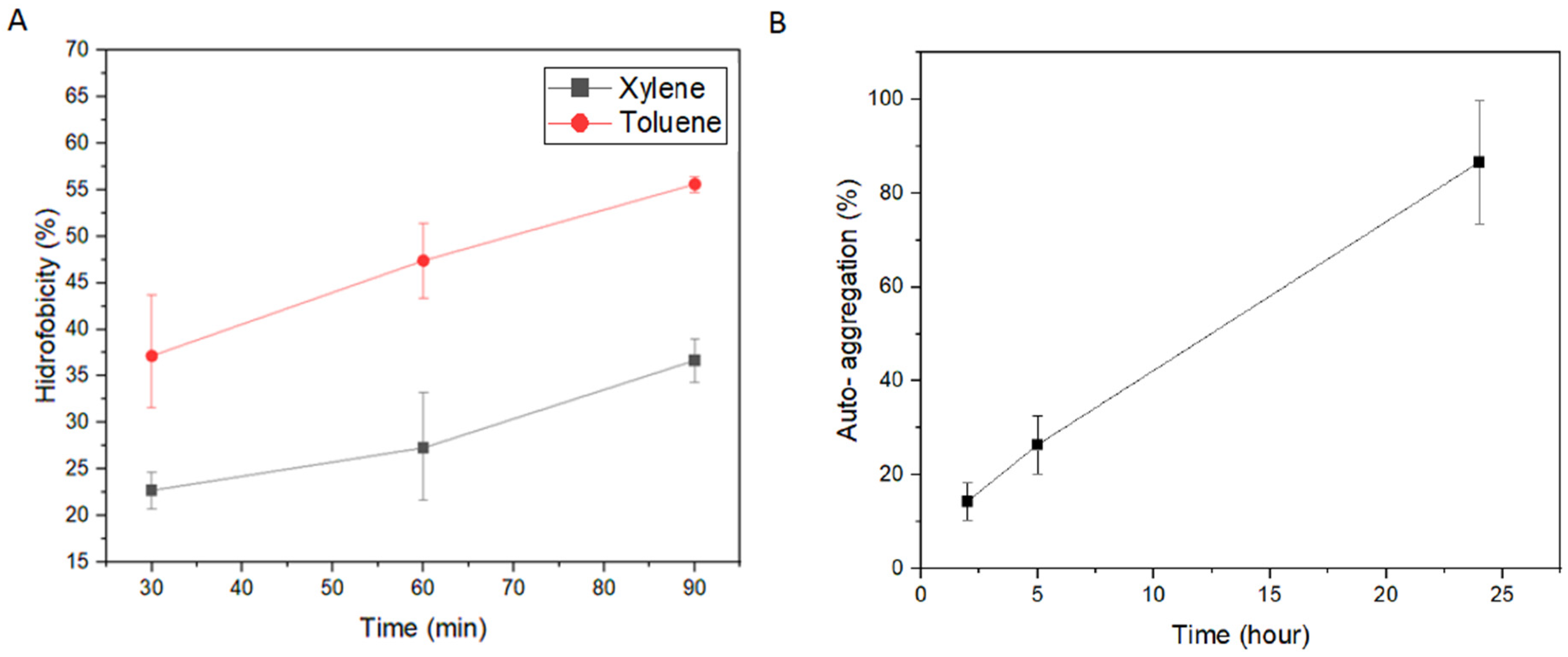
In the present study, the hydrophobicity of Veillonella atypica ATCC 17744 was evaluated using the MATS (Microbial Adhesion to Solvents) method [26], employing xylene and toluene as organic solvents that mimic the mucosal environment of the gastrointestinal tract [27]. According to Nader-Macías et al. [28], microbial strains can be classified as having high (66.67–100%), medium (33.37–66.66%), or low (0–33.33%) hydrophobicity. Based on this classification and the results shown in Figure 3A, V. atypica ATCC 17744 exhibited moderate hydrophobicity, with values ranging from 37.2% to 55.6% for toluene and from 22.7% to 36.7% for xylene over the 90 min contact period.
According to De Oliveira Coelho et al. [7], the hydrophobicity and auto-aggregation abilities of probiotic strains contribute to their adhesion to the host’s intestinal epithelium. Hydrophobicity is associated with the interaction between microbial cells and hydrocarbon solvents, serving as an indirect indicator of the strain’s adhesion potential. These authors reported that microbial cell surface hydrophobicity is an important parameter in estimating the capacity to adhere to the intestinal mucosa. However, other authors (Mathara et al. [24]; Vinderola and Reinheimer [25]) emphasize that hydrophobicity alone may not directly predict cell adhesion ability.
The increasing affinity observed over time, particularly for toluene, suggests a moderate potential for adherence to intestinal epithelial surfaces. Although hydrophobicity alone is not a determinant of adhesion [24,25], it remains a relevant factor that contributes to mucosal interaction, colonization potential, and probiotic functionality [29,30]. Thus, the hydrophobic profile of V. atypica ATCC 17744 supports its potential for transient adhesion to epithelial surfaces, complementing other adhesion-related characteristics observed in this study, such as moderate auto-aggregation and weak biofilm formation, which are discussed in subsequent sections.
Similar results were reported by De Oliveira Coelho et al. [7], who characterized Lactobacillus satsumensis LPBF1. They showed hydrophobicity values between 73% and 77% for toluene and 42% to 58% for xylene. In contrast, Vitola [8] observed lower hydrophobicity values (12–14%) in three strains isolated from bovine colostrum silage, indicating limited adhesion capacity. Similarly, Todorov et al. [27], studying isolates from salmon microbiota, concluded that high in vitro hydrophobicity does not necessarily correlate with strong in vivo adhesion, reinforcing that hydrocarbon adhesion is not a definitive predictor of epithelial colonization.
Regarding the auto-aggregation capacity of V. atypica ATCC 17744, the results (Figure 3B) showed a progressive increase from 14.3% at 2 h to 68.7% at 24 h. Auto-aggregation reflects a strain’s ability to interact with itself and form microbial clusters, which may enhance its capacity to adhere to epithelial surfaces [31]. Similar observations have been reported for probiotic bacteria; for instance, Krausova et al. [32] evaluated various Lactobacillaceae strains and found that auto-aggregation steadily increased over time (beginning at around 5–24% at early time points and reaching up to approximately 70% after 24 h), which correlates positively with adhesion capacity to human epithelial cell lines. Such findings reinforce the relevance of aggregation phenotypes in TGI host colonization, promoting pathogen exclusion. González-Rodríguez et al. [33] emphasized that probiotic strains must present properties, such as surviving harsh gastric conditions, adhering to mucosal surfaces via specific adhesins, and competing effectively with resident microbiota to persist in the TGI. In this context, Johnson [34] highlighted that the auto-aggregation ability of Lactobacillus strains is associated with specific surface proteins and polysaccharides involved in adhesion and biofilm formation.
According to Bentahar [35], bacterial strains presenting an aggregation level of at least 40% are classified as having good auto-aggregation properties, while those below 10% are considered weak. Based on these classification criteria, V. atypica ATCC 17744 demonstrated a good level of auto-aggregation after 24 h. De Oliveira Coelho et al. [7] also observed a good aggregation level (<60%) for Lactobacillus satsumensis LPBF1, as well as Kos et al. [9] for L. acidophilus M92 after only 5 h.
Regarding the characterization of Veillonella atypica ATCC 17744 in terms of biofilm formation, the average absorbance readings of the control wells (blank) after 24 h were 0.0793, while the absorbance readings for the sample wells were 0.0791, resulting in a ratio of approximately 1. This indicates an inability to form biofilm. After 48 h of incubation, the average absorbance of the sample wells increased to 0.1117, corresponding to a ratio of 1.41, which is classified as weak biofilm formation (Table 1).
Biofilm formation is considered an important property of probiotic strains, as it contributes to prolonged colonization and persistence in the gastrointestinal tract. The biofilm matrix can protect bacterial cells against environmental stressors such as pH fluctuations, bile salts, and antimicrobial compounds, enhancing survival and functionality under intestinal conditions [36,37]. Moreover, biofilm-forming probiotics may outcompete pathogenic microorganisms by competitive exclusion, consisting of occupying adhesion sites and modulating the local immune response [38].
The weak biofilm formation observed in V. atypica ATCC 17744 suggests limited ability to establish long-term colonization under static in vitro conditions. However, biofilm formation is a multifactorial process, influenced by the microbial species and strain, medium composition, incubation time, surface properties of the material, and growth phase [39,40]. Therefore, these results must be interpreted with caution, as dynamic or host-associated models may yield different outcomes.

3.2.3. Anti-Pathogenic Activity

According to Plaza-Diaz et al. [41], many lactic acid bacteria (LAB) and bifidobacteria strains exhibit the ability to suppress or eliminate pathogenic microorganisms, which is considered one of their most important probiotic attributes. This antagonistic effect is largely attributed to the production and tolerance of antimicrobial metabolites such as lactic acid, acetic acid, hydrogen peroxide, and bacteriocins. These substances help LAB to compete within microbial ecosystems by inhibiting or preventing the growth of potentially harmful bacteria.
In this context, the present study assessed the potential antipathogenic activity of Veillonella atypica ATCC 17744 over Streptococcus aureus ATCC 6538 and Escherichia coli ATCC 11229 using TSA medium. No inhibitory effect was observed under the tested conditions, either in the presence of bacterial cells or their corresponding cell-free supernatant. A lack of antagonistic activity has been observed in Lactobacillus and Bifidobacterium strains. For instance, Lee et al. [42] tested multiple LAB strains over S. aureus and E. coli: while some probiotic strains exhibited clear antimicrobial activity in cell-free supernatants, others demonstrated limited or no inhibition under comparable test conditions, emphasizing the strain-specific nature of these interactions. These findings underscore that in vitro assays may not reliably predict in vivo efficacy, as host-related factors (such as immune responses, nutrient availability in the gastrointestinal tract, and interactions with the food matrix) can significantly influence the survival, activity, and overall functionality of probiotic strains within the host gastrointestinal environment.
Several studies have demonstrated the inhibitory effect of potentially probiotic strains on pathogenic species. Wiktorczyk-Kapischke et al. [43] reported antimicrobial activity of Lactobacillus spp. isolated from yogurt over E. coli and Salmonella Enteritidis (Department of Microbiology of Collegium Medicum in Bydgoszcz Nicolaus Copernicus University in Toruń). They used agar diffusion assays, demonstrating inhibition zones indicative of antagonistic potential (though not reaching as large as 24 mm). Significant growth suppression was observed at around 15–20 mm under specific conditions. These results align with previous observations that LAB strains can exert antimicrobial effects due to the synthesis of organic acids, bacteriocins, and hydrogen peroxide. Importantly, the extent of inhibition varies by strain and experimental setup.
Andrade et al. [44] evaluated the probiotic potential and antimicrobial activity of Lactobacillus spp. isolated from artisanal Minas cheese from Serra da Canastra—MG—Brazil. The authors demonstrated that the evaluated strains exhibited antagonistic activity over Escherichia coli, Staphylococcus aureus, Listeria monocytogenes, Salmonella enterica var. Typhimurium, Enterococcus faecalis (from the Laboratory of Ecology and Physiology of Microorganisms at the Institute of Biological Sciences of the Federal University of Minas Gerais, and two isolated samples from the same artisanal Minas cheeses from Serra da Canastra, and some lactic acid bacteria isolated from the cheese itself. Similarly, De Oliveira Coelho et al. [7] showed an inhibition effect of Lactobacillus satsumensis LPBF1, Leuconostoc mesenteroides LPBF2, and Saccharomyces cerevisiae LPBF3 strains, isolated from a honey-based kefir, over Staphylococcus aureus and Escherichia coli, reporting inhibition zones ranging from 8 to 12.5 mm.

3.2.4. Functional Characteristics—Antioxidant Activity

According to Santos-Sánchez [45], metabolism consists of several biochemical reactions involving reactive oxygen species such as hydrogen peroxide, superoxide anion radicals, and others. Biological systems involve antioxidant mechanisms of enzymatic and non-enzymatic origin to control the damage caused by the excess of free radicals, which can trigger different pathologies ranging from cardiovascular diseases to the promotion of cancer. Endogenous antioxidant compounds include enzymes such as catalase and superoxide dismutase, as well as other compounds of different nature, such as bilirubin and albumin, which act in the presence of these radicals. However, when the organism is in the presence of an excess of these reactive species, the system of endogenous compounds may fail to ensure adequate protection. To compensate for this deficit, the body can use exogenous antioxidant compounds present in foods, supplements, and pharmaceutical preparations.
Therefore, one assay to evaluate the antioxidant activity of a microbial species consists of measuring the loss of color in a solution containing stable radicals, such as DPPH (2,2-diphenyl-1-picrylhydrazyl), which exhibits a violet color in the presence of substances that can donate a hydrogen atom. This method is based on the transfer of electrons from an antioxidant compound to an oxidant [46,47].
In the present study, the antioxidant activity of Veillonella atypica ATCC 17744 was evaluated following the methodology described by Bian et al. [12]. This strain exhibited a DPPH scavenging activity of 4.30% ± 0.15, corresponding to a Trolox equivalent of 51.33 ± 1.66 µM. These results indicate low antioxidant potential, considering that most probiotic strains typically demonstrate activity levels exceeding DPPH 20% under similar assay conditions.
As reported by De Oliveira Coelho et al. [7], Lactobacillus satsumensis LPBF1, Leuconostoc mesenteroides LPBF2, and Saccharomyces cerevisiae LPBF3 strains, isolated from honey-based kefir, exhibited antioxidant activity, as measured by based on DPPH radical scavenging, ranging from 22% to 27%. Similarly, Begunova et al. [48] investigated the antioxidant activity of cow’s milk fermented by Lactobacillus helveticus NK1, L. rhamnosus F, and L. reuteri LR1, reporting that the antioxidant capacity increased significantly during fermentation. This increase was directly associated with the strains’ proteolytic activity, since protein breakdown releases bioactive peptides with known antioxidant properties. Specifically, L. helveticus NK1 showed the highest antioxidant activity (up to ~1045 µM Trolox equivalents after 24 h), indicating that the release of bioactive peptides during milk fermentation is a key factor in enhancing antioxidant potential.

3.2.5. Safety Properties: Antibiotic Resistance; Gelatinase, Lipase, and Catalase Synthesis; and Hemolytic Activity

One of the most critical aspects in characterizing a potential probiotic strain is assessing its safety properties for host consumption. In this regard, regulatory agencies from the European Community, the United States, and Canada have established criteria to ensure the safety of probiotic preparations addressed for human and animal consumption. These criteria include information about the strain isolation history, taxonomic identification, absence of virulence genes, and assessment of infectivity, toxicity, and transferable antibiotic resistance [7].
Therefore, in the present study, Veillonella atypica ATCC 17744 was evaluated for antibiotic susceptibility (Table 2), and the results showed that this strain was found to be sensitive to all antibiotics tested, indicating an absence of acquired resistance to clinically relevant antimicrobial agents. According to Fatahi-Bafghi [49], it is critical that strains intended for use in food formulations do not harbor transferable antibiotic resistance genes. Recent systematic reviews highlighted that numerous Lactobacillus and Bifidobacterium strains carry mobile genetic elements associated with resistance genes, which may be transferred horizontally to pathogenic bacteria in the gut.
Similar findings were reported in recent in vitro antibiotic susceptibility assessments of LAB isolates. For instance, Gueimonde et al. [50] demonstrated that most Lactobacillus and Bifidobacterium strains were susceptible to clinically relevant antibiotics, including ampicillin, tetracycline, erythromycin, and chloramphenicol, while exhibiting intrinsic resistance, or low susceptibility, to aminoglycosides and quinolones.
Regarding the synthesis of enzymes associated with pathogenicity in Veillonella atypica ATCC 17744, in the present study, its ability to synthesize gelatinase, lipase, catalase, and hemolytic activity was evaluated. This strain tested negative for gelatinase, lipase, and catalase synthesis, and showed gamma-hemolysis activity.
Hemolytic activity was also evaluated as part of the safety assessment. No hemolysis was observed, indicating gamma hemolysis, which is characterized by the absence of clear or greenish zones around the bacterial colonies on 5% sheep blood agar. In contrast, alpha hemolysis is identified by a greenish halo due to partial red blood cell lysis, while beta hemolysis results in a clear zone indicating complete lysis. The absence of hemolytic activity further supports the non-pathogenic profile of V. atypica and its potential safety for probiotic applications.
Gelatinase activity has been associated with nutrient acquisition through the degradation of host tissues, as highlighted by Fisher and Phillips [51], and is, therefore, considered a marker of pathogenicity.
Similarly, assessing the lipolytic activity of a probiotic strain is relevant because, according to Xie et al. [52], the presence of this enzyme in pathogenic bacteria may contribute to its accumulation in the host’s bloodstream, which is linked to harmful effects and is also regarded as a virulence factor.
Regarding catalase, Martín and Suárez [53] reported that this intracellular enzyme, synthesized by some microorganism species, decomposes hydrogen peroxide, which acts against pathogenic bacteria. According to Atassi et al. [54], lactic acid bacteria (LAB) are known to synthesize hydrogen peroxide (H2O2) as a metabolic by-product, and due to their general lack of catalase activity, H2O2 accumulates in the environment, which contributes to inhibiting catalase-negative pathogens. These authors have shown that Lactobacillus johnsonii NCC933 and Lactobacillus gasseri KS120.1 were shown to synthesize H2O2, which, in synergy with lactic acid, exerted bactericidal activity over pathogen species such as Salmonella enterica Typhimurium, Gardnerella vaginalis, and Escherichia coli. Catalase treatment of the culture supernatants significantly reduced this killing effect, because the enzyme decomposed the hydrogen peroxide present. This reduction in antimicrobial activity confirmed that H2O2 was the main factor responsible for inhibiting the pathogens.
Similarly, synthesis of H2O2 by Lactococcus garvieae N201 in raw and pasteurized milk contributed to the growth inhibition of Staphylococcus aureus SA15, and this inhibitory effect was attenuated in the presence of catalase, demonstrating the key role of H2O2 in antagonism activity [55]
Concerning hemolysin synthesis characterization, Vesterlund et al. [56] emphasized that this assay assesses the strain’s capacity to lyse red blood cells, a process that may lead to anemia and edema in the host. Hemolysin synthesis is considered a virulence factor due to its role in iron acquisition by certain pathogenic bacteria. Based on the hemolytic activity on blood agar plates, bacterial species are classified as alpha-hemolytic, when they promote partial hemolysis and exhibit high iron absorption; beta-hemolytic, when they cause complete hemolysis and show low iron absorption; and gamma-hemolytic, when no hemolysis occurs and iron absorption is absent.
Likewise, Hall and Mangels [14], in a study involving lactic acid bacteria isolated from the spontaneous fermentation of the Amazonian fruit bacupari (Rheedia gardneriana), identified only a few strains with gelatinase, lipase, or hemolytic activity. The author concluded that further studies are necessary to confirm the safety of these strains for consumption.

4. Conclusions

The in vitro characterization of Veillonella atypica ATCC 17744 provided new insights into the physiology of this species and its potential relevance for biotechnological and nutritional applications. The strain exhibited moderate tolerance to gastrointestinal stress conditions, showing sensitivity to pH values below 4.00 but improved survival in the presence of pepsin at pH 3.00, suggesting a certain adaptability to gastric environments. Moderate hydrophobicity, low affinity for toluene and xylene, and weak biofilm formation were also observed.
Although V. atypica ATCC 17744 did not exhibit antimicrobial or antioxidant activity under the tested conditions, it demonstrated susceptibility to all antibiotics evaluated and did not produce enzymes associated with pathogenicity, indicating a favorable safety profile.
Therefore, while V. atypica ATCC 17744 cannot yet be considered a probiotic candidate, its non-pathogenic behavior and moderate resistance to gastrointestinal stress suggest that it may represent a safe and interesting strain for future studies regarding its metabolic interactions with lactate-producing bacteria and possible applications in functional foods designed for physically active individuals.

Author Contributions

Conceptualization, J.C.F. and I.M.d.M.; methodology, J.C.F., F.W.B., and I.M.d.M.; software, J.C.F.; validation, J.C.F. and I.M.d.M.; formal analysis, J.C.F. and I.M.d.M.; investigation, J.C.F. and I.M.d.M.; resources, I.M.d.M. and A.K.C.; data curation, J.C.F. and I.M.d.M.; writing—original draft preparation, J.C.F. and I.M.d.M.; writing—review and editing, J.C.F., F.W.B., A.K.C., and I.M.d.M.; visualization, J.C.F., F.W.B., A.K.C., and I.M.d.M.; supervision, I.M.d.M.; project administration, J.C.F. and I.M.d.M.; funding acquisition, A.K.C. All authors have read and agreed to the published version of the manuscript.

Funding

This research was funded by the Coordination for the Improvement of Higher Education Personnel (CAPES, Brazil)—Finance Code 001, through a master’s scholarship grant. No article processing charges (APC) were applied for the publication of this manuscript.

Institutional Review Board Statement

Not applicable.

Informed Consent Statement

Not applicable.

Data Availability Statement

The original contributions presented in this study are included in the article. Further inquiries can be directed to the corresponding author.

Acknowledgments

The authors gratefully acknowledge the financial support provided by CAPS. We also thank the Analytical Science Laboratory for conducting some of the tests and André Moreni for his valuable assistance in the preparation of the scientific manuscript. A.K. Chandel gratefully acknowledges. The Brazilian National Council for Scientific and Technological Development (CNPq), Brazil for scientific productivity program (Process number: 304451/2025-8).

Conflicts of Interest

The authors declare no conflicts of interest.

References

  1. Marco, M.L.; Sanders, M.E.; Gänzle, M.; Arrieta, M.C.; Cotter, P.D.; De Vuyst, L.; Hill, C.; Holzapfel, W.; Lebeer, S.; Merenstein, D.; et al. The International Scientific Association for Probiotics and Prebiotics (ISAPP) Consensus Statement on Fermented Foods. Nat. Rev. Gastroenterol. Hepatol. 2021, 18, 196–208. [Google Scholar] [CrossRef]
  2. Barton, W.; Penney, N.C.; Cronin, O.; Garcia-Perez, I.; Molloy, M.G.; Holmes, E.; Shanahan, F.; Cotter, P.D.; O’Sullivan, O.; Claesson, M.J.; et al. The microbiome of professional athletes differs from that of more sedentary subjects in composition and particularly at the functional metabolic level. Gut 2018, 67, 625–633. [Google Scholar] [CrossRef] [PubMed]
  3. Scheiman, J.; Luber, J.M.; Chavkin, T.A.; MacDonald, T.; Tung, A.; Pham, L.D.; Wibowo, M.C.; Wurth, R.C.; Punthambaker, S.; Tierney, B.T.; et al. Meta-omics analysis of elite athletes identifies a performance-enhancing microbe that functions via lactate metabolism. Nat. Med. 2019, 25, 1104–1109. [Google Scholar] [CrossRef] [PubMed]
  4. Zhang, L.; Zhang, R.; Li, L. Effects of Probiotic Supplementation on Exercise and the Underlying Mechanisms. Foods 2023, 12, 1787. [Google Scholar] [CrossRef] [PubMed]
  5. Marttinen, M.; Ala-Jaakkola, R.; Laitila, A.; Lehtinen, M.J. Gut Microbiota, Probiotics and Physical Performance in Athletes and Physically Active Individuals. Nutrients 2020, 12, 2936. [Google Scholar] [CrossRef]
  6. Wolfe, R.S.; Metcalf, W.W. A vacuum vortex technique for preparation of anoxic solutions or liquid culture media in small volumes for cultivating methanogens or other strict anaerobes. Anaerobe 2010, 16, 216–219. [Google Scholar] [CrossRef]
  7. De Oliveira Coelho, B.; Fiorda-Mello, F.; De Melo Pereira, G.V.; Thomaz-Soccol, V.; Rakshit, S.K.; De Carvalho, J.C.; Soccol, C.R. In vitro probiotic properties and DNA protection activity of yeast and lactic acid bacteria isolated from a honey-based kefir beverage. Foods 2019, 8, 485. [Google Scholar] [CrossRef]
  8. Vitola, H.R.S.; Dannenberg, G.D.S.; Marques, J.L.; Fiorentini, Â.M. Probiotic potential of Lactobacillus casei CSL3 isolated from bovine colostrum silage and its viability capacity immobilized in soybean. Process Biochem. 2018, 75, 22–30. [Google Scholar] [CrossRef]
  9. Kos, B.; Šušković, J.; Vuković, S.; Simpraga, B.; Banović, M.; Pavunc, A.L.; Džidara, P.; Matosić, S.; Jaki, M.; Maurac, I. Adhesion and aggregation ability of probiotic strain Lactobacillus acidophilus M92. J. Appl. Microbiol. 2003, 94, 981–987. [Google Scholar] [CrossRef]
  10. Hooshdar, P.; Kermanshahi, R.K.; Ghadam, P.; Khosravi-Darani, K. A Review on Production of Exopolysaccharide andBiofilm in Probiotics like Lactobacilli and Methods of Analysis. Biointerface Res. Appl. Chem. 2020, 10, 6058–6075. [Google Scholar] [CrossRef]
  11. Tagg, J.R.; McGiven, A.R. Assay system for bacteriocins. Appl. Microbiol. 1971, 21, 943. [Google Scholar] [CrossRef] [PubMed]
  12. Bian, J.; Peng, F.; Peng, X.P.; Peng, P.; Xu, F.; Sun, R.C. Structural features and antioxidant activity of xylooligosaccharides enzymatically produced from sugarcane bagasse. Bioresour. Technol. 2013, 127, 236–241. [Google Scholar] [CrossRef] [PubMed]
  13. Zulkiply, N.A.; Santha, S.; Zulperi, D.; Noor Azmai, M.A.; Yusof, M.T.; Zamri Saad, M. Antibiotic susceptibility and resistance profiles of Vibrio spp. isolated from cultured grouper using disk diffusion method conforming to CLSI guidelines. BMC Microbiol. 2019, 19, 251. [Google Scholar] [CrossRef]
  14. Hall, G.S.; Mangels, J.I. Gelatinase production: Incubation techniques for anaerobic bacteriology specimens. In Clinical Microbiology Procedures Handbook; Leber, A.L., Ed.; American Society for Microbiology: Washington, DC, USA, 2023; Chapter 4.6.13. [Google Scholar]
  15. Clinical and Laboratory Standards Institute (CLSI). Performance Standards for Antimicrobial Susceptibility Testing, 34th ed.; CLSI: Wayne, PA, USA, 2024; CLSI Document M100. [Google Scholar]
  16. Food and Agriculture Organization (FAO). Guidelines for the Evaluation of Probiotics in Food; Food and Agriculture Organization of the United Nations: Rome, Italy, 2002; pp. 1–11. [Google Scholar]
  17. Feltrin, V.P.; Sant’Anna, E.S.; Porto, A.C.S.; Torres, R.C.O. Produção de Lactobacillus plantarum em melaço de cana-de-açúcar. Braz. Arch. Biol. Technol. 2000, 43, 119–124. [Google Scholar] [CrossRef]
  18. Ge, Y.; Yu, X.; Zhao, X.; Liu, C.; Li, T.; Mu, S.; Zhang, L.; Chen, Z.; Zhang, Z.; Song, Z.; et al. Fermentation Characteristics and Postacidification of Yogurt by Streptococcus thermophilus CICC 6038 and Lactobacillus delbrueckii ssp. bulgaricus CICC 6047 at Optimal Inoculum Ratio. J. Dairy Sci. 2024, 107, 123–140. [Google Scholar] [CrossRef]
  19. Begley, M.; Gahan, C.G.M.; Hill, C. The interaction between bacteria and bile. FEMS Microbiol. Rev. 2005, 29, 625–651. [Google Scholar] [CrossRef]
  20. Marcia, J.; Aleman, R.S.; Montero-Fernández, I.; Martín-Vertedor, D.; Manrique-Fernández, V.; Moncada, M.; Kayanush, A. Attributes of Lactobacillus acidophilus as Effected by Carao (Cassia grandis) Pulp Powder. Fermentation 2023, 9, 408. [Google Scholar] [CrossRef]
  21. Zółkiewicz, J.; Marzec, A.; Ruszczyński, M.; Feleszko, W. Postbiotics—A Step Beyond Pre- and Probiotics. Nutrients 2020, 12, 2189. [Google Scholar] [CrossRef]
  22. Campos, J.V.F.; Silva, M.O.; Vieira, A.C.A.; Faria, L.M.; Valente, G.L.C. In Vitro Evaluation of the Probiotic Potential of Microorganisms Isolated from Functional Commercial Fermented Milks. Agrar. Sci. J. 2021, 13, 1–9. [Google Scholar] [CrossRef]
  23. Liu, C.; Han, F.; Cong, L.; Sun, T.; Menghe, B.; Liu, W. Evaluation of Tolerance to Artificial Gastroenteric Juice and Fermentation Characteristics of Lactobacillus Strains Isolated from Human. Food Sci. Nutr. 2021, 10, 227–238. [Google Scholar] [CrossRef]
  24. Mathara, J.M.; Schillinger, U.; Kutima, P.M.; Mbugua, S.K.; Guigas, C.; Franz, C.; Holzapfel, W.H. Functional Properties of Lactobacillus plantarum Strains Isolated from Maasai Traditional Fermented Milk Products in Kenya. Curr. Microbiol. 2008, 56, 315–321. [Google Scholar] [CrossRef]
  25. Vinderola, G.C.; Reinheimer, J.A. Lactic Acid Starter and Probiotic Bacteria: A Comparative “In Vitro” Study of Probiotic Characteristics and Biological Barrier Resistance. Food Res. Int. 2003, 36, 885–904. [Google Scholar] [CrossRef]
  26. Pelletier, C.; Bouley, C.; Cayuela, C.; Bouttier, S.; Bourlioux, P.; Bellon-Fontaine, M.N. Cell Surface Characteristics of Lactobacillus casei subsp. casei, Lactobacillus paracasei subsp. paracasei, and Lactobacillus rhamnosus Strains. Appl. Environ. Microbiol. 1997, 63, 1725–1731. [Google Scholar] [CrossRef]
  27. Todorov, S.D.; Furtado, D.N.; Saad, S.M.I.; Tome, E.; Franco, B.D.G.M. Potential Beneficial Properties of Bacteriocin-Producing Lactic Acid Bacteria Isolated from Smoked Salmon. J. Appl. Microbiol. 2011, 110, 971–986. [Google Scholar] [CrossRef]
  28. Nader-Macías, M.E.F.; Otero, M.C.; Espeche, M.C.; Maldonado, N.C. Advances in the Design of Probiotic Products for the Prevention of Major Diseases in Dairy Cattle. J. Ind. Microbiol. Biotechnol. 2008, 35, 1387–1395. [Google Scholar] [CrossRef] [PubMed]
  29. Du, Y.; Li, H.; Shao, J.; Wu, T.; Xu, W.; Hu, X.; Chen, J. Adhesion and Colonization of the Probiotic Lactobacillus plantarum HC-2 in the Intestine of Litopenaeus vannamei Are Associated with Bacterial Surface Proteins. Front. Microbiol. 2022, 13, 878874. [Google Scholar] [CrossRef]
  30. Dhakephalkar, T.; Pisu, V.; Margale, P.; Chandras, S.; Shetty, D.; Wagh, S.; Dagar, S.S.; Kapse, N.; Dhakephalkar, P.K. Strain-Dependent Adhesion Variations of Shouchella clausii Isolated from Healthy Human Volunteers: A Study on Cell Surface Properties and Potential Probiotic Benefits. Microorganisms 2024, 12, 1771. [Google Scholar] [CrossRef] [PubMed]
  31. Newaj-Fyzul, A.; Al-Harbi, A.H.; Austin, B. Developments in the Use of Probiotics for Disease Control in Aquaculture. Aquaculture 2014, 431, 1–13. [Google Scholar] [CrossRef]
  32. Krausova, G.; Hyrslova, I.; Hynstova, I. In Vitro Evaluation of Adhesion Capacity, Hydrophobicity, and Auto Aggregation of Newly Isolated Potential Probiotic Strains. Fermentation 2019, 5, 100. [Google Scholar] [CrossRef]
  33. González-Rodríguez, I.; Ruiz, L.; Gueimonde, M.; Margolles, A.; Sánchez, B. Factors Involved in the Colonization and Survival of Bifidobacteria in the Gastrointestinal Tract. FEMS Microbiol. Lett. 2013, 340, 1–10. [Google Scholar] [CrossRef]
  34. Johnson, B.R.; Hymes, J.; Sanozky-Dawes, R.; Henriksen, E.D.; Barrangou, R.; Klaenhammer, T.R. Conserved S-Layer-Associated Proteins Revealed by Exoproteomic Survey of S-Layer-Forming Lactobacilli. Appl. Environ. Microbiol. 2016, 82, 134–145. [Google Scholar] [CrossRef]
  35. Bentahar, M.C.; Benabdelmoumene, D.; Robert, V.; Dahmouni, S.; Qadi, W.S.M.; Bengharbi, Z.; Langella, P.; Benbouziane, B.; Al-Olayan, E.; Dawoud, E.A.D.; et al. Evaluation of Probiotic Potential and Functional Properties of Lactobacillus Strains Isolated from Dhan, Traditional Algerian Goat Milk Butter. Foods 2024, 13, 3781. [Google Scholar] [CrossRef]
  36. Motta, J.P.; Wallace, J.L.; Buret, A.G. Gastrointestinal Biofilms in Health and Disease. Nat. Rev. Gastroenterol. Hepatol. 2021, 18, 314–334. [Google Scholar] [CrossRef] [PubMed]
  37. Tomé, A.R.; Carvalho, F.M.; Teixeira-Santos, R.; Burmølle, M.; Mergulhão, F.J.M.; Gomes, L.C. Use of Probiotics to Control Biofilm Formation in Food Industries. Antibiotics 2023, 12, 754. [Google Scholar] [CrossRef]
  38. Pugazhendhi, A.S.; Wei, F.; Hughes, M.; Coathup, M. Bacterial Adhesion, Virulence, and Biofilm Formation. In Musculoskeletal Infection; Coathup, M., Ed.; Springer: Cham, Switzerland, 2022; pp. 19–64. [Google Scholar] [CrossRef]
  39. Terraf, M.C.L.; Juárez Tomás, M.S.; Nader-Macías, M.E.F.; Silva, C. Screening of Biofilm Formation by Beneficial Vaginal Lactobacilli and Influence of Culture Media Components. J. Appl. Microbiol. 2012, 113, 1517–1529. [Google Scholar] [CrossRef]
  40. Alotaibi, G.F.; Bukhari, M.A. Factors Influencing Bacterial Biofilm Formation and Development. Am. J. Biomed. Sci. Res. 2021, 12, 227–231. [Google Scholar] [CrossRef]
  41. Plaza-Diaz, J.; Ruiz-Ojeda, F.J.; Gil-Campos, M.; Gil, A. Mechanisms of Action of Probiotics. Adv. Nutr. 2019, 10, S49–S66. [Google Scholar] [CrossRef] [PubMed]
  42. Lee, J.; Jo, J.; Wan, J.; Seo, H.; Han, S.-W.; Shin, Y.-J.; Kim, D.-H. In Vitro Evaluation of Probiotic Properties and Anti-Pathogenic Effects of Lactobacillus and Bifidobacterium Strains as Potential Probiotics. Foods 2024, 13, 2301. [Google Scholar] [CrossRef]
  43. Wiktorczyk Kapischke, N.; Grudlewska Buda, K.; Budzyńska, A.; Chomacka Gollus, K.; Gospodarek Komkowska, E.; Skowron, K. Antimicrobial action of Lactobacillus spp. isolated from yoghurt against Escherichia coli, Salmonella enteritidis and Listeria monocytogenes: A pilot study. Appl. Sci. 2024, 14, 9010. [Google Scholar] [CrossRef]
  44. Andrade, C.R.G.; Souza, M.R.; Penna, C.F.A.M.; Acurcio, L.B.; Sant’Anna, F.M.; Castro, R.D.; Oliveira, D.L.S. In Vitro Probiotic Properties of Lactobacillus spp. Isolated from Minas Artisanal Cheese from Serra da Canastra—MG. Arq. Bras. Med. Vet. Zootec. 2014, 66, 1592–1600. [Google Scholar] [CrossRef][Green Version]
  45. Santos-Sánchez, N.F.; Salas-Coronado, R.; Villanueva-Cañongo, C.; Hernández-Carlos, B. Antioxidant Compounds and Their Antioxidant Mechanism. In Antioxidants; Shalaby, E., Ed.; IntechOpen: London, UK, 2019; pp. 1–30. [Google Scholar] [CrossRef]
  46. Brand-Williams, W.; Cuvelier, M.E.; Berset, C. Use of a free radical method to evaluate antioxidant activity. LWT—Food Sci. Technol. 1995, 28, 25–30. [Google Scholar] [CrossRef]
  47. Huang, D.; Boxin, O.U.; Prior, R.L. The Chemistry Behind Antioxidant Capacity Assays. J. Agric. Food Chem. 2005, 53, 1841–1856. [Google Scholar] [CrossRef] [PubMed]
  48. Begunova, A.V.; Savinova, O.S.; Glazunova, O.A.; Moiseenko, K.V.; Rozhkova, I.V.; Fedorova, T.V. Development of Antioxidant and Antihypertensive Properties during Growth of Lactobacillus helveticus, Lactobacillus rhamnosus and Lactobacillus reuteri on Cow’s Milk: Fermentation and Peptidomics Study. Foods 2020, 10, 17. [Google Scholar] [CrossRef]
  49. Fatahi Bafghi, M.; Naseri, S.; Alizehi, A. Genome analysis of probiotic bacteria for antibiotic resistance genes. Antonie Van Leeuwenhoek 2022, 115, 375–389. [Google Scholar] [CrossRef] [PubMed]
  50. Gueimonde, M.; Sánchez, B.; de los Reyes-Gavilán, C.G.; Margolles, A. Antibiotic resistance in probiotic bacteria. Front. Microbiol. 2013, 4, 202. [Google Scholar] [CrossRef] [PubMed]
  51. Fisher, K.; Phillips, C. The Ecology, Epidemiology and Virulence of Enterococcus. Microbiology 2009, 155, 1749–1757. [Google Scholar] [CrossRef]
  52. Xie, W.; Khosasih, V.; Suwanto, A.; Kim, H.K. Characterization of Lipases from Staphylococcus aureus and Staphylococcus epidermidis Isolated from Human Facial Sebaceous Skin. J. Microbiol. Biotechnol. 2012, 22, 84–91. [Google Scholar] [CrossRef]
  53. Martín, R.; Suárez, J.E. Biosynthesis and Degradation of H2O2 by Vaginal Lactobacilli. Appl. Environ. Microbiol. 2010, 76, 400–405. [Google Scholar] [CrossRef]
  54. Atassi, F.; Servin, A.L. Individual and Cooperative Roles of Lactic Acid and Hydrogen Peroxide in the Killing Activity of Lactobacillus johnsonii NCC933 and Lactobacillus gasseri KS120.1 against Enteric, Uropathogenic and Vaginosis-Associated Pathogens. FEMS Microbiol. Lett. 2010, 304, 29–38. [Google Scholar] [CrossRef]
  55. Delbes-Paus, C.; Dorchies, G.; Chaabna, Z.; Callon, C.; Montel, M.C. Contribution of Hydrogen Peroxide to the Inhibition of Staphylococcus aureus by Lactococcus garvieae in Interaction with Raw Milk Microbial Community. Food Microbiol. 2010, 27, 924–932. [Google Scholar] [CrossRef]
  56. Vesterlund, S.; Vankerckhoven, V.; Saxelin, M.; Goossens, H.; Salminen, S.; Ouwehand, A.C. Safety Assessment of Lactobacillus Strains: Presence of Putative Risk Factors in Faecal, Blood and Probiotic Isolates. Int. J. Food Microbiol. 2007, 116, 325–331. [Google Scholar] [CrossRef] [PubMed]
Figure 1. Growth performance and pH evolution of Veillonella atypica ATCC 17744 in BHIL medium over 120 h. (A) Bacterial growth curve (CFU/mL); (B) pH variation. Error bars represent the standard deviation (SD) of the mean of two independent replicates.
Fermentation 11 00612 g001
Figure 2. In vitro stress tolerance of Veillonella atypica ATCC 17744: (A) Viability under different pH conditions, (B) tolerance to bile salts, and (C) survival in simulated gastrointestinal conditions. Error bars represent the standard deviation (SD) of the mean of two independent replicates.
Fermentation 11 00612 g002
Figure 3. Adhesion capacity of Veillonella atypica ATCC 17744 considering (A) hydrophobicity percentage and (B) auto-aggregation. Error bars represent the standard deviation (SD) of the mean of two independent replicates.
Fermentation 11 00612 g003
Table 1. Average absorbance values regarding the biofilm formation assay of Veillonella atypica ATCC 17744.
Absorbance (600 nm)
TimeBlankSamples
24 h0.079030.0791
48 h0.079030.11171
Table 2. Average inhibition zone diameters (mm) of V. atypica ATCC 17744 against different antibiotics.
AntibioticAverage Inhibition Zone (mm)
Ceftiofur39.5
Ciprofloxacin25.5
Ceftriaxone37.0
Enrofloxacin27.0
Amoxicillin22.5
Ampicillin22.5
Gentamicin21.5
Tetracycline30.0
Disclaimer/Publisher’s Note: The statements, opinions and data contained in all publications are solely those of the individual author(s) and contributor(s) and not of MDPI and/or the editor(s). MDPI and/or the editor(s) disclaim responsibility for any injury to people or property resulting from any ideas, methods, instructions or products referred to in the content.