


Abstract
High-speed train aerodynamics have mainly been improved by passive design methods, such as streamlined noses, local fairings, and surface smoothing. These methods have achieved clear benefits, but several important aerodynamic problems remain difficult to solve by geometry optimization alone. Open-air drag is still affected by tail flow separation, base-pressure recovery, and disturbances around bogies and the underbody; crosswind safety is influenced by unsteady leeward-side separation and wake asymmetry; slipstream behavior depends on wake vortices, boundary-layer development, and complex near-ground underbody flow; and tunnel-related pressure transients arise from compression-wave generation, propagation, and reflection. These coupled effects mean that one fixed train shape cannot perform optimally in all operating conditions. For this reason, this review proposes that active flow control (AFC) should not be regarded only as a drag-reduction or stability-improvement technique for high-speed trains. Instead, it should be understood as a mission-adaptive aerodynamic control framework, in which different control actions are used for different operating scenarios. This paper first clarifies that passive optimization is increasingly subject to diminishing returns under multi-objective and engineering constraints. It then reviews AFC studies on drag reduction, base-pressure recovery, wake and slipstream control, underbody flow conditioning, crosswind mitigation, and tunnel pressure-wave suppression. Related AFC studies on bluff bodies, road vehicles, and other separated flows are included only when their physical relevance to trains is clear. The review further distinguishes gross aerodynamic improvement from net energy gain and identifies actuator power, durability, maintainability, acoustic impact, validation level, and full-scale transferability as decisive feasibility factors. Current research is still dominated by open-loop numerical studies with simplified actuation. Future work should therefore move toward multi-objective, closed-loop, energy-aware, sensor–actuator-integrated, and explainable machine-learning-assisted AFC. The main message is that the next step in train aerodynamics is not simply a better fixed shape, but a control-enabled train that can selectively redistribute aerodynamic authority across its mission profile.
1. Introduction
High-speed train aerodynamics have traditionally been improved mainly by passive design. Streamlined nose and tail shapes, smoother external surfaces, bogie fairings, shields, and some infrastructure-side measures have already brought significant benefits in drag reduction, passenger comfort, and environmental loading [1,2,3]. As a result, the main aerodynamic issues of high-speed trains are now well recognized. Aerodynamic drag directly affects energy consumption. Crosswind loads influence running safety. Wake and slipstream affect passengers, trackside workers, and nearby infrastructure. In addition, the flow around the underbody and bogies contributes to both flow energy loss and local unsteadiness, while tunnel entry, tunnel exit, and train-passing events can generate strong short-duration pressure transients [4,5,6,7,8].
In recent years, the main change has not been the type of aerodynamic problem, but the amount and nature of the remaining design margin. After the head, tail, and overall outer shape of a high-speed train have already been highly streamlined, it becomes increasingly difficult to obtain further improvements only through passive geometric optimization [9,10,11]. For example, nose-shape optimization can help reduce drag or tunnel-entry pressure gradients, but the available design space is limited by many practical constraints, such as crashworthiness, coupler arrangement, manufacturing, maintenance, and vehicle envelope requirements [12]. At the same time, as the easy gains from global streamlining become smaller, more attention must be paid to local high-turbulence regions, including bogies, underbody recesses, inter-car gaps, and the tail pressure-recovery region [13,14,15,16].
This situation means that high-speed train aerodynamics should be considered in a more dynamic way. Different operating scenarios place emphasis on different aerodynamic problems. In open-air operation, drag and wake features are important. Under crosswind conditions, the key concerns become side force, lift, and rolling moment [17,18]. For slipstream safety, more attention must be paid to the induced flow near the tail and underbody. For tunnel entry, tunnel exit, and train-meeting events, the main issue is the control of transient pressure waves [4,19]. Therefore, one fixed train geometry cannot be optimal for all operating conditions. It can only provide a compromise. By contrast, active flow control (AFC) offers the possibility of applying aerodynamic control only when and where a specific objective becomes important [20].
AFC has developed into a broad research field. Early studies mainly focused on steady blowing, suction, and periodic excitation, while later developments introduced more advanced control methods, such as sweeping jets, synthetic jets, plasma actuators, and data-driven or machine-learning-assisted control strategies [21,22,23,24,25]. These methods have shown strong potential in controlling flow separation, vortex evolution, and wake behavior in aerospace and bluff-body aerodynamics [26,27]. Compared with these mature research areas, the application of AFC to high-speed trains is still at an early stage.
Even so, train-related AFC studies have increased in recent years and now provide enough material for a more systematic review. Existing studies have investigated nose blowing, combined blowing and suction on streamlined heads and tails [28,29], synthetic-jet control near the tail region [30], leeward-side blowing or suction for crosswind mitigation [31,32,33,34,35,36], jet control in front of bogies [37], and slit-based suction or blowing for train–tunnel interaction problems [38,39,40]. Although this body of work is still limited, it already shows that AFC can address several train aerodynamic problems that are difficult to solve by passive design alone.
Based on this background, this work is not organized mainly by actuator type, such as steady blowing, suction slots, or synthetic jets. Instead, it is organized according to the main aerodynamic problems of high-speed trains, the corresponding control objectives, and the operating scenarios in which these objectives become important. From this perspective, AFC should not be understood only as a drag-reduction tool or a local stability-improvement technique. Rather, it should be viewed as a mission-adaptive aerodynamic control framework for high-speed trains. This viewpoint makes it possible to connect train-specific studies with carefully selected generic-model studies to discuss AFC as a strategic direction for the future development of railway aerodynamics.
2. AFC Beyond Passive Optimization
2.1. Bottlenecks of Aerodynamic Objectives
A high-speed train should not be treated as an aerodynamic object with only one representative operating condition. Although a train runs for much of its route in nominal open-air conditions, the most critical issues of safety and passenger comfort are often associated with specific operating events, such as strong crosswinds, train passing, and tunnel passage. These events are governed by different aerodynamic mechanisms. In open-air operation, the main concerns are aerodynamic drag and wake features [1,17]. In crosswinds, the key issues are pressure asymmetry, leeward-side flow separation, and rolling moment. Slipstream safety depends mainly on the near-ground and near-tail velocity field, which is strongly affected by the wake and underbody flow [2,3]. Tunnel aerodynamics are mainly related to compression and expansion waves, blockage effects, and local pressure gradients [4,5,18].
For this reason, aerodynamic optimization for high-speed trains is naturally a multi-objective problem, and the objectives are often not fully consistent with each other (listed in Table 1). A train nose shape that performs well for drag reduction in open-air operation may not be the best choice under crosswind conditions or during train-passing events [19]. Similarly, a tail treatment that improves mean drag does not necessarily reduce peak slipstream velocity or wake asymmetry [41,42]. In addition, the most important aerodynamic region changes with the operating scenario. The train nose is especially important for train/tunnel coupled effects, the leeward shoulder shape of the train body is more important in crosswinds [43,44], the tail controls pressure recovery and wake development, and the bogie and underbody regions remain persistent sources of local flow energy loss and flow unsteadiness [15,16,45].
Table 1.
Passive optimization alone is no longer sufficient for key aerodynamic functions of high-speed trains.
This is exactly the situation in which AFC becomes attractive. The purpose of AFC is not to replace passive design or to perform better than passive measures in every condition. Its main advantage is that it can provide local and timely aerodynamic control when the operating objective changes. In other words, the value of AFC for high-speed trains is not that passive design is no longer useful, but that passive design has already become highly optimized, while the remaining aerodynamic problems are increasingly local, constrained, and dependent on the operating scenario.
2.2. Diminishing Returns of Passive Shape Optimization
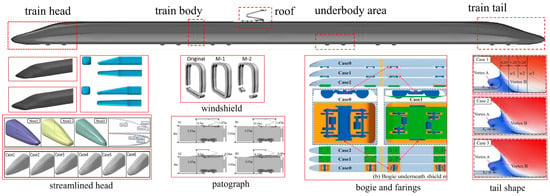
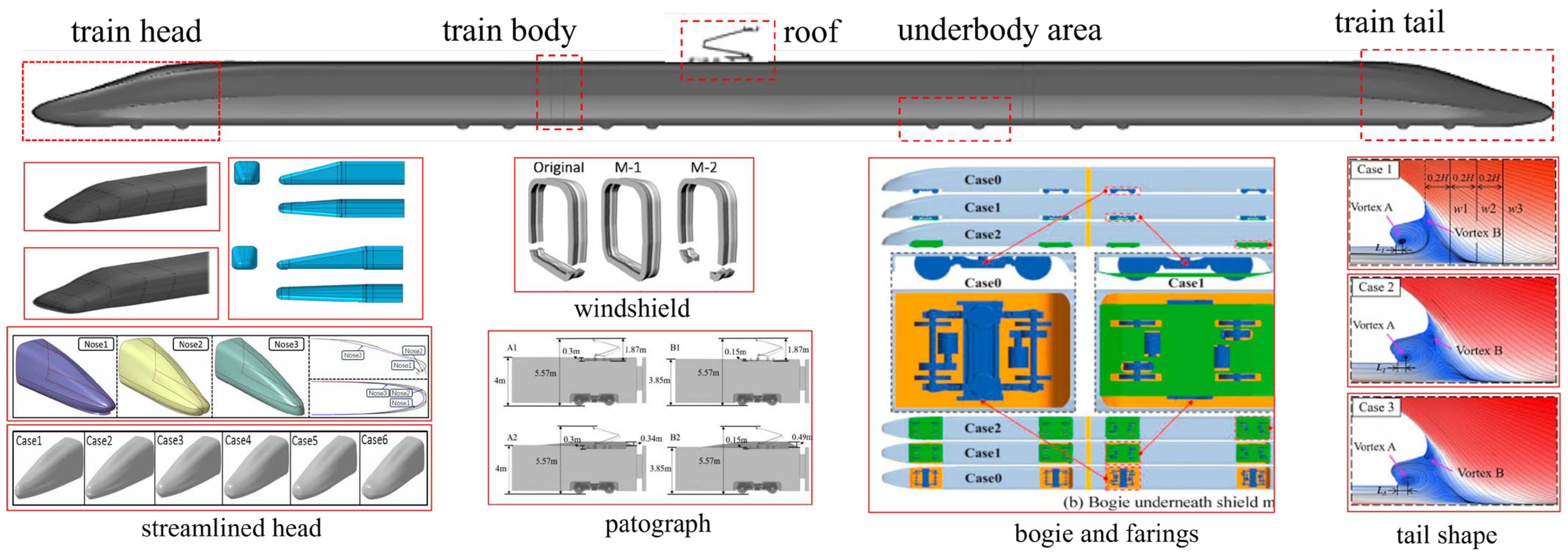
Aerodynamic optimization can be clearly seen in the literature on shape modification of high-speed trains (see Figure 1). Previous studies have shown that further aerodynamic improvements can still be achieved by modifying the nose shape, especially when multi-objective optimization or adjoint-based methods are used [9,10]. However, these improvements are usually constrained by the selected objective and by practical design. For example, Chen et al. [52] numerically studied the aerodynamic effects of different nose lengths on two trains intersecting in a tunnel at 350 km/h, and indicated that the maximum total drag decreases by 6.71% when changing the train nose length from 4 m to 7 m, whereas the maximum decreases by only 0.16% when the nose length changes from 9 m to 12 m. Similarly, Li et al. [53] found that increasing the nose length from 4 m to 7 m produced obvious reductions in the drag coefficients of the head and tail cars, whereas the difference in drag and lift coefficients became not obvious when the nose length increased further from 7 m to 12 m. These results indicate a diminishing-return behavior of passive nose-length optimization. Apart from above, a nose shape that performs well for open-air drag reduction may not remain optimal when the main objective changes to crosswind performance or train-passing conditions [11,12]. This indicates that passive optimization is still useful, but its benefits are increasingly case-dependent.
Figure 1.
Passive shape modifications for different regions of a high-speed train (adapted from [9,10,12,13,54]).
A similar conclusion can be drawn from studies on the underbody and bogie regions. Many wake and slipstream studies have shown that bogie position, bogie fairings, shields, and ground simulation can strongly affect drag and near-wake development [13,14]. In other words, the aerodynamic performance of modern high-speed trains is already very sensitive to local geometric details. However, these local regions are also the most difficult to optimize only by passive redesign, because they are closely related to maintenance access, safety clearance, suspension movement, and equipment arrangement [15,16,45,55]. Therefore, even when the flow is sensitive, the available geometric freedom is often very limited.
The main implication is not that passive optimization should be replaced. On the contrary, passive streamlining should still be regarded as the necessary foundation of high-speed train aerodynamic design. However, once this foundation has been largely optimized, the remaining aerodynamic problems become more local, more constrained, and more dependent on the operating scenario. Under these conditions, active flow control becomes attractive as a supplementary approach. Passive design defines the basic aerodynamic level of the train, while AFC can be introduced selectively in those regions where geometry is difficult to modify or where one fixed shape cannot fully satisfy different operating requirements.
2.3. Dynamic Aerodynamic Control Is Challenging
AFC for high-speed trains becomes more challenging when the aerodynamic objective changes from one operating scenario to another. Some events are predictable from rail line information, such as tunnel entry, tunnel exit, and train passing at specific locations. Other events, especially crosswind exposure, depend on weather conditions, local terrain, and rail line segments. Therefore, these aerodynamic disturbances should not be regarded as isolated or purely random phenomena; they are closely linked to the mission profile of railway operation.
From this viewpoint, the key question is not only whether blowing or suction can improve a certain aerodynamic performance in one fixed case. More importantly, it is whether aerodynamic control can be adjusted in a timely and effective way according to different operating events. This is why AFC for high-speed trains should be understood as a dynamic and mission-related control problem, rather than as a static flow-modification technique. This perspective also explains the reason why this work is not organized only by actuator type. The same jet slot or suction/blowing device may play very different roles at different locations on the train. For example, when applied near the nose, it may help mitigate tunnel pressure waves; when used on the leeward side, it may reduce crosswind-induced aerodynamic loads; when placed near the tail, it may weaken the wake and improve base-pressure recovery; and when introduced in the bogie region, it may modify the underbody flow and slipstream. Therefore, for high-speed train AFC, a classification based on the aerodynamic problem, control objective, and control logic is more informative than a simple hardware-based classification.
3. AFC on Train Aerodynamic Problems
3.1. Open-Air Drag Reduction
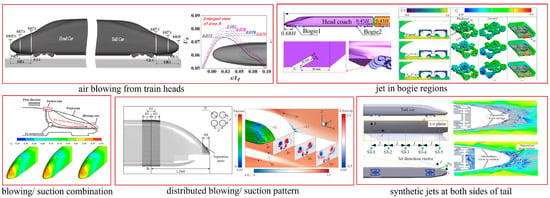
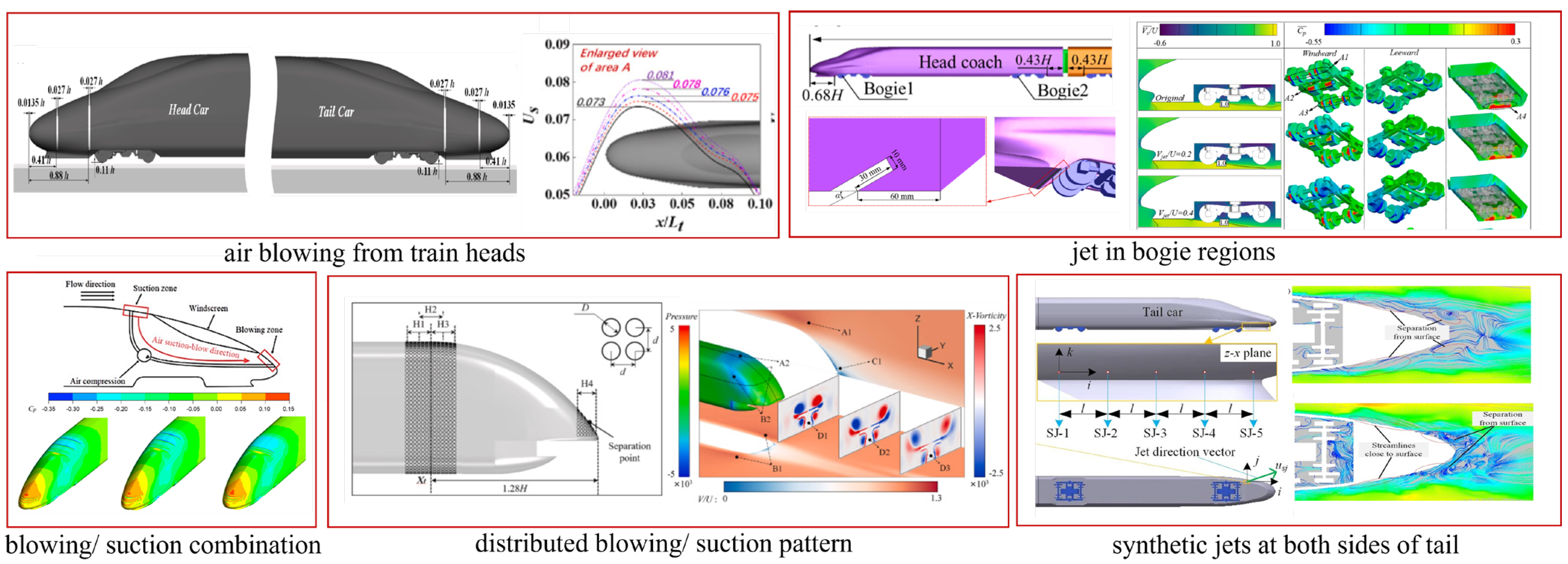
The earliest train-related AFC studies mainly focused on drag reduction, because aerodynamic drag is still the most direct penalty for high-speed operation (see Figure 2). Chen et al. [33] showed that air blowing from the nose region can reduce the overall drag of a high-speed train by modifying the pressure distribution established near the front part of the body. Che et al. [28] studied blowing and suction on a high-speed maglev train and found that the control affected both drag and lift. Cui et al. [29] used a suction–blowing combination at the tail of a 400 km/h Electric Multiple Unit (EMU) and reported improved pressure recovery in the rear region. These studies all use fluidic actuation, but the physical mechanisms are not the same. Nose blowing mainly changes the upstream pressure loading and the downstream development of the boundary layer. Tail suction and blowing act more directly on rear-end pressure recovery. In maglev studies, the control may influence both drag-related and lift-related pressure components at the same time.
Figure 2.
AFC aiming at reducing aerodynamic drag of trains (adapted from [28,29,30,33,37]).
More recent studies have shown that train AFC in open air should not be understood only as drag control. The wake behind the train is also an important control target, because it is related not only to drag, but also to slipstream and flow unsteadiness. Chen and Wang [30] placed synthetic jets on both sides of the tail car and reported reductions in aerodynamic drag, wake fluctuation, and the unsteadiness of side force on the tail car. They also observed a reduction in slipstream amplitude in the near wake. This result is important because it shows that the tail region is a multi-objective control zone. In this region, one actuation strategy may influence drag, wake stability, and slipstream behavior at the same time.
This point is further supported by the sweeping jet on a generic model of a slanted-base cylinder. These studies should not be regarded as a separate canonical AFC topic unrelated to trains. Instead, they are highly relevant to train-tail flow control, because the authors explicitly treat the slanted-base cylinder as a generic model for the rear flow of a high-speed train. In Chen et al. [56], sweeping jets weakened and displaced the afterbody vortices, shortened the low-pressure region on the slanted base, and changed the wandering behavior of the vortex system. In Chen et al. [57], stronger sweeping jets produced larger gross drag reduction, but the energy efficiency of the control decreased rapidly, and net energy saving was found only within a narrow low-momentum range. Chen et al. [58] and Chen, Zhong et al. [48] further explained the unsteady mechanism of this control process. Their results showed how the oscillatory jet penetrates into the vortex pair, injects disturbances into the core region, and causes periodic deformation and circulation change in the vortices. Chen, Zhong et al. [59] also showed that the interaction between multiple sweeping jets is itself an important design issue. For train aerodynamics, these studies are useful because they show that tail control is not only about shifting one separation point. It is also about reorganizing the streamwise-vortex system that determines rear pressure recovery and induced flow.
Several important lessons can be drawn from this group of studies. Train-tail AFC should be evaluated from a multi-objective viewpoint, because the rear flow affects drag, wake stability, and slipstream at the same time. Gross aerodynamic improvement is not enough; the control must also be evaluated from the perspective of net energy benefit. This point is especially important for railway applications, where system efficiency matters as much as aerodynamic performance. Furthermore, sweeping jets may offer a useful compromise between steady blowing and synthetic jets, because they can provide unsteady flow control without moving external parts. However, this potential has not yet been validated on a full train configuration.
Related studies on bluff bodies and road vehicles support the same general idea. Barros et al. [60], Li et al. [61], and Zhang et al. [62] showed that pulsed jets, steady blowing, and other actuation methods can reorganize the wake and increase base pressure behind bluff bodies or road-vehicle afterbodies. These studies are helpful for understanding the general control logic. However, the wake of a high-speed train is more complicated than the wake of a simple bluff body, because it is influenced by long upstream boundary-layer development, ground effect, underbody flow, and bogie-related structures. Therefore, the most reliable transfer is at the level of mechanism and control logic, rather than at the level of exact actuator parameters or expected drag-reduction percentages.
A final point concerns train type. Results from maglev studies are useful when the main mechanism is located on the external streamlined surface, such as tail pressure recovery or tunnel-entry loading. However, they are less directly applicable to conventional wheel–rail trains in problems dominated by bogies, underbody cavities, and near-ground flow, because the guideway clearance, underbody layout, and the absence of exposed bogies make the maglev flow environment quite different [28,36].
3.2. Crosswind Load Control
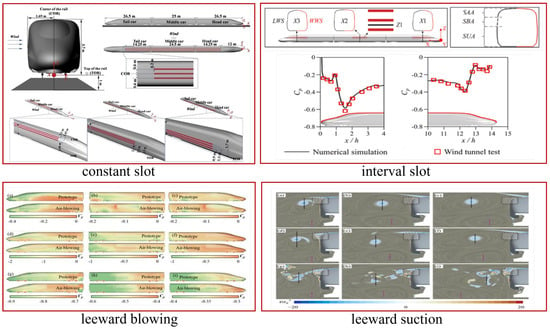
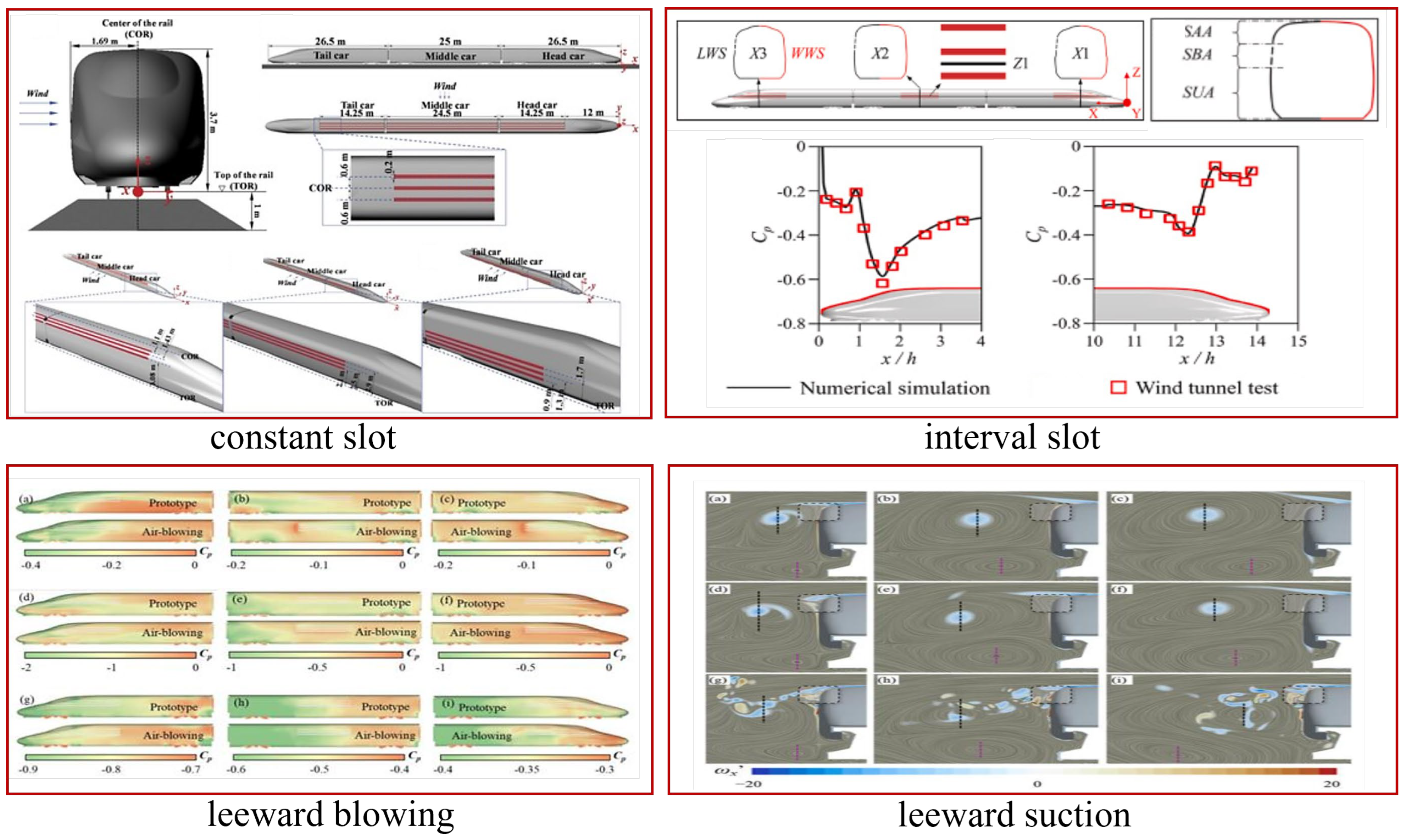
Crosswind control is one of the most important and most distinctive application areas of AFC for high-speed trains, and is shown in Figure 3. In this case, the main problem is not streamwise drag, but lateral aerodynamic loading. The key quantities are side force, lift, and rolling moment under yawed flow. Crosswind flow around a train is highly three-dimensional, and its effect depends on train speed, wind condition, embankment or bridge exposure, and the local infrastructure environment [17,18,43,46,63]. For this reason, crosswind AFC is different in nature from conventional drag-reduction control.
Figure 3.
AFC for train stability improvement under crosswind scenario (adapted from [32,35,36,47]).
Chen, Ni et al. [32] provided an important train-specific study by comparing blowing slots at different positions under crosswind conditions. Their results showed that the most effective blowing location depends on both the car position in the train set and the selected performance index. For the rolling moment around the leeward rail, the head car showed the largest reduction when blowing was applied at the leeward-middle position, while the middle and tail cars responded better to windward-lower blowing. The reported reductions were 18.5%, 21.7%, and 30.8%, respectively. The physical reason is that the control either created a protective air layer on the windward lower side or delayed the development of leeward-side vortex separation, thereby reducing the aerodynamic effect of the incoming crosswind.
Later studies further clarified the importance of the leeward side as a sensitive control region. Guo, Chen et al. [35] studied leeward-side air blowing at different yaw angles and showed that its effectiveness depends strongly on how the actuation interacts with local separation and wake asymmetry. Chen, Guo, Che et al. [47] compared different leeward-side blowing layouts and again found that the aerodynamic benefit is highly location-dependent. Guo, Guo et al. [36] investigated leeward suction and blowing on a high-speed maglev train and also concluded that the leeward side is a key region for active control under crosswind. Taken together, these studies show that crosswind AFC should not be understood simply as adding blowing to a train under yawed flow. Its real purpose is to modify the leeward separated flow and the resulting pressure asymmetry.
Although the present results are encouraging, the current evidence still has important limitations. Most studies are carried out at fixed yaw angles, while real crosswinds are unsteady and often gust-like. In addition, most published results focus on aerodynamic coefficients, whereas practical railway safety depends on the coupled response of the train, track, and sometimes bridge system. Many studies also assume idealized slot geometry and idealized actuation capability, without discussing control robustness, actuator failure, or the response speed required for realistic gust events. Therefore, the current literature already shows that active mitigation of crosswind loads is aerodynamically feasible, but it does not yet demonstrate that a full railway application would be sufficiently robust under realistic atmospheric conditions.
Since real crosswind exposure is transient, future studies should report a response-time budget rather than only steady-yaw force coefficients. A useful engineering requirement is
where the total delay should be much smaller than the characteristic gust time scale. Otherwise, the commanded actuation may arrive after the peak disturbance or introduce a phase lag that reduces stability. This issue is especially important for closed-loop leeward-side blowing or suction, where aerodynamic authority, sensor bandwidth, actuator rise time, and vehicle dynamic response must be evaluated together.
This is also the reason why crosswind AFC is one of the most likely train applications to require feedback or adaptive control. In open-air drag reduction, a pre-set open-loop strategy may sometimes be sufficient. In crosswind conditions, however, the disturbance is uncertain and changes in time. Studies on road vehicles under crosswind gusts have shown that feedback control can be useful when the goal is to suppress disturbance response rather than only reduce a mean aerodynamic coefficient [64]. The same implication is relevant for trains. Future crosswind AFC is likely to depend more on sensing, state estimation, and adaptive control than many current open-loop CFD studies suggest.
3.3. Bogie and Underbody Induced-Flow Manipulation
Compared with the nose and tail, the bogie and underbody regions are less prominent, but they are often more difficult to optimize and remain aerodynamically important. Experimental and numerical studies have shown that bogies and underbody details strongly affect drag, near-wake development, and slipstream behavior. Studies on moving-ground simulation, wheel and rail representation, and bogie geometry also show that this region is highly flow-sensitive and cannot be treated as a secondary detail [15,16,41,42,45,55].
Recent studies have begun to apply control-oriented ideas to this topic. Zhang et al. [65] used diversion slots near the bogie region and showed that the local underbody flow can be guided in a way that reduces drag. Strictly speaking, this is a passive flow-control measure rather than active flow control. However, it is still highly relevant because it demonstrates that the bogie region is a high-leverage aerodynamic zone. Huang et al. [37] moved one step closer to AFC by introducing a jet slot in front of the leading bogie. They reported reductions in drag and changes in underbody slipstream. This suggests that front-bogie actuation may influence not only the local cavity flow, but also the downstream flow penalty distribution of the whole train.
The importance of this region becomes even clearer when slipstream is considered. Slipstream safety is closely related to the velocity field near the ground and near the tail, and both the underbody and the wake contribute to it. Chen and Wang [30] showed that synthetic jets near the tail can suppress wake motion and reduce slipstream amplitude in the wake region. Chen et al. [66] further reported, on a train-tail-relevant slanted-base-cylinder model, that sweeping jets reduced the total induced velocity by 17.7% at a velocity ratio of 6.4. These findings are important because they show that AFC in the tail region can contribute not only to drag reduction but also to trackside safety. In other words, even if the train body is already globally streamlined, AFC can still be valuable because the remaining task is to control the induced-flow footprint rather than to redesign the whole outer shape.
This broader viewpoint also helps explain the relevance of semi-active or deployable concepts. Dunlop and Thompson [49] studied retractable stationary surfaces for reducing train slipstream. Their method is not a classical fluidic AFC technique, but it follows the same mission-adaptive idea. A device that can be deployed only when slipstream mitigation is needed may still be understood as part of the same wider control strategy. Such studies are useful because they show that future train flow control may include not only blowing and suction, but also hybrid passive–active or deployable concepts.
At the same time, the bogie and underbody region is one of the most difficult places for practical application. Any device installed in this area must withstand contamination, ballast impact, dust, snow, and demanding maintenance conditions. This makes underbody AFC both attractive and difficult. It is attractive because the flow there remains highly sensitive. It is difficult because the railway operating environment is harsh. For this reason, future studies should evaluate bogie-region AFC not only in terms of drag coefficient reduction but also in terms of underbody slipstream, maintenance accessibility, and fault tolerance.
The practical integration of underbody AFC also requires structural and manufacturing assessment. Fluidic slots, ducts, compressor connections, and removable panels should not reduce fatigue life, compromise stiffness, or obstruct routine inspection. Recent railway topology-optimization studies on bolster beams, motor supports, and bogie frames show that lightweight structural redesign must be combined with manufacturing constraints, dynamic load cases, and stress-based verification [67,68,69]. In the same way, an AFC device in the underbody should be evaluated as part of the vehicle structure rather than as an isolated aerodynamic device.
3.4. Tunnel-Related Aerodynamic Control
Tunnel aerodynamics provide some of the clearest examples of why AFC for high-speed trains should be considered in a mission-based way. The main tunnel-related aerodynamic problems include pressure-wave generation at tunnel entry, wave propagation and reflection inside the tunnel, micro-pressure-wave radiation, and transient pressure loading on the train surface. These are strongly event-dependent problems. They are not continuously present during the whole journey, but become important during specific rail line segments and short time periods. Tunnel aerodynamics has been widely studied using passive solutions, such as flared portals, tunnel hoods, and optimized nose shapes, and these measures remain essential [4,7,50,51]. However, both passive infrastructure measures and passive train geometry are fixed solutions, while the actual operating event can vary with train speed, tunnel type, and traffic condition.
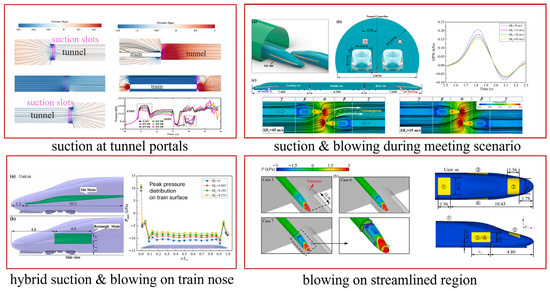
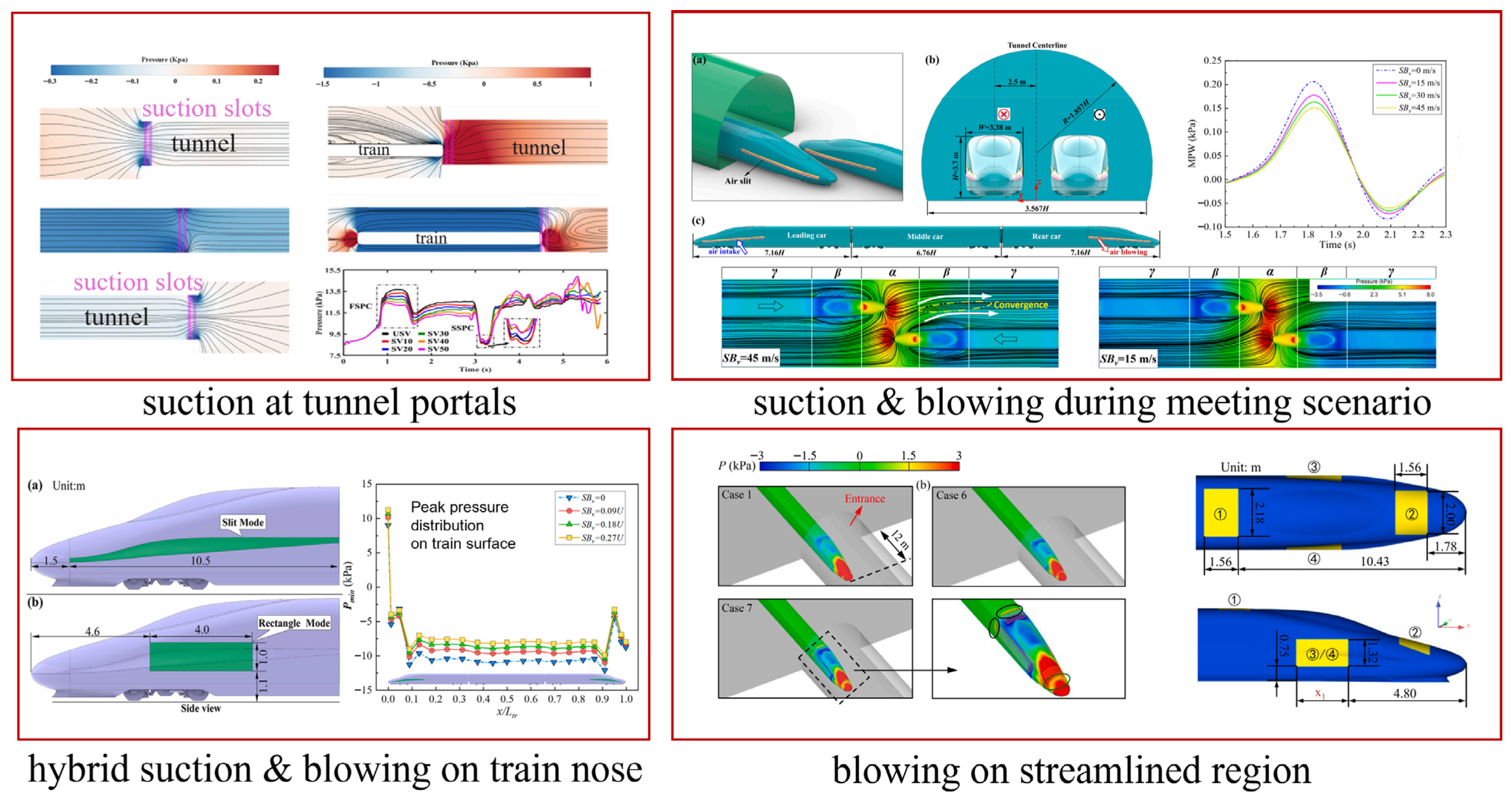
For this reason, recent AFC studies on train–tunnel interaction are especially important, see Figure 4. Chen et al. [31] proposed a suction method to mitigate tunnel pressure waves generated by high-speed maglev trains. Jin et al. [38] studied the effects of air-bleeding and blowing interface parameters in streamlined regions of the train on tunnel pressure waves. Li et al. [39] investigated active airflow control at the front and rear nose regions and found that increasing the slit area reduced the peak-to-peak pressure fluctuations both on the train surface and on the tunnel wall. In their study, a slit area of 4 m2 eliminated the original 4.8% pressure difference between two symmetric points on the train body, and both pressure and slipstream indicators decreased approximately linearly with slit area. Later studies extended this idea to hybrid suction–blowing control at the nose and to train-meeting events in tunnels under ultra-high-speed conditions [34,40].
Figure 4.
AFC strategies on mitigating tunnel pressure waves (adapted from [31,34,38,40]).
Tunnel-related AFC is different from most open-air AFC applications because its activation logic is naturally event-based. The train knows its location, speed, and tunnel approach in advance. Therefore, in principle, the control system can be activated only during the short time period when tunnel pressure-wave mitigation is needed. This is a major advantage, because it means that the actuation does not have to operate continuously during the whole journey. From an engineering viewpoint, this makes the energy requirement more favorable than in always-on control strategies. It also suggests that AFC for the tunnel scenario may become one of the earliest realistic applications of feedforward aerodynamic control in railway systems.
However, the current literature is still dominated by numerical studies and idealized actuation models. Important practical issues, such as actuator response speed, acoustic side effects, coordination with tunnel pressure-monitoring systems, and fail-safe operation, have not yet been sufficiently studied. Therefore, the present literature already shows that tunnel AFC has clear aerodynamic potential, but it does not yet provide a complete system-level solution for real railway deployment.
For tunnel events, feedforward control is attractive because the tunnel location and train speed are known before entry. Nevertheless, the supervisory controller and the local actuator layer must be synchronized with sufficient temporal accuracy. The actuation command should be scheduled according to train position, speed, tunnel geometry, and actuator rise time so that blowing or suction is already effective during the pressure-wave generation period. Poor synchronization may not only reduce the benefit but also create additional pressure fluctuations during high-speed tunnel entries or train-meeting events.
4. Transferable Insights from Canonical AFC Studies
As train-specific AFC studies are still limited, it is useful to consider related work on bluff bodies, road vehicles, airfoils, and cylinders. However, such studies should not be transferred to railway applications simply because the geometries look similar. A more reasonable basis for transfer is the similarity of flow physics. In other words, the key question is whether the controlled mechanism in the surrogate problem is relevant to a train aerodynamic problem, such as wake and base-pressure control at the tail, leeward-side separation under crosswind, or induced-flow generation near the rear of the train.
Among the available surrogate studies, road vehicles and Ahmed-type bodies provide the most direct reference for train tail and wake control. Barros et al. [60] showed that pulsed actuation on bluff afterbodies can increase base pressure and reorganize wake structures. Li et al. [61] further showed that, under yawed conditions, bi-frequency forcing can change the wake-control mechanism of a road vehicle. Zhang et al. [62] also demonstrated that steady blowing on an Ahmed body can improve pressure recovery in the rear region. These studies are relevant to high-speed trains because the tail car remains an important pressure-recovery region, even when the upstream part of the train has already been highly streamlined. At the same time, the transfer has clear limits. Compared with road vehicles or simplified bluff bodies, a train has a much longer body, stronger ground effect, longer upstream boundary-layer development, and more complex interaction with the bogie and underbody flow. Therefore, these studies are most useful for understanding mechanisms and control logic, rather than for directly predicting actuator settings or aerodynamic gains for trains.
In this context, studies of sweeping jets on slanted-base-cylinders are especially important. These studies provide a more convincing bridge between canonical AFC and train-tail aerodynamics. Chen et al. [56,57] explicitly treated the slanted-base-cylinder wake as a train-tail-like afterbody-vortex system. Later, Chen et al. [58] and the phase-resolved studies by Chen et al. [48] and Chen et al. [59] further explained the interaction between sweeping jets and the vortex system, as well as the effects of actuator synergy. For the present review, the value of this series lies in showing that train-tail control is closely related to the manipulation of streamwise vortices, rear pressure recovery, and induced-flow behavior, rather than only to a simple shift in a separation point.
Airfoil and separated lifting-surface studies provide a different type of reference. Greenblatt and Wygnanski [27] showed that periodic excitation can delay flow separation and modify lift-related aerodynamic behavior. Cattafesta and Sheplak [22] and Corke et al. [23] further showed that relatively small perturbations introduced by synthetic jets or plasma actuators can alter flow receptivity and change force and moment characteristics. For high-speed trains, the main relevance of this literature lies in local separation control under crosswind, especially near the roof and leeward edges. However, the analogy should not be overstated. Crosswind flow over a train is not a two-dimensional airfoil problem. It is a three-dimensional, bluff-body, ground-affected flow over a long multi-car vehicle. Therefore, airfoil AFC studies are more useful as references for actuator concepts and control ideas than as direct evidence of train aerodynamic performance.
Studies on cylinders and other canonical bluff bodies are even more important from the viewpoint of control methodology. Kim and Bewley [24] established a linear-systems framework that has strongly influenced modern flow control. Rowley and Dawson [25] showed how reduced-order modeling can support controller design, and Brunton and Noack [21] discussed both the progress and the challenges of closed-loop turbulence control. Choi et al. [26] remains an important review for bluff-body flow control more generally. More recently, Brunton et al. [70], Rabault et al. [71], and Ren et al. [72,73] extended the field through data-driven, reinforcement-learning, and model-free control methods for separated flows. These studies cannot replace train-specific aerodynamic research, but they provide useful methods for future railway AFC, especially when the control problem is recognized as distributed, uncertain, and multi-objective.
Overall, the main lesson from canonical AFC studies is not that their results can be directly applied to trains. Rather, their value lies in helping researchers identify transferable mechanisms, actuator concepts, and control strategies (Table 2). In this sense, the adjacent AFC literature should be used to support train research where the physical connection is clear, while the limits of transfer should always be stated explicitly.
Table 2.
Representative AFC evidence organized by train problem class, with train-native studies, transferable surrogate studies, and the main unresolved gaps.
Accordingly, canonical AFC studies should be transferred to high-speed trains at the level of the mechanism, not at the level of actuator parameters or guaranteed full-scale gains. The main technical risk is that a control mechanism demonstrated in CFD or at reduced scale may weaken at real-vehicle scale because of Reynolds-number effects, natural turbulence, ground motion, ballast contamination, multi-car interaction, yaw-angle fluctuation, tunnel compressibility, and long-term actuator degradation. A validation hierarchy is therefore required before any AFC concept can be considered railway-ready.
5. Recent AFC Strategies in Railway Operation
Open-loop AFC still dominates the current literature on high-speed trains. This is because it is easier to implement in CFD and parametric studies. Train-related AFC research is still at an early stage, so many studies focus first on whether a given actuation method can produce a useful aerodynamic effect. Additionally, some railway aerodynamic events are naturally predictable. For example, tunnel entry, tunnel exit, and known infrastructure transitions can all be identified in advance from train position and speed. Under such conditions, pre-set suction or blowing may already provide a large part of the possible benefit. This idea is supported by recent tunnel-oriented studies, such as those by Chen et al. [31], Li, Gu et al. [39], and Li et al. [40] (see Table 2 and Table 3).
Table 3.
Quantitative comparison of AFC evidence (same references as in Table 2).
However, open-loop control is unlikely to be sufficient for all important railway applications. This is particularly true for crosswind problems. Baker [17] and Baker et al. [18] showed that crosswind exposure depends strongly on route condition, terrain, and surrounding infrastructure. Gallagher et al. [46] also showed that the aerodynamic response can differ considerably between full-scale measurements, model tests, and CFD, because the actual inflow and exposure conditions are different in each case. Wake and slipstream behavior near platforms, embankments, or other nearby structures may also change from one location to another. In these situations, a fixed pre-designed control law is less attractive, because the real disturbance may differ from the assumed one. A control system that can respond to the actual flow state is therefore more desirable. A similar conclusion was reported by Pfeiffer and King [64] for road vehicles under crosswind gusts, where feedback control improved disturbance rejection.
For this reason, the future of railway AFC will probably not be based on a simple choice between open-loop and closed-loop control. A more realistic direction is a layered or hierarchical control architecture. At the local level, individual actuators may still use relatively simple actuation laws. At the supervisory level, however, the control system can use information such as route position, train speed, onboard pressure signals, inertial response, weather data, and possibly local flow sensing to identify the current operating condition and then allocate aerodynamic control accordingly. This idea is consistent with the general development of modern AFC. Rowley and Dawson [25] emphasized the importance of reduced-order models for compact flow representation and controller design. Kim and Bewley [24] and Brunton and Noack [21] remain important references for feedback-oriented flow control. Brunton et al. [70] further showed that model-based methods and data-driven methods are increasingly used together rather than treated as competing approaches.
Based on the above, machine learning should be regarded as a supporting tool rather than as a complete solution by itself. Data-driven methods have already been used in fluid mechanics for flow modeling, reduced-order representation, and control-oriented analysis, as reviewed by Brunton et al. [70] and Li et al. [74]. They have also shown potential for control-policy design in canonical active flow-control problems, as discussed by Rabault et al. [71] and Ren et al. [72,73]. For railway applications, the most realistic roles of machine learning are likely to be flow-state classification, actuator scheduling, and control allocation under changing operating conditions. Machine-learning-based optimization has also influenced drag-control studies on canonical configurations. One representative example is the explorative gradient method applied to the slanted Ahmed body by Li et al. [75]. Even so, railway applications will almost certainly require hybrid strategies in which data-driven methods are constrained by physical understanding, operational logic, and safety requirements (See Table 4).
Table 4.
Comparison of control patterns for high-speed train AFC.
Finally, engineering constraints, as listed in Table 3, must be treated as a central issue. AFC devices installed on a train must operate reliably under rain, dust, and long maintenance intervals. Their power consumption should be evaluated against net traction-energy benefit, not only against gross drag reduction. Possible acoustic penalties, actuator degradation, and failure modes must also be considered. In this respect, the study of Chen et al. [57] clearly showed that a larger drag reduction does not necessarily mean better energy efficiency. This lesson is highly important for railway AFC. In future research, aerodynamic benefit, energy cost, robustness, and maintainability should be evaluated together, because only such a system-level assessment can show whether AFC is truly practical for railway operation.
5.1. Energy Feasibility and Net Benefit of AFC
AFC feasibility should be evaluated by net energy benefit rather than by gross drag reduction alone. For a train running at speed U, the instantaneous traction-power saving associated with drag reduction can be written as
The corresponding net benefit is
where Pact is the actuator input power and Paux includes compressor, duct, valve, sensor, controller, and auxiliary-system losses. A route-level assessment should integrate this balance over the mission profile:
AFC is energetically meaningful for drag reduction only when Enet is positive under realistic duty cycle, degradation, and maintenance conditions.
A compact reporting index is
Values above unity indicate positive instantaneous power balance, while values below unity mean that the actuator consumes more power than the aerodynamic saving it creates. Another useful approach is to convert actuator power into an equivalent drag coefficient:
where .
The controlled configuration is beneficial only if CD,eq is lower than the baseline CD,0. These simple indices would make future train AFC studies more comparable and directly address the distinction between gross aerodynamic benefit and net energy gain.
Please note, the importance of actuation energy is mission-dependent. For drag-reduction-oriented AFC, net energy efficiency should be the primary criterion, whereas for crosswind-stability control and tunnel-pressure-wave mitigation, energy consumption can be considered a secondary objective once higher-priority safety, stability, and comfort requirements are satisfied.
5.2. Structural Integration, Durability, and Maintainability
AFC hardware must be integrated with the railway vehicle structure. Nose slots and internal ducts may interact with crash-energy absorption, coupler layout, sealing, and maintenance access, while underbody actuators are exposed to ballast impact, dust, water, ice, snow, vibration, and frequent inspection requirements. Dynamic stress analysis of bogie structures has long been used to evaluate railway-component reliability under operational loads [76]. Recent topology-optimization studies on railway bolster beams, motor supports, and bogie frames further show that manufacturability, lightweight design, and stress constraints must be considered together [67,68,69]. The same philosophy should be applied to AFC; aerodynamic devices should be assessed as structural, maintainable, and replaceable subsystems.
5.3. Explainable and Fail-Safe Control Logic
Machine-learning-assisted AFC should not be presented as a black-box replacement for physical modeling in safety-critical railway operation. Neural-network controllers may be useful for flow-state classification, reduced-order modeling, or supervisory scheduling, but certification will require interpretable control logic, bounded operating envelopes, and fail-safe fallback modes. The argument by Rudin [77] that high-stakes decisions should favor interpretable models is directly relevant to railway AFC. A practical architecture should therefore combine physical constraints, reduced-order models, transparent decision rules, actuator health monitoring, and conservative fallback to passive operation if sensor or actuator faults are detected.
5.4. Acoustic and Environmental Side Effects
AFC should also be evaluated against acoustic objectives. High-frequency pulsing, synthetic jets, plasma actuation, or compressed-air discharge may introduce tonal or broadband noise near platforms, tunnels, and urban regions. This potential penalty is important because quiet-train initiatives already treat aerodynamic noise as a major design issue for high-speed rail. Future studies should therefore report acoustic indicators such as sound pressure level, overall sound pressure level, or one-third-octave spectra together with drag, slipstream, pressure-wave, and energy metrics.
6. From Local to Mission-Adaptive Aerodynamic Control
The most important conclusion from the current literature is not that one specific actuator has already solved the aerodynamic problems of high-speed trains. A more meaningful conclusion is that AFC should be understood in a mission-adaptive way. Different operating scenarios require different aerodynamic priorities, and these priorities are not the same. In open-air operation, the main concern may be drag reduction and wake control. On a viaduct under strong crosswind, the priority may become the reduction in rolling moment and lateral aerodynamic load. At tunnel entry, the main objective may be pressure-wave mitigation. Near platforms or other sensitive infrastructure, slipstream control may become more important. Once this is recognized, AFC is no longer a single-purpose technology. Instead, it becomes a method for applying aerodynamic control according to the actual operating scenario.
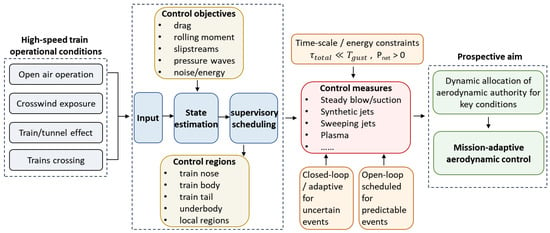
From an engineering viewpoint, a practical AFC system for high-speed trains is likely to have a hierarchical structure, as shown in Figure 5. The basic idea is that the train should not use the same aerodynamic control strategy in all situations. Instead, a supervisory mission layer first identifies the current operating condition by using route information, wind forecast, and onboard sensing, for example, open-air running, crosswind exposure, train–tunnel interaction, or train passing. After that, the system determines the main control objective for that condition, such as drag reduction, rolling-moment suppression, slipstream mitigation, pressure-wave alleviation, or a balance between aerodynamic benefit and energy cost. It then allocates control authority to the most relevant region of the train, such as the nose, body side, tail, underbody, or other local zones, and selects an appropriate control measure, including steady blowing or suction, synthetic jets, sweeping jets, or plasma actuation. Predictable events such as tunnel entry can use scheduled feedforward control, while uncertain events such as gusty crosswinds require feedback or gain-scheduled logic. The architecture could also include a fallback path so that the train returns to passive-safe operation if sensing, communication, or actuation fails. In this way, AFC is not treated as a single fixed device, but as a mission-adaptive aerodynamic control framework that activates different control actions according to different railway operating scenarios.
Figure 5.
A supervisory mission layer links operating events to control objectives, control zones, and open-loop or closed-loop logic.
The existing literature already provides some support for this framework. Studies on the tail and wake region suggest that local unsteady actuation can modify train-relevant afterbody vortices and induced flow, especially when pressure recovery and slipstream are considered together [30,48,56,57,58]. Crosswind studies indicate that the most effective control should focus on sensitive separation regions, especially the leeward side and roof-edge area, rather than being distributed uniformly over the whole train body [32,35,47]. Tunnel-related studies show that nose-based suction or blowing is naturally suitable for route-linked and event-triggered control [31,39,40]. Studies on the underbody and bogie region further suggest that these local regions may be more valuable control targets than some already optimized outer surfaces [16,37,65].
To move the field beyond proof-of-concept numerical studies, several steps are needed. Future studies should evaluate multiple aerodynamic outputs at the same time. These should include not only drag, but also lateral force, rolling moment, slipstreams, tunnel pressure wave, and actuator power consumption. More validation is needed through wind-tunnel tests, moving-model experiments, and eventually full-scale measurements on instrumented trains. The field needs a set of representative benchmark problems covering at least several important mission classes, such as open-air wake control, crosswind disturbance rejection, and tunnel-event mitigation. The choice of control strategy should depend on the physical nature of the problem. Scheduled open-loop control may remain the most practical choice for predictable events, while closed-loop and adaptive control are more suitable for scenarios with strong uncertainty, especially crosswinds.
A validation hierarchy should be adopted. The first level is mechanism-oriented CFD or canonical surrogate experiments, which are useful for identifying sensitive flow structures. The second level is train-specific CFD with realistic geometry, moving ground, bogie/underbody details, and actuator-loss models. The third level is wind-tunnel or moving-model testing that can assess wake, slipstream, pressure-wave, and crosswind transients with controlled uncertainty. The fourth level is full-scale measurement on instrumented trains, including pressure, inertial, trackside wind/slipstream, and actuator-power data. The final level is integrated system demonstration, where aerodynamic authority, net energy balance, durability, acoustic impact, maintainability, fail-safe behavior, and certification constraints are evaluated together.
From this viewpoint, the future of train aerodynamics should not be seen as a competition between passive design and active control. A more realistic and useful perspective is to design in layers. Passive geometry still defines the basic aerodynamic capability of the train, while AFC is introduced only when the operating scenario requires additional local control. This is the meaning of mission-adaptive aerodynamic control proposed in this review. It is not simply a new term, but a design framework that better matches the real operating conditions of high-speed railways.
7. Conclusions
This review has shown that the case for AFC in high-speed trains does not arise from the failure of passive aerodynamic design, but from its success. After decades of streamlining and local optimization, the remaining aerodynamic problems are no longer dominated by one global shape variable. Instead, they are increasingly local, strongly constrained by engineering requirements, and different from one operating scenario to another. Drag reduction, crosswind safety, slipstream control, and tunnel pressure mitigation cannot all be optimized by one fixed geometry.
When the existing literature is reorganized by train aerodynamic problem rather than by actuator type, a clearer picture emerges. Train-specific studies already show that local blowing, suction, synthetic jets, and related strategies can affect drag, wake structure, lateral aerodynamic loads, slipstream, and tunnel pressure waves. At the same time, surrogate-model studies are useful only when the underlying flow mechanism is truly relevant to trains. Taken together, the current evidence suggests that the most promising AFC targets are not simply the easiest places to actuate, but the flow regions where passive geometry has the least remaining flexibility and the operating objective changes most sharply.
The next research step should therefore be a shift from isolated local actuation to mission-adaptive aerodynamic control with explicit feasibility criteria. For predictable events, such as tunnel passage or other route-linked operations, scheduled open-loop control may already be practical if actuator timing and duty cycle are validated. For uncertain disturbances, especially crosswinds, future systems will need sensing, state estimation, response-time budgeting, and some degree of feedback or adaptation. More importantly, AFC should not be evaluated only by one favorable aerodynamic coefficient. Drag, side force, rolling moment, slipstream safety, pressure-wave mitigation, actuator power, auxiliary losses, durability, acoustic effects, maintenance access, and fault tolerance must be considered together.
The broader implication is that the central design demand is changing. Instead of pursuing the best fixed train shape, future research should focus on the best combination of passive shape and selective active control over the whole mission profile. AFC is promising but not yet industrially mature; its practical value depends on positive route-level net energy balance, validated full-scale control authority, robust sensor–actuator integration, maintainability, acoustic acceptability, explainable and certifiable control logic, fail-safe operation, etc. In this sense, AFC is valuable not because it replaces passive design, but because it gives an already optimized train a new capability: the ability to redistribute aerodynamic authority in time and space.
Author Contributions
Conceptualization, L.S. and X.C.; methodology, K.W.; software, Y.L.; formal analysis, L.S.; investigation, L.S. and K.W.; resources, T.L.; writing—original draft preparation, L.S.; writing—review and editing, K.W. and X.C.; funding acquisition, T.L. All authors have read and agreed to the published version of the manuscript.
Funding
This research was funded by the National Natural Science Foundation of China, grant number 52472373 and 52502458, Scientific Research Fund of Hunan Provincial Education Department, grant number 25A0021, and Natural Science Foundation of Hunan Province, grant number 2024JJ6518.
Institutional Review Board Statement
Not applicable.
Informed Consent Statement
Not applicable.
Data Availability Statement
No new data were created or analyzed in this study.
Conflicts of Interest
Authors Li Sheng and Kaimin Wang were employed by the company CRRC Zhuzhou Co Ltd. The remaining authors declare that the research was conducted in the absence of any commercial or financial relationships that could be construed as a potential conflict of interest.
References
- Baker, C. The flow around high speed trains. J. Wind Eng. Ind. Aerodyn. 2010, 98, 277–298. [Google Scholar] [CrossRef] [Scilit]
- Baker, C.J. A review of train aerodynamics. Part 1: Fundamentals. Aeronaut. J. 2014, 118, 201–228. [Google Scholar] [CrossRef] [Scilit]
- Baker, C.J. A review of train aerodynamics. Part 2: Applications. Aeronaut. J. 2014, 118, 345–382. [Google Scholar] [CrossRef] [Scilit]
- Niu, J.; Sui, Y.; Yu, Q.; Cao, X.; Yuan, Y. Aerodynamics of railway train/tunnel system: A review of recent research. Energy Built Environ. 2020, 1, 351–375. [Google Scholar] [CrossRef] [Scilit]
- Raghunathan, R.S.; Kim, H.-D.; Setoguchi, T. Aerodynamics of high-speed railway train. Prog. Aerosp. Sci. 2002, 38, 469–514. [Google Scholar] [CrossRef] [Scilit]
- Schetz, J.A. Aerodynamics of high-speed trains. Annu. Rev. Fluid Mech. 2001, 33, 371–414. [Google Scholar] [CrossRef] [Scilit]
- Srivastava, S.; Sivasankar, G.; Dua, G. A review of research into aerodynamic concepts for high speed trains in tunnels and open air and the air-tightness requirements for passenger comfort. Proc. Inst. Mech. Eng. Part F J. Rail Rapid Transit 2022, 236, 1011–1025. [Google Scholar] [CrossRef] [Scilit]
- Tian, H.-Q. Review of research on high-speed railway aerodynamics in China. Transp. Saf. Environ. 2019, 1, 1–21. [Google Scholar] [CrossRef] [Scilit]
- Muñoz-Paniagua, J.; García, J. Aerodynamic surrogate-based optimization of the nose shape of a high-speed train for crosswind and passing-by scenarios. J. Wind Eng. Ind. Aerodyn. 2019, 184, 139–152. [Google Scholar] [CrossRef] [Scilit]
- Muñoz-Paniagua, J.; García, J. Aerodynamic drag optimization of a high-speed train. J. Wind Eng. Ind. Aerodyn. 2020, 204, 104215. [Google Scholar] [CrossRef] [Scilit]
- Muñoz-Paniagua, J.; García, J.; Crespo, A. Genetically aerodynamic optimization of the nose shape of a high-speed train entering a tunnel. J. Wind Eng. Ind. Aerodyn. 2014, 130, 48–61. [Google Scholar] [CrossRef] [Scilit]
- Yao, S.-B.; Guo, D.-L.; Sun, Z.-X.; Chen, D.-W.; Yang, G.-W. Parametric design and optimization of high speed train nose. Optim. Eng. 2016, 17, 605–630. [Google Scholar] [CrossRef] [Scilit]
- Dai, Z.; Li, T.; Zhang, W.; Zhang, J. Investigation on aerodynamic characteristics of high-speed trains with shields beneath bogies. J. Wind Eng. Ind. Aerodyn. 2024, 246, 105666. [Google Scholar] [CrossRef] [Scilit]
- Gao, G.; Li, F.; He, K.; Wang, J.; Zhang, J.; Miao, X. Investigation of bogie positions on the aerodynamic drag and near wake structure of a high-speed train. J. Wind Eng. Ind. Aerodyn. 2019, 185, 41–53. [Google Scholar] [CrossRef] [Scilit]
- Wang, S.; Burton, D.; Herbst, A.H.; Sheridan, J.; Thompson, M.C. The effect of bogies on high-speed train slipstream and wake. J. Fluids Struct. 2018, 83, 471–489. [Google Scholar] [CrossRef] [Scilit]
- Wang, J.; Minelli, G.; Dong, T.; Chen, G.; Krajnovic, S. The effect of bogie fairings on the slipstream and wake flow of a high-speed train: An IDDES study. J. Wind Eng. Ind. Aerodyn. 2019, 191, 183–202. [Google Scholar] [CrossRef] [Scilit]
- Baker, C.J. A framework for the consideration of the effects of crosswinds on trains. J. Wind Eng. Ind. Aerodyn. 2013, 123, 130–142. [Google Scholar] [CrossRef] [Scilit]
- Baker, C.J.; Cheli, F.; Orellano, A.; Paradot, N.; Proppe, C.; Rocchi, D. Cross-wind effects on road and rail vehicles. Veh. Syst. Dyn. 2009, 47, 983–1022. [Google Scholar] [CrossRef] [Scilit]
- Li, W.; Liu, T.; Chen, Z.; Guo, Z.; Huo, X. Comparative study on the unsteady slipstream induced by a single train and two trains passing each other in a tunnel. J. Wind Eng. Ind. Aerodyn. 2020, 198, 104095. [Google Scholar] [CrossRef] [Scilit]
- Gilbert, T.; Baker, C.J.; Quinn, A.D. Aerodynamic pressures around high-speed trains: The transition from unconfined to enclosed spaces. Proc. Inst. Mech. Eng. Part F J. Rail Rapid Transit 2013, 227, 608–621. [Google Scholar] [CrossRef] [Scilit]
- Brunton, S.L.; Noack, B.R. Closed-loop turbulence control: Progress and challenges. Appl. Mech. Rev. 2015, 67, 050801. [Google Scholar] [CrossRef] [Scilit]
- Cattafesta, L.N.; Sheplak, M. Actuators for active flow control. Annu. Rev. Fluid Mech. 2011, 43, 247–272. [Google Scholar] [CrossRef] [Scilit]
- Corke, T.C.; Enloe, C.L.; Wilkinson, S.P. Dielectric barrier discharge plasma actuators for flow control. Annu. Rev. Fluid Mech. 2010, 42, 505–529. [Google Scholar] [CrossRef] [Scilit]
- Kim, J.; Bewley, T.R. A linear systems approach to flow control. Annu. Rev. Fluid Mech. 2007, 39, 383–417. [Google Scholar] [CrossRef] [Scilit]
- Rowley, C.W.; Dawson, S.T.M. Model reduction for flow analysis and control. Annu. Rev. Fluid Mech. 2017, 49, 387–417. [Google Scholar] [CrossRef] [Scilit]
- Choi, H.; Jeon, W.-P.; Kim, J. Control of flow over a bluff body. Annu. Rev. Fluid Mech. 2008, 40, 113–139. [Google Scholar] [CrossRef] [Scilit]
- Greenblatt, D.; Wygnanski, I.J. The control of flow separation by periodic excitation. Prog. Aerosp. Sci. 2000, 36, 487–545. [Google Scholar] [CrossRef] [Scilit]
- Che, Z.-X.; Huang, S.; Li, Z.-W.; Chen, Z.-W. Aerodynamic drag reduction of high-speed maglev train based on air blowing/suction. J. Wind Eng. Ind. Aerodyn. 2023, 233, 105321. [Google Scholar] [CrossRef] [Scilit]
- Cui, H.; Chen, G.; Guan, Y.; Deng, W. Study on aerodynamic drag reduction at tail of 400 km/h Electric Multiple Unit (EMU) with air suction-blowing combination. Machines 2023, 11, 222. [Google Scholar] [CrossRef] [Scilit]
- Chen, C.; Wang, D. Active flow control of a high-speed train wake using synthetic jets. Flow Turbul. Combust. 2023, 111, 439–461. [Google Scholar] [CrossRef] [Scilit]
- Chen, Z.-W.; Guo, Z.-H.; Ni, Y.-Q.; Liu, T.-H.; Zhang, J. A suction method to mitigate pressure waves induced by high-speed maglev trains passing through tunnels. Sustain. Cities Soc. 2023, 96, 104682. [Google Scholar] [CrossRef] [Scilit]
- Chen, Z.-W.; Ni, Y.-Q.; Wang, Y.-W.; Wang, S.-M.; Liu, T.-H. Mitigating crosswind effect on high-speed trains by active blowing method: A comparative study. Eng. Appl. Comput. Fluid Mech. 2022, 16, 1064–1081. [Google Scholar] [CrossRef] [Scilit]
- Chen, Z.-W.; Zeng, G.-Z.; Ni, Y.-Q.; Liu, T.-H.; Niu, J.-Q.; Yao, H.-D. Reducing the aerodynamic drag of high-speed trains by air blowing from the nose part: Effect of blowing speed. J. Wind Eng. Ind. Aerodyn. 2023, 238, 105429. [Google Scholar] [CrossRef] [Scilit]
- Gu, Y.; Ding, P.; Lu, C.; Luo, T.; Li, W. Reducing adverse tunnel aerodynamics via nose-based suction and blowing during ultra-high-speed trains meeting scenario. J. Wind Eng. Ind. Aerodyn. 2025, 266, 106209. [Google Scholar] [CrossRef] [Scilit]
- Guo, Z.-J.; Chen, Z.-W.; Che, Z.-X.; Bordbar, A.; Ni, Y.-Q. Using leeward air-blowing to alleviate the aerodynamic lateral impact of trains at diverse yaw angles. Phys. Fluids 2024, 36, 045121. [Google Scholar] [CrossRef] [Scilit]
- Guo, Z.-J.; Guo, Z.-H.; Chen, Z.-W.; Zeng, G.-Z.; Xu, J.-Q. On the active flow control in maglev train safety under crosswinds: Analysis of leeward suction and blowing action. Phys. Fluids 2024, 36, 095130. [Google Scholar] [CrossRef] [Scilit]
- Huang, S.; Li, Z.-W.; Peng, W.-J.; Lin, J.-R.; Huang, Z.-D.; Zeng, G.-Z. Effect of jet flow control in front of the leading bogie on the aerodynamic drag and underbody slipstream of high-speed trains. Eng. Appl. Comput. Fluid Mech. 2025, 19, 2447391. [Google Scholar] [CrossRef] [Scilit]
- Jin, K.; Zhang, L.; Li, X.; Li, L.; Chen, J.; Wang, J.; Niu, J. Effect of characteristic parameters of air-bleeding/blowing interface on tunnel pressure waves in streamlined regions of high-speed trains: A numerical simulation study. Sustain. Cities Soc. 2024, 102, 105222. [Google Scholar] [CrossRef] [Scilit]
- Li, W.; Gu, Y.; Su, H.; Zhao, W.; Deng, Y.; Fan, X. Mitigation of train-tunnel aerodynamics through active airflow control at front and rear noses: Impact of slit area. Phys. Fluids 2024, 36, 126140. [Google Scholar] [CrossRef] [Scilit]
- Li, W.; Gu, Y.; Zhao, W.; Deng, Y.; Fan, X. Alleviating tunnel aerodynamics through hybrid suction and blowing techniques applied to train nose sections. J. Wind Eng. Ind. Aerodyn. 2025, 256, 105961. [Google Scholar] [CrossRef] [Scilit]
- Bell, J.R.; Burton, D.; Thompson, M.C.; Herbst, A.H.; Sheridan, J. Wind tunnel analysis of the slipstream and wake of a high-speed train. J. Wind Eng. Ind. Aerodyn. 2014, 134, 122–138. [Google Scholar] [CrossRef] [Scilit]
- Bell, J.R.; Burton, D.; Thompson, M.C.; Herbst, A.H.; Sheridan, J. Moving model analysis of the slipstream and wake of a high-speed train. J. Wind Eng. Ind. Aerodyn. 2015, 136, 127–137. [Google Scholar] [CrossRef] [Scilit]
- Cheli, F.; Ripamonti, F.; Rocchi, D.; Tomasini, G. Aerodynamic behaviour investigation of the new EMUV250 train to cross wind. J. Wind Eng. Ind. Aerodyn. 2010, 98, 189–201. [Google Scholar] [CrossRef] [Scilit]
- Hemida, H.; Krajnovic, S. LES study of the influence of the nose shape and yaw angles on flow structures around trains. J. Wind Eng. Ind. Aerodyn. 2010, 98, 34–46. [Google Scholar] [CrossRef] [Scilit]
- Wang, S.; Burton, D.; Herbst, A.H.; Sheridan, J.; Thompson, M.C. The effect of the ground condition on high-speed train slipstream. J. Wind Eng. Ind. Aerodyn. 2018, 172, 230–243. [Google Scholar] [CrossRef] [Scilit]
- Gallagher, M.; Morden, J.; Baker, C.; Soper, D.; Quinn, A.; Hemida, H.; Sterling, M. Trains in crosswinds: Comparison of full-scale on-train measurements, physical model tests and CFD calculations. J. Wind Eng. Ind. Aerodyn. 2018, 175, 428–444. [Google Scholar] [CrossRef] [Scilit]
- Chen, Z.-W.; Guo, Z.-J.; Che, Z.-X.; Huang, Z.-D.; Ni, Y.-Q.; Wang, S.-M.; Huang, S.; Li, Z.-W.; Wang, Q.-X. Evaluation of active leeward side air-blowing layout on the lateral aerodynamic performance of high-speed trains in crosswinds environment: Sustainable and safe operation strategy. J. Wind Eng. Ind. Aerodyn. 2024, 247, 105695. [Google Scholar] [CrossRef] [Scilit]
- Chen, X.; Zhong, S.; Liu, T.; Ozer, O.; Gao, G. Manipulation of the flow induced by afterbody vortices using sweeping jets. Phys. Fluids 2024, 36, 035147. [Google Scholar] [CrossRef] [Scilit]
- Dunlop, J.A.; Thompson, M.C. Reducing slipstream velocities around high-speed trains through retractable stationary surfaces. Eur. J. Mech.-B/Fluids 2023, 100, 141–162. [Google Scholar] [CrossRef] [Scilit]
- Baron, A.; Mossi, M.; Sibilla, S. The alleviation of the aerodynamic drag and wave effects of high-speed trains in very long tunnels. J. Wind Eng. Ind. Aerodyn. 2001, 89, 365–401. [Google Scholar] [CrossRef] [Scilit]
- Howe, M.S.; Iida, M.; Fukuda, T.; Maeda, T. Theoretical and experimental investigation of the compression wave generated by a train entering a tunnel with a flared portal. J. Fluid Mech. 2000, 425, 111–132. [Google Scholar] [CrossRef] [Scilit]
- Chen, X.D.; Liu, T.H.; Zhou, X.S.; Li, W.H.; Xie, T.Z.; Chen, Z.W. Analysis of the aerodynamic effects of different nose lengths on two trains intersecting in a tunnel at 350 km/h. Tunn. Undergr. Space Technol. 2017, 66, 77–90. [Google Scholar] [CrossRef] [Scilit]
- Li, X.; Chen, G.; Zhou, D.; Chen, Z. Impact of Different Nose Lengths on Flow-Field Structure around a High-Speed Train. Appl. Sci. 2019, 9, 4573. [Google Scholar] [CrossRef] [Scilit]
- Niu, J.; Wang, Y.; Zhou, D. Effect of the outer windshield schemes on aerodynamic characteristics around the car-connecting parts and train aerodynamic performance. Mech. Syst. Signal Process. 2019, 130, 1–16. [Google Scholar] [CrossRef] [Scilit]
- Weidner, D.; Stoll, D.; Kuthada, T.; Wagner, A. Aerodynamics of high-speed trains with respect to ground simulation. Fluids 2022, 7, 228. [Google Scholar] [CrossRef] [Scilit]
- Chen, X.; Zhong, S.; Ozer, O.; Weightman, A. Control of afterbody vortices from a slanted-base cylinder using sweeping jets. Phys. Fluids 2022, 34, 075115. [Google Scholar] [CrossRef] [Scilit]
- Chen, X.; Zhong, S.; Ozer, O.; Weightman, A. Drag reduction of a slanted-base cylinder using sweeping jets. Phys. Fluids 2022, 34, 105101. [Google Scholar] [CrossRef] [Scilit]
- Chen, X.; Zhong, S.; Ozer, O.; Weightman, A.; Gao, G. On the unsteady interactions between a sweeping jet and afterbody vortices. Phys. Fluids 2023, 35, 105153. [Google Scholar] [CrossRef] [Scilit]
- Chen, X.; Zhong, S.; Liu, T.; Zhang, J.; Ozer, O.; Gao, G. Experimental study on the synergy of sweeping jets on the afterbody flows of a slanted-base cylinder. Aerosp. Sci. Technol. 2024, 148, 109096. [Google Scholar] [CrossRef] [Scilit]
- Barros, D.; Borée, J.; Noack, B.R.; Spohn, A.; Ruiz, T. Bluff body drag manipulation using pulsed jets and Coanda effect. J. Fluid Mech. 2016, 805, 422–459. [Google Scholar] [CrossRef] [Scilit]
- Li, R.; Borée, J.; Noack, B.R.; Cordier, L.; Harambat, F. Drag reduction mechanisms of a car model at moderate yaw by bi-frequency forcing. Phys. Rev. Fluids 2019, 4, 034604. [Google Scholar] [CrossRef] [Scilit]
- Zhang, B.F.; Liu, K.; Zhou, Y.; To, S.; Tu, J.Y. Active drag reduction of a high-drag Ahmed body based on steady blowing. J. Fluid Mech. 2018, 856, 351–396. [Google Scholar] [CrossRef] [Scilit]
- He, X.-H.; Li, H. Review of aerodynamics of high-speed train-bridge system in crosswinds. J. Cent. South Univ. 2020, 27, 1054–1073. [Google Scholar] [CrossRef] [Scilit]
- Pfeiffer, J.; King, R. Robust control of drag and lateral dynamic response for road vehicles exposed to cross-wind gusts. Exp. Fluids 2018, 59, 45. [Google Scholar] [CrossRef] [Scilit]
- Zhang, J.; Adamu, A.; Gidado, F.; Tang, M.; Ozer, O.; Chen, X. Flow control for aerodynamic drag reduction of a high-speed train with diversion slots on bogie regions. Phys. Fluids 2023, 35, 115111. [Google Scholar] [CrossRef] [Scilit]
- Chen, X.; Zhong, S.; Ozer, O.; Kennaugh, A.; Liu, T.; Gao, G. A study of spatiotemporal features of sweeping jets acting on afterbody vortices using low-operation-rate stereo PIV. Exp. Therm. Fluid Sci. 2024, 158, 111244. [Google Scholar] [CrossRef] [Scilit]
- Cascino, A.; Meli, E.; Rindi, A. Development of a methodology for railway bolster beam design enhancement using topological optimization and manufacturing constraints. Eng 2024, 5, 1485–1498. [Google Scholar] [CrossRef] [Scilit]
- Cascino, A.; Meli, E.; Rindi, A. Lightweight design and topology optimization of a railway motor support under manufacturing and adaptive stress constraints. Vehicles 2026, 8, 3. [Google Scholar] [CrossRef] [Scilit]
- Cascino, A.; Meli, E.; Rindi, A. Multi-stage topology optimization for structural redesign of railway motor bogie frames. Appl. Sci. 2026, 16, 973. [Google Scholar] [CrossRef] [Scilit]
- Brunton, S.L.; Noack, B.R.; Koumoutsakos, P. Machine learning for fluid mechanics. Annu. Rev. Fluid Mech. 2020, 52, 477–508. [Google Scholar] [CrossRef] [Scilit]
- Rabault, J.; Ren, F.; Zhang, W.; Tang, H.; Xu, H. Deep reinforcement learning in fluid mechanics: A promising method for both active flow control and shape optimization. J. Hydrodyn. 2020, 32, 234–246. [Google Scholar] [CrossRef] [Scilit]
- Ren, F.; Hu, H.B.; Tang, H. Active flow control using machine learning: A brief review. J. Hydrodyn. 2020, 32, 247–253. [Google Scholar] [CrossRef] [Scilit]
- Ren, F.; Wen, X.; Tang, H. Model-free closed-loop control of flow past a bluff body: Methods, applications, and emerging trends. Actuators 2024, 13, 488. [Google Scholar] [CrossRef] [Scilit]
- Li, Y.; Chang, J.; Kong, C.; Bao, W. Recent progress of machine learning in flow modeling and active flow control. Chin. J. Aeronaut. 2022, 35, 14–44. [Google Scholar] [CrossRef] [Scilit]
- Li, Y.; Cui, W.; Jia, Q.; Li, Q.; Yang, Z.; Morzynski, M.; Noack, B.R. Explorative gradient method for active drag reduction of the fluidic pinball and slanted Ahmed body. J. Fluid Mech. 2022, 932, A7. [Google Scholar] [CrossRef] [Scilit]
- Luo, R.K.; Gabbitas, B.L.; Brickle, B.V. Dynamic stress analysis of an open-shaped railway bogie frame. Eng. Fail. Anal. 1996, 3, 53–64. [Google Scholar] [CrossRef] [Scilit]
- Rudin, C. Stop explaining black box machine learning models for high stakes decisions and use interpretable models instead. Nat. Mach. Intell. 2019, 1, 206–215. [Google Scholar] [CrossRef] [Scilit] [PubMed]

Disclaimer/Publisher’s Note: The statements, opinions and data contained in all publications are solely those of the individual author(s) and contributor(s) and not of MDPI and/or the editor(s). MDPI and/or the editor(s) disclaim responsibility for any injury to people or property resulting from any ideas, methods, instructions or products referred to in the content. |
© 2026 by the authors. Licensee MDPI, Basel, Switzerland. This article is an open access article distributed under the terms and conditions of the Creative Commons Attribution (CC BY) license.