


Abstract
Highway merging and platoon formation are critical scenarios in heavy-duty vehicle aerodynamics. This study presents a transient computational fluid dynamics (CFD) analysis of two trucks undergoing a merging maneuver and subsequent platoon formation. A three-dimensional unsteady Reynolds-Averaged Navier–Stokes (uRANS) approach with the SST k–ω turbulence model is employed under zero-crosswind and yawed inflow conditions. The present work provides a time-resolved characterization of truck–truck aerodynamic interactions during dynamic spacing evolution, enabling the capture of unsteady wake effects that are not accessible in steady-state formulations commonly used in cooperative driving studies. Unlike previous steady analyses, the approach resolves transient wake development, vortex shedding, and their direct impact on instantaneous aerodynamic loads. Results identify three interaction regimes: weak interaction, strong wake interaction during wake impingement, and wake recovery at larger spacing. Under zero-crosswind conditions, significant drag reduction is observed, confirming platooning benefits. However, crosswind conditions substantially reduce this benefit and increase lateral loads due to asymmetric pressure distribution and wake deflection. A non-linear spacing–drag relationship is observed, governed by wake evolution and shear-layer interaction. These findings provide quantitative insight into transient aerodynamic interactions and highlight the importance of accounting for unsteady and crosswind effects in platoon performance assessment.
1. Introduction
Heavy-duty vehicles are the most fuel-consuming and emission-intensive category within the road transport sector. Since aerodynamic drag constitutes the dominant resistance component during high-speed cruising, improving the aerodynamic efficiency of trucks is of major importance for reducing operational costs and environmental impact [1,2]. Truck platooning, in which vehicles travel at reduced inter-vehicle spacing, has been widely investigated as a promising strategy for drag reduction through wake interaction and slipstream effects [3,4].
Crosswind effects are consistently identified in the literature as a critical factor influencing platooning performance. Even moderate crosswind angles can induce significant increases in drag and side forces, consequently reducing the benefits of the platoon in terms of fuel savings [5]. The degradation of drag reduction with increasing yaw angles and wind intensities is quantified in several studies, and different control strategies are proposed to counteract crosswind-induced instability [6]. The inter-vehicle spacing has also been identified as playing a determining role in aerodynamic interaction, with reduced spacing generally increasing drag reduction [2]. The mechanisms governing these phenomena are well documented: a reduced apparent wind speed is experienced by the trailing vehicles, and an increased base pressure due to the wake interaction is beneficial to leading vehicles [7,8].
Computational Fluid Dynamics (CFD) has become a principal tool for analyzing heavy-vehicle aerodynamics. Advanced turbulence modeling approaches [9], including Reynolds-Averaged Navier–Stokes (RANS) with the Shear Stress Transport (SST) k–ω model [10], Large Eddy Simulation (LES) [11,12], and Detached Eddy Simulation (DES) [13], have been employed to capture wake structures, pressure distributions, and unsteady aerodynamic forces. Validation based on experimental data obtained in wind tunnels and at full scale has increased confidence in CFD-based methodologies, and hybrid experimental-numerical approaches have further improved their predictive reliability [14,15]. In particular, ANSYS Fluent 2025 R1, a CFD-specialized module of ANSYS engineering simulation software, has proven robust capability in determining the aerodynamic coefficients of heavy vehicles under various operating conditions [16,17].
Numerous numerical investigations on the aerodynamic characteristics of vehicle platoons presented in the literature have been conducted in steady-state conditions [18,19], while the transient effects during highway merging scenarios remain insufficiently characterized. Real driving conditions involve continuous variations in vehicle spacing, relative motion, and exposure to unsteady crosswind disturbances, all of which generate time-dependent aerodynamic loads that cannot be fully captured by steady-state formulations [20]. Understanding these transient effects is essential for the development of both advanced driver assistance systems and autonomous vehicle control algorithms that can safely and efficiently manage platoon formation under realistic environmental and traffic conditions [21].
To address this gap, the present study investigates the transient aerodynamic behavior of two heavy-duty trucks during a highway merging and platoon formation process using a three-dimensional unsteady Reynolds-Averaged Navier–Stokes (uRANS) approach. Unlike previous steady-state studies, the proposed methodology resolves the time-dependent evolution of wake structures, pressure fields, and aerodynamic loads under both still-air and crosswind conditions, enabling a detailed assessment of unsteady vehicle–vehicle interactions.
The specific goals of the study are to:
- •
- Characterize the time-dependent evolution of aerodynamic drag and lateral forces during the vehicle merging scenario under both still-air and crosswind conditions.
- •
- Analyze the unsteady flow field, including wake deflection, pressure distributions, and velocity profiles, as inter-vehicle spacing decreases.
- •
- Quantify the impact of crosswind on vehicle aerodynamic efficiency during transient maneuvers.
- •
- Provide insights into the aerodynamic mechanisms governing truck–truck interactions in realistic highway traffic situations.
The paper is organized as follows: Section 2 presents the numerical strategy, including domain geometry, vehicle trajectories, mesh generation, turbulence modeling, boundary conditions, and dynamic mesh implementation. Section 3 presents the results for still-air and crosswind conditions, including the evolution of drag and side force coefficients and flow field analysis: pressure, velocity, and turbulent kinetic energy (TKE) distributions. Section 4 discusses the implications of the findings for vehicle design and control strategies, compares results with previous studies, and outlines limitations. Section 5 summarizes the main conclusions and suggests directions for future work.
2. Materials and Methods
2.1. Kinematic Model of the Vehicle Movement on the Acceleration Lane
For this study, a simplified geometry of a Mercedes-Benz Actros truck is adopted, representing a common vehicle used in European highway operations [22]. The model retains the essential aerodynamic features, such as the windshield, but omits other fine details in order to reduce computational cost. The overall dimensions are approximately 2.5 m in width, 3.6 m in height, and 10.5 m in length, consistent with typical Class 8 tractor specifications.
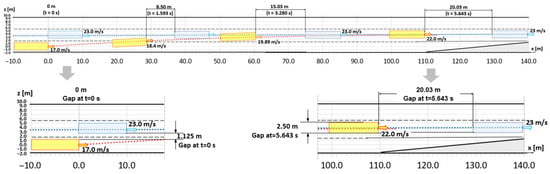
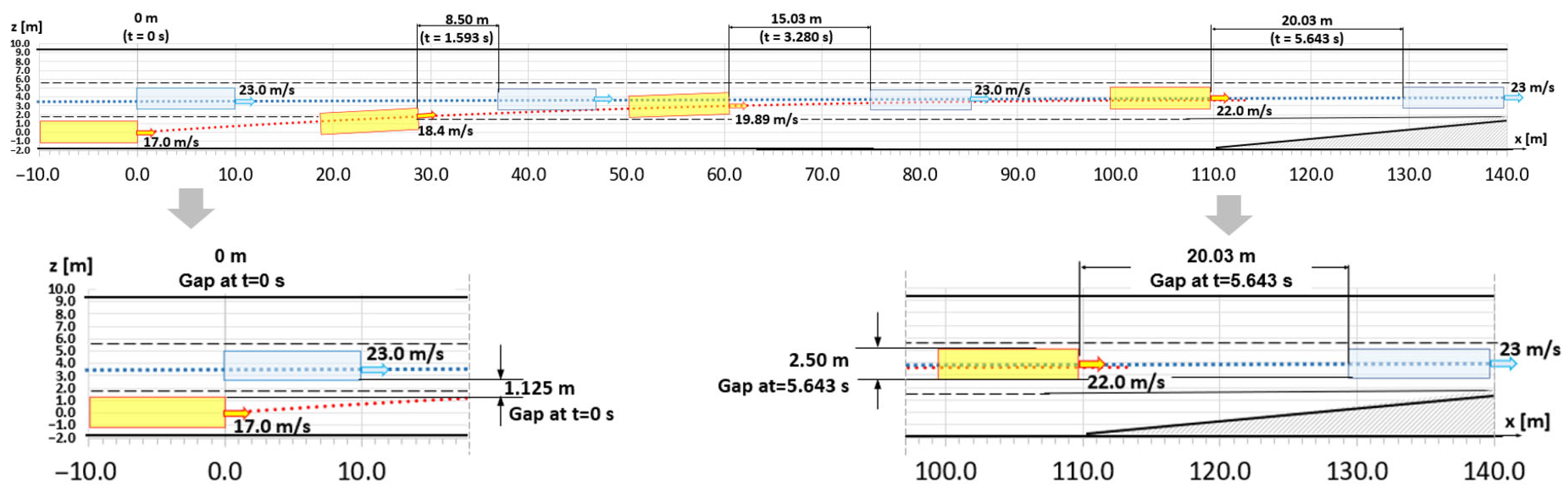
To simulate the highway merging maneuver of two European-style trucks within the CFD framework, a time-dependent kinematic model was developed to describe the trajectory and velocity of the vehicle traveling along the acceleration lane (highlighted in yellow in Figure 1). A Cartesian coordinate system was defined with x being the longitudinal direction of the highway (negative in the direction of motion) and z the transverse direction (positive from the acceleration lane toward the first highway lane). The vehicle motion was assumed to be uniformly accelerated with constant longitudinal and transverse acceleration components.
Figure 1.
Highway layout, truck trajectories and vehicle movement characteristics.
The geometric and kinematic input data for the trailing truck (yellow in Figure 1) are:
- •
- Length of merging section: s = 110 m
- •
- Initial speed: v0 = 17 m/s (61.2 km/h)
- •
- Final speed: v1 = 22 m/s (79.2 km/h)
- •
- Required lateral displacement: z1 = 3.625 m
At the end of the maneuver (t = T), the vehicle must reach the first lane: z(T) = z1 and move parallel to the highway axis: vz(T) = 0.
The vehicle trajectory and velocity were described using second-order, respectively, first-order time polynomials:
Assuming uniformly accelerated longitudinal motion over the merging length d, the maneuver duration is obtained from , which yields:
From the boundary conditions for the transverse motion, defined as , the initial transverse velocity and constant transverse acceleration are obtained:
This formulation ensures a parabolic lateral trajectory and zero transverse velocity at the end of the maneuver. From the magnitude of the initial velocity, prescribed as , it follows:
The longitudinal acceleration is obtained from the final velocity condition:
The resulting trajectory equations are:
and the corresponding velocity components:
The model presented in Figure 1 satisfies: x(0) = 0, z(0) = 0, ∣v(0)∣ = 17 m/s, z(T) = 3.625 m, vx(T) = 22 m/s, vz(T) = 0. Only a minor longitudinal discrepancy (of 0.137 m) relative to the prescribed merging length (110 m) results from strictly enforcing the velocity boundary conditions and is considered negligible for the present CFD application.
2.2. Numerical Methodology
2.2.1. Computational Domain and Boundary Conditions
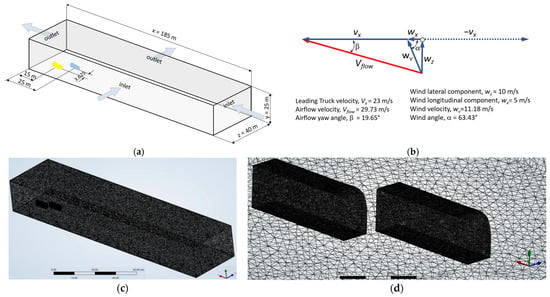
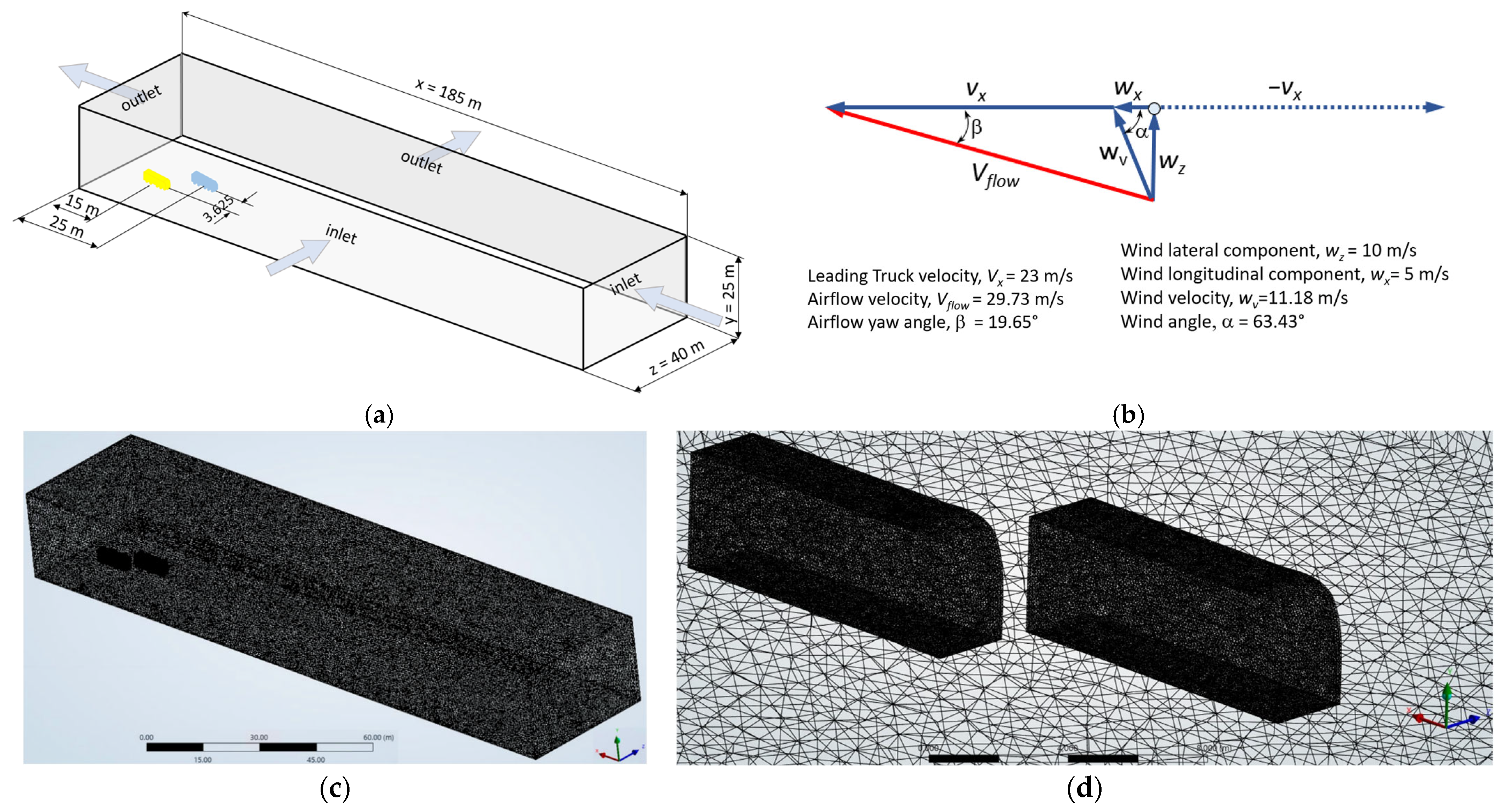
Two identical truck models are positioned within a computational domain (Figure 2a) representing a highway merging scenario (Figure 1). The leading truck (Truck 1) travels on the main highway lane at a constant longitudinal velocity of 23 m/s (82.8 km/h). The trailing truck (Truck 2) approaches from a lateral offset corresponding to the acceleration lane and gradually merges into the main lane behind Truck 1.
Figure 2.
(a) Computational domain dimensions, inlet and outlet boundaries; (b) Airflow configuration for the crosswind case; (c) Discretization of the computational domain; (d) Truck surface and ground discretization.
The computational domain extends approximately 18 vehicle lengths in the longitudinal direction (x = 185 m), 16 vehicle widths in the lateral direction (z = 40 m), and 7 vehicle heights in the vertical direction (y = 25 m). The domain dimensions were selected based on established guidelines for external vehicle aerodynamics, ensuring sufficient upstream and downstream extents to avoid boundary interference effects [23]. In particular, the downstream length allows adequate wake development, while the lateral and vertical dimensions minimize blockage and confinement, thereby enabling accurate capture of the aerodynamic interaction during the merging maneuver.
The blockage ratio for a single truck is therefore 0.9%, computed as:
Even when considering the presence of two vehicles, the maximum effective blockage ratio remains below 2%, which is well below commonly accepted limits for external aerodynamic simulations [1], so the confinement effects due to the finite domain size can be considered negligible.
At the initial simulation time:
- •
- Truck 1, travelling at 23 m/s on the first highway lane, has the center positioned 25 m upstream of the downstream boundary.
- •
- Truck 2, entering from the acceleration lane, has the center positioned 15 m upstream of the downstream boundary.
- •
- The initial longitudinal offset between the vehicle centers is therefore 10 m.
- •
- The initial lateral separation between the vehicle centers is 3.625 m.
- •
- This configuration provides sufficient downstream flow development while allowing accurate capture of aerodynamic interactions during the merging maneuver.
The inlet boundaries located at the upstream (−x) side and, in the crosswind case only, at the lateral (−z) side of the computational domain were defined as velocity inlets. Two flow configurations were considered:
- •
- Case 1—zero crosswind (still air)
- •
- Case 2—crosswind: a uniform wind velocity of 5 m/s in the x-direction and 10 m/s in the z-direction was imposed at the inlets, resulting in a total wind velocity of 11.18 m/s at an angle of 63.43° relative to the main axis of the vehicles.
For the crosswind simulations, assuming a truck velocity of 23 m/s, the resulting reference airflow velocity is 29.73 m/s, and the effective yaw angle induced by the crosswind is 19.65° relative to the main axis of the vehicles (Figure 2b). Air is modeled with standard properties: density 1.225 kg/m3, dynamic viscosity 1.7894 × 10⁻⁵ kg/(m·s), and the inlet turbulence intensity was set to 1%, with a turbulent viscosity ratio of 2.
The downstream (+x) boundary and the lateral boundaries were specified as pressure outlets with zero gauge pressure in the zero-wind case. In the crosswind case, the lateral (+z) boundary was defined as a pressure outlet with zero gauge pressure. The ground and upper boundary were modeled as stationary no-slip walls, while the vehicle surfaces were treated as no-slip walls with standard wall functions. Although a moving ground approach can reduce artificial boundary layer development upstream of the vehicle, the present stationary-ground formulation is consistent with the transient moving-mesh framework and provides a stable and consistent basis for analyzing vehicle–vehicle interaction and crosswind effects.
Vehicle motion was simulated using a dynamic deforming mesh technique, allowing the trucks to translate through the computational domain while the surrounding flow field evolved accordingly.
2.2.2. Physical and Turbulence Modeling
The three-dimensional, incompressible, uRANS equations are solved using the SST k-ω turbulence model [24]. This model combines the advantages of the k-ω formulation in the near-wall region with the k-ε behavior in the free-stream region, making it particularly suitable for external aerodynamic flows involving adverse pressure gradients and flow separation. The SST k-ω model has been widely validated for heavy vehicle aerodynamics and has demonstrated improved accuracy compared with standard and realizable k-ε models in predicting drag coefficients and wake structures [25,26]. While steady RANS provides a computationally efficient estimate of the mean flow field, uRANS was employed to capture the transient nature of the aerodynamic interaction between the vehicles [27]. In particular, uRANS resolves the time-dependent evolution of wake structures, including vortex shedding and shear-layer fluctuations, as well as the instantaneous pressure field associated with the relative motion of the trucks. This enables the analysis of force histories and the identification of peak aerodynamic loads, which are not accessible in a steady-state formulation [28]. The use of uRANS is therefore particularly suitable for capturing transient interaction effects and assessing their impact on vehicle stability under crosswind and variable-velocity conditions.
The governing equations include the continuity and momentum equations, together with the transport equations for TKE and specific dissipation rate. A blending function ensures a smooth transition between the near-wall k-ω formulation and the outer-region k-ε formulation. The model also includes an eddy-viscosity limiter to prevent excessive turbulence production in stagnation regions. The flow is modeled as fully turbulent, which is appropriate given the high Reynolds number of the problem (order of 107) and the bluff-body nature of the vehicle geometry. Under these conditions, transition to turbulence occurs close to the leading edges and has a negligible impact on the overall flow development. The SST k-ω model is therefore employed due to its robustness in predicting separated flows and shear-layer dynamics [25,26].
2.2.3. Mesh Quality and Dynamic Mesh Strategy
The computational domain was discretized using an unstructured tetrahedral mesh (Figure 2c) generated with the patch-conforming method. A global element size of 0.5 m was applied in the far-field region, while local refinement was introduced on the truck surfaces (Figure 2d) using a face sizing of 0.1 m in order to resolve pressure gradients and flow separation zones. For the grid-independence study discussed in Section 2.2.4, an additional refinement level with a face size of 0.05 m was also tested.
Boundary layer effects were modeled using five inflation layers applied to the truck surfaces, with a growth rate of 1.2 and a transition ratio of 0.272. The resulting near-wall resolution corresponds to y+ values in the range of approximately 400–850, which is suitable for wall-function treatment in high-Reynolds-number external aerodynamic flows. In this setup, the SST k–ω turbulence model was employed together with wall functions, as a near-wall mesh resolution corresponding to y+ ≈ 1 would not be computationally feasible for the present simulations.
The resulting mesh consists of 1,392,167 nodes and 693,888 elements. Mesh quality was evaluated using standard metrics:
- •
- Maximum aspect ratio: 2.755 (below the warning limit of 5)
- •
- Maximum skewness: 0.664 (below the warning limit of 0.9)
These values indicate acceptable mesh quality and smooth mesh gradation compatible with the near-wall requirements of the SST k-ω turbulence model and provide a reasonable balance between computational cost and accuracy for full-scale heavy-vehicle simulations.
To simulate the merging maneuver, a dynamic mesh approach was implemented in ANSYS Fluent. The trailing vehicle (Truck 2) follows a predefined trajectory combining lateral displacement (lane change) and longitudinal motion relative to Truck 1. The vehicle motion was defined using user-defined functions specifying the time-dependent velocity of Truck 2, while Truck 1 maintains a constant longitudinal velocity.
The merging trajectory represents a realistic highway lane-change maneuver with a smooth lateral transition over 5.8 s, during which the longitudinal spacing between the truck centerlines increases from 10 m to 30 m (approximately two vehicle lengths), while the lateral spacing between the centerlines decreases from 3.625 m to 0 m. However, to provide a more intuitive representation of the merging process, the results throughout this paper are reported using gap distances between the vehicles rather than centerline spacing. The longitudinal spacing is therefore defined as the gap between the rear of Truck 1 and the front of Truck 2, ranging from 0 m to 20 m, equivalent to 0–2 truck lengths (x/L). The lateral spacing is defined as the gap between the right rear corner of Truck 1 and the front left corner of Truck 2, varying from 1.125 m to −2.5 m during the merging maneuver. A schematic of the longitudinal and lateral spacing definitions used in the analysis is provided in Figure 1.
The dynamic mesh is updated at each time step using the smoothing and remeshing algorithms available in ANSYS Fluent, ensuring mesh quality is preserved throughout the vehicle motion. Mesh quality metrics were monitored during the simulation to maintain numerical stability.
2.2.4. Transient Formulation and Numerical Settings
A transient formulation was adopted in order to capture the time-dependent aerodynamic interactions occurring during the merging maneuver. Time discretization was performed using a first-order implicit scheme, ensuring numerical stability during dynamic mesh deformation.
The simulations were performed using the pressure-based solver in ANSYS Fluent. Pressure–velocity coupling was achieved using the SIMPLE algorithm [29].
Spatial discretization schemes [30] included:
- •
- Least-squares cell-based gradient reconstruction
- •
- Second-order scheme for pressure
- •
- Second-order upwind schemes for momentum, TKE, and specific dissipation rate
Convergence within each time step was monitored using residual reduction criteria below 10−3 for all transport equations.
The domain was initialized using Standard Initialization (Relative to Cell Zone) to provide a consistent and controlled starting condition. The initial velocity field was defined according to the inlet boundary conditions (vx = vz = 0 for the zero-wind case; vx = 5 m/s and vz = 10 m/s for the crosswind case). The initial turbulence quantities were set to match the inlet conditions (1% intensity, viscosity ratio of 2), resulting in TKE values of 1.5 × 10⁻⁸ m2/s2 for Case 1 and 0.1875 m2/s2 for Case 2, and specific dissipation rates of 0.000513 s−1 and 641.8 s−1, respectively. This approach minimizes artificial transients at the start of the simulation and ensures that the subsequent flow development is governed by vehicle motion and crosswind effects.
The transient simulation employed a time step of 0.0135 s, with 430 time steps and up to 20 iterations per time step. The time step was selected based on both Courant-Friedrichs-Lewy constraints and physical time-scale considerations. The resulting global Courant number is approximately 0.8 (remaining below 5 in locally refined regions with a characteristic size of 0.1 m), which is acceptable for the implicit solver used. In addition, the chosen time step corresponds to approximately 25 increments per characteristic convective time scale, providing adequate temporal resolution of the unsteady flow. At the end of the simulation, the distance between the trucks reaches approximately two vehicle lengths (2 x/L).
A combined grid and time-step sensitivity analysis was conducted to evaluate the numerical accuracy of the solution. The baseline mesh (surface size 0.1 m) was refined to 0.05 m, and the time step was reduced from 0.0135 s to 0.0016 s. The comparison, based on the time evolution of the aerodynamic coefficients (CD and CS), shows mean deviations below 4% for Truck 1 and below 7% for Truck 2 over the analyzed simulation interval (0–4.5 s). This interval captures the dominant aerodynamic interactions associated with the merging and platoon formation process, while the remaining simulation time primarily reflects wake recovery with limited influence on the reported trends. Considering the inherently unsteady nature of the flow, characterized by transient wake interactions and vehicle motion [13,27,28], the observed level of deviation is considered acceptable and consistent with values typically reported in uRANS simulations of bluff-body aerodynamics. Overall, the adopted spatial and temporal discretization is deemed sufficient to represent the main features of the transient aerodynamic behavior.
3. Results
3.1. Comparison with Steady-State CFD Simulations
The steady-state simulations are used here as a reference baseline for comparison with the transient merging results, as they provide a simplified representation of fully developed flow conditions under identical geometry and boundary conditions. This allows consistent normalization and direct comparison of aerodynamic force trends. However, under increasing crosswind intensity, unsteady effects become more pronounced, leading to expected deviations between steady-state and transient results.
The baseline simulation of an isolated truck under aligned flow conditions at a velocity of 28 m/s (approximately 100 km/h) yields a drag coefficient of CD ≈ 0.74, while the side force coefficient is negligible (CS ≈ 0) [18]. These values are consistent with previously reported data for similar heavy-duty trucks [5,20]. Under crosswind conditions, the aerodynamic loads increase significantly. For a lateral wind velocity of 10 m/s (corresponding to a relative airflow velocity of 29.73 m/s at a yaw angle of 19.65°, similar to Case 2 in the current study), the drag coefficient increases to CD ≈ 1.14, while the side force coefficient rises to CS ≈ 0.41 [18]. These results indicate the development of substantial lateral aerodynamic loads that may affect vehicle stability.
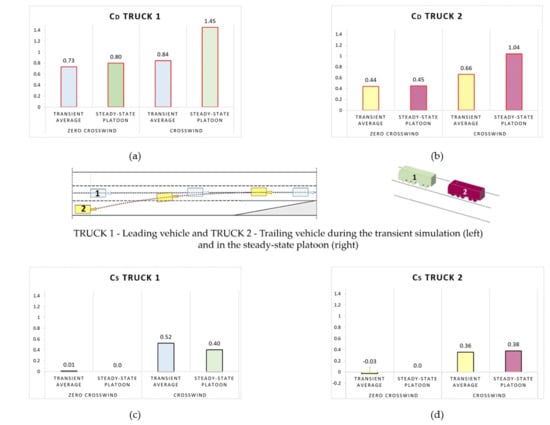
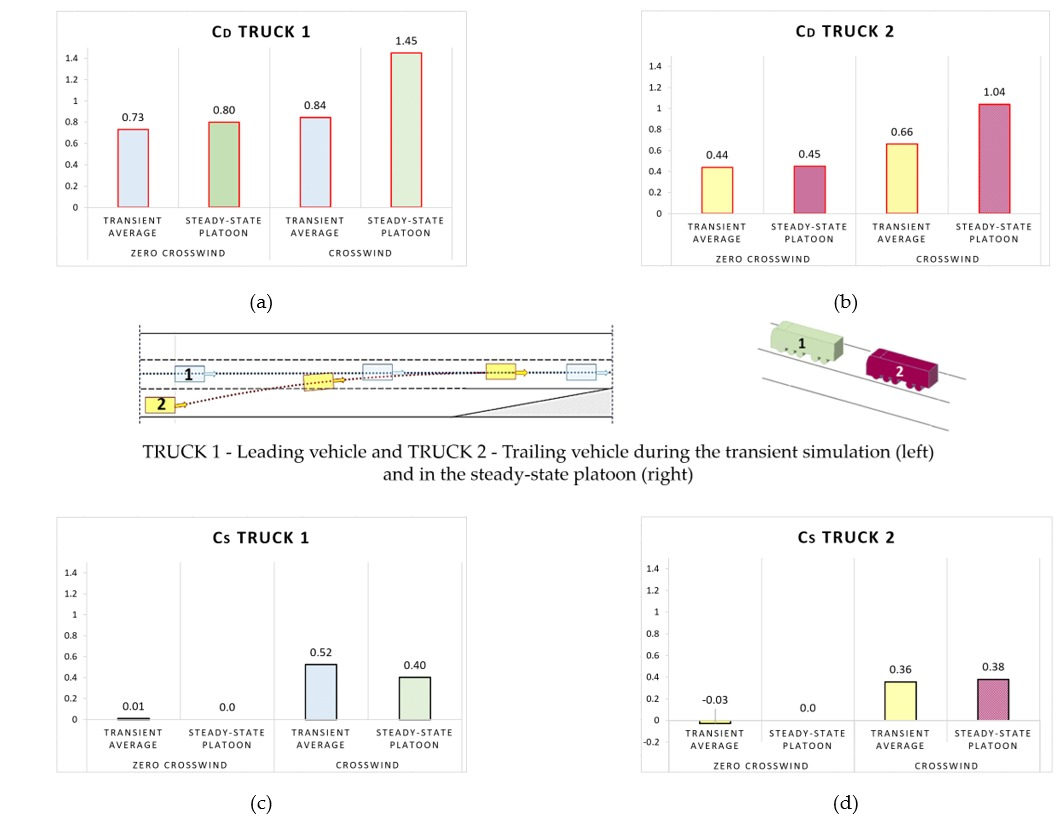
The drag and side force coefficients, computed as time-averaged values in the present transient simulations, are shown in Figure 3.
Figure 3.
Comparison between time-averaged transient aerodynamic coefficients and steady-state data [19] during the initial platoon phase: (a) Drag coefficient CD for Truck 1; (b) Drag coefficient CD for Truck 2; (c) Side force coefficient CS for Truck 1; (d) Side force coefficient CS for Truck 2.
To provide a reference for the present unsteady simulations, previously published steady-state results for a similar truck configuration are included in Figure 3. These correspond to the initial stage of platoon formation (phase 4 in Ref. [19]), where the trailing truck follows the leading vehicle at a distance of approximately half a vehicle length, with a velocity of 28 m/s under crosswind conditions. The flow conditions in the present study are fully consistent with those reported in Ref. [19], as both cases are defined by the same streamwise velocity (28 m/s) and crosswind component (10 m/s), resulting in identical inflow magnitude and yaw angle, thereby ensuring a meaningful comparison of aerodynamic coefficients. This comparison enables a direct assessment of the differences between steady-state and transient aerodynamic predictions.
The drag and side force coefficients are defined as
where and are the total aerodynamic forces in the streamwise and lateral directions, respectively, obtained in ANSYS Fluent by integrating pressure and viscous contributions over the vehicle surfaces [23,24]. A constant air density of = 1.225 kg/m3 is assumed. For normalization, the projected frontal area Aref = Ayz = 8.89 m2 is used for CD, while a projected lateral area Aref = Axy = 36.5 m2 is used for CS, ensuring consistency with previous studies [18,19]. The reference velocity is defined as vref = 23 m/s for the zero-wind case. For the crosswind case, vref = 29.73 m/s corresponds to the magnitude of the relative inflow velocity, accounting for both vehicle motion and crosswind components, with an associated yaw angle of 19.65°.
These results highlight the aerodynamic benefits of platooning, particularly under zero crosswind conditions where the trailing vehicle experiences an average drag reduction of 39.73% in the present study, while steady-state results report reductions up to 50% compared to the isolated truck case at vehicles distances of 0.5 x/L [19]. However, as wind intensity increases, the aerodynamic benefits diminish. Under representative crosswind conditions, drag reduction decreases to 21.43%, which lies within the reported range of 20–30% [13,19].
3.2. Transient Drag Evolution During Merging (Zero Crosswind)
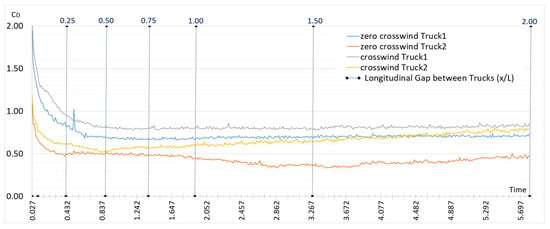
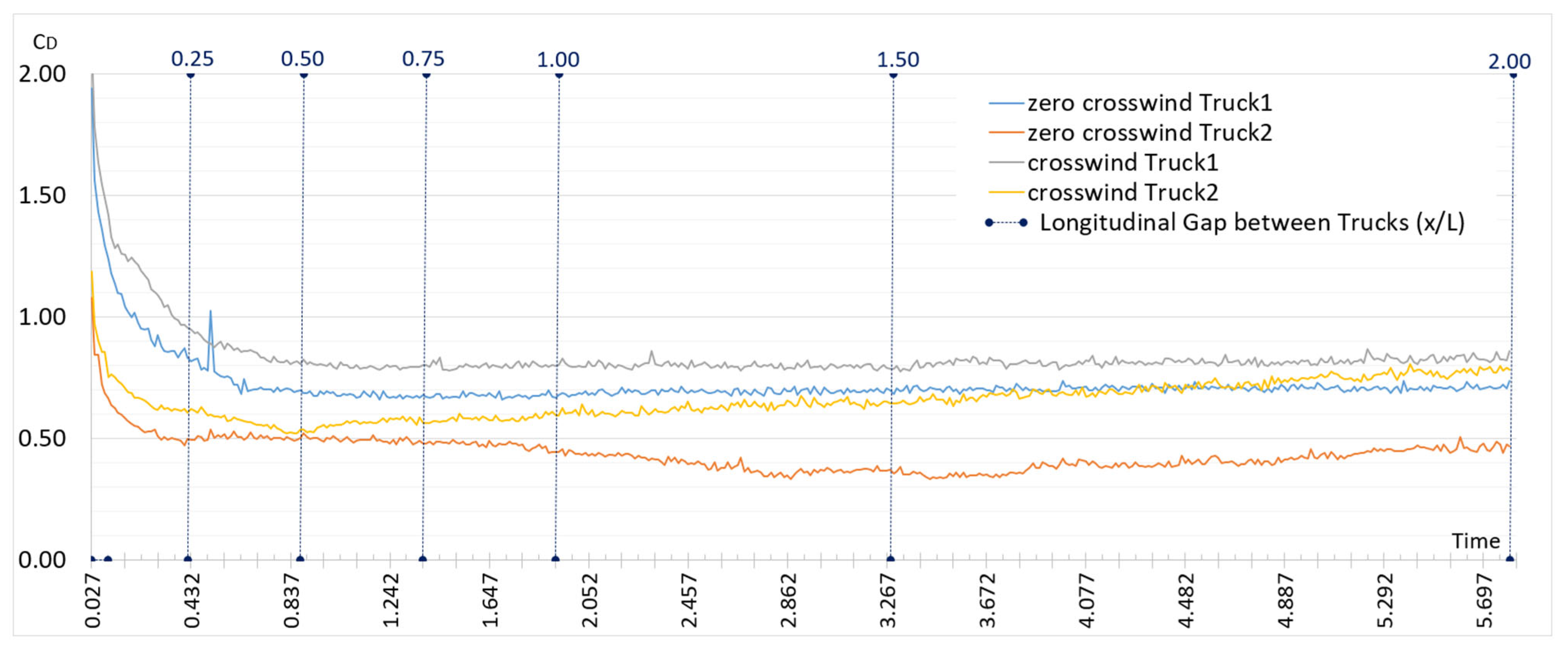
Figure 4 presents the time history of the drag coefficients for both trucks during the merging maneuver in Case 1. As the simulation progresses, the lateral spacing decreases while the longitudinal spacing increases, resulting in progressive wake interaction between the two vehicles.
Figure 4.
Time evolution of drag coefficients in the direction of travel (x) for Truck 1 and Truck 2, across Case 1 (zero-crosswind) and Case 2 (crosswind).
Following an initial interaction phase (t = 0–0.6 s), during which the surrounding airflow adjusts to the dynamic configuration, the drag coefficient of Truck 1 (leading vehicle) remains relatively constant at approximately CD ≈ 0.70, slightly lower than in the single truck aligned flow CD ≈ 0.74, in agreement with [13]. In contrast, Truck 2 (trailing vehicle) experiences a significant drag reduction as it enters the wake region of Truck 1. The drag coefficient decreases to approximately CD ≈ 0.50 for longitudinal spacing between 0.25 and 1.0 x/L. As the trailing truck aligns with the leading one, the drag reduction becomes more pronounced, reaching a minimum value of approximately CD ≈ 0.40.
This reduction is attributed to the lower dynamic pressure within the wake of the leading vehicle and the favorable pressure gradient generated by wake interaction. As the longitudinal spacing increases beyond approximately 1.5 x/L, the drag reduction gradually diminishes and the drag coefficient settles to a value of CD ≈ 0.50 at a spacing of 2 x/L.
The transient drag evolution exhibits a non-linear relationship with inter-vehicle spacing. The rate of drag reduction increases between 1 x/L and 1.5 x/L, indicating that the aerodynamic benefits of platooning are strongest at close longitudinal spacing. Nevertheless, partial wake shielding remains observable even at a spacing of up to 2 x/L. Small-amplitude oscillations in the drag coefficients are also present, which are attributed to unsteady wake structures and vortex shedding.
3.3. Transient Drag Evolution During Merging (Crosswind)
Figure 4 shows the drag coefficient evolution for both trucks during the merging maneuver in Case 2. The presence of crosswind, which tilts the airflow at a yaw angle of approximately 20°, significantly alters the aerodynamic interaction compared to Case 1.
After the initial interaction phase (t = 0–0.6s), the drag coefficient of Truck 1 remains relatively constant at approximately CD ≈ 0.80. The aerodynamic benefit observed under zero crosswind conditions is reduced due to the lateral deflection of the wake, which weakens the base pressure recovery behind the vehicle.
For Truck 2, the drag coefficient decreases as the vehicle enters the wake of Truck 1, reaching a minimum of CD ≈ 0.52 for longitudinal spacing between 0.25 and 0.5 x/L. However, the percentage drag reduction is significantly smaller than in Case 1. As the longitudinal spacing increases, the drag coefficient rises gradually, reaching approximately CD ≈ 0.78 at a spacing of 2 x/L.
This behavior results from the lateral deflection of the wake caused by the crosswind, which reduces the aerodynamic shielding experienced by the trailing vehicle. In addition, the yawed inflow produces an asymmetric pressure distribution around Truck 2, leading to increased aerodynamic drag during the merging process.
3.4. Side Force Evolution Under Crosswind
Figure 5 presents the time history of the side force coefficients for both trucks during the merging maneuver. Side force is a critical parameter for vehicle stability, as large lateral aerodynamic loads can significantly affect handling characteristics and may lead to lane departure or rollover, particularly for high center-of-gravity vehicles such as heavy-duty trucks [31].
Figure 5.
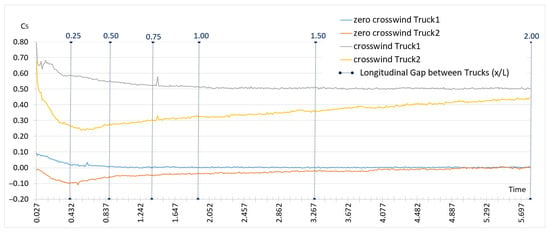
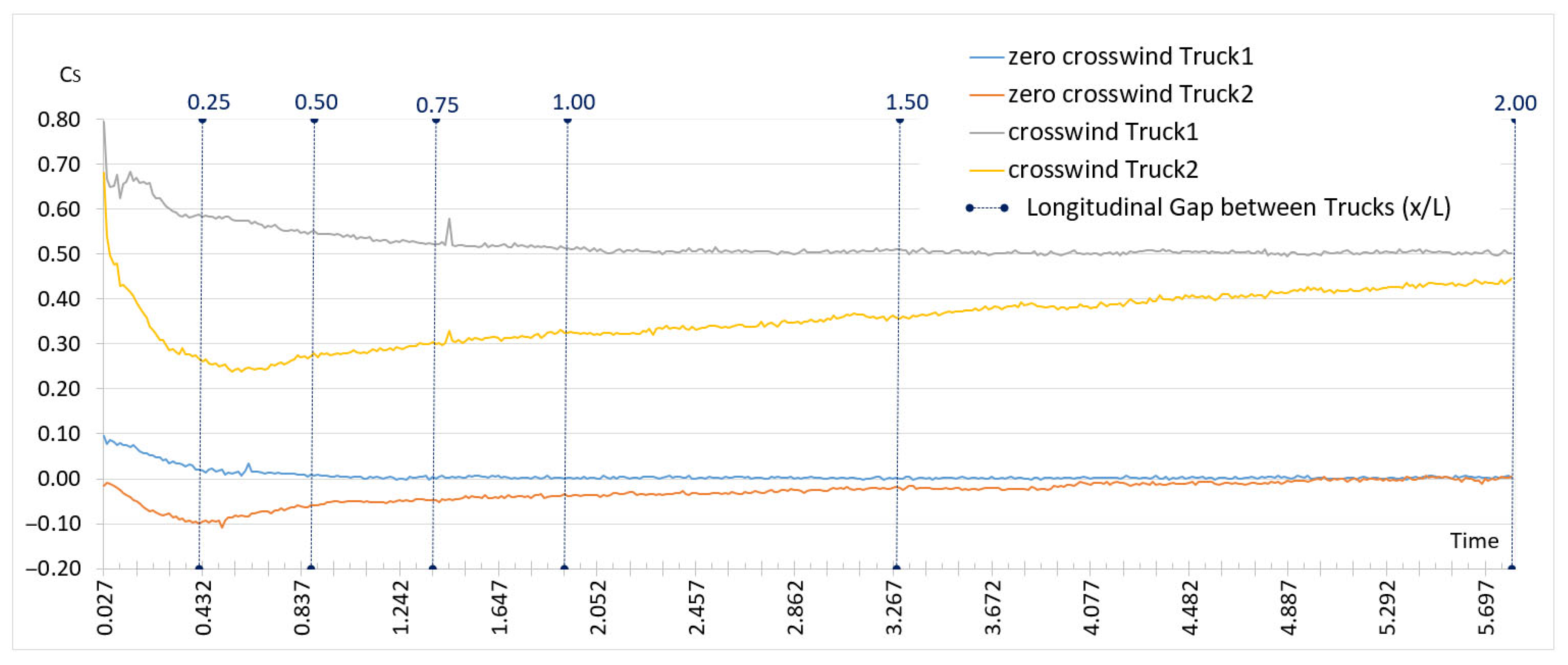
Time evolution of side force coefficients for Truck1 and Truck2, across Case 1 (zero-crosswind) and Case 2 (crosswind).
Case 1 exhibits negligible side force coefficients, serving as a baseline reference for comparison with the crosswind cases, where significant lateral loading is observed. For Case 2, the leading vehicle (Truck 1) exhibits a relatively stable side force coefficient throughout the maneuver, with values gradually decreasing toward CS ≈ 0.5. This indicates that the presence of Truck 2 has only a limited influence on the lateral aerodynamic load acting on the leading vehicle under crosswind conditions.
In contrast, Truck 2 experiences significant variations in side force during the merging maneuver. During the initial settling phase, the side force coefficient decreases to CS ≈ 0.24 as the vehicle enters the wake region of Truck 1, at a spacing below 0.5 x/L. As the longitudinal spacing increases and the sheltering effect diminishes, the side force gradually increases, reaching approximately CS ≈ 0.43 at a spacing of 2 x/L.
This behavior results from the complex interaction between the deflected wake of the leading vehicle and the asymmetric pressure distribution around the trailing truck. These transient side force fluctuations may present challenges for vehicle control systems and highlight the importance of accounting for crosswind effects in the design of platoon control strategies.
3.5. Flow Field Analysis (Zero-Crosswind)
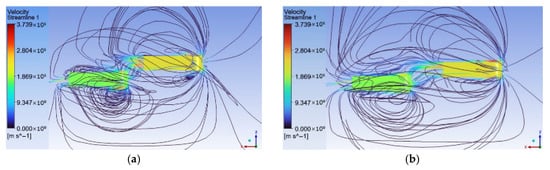
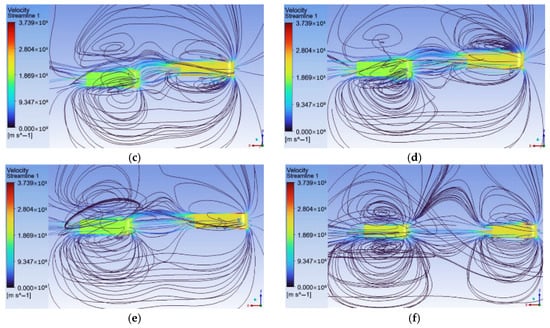
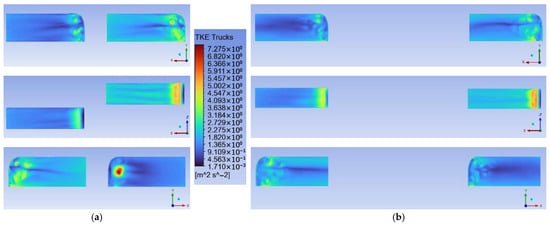
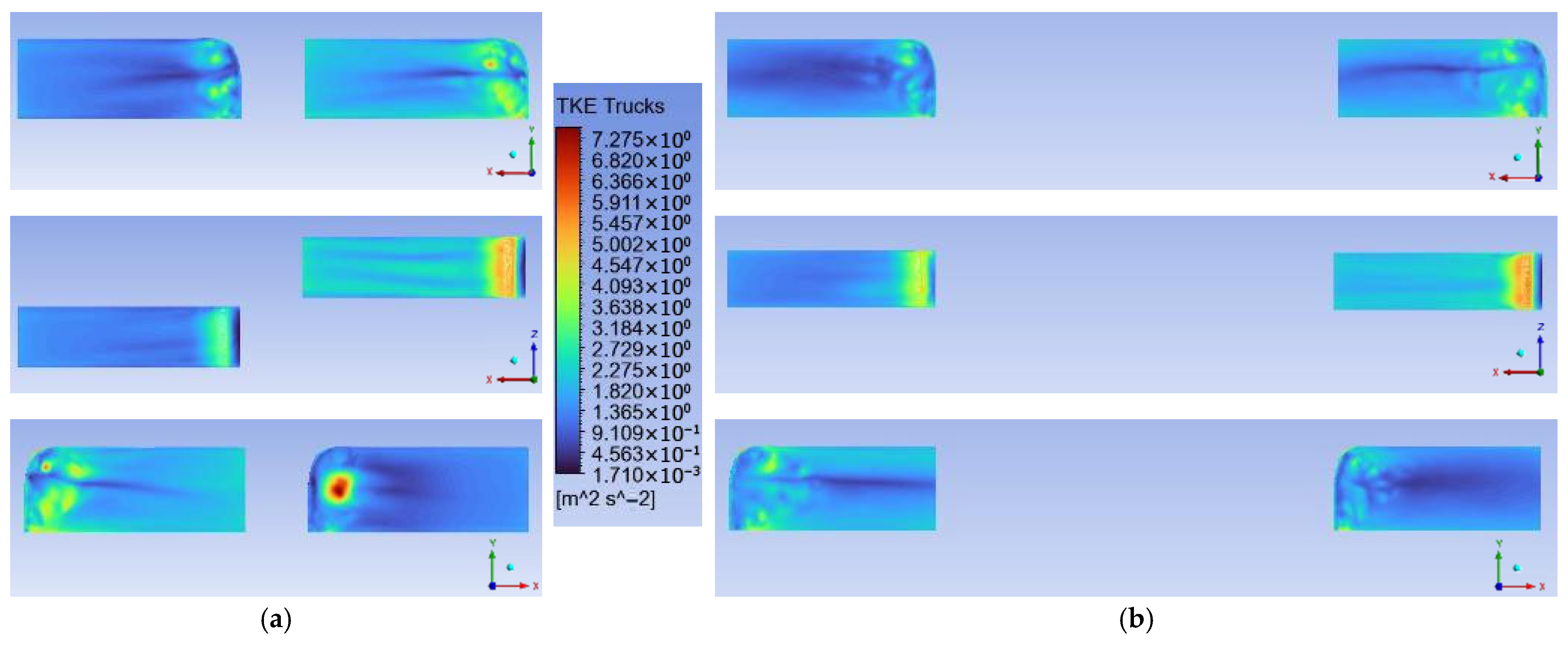
Figure 6 presents the velocity streamlines, while Figure 7 and Figure 8 present the TKE contours for Case 1 at representative time instants during the merging maneuver: t = 0.5 s (close spacing, 0.3 x/L), t = 1, 1.5 and 2 s (intermediate spacing, 0.5–1.0 x/L), and t = 2.5 and 5.5 s (large spacing, 1.25–2.0 x/L).
Figure 6.
Top view (XZ-plane) of velocity streamlines illustrating the lane-change maneuver and platoon entry for Case 1 at: (a) 0.5 s; (b) 1 s; (c) 1.5 s; (d) 2 s; (e) 2.5 s; (f) 5.5 s.
Figure 7.
Time evolution of TKE contours (XZ-plane top view) on truck surfaces and the ground (left column) versus the mid-plane (right column) for Case 1 (zero-crosswind). Snapshots correspond to times: (a) 0.5 s; (b) 1.0 s; (c) 1.5 s; (d) 2.0 s; (e) 2.5 s; (f) 5.5 s. Distinct color bars and legends are shown for the ground, mid-plane, and vehicles.
Figure 8.
TKE contours on the truck surfaces (Right, Top, and Left views) for Case 1 (zero-crosswind) at: (a) 0.5 s; (b) 5.5 s.
The velocity streamlines presented in Figure 6 were generated in ANSYS CFD-Post using seed points distributed on the vehicle surfaces to highlight near-body flow features. Both forward and backward integration were applied to capture the development of wakes and identify flow separation and stagnation regions.
At t = 0.5 s, the longitudinal spacing is approximately 3 m and the lateral distance 0.5 m. The aerodynamic interaction is clearly visible in the velocity streamlines (Figure 6a), resembling the overtaking configuration corresponding to phase 3 in Ref. [19]. From the perspective of the incoming airflow, the two trucks behave almost as a single aerodynamic body, with a slight left–right asymmetry caused by the lateral misalignment. Truck 2 is already partially shielded by the upstream position of Truck 1, explaining the pronounced drag reduction observed at this stage. The wake of Truck 1 is characterized by a recirculation region immediately behind the vehicle, which interacts with the windshield region of Truck 2 and leads to locally increased TKE levels (Figure 8).
At t = 1.5 s, Truck 2 has partially entered the wake of Truck 1 and is positioned approximately 8 m behind the leading vehicle. The streamlines (Figure 6c) indicate that the flow is deflected around both vehicles, while localized acceleration occurs in the gap region between the trucks. At t = 2.5 s, the wake structure becomes more symmetric with respect to the vehicle centerline, and two vortices are visible in the lateral regions of Truck 2 (Figure 6e).
At t = 5.5 s, the longitudinal spacing increases to approximately 20 m and the lateral distance approaches zero, corresponding to a platoon configuration (similar to phase 4 in [19]). Truck 1 experiences nearly free-stream flow conditions, while Truck 2 operates largely within the wake of the leading vehicle. As a result, Truck 2 is exposed to a highly non-uniform velocity field with reduced velocities in the frontal region. The streamlines (Figure 6f) indicate strong flow entrainment into the gap between the vehicles, producing a complex three-dimensional wake interaction.
The transient simulations were initialized directly from the prescribed inlet and vehicle motion conditions rather than from a converged steady-state solution corresponding to the initial vehicle arrangement. Consequently, the TKE distribution near the ground is not fully developed during the early stage of the simulation (Figure 7a, left column).
However, the flow structures at the vehicle mid-plane (y = 2 m) already exhibit characteristic wake patterns, separation regions, and shear layers surrounding the tractor–trailer units (Figure 7a, right column). Due to the relatively small initial longitudinal offset between the vehicles, the dominant aerodynamic interactions, including pressure-field interference and wake impingement, are established early in the transient sequence. Although a steady-state precursor simulation would provide a more developed far-field wake at the initial time, the influence of the adopted initialization approach on the reported transient aerodynamic trends and peak force values is expected to be limited.
The merging maneuver leaves a clear imprint on the TKE distribution around Truck 2. For close and intermediate spacing, the turbulence intensity is asymmetric along the side and top surfaces (Figure 7a–c), whereas for larger spacing the TKE distribution becomes primarily concentrated near the roof region above the windshield due to the symmetric flow conditions established after platoon formation (Figure 7d–f).
The TKE distribution (Figure 8) reaches maximum values (approximately 7 m2/s2), particularly in the upper windshield-roof region and along the lateral edges of the trucks. These regions correspond to areas of strong shear and flow separation, where high-velocity incoming air interacts with the vehicle geometry and cannot remain attached, leading to the formation of shear layers and separated flow structures.
TKE is presented as an indicator of turbulence intensity and energy distribution within the flow. Elevated TKE values occur in shear layers and wake regions where turbulent production is significant. It should be noted that TKE does not directly represent velocity gradients but reflects the integrated effect of shear-driven turbulence generation and transport.
3.6. Flow Field Analysis (Crosswind)
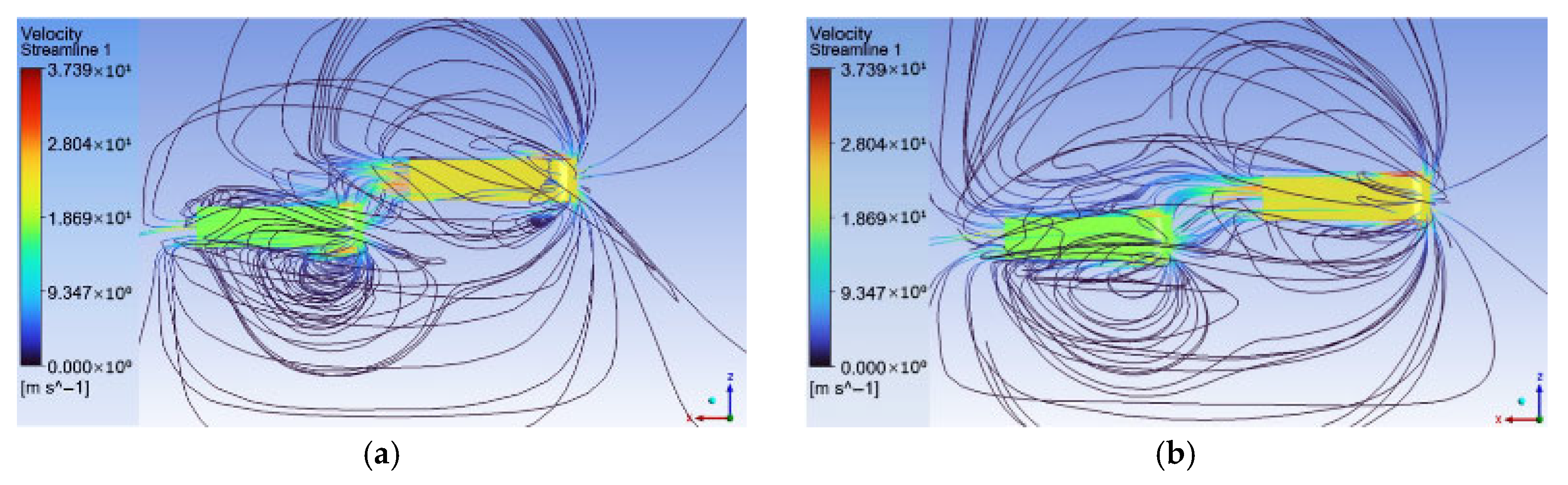
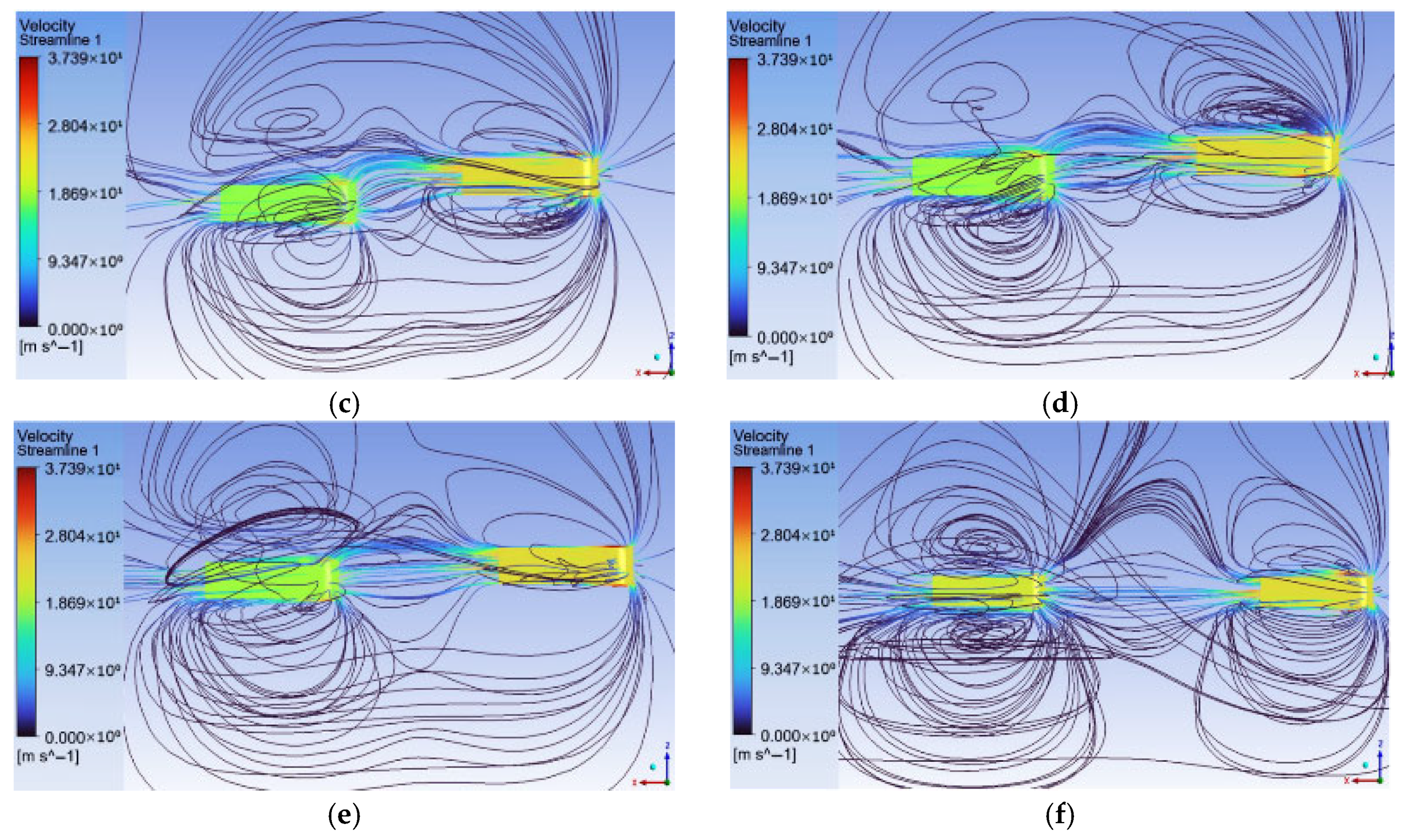
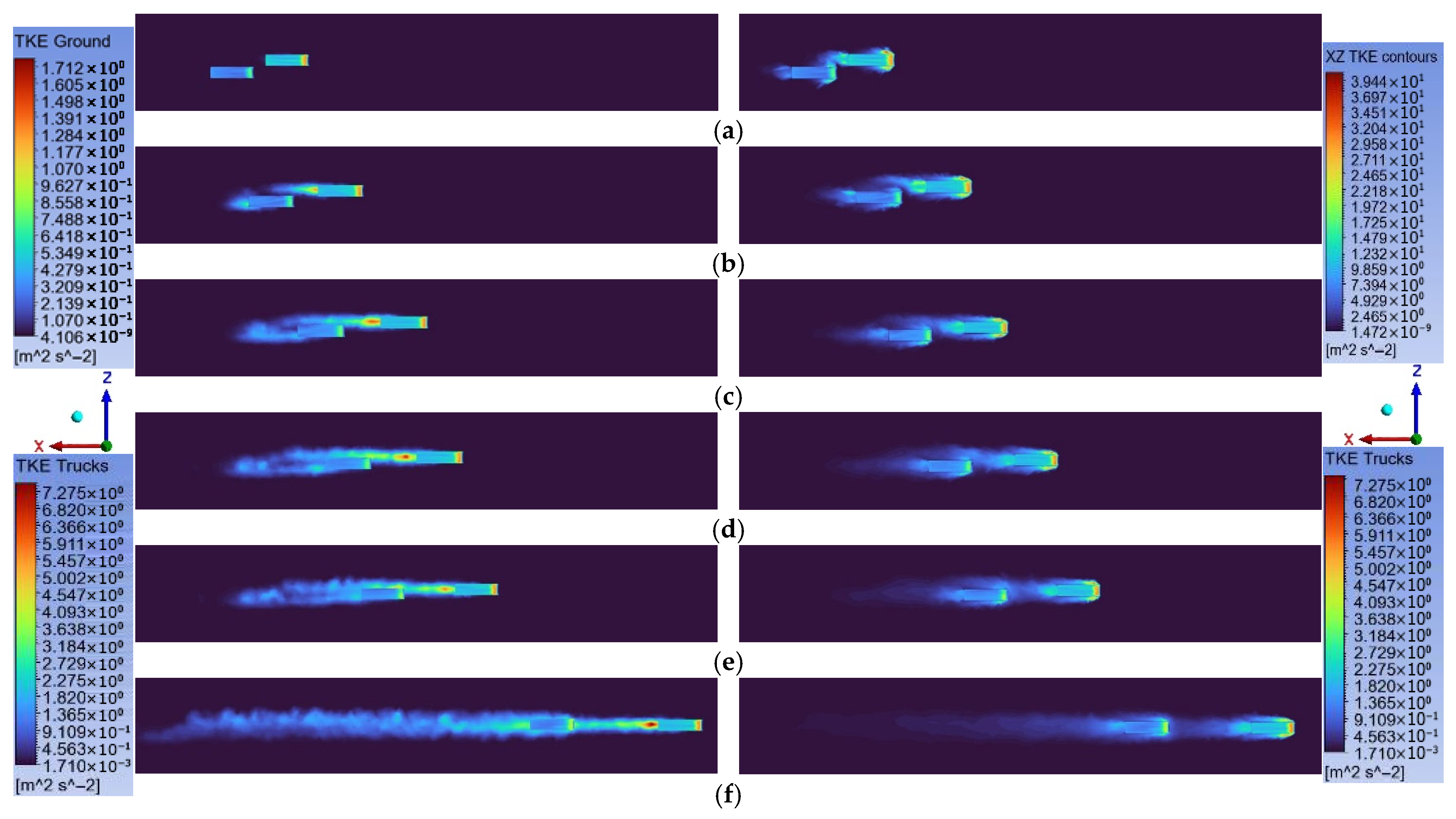
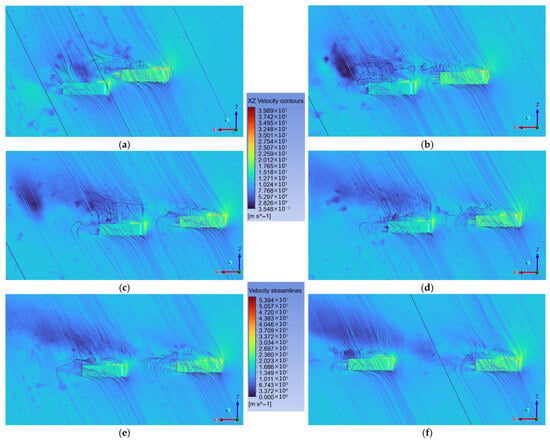
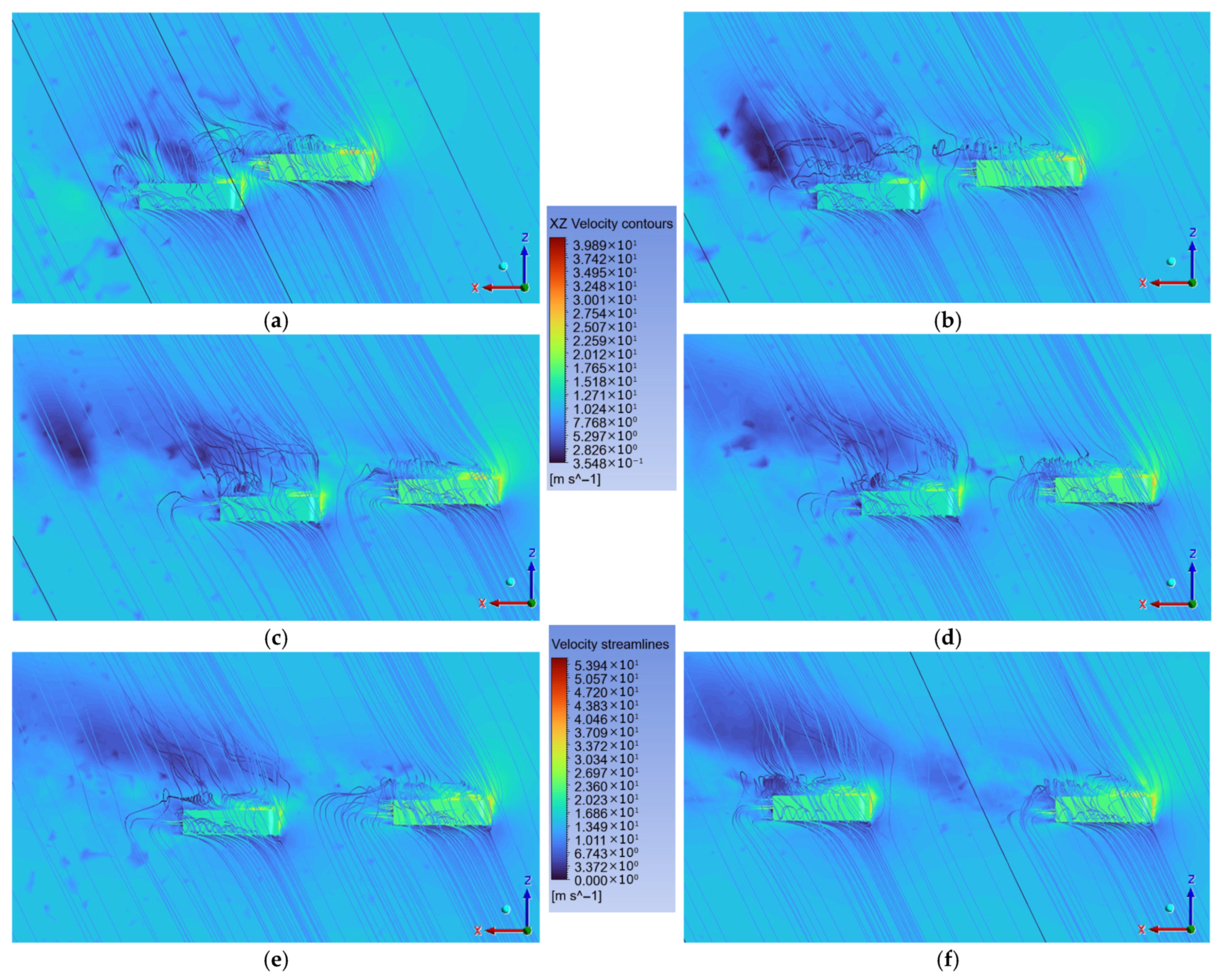
Figure 9 presents the velocity streamlines, while Figure 10 and Figure 11 show the TKE contours for Case 2 at representative time instants during the merging maneuver: t = 0.5 s (close spacing, 0.3 x/L), t = 1, 1.5 and 2 s (intermediate spacing, 0.5–1.0 x/L), and t = 2.5 and 5.5 s (large spacing, 1.25–2.0 x/L).
Figure 9.
Top view (XZ-plane) of velocity streamlines illustrating the lane-change maneuver and platoon entry for Case 2 (crosswind) at: (a) 0.5 s; (b) 1 s; (c) 1.5 s; (d) 2 s; (e) 2.5 s; (f) 5.5 s. Individual legends and color codes are provided for the XZ plane and velocity streamlines.
Figure 10.
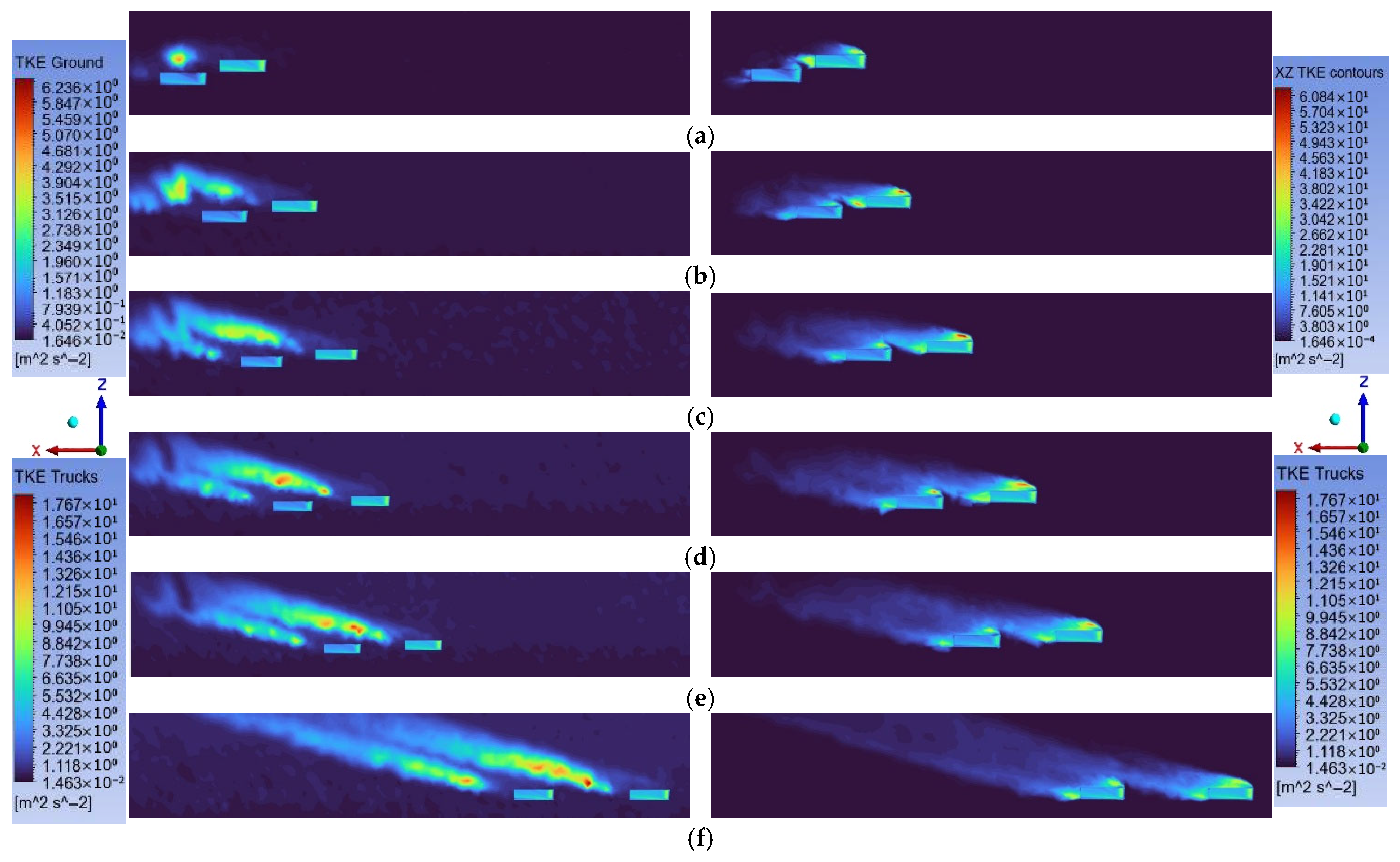
Time evolution of TKE contours (XZ-plane top view) on truck surfaces and the ground (left column) versus the mid-plane (right column) for Case 2 (crosswind). Snapshots correspond to times: (a) 0.5 s; (b) 1.0 s; (c) 1.5 s; (d) 2.0 s; (e) 2.5 s; (f) 5.5 s. Distinct color bars and legends are shown for the ground, mid-plane, and vehicles.
Figure 11.
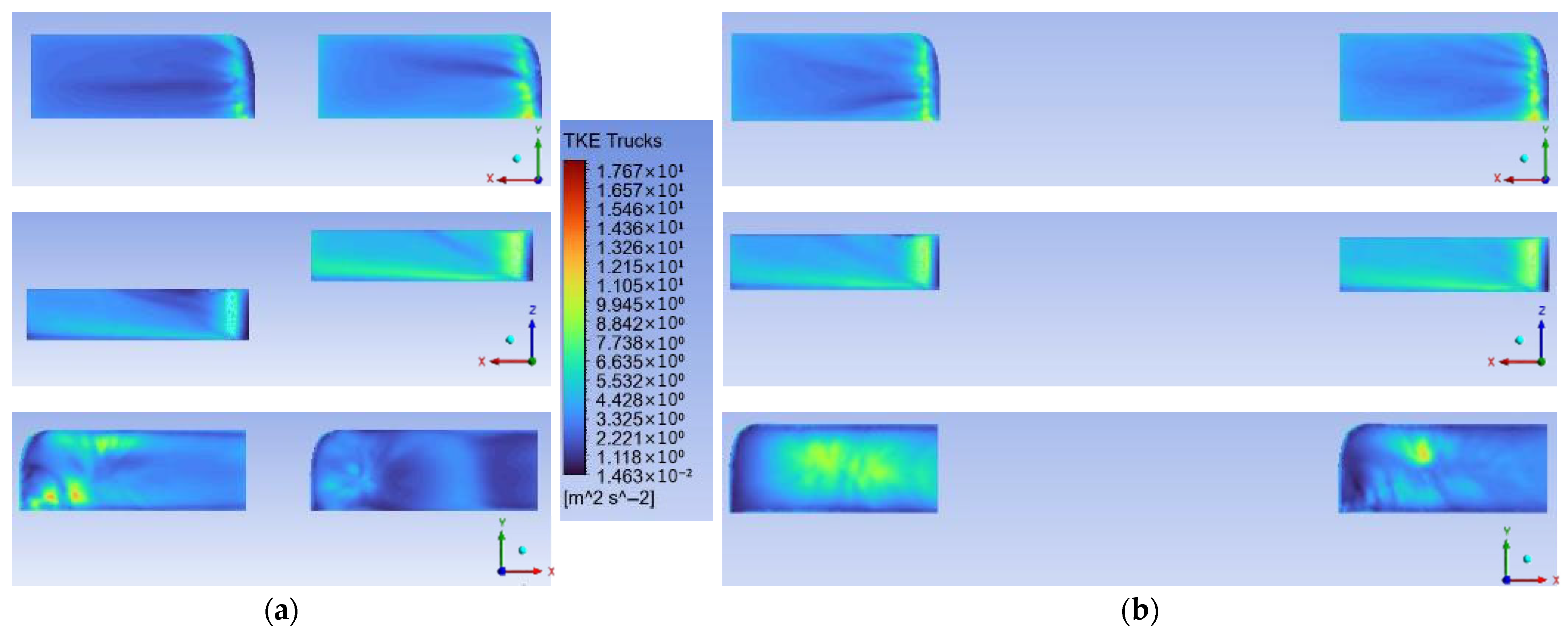
TKE contours on the truck surfaces (Right, Top, and Left views) for Case 2 (crosswind) at: (a) 0.5 s; (b) 5.5 s.
The streamwise flow component arises from the vehicle motion implemented via the dynamic mesh formulation, while the inlet boundary condition prescribes only the crosswind velocity component. In the presence of crosswind, the streamlines visualized in the absolute (stationary) frame are dominated by the ambient wind vector. At a wind yaw angle of approximately 63°, the global flow field tends to obscure the local wake interactions between the vehicles. Consequently, the visualized airflow streamlines follow the crosswind direction (Figure 9). To provide a clearer representation of the resulting velocity structure, as sketched in Figure 2b, velocity contour plots have also been introduced on a plane close to the ground (y = 0.3 m). These contours more clearly illustrate the direction of the resulting airflow relative to the imposed crosswind and better highlight the aerodynamic interaction between the vehicles.
At t = 0.5 s, the velocity streamlines (Figure 9a) show the incoming airflow deflected by approximately 63° relative to the vehicle centerline, resulting in a highly asymmetric flow field. The leeward side (left side relative to the travel direction) exhibits flow separation and a large recirculation region, while the windward side remains largely attached.
At t = 1.5 s (Figure 9c), Truck 2 is positioned partially within the deflected wake of Truck 1. However, because the wake is displaced laterally, Truck 2 experiences a strongly asymmetric velocity field. The windward side is exposed to higher velocities, while the leeward side benefits from partial aerodynamic sheltering. This asymmetry contributes to increased side force and a smaller drag reduction compared with Case 1. The streamlines (Figure 9d,e) reveal complex flow structures, including lateral vortices and cross-flow components that enhance turbulence and unsteadiness in the inter-vehicle region.
At t = 5.5 s, the longitudinal spacing approaches 20 m. Due to the persistent wake deflection, Truck 2 no longer benefits significantly from the shielding effect. The windward side remains exposed to the crosswind, leading to increased drag and side forces. On the leeward side, the flow remains disturbed by the deflected wake of Truck 1, as evidenced by the streamline patterns (Figure 9f).
The most notable feature is the strong lateral deflection of the wake induced by the crosswind. While the velocity streamlines in Figure 9 are dominated by the ambient crosswind vector in the absolute frame, the windbreak effect of the leading vehicle is evidenced by the deflected TKE footprint (Figure 10). This turbulence confirms that the leading vehicle intercepts and redistributes the crosswind momentum, creating a zone of reduced velocity that the trailing vehicle enters during the maneuver.
The TKE distribution reaches peak values of approximately 17 m2/s2 in the upper windshield region and on the roof of the vehicles (Figure 11). Under yawed inflow conditions (approximately 20°), the flow no longer remains aligned over the roof, as in Case 1, but is instead redirected diagonally across the cab. This generates a strong leeward-side vortex, analogous to a delta-wing vortex structure.
During the merging maneuver, crosswind conditions leave a pronounced imprint on the turbulence field around the trailing vehicle. At close and intermediate inter-vehicle spacing, elevated TKE levels are primarily observed along the upper windshield edge and the windward roof edge of Truck 2, due to partial wake shielding (Figure 10a–d). At larger spacing, the TKE distribution (Figure 10e,f) gradually approaches that of the leading vehicle, as the yaw angle limits effective lateral wake sheltering.
High yaw angles promote the formation of strong, concentrated vortical structures originating from the roof and leeward edges, as the flow undergoes a sharper directional change. These structures are significantly more energetic than the recirculating wake typically observed under zero-crosswind conditions.
3.7. Pressure Distribution Analysis
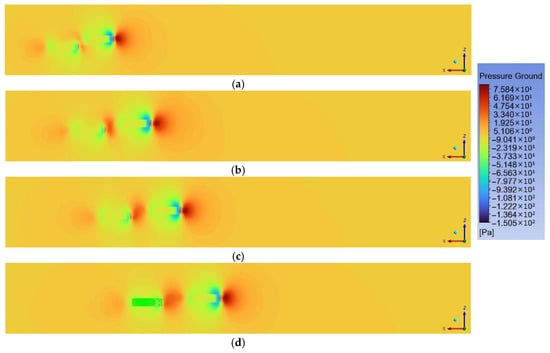
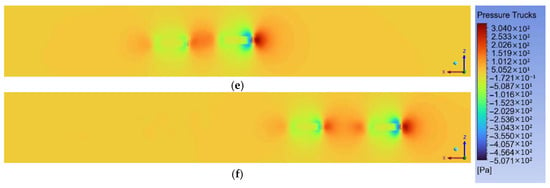
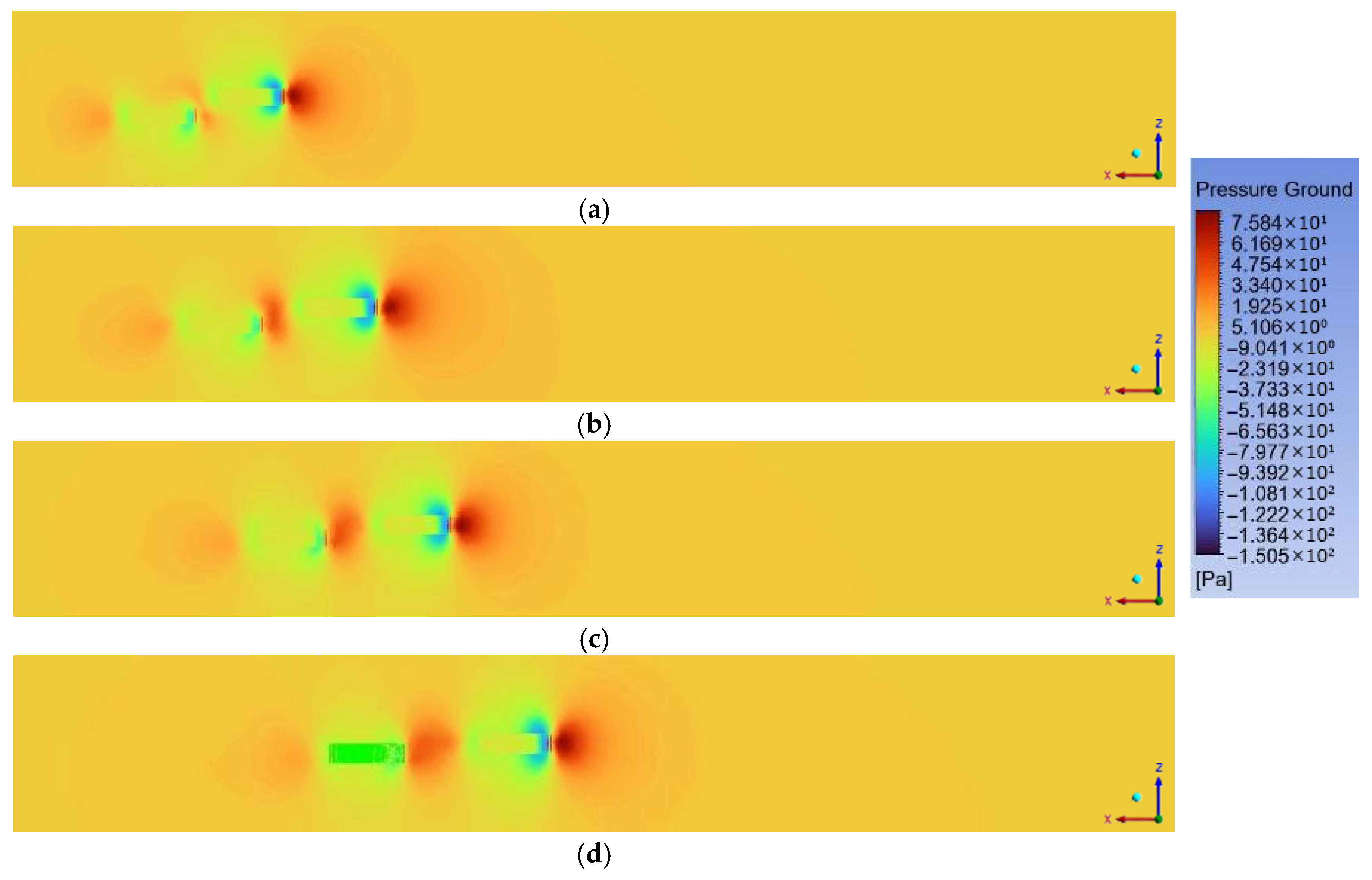
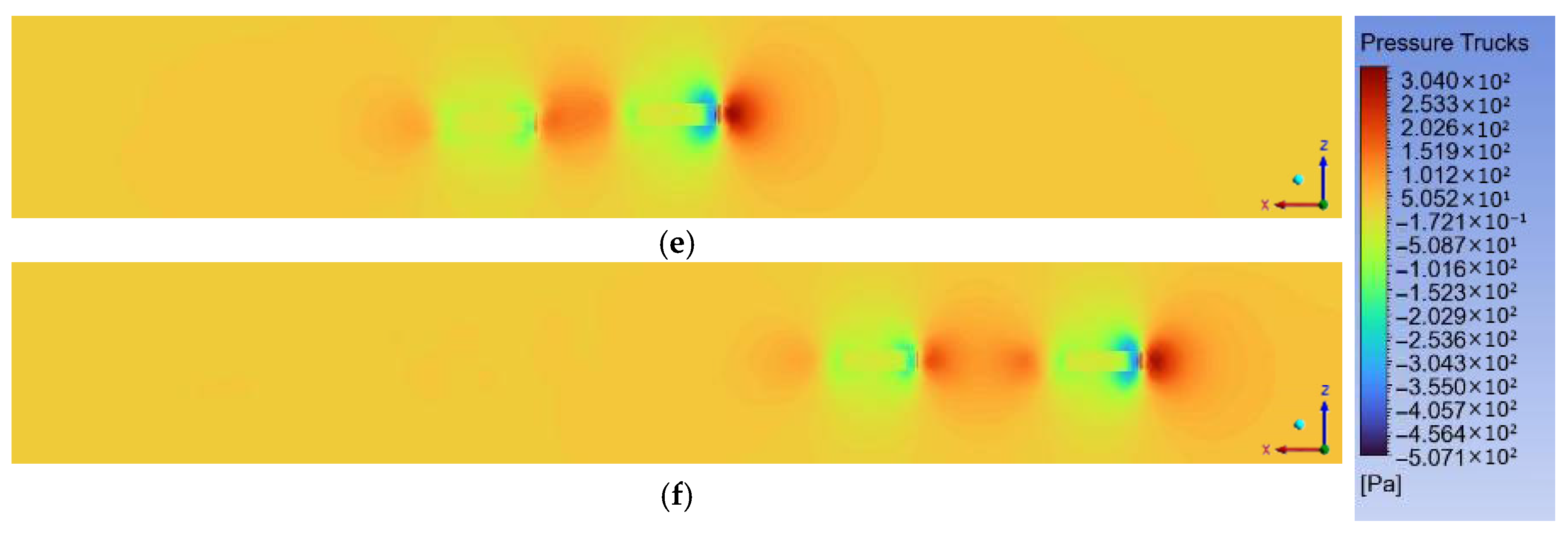
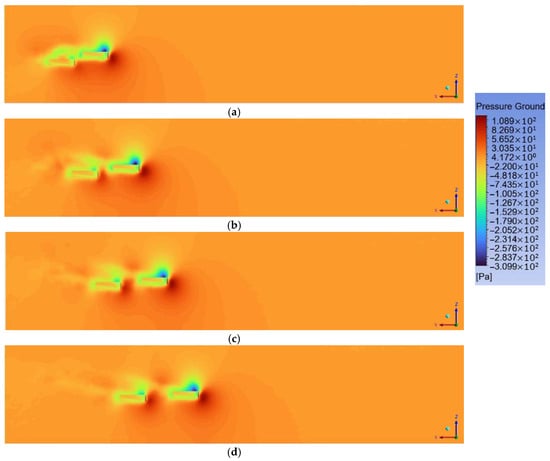
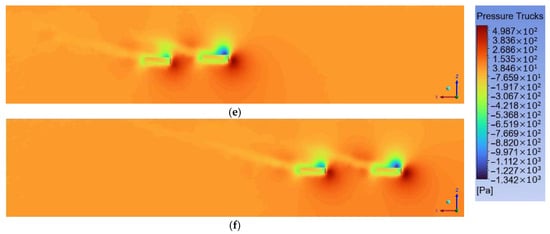
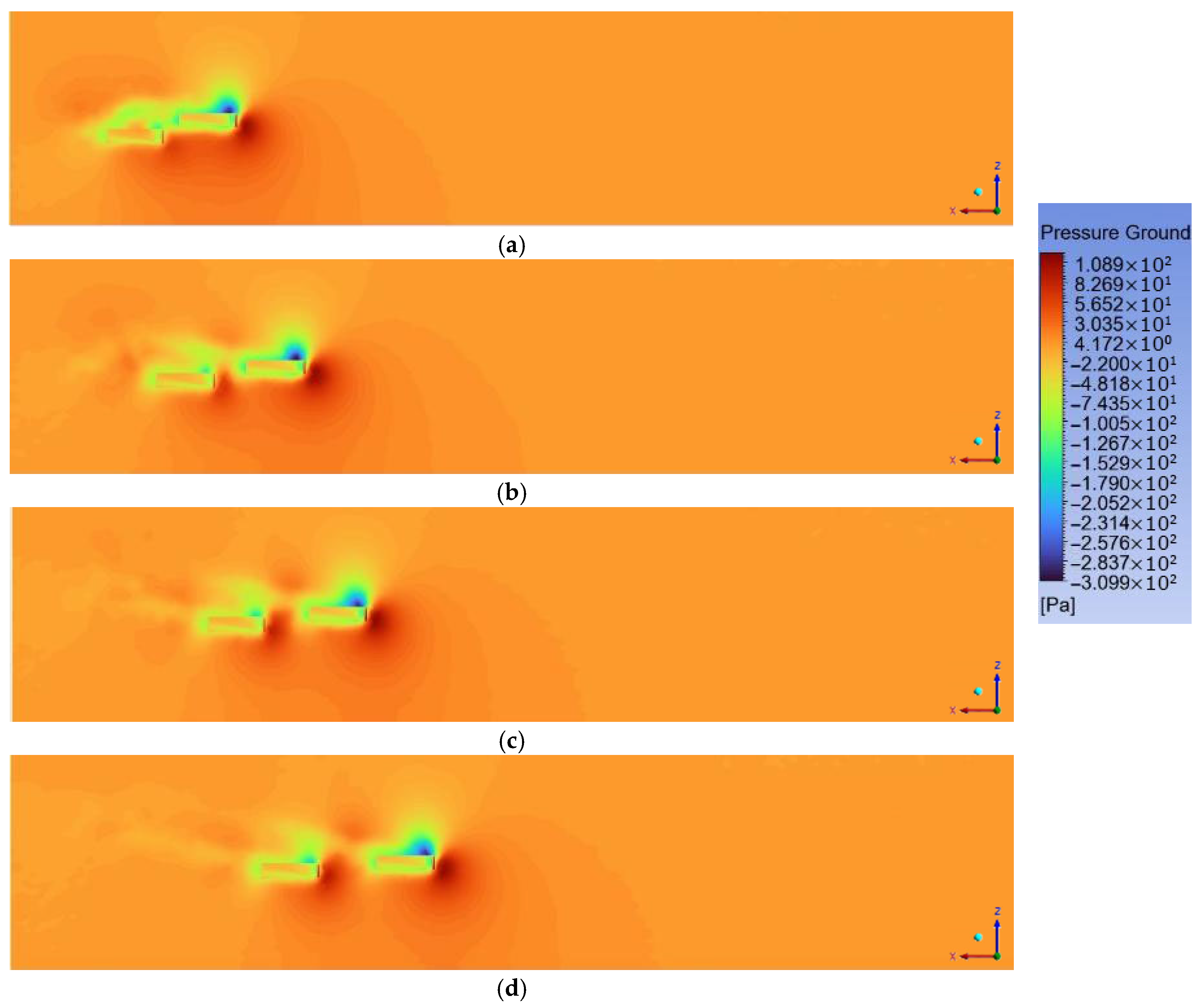
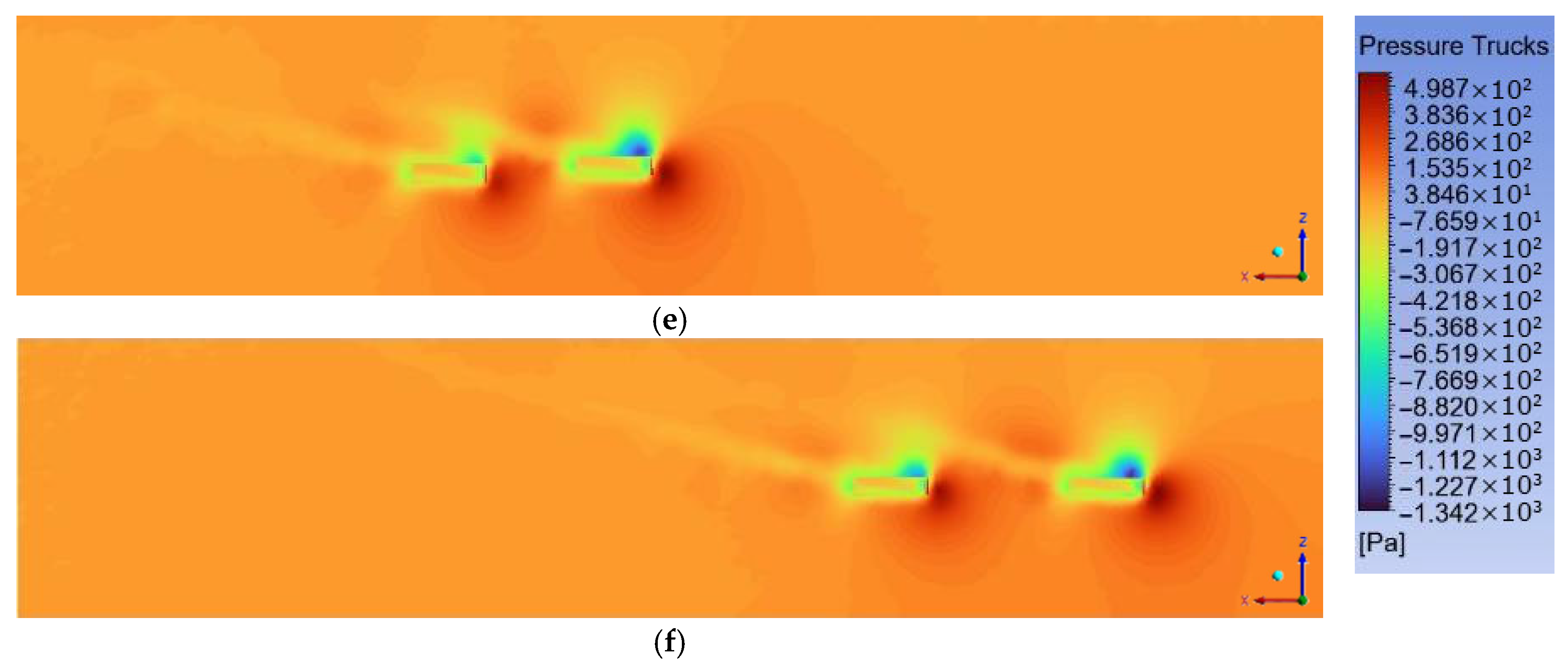
The pressure distribution on both trucks during the merging maneuver is presented in Figure 12 for Case 1 and in Figure 13 for Case 2. The distributions are shown at representative time instants: t = 0.5 s (close spacing, 0.3 x/L), t = 1, 1.5 and 2 s (intermediate spacing, 0.5–1.0 x/L), and t = 2.5 and 5.5 s (large spacing, 1.25–2.0 x/L).
Figure 12.
Pressure distribution contours in Case 1 (zero-crosswind) at: (a) 0.5 s; (b) 1 s; (c) 1.5 s; (d) 2 s; (e) 2.5 s; (f) 5.5 s. Individual legends and color codes are provided for the ground and vehicles.
Figure 13.
Pressure distribution contours in Case 2 (crosswind) at: (a) 0.5 s; (b) 1 s; (c) 1.5 s; (d) 2 s; (e) 2.5 s; (f) 5.5 s. Individual legends and color codes are provided for the ground and vehicles.
In the zero-crosswind case (Figure 12), Truck 1 exhibits a nearly symmetric pressure distribution, with high stagnation pressure on the frontal surfaces and low pressure in the base region. When Truck 2 is positioned at close spacing, the base pressure behind Truck 1 increases slightly, contributing to a reduction in its aerodynamic drag. For Truck 2, the frontal pressure is reduced due to the lower dynamic pressure within the wake of Truck 1, which constitutes the primary aerodynamic mechanism responsible for the observed drag reduction.
In the crosswind case (Figure 13), the pressure field becomes strongly asymmetric for both vehicles. Truck 1 experiences higher pressure on the windward side and lower pressure on the leeward side, resulting in a significant lateral aerodynamic force. Due to the lateral deflection of the wake, the base pressure of Truck 1 remains relatively low even when Truck 2 is located at close spacing. Truck 2 exhibits a similar asymmetric distribution, which contributes to increased drag and side force compared to the Case 1 configuration.
3.8. Summary of Drag Reduction
Table 1 summarizes the average drag and side force coefficients during the merging maneuver and platoon formation, together with the reduction achieved by the trailing truck relative to the leading truck for both zero-crosswind and crosswind conditions.
Table 1.
Drag and side force coefficients (averaged) along with percentage reduction for trailing Truck 2 relative to leading Truck 1.
In Case 1, a significant drag reduction is observed for the trailing truck (Truck 2), reaching approximately 40%, which indicates a strong potential for fuel savings during platoon formation. However, in Case 2, the presence of crosswind substantially weakens this aerodynamic benefit, diminishing the drag reduction to about 21% relative to the leading vehicle. At the same time, the leading truck (Truck 1) experiences a 15% drag increase compared with the zero-crosswind setup.
The side force coefficient of the trailing vehicle is reduced by approximately 31% in Case 2, indicating partial aerodynamic shielding by the leading truck, which acts as a windbreak. The model captures the vortex impingement mechanism, as high-energy vortical structures shed from the leeward edge of Truck 1 impinge on the side surface of Truck 2, generating a localized high-pressure region that partially opposes the incoming crosswind. As a result, the side force acting on the trailing vehicle is reduced compared with that on the leading truck.
These results align with, support, and extend the conclusions obtained from steady-state simulations of trucks under crosswind conditions [19], demonstrating that such conditions significantly alter the aerodynamic interaction between vehicles and reduce the effectiveness of platooning strategies.
4. Discussion
4.1. Aerodynamic Mechanisms of Drag Reduction
The transient CFD simulations reveal the fundamental aerodynamic mechanisms governing drag reduction during highway merging maneuvers and truck platoon formation. The primary mechanism for the trailing vehicle (Truck 2) is the reduction in dynamic pressure within the wake of the leading vehicle (Truck 1). As the lateral spacing decreases, Truck 2 progressively enters the low-velocity wake region, where the effective flow velocity is reduced. This reduction in drag is primarily driven by the velocity deficit in the wake of the leading vehicle and is therefore significantly reduced in the crosswind configuration, confirming that crosswind deflects the wake of the leading vehicle and reduces the aerodynamic shielding effect.
A secondary mechanism is the favorable pressure interaction between the two vehicles. The presence of Truck 2 within the near wake of Truck 1 compresses the recirculation region and increases the base pressure behind the leading vehicle. This effect results in the zero-crosswind case in a modest drag reduction (1–5%) for Truck 1 as well [13]. Such mutual aerodynamic benefits represent one of the key advantages of platooning, although the trailing vehicle generally experiences a significantly larger drag reduction.
The non-linear relationship between inter-vehicle spacing and drag reduction observed in the present results is consistent with previous experimental and numerical studies on vehicle wake interactions and platooning aerodynamics [5,8,27,32]. These studies report a rapid increase in drag reduction at short spacing due to strong wake interaction, followed by a saturation behavior as the trailing vehicle becomes fully immersed in the wake. This behavior reflects the progressive immersion of the trailing vehicle into the wake, leading to a saturation of aerodynamic benefit as the wake deficit is fully developed.
The present uRANS results further indicate that unsteady wake dynamics, including vortex shedding and shear-layer deformation, modulate the instantaneous aerodynamic shielding, thereby explaining deviations from steady-state predictions and highlighting the importance of transient modeling approaches.
4.2. Impact of Crosswind on Platoon Aerodynamics
The crosswind simulations demonstrate that large yaw angles (~20°) can substantially degrade the aerodynamic benefits of platooning. The primary reason is the lateral deflection of the wake, which reduces the sheltering effect experienced by the trailing vehicle. Under crosswind conditions, the wake of the leading vehicle is deflected from the vehicle centerline, causing the trailing vehicle to be partially exposed to the incoming flow even at relatively small spacing.
This behavior is consistent with previous studies on yawed inflow conditions, which report that crosswind deflects the wake and reduces the aerodynamic shielding between vehicles, leading to lower drag reduction compared to aligned flow [6,13,28]. Similar trends have been observed in both CFD and experimental investigations, where increasing yaw angle results in a progressive degradation of platooning benefits.
Severe crosswind conditions also increase the absolute drag of both vehicles due to the asymmetric pressure distribution and the effective increase in directly exposed area relative to the incoming flow. The combined effects of increased baseline drag and reduced wake shielding result in a substantial decrease in the aerodynamic benefit of platooning under crosswind conditions. At the same time, the trailing vehicle experiences a lower side force coefficient compared to the leading vehicle. The greater reduction relative to drag suggests that the leading truck provides more effective shielding by acting as a windbreak for the lateral inflow. The deflected wake redistributes crosswind momentum, partially shielding the trailing vehicle and reducing the pressure differential between its windward and leeward surfaces. These findings highlight the importance of accounting for crosswind-induced unsteady aerodynamic interactions when evaluating platoon performance under realistic operating conditions.
The side force results are particularly important for vehicle stability and safety [31,33]. The trailing vehicle experiences significant variations in side force during the merging process. These transient lateral loads may challenge vehicle control systems, particularly for high-center-of-gravity vehicles such as heavy-duty trucks, which are more susceptible to rollover [20]. The non-monotonic behavior of side force coefficient, characterized by an initial decrease at close spacing, followed by an increase as spacing grows, suggests that an optimal spacing range may exist that balances aerodynamic efficiency with lateral stability under crosswind conditions.
4.3. Implications for Platoon Control Strategies
The transient nature of aerodynamic forces during merging maneuvers has important implications for the design of platoon control algorithms. Current cooperative adaptive cruise control systems typically assume quasi-steady aerodynamic conditions and may not adequately account for the time-varying forces experienced during lane changes and spacing adjustments [34].
The results of this study suggest that advanced control strategies should incorporate:
- •
- Predictive models of transient aerodynamic forces based on real-time measurements of vehicle spacing, relative velocity, and crosswind conditions.
- •
- Adaptive spacing strategies that adjust the target inter-vehicle distance according to crosswind intensity to maintain a balance between fuel efficiency and lateral stability.
- •
- Coordinated steering control capable of compensating for transient side forces during merging maneuvers under crosswind conditions.
- •
- Robust estimation algorithms capable of distinguishing aerodynamic disturbances from other sources of lateral forces such as road irregularities or tire dynamics.
The non-linear relationship between spacing and drag reduction also indicates diminishing aerodynamic benefits at very close spacing, particularly when safety margins and control effort are considered. A spacing range of approximately 5–15 m may therefore represent a practical balance that provides significant fuel savings while maintaining adequate safety margins and lateral stability [3].
4.4. Comparison with Previous Studies
The drag reduction values obtained in this study are consistent with a wide range of experimental and numerical investigations of heavy-duty vehicle platooning [1,5,8]. Previous studies have reported drag reductions for trailing vehicles typically in the range of 10–50%, depending on inter-vehicle spacing and flow conditions [23,27,32]. In particular, multi-vehicle platooning simulations validated against NASA experimental benchmarks have reported drag reductions of 13–44% under aligned flow conditions [1], which agrees well with the values obtained in the present work.
The crosswind results are also in agreement with studies that have demonstrated a significant degradation of platooning benefits under yawed inflow conditions. The drag reduction of 21.43% observed for the trailing vehicle in the present study falls within the range of 14–26% reported in both CFD and experimental investigations [14,33]. These studies attribute the reduction in aerodynamic benefit to wake deflection and asymmetric pressure distributions, which are also observed in the present results. During the merging maneuver, the partial shielding of the windward side of the trailing vehicle is consistent with the redistribution of momentum within the deflected wake.
The findings of the present study are generally consistent with previously reported steady-state investigations of heavy-duty truck aerodynamics under crosswind conditions [18,19]. However, the present work extends existing research by providing a transient analysis of the merging process, capturing the time-resolved evolution of aerodynamic forces. While steady-state simulations provide mean flow characteristics, recent high-fidelity studies [5,12,35] highlight the importance of unsteady wake dynamics, supporting the use of transient modeling approaches.
The time-resolved evolution of drag and side forces during spacing reduction provides additional insight into the dynamic aerodynamic interactions occurring during real-world highway operations. These transient effects, including vortex shedding and wake deformation, cannot be captured by steady-state simulations and are therefore essential for understanding the instantaneous aerodynamic loads experienced during platoon formation maneuvers.
4.5. Limitations and Future Work
While the results provide valuable insights, certain limitations of the present study should be recognized.
- •
- The RANS-based SST k-ω turbulence model, although widely used and validated for heavy-vehicle aerodynamics, has known limitations in resolving highly unsteady wake phenomena such as vortex shedding and bi-stable wake modes [7]. Higher-fidelity approaches such as LES and DES effectively resolve highly unsteady wake structures and enable active flow control for drag reduction in vehicle platooning [12]. This methodology addresses limitations in RANS-based models, albeit at a substantially higher computational cost.
- •
- The simplified vehicle geometry omits several geometric details such as cooling air intakes, exhaust stacks, and underbody components that may influence wake development and aerodynamic forces [36]. Future investigations could include more detailed vehicle geometries in order to assess the influence of these features on platoon aerodynamics.
- •
- The crosswind conditions considered in this study are modeled as steady and uniform yawed inflow. In real-world environments, crosswinds are typically unsteady and spatially varying [37]. Future work should therefore investigate the influence of gusty crosswinds and turbulent atmospheric boundary layers on platoon stability and control.
- •
- The present analysis considers only two vehicles, whereas real-world platoons may consist of three or more trucks. Aerodynamic interactions within multi-vehicle platoons are more complex [6] and may produce additional wake interference effects as well as greater potential fuel savings.
- •
- Finally, the study does not account for vehicle motion dynamics such as pitch, roll, or yaw, nor for suspension effects. These factors may couple with aerodynamic loads and influence vehicle stability [28]. Integrating CFD–vehicle dynamics simulations could achieve a more comprehensive understanding of aerodynamic–vehicle interactions in real-world highway environments.
5. Conclusions
This study presents a transient CFD analysis of the aerodynamic interactions between two heavy-duty trucks during highway merging and platoon formation under zero-crosswind and crosswind conditions. The transient aerodynamic interaction during the merging maneuver can be interpreted in terms of three distinct regimes. In the initial approach stage, the vehicles interact weakly and the trailing truck is largely exposed to the free-stream flow. As the lateral spacing decreases, the trailing vehicle enters the wake of the leading truck, producing a strong wake-interaction regime characterized by significant reductions in drag and side force due to the velocity deficit and pressure redistribution in the wake. Finally, as the longitudinal spacing increases during the completion of the maneuver, the wake gradually dissipates and the aerodynamic interaction weakens, leading to a progressive recovery of drag and side-force coefficients. The main conclusions are as follows:
- •
- In the highway merging scenario, the trailing vehicle experiences substantial drag reduction, reaching approximately 40% under zero-crosswind conditions. The drag reduction exhibits a non-linear relationship with spacing, with the most significant gains occurring at intermediate spacing (up to approximately 15 m).
- •
- Strong crosswind conditions corresponding to a 20° yaw angle significantly degrade the aerodynamic benefits of platooning. The drag reduction for the trailing vehicle decreases by half, leading to a substantial reduction in fuel-saving potential.
- •
- The trailing vehicle experiences significant transient side forces during the merging process under crosswind conditions, with a relative reduction in side force coefficient of approximately 31%. Both vehicles present non-monotonic variations at close distances. These lateral load fluctuations may pose challenges for vehicle control and stability.
- •
- Flow visualization indicates that crosswind causes substantial lateral deflection of the wake, reducing the sheltering effect experienced by the trailing vehicle. The resulting asymmetric pressure distributions contribute to increased drag and side forces for both vehicles.
- •
- The transient nature of aerodynamic forces during merging maneuvers highlights the need for advanced platoon control algorithms capable of incorporating predictive models of time-varying aerodynamic loads, adaptive spacing strategies based on crosswind conditions, and coordinated steering control to maintain lateral stability.
Overall, the findings provide quantitative insight into the aerodynamic mechanisms governing truck–truck interactions during realistic highway operations and emphasize the importance of accounting for crosswind effects in evaluating platoon performance in real-world traffic conditions. These results may support the development of improved vehicle designs, control strategies, and operational guidelines aimed at maximizing fuel efficiency while ensuring safety in heavy-duty truck platooning.
Author Contributions
Conceptualization, D.D.A.; methodology, D.D.A.; software, D.D.A.; validation, I.Z.M.; formal analysis, I.Z.M.; investigation, D.D.A.; writing—original draft preparation, D.D.A.; writing—review and editing, C.C.M.; visualization, C.C.M. All authors have read and agreed to the published version of the manuscript.
Funding
This research received no external funding.
Institutional Review Board Statement
Not applicable.
Informed Consent Statement
Not applicable.
Data Availability Statement
The raw data supporting the conclusions of this article will be made available by the authors on request.
Acknowledgments
The authors acknowledge the support of Politehnica University Timisoara through the provision of computational resources and required software licenses.
Conflicts of Interest
The authors declare no conflicts of interest.
Abbreviations
The following abbreviations are used in this manuscript:
| CFD | Computational Fluid Dynamics |
| uRANS | Unsteady Reynolds-Averaged Navier–Stokes |
| RANS | Reynolds-Averaged Navier–Stokes |
| SST | Shear Stress Transport |
| LES | Large Eddy Simulation |
| DES | Detached Eddy Simulation |
| TKE | Turbulent Kinetic Energy |
| CD | Drag Coefficient |
| CS | Side Force Coefficient |
References
- Xiao, L.; Gao, X.; Gu, T.; Jia, X. Aerodynamic Drag Coefficient Analysis of Heavy-Duty Vehicle Platoons: A Hybrid Approach Integrating Wind Tunnel Experiments and CFD Simulations. Energies 2024, 17, 6383. [Google Scholar] [CrossRef] [Scilit]
- Hamiga, W.; Ciesielka, W. Numerical Investigation of the Drag Force Reduction for Homogeneous Column of Vehicles. New Trends Prod. Eng. 2019, 2, 524–531. [Google Scholar] [CrossRef] [Scilit]
- Lechner, B.; Cajic, A.; Fischbacher, B.; Kospach, A.; Mladek, A.; Sammer, P.; Zitz, C.; Zotz, M.; Irrenfried, C. Validation of Truck Platoon Slipstream Effects. In Proceedings of the 16th International Symposium on Advanced Vehicle Control (AVEC 2022); Springer: Cham, Switzerland, 2022; pp. 69–81. [Google Scholar] [CrossRef] [Scilit]
- McAuliffe, B. A Drag-Reduction Prediction Model for Truck Platoons. SAE Int. J. Adv. Curr. Prac. Mobil. 2025, 7, 153–167. [Google Scholar] [CrossRef] [Scilit]
- Marshall, S.D.; Snape, K.; Soper, D.; Sterling, M.; Gillmeier, S. The aerodynamic performance of a platoon of lorries in close-proximity during an overtaking manoeuvre. Front. Future Transp. 2024, 5, 1356539. [Google Scholar] [CrossRef] [Scilit]
- Wu, W.; Ma, X. Evaluation of the Risk of Truck Platoon under Crosswind Regarding the Lateral Displacement on Horizontal Curves. J. Adv. Transp. 2023, 2023, 4771818. [Google Scholar] [CrossRef] [Scilit]
- Stalters, D.M. Bi-Stability in the Wakes of Platooning Ahmed Bodies. Master’s Thesis, California Polytechnic State University, San Luis Obispo, CA, USA, 2018. Available online: https://digitalcommons.calpoly.edu/theses/2538 (accessed on 15 March 2026).
- McAuliffe, B.; Barber, H.; Ghorbanishohrat, F. The Influence of Traffic Wakes on the Aerodynamic Performance of Heavy Duty Vehicles. SAE Int. J. Adv. Curr. Pract. Mobil. 2023, 5, 2193–2214. [Google Scholar] [CrossRef] [Scilit]
- Bounds, C.P.; Rajasekar, S.; Uddin, M. Development of a Numerical Investigation Framework for Ground Vehicle Platooning. Fluids 2021, 6, 404. [Google Scholar] [CrossRef] [Scilit]
- Alic, D.; Matijošius, J.; Kilikevičius, A. Numerical Modelling of the Crosswind Influence on Vehicle Aerodynamics in Highway Traffic Conditions. Facta Univ. Ser. Mech. Eng. 2025, 23, 65–77. [Google Scholar] [CrossRef] [Scilit]
- Hamiga, W.M.; Ciesielka, W.B. Numerical Analysis of Aeroacoustic Phenomena Generated by Truck Platoons. Sustainability 2021, 13, 14073. [Google Scholar] [CrossRef] [Scilit]
- Wang, B.; Chen, H.; Huang, Z.; Lou, H. Large eddy simulation of active flow control for aerodynamic drag reduction in vehicle platooning. Phys. Fluids 2025, 37, 055112. [Google Scholar] [CrossRef] [Scilit]
- He, M.; Huo, S.; Hemida, H.; Soper, D.; Sterling, M.; Baker, C.V. The Flow Around a Lorry Platoon Subject to a Crosswind—A Detached Eddy Simulation. Front. Future Transp. 2022, 3, 901204. [Google Scholar] [CrossRef] [Scilit]
- McAuliffe, B.R.; Barber, H. Simulating Traffic-Wake Effects in a Wind Tunnel. SAE Int. J. Adv. Curr. Prac. Mobil. 2023, 5, 1969–1987. [Google Scholar] [CrossRef] [Scilit]
- Zhang, Z.; Li, J.; Guo, W. Combined Simulation of Heavy Truck Stability under Sudden and Discontinuous Direction Change of Crosswind with Computational Fluid Dynamics and Multi-Body System Vehicle Dynamics Software. Adv. Mech. Eng. 2018, 10, 1687814018786364. [Google Scholar] [CrossRef] [Scilit]
- Gheyssens, T. Aerodynamic Analysis of a Platoon of Bluff Bodies Subjected to Cross Wind: A Numerical Investigation on the Effect of Drag Reduction Devices. Master’s Thesis, Ghent University, Ghent, Belgium, 2016. Available online: https://repository.tudelft.nl/file/File_33e1b1bd-1b55-4c4b-8eed-a847a8a0da9d?preview=1 (accessed on 15 March 2026).
- Hamiga, W.; Ciesielka, W. Numerical Modeling of Airflow over Column of Vehicles Using Ansys® Package. E3S Web Conf. 2018, 46, 00025. [Google Scholar] [CrossRef] [Scilit]
- Alic, D.; Miltenovic, A.; Banic, M.; Zafra, R.V. Numerical Investigation of Large Vehicle Aerodynamics under the Influence of Crosswind. Spectr. Mech. Eng. Oper. Res. 2025, 2, 13–23. [Google Scholar] [CrossRef] [Scilit]
- Alic, D.D.; Dungan, L.I.; Rackov, M.; Greconici, M.; Alic, C.I. Effect of Crosswind on Drag and Lift Variations during Mixed-Vehicle Overtaking Manoeuvres: A CFD Approach. Teh. Vjesn. 2026, 33, 80–87. [Google Scholar] [CrossRef] [Scilit]
- Zhang, Q.; Su, C.; Zhou, Y.; Zhang, C.; Ding, J.; Wang, Y. Numerical Investigation on Handling Stability of a Heavy Tractor Semi-Trailer under Crosswind. Appl. Sci. 2020, 10, 3672. [Google Scholar] [CrossRef] [Scilit]
- Wang, S.; Wu, Z.; Su, Y. A Cooperative Longitudinal-Lateral Platoon Control Framework with Dynamic Lane Management for Unmanned Ground Vehicles Based on A Dual-Stage Multi-Objective MPC Approach. Drones 2025, 9, 711. [Google Scholar] [CrossRef] [Scilit]
- Mercedes-Benz Trucks. The Actros F. Available online: https://www.mercedes-benz-trucks.com (accessed on 15 March 2026).
- Hucho, W.-H.; Sovran, G. Aerodynamics of Road Vehicles. Annu. Rev. Fluid Mech. 1993, 25, 485–537. [Google Scholar] [CrossRef]
- ANSYS. Best Practice: RANS Turbulence Modeling in ANSYS CFD. Technical Paper. Available online: https://www.ansys.com/resource-center/technical-paper/best-practice-rans-turbulence-modeling-in-ansys-cfd (accessed on 15 March 2026).
- Menter, F.R. Two-Equation Eddy-Viscosity Turbulence Models for Engineering Applications. AIAA J. 1994, 32, 1598–1605. [Google Scholar] [CrossRef] [Scilit]
- Igali, D.; Mukhmetov, O.; Zhao, Y.; Fok, S.C.; Teh, S.L. Comparative Analysis of Turbulence Models for Automotive Aerodynamic Simulation and Design. Int. J. Automot. Technol. 2019, 20, 1145–1152. [Google Scholar] [CrossRef] [Scilit]
- Khalighi, B.; Zhang, S.; Koromilas, C.; Balkanyi, S.R.; Bernal, L.P.; Iaccarino, G.; Moin, P. Experimental and Computational Study of Unsteady Wake Flow Behind a Bluff Body with a Drag Reduction Device. In Proceedings of the SAE 2001 World Congress, Detroit, MI, USA, 5 March 2001. [Google Scholar] [CrossRef] [Scilit]
- Su, C.; Hu, Z.; Zhang, Q.; Yuan, X.; Zhang, C.; Wang, Y. Coupling Analysis of Transient Aerodynamic and Dynamic Response of Cars in Overtaking under Crosswinds. Eng. Appl. Comput. Fluid Mech. 2020, 14, 1215–1227. [Google Scholar] [CrossRef] [Scilit]
- ANSYS. Pressure–Velocity Coupling. Available online: https://www.afs.enea.it/project/neptunius/docs/fluent/html/th/node373.htm (accessed on 15 March 2026).
- ANSYS. Evaluation of Gradients and Derivatives. Available online: https://www.afs.enea.it/project/neptunius/docs/fluent/html/th/node368.htm (accessed on 15 March 2026).
- Zhang, Z.; Chen, S.; Zhang, W. Numerical study on vehicle stability under crosswind conditions on desert highways. Sci. Rep. 2025, 15, 23552. [Google Scholar] [CrossRef] [Scilit]
- Al Alam, A.; Gattami, A.; Johansson, K.H. An experimental study on the fuel reduction potential of heavy duty vehicle platooning. In Proceedings of the 13th International IEEE Conference on Intelligent Transportation Systems, Funchal, Portugal, 19–22 September 2010; pp. 306–311. [Google Scholar] [CrossRef] [Scilit]
- Hemida, H.; Baker, C.J. Large-eddy simulation of the flow around a freight wagon subjected to a crosswind. Comput. Fluids 2010, 39, 1944–1956. [Google Scholar] [CrossRef] [Scilit]
- Tomisawa, Y.; Sugimachi, T.; Sakurai, T.; Yahagi, S. Cooperative Adaptive Cruise Control System Identification in Multi-Brand Truck Platooning. Int. J. ITS Res. 2026, 24, 179–192. [Google Scholar] [CrossRef] [Scilit]
- Van, D.D.; Chou, C.C.; Chang, K.C. Numerical and Experimental Study of Two-Vehicle Overtaking Process. Adv. Mech. Eng. 2023, 15, 16878132231221044. [Google Scholar] [CrossRef] [Scilit]
- Vieru, E.M.; Stan, C.; Ilea, L. Analysis of the Aerodynamic Performance of Truck Semi-Trailers. IOP Conf. Ser. Mater. Sci. Eng. 2024, 1303, 012044. [Google Scholar] [CrossRef] [Scilit]
- Aman, A.H.; Habib, M.S. Effect of Cross Wind Aerodynamic Force Variation on Stability of Vehicle Crossing Bridge Using a Aerodynamic_CFD Sliding Mesh TechniquCFD Sliding Mesh Technique. In Proceedings of the Sustainability and Resilience Conference: Mitigating Risks and Emergency Planning, Manama, Bahrain, 15–16 October 2018; KnE Engineering: Dubai, United Arab Emirates, 2018; pp. 221–243. [Google Scholar] [CrossRef] [Scilit]

Disclaimer/Publisher’s Note: The statements, opinions and data contained in all publications are solely those of the individual author(s) and contributor(s) and not of MDPI and/or the editor(s). MDPI and/or the editor(s) disclaim responsibility for any injury to people or property resulting from any ideas, methods, instructions or products referred to in the content. |
© 2026 by the authors. Licensee MDPI, Basel, Switzerland. This article is an open access article distributed under the terms and conditions of the Creative Commons Attribution (CC BY) license.