
Article

Comparative Study of the Performance Characteristics of Annular Jet Pumps Conveying Newtonian and Shear-Thinning Non-Newtonian Fluids


1
Research Center of Fluid Machinery Engineering and Technology, Jiangsu University, Zhenjiang 212013, China
2
Suzhou Nuclear Power Research Institute Co., Ltd., Suzhou 215004, China
*
Author to whom correspondence should be addressed.
Fluids 2026, 11(5), 112; https://doi.org/10.3390/fluids11050112
Submission received: 24 March 2026 / Revised: 20 April 2026 / Accepted: 28 April 2026 / Published: 30 April 2026

Abstract

This study investigates the factors influencing the performance characteristics of annular jet pumps (AJPs) conveying non-Newtonian fluids, to enhance their suction capability for marine organisms such as jellyfish, which exhibit properties close to non-Newtonian fluids. Based on the power-law fluid model, realizable k-ε model, and volume of fluid (VOF) model, shear-thinning carboxymethyl cellulose (CMC) was selected to simulate marine organisms like jellyfish. Fluent software was employed to numerically simulate the performance characteristics and internal flow field of the annular jet pumps. The results demonstrate that the shear-thinning effect of non-Newtonian fluids reduces the maximum efficiency point of annular jet pumps and decreases the flow rate ratio corresponding to this efficiency point. As the concentration of CMC solution increased to 0.5%, the maximum efficiency point decreased by 5.5%, and the flow rate ratio corresponding to this efficiency point dropped from 1 to 0.8. These findings provide reference and insights for analyzing the full flow field of annular jet pumps pumping shear-thinning non-Newtonian fluids and for structural design of such pumps.

1. Introduction

An annular jet pump (AJP) is a specialized fluid transfer device that utilizes high-velocity working fluid passing through an annular nozzle to generate negative pressure, thereby entraining and conveying the suction fluid. Unlike traditional centrifugal or axial flow pumps, the AJP features no moving parts, a simple structure, and high reliability, making it particularly suitable for conveying media containing solid particles, fibers, or high viscosity. The core working principle is that the working fluid is ejected at high velocity through the annular nozzle, creating a low-pressure zone in the suction chamber, thereby drawing the suction fluid into the mixing chamber. Within the throat and diffuser, momentum exchange and energy transfer occur between the two fluids, ultimately achieving fluid conveyance and pressure boosting. With advantages such as anti-clogging performance, corrosion resistance, compact design, and low maintenance costs, AJPs have demonstrated broad application prospects in petrochemicals, wastewater treatment, aquaculture, and marine engineering, particularly for conveying non-Newtonian fluids with complex rheological properties. Their unique flow structure and shear characteristics offer novel solutions to related engineering challenges.
Annular jet pumps offer a novel technical approach for safely and efficiently suctioning and handling non-Newtonian fluids like jellyfish, leveraging their unique advantages of no moving parts, simple structure, resistance to clogging, and ability to generate intense shear forces. This paper describes an AJP as the core transport component for conveying marine organisms with properties similar to non-Newtonian fluids, such as jellyfish, within nuclear power plant cooling systems. While demonstrating significant potential for conveying special media, AJPs still face notable limitations in current research. Domestic and international studies have mostly focused on the impact of structural parameter optimization on external characteristics, as well as research on AJP in gas–liquid, gas–solid, and solid–liquid two-phase flows. These studies have predominantly used Newtonian fluids such as water and air, along with solids, as the research media.
In terms of research on the structural optimization design of AJPs, Li and Yang [1] discovered that changes in the flow rate ratio lead to corresponding variations in the optimal suction pipe outlet position. Targeting subsea excavation AJPs, Xu et al. [2,3] proposed a multi-objective structural optimization method based on the RBF neural network model, as well as a global optimization design method combining Kriging approximation with experimental data. The results indicate that the Kriging approximation can effectively predict the efficiency of AJPs. Xu et al. [4] investigated the coherent structures in the turbulent flow field of AJPs with different area ratios using large eddy simulation. They found that azimuthal instability is the main reason for the generation of spanwise vortices from streamwise vortices. Although the vortices in the recirculation zone are intense, they are small in scale and chaotically distributed, failing to form periodic vortex rings. Shrestha and Choi [5] achieved an optimal J-shaped groove channel shape through multi-objective optimization. Wang et al. [6] compared conical and streamlined suction chambers using turbulent numerical simulation methods. The results showed that, compared to the conical structure, the flow within the streamlined suction chamber is smoother, which helps effectively weaken its squeezing effect on the entrained flow field. Xiao et al. [7] found that there is an optimal suction chamber convergence angle (20°) for an AJP. When this angle increases, the maximum axial velocity rises, intensifying the squeezing effect on the annular jet fluid, but this also leads to poorer mixing of the two fluid streams. Yang et al. [8] employed the Constant Rate of Velocity/Pressure Change method to design the diffuser structure of an AJP and deeply explored the influence mechanism of the diffuser’s geometric profile and angle on the performance and internal flow details of the AJP. Morral et al. [9] conducted research on the impact of nozzle diameter and fluid swirl on pump performance. The results showed that under the highest swirl intensity, analysis based on shear stress transport predicted a reduction in energy dissipation, while the mixing between the driving flow and the pumped flow became more intense. Xiao et al. [10] compared the development process of the recirculation region at different suction angles and discovered that the suction chamber restricts and squeezes the recirculation flow, leading to changes in the critical flow rate ratio. Du [11] studied the influence of swirling flow on the efficiency of AJPs, as well as the effects of suction chamber and diffuser chamber profiles on the cavitation performance of AJPs. Xu [12] analyzed the internal flow field of annular nozzle jet pumps with three different nozzle shapes and derived the influence patterns of the annular nozzle shape on jet pump performance and flow field. Wang [13] investigated a streamlined AJP based on pressure pulsation and vortex criteria. He discovered that the dominant frequency of pressure pulsation in the streamlined jet shear layer was higher than that of a traditional AJP, and the streamwise vortex intensity within the throat pipe of the streamlined AJP was significantly higher than that of traditional ones. Dong et al. [14] studied the velocity, pressure, and turbulent kinetic energy distributions of a swirling flow AJP and a prototype pump under different operating pressures to analyze the effect of swirling flow on the performance of AJPs.
In the field of multiphase flow research on AJPs, Riaz [15,16] employed a multiphase mixture model to conduct numerical simulations of slurry flow inside the pump. This was carried out to deeply investigate the mechanism by which dispersed particle size, dispersed phase concentration, nozzle convergence angle, and mainstream fluid velocity affect the suction performance and pressure distribution of AJP. Furthermore, by comparing experimental data of a slurry pump with simulation results, the accuracy of the k-ε turbulence model in predicting slurry flow states was validated. Liu et al. [17,18] analyzed the effects of different physical densities and particle concentrations on the flow field performance of AJP using a mixture multiphase flow model. They also explored the impact of sand particle diameter on the flow field characteristics, pressure distribution, and efficiency of AJPs. The results indicated that the pump’s sand transport capacity exhibited a parabolic growth trend with changes in particle diameter. Yang [19] analyzed and researched the liquid-lifting capacity of AJPs in underground coal mines. Xiao et al. [20] constructed an underwater hydraulic transportation system and conducted experimental research on a deep-sea mining AJP, clarifying the relationships between the flow ratio, pressure ratio, and efficiency with the outlet pressure. Xiao and Long [21] investigated the motion of air masses formed at the throat inlet of an AJP during the cavitation process. Chen et al. [22] employed a response surface methodology to optimize the throat length, nozzle-to-throat distance, area ratio, and diffuser angle of liquid–gas jet pumps. Xia et al. [23] conducted numerical simulation analysis on the characteristics of gas–liquid two-phase flow in downhole jet pumps based on actual operating conditions. Murillo et al. [24] utilized a genetic algorithm for parameter optimization of air–solid jet pumps. Alkhulaifi et al. [25] proposed using high-speed jet pumps for slurry transportation. Cao et al. [26] found that the suction ratio of a liquid–gas jet pump increased with the inlet pressure, and the suction volume ratio increased significantly with the increase of the driving water flow rate. Tang et al. [27] designed a dual jet pump applicable for oil and gas extraction characterized by high sand content. Yang et al. [28] conducted a comparative analysis of the performance of compact jet pumps with different throat diameters.
While these studies lay a crucial foundation for optimizing the performance and design of AJP, they failed to reveal the specific mechanisms underlying their interaction with non-Newtonian fluids. In fact, characteristics exhibited by non-Newtonian fluids, such as shear thinning and potential yield stress, significantly alter the shear rate distribution, energy transfer efficiency, and turbulent structure within the pump flow field. This leads to systematic differences in performance patterns compared to conventional Newtonian fluid scenarios. However, to date, research on AJP conveying non-Newtonian fluids remains scarce, particularly lacking comprehensive numerical simulations that integrate non-Newtonian rheological properties with complex turbulent flows within the pump through multi-physics coupling. Consequently, the accuracy and applicability of existing Newtonian-fluid-based design criteria and performance prediction models are questionable when applied to non-Newtonian fluids like jellyfish.
To investigate the broader impact of non-Newtonian fluids on AJP suction performance, this study examines a self-designed variable-area-ratio AJP. Employing a combined approach of numerical simulation and theoretical analysis, it analyzes the effects of non-Newtonian fluid properties on pump suction performance and explores phenomena such as flow lag and stress relaxation potentially caused by the shear-thinning characteristics of non-Newtonian fluids. This study reveals the influence mechanism of non-Newtonian rheological characteristics on the performance of AJPs, providing a theoretical basis for performance prediction and structural optimization when conveying non-Newtonian fluids, and also lays an engineering foundation for the safe and efficient suction of marine organisms such as jellyfish in coastal nuclear power cooling water systems.

2. Model and Computational Method

2.1. Geometric Model

The performance parameters of an AJP include the area ratio M, flow ratio q, pressure ratio h, and efficiency η, defined as follows:
M = Am/At
q = Q c Q s
h = ( p c γ + v c 2 2 g + z c ) ( p s γ + v s 2 2 g + z s ) ( p j γ + v j 2 2 g + z j ) ( p c γ + v c 2 2 g + z c )
η = qh
where Am and At represent the throat area and nozzle area, respectively; Q denotes the flow rate; p, v, and z represent the average pressure, average velocity, and installation height of the cross-section, respectively; subscripts s, c, and j denote the working fluid, suction fluid, and mixed fluid, respectively.
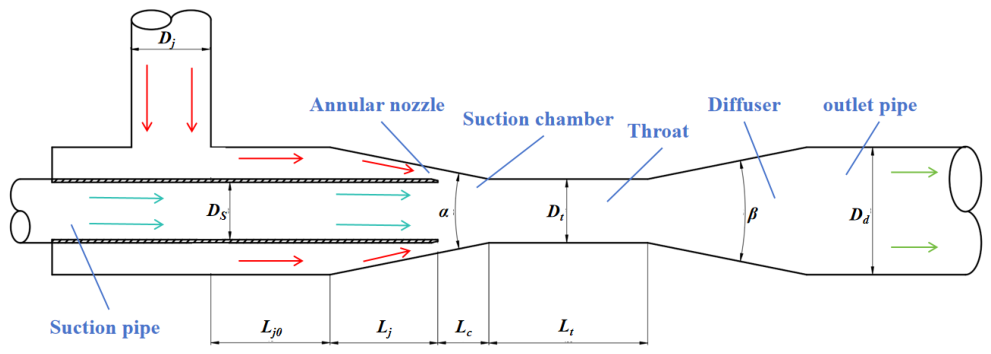
The AJP employed in this study achieves variable area ratio by altering the relative position between the suction pipe and the working pipe, thereby modifying the nozzle area. The nozzle inlet of the AJP connects to the working pipe, linking the right-angle section and the straight pipe section of the nozzle. A negative pressure formed at the nozzle draws in the suction liquid, which flows through the suction chamber, throat, and diffuser before exiting via the discharge pipe. The structure of the AJP is shown in Figure 1.
We conducted simulation analyses for five area ratio operating conditions. The structural dimensions of the AJP with an area ratio of 7.73 are listed in Table 1. Dj denotes the working pipe diameter; Ds denotes the suction pipe diameter; Lj0 denotes the straight pipe section length of the nozzle; Dt denotes the throat pipe diameter; Lc denotes the throat-nozzle distance; Lt denotes the throat pipe length; Dd denotes the discharge pipe diameter; α denotes the nozzle installation angle; β denotes the diffuser angle of the diffuser section.
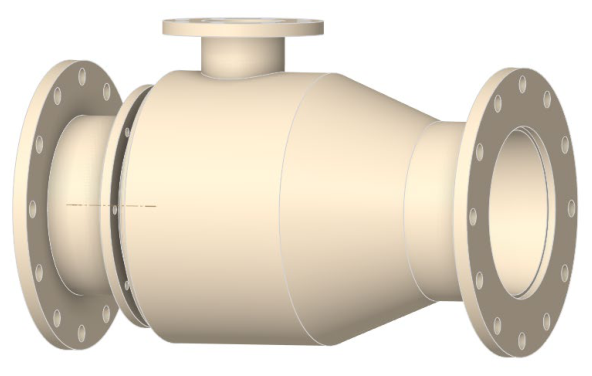
The three-dimensional model of the AJP established based on the above parameters is shown in Figure 2. The throat section and diffuser can be constructed by connecting gradually expanding pipes. To ensure stable flow at the inlet and outlet, each must be extended by five times the pipe diameter.

2.2. Computational Domain Mesh Generation

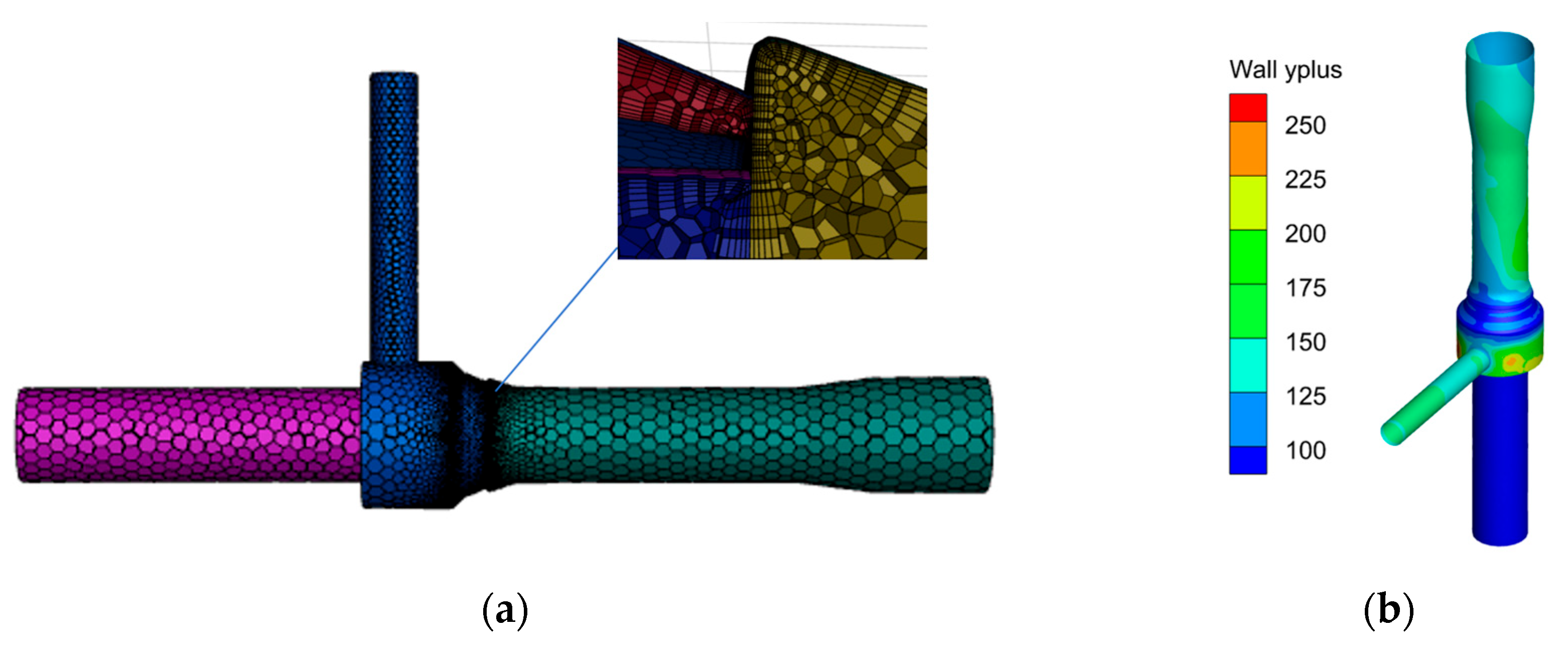
Fluent meshing was employed for computational domain meshing. The internal flow within the jet pump constitutes a confined jet problem occurring within a specific finite space, rendering a globally uniform mesh unsuitable. Consequently, an unstructured polyhedral core mesh type was selected, with boundary layer meshes established near the walls. The boundary layer comprises five layers, with the first layer having a height of 1 × 10⁻³ mm, with a mesh growth factor of 1.2. Considering the extremely high flow velocities in the nozzle region, the relative base percentage of the total boundary layer thickness was individually set to 5% to ensure adequate resolution and quality in this area. Additionally, wake refinement was implemented for the mixing chamber and the downstream flow development zone. The external flow field structure was relatively simple, employing an unstructured cut-cell mesh for discretization. The calculation grid distribution and wall Yplus of the jet pump are shown in Figure 3. The grid quality is above 0.4, which meets the calculation requirements. The Yplus value range of the grid is 30 to 250, which meets the computational requirements of the turbulence model.

2.3. Governing Equation

The computational framework is based on the Reynolds-averaged Navier–Stokes (RANS) methodology, which governs the time-averaged motion of turbulent fluid flow. Among the available approaches for industrial turbulent computations, RANS-based models offer a favorable balance between numerical economy and predictive fidelity, making them particularly suitable for parametric investigations of complex internal flow configurations such as annular jet pumps. Within the two-equation RANS family, the realizable kε was selected for turbulence closure. In contrast to the standard kε formulation, the realizable kε incorporates a variable coefficient Cμ and a refined transport equation for the dissipation rate ε, which confers distinct advantages in resolving flows characterized by streamline curvature, vortex structures, and strong shear. Previous investigations have established that the combination of standard wall functions with the realizable kε model [15,29] reliably reproduces the intricate mixing dynamics and global performance metrics of annular jet pumps. Given its demonstrated stability and enhanced accuracy in confined jet environments, the realizable kε model was adopted throughout the present numerical study. The continuity and momentum equations are as follows [15]:
( ρ u i ) x i = 0
ρ u j u i x j = x j μ u i x i ρ u i u j ¯ p x i
Reynolds stresses can be represented as follows:
ρ u i u j ¯ = μ u i x j + u j x i 2 3 ρ k δ i j
In the governing equations presented above, ui is velocity component, xi is space coordinate and δij is Kronecker delta, which is 1 if i = j (diagonal elements) and 0 otherwise (off-diagonal elements), the μ and μt correspond to the dynamic viscosity and the turbulent viscosity, k is turbulence kinetic energy. The realizable k-ε model offers benefits in accurately simulating the vortices and rotation, compared to the standard k-ε model. The realizable k-ε model employs the following modified transport equations for turbulence kinetic energy and dissipation rate [30]
( ρ k ) t + ( ρ k u j ) x j = x j ( μ + μ t σ k ) ( k ) x j + G k + G b ρ ε Y M + S k
( ρ ε ) t + ( ρ ε u j ) x j = x j ( μ + μ t σ ε ) ( ε ) x j + ρ C 1 S ε ρ C 2 ε 2 k + v ε + C 1 ε ε k C 3 ε G b + S ε
In the above equations, the following applies:
C 1 = max 0.43 , n n + 5 , n = S k ε , S = 2 S i j S i j
where Gk and Gb represent the turbulent kinetic energy generated by the average velocity gradient and the turbulent kinetic energy produced by buoyancy, respectively. YM is the contribution of the fluctuating dilatation in compressible turbulence to the overall dissipation rate, S is strain rate magnitude, C2 and Cε are constants. σk and σε are the turbulent Prandtl numbers for k and ε, respectively. Sk and Sε are user-defined source terms. The eddy viscosity [31] is expressed as follows:
μ t = ρ C μ k 2 ε
In the realizable k-ε model, Cμ is not constant and it can be mathematically described as follows:
C μ = 1 A 0 + A s k U * ε
where
U * = S i j S i j + Ω ˜ i j Ω ˜ i j
Ω ˜ i j = Ω i j 2 ε i j k ω k
Ω i j = Ω ˜ i j ε i j k ω k
A 0 = 4.04 , A s = 6 c o s ϕ , ϕ = 1 3 c o s 1 ( 6 W )
W = S i j S j k S k i S ˜ 3 , S ˜ 3 = S i j S i j , S i j = 1 2 ( u j x i + u i x j )
where Ωij is the mean rate-of-rotation tensor [9]. Consequently, Cμ is determined by the local mean deformation, rotation, and turbulence fields.

2.4. Physical Models and Boundary Conditions

Pressure and velocity coupling was handled using the coupled scheme. The governing equations were discretized using a second-order upwind scheme and solved iteratively with under-relaxation factors. Convergence was assessed by monitoring the scaled residuals of all governing equations, with a convergence threshold of 10−5 for continuity, momentum, and turbulence quantities.
Subhash et al. [32] employed a power-law constitutive model to describe the shear stress-strain rate response of gelatin exhibiting jellyfish-like properties. References [33,34] similarly treated such gelatin as a power-law fluid, while noting that jellyfish collagen can hydrolyze into jellyfish gel. Reference [35] highlighted that the gel exhibits high yield stress and viscosity index. Previous studies [36,37,38] have conducted relevant research on biomass slurries as power-law fluids. Therefore, this study employs the following power-law constitutive equation to simulate the flow characteristics of jellyfish-like shear-thinning phenomena:
η   =   k γ ˙ n 1
where η is the apparent viscosity; k is the viscosity coefficient; γ ˙ is the shear rate; and n is the flow index or non-Newtonian index. In CFD simulations, the Reynolds number Re for clear water is calculated using Equation (19):
R e = ρ u 0 D μ
The Reynolds number Re for power-law fluids is expressed using the generalized Reynolds number Reg defined by Metzner et al. [39]:
R e g = ρ u 0 2 n D n 8 n 1 ( 3 n + 1 4 n ) n K
where μ denotes the dynamic viscosity of clear water, with a value of 0.001–0.005 Pa·s; u0 represents the jet inlet velocity (m/s); D is the nozzle diameter (m); and ρ is the fluid density (kg/m3). Based on the analysis of the annular jet pump structure and the minimum velocity of the studied fluid for Reynolds number calculation, it is demonstrated that all flow regimes in this study are turbulent flows [40], consistent with our choice of the realizable k-ε turbulence model.
For this simulation, calculations were performed for three different concentrations of carboxymethyl cellulose (CMC) solutions at mass fractions of 0.3%, 0.4%, and 0.5%. The flow property parameters for CMC solutions at different concentrations are shown in Table 2, based on previous research [41]. Fluid parameters were input into Fluent as the basis for simulation.
To ensure stable inflow, the working pipe and suction pipe were extended to five times their diameter. In order to measure the complete performance curve of the AJP under different flow ratios and the ability to pump fluid in an open environment, two different boundary conditions were used. In order to obtain the complete performance curves under different flow ratios, both the working fluid inlet and the suction fluid inlet were defined as mass flow inlet. This method can realize the independent control of two streams of fluid, and under the premise of keeping the working fluid flow constant at 200 m3/h, the system can adjust the flow ratio Q by setting the range of suction mass flow, a complete performance characteristic curve is finally obtained. In this analysis, in order to obtain the fluid suction capacity of AJP in an open environment, the suction port was changed to the pressure inlet set to atmospheric pressure. This configuration is closer to the actual operating conditions. Under this condition, the actual entrainment flow is the natural result of momentum exchange between the driving jet and the suction flow, so its value is inherently correlated with the area ratio M.

2.5. Mesh-Independent Verification

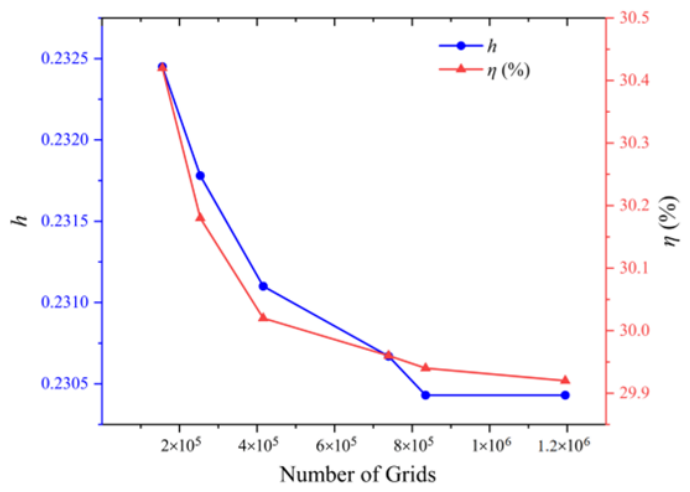
A systematic mesh independence study was performed to ensure that the numerical results were insensitive to the spatial discretization. Six progressively refined grids were generated, with cell counts ranging from approximately 155,000 to 1,194,000. All boundary conditions were held strictly constant throughout this verification, corresponding to a representative operating condition with an area ratio M = 2.1 and a flow ratio q = 1.0. The analysis was based on the convergence of global performance parameters h and η, which are directly relevant to the engineering objectives of this study. Figure 4 presents the variation of h and η with grid refinement. Both quantities display a monotonic convergence trend and stabilize to within 0.5% for all grids finer than approximately 415,000 cells. Specifically, between the selected mesh of 834,577 cells and the finest mesh, the relative differences are merely 0.07% for the pressure ratio h and 0.1% for the efficiency η. These discrepancies are substantially smaller than the uncertainties associated with turbulence modeling and experimental validation, confirming that the solution is effectively grid-independent. Consequently, the mesh with 834,577 cells was adopted for all subsequent simulations, providing an optimal compromise between numerical accuracy and computational expenditure.

2.6. CFD Simulation Validation

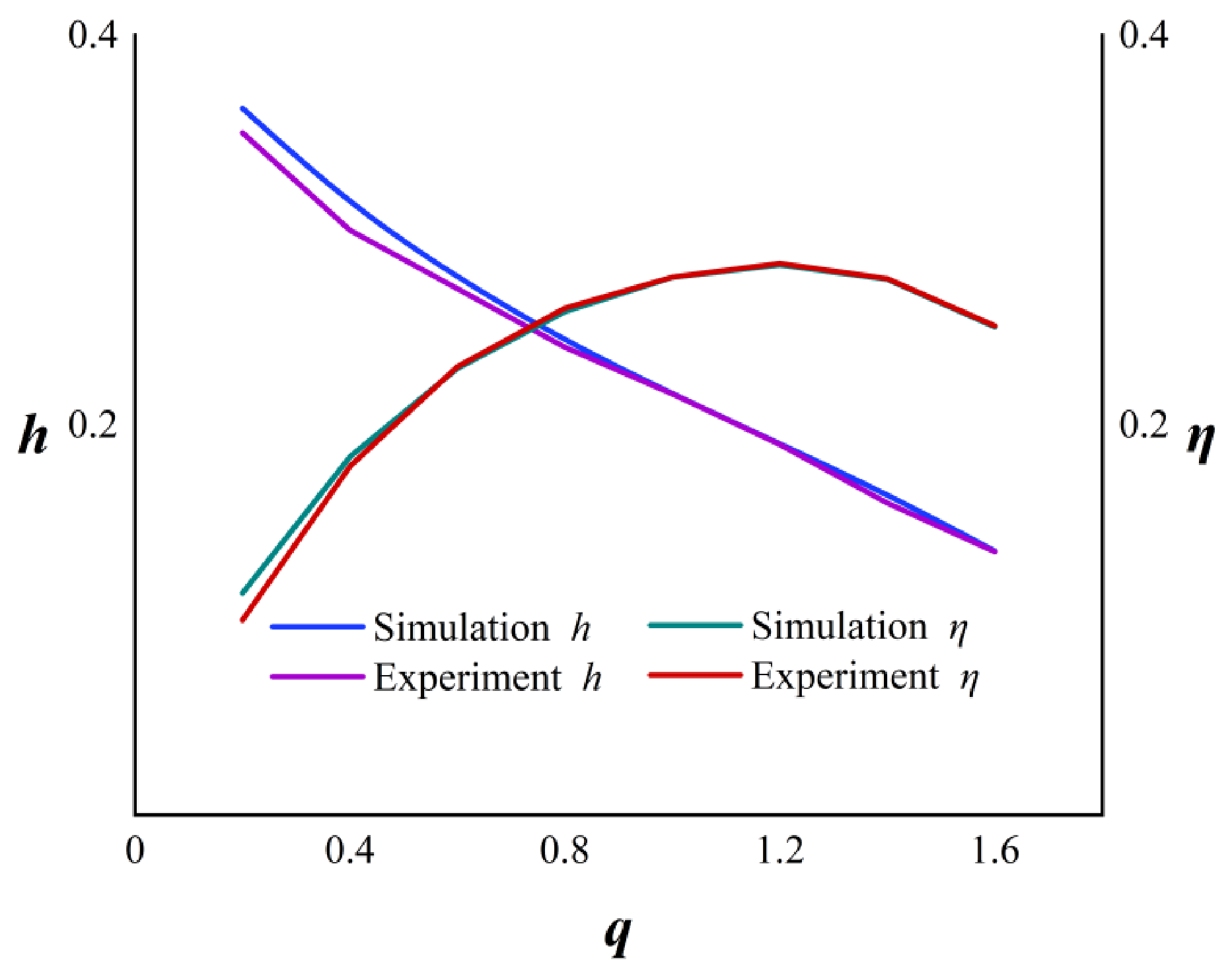
To validate the simulation methodology, the results of the AJP simulation with an area ratio of 2.6 were compared with experimental data from Shimizu [42]. However, it should be noted that this verification has certain limitations. The experimental data are based on the AJP configuration with water as working fluid. Consequently, the present validation confirms the reliability of the numerical framework for Newtonian flow conditions, whereas its extrapolation to non-Newtonian CMC solutions relies on the assumption that the turbulence model and grid resolution remain adequate when only the viscosity model is altered. The comparison of experimental and simulated data is shown in Figure 5. The simulation results exhibit an error of less than 5% compared to the experiments. These simulated results can serve as a basis for analyzing the internal flow field and predicting the performance of this AJP.

3. Water Conditions

Before examining the effects of non-Newtonian rheology, the performance of the AJP with water as the working fluid was first analyzed to establish a Newtonian performance baseline. This baseline serves two purposes, as follows:
(i)
It enables quantitative comparison with the subsequent CMC results to isolate the net effect of shear-thinning;
(ii)
It provides validation of the numerical framework against available experimental data for water.

3.1. Performance Analysis of AJPs with Different Area Ratios

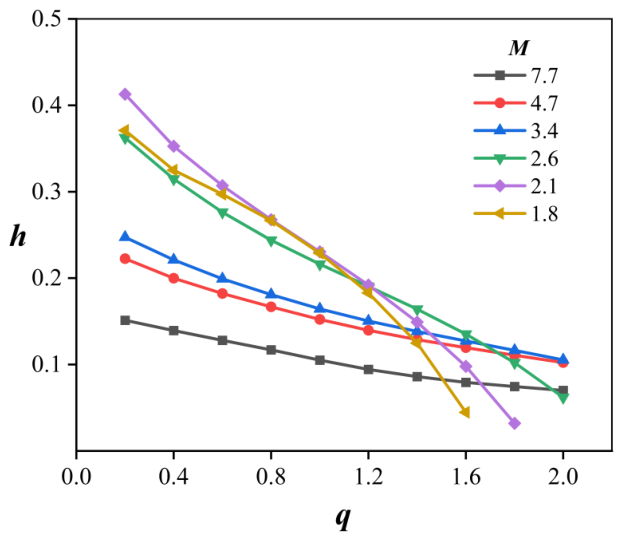
The relationship between h and q for AJPs with different area ratios is shown in Figure 6. As seen in the figure, all area ratio curves exhibit a monotonically decreasing trend of h with increasing q. This is primarily due to the increased secondary flow causing faster dilution of the main jet flow, along with increased flow losses in the mixing zone and diffuser section, resulting in a reduced achievable pressure ratio. It should also be noted that curves for larger area ratios exhibit flatter pressure ratio profiles than those for smaller ratios. This indicates broader operating ranges and more stable performance, though pressure ratios are generally lower. Smaller area ratios (M = 1.8, 2.1) feature steeper slopes, delivering high performance at low flow rates but rapid decay at high flow rates. Under small area ratio conditions (M = 1.8, 2.1), the highest h values (0.30–0.41) occur in the low q range (0.2–0.8). This indicates that more kinetic energy generated by the nozzle is converted into the kinetic energy of the entrained fluid, resulting in higher energy conversion efficiency and consequently, higher pressure ratios. However, the pressure ratio declines most sharply with increasing q, approaching extremely low h values around q (1.4–1.8). This is attributed to insufficient mixing, difficulty in expanding and recovering, or proximity to the instability zone at high q. Under medium area ratios (M = 2.6, 3.4), performance is most balanced in the medium-high q range (0.8–1.6), with h maintained at a medium-high level and a moderate curve slope. After multiple curves intersect at q = 1.2–1.4, the area ratios of 2.6 and 3.4 often outperform 1.8 and 2.1. This indicates that when systems require higher flow ratios, medium area ratios maintain superior pressure capability and stability. Under high area ratio conditions (M = 4.7, 7.7), h is lowest across the entire q range, but the curve is the flattest, indicating insensitivity to q variations and a wide adjustment/adaptation range, though the pressure ratio is relatively small.
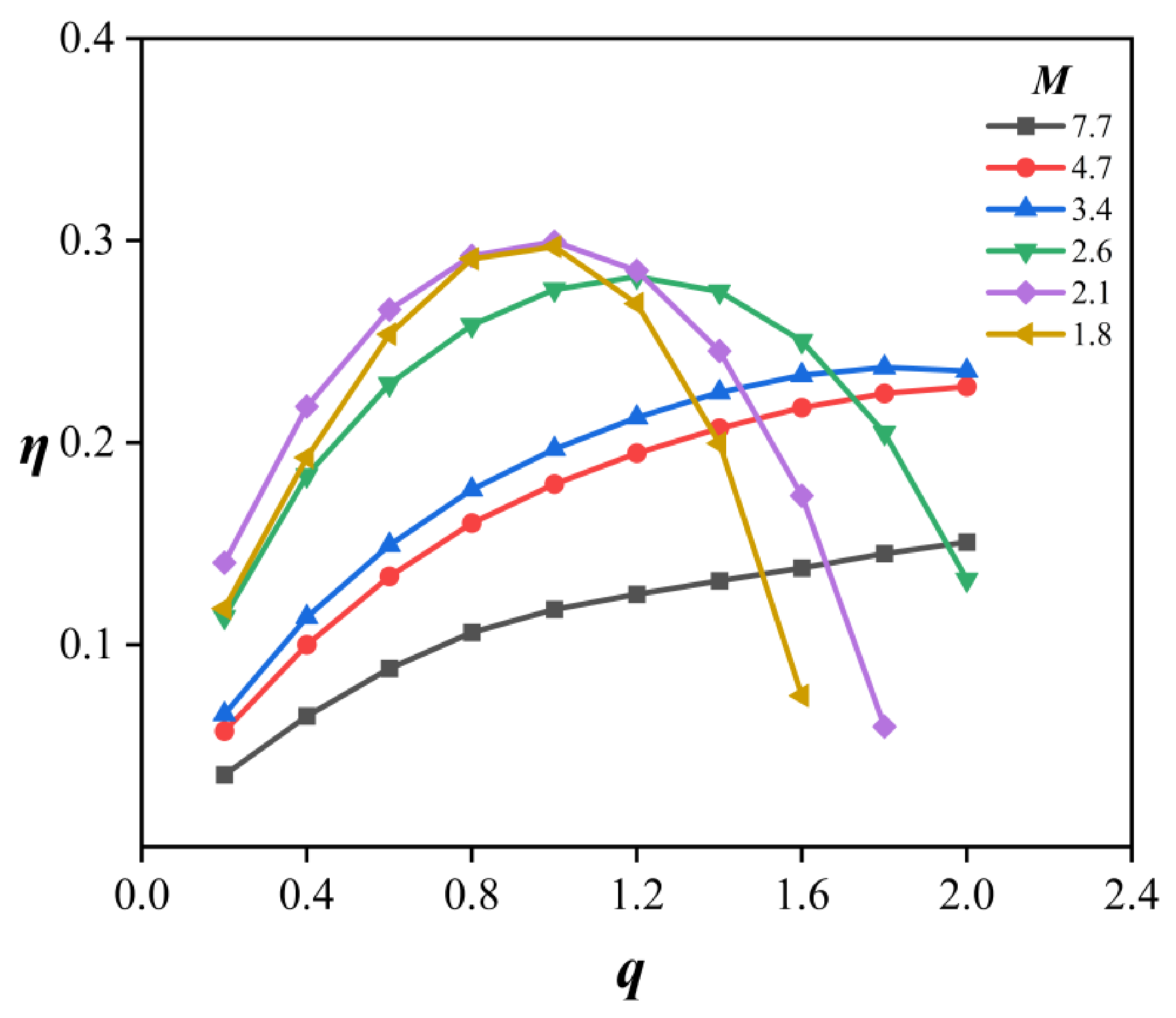
Figure 7 shows the relationship curves between η and q under different area ratio conditions. Analysis reveals that at area ratios of 1.8, 2.1, and 2.6, efficiency first increases then decreases with flow ratio, indicating peak efficiency point issues. Generally, the peak efficiency corresponding to the maximum efficiency increases as the area ratio decreases, while the flow ratio corresponding to the maximum efficiency point decreases with a smaller area ratio. The highest efficiency occurs at an area ratio of 2.1 and a flow ratio of 1, reaching 29.94%. Beyond the peak, the efficiency of AJP with smaller area ratios declines more rapidly as the flow ratio increases. For instance, at an area ratio of 1.8, efficiency drops sharply when the flow ratio exceeds 1.2, resulting in a relatively narrow stable operating range. For high area ratio conditions (M = 3.4, 4.7, 7.7), efficiency increases with rising flow ratio. This occurs because their peak flow ratios lie outside the selected range, with maximum efficiency points appearing at flow rates exceeding 2.4. Consequently, high area ratio AJPs exhibit the lowest η but offer the most stable performance, maximum adaptability, and limited efficiency and pressure differential.
In summary, the h–q curve decreases monotonically with q under all area ratios, while the ηq curve first rises and then falls; the area ratio significantly influences peak position, amplitude, and operating condition adaptability, with the optimal area ratio being between 2.1 and 2.6.

3.2. Flow Characteristics Analysis

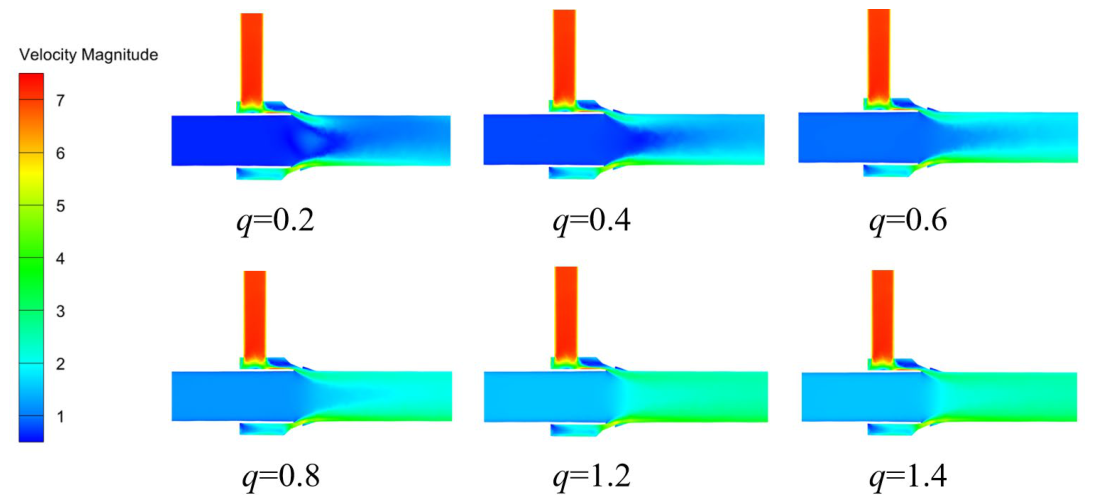
A comparative analysis of an AJP with an area ratio of 2.1 was conducted to investigate its flow characteristics under different flow ratios. The following shows the velocity contour plots on the central axis plane at various flow ratios. As shown in Figure 8, with increasing flow ratio q, the low velocity core in the mixing section significantly contracts, the wall-adjacent shear layer thickens and converges earlier, and the velocity distortion at the diffuser inlet markedly decreases. The most uniform velocity distribution across the cross-section occurs within the q = 0.8–1.2 range, indicating faster pressure recovery and saturated efficiency improvement in this interval. Further increasing q to 1.4 elevates overall velocity levels but thickens the near-wall layer, potentially increasing friction losses and reducing efficiency.
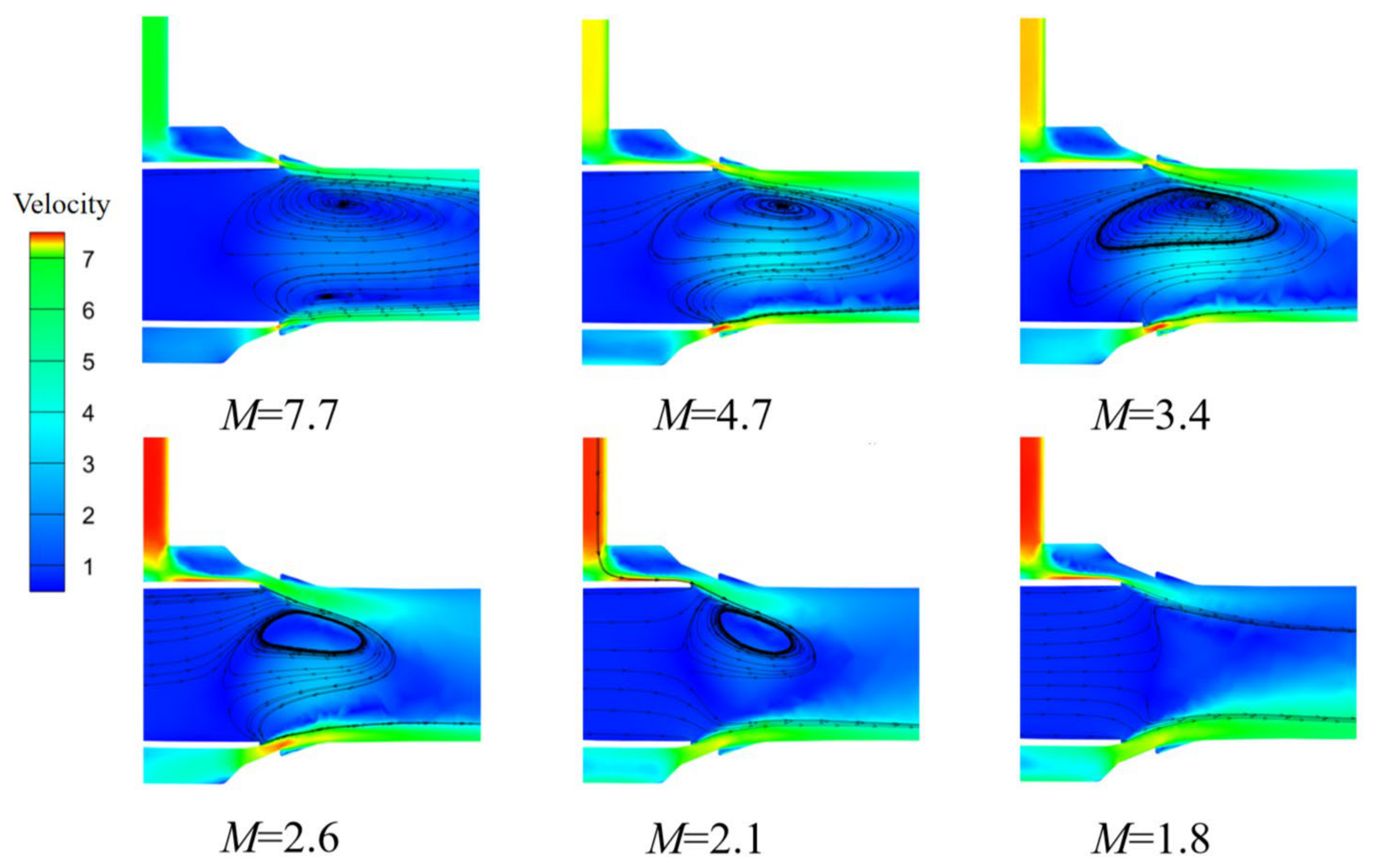
Figure 9 shows velocity contour plots and central streamlines of the mixing section at different area ratios but the same flow ratio. The contour plots reveal that as the area ratio M increases, the velocity gradient in the jet core gradually flattens, while the high-velocity region expands. Particularly at M = 7.7, the velocity distribution throughout the flow channel becomes more uniform, indicating that a large area ratio helps reduce localized high-speed impacts and minimizes energy loss. Conversely, at M = 1.8 and 2.1, significant velocity concentration near the jet outlet occurs, potentially triggering shear layer instability and vortex formation. Streamline diagrams further reveal the evolution of flow structures under different area ratios. At low M values, streamlines exhibit pronounced curvature near the mixing chamber inlet, accompanied by the formation of recirculation zones or vortex structures. This arises from insufficient momentum exchange between the jet and the surrounding fluid. As M increases, streamlines gradually straighten, indicating smoother flow. This demonstrates that the increased jet velocity from a larger area ratio transfers more energy to the entrained fluid, resulting in straighter streamlines in the recirculation zone. Thus, a larger area ratio improves flow stability and enhances energy transfer efficiency. In summary, the area ratio M is a key parameter influencing the internal flow structure and performance of AJP. A larger area ratio promotes more uniform and stable flow, reducing vortex formation and energy dissipation, thereby improving pump efficiency. Conversely, a smaller area ratio tends to cause flow separation and localized high-velocity zones, increasing flow losses.
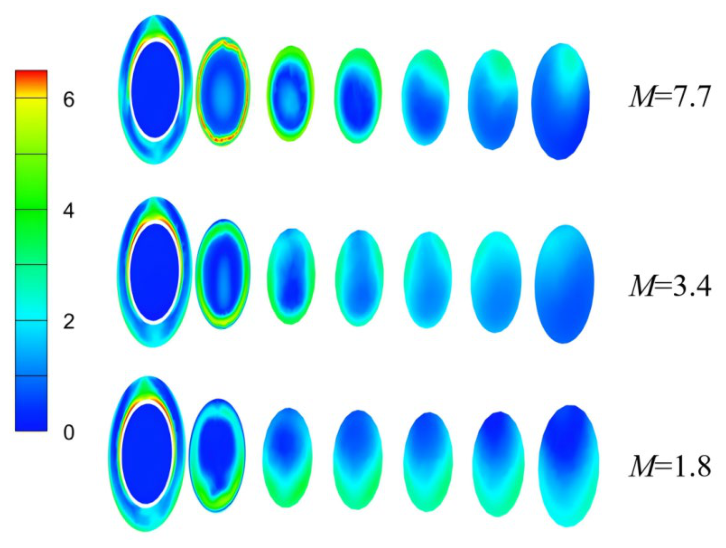
To illustrate velocity field distributions across different cross-sections along the flow direction, Figure 10 presents velocity fields for the suction chamber cross-section, nozzle cross-section, three throat cross-sections, the diffuser cross-section, and the outlet cross-section under three distinct area ratios, arranged from left to right. Figure 9 reveals that in cross-sections perpendicular to the main flow direction, the suction chamber cross-section exhibits relatively high velocities, forming a teardrop-shaped velocity structure around the suction tube. This occurs because the working fluid is ejected at high velocity from the working tube onto the suction tube. Since the area ratio is altered solely by modifying the nozzle structure, the cross-section in the suction chamber remains unaffected. As the area ratio decreases, the jet velocity at the annular nozzle cross-section shows a pronounced downward trend due to the increased cross-sectional area of the nozzle. The most pronounced changes occur in the velocity distributions of the throat section, diffuser section, and outlet section. At M = 7.7, the high-velocity zone primarily concentrates above the nozzle outlet section, with the high-velocity jet exhibiting an upward tendency or deflection toward the upper wall. Subsequently, as it passes through the throat, the high-velocity zone gradually disperses, and the velocity distribution becomes more uniform, though the initial deflection remains discernible. At M = 3.4, the high-velocity zone begins to shift downward. This trend becomes more pronounced at M = 1.8, where the high velocity regions—particularly, at the nozzle outlet and the front end of the subsequent throat—are predominantly concentrated in the lower section. The jet exhibits a stronger tendency to adhere to or be drawn toward the lower wall. Combined with the analysis in Figure 10, this indicates momentum exchange and mixing between the primary jet and the induced flow. Different M values imply distinct inlet velocity conditions for the main jet and the suction flow. This alters the pressure and streamline distribution within the mixing region, causing the jet’s centerline to deviate. At higher M values, the pressure exerted by the main jet through the annular jet nozzle is lower, allowing the high-pressure suction flow to push upward. When M is small, the suction flow’s influence diminishes, and the jet develops downward along the suction pipe. Ultimately, the velocity below the nozzle becomes greater than that above it, causing the high-velocity zone to shift downward across different cross-sections. According to the above analysis, the area ratio M not only affects the jet’s diffusion and mixing efficiency but also alters the position and radial distribution of the high-velocity jet’s centerline.
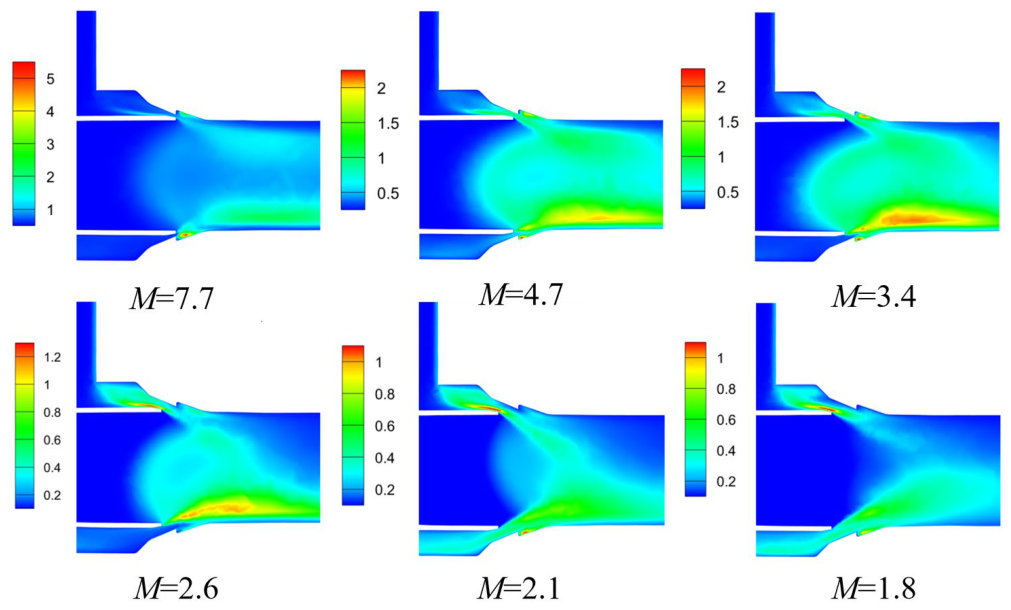
To further elucidate the impact of different area ratios on energy loss in AJPs from a turbulent mechanism perspective, this study plots the turbulent kinetic energy contour map at the central cross-section for q = 0.2, as shown in Figure 11. It is particularly noteworthy that different scale ranges were applied to each contour map to clearly display the distribution details of turbulent kinetic energy across various area ratios. This approach directly highlights the significant order-of-magnitude differences in turbulent kinetic energy intensity between different area ratios. The turbulent kinetic energy contour plots reveal that larger area ratios (M) correspond to higher absolute values of turbulent kinetic energy and broader high-energy regions. For instance, the maximum turbulent kinetic energy at M = 7.7 is four times higher than that at M = 1.8. This indicates that under high aspect ratio conditions, the flow field contains extremely intense turbulent pulsations and mixing processes. For low aspect ratios (M = 1.8, 2.1), the turbulence kinetic energy intensity further weakens, with the entire flow field exhibiting a very uniform and low-level distribution. This observation is consistent with the flatter and more stable flow-field structure under this operating condition. However, the most stable flow field does not correspond to the highest efficiency. If the turbulent kinetic energy is excessively low, the momentum exchange between the jet and the suction fluid becomes too weak, resulting in insufficient mixing and limited energy transfer. At the operating conditions with the highest efficiency (M = 2.6 and 3.4), the turbulent kinetic energy is reduced to an appropriate level. The high-energy region is restricted to a thinner shear layer, and the turbulent kinetic energy near the vortex core is significantly weakened. This suggests that the mixing process is relatively gentle and orderly, while turbulent dissipation losses remain low, thereby promoting efficient energy transfer. For larger area ratios, high turbulent kinetic energy appears mainly in the jet shear layer and in the large-scale vortex core regions identified in the streamline analysis. These regions are responsible for strong irreversible dissipation of mean kinetic energy. Therefore, overly high turbulent kinetic energy leads to excessive mixing losses, while overly low turbulent kinetic energy results in insufficient mixing. The results demonstrate that there exists an optimal turbulence intensity range for achieving high pump efficiency. In this study, operating conditions with aspect ratios M = 2.6 to M = 3.4 fall precisely within this optimal window. Their flow fields combine moderate mixing capability with controllable turbulent dissipation, thereby achieving peak efficiency.

4. CMC Conditions

4.1. Impact of Non-Newtonian Properties on Performance
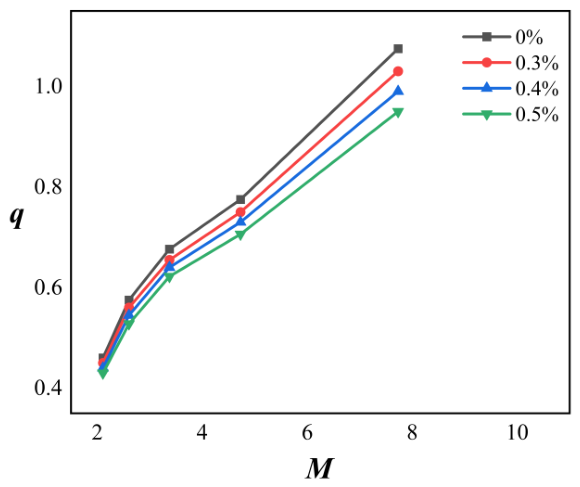
The flow ratio typically serves as a metric for the ejector capability of AJP. When the operating pressure is constant at one atmosphere, the area ratio and non-Newtonian fluid characteristics are the primary factors influencing the flow ratio. To investigate the impact of non-Newtonian properties on the flow ratio, simulations were conducted for suction conditions with an area ratio of 2.1 and a working fluid flow rate of 200 m3/h, using CMC working fluids of varying concentrations. Figure 12 shows the flow ratio versus CMC solution concentration under these conditions, with a working fluid flow rate of 200 m3/h. Figure 12 shows the variation of the flow ratio with the area ratio under different CMC solution concentrations in this operating condition. The figure reveals that q increases monotonically with M and exhibits near-linear growth within the range M = 2.1–7.7. This indicates that increasing the area ratio enhances suction and mixing, thereby strengthening the entrainment capability. Higher CMC solution concentrations cause q to decrease overall at the same M, with the difference becoming more pronounced at higher M values. This demonstrates that the negative impact of fluid viscosity on performance intensifies as M increases. Near M = 2.1, the four curves are relatively close, indicating that at small area ratios, the nozzle’s geometric contraction dominates the ejection process, with viscosity effects not yet fully evident. As M increases, the proportion of shear and dissipation in the mixing and expansion sections rises, amplifying differences in viscosity.
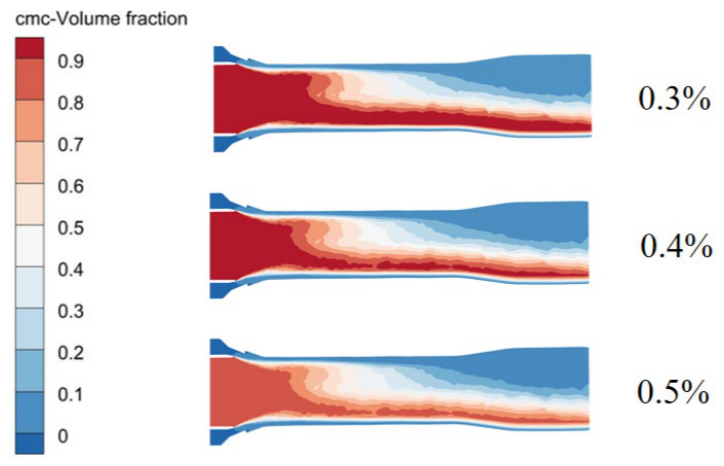
Figure 13 clearly illustrates the distribution characteristics of the CMC solution volume fraction versus the initial concentration in the AJP under fixed area ratio and operating flow conditions. Observations reveal that as CMC concentration increases, regions of high CMC volume fraction within the pump become more concentrated and pronounced, particularly downstream of the mixing section. This indicates that the solution’s non-Newtonian properties, particularly its shear thinning behavior, directly influence mass transfer and mixing kinetics within the flow field. This variation in volume fraction distribution is closely related to the rheological properties of the CMC solution. As a typical pseudoplastic fluid, CMC exhibits enhanced non-Newtonian effects with increasing concentration, leading to elevated apparent viscosity at low shear rates and more pronounced viscosity reduction at high shear rates. Within the AJP, these variations in non-Newtonian parameters significantly influence jet diffusion, momentum transfer efficiency, and energy dissipation patterns. High-concentration CMC solutions alter local shear stress distributions and reconfigure mixing efficiency, profoundly affecting critical pump performance metrics such as flow rate ratios.
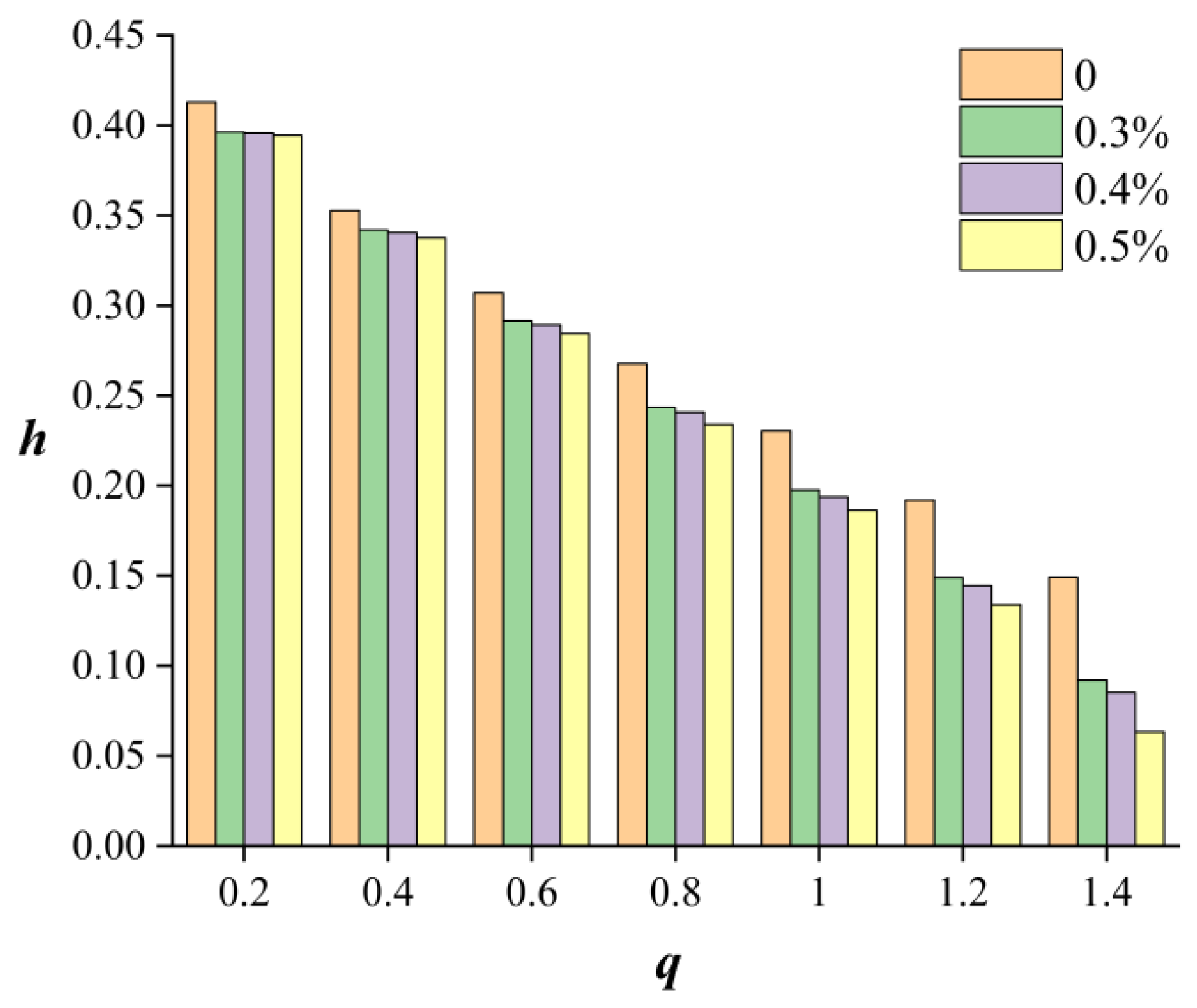
Figure 14 illustrates the distribution pattern of pressure ratio h versus flow ratio q under different CMC solution concentrations, revealing the impact of non-Newtonian fluid properties on AJP performance. Overall, for all experimental conditions, the pressure ratio h exhibits a decreasing trend with increasing flow ratio q. At low flow ratios, the pressure ratios of CMC solutions at various concentrations show only slight decreases compared to pure water, with insignificant differences. This indicates that under these operating conditions, the non-Newtonian properties of CMC solutions have a relatively limited impact on entrainment capability. However, as the flow ratio q increases further, the negative effect of CMC solutions’ shear thinning behavior on the jet pump’s pressure ratio gradually becomes apparent and intensifies. Specifically, at the same flow ratio, higher CMC concentrations correspond to lower pressure ratios h. For instance, when q reaches 1.4, the pressure ratio of the 0.5% CMC solution is significantly lower than that of pure water and other low-concentration CMC solutions. This is attributed to changes in the viscosity behavior of high-concentration CMC solutions within the pump’s high-shear zones, leading to reduced momentum transfer efficiency and increased frictional resistance. The shear-thinning characteristics of non-Newtonian fluids may alter the energy dissipation patterns of the jet, thereby affecting the effective energy exchange between the pump’s working fluid and the entrained fluid. This ultimately leads to a deterioration in overall pressure ratio performance.
Figure 14. Pressure Ratio at Different CMC Concentrations.
Fluids 11 00112 g014
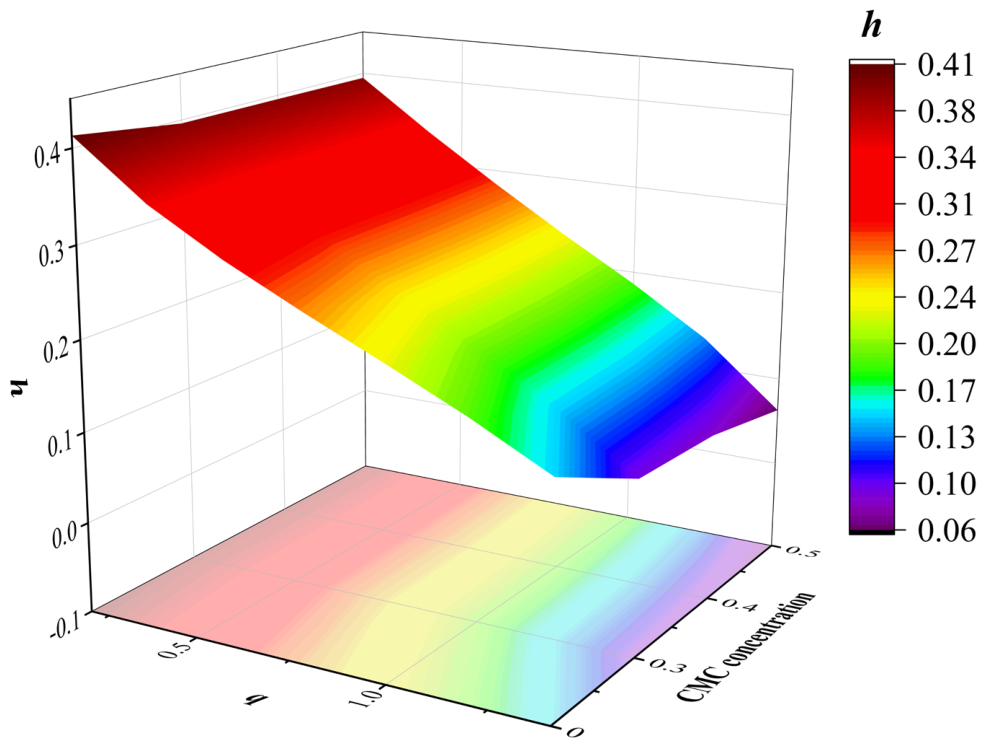
The three-dimensional surface plot Figure 15 reveals a nonlinear decrease in the pressure ratio h with increasing flow ratio q. This trend remains consistent across different CMC concentrations, corroborating the pattern observed in the discrete data points shown in Figure 14. Furthermore, the surface intuitively reveals that at any given flow ratio q, the pressure ratio h generally decreases with increasing CMC concentration, a trend particularly pronounced in the high-flow ratio region. This decline indicates that the non-Newtonian fluid properties, specifically the shear thinning effect of CMC solutions, impede the jet pump’s ability to perform work. The decrease in pressure ratio h with increasing CMC concentration arises because the solution’s non-Newtonian shear-thinning behavior becomes more pronounced at higher concentrations. Although apparent viscosity decreases in high-shear zones, the efficiency of momentum transfer between the main flow and the entrained fluid is still altered within the mixing and diffusion sections of the AJP. This occurs because higher CMC concentrations induce stronger elastic effects or more complex stress states within the fluid. Although shear thinning properties may promote flow in localized regions, the overall alteration in fluid behavior increases friction losses within the pump and leads to incomplete momentum transfer. This consequently reduces the jet pump’s ability to elevate pressure differentials. Notably, its two-dimensional projection diagram further corroborates the complex mechanism by which the pressure ratio h is jointly regulated by CMC concentration and flow rate ratio q under varying operating conditions.
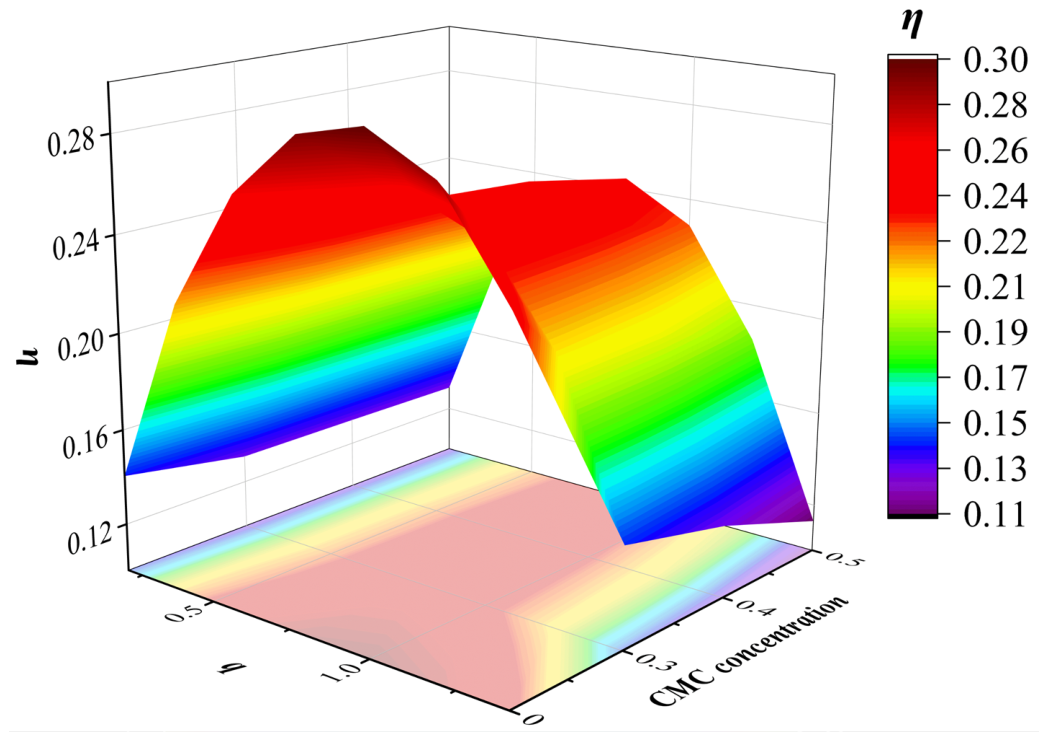
Figure 16 presents a three-dimensional projection of efficiency versus flow ratio under different CMC solution concentrations. The chart indicates that the concentration of CMC solution significantly influences the peak efficiency, high-efficiency operating range, and optimal operating point of the jet pump. Furthermore, its shear-thinning properties exhibit complex interaction mechanisms across different flow field regions. Under clean water conditions, the AJP achieves its highest efficiency of 29.94% at a flow ratio of 1. As the CMC solution concentration increases, the peak efficiency shows a clear downward trend, and the corresponding flow ratio shifts leftward. Under a 0.5% CMC solution working fluid condition, the peak efficiency point is 24.43% at a flow ratio of 0.8. Moreover, as CMC concentration increases, the high-efficiency operating range of the AJP noticeably shrinks. Deviating from the pump’s optimal operating point leads to a more pronounced decrease in efficiency. The increased slope of the efficiency curve reflects heightened sensitivity to changes in the flow ratio.

4.2. Flow Field Analysis of AJP in Non-Newtonian Fluids

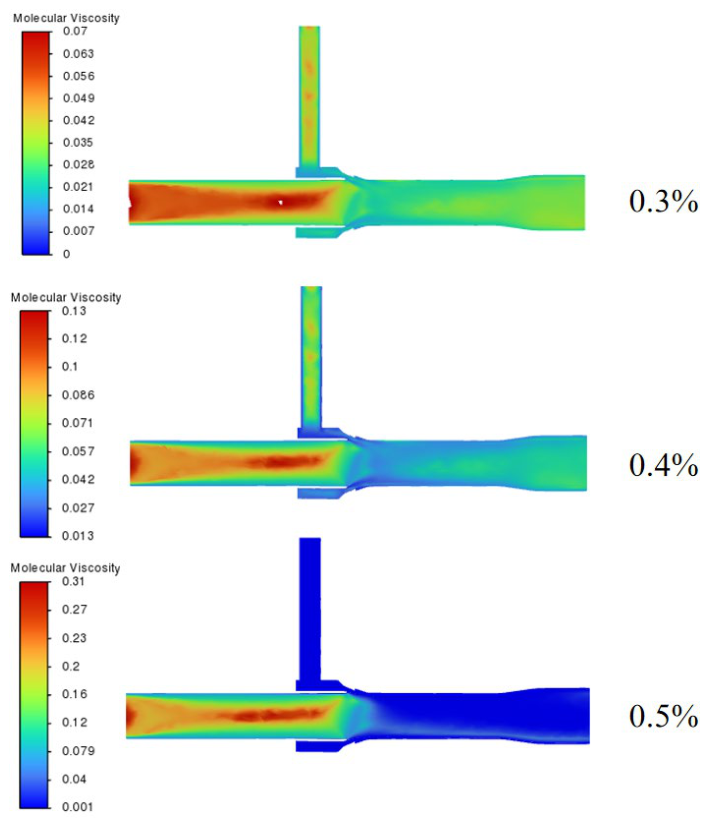
Figure 17 shows the contour distribution of laminar viscosity at the center cross-section under different CMC concentrations. The figure reveals a sharp drop in viscosity as the fluid flows from the suction inlet through the driving nozzle outlet and into the central region of the mixing throat. This occurs because the velocity gradient of the working fluid at the nozzle is very large, resulting in extremely high shear rates. In this region, the CMC solution exhibits a significant shear-thinning effect, causing its viscosity to decrease substantially. This lower local viscosity facilitates the formation and high-speed flow of the driving jet, thereby enhancing its ability to entrain surrounding aspirated fluid and promoting efficient momentum transfer. In contrast, areas with lower velocity gradients, such as the pump inlet, near the walls of the mixing throat, and within the diffuser, exhibit relatively low shear rates. Here, CMC solutions maintain higher apparent viscosities. The elevated viscosity increases flow resistance and promotes the formation of a thicker boundary layer near the wall, which elevates friction losses along the flow path. More critically, in the diffuser section, this thick, highly viscous boundary layer is prone to separation under the reverse pressure gradient, leading to a sharp decline in pressure recovery efficiency and contributing directly to the overall reduction in pump efficiency.
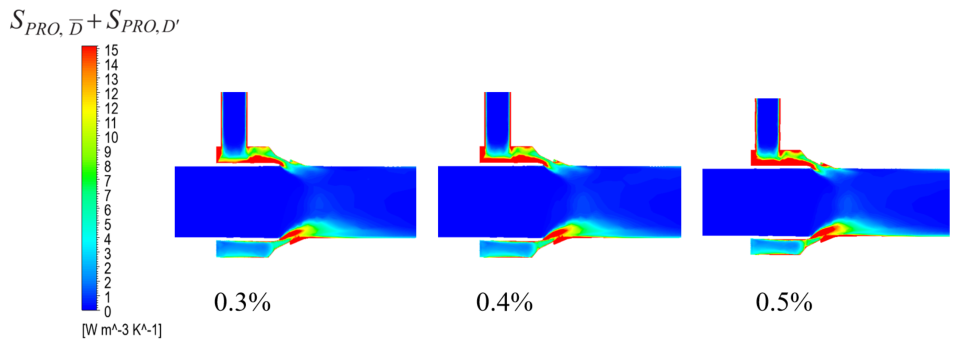
To quantify the local and global irreversibilities within the AJP, entropy generation theory was employed following the method established by Kock and Herwig [43]. For the isothermal turbulent flow considered here, the total volumetric entropy production rate was decomposed into direct dissipation, turbulent dissipation, and Wall dissipation contributions. The direct dissipation was computed from the time-averaged velocity gradients, while the turbulent dissipation was modeled as a function of the turbulent dissipation rate ε. Wall entropy production was accounted for using wall functions. These quantities were evaluated during post-processing and integrated over the computational domain to obtain the global entropy components presented in Figure 18.
Δ S P R O = Δ S P R O , D ¯ + Δ S P R O , D + Δ S P R O , W
The entropy production rate contour map of the center section reveals that high entropy production zones are primarily concentrated at the outlet of the driving jet and its near-field shear layer, where the convergence of the induced jet with the main jet creates maximum velocity gradients, generating strong shear and turbulent dissipation. Stagnation of the induced jet fluid at the leading edge of the right-angle section also contributes significantly. Near the wall, boundary layer thickening or separation enhances viscous dissipation, particularly at geometric transitions, corners, and the throat/diffuser inlets, resulting in striped high-entropy regions. Overall, entropy production is lower in regions distant from the mixing core and downstream of the diffuser, confirming that irreversible losses are concentrated in the nozzle jet region, stagnation zones, and near-wall shear zones. As CMC concentration increases, the high-entropy production regions exhibit stronger and more concentrated dissipation near the right-angle section, the straight pipe section of the nozzle, and the nozzle jet, with the affected area expanding to occupy the entire straight pipe section and the front half of the right-angle section. This indicates that higher solution viscosity increases shear stress and intensifies energy dissipation at the wall and within the mixing layer. A thicker boundary layer and impaired flow adhesion through geometric transitions further amplify irreversible losses by promoting separation and recirculation.
The pressure ratio and efficiency of a jet pump fundamentally depend on the effective conversion of the driving jet’s kinetic energy into momentum of the entrained flow and the subsequent recovery of static pressure. As CMC concentration increases, entrainment capability diminishes, altering the development of the mixing layer and impeding momentum transfer to the entrained flow. The resulting incomplete momentum exchange manifests as increased turbulent dissipation and mixing losses, which directly reduce efficiency. Concurrently, pressure recovery in the diffuser becomes more difficult, further lowering overall performance.
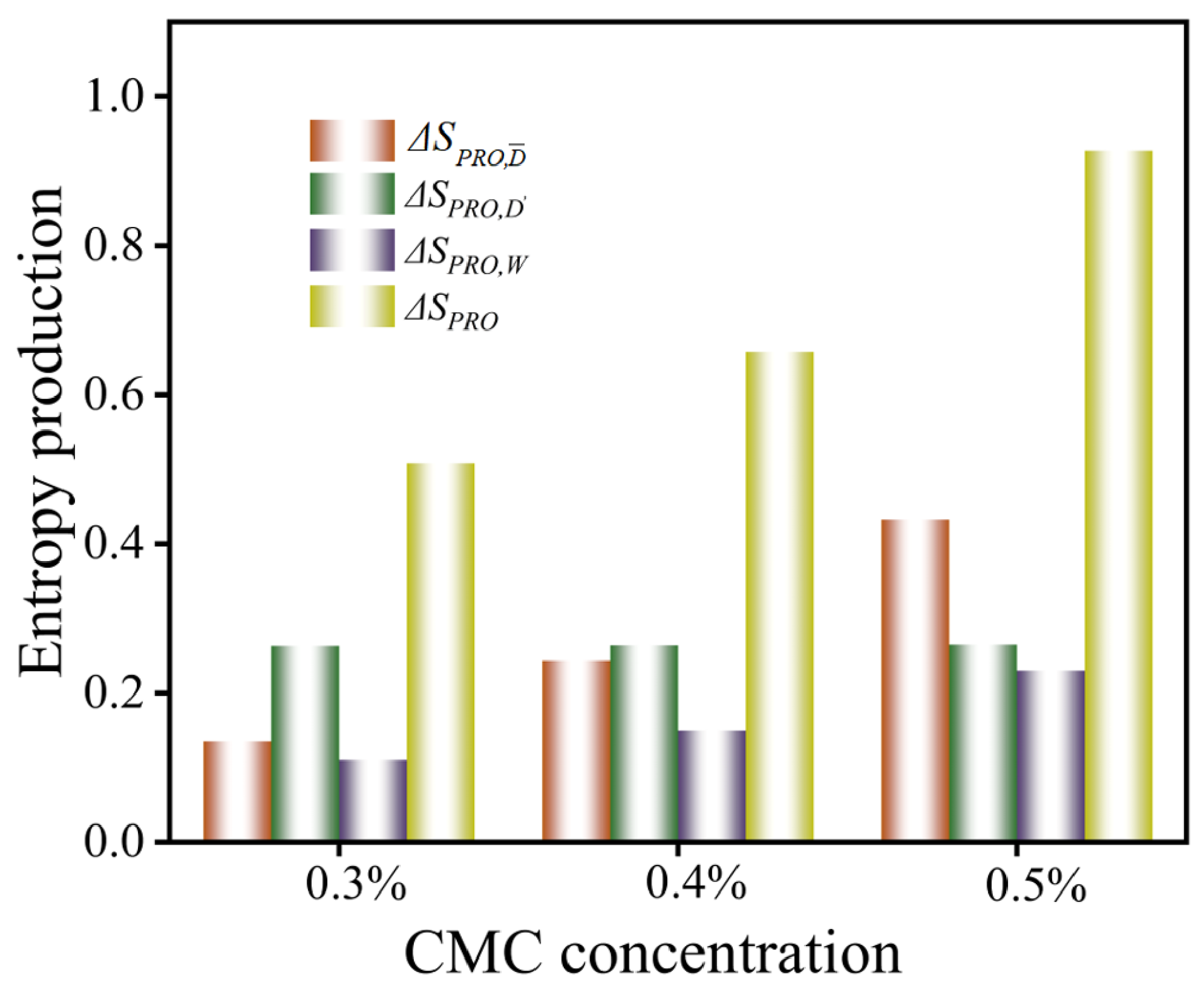
Figure 19 shows the distribution of entropy products at different concentrations, where   Δ S PRO , D ¯ ,   Δ S PRO , D ,   and   Δ S PRO , W represent direct dissipation entropy product, turbulent dissipation entropy product, wall entropy product, and total entropy product, respectively. The results indicate that as the CMC mass fraction increased from 0.3% to 0.5%, the total entropy production S of the AJP monotonically increased, reflecting a significant accumulation of irreversible losses in the system. A component-by-component comparison reveals that direct dissipation entropy production increased most markedly with concentration, rising rapidly from 0.135 J/k to 0.432 J/k and becoming the dominant term at 0.5%. Turbulent dissipation entropy production remained relatively stable at approximately 0.265 J/k across all operating conditions, indicating no significant enhancement in macroscopic turbulence intensity. Wall-related entropy production steadily increased with concentration, reflecting intensified shear and friction losses within the boundary layer. This trend can be explained by rheological and energy dissipation mechanisms. Increased CMC concentration elevates system viscosity, intensifying viscous dissipation at the molecular scale and propelling direct dissipation as the primary driver of total entropy production growth. Concurrently, heightened viscosity thickens velocity gradients near the wall and increases shear stress, leading to synchronous growth in wall-related entropy production. Thus, the irreversible losses induced by concentration increase are primarily concentrated in direct viscous dissipation and wall friction.

5. Conclusions

This study investigated the performance characteristics and internal flow field evolution of a AJP during the transport of non-Newtonian fluids using numerical simulation methods. Based on the power-law fluid model, realizable k-ε turbulence model, and VOF multiphase flow model, we analyzed the effects of different area ratios and CMC concentrations on the flow ratio, pressure ratio, efficiency, and flow field structure of the AJP. Combined with entropy production analysis, the mechanism of energy loss was revealed. The main conclusions are as follows:
(1)
Under pure water conditions, the performance of the AJP is significantly influenced by the area ratio. A small area ratio facilitates efficient energy conversion at low flow ratios but exhibits a narrow high-efficiency range. A large area ratio yields stable performance but generally results in lower pressure ratios and efficiency. Optimal performance occurs at an area ratio of 2.1 and a flow ratio of approximately 1.0, achieving a maximum efficiency of 29.94%;
(2)
The introduction of non-Newtonian fluids markedly alters the performance characteristics of AJP. As CMC concentration increases, the solution’s shear thinning effect intensifies, leading to reduced pumping capacity, decreased pressure ratio, lower peak efficiency, and a leftward shift of the optimal operating point. The maximum efficiency of a 0.5% CMC solution decreases by approximately 5.5% compared to pure water, indicating that non-Newtonian properties significantly suppress the pump’s energy conversion efficiency;
(3)
Flow field analysis reveals that CMC solutions exhibit pronounced viscosity reduction in high-shear regions (e.g., nozzle outlet, mixing layer), facilitating jet formation and entrainment. Conversely, in low-shear zones (e.g., inlet, near walls, diffuser section), apparent viscosity increases, thickening the boundary layer and elevating friction losses, thereby impairing pressure recovery and overall efficiency;
(4)
Entropy production analysis further reveals the sources of energy loss. As CMC concentration increases, direct dissipation entropy production significantly rises, becoming the dominant term in total entropy production, while wall-related entropy production also increases synchronously. Turbulent dissipation entropy production remains relatively stable. This indicates that additional losses introduced by the non-Newtonian fluid are primarily concentrated in molecular viscous dissipation and wall friction.
In summary, the performance of AJP conveying non-Newtonian fluids is jointly influenced by fluid rheological properties, geometric structure, and operating conditions. The findings of this study provide a theoretical foundation for understanding the flow behavior of shear-thinning non-Newtonian fluids in AJPs. From an engineering perspective, the quantified relationship between CMC concentration and efficiency decline offers a predictive basis for selecting safe operating flow ratios. Notably, the observed leftward shift of the maximum efficiency point indicates that, for shear-thinning fluids, the design flow ratio should be reduced relative to Newtonian benchmarks to maintain operation near peak efficiency. In addition, the research based on the energy dissipation mechanism of CMC in the annular jet pump also provides guidance for optimizing the area, to minimize energy loss and potential biological damage in the suction process. Future work may integrate experimental validation with a wider spectrum of non-Newtonian constitutive models and explore structural optimization strategies, thereby further enhancing the engineering adaptability of AJPs for conveying complex biological media.

Author Contributions

T.L.: Writing—original draft, formal analysis. P.W.: Validation, supervision. W.Z.: Software. D.L.: Resources, funding acquisition. X.X.: Data curation, visualization. H.Z.: Conceptualization. Q.S.: Methodology, project administration. All authors have read and agreed to the published version of the manuscript.

Funding

This research received no external funding.

Institutional Review Board Statement

Not applicable.

Informed Consent Statement

Not applicable.

Data Availability Statement

The raw data supporting the conclusions of this article will be made available by the authors on request.

Conflicts of Interest

Author Donghua Lu was employed by the company Suzhou Nuclear Power Research Institute Co., Ltd. The remaining authors declare that the research was conducted in the absence of any commercial or financial relationships that could be construed as a potential conflict of interest.

Abbreviations

The following abbreviations are used in this manuscript:
CMCCarboxymethyl
VOFVolume of fluid
AJPAnnular jet pump
LESLarge eddy simulation

References

  1. Li, T.Z.; Yang, Z.P. Numerical Simulation of the Effect of Suction Pipe Outlet Position and Diameter on Annular Jet Pump. J. Irrig. Drain. 2022, 41, 63–68. [Google Scholar] [CrossRef]
  2. Xu, K.; Wang, G.; Zhang, L.Y.; Wang, L.Q.; Yun, F.H.; Sun, W.H.; Wang, X.Y.; Chen, X. Multi-Objective Optimization of Jet Pump Based on RBF Neural Network Model. J. Mar. Sci. Eng. 2021, 9, 236. [Google Scholar] [CrossRef]
  3. Xu, K.; Wang, G.; Wang, L.Q.; Yun, F.H.; Sun, W.H.; Wang, X.Y.; Chen, X. Parameter Analysis and Optimization of Annular Jet Pump Based on Kriging Model. Appl. Sci. 2020, 10, 7860. [Google Scholar] [CrossRef]
  4. Xu, M.S.; Yang, X.L.; Long, X.P.; Lü, Q. Large eddy simulation of turbulent flow structure and characteristics in an annular jet pump. J. Hydrodyn. Ser. B 2017, 29, 702–715. [Google Scholar] [CrossRef]
  5. Shrestha, U.; Choi, Y.D. Effect of diffuser angle and J-groove depth on improvement in suction performance of annular jet pump model. J. Adv. Mar. Eng. Technol. 2020, 44, 385–394. [Google Scholar] [CrossRef]
  6. Wang, X.D.; Chen, Y.L.; Zhao, Y.; Xu, Y.; Wang, B. Influence of suction chamber profile on flow field of annular jet pump. IOP Conf. Ser. Earth Environ. Sci. 2019, 304, 032088. [Google Scholar] [CrossRef]
  7. Xiao, L.Z.; Long, X.P.; Lyu, Q.; Hu, Y.; Wang, Q.Q. Numerical investigation on the cavitating flow in Annular Jet Pump under different flow rate ratio. IOP Conf. Ser. Earth Environ. Sci. 2014, 22, 52001. [Google Scholar] [CrossRef]
  8. Yang, X.L.; Long, X.P.; Kang, Y.; Xiao, L.Z. Application of Constant Rate of Velocity or Pressure Change Method to Improve Annular Jet Pump Performance. Int. J. Fluid Mach. Syst. 2013, 6, 137–143. [Google Scholar] [CrossRef]
  9. Morrall, A.; Quayle, S.; Campobasso, M.S. Turbulence modelling for RANS CFD analyses of multi-nozzle annular jet pump swirling flows. Int. J. Heat. Fluid Flow. 2020, 85, 108652. [Google Scholar] [CrossRef]
  10. Xiao, L.Z.; Cai, B.H.; Hu, Y. Investigation on the Recirculation Region of an Annular Jet Pump with Different Suction Angles. Fluid Mach. 2020, 48, 48–52. [Google Scholar]
  11. Du, Z. Study on the Performance of a Conveying Device Based on an Annular Jet Pump. Ph.D. Thesis, Dalian Maritime University, Dalian, China, 2022. [Google Scholar]
  12. Xu, K. Numerical Simulation and Optimization of Jetting and Suction Systems of a Jet Trencher. Ph.D. Thesis, Harbin Engineering University, Harbin, China, 2021. [Google Scholar]
  13. Wang, X.D. Study on Hydraulic Characteristics of Streamlined Annular Jet Pump. Ph.D. Thesis, Sichuan University, Chengdu, China, 2021. [Google Scholar]
  14. Dong, J.M.; Du, Z.Y.; Chen, C.; Xu, G.L. Numerical Simulation of the Influence of Swirling Flow on the Performance of an Annular Jet Pump. Mech. Sci. Technol. Aerosp. Eng. 2023, 42, 530–537. [Google Scholar] [CrossRef]
  15. Riaz, S.; Aaltonen, J.; Pinkse, T.; Koskinen, K. Parametric study of structural influences on suction performance in an Annular Jet Pump—CFD and experimental validation. J. Water Process. Eng. 2025, 70, 107066. [Google Scholar] [CrossRef]
  16. Riaz, S.; Aaltonen, J.; Pinkse, T.; Koskinen, K. Numerical investigation and validation of multiphase flow in annular jet pump—A mixture model approach. Eng. Sci. Technol. 2025, 69, 102100. [Google Scholar] [CrossRef]
  17. Liu, W.H.; Lai, X.J.; Zhu, C.B.; Zhou, Q.W.; Yang, X.L. Effect of sand diameter on the performance of annular jet pumps. In Proceedings of the 17th Asian International Conference on Fluid Machinery (AICFM 17 2023), Zhenjiang, China, 20 October 2023–23 October 2026. [Google Scholar] [CrossRef]
  18. Liu, W.H.; Lai, X.J.; Zhou, Q.W.; Zhu, C.B.; Yang, X.L. CFD study on the effect of particle properties on the performance of annular jet pump. J. Phys. Conf. Ser. 2024, 2707, 012038. [Google Scholar] [CrossRef]
  19. Yang, Z.J. Analysis and Research on Liquid Withdrawal Capacity of Annular Jet Pump in Coal Mine. Inn. Mong. Coal Econ. 2019, 134–135. [Google Scholar]
  20. Xiao, C.; Wang, S.T.; Wang, X.W.; Chen, K.; Su, H.F.; Chen, M.S. Experimental investigation on the convey performance and control strategy of a special annular jet pump for deep sea feeding. Aquac. Eng. 2024, 107, 102454. [Google Scholar] [CrossRef]
  21. Xiao, L.; Long, X. Cavitating flow in annular jet pumps. Int. J. Multiph. Flow 2015, 71, 116–132. [Google Scholar] [CrossRef]
  22. Chen, Z.J.; Jiang, Y.; Lu, H.Z.; Tang, Y.; Chen, Z. Optimization Design of Liquid–Gas Jet Pump Based on RSM and CFD: A Comprehensive Analysis of the Optimization Mechanism. Water 2025, 17, 3423. [Google Scholar] [CrossRef]
  23. Xia, X.; Zhao, M.H.; Liu, J.L.; Jiao, S.J.; Che, J.; Guo, J.; Li, A.D. Numerical study on gas–liquid two-phase flow within downhole jet pumps. Can. J. Chem. Eng. 2025, 104, 535–552. [Google Scholar] [CrossRef]
  24. Murillo, W.O.; Arcila, I.D.P.; Fernández, J.A.P. Fluid dynamic simulations and genetic-based algorithms for parametric analysis and performance optimization of air-solid jet pumps used in pneumatic transportation of high-density particles. Powder Technol. 2025, 455, 120764. [Google Scholar] [CrossRef]
  25. Alkhulaifi, Y.M.; Jaroslawski, T.M.; Paul, S.; Hawks, S.A.; Santiago, J.G. A miniature jet pump for slurries. Chem. Eng. J. 2025, 503, 158293. [Google Scholar] [CrossRef]
  26. Cao, Z.Q.; Yang, X.L.; Xu, X.; Zhu, C.B.; Zou, D.H.; Zhou, Q.W.; Fang, K.Y.; Zhang, X.C.; Mou, J.G. Experimental Study on the Performance and Internal Flow Characteristics of Liquid–Gas Jet Pump with Square Nozzle. Water 2024, 16, 2358. [Google Scholar] [CrossRef]
  27. Tang, Y.; Zhang, W.D.; He, Y.F.; Wei, J.F.; Xiong, H.Y. Study on the working characteristics of a double jet pump used for high sand content extraction in the oil and gas production. Flow Meas. Instrum. 2024, 98, 102648. [Google Scholar] [CrossRef]
  28. Yang, Y.; Wu, S.H.; Wang, C.; Jiao, W.X.; Ji, L.L.; An, C.; Ge, J. Effect of effuser throat diameter on the internal flow structure and energy characteristics of the jet pump. Energy Rep. 2023, 9, 2075–2086. [Google Scholar] [CrossRef]
  29. Wang, X.; Chen, Y.; Li, M.; Xu, Y.; Wang, B.; Dang, X. Numerical Study on the Working Performance of a Streamlined Annular Jet Pump. Energies 2020, 13, 4411. [Google Scholar] [CrossRef]
  30. Sana, A.; Ghumman, A.R.; Tanaka, H. Modification of the damping function in the k–ε model to analyse oscillatory boundary layers. Ocean. Eng. 2007, 34, 320–326. [Google Scholar] [CrossRef]
  31. Wang, Z.; Lei, Y.; Wu, Z.; Wu, J.; Zhang, M.; Liao, R. Structure Size Optimization and Internal Flow Field Analysis of a New Jet Pump Based on the Taguchi Method and Numerical Simulation. Processes 2023, 11, 341. [Google Scholar] [CrossRef]
  32. Subhash, G.; Kwon, J.; Mei, R.; Moore, D.F. Non-Newtonian Behavior of Ballistic Gelatin at High Shear Rates. Exp. Mech. 2011, 52, 551–560. [Google Scholar] [CrossRef]
  33. Borah, P.K.; Yakubov, G.E.; Duary, R.K. Rheology, microstructure and diffusion in soft gelatin nanocomposites packed with anionic nanogels. Food Struct. 2021, 30, 100216. [Google Scholar] [CrossRef]
  34. Pal, A.; Bajpai, J.; Bajpai, A.K. Easy fabrication and characterization of gelatin nanocarriers and in vitro investigation of swelling controlled release dynamics of paclitaxel. Polym. Bull. 2018, 75, 4691–4711. [Google Scholar] [CrossRef]
  35. Chiarelli, P.G.; Fair, C.G.; Pegg, R.B.; Mis Solval, K. Modifying and improving the Bloom strength and rheological properties of jellyfish gelatin. Food Hydrocoll. 2025, 159, 110692. [Google Scholar] [CrossRef]
  36. Dunaway, K.W.; Dasari, R.K.; Bennett, N.G.; Eric Berson, R. Characterization of changes in viscosity and insoluble solids content during enzymatic saccharification of pretreated corn stover slurries. Bioresour. Technol. 2010, 101, 3575–3582. [Google Scholar] [CrossRef]
  37. Faghani, A.; Sen, S.; Vaezi, M.; Kumar, A. Rheology of fibre suspension flows in the pipeline hydro-transport of biomass feedstock. Biosyst. Eng. 2020, 200, 284–297. [Google Scholar] [CrossRef]
  38. Knutsen, J.S.; Liberatore, M.W. Rheology Modification and Enzyme Kinetics of High-Solids Cellulosic Slurries: An Economic Analysis. Energy Fuels 2010, 24, 6506–6512. [Google Scholar] [CrossRef]
  39. Metzner, A.B.; Reed, J.C. Flow of non-newtonian fluids—Correlation of the laminar, transition, and turbulent-flow regions. AICh E J. 1955, 1, 434–440. [Google Scholar] [CrossRef]
  40. Rudman, M.; Blackburn, H.M.; Graham, L.J.W.; Pullum, L. Turbulent pipe flow of shear-thinning fluids. J. Non-Newton. Fluid Mech. 2004, 118, 33–48. [Google Scholar] [CrossRef]
  41. Dong, X.; Xue, C.; Shan, Y.R.; Feng, Y.; Zhang, J.W. Numerical Simulation of Gas-Liquid Two-Phase Flow Dynamics Enhanced by Jet. Chin. J. Process Eng. 2025, 25, 820–833. [Google Scholar]
  42. Shimizu, Y.; Nakamura, S.; Kuzuhara, S.; Kurata, S. Studies of the configuration and performance of annular type jet pumps. J. Fluids Eng. 1987, 109, 205–212. [Google Scholar] [CrossRef]
  43. Kock, H.H.F. Local entropy production in turbulent shear flows: A tool for evaluating heat transfer performance. J. Therm. Sci. 2006, 15, 159–167. [Google Scholar] [CrossRef]
Figure 1. Schematic drawing of annular jet pump.
Fluids 11 00112 g001
Figure 2. Three-dimensional structure of annular jet pump.
Fluids 11 00112 g002
Figure 3. Computational Domain Mesh and Wall Yplus on the AJP surfaces. (a) is the mesh division of the annular jet pump, (b) is the distribution of y+on the wall surface.
Fluids 11 00112 g003
Figure 4. Mesh independence: pressure ratio and efficiency.
Fluids 11 00112 g004
Figure 5. Comparison of Experimental Data and Simulation Results.
Fluids 11 00112 g005
Figure 6. Pressure ratio curve at different area ratios and flow ratios.
Fluids 11 00112 g006
Figure 7. Efficiency curve at different area ratios and flow ratios.
Fluids 11 00112 g007
Figure 8. Velocity magnitude contours for different flow ratios.
Fluids 11 00112 g008
Figure 9. Velocity contour plots and central streamlines for different area ratios.
Fluids 11 00112 g009
Figure 10. Velocity contour plots at different cross-sections for various area ratios.
Fluids 11 00112 g010
Figure 11. Turbulent kinetic energy contour plots for different aspect ratios.
Fluids 11 00112 g011
Figure 12. Flow ratio versus area ratio for different CMC concentrations.
Fluids 11 00112 g012
Figure 13. Volume fraction of CMC at different concentrations.
Fluids 11 00112 g013
Figure 15. Three-dimensional surface projection of pressure ratio.
Fluids 11 00112 g015
Figure 16. Three-dimensional surface projection of efficiency.
Fluids 11 00112 g016
Figure 17. Contour plots of molecular viscosity at different concentrations.
Fluids 11 00112 g017
Figure 18. Local entropy production distribution.
Fluids 11 00112 g018
Figure 19. Distribution of Entropy Products at Different Concentrations.
Fluids 11 00112 g019
Table 1. Structural dimensions of the annular jet pump.
Dj/mmDs/mmLj0/mmLj/mmLc/mmα/(°)Dt/mmLt/mmβ/(°)Dd/mm
10422375816137.332252388.82275
Table 2. Flow Property Parameters of CMC Solutions at Different Concentrations.
Mass Concentratio n (%)Viscosity
Coefficient   k   (Pa·sn)
Flow   Index   n Density (kg/m3)Surface
Tension (mN/m)
0.30.0430.83631002.7952.17
0.40.07450.80171004.5453.98
0.50.16850.73171005.4366.04
Disclaimer/Publisher’s Note: The statements, opinions and data contained in all publications are solely those of the individual author(s) and contributor(s) and not of MDPI and/or the editor(s). MDPI and/or the editor(s) disclaim responsibility for any injury to people or property resulting from any ideas, methods, instructions or products referred to in the content.