Article

A Novel Neural Network-Based Symbolic Approach for Shallow-Water Waves with Surface Tension

by
Oswaldo González-Gaxiola
1,
Milisha Hart-Simmons
2,
Husham M. Ahmed
3 and
Anjan Biswas
2,4,5,6,*
1
Applied Mathematics and Systems Department, Universidad Autónoma Metropolitana–Cuajimalpa, Vasco de Quiroga 4871, Mexico City 05348, Mexico
2
Department of Mathematics & Physics, Grambling State University, Grambling, LA 71245-2715, USA
3
College of Engineering, University of Technology Bahrain, Salmabad 8041, Bahrain
4
Department of Mathematics, Faculty of Science, Karadeniz Technical University, Trabzon 61080, Türkiye
5
Department of Physics and Electronics, Khazar University, Baku 1096, Azerbaijan
6
Department of Mathematics and Applied Mathematics, Sefako Makgatho Health Sciences University, Medunsa, Pretoria 0204, South Africa
*
Author to whom correspondence should be addressed.
Fluids 2026, 11(4), 100; https://doi.org/10.3390/fluids11040100
Submission received: 14 February 2026 / Revised: 1 April 2026 / Accepted: 8 April 2026 / Published: 15 April 2026
(This article belongs to the Special Issue State-of-the-Art Computational Fluid Dynamics and Applications)

Abstract

This paper examines the sixth-order generalized Boussinesq equation, which describes the dynamics of shallow-water waves, including the effects of surface tension. The study introduces Kudryashov’s R-function neural network approach for the first time, aiming to provide exact solutions to the nonlinear differential equation that represents the mathematical model of the sixth-order generalized Boussinesq equation. This technique incorporates the solutions of a nonlinear differential equation into neural networks, using them as an activation function within the hidden layer. In line with previous research on this topic, two categories of solutions are derived: solitary wave and shock wave solutions. Additionally, this paper includes 3D and 2D graphs to visually represent the solutions obtained.

1. Introduction

Nonlinear evolution equations (NLEEs) are essential instruments that encapsulate the dynamic behavior of intricate systems, including those in fields such as physics, biology, chemistry, fluid mechanics, and nonlinear optics. The search for exact solutions to nonlinear partial differential equations is essential for understanding these physical processes and has consequently attracted the attention of several researchers. Over the past several decades, numerous analytical techniques have been established and refined, including the trial equation method [1,2], Bäcklund transformation [3,4,5], Riccati–Bernoulli sub-ODE method [6,7], Jacobi elliptic function expansion method [8], tanh-function expansion and its various extensions [9,10], F-expansion method [11,12], exp-function method [13], decomposition methods [14], and Kudryashov’s methods [15,16,17,18,19,20,21]. These methods have proven invaluable in deriving solutions that are not only mathematically elegant but also relevant for practical applications across various fields. As researchers continue to explore these techniques, the potential for discovering new solutions and enhancing our understanding of complex systems remains robust. Despite extensive efforts, no general technique capable of resolving all classes of NLEEs has been established to date. Researchers continue to explore various specialized methods, hoping to uncover strategies that can be adapted for broader applications. The complexity of nonlinear partial differential equations continues to pose a significant challenge, stretching the limits of mathematical and computational techniques.
The advent of artificial intelligence (AI) has led to the extensive use of deep learning in all fields of science and technology. Deep learning is being applied across almost every branch of physics to analyze massive datasets, simulate complex systems, and even discover new patterns [22,23,24,25,26,27]. Neural networks (NNs) can learn to solve the difficult partial differential equations (PDEs) that describe physical systems like fluid dynamics, heat transfer, or quantum mechanics. In addition, the use of physics-informed neural networks (PINNs) to solve PDEs is receiving significant interest [28,29,30,31,32]. Recent studies [33,34,35,36,37,38] have introduced analytical approaches based on neural networks to address NLEEs. The proposed methods are referred to as NN-based symbolic methods, which primarily involve utilizing an NN combined with various types of activation functions in the first hidden layer of the NN. This research proposes an NN-based symbolic method for solving a generalized version of the Boussinesq equation by integrating Kudryashov’s R-function method into the architecture of neural networks. The fundamental idea of the suggested strategy is to use Kudryashov’s R-function as the activation function for the hidden layer of the NN. In contrast to PINNs, the analytical solutions derived from these techniques are exact, are free from computational errors, and do not require extensive training times. Consequently, these NN-based symbolic methods can provide precise solutions to equations without the need for data samples, thereby lowering computational costs compared to PINNs.
The methods discussed differ from our proposed method mainly in the interaction of the symbolic neural components. In our approach, this interaction features the R-function and some algebraic variants of it.
The remainder of this paper is structured as follows: In Section 2, we outline the methodology proposed in the manuscript, focusing specifically on the 2-3-1 and 2-2-2-1 NN architectures. Section 3 presents the mathematical model of the sixth-order Boussinesq equation, incorporating the effects of surface tension. In Section 4, we apply the proposed method to derive exact solutions for the sixth-order Boussinesq equation, utilizing the two NN architectures. Section 5 provides a graphical representation of the results obtained from applying the proposed method. Finally, in Section 7, we discuss the conclusions drawn from the entire study.

2. Methodology and Algorithm

In this section, we introduce the basic concept of the Kudryashov R-function neural network method (KRFNNM) for deriving solutions to nonlinear partial differential equations. We will examine the following general form of nonlinear partial differential equations represented symbolically:
L ( u ( x , t ) ) + N ( u ( x , t ) ) = 0 ,
where u ( x , t ) denotes the dependent variable, and x and t represent the independent variables. Additionally, in Equation (1), L includes all the linear terms of the equation, whereas N denotes the collection of nonlinear terms.
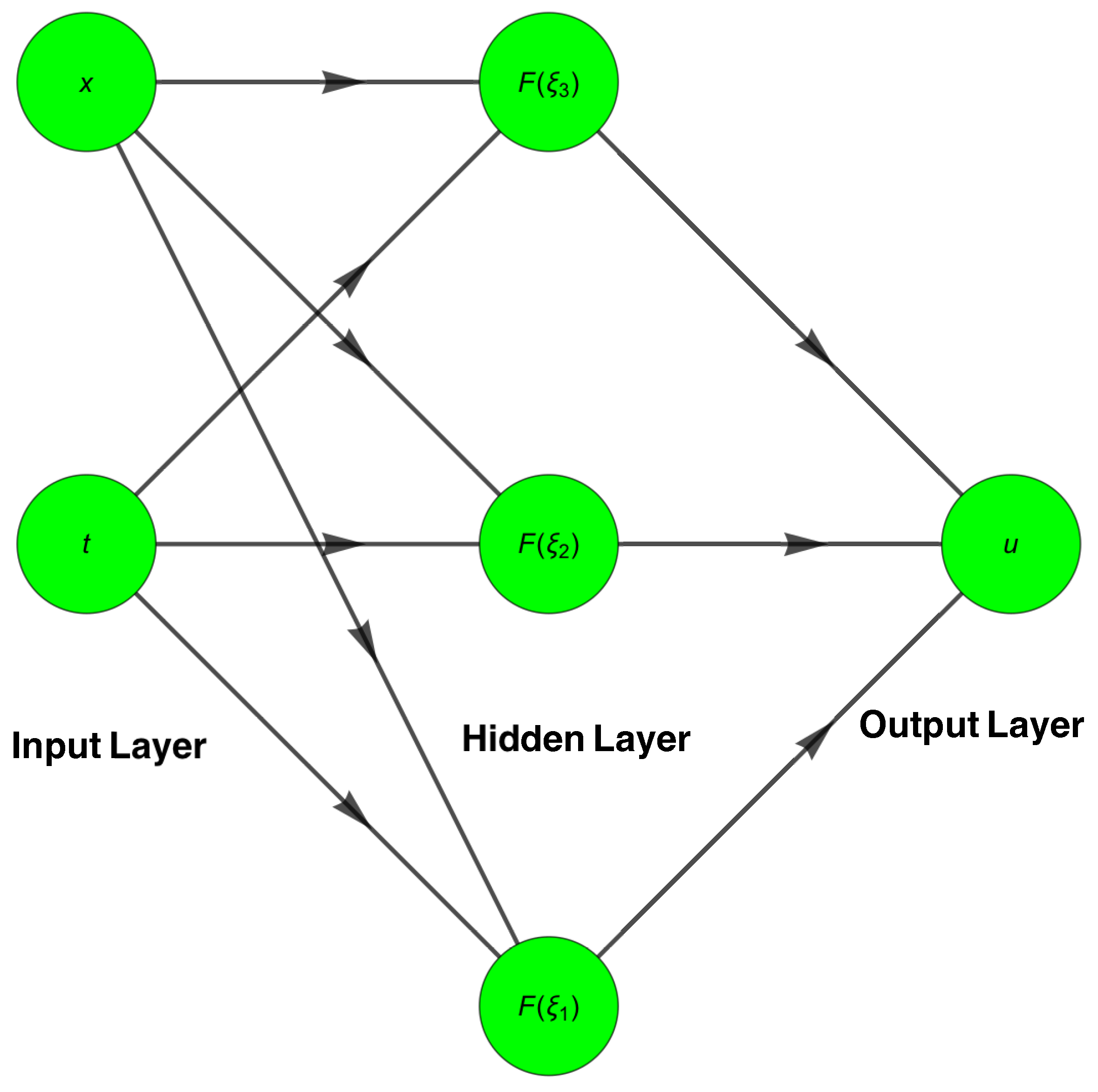
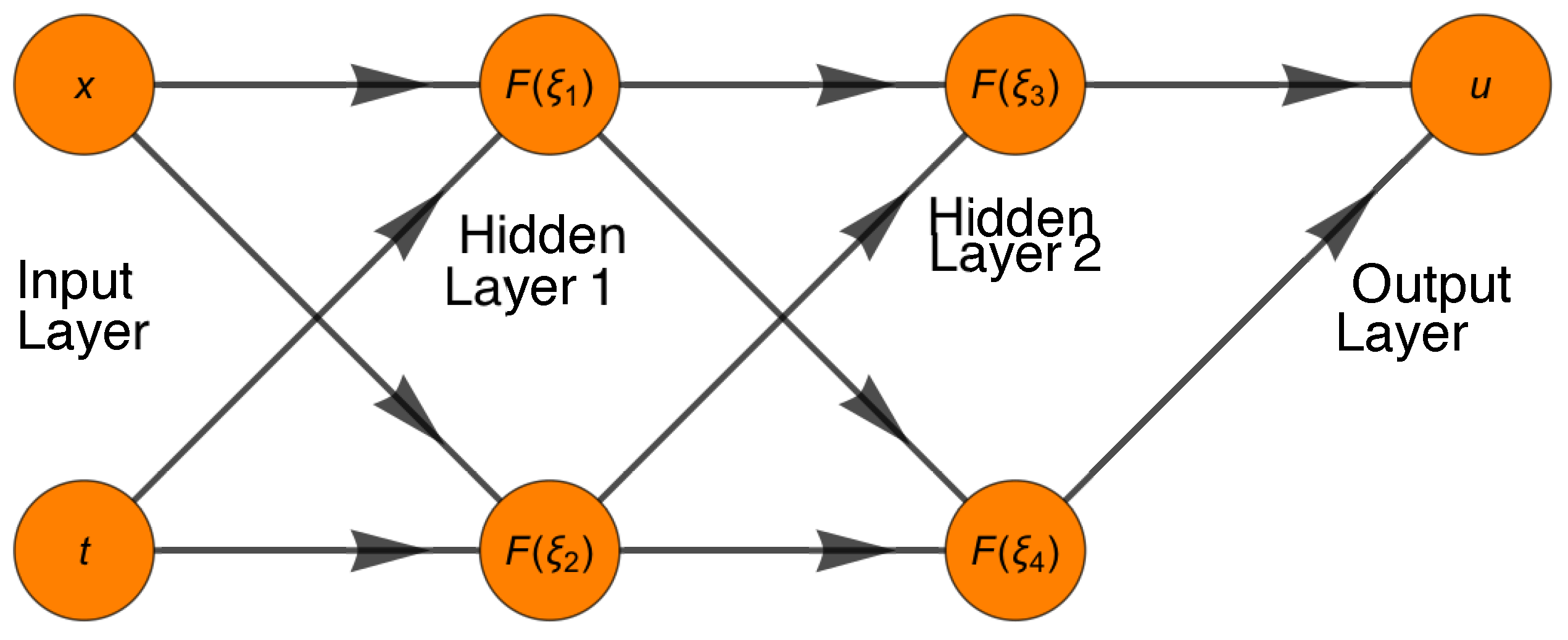
The method utilizes neural network outputs as trial functions to derive analytical solutions for nonlinear partial differential equations. We begin by transforming the nonlinear differential equation into a system of solvable nonlinear algebraic equations through the application of a trial function. Next, we determine the appropriate weights and biases for the neural networks by solving this system of nonlinear algebraic equations. To compute the solution u ( x , t ) of the nonlinear differential equation, we employ two specific models within the feedforward computation of the neural networks: the first one has a hidden layer consisting of three neurons, as illustrated in Figure 1, and the second has two hidden layers of two neurons each, as illustrated in Figure 2.
The mathematical relationship among the aforementioned models can be articulated as follows:
  • Model I:
    ξ i = w x i x + w t i t + b i , i = 1 , 2 , 3 u ( x , t ) = w 1 u F 1 ( ξ 1 ) + w 2 u F 2 ( ξ 2 ) + w 3 u F 3 ( ξ 3 ) + b 4 .
    In this context, w x i denotes the weight that connects entry x to the i-th neuron of the hidden layer, while w t i represents the weight that connects entry t to the same i-th neuron. Furthermore, w i u represents the weight connecting each neuron in the hidden layer to the test function u ( i = 1 , 2 , 3 ); ultimately, each b i denotes the biases.
  • Model II:
    ξ i = w x i x + w t i t + b i , i = 1 , 2 ξ j = w 1 j F 1 ( ξ 1 ) + w 2 j F 2 ( ξ 2 ) + b j , j = 3 , 4 u ( x , t ) = w 3 u F 3 ( ξ 3 ) + w 4 u F 4 ( ξ 4 ) + b 5 .
    In this context, w x i denotes the weight that connects entry x to the i-th neuron of the first hidden layer, while w t i represents the weight that connects entry t to the same i-th neuron. The connection weights w 1 j and w 2 j , where j = 3 , 4 , are for the first and second neurons in the first hidden layer and their links to the third and fourth neurons in the second hidden layer. Furthermore, w i u represents the weight connecting each neuron in the second hidden layer to the test function u ( i = 1 , 2 , 3 ); ultimately, each b i denotes the biases.
In the proposed technique, the activation functions F i within the first hidden layer are suggested to be algebraic powers of R ( · ) , where the R-function, R ( · ) is defined as
R ( ξ ) = 1 d 1 e α ξ + d 2 e α ξ ,
where d 1 , d 2 , and α are parameters of the function. The function R is a solution of the differential equation
( R ) 2 = α R 2 ( 1 4 d 1 d 2 R 2 ) .
The R-function was initially introduced by N. A. Kudryashov as a key element of a method for solving nonlinear differential equations in [15]. The R-function has become an indispensable tool in the study of dynamic systems and their behaviors [16,17,18,19]. This function exhibits several properties [20,21], among which the most significant is that all of its higher-order (even) derivatives can be expressed in terms of polynomials of R. However, its higher-order (odd) derivatives are polynomial functions of both R and R ξ . In addition,
lim ξ ± R ( ξ ) = 0 ,
which is particularly convenient when we are searching for solitary waves.
The proposed methodology integrates a neural network model with the Kudryashov R-function method. By incorporating the Kudryashov R-function into neural networks, the activation functions of the initial hidden layer in the neural network can be represented as the Kudryashov R-function. This integration facilitates the derivation of additional and more accurate solutions to nonlinear partial differential equations.
The algorithm for the neural network-based symbol calculation methodology is systematically developed through the following steps:
  • Step 1: A neural network model is constructed by selecting one of the schemes presented in Figure 1 and Figure 2.
  • Step 2: The neural network uses the R-function, derived as the solution to Equation (5), and some algebraic powers of it as the activation function F i in the first hidden layer.
  • Step 3: A nonlinear algebraic equation is derived by substituting the trial function specified in Equation (2) or Equation (3) into the NLEE in Equation (1).
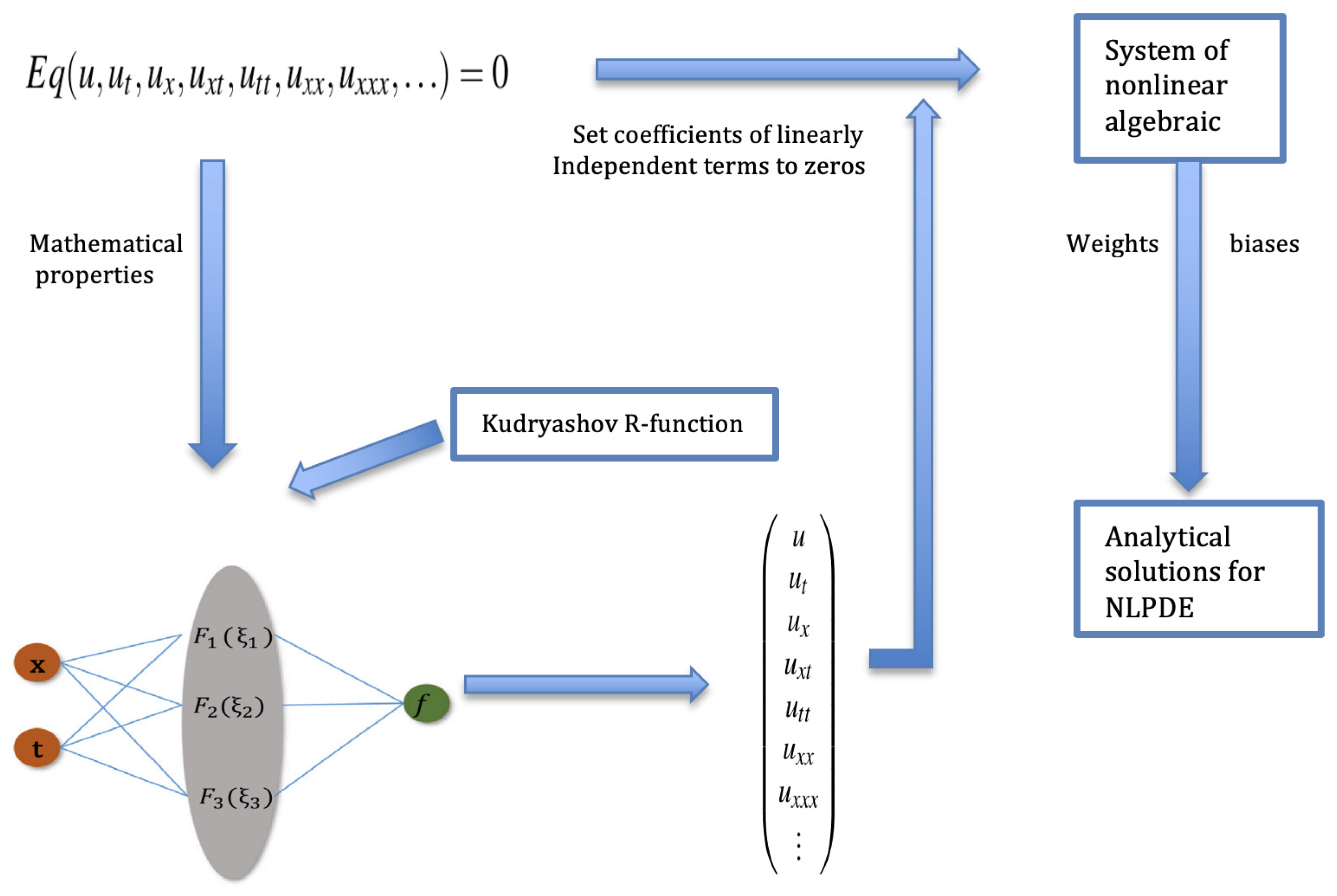
  • Step 4: By combining like terms of the algebraic equation, extracting the coefficients, and setting all coefficients to zero, we obtain an underdetermined system of nonlinear algebraic equations. This system requires careful analysis to identify potential solutions.
  • Step 5: The derived system of nonlinear algebraic equations is computationally solved by using symbolic computation software. Examples of such software include Mathematica or Maple.
  • Step 6: By substituting the obtained weights and biases along with the specific form of Equation (4) for F i ( · ) into the NN model in Equation (2) or Equation (3), the analytical solution of Equation (1) is derived.
The diagram in Figure 3 illustrates the six stages that the proposed method’s algorithm will implement.
In Table 1, we present the general form of the activation functions used in the NN-based symbolic methods described in [33,34,35,36,37,38]. By comparing the activation functions listed in this table with the R-function provided in Equation (4), we find that the R-function is a suitable activation function due to its differentiability, geometric shape, and algebraic manipulability. Consequently, the KRFNNM is competitive among NN-based symbolic methodologies for obtaining solutions that exhibit mathematical characteristics similar to those of the R-function across various application problems.

3. The Sixth-Order Boussinesq Equation

In this article, we will apply the proposed method to obtain solutions for the sixth-order Boussinesq Equation (6BE), taking into account the effects of surface tension, which is expressed in its dimensionless form as follows:
u t t k 2 u x x + c ( u 2 m ) x x + a 1 u x x x x + a 2 u x x t t + β 1 u x x x x x x + β 2 u x x x x t t = 0 .
The independent variables include the spatial variable x and the temporal variable t. The dependent variable, which denotes the wave structure, is expressed as u ( x , t ) . The wave operator is denoted by the initial two terms, with k representing the wave number. The parameter m represents the general power law parameter, while the nonlinearity coefficient is indicated by c. This parameter endows the model with a generalized characteristic. The original model also establishes a connection between the fourth-order dispersion parameters, influenced by the effects of a i , and the Navier–Stokes equation. The effect of surface tension contributes to the coefficients of β i . This connection illustrates the relationship between fluid dynamics and wave behavior, facilitating a better understanding of wave propagation across different media. Additionally, the exploration of these relationships may lead to progress in predictive modeling and its applications within engineering and scientific disciplines.
The 6BE was constructed in compliance with the fundamental principles in 2006 [39]. It describes the bi-directional propagation of small-amplitude long capillary–gravity waves on the surface of shallow water. One clear example where two-way propagation is desirable is when the flow is confined by walls. It is not feasible to analyze wall reflections in either the third-order KdV equation or its fifth-order generalization. However, the 6BE provides a solution to this challenge, enabling the exploration of such studies; for more details, see [39].
In 2023, several analytical investigations using the model were conducted, encompassing the derivation of analytical forms of solitary and shock waves, along with the recovery of conservation laws [40,41]. This study offers a comprehensive analysis of shallow-water waves, including the effects of surface tension for the first time, using a well-defined neural network architecture. The 6BE is used in various mathematical models for real-world applications, including the analysis of vibrations in nonlinear atomic chains [42], the resolution of specific microstructural problems [43], and the examination of inviscid flow dynamics in shallow fluid layers [44]. These applications demonstrate the 6BE’s versatility, providing insights into intricate processes in various scientific fields.
In the parts that follow, we will describe the steps needed for implementing the suggested method and finally use it to obtain solutions for the 6BE.

4. Adoption of the Suggested Methodology to Solve the 6BE

This section will concentrate on applying the technique discussed in the previous section to derive solutions for the 6BE model as described in Equation (7). All symbolic computations are completely executed with Mathematica-Wolfram version 14.2 software. The results obtained from these simulations will be analyzed to determine the effectiveness of the technique.

4.1. Solutions Using Model-I

To solve the 6BE described in Equation (7), we will use the mathematical framework presented in Equation (2), which details the structure of the 2-3-1 NN depicted in Figure 1. The neural network has two neurons in the input layer, representing the independent variables x and t, and three neurons in the hidden layer, labeled as F 1 ( ξ 1 ) , F 2 ( ξ 2 ) , and F 3 ( ξ 3 ) , which represent activation functions. The output layer will combine the activations from the hidden-layer neurons to generate the final result. This architecture effectively models complex relationships between the input variables. The network learns to accurately predict outcomes based on the input data by adjusting the weights and biases during training.
To use the KRFNNM, we will select F 1 , F 2 , and F 3 based on the 2-3-1 NN architecture, such as those considered in the following three cases:
Case 1.1: we select F 1 ( ξ 1 ) = ( ξ 1 ) , F 2 ( ξ 2 ) = R ( ξ 2 ) and F 3 ( ξ 3 ) = R 2 ( ξ 3 ) , and then Equation (2) is established as:
u ( x , t ) = w 1 u ( ξ 1 ) + w 2 u R ( ξ 2 ) + w 3 u R 2 ( ξ 3 ) + b 4 , ξ i = w x i x + w t i t + b i , i = 1 , 2 , 3 .
Consequently, the test function derived from the neural network framework is:
u ( x , t ) = w 1 u b 1 + t w t 1 + x w x 1 + w 2 u R b 2 + t w t 2 + x w x 2 + w 3 u R 2 b 3 + t w t 3 + x w x 3 + b 4 .
By substituting Equation (9) into Equation (7) and noting that, for solitary waves, we must use m = 5 / 2 [40,41], the following coefficient solutions are obtained via the KRFNNM:
a 1 = a 1 , a 2 = a 2 , β 1 = β 1 , β 2 = β 2 , c = c , b 1 = 3 w t 2 1 , b 2 = 2 β 1 w x 2 4 + w t 2 2 a 1 w x 2 2 2 w x 2 2 , b 3 = 3 b 2 β 2 a 1 k 3 , b 4 = 3 a 1 a 2 , w 1 u = 5 w x 2 , w 2 u = w 3 u = 2 w x 2 3 w t 3 2 , w x 1 = 0 , w x 2 = w x 2 , w x 3 = a 1 β 1 2 , w t 1 = w t 1 , w t 2 = w t 2 , w t 3 = 3 c β 2 , d 1 = a 2 , d 2 = a 2 β 1 , α = 3 β 1 c k , k = k , w x 2 0 , w t 3 0 , β 2 0 .
By substituting the weight coefficients, biases, and other parameters from set (10) back into the analytical test function given by Equation (9), we obtain the exact family of solutions under these constraints as follows:
u 1.1 ( x , t ) = 5 w x 2 ( w t 2 1 + w t 1 t ) 2 w x 2 2 w t 3 2 R ( ξ 2 ) 2 w x 2 2 w t 3 2 R 2 ( ξ 3 ) + 4 a 1 a 2 ,
where the function R is defined in Equation (4).
The algebraic system derived by equating the coefficients of R, R , R , etc., to zero is presented in Appendix A.
The function presented in Equation (11) can be verified symbolically as a solution to Equation (7); details are provided in Appendix B.
Case 1.2: we select F 1 ( ξ 1 ) = R ( ξ 1 ) , F 2 ( ξ 2 ) = R ( ξ 2 ) , and F 3 ( ξ 3 ) = R ( ξ 3 ) , substituting in Equation (2) the test function obtained from the neural network architecture, which is
u ( x , t ) = w 1 u R b 1 + t w t 1 + x w x 1 + w 2 u R b 2 + t w t 2 + x w x 2 + w 3 u R b 3 + t w t 3 + x w x 3 + b 4 .
By substituting Equation (12) into Equation (7) and noting that, for solitary waves, we must use m = 3 / 4 [40,41], the following coefficient solutions are obtained via the KRFNNM:
a 1 = a 1 , a 2 = a 2 , β 1 = β 1 , β 2 = a 1 , b 1 = 2 w u 1 w t 3 c k 2 , b 2 = w x 2 2 + w t 2 2 1 3 c β 1 β 2 , c = c , b 3 = w t 2 + 2 β 1 a 2 k , b 4 = 0 , w 1 u = 2 b 1 + w x 3 c + k , w 2 u = w 3 u = 6 w x 3 w t 1 β 1 , w x 1 = 2 b 1 , w x 2 = a 1 k 3 4 , w x 3 = β 1 β 2 2 , w t 1 = w t 2 , w t 3 = b 2 c β 2 , d 1 = d 1 , d 2 = d 1 , α = 3 w t 1 β 1 , k = k , c 0 , β 1 0 , β 2 0 , w t 1 β 1 .
By substituting the weight coefficients, biases, and other parameters from set (13) back into the analytical test function given by Equation (12), we obtain the exact family of solutions under these constraints as follows:
u 1.2 ( x , t ) = ( 2 b 1 + w x 3 c + k ) R ( ξ 1 ) + 6 w x 3 w t 1 β 1 R ( ξ 2 ) + 6 w x 3 w t 1 β 1 R ( ξ 3 ) ,
where the function R is defined in Equation (4).
Case 1.3: we select F 1 ( ξ 1 ) = ( ξ 1 ) , F 2 ( ξ 2 ) = R 1 ( ξ 2 ) and F 3 ( ξ 3 ) = R 2 ( ξ 3 ) , substituting in Equation (2) the test function obtained from the neural network architecture, which is
u ( x , t ) = w 1 u b 1 + t w t 1 + x w x 1 + w 2 u R 1 b 2 + t w t 2 + x w x 2 + w 3 u R 2 b 3 + t w t 3 + x w x 3 + b 4 .
By substituting Equation (15) into Equation (7) and noting that, for shock waves or the kink-type soliton, we must use m = 3 / 2 [40,41], the following coefficient solutions are obtained via the KRFNNM:
a 1 = a 1 , a 2 = a 2 , β 1 = β 1 , β 2 = a 1 β 1 , b 1 = β 2 + w u 3 w t 2 , b 2 = a 1 2 + 2 c a 2 w t 1 , b 3 = w 2 u + 4 k a 2 , b 4 = 2 β 1 , w 1 u = ± 2 c k , w 2 u = w 2 u , w 3 u = β 2 w 2 u 1 b 4 , w x 1 = 4 k , w x 2 = β 1 w 3 u , w x 3 = a 2 k , w t 1 = 0 , w t 2 = 1 a 1 , w t 3 = 3 2 w 3 u , d 1 = d 2 = 2 w t 1 c β 2 , k = k , c = c , α = a 1 b 3 + 2 , a 1 0 , w 3 u 0 , b 4 1 , c β 2 0 .
By substituting the weight coefficients, biases, and other parameters from set (16) back into the analytical test function given by Equation (15), we obtain the exact family of solutions under these constraints as follows:
u 1.3 ( x , t ) = ± 2 c k ( β 2 + w 3 u w t 2 + 4 k x ) + w 2 u R 1 ( ξ 2 ) + β 2 w 2 u 1 b 4 R 2 ( ξ 3 ) ,
where the function R is defined in Equation (4).

4.2. Solutions Using Model-II

To solve the 6BE described in Equation (7), we will use the mathematical framework presented in Equation (3), which details the structure of the 2-2-2-1 NN depicted in Figure 2. The neural network has two neurons in the input layer, representing the independent variables x and t; two neurons in the first hidden layer, which are labeled as F 1 ( ξ 1 ) and F 2 ( ξ 2 ) and represent activation functions; and two neurons in the second hidden layer, F 3 ( ξ 3 ) and F 4 ( ξ 4 ) . The output layer will combine the activations from the neurons in the first hidden layer with the two neurons in the second hidden layer to obtain the final result.
To use the KRFNNM, we will select F 1 , F 2 , F 3 , and F 4 based on the 2-2-2-1 NN architecture, such as those considered in the following three cases:
Case 2.1: we select F 1 ( ξ 1 ) = R ( ξ 1 ) , F 2 ( ξ 2 ) = R ( ξ 2 ) , F 3 ( ξ 3 ) = ( ξ 3 ) and F 4 ( ξ 4 ) = ( ξ 4 ) , and then Equation (3) is established as:
ξ i = w x i x + w t i t + b i , i = 1 , 2 ξ j = w 1 j R ( ξ 1 ) + w 2 j R ( ξ 2 ) + b j , j = 3 , 4 u ( x , t ) = w 3 u ( ξ 3 ) + w 4 u ( ξ 4 ) + b 5 .
The first hidden layer has two neurons, each using Kudryashov’s R-function as the activation function. Thus, the test function obtained from the 2-2-2-1 NN architecture is:
u ( x , t ) = w 3 u w 13 R ( w x 1 x + w t 1 t + b 1 ) + w 23 R ( w x 2 x + w t 2 t + b 2 ) + b 3 + w 4 u w 14 R ( w x 1 x + w t 1 t + b 1 ) + w 24 R ( w x 2 x + w t 2 t + b 2 ) + b 4 + b 5 .
By substituting Equation (19) into Equation (7) and noting that, for solitary waves, we must use m = 3 / 4 [40,41], the following coefficient solutions are obtained via the KRFNNM:
a 1 = a 1 , a 2 = a 2 , β 1 = β 1 , β 2 = β 2 , b 1 = w 13 w t 2 + w 3 u , b 2 = b 1 b 2 3 c w t 2 , c = c , b 3 = β 1 β 2 k 2 , b 4 = w 4 u 2 w t 1 b 5 , b 5 = w x 1 b 1 , w 3 u = 2 c + k 2 , w 4 u = w 4 u , w x 1 = a 1 β 2 c 2 k w t 2 , w x 2 = 0 , w t 1 = 5 w 3 u + 1 , w t 2 = β 1 w 4 u 2 , w 13 = w 13 , w 23 = c k w t 2 , k = k , w 14 = w x 2 + 2 , w 24 = a 1 β 1 + 1 b 4 , d 1 = c k a 1 w 4 u , d 2 = w x 2 + 1 , α = a 1 b 3 , b 4 0 , b 5 0 , w t 1 0 , c 2 k w t 2 .
By substituting the weight coefficients, biases, and other parameters from set (20) back into the analytical test function given by Equation (19), we obtain the exact family of solutions under these constraints as follows:
u 2.1 ( x , t ) = ( 2 c + k 2 ) w 13 R ( ξ 1 ) + ( c k w t 2 ) R ( ξ 2 ) + c β 1 β 2 k 2 + w 4 u ( w x 2 + 2 ) R ( ξ 1 ) + ( a 1 β 1 + 1 b 4 ) R ( ξ 2 ) + w 4 u 2 w t 1 b 5 + b 1 w x 1 .
where the function R is defined in Equation (4).
Case 2.2: we select F 1 ( ξ 1 ) = R ( ξ 1 ) , F 2 ( ξ 2 ) = R 2 ( ξ 2 ) , F 3 ( ξ 3 ) = ( ξ 3 ) 1 , and F 4 ( ξ 4 ) = ( ξ 4 ) , substituting in Equation (3) the test function obtained from the 2-2-2-1 NN architecture, which is
u ( x , t ) = w 3 u w 13 R ( w x 1 x + w t 1 t + b 1 ) + w 23 R 2 ( w x 2 x + w t 2 t + b 2 ) + b 3 1 + w 4 u w 14 R ( w x 1 x + w t 1 t + b 1 ) + w 24 R 2 ( w x 2 x + w t 2 t + b 2 ) + b 4 + b 5 .
By substituting Equation (22) into Equation (7) and noting that, for shock waves or the kink-type soliton, we must use m = 3 / 2 [40,41], the following coefficient solutions are obtained via the KRFNNM:
a 1 = a 1 , a 2 = a 2 , β 1 = β 1 , β 2 = β 2 , b 1 = 2 w 3 u w t 2 2 , b 2 = β 1 a 1 + k w 4 u , b 3 = b 3 , b 4 = w t 2 a 2 c w t 1 , b 5 = w 4 u + 3 w x 1 , w 3 u = b 1 β 2 c 2 , w 4 u = 3 w t 1 + b 5 3 , w x 1 = w x 1 , w x 2 = c a 1 w 24 1 b 4 b 3 , w t 1 = ( w t 2 b 1 ) 3 / 2 , w t 2 = a 1 β 2 w t 1 , w 13 = 5 w x 2 + b 3 , k = k , w 23 = w 24 + β 2 2 , w 14 = 3 c a 2 w 3 u β 1 w 4 u k 2 , w 24 = w 24 , d 1 = 1 w 13 , d 2 = 3 c 2 + 2 w 3 u , c = c , α = w 23 + b 1 , c w t 1 , b 3 b 4 1 , k 2 β 1 w 4 u , w 13 0 .
By substituting the weight coefficients, biases, and other parameters from set (23) back into the analytical test function given by Equation (22), we obtain the exact family of solutions under these constraints as follows:
u 2.2 ( x , t ) = ( b 1 β 2 c 2 ) ( b 3 5 w x 2 ç ) R ( ξ 1 ) + ( w 24 + β 2 2 ) R 2 ( ξ 2 ) + b 3 1 + ( b 5 3 3 w t 1 ) ( 3 a 2 c w 3 u β 1 w 4 u k 2 ) R ( ξ 1 ) + w 24 R 2 ( ξ 2 ) + a 2 w t 2 c w t 1 + w 4 u + 3 w x 1 .
where the function R is defined in Equation (4).
Case 2.3: we select F 1 ( ξ 1 ) = R 2 ( ξ 1 ) , F 2 ( ξ 2 ) = R 2 ( ξ 2 ) , F 3 ( ξ 3 ) = ( ξ 3 ) 1 , and F 4 ( ξ 4 ) = ( ξ 4 ) 1 , substituting in Equation (3) the test function obtained from the 2-2-2-1 NN architecture, which is
u ( x , t ) = w 3 u w 13 R 2 ( w x 1 x + w t 1 t + b 1 ) + w 23 R 2 ( w x 2 x + w t 2 t + b 2 ) + b 3 1 + w 4 u w 14 R 2 ( w x 1 x + w t 1 t + b 1 ) + w 24 R 2 ( w x 2 x + w t 2 t + b 2 ) + b 4 1 + b 5 .
By substituting Equation (25) into Equation (7) and noting that, for solitary waves, we must use m = 5 / 2 [40,41], the following coefficient solutions are obtained via the KRFNNM:
a 1 = a 1 , a 2 = a 2 , β 1 = β 1 , β 2 = β 2 , b 1 = w t 1 w 4 u 3 c w t 1 3 k 2 , b 2 = 5 β 2 + 3 w x 2 , b 3 = 2 w x 1 β 1 7 β 2 c + 3 k , b 4 = b 4 , b 5 = w x 1 w x 2 3 β 1 c b 1 , w 3 u = b 2 β 1 c b 2 3 k 2 w t 1 , w 4 u = w t 2 k w 23 w x 2 w 14 , w x 1 = 6 w t 2 1 , w x 2 = w x 2 , w t 1 = a 2 w 13 c β 2 , w t 2 = 3 a 2 β 1 , w 13 = k c 2 β 1 β 2 + 2 b 5 , w 23 = 3 w 4 u + 5 2 a 1 β 1 , w 14 = w 14 , w 24 = a 1 a 2 w x 2 3 w t 1 , d 1 = 3 a 2 1 , d 2 = 2 β 2 + 1 , α = k w x 1 , w t 1 0 , c = c , k = k , c 0 , β 2 0 , w x 2 w 14 , k 2 w t 1 3 , 7 β 2 c 3 k , c w t 1 3 k 2 .
By substituting the weight coefficients, biases, and other parameters from set (26) back into the analytical test function given by Equation (25), we obtain the exact family of solutions under these constraints as follows:
u 2.3 ( x , t ) = b 2 β 1 c b 2 3 k 2 w t 1 c k 2 β 1 β 2 R 2 ( ξ 1 ) + ( 5 2 a 1 β 1 3 w 4 u ) R 2 ( ξ 2 ) + 2 w x 1 β 1 7 c β 2 + 3 k 1 + w t 2 k w 23 w x 2 w 14 w 14 R 2 ( ξ 1 ) + a 1 a 2 w x 2 3 w t 1 R 2 ( ξ 2 ) + b 4 1 + w x 1 w x 2 3 β 1 c b 1 .
where the function R is defined in Equation (4).

5. Visual Representation of Solutions

This section provides comprehensive information about the graphical and physical implications of the solutions derived from the equation that we examined. The study illustrates, via visualization and dynamic analysis using Mathematica-Wolfram version 14.2 software, that the geometric configurations of these solutions substantially affect the system’s structure, allowing the creation of two wave behaviors.
Let us consider that, for values of m > 1 / 2 , Equation (7) has solitary wave solutions, whereas when the nonlinearity power is m = 3 / 2 , the solutions are shock wave (kink-type soliton) types [40]. The parameter m must be selected from the interval ( 0 , 2 ) to avoid wave collapse. For more information, see [41,45].
Using the solutions obtained in Section 4, Table 2 and Table 3 provide numerical examples for different values of m and selected parameter sets.
Table 2. Numerical simulations of solutions obtained with the 2-3-1 neural network architecture.
CaseValue of mParametersType of SurfaceDescription
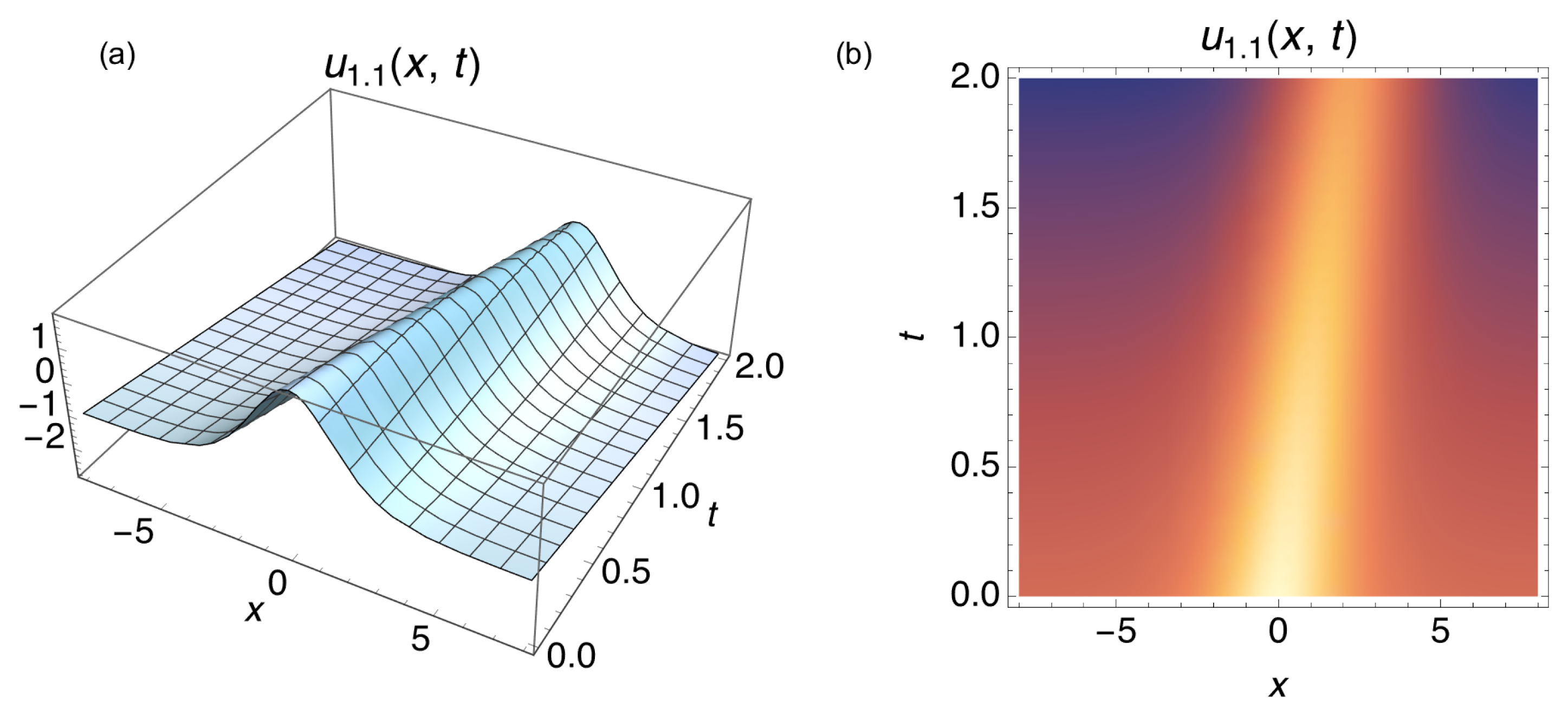
1.15/2 a 1 = 1.5 , a 2 = 3.1 , β 1 = 2.8 , β 2 = 3.1 , c = 2.8 , k = 0.5 , w x 2 = 0.8 , w t 1 = 0.2 , w t 2 = 0.15 Solitary waveFigure 4 illustrates the solitary wave type corresponding to solution u 1.1 ( x , t ) given by Equation (11). Solitary wave propagation is characterized by its stability and persistence over time.
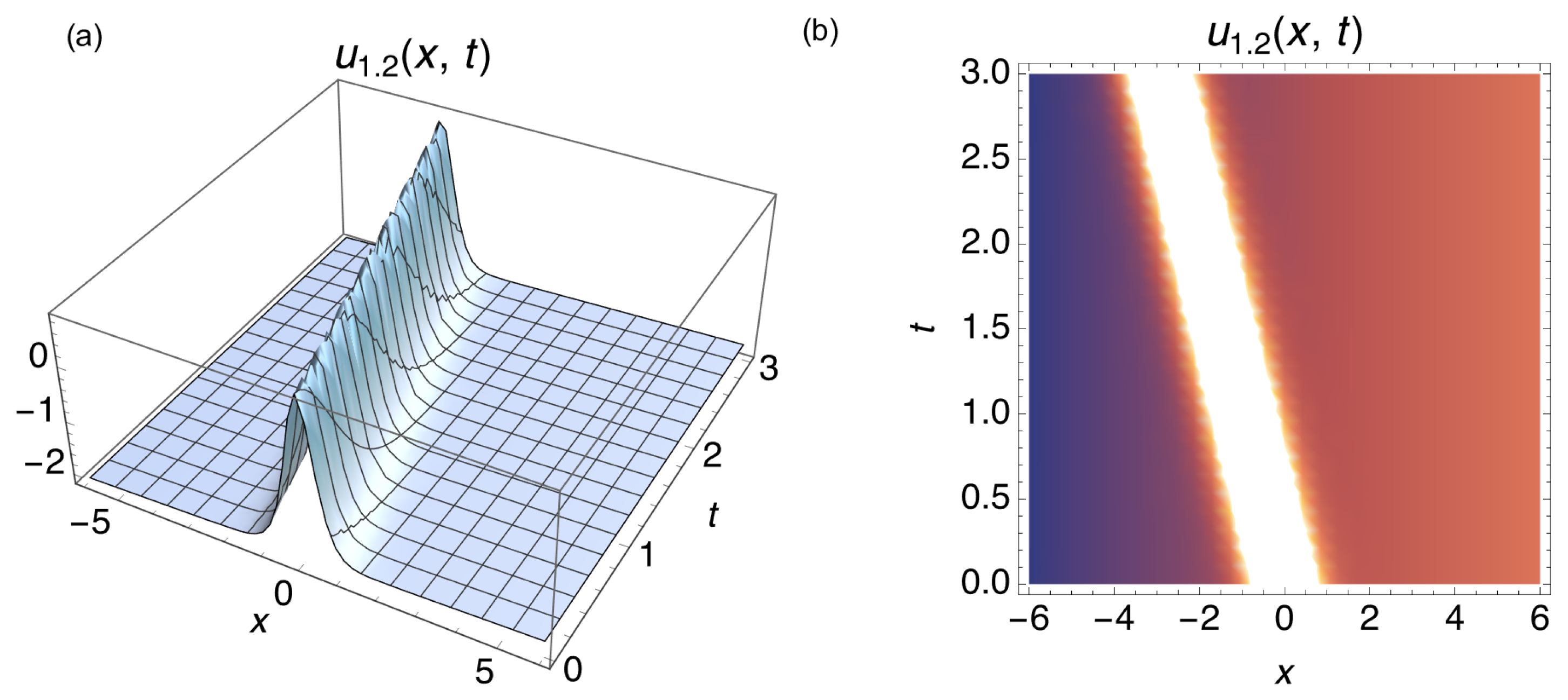
1.23/4 a 1 = 2.2 , a 2 = 7.9 , β 1 = 3.4 , β 2 = 2.2 , c = 1.5 , w t 1 = 0.25 , d 1 = 1.0 , k = 2.5 Solitary waveFigure 5 illustrates the solitary wave type corresponding to solution u 1.2 ( x , t ) given by Equation (14).
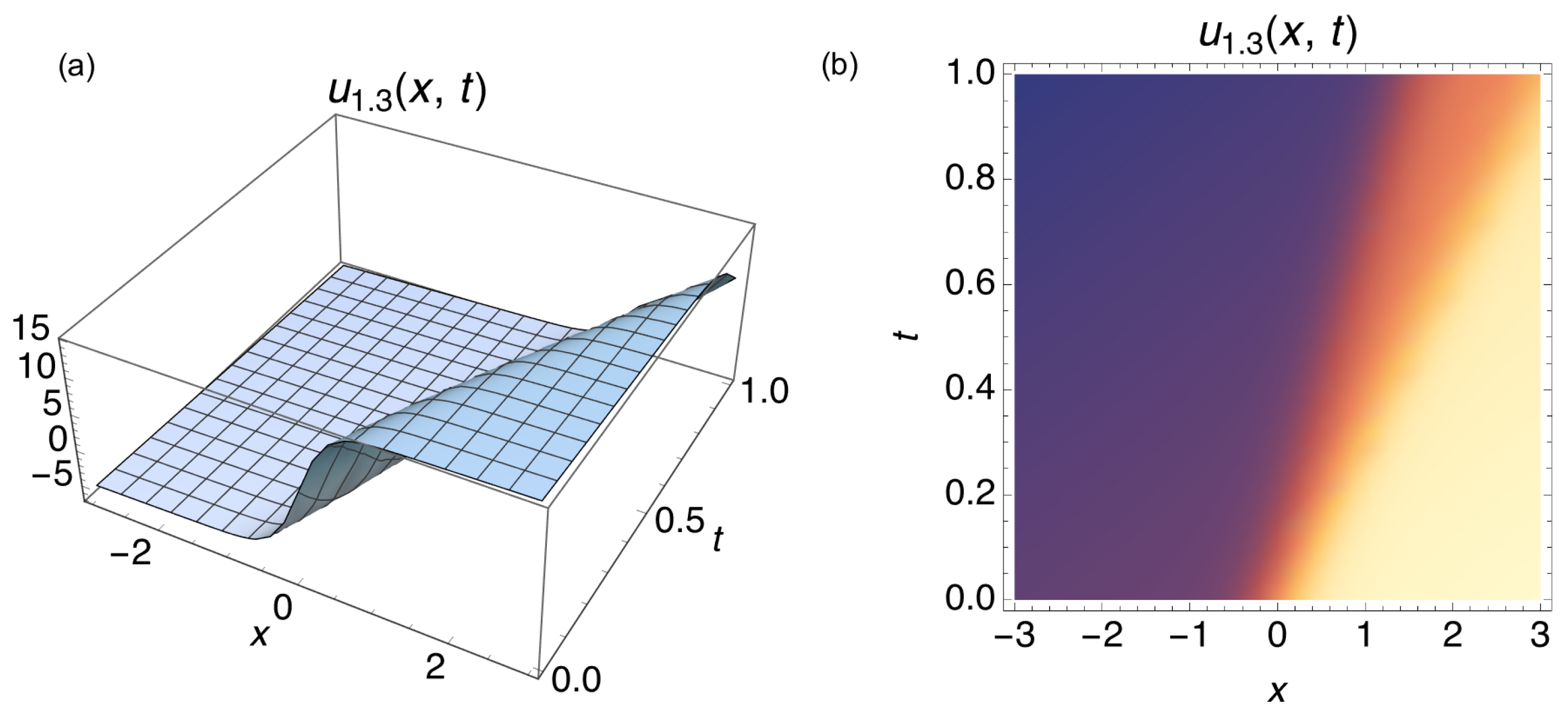
1.33/2 a 1 = 8.2 , a 2 = 3.5 , β 1 = 0.3 , β 2 = 2.4 , w u 2 = 0.5 , k = 3.0 , c = 2.2 Shock wave (kink-type soliton)Figure 6 illustrates the shock wave type corresponding to solution u 1.3 ( x , t ) given by Equation (17). Shock wave propagation can be observed as it interacts with the surrounding medium, resulting in distinct changes in pressure and density profiles.
Table 3. Numerical simulations of solutions obtained with the 2-2-2-1 neural network architecture.
CaseValue of mParametersType of SurfaceDescription
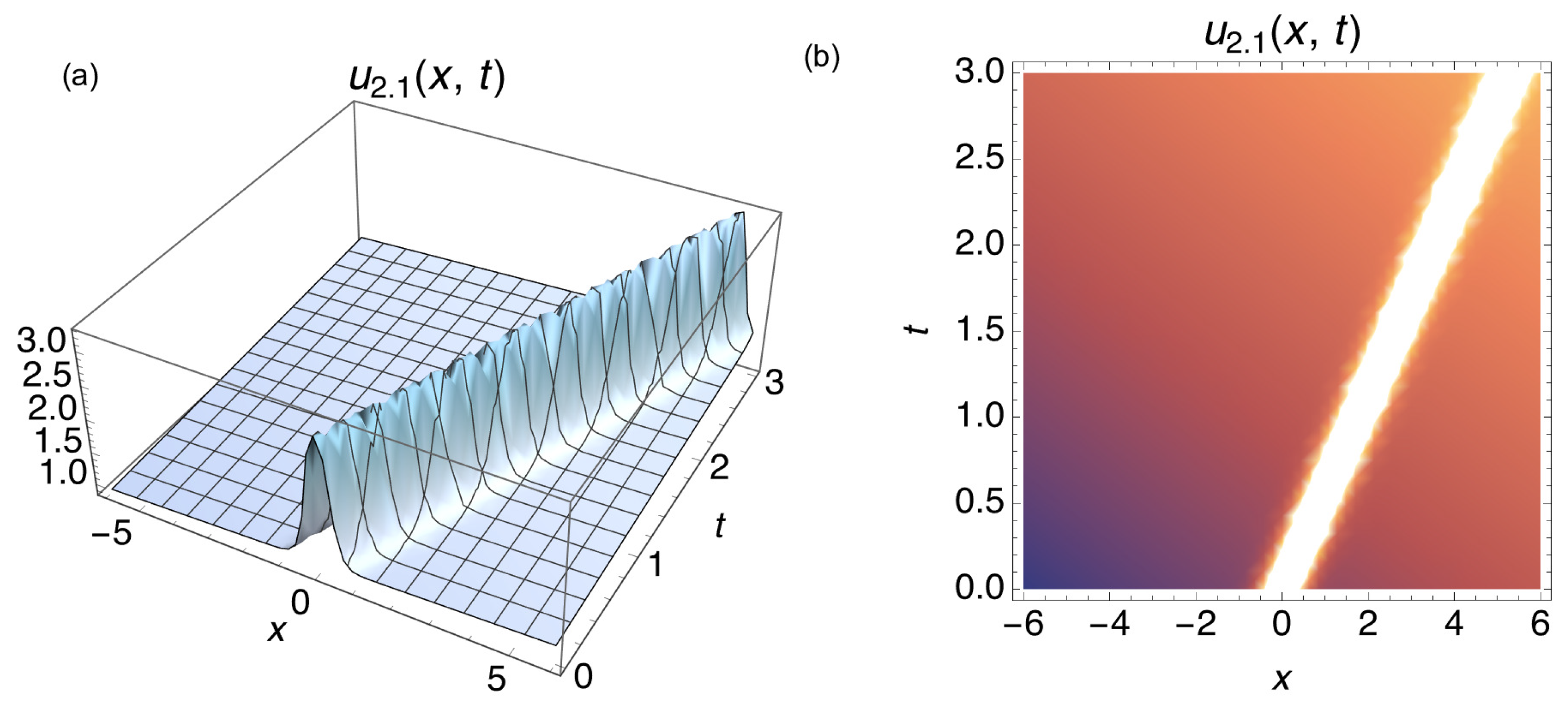
2.13/4 a 1 = 1.5 , a 2 = 3.5 , β 1 = 2.0 , β 2 = 6.5 , c = 8.8 , w 4 u = 0.9 , w 13 = 0.85 , k = 3.7 Solitary waveFigure 7 illustrates the solitary wave type corresponding to solution u 2.1 ( x , t ) given by Equation (21).
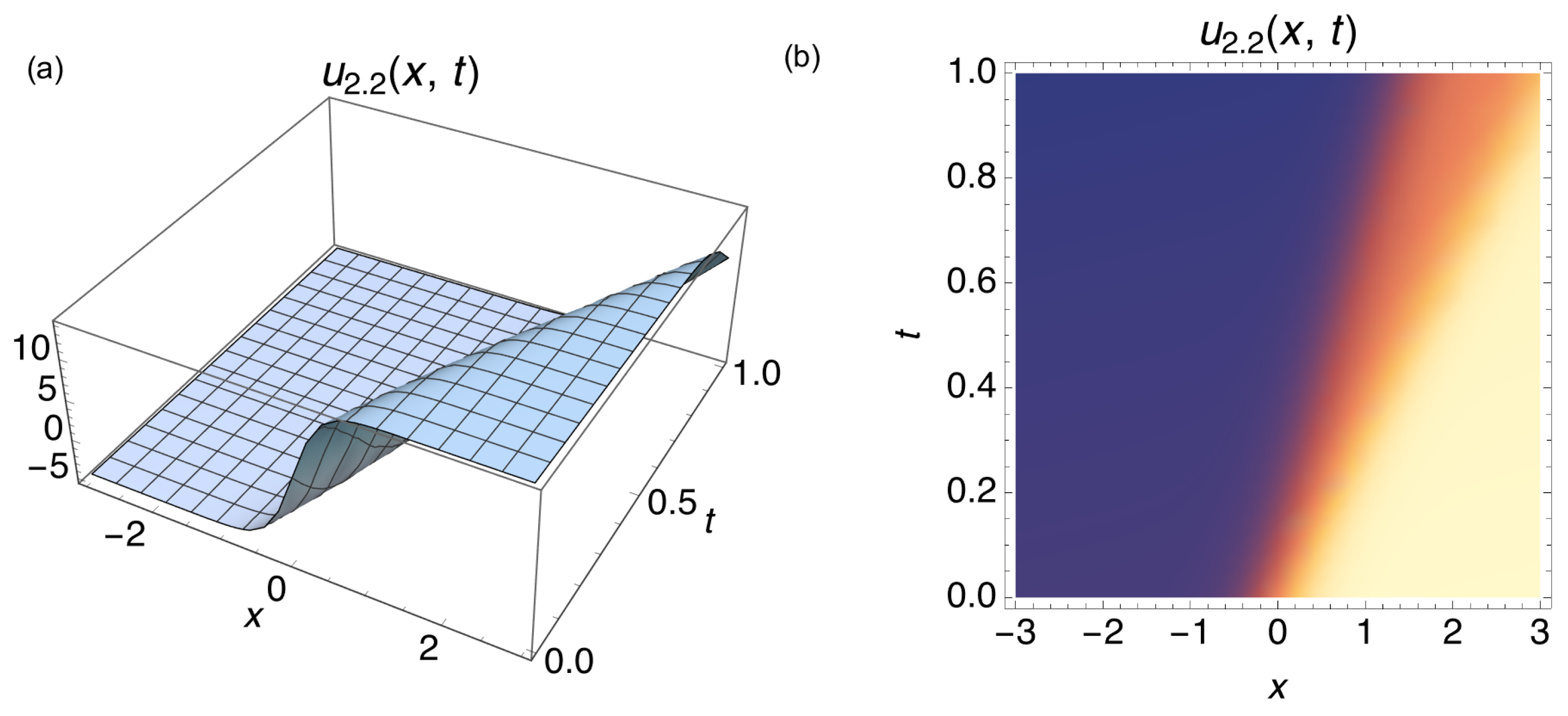
2.23/2 a 1 = 7.4 , a 2 = 5.1 , β 1 = 3.4 , β 2 = 2.9 , b 3 = 2.1 , w x 1 = 0.3 , k = 0.1 , c = 8.4 ,Shock wave (kink-type soliton)Figure 8 illustrates the shock wave type corresponding to solution u 2.2 ( x , t ) given by Equation (24).
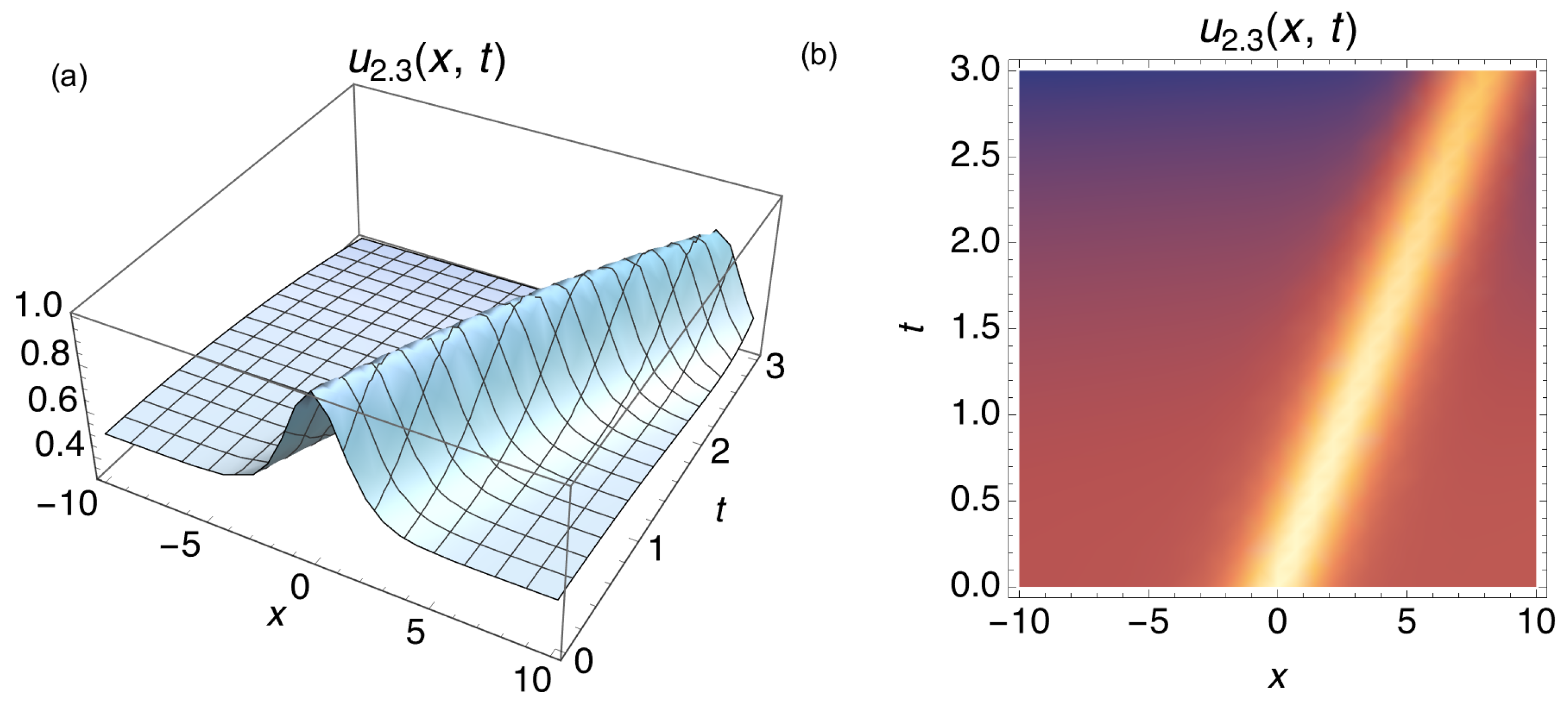
2.35/2 a 1 = 3.3 , a 2 = 1.7 , β 1 = 1.2 , β 2 = 3.5 , b 4 = 3.7 , w x 2 = 0.8 , w 14 = 0.66 , c = 8.5 , k = 6.5 Solitary waveFigure 9 illustrates the solitary wave type corresponding to solution u 2.3 ( x , t ) given by Equation (27).
Figure 4. (a) Three-dimensional representation of the solitary wave modeled in Equation (11) and (b) two-dimensional illustration of the evolution density, including the parameters a 1 = 1.5 , a 2 = 3.1 , β 1 = 2.8 , β 2 = 3.1 , c = 2.8 , k = 0.5 , and m = 5 / 2 .
Fluids 11 00100 g004
Figure 5. (a) Three-dimensional representation of the solitary wave modeled in Equation (14) and (b) two-dimensional illustration of the evolution density, including the parameters a 1 = 2.2 , a 2 = 7.9 , β 1 = 3.4 , β 2 = 2.2 , c = 1.5 , k = 2.5 , and m = 3 / 4 .
Fluids 11 00100 g005
Figure 6. (a) Three-dimensional representation of the shock wave (kink-type soliton) modeled in Equation (17) and (b) two-dimensional illustration of the evolution density, including the parameters a 1 = 8.2 , a 2 = 3.5 , β 1 = 0.3 , β 2 = 2.4 , c = 2.2 , k = 3.0 , and m = 3 / 2 .
Fluids 11 00100 g006
Figure 7. (a) Three-dimensional representation of the solitary wave modeled in Equation (21) and (b) two-dimensional illustration of the evolution density, including the parameters a 1 = 1.5 , a 2 = 3.5 , β 1 = 2.0 , β 2 = 6.5 , c = 8.8 , k = 3.7 , and m = 3 / 4 .
Fluids 11 00100 g007
Figure 8. (a) Three-dimensional representation of the shock wave (kink-type soliton) modeled in Equation (24) and (b) two-dimensional illustration of the evolution density, including the parameters a 1 = 7.4 , a 2 = 5.1 , β 1 = 3.4 , β 2 = 2.9 , c = 8.4 , k = 0.1 , and m = 3 / 2 .
Fluids 11 00100 g008
Figure 9. (a) Three-dimensional representation of the solitary wave modeled in Equation (27) and (b) two-dimensional illustration of the evolution density, including the parameters a 1 = 3.3 , a 2 = 1.7 , β 1 = 1.2 , β 2 = 3.5 , c = 8.5 , K = 6.5 , and m = 5 / 2 .
Fluids 11 00100 g009

6. Discussion of Results

In this section, we will analyze how the values assigned to the coefficients in Equation (7) impact the dynamics of the resulting solutions. Additionally, we will explore how the primary constraints that emerge during the implementation of the proposed methodology influence these dynamics.
  • Figure 4 provides a visual representation of the solution derived from Equation (11), based on the parameters specified in Case 1.1 of Table 2. This case demonstrates that, when dispersion and surface tension have the same sign, the wave surface displays a low amplitude. The weights w x 2 , w t 1 , and w t 2 regulate the temporal scaling of the soliton pulse width. The constraint w t 3 = 3 c β 2 inversely influences the propagation velocity in relation to the surface tension coefficient β 2 and directly depends on the nonlinearity coefficient c. Additionally, the constraint w x 3 = a 1 β 1 2 has a slight impact on the wave dispersion axis, which is directly proportional to the product of the dispersion coefficient a 1 and the surface tension coefficient β 1 . Furthermore, the wave amplitude is affected by the constraint α = 3 β 1 c k .
  • Figure 5 presents a visual representation of the solution derived from Equation (14), based on the parameters specified in Case 1.2 of Table 2. This case demonstrates that a sign change in a surface tension parameter leads to a significant increase in the surface level amplitude of the waves. The weight w t 1 governs the temporal scaling of the soliton pulse width, while the surface tension parameters β 1 and β 2 influence the wave height. The constraints on the weights w x 2 = a 1 k 3 / 4 and w x 3 = β 1 β 2 2 impact the inclination of the wave axis in direct proportion to the dispersion and surface tension coefficients, respectively. Additionally, the constraint α = 3 w t 1 β 1 signifies that the wave amplitude is directly affected by the surface tension coefficient β 1 . Finally, the constraint w t 3 = b 2 c β 2 indicates that the propagation speed is reduced in proportion to both β 2 and c.
  • Figure 6 illustrates the shock wave type corresponding to the solution given by Equation (17), based on the parameters specified in Case 1.3 of Table 2. Shock wave propagation can be observed as it interacts with the surrounding medium, resulting in distinct changes in pressure and density profiles. This case shows how nonlinear power affects waveform shape. The weight w u 2 and the value of c determine the kink-type shape of the shock wave. Meanwhile, the surface tension parameters β 1 and β 2 influence the wave height. The constraints on the weights w x 1 = 4 k and w x 3 = a 2 k affect the slope of the wave axis in direct proportion to the value of the wave number; furthermore, the constraint w x 2 = β 1 w 3 u also affects the axis of evolution in proportion to the coefficient of the surface tension parameter β 1 . The constraint w t 2 = 1 a 1 decreases the speed of evolution inversely proportional to the dispersion coefficient a 1 . Finally, the wave velocity is affected in inverse proportion to the surface tension coefficient β 2 through the constraints on the weights w t 3 and w 3 u .
  • Figure 7 illustrates the solitary wave type corresponding to the solution given by Equation (21) based on the parameters outlined in Case 2.1 of Table 3. The selection of surface tension and dispersion parameters results in the wave traveling to the right over time while sustaining a large amplitude. The weights w 4 u and w 13 , combined with the signs of a 1 and a 2 , determine the amplitude of the wave. Meanwhile, the surface tension parameters β 1 and β 2 control the wave height. The constraint w x 1 = a 1 β 2 c 2 k w t 2 governs the inclination of the line of evolution in direct proportion to the dispersion and surface tension coefficients a 1 and β 1 , respectively. Additionally, the constraint w t 2 = β 1 w 4 u 2 indicates that the dispersion velocity is directly proportional to the surface tension coefficient β 1 .
  • Figure 8 illustrates the type of shock wave corresponding to the solution provided by Equation (24) based on the parameters outlined in Case 2.2 of Table 3. Due to the selection of the nonlinearity power, these waves manifest as stable solitary solutions that converge to a constant value at infinity. The parameters w x 1 , along with the values of k and c, determine the kink-like shape of the shock wave. Additionally, the surface tension parameters β 1 and β 2 affect the height of the wave. The slope of the wave axis arises from the constraint w x 2 = c a 1 w 24 1 b 4 b 3 , indicating that it is proportional to the dispersion coefficient a 1 and the nonlinearity coefficient c. The constraints w t 1 = ( w t 2 b 1 ) 3 / 2 and w t 2 = a 1 β 2 w t 1 govern the dispersion velocity of the wave, which is directly proportional to the dispersion coefficient a 1 and the surface tension coefficient β 2 .
  • Figure 9 illustrates the type of solitary wave corresponding to the solution provided by Equation (27), based on the parameters specified in Case 2.3 of Table 3. The chosen surface tension and dispersion parameters lead to the wave traveling to the right over time while maintaining a low amplitude. The weights w x 2 and w 14 , along with the signs of a 1 and a 2 , dictate the wave’s amplitude. Meanwhile, the surface tension parameters β 1 and β 2 control the wave height. The restriction w x 1 = 6 w t 2 1 influences the wave’s axis of development, which is directly proportional to the spatiotemporal dispersion coefficient a 2 and the surface tension coefficient β 1 . Additionally, the relationships w t 1 = a 2 w 13 c β 2 and w t 2 = 3 a 2 β 1 suggest that wave velocity is directly proportional to both a 2 and β 1 , while it is inversely proportional to the nonlinearity coefficient c and the surface tension coefficient β 2 , respectively.

7. Conclusions

In this study, we propose an NN-based symbolic method to obtain exact symbolic analytical solutions for NLEEs. The key point of the proposed technique is the choice of activation functions in the first hidden layer of the NN architecture. The proposed technique does not rely on traveling wave transformations or require initial or boundary conditions. Instead, it integrates the solution of a nonlinear equation as an activation function within the structure of the NN. Furthermore, as an application of the proposed method, we analyzed the sixth-order generalized Boussinesq equation, which describes the dynamics of shallow-water waves while considering the effects of surface tension. We obtained several families of exact solutions, thereby demonstrating the effectiveness and precision of the methodology.
Future research may focus on enhancing the methodology, exploring its application to more intricate equations, and potentially integrating it with advanced techniques to expand its functionality. Furthermore, we can enhance the neural network model to exhibit more intricate nonlinear characteristics by employing configurations such as “2-3-2-1,” “2-2-3-1,” and “2-4-3-2-1” that increase the capacity of the KRFNNM or by utilizing models like “3-2-2-1” and “3-2-3-1” to deepen the neural network architecture. These enhancements could lead to significant improvements in predictive accuracy and overall performance. As a result, the potential applications in fields such as soliton dynamics in optical fibers, finance, and engineering could become more robust and versatile.

Author Contributions

Conceptualization, writing—original draft preparation, and methodology: O.G.-G.; project administration and supervision: A.B.; software and investigation: M.H.-S. and H.M.A. All authors have read and agreed to the published version of the manuscript.

Funding

This research received no external funding.

Institutional Review Board Statement

Not applicable.

Informed Consent Statement

Not applicable.

Data Availability Statement

The original contributions presented in this study are included in the article. Further inquiries can be directed to the corresponding author.

Acknowledgments

This work of the last author (A.B.) was supported by Grambling State University for the Endowed Chair of Mathematics. The author thankfully acknowledges this support.

Conflicts of Interest

The authors declare no conflicts of interest.

Appendix A. Algebraic System Corresponding to Case 1.1

2 a 1 b 2 α w 3 u w x 2 w t 1 + 4 β 1 d 2 a 1 w t 3 w x 2 2 c b 2 w t 2 w 3 u w t 1 + 6 a 1 b 3 w t 1 w x 2 w 1 u + a 1 b 2 k w t 1 w x 1 + 2 c α β 1 w 2 u w 1 u w t 3 w x 3 a 1 b 2 b 3 w t 1 w x 3 w 1 u w x 1 6 d 2 b 4 w t 2 w t 1 w x 1 w 1 u 8 k α d 1 w t 2 w 3 u w x 3 12 β 2 a 2 b 4 w x 2 w 3 u w 2 u w t 1 = 0 ,
d 1 w t 2 2 w 2 u w x 2 3 β 1 c k w 1 u + 2 a 1 α k 2 b 4 + 8 w t 1 d 1 a 2 w x 2 + 8 w x 3 2 w t 3 2 + β 2 α w t 2 2 w 2 u w x 2 w x 3 + 3 d 2 w t 3 2 w x 3 2 4 w 1 u w t 3 2 w x 3 2 2 β 1 w 2 u w x 2 6 + 15 w t 3 2 c b 1 k + 12 β 1 α w 3 u w x 2 a 1 3 w t 1 b 1 a 1 w x 2 w t 2 2 α a 1 β 1 α w 1 u + 3 d 2 b 3 b 4 w t 1 2 w 2 u w x 3 + 3 c k w 2 u w t 1 2 w x 1 2 3 a 1 b 3 w t 3 2 4 w 1 u w x 2 3 w x 2 c + 2 b 1 c w x 2 + a 2 b 3 w 2 u w t 3 3 b 4 d 2 a 1 w x 2 w 3 u + 2 d 1 a 2 w t 3 2 + 15 c a 1 w x 2 w 2 u w t 2 + 3 w t 2 b 4 b 3 w x 2 w t 1 + 3 β 2 w t 2 2 α k a 1 b 3 w 2 u β 1 3 k w t 2 b 1 d 2 w x 2 w 2 u + 7 w x 3 2 w x 1 w 2 u a 2 + 3 β 2 a 1 w x 1 w t 1 w 1 u c β 2 k 2 w 2 u + 12 a 2 b 3 β 2 w 2 u w t 3 6 α w t 1 w x 2 w 3 u 20 a 1 k w 2 u c + 3 w t 2 d 1 w t 3 + 14 c a 2 d 2 d 1 w 1 u = 0 ,
c a 1 d 1 b 4 w 3 u + 9 d 2 b 3 a 1 w t 1 2 + 4 a 2 c k 2 w 2 u w 1 u w t 3 + 2 α w 1 u d 1 w t 2 4 k w t 3 d 2 a 2 w x 3 w 2 u 6 w 2 u w 3 u w t 3 w t 1 + β 2 β 1 a 2 d 2 b 4 w 3 u + 3 c k 2 w t 2 w t 1 2 w 1 u 8 b 2 d 2 a 1 c w x 2 w x 1 + a 1 α b 3 w 2 u w t 3 + 4 a 1 k 2 w 2 u w 3 u w t 1 + 3 d 2 w x 2 w 3 u w t 1 β 1 k w 1 u w t 1 2 + α d 1 b 4 b 3 w t 2 2 w 1 u w x 3 + 6 c a 2 w x 2 w 3 u w t 3 3 α b 2 w t 1 w x 3 w 1 u + c β 1 α d 2 w t 2 w 1 u w x 1 2 w x 3 + 9 d 2 b 1 a 1 b 3 w t 1 2 w t 2 w x 1 12 β 2 a 2 b 2 w 1 u w t 3 + 24 b 1 w t 2 w x 1 w 1 u + 4 d 2 b 3 w t 1 w x 1 w t 3 + 3 c w t 2 a 1 w t 2 w 3 u 2 α w t 1 w x 1 w 1 u a 2 α d 2 b 4 w 2 u = 0 ,
a 1 w 2 u w 3 u w t 1 6 a 2 d 2 b 3 b 4 w t 1 2 25 a 2 b 2 w t 2 w 3 u + 16 b 3 α w t 2 w x 1 w 1 u + 12 a 1 b 3 c β 2 w 2 u w 3 u 30 α w t 2 d 2 w x 3 10 w 1 u d 2 w t 2 w 3 u + a 1 w t 2 d 2 w t 3 12 w t 1 b 1 a 2 w x 3 w t 2 2 d 2 b 1 b 4 w t 2 2 w 3 u w x 3 6 β 1 c a 2 b 3 w 1 u 20 a 1 b 3 α w t 1 w x 2 w 1 u + 30 d 1 b 1 b 4 w t 1 2 w 2 u w x 3 2 + 2 β 2 α w 3 u w x 1 w 3 u w 1 u + 8 c d 2 b 2 a 2 w t 1 w t 3 w x 1 w 2 u + k 2 a 2 b 3 α w 2 u w 3 u + 16 c a 2 w x 2 w 3 u w t 2 + 3 β 2 a 1 d 2 w t 2 w 1 u w t 1 w 2 u 24 b 2 w t 1 d 1 a 1 w x 2 w 3 u + 14 α b 2 w t 2 w x 1 w 1 u w 3 u 120 a 1 b 2 w 2 u w 3 u + 12 β 2 b 1 a 2 d 2 b 4 w 3 u w t 1 + 16 α a 1 w x 2 w 2 u w 3 u w t 1 + 24 a 2 b 3 b 4 w t 1 w x 2 w x 3 w 3 u = 0 ,
120 a 1 w 3 u w t 1 w x 2 w x 3 + 12 d 2 b 4 a 1 w t 3 2 w x 3 w 1 u + k α d 1 b 1 b 4 w t 2 2 w 3 u w t 3 8 a 2 w x 2 w x 3 w 3 u + 16 a 2 α β 1 w t 1 w 1 u w 3 u 10 α k w t 1 b 4 a 2 w x 1 w 2 u 4 w t 1 w x 1 w 1 u w x 3 w 2 u 2 w 1 u d 2 w t 2 + a 2 α β 2 d 2 b 3 w t 1 w x 1 w t 3 + 12 c β 1 w t 1 2 w 1 u w x 3 w 3 u + 10 d 1 w t 1 w x 2 w 2 u w 3 u + 4 a 1 b 2 w 2 u w t 2 + 22 α w 2 u w x 2 3 w x 3 w 3 u k β 2 a 1 w x 1 w x 3 w t 1 w 1 u 8 d 2 b 1 b 4 w t 1 w 2 u w x 1 w x 3 + 2 β 1 w x 1 w t 1 w 3 u + 14 b 1 β 2 a 1 w x 2 w t 1 w 2 u w 3 u + 15 a 2 α w t 1 w x 2 w 3 u 6 d 2 b 1 b 4 w t 1 w 2 u w x 3 22 d 1 a 2 w t 3 2 w x 3 = 0 ,
26 a 1 β 1 c 2 w t 1 w x 2 w 2 u w 3 u + 5 a 1 α w t 1 w x 2 w x 3 w 3 u + 24 k b 3 w t 2 w x 3 w 2 u 4 c d 2 b 4 w t 1 w x 1 2 w t 3 24 k 6 a 1 w t 1 w x 3 w t 1 w 1 u 36 a 1 c k 2 b 1 2 w t 2 w x 1 w 1 u + β 2 w t 1 w x 1 w 1 u w x 2 w 2 u α a 2 w 2 u w t 2 w 3 u + 36 a 2 b 1 b 4 w t 3 2 w x 3 w 1 u w 3 u α β 1 k 2 w t 1 w x 2 + a 1 c d 2 b 2 w t 2 w t 3 w x 3 w 2 u 2 a 2 d 1 w t 3 w x 2 w 3 u 2 β 2 b 2 a 2 d 1 w 3 u w t 1 w x 3 + 12 b 3 w t 1 2 w t 2 w x 1 2 + 14 a 1 b 4 w t 1 w 3 u w x 1 2 14 d 2 b 1 b 4 w t 1 w 2 u 2 w x 3 + 11 a 1 k w t 1 w x 2 w 2 u w t 2 + 2 c β 2 a 1 d 1 w x 2 w x 3 w t 1 w 3 u 12 a 1 b 1 w t 1 w t 2 w x 3 16 a 2 β 1 w 2 u 2 w t 1 + 23 a 2 k d 2 2 w t 3 2 w x 2 w 1 u 14 a 2 b 3 b 4 k w t 1 w x 1 w 3 u 16 a 2 d 2 w t 1 w x 3 w 2 u 2 + 2 k 2 w t 1 w 1 u w x 1 2 w x 3 36 a 1 α w t 1 w x 2 w 2 u 72 d 1 w t 1 w x 2 = 0 ,
2 c β 2 b 3 w t 3 w x 2 w 1 u 2 + 48 β 1 a 1 d 2 w t 1 w x 1 w 3 u 18 a 1 2 b 2 d 2 w t 1 w x 3 w 3 u 2 3 β 1 d 2 w x 1 w 1 u w x 2 2 + 35 k 2 b 1 b 4 w t 1 2 w 2 u + 12 a 1 c β 2 w x 1 w x 3 w t 1 w 1 u w 2 u + 8 α β 1 k 3 w x 1 2 w 3 u 2 + 15 d 2 b 1 w t 1 w x 2 3 + 18 c 2 a 1 β 1 2 w t 1 3 w x 3 w 2 u 2 + 32 a 1 a 2 β 1 2 w x 1 w 1 u w 3 u 3 + 45 w x 1 2 w x 3 w 2 u 2 12 a 1 w t 3 w x 1 w 1 u w x 2 w 2 u + 62 c 2 a 1 2 b 3 w x 3 w 1 u 2 w 3 u 15 a 2 β 1 2 w t 1 w x 1 2 22 β 1 c 2 w t 3 2 w x 1 w 1 u + 72 a 2 d 2 2 b 2 w x 3 w t 2 w t 3 2 18 b 2 2 a 2 2 w t 2 w t 1 2 w x 1 2 6 β 1 β 2 2 w t 1 w x 1 2 w 2 u 4 b 1 b 3 d 1 2 w t 1 2 w x 3 w 2 u 2 27 a 1 k 2 c 2 w t 1 w x 2 8 w 1 u 2 + 28 d 2 2 a 1 2 w t 3 w x 3 2 w 3 u 14 α 2 β 2 b 2 b 4 4 w x 1 2 w 2 u 2 44 d 2 2 β 1 a 1 w x 1 3 w 3 u 2 = 0 ,
14 β 2 a 2 k 4 w t 2 3 w x 3 4 w 3 u + 34 a 1 k 6 α d 2 4 w t 1 3 w x 3 4 w 2 u 144 k 4 w t 1 2 w 1 u w x 3 3 + 256 β 1 c 2 w t 1 4 w 1 u 3 w x 2 2 64 a 1 2 β 2 4 c 2 w t 1 4 w x 2 3 w x 3 18 a 2 b 3 2 b 4 2 w t 1 w 1 u 2 w x 3 35 k 4 β 2 2 a 1 w x 2 w x 3 2 w t 1 3 w 1 u 22 k 2 w x 3 3 w 2 u 2 + 72 α 2 d 1 k 2 w x 2 10 w 1 u 2 w 2 u 2 + 144 β 1 d 1 b 2 3 w t 3 2 w x 2 4 w 1 u 81 a 1 a 2 2 k 4 w t 1 2 w x 1 w 1 u 2 3 c 2 β 1 d 1 4 b 2 2 w t 1 2 w x 3 2 w 3 u 2 + 121 c 2 b 2 2 b 4 d 1 w t 1 3 w x 1 2 28 k 2 d 2 4 β 1 4 w x 1 w x 3 6 w t 1 36 b 2 3 b 2 2 β 1 w 2 u 2 w x 2 6 w x 3 + 124 c 2 d 1 4 w x 2 8 w 2 u w t 1 + 74 k 2 c 2 w t 2 2 w 2 u w x 2 2 w x 3 120 β 1 4 d 2 2 b 3 w t 3 2 w x 2 2 w 1 u 2 + 34 a 1 b 2 c w t 1 3 w 1 u w 2 u 3 124 β 1 2 d 2 3 w 2 u 2 w 3 u 2 w t 1 64 a 1 k 9 d 2 3 c 2 w t 1 4 w 1 u 2 w 3 u w x 2 8 24 c 4 d 1 4 w 1 u 4 w 2 u 2 + 124 a 1 3 d 1 2 b 3 3 w t 1 4 w 2 u w x 3 2 288 a 2 2 β 2 3 c 3 w t 1 2 w x 1 3 w t 3 3 124 β 1 4 k 4 d 1 3 w t 2 2 w t 1 2 w 1 u 4 + 136 a 2 4 b 2 4 c w 1 u 4 w t 2 w x 3 w 2 u 128 β 1 2 β 2 4 b 4 2 w t 2 4 w 2 u 2 w 3 u 2 96 k 4 β 2 2 w t 1 6 w x 1 2 w 2 u 240 c d 2 4 b 2 3 w 3 u 2 w t 1 4 w x 2 10 122 c 4 b 1 3 a 2 3 w x 2 2 w x 3 2 w t 1 4 w 2 u 2 + 324 a 1 3 β 1 2 β 2 2 α 4 w x 1 2 w x 3 8 w t 1 4 w 1 u w 2 u = 0 .

Appendix B. Symbolic Verification of the Solution u1.1 to Case 1.1

By substituting
u 1.1 ( x , t ) = 5 w x 2 ( w t 2 1 + w t 1 t ) 2 w x 2 2 w t 3 2 R ( ξ 2 ) 2 w x 2 2 w t 3 2 R 2 ( ξ 3 ) + 4 a 1 a 2 ,
in Equation (7), symbolically, we have
6 b 4 c ( w 2 u w x 2 R b 2 + t w t 2 + x w x 2 + 2 w 3 u w x 3 R b 3 + t w t 3 + x w x 3 R b 3 + t w t 3 + x w x 3 + w u w x 1 ) 2 + 6 b 1 c w u ( w 2 u w x 2 R b 2 + t w t 2 + x w x 2 + 2 w 3 u w x 3 R b 3 + t w t 3 + x w x 3 R b 3 + t w t 3 + x w x 3 + w u w x 1 ) 2 + 6 c w 2 u R b 2 + t w t 2 + x w x 2 w 2 u w x 2 R b 2 + t w t 2 + x w x 2 + 2 w 3 u w x 3 R b 3 + t w t 3 + x w x 3 2 × R b 3 + t w t 3 + x w x 3 + w u w x 1 + 6 c w 3 u R b 3 + t w t 3 + x w x 3 2 + 2 w 2 u 2 w x 1 R b 3 + t w t 3 + x w x 3 × w 2 u w x 2 R b 2 + t w t 2 + x w x 2 + 2 w 3 u w x 3 R b 3 + t w t 3 + x w x 3 R b 3 + t w t 3 + x w x 3 + w u w x 1 2 + 3 b 4 2 c w 2 u w x 2 2 R b 2 + t w t 2 + x w x 2 + 6 b 1 b 4 c w u w 2 u w x 2 2 R b 2 + t w t 2 + x w x 2 + w t 2 2 R b 2 + t w t 2 + x w x 2 + 6 b 4 c w 2 u 2 w x 2 2 R b 2 + t w t 2 + x w x 2 R b 2 + t w t 2 + x w x 2 + 6 b 1 c w u w 2 u 2 w x 2 2 R b 2 + t w t 2 + x w x 2 × R b 2 + t w t 2 + x w x 2 + 3 b 1 2 c w u 2 w 2 u w x 2 2 R b 2 + t w t 2 + x w x 2 + 3 c R b 2 + t w t 2 + x w x 2 2 + 6 b 4 c w 3 u w 2 u w x 2 2 R b 3 + t w t 3 + x w x 3 2 R b 2 + t w t 2 + x w x 2 + 3 c w 2 u 3 w x 2 2 R b 2 + t w t 2 + x w x 2 2 × R b 2 + t w t 2 + x w x 2 + 6 c w 2 u 2 w 3 u w x 2 2 R b 2 + t w t 2 + x w x 2 R b 3 + t w t 3 + x w x 3 2 R b 2 + t w t 2 + x w x 2 + 6 b 1 c w u w 2 u w 3 u w x 2 2 R b 3 + t w t 3 + x w x 3 2 R b 2 + t w t 2 + x w x 2 + w 2 u 4 w 3 u 3 w x 2 2 R b 2 + t w t 2 + x w x 2 + 2 w t 3 2 w 3 u R b 3 + t w t 3 + x w x 3 R b 3 + t w t 3 + x w x 3 + R b 3 + t w t 3 + x w x 3 2 + 6 b 4 2 c w 3 u w x 3 2 R b 3 + t w t 3 + x w x 3 R b 3 + t w t 3 + x w x 3 + R b 3 + t w t 3 + x w x 3 2 + R b 2 + t w t 2 + x w x 2 + 12 b 1 b 4 c w u w 3 u w x 3 2 R b 3 + t w t 3 + x w x 3 R b 3 + t w t 3 + x w x 3 + R b 3 + t w t 3 + x w x 3 2 + 6 b 1 2 c w u 2 w 3 u w x 3 2 R b 3 + t w t 3 + x w x 3 R b 3 + t w t 3 + x w x 3 + R b 3 + t w t 3 + x w x 3 2 + R b 2 + t w t 2 + x w x 2 + 12 b 4 c w 2 u w 3 u w x 3 2 R b 2 + t w t 2 + x w x 2 R b 3 + t w t 3 + x w x 3 R b 3 + t w t 3 + x w x 3 + R b 3 + t w t 3 + x w x 3 2 + 12 b 1 c w u w 2 u w 3 u w x 3 2 R b 2 + t w t 2 + x w x 2 R b 3 + t w t 3 + x w x 3 R b 3 + t w t 3 + x w x 3 + R b 3 + t w t 3 + x w x 3 2 c w 2 u w 3 u R b 2 + t w t 2 + x w x 2 w x 3 2 R b 3 + t w t 3 + x w x 3 2 + R b 2 + t w t 2 + x w x 2 + 24 c w 3 u w x 3 2 R b 2 + t w t 2 + x w x 2 R b 3 + t w t 3 + x w x 3 R b 3 + t w t 3 + x w x 3 + R b 3 + t w t 3 + x w x 3 2 + 6 c w 2 u 2 w 3 u w x 3 2 R b 2 + t w t 2 + x w x 2 2 R b 3 + t w t 3 + x w x 3 R b 3 + t w t 3 + x w x 3 + R b 3 + t w t 3 + x w x 3 2 + 12 b 4 c w 3 u 2 w x 3 2 R b 3 + t w t 3 + x w x 3 2 R b 3 + t w t 3 + x w x 3 R b 3 + t w t 3 + x w x 3 + R b 3 + t w t 3 + x w x 3 2 + 12 b 1 c w 3 u 2 w x 3 2 R b 3 + t w t 3 + x w x 3 2 R b 3 + t w t 3 + x w x 3 R b 3 + t w t 3 + x w x 3 + R b 3 + t w t 3 + x w x 3 2 + 12 c w 2 u w 3 u 2 w x 3 2 R b 3 + t w t 3 + x w x 3 2 R b 3 + t w t 3 + x w x 3 R b 3 + t w t 3 + x w x 3 + R b 3 + t w t 3 + x w x 3 2 + 6 c w 3 u 3 w x 3 2 R b 3 + t w t 3 + x w x 3 4 R b 3 + t w t 3 + x w x 3 R b 3 + t w t 3 + x w x 3 + R b 3 + t w t 3 + x w x 3 2 k 2 w 2 u w x 2 2 R b 2 + t w t 2 + x w x 2 + 2 w 3 u w x 3 2 R b 3 + t w t 3 + x w x 3 R b 3 + t w t 3 + x w x 3 + 3 c k 4 w t 1 2 w u 2 w 2 u w x 2 2 R b 2 + t w t 2 + x w x 2 + 2 w 3 u w x 3 2 R b 3 + t w t 3 + x w x 3 R b 3 + t w t 3 + x w x 3 2 + 3 c x 2 w u 2 w x 1 2 w 2 u w x 2 2 R b 2 + t w t 2 + x w x 2 + 2 w 3 u w x 3 2 R b 3 + t w t 3 + x w x 3 R b 3 + t w t 3 + x w x 3 + 6 c t w t 1 w u w 2 u w 3 u w x 2 2 R b 3 + t w t 3 + x w x 3 2 R b 2 + t w t 2 + x w x 2 + w 2 u 2 w x 2 2 R b 2 + t w t 2 + x w x 2 + R b 2 + t w t 2 + x w x 2 + b 4 w 2 u w x 2 2 R b 2 + t w t 2 + x w x 2 + b 1 w u w 2 u w x 2 2 R b 2 + t w t 2 + x w x 2 + + w 2 u w x 2 R b 2 + t w t 2 + x w x 2 + 2 w 3 u w x 3 R b 3 + t w t 3 + x w x 3 R b 3 + t w t 3 + x w x 3 + w u w x 1 2 + 2 w 2 u w 3 u w x 3 2 R b 2 + t w t 2 + x w x 2 R b 3 + t w t 3 + x w x 3 R b 3 + t w t 3 + x w x 3 + R b 3 + t w t 3 + x w x 3 2 + 4 w 3 u 2 w x 3 2 R b 3 + t w t 3 + x w x 3 2 R b 3 + t w t 3 + x w x 3 R b 3 + t w t 3 + x w x 3 + R b 3 + t w t 3 + x w x 3 2 + w 2 u w 3 u w x 3 2 R b 3 + t w t 3 + x w x 3 R b 3 + t w t 3 + x w x 3 + R b 3 + t w t 3 + x w x 3 2 × 6 c t w t 1 w u 2 w x 1 w 2 u w x 2 2 R b 2 + t w t 2 + x w x 2 + 2 w 3 u w x 3 2 R b 3 + t w t 3 + x w x 3 R b 3 + t w t 3 + x w x 3 + w 2 u 2 w x 2 2 R b 2 + t w t 2 + x w x 2 R b 2 + t w t 2 + x w x 2 + w 3 u w x 2 2 R b 3 + t w t 3 + x w x 3 2 R b 2 + t w t 2 + x w x 2 + 2 b 4 w 3 u w x 3 2 R b 3 + t w t 3 + x w x 3 R b 3 + t w t 3 + x w x 3 + R b 3 + t w t 3 + x w x 3 2 R b 2 + t w t 2 + x w x 2 + 2 b 1 w u w 3 u w x 3 2 R b 3 + t w t 3 + x w x 3 R b 3 + t w t 3 + x w x 3 + R b 3 + t w t 3 + x w x 3 2
+ 2 w 2 u w 3 u w x 3 2 R b 2 + t w t 2 + x w x 2 R b 3 + t w t 3 + x w x 3 R b 3 + t w t 3 + x w x 3 + R b 3 + t w t 3 + x w x 3 2 + 2 w 3 u 2 w x 3 2 R b 3 + t w t 3 + x w x 3 2 R b 3 + t w t 3 + x w x 3 R b 3 + t w t 3 + x w x 3 + R b 3 + t w t 3 + x w x 3 2 × a 2 w t 2 2 w 2 u w x 2 2 R ( 4 ) b 2 + t w t 2 + x w x 2 + 2 w t 3 2 w 3 u w x 3 2 R b 3 + t w t 3 + x w x 3 R ( 4 ) b 3 + t w t 3 + x w x 3 × w x 2 2 w x 3 2 3 R b 3 + t w t 3 + x w x 3 2 + 4 R ( 3 ) b 3 + t w t 3 + x w x 3 R b 3 + t w t 3 + x w x 3 + a 1 w 2 u w x 2 4 R ( 4 ) b 2 + t w t 2 + x w x 2 + 2 w 3 u w x 3 4 R b 3 + t w t 3 + x w x 3 R ( 4 ) b 3 + t w t 3 + x w x 3 × 3 R b 3 + t w t 3 + x w x 3 2 + 4 R ( 3 ) b 3 + t w t 3 + x w x 3 R b 3 + t w t 3 + x w x 3 + β 2 w t 2 2 w 2 u w x 2 4 R ( 6 ) b 2 + t w t 2 + x w x 2 + 2 w t 3 2 w 3 u w x 3 4 10 R ( 3 ) b 3 + t w t 3 + x w x 3 2 + β 2 w t 3 w 2 u × w x 2 2 w x 3 2 15 R ( 4 ) b 3 + t w t 3 + x w x 3 R b 3 + t w t 3 + x w x 3 R b 3 + t w t 3 + x w x 3 R b 3 + t w t 3 + x w x 3 2 + 2 β 1 w 2 u w x 3 2 R b 3 + t w t 3 + x w x 3 R ( 6 ) b 3 + t w t 3 + x w x 3 + 6 R ( 5 ) b 3 + t w t 3 + x w x 3 R b 3 + t w t 3 + x w x 3 + β 1 w 2 u w x 2 6 R ( 6 ) b 2 + t w t 2 + x w x 2 2 w 3 u w x 3 6 10 R ( 3 ) b 3 + t w t 3 + x w x 3 2 + 15 R b 3 + t w t 3 + x w x 3 + 2 w x 3 6 R b 3 + t w t 3 + x w x 3 R ( 6 ) b 3 + t w t 3 + x w x 3 + R ( 4 ) b 3 + t w t 3 + x w x 3 + 6 R ( 5 ) b 3 + t w t 3 + x w x 3 × R b 3 + t w t 3 + x w x 3 + 2 w 2 u w 3 u w x 3 2 R b 2 + t w t 2 + x w x 2 R b 3 + t w t 3 + x w x 3 3 R b 3 + t w t 3 + x w x 3 + 2 c b 1 w 2 u 2 w 3 u w x 3 2 R b 2 + t w t 2 + x w x 2 2 c 2 w 3 u R ( 6 ) b 3 + t w t 3 + x w x 3 + k 4 w 3 u 2 w x 3 2 R ( 4 ) b 2 + t w t 2 + x w x 2 .
In this case, the activation functions are explicitly given as
R ( ξ 2 ) = 1 a 2 e ( 3 β 1 c k ) ξ 2 + a 2 β 1 e ( 3 β 1 c k ) ξ 2 , ξ 2 = 2 β 1 w x 2 4 + w t 2 2 a 1 w x 2 2 2 w x 2 2 + w t 2 t + w x 2 x ,
R ( ξ 3 ) = 1 a 2 e ( 3 β 1 c k ) ξ 3 + a 2 β 1 e ( 3 β 1 c k ) ξ 3 , ξ 3 = 3 b 2 a 1 β 2 k 3 + 3 c β 2 t + a 1 β 1 2 x .
Finally, taking into account the relationships among the weights, coefficients, and biases outlined in set (10), we substitute them into Equation (A1) and obtain
β 2 4 c 2 w t 2 4 w x 2 2 e 2 b 2 + t w t 2 + x w x 2 ξ 2 3 β 2 2 e 2 b 2 + t w t 2 + x w x 2 ξ 2 k 2 β 2 e 4 b 3 + t w t 3 + x w x 3 ξ 3 + e 6 b 2 + t w t 2 + x w x 2 ξ 2 β 2 3 2 a 2 2 e 2 b 2 + t w t 2 + x w x 2 ξ 2 + β 2 k 2 8 + β 2 4 c 2 w t 2 4 k w t 1 4 e 2 b 2 + t w t 2 + x w x 2 ξ 2 23 β 2 2 e 4 b 2 + t w t 2 + x w x 2 ξ 2 6 β 2 e 6 b 3 + t w t 3 + x w x 3 ξ 3 + e b 2 + t w t 2 + x w x 2 ξ 2 2 a 2 2 e 2 b 2 + t w t 2 + x w x 2 ξ 2 + β 2 10 3 β 2 2 ξ 3 2 e 8 b 2 + t w t 2 + x w x 2 ξ 2 β 2 ξ 2 e 10 b 3 + t w t 3 + x w x 3 ξ 3 + e 12 b 2 + t w t 2 + x w x 2 ξ 2 β 2 5 e 2 b 2 + t w t 2 + x w x 2 ξ 2 + 4 β 2 4 ξ 3 4 × 12 w t 2 4 β 2 2 ξ 3 2 e 2 b 3 + t w t 3 + x w x 3 ξ 3 + 2 β 2 ξ 3 e b 2 + t w t 2 + x w x 2 ξ 2 48 w t 3 2 e 6 b 2 + t w t 2 + x w x 2 ξ 2 + 3 k 6 b 2 2 a 2 2 b 2 β 2 ξ 3 + e ξ 2 + ξ 3 b 3 + t w t 3 + x w x 3 8 β 2 2 ξ 3 2 4 β 2 ξ 3 e ξ 2 + ξ 3 b 2 + t w t 2 + x w x 2 + e 2 ξ 2 + ξ 3 b 2 + t w t 2 + x w x 2 + 1 β 2 2 a 2 ξ 3 + e ξ 2 + ξ 3 b 3 + t w t 3 + x w x 3 10 3 a 2 2 ξ 3 2 e ξ 2 + ξ 3 b 2 + t w t 2 + x w x 2 + 3 a 2 ξ 3 e 2 ξ 2 + ξ 3 b 2 + t w t 2 + x w x 2
+ a 2 2 c 2 ξ 3 2 w x 2 4 e 2 ξ 3 b 2 + t w t 2 + x w x 2 a 2 b 1 ξ 3 3 a 2 ξ 3 e ξ 2 + ξ 3 b 2 + t w t 2 + x w x 2 4 a 2 ξ 2 ξ 3 2 e ξ 2 + ξ 3 b 2 + t w t 2 + x w x 2 2 a 2 ξ 3 + e ξ 2 + ξ 3 b 3 + t w t 3 + x w x 3 6 + 12 a 2 β 1 ξ 2 ξ 3 6 e ξ 2 + ξ 3 b 3 + t w t 3 + x w x 3 14 a 2 3 ξ 3 3 e ξ 2 + ξ 3 b 2 + t w t 2 + x w x 2 + 14 a 2 2 ξ 3 2 e 2 ξ 2 + ξ 3 b 2 + t w t 2 + x w x 2 4 e ξ 2 + ξ 3 b 2 + t w t 2 + x w x 2 w t 1 w t 2 a 2 ξ 2 2 ξ 3 5 e 4 ξ 2 + ξ 3 b 2 + t w t 2 + x w x 2 22 a 2 ξ 3 e 3 ξ 2 + ξ 3 b 3 + t w t 3 + x w x 3 + a 2 ξ 2 4 ξ 3 3 2 a 2 3 ξ 3 3 e ξ 2 + ξ 3 b 3 + t w t 3 + x w x 3 + 26 a 2 2 ξ 3 2 e 2 ξ 2 + ξ 3 b 2 + t w t 2 + x w x 2 24 a 2 ξ 3 e 3 ξ 2 + ξ 3 b 2 + t w t 2 + x w x 2 60 β 1 β 2 6 e ξ 3 + ξ 2 b 3 + t w t 3 + x w x 3 a 2 ξ 2 2 ξ 3 5 e 4 ξ 2 + ξ 3 b 2 + t w t 2 + x w x 2 29 a 2 ξ 3 e 3 ξ 2 + ξ 3 b 2 + t w t 2 + x w x 2 2 β 1 c w t 2 2 w t 3 e 2 ξ 3 b 3 + t w t 3 + x w x 3 a 2 ξ 3 3 2 a 2 ξ 3 e ξ 2 + ξ 3 b 2 + t w t 2 + x w x 2 6 a 2 ξ 2 ξ 3 2 e ξ 2 + ξ 3 b 2 + t w t 2 + x w x 2 β 2 a 2 ξ 3 + e ξ 2 + ξ 3 b 3 + t w t 3 + x w x 3 4 + 2 c w t 2 w x 2 4 w t 3 e 2 ξ 3 b 3 + t w t 3 + x w x 3 β 2 a 2 ξ 3 + e ξ 2 + ξ 3 b 2 + t w t 2 + x w x 2 6 a 2 2 ξ 3 2 e ξ 2 + ξ 3 b 2 + t w t 2 + x w x 2 + 18 a 2 ξ 3 e 2 ξ 2 + ξ 3 b 2 + t w t 2 + x w x 2 + 8 a 2 3 ξ 3 3 + 14 a 2 ξ 3 e ξ 2 + ξ 3 b 2 + t w t 2 + x w x 2 + 3 a 2 2 ξ 3 2 + 3 e 2 ξ 2 + ξ 3 b 3 + t w t 3 + x w x 3 12 a 2 β 2 ξ 2 ξ 3 4 e ξ 2 + ξ 3 b 2 + t w t 2 + x w x 2 18 a 2 ξ 2 5 ξ 3 2 e ξ 2 + ξ 3 b 3 + t w t 3 + x w x 3 56 a 2 3 ξ 3 3 e ξ 2 + ξ 3 b 2 + t w t 2 + x w x 2 + a 2 4 ξ 3 4 + 81 e 4 ξ 2 + ξ 3 b 2 + t w t 2 + x w x 2 a 2 ξ 3 7 48 a 2 4 ξ 3 4 e ξ 2 + ξ 3 b 2 + t w t 2 + x w x 2 + 128 a 2 3 ξ 3 3 e 2 ξ 2 + ξ 3 b 2 + t w t 2 + x w x 2 4 a 2 ξ 3 e ξ 2 + ξ 3 b 3 + t w t 3 + x w x 3 + 9 a 2 ξ 2 2 ξ 3 2 e ξ 2 + ξ 3 b 2 + t w t 2 + x w x 2 3 e ξ 2 + ξ 3 b 3 + t w t 3 + x w x 3 a 2 ξ 3 + a 1 c w t 2 w x 2 3 a 2 ξ 3 4 2 c w t 2 e 2 ξ 3 b 3 + t w t 3 + x w x 3 + c w t 2 2 w x 2 3 e 2 ξ 2 b 2 + t w t 2 + x w x 2 18 a 1 β 1 ξ 3 e 2 ξ 2 + ξ 3 b 2 + t w t 2 + x w x 2 a 2 k ξ 3 w x 2 w t 3 4 e 3 ξ 2 + ξ 3 b 2 + t w t 2 + x w x 2 12 e ξ 2 + ξ 3 b 2 + t w t 2 + x w x 2 a 2 ξ 2 ξ 3 4 10 a 2 ξ 3 e ξ 2 + ξ 3 b 2 + t w t 2 + x w x 2 + 9 a 2 2 ξ 3 2 + e 2 ξ 2 + ξ 3 b 3 + t w t 3 + x w x 3 ξ 2 w t 2 11 ξ 2 3 w x 2 3 + 42 ξ 3 ξ 2 2 w x 2 2 w x 3 + 48 ξ 3 2 ξ 2 w x 2 w x 3 2 + 14 ξ 3 3 w x 3 3 + ξ 3 w t 3 14 ξ 2 3 w x 2 3 + 42 ξ 3 2 ξ 2 w x 2 w x 3 2 + b 2 3 β 2 ξ 3 ξ 2 w t 2 11 ξ 2 3 w x 2 3 + 24 ξ 3 ξ 2 2 w x 2 2 w x 3 + 12 ξ 3 2 ξ 2 w t 2 w x 3 2 + 2 ξ 3 3 w t 3 3 + ξ 3 w t 3 2 ξ 2 w x 2 + ξ 3 w x 3 3 + c b 2 e ξ 2 b 2 + t w t 2 + x w x 2 + β 2 ξ 3 e ξ 3 b 3 + t w t 3 + x w x 3 6 3 ξ 2 w t 2 11 ξ 2 3 w x 2 3 + 9 ξ 3 2 ξ 2 w x 2 w x 3 2 + ξ 3 3 w x 3 3 2 β 2 b 2 4 c 2 w t 2 4 w x 2 4 e 2 ξ 3 b 3 + t w t 3 + x w x 3 11 a 2 ξ 3 w t 2 e 2 ξ 2 + ξ 3 b 2 + t w t 2 + x w x 2 11 a 2 2 ξ 3 2 w t 2 2 e ξ 2 + ξ 3 b 3 + t w t 3 + x w x 3 6 a 2 β 1 ξ 3 4 w t 2 e 2 ξ 2 + ξ 3 b 2 + t w t 2 + x w x 2 + 2 k w t 2 w t 3 β 2 6 ξ 3 12 9 ξ 2 4 w x 2 4 + 108 ξ 3 ξ 2 3 w x 2 3 w x 3 + 486 ξ 3 2 ξ 2 2 w x 2 2 w x 3 2 + 972 ξ 3 3 ξ 2 w x 2 w x 3 3 + 473 ξ 3 4 w x 3 4 × b 2 β 2 5 ξ 3 5 e ξ 2 b 2 + t w t 2 + x w x 2 5 ξ 3 b 3 + t w t 3 + x w x 3 + ξ 3 2 w t 3 2 32 b 2 6 ξ 2 6 w t 2 2 w x 2 4 e 6 ξ 2 b 2 + t w t 2 + x w x 2 + 32 β 2 6 w t 3 2 w x 3 4 58 a 2 ξ 3 w t 2 e 4 ξ 2 + ξ 3 b 2 + t w t 2 + x w x 2 + 302 a 2 4 ξ 2 4 w t 3 4 e 3 ξ 2 + ξ 3 b 2 + t w t 2 + x w x 2 + a 2 5 ξ 3 5 w t 2 5 e 5 ξ 2 + ξ 3 b 3 + t w t 3 + x w x 3 + 24 e 2 ξ 2 + ξ 3 b 2 + t w t 2 + x w x 2 a 2 w t 2 ξ 2 ξ 3 6 e 4 2 ξ 2 + ξ 3 b 2 + t w t 2 + x w x 2 41 a 2 ξ 3 w t 2 e 3 2 ξ 2 + ξ 3 b 3 + t w t 3 + x w x 3 β 2 2 a 2 ξ 3 w t 2 + e 2 ξ 2 + ξ 3 b 3 + t w t 3 + x w x 3 14 + 144 β 2 8 b 2 4 c 2 w t 2 4 w x 2 8 k 10 e 2 ξ 3 b 3 + t w t 3 + x w x 3 57 a 2 4 ξ 3 4 w t 2 4 e 2 ξ 2 + ξ 3 b 2 + t w t 2 + x w x 2 a 2 5 ξ 3 5 w t 2 5 + a 2 3 ξ 3 3 w t 2 3 × a 2 4 ξ 3 4 w t 2 4 20 a 2 3 ξ 3 3 w t 2 3 e 2 ξ 2 + ξ 3 b 3 + t w t 3 + x w x 3 48 a 2 2 ξ 3 2 w t 2 2 e 2 2 ξ 2 + ξ 3 b 2 + t w t 2 + x w x 2 + a 2 ξ 3 w t 2 240 β 1 a 2 ξ 2 2 ξ 3 5 w t 2 e 2 ξ 2 + ξ 3 b 2 + t w t 2 + x w x 2 134 a 2 3 ξ 3 3 w t 2 3 e 2 ξ 2 + ξ 3 b 3 + t w t 3 + x w x 3 + 16 a 2 4 ξ 3 4 w t 2 4 ( ξ 2 + 2 a 2 ξ 3 ) 60 a 2 ξ 2 2 ξ 3 5 w t 2 e 2 ξ 2 + ξ 3 b 2 + t w t 2 + x w x 2 8 β 1 2 ξ 3 2 w t 2 2 e 4 ξ 2 + ξ 3 b 2 + t w t 2 + x w x 2 9 a 2 ξ 3 w t 2 e 6 ξ 2 + ξ 3 b 2 + t w t 2 + x w x 2 + 12 β 1 4 a 2 ξ 2 5 ξ 3 2 w t 2 e 2 ξ 2 + ξ 3 b 3 + t w t 3 + x w x 3 + 160 a 2 ξ 2 3 ξ 3 4 e 6 ξ 2 + ξ 3 b 2 + t w t 2 + x w x 2 302 a 2 3 w t 2 3 e 4 b 2 + t w t 2 + x w x 2 + 4096 b 2 4 w t 2 6 w x 3 8 β 2 2 a 2 c 2 k 6 β 1 ξ 3 w t 2 + e 2 ξ 2 + ξ 3 b 3 + t w t 3 + x w x 3 14 a 2 2 k 4 β 1 2 ξ 3 2 w t 2 2 e 6 ξ 2 + ξ 3 b 2 + t w t 2 + x w x 2 ( 16 a 2 4 c 8 k β 1 4 ξ 3 4 w t 2 4 + a 2 3 k β 1 3 ξ 3 3 w t 2 3 ) e 6 ξ 2 + ξ 3 b 3 + t w t 3 + x w x 3 a 2 2 k 8 β 1 2 ξ 3 2 w t 2 2 + 6 c β 2 3 ξ 2 3 w x 2 3 132 c 6 e 2 ξ 2 + ξ 3 b 2 + t w t 2 + x w x 2 + a 2 β 2 6 ξ 2 4 ξ 3 3 w t 2 w t 3 4 w x 3 6 e 8 ξ 2 + ξ 3 b 3 + t w t 3 + x w x 3 + b 2 4 β 2 a 1 w t 2 4 w x 3 2 e 12 ξ 2 b 2 + t w t 2 + x w x 2 + ξ 3 b 3 + t w t 3 + x w x 3 a 1 w x 3 e 2 ξ 2 b 2 + t w t 2 + x w x 2 + e ξ 2 + ξ 3 b 2 + t w t 2 + x w x 2
+ 1024 a 2 6 c 12 k 12 β 1 6 ξ 3 12 w t 2 5 w t 3 4 w x 3 e 6 ξ 3 b 3 + t w t 3 + x w x 3 1024 a 1 6 ξ 2 6 w t 2 3 w x 2 2 w x 3 5 e 6 ξ 2 b 2 + t w t 2 + x w x 2 ξ 2 ξ 3 3 w x 2 w x 3 3 β 2 8 a 2 c 2 k β 1 ξ 3 w t 2 e ξ 3 b 3 + t w t 3 + x w x 3 + a 1 w x 3 e ξ 2 b 2 + t w t 2 + x w x 2 20 + 288 a 2 6 k 6 β 1 6 β 2 12 ξ 3 12 w t 2 5 w t 3 4 w x 3 a 2 c k β 1 ξ 3 w t 2 e ξ 3 b 3 + t w t 3 + x w x 3 + a 1 w x 3 2 e ξ 2 b 2 + t w t 2 + x w x 2 24 + 16 b 2 4 c 2 w t 2 2 w x 2 10 e 8 ξ 3 b 3 + t w t 3 + x w x 3 a 2 ξ 3 + e ξ 2 + ξ 3 b 2 + t w t 2 + x w x 2 20 β 2 6 ξ 3 12 w t 3 2 w x 3 4 e ξ 2 + ξ 3 b 2 + t w t 2 + x w x 2 5385 a 2 ξ 3 e 5 ξ 2 + ξ 3 b 2 + t w t 2 + x w x 2 6470 e 4 ξ 2 + ξ 3 b 2 + t w t 2 + x w x 2 1024 e 6 ξ 2 + ξ 3 b 2 + t w t 2 + x w x 2 + a 2 5 w t 2 ξ 3 5 e ξ 2 + ξ 3 b 2 + t w t 2 + x w x 2 150 a 2 4 ξ 3 4 e 2 ξ 2 + ξ 3 b 2 + t w t 2 + x w x 2 + 2090 a 2 3 ξ 3 3 e 3 ξ 2 + ξ 3 b 2 + t w t 2 + x w x 2 5385 a 2 4 ξ 3 4 e ξ 2 + ξ 3 b 2 + t w t 2 + x w x 2 6470 a 2 3 ξ 3 3 e 4 ξ 2 + ξ 3 b 3 + t w t 3 + x w x 3 + 1024 a 2 2 ξ 2 2 e 3 ξ 2 + ξ 3 b 2 + t w t 2 + x w x 2 800 e 12 2 ξ 2 + ξ 3 b 2 + t w t 2 + x w x 2 1746 a 2 2 ξ 3 2 e 24 2 ξ 2 + ξ 3 b 2 + t w t 2 + x w x 2 614 a 2 ξ 3 e 36 2 ξ 2 + ξ 3 b 2 + t w t 2 + x w x 2 × 25 ξ 2 3 ξ 3 w x 2 3 w x 3 β 2 e 48 2 ξ 2 + ξ 3 b 2 + t w t 2 + x w x 2 6 ξ 2 ξ 3 w t 2 w t 3 ξ 2 w x 2 + 3 ξ 3 w x 3 4 e 6 ξ 3 b 3 + t w t 3 + x w x 3 150 a 2 4 ξ 3 4 e 12 2 ξ 2 + ξ 3 b 2 + t w t 2 + x w x 2 + 2090 a 2 3 ξ 3 3 e 24 2 ξ 2 + ξ 3 b 2 + t w t 2 + x w x 2 86 a 2 ξ 3 e 36 2 ξ 2 + ξ 3 b 3 + t w t 3 + x w x 3 1526 a 2 ξ 3 e 36 2 ξ 2 + ξ 3 b 2 + t w t 2 + x w x 2 786 e 24 2 ξ 2 + ξ 3 b 2 + t w t 2 + x w x 2 + 625 e 48 2 ξ 2 + ξ 3 b 2 + t w t 2 + x w x 2 216 b 2 4 c 2 w t 2 2 w x 2 10 e 144 ξ 3 b 2 + t w t 2 + x w x 2 + 220 a 2 4 ξ 3 4 e 12 2 ξ 2 + ξ 3 b 2 + t w t 2 + x w x 2 47 ξ 2 4 w x 2 4 + 148 ξ 3 ξ 2 3 w x 2 3 w x 3 + 138 ξ 3 2 ξ 2 2 w x 2 2 w x 3 2 + 52 ξ 3 3 ξ 2 w x 2 w x 3 3 486 ξ 2 2 ξ 3 2 w x 2 2 w x 3 2 e 14 ξ 3 b 3 + t w t 3 + x w x 3 212 e 12 2 ξ 2 + ξ 3 b 2 + t w t 2 + x w x 2 β 1 c k 2 e 6 ξ 2 b 2 + t w t 2 + x w x 2 + 4 ξ 3 b 3 + t w t 3 + x w x 3 + 10 a 2 ξ 2 3 ξ 3 5 w x 2 3 w x 3 × 410 c 2 e 8 ξ 2 b 2 + t w t 2 + x w x 2 + 2 ξ 3 b 3 + t w t 3 + x w x 3 104 c e 12 ξ 2 b 2 + t w t 2 + x w x 2 + 3 ξ 3 b 3 + t w t 3 + x w x 3 + 280 a 2 2 ξ 3 2 e 8 ξ 2 + 6 ξ 3 b 3 + t w t 3 + x w x 3 618 a 2 ξ 3 e 10 ξ 2 + 6 ξ 3 b 2 + t w t 2 + x w x 2 + 32 a 2 6 ξ 3 6 e 12 ξ 2 + 6 ξ 3 b 2 + t w t 2 + x w x 2 406 a 2 2 ξ 3 2 e 6 ξ 2 + 6 ξ 3 b 2 + t w t 2 + x w x 2 2906 a 2 ξ 2 4 e 8 ξ 2 + 6 ξ 3 b 2 + t w t 2 + x w x 2 + 25 c ξ 3 2 w t 3 2 e 10 ξ 2 + 6 ξ 3 b 2 + t w t 2 + x w x 2 76 a 2 6 c 6 k 8 β 1 6 ξ 3 12 w t 2 5 w t 3 4 e 6 ξ 3 b 3 + t w t 3 + x w x 3 4 c 2 e 4 ξ 2 b 2 + t w t 2 + x w x 2 2 ξ 3 b 3 + t w t 3 + x w x 3 + 65 ξ 3 2 w x 3 2 β 2 2 ξ 3 2 × ξ 3 4 w x 3 4 60 e 4 ξ 2 + 6 ξ 3 b 2 + t w t 2 + x w x 2 30 ξ 2 ξ 3 w x 2 w x 3 e 16 ξ 2 b 2 + t w t 2 + x w x 2 + 4 ξ 3 b 3 + t w t 3 + x w x 3 24 ξ 2 ξ 3 w t 2 w t 3 16 ξ 2 4 w x 2 4 + 146 ξ 3 ξ 2 3 w x 2 3 w x 3 + 96 ξ 3 2 ξ 2 2 w x 2 2 w x 3 2 + 1600 ξ 3 3 ξ 2 w x 2 w x 3 3 + 82 ξ 3 4 w x 3 4 × 243 c 6 ξ 3 12 w t 3 w x 3 4 e 6 ξ 3 b 3 + t w t 3 + x w x 3 2 β 1 6 a 1 1 2 e 6 ξ 2 b 2 + t w t 2 + x w x 2 5 ξ 3 b 3 + t w t 3 + x w x 3 396 ξ 2 2 ξ 3 2 w x 2 2 w x 3 2 + 1 β 2 2 w t 3 4 2 a 2 ξ 3 + e 2 ξ 2 + 6 ξ 3 b 3 + t w t 3 + x w x 3 16 176 a 2 ξ 3 e 8 ξ 2 + 6 ξ 3 b 2 + t w t 2 + x w x 2 + a 1 6 k 10 ξ 2 6 w t 2 3 w x 2 2 w x 3 10 × 1372 ξ 2 ξ 3 3 w t 2 w t 3 3 ξ 2 w x 2 + 7 ξ 3 w x 3 2 + ξ 3 4 w t 3 4 2401 ξ 2 2 w x 2 2 + 33614 ξ 3 ξ 2 w x 2 w x 3 + 24337 ξ 3 2 w x 3 2 4 + 12 a 2 2 ξ 3 2 b 2 4 w t 2 4 w x 3 6 e 10 ξ 2 + 6 ξ 3 b 2 + t w t 2 + x w x 2 576 a 1 6 β 2 4 ξ 2 2 w t 2 2 e 8 ξ 2 + 6 ξ 3 b 3 + t w t 3 + x w x 3 = 0 .

Appendix C. The Activation Functions in the Methods Presented in [33,34,35,36,37,38]

The activation function in the method described in [36] is:
G G ( ξ ) = λ 2 4 μ 2 C 1 sinh 1 2 λ 2 4 μ ξ + C 2 cosh 1 2 λ 2 4 μ ξ C 1 cosh 1 2 λ 2 4 μ ξ + C 2 sinh 1 2 λ 2 4 μ ξ λ 2 if λ 2 4 μ > 0 , 4 μ λ 2 2 C 2 cos 1 2 4 μ λ 2 ξ C 1 sin 1 2 4 μ λ 2 ξ C 1 cos 1 2 4 μ λ 2 ξ + C 2 sin 1 2 4 μ λ 2 ξ λ 2 if λ 2 4 μ < 0 , C 1 C 1 + C 2 ξ λ 2 if λ 2 4 μ = 0 .
The activation function in the method described in [37,38] is:
φ ( ξ ) = μ tanh ( μ ξ ) if μ < 0 , μ coth ( μ ξ ) if μ < 0 , μ tan ( μ ξ ) if μ > 0 , μ cot ( μ ξ ) if μ > 0 , 1 ω + μ if μ = 0 .

References

  1. Liu, C.-S. A new trial equation method and Its applications. Commun. Theor. Phys. 2006, 45, 395. [Google Scholar] [CrossRef]
  2. Kirci, O.; Pandir, Y.; Latifa, A.; Bulut, H. A new version of trial equation method for a complex nonlinear system arising in optical fibers. Opt. Quant. Electron. 2024, 56, 1019. [Google Scholar] [CrossRef]
  3. Feng, B.; Gui, L.; Zhang, Y.; Han, S. Bäcklund transformation for solving a (3+1)-dimensional integrable equation. Axioms 2025, 14, 225. [Google Scholar] [CrossRef]
  4. Zedan, H.A. Exact solutions for the generalized KdV equation by using Backlund transformations. J. Frankl. Inst. 2011, 348, 1751–1768. [Google Scholar] [CrossRef]
  5. Mao, H.; Wang, G. Bäcklund transformations for the Degasperis-Procesi equation. Theor. Math. Phys. 2020, 203, 747–760. [Google Scholar] [CrossRef]
  6. Yang, X.-F.; Deng, Z.-C.; Wei, Y. A Riccati-Bernoulli sub-ODE method for nonlinear partial differential equations and its application. Adv. Differ. Equ. 2015, 2015, 117. [Google Scholar]
  7. Hamali, W.; Alghamdi, A.A. Exact solutions to the fractional nonlinear phenomena in fluid dynamics via the Riccati-Bernoulli sub-ODE method. AIMS Math. 2024, 9, 31142–31162. [Google Scholar]
  8. Khan, M.I.; Asghar, S.; Sabi’u, J. Jacobi elliptic function expansion method for the improved modified kortwedge-de vries equation. Opt. Quant. Electron. 2022, 54, 734. [Google Scholar]
  9. Zhang, J.-L.; Wang, M.-L. Complex Tanh-function expansion method and exact solutions to two systems of nonlinear wave equations. Commun. Theor. Phys. 2024, 42, 491. [Google Scholar]
  10. Soliman, A.A. Extended improved tanh-function method for solving the nonlinear physical problems. Acta Appl. Math. 2008, 104, 367–383. [Google Scholar] [CrossRef]
  11. Li, W.-W.; Tian, Y.; Zhang, Z. F-expansion method and its application for finding new exact solutions to the sine–Gordon and sinh-Gordon equations. Appl. Math. Comput. 2012, 219, 1135–1143. [Google Scholar] [CrossRef]
  12. Filiz, A.; Ekici, M.; Sonmezoglu, A. F-expansion method and new exact solutions of the Schrödinger-KdV equation. Sci. World J. 2014, 2014, 534063. [Google Scholar] [CrossRef]
  13. Shakeel, M.; Attaullah; Shah, N.A.; Chung, J.D. Modified Exp-function method to find exact solutions of microtubules nonlinear dynamics models. Symmetry 2023, 15, 360. [Google Scholar] [CrossRef]
  14. Al Qarni, A.A.; Bodaqah, A.M.; Mohammed, A.S.H.F.; Alshaery, A.A.; Bakodah, H.O.; Biswas, A. Dark and singular cubic–quartic optical solitons with Lakshmanan–Porsezian–Daniel equation by the improved Adomian decomposition scheme. Ukr. J. Phys. Opt. 2023, 24, 46–61. [Google Scholar] [CrossRef] [PubMed]
  15. Kudryashov, N.A. Method for finding highly dispersive optical solitons of nonlinear differential equations. Optik 2020, 206, 163550. [Google Scholar] [CrossRef]
  16. Dan, J.; Sain, S.; Ghose-Choudhury, A.; Garai, S. Solitary wave solutions of nonlinear PDEs using Kudryashov’s R function method. J. Modern Opt. 2020, 67, 1499–1507. [Google Scholar] [CrossRef]
  17. Hosseini, K.; Mirzazadeh, M.; Dehingia, K.; Das, A.; Salahshour, S. A study of different wave structures of the (2+1)-dimensional chiral Schrödinger equation. Russ. J. Nonlinear Dyn. 2022, 18, 231–241. [Google Scholar] [CrossRef]
  18. Das, N.; Ray, S.S. Investigations of bright, dark, kink-antikink optical and other soliton solutions and modulation instability analysis for the (1+1)-dimensional resonant nonlinear Schrödinger equation with dual-power law nonlinearity. Opt. Quantum Electron. 2023, 55, 1071. [Google Scholar] [CrossRef]
  19. Arnous, A.H.; Mirzazadeh, M.; Akinyemi, L.; Akbulut, A. New solitary waves and exact solutions for the fifth-order nonlinear wave equation using two integration techniques. J. Ocean Eng. Sci. 2023, 8, 475–480. [Google Scholar] [CrossRef]
  20. González-Gaxiola, O. Optical soliton solutions for Triki–Biswas equation by Kudryashov’s R function method. Optik 2022, 249, 168230. [Google Scholar] [CrossRef]
  21. Ozisik, M.; Secer, A.; Bayram, M.; Aydin, H. An encyclopedia of Kudryashov’s integrability approaches applicable to optoelectronic devices. Optik 2022, 265, 169499. [Google Scholar] [CrossRef]
  22. Schleder, G.R.; Padilha, A.C.; Acosta, C.M.; Costa, M.; Fazzio, A. From dft to machine learning: Recent approaches to materials science—A review. J. Phys. Mater. 2019, 2, 032001. [Google Scholar] [CrossRef]
  23. Vasudevan, R.K.; Choudhary, K.; Mehta, A.; Smith, R.; Kusne, G.; Tavazza, F.; Vlcek, L.; Ziatdinov, M.; Kalinin, S.V.; Hattrick-Simpers, J. Materials science in the artificial intelligence age: High-throughput library generation, machine learning, and a pathway from correlations to the underpinning physics. MRS Commun. 2019, 9, 821–838. [Google Scholar] [CrossRef]
  24. Schmidt, J.; Marques, M.R.; Botti, S.; Marques, M.A. Recent advances and applications of machine learning in solid-state materials science. npj Comput. Mater. 2019, 5, 83. [Google Scholar] [CrossRef]
  25. Butler, K.T.; Davies, D.W.; Cartwright, H.; Isayev, O.; Walsh, A. Machine learning for molecular and materials science. Nature 2018, 559, 547–555. [Google Scholar] [CrossRef] [PubMed]
  26. LeCun, Y.; Bengio, Y.; Hinton, G. Deep learning. Nature 2015, 521, 436–444. [Google Scholar] [CrossRef] [PubMed]
  27. Albrecht, T.; Slabaugh, G.; Alonso, E.; Al-Arif, S.M.R. Deep learning for single-molecule science. Nanotechnology 2017, 28, 423001. [Google Scholar] [CrossRef] [PubMed]
  28. Zhang, Z.Z.; Bao, F.; Ju, L.L.; Zhang, G.N. Transferable neural networks for partial differential equations. J. Sci. Comput. 2024, 99, 2. [Google Scholar] [CrossRef]
  29. Lu, L.; Meng, X.H.; Mao, Z.P.; Karniadakis, G.E. Deep-XDE: A deep learning library for solving differential equations. SIAM Rev. 2021, 63, 208–227. [Google Scholar]
  30. Zhang, J.; Leng, Y.; Wu, C.; Su, C. Data-driven soliton solution implementation based on nonlinear adaptive physics-informed neural networks. Nonlinear Dyn. 2025, 113, 1467–1488. [Google Scholar] [CrossRef]
  31. Zhao, N.; Chen, Y.; Cheng, L.; Chen, J. Data-driven soliton solutions and parameter identification of the nonlocal nonlinear Schrödinger equation using the physics-informed neural network algorithm with parameter regularization. Nonlinear Dyn. 2025, 113, 8801–8817. [Google Scholar] [CrossRef]
  32. Quan, H.D.; Huynh, H.T. Solving partial differential equation based on extreme learning machine. Math. Comput. Simul. 2023, 205, 697–708. [Google Scholar] [CrossRef]
  33. Zhang, R.-F.; Li, M.-C.; Ga, J.-Y.; Li, Q.; Lan, Z.-Z. Novel trial functions and rogue waves of generalized breaking soliton equation via bilinear neural network method. Chaos Solitons Fractals 2022, 154, 111692. [Google Scholar] [CrossRef]
  34. Xie, X.-R.; Zhang, R.-F. Neural network-based symbolic calculation approach for solving the Korteweg–de Vries equation. Chaos Solitons Fractals 2025, 194, 116232. [Google Scholar] [CrossRef]
  35. Zhang, Y.; Zhang, R.-F.; Yuen, K.-V. Neural network-based analytical solver for Fokker–Planck equation. Eng. Appl. Artif. Intell. 2023, 125, 106721. [Google Scholar] [CrossRef]
  36. Liu, Y.; Yuan, S.; Zhang, R.; Yan, L.; Dong, H.; Feng, L. A novel G G -expansion neural networks method for exactly explicit solutions of nonlinear partial differential equations. Nonlinear Dyn. 2025, 113, 26603–26630. [Google Scholar] [CrossRef]
  37. Ming, L.; Muhammad, J.; Yaro, D.; Tipu, G.H.; Younas, U. Investigation of the exact solutions via sub-equation neural network method to the nonlinear systems in fluid and nuclear physics. AIP Adv. 2025, 15, 075208. [Google Scholar] [CrossRef]
  38. Wang, J.; Liu, Y.; Yan, L.; Han, K.; Feng, L.; Zhang, R. Fractional sub-equation neural networks (fSENNs) method for exact solutions of space–time fractional partial differential equations. Chaos 2025, 35, 043110. [Google Scholar] [CrossRef] [PubMed]
  39. Daripa, P. Higher-order Boussinesq equations for two-way propagation of shallow water waves. Eur. J. Mech.-B/Fluids 2006, 25, 1008–1021. [Google Scholar] [CrossRef]
  40. Biswas, A.; Vega-Guzman, J.; Bansal, A.; Kara, A.H.; Aphane, M.; Yildirim, Y.; Alshehri, H.M. Solitary waves, shock waves and conservation laws with the surface tension effect in the Boussinesq equation. Proc. Est. Acad. Sci. 2023, 72, 17–29. [Google Scholar] [CrossRef]
  41. González-Gaxiola, O.; Yildirim, Y.; Moraru, L.; Biswas, A. Shallow water waves with surface tension by Laplace–Adomian decomposition. Fluid Dyn. Mater. Process. 2025, 21, 2273–2287. [Google Scholar] [CrossRef]
  42. Feng, B.; Kawahara, T.; Mitsui, T.; Chan, Y. Solitary wave propagation and interactions for a sixth-order generalized Boussinesq equation. Int. J. Math. Math. Sci. 2005, 9, 1435–1448. [Google Scholar] [CrossRef]
  43. Casasso, A.; Pastrone, F.; Samsonov, A. Travelling waves in microstructure as exact solutions to the 6th order nonlinear equation. Acoust. Phys. 2010, 56, 871–876. [Google Scholar] [CrossRef]
  44. Daripa, P.; Dash, R.K. Weakly non-local solitary wave solutions of a singularly perturbed Boussinesq equation. Math. Comput. Simul. 2001, 55, 393–405. [Google Scholar] [CrossRef]
  45. Biswas, A.; Konar, S. Introduction to Non-Kerr Law Optical Solitons; Chapman and Hall/CRC: New York, NY, USA, 2006. [Google Scholar]
Figure 1. Single-hidden-layer network: 2-3-1 NN architecture.
Fluids 11 00100 g001
Figure 2. Double-hidden-layer network: 2-2-2-1 NN architecture.
Fluids 11 00100 g002
Figure 3. Diagram with the steps of the proposed method.
Fluids 11 00100 g003
Table 1. Activation functions used in the NN-based symbolic methods described in [33,34,35,36,37,38].
ReferencesActivation Function
[33,34] F ( ξ ) = J a c o b i C N ( ξ ) , F ( ξ ) = W e i e r s t r a s s P ( ξ )
[35] F ( ξ ) = sin ( ξ ) , F ( ξ ) = cos ( ξ )
[36] F ( ξ ) = G G ( ξ ) , see Equation (A2) in Appendix C
[37,38] F ( ξ ) = φ ( ξ ) , see Equation (A3) in Appendix C
Disclaimer/Publisher’s Note: The statements, opinions and data contained in all publications are solely those of the individual author(s) and contributor(s) and not of MDPI and/or the editor(s). MDPI and/or the editor(s) disclaim responsibility for any injury to people or property resulting from any ideas, methods, instructions or products referred to in the content.