


Abstract
In recent years, a novel decomposition of fluid motion has been proposed, which mathematically defines a type of fluid rigid rotation distinct from vorticity, termed the Liutex quantity. Since its introduction, Liutex has been successfully applied to describe fluid vortices and has emerged as an internationally recognized third-generation vortex identification method. This new motion decomposition undoubtedly leads to a revised description of rotational and deformational motions, thereby necessitating a new description of dynamics. Therefore, based on the Stokes assumption and the novel Liutex decomposition, this paper constructs a new constitutive equation and derives a new set of fluid dynamic equations. The research findings reveal two key insights: first, the new shear stress in the fluid is no longer symmetric; second, in addition to traditional forces such as body force, pressure, and viscous force, an additional force induced by Liutex-based rigid rotation is identified. Furthermore, the new dynamic framework encompasses traditional fluid dynamics, with the latter being a special case when Liutex equals the traditional vorticity. It is anticipated that the proposed equations will find significant applications in the study of fluid vortices and turbulence and will undoubtedly stimulate research interest in the field of fluid mechanics.
1. Introduction
Turbulence remains a globally recognized challenge in fluid mechanics. Fundamentally, turbulence is a problem rooted in Newtonian mechanics, with the Navier–Stokes (N-S) equation—an expression of Newton’s second law—serving as its core theoretical foundation. However, this equation is difficult to solve in most cases due to the strong nonlinearity of the convective acceleration term. The complexity of turbulence itself also arises from this nonlinear convective acceleration, which makes turbulence difficult to recognize and accurately measure. Now, people are gradually recognizing that turbulence itself consists of different levels of vortices, which may play a crucial role in turbulent fluctuations, energy dissipation, and the complexity of turbulence. The renowned fluid dynamicist P.G. Saffman [1] said, as aptly remarked by Küchemann (1965) [2], that vortices are the “sinews and muscles of fluid motions”. China’s scientist Lu Shijia also pointed out that “The essence of fluids is vortices” [3]. Therefore, understanding vortices is key to understanding fluid motion, making the accurate definition and identification of vortices particularly important. In 1858, Helmholtz [4] proposed the concept of vorticity, giving rise to the first generation of vortex recognition methods, which describe vortices using vorticity lines, vorticity surfaces, and vorticity tubes. However, it was gradually realized that this approach was not always accurate in practical applications. For instance, in flows such as Couette, Poiseuille, and laminar boundary layers, vorticity exists everywhere, yet distinct vortical structures are not always observed. Robinson [5] found in 1991 a very low correlation between regions of high vorticity and actual fluid rotation. Wang and Liu [6] observed in direct numerical simulations of boundary layers that strong rotation could coincide with low vorticity, and vice versa. Consequently, by the 1980s, the second generation of vortex identification methods emerged, including the Q-criterion, λ2 method, and Ω method [7,8,9,10], based on the eigenvalues of the velocity gradient tensor. This represented a significant advancement in vortex identification. In our view, the essence of the second-generation methods lies in characterizing vortices through the comparison of vorticity and strain rate. Their merit is providing an overall grasp of vortex characteristics, but this is also their shortcoming. Liu Chaoqun [11] summarized six shortcomings of second-generation methods: unclear physical meaning; inability to represent vortex rotational direction; non-unique thresholds; neglect of eigenvector information; contamination of vortices by shear; and inability to simultaneously identify strong and weak vortices. Subsequently, methods such as the Ω method [12], Liutex vector method [13,14,15], Liutex-Ω method [16,17], objective Ω method [18], vorticity decomposition and velocity gradient tensor decomposition based on Liutex [19], Liutex vortex core lines [20,21,22], Liutex similarity principle [23], and objective Liutex vector method [24] were proposed. These methods was promptly applied to the study of turbulent vortices, including investigations into turbulence mechanisms [25,26,27,28,29,30], comparisons of vortex identification techniques [31,32,33], and extensive utilization across various fields such as shipbuilding [34,35,36], hydrofoils [37], airfoils [38], dust collectors [39,40], pumps [41,42,43,44,45], and compressors [46]. These studies reflect that the third-generation Liutex vortex identification technology is gaining increasing attention, offering advantages in terms of accuracy, scope, directionality, and quantification that surpasses the second-generation methods. However, the most important contribution of the third-generation vortex identification method is not only the methods themselves but, more fundamentally, the proposal of a rigorous mathematical definition of vortices. This defines the physical-quantity Liutex vector (L), which describes the true rigid rotation of the fluid [47]. Thus, Helmholtz’s vorticity is decomposed into two parts: rigid rotation and anti-symmetric shear. Professor Liu Chaoqun’s team [47] has mathematically proven that traditional vorticity does not accurately represent rotation but often reflects shear deformation. This realization naturally leads to new velocity gradient tensor decomposition, new fluid constitutive equations, and new fluid dynamics. We have been working on this since the initial proposal of the Rortex vector (now Liutex vector) by Professor Liu Chaoqun in 2018 [47]. With a decade of collaboration and support from Professor Liu Chaoqun’s team, we have finally developed new fluid dynamics based on Liutex. One of our most significant results reveals asymmetric stresses induced by the rigid rotation of the fluid, which share certain conceptual commonalities with the theory of micropolar fluids developed in the mid-20th century. Initially, Stokes [48] proposed the couple-stress theory to study the scale-dependent behavior of fluids. Subsequently, Teoman Ariman and Ahmet S. Cakmak [49] incorporated the independent spin of micropolar particles in fluid, A. R. Hadjesfandiari [50,51] established a systematic theoretical framework for micropolar fluids, and Qammar Rubbab [52] successfully applied it to unsteady helical flows. However, the asymmetric stress we derive fundamentally differs from micropolar fluid theory. In micropolar fluids, asymmetric stresses arise from the interaction between rotating micropolar particles of a certain size and the fluid, typically exhibiting anisotropic characteristics. In contrast, the asymmetric stress we obtain stems from the rigid rotation of the fluid itself and demonstrates isotropic properties.
2. Liutex Definition and Velocity Decomposition
2.1. Liutex Definition
Liutex is defined as the rigid rotation part of the local fluid motion in the flow field. According to the Liutex concept, the rotation of the fluid occurs only when the eigenvalues of the velocity gradient tensor consist of one real number and two conjugate complex numbers. The direction of the rotation axis is given by the direction of the real eigenvector r of the velocity gradient tensor, and Liutex magnitude is twice the magnitude of the angular velocity of the rigid rotation. The Liutex vector is defined as , where L is calculated specifically by Equation (1).
r is the real eigenvector of velocity gradient tensor, . is the real eigenvalue of . λci is the magnitude of the imaginary part of the complex conjugate eigenvalues. If has no complex eigenvalues, r = 0, L = 0. . Since the physical quantities (r, , ) are invariant under Galilean translation and rotation, their calculations are performed in the original coordinate system.
2.2. Liutex Velocity Decomposition
Since Liutex represents the rigid rotation component of the fluid, the velocity gradient tensor in the original coordinate system can be decomposed into the rigid rotation Liutex tensor R and the new strain rate tensor NR. R is expressed as Equation (2).
In Equation (2), represent the components of the Liutex vector (L) in the original coordinates x, y, and z, respectively. Since the Liutex quantity is a Galilean invariant, the velocity gradient tensor can be decomposed as shown in Equation (3).
In Equation (3), NR is the new deformation rate tensor. Only when R = A (A is traditional antisymmetric tensor, as Equation (4)), NR becomes traditional deformation rate tensor.
According to the Liutex theory, the traditional vorticity Ω is contaminated by shear deformation and cannot represent rigid rotation of fluid [11]. Liutex L is only a part of the traditional vorticity Ω, and traditional antisymmetric tensor A can be decomposed as shown in Equation (4).
From Equation (3) and (4), in the expression of NR, the linear deformation is the same as the traditional one, but the shear deformation has changed. Besides the traditional shear deformation, it also includes part of the anti-symmetric shear deformation.
Let represent and represent , where both i and j take the values 1, 2, and 3, respectively, representing x, y, and z in the original Cartesian coordinate system. When i = j, , otherwise
3. Constitutive Equation Based on Liutex
For Newtonian fluids, the following three Stokes hypotheses are satisfied:
- (1)
- The stress is linearly related to the rate of deformation;
- (2)
- The fluid is isotropic, meaning its physical properties are independent of direction;
- (3)
- In a static flow field, the shear stress is zero, and all normal stresses are equal to the static pressure.
The Liutex velocity decomposition divides fluid motion into true rigid rotation and deformational motion, i.e., the velocity gradient is decomposed into the rigid rotation tensor R and the deformation tensor NR. We consider the non-rotating part NR as the new deformation rate. According to the first assumption of Stokes’ hypothesis, we can arrive at Equation (6).
In the equation, a and b are proportional coefficients, , and i and j each take the values 1, 2, and 3.
If L= Ω,
. According to the Stokes assumption and Newton’s law of viscosity, we can obtain a = 2μ.
From Equation (3), it follows that . Substituting into Equation (6) yields Equation (7).
In Equation (7), when i = j, since R is an anti-symmetric tensor, and = 0, Equation (8) can thus be derived.
So, . Substituting b into Equation (7) gives Equation (9).
According to Stokes’ assumption (3), when the fluid is at rest, , and the term should include the term . Moreover, since is the first invariant of the stress tensor, based on the assumption of isotropy, it should also be related to the invariant of the deformation rate tensor, as defined in Equation (10).
In the equation, μ′ is a proportional coefficient. Stokes assumed that this coefficient is zero. Substituting Equation (10) into Equation (9) yields Equation (11).
Equation (11) is the constitutive equation based on the Liutex decomposition. Substituting into Equation (11) gives the stress component form as Equation (12).
Compared with the traditional stress constitutive equation, the following two differences can be observed:
(1) The normal stress based on Liutex is entirely identical to the traditional normal stress.
(2) The shear stress based on Liutex includes a contribution due to rigid rotation, and it no longer requires . Only when Liutex equals the traditional vorticity do the two become equal. Clearly, in many cases, Liutex does not equal traditional vorticity. Therefore, the traditional constitutive equation is actually a special case of the aforementioned constitutive equation.
Proof.
When i and j are not equal, the shear stresses on the i-j plane are, respectively,
If , , thus .
Therefore, only when Liutex is equal to the traditional vorticity will the shear stresses be equal, and their values are the same as the shear stresses in the traditional constitutive equation (). □
Discussion on the Violation of the Theorem of Reciprocal Shear Stresses in Fluids
Theorem of Reciprocal Shear Stresses: On mutually perpendicular planes, shear stresses exist in pairs and have equal magnitudes. Both of them are perpendicular to the intersection line of the two mutually perpendicular planes, and their directions either both point towards or both point away from this intersection line.
The Theorem of Reciprocal Shear Stresses was initially proposed within the field of elasticity mechanics and has since been extensively applied across numerous scientific disciplines. However, in elasticity mechanics, it is derived from the equilibrium of static moments in solids. In contrast, in fluid dynamics, fluid micro-elements are non-equilibrium dynamic systems, inherently undergoing translational, rotational, and deformational motions. Consequently, there is a significant distinction between fluid micro-elements in fluids and micro-elements in solids; the reciprocal shear stresses that are equal in elasticity mechanics may not be equal in fluid dynamics. We believe that there are at least two situations where the shear stresses are not equal.
(1) On mutually perpendicular planes, shear stresses do not necessarily exist in pairs. In this case, the equality of shear stresses does not hold.
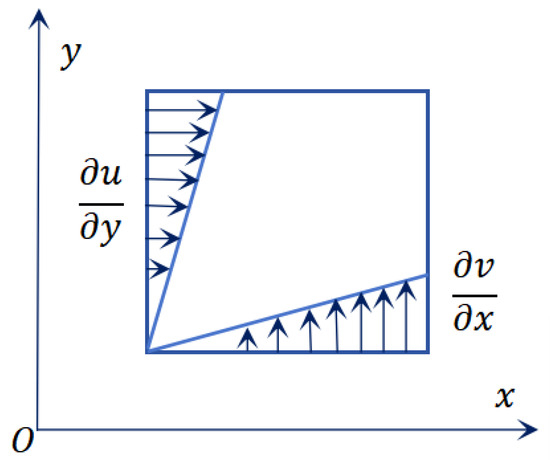
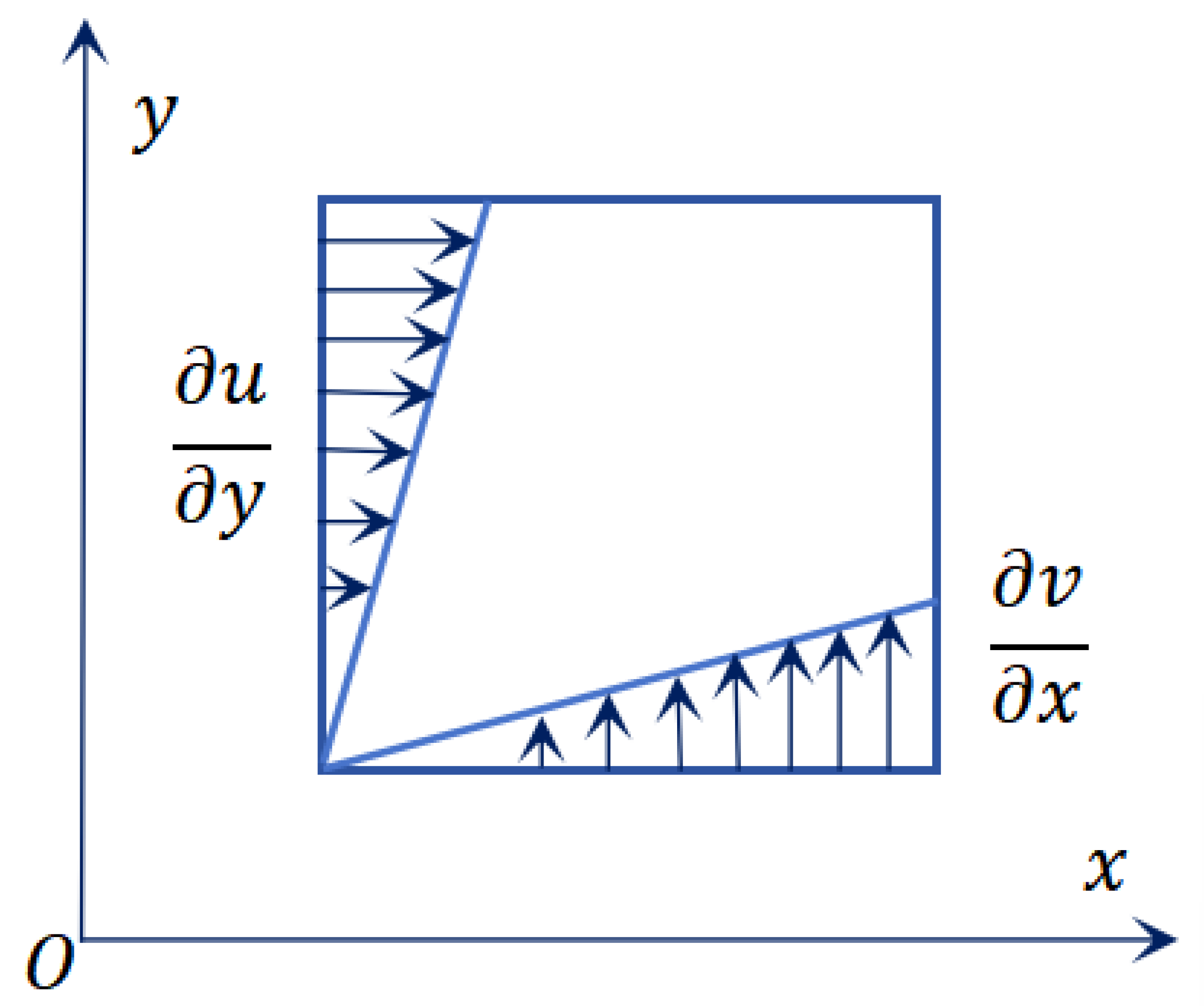
As shown in Figure 1, we selected a fluid micro-element on the xy plane in the fluid. A fluid micro-element can deform in one direction, that is, , while in the other direction, there is no deformation or rotation, that is, . In this case, the shear stresses cannot be equal.
Figure 1.
Fluid micro-element of xy plane.
(2) Even if the shear stresses exist in pairs, their magnitudes are not necessarily equal; thus, the shear stresses are not equal.
Still referring to Figure 1, when the deformation velocities on the two sides of the micro-element are different (i.e., ), the micro-element will undergo different deformations on the two sides, resulting in different shear stresses.
4. New Fluid Momentum Equation Based on the Liutex Constitutive Equation
The derivation method is similar to the traditional one. Assume that the Newtonian fluid is a continuous medium. Take a fluid micro-element. According to Newton’s second law or the momentum theorem, Equation (13) can be obtained.
Substitute Equation (11) into Equation (13) to obtain Equation (14).
Simplifying Equation (14), we can obtain the new fluid momentum equation, Equation (15).
Equation (15) is the new momentum equation based on the Liutex decomposition. The left-hand side of the equation is the acceleration, and the right-hand side represents the forces per unit mass, including body force, net pressure force, net viscous force, net volume expansion force, and the force generated by the rigid rotation of the fluid. Equation (15) is in vector form, and Equation (16) is in component form.
When Liutex is equal to the traditional vorticity in Equation (16), the above-mentioned equation is transformed into the original Navier–Stokes (N-S) equation. Therefore, the traditional N-S equation is actually a special form of the dynamic equation based on the Liutex decomposition. Now we already know that in many cases, Liutex is not equal to the traditional vorticity. So, this new fluid dynamic equation is bound to have broader and more accurate applications. However, the conclusions in this paper are only obtained through strict theoretical deductions. Their applicability and accuracy still require more in-depth analysis by fluid mechanics peers, as well as a large number of experiments and numerical verifications.
5. Conclusions
(1) A new constitutive equation for fluid mechanics is defined based on the velocity decomposition of Liutex. It is evident that the rigid rotation of the fluid does not affect the normal stress but makes the shear stress different from the traditional definition. It is no longer necessary for fluid to follow the theorem of equality of shear stresses. Only when Liutex is equal to the traditional vorticity does the theorem of equality of shear stresses hold, and the equation is transformed into the traditional constitutive equation. The traditional constitutive equation is just a special case of the new constitutive equation.
(2) A new fluid momentum equation is derived based on the new constitutive equation. The new equation includes an additional force generated by the rigid rotation of Liutex, and this term contributes to the change in momentum or acceleration. When Liutex is equal to the traditional vorticity, the equation is transformed into the traditional Navier–Stokes (N-S) equation. Therefore, the traditional N-S equation is merely a special case of the Liutex-based momentum equation.
Author Contributions
Conceptualization, K.Z.; Methodology, K.Z.; Investigation, K.Z., Z.P. and Y.F.; Validation, K.Z., Y.F. and D.Z.; Writing—original draft, K.Z., Z.P. and Y.F.; Writing—review & editing, K.Z., Z.P., Y.F. and Y.L.; Visualization, K.Z.; Supervision, K.Z., D.Z. and Y.N.; Project administration, K.Z.; Funding acquisition, K.Z. and Y.N. All authors have read and agreed to the published version of the manuscript.
Funding
This research is funded by Inner Mongolia Natural Science Foundation (Grant Nos. 2025MS02027), the National Natural Science Foundation of China (Grant Nos. 51764046 and 52160013), and the Research Program of Science and Technology at Universities of Inner Mongolia Autonomous Region of China (2023RCTD016 and 2024RCTD008).
Data Availability Statement
No new data were created or analyzed in this study. Data sharing is not applicable to this article.
Conflicts of Interest
The authors declare no conflict of interest.
References
- Saffman, P.G. Vortex Dynamics; Springer: New York, NY, USA, 1992. [Google Scholar]
- Küchemann, D. Report on the I.U.T.A.M. symposium on concentrated vortex motions in fluids. J. Fluid Mech. 1965, 22, 321–324. [Google Scholar] [CrossRef] [Scilit]
- Zhang, H. Structural Analysis of Separated Flows and Vortex Motions; National Defense Industry Press: Beijing, China, 2002. [Google Scholar]
- Helmholtz, H. Über Integrale der hydrodynamischen Gleichungen, welche den Wirbelbewegungen Entsprechen. J. Für Die Reine Und Angew. Math. 1858, 55, 25–55. [Google Scholar]
- Robinson, S.K. Coherent motions in the turbulent boundary layer. Annu. Rev. Fluid Mech. 1991, 23, 601–639. [Google Scholar] [CrossRef] [Scilit]
- Wang, Y.; Yang, Y.; Yang, G.; Liu, C. DNS study on vortex and vorticity in late boundary layer transition. Commun. Comput. Phys. 2017, 22, 441–459. [Google Scholar] [CrossRef] [Scilit]
- Hunt, J.C.R.; Wray, A.A.; Moin, P. Eddies, stream, and convergence zones in turbulent flows. In Proceedings of the Summer Program; Center for Turbulence Research Report CTR-S88; Center for Turbulence Research: Stanford, CA, USA, 1988; pp. 193–208. [Google Scholar]
- Jeong, J.; Hussain, F. On the identification of a vortex. J. Fluid Mech. 1995, 285, 69–94. [Google Scholar] [CrossRef] [Scilit]
- Chong, M.S.; Perry, A.E.; Cantwell, B.J. A general classification of three-dimensional flow fields. Phys. Fluids A Fluid Dyn. 1990, 2, 765–777. [Google Scholar] [CrossRef] [Scilit]
- Zhou, J.; Adrian, R.J.; Balachandar, S.; Kendall, T. Mechanisms for generating coherent packets of hairpin vortices in channel flow. J. Fluid Mech. 1999, 387, 353–396. [Google Scholar] [CrossRef] [Scilit]
- Liu, C. Liutex—Third Generation of Vortex Definition and Identification Methods. Acta Aerodyn. Sin. 2020, 38, 413–431. [Google Scholar]
- Liu, C.; Wang, Y.; Yang, Y.; Duan, Z. New omega vortex identification method. Sci. China (Phys. Mech. Astron.) 2016, 59, 62–70. [Google Scholar]
- Liu, C.; Gao, Y.S.; Dong, X.R.; Wang, Y.Q.; Liu, J.M.; Zhang, Y.N.; Cai, X.S.; Gui, N. Third generation of vortex identification methods: Omega and Liutex/Rortex based systems. J. Hydrodyn. 2019, 31, 205–223. [Google Scholar] [CrossRef] [Scilit]
- Xu, W.; Gao, Y.; Deng, Y.; Liu, J.; Liu, C. An explicit expression for the calculation of the Rortex vector. Phys. Fluids 2019, 31, 095102. [Google Scholar] [CrossRef] [Scilit]
- Gao, Y.; Liu, C. Rortex and comparison with eigenvalue-based vortex identification criteria. Phys. Fluids 2018, 30, 085107. [Google Scholar] [CrossRef] [Scilit]
- Dong, X.; Gao, Y.; Liu, C. New normalized Rortex/vortex identification method. Phys. Fluids 2019, 31, 011701. [Google Scholar] [CrossRef] [Scilit]
- Liu, J.; Liu, C. Modified normalized Rortex/vortex identification method. Phys. Fluids 2019, 31, 061704. [Google Scholar] [CrossRef] [Scilit]
- Liu, J.-m.; Gao, Y.-s.; Wang, Y.-q.; Liu, C. Objective Omega vortex identification method. J. Hydrodyn. 2019, 31, 455–463. [Google Scholar] [CrossRef] [Scilit]
- Gao, Y.; Liu, C. Rortex based velocity gradient tensor decomposition. Phys. Fluids 2019, 31, 011704. [Google Scholar] [CrossRef] [Scilit]
- Gao, Y.-s.; Liu, J.-m.; Yu, Y.-f.; Liu, C. A Liutex based definition and identification of vortex core center lines. J. Hydrodyn. Ser. B 2019, 31, 445–454. [Google Scholar] [CrossRef] [Scilit]
- Benton, S.I.; Bons, J.P. Response of a Streamwise Vortex-Wall Interaction to Unsteady Forcing. In Proceedings of the 2016 AIAA Aerospace Sciences Meeting, San Diego, CA, USA, 4–8 January 2016. [Google Scholar]
- Xu, H.; Cai, X.-s.; Liu, C. Liutex (vortex) core definition and automatic identification for turbulence vortex structures. J. Hydrodyn. Ser. B 2019, 31, 857–863. [Google Scholar] [CrossRef] [Scilit]
- Xu, W.-q.; Wang, Y.-q.; Gao, Y.-s.; Liu, J.-m.; Dou, H.-s.; Liu, C. Liutex similarity in turbulent boundary layer. J. Hydrodyn. Ser. B 2019, 31, 1259–1262. [Google Scholar] [CrossRef] [Scilit]
- Yan, B.; Wang, Y.; Yu, Y.; Liu, C. New objective Liutex vector based on an optimization procedure. Int. J. Heat Fluid Flow 2024, 107, 109407. [Google Scholar] [CrossRef] [Scilit]
- Li, H.; Wang, D.; Xu, H. Numerical simulation of turbulent thermal boundary layer and generation mechanisms of hairpin vortex. Aerosp. Sci. Technol. 2020, 98, 105680. [Google Scholar] [CrossRef] [Scilit]
- Yang, R.; Wang, Z.; Zhao, Y.; Wang, Q.; Feng, W. Numerical investigation on spatial development of the secondary flow in a supersonic turbulent square duct. Aerosp. Sci. Technol. 2020, 100, 105832. [Google Scholar] [CrossRef] [Scilit]
- Xu, L.; Guo, T. Analysis of hydraulic stability of a Francis turbine under partial load conditions based on Liutex method and entropy production theory. Energy 2025, 328, 136528. [Google Scholar] [CrossRef] [Scilit]
- Trieu, X.M.; Liu, J.; Gao, Y.; Charkrit, S.; Liu, C. Proper Orthogonal Decomposition Analysis of Coherent Structure in a Turbulent Flow after a Micro-vortex Generator. Appl. Math. Model. 2022, 104, 140–162. [Google Scholar] [CrossRef] [Scilit]
- Xu, W.; Wang, Y.; Gao, Y.; Liu, J.; Dou, H.-S.; Liu, C. Observation on Liutex similarity in the dissipation subrange of turbulent boundary layer. Comput. Fluids 2022, 246, 105613. [Google Scholar] [CrossRef] [Scilit]
- Ding, H.; Sun, R.; Wu, X.; Li, Y.; Gao, G.; Yu, H.; Chen, F.; Ji, Z. Impact of bypass ratio in a double-stage vortex tube on vortex stability and separation performance. Sep. Purif. Technol. 2025, 378, 134587. [Google Scholar] [CrossRef] [Scilit]
- Bai, X.; Cheng, H.; Ji, B.; Long, X.; Qian, Z.; Peng, X. Comparative Study of different vortex identification methods in a tip-leakage cavitating flow. Ocean. Eng. 2020, 207, 107373. [Google Scholar]
- Yu, Y.; Shrestha, P.; Alvarez, O.; Nottage, C.; Liu, C. Investigation of correlation between vorticity, Q, λci, λ2, Δ and Liutex. Comput. Fluids 2021, 225, 104977. [Google Scholar]
- Kovács, K.A.; Balla, E. Quantitative comparison of vortex identification methods in three-dimensional fluid flow around bluff bodies. Int. J. Heat Fluid Flow 2025, 113, 109773. [Google Scholar] [CrossRef] [Scilit]
- Qu, Y.; Wu, Q.; Zhao, X.; Huang, B.; Fu, X.; Wang, G. Numerical investigation of flow structures around the DARPA SUBOFF model. Ocean. Eng. 2021, 239, 109866. [Google Scholar]
- Ren, Z.; Wang, J.; Wan, D. Investigation of fine viscous flow fields in ship planar motion mechanism tests by DDES and RANS methods. Ocean. Eng. 2022, 243, 110272. [Google Scholar]
- Shao, Y.; Song, B.; Wan, D.; Wang, J. Numerical study of air entrainment mechanisms and vortical structures in breaking waves. Ocean. Eng. 2025, 341, 122569. [Google Scholar] [CrossRef] [Scilit]
- Chen, J.; Huang, B.; Liu, T.; Wang, Y.; Wang, G. Numerical investigation of cavitation-vortex interaction with special emphasis on the multistage shedding process. Appl. Math. Model. 2021, 96, 111–130. [Google Scholar] [CrossRef] [Scilit]
- Pang, C.; Yang, H.; Gao, Z.; Chen, S. Enhanced adaptive mesh refinement method using advanced vortex identification sensors in wake flow. Aerosp. Sci. Technol. 2021, 115, 106796. [Google Scholar] [CrossRef] [Scilit]
- Zhang, Z.; Dong, S.; Jin, R.; Dong, K.; Hou, L.; Wang, B. Vortex characteristics of a gas cyclone determined with different vortex identification methods. Powder Technol. 2022, 4s04, 117370. [Google Scholar] [CrossRef] [Scilit]
- Shen, H.; Wang, W.; Yu, W.; Zheng, Y.; Hou, G.; Kang, Y. Investigating electrohydrodynamic vortical flow and particle transport mechanism in electrostatic precipitators with discharge needles via vortex identification techniques. Sep. Purif. Technol. 2025, 376, 134028. [Google Scholar] [CrossRef] [Scilit]
- Lihui, X.; Tao, G.; Wenquan, W. Effects of Vortex Structure on Hydraulic Loss in a Low Head Francis Turbine under Overall Operating Conditions Base on Entropy Production Method. Renew. Energy 2022, 198, 367–379. [Google Scholar] [CrossRef] [Scilit]
- Wang, C.; Guo, L.; Liu, Z.; Zhang, Y.; Li, Z. Unsteady flow analysis regarding stall flow and rotating cavitation in the first-stage of a multistage LNG cryogenic submerged pump. Cryogenics 2023, 129, 103546. [Google Scholar]
- Yan, X.; Kan, K.; Zheng, Y.; Xu, Z.; Rossi, M.; Xu, L.; Chen, H. The vortex dynamics characteristics in a pump-turbine: A rigid vorticity analysis while varying guide vane openings in turbine mode. Energy 2024, 289, 130086. [Google Scholar] [CrossRef] [Scilit]
- Yu, A.; Tang, Y.; Liang, J.; Chen, P.; Zhang, Y.; Yang, C. Numerical investigation of the vorticity transportation and energy dissipation in a variable speed pump-turbine. J. Energy Storage 2024, 93, 112392. [Google Scholar] [CrossRef] [Scilit]
- Wang, Y.; Cheng, L. Research on the flow characteristics and energy variation characteristics of the outlet passage of a two-way flow pump device based on Liutex and energy balance equation method. Energy 2025, 318, 134805. [Google Scholar] [CrossRef] [Scilit]
- Liu, Y.; Zhong, W.; Zhong, L.; Tang, Y. Comparison of vortex identification criteria for tip leakage flow in an axial compressor rotor. Aerosp. Sci. Technol. 2026, 168, 110840. [Google Scholar] [CrossRef] [Scilit]
- Liu, C.; Gao, Y.; Tian, S. Rortex A New Vortex Vector Definition and Vorticity Tensor and Vector Decompositions. Phys. Fluids 2018, 30, 035103. [Google Scholar] [CrossRef] [Scilit]
- Stokes, V.K. Couple stresses in fluids. Phys. Fluids 1966, 9, 1709–1715. [Google Scholar] [CrossRef] [Scilit]
- Ariman, T.; Cakmak, A.S. Couple stresses in fluids. Phys. Fluids 1967, 10, 2497–2499. [Google Scholar] [CrossRef] [Scilit]
- Hadjesfandiari, A.R.; Dargush, G.F. Couple stress theory for solids. Int. J. Solids Struct. 2011, 48, 2496–2510. [Google Scholar] [CrossRef] [Scilit]
- AHadjesfandiari, R.; Hajesfandiari, A.; Dargush, G.F. Skew-symmetric couple-stress fluid mechanics. Acta Mech. 2015, 226, 871–895. [Google Scholar]
- Rubbab, Q.; Mirza, I.A.; Siddique, I.; Irshad, S. Unsteady Helical Flows of a Size-Dependent Couple-Stress Fluid. Adv. Math. Phys. 2017, 2017, 9724381. [Google Scholar]
Disclaimer/Publisher’s Note: The statements, opinions and data contained in all publications are solely those of the individual author(s) and contributor(s) and not of MDPI and/or the editor(s). MDPI and/or the editor(s) disclaim responsibility for any injury to people or property resulting from any ideas, methods, instructions or products referred to in the content. |
© 2026 by the authors. Licensee MDPI, Basel, Switzerland. This article is an open access article distributed under the terms and conditions of the Creative Commons Attribution (CC BY) license.