
Numerical Investigation on Flow Separation Control for Aircraft Serpentine Intake with Coanda Injector


Abstract
1. Introduction
2. Simulation Validation
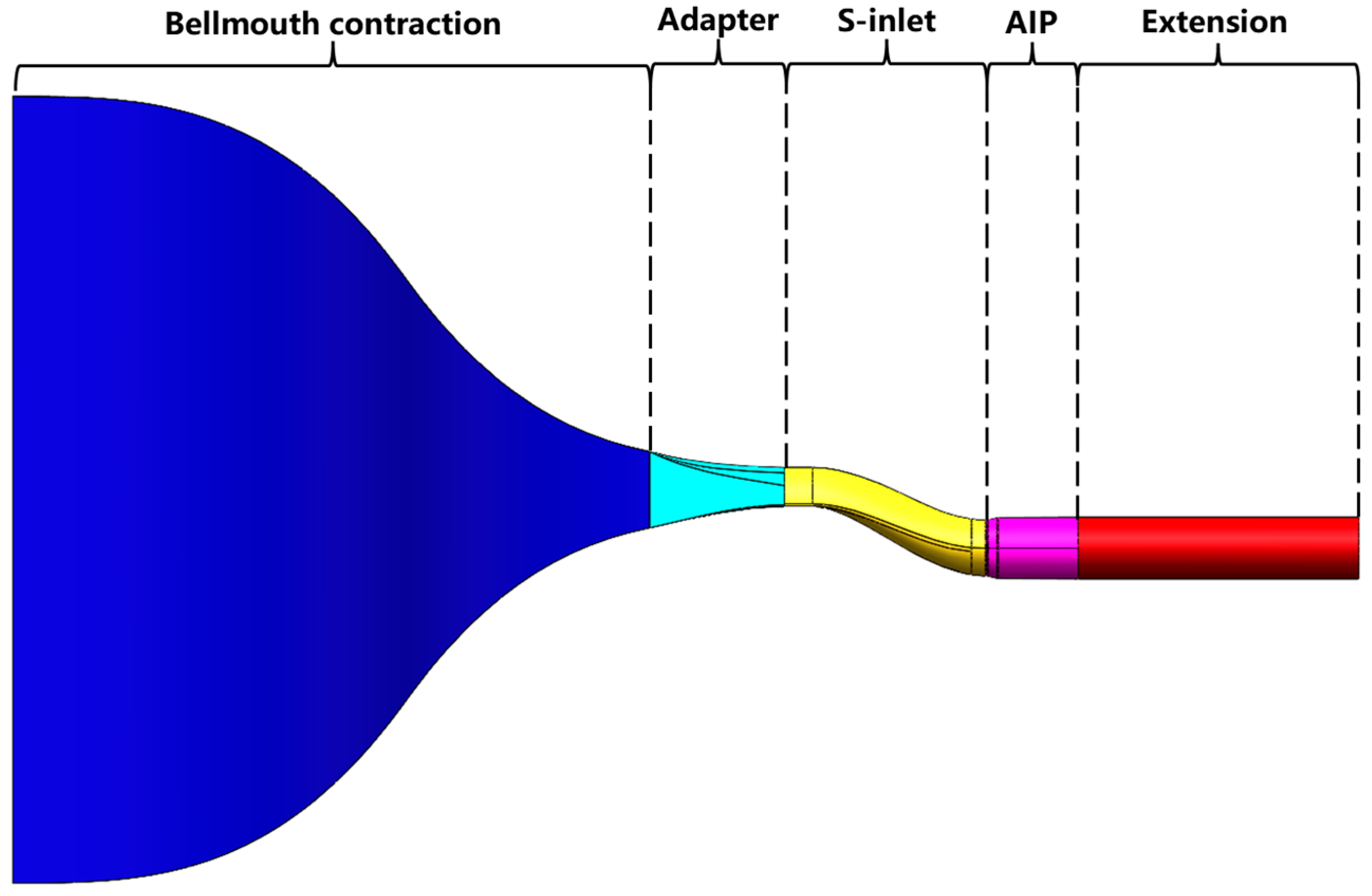
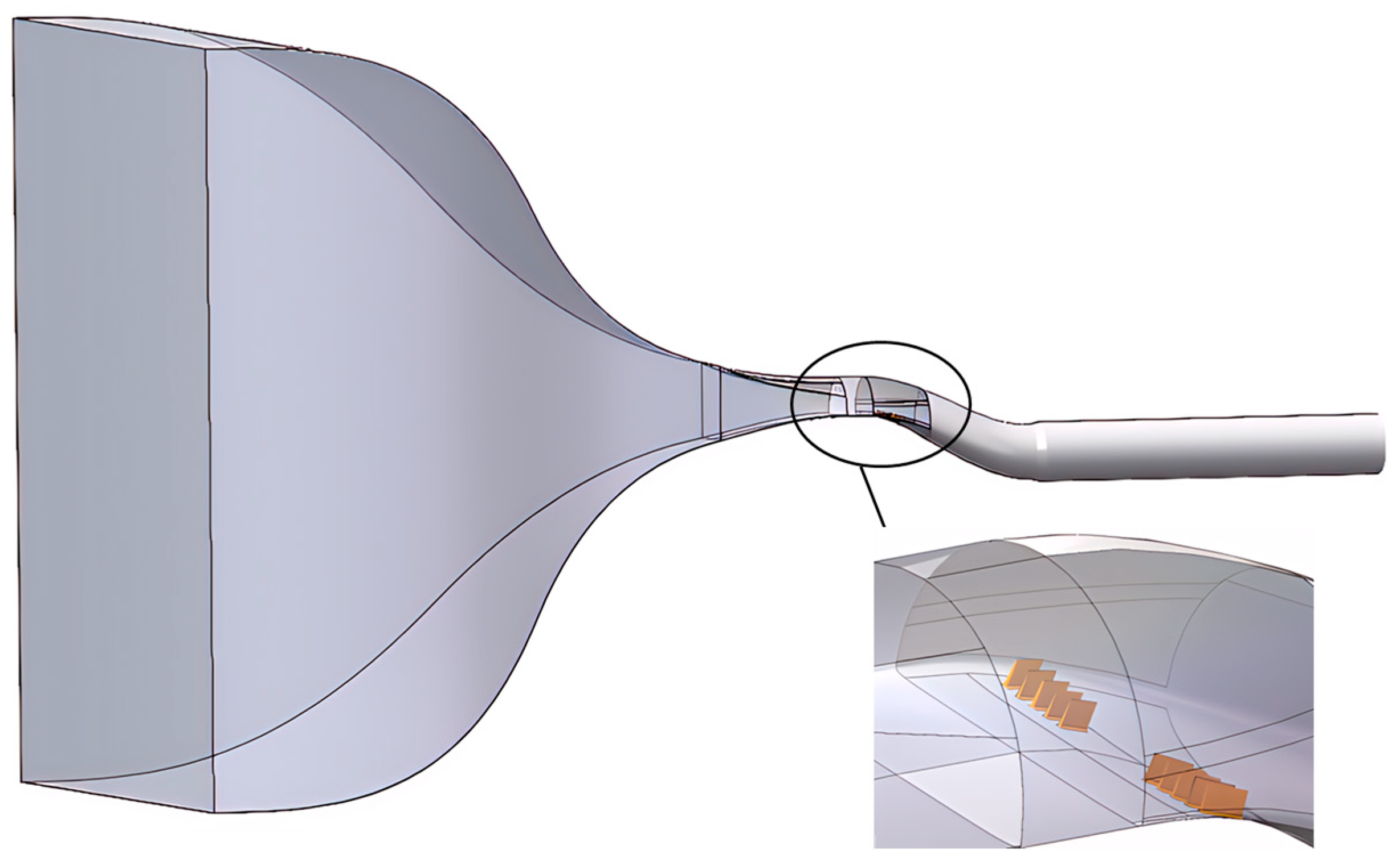
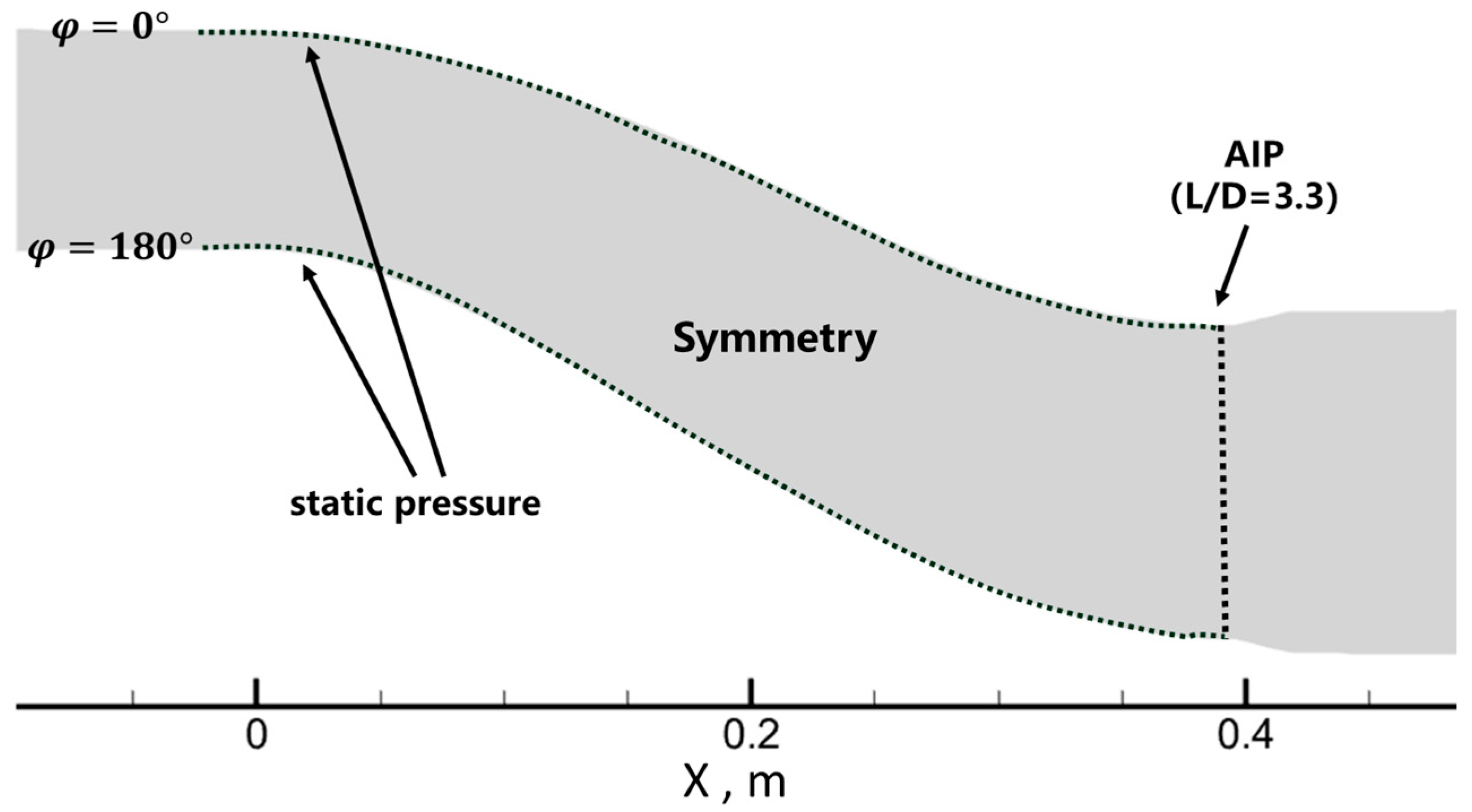
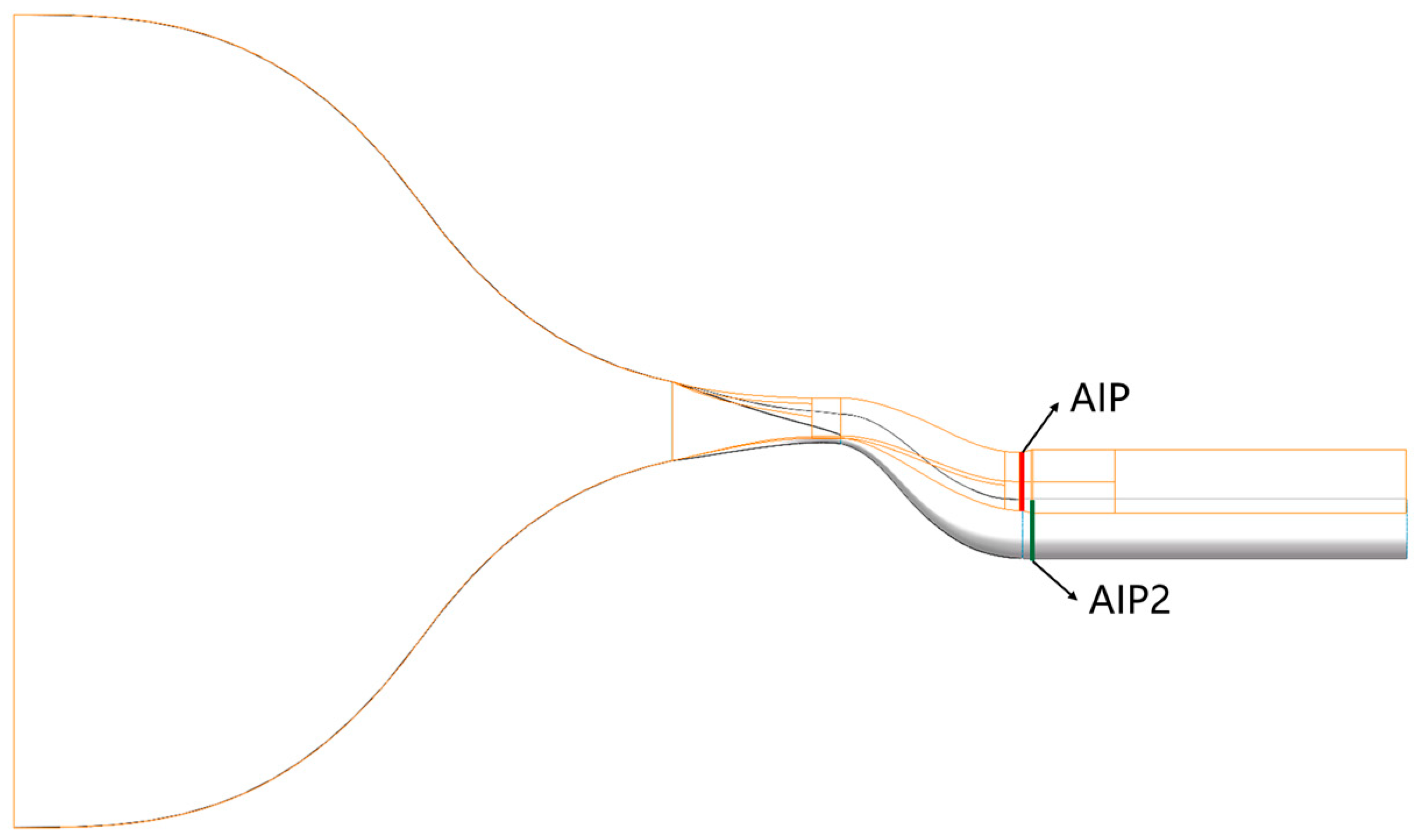
2.1. S-Duct Inlet Geometry
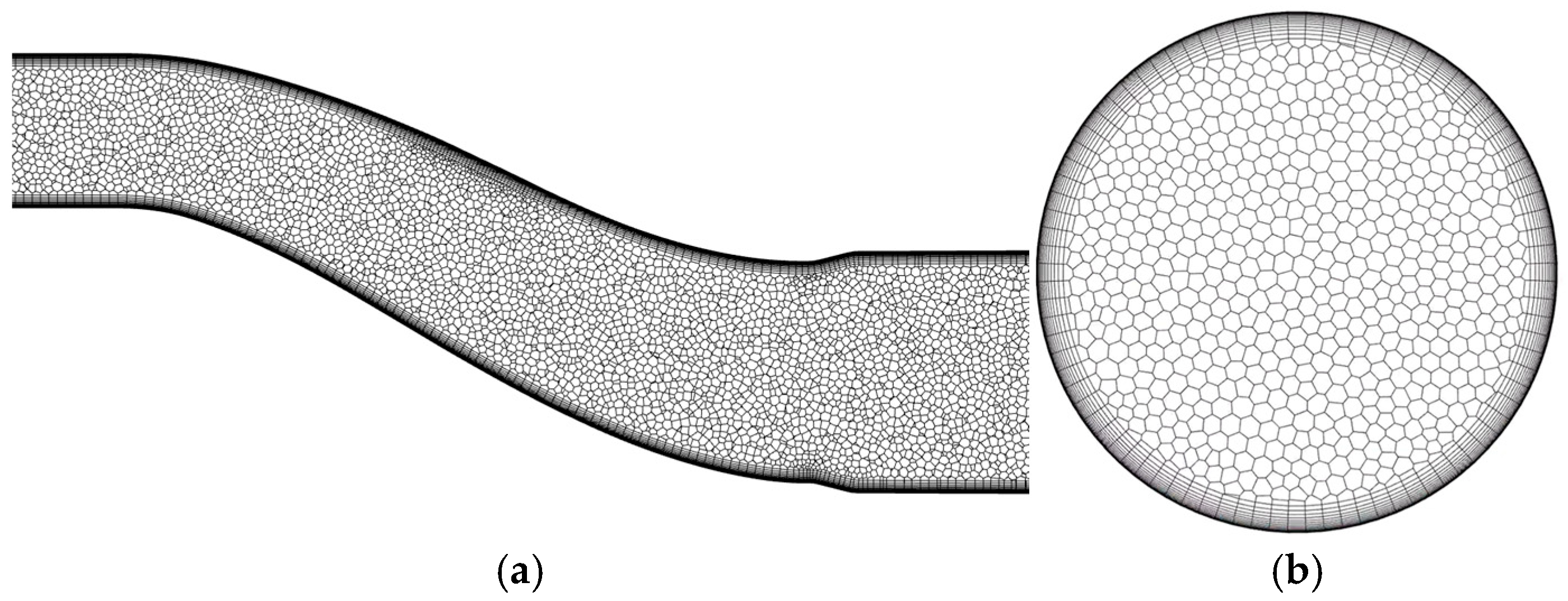
2.2. Grids
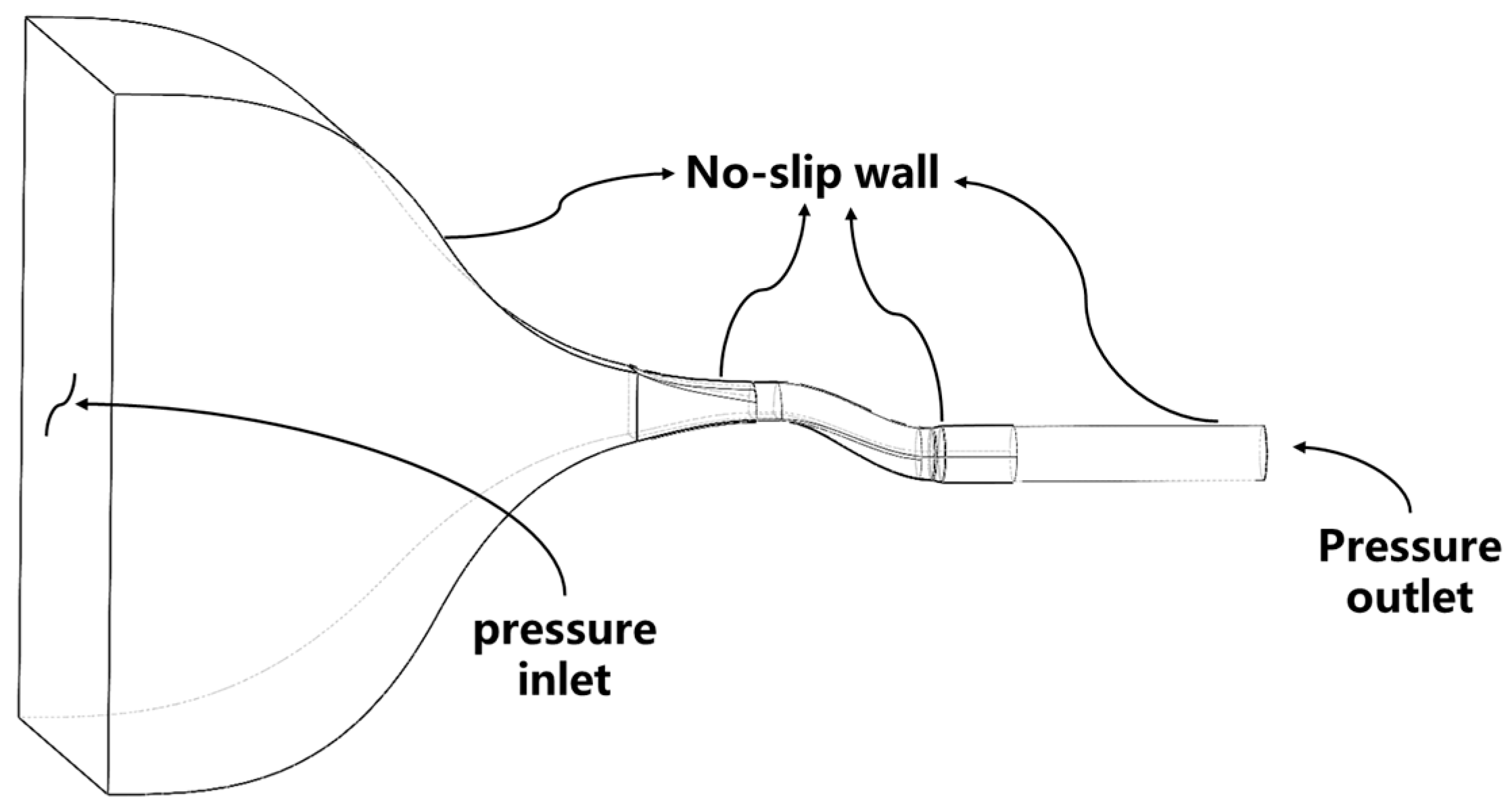
2.3. Solver
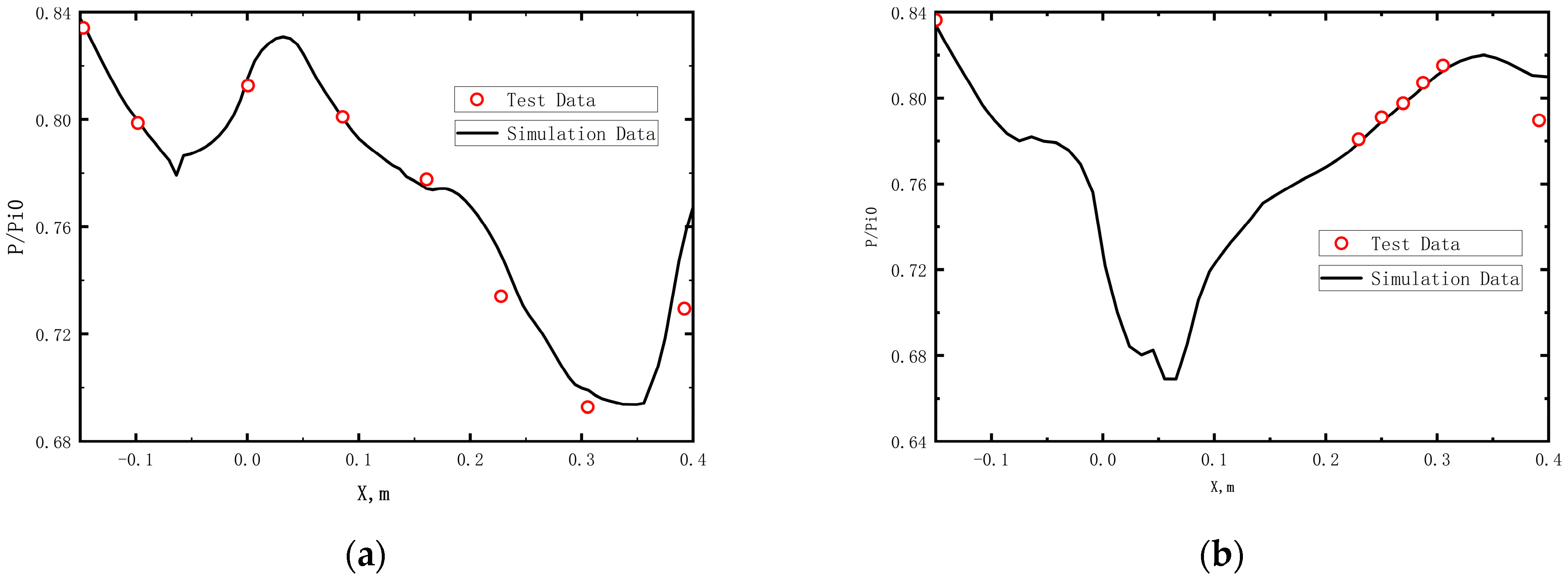
2.4. Case Validation
3. Results and Discussion
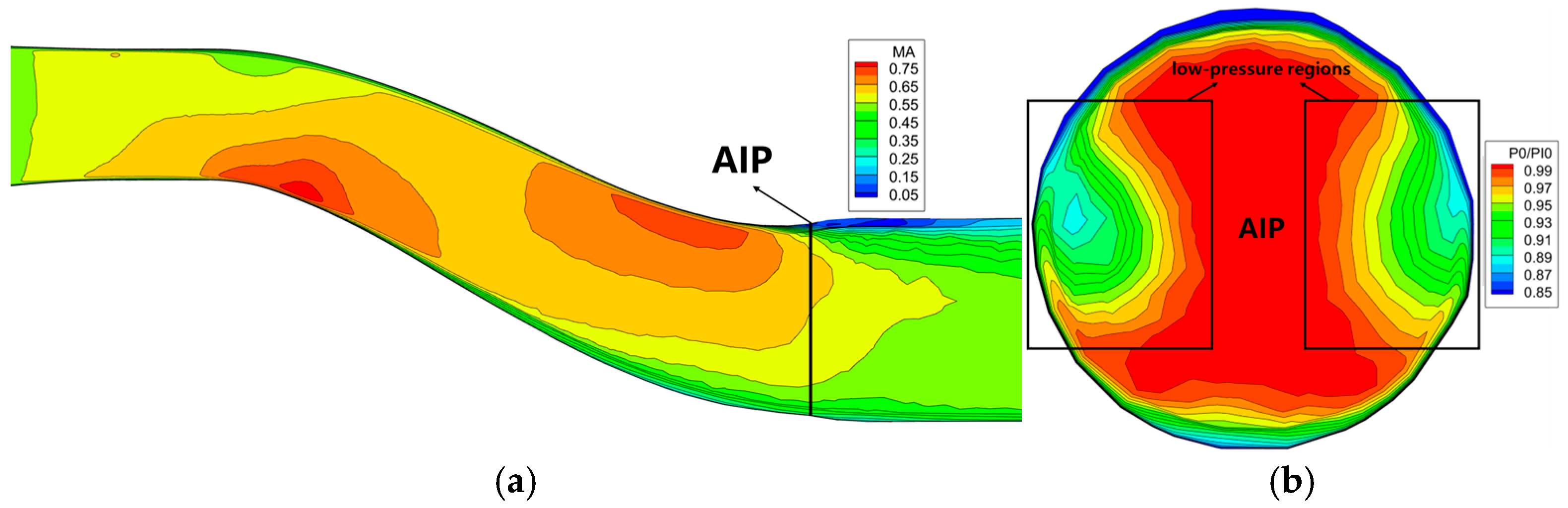
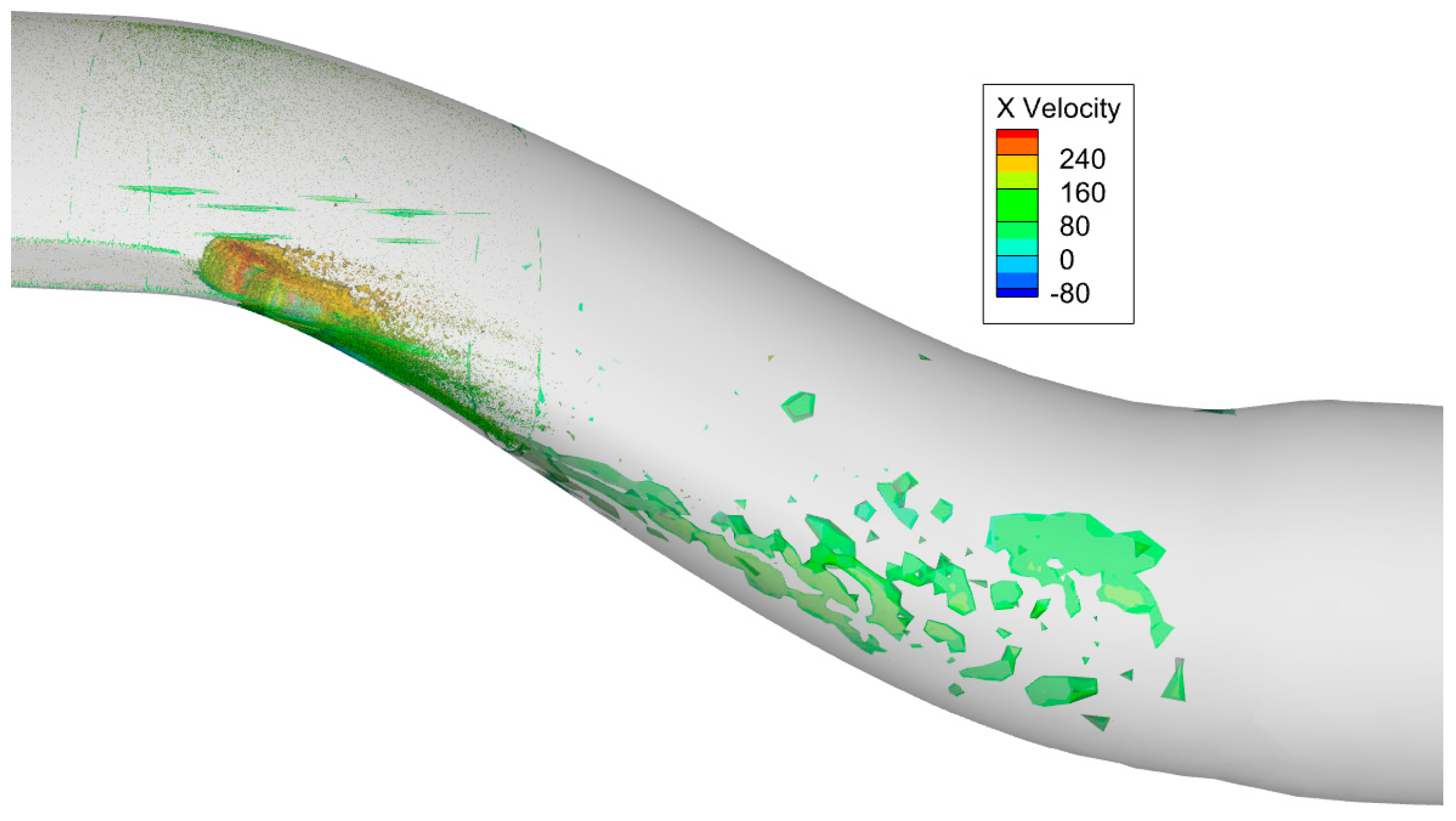
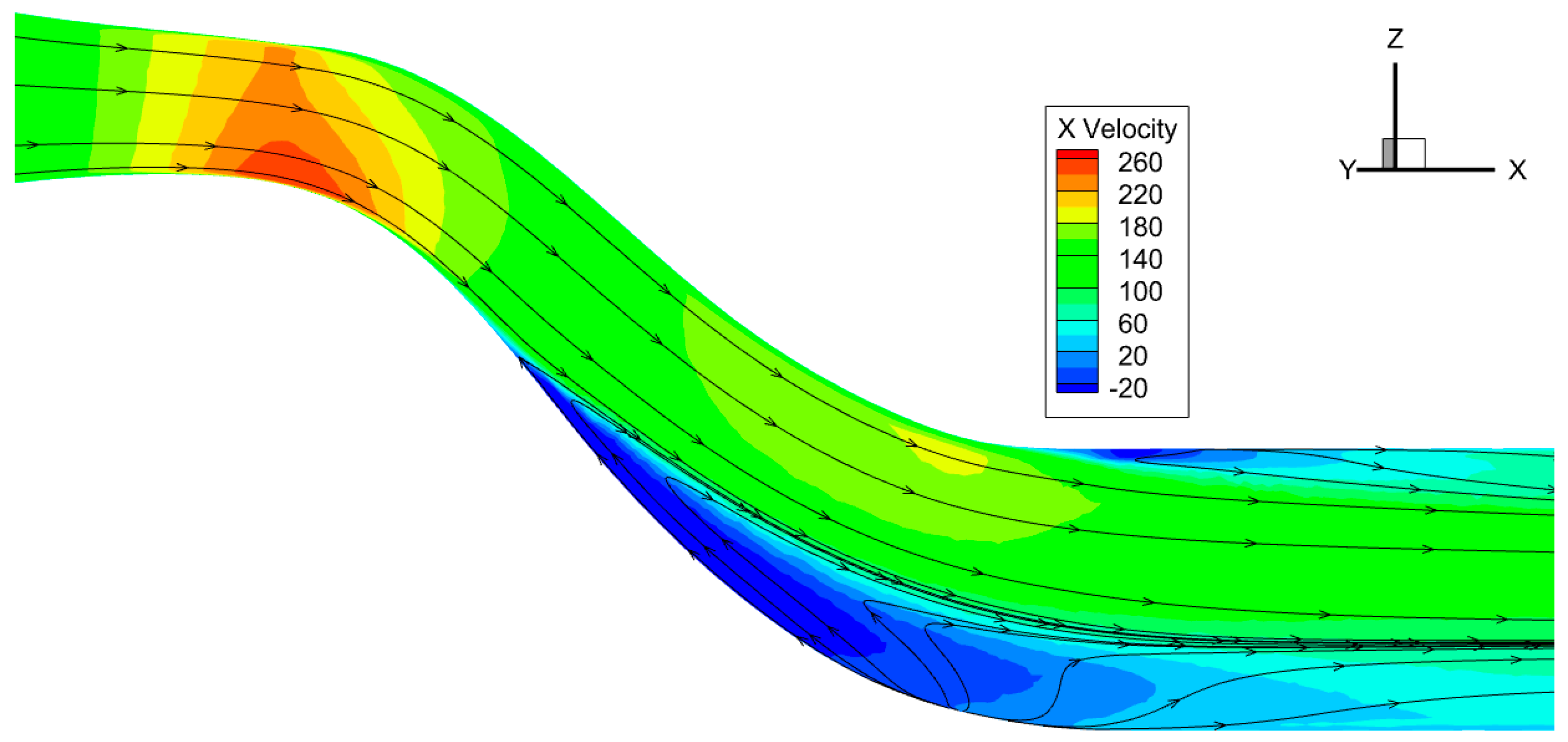
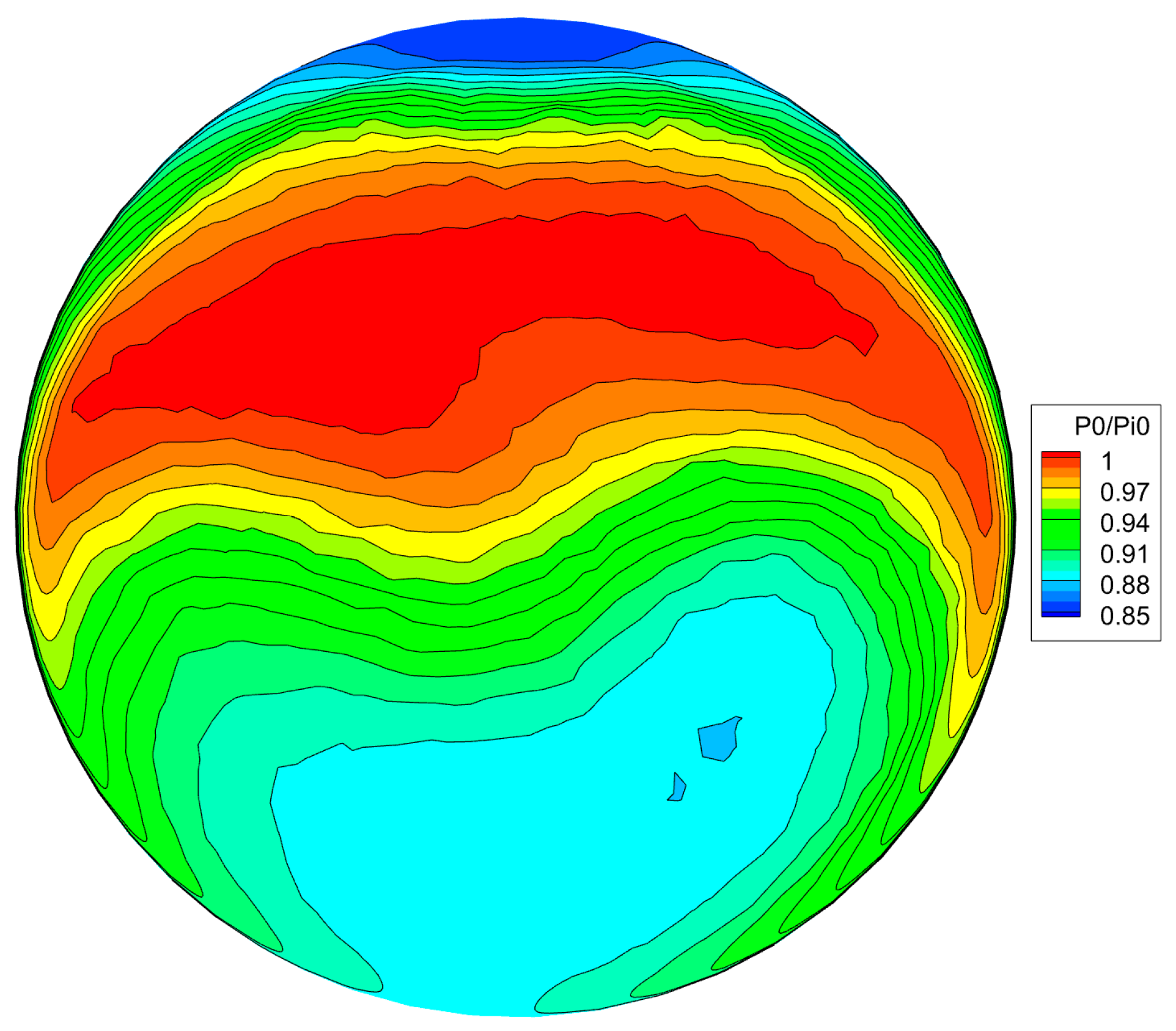
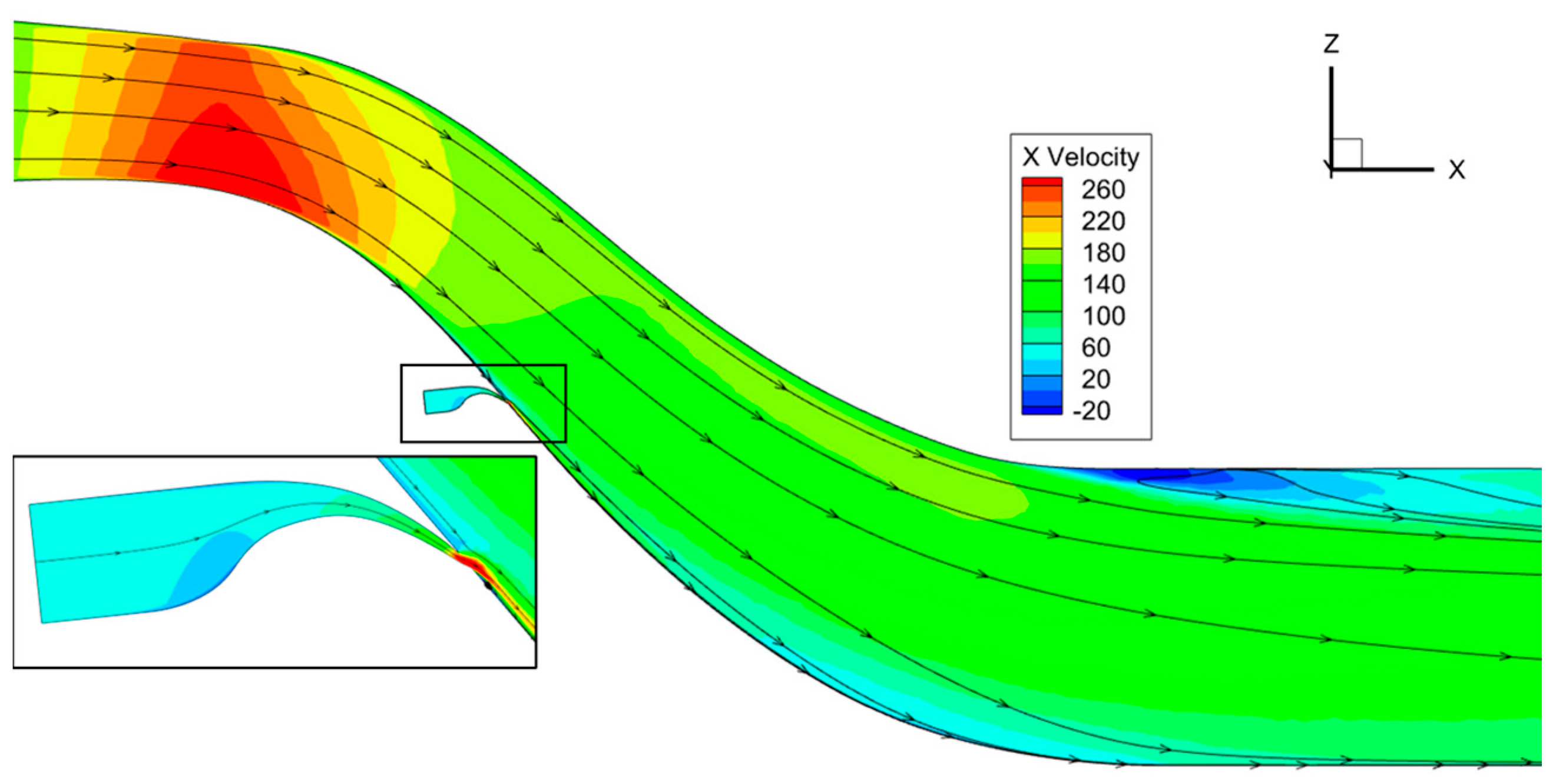
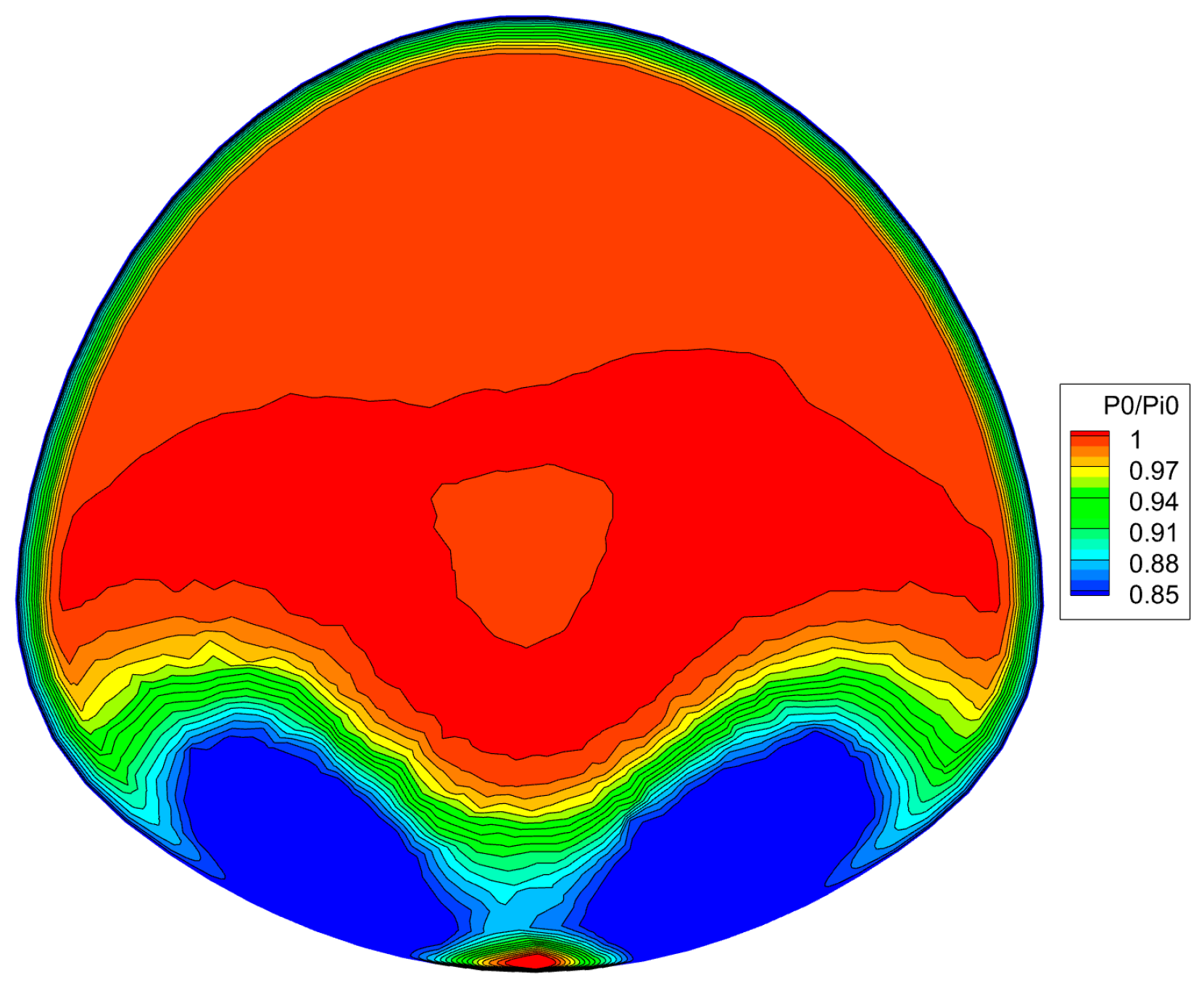
3.1. Flow Separation in the S-Duct Inlet
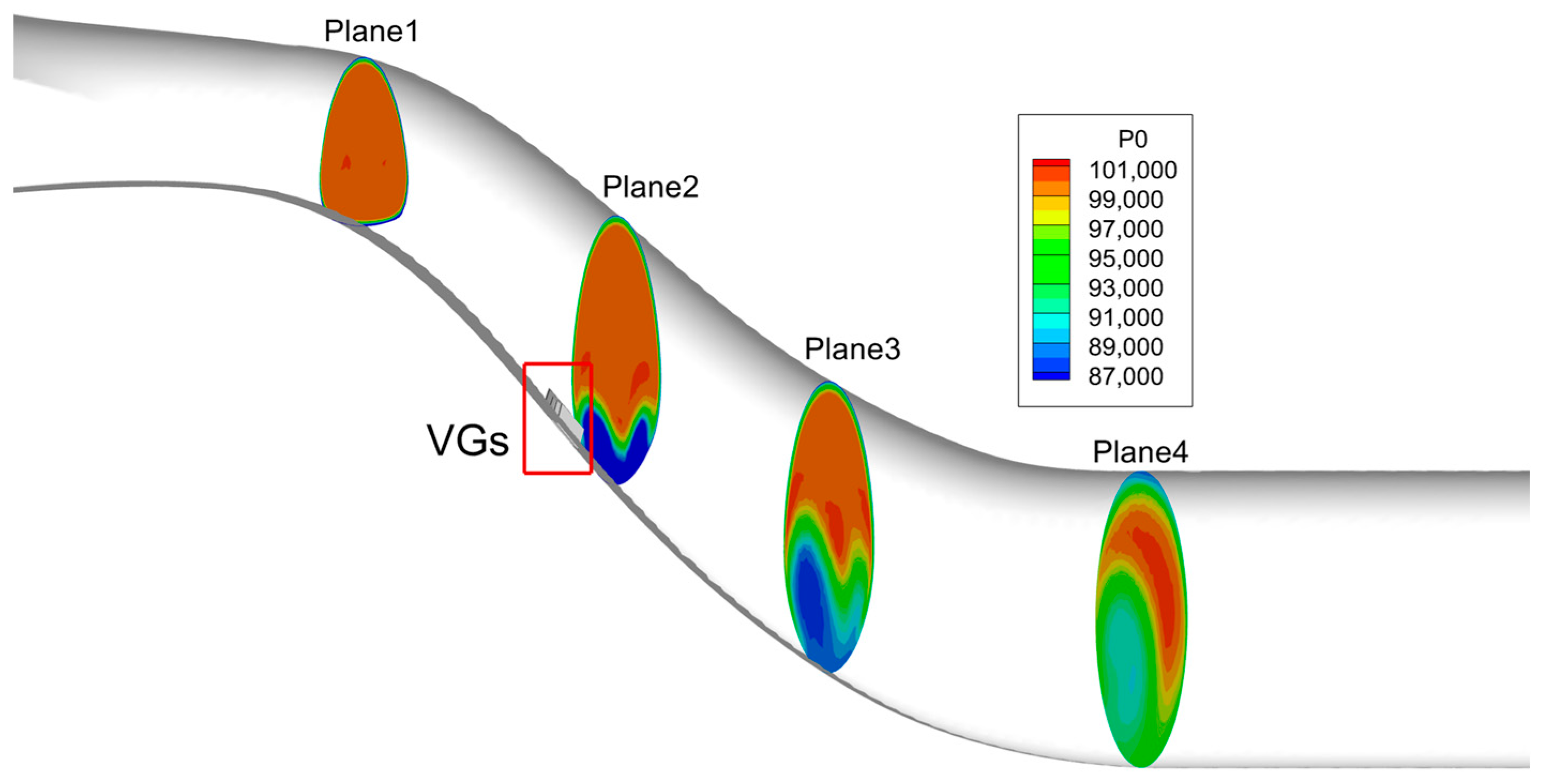
3.2. S-Duct Inlet Flow Separation Control with Vortex Generators
3.3. Flow Control with Coanda Injector in S-Duct Inlet
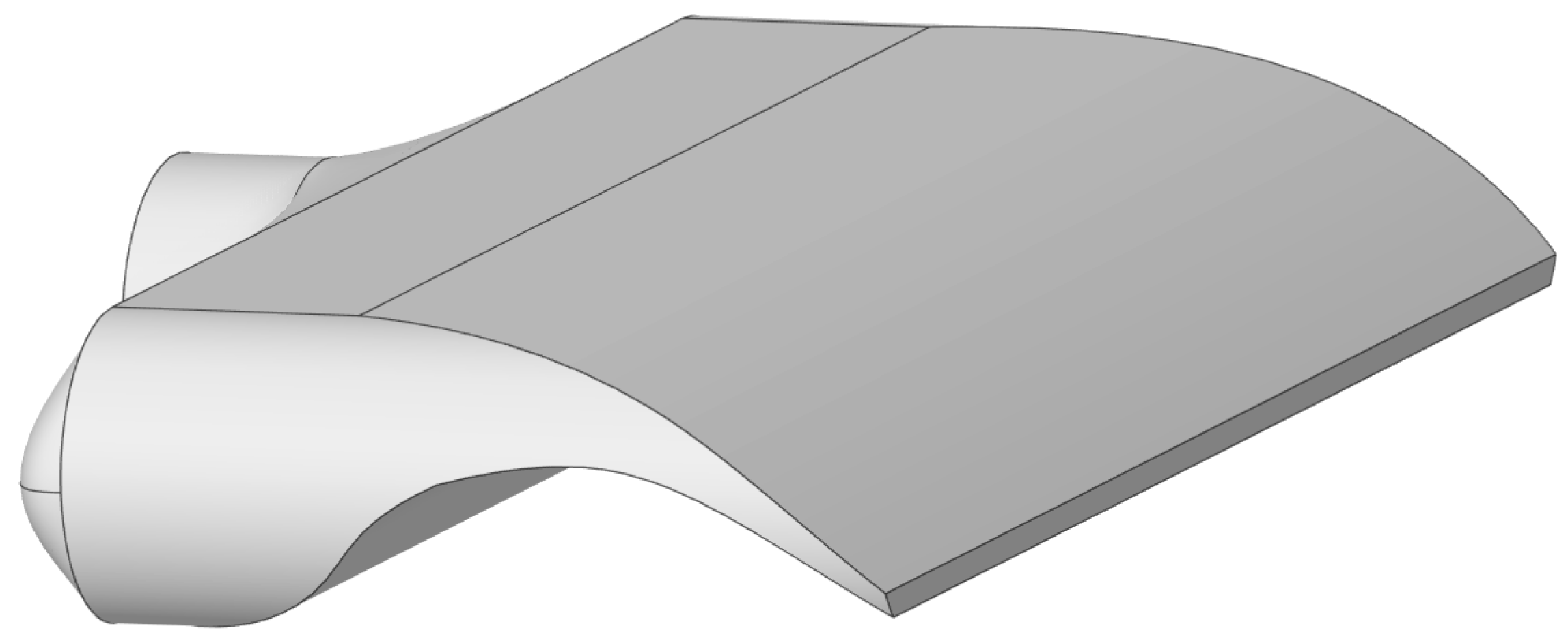
3.3.1. Geometric Design of Coanda Injector
3.3.2. Control of S-Duct Inlet Flow Separation by Coanda Injector
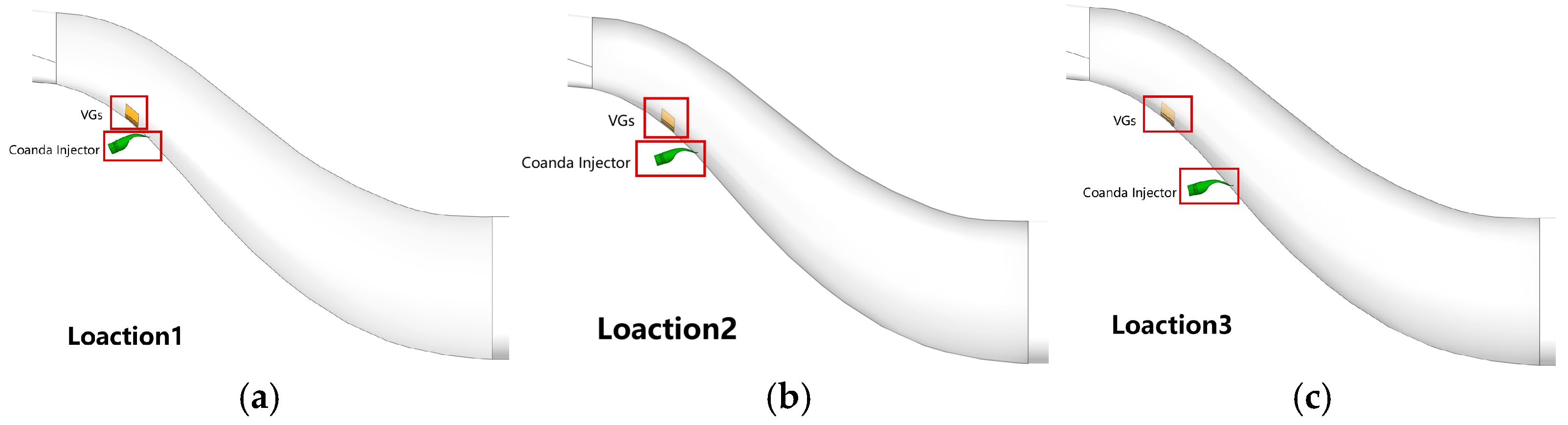
3.4. Control of S-Duct Inlet Flow Separation by Combination of Coanda Injector and Vortex Generator
4. Conclusions
- (1)
- The CFD simulations are validated against experimental data, showing good agreement and confirming the accuracy of the numerical approach.
- (2)
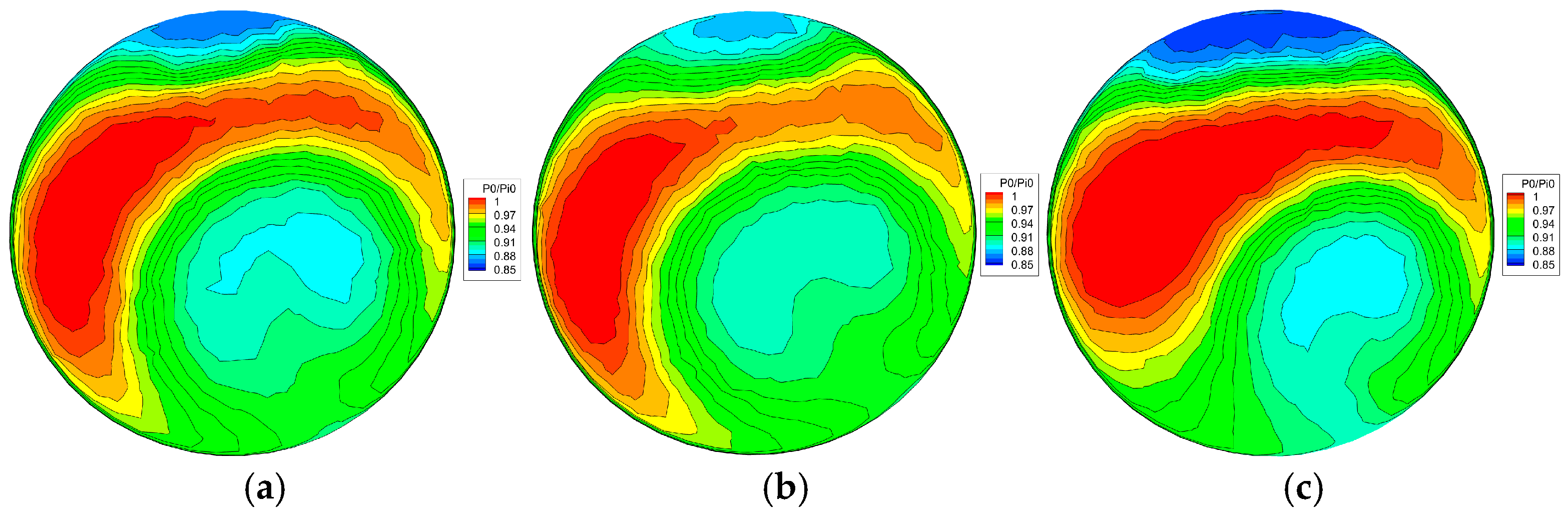
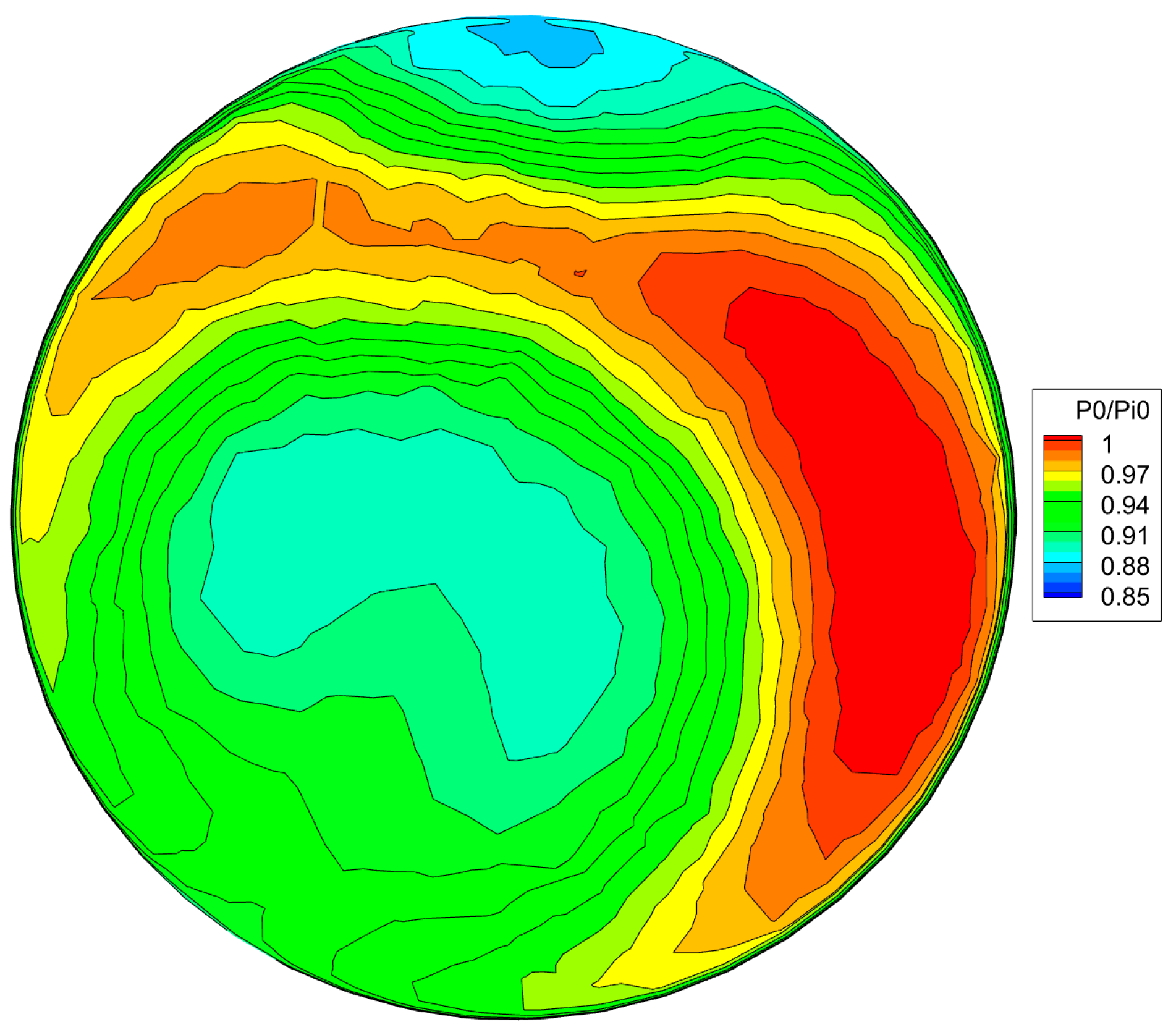
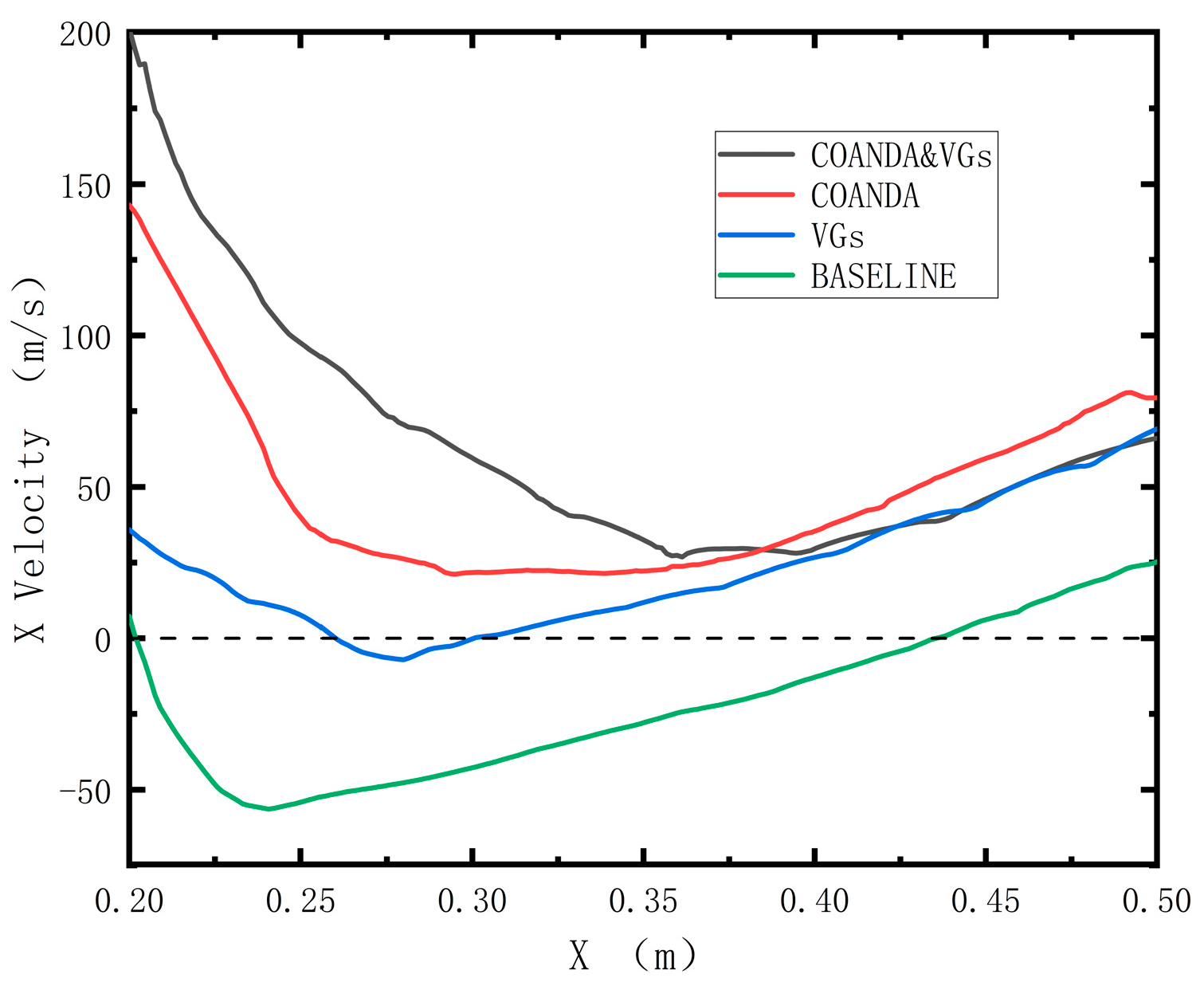
- With the VGs inside the S-duct inlet, flow separation is suppressed, the recirculation region is reduced, and the total pressure distortion coefficient at the AIP decreases, while improvements in total pressure recovery remain limited. The current VGs configuration proves beneficial under specific conditions but may require optimization for broader operational envelopes to maximize its aerodynamic effectiveness.
- (3)
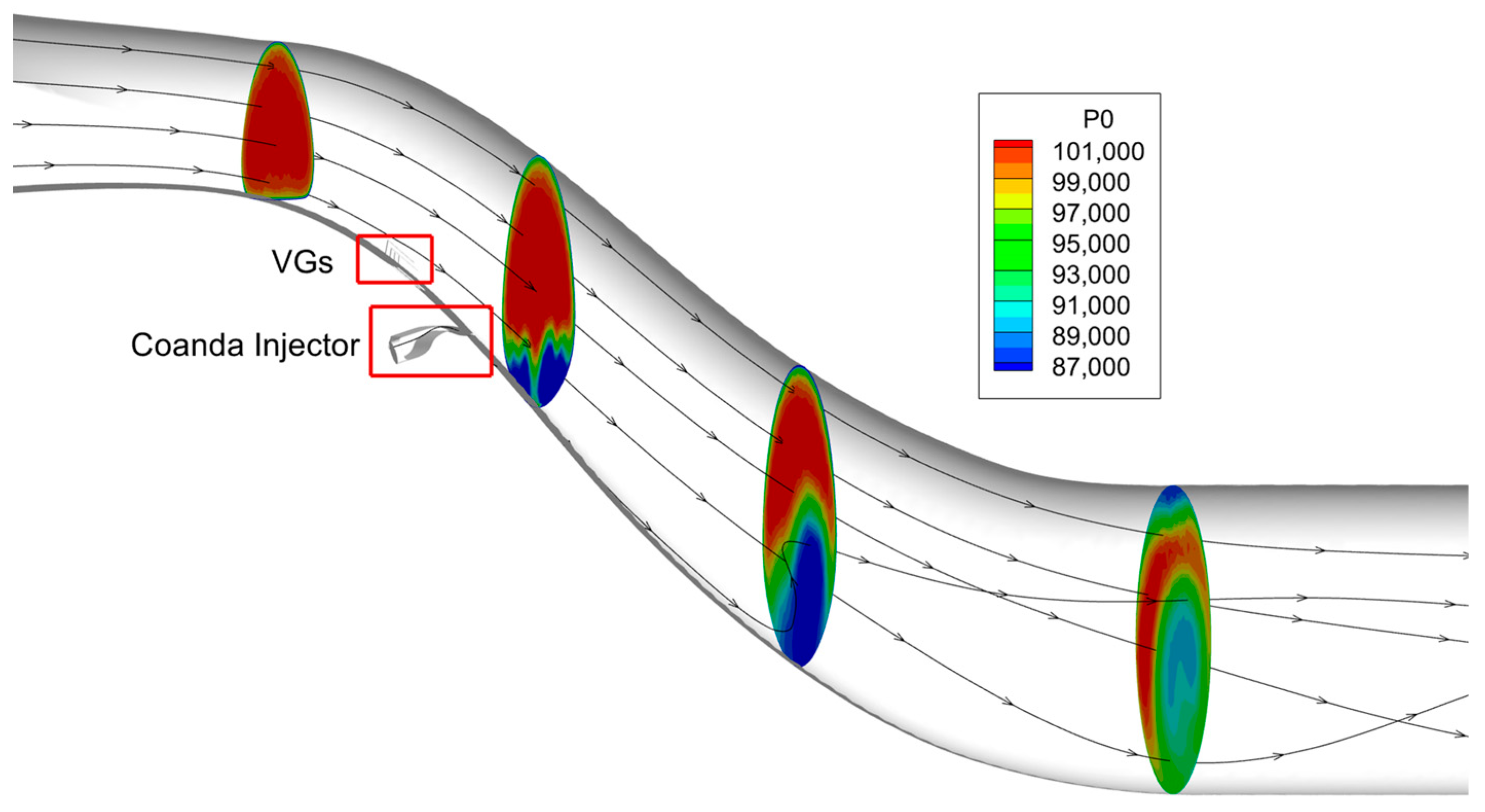
- With the Coanda injector installed in the S-duct inlet, direct momentum injection energizes the boundary layer, significantly improving pressure recovery and mass flow supply, while moderately reducing distortion though less effectively than VG.
- (4)
- With the combined VGs and Coanda injector, the method achieves the lowest total pressure distortion coefficient and a higher total pressure recovery coefficient than VGs alone. Although the recovery is slightly lower than the Coanda injector case due to additional flow blockage from VGs, the coupled strategy provides the most balanced performance by minimizing flow distortion, increasing the mass flow rate across the S-duct.
Author Contributions
Funding
Data Availability Statement
Conflicts of Interest
DURC Statement
Abbreviations
| Total Pressure | |
| Total Temperature | |
| Total Pressure Recovery Coefficient | |
| Total Pressure Distortion Coefficient | |
| Maximum Value of Total Pressure at AIP | |
| Minimum Value of Total Pressure at AIP | |
| Average Value of Total Pressure at AIP |
References
- Tu, M.; Yun, G.; Xu, F.; Wang, X. Application of integrated thermal management in development of advanced fighter system. Acta Aeronaut. Astronaut. Sin. 2020, 41, 523629. [Google Scholar] [CrossRef]
- Yang, L.; Ma, C.; Pang, L. Design and performance simulation of environmental control system for civil supersonic aircraft. Acta Aeronaut. Astronaut. Sin. 2025, 46, 531585. [Google Scholar] [CrossRef]
- Hamstra, J.W.; Miller, D.N.; Truax, P.P.; Anderson, B.A.; Wendt, B.J. Active inlet flow control technology demonstration. Aeronaut. J. 2000, 104, 473–479. [Google Scholar] [CrossRef]
- Vaccaro, J.C.; Elimelech, Y.; Chen, Y.; Sahni, O.; Jansen, K.E.; Amitay, M. Experimental and numerical investigation on the flow field within a compact inlet duct. Int. J. Heat. Fluid. Flow. 2013, 44, 478–488. [Google Scholar] [CrossRef]
- Ding, W.; Huang, H.; Xie, L.; Chen, C.; Zhu, Y. Jet and Bleed Flow Control Method for Bump Inlet. J. Nav. Aviat. Univ. 2025, 40, 437–446. [Google Scholar] [CrossRef]
- Liu, X.; Chen, T.; Zhou, M. Development status and application prospect of the active flow control technology. Aerosp. Technol. 2023, 5, 54–62+71. [Google Scholar] [CrossRef]
- Wu, Y.; Ma, X.; Feng, L. Research Progress of Flow Control on Shock Wave/Boundary Layer Interaction in Supersonic Inlets. Chin. J. Appl. Mech. 2024, 1–17. [Google Scholar]
- Tian, X.; Pan, P.; Tian, L. Research and Simulation of Flow Control in S-duct Inlet with Vortex Generators. Aeronaut. Sci. Technol. 2015, 26, 16–23. Available online: https://qikan.cqvip.com/Qikan/Article/Detail?id=664834335 (accessed on 12 September 2024).
- Bruce, P.J.K.; Colliss, S.P. Review of research into shock control bumps. Shock. Waves 2015, 25, 451–471. [Google Scholar] [CrossRef]
- Zhang, H.; Tan, C.; Zhang, X.; Wang, S. Numerical investigation on application of boundary layer suction to control the flow separations. J. Propuls. Technol. 2009, 28, 462–465. Available online: https://www.researchgate.net/publication/290287883_Numerical_investigation_on_application_of_boundary_layer_suction_to_control_the_flow_separations (accessed on 12 September 2024).
- Sun, R.; Zhu, W.; Huang, S.; Chen, H. Numerical simulation of the blowing method for controlling oblique shock/boundary layer interactions. J. Harbin Eng. Univ. 2012, 33, 166–173. [Google Scholar] [CrossRef]
- Wellborn, S.R.; Reichert, B.A.; Okiishi, T.H. An Experimental Investigation of the Flow in a Diffusing S-Duct. In Proceedings of the 28th Joint Propulsion Conference and Exhibit, Nashville, TN, USA, 6–8 July 1992. [Google Scholar] [CrossRef]
- Reichert, B.A.; Wendt, B.J. Improving Diffusing S-Duct Performance by Secondary Flow Control. In Proceedings of the 32nd Aerospace Sciences Meeting and Exhibit, Washington, DC, USA, 1 February 1994. [Google Scholar] [CrossRef]
- Wan, B.; Liu, Z.; Zhang, L. Numerical simulation of flow field for short S-shaped inlet. Sci. Technol. Eng. 2009, 9, 1807–1811. Available online: http://www.jasp.com.cn/hkdlxb/article/id/20060620 (accessed on 15 September 2024).
- Chen, X.; Fang, L. Application of vortex generators in boundary layer and flow control of the subsonic diffuser of inlet. J. Nanjing Univ. Aeronaut. Astronaut. 1985, 2, 101–108. Available online: https://kns.cnki.net/kcms2/article/abstract?v=eLwJ_SlppzttceMjnAKDCFpTM95rIvBBRdlUMwCW3G09vSw0ERtWXUeDjp9q7XB9n3XG3B_cMurs1cPK8a7l2ANEbVHZQm3u5JcRFcAX6D05tfs5b54qx_N6YK61zTi2jNwBcPrjksem34niqNBKG1VRe8gGd-3mepa5iyjjUTeSkr3Xt4EkIw==&uniplatform=NZKPT&language=CHS (accessed on 19 September 2024).
- Debiasi, M.; Herberg, M.; Zeng, Y.; Tsai, H.M.; Dhanabalan, S. Control of Flow Separation in S-Ducts via Flow Injection and Suction. In Proceedings of the 46th AIAA Aerospace Sciences Meeting and Exhibit, Reno, NV, USA, 7–10 January 2008. [Google Scholar] [CrossRef]
- Hamed, A.; Lehning, T. Investigation of oblique shock/boundary layer bleed interaction. J. Propuls. Power 1992, 10, 407–413. [Google Scholar] [CrossRef]
- Wang, Y. Investigation on the Starting Characteristics of Hypersonic Inlet. Ph.D. Thesis, National University of Defense Technology, Changsha, China, 2008. Available online: https://kns.cnki.net/kcms2/article/abstract?v=eLwJ_Slppzs8dBSSyvTTmnQuZ0L51SD-4RrSC-Lwy0tTBesEyPZwBHxkOER_wruUYrDDD9-eJ6EZ-zFSdEWtzpnFTPoKnvLKs0nbeCLA38HrOKcLRlDSaRlI_I_pi6HMhuR6Z66sDYJky-ngzMjy14RY5vIGLoXZTKM2NxaZtZw=&uniplatform=NZKPT (accessed on 22 October 2024).
- Zhang, Y.; Tan, H.; Zhang, Q.; Cheng, D. A new method and its flow mechanism for control of shock/boundary layer interaction in hypersonic inlet. J. Astronaut. 2012, 33, 265–273. [Google Scholar] [CrossRef]
- Huang, S. The Numerical Simulation of Blowing Boundary Layer Control in Inlet. Master’s Thesis, Harbin Engineering University, Harbin, China, 2009. Available online: https://kns.cnki.net/kcms2/article/abstract?v=eLwJ_SlppzvE9aB5ds88uHZZsTuDhGTeqspMTxKyu-LvLjV7jSqWNK0q9PzVBwzy9_Ykrtm-alW4ARJYF5jWxKTRtF0n_jfZs1X_D468YjU7bdE9pHvhiGnfGaWocGPG8cgY-LUSiSCwHi004ByZj0gIfcJWiXPFCrzlSp6kqpw=&uniplatform=NZKPT (accessed on 3 November 2024).
- Liu, L.; Chen, F.; Song, Y.; Chen, H. Numerical simulation of effects of active flow control on the performance of a half flush-mounted S-shaped inlet. J. Propuls. Technol. 2014, 35, 1168–1173. Available online: https://kns.cnki.net/kcms2/article/abstract?v=eLwJ_SlppztriGWGu38_Fwa0dKqKvx0W2s6ioBgc-_WAX5YCGmNsoZBfTXDkYmHlfnHam4hQR_J3KT-5I_WpF29zbT3_xoNspq6l4NHtsfAcrzMJMjgn7oIckFS5xJ_-zrUozXzQD-qXGAtR27EYTqsyrWd0t_l0&uniplatform=NZKPT (accessed on 17 November 2024).
- Hamstra, J.W.; McCallum, B.N.; Sylvester, T.G.; Denner, B.W.; Moorehouse, J.A. Transition Shoulder System and Method for Diverting Boundary Layer Air. U.S. Patent 5,749,542, 12 May 1998. Available online: http://www.patentbuddy.com/Patent/5749542 (accessed on 17 November 2024).
- Liu, W. Research on the Application of Plasma to Achieve Active Flow Control. Ph.D. Thesis, Northwestern Polytechnical University, Xi’an, China, 2004. Available online: https://kns.cnki.net/kcms2/article/abstract?v=eLwJ_SlppztKefyhGjs9qKtfsyfiEBDqKjpdbJYVaC1KIWBeWmDgEWMcfTZtvdON2egpqANf0IV-LOC4rVLetRrE-3xEu3ZdJPDJmdRLkwmF5iVHK683b3NWLBBCmJ2A-DwYhoCi_bIY-myevS5rTHw-SxESCvpV5Y_LVVQlrkI08NozILtVFg==&uniplatform=NZKPT&language=CHS (accessed on 25 November 2024).
- Zhan, H. Influence of Flow Control on Inlet Flow Field Characteristics. Ph.D. Thesis, Nanjing University of Aeronautics and Astronautics, Nanjing, China, 2022. [Google Scholar]
- Tian, S.; Jin, L.; Du, Z.; Zhong, X.; Huang, W.; Liu, Y. Research progress of shock wave/boundary layer interaction controls induced by bump. Acta Aeronaut. Astronaut. Sin. 2023, 44, 37–60. [Google Scholar]
- Wang, Y.; Zhu, G.; Wang, Q.; Yang, B. Influence of vortex generator on compressor flow field under inlet distortion. J. Eng. Therm. Energy Power 2022, 37, 73–80. [Google Scholar]
- Chillemi, M.; Raffaele, M.; Sfravara, F. A Review of Advanced Air Lubrication Strategies for Resistance Reduction in the Naval Sector. Appl. Sci. 2024, 14, 5888. [Google Scholar] [CrossRef]
- Lemos, R.L.; Marques, C.H.; El Halal, Y.B.; Santos, E.D.D. Two novel marine thruster concepts based on the Coanda effect. Mar. Syst. Ocean. Technol. 2021, 16, 14–22. [Google Scholar] [CrossRef]
- Selvanayagam, J.; Aliaga, C.; Stokes, J.; Sasanapuri, B. Numerical Simulation of an Aircraft Engine Intake S-Duct Diffuser. In Proceedings of the 53rd AIAA/SAE/ASEE Joint Propulsion Conference, Atlanta, GA, USA, 10–12 July 2017. [Google Scholar] [CrossRef]
- Menter, F.R. Two-equation eddy-viscosity turbulence models for engineering applications. AIAA J. 1994, 32, 1598–1605. [Google Scholar] [CrossRef]
- Leandro, S.M.; Lima, R.H.; Luiz, T. Numerical Investigations of S-Shaped Air Inlet for Embedded Engines. In Proceedings of the 53rd AIAA/SAE/ASEE Joint Propulsion Conference, Atlanta, GA, USA, 10–12 July 2017. [Google Scholar] [CrossRef]
- Gong, D.; Gu, Y.; Zhou, Y.; Shi, N. Control law of passive fluid thrust vector nozzle based on thermal jet of micro turbojet engine. Acta Aeronaut. Astronaut. Sin. 2020, 41, 123609. [Google Scholar] [CrossRef]


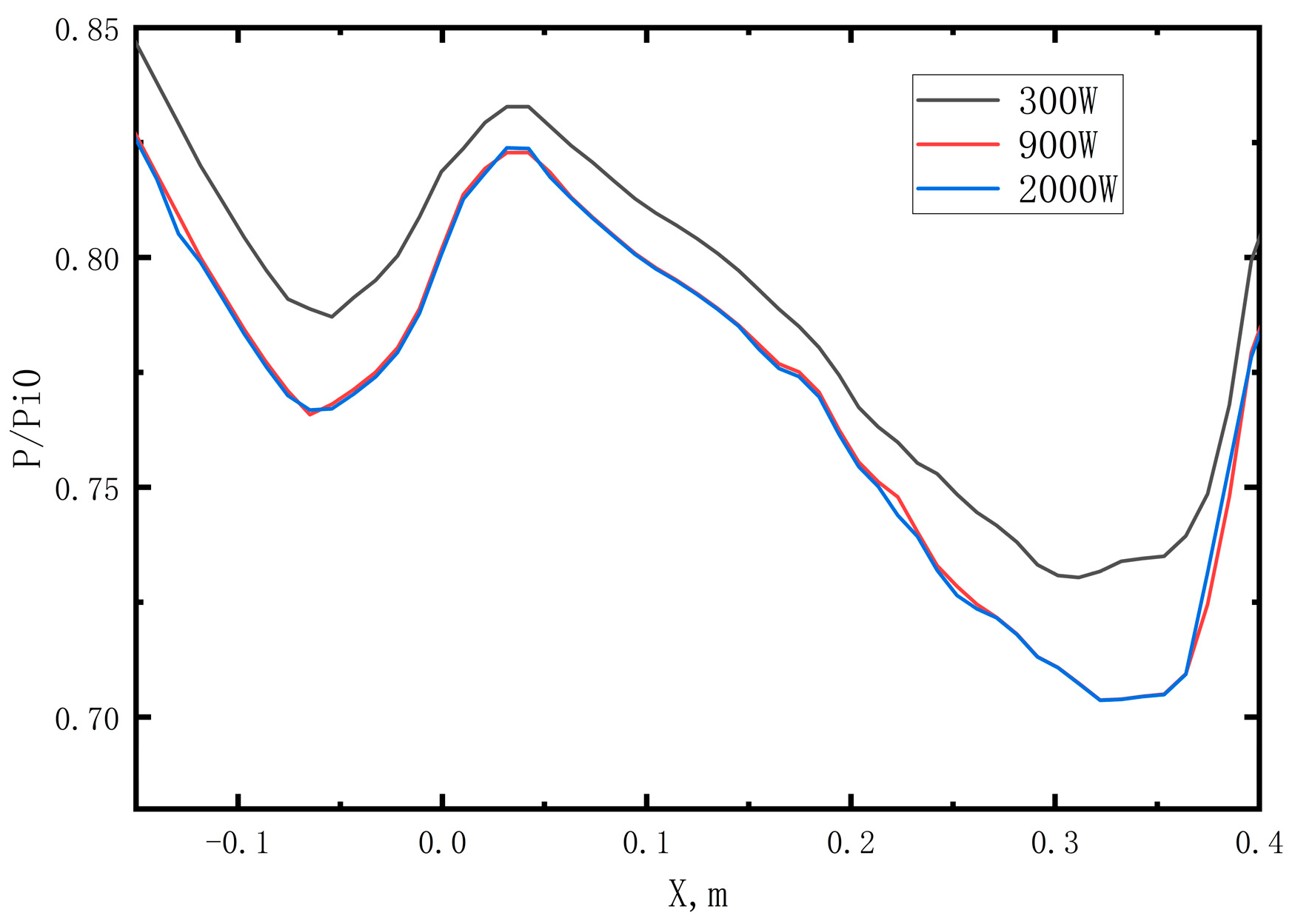

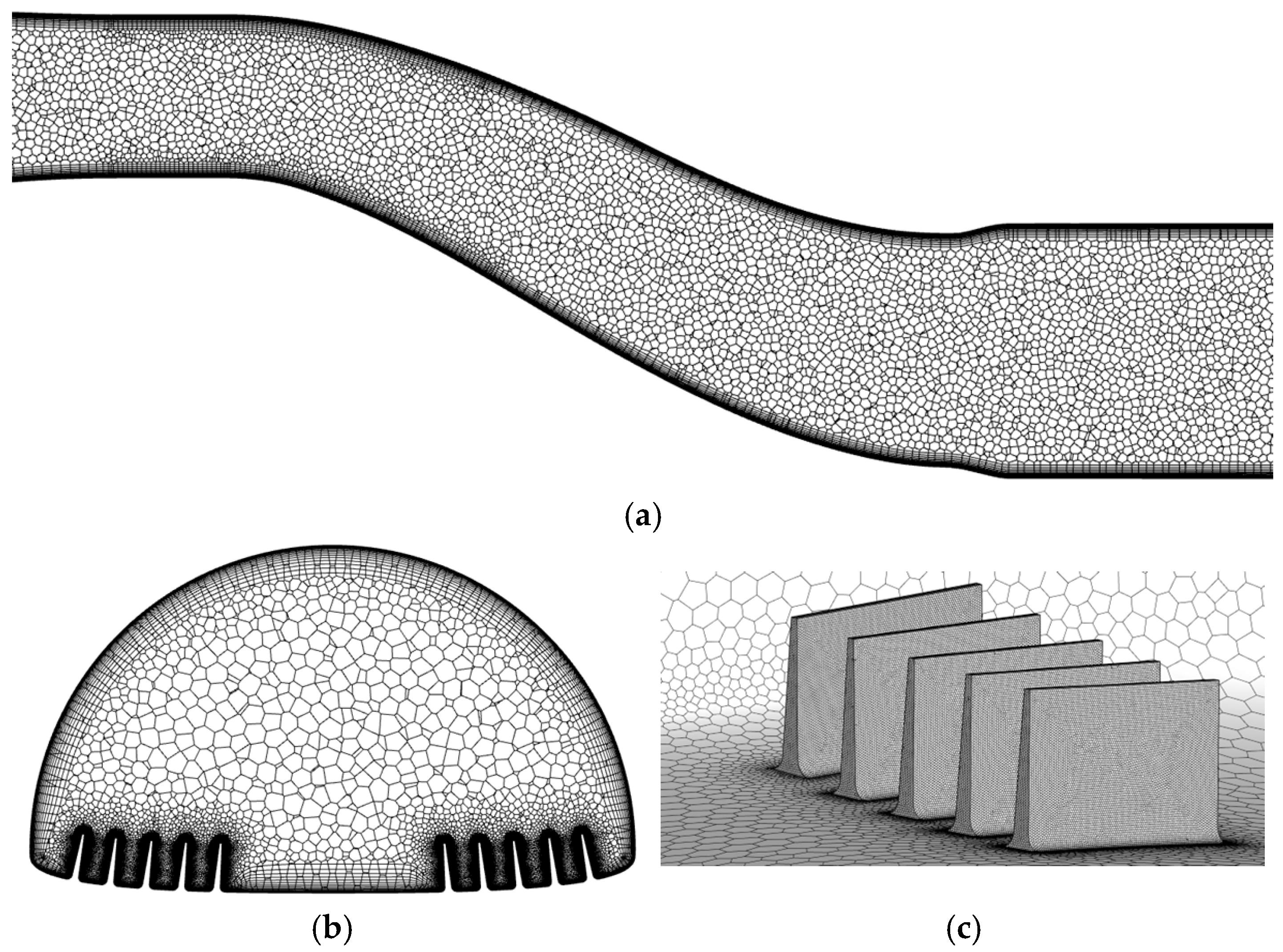


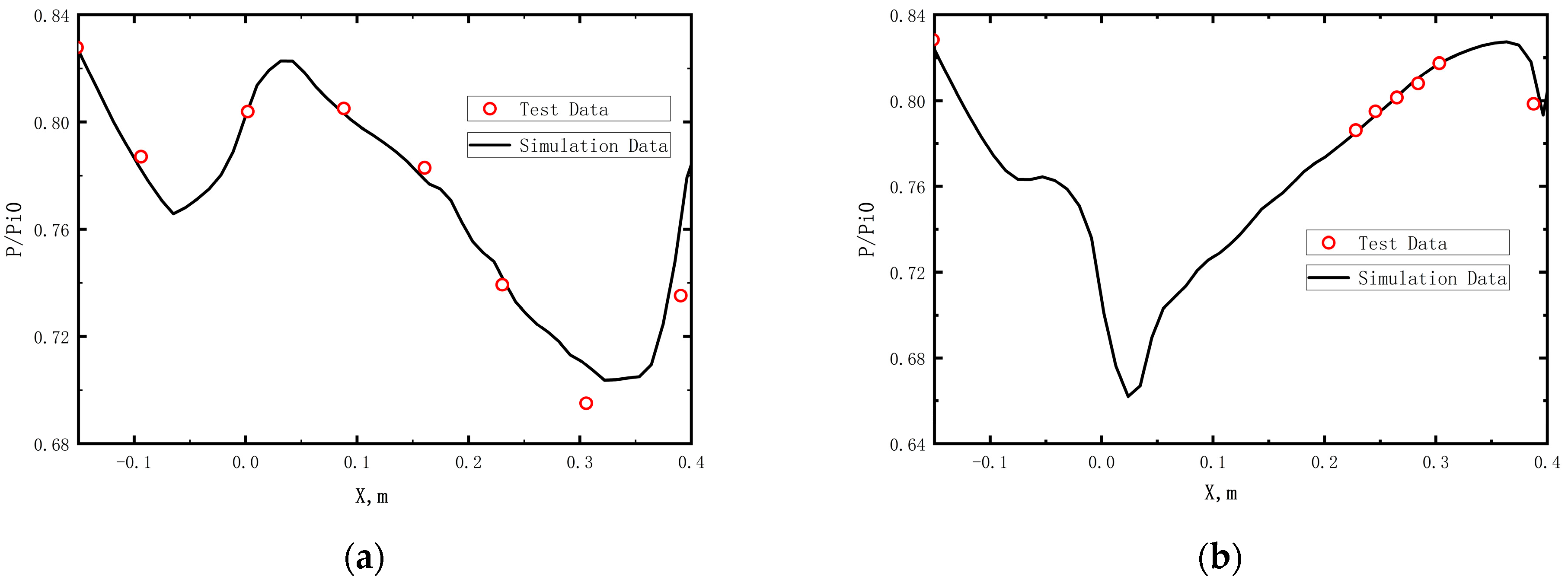

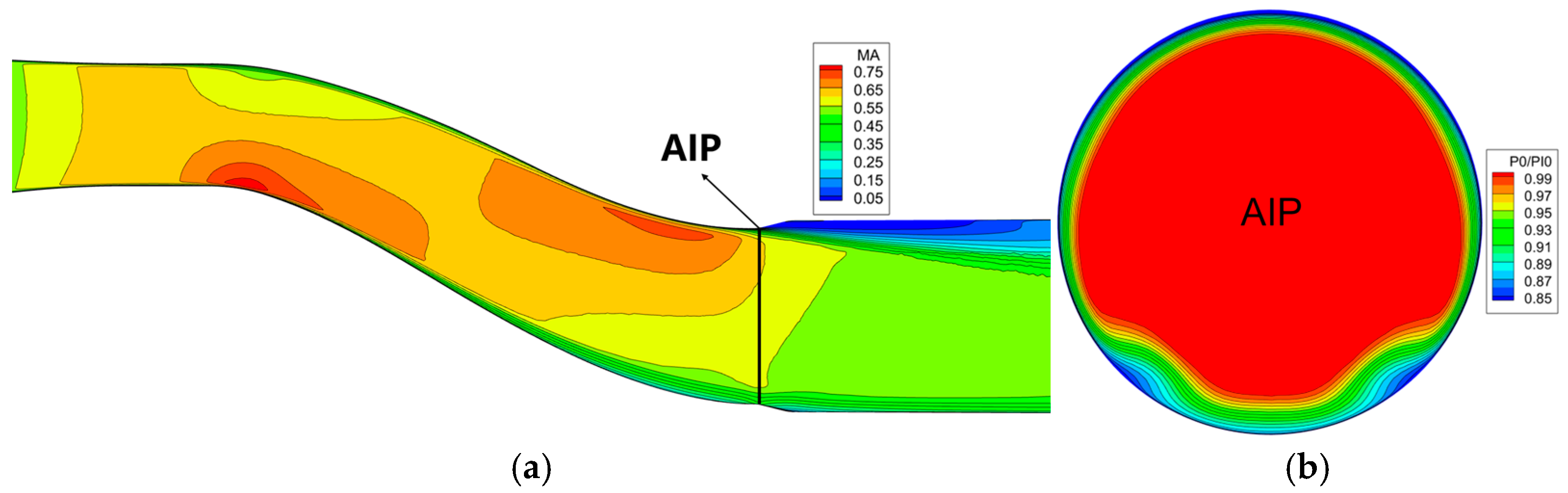


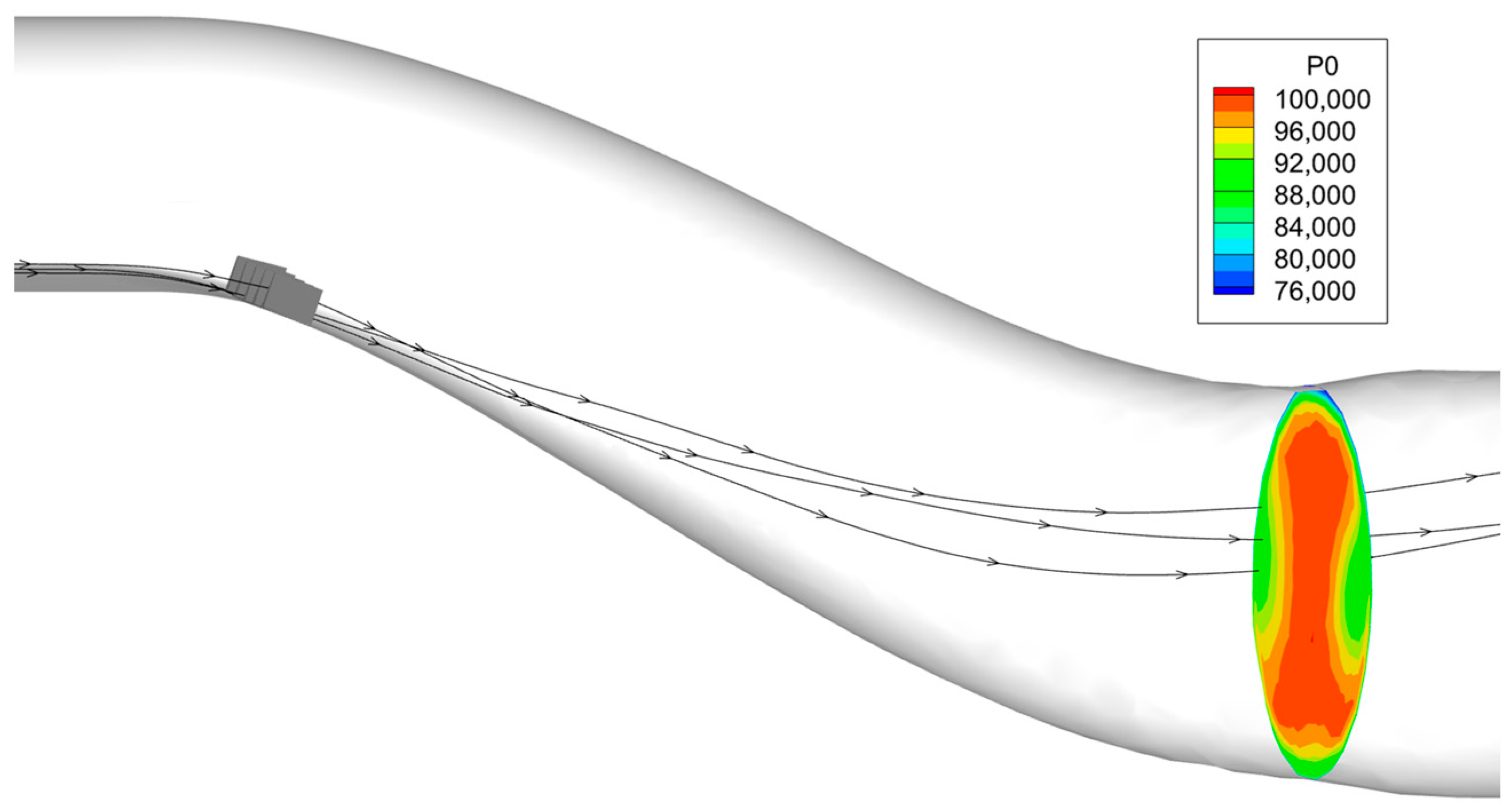

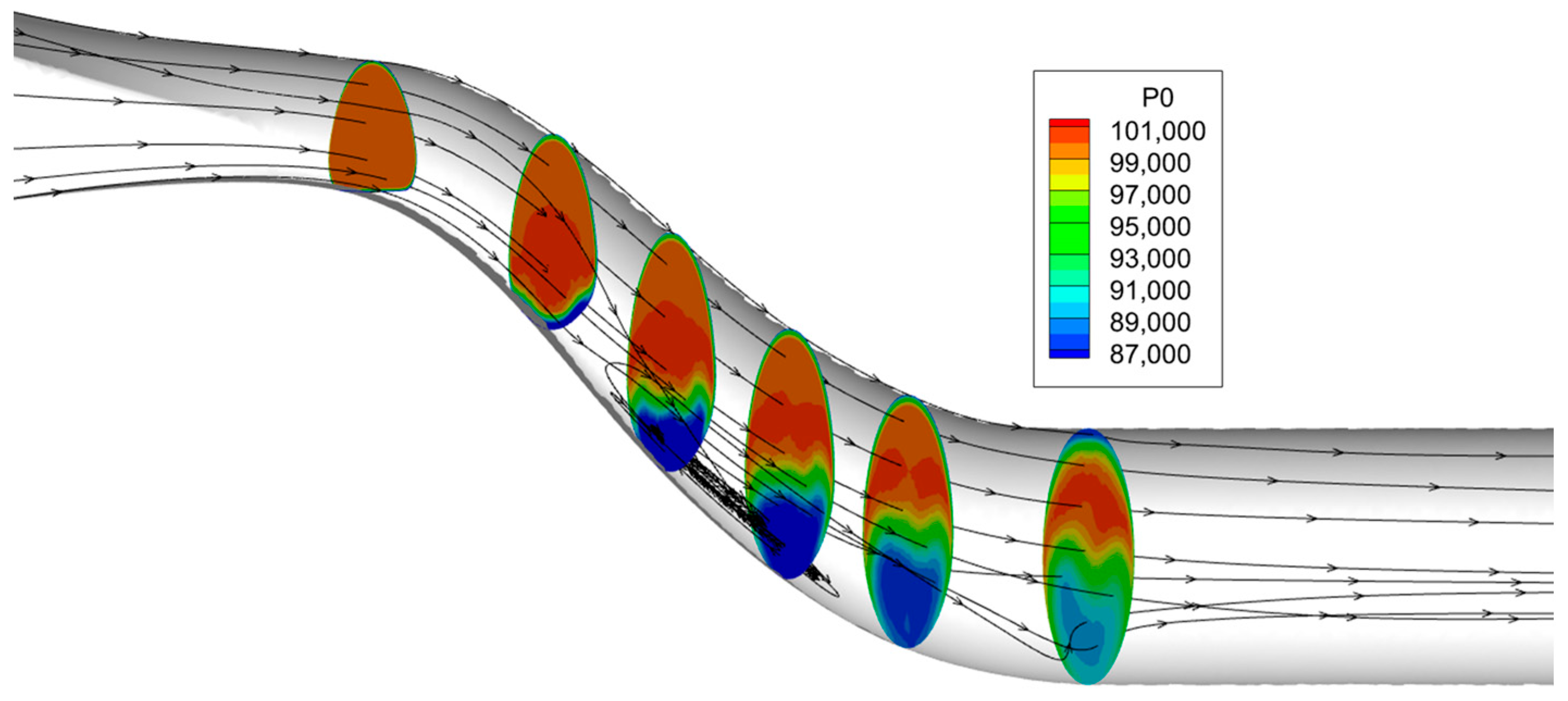


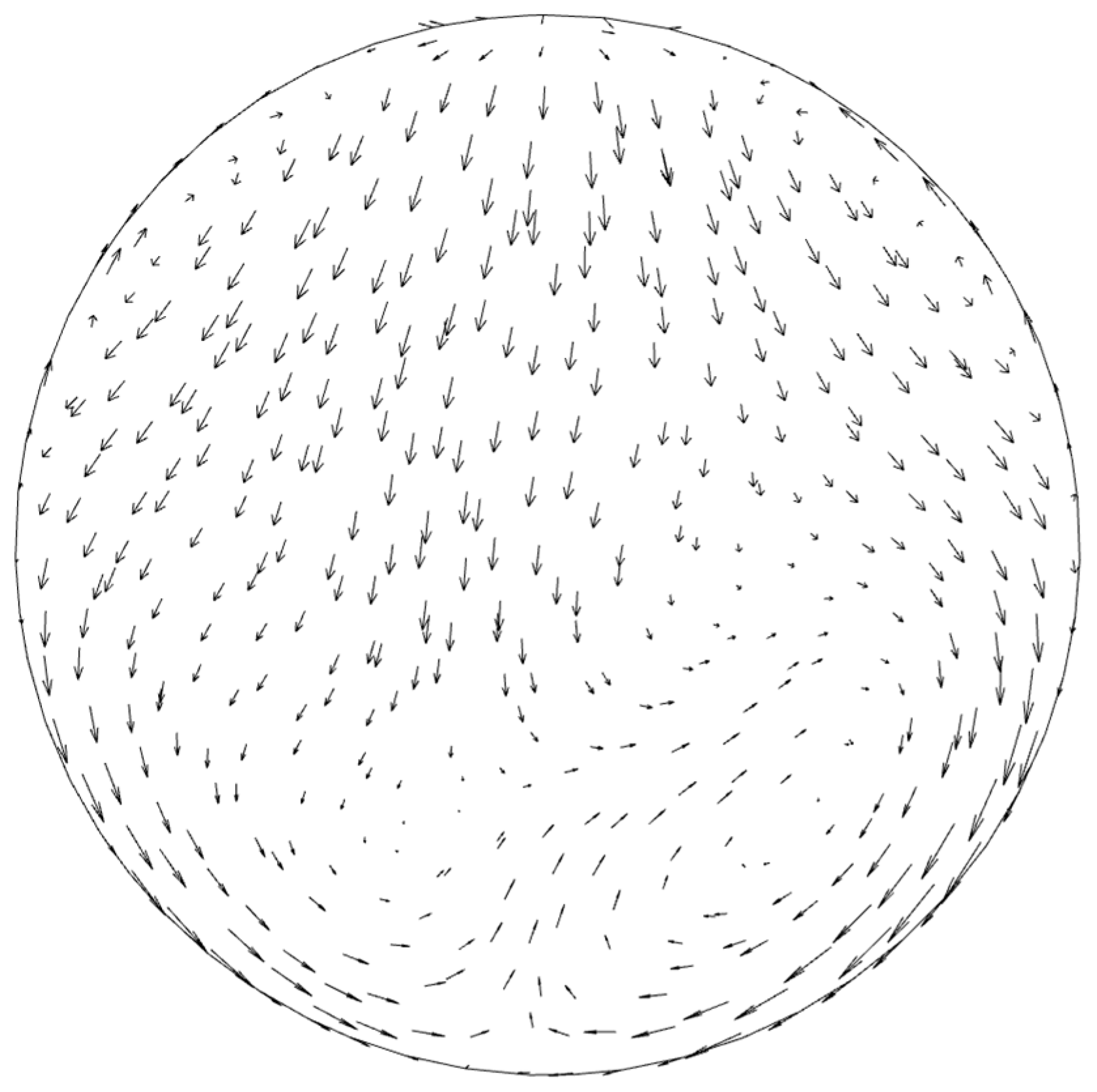


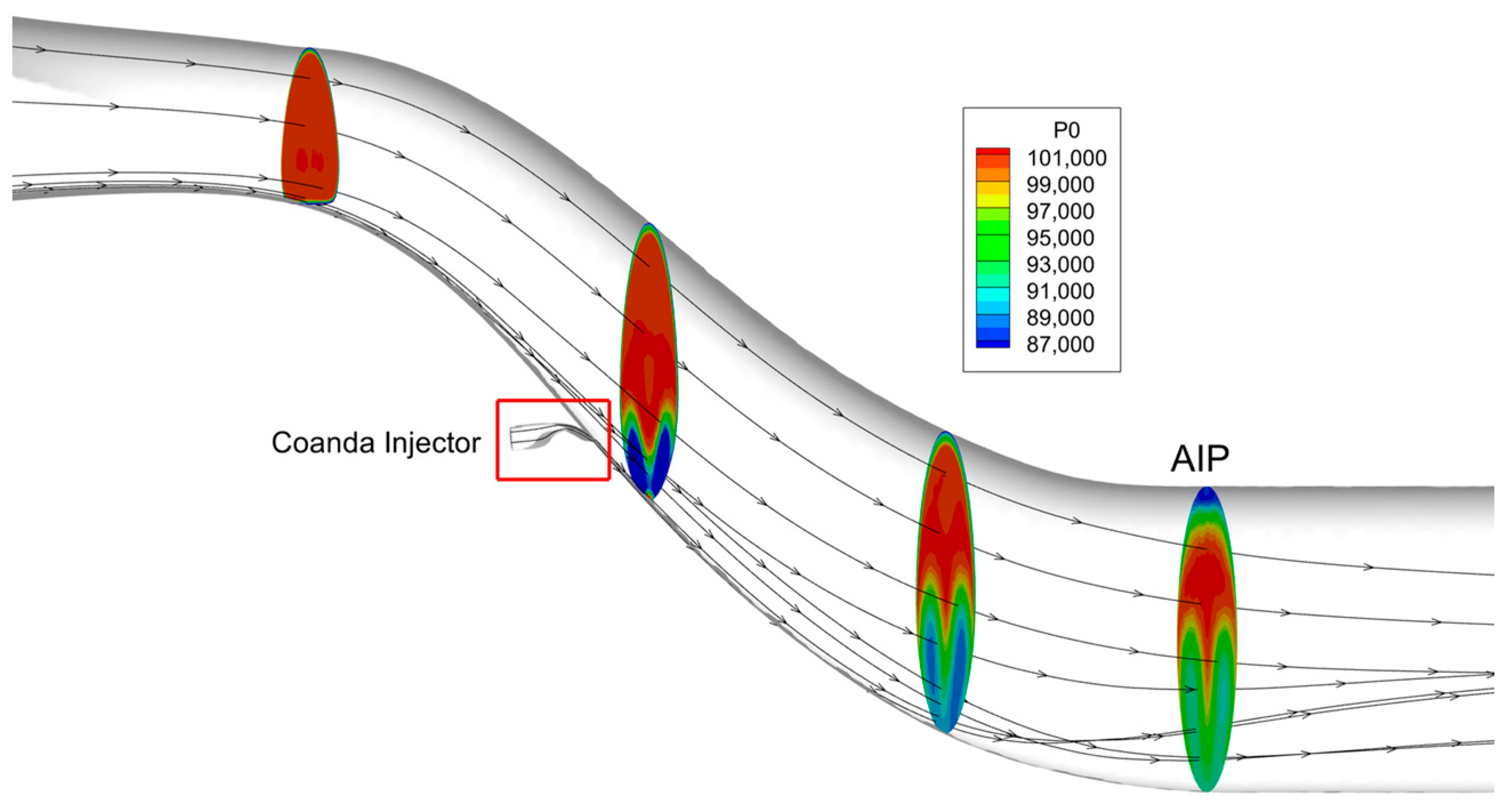


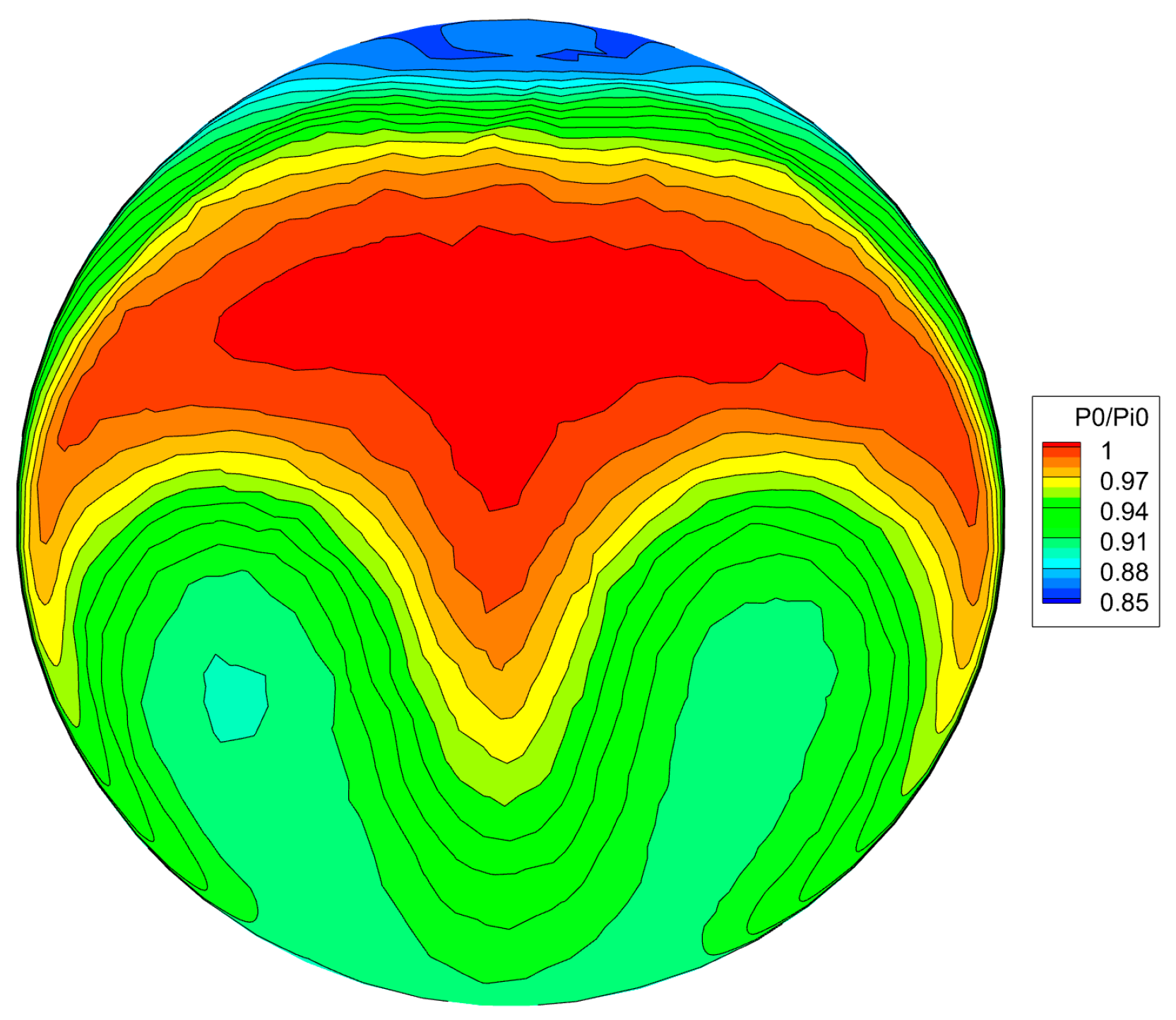


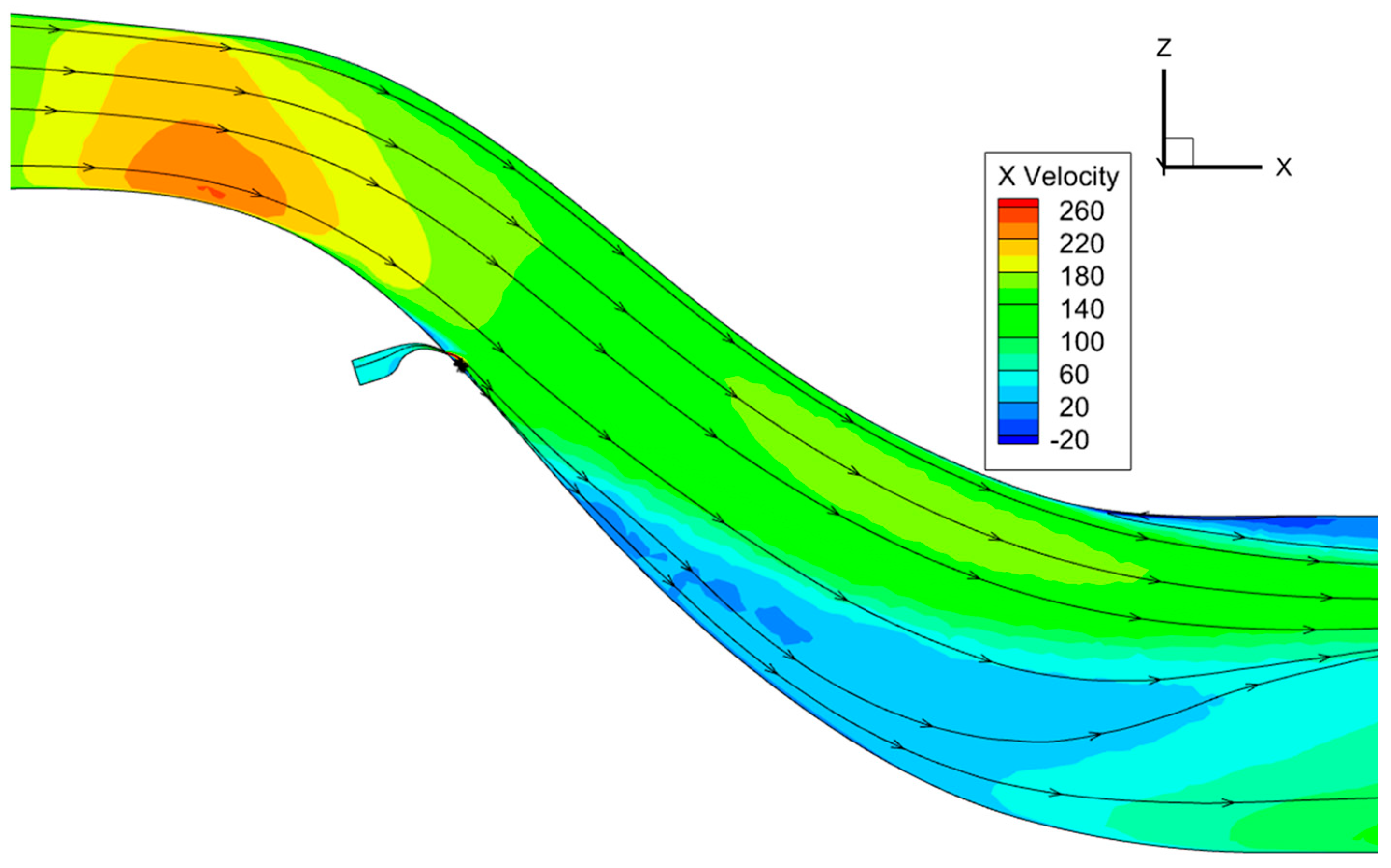



| Location | Inlet | |
|---|---|---|
| AIP | Smooth S-duct inlet | 0.9706 |
| S-duct inlet with VGs | 0.9654 | |
| Outlet | Smooth S-duct inlet | 0.9543 |
| S-duct inlet with VGs | 0.9507 |
| Condition | σ | DC |
|---|---|---|
| Baseline | 0.9405 | 0.1634 |
| VGs | 0.9439 | 0.1439 |
| Coanda | 0.9515 | 0.1530 |
| VGs and Coanda | 0.9465 | 0.1366 |
Disclaimer/Publisher’s Note: The statements, opinions and data contained in all publications are solely those of the individual author(s) and contributor(s) and not of MDPI and/or the editor(s). MDPI and/or the editor(s) disclaim responsibility for any injury to people or property resulting from any ideas, methods, instructions or products referred to in the content. |
© 2025 by the authors. Licensee MDPI, Basel, Switzerland. This article is an open access article distributed under the terms and conditions of the Creative Commons Attribution (CC BY) license (https://creativecommons.org/licenses/by/4.0/).
Share and Cite
Fu, Z.; Jin, Z.; Zhang, W.; Yang, T.; Li, J.; Shen, J. Numerical Investigation on Flow Separation Control for Aircraft Serpentine Intake with Coanda Injector. Fluids 2025, 10, 271. https://doi.org/10.3390/fluids10100271
Fu Z, Jin Z, Zhang W, Yang T, Li J, Shen J. Numerical Investigation on Flow Separation Control for Aircraft Serpentine Intake with Coanda Injector. Fluids. 2025; 10(10):271. https://doi.org/10.3390/fluids10100271
Chicago/Turabian StyleFu, Zhan, Zhixu Jin, Wenqiang Zhang, Tao Yang, Jichao Li, and Jun Shen. 2025. "Numerical Investigation on Flow Separation Control for Aircraft Serpentine Intake with Coanda Injector" Fluids 10, no. 10: 271. https://doi.org/10.3390/fluids10100271
APA StyleFu, Z., Jin, Z., Zhang, W., Yang, T., Li, J., & Shen, J. (2025). Numerical Investigation on Flow Separation Control for Aircraft Serpentine Intake with Coanda Injector. Fluids, 10(10), 271. https://doi.org/10.3390/fluids10100271