


Gummies: From Confectionery to Functional Hydrogel-Based Bioactive Delivery Systems
 ,
,  and
and
Abstract
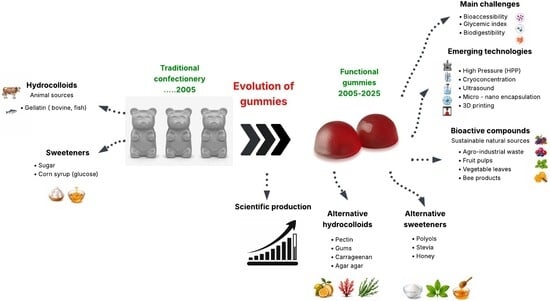
1. Introduction
2. Gummy Matrix: The Role of Hydrocolloids
2.1. Animal-Based Proteins
2.2. Plant-Based Polysaccharides
2.2.1. Pectin
2.2.2. Starch
2.2.3. Seaweed
2.2.4. Other Hydrocolloids
3. Sweetening Systems and Their Influence on Structural Stability
3.1. Conventional Sugars vs. Alternative Sweetening Systems
3.2. Molecular Interactions Governing the Stability of Gummy Hydrogel Systems
3.2.1. Molecular Interactions and Hydrogen Bonding
3.2.2. Role of Glucose Syrup and Dextrose Equivalent (DE)
3.2.3. Polyols and Water Binding
3.2.4. Molecular Instability During Storage: Phase Separation, Syneresis and Crystallization
3.2.5. Implications for Texture and Shelf Life
4. Sustainability and Incorporation of Bioactives into Gummies
5. Other Functional Additives in Gummies
6. Future Challenges
6.1. Sources
6.2. Sweetener Interchange
6.3. Emerging Technologies
6.4. Stability
6.5. Bioaccessibility
7. Conclusions
8. Materials and Methods
8.1. Review Design
8.2. Information Sources and Literature Search
8.3. Eligibility and Literature Selection
Author Contributions
Funding
Institutional Review Board Statement
Informed Consent Statement
Data Availability Statement
Acknowledgments
Conflicts of Interest
Abbreviations
| CBD | Cannabidiol |
| DE | Dextrose equivalent |
| TPA | Texture profile analysis |
| FTIR | Fourier-transform infrared spectroscopy |
| SEM | Scanning electron microscopy |
| AFM | Atomic force microscopy |
| DSC | Differential scanning calorimetry |
| ROS | Reactive oxygen species |
| DPPH | 2,2-diphenyl-1-picrylhydrazyl |
| FRAP | Ferric reducing antioxidant power |
| GAE | Gallic acid equivalents |
| TE | Trolox equivalents |
| FOS | Fructooligosaccharides |
| XOS | Xylooligosaccharides |
| PhG | Phenylethanoid glycoside |
| CMC | Carboxymethyl cellulose |
| ACE | Angiotensin-converting enzyme |
| HPLC-MS | High-performance liquid chromatography-mass spectrometry |
| RATA | Rate-All-That-Apply |
| CBJ | Cryoconcentrated blueberry juice |
| HPP | High pressure processing |
| PGP | Peach gum polysaccharide |
| LAOS | Large amplitude oscillatory shear |
References
- Delgado-Durán, R.; Antonio-Pérez, A.; Esperón-Carreón, J.; Méndez-Guerrero, O.E.; Saucedo, S.V.; Rivero-Aranda, R.E.; Torres-Huerta, A.L. Formulating chayote-enriched gummy candies: Balancing nutrition and taste for a delightful alternative. Food Chem. Adv. 2025, 6, 100902. [Google Scholar] [CrossRef] [Scilit]
- Gonzales-Quispe, I.; Salvador-Reyes, R.; Schmiele, M.; Paucar-Menacho, L.M. Unconventional ingredients in gummy reformulation: A review of nutritional, functional, and technological implications. Foods 2026, 15, 2615. [Google Scholar] [CrossRef] [Scilit]
- Nordin, N.A.; Nordin, M.H.A.; Misron, A.A.; Samsudin, Z.; Rashid, J.; Ramadhan, A.F. From treat to nutrition: A review of gummy candies as a healthy food alternative to develop micro-credential training for community-based entrepreneurship. Food Sci. Technol. 2025, 13, 226–241. [Google Scholar] [CrossRef] [Scilit]
- Renaldi, G.; Junsara, K.; Jannu, T.; Sirinupong, N.; Samakradhamrongthai, R.S. Physicochemical, textural, and sensory qualities of pectin/gelatin gummy jelly incorporated with Garcinia atroviridis and its consumer acceptability. Int. J. Gastron. Food Sci. 2022, 28, 100505. [Google Scholar] [CrossRef] [Scilit]
- Teixeira-Lemos, E.; Almeida, A.R.; Vouga, B.; Morais, C.; Correia, I.; Pereira, P.; Guiné, R.P. Development and characterization of healthy gummy jellies containing natural fruits. Open Agric. 2021, 6, 466–478. [Google Scholar] [CrossRef] [Scilit]
- Gunes, R.; Palabiyik, I.; Konar, N.; Toker, O.S. Soft confectionery products: Quality parameters, interactions with processing and ingredients. Food Chem. 2022, 385, 132735. [Google Scholar] [CrossRef] [Scilit]
- Arshad, Z.; Shahid, S.; Hasnain, A.; Yaseen, E.; Rahimi, M. Functional foods enriched with bioactive compounds: Therapeutic potential and technological innovations. Food Sci. Nutr. 2025, 13, e71024. [Google Scholar] [CrossRef] [Scilit]
- Alvarez-Leite, J.I. The role of bioactive compounds in human health and disease. Nutrients 2025, 17, 1170. [Google Scholar] [CrossRef] [Scilit]
- Ali, S.; Khalil, A.A.K.; Akhtar, M.S.; Amin, A.; Zaman, W. Comprehensive insights into natural bioactive compounds: From chemical diversity and mechanisms to biotechnological innovations and applications. ChemistryOpen 2026, 15, e202500469. [Google Scholar] [CrossRef] [Scilit]
- Skenderidou, I.; Leontopoulos, S.; Skenderidis, P. Functional food ingredients enhancing immune health: A systematic review. Int. J. Mol. Sci. 2025, 26, 8408. [Google Scholar] [CrossRef] [Scilit]
- Čižauskaitė, U.; Jakubaitytė, G.; Žitkevičius, V.; Kasparavičienė, G. Natural ingredients-based gummy bear composition designed according to texture analysis and sensory evaluation in vivo. Molecules 2019, 24, 1442. [Google Scholar] [CrossRef] [Scilit]
- Roudbari, M.; Barzegar, M.; Sahari, M.A.; Gavlighi, H.A. Formulation of functional gummy candies containing natural antioxidants and stevia. Heliyon 2024, 10, e31581. [Google Scholar] [CrossRef] [Scilit]
- Tiwari, D.; Rastogi, M. Gummy jellies: Properties and advancements. Int. J. Plant Biotechnol. 2024, 12, 21–34. [Google Scholar]
- Tarahi, M.; Mohamadzade Fakhr-davood, M.; Ghaedrahmati, S.; Roshanak, S.; Shahidi, F. Physicochemical and sensory properties of vegan gummy candies enriched with high-fiber jaban watermelon exocarp powder. Foods 2023, 12, 1478. [Google Scholar] [CrossRef] [Scilit]
- Asan, Ş.; Özakar, E.; Sevinç-Özakar, R. Gummies and gel tablets: New approaches to oral drug delivery. J. Res. Pharm. 2025, 29, 1301–1317. [Google Scholar] [CrossRef] [Scilit]
- Latrofa, V.; De Angelis, D.; Squeo, G.; Caponio, F.; Pasqualone, A.; Summo, C. Rheology and structure of gelatin-free jelly candies prepared with dry-fractionated pea and corn starches. Food Hydrocoll. 2025, 170, 111757. [Google Scholar] [CrossRef] [Scilit]
- López-Palestina, C.U.; García-García, Á.; Altamirano Romo, S.E.; Gutiérrez-Tlahque, J. Sucrose reduction and addition of agave syrup and inulin in gummies with strawberry and blackberry pulp: Impact on physicochemical, antioxidant, and sensory characteristics. Int. Food Res. J. 2023, 30, 1562–1571. [Google Scholar] [CrossRef] [Scilit]
- Mohammadi, N.; Ostovar, N. From sea to sweet: Seaweed’s role in nutritious and sustainable confectionery. Compr. Rev. Food Sci. Food Saf. 2026, 25, e70361. [Google Scholar] [CrossRef] [Scilit]
- Talar-Śpionek, A.; Juszczuk-Kubiak, E.; Roszko, M. Cannabidiol in dietary supplements: Characteristics, routes of administration, bioavailability, and research challenges. Molecules 2026, 31, 2385. [Google Scholar] [CrossRef] [Scilit]
- Khubber, S.; Gharibzahedi, S.M.T.; Gupta, S. Gum arabic-protein coacervation: Recent advances for improved functionality and food applications. Adv. Colloid Interface Sci. 2025, 342, 103522. [Google Scholar] [CrossRef] [Scilit]
- Tama, A.; Karaś, M. The health-promoting potential of fruit pomace and its application in the confectionery industry. Appl. Sci. 2025, 15, 5790. [Google Scholar] [CrossRef] [Scilit]
- Vičič, V.; Pandel Mikuš, R.; Ferjančič, B. Review of history and mechanisms of action of lactulose (4-O-β-D-galactopyranosyl-β-D-fructofuranose): Present and future applications in food. J. Food Sci. Technol. 2024, 61, 2036–2045. [Google Scholar] [CrossRef] [Scilit]
- Espinoza-Espinoza, L.A.; Muñoz-More, H.D.; Nole-Jaramillo, J.M.; Ruiz-Flores, L.A.; Arana-Torres, N.M.; Moreno-Quispe, L.A.; Valdiviezo-Marcelo, J. Microencapsulation of vitamins: A review and meta-analysis of coating materials, release and food fortification. Food Res. Int. 2024, 187, 114420. [Google Scholar] [CrossRef] [Scilit]
- Gawande, S.; Ghadge, A.; Palshikar, G. A comprehensive review on medicinal gummies for gastrointestinal relief. Int. J. Pharmacogn. Pharm. Res. 2025, 7, 94–98. [Google Scholar] [CrossRef] [Scilit]
- Dalabasmaz, S.; Melayim, M.E.; Konar, N. Effects of gelatin concentration, adding temperature and mixing rate on texture and quality characteristics of model gels. J. Texture Stud. 2024, 55, e12800. [Google Scholar] [CrossRef] [Scilit]
- Ranalli, N.; Adornato, L.; Califano, A.N.; Andrés, S.C. Impact of processing conditions and gelling agent on physical and sensorial properties of pecan oil-dulce de leche gummy candies. Braz. J. Food Technol. 2020, 23, e2019177. [Google Scholar] [CrossRef] [Scilit]
- Alipal, J.; Mohd Pu’Ad, N.A.S.; Lee, T.C.; Nayan, N.H.M.; Sahari, N.; Basri, H.; Idris, M.I.; Abdullah, H.Z. A review of gelatin: Properties, sources, process, applications, and commercialisation. Mater. Today Proc. 2021, 42, 240–250. [Google Scholar] [CrossRef] [Scilit]
- Mushtaq, F.; Raza, Z.A.; Batool, S.R.; Zahid, M.; Onder, O.C.; Rafique, A.; Nazeer, M.A. Preparation, properties, and applications of gelatin-based hydrogels (GHs) in the environmental, technological, and biomedical sectors. Int. J. Biol. Macromol. 2022, 218, 601–633. [Google Scholar] [CrossRef] [Scilit]
- Michelini, L.; Probo, L.; Farè, S.; Negrini, N.C. Characterization of gelatin hydrogels derived from different animal sources. Mater. Lett. 2020, 272, 127865. [Google Scholar] [CrossRef] [Scilit]
- Noor, N.Q.I.M.; Razali, R.S.; Ismail, N.K.; Ramli, R.A.; Razali, U.H.M.; Bahauddin, A.R.; Zaharudin, N.; Rozzamri, A.; Bakar, J.; Shaarani, S.M. Application of green technology in gelatin extraction: A review. Processes 2021, 9, 2227. [Google Scholar] [CrossRef] [Scilit]
- Xu, X.; Xi, Y.; Weng, Y. Gelatin-based materials: Fabrication, properties and applications in the food packaging system. RSC Adv. 2025, 15, 30605–30621. [Google Scholar] [CrossRef] [Scilit]
- Tang, C.; Cai, K.; Liu, X.; Li, M.; Bao, Z.; Cai, H.; Chu, J.; Xie, Y.; Zhou, H.; Xu, B. Development of functionalized gelatin: Recent advances, challenges and prospects. Food Hydrocoll. 2026, 178, 112593. [Google Scholar] [CrossRef] [Scilit]
- Atik, D.S.; Demirci, M.; Toker, Ö.S.; Palabiyik, I. Development of a novel rheological method for determining melting properties of gelatin-based gummies. Int. J. Biol. Macromol. 2022, 209, 385–395. [Google Scholar] [CrossRef] [Scilit]
- Derkach, S.R.; Voron’ko, N.G.; Kuchina, Y.A.; Kolotova, D.S.; Grokhovsky, V.A.; Nikiforova, A.A.; Sedov, I.A.; Faizullin, D.A.; Zuev, Y.F. Rheological properties of fish and mammalian gelatin hydrogels as bases for potential practical formulations. Gels 2024, 10, 486. [Google Scholar] [CrossRef] [Scilit]
- Ata, O.; Yazar, G.; Tavman, S.; Kokini, J.L. Linear and nonlinear rheological properties of gelatin-chitosan hydrogels: Evaluation of crosslinker concentration and temperature effects. Food Hydrocoll. 2025, 163, 111130. [Google Scholar] [CrossRef] [Scilit]
- Wang, C.; Su, K.; Sun, W.; Huang, T.; Lou, Q.; Zhan, S. Comparative investigations of various modification methods on the gelling, rheological properties and mechanism of fish gelatin. Food Chem. 2023, 426, 136632. [Google Scholar] [CrossRef] [Scilit]
- Bulca, E.N.; Akdeniz, E.; Mutlu, Z.; Tireki, S.; Karimidastjerd, A.; Toker, O.S. Influence of various corn syrup types on the quality and sensory properties of gelatin-based jelly confectionery. J. Food Meas. Charact. 2024, 18, 8408–8422. [Google Scholar] [CrossRef] [Scilit]
- Said, N.S.; Olawuyi, I.F.; Lee, W.Y. Pectin hydrogels: Gel-forming behaviors, mechanisms, and food applications. Gels 2023, 9, 732. [Google Scholar] [CrossRef] [Scilit]
- Dumitrescu, I.A.; Dinu-Pîrvu, C.E.; Ghica, M.V.; Anuța, V.; Prisada, R.M.; Popa, L. Pectin as a versatile biomaterial: Structure, green sourcing, and emerging applications in pharmaceutics and biomedicine. Int. J. Mol. Sci. 2026, 27, 3518. [Google Scholar] [CrossRef] [Scilit]
- Anandha-Keerthy, M.; Dhanaselvam, K.R.; Santhoshkumar, P.; Ravikrishnan, V.; Moses, J.A. Improving the printability of watermelon rind using pectin: 3d printing optimization for the development of gummies. Food Biomacromol. 2025, 2, 143–156. [Google Scholar] [CrossRef] [Scilit]
- Hani, N.M.; Romli, S.R.; Ahmad, M. Influences of red pitaya fruit puree and gelling agents on the physico-mechanical properties and quality changes of gummy confections. Int. J. Food Sci. Technol. 2015, 50, 331–339. [Google Scholar] [CrossRef] [Scilit]
- Gawkowska, D.; Cybulska, J.; Zdunek, A. Structure-related gelling of pectins and linking with other natural compounds: A review. Polymers 2018, 10, 762. [Google Scholar] [CrossRef] [Scilit]
- Tarahi, M.; Tahmouzi, S.; Kianiani, M.R.; Ezzati, S.; Hedayati, S.; Niakousari, M. Current innovations in the development of functional gummy candies. Foods 2023, 13, 76. [Google Scholar] [CrossRef] [Scilit]
- Kurniawan, M.F.; Hapsari, D.R.; Nurlaela, R.S.; Citra, N. Pectin extraction from Ambon banana (Musa paradisiaca Var. sapientum) peel and its application for gummy jelly. Indones. J. Appl. Res. 2023, 4, 75–83. [Google Scholar] [CrossRef] [Scilit]
- Soedirga, L.C.; Marchellin, M. Physicochemical properties of jelly candy made with pectin from red dragon fruit peel in combination with carrageenan. Caraka Tani J. Sustain. Agric. 2021, 37, 1–14. [Google Scholar] [CrossRef] [Scilit]
- Salarbashi, D.; Bazeli, J.; Tafaghodi, M. Environment-friendly green composites based on soluble soybean polysaccharide: A review. Int. J. Biol. Macromol. 2019, 122, 216–223. [Google Scholar] [CrossRef] [Scilit]
- Jia, X.; Chen, M.; Wan, J.B.; Su, H.; He, C. Review on the extraction, characterization and application of soybean polysaccharide. RSC Adv. 2015, 5, 73525–73534. [Google Scholar] [CrossRef] [Scilit]
- Liu, D.; Li, Z.; Fan, Z.; Zhang, X.; Zhong, G. Effect of soybean soluble polysaccharide on the pasting, gels, and rheological properties of kudzu and lotus starches. Food Hydrocoll. 2019, 89, 443–452. [Google Scholar] [CrossRef] [Scilit]
- Shimada, R.; Sasaki, K.; Kuwano, T.; Eguchi, S.; Nakatani, M.; Yuasa, M.; Yoshimura, M. Physical properties, palatability, and mastication of breads with different compositions of soy protein isolate and soybean soluble polysaccharide. Int. J. Gastron. Food Sci. 2024, 37, 100961. [Google Scholar] [CrossRef] [Scilit]
- Wang, F.; Sukmanov, V.; Zeng, J.; Jiang, J. Improving the quality of soybean by-products by physical methods during its use in bakery technology. Rev. Ukr. Food J. 2020, 9, 513. [Google Scholar] [CrossRef] [Scilit]
- Zhang, J.; Liu, Z.; Sun, J.; Yao, Z.; Lu, H. The formation and performance tuning mechanism of starch-based hydrogels. Carbohydr. Polym. 2025, 350, 123048. [Google Scholar] [CrossRef] [Scilit]
- Cheng, H.; Chen, L.; McClements, D.J.; Yang, T.; Zhang, Z.; Ren, F.; Ming, M.; Tian, Y.; Jin, Z. Starch-based biodegradable packaging materials: A review of their preparation, characterization and diverse applications in the food industry. Trends Food Sci. Technol. 2021, 114, 70–82. [Google Scholar] [CrossRef] [Scilit]
- Bertoft, E. Understanding starch structure: Recent progress. Agronomy 2017, 7, 56. [Google Scholar] [CrossRef] [Scilit]
- Qamruzzaman, M.; Ahmed, F.; Mondal, M.I.H. An overview on starch-based sustainable hydrogels: Potential applications and aspects. J. Polym. Environ. 2022, 30, 19–50. [Google Scholar] [CrossRef] [Scilit]
- Tarahi, M.; Shahidi, F.; Hedayati, S. Physicochemical, pasting, and thermal properties of native corn starch–mung bean protein isolate composites. Gels 2022, 8, 693. [Google Scholar] [CrossRef] [Scilit]
- Pereira, D.G.; de Toledo Benassi, M.; Beleia, A.D.P. Gummy candies produced with acid-thinned cassava starch: Physical and sensory evaluation. J. Food Process. Preserv. 2022, 46, e16661. [Google Scholar] [CrossRef] [Scilit]
- Neder-Suárez, D.; Amaya-Guerra, C.A.; Quintero-Ramos, A.; Pérez-Carrillo, E.; Alanís-Guzmán, M.G.D.J.; Báez-González, J.G.; García-Díaz, C.L.; Núñez-González, M.A.; Lardizábal-Gutiérrez, D.; Jiménez-Castro, J.A. Physicochemical changes and resistant-starch content of extruded cornstarch with and without storage at refrigerator temperatures. Molecules 2016, 21, 1064. [Google Scholar] [CrossRef] [Scilit]
- Rubio, F.T.V.; Maniglia, B.C.; Maciel, M.H.; Romano, R.C.O.; Pileggi, R.G.; Tadini, C.C. Development and characterization of 3D-printable gummies and chewable gels as food models for versatile applications. Food Bioprocess Technol. 2026, 19, 188. [Google Scholar] [CrossRef] [Scilit]
- Pradhan, B.; Bhuyan, P.P.; Patra, S.; Nayak, R.; Behera, P.K.; Behera, C.; Behera, A.K.; Ki, J.-S.; Jena, M. Beneficial effects of seaweeds and seaweed-derived bioactive compounds: Current evidence and future prospective. Biocatal. Agric. Biotechnol. 2022, 39, 102242. [Google Scholar] [CrossRef] [Scilit]
- Cebrian-Lloret, V.; Martinez-Abad, A.; López-Rubio, A.; Martinez-Sanz, M. Exploring alternative red seaweed species for the production of agar-based hydrogels for food applications. Food Hydrocoll. 2024, 146, 109177. [Google Scholar] [CrossRef] [Scilit]
- Kapoor, D.U.; Pareek, A.; Sharma, S.; Prajapati, B.G.; Thanawuth, K.; Sriamornsak, P. Alginate gels: Chemistry, gelation mechanisms, and therapeutic applications with a focus on GERD treatment. Int. J. Pharm. 2025, 675, 125570. [Google Scholar] [CrossRef] [Scilit]
- Kumar, S.; Bhatt, A.; Purohit, P. Carrageenan modifications: Improving biomedical applications. J. Polym. Environ. 2025, 33, 1667–1688. [Google Scholar] [CrossRef] [Scilit]
- Ali, M.Q.; Azhar, M.A.; Munaim, M.S.A.; Ruslan, N.F.; Ahmad, N.; Noman, A.E. Recent advances in edible seaweeds: Ingredients of functional food products, potential applications, and food safety challenges. Food Bioprocess Technol. 2025, 18, 4947–4974. [Google Scholar] [CrossRef] [Scilit]
- Ali, M.Q.; Azhar, M.A.; Munaim, M.S.A.; Ruslan, N.F.; Alsubhi, L.M.; Ahmad, N.; Noman, A.E. Seaweed organic compounds source of hydrocolloids and sustainable food packaging: Properties, application, and future direction. Discov. Food 2024, 4, 101. [Google Scholar] [CrossRef] [Scilit]
- Ozcan, B.E. Plant-based marine polysaccharides in food applications. In Multifunctional Marine Polysaccharides: Drug Delivery, Biomedicine and Food Technology Applications, 1st ed.; Jana, S., Jana, S., Kennedy, J.F., Eds.; Springer Nature: Singapore, 2026; pp. 503–523. [Google Scholar]
- Rhein-Knudsen, N.; Meyer, A.S. Chemistry, gelation, and enzymatic modification of seaweed food hydrocolloids. Trends Food Sci. Technol. 2021, 109, 608–621. [Google Scholar] [CrossRef] [Scilit]
- Vieira, E.F.; Gomes, L.R.; Grosso, C.; Delerue-Matos, C. Recent advances on seaweed-derived pigments for food application and current legal framework. Foods 2025, 14, 3265. [Google Scholar] [CrossRef] [Scilit]
- Cotas, J.; Leandro, A.; Monteiro, P.; Pacheco, D.; Figueirinha, A.; Gonçalves, A.M.; da Silva, G.J.; Pereira, L. Seaweed phenolics: From extraction to applications. Mar. Drugs 2020, 18, 384. [Google Scholar] [CrossRef] [Scilit]
- Sharma, A.; Dubey, S.; Singh, K.; Mittal, R.; Quille, P.; Rajauria, G. Innovative processing and industrial applications of seaweed. Phycology 2025, 5, 10. [Google Scholar] [CrossRef] [Scilit]
- Pereira, L.; Valado, A. Marine algae hydrogels as emerging biomaterials for medicine. Gels 2026, 12, 228. [Google Scholar] [CrossRef] [Scilit]
- Sigamani, S.; Venkatachalam, S.K.; Digala, P.; Santhoshkumar, M.; Dharmaraj, S.; Duraisamy, N.; Abdi, G. Seaweed-derived polysaccharides: Multifunctional biomaterials for gut health and wound healing applications. J. Funct. Foods 2025, 134, 107045. [Google Scholar] [CrossRef] [Scilit]
- Prova, O.S.; Afrin, S.; Tabish, T.; Rizwan, M. Fucoidan based hydrogel biomaterials for tissue engineering. Biomater. Sci. 2025, 13, 6572–6597. [Google Scholar] [CrossRef] [Scilit]
- Afrin, S.; Prova, O.S.; Qureshi, A.T.; Ishaq, M.W.; Callmann, C.E.; Rizwan, M. Injectable and self-healing fucoidan hydrogel: A natural anti-inflammatory biomaterial. Biomaterials 2025, 326, 123649. [Google Scholar] [CrossRef] [Scilit]
- Wang, N.; Tian, J.; Wang, L.; Song, S.; Ai, C.; Janaswamy, S.; Wen, C. Fucoidan hydrogels induced by κ-carrageenan: Rheological, thermal and structural characterization. Int. J. Biol. Macromol. 2021, 191, 514–520. [Google Scholar] [CrossRef] [Scilit]
- Dash, M.; Samal, S.K.; Bartoli, C.; Morelli, A.; Smet, P.F.; Dubruel, P.; Chiellini, F. Biofunctionalization of ulvan scaffolds for bone tissue engineering. ACS Appl. Mater. Interfaces 2014, 6, 3211–3218. [Google Scholar] [CrossRef] [Scilit]
- Mariia, K.; Arif, M.; Shi, J.; Song, F.; Chi, Z.; Liu, C. Novel chitosan-ulvan hydrogel reinforcement by cellulose nanocrystals with epidermal growth factor for enhanced wound healing: In vitro and in vivo analysis. Int. J. Biol. Macromol. 2021, 183, 435–446. [Google Scholar] [CrossRef] [Scilit]
- Hwang, P.A.; Huang, P.S.; Hsu, F.Y. Development and biocompatibility assessment of alginate–ulvan hydrogels for potential medical use. Carbohydr. Polym. Technol. Appl. 2025, 11, 100963. [Google Scholar] [CrossRef] [Scilit]
- Jalali-Jivan, M.; Nejatian, M.; Capanoglu, E.; Fathi, M.; Tomas, M.; Gunal-Koroglu, D.; Rashidinejad, A. Gum arabic as a functional biopolymer: From fundamental properties to emerging encapsulation of nutraceuticals and bioactive compounds. Carbohydr. Polym. Technol. Appl. 2026, 14, 101129. [Google Scholar] [CrossRef] [Scilit]
- Al-Hamayda, A.; Abu-Jdayil, B.; Ayyash, M.; Tannous, J. Advances in microencapsulation techniques using arabic gum: A comprehensive review. Ind. Crops Prod. 2023, 205, 117556. [Google Scholar] [CrossRef] [Scilit]
- Ahmed, A.H.; Riaz, T.; Akram, M.; Ghaffar, I.; Iftikhar, M.; Laila, U.; Zainab, R.; Ozdemir, F.A.; Sołowski, G.; Alinia-Ahandani, E.; et al. A review on ethnobotanical, pharmacological, and conventional uses of gum arabic. Int. Arch. Integr. Med. 2024, 11, 23–30. [Google Scholar] [CrossRef]
- Sundharaiya, K.; Kabilan, M.; Karuthamani, M.; Sathish, G.; Santha, S.; Muthuramalingam, S.; Jayakumar, M. Guar gum: A comprehensive review of its potential applications in pharmaceuticals, biomedicine, and the food industry. Ann. Phytomed. 2025, 14, 187–198. [Google Scholar] [CrossRef] [Scilit]
- Rawat, S.; Rai, S.; Sangeeta, S.; Ramachandran, P.; Kumar, A.; Sharma, S.K.; Shukla, A.D. Textural characterization of agar–agar and guar gum-based hydrocolloids in vegan gummies: Effects of acid and sugar. Food Biomacromol. 2026, 3, 37–46. [Google Scholar] [CrossRef] [Scilit]
- Başyiğit, B.; Altun, G.; Yücetepe, M.; Karaaslan, A.; Karaaslan, M. Locust bean gum provides excellent mechanical and release attributes to soy protein-based natural hydrogels. Int. J. Biol. Macromol. 2023, 231, 123352. [Google Scholar] [CrossRef] [Scilit]
- Wu, F.F.; Tu, Z.C.; Cheng, J.; Wang, H.; Hu, Z.Z.; Sha, X.M. Locust bean gum improved the gelling properties of fish gelatin in acidic environments and its application in acid gel gummies. npj Sci. Food 2025, 9, 179. [Google Scholar] [CrossRef] [Scilit]
- Ghiraldi, M.; Franco, B.G.; Moraes, I.C.F.; Pinho, S.C. Emulsion-filled pectin gels for vehiculation of vitamins D3 and B12: From structuring to the development of enriched vegan gummy candies. ACS Food Sci. Technol. 2021, 1, 1945–1952. [Google Scholar] [CrossRef] [Scilit]
- Yu, H.; Yu, S.; Tang, X. Nondestructive small deformation texture profile analysis for characterizing gelatin–maltose composite gel gummy model samples: A structural and mechanical property analysis. J. Food Meas. Charact. 2026, 20, 376–396. [Google Scholar] [CrossRef] [Scilit]
- Liu, Y.; Shi, Y.; Wang, Y.; Wang, Z.; Wang, Y.; Lu, Y.; Qi, H. A novel fucoxanthin enriched seaweed gummy: Physicochemical qualities and protective effect on uvb-induced retinal müller cells. Food Chem. X 2024, 23, 101648. [Google Scholar] [CrossRef] [Scilit]
- Rivero, R.; Archaina, D.; Sosa, N.; Schebor, C. Sensory characterization, acceptance, and stability studies on low calories fruit jelly candies. J. Food Sci. Technol. 2023, 60, 2204–2212. [Google Scholar] [CrossRef] [Scilit]
- Park, J.J.; Olawuyi, I.F.; Park, G.D.; Lee, W.Y. Effects of gelling agents and sugar substitutes on the quality characteristics of carrot jelly. Food Sci. Preserv. 2021, 28, 469–479. [Google Scholar] [CrossRef] [Scilit]
- Moghaddas, E.; Ghaderzadeh, S.; Mojaddar Langroodi, A.; Ghasempour, Z.; Ehsani, A. Red beet extract usage in gelatin/gellan based gummy candy formulation introducing salix aegyptiaca distillate as a flavouring agent. J. Food Sci. Technol. 2020, 57, 3355–3362. [Google Scholar] [CrossRef] [Scilit]
- Bayarri, S.; Durán, L.; Costell, E. Influence of sweeteners on the viscoelasticity of hydrocolloids gelled systems. Food Hydrocoll. 2024, 18, 611–619. [Google Scholar] [CrossRef] [Scilit]
- Saha, D.; Bhattacharya, S. Characteristics of gellan gum based food gels. J. Texture Stud. 2010, 41, 459–471. [Google Scholar] [CrossRef] [Scilit]
- Ma, X.; Nan, F.; Liang, H.; Shu, P.; Fan, X.; Song, X.; Hou, Y.; Zhang, D. Excessive intake of sugar: An accomplice of inflammation. Front. Immunol. 2022, 13, 988481. [Google Scholar] [CrossRef] [Scilit]
- Gillespie, K.M.; Kemps, E.; White, M.J.; Bartlett, S.E. The impact of free sugar on human health—A narrative review. Nutrients 2023, 15, 889. [Google Scholar] [CrossRef] [Scilit]
- Qin, D.; Qi, J.; Shi, F.; Guo, Z.; Li, H. Sugar addiction: Neural mechanisms and health implications. Brain Behav. 2025, 15, e70338. [Google Scholar] [CrossRef] [Scilit]
- Maringka, C.T.; Putra, A.B.N.; Lo, D. Development of gummy candy with polydextrose, isomalto-oligosaccharides, fructo-oligosaccharides, and xylitol as sugar replacers. Int. J. Gastron. Food Sci. 2024, 35, 100881. [Google Scholar] [CrossRef] [Scilit]
- Rice, T.; Zannini, E.K.; Arendt, E.; Coffey, A. A review of polyols–biotechnological production, food applications, regulation, labeling and health effects. Crit. Rev. Food Sci. Nutr. 2020, 60, 2034–2051. [Google Scholar] [CrossRef] [Scilit]
- Le, H.; Wang, X.; Wei, Y.; Zhao, Y.; Zhang, J.; Zhang, L. Making polyol gummies by 3D printing: Effect of polyols on 3D printing characteristics. Foods 2022, 11, 874. [Google Scholar] [CrossRef] [Scilit]
- Asasta, A.R.; Armando, D.W.; Tissadharma, J.C.; Theo, K.A.; Nobelta, N. Sugar alcohol: A comparison of xylitol and sorbitol in food application. J. Glob. Ilm. 2024, 1, 231–239. [Google Scholar] [CrossRef] [Scilit]
- Sasiluksananukul, T.; Punya, N.; Sangpimpa, W.; Srichan, P.; Renaldi, G.; Samakradhamrongthai, R.S. Xylitol substitution in the development of reduced-sugar gummy jelly mixed with Gymnema inodorum (Lour.) Decne leaf powder. Appl. Food Res. 2025, 5, 101011. [Google Scholar] [CrossRef] [Scilit]
- Farias, B.V.; Haeri, F.; Khan, S.A. Linking polymer hydrophobicity and molecular interactions to rheology and tribology in phospholipid-containing complex gels. J. Colloid Interface Sci. 2021, 584, 134–144. [Google Scholar] [CrossRef] [Scilit]
- Gao, Y.; Liu, R.; Liang, H. Food hydrocolloids: Structure, properties, and applications. Foods 2024, 13, 1077. [Google Scholar] [CrossRef] [Scilit]
- Ge, H.; Wu, Y.; Woshnak, L.L.; Mitmesser, S.H. Effects of hydrocolloids, acids and nutrients on gelatin network in gummies. Food Hydrocoll. 2021, 113, 106549. [Google Scholar] [CrossRef] [Scilit]
- Yan, B.; Chen, T.; Tao, Y.; Zhang, N.; Zhao, J.; Zhang, H.; Chen, W.; Fan, D. Fabrication, functional properties, and potential applications of mixed gellan–polysaccharide systems: A review. Annu. Rev. Food Sci. Technol. 2024, 15, 151–172. [Google Scholar] [CrossRef] [Scilit]
- Pawde, S.; Dave, J. Applications of soft matter physics in food science: From molecular interactions to macro-scale food structures. Sustain. Food Technol. 2025, 3, 979–1004. [Google Scholar] [CrossRef] [Scilit]
- Wang, R.; Hartel, R.W.; Zhai, X.; Fu, W.; Sun, Y.; Wang, S. Phase separation and gelation of gelatin-glucose syrup mixtures and gummy confections: Effects of moisture content, sugars, citric acid, and citrates. Food Hydrocoll. 2024, 153, 110006. [Google Scholar] [CrossRef] [Scilit]
- Hartel, R.W.; von Elbe, J.H.; Hofberger, R. Confectionery Science and Technology, 1st ed.; Springer International Publishing: Cham, Switzerland, 2018; pp. 3–36. [Google Scholar]
- Wang, R.; Hartel, R.W.; Wu, J.; Liu, Q.; Wang, J.; Wang, S. Phase separation phenomena in gelatin-glucose syrup mixtures: Microstructures and gel characterization. Food Hydrocoll. 2024, 148, 109378. [Google Scholar] [CrossRef] [Scilit]
- Stępień, A.; Jamróz, E. Influence of polyol cosolvents on the stability, texture, thermal properties and rheology of furcellaran-based composite gels. Food Chem. 2026, 510, 148719. [Google Scholar] [CrossRef] [Scilit]
- Shi, X.; Guo, X.; Yang, S.; Li, B.; Xu, S.; Feng, X.; Li, T.; Su, W.; Cao, X.; Wang, Y. β-Glucan-based microgel induced by erythritol via the formation of inter-helical hydrogen bonds as gelatin replacer in gummy candies. Food Hydrocoll. 2025, 163, 111111. [Google Scholar] [CrossRef] [Scilit]
- Rebai, O.; Temessek, M.B.; Fattouch, S. Innovative vegan gummy candy based carob syrup (Ceratonia silique L.): Nutritional, technological, and sensory evaluation. Plant Foods Hum. Nutr. 2025, 80, 190. [Google Scholar] [CrossRef] [Scilit]
- Gan, D.; Xu, M.; Chen, L.; Cui, S.; Deng, C.; Qiao, Q.; Guan, R.; Zhong, F. Intake of sugar substitute gummy candies benefits the glycemic response in healthy adults: A prospective crossover clinical trial. Gels 2022, 8, 642. [Google Scholar] [CrossRef] [Scilit]
- Gok, S.; Toker, O.S.; Palabiyik, I.; Konar, N. Usage possibility of mannitol and soluble wheat fiber in low calorie gummy candies. LWT-Lebensm. Wiss. Technol. 2020, 128, 109531. [Google Scholar] [CrossRef] [Scilit]
- Rawat, S.; Rai, S.; Sangeeta, S.; Kumar, A.; Ramachandran, P.; Sharma, S.K.; Dubey, S.K.; Prakash, A.; Joshi, R.; Spigno, G. Application of plant-based hydrocolloids on the textural profile of vegan gummies supplemented with turmeric and black pepper. Int. J. Food Sci. 2024, 2024, 7127635. [Google Scholar] [CrossRef] [Scilit]
- Song, X.; Chiou, B.; Xia, Y.; Chen, M.; Liu, F.; Zhong, F. The improvement of texture properties and storage stability for kappa carrageenan in developing vegan gummy candies. J. Sci. Food Agric. 2022, 102, 3693–3702. [Google Scholar] [CrossRef] [Scilit]
- Sarabandi, K.; Mohammadi, A. Stabilization of peppermint polyphenols within crystalline sucrose matrix: Fortification of gummy candy as a food model system. J. Food Process. Preserv. 2022, 46, e16720. [Google Scholar] [CrossRef] [Scilit]
- Gonzales, E.; Bustamante, A.; García-Díaz, D.; Sanhueza, L.; Orellana, J.F.; Fredes, C.; Jiménez, P.; Chávez, V.; Echeverría, F. Assessing quality and polyphenol in vitro bioaccessibility in healthy jelly gummies with microencapsulated and non-encapsulated pomegranate peel extract. Food Chem. 2025, 470, 142611. [Google Scholar] [CrossRef] [Scilit]
- Otálora, M.C.; Wilches-Torres, A.; Gómez Castaño, J.A. Microencapsulation of betaxanthin pigments from pitahaya (Hylocereus megalanthus) by-products: Characterization, food application, stability, and in vitro gastrointestinal digestion. Foods 2023, 12, 2700. [Google Scholar] [CrossRef] [Scilit]
- Adhikary, J.; Dutta, D.; Kumari, B.; Sit, N. Effect of Ultrasonication parameters on properties of kodo millet starch and development of gummies using the modified starches. Starch 2025, 77, e70078. [Google Scholar] [CrossRef] [Scilit]
- Alak, G.; Sevinç Özakar, R.; Özakar, E.; Kaplan, E.; Koşar, K.; Ucar, A.; Adigüzel, M.C.; Parlak, V.; Atamanalp, M. Gummies as a novel approach to valorize rainbow trout wastes. J. Food Sci. 2026, 91, e70992. [Google Scholar] [CrossRef] [Scilit]
- Amalraj, A.; Abraham, E.K.; Nair, A.S.; Sivarajakumar, P.; Gopi, S. Development of highly stable vitamin c gummies using innovative in situ soft sphere integrated (issi) liposomal technology: Characterization and in vitro release studies. ACS Omega 2026, 11, 5798–5812. [Google Scholar] [CrossRef] [Scilit]
- Vojvodić Cebin, A.; Bunić, M.; Mandura Jarić, A.; Šeremet, D.; Komes, D. Physicochemical and sensory stability evaluation of gummy candies fortified with mountain germander extract and prebiotics. Polymers 2024, 16, 259. [Google Scholar] [CrossRef] [Scilit]
- Magarde, S.; Chaturvedi, N. Functional confectionery products: Ingredient innovations, health outcomes, consumer perceptions, and future prospects. Int. J. Home Sci. 2026, 12, 174–180. [Google Scholar] [CrossRef] [Scilit]
- Ishchenko, S.; Złotek, U. Herbal and spice additives in functional confectionery products: A review. Molecules 2025, 30, 3449. [Google Scholar] [CrossRef] [Scilit]
- Dadayan, S.; Arstamyan, L.; Martirosyan, D.; Badalyan, A.; Mkhitaryan, H.; Abrahamyan, S.; Khanamiryan, K.; Petrosyan, G.; Grigoryan, L.; Grigoryan, V.; et al. Novel functional confectionery: Incorporating blueberry extract for nutritional enhancement and quality improvement. Funct. Foods Health Dis. 2025, 15, 551–560. [Google Scholar] [CrossRef] [Scilit]
- Nurhasanah, S.; Muhaimin; Pyopyash, S.A.; Zaida; Pangawikan, A.D.P. Enhancing functional foods with plant extracts: A study on gummy candies containing sungkai leaf extract. Adv. Sustain. Sci. Eng. Technol. 2025, 7, 02502024. [Google Scholar] [CrossRef] [Scilit]
- Ganea, M.; Georgiana Ioana, P.C.; Ghitea, T.C.; Ștefan, L.; Groza, F.; Frent, O.D.; Nagy, C.; Iova, C.S.; Schwarz-Madar, A.F.; Ciavoi, G.; et al. Development and evaluation of gelatin-based gummy jellies enriched with oregano oil: Impact on functional properties and controlled release. Foods 2025, 14, 479. [Google Scholar] [CrossRef] [Scilit]
- Meilianti; Aznury, M.; Yuniar; Sofia; Farhan, I.; Agustina, L. Characterization of red beetroot soft jelly candy with guava extract and gel colloid added. J. Phys. Conf. Ser. 2020, 1500, 012053. [Google Scholar] [CrossRef] [Scilit]
- Sakulrang, S.; Razem, M.; Mohammadi, N.; Granato, D. Sustainable, functional food design: Characterizing and utilizing passion fruit by-product extract in anthocyanin-enriched delivery systems. Future Foods 2025, 11, 100599. [Google Scholar] [CrossRef] [Scilit]
- Mohd-Isa, N.S.; Cheok, H.; Mohsin, A.; Mohdmaidin, N. The effect of different citric acid concentrations on physicochemical and antioxidant properties of red pitaya peel gummy candies. Trop. J. Nat. Prod. Res. 2024, 8, 9654–9663. [Google Scholar] [CrossRef] [Scilit]
- Lasik-Kurdyś, M.; Gumienna, M.; Krzywonos, M.; Mohd Adzahan, N. Alcohol-free wine based jelly candies enriched with grape pomace extracts with antioxidant and antidiabetic properties: Implications for sustainable development and health benefits. LWT-Lebensm. Wiss. Technol. 2026, 239, 118952. [Google Scholar] [CrossRef] [Scilit]
- Brennan, E.; Pressete, C.G.; Mohammadi, N.; Antunes, L.M.G.; Shang, Q.; Chen, J.; Bennett, J.; Franchin, M.; Granato, D. Ultrasound-assisted recovery of blackcurrant press cake anthocyanins: Antioxidant and anti-inflammatory properties, bioaccessibility, and application in functional gummies. Food Chem. X 2025, 26, 102285. [Google Scholar] [CrossRef] [Scilit]
- Trentin, J.; Mussagy, C.U.; Arantes, M.S.T.; Pedro, A.C.; Mafra, M.R.; Farias, F.O. Antioxidant ready-to-use grape pomace extracts recovered with natural eutectic mixtures for formulation of color-rich gummies. Foods 2024, 13, 2840. [Google Scholar] [CrossRef] [Scilit]
- Spinei, M.; Oroian, M. Characterization of Băbească neagră grape pomace and incorporation into jelly candy: Evaluation of phytochemical, sensory, and textural properties. Foods 2023, 13, 98. [Google Scholar] [CrossRef] [Scilit]
- Ciurlă, L.; Enache, I.-M.; Buțerchi, I.; Mihalache, G.; Lipșa, F.D.; Patraș, A. A new approach to recover bioactive compounds from apple pomace: Healthy jelly candies. Foods 2024, 14, 39. [Google Scholar] [CrossRef] [Scilit]
- Aiello, F.; Caputo, P.; Oliviero Rossi, C.; Restuccia, D.; Spizzirri, U.G. Formulation of antioxidant gummies based on gelatin enriched with citrus fruit peels extract. Foods 2024, 13, 320. [Google Scholar] [CrossRef] [Scilit]
- Lepaus, B.M.; Costa, N.A.; Chiocchetti, G.D.M.E.; Barbosa, P.D.P.M.; Queiroz, M.B.; Alvim, I.D.; Macedo, J.A.; Macedo, G.A. Upcycling orange by-product: Phenolic bioaccessibility and technological features of jelly candies enriched with hydroalcoholic and enzymatic extracts. J. Sci. Food Agric. 2026, 106, 3773–3785. [Google Scholar] [CrossRef] [Scilit]
- Lucas-González, R.; Albert-Bermejo, A.; Pérez-Álvarez, J.Á.; Fernández-López, J.; Viuda-Martos, M. Fortified gummy candies containing orange peel extract: Polyphenol profile, bioaccessibility and antioxidant potential during in vitro gastrointestinal digestion. Appl. Sci. 2025, 15, 11795. [Google Scholar] [CrossRef] [Scilit]
- Jiamjariyatam, R.; Phucharoenrak, P.; Samosorn, S.; Dolsophon, K.; Lorliam, W.; Krajangsang, S. Influence of different gelatin and honey contents on the physicochemical properties, sensory acceptance, and the potential use of coffee husk extract in healthy gummy jelly. J. Culin. Sci. Technol. 2026, 24, 767–780. [Google Scholar] [CrossRef] [Scilit]
- Boninsegna, M.A.; Cilea, I.; Piscopo, A.; De Bruno, A.; Poiana, M. Sustainable Use of Coffee Roasting By-Products: Development of high value-added gummy candies. J. Food Meas. Charact. 2024, 18, 9519–9531. [Google Scholar] [CrossRef] [Scilit]
- Abinaya, K.; Sharmila, K.; Priya, S.; Ponmozhi, M.; Linekha, R. Valorization of surplus onion for the development and characterization of antioxidant-rich gummies. Food Hydrocoll. Health 2023, 3, 100130. [Google Scholar] [CrossRef] [Scilit]
- Rashmi, H.B.; Negi, P.S. Upcycling Surinam Cherry and Spine Gourd Fruit Waste: Development of anthelmintic jelly candies using fruit extracts. J. Food Sci. Technol. 2024, 61, 1905–1918. [Google Scholar] [CrossRef] [Scilit]
- Zlatanović, S.; Laličić-Petronijević, J.; Pastor, F.; Micić, D.; Dodevska, M.; Stevanović, M.; Karlović, S.; Gorjanović, S. Agro-residues and sucrose alternatives in confectionery transformation towards glucose spikes minimization. Foods 2025, 14, 491. [Google Scholar] [CrossRef] [Scilit]
- Covaliov, E.; Capcanari, T.; Radu, O.; Resitca, V.; Patrascu, L. A novel approach to craft jelly candies with quince and sea buckthorn: Quality and bioactive insights. Ann. Univ. Dunarea Jos Galati Fascicle VI—Food Technol. 2025, 49, 103–122. [Google Scholar] [CrossRef] [Scilit]
- Gorjanović, S.; Zlatanović, S.; Laličić-Petronijević, J.; Dodevska, M.; Micić, D.; Stevanović, M.; Pastor, F. Enhancing composition and functionality of jelly candies through apple and beetroot pomace flour addition. npj Sci. Food 2024, 8, 85. [Google Scholar] [CrossRef] [Scilit]
- Cedeño-Pinos, C.; Martínez-Tomé, M.; Murcia, M.A.; Jordán, M.J.; Bañón, S. Assessment of rosemary (Rosmarinus officinalis L.) extract as antioxidant in jelly candies made with fructan fibres and stevia. Antioxidants 2020, 9, 1289. [Google Scholar] [CrossRef] [Scilit]
- Ozcan, B.E.; Karakas, C.Y.; Karadag, A. Application of purple basil leaf anthocyanins-loaded alginate-carrageenan emulgel beads in gelatin-based jelly candies. Int. J. Biol. Macromol. 2024, 277, 134547. [Google Scholar] [CrossRef] [Scilit]
- Amer, S.A.; Abd El-Rahman, H.S.M. Development and evaluation of free sugar jelly made withleafy vegetables as a functional food. Carpathian J. Food Sci. Technol. 2023, 15, 26–46. [Google Scholar] [CrossRef] [Scilit]
- Puntawonnawin, C.; Ruknetrsakhon, P.; Rattanapairoj, T.; Kaenthong, S.; Thongrod, W.; Jiamjariyatam, R. Application of bioactive compounds from lotus (Nelumbo nucifera) petals in gummy jelly products. J. Culin. Sci. Technol. 2024, 22, 804–818. [Google Scholar] [CrossRef] [Scilit]
- Anjani, V.S.; Surya, R.; Joshi, R.C.; Kafle, L.; Nazir, N. Physicochemical and sensory characteristics of globe amaranth (Gomphrena globosa L.) gummy candy with addition of betel leaf extract (Piper betle L.). BIO Web Conf. 2025, 189, 02008. [Google Scholar] [CrossRef] [Scilit]
- Thilavech, T.; Sutiyaporn, A.; Kanchanadumkerng, P.; Sato, V.H.; Parichatikanond, W.; Charoenwiwattanakij, P.; Chewchinda, S. Development of gummy jelly incorporated with Lysiphyllum strychnifolium leaf extract and its antioxidant and α-glucosidase inhibitory activities. Nat. Life Sci. Commun. 2023, 22, e2023019. [Google Scholar] [CrossRef] [Scilit]
- De Moura, S.C.S.R.; Berling, C.L.; Garcia, A.O.; Queiroz, M.B.; Alvim, I.D.; Hubinger, M.D. Release of anthocyanins from the hibiscus extract encapsulated by ionic gelation and application of microparticles in jelly candy. Food Res. Int. 2019, 121, 542–552. [Google Scholar] [CrossRef] [Scilit]
- Mandura Jarić, A.; Haramustek, L.; Nižić Nodilo, L.; Vrsaljko, D.; Petrović, P.; Kuzmić, S.; Jozinović, A.; Aladić, K.; Jokić, S.; Šeremet, D.; et al. A novel approach to serving plant-based confectionery—The employment of spray drying in the production of carboxymethyl cellulose-based delivery systems enriched with Teucrium montanum L. extract. Foods 2024, 13, 372. [Google Scholar] [CrossRef] [Scilit]
- Bastardo, Á.; Jiménez-Pulido, I.J.; Ordás, E.; Rico, D.; Aparicio, N.; Arjona, J.M.; Martín-Diana, A.B. Design of a nutraceutical gummy candy incorporating hydrolysed hemp (Cannabis sativa L.) as an antioxidant and antihypertensive ingredient. Bioengineering 2025, 12, 1298. [Google Scholar] [CrossRef] [Scilit]
- Mann, P.; Sharma, U.; Singh, G.; Jangra, G. Antidepressant efficacy of nutraceutical gummies: Formulation of Withania somnifera and Valeriana officinalis evaluated in force swim test model. Recent Adv. Food Nutr. Agric. 2025, 16, 252–276. [Google Scholar] [CrossRef] [Scilit]
- Do Nascimento, R.R.; Pimentel, T.C.; Garcia, S.; Prudencio, S.H. Acacia gum candy with limosi Lactobacillus reuteri and lemongrass essential oil: Effect of storage time on physicochemical characteristics and probiotic survival. Food Biosci. 2023, 56, 103128. [Google Scholar] [CrossRef] [Scilit]
- Da Silveira, M.F.; Efraim, P.; Silva, M.J.V.; De Aro, J.D.N.; Fadini, A.L.; Queiroz, G.D.C.; Montenegro, F.M.; Queiroz, M.B. Improving the nutritional profile of jelly candies. Appl. Food Res. 2025, 5, 101099. [Google Scholar] [CrossRef] [Scilit]
- Malik, M.; Dewan, A.; Arya, D.; Singh, A.; Kumar, K.; Luthra, A. Formulation and characterization of pome-granate-beetroot gummies: A healthy confectionary approach. Curr. Nutr. Food Sci. 2025, 21, 841–848. [Google Scholar] [CrossRef] [Scilit]
- Cano-Lamadrid, M.; Calín-Sánchez, Á.; Clemente-Villalba, J.; Hernández, F.; Carbonell-Barrachina, Á.A.; Sendra, E.; Wojdyło, A. Quality parameters and consumer acceptance of jelly candies based on pomegranate juice “Mollar de Elche”. Foods 2020, 9, 516. [Google Scholar] [CrossRef] [Scilit]
- Koga, C.C.; Lee, S.; Lee, Y. Consumer acceptance of bars and gummies with unencapsulated and encapsulated resveratrol. J. Food Sci. 2016, 81, S1222–S1229. [Google Scholar] [CrossRef] [Scilit]
- Nishiyama-Hortense, Y.P.D.O.; Rossi, M.J.D.P.; Shimizu-Marin, V.D.; Janzantti, N.S.; Gómez-Alonso, S.; Da-Silva, R.; Lago-Vanzela, E.S. Jelly candy enriched with brs violeta grape juice: Anthocyanin retention and sensory evaluation. Future Foods 2022, 6, 100179. [Google Scholar] [CrossRef] [Scilit]
- Lavefve, L.; Brownmiller, C.; Howard, L.; Reeves, D.; Adams, S.H.; Chen, J.-R.; Diaz, E.C.; Mauromoustakos, A. Changes in polyphenolics during storage of products prepared with freeze-dried wild blueberry powder. Foods 2020, 9, 466. [Google Scholar] [CrossRef] [Scilit]
- Casas-Forero, N.; Trujillo-Mayol, I.; Zúñiga, R.N.; Petzold, G.; Orellana-Palma, P. Effects of cryoconcentrated blueberry juice as functional ingredient for preparation of commercial confectionary hydrogels. Gels 2022, 8, 217. [Google Scholar] [CrossRef] [Scilit]
- Casas-Forero, N.; Moreno-Osorio, L.; Orellana-Palma, P.; Petzold, G. Effects of cryoconcentrate blueberry juice incorporation on gelatin gel: A rheological, textural and bioactive properties study. LWT-Lebensm. Wiss. Technol. 2021, 138, 110674. [Google Scholar] [CrossRef] [Scilit]
- Casas-Forero, N.; Orellana-Palma, P.; Petzold, G. Comparative study of the structural properties, color, bioactive compounds content and antioxidant capacity of aerated gelatin gels enriched with cryoconcentrated blueberry juice during storage. Polymers 2020, 12, 2769. [Google Scholar] [CrossRef] [Scilit]
- Atalar, I.; Ozen, B.; Polat, D.G.; Han, E.; Toker, O.S.; Palabiyik, I.; ElObeid, T.; Konar, N. Interactions of black carrot concentrate powder as a natural coloring agent with gelatine and sucrose in model gummy samples. LWT-Lebensm. Wiss. Technol. 2025, 218, 117443. [Google Scholar] [CrossRef] [Scilit]
- Toker, O.S.; Atalar, I.; Kurt, A.; Palabiyik, I.; Konar, N. Red beet extract powder, gelatin and sucrose interactions in gummy candies. Foods 2025, 14, 3138. [Google Scholar] [CrossRef] [Scilit]
- Otálora, M.C.; De Jesús Barbosa, H.; Perilla, J.E.; Osorio, C.; Nazareno, M.A. Encapsulated betalains (Opuntia ficus-indica) as natural colorants. Case study: Gummy candies. LWT-Lebensm. Wiss. Technol. 2019, 103, 222–227. [Google Scholar] [CrossRef] [Scilit]
- Biltekin, S.İ.; Demir, A.E.; Özbek, H.N.; Göğüş, F. Food industry byproducts in confectionery: Functional jelly candy development from black carrot pomace and olive oil. Foods 2025, 14, 3524. [Google Scholar] [CrossRef] [Scilit]
- Gómez-Llorente, H.; Ortolá, M.D.; Fernández-Segovia, I.; Barat, J.M.; Pérez-Esteve, É. Reformulating gummy candies with carob flour: A nutritional strategy to enhance bioactive compounds and functional properties. Food Hydrocoll. Health 2026, 9, 100262. [Google Scholar] [CrossRef] [Scilit]
- Pinheiro, L.G.S.D.; De Matos, A.C.; Chiocchetti, G.D.M.E.; Efraim, P.; Macedo, G.A.; Macedo, J.A. Peanut skin bioactive extract on pectin and gelatin candies: Is it a potential dietary antioxidant delivery system for health improvement? J. Sci. Food Agric. 2026, 106, 1070–1078. [Google Scholar] [CrossRef] [Scilit]
- Nguyen, N.H.K.; Tran, N.Q.; Nguyen, N.T.; Phan, A.K.; Ho, T.T.N.; Jha, P. Impact of ginger powder on the physicochemical, microbiological, and sensory properties of vegan gummy candy during storage. J. Food Process. Preserv. 2025, 2025, 2914282. [Google Scholar] [CrossRef] [Scilit]
- Mohammadi, N.; Franchin, M.; Girotto Pressete, C.; Maria Greggi Antunes, L.; Granato, D. Green recovery and application of berry anthocyanins in functional gummies: Stability study, plasma and cellular antioxidant and anti-inflammatory activity. Food Res. Int. 2024, 196, 115128. [Google Scholar] [CrossRef] [Scilit]
- Singh, J.; Poonia, A.; Rao, V. Profiling of bioactive compounds identified in functional gummies by metabolomics analysis using high-resolution accurate mass-spectrometry. Food Humanit. 2024, 3, 100327. [Google Scholar] [CrossRef] [Scilit]
- Paternina, L.P.R.; Moraes, L.; Santos, T.D.; De Morais, M.G.; Costa, J.A.V. Spirulina and açai as innovative in-gredients in the development of gummy candies. J. Food Process. Preserv. 2022, 46, e17261. [Google Scholar] [CrossRef] [Scilit]
- Rojas-Orduña, E.; Hernández-Carrión, M.; Sánchez-Camargo, A.D.P. Gummies enriched with carotenoids extracted from yellow coffee pulp (Caturra Var.) using microwave-assisted extraction. ACS Food Sci. Technol. 2024, 4, 1950–1959. [Google Scholar] [CrossRef] [Scilit]
- Enache, I.-M.; Ciurlă, L.; Patraș, A.; Leonte, E.; Cârlescu, P.-M. Jelly Candies with apple pomace—A circular economy solution for a food processing waste. Agriculture 2025, 15, 653. [Google Scholar] [CrossRef] [Scilit]
- Bouphun, T.; Sassa-deepaeng, T.; Krueaboon, R. Effect of sucrose replacer on physicochemical properties and sensory analysis of rose tea gummy jelly. Int. Food Res. J. 2023, 30, 426–438. [Google Scholar] [CrossRef] [Scilit]
- Amjadi, S.; Ghorbani, M.; Hamishehkar, H.; Roufegarinejad, L. Improvement in the stability of betanin by liposomal nanocarriers: Its application in gummy candy as a food model. Food Chem. 2018, 256, 156–162. [Google Scholar] [CrossRef] [Scilit]
- Sarabandi, K.; Akbarbaglu, Z.; Peighambardoust, S.H.; Ayaseh, A.; Jafari, S.M. Biological stabilization of natural pigment-phytochemical from poppy-pollen (Papaver bracteatum) extract: Functional food formulation. Food Chem. 2023, 429, 136885. [Google Scholar] [CrossRef] [Scilit]
- Ligarda-Samanez, C.A.; Choque-Quispe, D.; Palomino-Rincón, H.; Moscoso-Moscoso, E.; Guzmán Gutiérrez, R.J.; Banda Mozo, I. Microencapsulation of propolis by complex coacervation with chia mucilage and gelatin: Antioxidant stability and functional potential. Antioxidants 2025, 14, 845. [Google Scholar] [CrossRef] [Scilit]
- Cedeño-Pinos, C.; Marcucci, M.C.; Bañón, S. Contribution of green propolis to the antioxidant, physical, and sensory properties of fruity jelly candies made with sugars or fructans. Foods 2021, 10, 2586. [Google Scholar] [CrossRef] [Scilit]
- Kaewpetch, K.; Yolsuriyan, S.; Disayathanoowat, T.; Phokasem, P.; Jannu, T.; Renaldi, G.; Samakradhamrongthai, R.S. influence of gelatin and propolis extract on honey gummy jelly properties: Optimization Using D-Optimal mixture design. Gels 2024, 10, 282. [Google Scholar] [CrossRef] [Scilit]
- Rivero, R.; Archaina, D.; Sosa, N.; Leiva, G.; Baldi Coronel, B.; Schebor, C. Development of healthy gummy jellies containing honey and propolis. J. Sci. Food Agric. 2020, 100, 1030–1037. [Google Scholar] [CrossRef] [Scilit]
- Alves, M.J.D.S.; Chacon, W.D.C.; Rodrigues Monteiro, A.; Ayala Valencia, G. Gelatin candies architected with active starch nanoparticles containing phenolic compounds from propolis extract. Starch 2024, 76, 2300162. [Google Scholar] [CrossRef] [Scilit]
- Osiriphun, S.; Rachtanapun, P.; Wangtueai, S.; Jirarattanarangsri, W. Influence of physicochemical properties on the production of alternative healthy gummy jelly from tilapia (Oreochromis niloticus) skin with added thai rice powder. Food Chem. X 2022, 15, 100365. [Google Scholar] [CrossRef] [Scilit]
- Tayel, A.A.; Alzayat, A.M.; Alsaman, M.A.-H.; Gad, H.A.; Mossa, S.H.; Abonama, O.M. Gelatine nanoparticles from sole fish and their usage for mediating selenium nanoparticles and producing functional candies. Int. Food Res. J. 2024, 31, 1036–1049. [Google Scholar] [CrossRef] [Scilit]
- Agustiana, A.; Aisyah, S.; Rahmawati, H.; Anggraini, D.E.; Ramadhani, A. Gelatin jelly candy from mackerel skin (Scomberomorus commersonii). Food Process. Tech. Technol. 2024, 54, 236–244. [Google Scholar] [CrossRef] [Scilit]
- Figueroa, L.E.; Hughes, M.H.; Tarifa, M.C.; Brugnoni, L.I.; Genovese, D.B. Development and stability of low-sugar, plant-based gummy candies prepared via an innovative ionotropic gelation technique. Food Human. 2025, 5, 100708. [Google Scholar] [CrossRef] [Scilit]
- ElObeid, T.; Tuzun, B.; Apaydin, A.; Tekneci, E.; Palabiyik, I.; Toker, O.S.; Konar, N.; Atalar, I. Red beet process waste: A sustainable glucose syrup alternative for gummy confectionery. J. Food Sci. 2025, 90, e70262. [Google Scholar] [CrossRef] [Scilit]
- Wang, Y.; Ren, H.; Sun, X.; Zhan, Z.; Zhang, F. High-pressure processing enhances konjac glucoman-nan/zeaxanthin complex interactions: Implications for colorful plant-based gels. Food Chem. 2025, 484, 144356. [Google Scholar] [CrossRef] [Scilit]
- Zhou, L.; Meng, F.-B.; Li, Y.-C.; Shi, X.-D.; Yang, Y.-W.; Wang, M. Effect of peach gum polysaccharide on the rheological and 3D printing properties of gelatin-based functional gummy candy. Int. J. Biol. Macromol. 2023, 253, 127186. [Google Scholar] [CrossRef] [Scilit]
- Holkunde, A.; Karnik, I.; Uttreja, P.; Narala, N.; Wang, H.; Elkanayati, R.M.; Vemula, S.K.; Repka, M.A. Personalized medicine through semisolid-extrusion based 3D printing: Dual-drug loaded gummies for enhanced patient compliance. Pharm. Res. 2025, 42, 185–201. [Google Scholar] [CrossRef] [Scilit]
- Petzold, G.; Pérez-Bermúdez, I.; Vásquez-Senador, M.; Orellana-Palma, P. Effect of freeze concentration on the process parameters, physicochemical properties, total bioactive compounds and antioxidant capacity of almond milk. Foods 2026, 15, 3021. [Google Scholar] [CrossRef] [Scilit]
- Liang, Y.-X.; Xu, J.-B.; Zhou, L.; Li, X.; Zhang, L.; Meng, F.-B. Effects of different fruit freeze-dried powders on the 3D printing properties of peach gum-based gummy candy gels. Food Chem. X 2025, 27, 102464. [Google Scholar] [CrossRef] [Scilit]
- Muzafar, M.M.D.; Zakaria, S.A.N.; Rus, S.M.; Salleh, M.S.; Haris, M.S. Textural optimisation of fish-gelatine stingless bee honey gummies by response surface methodology. J. Pharm. 2026, 6, 110–122. [Google Scholar] [CrossRef] [Scilit]
- Monteiro, M.A.F.; Faria, B.; Moraes, I.C.F.; Valencia, G.A.; Hilliou, L. Architecting food gummies with hybrid carrageenans: Viscoelastic and structural properties. Food Biophys. 2025, 20, 134. [Google Scholar] [CrossRef] [Scilit]
- Kamil, R.Z.; Fadhila, F.H.; Rachmasari, A.D.; Murdiati, A.; Juffrie, M.; Rahayu, E.S. Development of probiotic gummy candy using the indigenous Lactobacillus plantarum dad-13 Strain: Evaluation of its gastrointestinal resistance and shelf life prediction. Food Res. 2021, 5, 265–273. [Google Scholar] [CrossRef] [Scilit]
- Zhu, X.; Fang, Z.; Chen, J. Effects of colloidal structure in lutein ester gummies on digestive properties and gut microbiota in vitro. LWT-Lebensm. Wiss. Technol. 2025, 228, 118081. [Google Scholar] [CrossRef] [Scilit]
- Schönenberger, K.A.; Ranzini, C.; Laval, J.; Bellenger, P.; Tenon, M.; Fança-Berthon, P. The influence of food matrices on the bioavailability of curcuminoids from a dried colloidal turmeric suspension: A randomized, crossover, clinical trial. Food Funct. 2025, 16, 774–784. [Google Scholar] [CrossRef] [Scilit]



| Review Topic | Objective | Key Points/Sections | Reference |
|---|---|---|---|
| Healthy gummy candies | To review gummy candies as healthier food alternatives, emphasizing nutritional enhancement and their potential as functional foods | Functional ingredients; bioactive compounds; sugar substitutes; natural gelling agents; encapsulation; health benefits; consumer trends | [3] |
| Seaweed-based confectionery | To review the nutritional, technological, and sustainability potential of seaweed and seaweed-derived ingredients in confectionery products | Nutritional composition of seaweed; agar, alginate, and carrageenan; bioactive phytochemicals; applications in gummies, jelly candies, sensory, regulatory, and techno-logical challenges | [18] |
| CBD gummies and dietary supplements | To provide a comprehensive overview of cannabidiol (CBD) in dietary supplements, emphasizing formulation strategies, bioavailability, safety, and regulatory aspects | CBD chemistry; oral delivery systems; gummies; bioavailability; safety; regulations; future perspectives | [19] |
| Gum arabic–protein coacervation | Summarize advances in gum arabic–protein coacervation for food applications | Coacervation; encapsulation; bioactive delivery; protein modification; nonthermal technologies; food applications | [20] |
| Fruit pomace in confectionery | Summarize the use of fruit pomace in confectionery products | Pomace; bioactives; candies; gummies; preservation methods | [21] |
| Lactulose in functional foods | Review the history, mechanisms, technological properties, and food applications of lactulose | Lactulose; prebiotic effects; technological properties in confectionery and gummies | [22] |
| Vitamin microencapsulation | To systematically review the use of biopolymers and lipid-based coating materials for vitamin microencapsulation, emphasizing their effects on stability, controlled release, and food fortification | Microencapsulation techniques; coating materials (gums, alginate, gelatin, proteins, starches); controlled release; mathematical release models; fortified foods, including gummy candies | [23] |
| Medicinal gummies for gastrointestinal relief | To review medicinal gummies as a nutraceutical approach for gastrointestinal health | Herbal extracts; gastrointestinal health; gummy formulation; physicochemical properties; nutraceutical delivery | [24] |
| Study | Hydrocolloid Matrix | Focus/Modification | Key Structural and Textural Findings | Reference |
|---|---|---|---|---|
| Pectin/Gelatin gummy jelly | Gelatin + pectin | Hybrid network/Functional enrichment | The binary system (85:15 ratio) provides a balanced texture where gelatin ensures elasticity and pectin improves thermal stability. The combination results in a hardness of approximately 41 N and high consumer acceptance, effectively masking the functional extracts. | [4] |
| Sustainable Starch-based jellies | Pea starch vs. corn starch | Gelatin replacement/Amylose content impact | Pea starch (16–24%) creates a more rigid and less elastic network than gelatin. The amylose in pea starch pro-motes retrogradation, and results in greater hardness and gumminess, but lower resilience compared to corn starch and gelatin gummies. | [16] |
| Process-driven texture in model gels | Gelatin + sucrose/Glucose | Impact of mixing rate and addition temperature | High gelatin concentrations (10%) at a temperature of 55 °C improve hardness and chewiness. High mixing speed (1100 rpm) alters gumminess and elasticity | [25] |
| Emulsion-filled pectin gels | Pectin + gum arabic | Active fillers (oil droplets) and Vitamin delivery | The oil droplets increased the resistance of the pectinate network. The matrix protected the vitamins for 30 days. | [85] |
| Nondestructive TPA (Texture Profile Analysis) in gummy models | Gelatin + maltose | Small deformation TPA/Bloom value impact | High-bloom gelatin (240–260 g) creates a dense, interconnected porous network compared to low-bloom versions | [86] |
| Fucoxanthin-enriched seaweed gummy | κ-carrageenan + seaweed pulp | Marine-based functional matrix | Carrageenan and seaweed pulp (15%) improves hardness and chewiness of gummies | [87] |
| Sweetening System | Hydrocolloid | Rheological and Mechanical/Textural Properties | Characterization Methods | Main Findings | Reference |
|---|---|---|---|---|---|
| Sucrose Glucose syrup Garcinia atroviridis puree | Salmon gelatin Pectin | Hardness, cohesiveness, adhesiveness, springiness, chewiness, gumminess | TPA | TPA demonstrated that increasing pectin and decreasing gelatin reduce hardness and chewiness of the gummies, while the opti-mized formulation achieved a textural bal-ance with adequate firmness and springiness, validated by high sensory acceptance. | [4] |
| Sucrose Glucose syrup Stevia Pistachio green shell extract | Gelatin Modified potato starch | Hardness, cohesiveness, springiness | TPA FTIR SEM | TPA showed that pistachio hull extract and the gelatin:starch ratio modify hardness, cohesiveness and springiness, allowing texture optimization. FTIR confirmed the physical entrapment of phenolic compounds in the matrix without new covalent interactions, and SEM revealed that the extract produces a denser and rougher structure, consistent with the higher hardness observed. | [12] |
| Maltol Erythritol Sorbitol Xylitol | Gelatin Low acyl gellan | Yield stress, viscosity, shear-thinning behavior, shear recovery, hardness, springiness, cohesiveness, gumminess, chewiness, and gel strength | FTIR SEM | Moderate polyol incorporation strengthened hydrogen bonding and excluded-volume effects. It increased gelation temperature, yield stress, viscosity and shear recovery performance, resulting in improved gel strength, hardness, gumminess, and chewiness. FTIR showed no new functional groups but stronger intermolecular hydrogen bonding. SEM revealed a denser and smoother gel network. Sorbitol and xylitol generated firmer gels than erythritol. | [98] |
| Eritritol | β-Glucan from Dictyophora rubrovalvata | Storage modulus (G’), viscosity, hardness, elasticity, cohesiveness, adhesiveness, chewiness, gumminess. | TPA FTIR SEM | Rheology confirmed that the microgel (β-glucan + erythritol) is a pseudoplastic fluid with higher viscosity and thermal stability; FTIR and SEM showed the formation of inter-helical hydrogen bonds that densify the gel network; and TPA demonstrated that the gummies present greater elasticity and chewability than commercial ones, with a softer and more resistant texture. | [110] |
| Maltitol Erythritol | Plant-based gummies | Hardness, springiness, cohesiveness, gumminess, chewiness, resilience | TPA | The replacement of sucrose with maltitol and erythritol in gummies increases the hardness, gumminess, and chewiness of the gel, which slows down glucose release during digestion, and combined with the low hydrolysis metabolism of polyols, significantly reduces the glycemic index compared to the control gummy, making them healthy options for glycemic control. | [112] |
| Mannitol Maltitol syrup | Gelatin | Hardness, springiness, cohesiveness, gumminess, chewiness, resilience | TPA | The substitution of sucrose with mannitol in gummy candies formulated with maltitol syrup increases hardness and reduces springiness due to mannitol’s low solubility and crystallization tendency, negatively affecting sensory quality, whereas soluble wheat fiber behaves similarly to sucrose, making it a better alternative for developing low-calorie gummies. | [113] |
| Sucrose Citric acid | Agar-agar Guar gum | Chewiness, gumminess, hardness, springiness, adhesiveness, firmness | TPA | The synergistic combination of agar-agar and guar gum as gelatin substitutes, together with sucrose and citric acid, enables the development of vegan gummies with texture similar to gelatin, which upon incorporation of turmeric and black pepper provide bioactive compounds and high antioxidant capacity, with excellent sensory acceptability. | [114] |
| Caster sugar High-fructose corn syrup | Kappa carrageenan Carboxymethylcellulose (CMC) | Hardness, adhesiveness, springiness, cohesiveness, gumminess, chewiness | FTIR SEM AFM | FTIR evidenced that carboxymethylcellulose at optimal concentration forms hydrogen bonds with carrageenan that strengthen the gel network; SEM revealed that this concentration produces a denser and more homogeneous network structure with similar-sized pores; and AFM confirmed that carboxymethylcellulose promotes side-by-side aggregation of carrageenan helices, forming a firmer and more stable structure. | [115] |
| Co-crystallized sucrose | Gelatin | Hardness, springiness, cohesiveness, gumminess, chewiness, adhesiveness, resilience | FTIR SEM DSC | FTIR confirmed the formation of intermolecular interactions between peppermint extract and sucrose during co-crystallization, SEM revealed a porous structure with cluster-like agglomerates that allow the entrapment of phenolic compounds, and DSC showed an increase in the melting point of sucrose indicating greater thermal stability of the co-crystallized powder. | [116] |
| Oligofructose Maltitol Stevia | Gelatin Microencapsulated pomegranate peel extract with maltodextrin | Firmness, hardness | SEM | SEM revealed that pomegranate peel extract microcapsules with maltodextrin are spherical particles with wrinkled surfaces that integrate into the gelatin matrix, and texture analysis demonstrated that their incorporation does not significantly affect firmness nor hardness of the gummies, although panelists perceived a slightly more acceptable texture in gummies with non-encapsulated extract. | [117] |
| Glucose syrup Sucrose | Gelatin Betaxanthin microcapsules | Hardness, adhesiveness, springiness, cohesiveness, gumminess, chewiness | FTIR SEM TPA | FTIR evidenced the formation of hydrogen bonds between betaxanthins and wall materials (mucilage or maltodextrin) without generating new functional groups; SEM revealed that microcapsules with mucilage have heterogeneous and rough particles that integrate into the gelatin matrix affecting texture; and TPA demonstrated that mucilage microcapsules reduce hardness and chewiness by acting as humectants, while increasing cohesiveness due to greater crosslinking with gelatin. | [118] |
| Jaggery apple juice | Agar-agar Kodo millet starch | Hardness, adhesiveness, cohesiveness, gumminess, chewiness | SEM TPA | SEM revealed that ultrasonication of Kodo millet starch produces granules with fissures and pores that improve their interaction with the agar-agar matrix, while TPA demonstrated that modified starch significantly increases hardness, gumminess and chewiness of the gummies, surpassing gelatin-based formulations. | [119] |
| Sodium saccharin Sodium cyclamate Mannitol | Gelatin Xanthan gum Trout collagen Hydroxyapatite Fish oil nanoemulsion | Hardness, adhesiveness, springiness, cohesiveness, gumminess, chewiness, resilience | TPA SEM FTIR | TPA analysis demonstrated that active ingredients reduce gummy hardness and gumminess while increasing springiness, facilitating their integration into the matrix due to the homogeneous, spherical, and porous morphology revealed by SEM inhydroxyapatite. Concurrently, FTIR assays confirmed the absence of unwanted chemical interactions with the gelatin, successfully preserving the structural integrity of the compounds. | [120] |
| Sorbitol Sugar Corn syrup | Pectin | Texture, shape, weight variation, dimension, swelling ratio, dispersion time, water activity | SEM FTIR | Sorbitol and pectin acted as sweetener and gelling agent, respectively, forming the base matrix of the gummies with elastic and non-sticky texture; SEM revealed that liposomal vesicles coated with the xyloglucan/trehalose/citric acid polymeric matrix were uniformly integrated into the pectin network, maintaining structural integrity; and FTIR confirmed that citric acid cross-linking reinforced the pectin matrix through ester bonds and hydrogen bonds, contributing to the firmness, springiness and textural stability of the gummies. | [121] |
| Xylitol Maltitol Inulin Fructooligosaccharides Xylooligosaccharides | Gelatin | Hardness, chewiness | TPA | Inulin as a sugar substitute alters the appearance and textural stability of gummies during storage. | [122] |
| Bioactive Source | Gummy Formulation | Experimental Model | Measured Outcomes | Main Findings | Reference |
|---|---|---|---|---|---|
| Jaban watermelon exocarp powder | Vegan gummies with 20–50% exocarp powder | Physicochemical, textural and sensory evaluation | Phenolics, flavonoids, antioxidant activity, texture, color, and sensory acceptance | 35% exocarp with 0.75% citric acid and 0.5% agar showed the best sensory acceptance; increasing exocarp increased viscosity and hardness | [14] |
| Pomegranate peel extract | Jelly gummies with non-encapsulated or microencapsulated extract | Physicochemical, sensory and in vitro digestion | Polyphenols, punicalagin, ellagic acid, antioxidant activity and bioaccessibility | Microencapsulation markedly improved polyphenol bioaccessibility, particularly punicalagin | [117] |
| Red pitaya peel powde | Gummies with 0–3% citric acid | Physicochemical, antioxidant, and sensory evaluation | Phenolics, betacyanins, DPPH, pH, color, texture, and sensory acceptance | Citric acid increased antioxidant activity but reduced betacyanin content; 1% citric acid provided the best sensory acceptance | [130] |
| Grape pomace extracts | Alcohol-free wine-based jelly candies with Pinot noir or Chardonnay pomace extracts | Physicochemical, antioxidant, antidiabetic and sensory evaluation | Phenolics, antioxidant activity, α-glucosidase inhibition, sensory properties | Pinot noir gummies showed higher phenolics, antioxidant activity and α-glucosidase inhibition; Chardonnay gummies had better sensory acceptance due to lower astringency | [131] |
| Blackcurrant press cake extract | Functional gummies enriched with ultrasound-assisted extract | Chemical, cellular, in vitro digestion and sensory evaluation | Anthocyanins, antioxidant/anti-inflammatory activity, ROS, bioaccessibility and sensory acceptance | Gummies achieved 75% sensory acceptance; the extract reduced ROS in erythrocytes and THP-1 cells, but bioactive compound bioaccessibility decreased after digestion | [132] |
| Grape pomace extract | Color-rich gummies with anthocyanin-rich extracts obtained using natural eutectic solvents | Extraction characterization and gummy evaluation | Anthocyanins, DPPH, FRAP, color and antioxidant properties | Natural eutectic solvents produced anthocyanin-rich extracts with antioxidant activity, enabling intensely colored functional gummies | [133] |
| Vitis vinifera cv. Băbească Neagră grape pomace | Jelly candies with different pomace particle sizes and gelatin concentrations | Physicochemical, phytochemical, textural and sensory evaluation | Phenolics, antioxidant activity, color, hardness, cohesiveness and sensory acceptance | Grape pomace improved polyphenol content and purple color; extract <125 μm with 7 g gelatin showed the highest phenolics (156 mg GAE/g) and antioxidant activity (65.8%). | [134] |
| Apple pomace aqueous extract | Healthy jelly candies with apple pomace extract | Phytochemical, antioxidant, microbiological, storage and sensory evaluation | Phenolics, antioxidant activity, color, microbiological stability and sensory acceptance | Gummies showed high polyphenol content (8.25 mg GAE/g) and antioxidant capacity (142.03 mmol TE/g), with sensory scores > 4.70/5 | [135] |
| Citrus peel extracts | Gelatin gummies containing red orange, blonde orange or lemon peel extracts | In vitro antioxidant and rheological evaluation | Phenolic profile, antioxidant activity, rheology and stability | Citrus peel extracts provided antioxidant activity; grafting polyphenols onto gelatin produced gummies with sustained antioxidant and rheological properties during storage | [136] |
| Orange juice by-products | Pectin jelly candies with hydroalcoholic or enzymatic extracts | Physicochemical evaluation + in vitro digestion | Phenolics, flavonoids, texture, color and bioaccessibility | Both extracts maintained technological properties and achieved high phenolic bioaccessibility (>90%), supporting pectin as an effective delivery matrix | [137] |
| Orange peel extract | Gummies with 7.5 or 15% ultrasound-assisted extract | Physicochemical evaluation + in vitro gastrointestinal digestion | Polyphenol profile, antioxidant activity and bioaccessibility | Hesperidin and narirutin were predominant; total polyphenol bioaccessibility reached 97.02% (7.5%) and 80.30% (15%) | [138] |
| Coffee husk extract | Healthy gummy jelly with different gelatin and honey levels | Physicochemical and sensory evaluation | Color, water activity, texture and sensory acceptance | 20 g gelatin + 90 g honey achieved the highest overall acceptance (7.43); higher gelatin reduced sensory acceptance | [139] |
| Coffee silverskin extract | Gummy candies with 1–4% coffee silverskin extract | Chemical, physical, microbiological, structural and sensory evaluation during 120-day storage | Phenolics, antioxidant activity, quality, texture, structure and sensory properties | Coffee silverskin improved bioactive content, antioxidant activity and physical/sensory quality; benefits were maintained during storage | [140] |
| Red onion extract | Antioxidant gummy jelly with increasing extract concentrations | Physicochemical, antioxidant and sensory evaluation | Antioxidant activity, color, texture and sensory acceptance | Onion extract increased antioxidant potential; the developed gummies showed good sensory acceptance and potential as a functional confectionery | [141] |
| Surinam cherry and spine gourd fruit extracts | Jelly candies containing fruit extracts | C. elegans anthelmintic assay + physicochemical, microbial and sensory evaluation | Anthelmintic activity, texture, color, pH, water activity, stability and sensory acceptance | Both gummies showed anthelmintic activity; Surinam cherry candy showed greater efficacy, with acceptable quality maintained during storage | [142] |
| Apple pomace + grape pomace | Jelly candies with agro-residues and sucrose alternatives | Physicochemical, antioxidant and glycemic-related evaluation | Phenolics, antioxidant activity, sugars and glycemic response | Agro-residues and sucrose substitutes improved nutritional functionality and reduced predicted glucose-spike potential | [143] |
| Quince + sea buckthorn | Jelly candies enriched with fruit ingredients | Physicochemical, phytochemical and sensory evaluation | Phenolics, antioxidant activity, color, texture and sensory properties | Fruit incorporation enhanced bioactive content and antioxidant capacity while maintaining acceptable technological and sensory properties | [144] |
| Apple and beetroot pomace flour | Jelly candies with pomace flour | Physicochemical, nutritional and antioxidant evaluation | Phenolics, antioxidant activity, color, texture and nutritional composition | Pomace flour increased phenolic content, antioxidant activity and nutritional value, demonstrating potential for confectionery upcycling | [145] |
| Rosemary extract | Jelly candies with fructan fibers and stevia | Physicochemical, antioxidant and sensory evaluation | Antioxidant activity, phenolics, color, texture and sensory properties | Rosemary extract provided antioxidant protection; fructan fibers and stevia enabled a reduced-sugar functional gummy formulation | [146] |
| Purple basil anthocyanins | Gelatin gummies containing alginate–carrageenan emulgel beads | Physicochemical, stability and antioxidant evaluation | Anthocyanin stability, color, texture and antioxidant activity | Encapsulation improved anthocyanin protection and stability, enabling incorporation of purple basil pigments into gelatin gummies | [147] |
| Leafy vegetables | Free-sugar jelly with leafy vegetable extracts | Physicochemical, nutritional and sensory evaluation | Nutritional composition, phenolics, antioxidant activity and sensory acceptance | Vegetable incorporation produced functional, free-sugar jellies with enhanced nutritional and antioxidant properties | [148] |
| Lotus (Nelumbo nucifera) petals | Gummy jelly enriched with lotus petal bioactive compounds | Physicochemical, antioxidant and sensory evaluation | Phenolics, antioxidant activity, color, texture and sensory acceptance | Lotus petal compounds enhanced antioxidant properties while maintaining acceptable gummy characteristics | [149] |
| Globe amaranth + betel leaf extract | Gummy candy containing Gomphrena globosa and Piper betle extracts | Physicochemical and sensory evaluation | Color, texture, moisture and sensory acceptance | Betel leaf extract altered physicochemical properties while providing a plant-based source of bioactive compounds; formulations remained sensorially acceptable | [150] |
| Lysiphyllum strychnifolium leaf extract | Gummy jelly enriched with leaf extract | Antioxidant and α-glucosidase inhibition assays | Phenolics, antioxidant activity and α-glucosidase inhibition | Extract incorporation increased antioxidant and α-glucosidase inhibitory activities, supporting potential antidiabetic functionality | [151] |
| Hibiscus extract | Jelly candy containing anthocyanin-loaded microparticles | In vitro release + gummy evaluation | Anthocyanin retention, release and stability | Ionic-gelation encapsulation improved anthocyanin protection and controlled release in the jelly matrix | [152] |
| Teucrium montanum extract | Spray-dried CMC delivery system for plant-based confectionery | Physicochemical and bioactive characterization | Phenolics, antioxidant activity, encapsulation efficiency and stability | Spray drying generated stable CMC-based systems suitable for incorporating plant extracts into confectionery products | [153] |
| Hydrolyzed hemp (Cannabis sativa) | Nutraceutical gummy candy | Physicochemical, antioxidant and antihypertensive evaluation | Phenolics, antioxidant activity and ACE-inhibitory potential | Hemp hydrolysate provided antioxidant and potential antihypertensive functionality in a nutraceutical gummy matrix | [154] |
| Withania somnifera + Valeriana officinalis | Nutraceutical gummies | Rat forced-swim test | Immobility time and antidepressant-related activity | Gummies containing the botanical combination showed antidepressant-like effects in the forced-swim model | [155] |
| Lactobacillus reuteri + lemongrass essential oil | Acacia-gum candy with probiotic and essential oil | Storage stability study | Probiotic survival, physicochemical properties and stability | L. reuteri survived storage in the acacia-gum matrix, although viability decreased over time; formulation provided a potential probiotic confectionery vehicle | [156] |
| Fruit/vegetable ingredients and dietary fiber | Nutritionally improved jelly candies | Nutritional, physicochemical and sensory evaluation | Nutritional composition, texture, color and sensory acceptance | Reformulation improved the nutritional profile while maintaining acceptable technological and sensory characteristics | [157] |
| Pomegranate + beetroot | Pomegranate–beetroot gummies | Physicochemical, nutritional and sensory evaluation | Phenolics, antioxidant activity, color, texture and sensory acceptance | Pomegranate and beetroot incorporation enhanced bioactive and antioxidant potential, producing a healthier confectionery product | [158] |
| Pomegranate juice (Punica granatum cv. Mollar de Elche) | Jelly candies based on pomegranate juice | Physicochemical and consumer acceptance evaluation | Phenolics, antioxidant activity, color, texture and consumer acceptance | Pomegranate juice produced gummies with high bioactive content and antioxidant capacity and good consumer acceptance | [159] |
| Resveratrol | Gummies with free or encapsulated resveratrol | Consumer acceptance + product evaluation | Sensory acceptance, liking and purchase-related responses | Encapsulation improved the feasibility of incorporating resveratrol into gummies; consumer acceptance was generally favorable, with formulation effects on sensory responses | [160] |
| BRS Violeta grape juice | Jelly candy with grape juice, gelatin, honey and agar | Anthocyanin through HPLC-MS with RATA + sensory | Anthocyanins, retention and sensory acceptance | 41% of juice anthocyanins were retained; delphinidin derivatives predominated and the candy showed satisfactory acceptance | [161] |
| Wild blueberry powder | Gummy product prepared with freeze-dried blueberry powder | Storage at 4.4 and 21 °C for 8 weeks | Anthocyanins, polyphenolics and polymeric color | Anthocyanin retention decreased during storage, reaching 43% at 4.4 °C and 51% at 21 °C; chlorogenic acid and flavonols were more stable | [162] |
| Cryoconcentrated blueberry juice | Commercial gelatin, aerated gelatin, gummy and aerated gummy hydrogels | Physicochemical, textural and storage evaluation | Polyphenols, anthocyanins, flavonoids and antioxidant stability | Gummy and gelatin gels showed the lowest bioactive degradation; gummies remained stable for up to ~21 days, supporting cryoconcentrated juice as a functional ingredient | [163] |
| Cryoconcentrated blueberry juice | Gelatin gels enriched with different CBJ concentrations | Rheological, textural and bioactive evaluation | Gel strength, hardness, rheology, polyphenols, anthocyanins and antioxidant activity | 20% CBJ reinforced the gel structure, increasing gel strength, hardness, gumminess and chewiness while providing bioactive compounds | [164] |
| Cryoconcen-trated blue-berry juice | Aerated gelatin gels | Structural, color, bioactive and storage evaluation | Microstructure, color, phenolics, anthocyanins and antioxidant capacity | Cryoconcentrated juice enriched the gels with bioactives and antioxidant capacity while maintaining structural properties during storage | [165] |
| Black carrot concentrate powder | Gelatin-based model gummies | Physicochemical, texture, color and stability evaluation | Color, texture, phenolics and antioxidant activity | Black carrot concentrate interacted with gelatin and sucrose, improving appearance and taste; the optimized formulation contained 32.03% sucrose, 21% gelatin and 0.27% concentrate | [166] |
| Red beet extract powder | Gelatin gummies with different sucrose and gelatin levels | Physicochemical, texture, color, bioactive and stability evaluation | Color, texture, phenolics and antioxidant activity | Interactions among beet extract, gelatin and sucrose strongly affected color and texture; the optimized formulation contained 0.44% beet extract | [167] |
| Opuntia ficus-indica betalain extract | Gelatin gummies containing calcium-alginate betalain capsules | Rheological, structural, color and storage evaluation | Betalain stability, color, viscoelasticity and gel strength | Encapsulation produced vivid red-purple gummies and maintained betalain color stability during 30 days at 4 °C | [168] |
| Black carrot pomace + virgin olive oil | Functional jelly candies with 6.7–10.7 g pomace | Physicochemical, nutritional, textural and sensory evaluation | Texture, moisture, sugars, fiber, protein, fat and sensory acceptance | Increasing pomace reduced hardness and chewiness; the intermediate-pomace formulation achieved the highest overall acceptance (7.40/10), supporting by-product valorization | [169] |
| Carob flour (Ceratonia siliqua) | Gelatin-based gummies with different flour levels, roasting conditions and particle sizes | Nutritional, physicochemical, antioxidant, antidiabetic and sensory evaluation | Fiber, phenolics, D-pinitol, antioxidant activity, α-glucosidase inhibition, texture and acceptance | Carob flour improved nutritional and functional properties; moderate roasting enhanced antioxidant and antidiabetic activity, while fine milling improved texture and acceptance | [170] |
| Peanut skin phenolic extract | Pectin- and gelatin-based candies with 0.1–0.2 g/kg extract | Physicochemical evaluation and INFOGEST in vitro digestion | Phenolics, antioxidant activity and bioaccessibility | Phenolic bioaccessibility reached 29.88–32.46% in pectin candies and 25.94–30.16% in gelatin candies; both matrices retained considerable antioxidant capacity after digestion | [171] |
| Ginger powder | Vegan gummy candies with different ginger concentrations | Physicochemical, microbiological, textural and sensory evaluation during storage | Moisture, aw, pH, color, texture, microbial stability and sensory acceptance | Ginger powder modified color and texture while providing a plant-based functional ingredient; suitable formulations maintained acceptable quality during storage | [172] |
| Blackberry and elderberry anthocyanin extracts | Functional gummies containing freeze-dried berry extracts | Chemical, stability, plasma and cellular antioxidant/anti-inflammatory assays | Phenolics, anthocyanins, antioxidant activity, ROS, IL-6 and sensory properties | Elderberry extract showed higher phenolic and anthocyanin contents; berry gummies increased antioxidant potential, while elderberry extract more effectively reduced IL-6 | [173] |
| Functional gummy formulations | Commercial/experimental functional gummies analyzed by metabolomics | High-resolution accurate-mass metabolomics | Phenolic compounds, flavonoids, metabolites and chemical profiles | Metabolomic analysis enabled the identification and profiling of bioactive compounds in functional gummies, supporting their chemical characterization and quality assessment | [174] |
| Spirulina and açaí | Gummy candies enriched with spirulina and açaí | Physicochemical, nutritional, antioxidant and sensory evaluation | Proximate composition, phenolics, antioxidant activity, color, texture and acceptance | Spirulina and açaí increased the functional and nutritional value of gummies while maintaining acceptable technological and sensory properties | [175] |
| Carotenoid extract from yellow coffee pulp | Gummies enriched with microwave-assisted coffee-pulp extract | Extraction optimization and gummy evaluation | Carotenoids, color, antioxidant activity, texture and sensory properties | Microwave-assisted extraction enabled the recovery of carotenoids from coffee pulp and their incorporation into gummies as a natural functional colorant | [176] |
| Apple pomace | Jelly candies containing apple pomace | Physicochemical, nutritional, antioxidant and sensory evaluation | Phenolics, antioxidant activity, fiber, color, texture and acceptance | Apple pomace improved the nutritional and antioxidant profile of jelly candies, supporting the valorization of fruit-processing waste within a circular-economy approach | [177] |
| Rose tea | Rose tea gummy jelly with 0–100% sucrose replacement by sucralose | Physicochemical, antioxidant and sensory evaluation | Reducing sugars, phenolics, flavonoids, DPPH, texture and acceptance | Sucrose replacement reduced reducing sugars; complete replacement produced the highest redness, whereas 50% replacement yielded the greatest hardness, gumminess and chewiness | [178] |
| Betanin | Gummy candy containing free betanin or betanin-loaded nanoliposomes | Stability, antioxidant and sensory evaluation | Betanin retention, antioxidant activity and sensory acceptance | Liposomal encapsulation improved betanin stability; betanin content and antioxidant activity were at least twice those of gummies containing free betanin, without negatively affecting acceptance | [179] |
Disclaimer/Publisher’s Note: The statements, opinions and data contained in all publications are solely those of the individual author(s) and contributor(s) and not of MDPI and/or the editor(s). MDPI and/or the editor(s) disclaim responsibility for any injury to people or property resulting from any ideas, methods, instructions or products referred to in the content. |
© 2026 by the authors. Licensee MDPI, Basel, Switzerland. This article is an open access article distributed under the terms and conditions of the Creative Commons Attribution (CC BY) license.
Share and Cite
Vásquez-Senador, M.; Pérez-Bermúdez, I.; Orellana-Palma, P.; Petzold, G. Gummies: From Confectionery to Functional Hydrogel-Based Bioactive Delivery Systems. Gels 2026, 12, 841. https://doi.org/10.3390/gels12090841
Vásquez-Senador M, Pérez-Bermúdez I, Orellana-Palma P, Petzold G. Gummies: From Confectionery to Functional Hydrogel-Based Bioactive Delivery Systems. Gels. 2026; 12(9):841. https://doi.org/10.3390/gels12090841
Chicago/Turabian StyleVásquez-Senador, Max, Indira Pérez-Bermúdez, Patricio Orellana-Palma, and Guillermo Petzold. 2026. "Gummies: From Confectionery to Functional Hydrogel-Based Bioactive Delivery Systems" Gels 12, no. 9: 841. https://doi.org/10.3390/gels12090841
APA StyleVásquez-Senador, M., Pérez-Bermúdez, I., Orellana-Palma, P., & Petzold, G. (2026). Gummies: From Confectionery to Functional Hydrogel-Based Bioactive Delivery Systems. Gels, 12(9), 841. https://doi.org/10.3390/gels12090841