
Preparation, Structure and Rheological Properties of Konjac Glucomannan–CaCl2 Electrogel
Abstract
1. Introduction
2. Results and Discussion
2.1. Formation of KGM-CaCl2 Electrogel Induced by AC Electric Field
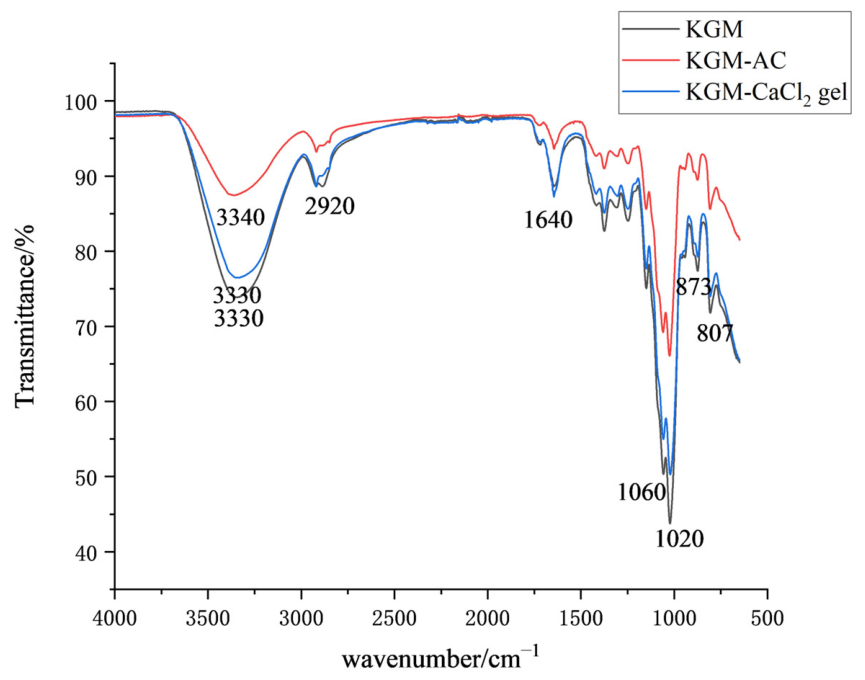
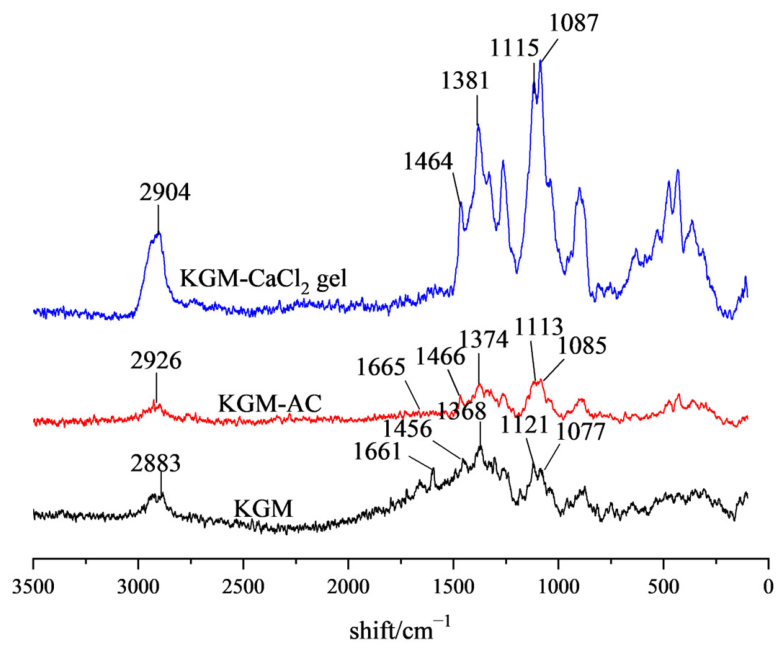
2.2. FTIR Spectroscopic Analysis
2.3. Raman Spectroscopic Analysis
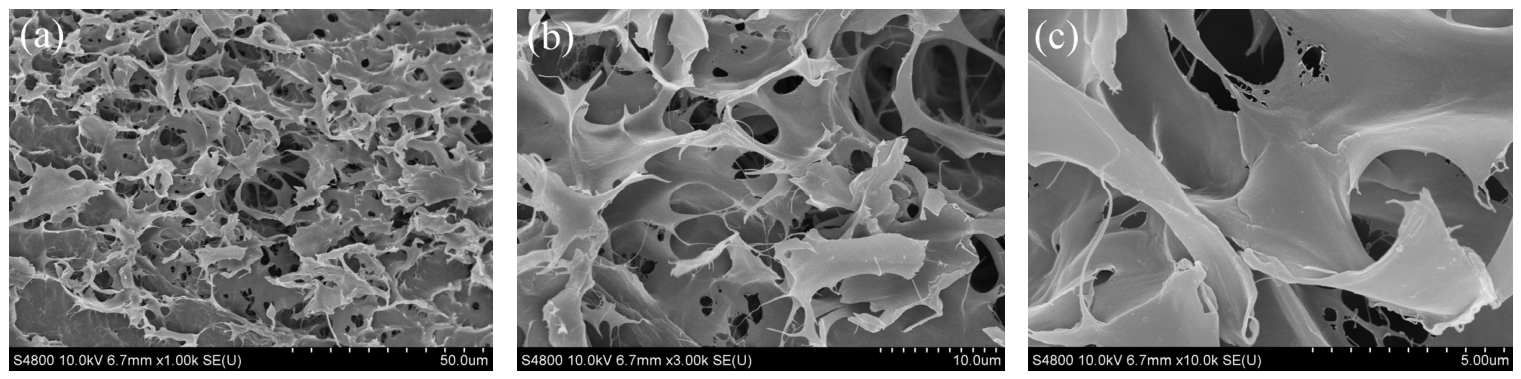
2.4. SEM Observations
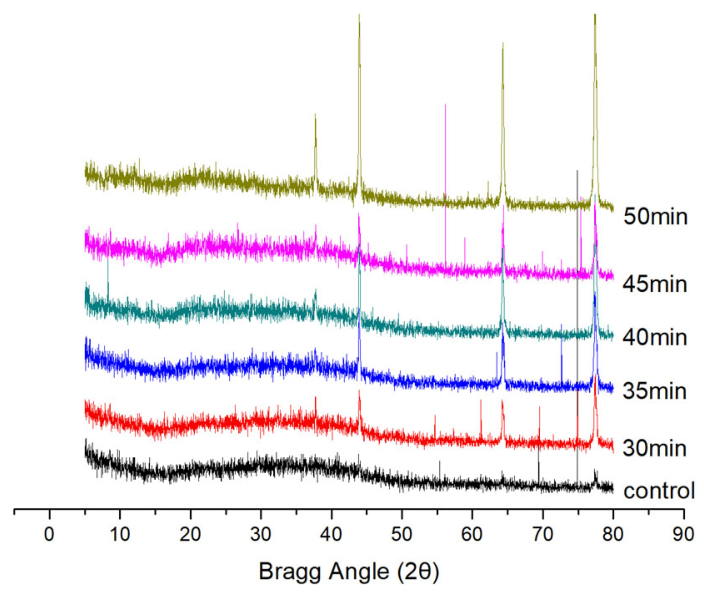
2.5. X-Ray Diffraction of KGM-CaCl2 Gels
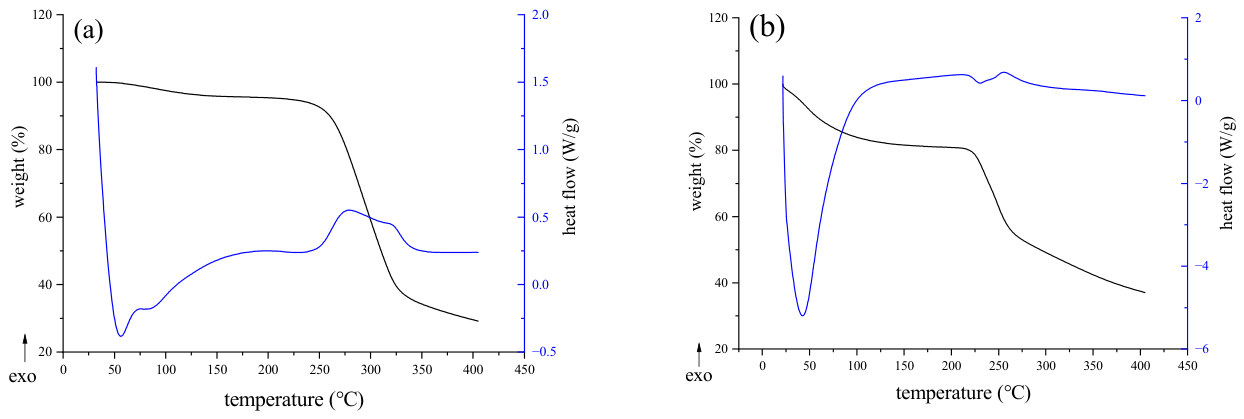
2.6. DSC/TGA Analysis
2.7. The Rheological Properties of KGM-CaCl2 Electrogels
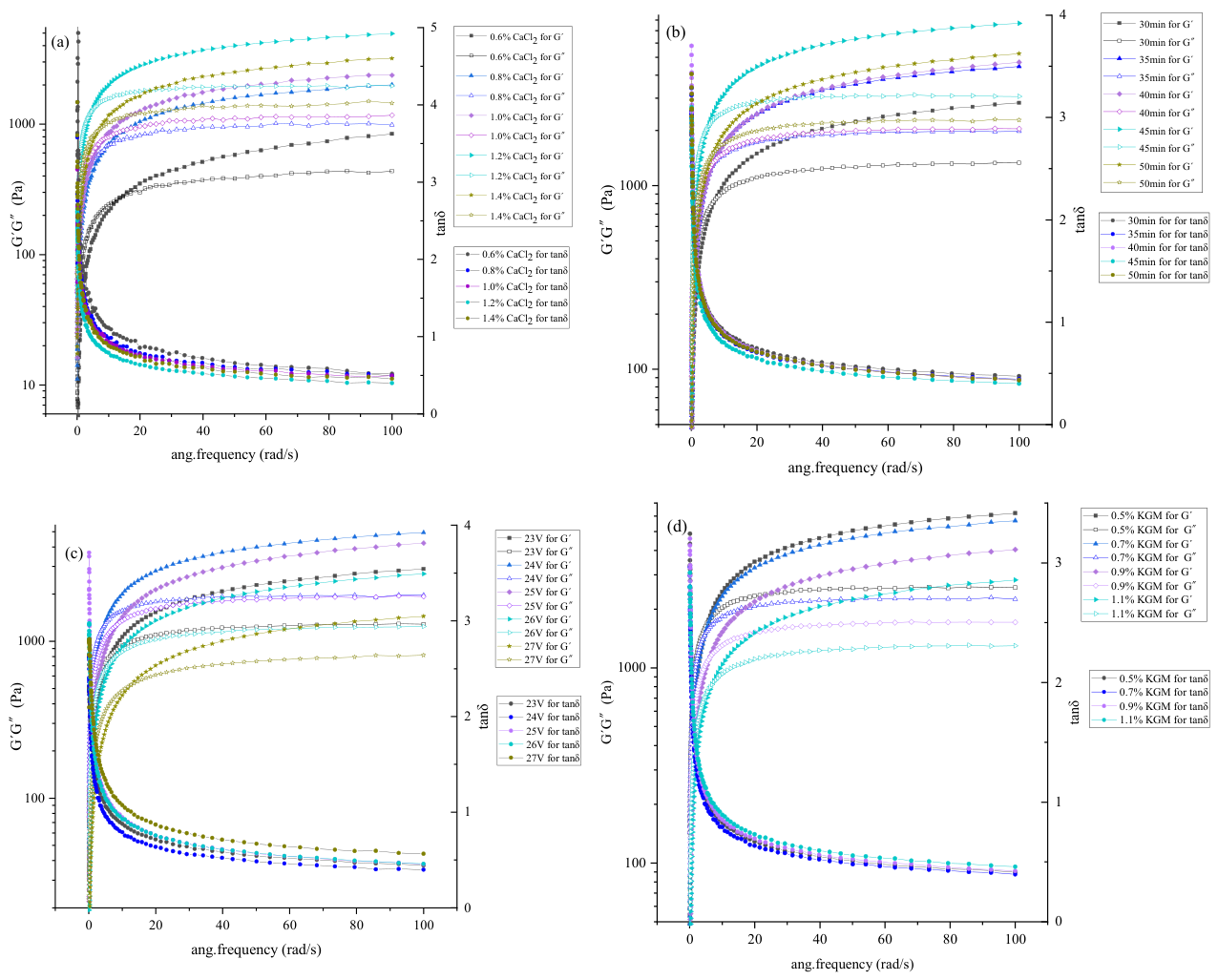
2.7.1. Effect of CaCl2 Concentration on G′, G″ and Tanδ of KGM-CaCl2 Electrogels
2.7.2. Effect of Electric Treatment Duration on G′, G″ and Tanδ of KGM-CaCl2 Electrogels
2.7.3. Effect of Voltage on G′, G″ and Tanδ of KGM-CaCl2 Electrogels
2.7.4. Effect of KGM Concentration on G′, G″ and Tanδ of KGM-CaCl2 Electrogels
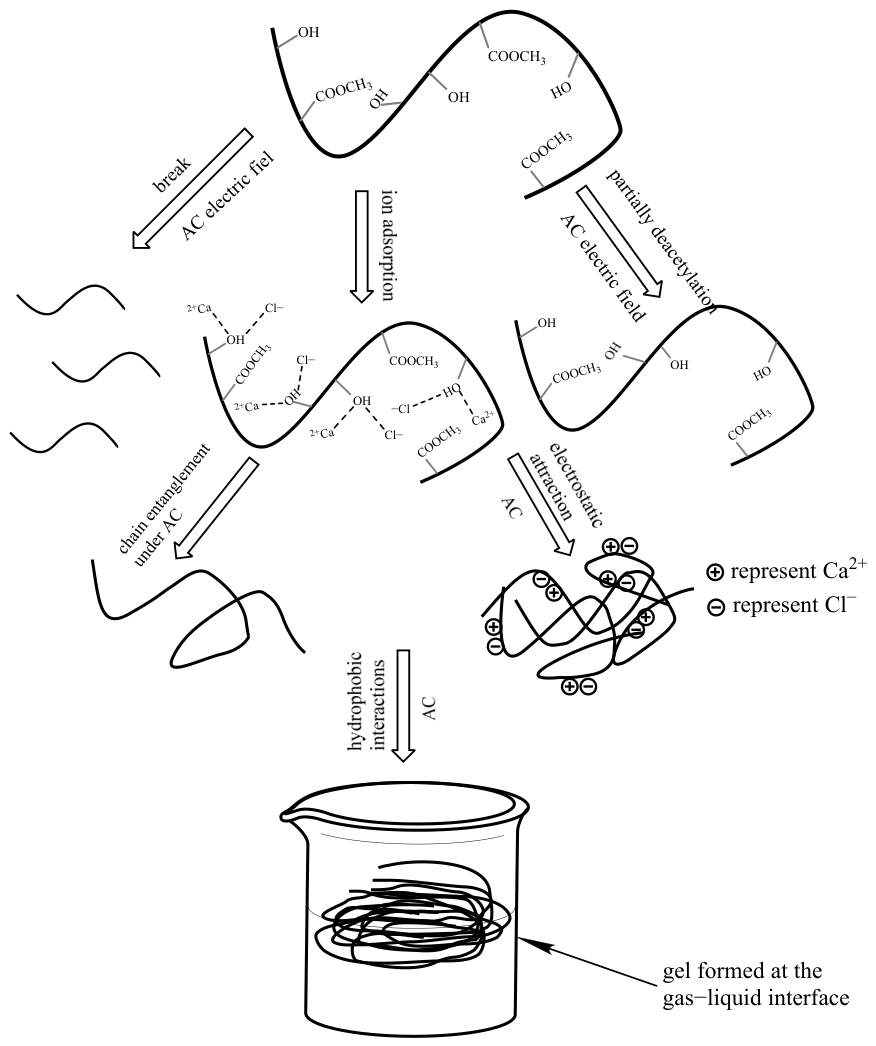
2.8. Gelation Mechanism of KGM-CaCl2 Electrogel
3. Conclusions
 . Under an AC electric field, the charged KGM molecular chains interpenetrate and entangle mutually, ultimately assembling into a stable gel network. Distinct from conventional KGM gels, this gel exhibits notable hydrophobicity, suggesting potential applications in oil adsorption and hydrophobic film fabrication. In future studies, the effects of acetyl content, KGM molecular weight, and electrode distance on the formation, structure, and properties of the gel should be investigated. The successful fabrication of this gel further supports the formation mechanism of AC-induced KGM gels. Meanwhile, its structural characteristics and viscoelastic moduli are distinct from those of KGM-KCl electrogels, which may endow it with unique application potential compared with KGM-KCl electrogels.
4. Materials and Methods
4.1. Materials
4.2. Preparation of KGM-CaCl2 Electrogels Under AC Electric Field
4.3. FTIR
4.4. Raman
4.5. SEM
4.6. XRD
4.7. Simultaneous DSC/TGA
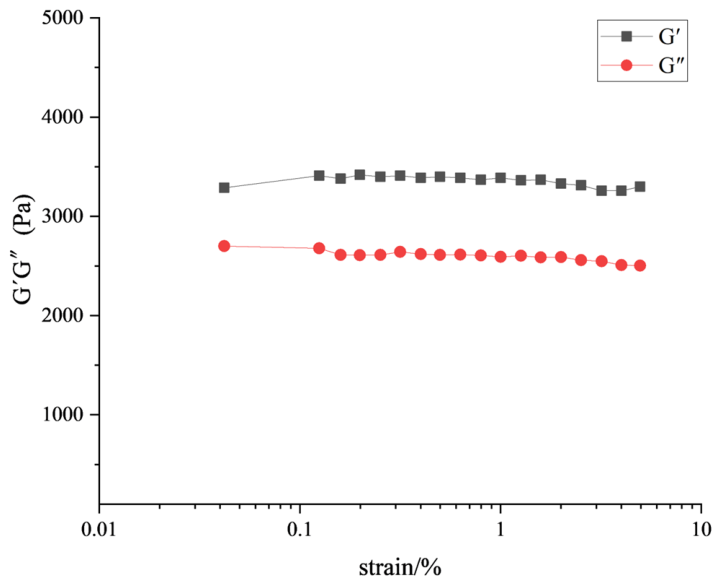
4.8. Rheological Measurements
Author Contributions
Funding
Institutional Review Board Statement
Informed Consent Statement
Data Availability Statement
Conflicts of Interest
References
- Niu, Y.G.; Xia, Q.; Li, N.; Wang, Z.Y.; Yu, L.L. Gelling and Bile Acid Binding Properties of Gelatin-Alginate Gels with Interpenetrating Polymer Networks by Double Cross-Linking. Food Chem. 2019, 270, 223–228. [Google Scholar] [CrossRef]
- Zhao, Y.T.; Wang, D.N.; Xu, J.X.; Tu, D.K.; Zhuang, W.J.; Tian, Y.T. Effect of Polysaccharide Concentration on Heat-Induced Tremella fuciformis Polysaccharide-Soy Protein Isolation Gels: Gel Properties and Interactions. Int. J. Biol. Macromol. 2024, 262, 129782. [Google Scholar] [CrossRef] [PubMed]
- Yang, X.; Li, A.Q.; Li, D.; Li, X.F.; Li, P.Y.; Sun, L.J.; Guo, Y.R. Improved Physical Properties of Konjac Glucomannan Gels by Co-incubating Composite Konjac Glucomannan/Xanthan Systems under Alkaline Conditions. Food Hydrocoll. 2020, 106, 105870. [Google Scholar] [CrossRef]
- Wang, S.D.; Luo, S.; Wang, H.P.; Zhang, S.; Wang, X.Y.; Yang, X.; Guo, Y.R. Strong Gelation Capacity of a Pectin-like Polysaccharide in the Presence of K+ Ion. Int. J. Biol. Macromol. 2024, 256, 128395. [Google Scholar] [CrossRef]
- Kimura, A.; Nagasawa, N.; Taguchi, M. Synthesis of Polysaccharide Hybrid Gel in Ionic Liquids via Radiation Induced Crosslinking. Polym. Degrad. Stab. 2019, 159, 133–138. [Google Scholar] [CrossRef]
- Tasoglu, S.; Yu, C.H.; Gungordu, H.I.; Guven, S.; Vural, T.; Demirci, U. Guided and Magnetic Self-assembly of Tunable Magnetoceptive Gels. Nat. Commun. 2014, 5, 4702. [Google Scholar] [CrossRef] [PubMed]
- Kojic, N.; Panzer, M.J.; Leisk, G.G.; Raja, W.K.; Kojic, M.; Kaplan, D.L. Ion Electrodiffusion Governs Silk Electrogelation. Soft Matter 2012, 8, 2897–2905. [Google Scholar] [CrossRef]
- Leisk, G.G.; Lo, T.J.; Yucel, T.; Lu, Q.; Kaplan, D.L. Electrogelation for Protein Adhesives. Adv. Mater. 2010, 22, 711–715. [Google Scholar] [CrossRef]
- Yucel, T.; Kojic, N.; Leisk, G.G.; Lo, T.J.; Kaplan, D.L. Non-equilibrium Silk Fibroin Adhesives. J. Struct. Biol. 2010, 170, 406–412. [Google Scholar] [CrossRef]
- Wang, L.X.; Jiang, Y.P.; Lin, Y.H.; Pang, J.; Liu, X.Y. Rheological Properties and Formation Mechanism of DC Electric Fields Induced Konjac Glucomannan-Tungsten Gels. Carbohydr. Polym. 2016, 142, 293–299. [Google Scholar] [CrossRef]
- Vasudevan, S.; Lakshmi, J.; Sozhan, G. Effects of Alternating and Direct Current in Electro-coagulation Process on the Removal of Cadmium from Water. J. Hazard. Mater. 2011, 192, 26–34. [Google Scholar]
- Servoli, E.; Maniglio, D.; Motta, A.; Migliaresi, C. Folding and Assembly of Fibroin Driven by an AC Electric Field: Effects on Film Properties. Macromol. Biosci. 2008, 8, 827–835. [Google Scholar] [CrossRef] [PubMed]
- Ratcliffe, I.; Williams, P.A.; English, R.J.; Meadows, J. Small Strain Deformation Measurements of Konjac Glucomannan Solutions and the Influence of Borate Cross-Linking. Carbohydr. Polym. 2013, 95, 272–281. [Google Scholar] [CrossRef]
- Zhu, F. Modifications of Konjac Glucomannan for Diverse Applications. Food Chem. 2018, 256, 419–426. [Google Scholar] [CrossRef]
- Yao, M.N.; Fan, L.L.; Liu, Y.N.; Chen, Q.A.; Zeng, Y.; Jian, W.J.; Pang, J. Effects of High-Voltage Pulse Electric Field Treatment on the Structure Stability of Konjac Glucomannan. Chin. J. Struct. Chem. 2011, 12, 1833–1837. [Google Scholar]
- Wang, L.X.; Xiao, L.X.; Cai, L.G.; Yin, N.; Kou, D.D.; Pang, J. Influence of Konjac Glucomannan on Crystallization Morphology and Structure of Calcium Oxalate. Chin. J. Struct. Chem. 2013, 6, 831–838. [Google Scholar]
- Wang, L.X.; Zhuang, Y.H.; Li, J.L.; Pang, J.; Liu, X.Y. The Textural Properties and Microstructure of Konjac Glucomannan—Tungsten Gels Induced by DC Electric Fields. Food Chem. 2016, 212, 256–263. [Google Scholar] [CrossRef] [PubMed]
- Wang, L.X.; Lee, A.R.; Yuan, Y.; Wang, X.M.; Lu, T.J. Preparation and FTIR, Raman and SEM characterizations of konjac glucomannan-KCl electrogels. Food Chem. 2020, 331, 127289. [Google Scholar] [CrossRef]
- Wang, S.S.; Zhou, B.; Wang, Y.T.; Li, B. Preparation and Characterization of Konjac Glucomannan Microcrystals through Acid Hydrolysis. Food Res. Int. 2015, 67, 111–116. [Google Scholar] [CrossRef]
- Sun, Q.; Li, G.; Dai, L.; Ji, N.; Xiong, L. Green Preparation and Characterisation of Waxy Maize Starch Nanoparticles Through Enzymolysis and Recrystallisation. Food Chem. 2014, 162, 223–228. [Google Scholar] [CrossRef] [PubMed]
- Li, J.W.; Ma, J.W.; Chen, S.J.; He, J.M.; Huang, Y.D. Characterization of Calcium Alginate/Deacetylated Konjac Glucomannan Blend Films Prepared by Ca2+ Crosslinking and Deacetylation. Food Hydrocoll. 2018, 82, 363–369. [Google Scholar] [CrossRef]
- Li, X.J.; Ji, N.; Li, M.; Zhang, S.L.; Xiong, L.; Sun, Q.J. Morphology and Structural Properties of Novel Short Linear Glucan/Protein Hybrid Nanoparticles and their Influence on the Rheological Properties of Starch Gel. J. Agric. Food Chem. 2017, 65, 7955–7965. [Google Scholar] [CrossRef]
- Zhang, K.G.; Yang, W.Z.; Xu, B.; Chen, Y.; Yin, X.S.; Liu, Y.; Zuo, H.Z. Inhibitory Effect of Konjac Glucomanan on Pitting Corrosion of AA5052 Aluminium Alloy in NaCl Solution. J. Colloid Interface Sci. 2018, 517, 52–60. [Google Scholar] [CrossRef] [PubMed]
- Jian, W.J.; Siu, K.C.; Wu, J.Y. Effects of pH and Temperature on Colloidal Properties and Molecular Characteristics of Konjac Glucomannan. Carbohydr. Polym. 2015, 134, 285–292. [Google Scholar] [CrossRef]
- Mu, R.J.; Wang, L.; Du, Y.; Yuan, Y.; Ni, Y.S.; Wu, C.H.; Pang, J. Synthesis of Konjac Glucomannan-Silica Hybrid Materials with Honeycomb Structure and its Application as Activated Carbon Support for Cu(II) adsorption. Mater. Lett. 2018, 226, 75–78. [Google Scholar] [CrossRef]
- Rondán-Flores, L.M.; Villavicencio, A.L.C.H.; Pereira de Castro, D.; Wetter, N.U.; Gundu Rao, T.K.; Canaza, E.A.; Cano, N.F. Physicochemical Characterization of Red Pitaya (Hylocereus sp.) Peel Flour Using FT-IR, Raman, and EPR spectroscopy: Effects of γ-irradiation on its Intrinsic Properties. Spectrochim. Acta A Mol. Biomol. Spectrosc. 2026, 356, 127720. [Google Scholar] [CrossRef]
- Pękala, P.; Szymańska-Chargot, M.; Zdunek, A. Acetylated Hemicelluloses and Esterified Pectin Alterations in Apple Cell Walls during the Development of Two Apple Cultivars: Insights from FT-IR, Raman Spectroscopy, and Imaging. Food Chem. 2025, 493, 146129. [Google Scholar] [CrossRef]
- Xu, X.L.; Han, M.Y.; Fei, Y.; Zhou, G.H. Raman Spectroscopic Study of Heat-Induced Gelation of Pork Myofibrillar Proteins and its Relationship with Textural Characteristic. Meat Sci. 2011, 87, 159–164. [Google Scholar] [CrossRef]
- Courbona, E.; D’Ansb, P.; Permyakovac, A.; Skrylnyka, O.; Steunouc, N.; Degrezb, M.; Frèrea, M. Further Improvement of the Synthesis of Silica Gel and CaCl2 Composites: Enhancement of Energy Storage Density and Stability over Cycles for Solar Heat Storage Coupled with Space Heating Applications. Sol. Energy 2017, 157, 532–541. [Google Scholar] [CrossRef]
- Eberbach, M.C.; Shkatulov, A.I.; Huinink, H.P.; Fischer, H.R.; Adan, O.C.G. Hydration pathways of CaCl2 inside matrices with different pore size. Microporous Mesoporous Mater. 2025, 391, 113605. [Google Scholar] [CrossRef]
- Zhu, X.H.; Tang, D.S.; Yang, K.; Zhang, Z.L.; Li, Q.; Pan, Q.; Yang, C.H. Effect of Ca(OH)2 on Shrinkage Characteristics and Microstructures of Alkali-Activated Slag Concrete. Constr. Build. Mater. 2018, 175, 467–482. [Google Scholar] [CrossRef]
- Wang, L.X.; Dao, L.P.; Guo, Q.Y.; Chen, T.L.; Fu, L.J.; Zhou, F.C.; Yuan, Y. Investigation on the influence of AC electric filed and KCl on the structure and gel properties of Konjac glucomannan. Food Chem. 2022, 386, 132755. [Google Scholar] [CrossRef] [PubMed]
- Chen, J.F.; Zhang, W.Y.; Li, X. Adsorption of Cu(II) ion from aqueous solutions on hydrogel prepared from Konjac glucomannan. Polym. Bull. 2016, 73, 1965–1984. [Google Scholar]
- Chen, Z.J.; Wang, S.S.; Shang, L.C.; Zhou, P.Y.; Li, J.; Li, B. An Efficient and Simple Approach for the Controlled Preparation of Partially Degraded Konjac Glucomannan. Food Hydrocoll. 2020, 108, 106017. [Google Scholar] [CrossRef]
- Danjo, T.; Enomoto-Rogers, Y.; Takemura, A.; Iwata, T. Syntheses and properties of glucomannan acetate butyrate mixed Esters. Polym. Degrad. Stab. 2014, 109, 373–378. [Google Scholar] [CrossRef]
- Jabbari-Hichri, A.; Bennici, S.; Auroux, A. Enhancing the Heat Storage Density of Silica-Alumina by Addition of Hygroscopic Salts (CaCl2, Ba(OH)2, and LiNO3). Sol. Energy Mater. Sol. Cells 2015, 140, 351–360. [Google Scholar] [CrossRef]
- Liu, Z.Z.; Liu, C.Z.; Sun, X.; Zhang, S.Z.; Yuan, Y.K.; Wang, D.F.; Xu, Y. Fabrication and Characterization of Cold-gelation Whey Protein-Chitosan Complex Hydrogels for the Controlled Release of Curcumin. Food Hydrocoll. 2020, 103, 150619. [Google Scholar] [CrossRef]
- Liao, F.Y.; Tian, Z.H.; Yang, X.; Yang, H.; Liu, X.; Liao, H.; Duan, L. Hydrophobic association: A facile approach to prepare physical cross-linked gelatin hydrogel with desirable thermal stability, flexibility and self-healing ability. Int. J. Biol. Macromol. 2024, 262, 130044. [Google Scholar] [CrossRef]
- Li, S.H.; Ye, F.Y.; Zhou, Y.; Lei, L.; Zhao, G.H. Rheological and Textural Insights into the Blending of Sweet Potato and Cassava Starches: In Hot and Cooled Pastes as well as in Fresh and Dried Gels. Food Hydrocoll. 2019, 89, 901–911. [Google Scholar] [CrossRef]
- Bagheri, A.; Nazari, A.; Sanjayan, J.G.; Duan, W.H. Molecular Simulation of Water and Chloride Ion Diffusion in Nanopores of Alkali-Activated Aluminosilicate Structures. Ceram. Int. 2018, 44, 20723–20731. [Google Scholar] [CrossRef]
- Tiwari, S.; Singh, J.K. Effect of monovalent and divalent salts on the interfacial and structural properties of vapor-liquid water interface in presence of sodium dodecyl sulfate. J. Mol. Liq. 2023, 384, 122261. [Google Scholar] [CrossRef]
- Zhao, Z.X.; Gao, S.J.; Li, Y.Z.; Wu, F.C.; Shen, C.H. Gelation of Konjac glucomannan crosslinked by organotitanium chelated with different ligands. J. Sol-Gel Sci. Technol. 2021, 98, 401–410. [Google Scholar] [CrossRef]
- Gao, S.J.; Guo, J.M.; Nishnari, K. Thermoreversible konjac glucomannan gel crosslinked by borax. Carbohydr. Polym. 2008, 72, 315–325. [Google Scholar] [CrossRef]
- Zhang, L.H.; Zhang, L.L.; Yue, M.G.; Zhang, J.X.; Kang, M.Y.; Li, L.L.; Luo, B.; Xu, W. Effect of moisture content and Konjac glucomannan on the mechanical properties of κ-carrageenan-derived hydrogels. J. Food Meas. Charact. 2026, 20, 823–832. [Google Scholar] [CrossRef]




| CaCl2 Concentration (%) | Electric Treatment Duration (min) | Voltage (V) | KGM Concentration (%) | Storage Modulus (G′, Pa) |
|---|---|---|---|---|
| 1.2 | 45 | 24 | 0.5 | 6~7 × 10³ |
Disclaimer/Publisher’s Note: The statements, opinions and data contained in all publications are solely those of the individual author(s) and contributor(s) and not of MDPI and/or the editor(s). MDPI and/or the editor(s) disclaim responsibility for any injury to people or property resulting from any ideas, methods, instructions or products referred to in the content. |
© 2026 by the authors. Licensee MDPI, Basel, Switzerland. This article is an open access article distributed under the terms and conditions of the Creative Commons Attribution (CC BY) license.
Share and Cite
Wang, L.; Lin, G.; Fu, L. Preparation, Structure and Rheological Properties of Konjac Glucomannan–CaCl2 Electrogel. Gels 2026, 12, 466. https://doi.org/10.3390/gels12060466
Wang L, Lin G, Fu L. Preparation, Structure and Rheological Properties of Konjac Glucomannan–CaCl2 Electrogel. Gels. 2026; 12(6):466. https://doi.org/10.3390/gels12060466
Chicago/Turabian StyleWang, Lixia, Guorong Lin, and Lijun Fu. 2026. "Preparation, Structure and Rheological Properties of Konjac Glucomannan–CaCl2 Electrogel" Gels 12, no. 6: 466. https://doi.org/10.3390/gels12060466
APA StyleWang, L., Lin, G., & Fu, L. (2026). Preparation, Structure and Rheological Properties of Konjac Glucomannan–CaCl2 Electrogel. Gels, 12(6), 466. https://doi.org/10.3390/gels12060466