
Noble Metal Aerogels: Synthesis and Application as Support-Free Anode Electrocatalysts for Ethanol Electro-Oxidation

 , , ,
, , , 

Abstract
1. Introduction
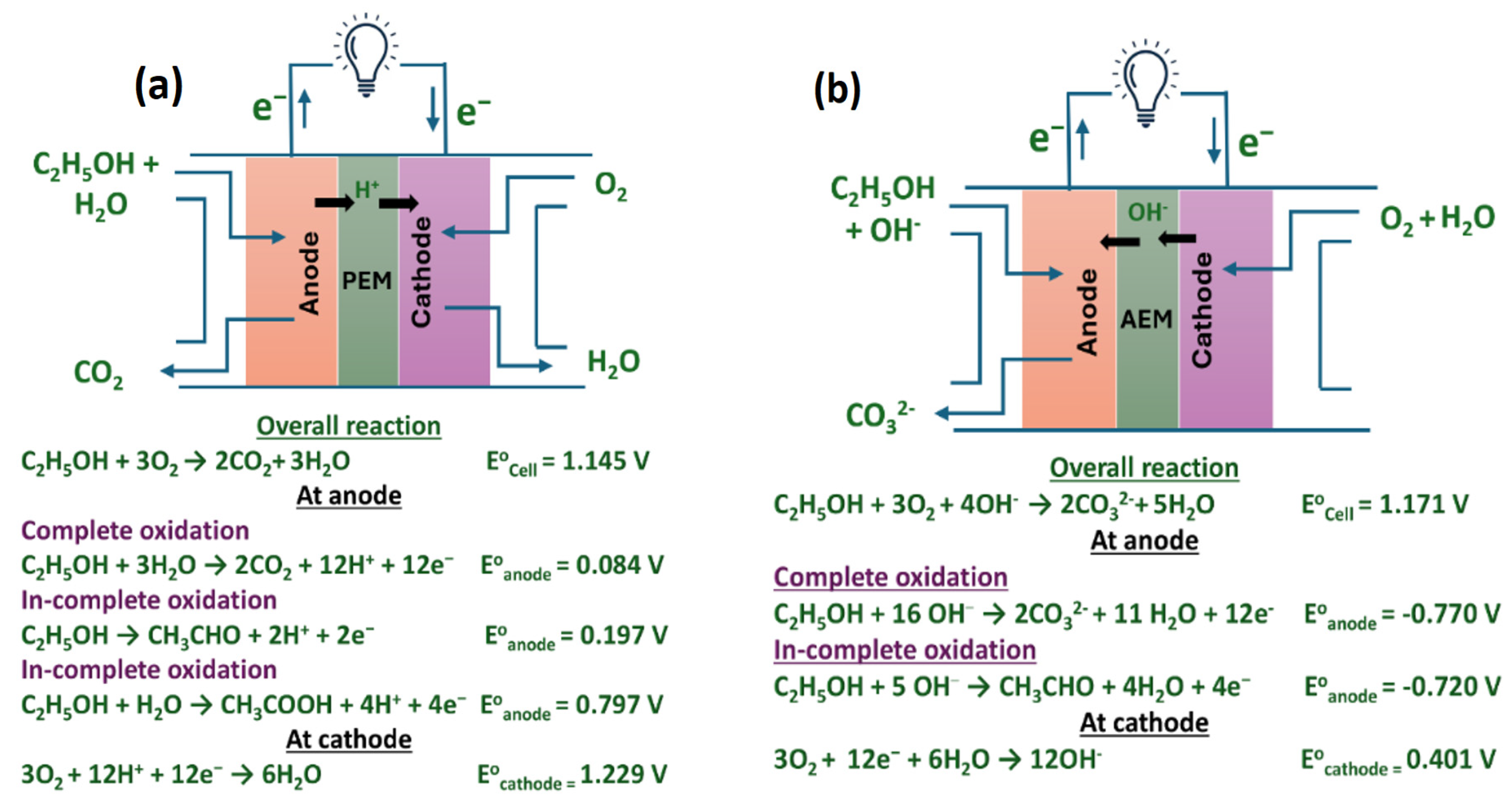
1.1. EOR and Anode Electrocatalysts in Acidic DEFCs
1.2. EOR and Anode Electrocatalysts in Alkaline DEFCs
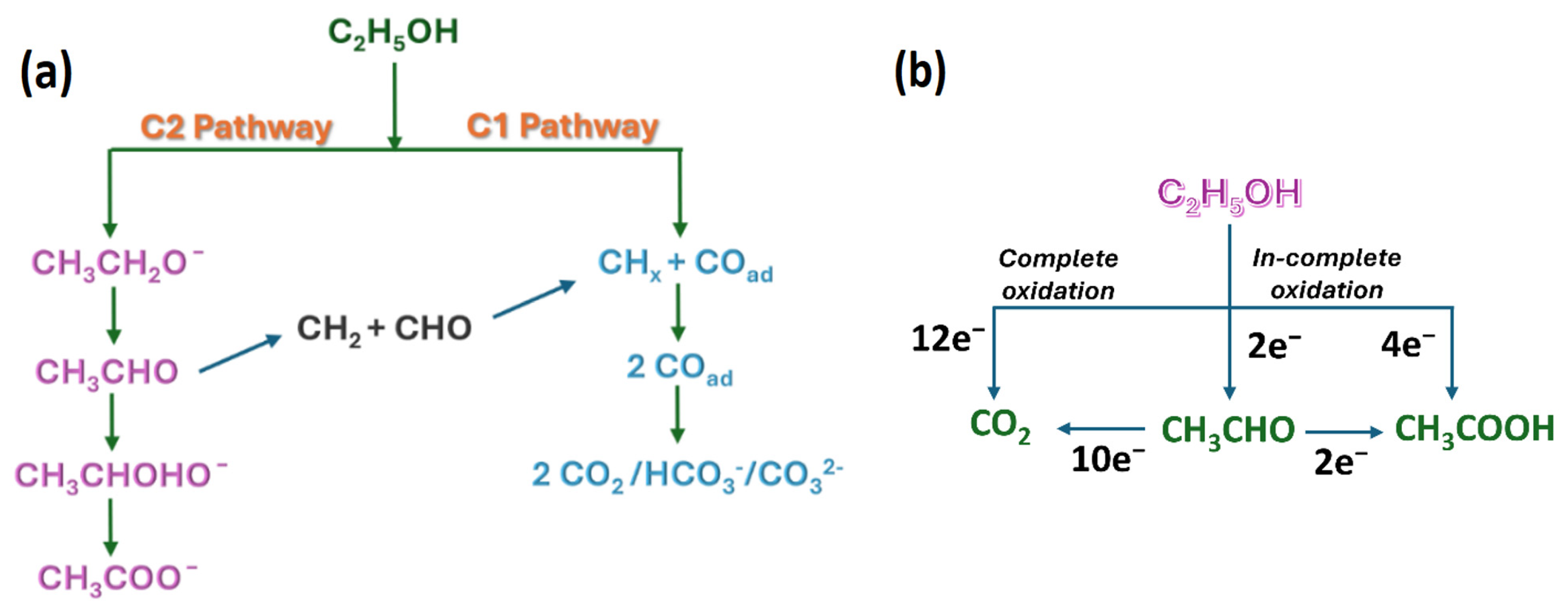
1.3. Mechanism of EOR
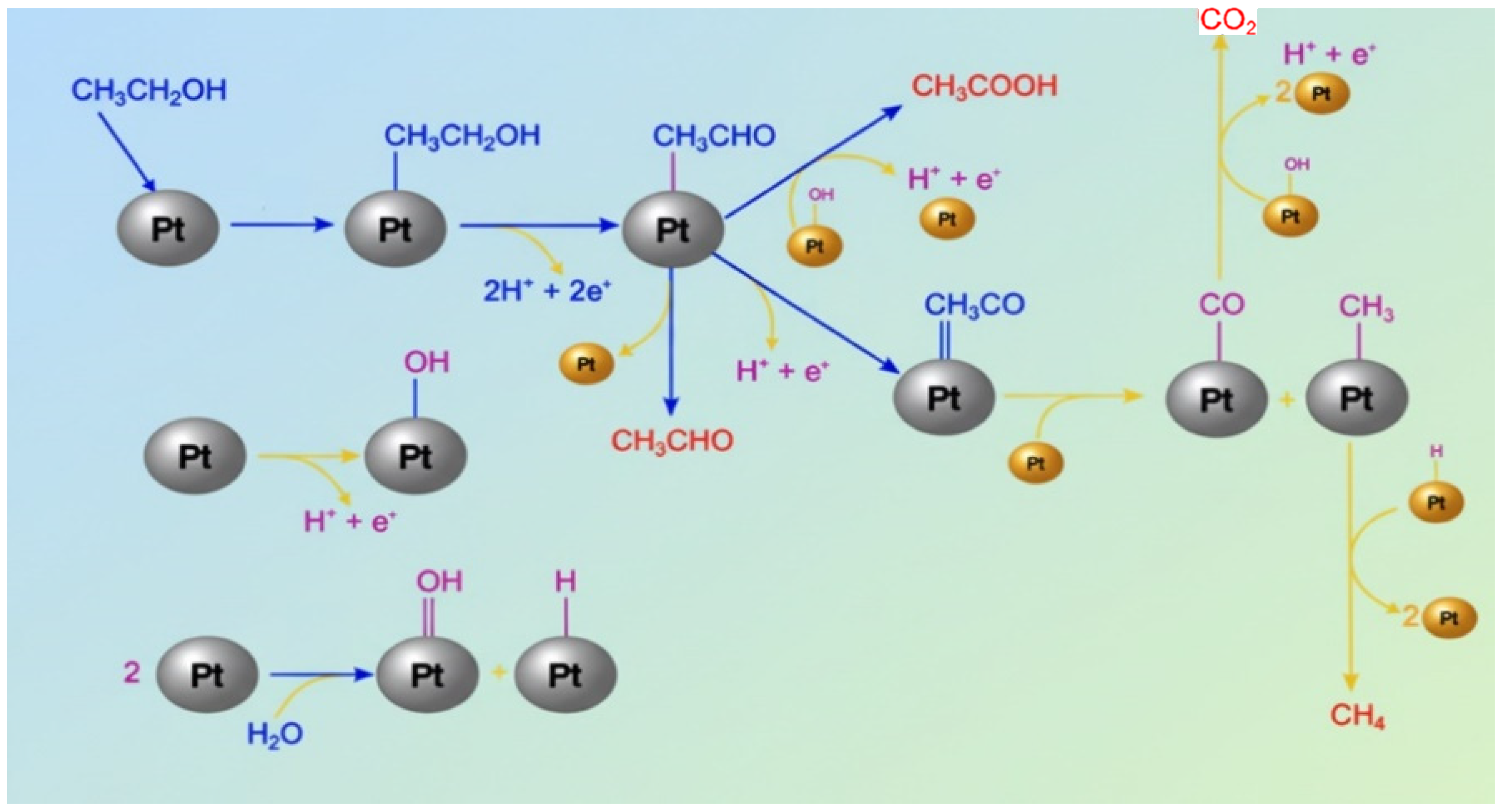
1.4. EOR over Pt Surface in Acidic Electrolytes
1.5. EOR over Pd Surface in Alkaline Electrolytes
1.6. Anode Electrocatalysts for EOR and Prerequisites
- (i)
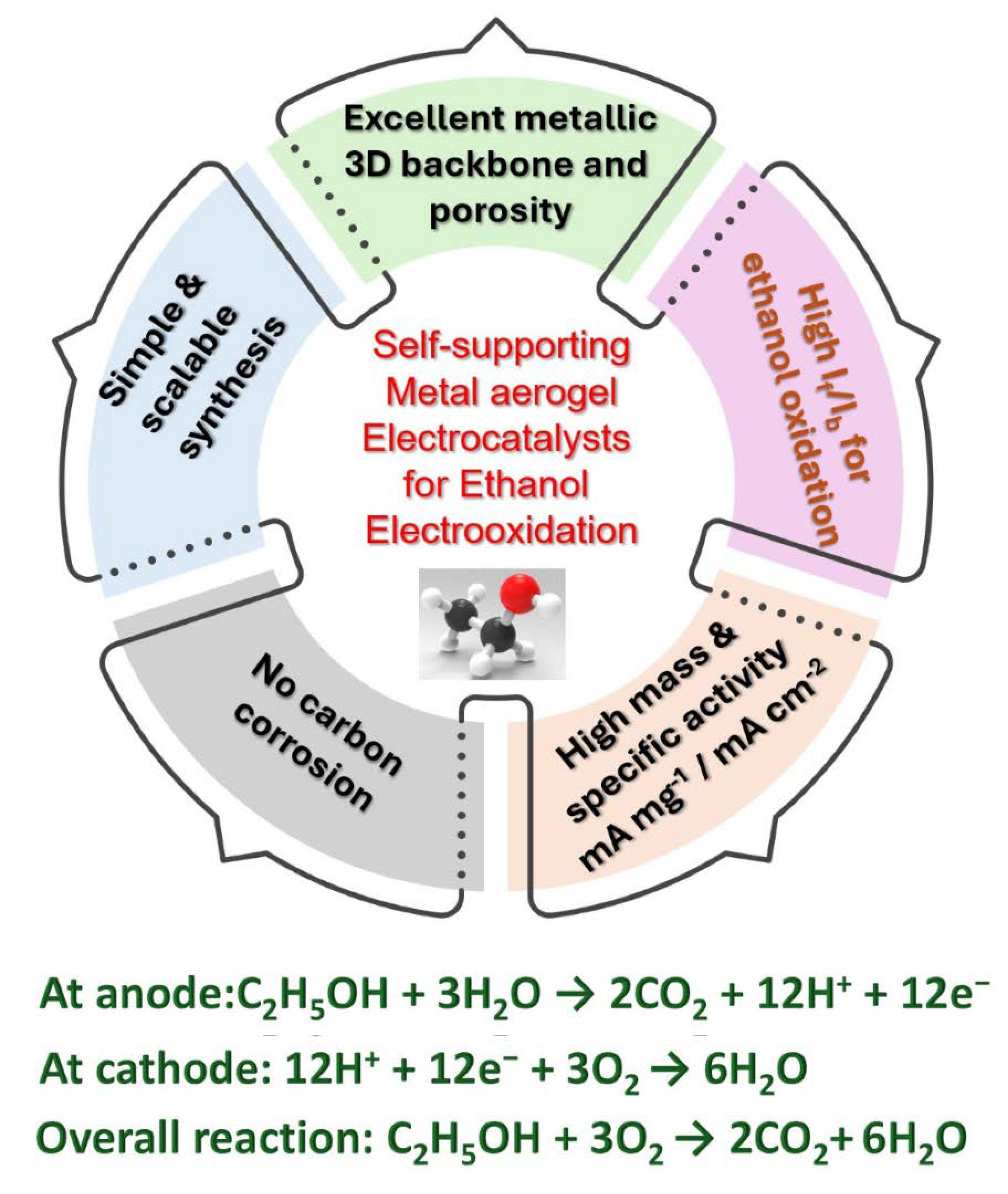
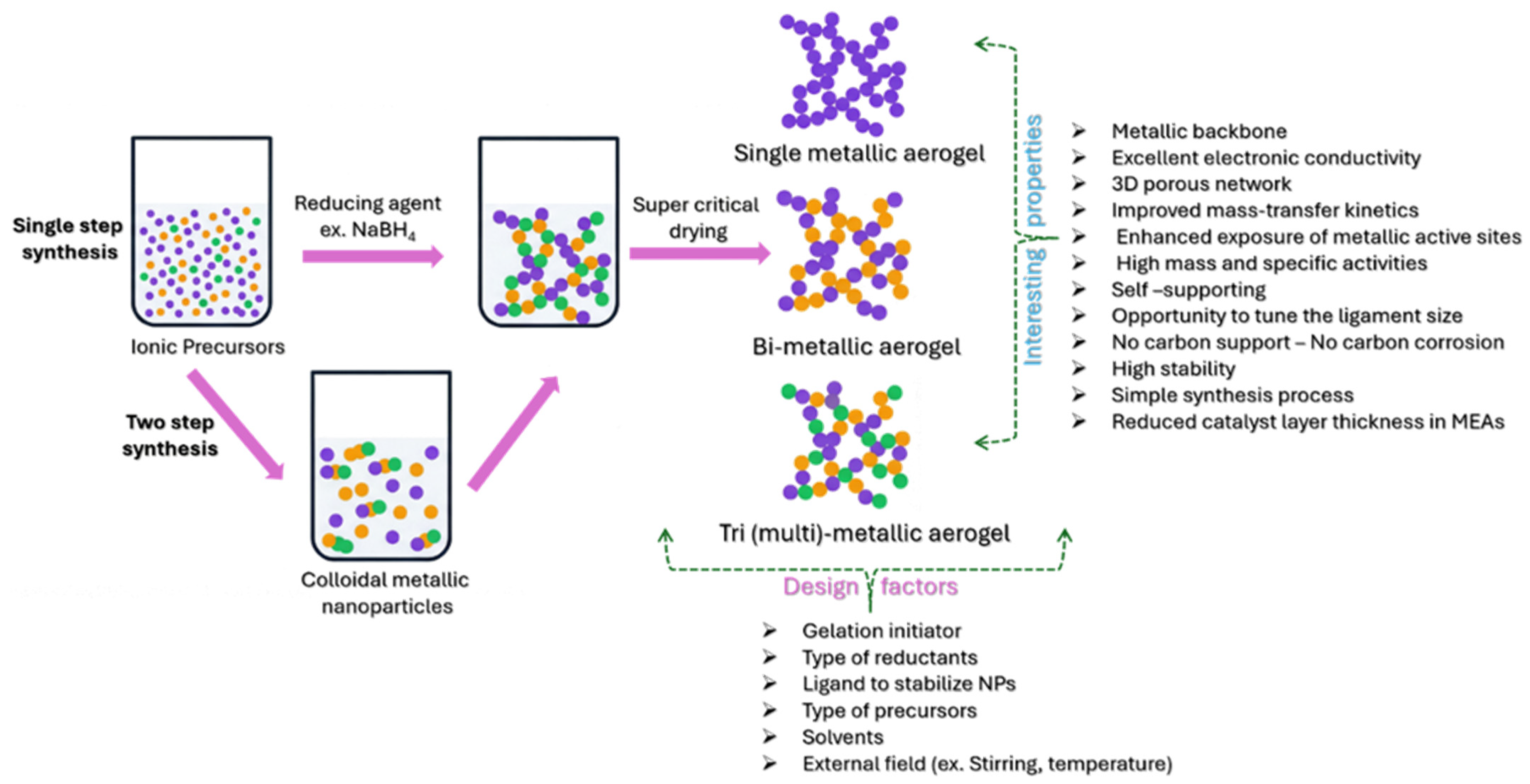
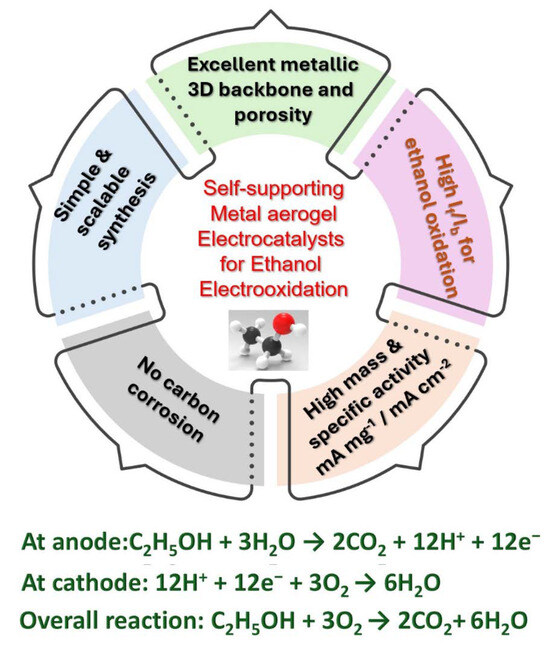
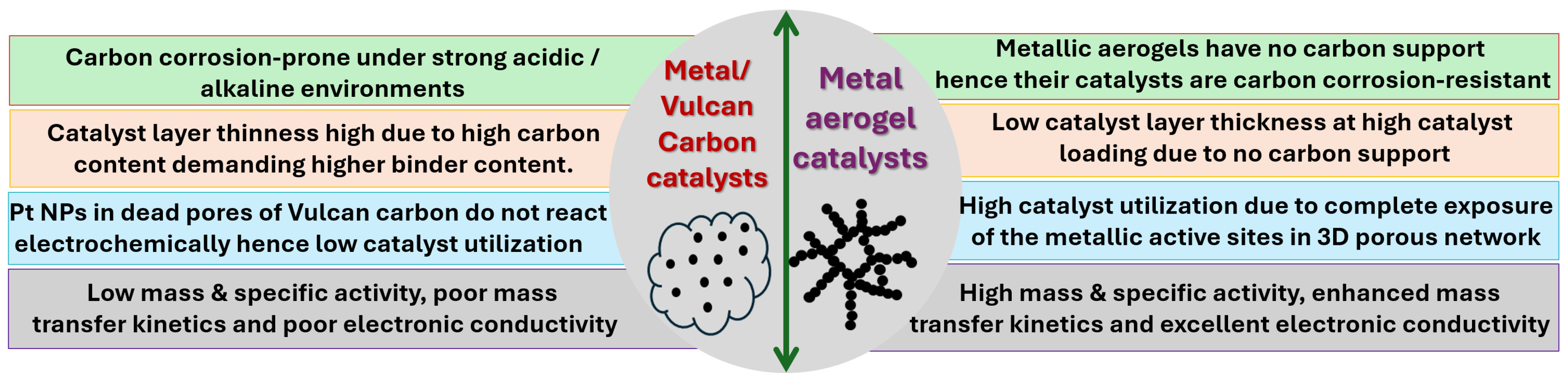
- No carbon—No support corrosion: Self-supported metal aerogel catalysts are entirely made of a metallic backbone; therefore, catalyst instability arising from carbon support corrosion can be completely avoided. Furthermore, the complete metallic network with a direct metal–metal bond fastens electron transport and hence enhances the electrocatalytic activity through faster electron transport to/from the adsorbate reactants.
- (ii)
- High metallic active site utilization: Unlike conventional carbon black or Vulcan carbon, which contains dead pores in which metallic nanoparticles may be deeply buried and inaccessible for electrochemical reactions, metal aerogels process a three-dimensional network with high porosity. This structure makes more metallic active sites accessible to reactants and thus greatly enhances catalyst utilization.
- (iii)
- Simple synthesis process: Metal aerogel catalysts are synthesized through the reduction of metallic precursors with the help of reducing agents, which generally requires no further treatment. This is advantageous compared with certain catalyst synthesis methods that require heat treatment or special post-synthesis procedures to remove ligands, surfactants, polymers, or structure-directing agents, which can lengthen and complicate the synthesis process.
- (iv)
- Reduced catalyst layer thickness: In MEAs, self-supported catalysts significantly reduce the catalyst layer thickness. When applying at the cathodes, traditional carbon-supported catalysts contribute a very high catalyst layer thickness due to the contribution from the carbon vs. the actual metallic active sites. In contrast, metal aerogels are completely made of metallic components; therefore, they can significantly reduce the catalyst layer thickness and enhance reactant utilization.
2. Metal Aerogels and Their Synthesis
- (1)
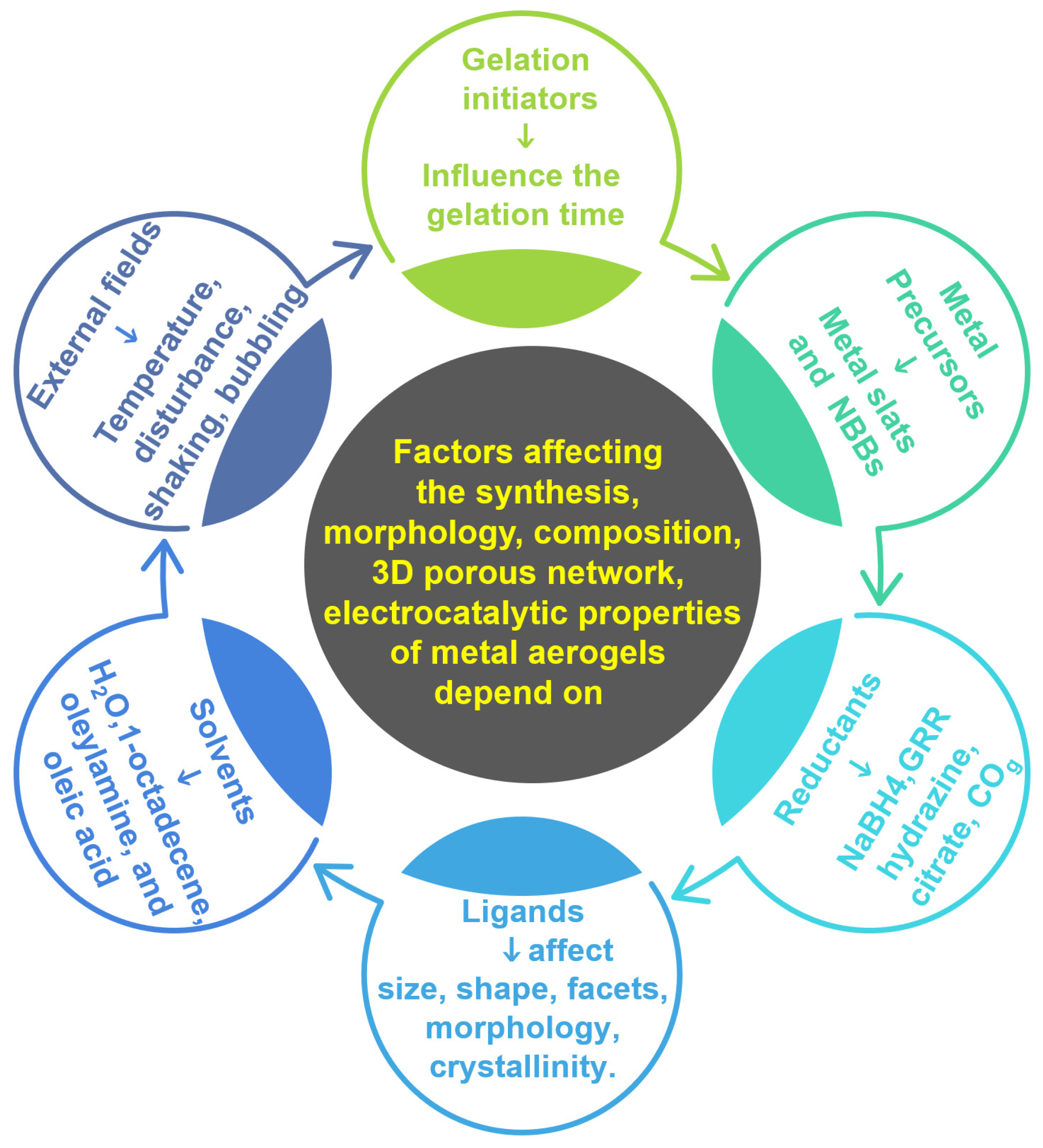
- Initiators: These are the agents that induce the gelation and hence strongly affect gel formation and the gelation time.
- (2)
- Precursors: The type of precursors influence the metal aerogel’s morphology; the precursors could mostly be metal salts in some cases, nano building blocks, or metal gels.
- (3)
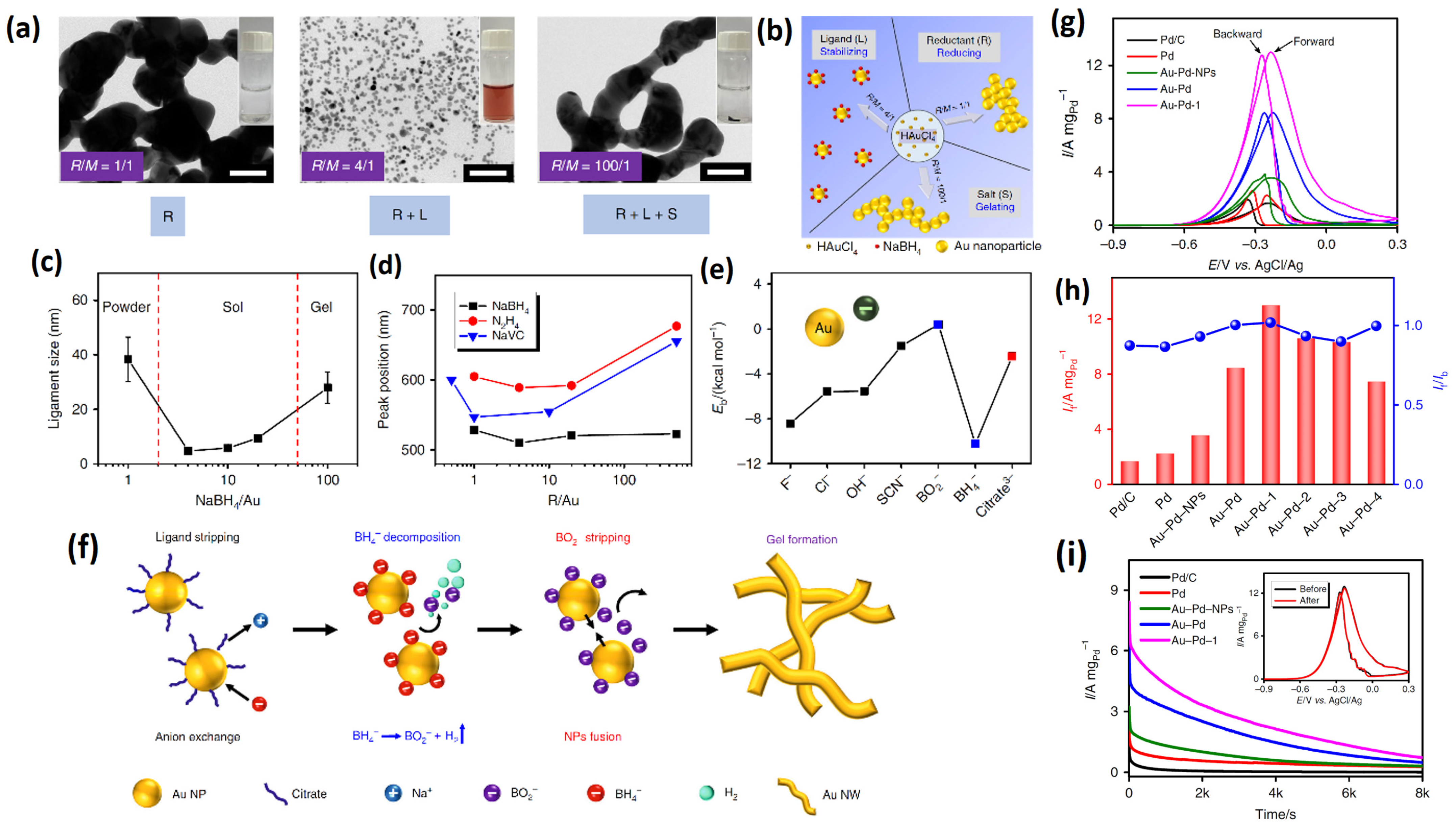
- Reductants: Since most metal aerogel synthesis utilizes metal salts as precursors, the reductants play an important role in converting ionic metal precursors to zero-valent metallic atoms that further self-assemble into a 3D gel network. The most common reductants involve liquid-phase reduction using NaBH4, hydrazine, etc. Solid–solid reduction at high temperatures and liquid–gas reduction methods are also explored.
- (4)
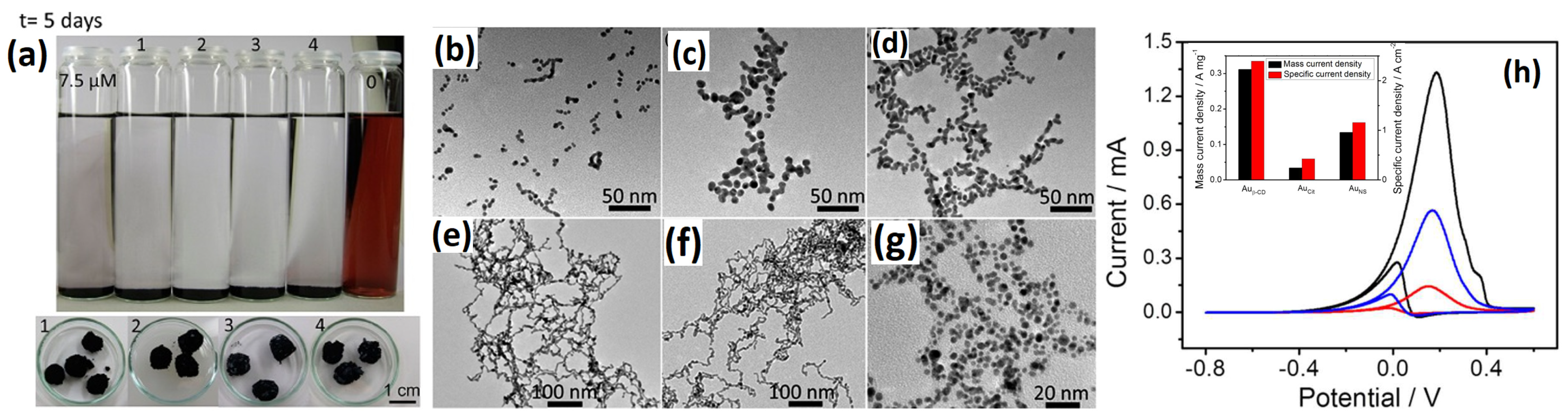
- Ligands: The interaction between ligands and nanoparticles affects the size, shape, morphology, crystallinity and facet of the obtained metal aerogels. Several researchers used a variety of ligands such as CO gas, citrate, cyclodextrins, thiol-containing glutamic acid, etc. However, one of the persistent problems of using ligands is their shielding effect on nanoparticles; limited techniques are available to completely remove them from the nanoparticle surface. Recently, utilizing excessive NaBH4, which acts as both a redundant and a stabilizer, has mostly solved the issue of ligand blocking by organic molecules.
- (5)
- Solvents: The solvents play an important role in the even dispersion of metallic salt precursors and reductants. For a majority of the metal aerogels, H2O is the best solvent. Other non-polar solvents such as 1-octadecene, oleylamine, and oleic acid have also been used.
- (6)
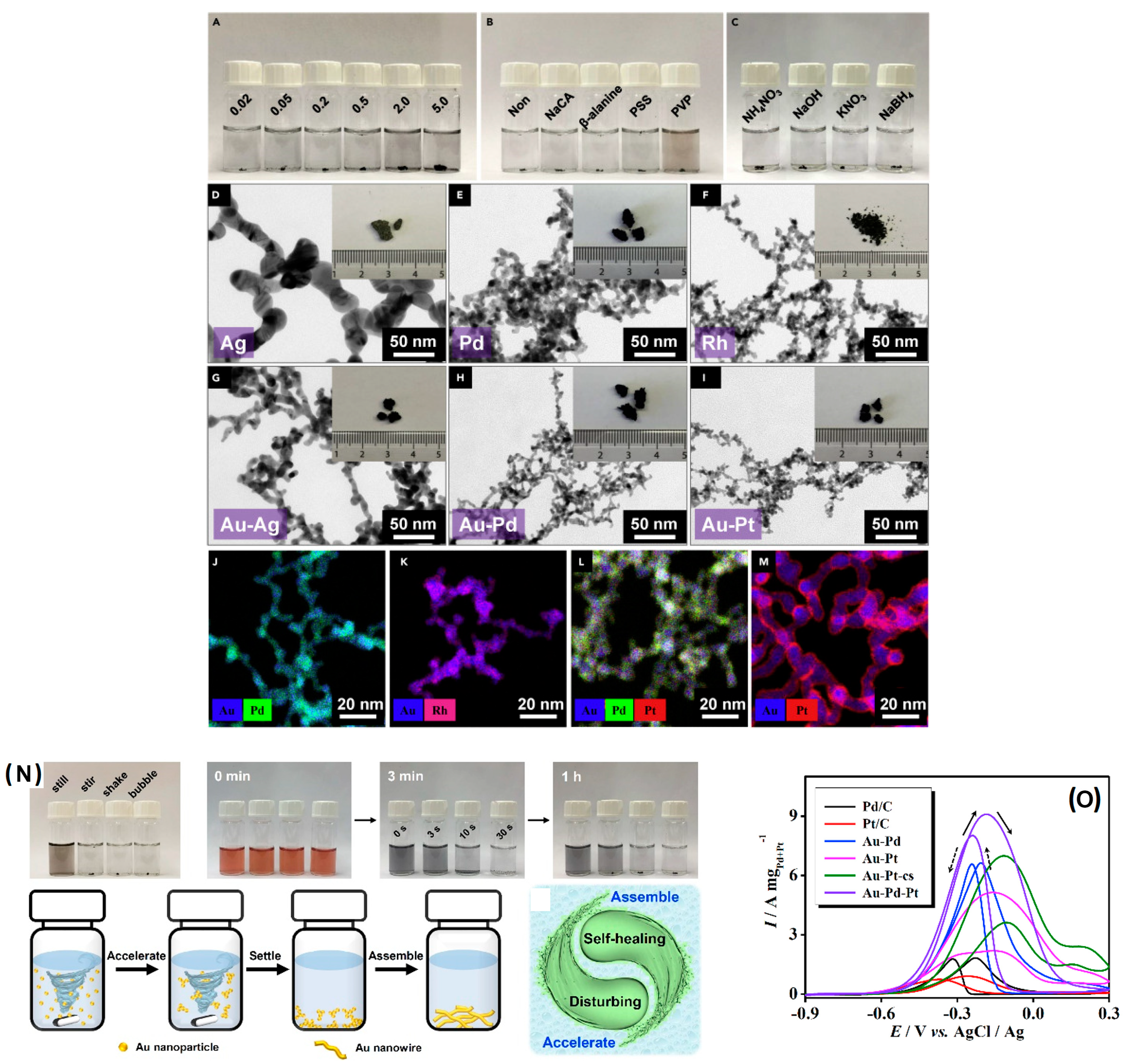
- External fields: Apart from all the five major factors, external fields also affect metal aerogel synthesis, especially the gelation process. Temperature, increasing concentration by raising the precursor amount, counterintuitive disturbance, shaking and bubbling are some of the external force fields that are investigated (Figure 6).Detailed information on metal aerogel synthesis methods, factors affecting gel formation, the mechanism of gelation, background on the theoretical and experimental aspects of gelation, and the properties of metal aerogels have been discussed in recent reviews by none other than the discoverer of metal aerogels, Prof. Alexander Eychmuller, and other pioneering researchers of metal aerogels. Therefore, we choose to exclude a discussion in this review and ask the readers to refer to the following literature for more information [53,56,57,58,59,60,61].
2.1. Metal Aerogels as Electrocatalyst for Ethanol Oxidation Reaction
2.1.1. Monometallic Pd-Based Metal Aerogels
2.1.2. Monometallic Pd Metallene Aerogels
2.1.3. Bimetallic Pd Metal Aerogels
2.1.4. Pt-Based Bimetallic Aerogels
2.1.5. Au-Based Bimetallic Aerogels
2.1.6. Ag-Based Bimetallic Aerogels
2.2. Factors Responsible for Enhanced EOR Activity of Metal Aerogels

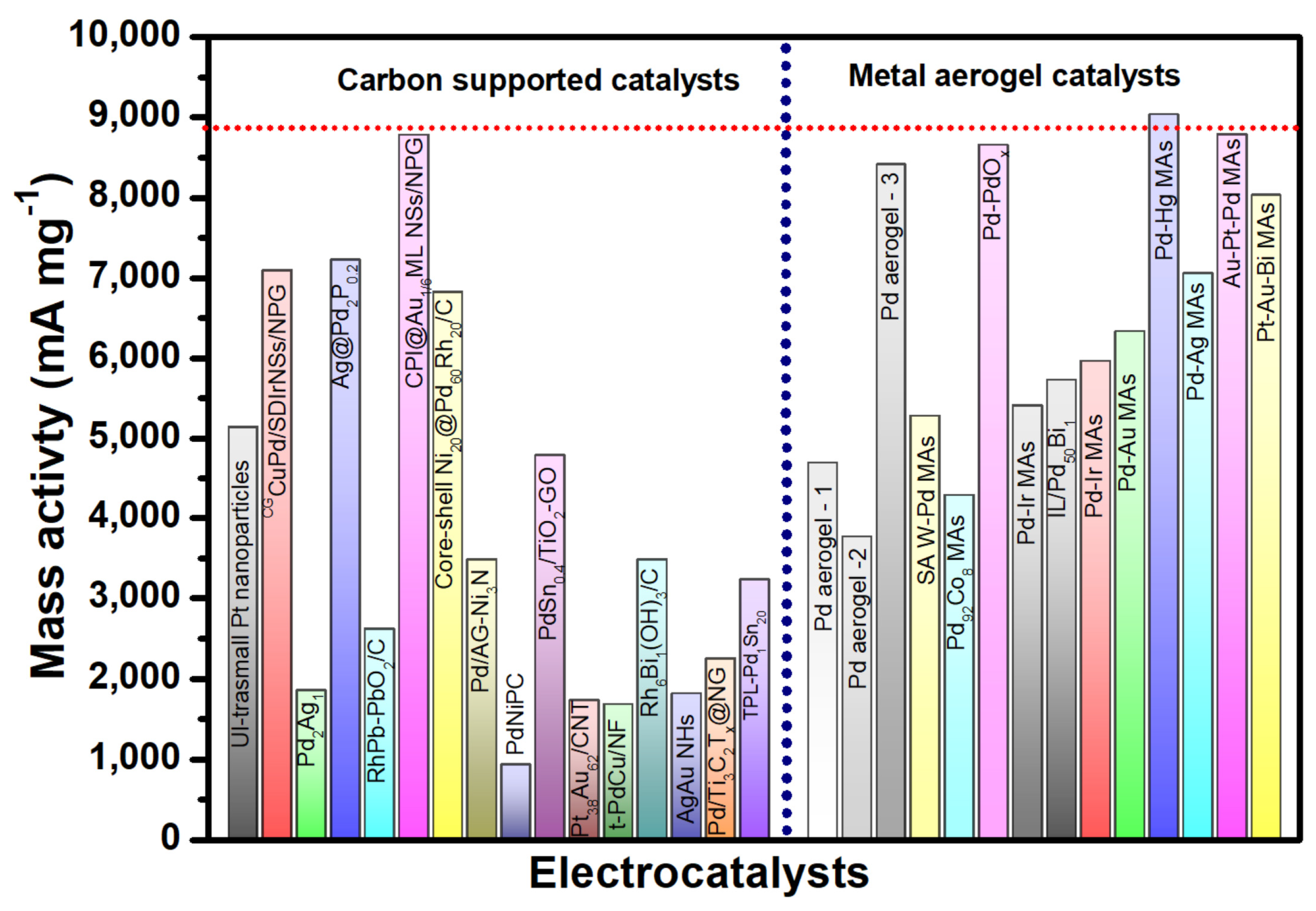
| Metal Aerogel Catalyst | Reducing Agent/Gelation Time | BET/ECSA Surface Area (m2 g−1) | Electrolyte | If/Ib of Metal Aerogel Catalyst | If/Ib vs. Standard Catalyst | Mass Activity of Aerogel Catalyst | Mass Activity vs. Standard Catalyst | Ref. |
|---|---|---|---|---|---|---|---|---|
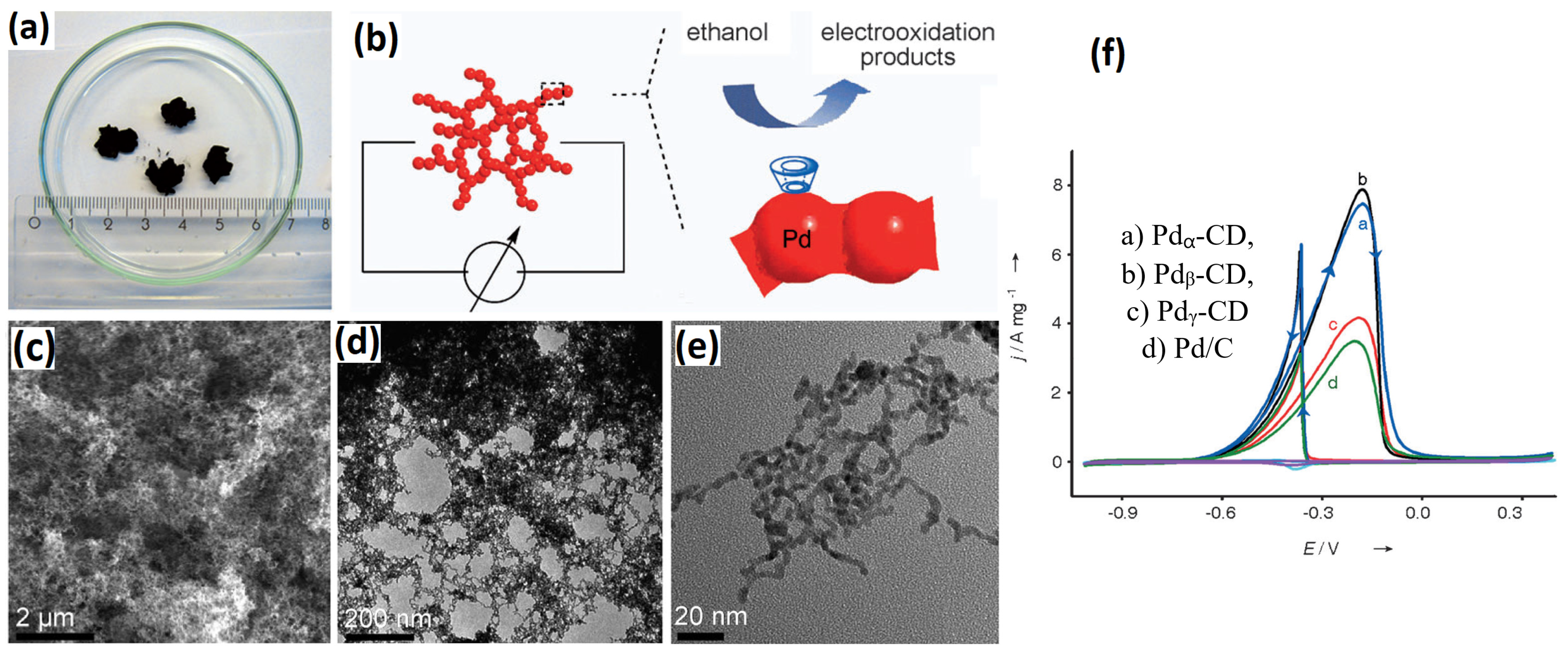
| Pdα-CD aerogel | NaBH4 | 92/69 | 1.0 M KOH + 1.0 M C2H5OH | 1.28 | 1.09 (Pd/C) | NR | NR | [48] |
| Pd | Na2CO3 and C2H2O3. H2O | 50/133 | 1.0 M KOH + 0.5 M C2H5OH | 1.59 | 0.6 (Pd/C) | 4.703 A mg−1 | NR | [88] |
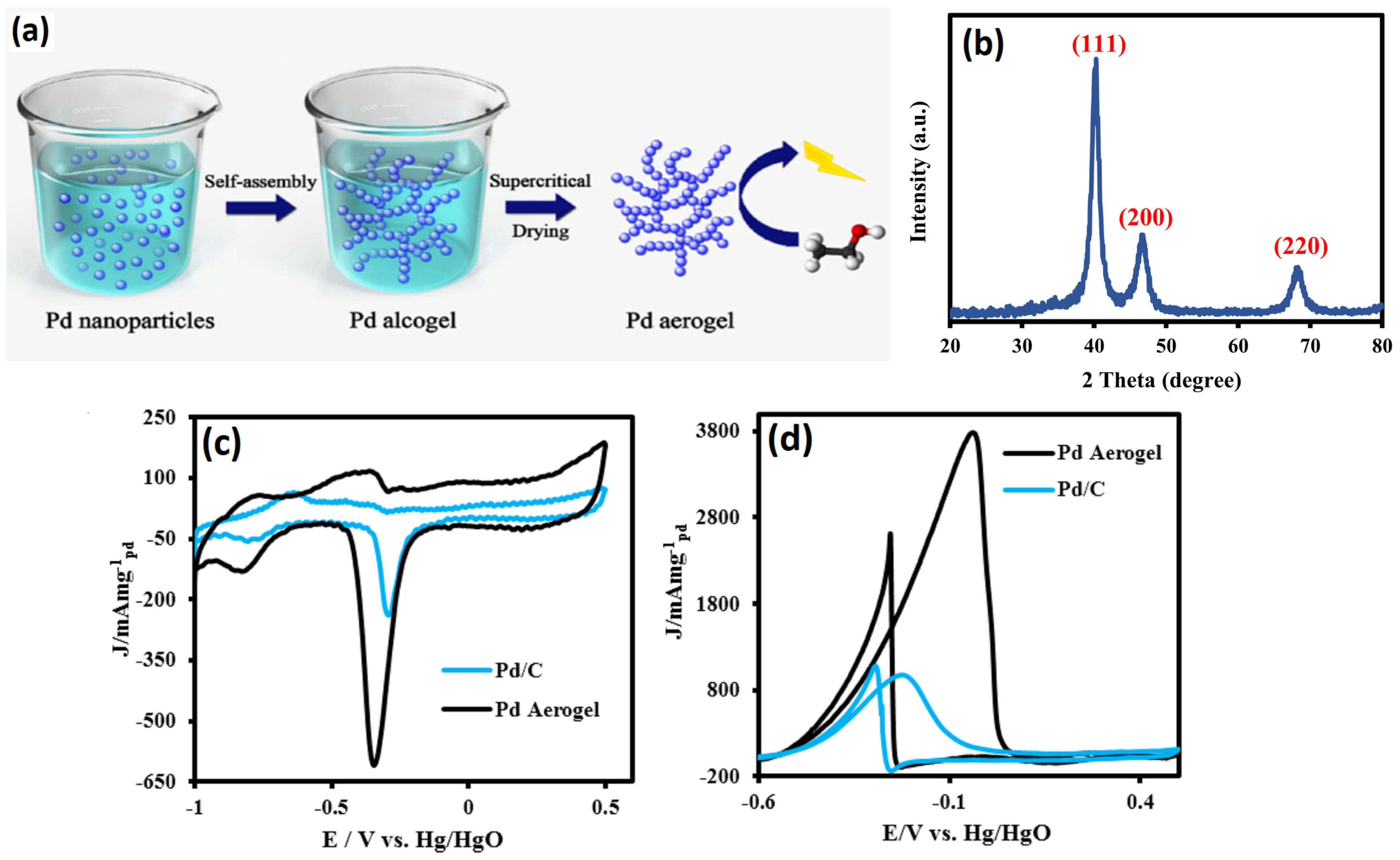
| Pd aerogel | C2H5OH/NaOH 2 h | 44/75 | 1.0 M KOH + 1.0 M C2H5OH | 1.53 | 0.6 (Pd/C) | 3787 mA mg−1 | 1074 mA mg−1 | [66] |
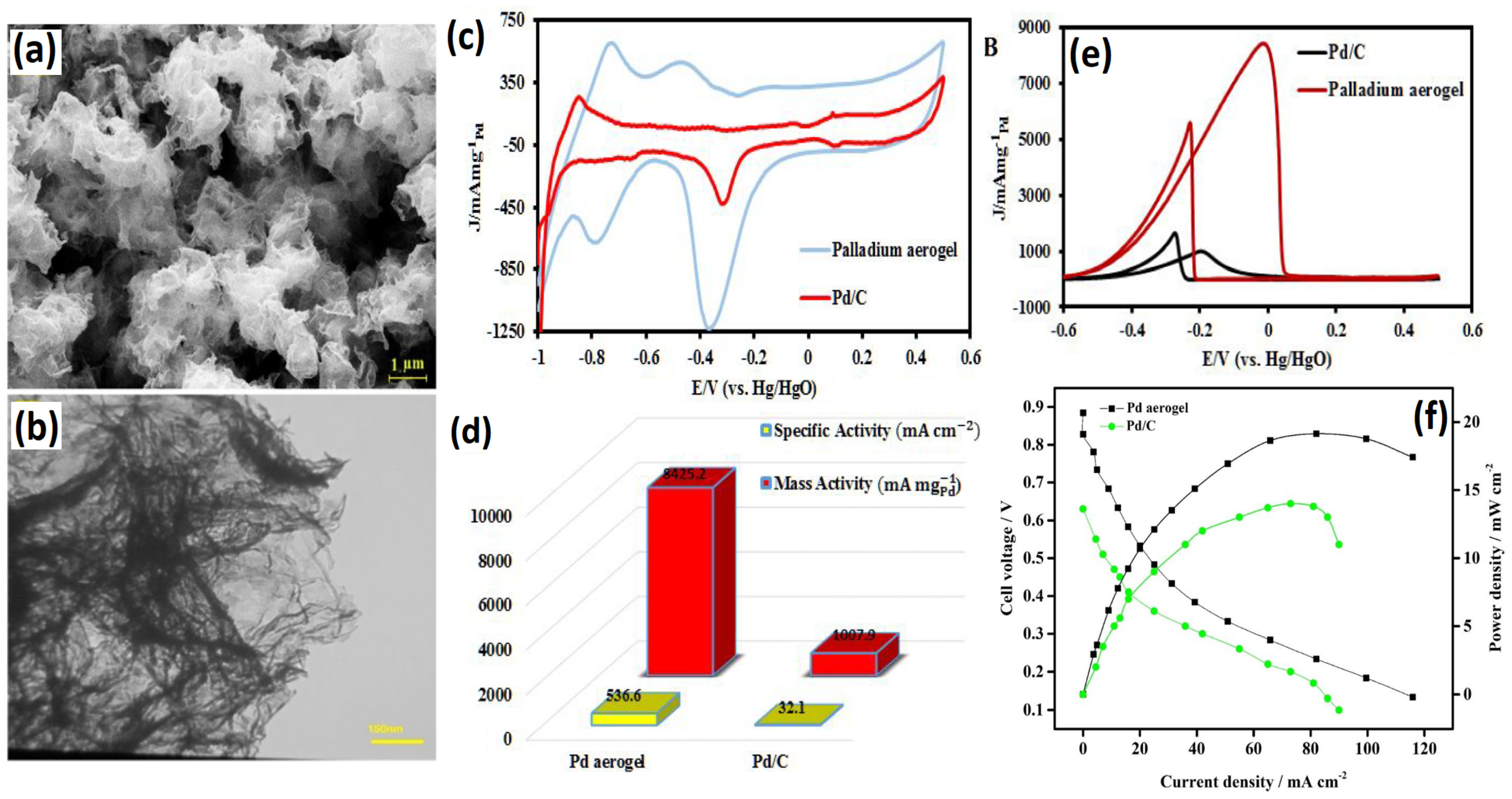
| Pd aerogel | CO gas/2 days | 75/77 | 1.0 M KOH + 0.5 M C2H5OH | 1.48 | 0.6 (Pd/C) | 8425.2 mA mg−1 | 1007.9 mA mg−1 | [73] |
| Pd (FA) formic acid | CO gas/4 h at 50 °C | NR | 1.0 M KOH + 1.0 M C2H5OH | 1.38 | 1.0 (Pd/C) | 284 mAcm−2 (oxidation current) | 78.1 (oxidation current) | [76] |
| Pd (PA) propionic acid | CO gas/4 h at 50 °C | NR | 1.0 M KOH + 1.0 M C2H5OH | 1.72 | 1.0 (Pd/C) | 478 (oxidation current) | 78.1 (oxidation current) | [76] |
| Pd (BA) (butyric acid) | CO gas/4 h at 50 °C | NR | 1.0 M KOH + 1.0 M C2H5OH | 1.39 | (Pd/C) | 380 (oxidation current) | 78.1 (oxidation current) | [76] |
| Pd (AA) (acetic acid) | CO gas/4 h at 50 °C | NR | 1.0 M KOH + 1.0 M C2H5OH | 1.69 | 1.0 (Pd/C) | 533 (oxidation current) | 78.1 (oxidation current) | [76] |
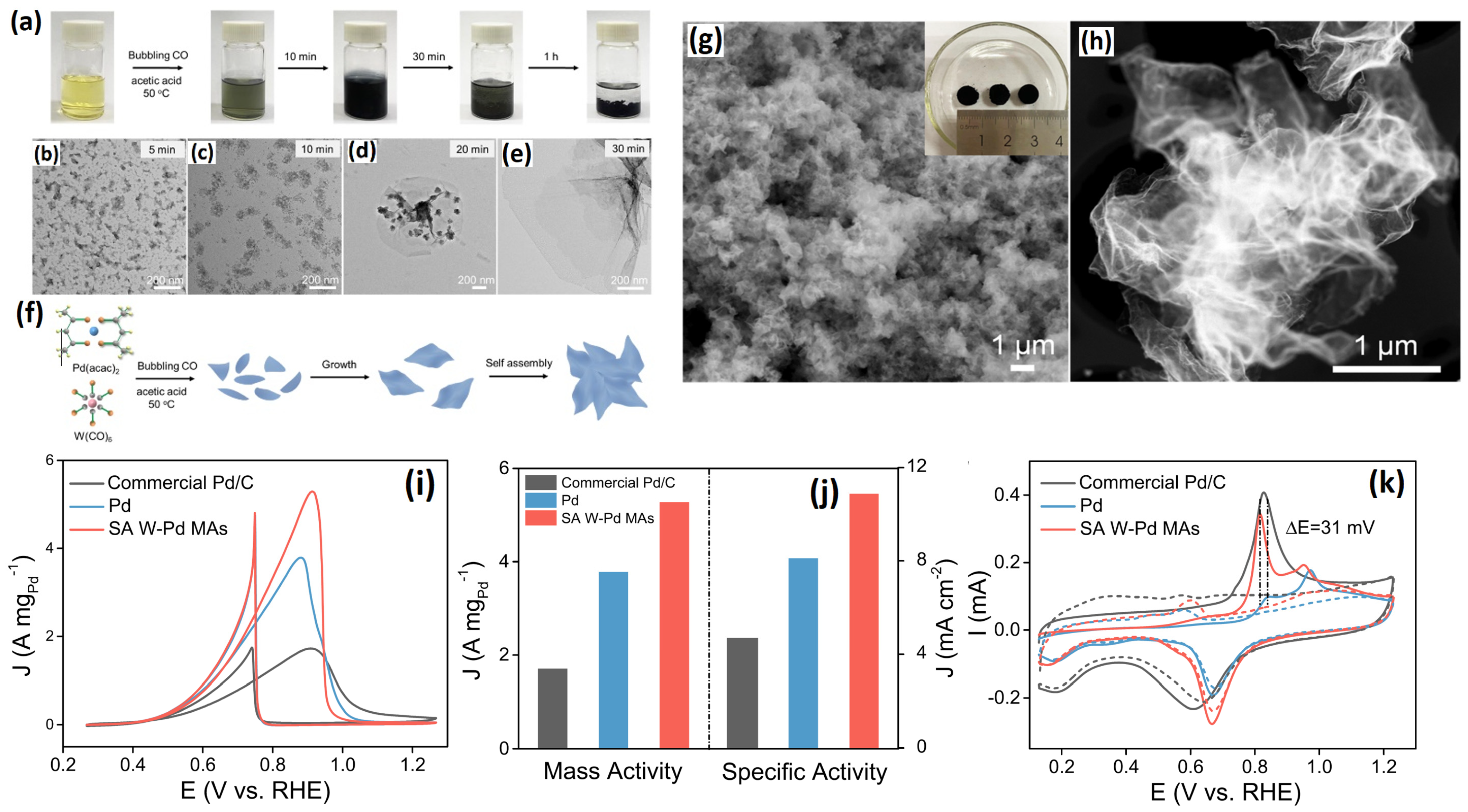
| SA W-Pd MAs | CO gas/1 h at 50 °C | 44/48 | 1.0 M KOH + 1.0 M C2H5OH | 1.30 | 0.99 (Pd/C) | 5.29 A mgPd−1 | 3.1 times lower (Pd/C) | [77] |
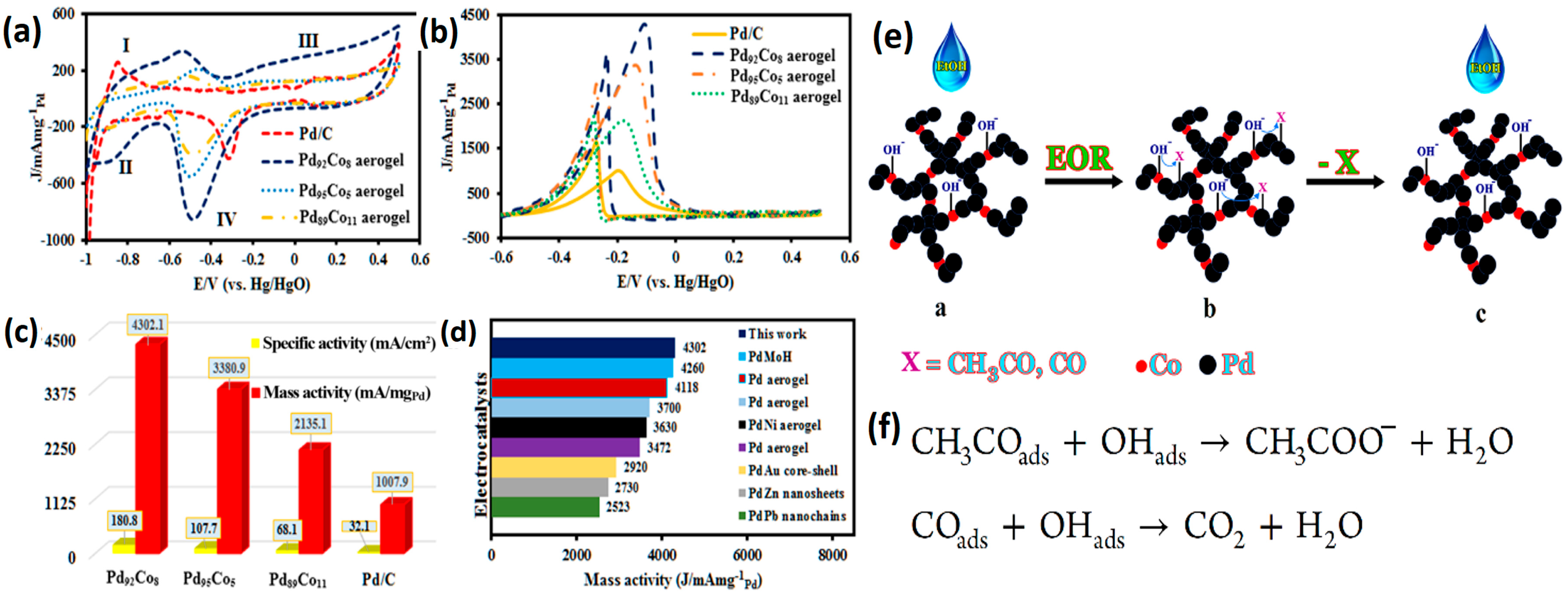
| Pd92Co8 aerogel | NaBH4/1.83 h at 70 °C | 32/107 | 1.0 M KOH + 0.5 M C2H5OH | 1.17 | 0.6 (Pd/C) | 4302 mA mg−1 | 1008 mA mg−1 | [82] |
| Pd-CoOx | Na2CO3/12 h | 203/52 | 1.0 M KOH + 1.0 M C2H5OH | NR | NR | 8.67 A mg−1 | 7.4 times lower | [83] |
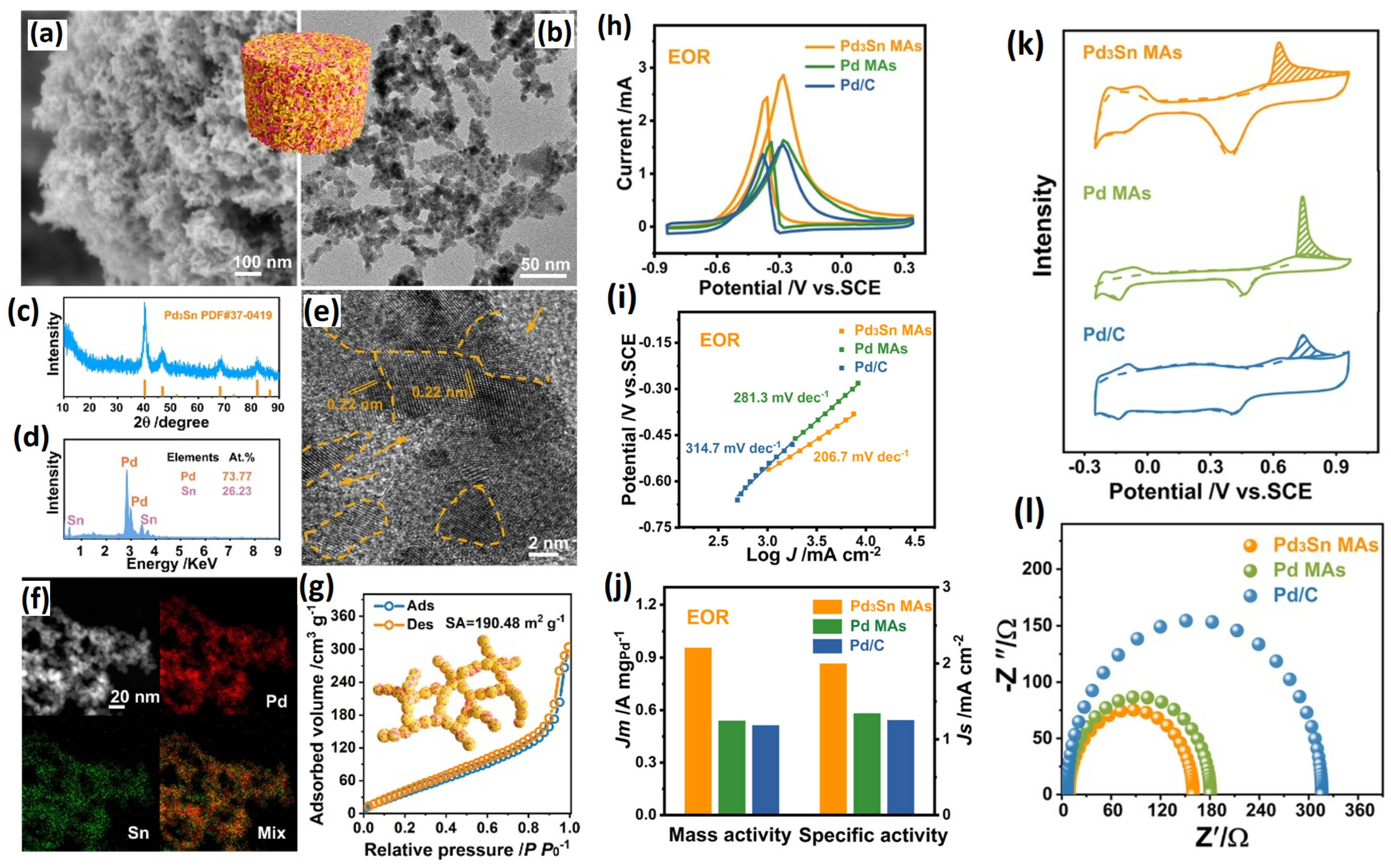
| Pd3Sn MAs | N2H4·H2O/rest until hydrogel forms | 190/47 | 1.0 M KOH + 0.5 M C2H5OH | NR | NR | 0.96 A mg−1 | NR | [98] |
| Pd-Ir aerogel | NaBH4/2.41 h, 60 °C | 42/68 | 1.0 M KOH + 0.5 M C2H5OH | 1.45 | 0.6 (Pd/C) | 5416 mA mg−1 | 1007 mA mg−1 | [135] |
| IL/Pd50Bi1 hydrogels | NaBH4/1 h at 60 °C | 46/59 | 1.0 M KOH + 1.0 M C2H5OH | 1.03 | 0.73 (Pd/C) | 5.74 A mg−1 | 1.40 mA mg−1 | [87] |
| Pd-Ir aerogel | HCHO, Na2CO3/~2 h at 60 °C | 57/90 | 1.0 M KOH + 0.5 M C2H5OH | 1.49 | 0.6 (Pd/C) | 5977.7 mA mg−1 | 1008 mA mg−1 | [85] |
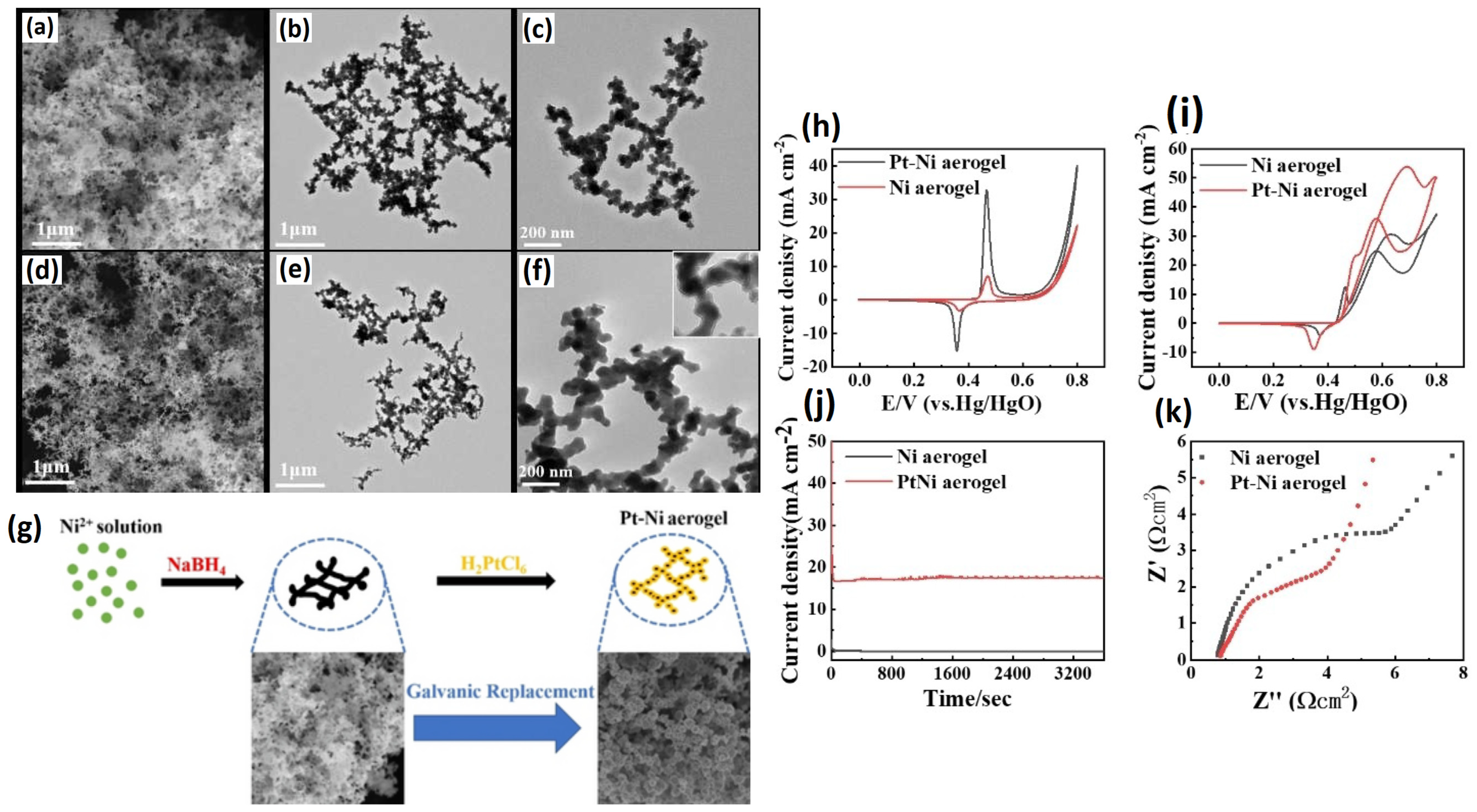
| Pd-Au aerogel | C2H2O3, Na2CO3/5 h at 60 °C | 90/136 | 1.0 M KOH + 0.5 M C2H5OH | 1.86 | 0.6 (Pd/C) | 6344 mA mg−1 | 1007 mA mg−1 | [136] |
| Pt6-Ru MAs | NaBH4/12–24 h | 99/13 | 1.0 M KOH + 0.5 M C2H5OH | Higher If/Ib of Pt6-Ru MAs than Pt/C | 1.264 A mgPt−1 | 0.696 A mgPt−1 | [100] | |
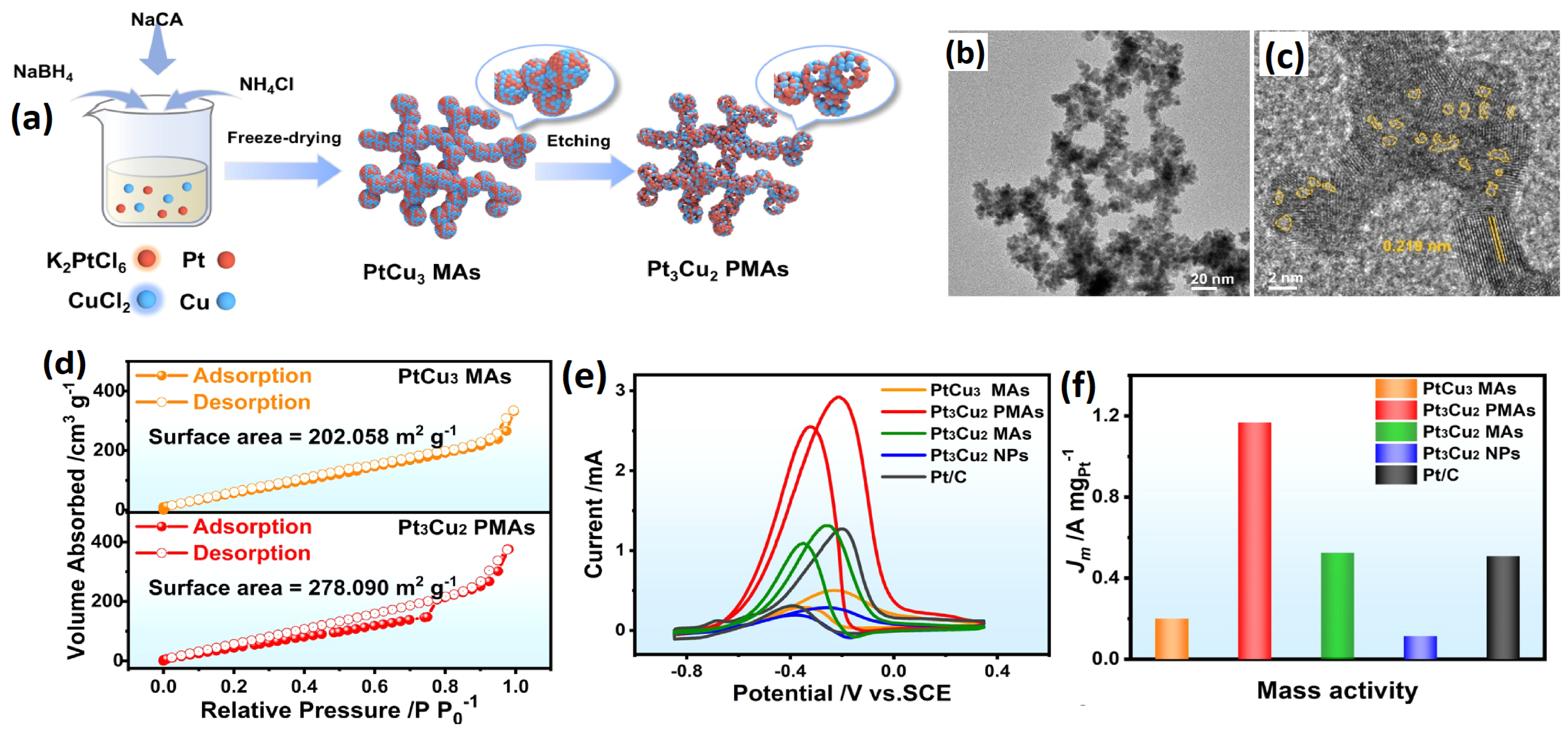
| Pt3Cu2 PMAs | Sodium citrate, NH4Cl, NaBH4 | 278/54 | 1.0 M KOH + 0.5 M C2H5OH | Higher If/Ib of Pt3Cu2 PMA MAs than Pt/C | 1.17 A mg Pt−1 | 0.51A mg Pt−1 | [101] | |
| PtHg aerogel | NaBH4/8 h at 60 °C | 27/23 | 1.0 M KOH + 1.0 M C2H5OH | Higher If/Ib of PtHg aerogel MAs than Pt/C | 9.05 A mg Pt−1, 10.5-times-higher mass activity | [107] | ||
| Auβ-CD | Dopamine, β-CD 6 h | 50/18 | 1.0 M NaOH + 1.0 M C2H5OH | 5.1 | NR | 0.31 A mg−1 | NR | [108] |
| Au-Pd | NaBH4/4–6 h | ~60/NR | 1.0 M NaOH + 1.0 M C2H5OH | 1.5 times higher than Pd/C | 3.79 A mg−1 | 1.68 A mg−1 | [110] | |
| Au50Pt50 gel | NaBH4/12 h | NR | 1.0 M NaOH + 1.0 M C2H5OH | Higher If/Ib than the Pt/C | ~2.8 times improvement | [116] | ||
| Au-Pd-Pt | NH4F/Na3C6H5O7 90 s/2–3 days | 42.6/NR | 1.0 M NaOH + 1.0 M C2H5OH | 1.4 | NR | 1.8 A mgPd−1 8.8 A mgPd+Pt−1 | 0.9 A mgPt−1 | [120] |
| Pd-Ag aerogel | Galvanic displacement reaction (GDR) | NR/83 | M NaOH + 0.5 M C2H5OH | Higher If/Ib of Pd-Ag aerogel than Pt/C | 7066.7 mA mgPd−1 | 1007.9 mAmg Pd−1 | [127] | |
| Au/Ag/Pd aerogel | NaBH4/16–24 h | 269/ | 1.0 M NaOH + 1.0 M C2H5OH | 8 times higher If/Ib | ∼20−30 times increase in current density | [137] | ||
| Au-Pt-Pd gel | NaBH4/1 h | 6.5/83 | 1.0 M NaOH + 1.0 M C2H5OH | 1.15 | 1.19 | 8.8 A mg−1Pt+Pd | 1.14 A mg−1Pt+Pd | [138] |
| Ag/Pt/Pd-2 | NaBH4/2–3 days of aging | 119/NR | 1.0 M NaOH + 1.0 M C2H5OH | Higher oxidation currents for MAs over Pd/C | 5-times-higher mass activity for aerogel (2444.5 mA/mg) over Pd/C | [139] | ||
| Pt-Au-Bi aerogel | NaBH4/8 h | 29/115 | 1.0 M NaOH + 1.0 M C2H5OH | Higher oxidation currents for MAs over Pd/C | 8045 mA mgPt−1 | 1064 mA mgPt−1 | [140] | |
| Electrocatalyst | Mass Activity (mA mg−1) for EOR | Reference |
|---|---|---|
| Ultra-small Pt nanoparticles | 5150 mA mg−1 | [141] |
| CGCu1Pd1/SDIr0.03 NSs/NPG | 7105 mA mg−1 | [142] |
| Pd2Ag1 nanosheets | 1866 mA mg−1 | [143] |
| Ag@Pd2P0.2 | 7240 mA mg−1 | [144] |
| RhPb-PbO2/C | 2636 mA mg−1 | [145] |
| CPI@Au1/6ML NSs/NPG | 8796 mA mg−1 | [146] |
| Core–shell Ni20@Pd60Rh20/C | 6835 mA mg−1 | [147] |
| Pd/AG-Ni3N | 3500 mA mg−1 | [148] |
| PdNiP/C | 949 mA mg−1 | [149] |
| PdSn0.4/TiO2-GO | 4800 mA mg−1 | [150] |
| Pt38Au62/CNTs | 1746 mA mg−1 | [151] |
| t-PdCu/NF | 1695 mA mg−1 | [152] |
| Rh9Bi1(OH)3/C | 3500 mA mg−1 | [153] |
| AgAu nanohybrids | 1834 mA mg−1 | [154] |
| Pd/Ti3C2Tx@NG | 2262 mA mg−1 | [155] |
| TPL-Pd1Sn20 | 3246 mA mg−1 | [156] |
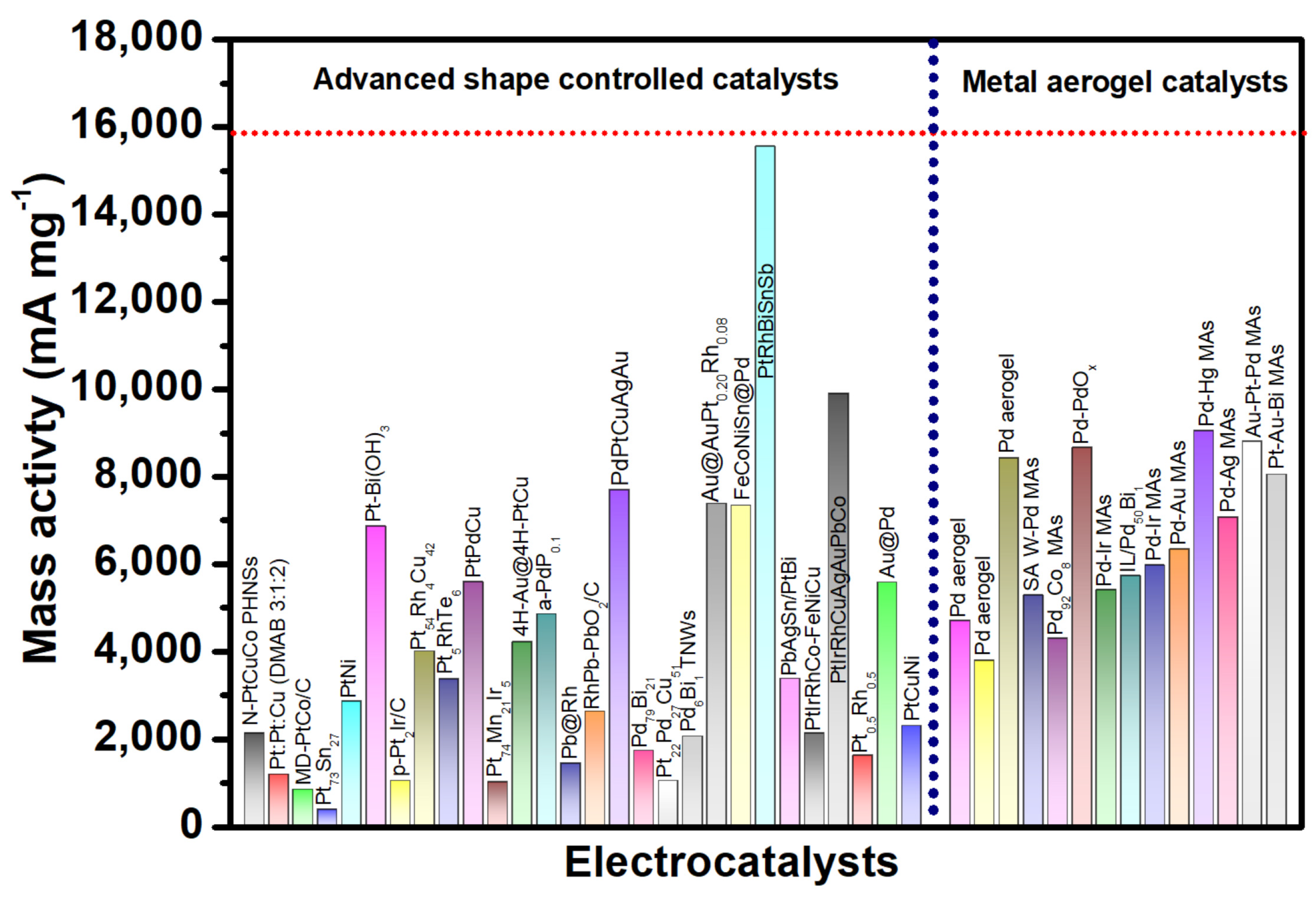
| Electrocatalyst | Morphology | Mass Activity (mA mg−1) for EOR | Reference |
|---|---|---|---|
| N–PtCuCo PHNSs | Nanowire | 2140 mA mgPt−1 | [157] |
| Pt2−:Pt2+:Cu (DMAB,3:1:2) | Macrobeams and macrotubes | 1200 mA/gPt | [158] |
| MD-PtCo/C | Nanoporous | 850 mA/mgPt | [159] |
| Pt73Sn27 | 3D nanostructure | ≈400 mA mgPt−1 | [160] |
| PtNi | Multicubes | 2860 mA/mgPt | [161] |
| Pt-Bi(OH)3 | Nanoframes | 6870 mA/mgP | [162] |
| p-Pt2Ir/C | Nanocrystals | 1019 mA/mgpt | [163] |
| Pt54Rh4Cu42 | Cubic nanoboxes | 4000 mA/gPt | [164] |
| Pt5RhTe6 | 1D nanotubes | 3370 mA/mgpt+Rh | [165] |
| PtPdCu NDs | Nanodendrites | 5590 mA/mgPtPd | [166] |
| Pt74Mn21Ir5 | Nanowires | 1020 mA mg−1 | [167] |
| 4H-Au@4H-PtCu | Nanoribbons | 4220 mA mg−1 | [168] |
| a-PdP0.1 | Amorphous palladium-based alloy nanoparticles | 4851 mA mg−1 metal | [169] |
| Pb@Rh | Core–shell | 1454 mA mg−1 | [170] |
| RhPb–PbO2/C | Carbon-supported nanoparticles | 2636 mA mg−1 | [171] |
| PdPtCuAgAu | High-entropy nanowire | 7700 mA mg−1Pd+Pt | [172] |
| Pd79Bi21 | Nanochains | 1740 mA mg−1Pd | [173] |
| Pt22Pd27Cu51 | Ultrathin nanowires | 1050 mA mg−1PtPd | [174] |
| Pd6Bi1 TNWs | Ultrathin twisty nanowires | 2066 mA mg−1Pd | [175] |
| Au@AuPt0.20Rh0.08 | Core–shell nanowires | 7380 mAmg−1Pt | [176] |
| FeCoNiSn@Pd | High entropy alloy | 7340 mA mg−1Pd | [177] |
| PtRhBiSnSb | Hexagonal close-packed High-entropy intermetallic | 15,558 mA mg−1Pt+Rh | [178] |
| PdAgSn/PtBi | High-entropy alloy NPs | 3386 mA mg(Pd+Pt)−1 | [179] |
| PtIrRhCoFeNiCu | High-entropy alloy NP nanodendrites | 2130 mA mg Pt−1 | [180] |
| PdPtCuAgAuPbCo | High-entropy alloy nanowires | 9900 mA mgPd+Pt−1 | [181] |
| Pt0.5Rh0.5 | Hollow-structured | 1629 mA gPtRh−1 | [182] |
| Au@Pd | nanoframe@arrays | 5580 mA mg−1, | [183] |
| PtCuNi | Nanohexapods | 2310 mA mgPt−1 | [184] |
3. Conclusions
4. Challenges and Future Perspectives
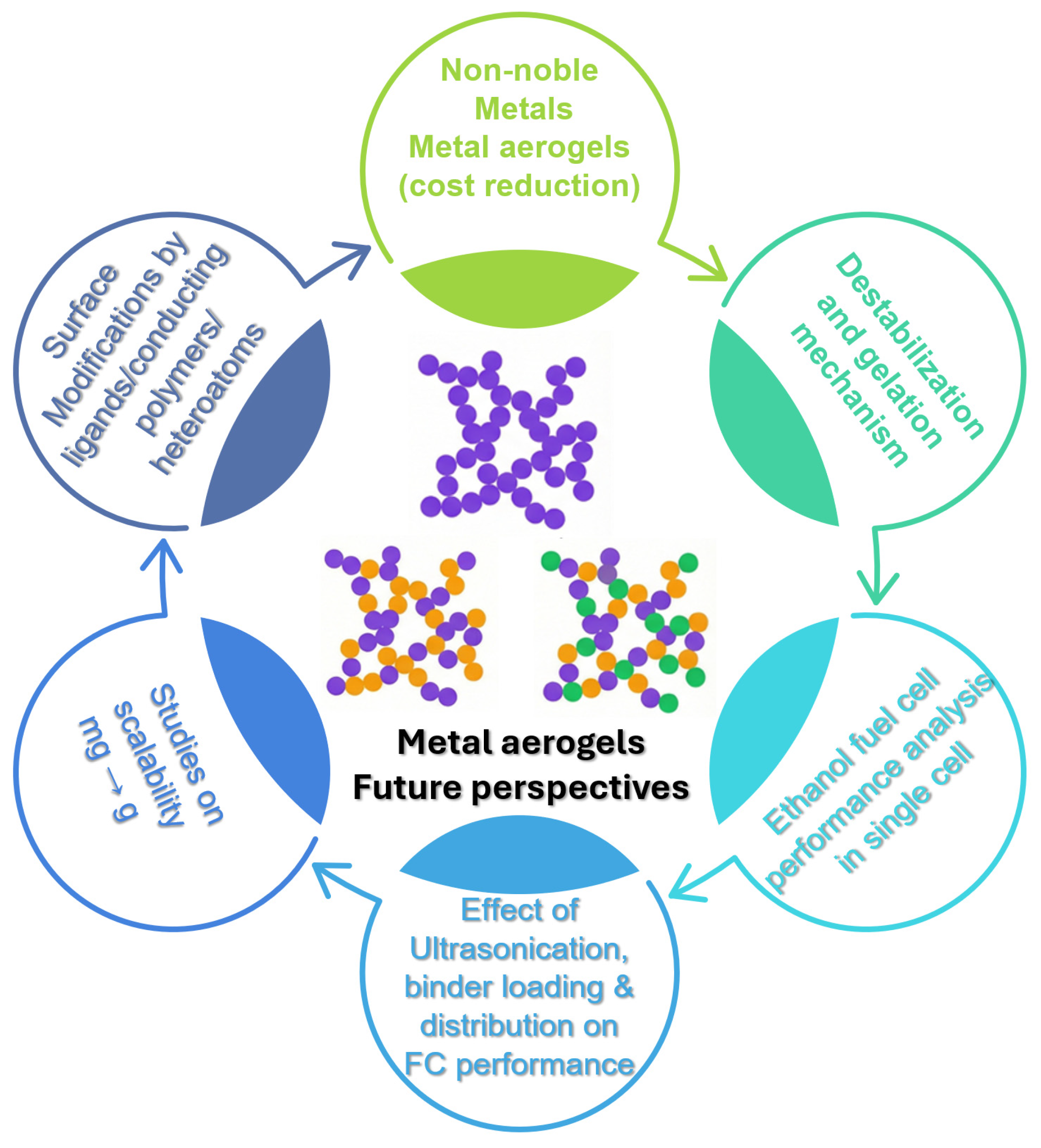
- It is well established that the type of reductant used during metal aerogels synthesis influences the morphology, size distribution, and self-destabilizing behavior of the resulting materials. To date, most metal aerogels have been prepared entirely or largely using NaBH4 as a reductant. Therefore, it is essential to identify alternative reductants that might change the morphology and size distribution of the metal aerogel catalysts.
- One of the important steps of metal aerogel synthesis is the destabilization of colloidal nanoparticles to obtain gels. Over the past decade, the gelation time for metal aerogels has been greatly reduced, from a few weeks to a few hours, due to continuous research efforts. However, knowledge on the mechanism of gelation has largely remained unknown, except for a few examples, such as NaBH4. Therefore, it is essential to understand the destabilization and gelation mechanism with a combined theoretical and experimental approach in order to tune the gelation step and control the morphology, size and growth of metal aerogels.
- Despite significant advancements and the number of high-performance metal aerogels, there are still two significant obstacles to overcome. First, a significant obstacle to simple material production is the lack of a sufficiently quick gelation process (e.g., <10 min) for a low-to-medium metal concentration (e.g., cM < 1.0 mM) at ambient temperature. Therefore, efficient gelation processes need to be developed.
- Since their discovery in 2009, all research until now has only been concentrated on noble metals and their combinations and few transition metals. Although noble metal aerogels exhibit excellent mass activities, these catalysts still contain noble metals and therefore remain expensive for commercial applications. Thus, it is essential to explore non-noble metal aerogels that might truly reduce the catalyst cost.
- Ethanol oxidation is known to procced via a 12-electron transfer for complete oxidation. Hence, it is essential to understand whether or not metal aerogels proceed through a 12-electron transfer. To date, few studies have clearly reported the number of electrons transferred during the EOR over metal aerogels. Therefore, detailed studies are required for analyzing the potential of metal aerogels in comparison with traditional catalysts for complete or incomplete oxidation reactions.
- The commercial potential of metal aerogel catalysts will only be recognized when they are applied as anode catalysts in realistic direct ethanol fuel cells, for which recording power density curves is paramount. Unfortunately, none of the studies have been dedicated to this direction. We believe that half-cell characterization of the catalyst in a traditional three-electrode system gives a fundamental idea of the activity of the catalysts; however, realistic applications will only be realized through a fuel cell power density analysis.
- When analyzing the potential of metal aerogels, it is essential to coat the catalyst layer onto the carbon substrate of the gas diffusion layer. This requires the preparation of catalyst ink through ultrasonication. However, it remains unclear how the three-dimensional network morphology of metal aerogels changes during sonication. It is highly likely that the metallic network disintegrates, losing the advantages of metal aerogel physicochemical properties. Therefore, dedicated studies are required to investigate the morphological changes that occur during ink preparation. Recommendations about ultrasonication power, time and ink preparation protocols are also needed.
- Furthermore, during the ink preparation process, the addition of a binder and its effect on the blockage of the metallic active sites remain unclear. The effects of ionomer loading and distribution in metal aerogels may differ from those in traditional carbon-supported catalysts.
- Although metal aerogels exhibit a high mass activity, they are prone to undergoing coalescence, resulting in a reduction in catalyst stability. So far, most studies have focused primarily on the synthesis of metal aerogels, while only limited attention has been given to stability testing. Therefore, it is highly essential to comprehend their stability behavior and recommend standard operating protocols. After examining several research works on metal aerogel catalysts for the EOR, we found that almost all the research works predominantly used chronoamperometry (I vs. t) as a tool to measure the stability of the catalysts. Unfortunately, the stability tests were carried out for relatively short time periods. Furthermore, the stability tests were only done in a traditional three-electrode system in liquid electrolytes. We believe that current studies do not reflect the stability of metal aerogel catalysts in realistic experimental conditions such as fuel cell conditions and potential cycling conditions.
- It is highly recommended to develop novel in situ metal aerogel MEA coating processes that mitigate the disadvantages of the effects of ultrasonication on the structural and morphological changes to metal aerogel catalysts.
- To date, the yield of metal aerogels has generally been limited to milligram levels. In order to realize the commercialization status of metal aerogels, it is important to scale up metal aerogel synthesis from mg to gram levels.
- Further improvements in metal aerogel catalysts could be achieved through surface medication techniques, either by ligands/conducting polymers, which may help in the stabilization of metal aerogels against coalescence. In addition, the modification of metal aerogels with heteroatoms such as N, S, P, B, and F could substantially improve ethanol oxidation kinetics and catalyst stability.
- One of the important challenges in applying metal aerogels in MEAs is their impact on catalyst porosity and catalyst layer thickness. When MEAs are made using a hot-press, there is a high change that the intrinsic porosity of the metal aerogels may be compressed, which could affect the mass transfer of reactants and products. In addition, due to no carbon, the metal aerogels will significantly reduce the catalyst layer thickness. Therefore, systematic studies on catalyst layer thickness and catalyst loading optimization are highly required.
Author Contributions
Funding
Institutional Review Board Statement
Informed Consent Statement
Data Availability Statement
Acknowledgments
Conflicts of Interest
References
- Aminudin, M.; Kamarudin, S.; Lim, B.; Majilan, E.; Masdar, M.; Shaari, N. An overview: Current progress on hydrogen fuel cell vehicles. Int. J. Hydrogen Energy 2022, 48, 4371–4388. [Google Scholar] [CrossRef]
- Pramuanjaroenkij, A.; Kakaç, S. The fuel cell electric vehicles: The highlight review. Int. J. Hydrogen Energy 2022, 48, 9401–9425. [Google Scholar] [CrossRef]
- Vallejo-Cervantes, C.; Espinoza-Andaluz, M.; Iranzo, A. Technical review of commercial LT-PEMFC technologies: Performance, applications and challenges. Int. J. Hydrogen Energy 2025, 176, 151480. [Google Scholar] [CrossRef]
- Mo, S.; Du, L.; Huang, Z.; Chen, J.; Zhou, Y.; Wu, P.; Meng, L.; Wang, N.; Xing, L.; Zhao, M.; et al. Recent Advances on PEM Fuel Cells: From Key Materials to Membrane Electrode Assembly. Electrochem. Energy Rev. 2023, 6, 28. [Google Scholar] [CrossRef]
- Pedersen, A.; Pandya, J.; Leonzio, G.; Serov, A.; Bernardi, A.; Stephens, I.E.L.; Titirici, M.-M.; Petit, C.; Chachuat, B. Comparative techno-economic and life-cycle analysis of precious versus non-precious metal electrocatalysts: The case of PEM fuel cell cathodes. Green Chem. 2023, 25, 10458–10471. [Google Scholar] [CrossRef]
- Wang, X.; Cheng, T.; Hong, H.; Guo, H.; Lin, X.; Yang, X.; Nie, B.; Hu, Z.; Zou, J. Challenges and opportunities in hydrogen storage and transportation: A comprehensive review. Renew. Sustain. Energy Rev. 2025, 219, 115881. [Google Scholar] [CrossRef]
- Xie, Z.; Jin, Q.; Su, G.; Lu, W. A Review of Hydrogen Storage and Transportation: Progresses and Challenges. Energies 2024, 17, 4070. [Google Scholar] [CrossRef]
- Berretti, E.; Osmieri, L.; Baglio, V.; Miller, H.A.; Filippi, J.; Vizza, F.; Santamaria, M.; Specchia, S.; Santoro, C.; Lavacchi, A. Direct Alcohol Fuel Cells: A Comparative Review of Acidic and Alkaline Systems. Electrochem. Energy Rev. 2023, 6, 30. [Google Scholar] [CrossRef]
- Azam, A.; Lee, S.; Masdar, M.; Zainoodin, A.; Kamarudin, S. Parametric study on direct ethanol fuel cell (DEFC) performance and fuel crossover. Int. J. Hydrogen Energy 2019, 44, 8566–8574. [Google Scholar] [CrossRef]
- Nguyen, A.Q.K.; Pham, H.Q.; Huynh, S.T.M.; Huynh, T.T. Milestones of Electrocatalyst Development for Direct Alcohol Fuel Cells. Adv. Sustain. Syst. 2023, 7, 202300205. [Google Scholar] [CrossRef]
- Liang, C.; Zhao, R.; Chen, T.; Luo, Y.; Hu, J.; Qi, P.; Ding, W. Recent Approaches for Cleaving the C─C Bond During Ethanol Electro-Oxidation Reaction. Adv. Sci. 2024, 11, e2308958. [Google Scholar] [CrossRef] [PubMed]
- Zakaria, Z.; Kamarudin, S.; Timmiati, S. Membranes for direct ethanol fuel cells: An overview. Appl. Energy 2016, 163, 334–342. [Google Scholar] [CrossRef]
- Zakaria, Z.; Kamarudin, S.K.; Wahid, K.A.A. Polymer electrolyte membrane modification in direct ethanol fuel cells: An update. J. Appl. Polym. Sci. 2022, 140, e53383. [Google Scholar] [CrossRef]
- Torrero, J.; Peña, M.A.; Retuerto, M.; Pascual, L.; Rojas, S. Infrared study of the electrooxidation of ethanol in alkaline electrolyte with Pt/C, PtRu/C and Pt3Sn. Electrochimica Acta 2019, 319, 312–322. [Google Scholar] [CrossRef]
- Yaqoob, L.; Noor, T.; Iqbal, N. A comprehensive and critical review of the recent progress in electrocatalysts for the ethanol oxidation reaction. RSC Adv. 2021, 11, 16768–16804. [Google Scholar] [CrossRef]
- Osman, S.H.; Zakaria, Z.; Kamarudin, S.K.; Abdullah, M.K. Catalyst modification in direct ethanol fuel cell: An update. Ionics 2024, 30, 5141–5158. [Google Scholar] [CrossRef]
- Chang, Q.; Hong, Y.; Lee, H.J.; Lee, J.H.; Ologunagba, D.; Liang, Z.; Kim, J.; Kim, M.J.; Hong, J.W.; Song, L.; et al. Achieving complete electrooxidation of ethanol by single atomic Rh decoration of Pt nanocubes. Proc. Natl. Acad. Sci. USA 2022, 119, e2112109119. [Google Scholar] [CrossRef]
- Li, C.; Selvam, N.C.S.; Fang, J. Shape-Controlled Synthesis of Platinum-Based Nanocrystals and Their Electrocatalytic Applications in Fuel Cells. Nano-Micro Lett. 2023, 15, 83. [Google Scholar] [CrossRef]
- Chen, T.; Xu, S.; Zhao, T.; Zhou, X.; Hu, J.; Xu, X.; Liang, C.; Liu, M.; Ding, W. Accelerating Ethanol Complete Electrooxidation via Introducing Ethylene as the Precursor for the C−C Bond Splitting. Angew. Chem. 2023, 135, e202308057. [Google Scholar] [CrossRef]
- Fu, X.; Wan, C.; Huang, Y.; Duan, X. Noble Metal Based Electrocatalysts for Alcohol Oxidation Reactions in Alkaline Media. Adv. Funct. Mater. 2022, 32, 2106401. [Google Scholar] [CrossRef]
- Kaur, J.; Gupta, R.K.; Kumar, A. Electrocatalytic ethanol oxidation reaction: Recent progress, challenges, and future prospects. Nanoscale Res. Lett. 2024, 19, 137. [Google Scholar] [CrossRef] [PubMed]
- Wu, Z.; Lu, X.F.; Zang, S.; Lou, X.W. Non-Noble-Metal-Based Electrocatalysts toward the Oxygen Evolution Reaction. Adv. Funct. Mater. 2020, 30, 1910274. [Google Scholar] [CrossRef]
- Bishnoi, P.; Mishra, K.; Siwal, S.S.; Gupta, V.K.; Thakur, V.K. Direct Ethanol Fuel Cell for Clean Electric Energy: Unravelling the Role of Electrode Materials for a Sustainable Future. Adv. Energy Sustain. Res. 2024, 5, 2300266. [Google Scholar] [CrossRef]
- Wang, Y.; Zou, S.; Cai, W.-B. Recent Advances on Electro-Oxidation of Ethanol on Pt- and Pd-Based Catalysts: From Reaction Mechanisms to Catalytic Materials. Catalysts 2015, 5, 1507–1534. [Google Scholar] [CrossRef]
- Poerwoprajitno, A.R.; Li, Q.; Cheong, S.; Gloag, L.; Yang, Y.; Subhash, B.; Bedford, N.M.; Watt, J.; Huber, D.L.; Gooding, J.J.; et al. Tuning the Pt–Ru Atomic Neighbors for Active and Stable Methanol Oxidation Electrocatalysis. Chem. Mater. 2023, 35, 10724–10729. [Google Scholar] [CrossRef]
- Wang, Q.; Zhou, Y.-W.; Jin, Z.; Chen, C.; Li, H.; Cai, W.-B. Alternative Aqueous Phase Synthesis of a PtRu/C Electrocatalyst for Direct Methanol Fuel Cells. Catalysts 2021, 11, 925. [Google Scholar] [CrossRef]
- Antolini, E. Catalysts for direct ethanol fuel cells. J. Power Sources 2007, 170, 1–12. [Google Scholar] [CrossRef]
- Zignani, S.C.; Baglio, V.; Linares, J.J.; Monforte, G.; Gonzalez, E.R.; Aricò, A.S. Performance and selectivity of PtxSn/C electro-catalysts for ethanol oxidation prepared by reduction with different formic acid concentrations. Electrochim. Acta 2012, 70, 255–265. [Google Scholar] [CrossRef]
- Antolini, E.; Gonzalez, E.R. A simple model to assess the contribution of alloyed and non-alloyed platinum and tin to the ethanol oxidation reaction on Pt–Sn/C catalysts: Application to direct ethanol fuel cell performance. Electrochim. Acta 2010, 55, 6485–6490. [Google Scholar] [CrossRef]
- Zhang, X.; Wang, J.; Wang, Y.; Zhao, Y.; Liu, Z.; Guo, P. Binary PdCu Nanoparticles for Electrocatalytic Ethanol Oxidation. ACS Appl. Nano Mater. 2025, 8, 19866–19874. [Google Scholar] [CrossRef]
- Qiang, L.; Wen, W.; Yan, Q.; Zhao, P.; Ma, J.; Liu, C.; Zhao, M.; He, Y.; Xiao, H.; Jia, J. Recent advances in constructing efficient electrocatalysts for ethanol oxidation reaction. J. Alloys Compd. 2024, 1001, 175120. [Google Scholar] [CrossRef]
- Đukić, T.; Pavko, L.; Jovanovič, P.; Maselj, N.; Gatalo, M.; Hodnik, N. Stability challenges of carbon-supported Pt-nanoalloys as fuel cell oxygen reduction reaction electrocatalysts. Chem. Commun. 2022, 58, 13832–13854. [Google Scholar] [CrossRef]
- Gao, Y.; Yang, S.; Liu, Y.; Zhao, Y.; Zhang, S.; Liu, D.; Du, H.; Lin, L. Advancing the Stability of Carbon-Based Catalysts for Long-Lasting Oxygen Reduction Reactions. Chemphyschem 2025, 26, e2500142. [Google Scholar] [CrossRef]
- ElSheikh, A.; McGregor, J. Unexpected Negative Performance of PdRhNi Electrocatalysts toward Ethanol Oxidation Reaction. Micromachines 2023, 14, 957. [Google Scholar] [CrossRef]
- Qi, Y.; Huang, Y.; Gao, Z.; Chen, C.H.; Perego, A.; Yildirim, H.; Odgaard, M.; Asset, T.; Atanassov, P.; Zenyuk, I.V. Insight into carbon corrosion of different carbon supports for Pt-based electrocatalysts using accelerated stress tests in polymer electrolyte fuel cells. J. Power Sources 2022, 551, 232209. [Google Scholar] [CrossRef]
- Roiron, C.; Cosenza, A.; Ferro, G.; Chen, J.L.; Wang, H.; Atanassov, P. Carbon Catalyst Supports for Pt-Based Polymer Electrolyte Membrane Fuel Cells: Porosity, Graphitization, and Chemical Modifications. Adv. Sci. 2025, 12, e08841. [Google Scholar] [CrossRef]
- Zaman, S.; Wang, M.; Liu, H.; Sun, F.; Yu, Y.; Shui, J.; Chen, M.; Wang, H. Carbon-based catalyst supports for oxygen reduction in proton-exchange membrane fuel cells. Trends Chem. 2022, 4, 886–906. [Google Scholar] [CrossRef]
- Kozhushner, A.; Li, Q.; Elbaz, L. Heteroatom-Doped Carbon Supports with Enhanced Corrosion Resistance in Polymer Electrolyte Membrane Fuel Cells. Energies 2023, 16, 3659. [Google Scholar] [CrossRef]
- Jaleh, B.; Nasrollahzadeh, M.; Eslamipanah, M.; Nasri, A.; Shabanlou, E.; Manwar, N.R.; Zboril, R.; Fornasiero, P.; Gawande, M.B. The Role of Carbon-Based Materials for Fuel Cells Performance. Carbon 2022, 198, 301–352. [Google Scholar] [CrossRef]
- Ramli, Z.A.C.; Pasupuleti, J.; Samidin, S.; Zaiman, N.F.H.N.; Mansor, M.; Mohd, N.H.; Yusoff, Y.N.; Isahak, W.N.R.W. Advanced carbon and non-carbon supports for high performance direct ethanol fuel cells: A comprehensive review. Fuel 2025, 406, 136942. [Google Scholar] [CrossRef]
- Sapountzi, F.; Di Palma, V.; Zafeiropoulos, G.; Penchev, H.; Verheijen, M.; Creatore, M.; Ublekov, F.; Sinigersky, V.; Bik, W.A.; Fredriksson, H.; et al. Overpotential analysis of alkaline and acidic alcohol electrolysers and optimized membrane-electrode assemblies. Int. J. Hydrogen Energy 2019, 44, 10163–10173. [Google Scholar] [CrossRef]
- Yoon, J.; Kim, Y.-J.; Song, J.-Y.; Jamal, A.; Gereige, I.; Kim, C.; Jung, H.-T. Solution-free synthesis of MXene composite hybrid nanostructures by rapid Joule heating. J. Mater. Chem. A 2023, 11, 22295–22303. [Google Scholar] [CrossRef]
- Zhang, Z.; Liu, C.; Dai, Y.; Liu, B.; Guo, P.; Tu, F.; Ma, M.; Shen, L.; Zhao, Z.; Liu, Y.; et al. Sandwich-Structured MXene/Carbon Hybrid Support Decorated with Pt Nanoparticles for Oxygen Reduction Reaction. ACS Appl. Energy Mater. 2022, 5, 14957–14965. [Google Scholar] [CrossRef]
- Yuan, K.; Zheng, Y.; Zhao, Y.; Liu, L.; Altaf, A.; Chen, Y.; Wang, A.; Wu, X.; Cui, S. Bimetallic self-supported AuCu alloy aerogel with abundant diffusion channels for regulating oxygen reduction reaction by electronic structure modulation for zinc-air battery application. Chem. Eng. J. 2025, 505, 159930. [Google Scholar] [CrossRef]
- Bigall, N.C.; Herrmann, A.; Vogel, M.; Rose, M.; Simon, P.; Carrillo-Cabrera, W.; Dorfs, D.; Kaskel, S.; Gaponik, N.; Eychmüller, A. Hydrogels and Aerogels from Noble Metal Nanoparticles. Angew. Chem. Int. Ed. Engl. 2009, 48, 9731–9734. [Google Scholar] [CrossRef]
- Leventis, N.; Chandrasekaran, N.; Sotiriou-Leventis, C.; Mumtaz, A. Smelting in the age of nano: Iron aerogels. J. Mater. Chem. 2008, 19, 63–65. [Google Scholar] [CrossRef]
- Jiang, B.; Wan, Z.; Kang, Y.; Guo, Y.; Henzie, J.; Na, J.; Li, H.; Wang, S.; Bando, Y.; Sakka, Y.; et al. Auto-programmed synthesis of metallic aerogels: Core-shell Cu@Fe@Ni aerogels for efficient oxygen evolution reaction. Nano Energy 2021, 81, 105644. [Google Scholar] [CrossRef]
- Liu, W.; Herrmann, A.; Geiger, D.; Borchardt, L.; Simon, F.; Kaskel, S.; Gaponik, N.; Eychmüller, A. High-Performance Electrocatalysis on Palladium Aerogels. Angew. Chem. Int. Ed. Engl. 2012, 51, 5743–5747. [Google Scholar] [CrossRef]
- Du, R.; Eychmüller, A. Metal-Based Aerogels and Porous Composites as Efficient Catalysts: Synthesis and Catalytic Performance. Catalysts 2023, 13, 1451. [Google Scholar] [CrossRef]
- Zhang, R.; Zhao, Y. Preparation and Electrocatalysis Application of Pure Metallic Aerogel: A Review. Catalysts 2020, 10, 1376. [Google Scholar] [CrossRef]
- Peera, S.G.; Byun, M. Engineering Gel-Based Precursors into Advanced ORR Catalysts for Zn–Air Batteries and Fuel Cells: Insights into Hydrogels, Aerogels, Xerogels, Metal–Organic Gels, and Metal Aerogels. Gels 2025, 11, 479. [Google Scholar] [CrossRef]
- Alfei, S. Aerogels Part 2. A Focus on the Less Patented and Marketed Airy Inorganic Networks Despite the Plethora of Possible Advanced Applications. Int. J. Mol. Sci. 2025, 26, 10696. [Google Scholar] [CrossRef] [PubMed]
- Wang, H.; Fang, Q.; Gu, W.; Du, D.; Lin, Y.; Zhu, C. Noble Metal Aerogels. ACS Appl. Mater. Interfaces 2020, 12, 52234–52250. [Google Scholar] [CrossRef]
- Du, R.; Hu, Y.; Hübner, R.; Joswig, J.-O.; Fan, X.; Schneider, K.; Eychmüller, A. Specific ion effects directed noble metal aerogels: Versatile manipulation for electrocatalysis and beyond. Sci. Adv. 2019, 5, eaaw4590. [Google Scholar] [CrossRef]
- Wen, D.; Herrmann, A.-K.; Borchardt, L.; Simon, F.; Liu, W.; Kaskel, S.; Eychmüller, A. Controlling the Growth of Palladium Aerogels with High-Performance toward Bioelectrocatalytic Oxidation of Glucose. J. Am. Chem. Soc. 2014, 136, 2727–2730. [Google Scholar] [CrossRef] [PubMed]
- Wang, C.; Herranz, J.; Hübner, R.; Schmidt, T.J.; Eychmüller, A. Element Distributions in Bimetallic Aerogels. Acc. Chem. Res. 2023, 56, 237–247. [Google Scholar] [CrossRef]
- Jiang, X.; Du, R.; Hübner, R.; Hu, Y.; Eychmüller, A. A Roadmap for 3D Metal Aerogels: Materials Design and Application Attempts. Matter 2021, 4, 54–94. [Google Scholar] [CrossRef]
- Du, R.; Fan, X.; Jin, X.; Hübner, R.; Hu, Y.; Eychmüller, A. Emerging Noble Metal Aerogels: State of the Art and a Look Forward. Matter 2019, 1, 39–56. [Google Scholar] [CrossRef]
- Liu, W.; Herrmann, A.-K.; Bigall, N.C.; Rodriguez, P.; Wen, D.; Oezaslan, M.; Schmidt, T.J.; Gaponik, N.; Eychmüller, A. Noble Metal Aerogels—Synthesis, Characterization, and Application as Electrocatalysts. Acc. Chem. Res. 2015, 48, 154–162. [Google Scholar] [CrossRef]
- Wen, D.; Eychmüller, A. 3D assembly of preformed colloidal nanoparticles into gels and aerogels: Function-led design. Chem. Commun. 2017, 53, 12608–12621. [Google Scholar] [CrossRef]
- Weng, B.; Sun, X.; Li, J.; Hao, S.; Hübner, R.; Luo, Y.; He, Z.; Du, R. Controlled synthesis of noble metal aerogels mediated by salts. Nat. Protoc. 2025, 21, 263–292. [Google Scholar] [CrossRef]
- Antolini, E. Palladium in fuel cell catalysis. Energy Environ. Sci. 2009, 2, 915–931. [Google Scholar] [CrossRef]
- Georgi, M.; Klemmed, B.; Benad, A.; Eychmüller, A. A versatile ethanolic approach to metal aerogels (Pt, Pd, Au, Ag, Cu and Co). Mater. Chem. Front. 2019, 3, 1586–1592. [Google Scholar] [CrossRef]
- Naskar, S.; Freytag, A.; Deutsch, J.; Wendt, N.; Behrens, P.; Köckritz, A.; Bigall, N.C. Porous Aerogels from Shape-Controlled Metal Nanoparticles Directly from Nonpolar Colloidal Solution. Chem. Mater. 2017, 29, 9208–9217. [Google Scholar] [CrossRef]
- Douk, A.S.; Saravani, H.; Noroozifar, M. Novel fabrication of PdCu nanostructures decorated on graphene as excellent electrocatalyst toward ethanol oxidation. Int. J. Hydrogen Energy 2017, 42, 15149–15159. [Google Scholar] [CrossRef]
- Hajnajafi, M.; Khorshidi, A.; Farsadrooh, M.; Gilani, A.G. Nanoscale Engineering of Building Blocks to Synthesize a Three-Dimensional Architecture of Pd Aerogel as a Robust Self-Supporting Catalyst toward Ethanol Electrooxidation. Energy Fuels 2021, 35, 3396–3406. [Google Scholar] [CrossRef]
- Li, D.; Cai, K.; Wu, L.; Zuo, Y.; Yin, W.; Zhang, H.; Lu, Z.; Zhu, G.; Han, H. Ammonia Mediated One-Step Synthesis of Three-Dimensional Porous PtxCu100–x Nanochain Networks with Enhanced Electrocatalytic Activity toward Polyhydric Alcohol Oxidation. ACS Sustain. Chem. Eng. 2017, 5, 11086–11095. [Google Scholar] [CrossRef]
- Lv, F.; Huang, B.; Feng, J.; Zhang, W.; Wang, K.; Li, N.; Zhou, J.; Zhou, P.; Yang, W.; Du, Y.; et al. A highly efficient atomically thin curved PdIr bimetallene electrocatalyst. Nat. Sci. Rev. 2021, 8, nwab019. [Google Scholar] [CrossRef]
- Yu, H.; Zhou, T.; Wang, Z.; Xu, Y.; Li, X.; Wang, L.; Wang, H. Defect-Rich Porous Palladium Metallene for Enhanced Alkaline Oxygen Reduction Electrocatalysis. Angew. Chem. Int. Ed. Engl. 2021, 60, 12027–12031. [Google Scholar] [CrossRef] [PubMed]
- Dang, Q.; Lin, H.; Fan, Z.; Ma, L.; Shao, Q.; Ji, Y.; Zheng, F.; Geng, S.; Yang, S.-Z.; Kong, N.; et al. Iridium metallene oxide for acidic oxygen evolution catalysis. Nat. Commun. 2021, 12, 6007. [Google Scholar] [CrossRef]
- Xie, L.; Wang, J.; Wang, K.; He, Z.; Liang, J.; Lin, Z.; Wang, T.; Cao, R.; Yang, F.; Cai, Z.; et al. Modulating the Bader Charge Transfer in Single p-Block Atoms Doped Pd Metallene for Enhanced Oxygen Reduction Electrocatalysis. Angew. Chem. Int. Ed. Engl. 2024, 63, e202407658. [Google Scholar] [CrossRef]
- Deng, K.; Zhou, T.; Mao, Q.; Wang, S.; Wang, Z.; Xu, Y.; Li, X.; Wang, H.; Wang, L. Surface Engineering of Defective and Porous Ir Metallene with Polyallylamine for Hydrogen Evolution Electrocatalysis. Adv. Mater. 2022, 34, e2110680. [Google Scholar] [CrossRef]
- Douk, A.S.; Saravani, H. Is the Pd Aerogel Assembled by Nanosheets as an Advanced Three-Dimensional Support-less Electrocatalyst in Renewable Energy? ACS Appl. Eng. Mater. 2022, 1, 87–94. [Google Scholar] [CrossRef]
- Yin, X.; Liu, X.; Pan, Y.-T.; Walsh, K.A.; Yang, H. Hanoi Tower-like Multilayered Ultrathin Palladium Nanosheets. Nano Lett. 2014, 14, 7188–7194. [Google Scholar] [CrossRef]
- Huang, X.; Tang, S.; Mu, X.; Dai, Y.; Chen, G.; Zhou, Z.; Ruan, F.; Yang, Z.; Zheng, N. Freestanding palladium nanosheets with plasmonic and catalytic properties. Nat. Nanotechnol. 2010, 6, 28–32. [Google Scholar] [CrossRef]
- Yazdan-Abad, M.Z.; Noroozifar, M.; Douk, A.S.; Modarresi-Alam, A.R.; Saravani, H. Shape engineering of palladium aerogels assembled by nanosheets to achieve a high performance electrocatalyst. Appl. Catal. B Environ. 2019, 250, 242–249. [Google Scholar] [CrossRef]
- Wang, H.; Zheng, H.; Ling, L.; Fang, Q.; Jiao, L.; Zheng, L.; Qin, Y.; Luo, Z.; Gu, W.; Song, W.; et al. Pd Metallene Aerogels with Single-Atom W Doping for Selective Ethanol Oxidation. ACS Nano 2022, 16, 21266–21274. [Google Scholar] [CrossRef]
- Zhang, L.Y.; Ouyang, Y.; Wang, S.; Wu, D.; Jiang, M.; Wang, F.; Yuan, W.; Li, C.M. Perforated Pd Nanosheets with Crystalline/Amorphous Heterostructures as a Highly Active Robust Catalyst toward Formic Acid Oxidation. Small 2019, 15, e1904245. [Google Scholar] [CrossRef]
- Deng, Z.; Pang, W.; Gong, M.; Jin, Z.; Wang, X. Revealing the role of mo doping in promoting oxygen reduction reaction performance of Pt3Co nanowires. J. Energy Chem. 2022, 66, 16–23. [Google Scholar] [CrossRef]
- Reddy, L.E.; Gollapudi, D.; Jain, G.M.; Kolluru, S.; Ramesh, G.V. Recent progress in the development of Platinum-based electrocatalysts for the oxidation of ethanol in fuel cells. Mater. Today Proc. 2023, 92, 636–641. [Google Scholar] [CrossRef]
- Nie, Y.; Shi, Z.; Li, B.; Meyer, Q.; Zhao, C. Engineering Platinum-Based Alloy Catalysts for Oxygen Reduction Reaction in Hydrogen Fuel Cells: A Mini-Review. Energy Fuels 2025, 39, 16049–16064. [Google Scholar] [CrossRef]
- Douk, A.S.; Saravani, H. Bimetallic Pd–Co Aerogel Three-Dimensional Architecture: Developing Self-Assembled Materials for Advanced Ethanol Oxidation. ACS Omega 2023, 8, 45245–45254. [Google Scholar] [CrossRef]
- Yao, B.; Ye, J.; Wang, C.; Mu, W.; Liu, F.; Wen, D. Pd-CoOx nanocomposite aerogels for highly efficient methanol and ethanol oxidation. Appl. Surf. Sci. 2023, 631, 157540. [Google Scholar] [CrossRef]
- Wang, C.; Gao, W.; Wan, X.; Yao, B.; Mu, W.; Gao, J.; Fu, Q.; Wen, D. In situ electrochemical synthesis of Pd aerogels as highly efficient anodic electrocatalysts for alkaline fuel cells. Chem. Sci. 2022, 13, 13956–13965. [Google Scholar] [CrossRef]
- Farsadrooh, M.; Saravani, H.; Douk, A.S. Unique superstructure of Pd–Ir aerogel as a robust three-dimensional electrocatalyst. Int. J. Hydrogen Energy 2022, 47, 25638–25646. [Google Scholar] [CrossRef]
- Zhang, R.; Zhu, L.; Liu, X.; Zhu, J.; Zhao, Y. Laser-Assisted Synthesis of Pd Aerogel with Compressive Strain for Boosting Formate and Ethanol Electrooxidation. ACS Sustain. Chem. Eng. 2021, 9, 7837–7845. [Google Scholar] [CrossRef]
- Wang, H.; Jiao, L.; Zheng, L.; Fang, Q.; Qin, Y.; Luo, X.; Wei, X.; Hu, L.; Gu, W.; Wen, J.; et al. PdBi Single-Atom Alloy Aerogels for Efficient Ethanol Oxidation. Adv. Funct. Mater. 2021, 31, 2103465. [Google Scholar] [CrossRef]
- Douk, A.S.; Saravani, H.; Noroozifar, M. Three-dimensional assembly of building blocks for the fabrication of Pd aerogel as a high performance electrocatalyst toward ethanol oxidation. Electrochim. Acta 2018, 275, 182–191. [Google Scholar] [CrossRef]
- Kwon, J.; Choi, K.; Tervoort, E.; Niederberger, M. One-pot microwave synthesis of Pd modified titanium dioxide nanocrystals for 3D aerogel monoliths with efficient visible-light photocatalytic activity in a heated gas flow reactor. J. Mater. Chem. A 2022, 10, 18383–18395. [Google Scholar] [CrossRef]
- Wang, T.; Li, F.; Huang, H.; Yin, S.; Chen, P.; Jin, P.; Chen, Y. Porous Pd-PdO Nanotubes for Methanol Electrooxidation. Adv. Funct. Mater. 2020, 30, 2000534. [Google Scholar] [CrossRef]
- Lei, H.; Zhang, Q. In situ electrochemical redox tuning of Pd-Co hybrid electrocatalysts for high-performance methanol oxidation: Strong metal-support interaction. J. Colloid Interface Sci. 2021, 588, 476–484. [Google Scholar] [CrossRef] [PubMed]
- Deng, M.; Xia, M.; Wang, Y.; Ren, X.; Li, S. Synergetic catalysis of p–d hybridized single-atom catalysts: First-principles investigations. J. Mater. Chem. A 2022, 10, 13066–13073. [Google Scholar] [CrossRef]
- Li, P.; Bi, J.; Liu, J.; Wang, Y.; Kang, X.; Sun, X.; Zhang, J.; Liu, Z.; Zhu, Q.; Han, B. p–d Orbital Hybridization Induced by p-Block Metal-Doped Cu Promotes the Formation of C2+ Products in Ampere-Level CO2 Electroreduction. J. Am. Chem. Soc. 2023, 145, 4675–4682. [Google Scholar] [CrossRef]
- Wang, L.; Yu, Z.; Yan, W.; Liu, L.; Wang, M.; Kong, Q.; Hu, Z.; Geng, H.; Huang, X.; Li, Y. Palladium chalcogenide nanosheets with p-d orbital hybridization for enhanced alcohol electro-oxidation performance. Appl. Catal. B Environ. 2023, 343, 123564. [Google Scholar] [CrossRef]
- Wu, L.; Su, L.; Liang, Q.; Zhang, W.; Men, Y.; Luo, W. Boosting Hydrogen Oxidation Kinetics by Promoting Interfacial Water Adsorption on d-p Hybridized Ru Catalysts. ACS Catal. 2023, 13, 4127–4133. [Google Scholar] [CrossRef]
- Song, T.; Gao, F.; Zhang, Y.; Yu, P.; Wang, C.; Shiraishi, Y.; Li, S.; Wang, C.; Guo, J.; Du, Y. Shape-controlled PdSn alloy as superior electrocatalysts for alcohol oxidation reactions. J. Taiwan Inst. Chem. Eng. 2019, 101, 167–176. [Google Scholar] [CrossRef]
- Xue, J.; Hu, Z.; Li, H.; Zhang, Y.; Liu, C.; Li, M.; Yang, Q.; Hu, S. Pd-Sn alloy nanoparticles for electrocatalytic methanol oxidation: Phase evolution from solid solution to intermetallic compounds. Nano Res. 2022, 15, 8819–8825. [Google Scholar] [CrossRef]
- Guan, L.; Fu, H.; Zhu, T.; Chen, C.; Zhang, Z.; Pi, Y.; Zhang, N.; Liu, T. p–d Orbital Hybridization in Pd3Sn Metallic Aerogels Boosts Alcohol Electrooxidation. Chem. Mater. 2024, 36, 9741–9749. [Google Scholar] [CrossRef]
- Fu, H.; Wang, J.; Chen, Y.; Huang, H.; Wang, Y.; Li, H.; Lai, F.; Zhang, L.; Zhang, N.; Chen, J.; et al. Pd3Pb bimetallic aerogels for anti-poisoned oxygen reduction reaction. Chem. Eng. J. 2023, 470, 144255. [Google Scholar] [CrossRef]
- Tang, X.; Zeng, M.; Chen, D.; Yua, L.; Wang, C.; Li, W.; Yi, Y. Self-Supporting Bimetallic Pt-Ni Aerogel as Electrocatalyst for Ethanol Oxidation Reaction. ChemistrySelect 2021, 6, 12696–12701. [Google Scholar] [CrossRef]
- Zhang, Z.; Fu, H.; Chen, C.; Huang, Z.; Guan, L.; Li, H.; Zhang, N.; Liu, T. Defect-rich Pt-Ru metallic aerogels for highly efficient ethanol oxidation reaction. Appl. Surf. Sci. 2024, 652, 159277. [Google Scholar] [CrossRef]
- Ni, W.; Meibom, J.L.; Hassan, N.U.; Chang, M.; Chu, Y.-C.; Krammer, A.; Sun, S.; Zheng, Y.; Bai, L.; Ma, W.; et al. Synergistic interactions between PtRu catalyst and nitrogen-doped carbon support boost hydrogen oxidation. Nat. Catal. 2023, 6, 773–783. [Google Scholar] [CrossRef]
- Jiao, S.; Fu, X.; Huang, H. Descriptors for the Evaluation of Electrocatalytic Reactions: D-Band Theory and Beyond. Adv. Funct. Mater. 2021, 32, 2107651. [Google Scholar] [CrossRef]
- Zhang, Z.; Duan, S.; Pi, Y.; Chen, C.; Guan, L.; Li, H.; Zhang, N. Pt–Cu Porous Metallic Aerogels for Ethanol Electrooxidation Reaction. ACS Appl. Energy Mater. 2025, 8, 5948–5954. [Google Scholar] [CrossRef]
- Fu, H.; Zhang, N.; Lai, F.; Zhang, L.; Chen, S.; Li, H.; Jiang, K.; Zhu, T.; Xu, F.; Liu, T. Surface-Regulated Platinum–Copper Nanoframes in Electrochemical Reforming of Ethanol for Efficient Hydrogen Production. ACS Catal. 2022, 12, 11402–11411. [Google Scholar] [CrossRef]
- Pi, Y.; Guo, J.; Shao, Q.; Huang, X. Highly Efficient Acidic Oxygen Evolution Electrocatalysis Enabled by Porous Ir–Cu Nanocrystals with Three-Dimensional Electrocatalytic Surfaces. Chem. Mater. 2018, 30, 8571–8578. [Google Scholar] [CrossRef]
- Zhang, X.; Wang, T.; Wang, C.; Hübner, R.; Eychmüller, A.; Zhan, J.; Cai, B. Bimetallic Pt-Hg Aerogels for Electrocatalytic Upgrading of Ethanol to Acetate. Small 2023, 19, e2207557. [Google Scholar] [CrossRef]
- Wen, D.; Liu, W.; Haubold, D.; Zhu, C.; Oschatz, M.; Holzschuh, M.; Wolf, A.; Simon, F.; Kaskel, S.; Eychmueller, A. Gold Aerogels: Three-Dimensional Assembly of Nanoparticles and Their Use as Electrocatalytic Interfaces. ACS Nano 2016, 10, 2559–2567. [Google Scholar] [CrossRef]
- Huang, T.; Meng, F.; Qi, L. Facile Synthesis and One-Dimensional Assembly of Cyclodextrin-Capped Gold Nanoparticles and Their Applications in Catalysis and Surface-Enhanced Raman Scattering. J. Phys. Chem. C 2009, 113, 13636–13642. [Google Scholar] [CrossRef]
- Du, R.; Wang, J.; Wang, Y.; Hübner, R.; Fan, X.; Senkovska, I.; Hu, Y.; Kaskel, S.; Eychmüller, A. Unveiling reductant chemistry in fabricating noble metal aerogels for superior oxygen evolution and ethanol oxidation. Nat. Commun. 2020, 11, 1590. [Google Scholar] [CrossRef] [PubMed]
- Zhu, C.; Shi, Q.; Fu, S.; Song, J.; Xia, H.; Du, D.; Lin, Y. Efficient Synthesis of MCu (M = Pd, Pt, and Au) Aerogels with Accelerated Gelation Kinetics and their High Electrocatalytic Activity. Adv. Mater. 2016, 28, 8779–8783. [Google Scholar] [CrossRef]
- Liu, W.; Rodriguez, P.; Borchardt, L.; Foelske, A.; Yuan, J.; Herrmann, A.; Geiger, D.; Zheng, Z.; Kaskel, S.; Gaponik, N.; et al. Bimetallic Aerogels: High-Performance Electrocatalysts for the Oxygen Reduction Reaction. Angew. Chem. Int. Ed. Engl. 2013, 52, 9849–9852. [Google Scholar] [CrossRef]
- Lu, L.; Sun, X.; Ma, J.; Yang, D.; Wu, H.; Zhang, B.; Zhang, J.; Han, B. Highly Efficient Electroreduction of CO2 to Methanol on Palladium–Copper Bimetallic Aerogels. Angew. Chem. Int. Ed. Engl. 2018, 57, 14149–14153. [Google Scholar] [CrossRef] [PubMed]
- Shi, Q.; Zhu, C.; Zhong, H.; Su, D.; Li, N.; Engelhard, M.H.; Xia, H.; Zhang, Q.; Feng, S.; Beckman, S.P.; et al. Nanovoid Incorporated IrxCu Metallic Aerogels for Oxygen Evolution Reaction Catalysis. ACS Energy Lett. 2018, 3, 2038–2044. [Google Scholar] [CrossRef]
- Zheng, Y.; Yang, J.; Lu, X.; Wang, H.; Dubale, A.A.; Li, Y.; Jin, Z.; Lou, D.; Sethi, N.K.; Ye, Y.; et al. Boosting Both Electrocatalytic Activity and Durability of Metal Aerogels via Intrinsic Hierarchical Porosity and Continuous Conductive Network Backbone Preservation. Adv. Energy Mater. 2020, 11, 2002276. [Google Scholar] [CrossRef]
- Cui, Q.; Li, Y.; Sun, X.; Weng, B.; Hübner, R.; Cui, Y.; Zhang, Q.; Luo, Y.; Zhang, L.; Du, R. Manipulating multimetallic effects: Programming size-tailored metal aerogels as self-standing electrocatalysts. Matter 2024, 8, 101905. [Google Scholar] [CrossRef]
- Xu, J.; Sun, F.; Li, Q.; Yuan, H.; Ma, F.; Wen, D.; Shang, L. Ultrasmall Gold Nanoclusters-Enabled Fabrication of Ultrafine Gold Aerogels as Novel Self-Supported Nanozymes. Small 2022, 18, e2200525. [Google Scholar] [CrossRef]
- Fenton, J.L.; Steimle, B.C.; Schaak, R.E. Tunable intraparticle frameworks for creating complex heterostructured nanoparticle libraries. Science 2018, 360, 513–517. [Google Scholar] [CrossRef]
- Zhong, Q.; Feng, J.; Jiang, B.; Fan, Y.; Zhang, Q.; Chen, J.; Yin, Y. Strain-Modulated Seeded Growth of Highly Branched Black Au Superparticles for Efficient Photothermal Conversion. J. Am. Chem. Soc. 2021, 143, 20513–20523. [Google Scholar] [CrossRef]
- Du, R.; Joswig, J.-O.; Fan, X.; Hübner, R.; Spittel, D.; Hu, Y.; Eychmüller, A. Disturbance-Promoted Unconventional and Rapid Fabrication of Self-Healable Noble Metal Gels for (Photo-)Electrocatalysis. Matter 2020, 2, 908–920. [Google Scholar] [CrossRef] [PubMed]
- Liu, Z.-X.; Feng, Y.; Yan, Z.-C.; He, Y.-M.; Liu, C.-Y.; Fan, Q.-H. Multistimuli Responsive Dendritic Organogels Based on Azobenzene-Containing Poly(aryl ether) Dendron. Chem. Mater. 2012, 24, 3751–3757. [Google Scholar] [CrossRef]
- Zhang, S.; Yang, S.; Lan, J.; Tang, Y.; Xue, Y.; You, J. Ultrasound-Induced Switching of Sheetlike Coordination Polymer Microparticles to Nanofibers Capable of Gelating Solvents. J. Am. Chem. Soc. 2009, 131, 1689–1691. [Google Scholar] [CrossRef]
- Shen, C.; Chen, H.; Qiu, M.; Shi, Y.; Yan, W.; Jiang, Q.; Jiang, Y.; Xie, Z. Introducing oxophilic metal and interstitial hydrogen into the Pd lattice to boost electrochemical performance for alkaline ethanol oxidation. J. Mater. Chem. A 2021, 10, 1735–1741. [Google Scholar] [CrossRef]
- Lao, X.; Yang, M.; Sheng, X.; Sun, J.; Wang, Y.; Zheng, D.; Pang, M.; Fu, A.; Li, H.; Guo, P. Monodisperse PdBi Nanoparticles with a Face-Centered Cubic Structure for Highly Efficient Ethanol Oxidation. ACS Appl. Energy Mater. 2021, 5, 1282–1290. [Google Scholar] [CrossRef]
- Liu, Q.; He, Y.-M.; Weng, X.; Wang, A.-J.; Yuan, P.-X.; Fang, K.-M.; Feng, J.-J. One-pot aqueous fabrication of reduced graphene oxide supported porous PtAg alloy nanoflowers to greatly boost catalytic performances for oxygen reduction and hydrogen evolution. J. Colloid Interface Sci. 2018, 513, 455–463. [Google Scholar] [CrossRef]
- Weng, X.; Liu, Q.; Feng, J.-J.; Yuan, J.; Wang, A.-J. Dendrite-like PtAg alloyed nanocrystals: Highly active and durable advanced electrocatalysts for oxygen reduction and ethylene glycol oxidation reactions. J. Colloid Interface Sci. 2017, 504, 680–687. [Google Scholar] [CrossRef]
- Douk, A.S.; Saravani, H. Exposing an Environmentally Friendly Gelation Strategy to Fabricate Modern Three-Dimensional M–Ag (M = Pt and Pd) Aerogels with Excellent Green Energy Generation. ACS Sustain. Chem. Eng. 2023, 11, 10649–10658. [Google Scholar] [CrossRef]
- Wang, L.; Chen, Y.; Ji, Y.; Wang, L.; Liu, X.; Wang, F.; Li, C. Nanozyme-Inhibited SERS Multichannel Paper-Based Sensor Array for the Quantification and Identification of Biothiols and Cancer Cells Based on Three Ag-Based Nanomaterials. Anal. Chem. 2024, 96, 11353–11365. [Google Scholar] [CrossRef] [PubMed]
- Wang, W.; Gong, S.; Lu, R.; Wang, H.; Liu, J.; Zhu, X.; Liu, B.; Lv, X. In situ growth of Ag aerogels mediating effective electrocatalytic CO2 reduction and Zn-CO2 batteries. Chem. Eng. Sci. 2023, 280, 119042. [Google Scholar] [CrossRef]
- Wang, W.; Gong, S.; Wang, H.; Tan, Y.; Zhu, X.; Wang, X.; Liu, J.; Yu, W.; Zhu, G.; Lv, X. Surface-modified silver aerogels combining interfacial regulation for electrocatalytic CO2 reduction under large current density. Chem. Eng. J. 2024, 490, 151849. [Google Scholar] [CrossRef]
- Wang, J.; Xu, Q.; Sun, M.; Xu, J.; Chen, P.; Yu, B.; Wu, Z.; Chen, Z.; Huang, X.; Sun, H.; et al. Direct observation of autonomous self-healing in silver. Matter 2024, 7, 3932–3948. [Google Scholar] [CrossRef]
- Weng, B.; Sun, X.; Zhang, D.; Wang, N.; Hübner, R.; Hu, J.; Zhao, J.; Hao, S.; Cui, Q.; Wang, H.; et al. Gel-Level Conversion: Customizing Silver-Based Aerogels for Enhanced Electrocatalysis. Adv. Funct. Mater. 2025, 36, e14345. [Google Scholar] [CrossRef]
- Witten, T.A.; Sander, L.M. Diffusion-Limited Aggregation, a Kinetic Critical Phenomenon. Phys. Rev. Lett. 1981, 47, 1400–1403. [Google Scholar] [CrossRef]
- Heuer-Jungemann, A.; Feliu, N.; Bakaimi, I.; Hamaly, M.; Alkilany, A.; Chakraborty, I.; Masood, A.; Casula, M.F.; Kostopoulou, A.; Oh, E.; et al. The Role of Ligands in the Chemical Synthesis and Applications of Inorganic Nanoparticles. Chem. Rev. 2019, 119, 4819–4880. [Google Scholar] [CrossRef]
- Douk, A.S.; Saravani, H. Porous 3D Inorganic Superstructure of Pd–Ir Aerogel as Advanced Support-Less Anode Electrocatalyst toward Ethanol Oxidation. ACS Omega 2020, 5, 22031–22038. [Google Scholar] [CrossRef]
- Douk, A.S.; Saravani, H.; Abad, M.Z.Y.; Noroozifar, M. Three-Dimensional Engineering of Nanoparticles To Fabricate a Pd–Au Aerogel as an Advanced Supportless Electrocatalyst for Low-Temperature Direct Ethanol Fuel Cells. ACS Appl. Energy Mater. 2020, 3, 7527–7534. [Google Scholar] [CrossRef]
- Nahar, L.; Farghaly, A.A.; Esteves, R.J.A.; Arachchige, I.U. Shape Controlled Synthesis of Au/Ag/Pd Nanoalloys and Their Oxidation-Induced Self-Assembly into Electrocatalytically Active Aerogel Monoliths. Chem. Mater. 2017, 29, 7704–7715. [Google Scholar] [CrossRef]
- Zhao, H.; Yuan, Y.; Zhang, D.; Qin, Y.; Han, Y.; Li, H.; Wang, Z.; Li, S.-X.; Lai, J.; Wang, L. Ultrafast Generation of Nanostructured Noble Metal Aerogels by a Microwave Method for Electrocatalytic Hydrogen Evolution and Ethanol Oxidation. ACS Appl. Nano Mater. 2021, 4, 11221–11230. [Google Scholar] [CrossRef]
- Sarkar, R.; Graves, L.S.; Taylor, J.R.; Arachchige, I.U. Self-Supported Ag/Pt/Pd Alloy Aerogels as High-Performance Bifunctional and Durable Electrocatalysts for Methanol and Ethanol Oxidation Reactions. ACS Appl. Mater. Interfaces 2023, 15, 50981–50993. [Google Scholar] [CrossRef]
- Li, C.; Tie, X.; Min, Y.; Xu, Q.; Li, Q. Self-supporting trimetallic PtAuBi aerogels as electrocatalyst for ethanol oxidation reaction. Chin. J. Struct. Chem. 2023, 42, 100088. [Google Scholar] [CrossRef]
- Hu, C.; Zhou, Y.; Xiao, M.; Yu, G. Precise size and dominant-facet control of ultra-small Pt nanoparticles for efficient ethylene glycol, methanol and ethanol oxidation electrocatalysts. Int. J. Hydrogen Energy 2020, 45, 4341–4354. [Google Scholar] [CrossRef]
- Luo, L.; Fu, C.; Yang, F.; Li, X.; Jiang, F.; Guo, Y.; Zhu, F.; Yang, L.; Shen, S.; Zhang, J. Composition-Graded Cu–Pd Nanospheres with Ir-Doped Surfaces on N-Doped Porous Graphene for Highly Efficient Ethanol Electro-Oxidation in Alkaline Media. ACS Catal. 2019, 10, 1171–1184. [Google Scholar] [CrossRef]
- Yang, M.; Lao, X.; Sun, J.; Ma, N.; Wang, S.; Ye, W.; Guo, P. Assembly of Bimetallic PdAg Nanosheets and Their Enhanced Electrocatalytic Activity toward Ethanol Oxidation. Langmuir 2020, 36, 11094–11101. [Google Scholar] [CrossRef] [PubMed]
- Yang, X.; Liang, Z.; Chen, S.; Ma, M.; Wang, Q.; Tong, X.; Zhang, Q.; Ye, J.; Gu, L.; Yang, N. A Phosphorus-Doped Ag@Pd Catalyst for Enhanced C-C Bond Cleavage during Ethanol Electrooxidation. Small 2020, 16, e2004727. [Google Scholar] [CrossRef]
- Lan, B.; Huang, M.; Wei, R.; Wang, C.; Wang, Q.; Yang, Y. Ethanol Electrooxidation on Rhodium–Lead Catalysts in Alkaline Media: High Mass Activity, Long-Term Durability, and Considerable CO2 Selectivity. Small 2020, 16, e2004380. [Google Scholar] [CrossRef] [PubMed]
- Luo, L.; Fu, C.; Yan, X.; Shen, S.; Yang, F.; Guo, Y.; Zhu, F.; Yang, L.; Zhang, J. Promoting Effects of Au Submonolayer Shells on Structure-Designed Cu–Pd/Ir Nanospheres: Greatly Enhanced Activity and Durability for Alkaline Ethanol Electro-Oxidation. ACS Appl. Mater. Interfaces 2020, 12, 25961–25971. [Google Scholar] [CrossRef]
- Almeida, C.V.; Tremiliosi-Filho, G.; Eguiluz, K.I.; Salazar-Banda, G.R. Improved ethanol electro-oxidation at Ni@Pd/C and Ni@PdRh/C core–shell catalysts. J. Catal. 2020, 391, 175–189. [Google Scholar] [CrossRef]
- Wu, T.; Wang, X.; Emre, A.E.; Fan, J.; Min, Y.; Xu, Q.; Sun, S. Graphene-nickel nitride hybrids supporting palladium nanoparticles for enhanced ethanol electrooxidation. J. Energy Chem. 2021, 55, 48–54. [Google Scholar] [CrossRef]
- Yu, Z.; Xu, J.; Amorim, I.; Li, Y.; Liu, L. Easy preparation of multifunctional ternary PdNiP/C catalysts toward enhanced small organic molecule electro-oxidation and hydrogen evolution reactions. J. Energy Chem. 2021, 58, 256–263. [Google Scholar] [CrossRef]
- Wang, X.; Zhang, C.; Chi, M.; Wei, M.; Dong, X.; Zhu, A.; Zhang, Q.; Liu, Q. Two-dimensional PdSn/TiO2-GO towards ethanol electrooxidation catalyst with high stability. Int. J. Hydrogen Energy 2021, 46, 19129–19139. [Google Scholar] [CrossRef]
- Jiang, M.; Hu, Y.; Zhang, W.; Wang, L.; Yang, S.; Liang, J.; Zhang, Z.; Zhang, X.; Jin, Z. Regulating the Alloying Degree and Electronic Structure of Pt–Au Nanoparticles for High-Efficiency Direct C2+ Alcohol Fuel Cells. Chem. Mater. 2021, 33, 3767–3778. [Google Scholar] [CrossRef]
- Kamyabi, M.A.; Jadali, S. Rational design of PdCu nanoparticles supported on a templated Ni foam: The cooperation effect of morphology and composition for electrocatalytic oxidation of ethanol. Int. J. Hydrogen Energy 2021, 46, 39387–39403. [Google Scholar] [CrossRef]
- Lan, B.; Wang, Q.-L.; Ma, Z.-X.; Wu, Y.-J.; Jiang, X.-L.; Jia, W.-S.; Zhou, C.-X.; Yang, Y.-Y. Efficient electrochemical ethanol-to-CO2 conversion at rhodium and bismuth hydroxide interfaces. Appl. Catal. B Environ. 2022, 300, 120728. [Google Scholar] [CrossRef]
- Wang, C.; Bukhvalov, D.; Goh, M.C.; Du, Y.; Yang, X. Hierarchical AgAu alloy nanostructures for highly efficient electrocatalytic ethanol oxidation. Chin. J. Catal. 2022, 43, 851–861. [Google Scholar] [CrossRef]
- Li, S.; Zhao, L.; Shu, J.; Niu, H.; Li, R.; Zhao, J.; Yang, H.; Jin, J.; Jin, R. Mxene coupled over nitrogen-doped graphene anchoring palladium nanocrystals as an advanced electrocatalyst for the ethanol electrooxidation. J. Colloid Interface Sci. 2022, 610, 944–952. [Google Scholar] [CrossRef] [PubMed]
- Kamyabi, M.A.; Jadali, S.; Alizadeh, T. Ethanol Electrooxidation on Nickel Foam Arrayed with Templated PdSn; From Catalyst Fabrication to Electrooxidation Dominance Route. ChemElectroChem 2022, 10, e202200914. [Google Scholar] [CrossRef]
- Luo, X.; Fu, C.; Shen, S.; Luo, L.; Zhang, J. Free–templated synthesis of N–doped PtCu porous hollow nanospheres for efficient ethanol oxidation and oxygen reduction reactions. Appl. Catal. B Environ. 2023, 330, 122602. [Google Scholar] [CrossRef]
- Burpo, F.J.; Nagelli, E.A.; Losch, A.R.; Bui, J.K.; Forcherio, G.T.; Baker, D.R.; McClure, J.P.; Bartolucci, S.F.; Chu, D.D. Salt-Templated Platinum-Copper Porous Macrobeams for Ethanol Oxidation. Catalysts 2019, 9, 662. [Google Scholar] [CrossRef]
- Wang, W.; Liu, X.; Wang, Y.; Zhang, L.; Imhanria, S.; Lei, Z. A metal–organic framework derived PtCo/C electrocatalyst for ethanol electro-oxidation. J. Taiwan Inst. Chem. Eng. 2019, 104, 284–292. [Google Scholar] [CrossRef]
- Sun, Y.; Xiang, H.; Li, H.; Yu, G.; Chen, H.; Liu, S. High stability three-dimensional porous PtSn nano-catalyst for ethanol electro-oxidation reaction. Chin. Chem. Lett. 2020, 31, 2491–2494. [Google Scholar] [CrossRef]
- Wu, F.; Eid, K.; Abdullah, A.M.; Niu, W.; Wang, C.; Lan, Y.; Elzatahry, A.A.; Xu, G. Unveiling One-Pot Template-Free Fabrication of Exquisite Multidimensional PtNi Multicube Nanoarchitectonics for the Efficient Electrochemical Oxidation of Ethanol and Methanol with a Great Tolerance for CO. ACS Appl. Mater. Interfaces 2020, 12, 31309–31318. [Google Scholar] [CrossRef]
- Yuan, X.; Jiang, B.; Cao, M.; Zhang, C.; Liu, X.; Zhang, Q.; Lyu, F.; Gu, L.; Zhang, Q. Porous Pt nanoframes decorated with Bi(OH)3 as highly efficient and stable electrocatalyst for ethanol oxidation reaction. Nano Res. 2020, 13, 265–272. [Google Scholar] [CrossRef]
- Fang, Y.; Cao, D.; Shi, Y.; Guo, S.; Wang, Q.; Zhang, G.; Cui, P.; Cheng, S. Highly Porous Pt2Ir Alloy Nanocrystals as a Superior Catalyst with High-Efficiency C–C Bond Cleavage for Ethanol Electrooxidation. J. Phys. Chem. Lett. 2021, 12, 6773–6780. [Google Scholar] [CrossRef]
- Han, S.; Liu, H.; Chen, P.; Jiang, J.; Chen, Y. Porous Trimetallic PtRhCu Cubic Nanoboxes for Ethanol Electrooxidation. Adv. Energy Mater. 2018, 8, 1801326. [Google Scholar] [CrossRef]
- Jin, L.; Xu, H.; Chen, C.; Shang, H.; Wang, Y.; Wang, C.; Du, Y. Porous Pt–Rh–Te nanotubes: An alleviated poisoning effect for ethanol electrooxidation. Inorg. Chem. Front. 2019, 7, 625–630. [Google Scholar] [CrossRef]
- Wang, F.; Wang, K.; An, C.; An, C.; Zhang, W. PtPdCu nanodendrites enable complete ethanol oxidation by enhancing C C bond cleavage. J. Colloid Interface Sci. 2020, 571, 118–125. [Google Scholar] [CrossRef]
- Gao, F.; Zhang, Y.; Ren, F.; Song, T.; Du, Y. Tiny Ir doping of sub-one-nanometer PtMn nanowires: Highly active and stable catalysts for alcohol electrooxidation. Nanoscale 2020, 12, 12098–12105. [Google Scholar] [CrossRef]
- Wang, J.; Zhang, J.; Liu, G.; Ling, C.; Chen, B.; Huang, J.; Liu, X.; Li, B.; Wang, A.-L.; Hu, Z.; et al. Crystal phase-controlled growth of PtCu and PtCo alloys on 4H Au nanoribbons for electrocatalytic ethanol oxidation reaction. Nano Res. 2020, 13, 1970–1975. [Google Scholar] [CrossRef]
- Zhang, Y.; Fang, J.; Zhang, L.; Wei, D.; Zhu, W.; Zhuang, Z. Amorphous palladium-based alloy nanoparticles as highly active electrocatalysts for ethanol oxidation. Chem. Commun. 2022, 58, 4488–4491. [Google Scholar] [CrossRef] [PubMed]
- Huang, M.; Lan, B.; Jiang, X.-L.; Yang, Y.-Y.; Jia, W.-S. Interfacial engineering Pb skin-layer at Rh surface to promote ethanol electrooxidation into CO2 in alkaline media. Int. J. Hydrogen Energy 2022, 47, 34932–34942. [Google Scholar] [CrossRef]
- Xiao, W.; Li, S.; Liu, J.; Fan, J.; Ma, L.; Cai, W. Lead as an effective facilitator for ethanol electrooxidation on Rh catalyst in alkaline media: RhPb/C vs. RhRu/C. J. Electroanal. Chem. 2023, 936, 117386. [Google Scholar] [CrossRef]
- Fan, D.; Guo, K.; Zhang, Y.; Hao, Q.; Han, M.; Xu, D. Engineering high-entropy alloy nanowires network for alcohol electrooxidation. J. Colloid Interface Sci. 2022, 625, 1012–1021. [Google Scholar] [CrossRef]
- Yang, H.; Xie, J.; Liu, Y.; Dong, Q. Rational design of PdBi nanochains with grain boundaries for enhanced ethanol oxidation reaction. Int. J. Hydrogen Energy 2022, 47, 14859–14868. [Google Scholar] [CrossRef]
- Wang, K.; Wang, F.; Zhao, Y.; Zhang, W. Surface-tailored PtPdCu ultrathin nanowires as advanced electrocatalysts for ethanol oxidation and oxygen reduction reaction in direct ethanol fuel cell. J. Energy Chem. 2021, 52, 251–261. [Google Scholar] [CrossRef]
- Lao, X.; Li, Z.; Yang, L.; Zhang, B.; Ye, W.; Fu, A.; Guo, P. Monodispersed ultrathin twisty PdBi alloys nanowires assemblies with tensile strain enhance C2+ alcohols electrooxidation. J. Energy Chem. 2023, 79, 279–290. [Google Scholar] [CrossRef]
- Xue, Q.; Ge, Z.; Yuan, Z.; Huang, J.; He, B.; Chen, Y. Au core@AuPtRh alloy shell nanowires for ethanol oxidation. Mater. Today Phys. 2023, 31, 100980. [Google Scholar] [CrossRef]
- Zeng, K.; Zhang, J.; Gao, W.; Wu, L.; Liu, H.; Gao, J.; Li, Z.; Zhou, J.; Li, T.; Liang, Z.; et al. Surface-Decorated High-Entropy Alloy Catalysts with Significantly Boosted Activity and Stability. Adv. Funct. Mater. 2022, 32, 2204643. [Google Scholar] [CrossRef]
- Chen, W.; Luo, S.; Sun, M.; Wu, X.; Zhou, Y.; Liao, Y.; Tang, M.; Fan, X.; Huang, B.; Quan, Z. High-Entropy Intermetallic PtRhBiSnSb Nanoplates for Highly Efficient Alcohol Oxidation Electrocatalysis. Adv. Mater. 2022, 34, e2206276. [Google Scholar] [CrossRef]
- Lao, X.; Liao, X.; Chen, C.; Wang, J.; Yang, L.; Li, Z.; Ma, J.; Fu, A.; Gao, H.; Guo, P. Pd-Enriched-Core/Pt-Enriched-Shell High-Entropy Alloy with Face-Centred Cubic Structure for C1 and C2 Alcohol Oxidation. Angew. Chem. Int. Ed. Engl. 2023, 62, e202304510. [Google Scholar] [CrossRef]
- Wang, Y.; Meng, H.; Yu, R.; Hong, J.; Zhang, Y.; Xia, Z.; Wang, Y. Unconventional Interconnected High-Entropy Alloy Nanodendrites for Remarkably Efficient C−C Bond Cleavage toward Complete Ethanol Oxidation. Angew. Chem. Int. Ed. Engl. 2025, 64, e202420752. [Google Scholar] [CrossRef] [PubMed]
- Ling, X.; Ao, Y.; Zheng, J.; Han, M.; Xu, D. Facile Synthesis of High-Entropy Alloy Nanowires for Electrocatalytic Alcohol Oxidation. Chempluschem 2024, 89, e202400010. [Google Scholar] [CrossRef]
- Kim, K.-H.; Hobold, G.M.; Steinberg, K.J.; Gallant, B.M. Confinement Effects of Hollow Structured Pt–Rh Electrocatalysts toward Complete Ethanol Electrooxidation. ACS Nano 2023, 17, 14176–14188. [Google Scholar] [CrossRef]
- Yun, Q.; Xu, J.; Wei, T.; Ruan, Q.; Zhu, X.; Kan, C. Synthesis of Pd nanorod arrays on Au nanoframes for excellent ethanol electrooxidation. Nanoscale 2021, 14, 736–743. [Google Scholar] [CrossRef] [PubMed]
- Ling, Y.; Wang, J.; Zhuang, L.; Yan, H. Facile Synthesis of PtCuNi Nanohexapods as Active Electrocatalysts for Methanol Oxidation and Ethanol Oxidation. ACS Appl. Energy Mater. 2023, 6, 1965–1972. [Google Scholar] [CrossRef]
- Banham, D.; Ye, S. Current Status and Future Development of Catalyst Materials and Catalyst Layers for Proton Exchange Membrane Fuel Cells: An Industrial Perspective. ACS Energy Lett. 2017, 2, 629–638. [Google Scholar] [CrossRef]
- Zheng, J.-H.; Li, G.; Zhang, J.-M.; Cheng, N.; Ji, L.-F.; Yang, J.; Zhang, J.; Zhang, B.-W.; Jiang, Y.-X.; Sun, S.-G. General strategy for evaluating the d-band center shift and ethanol oxidation reaction pathway towards Pt-based electrocatalysts. Sci. China Chem. 2022, 66, 279–288. [Google Scholar] [CrossRef]
- Chen, W.; Qian, G.; Wang, H.; Chen, D.; Zhou, X.; Yuan, W.; Duan, X. Rationalizing the d-Band Model from Theory to Practice in Catalyst Design. J. Am. Chem. Soc. 2025, 147, 46729–46744. [Google Scholar] [CrossRef]
- Tanuja; Tomar, S.; Singha, T.; Satpati, B. Tuning the d-Band Center via Strain and Ligand Effects in Core–Shell Pentatwinned Au@Pd Nanoparticles for Enhanced Ethanol Oxidation Reaction. Adv. Funct. Mater. 2025, 36, e14936. [Google Scholar] [CrossRef]
- Liu, D.; Zeng, Q.; Hu, C.; Liu, H.; Chen, D.; Han, Y.; Xu, L.; Yang, J. Core–Shell CuPd@NiPd Nanoparticles: Coupling Lateral Strain with Electronic Interaction toward High-Efficiency Electrocatalysis. ACS Catal. 2022, 12, 9092–9100. [Google Scholar] [CrossRef]
- Huynh, T.T.; Huynh, Q.; Van Nguyen, Q.; Pham, H.Q. Lattice Strain and Composition Effects on the Methanol Oxidation Performance of Platinum–Ruthenium–Nickel Ternary Nanocatalysts. Inorg. Chem. 2023, 62, 20477–20487. [Google Scholar] [CrossRef] [PubMed]
- Luo, S.; Zhang, L.; Liao, Y.; Li, L.; Yang, Q.; Wu, X.; Wu, X.; He, D.; He, C.; Chen, W.; et al. A Tensile-Strained Pt–Rh Single-Atom Alloy Remarkably Boosts Ethanol Oxidation. Adv. Mater. 2021, 33, 2008508. [Google Scholar] [CrossRef]
- Pham, H.Q.; Huynh, T.T.; Pham, T.M.; Ho, V.T.T. Boosting alcohol electro-oxidation reaction with bimetallic PtRu nanoalloys supported on robust Ti0.7W0.3O2 nanomaterial in direct liquid fuel cells. Int. J. Hydrogen Energy 2021, 46, 16776–16786. [Google Scholar] [CrossRef]
- Wala, M.; Simka, W. Effect of Anode Material on Electrochemical Oxidation of Low Molecular Weight Alcohols—A Review. Molecules 2021, 26, 2144. [Google Scholar] [CrossRef]







Disclaimer/Publisher’s Note: The statements, opinions and data contained in all publications are solely those of the individual author(s) and contributor(s) and not of MDPI and/or the editor(s). MDPI and/or the editor(s) disclaim responsibility for any injury to people or property resulting from any ideas, methods, instructions or products referred to in the content. |
© 2026 by the authors. Licensee MDPI, Basel, Switzerland. This article is an open access article distributed under the terms and conditions of the Creative Commons Attribution (CC BY) license.
Share and Cite
Peera, S.G.; Vinothkannan, M.; Ashmath, S.; Lee, T.G.; Byun, M.; Kim, S.W. Noble Metal Aerogels: Synthesis and Application as Support-Free Anode Electrocatalysts for Ethanol Electro-Oxidation. Gels 2026, 12, 397. https://doi.org/10.3390/gels12050397
Peera SG, Vinothkannan M, Ashmath S, Lee TG, Byun M, Kim SW. Noble Metal Aerogels: Synthesis and Application as Support-Free Anode Electrocatalysts for Ethanol Electro-Oxidation. Gels. 2026; 12(5):397. https://doi.org/10.3390/gels12050397
Chicago/Turabian StylePeera, Shaik Gouse, Mohanraj Vinothkannan, Shaik Ashmath, Tae Gwan Lee, Myunghwan Byun, and Seung Won Kim. 2026. "Noble Metal Aerogels: Synthesis and Application as Support-Free Anode Electrocatalysts for Ethanol Electro-Oxidation" Gels 12, no. 5: 397. https://doi.org/10.3390/gels12050397
APA StylePeera, S. G., Vinothkannan, M., Ashmath, S., Lee, T. G., Byun, M., & Kim, S. W. (2026). Noble Metal Aerogels: Synthesis and Application as Support-Free Anode Electrocatalysts for Ethanol Electro-Oxidation. Gels, 12(5), 397. https://doi.org/10.3390/gels12050397