1. Introduction
The cement industry is widely recognized as one of the major contributors to global anthropogenic carbon emissions, primarily due to the calcination of limestone and the energy-intensive production of Portland cement clinker. In this context, the partial replacement of cement with supplementary cementitious materials has become an effective and widely adopted strategy for reducing the environmental burden of cement-based materials while promoting the valorization of industrial by-products [
1,
2,
3,
4,
5]. Among various supplementary cementitious materials, fly ash has attracted sustained attention because of its abundant availability, low cost, spherical particle morphology, and long-term pozzolanic reactivity. The incorporation of fly ash can not only reduce clinker consumption and associated CO
2 emissions, but also improve the later-age performance, dimensional stability, and durability of cementitious systems by refining the hydration products and moderating the internal pore solution chemistry. Although fly ash may contain trace heavy metals originating from coal combustion, its use in cementitious materials is generally considered an effective valorization route because the cement matrix can substantially immobilize these species and reduce their environmental mobility. Its environmental benefit is thus as a conditional advantage derived from both industrial waste reutilization and partial cement replacement, rather than as an inherently risk-free material. However, despite these advantages, the use of fly ash, especially at relatively high replacement levels, is commonly accompanied by several intrinsic drawbacks [
6,
7,
8,
9]. Owing to its lower early reactivity compared with Portland cement, fly ash-blended systems often exhibit retarded hydration, insufficient early gel formation, delayed microstructural build-up, and consequently reduced early-age mechanical strength. This limitation significantly restricts the broader engineering application of high-volume fly ash cementitious materials, particularly in structural and prefabricated components where early-age strength development is essential. Therefore, improving the early-age performance of fly ash-blended cementitious materials while preserving their long-term sustainability advantages remains a critical scientific and technological challenge.
To overcome the early-age limitations of fly ash systems, nanomaterial-based modification has emerged as a promising route in recent years, among which graphene oxide (GO) is considered especially attractive. GO possesses an ultrahigh specific surface area and is enriched with oxygen-containing functional groups, such as hydroxyl, carboxyl, and epoxy groups, which endow it with high surface activity and strong physicochemical interaction potential in alkaline cementitious environments [
10,
11,
12,
13]. These structural characteristics enable GO to participate in the hydration process not as a conventional reactive binder, but as a multifunctional nanoscale regulator. On the one hand, GO sheets may act as heterogeneous nucleation substrates for hydration products, thereby accelerating the deposition of calcium silicate hydrate and related gel phases during the early stages of hydration. On the other hand, the two-dimensional morphology and surface functionality of GO may influence the spatial distribution of hydration products, modify gel growth pathways, and promote the formation of a more continuous and compact microstructure. A number of previous studies have reported that GO can improve the compressive strength [
14], flexural strength [
15], toughness [
16], and crack resistance [
17] of cement-based materials, while in some cases also affecting rheological properties and setting behavior. These beneficial effects have generally been attributed to one or more mechanisms, including nucleation promotion, crack-bridging, micro-filling, and interfacial regulation. Nevertheless, the current understanding of GO in fly ash-blended systems is still far from complete. Many existing studies tend to focus on macroscopic performance enhancement, such as strength gain or workability variation, whereas the underlying physicochemical origin of these changes is often discussed only qualitatively. In particular, the role of GO in regulating hydration product evolution, CH consumption, secondary pozzolanic reaction, and silicate gel structural development in fly ash-containing systems has not yet been sufficiently clarified. Since the performance of blended cementitious materials is fundamentally governed by the evolution of their hydration products and gel structures across multiple scales, a deeper mechanistic investigation is required in order to move beyond phenomenological observations.
A further limitation in the existing literature lies in the insufficient integration of multiscale characterization techniques when evaluating the effect of GO on fly ash-blended cementitious materials. Although X-ray diffraction is commonly used to identify crystalline hydration products and thermogravimetric analysis is often employed to estimate bound water and calcium hydroxide contents, relatively few studies have systematically combined these methods with
29Si MAS NMR and SEM to elucidate the evolution of silicate gel structure and microstructural morphology in a coordinated manner. This is a crucial gap, because the principal hydration products responsible for strength development in blended cementitious systems, especially C-(A)-S-H type gels, are largely poorly crystalline or amorphous, and therefore cannot be fully interpreted by XRD alone [
18,
19,
20]. Thermogravimetric analysis can provide complementary information on hydration progress and calcium hydroxide consumption [
21,
22,
23], but it still cannot directly reveal how the local silicate environment evolves as hydration and pozzolanic reactions proceed. By contrast,
29Si MAS NMR is uniquely suited to characterizing the structural state of silicate species, including the distribution of Q
0, Q
1, Q
2, and even higher-order silicate units, thereby offering direct insight into the degree of polymerization and chain development of hydration gels. When combined with SEM observations of morphology, matrix continuity, and the interaction between unreacted fly ash particles and surrounding gels, such a multi-technique framework can provide a much more convincing explanation for the strength evolution of GO-modified fly ash systems. In addition, another unresolved issue concerns whether the role of GO remains the same across different fly ash replacement levels. Because cement dilution, calcium availability, alkalinity, and pozzolanic potential all vary with fly ash dosage, GO is unlikely to exert an identical influence in systems with low and high fly ash contents. However, systematic comparative studies on this aspect remain limited. Another important gap lies in the insufficient understanding of the age dependence of GO action. Rather than treating the role of GO as two isolated mechanisms, it should be considered a time-dependent and continuous process. At early ages, GO mainly provides active sites for the precipitation of hydration products, thereby accelerating cement hydration and promoting initial strength development. As hydration proceeds, this early promotion effect gradually creates a more favorable microstructural environment for the subsequent pozzolanic reaction of fly ash. In this sense, the later-age contribution of GO is not an independent mechanism, but a continued manifestation of its early-age hydration promotion and microstructure refinement. Accordingly, the effect of GO at 3 days is primarily associated with nucleation promotion and accelerated initial gel formation, whereas at 28 days it is more closely reflected in intensified fly ash reaction, additional CH consumption, and further maturation of silicate gels. The transition between these stages should therefore be understood as a continuous evolution rather than an abrupt mechanistic shift. Nevertheless, such age-dependent coupling has rarely been discussed in depth. As a result, a coherent mechanistic framework linking hydration-product evolution, gel structural development, and strength development in GO-modified fly ash-blended cementitious materials is still lacking.
Therefore, this study aims to systematically investigate the age-dependent role of graphene oxide in fly ash-blended cementitious materials by focusing on three interrelated aspects. First, the evolution of hydration products is analyzed through XRD and TG in order to clarify how GO affects hydration progress and pozzolanic reaction at different ages and fly ash replacement levels. Second, the structural development of silicate gels is characterized by 29Si MAS NMR, together with SEM observations of morphological features and matrix densification, so as to reveal how GO regulates the formation, polymerization, and spatial organization of hydration gels. Third, the relationship between multiscale microstructural evolution and compressive strength is established to elucidate the mechanism by which GO compensates for the early-age weakness of fly ash-blended systems and contributes to their later-age performance. By integrating crystalline phase analysis, thermogravimetric evidence, molecular-scale silicate structural characterization, and microscale morphological observation, this work is expected to provide a more complete understanding of the physicochemical role of GO in fly ash cementitious matrices. The main contribution of this study is not simply to report strength improvement after GO incorporation, but to establish a multiscale interpretation linking compressive strength, CH evolution, silicate gel polymerization, and matrix densification in fly ash-blended cementitious materials. The findings may also offer theoretical support for the design of low-carbon, high-performance cementitious materials incorporating both nanomodification and industrial solid-waste utilization.
2. Results and Discussion
2.1. Compressive Strength
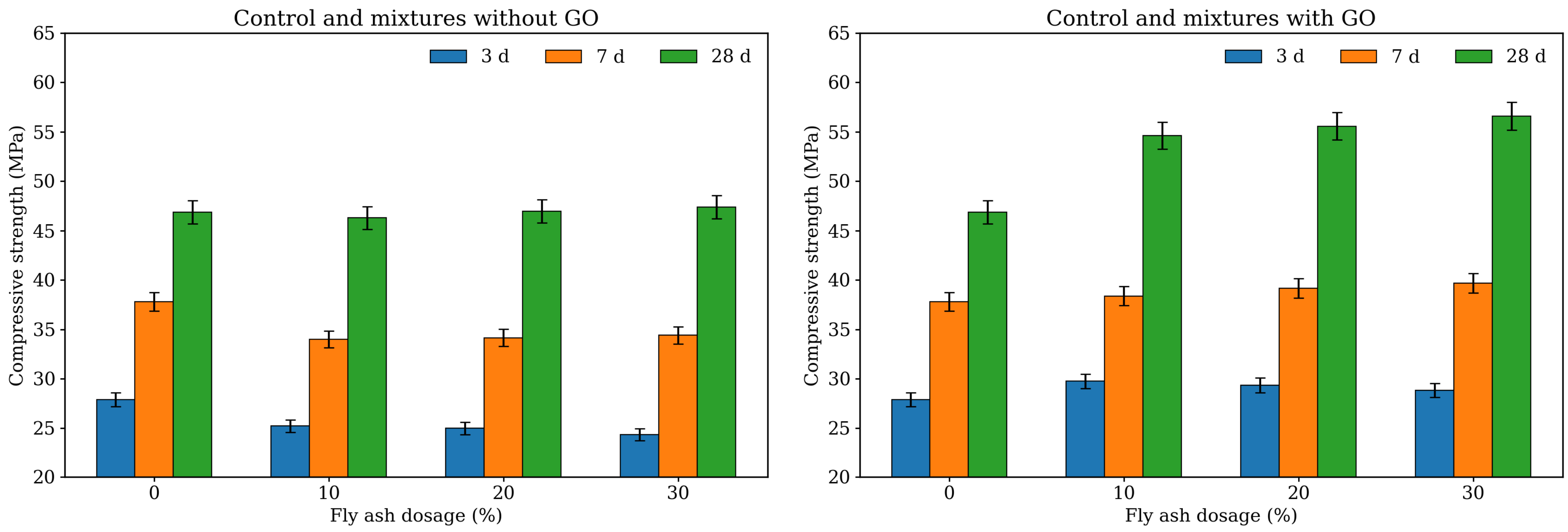
Figure 1 presents the compressive strength results of all mixtures at 3, 7, and 28 days. In the present study, F denotes the fly ash replacement level of 10%, 20%, and 30%, while G7 represents the incorporation of 0.07% GO. Therefore, G0F10, G0F20, and G0F30 correspond to the mixtures without GO and containing 10%, 20%, and 30% fly ash, respectively, whereas G7F10, G7F20, and G7F30 denote the corresponding fly ash mixtures modified with 0.07% GO.
As shown in the figure, the compressive strength exhibited distinct dependences on curing age, fly ash dosage, and GO incorporation. For the reference mixture without fly ash and GO (G0), the compressive strength reached 27.90 MPa at 3 days, 37.79 MPa at 7 days, and 46.87 MPa at 28 days. After introducing fly ash without GO, the early-age strength decreased consistently. At 3 days, the strength declined from 27.90 MPa for G0 to 25.20, 24.96, and 24.33 MPa for G0F10, G0F20, and G0F30, respectively, indicating that increasing fly ash replacement led to a gradual reduction in early-age load-bearing capacity [
24,
25,
26]. This reduction can be mainly attributed to the dilution effect of cement clinker and the relatively low early pozzolanic reactivity of fly ash, which resulted in slower hydration product accumulation and delayed structural build-up. A similar trend remained evident at 7 days, where the strengths of G0F10, G0F20, and G0F30 were 34.01, 34.16, and 34.41 MPa, respectively, all lower than that of G0. However, at 28 days, the differences between the fly ash mixtures without GO and the reference mixture became much smaller. The 28-day strengths of G0F10, G0F20, and G0F30 were 46.29, 46.98, and 47.38 MPa, respectively, which were very close to or slightly higher than that of G0. This result suggests that although fly ash hindered early-age strength development, its later pozzolanic contribution gradually compensated for the initial strength loss, leading to a recovery in compressive performance at 28 days.
The effect of GO on compressive strength was highly pronounced at all curing ages. For the mixtures containing GO, the 3-day compressive strengths of G7F10, G7F20, and G7F30 reached 29.75, 29.35, and 28.83 MPa, respectively. Compared with their GO-free counterparts, the strength increases were 18.06% for F10, 17.59% for F20, and 18.50% for F30. More importantly, all GO-modified fly ash mixtures exhibited even higher 3-day strength than the plain reference G0. This finding indicates that the incorporation of 0.07% GO not only compensated for the adverse effect of fly ash on early-age strength but also enabled the fly ash-blended systems to surpass the control without fly ash. Such behavior strongly suggests that GO played a crucial role in accelerating early hydration and promoting the initial formation of load-bearing gel phases.
At 7 days, the strengthening effect of GO became even more evident in absolute terms. The compressive strengths of G7F10, G7F20, and G7F30 were 38.38, 39.16, and 39.67 MPa, respectively, which exceeded those of G0F10, G0F20, and G0F30 by 12.85%, 14.64%, and 15.29%. In addition, all GO-containing mixtures also showed slightly higher values than G0 at the same age. This result implies that the beneficial role of GO was not limited to the very early stage but extended into the intermediate hydration period. From the rose diagram at 7 days, it can also be observed that the sectors corresponding to G7F10–G7F30 collectively expanded outward relative to both G0 and the GO-free fly ash mixtures, indicating a systematic and stable enhancement effect rather than an isolated improvement in one particular composition.
The most remarkable enhancement appeared at 28 days. The compressive strengths of G7F10, G7F20, and G7F30 increased to 54.60, 55.56, and 56.58 MPa, respectively, corresponding to increases of 17.95%, 18.25%, and 19.42% compared with G0F10, G0F20, and G0F30. Relative to the plain reference G0, the increases were also substantial, reaching 16.49%, 18.53%, and 20.71%, respectively. These results demonstrate that the effect of GO was sustained and even amplified with curing age. In particular, the gradual increase from G7F10 to G7F30 at 28 days suggests that, within the investigated fly ash range, the interaction between GO and fly ash became increasingly favorable at later age. This may indicate that GO not only accelerated the early hydration of cement particles, but also created a more suitable microchemical and structural environment for the subsequent pozzolanic reaction of fly ash, thereby leading to greater formation of secondary hydration products and a more mature gel network.
Another noteworthy feature is that the influence of fly ash dosage differed significantly depending on whether GO was present. In the absence of GO, increasing fly ash content from 10% to 30% caused a slight reduction in 3-day strength and only a marginal improvement at 28 days. This suggests that the positive later-age contribution of fly ash was relatively limited under the GO-free condition. In contrast, in the presence of GO, the strength values remained high across all fly ash levels and even exhibited a gradual increase with increasing fly ash content at 7 and 28 days. For example, at 28 days, the strength rose from 54.60 MPa for G7F10 to 56.58 MPa for G7F30. This trend indicates that GO enhanced the utilization efficiency of fly ash in the blended system. In other words, the role of fly ash was no longer dominated solely by clinker dilution but was increasingly associated with its later pozzolanic reactivity when GO was introduced.
From a mechanistic perspective, the strength enhancement induced by GO can be preliminarily attributed to several coupled effects. First, the oxygen-containing functional groups and ultrathin nanosheet structure of GO can provide abundant heterogeneous nucleation sites for hydration products, thereby accelerating the precipitation of early C–S–H and related gel phases [
27,
28]. Second, GO may promote a more uniform distribution of hydration products and improve the continuity of the solid skeleton, which is particularly beneficial for fly ash-blended systems that otherwise suffer from slow early microstructural development. Third, as curing proceeds, the accelerated early hydration and improved local reaction environment may facilitate the subsequent pozzolanic reaction of fly ash, leading to enhanced calcium hydroxide consumption and the formation of additional C-(A)-S-H gel. As a result, the later-age strength benefit becomes more pronounced than the early-age one. However, compressive strength alone cannot fully reveal the underlying physicochemical origin of these improvements. Therefore, the hydration product evolution and silicate gel structural development were further examined by XRD, TG, and ^29Si MAS NMR in the following sections.
2.2. Hydration Product Evolution Revealed by XRD
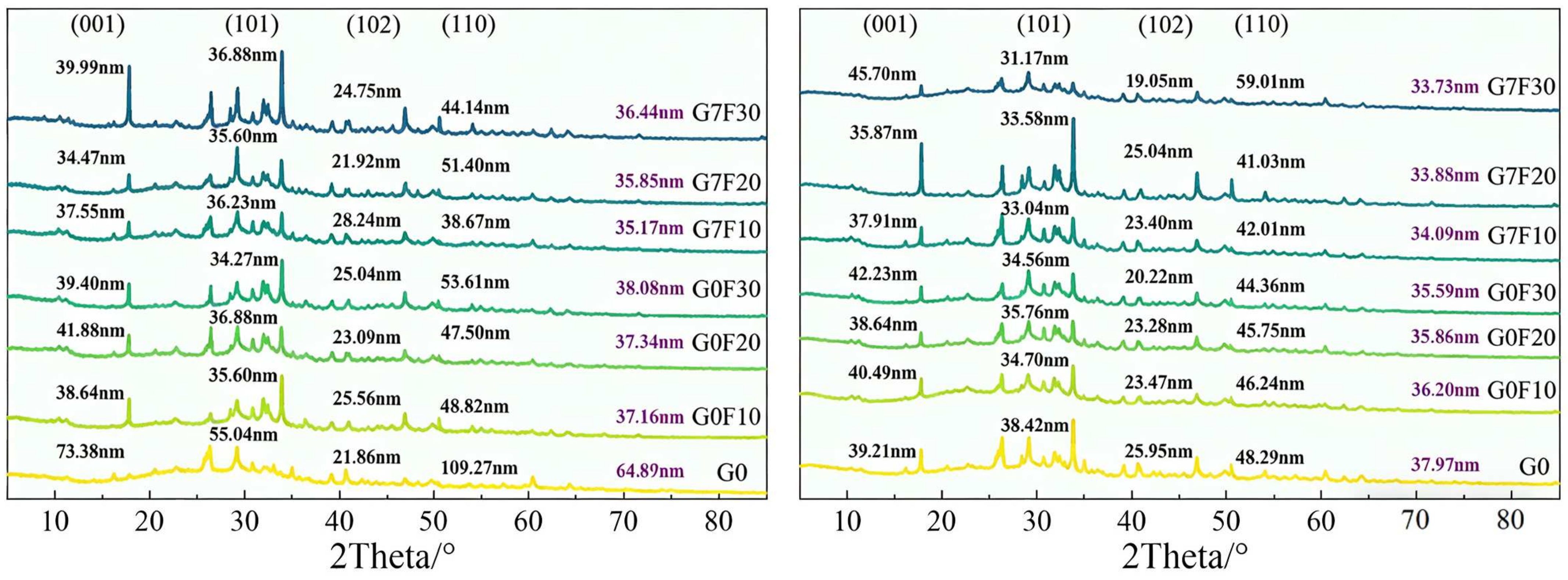
Figure 2 shows the XRD patterns of the fly ash-blended mixtures with and without GO at 3 and 28 days, together with the calculated crystallite sizes of Ca(OH)
2 along different crystal planes. In general, all mixtures exhibited the characteristic diffraction features of hydrated cementitious systems, while the reflections associated with CH remained clearly identifiable. The XRD results indicate that both fly ash incorporation and GO addition significantly influenced the crystallization behavior of CH, and these changes became more evident when the average CH crystallite size was compared among the mixtures.
At 3 days, the plain reference mixture G0 exhibited the largest average CH crystallite size, reaching 64.89 nm. After the incorporation of fly ash, the average CH crystallite size decreased sharply to 37.16 nm for G0F10, 37.34 nm for G0F20, and 38.08 nm for G0F30. This substantial reduction suggests that the introduction of fly ash markedly suppressed the growth of coarse CH crystals at early age. Such a phenomenon can be attributed to two combined factors. First, the replacement of cement by fly ash reduced the effective clinker content, thereby lowering the amount of directly generated CH. Second, the presence of fly ash particles altered the nucleation and spatial distribution of hydration products, which hindered the development of large CH crystals and led to a more dispersed crystallization state [
29,
30,
31]. Although the average CH crystallite sizes of the three fly ash mixtures were close to each other at 3 days, all of them remained far below that of G0, indicating that the influence of fly ash on CH crystallization was already pronounced even at the early stage.
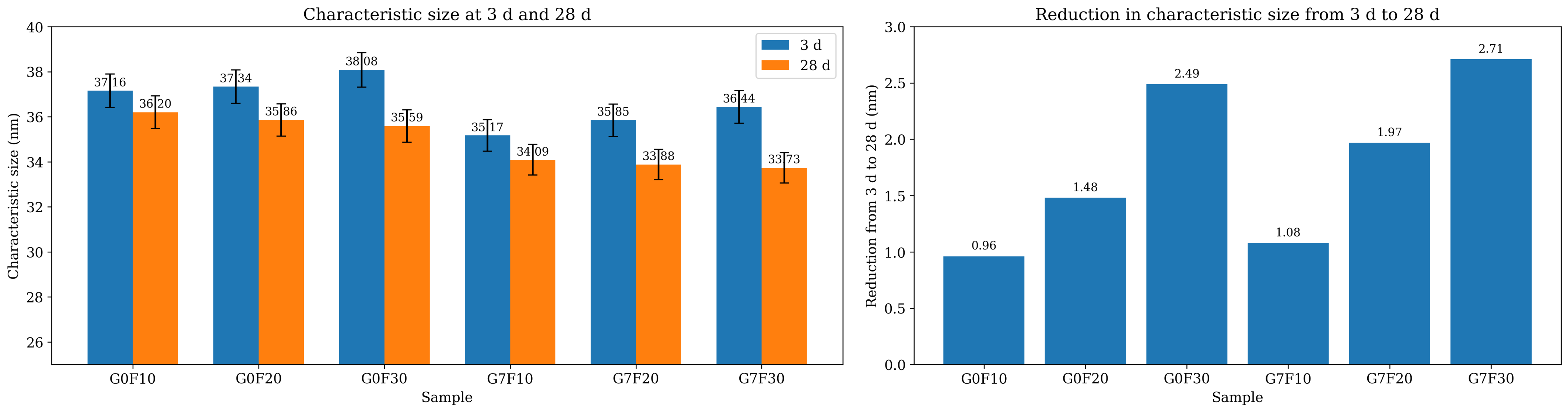
When GO was introduced into the fly ash-blended systems, the CH crystallite size decreased further (see
Figure 3). At 3 days, the average values were 35.17 nm for G7F10, 35.85 nm for G7F20, and 36.44 nm for G7F30, all of which were lower than those of the corresponding GO-free mixtures. This result indicates that GO further inhibited the coarsening of CH crystals and promoted the formation of finer CH domains. The reduction in CH crystallite size in the GO-modified mixtures suggests that GO altered the precipitation behavior of hydration products, likely by providing abundant heterogeneous nucleation sites through its oxygen-containing functional groups and high specific surface area. Instead of allowing CH to grow into relatively large crystals, the presence of GO favored a more dispersed and refined hydration environment. This effect is important because the formation of finer CH crystals is usually associated with a more homogeneous microstructure and may indirectly facilitate the precipitation and spatial continuity of gel phases.
At 28 days, the differences in average CH crystallite size among the mixtures became smaller than those at 3 days, but the overall trend remained consistent. The average CH crystallite size of G0 decreased markedly to 37.97 nm, indicating that the CH crystals in the reference system underwent substantial refinement with ongoing hydration. For the fly ash mixtures without GO, the average CH crystallite sizes were 36.20 nm for G0F10, 35.86 nm for G0F20, and 35.59 nm for G0F30, showing a slight downward trend with increasing fly ash dosage. This result suggests that, at later age, fly ash continued to regulate the crystallization state of CH, likely through its progressively developed pozzolanic reaction, which consumed CH and reduced the tendency for large CH crystals to persist in the matrix. In the GO-containing mixtures, the average CH crystallite sizes further decreased to 34.09, 33.88, and 33.73 nm for G7F10, G7F20, and G7F30, respectively. Therefore, even at 28 days, GO still maintained its effect on CH refinement, and this influence became slightly stronger as the fly ash dosage increased.
A more detailed comparison between 3 and 28 days reveals an interesting age-dependent feature. For G0, the average CH crystallite size decreased dramatically from 64.89 to 37.97 nm, whereas the fly ash-containing systems exhibited much smaller changes over the same period. This implies that in the plain cement system, CH initially formed in a relatively coarse and concentrated manner, while the incorporation of fly ash, with or without GO, made the CH phase much finer from the outset. In other words, the combined presence of fly ash and GO modified the early crystallization pathway of CH rather than merely affecting its later transformation. This is consistent with the strength results above, where GO effectively compensated for the early-age strength loss induced by fly ash. The refined CH crystallization behavior observed here suggests that GO promoted a more favorable early hydration environment and avoided the formation of excessively coarse CH crystals that are generally less beneficial to matrix integrity.
In addition to crystallite refinement, the XRD results also imply that the effect of GO was not limited to a simple physical dispersion mechanism. The systematic reduction in CH crystallite size across all fly ash replacement levels suggests that GO influenced the hydration product evolution in a persistent and composition-dependent manner. At early age, this effect was likely associated with accelerated nucleation and more uniform precipitation of hydration products [
32,
33,
34]. At later age, it may also be related to enhanced interaction between CH and fly ash reaction sites, thereby favoring the continuous development of secondary C-(A)-S-H type gels [
35,
36,
37,
38]. Therefore, the XRD evidence supports the view that GO regulated not only the morphology of CH crystals, but also the overall hydration environment of fly ash-blended cementitious materials. However, XRD mainly reflects the crystallization state of relatively crystalline phases and cannot fully quantify the total amount of CH or the extent of its consumption. For this reason, TG/DTG analysis was further conducted to examine the thermal decomposition behavior and total CH content of the different mixtures.
2.3. Thermogravimetric Evidence of Hydration and Pozzolanic Reaction
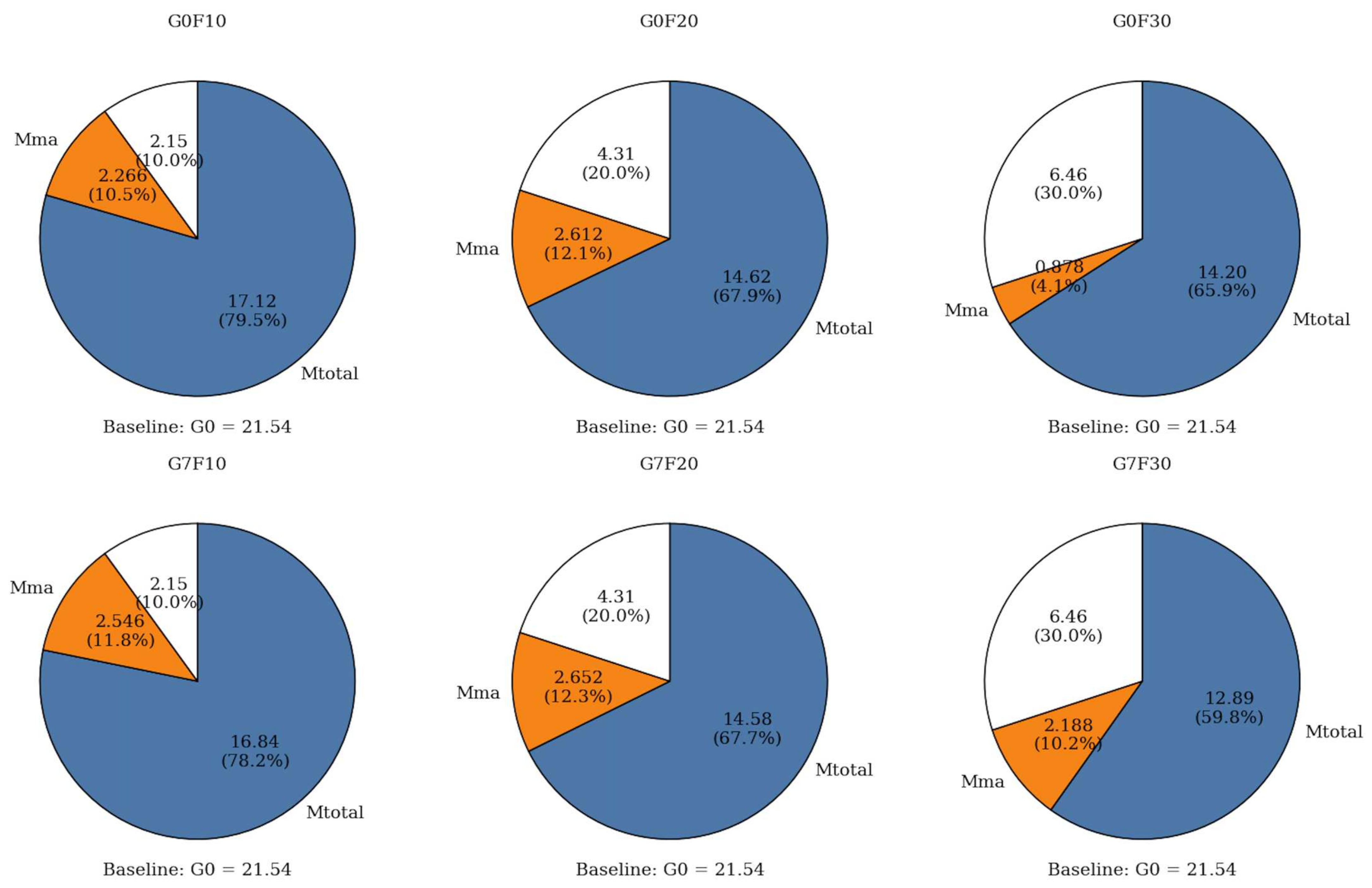
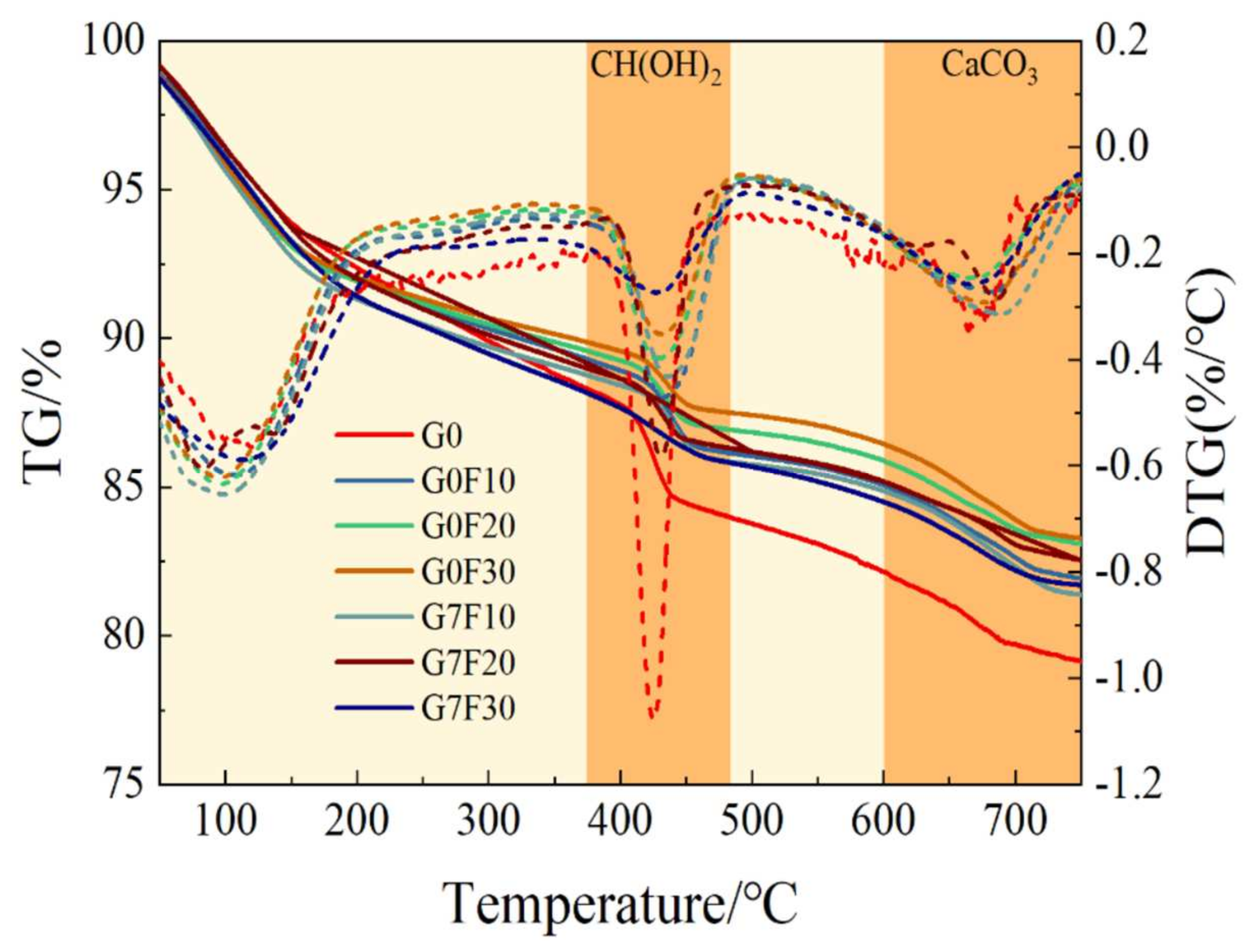
Figure 4 presents the TG-DTG curves of the fly ash-blended mixtures with and without GO at 28 days, and the corresponding total CH contents are presented in
Figure 5. In the TG-DTG profiles, the main mass-loss regions can be identified as the dehydration of bound water and hydration products at low temperature, the decomposition of Ca(OH)
2 in the range of approximately 400–450 °C, and the decomposition of CaCO
3 at around 600–750 °C [
39]. Among these regions, the mass loss associated with CH decomposition is particularly important because it directly reflects the amount of portlandite retained in the hydrated matrix and indirectly indicates the progress of hydration and pozzolanic reaction.
As illustrated by
Figure 5, the total CH content of the plain reference sample G0 was 21.54%, which was the highest among all mixtures. After the incorporation of fly ash, the total CH content decreased significantly to 17.12% for G0F10, 14.62% for G0F20, and 14.20% for G0F30. This progressive reduction is consistent with the expected effect of fly ash in blended cementitious systems. On the one hand, the replacement of cement by fly ash reduced the clinker content and thus lowered the amount of CH directly produced by cement hydration. On the other hand, the pozzolanic reaction of fly ash gradually consumed CH to form additional secondary hydration products. As a result, increasing fly ash dosage led to a systematic decline in the retained CH content. This trend agrees well with the XRD observations, where the crystallization of CH became notably refined after fly ash incorporation.
The effect of GO on total CH content showed a dosage-dependent trend across the fly ash-blended systems. Compared with the corresponding GO-free mixtures, the total CH content slightly decreased from 17.12% to 16.84% for F10, from 14.62% to 14.58% for F20, and more noticeably from 14.20% to 12.89% for F30 after GO addition. Although the reductions for F10 and F20 were relatively small, the overall trend indicates that GO tended to lower the residual CH content, especially at the higher fly ash dosage. This result suggests that GO not only affected the crystallization state of CH, as demonstrated by XRD, but also influenced its net retention in the hydrated system. Since GO itself does not directly contribute CH, the lower CH content in the GO-modified mixtures is more reasonably interpreted as evidence of a more effective conversion of CH into secondary hydration products or a more efficient coupling between cement hydration and fly ash reaction.
To further distinguish the role of fly ash-related reaction in CH evolution, the calculated values of Mce and MMA were also compared. Here, Mce represents the theoretical CH content generated solely by the cement fraction in the blended system, whereas MMA reflects the CH variation associated with the mineral admixture. For the GO-free mixtures, MMA values were 2.264%, 2.608%, and 0.882% for G0F10, G0F20, and G0F30, respectively. After GO incorporation, these values increased to 2.546%, 2.652%, and 2.186% for G7F10, G7F20, and G7F30, respectively. The increase in MMA, particularly for the 30% fly ash mixture, indicates that the CH associated with the fly ash-containing system was more strongly affected when GO was present. This implies that GO enhanced the interaction between fly ash and the surrounding hydration environment, making the fly ash-related reaction more pronounced. In other words, the role of GO appears to extend beyond accelerating cement hydration alone; it also promotes the effective participation of fly ash in the later-age reaction process.
The DTG curves provide further support for this interpretation. All mixtures showed a distinct endothermic decomposition feature in the CH region, but the depth and shape of the CH-related DTG trough varied among the samples. The reference mixture G0 displayed the most prominent CH decomposition signal, in agreement with its highest total CH content. By contrast, the fly ash-containing mixtures exhibited weakened CH-related DTG peaks, confirming that fly ash reduced the amount of retained portlandite. The GO-modified mixtures generally showed a further attenuation of the CH decomposition feature, especially at higher fly ash dosage, which is consistent with the reduced Mtotal values. Meanwhile, the decomposition region assigned to CaCO3 remained visible in all samples, indicating that partial carbonation occurred during sample preparation or storage, but this did not alter the overall conclusion regarding CH evolution.
When the TG/DTG results are considered together with the compressive strength data, an important feature becomes evident. The results show a clear quantitative trend between CH evolution and strength development, particularly at 28 days. For the GO-free fly ash mixtures, the total CH content decreased from 17.12% in G0F10 to 14.62% in G0F20 and 14.20% in G0F30, while the corresponding compressive strengths increased from 46.29 MPa to 46.98 MPa and 47.38 MPa. After GO incorporation, the same trend became more evident: the CH content decreased from 16.84% in G7F10 to 14.58% in G7F20 and 12.89% in G7F30, whereas the compressive strength increased from 54.60 MPa to 55.56 MPa and 56.58 MPa. In particular, for the 30% fly ash mixture, GO reduced the CH content from 14.20% to 12.89% while increasing the 28-day compressive strength from 47.38 MPa to 56.58 MPa, corresponding to a strength increase of 19.42%. This indicates that lower retained CH was associated with higher strength.
Overall, the TG/DTG analysis confirms three main points. First, increasing fly ash dosage reduced the total CH content because of both cement dilution and pozzolanic consumption. Second, GO further decreased the retained CH content, particularly in the high-fly-ash mixture, indicating a stronger coupling effect between GO and fly ash reaction. Third, when combined with the XRD evidence of reduced CH crystallite size, the TG results demonstrate that GO simultaneously refined the crystallization state of CH and promoted its further utilization in the blended system. These findings provide strong evidence that the strength enhancement induced by GO was closely related to its regulation of hydration product evolution and CH conversion behavior. To further clarify how these changes were reflected in the silicate environment of the binding gels, 29Si MAS NMR analysis is discussed in the following section.
2.4. Evolution of Silicate Gel Structure from 29Si MAS NMR
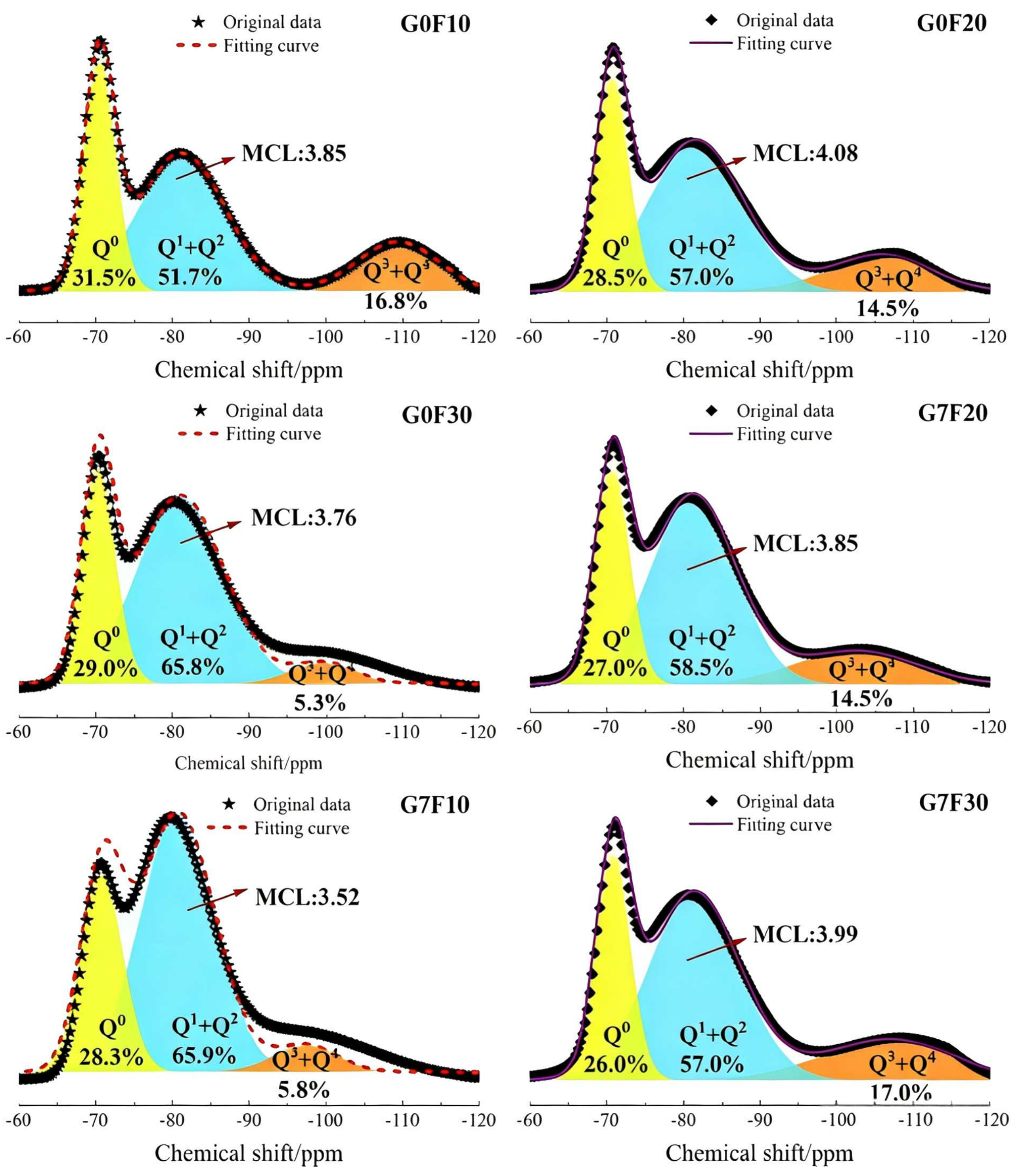
Figure 6 presents the
29Si MAS NMR spectra of the fly ash-blended mixtures with and without GO, and the corresponding deconvolution results reveal the relative fractions of Q
0, Q
1 + Q
2, and Q
3 + Q
4 species together with the mean chain length (MCL). In general, the spectra of all fly ash-containing samples can be divided into three main regions: the resonance near −70 ppm assigned to Q
0, which is mainly associated with unreacted or weakly reacted silicate units; the dominant band in the range of approximately −75 to −90 ppm corresponding to Q
1 and Q
2 species, which represent the chain-end and chain-middle silicate tetrahedra in C-(A)-S-H type gels; and the broader resonance at lower field attributed to Q
3 and Q
4, reflecting more polymerized and cross-linked silicate structures. Therefore, changes in the relative proportions of these structural units can directly reflect the evolution of gel polymerization and the degree of silicate chain development in the fly ash-blended cementitious system.
For the mixtures without GO, the fraction of Q0 decreased slightly with increasing fly ash dosage, from 31.5% for G0F10 to 29.0% for G0F20 and 28.3% for G0F30. Meanwhile, the proportion of Q1 + Q2 increased from 51.7% for G0F10 to 65.8% for G0F20 and 65.9% for G0F30. These results indicate that, as the fly ash content increased, the silicate environment became increasingly dominated by chain-like gel structures rather than isolated or poorly reacted silicate units. However, the fraction of Q3 + Q4 did not increase correspondingly; instead, it declined from 16.8% in G0F10 to 5.3% in G0F20 and 5.8% in G0F30. This suggests that although higher fly ash dosage promoted the formation of chain-like silicate units, the degree of highly polymerized or cross-linked silicate structures remained limited in the GO-free system. This interpretation is further supported by the MCL results, which decreased from 3.85 for G0F10 to 3.76 for G0F20 and 3.52 for G0F30. Therefore, in the absence of GO, increasing fly ash dosage did not continuously improve the overall polymerization level of the silicate network, but instead tended to shift the gel structure toward a Q1 + Q2-dominated state with a reduced mean chain length.
After GO incorporation, the silicate gel structure evolved in a clearly different manner. The Q0 fraction further decreased to 28.5%, 27.0%, and 26.0% for G7F10, G7F20, and G7F30, respectively, all lower than those of their GO-free counterparts. This reduction indicates that GO promoted the conversion of less-reacted silicate species into more integrated gel structures. More importantly, the MCL values increased to 4.08, 3.85, and 3.99 for G7F10, G7F20, and G7F30, respectively, compared with 3.85, 3.76, and 3.52 for G0F10, G0F20, and G0F30. The increase in MCL demonstrates that GO favored the development of longer silicate chains and a more mature gel structure. The enhancement was particularly pronounced in the 30% fly ash mixture, where the MCL increased from 3.52 to 3.99 after GO addition, indicating that GO effectively compensated for the structural limitation of the high-fly-ash system.
The variation in the Q
3 + Q
4 fraction provides additional evidence of this GO-induced effect. For G7F10 and G7F20, the Q
3 + Q
4 content was 14.5%, which, although slightly lower than that of G0F10, was markedly higher than those of G0F20 and G0F30. In G7F30, the Q
3 + Q
4 fraction further increased to 17.0%, which was substantially higher than the 5.8% observed in G0F30. This result strongly suggests that GO promoted the formation of more polymerized silicate environments, particularly in the high fly ash mixture. In other words, GO did not merely increase the amount of chain-like gel species but also facilitated the evolution of the gel network toward a more connected and polymerized state. Such a structural change is highly consistent with the substantial 28-day strength enhancement observed in
Section 2.1, especially for G7F30.
Another notable feature is that the role of GO was not simply to increase the Q1 + Q2 fraction. In fact, compared with the GO-free mixtures, the Q1 + Q2 content in the GO-containing systems decreased from 65.8% to 58.5% for F20 and from 65.9% to 57.0% for F30. However, this decrease was accompanied by a simultaneous increase in Q3 + Q4 and MCL. This indicates that GO promoted the transformation of part of the chain-like Q1 + Q2 units into more polymerized silicate structures, rather than merely increasing the quantity of intermediate gel species. Therefore, the main contribution of GO to gel structural development lies in improving the maturity and polymerization degree of the silicate network, not only in accelerating its initial formation. This point is important because it helps explain why GO-modified mixtures exhibited not only improved early-age strength but also more pronounced later-age enhancement.
When the NMR results are considered together with the TG and XRD findings, a coherent mechanistic picture emerges. XRD showed that GO refined the crystallite size of CH, while TG demonstrated that GO reduced the retained CH content, especially at higher fly ash dosage. The 29Si MAS NMR results further reveal where the consumed CH was likely utilized: it contributed to the development of a more polymerized silicate gel structure. In the fly ash-blended systems, CH acts as a key reactant in the pozzolanic reaction, and the conversion of CH into additional C-(A)-S-H gel is expected to increase both structural continuity and binding efficiency. Therefore, the higher MCL values and the increased Q3 + Q4 fractions in the GO-modified mixtures provide direct molecular-scale evidence that GO enhanced the later-age reaction of fly ash and promoted gel network maturation.
Overall, the 29Si MAS NMR analysis confirms that GO played a dual structural role in the fly ash-blended cementitious system. First, it reduced the fraction of less-reacted silicate species, indicating a more advanced reaction degree. Second, and more importantly, it promoted the formation of longer and more polymerized silicate chains, especially in the high-fly-ash system. These changes imply that the GO-modified mixtures developed a more mature C-(A)-S-H gel structure, which is expected to provide a stronger and more continuous load-bearing skeleton. This molecular-level evidence offers a critical link between hydration product evolution and the macroscopic compressive strength enhancement discussed earlier.
2.5. SEM-EDS Observations and Multiscale Mechanism Discussion
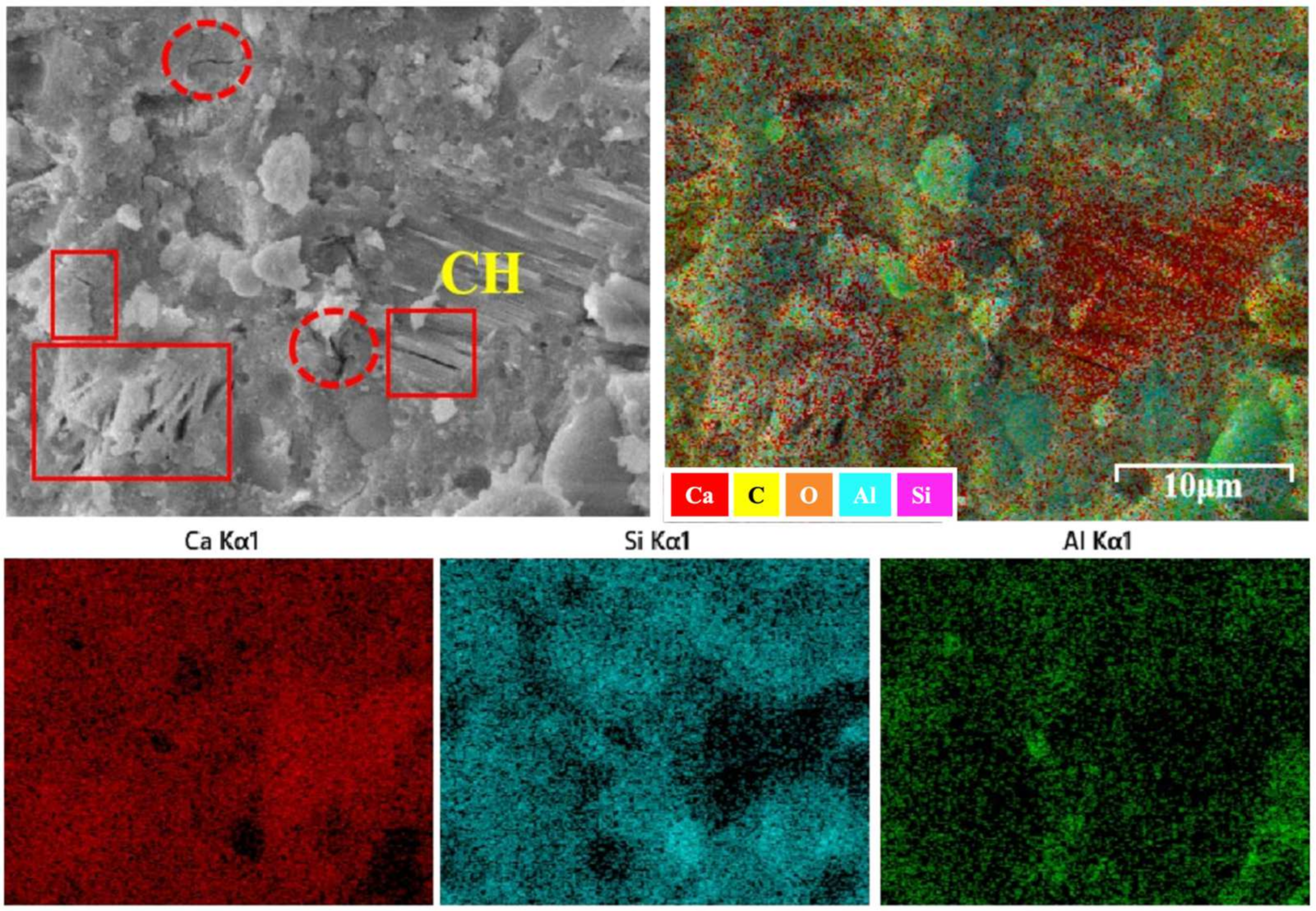
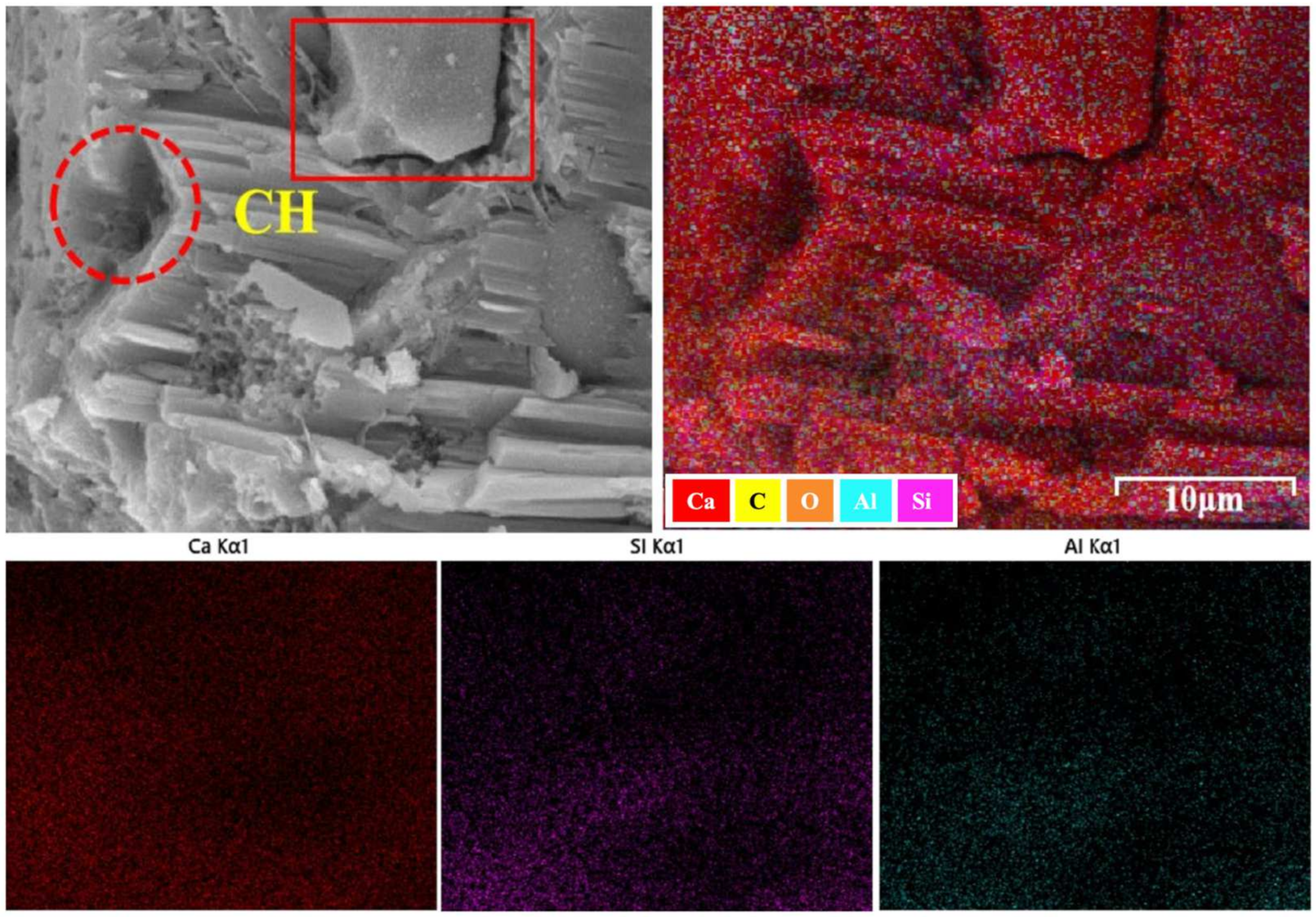
Figure 7,
Figure 8 and
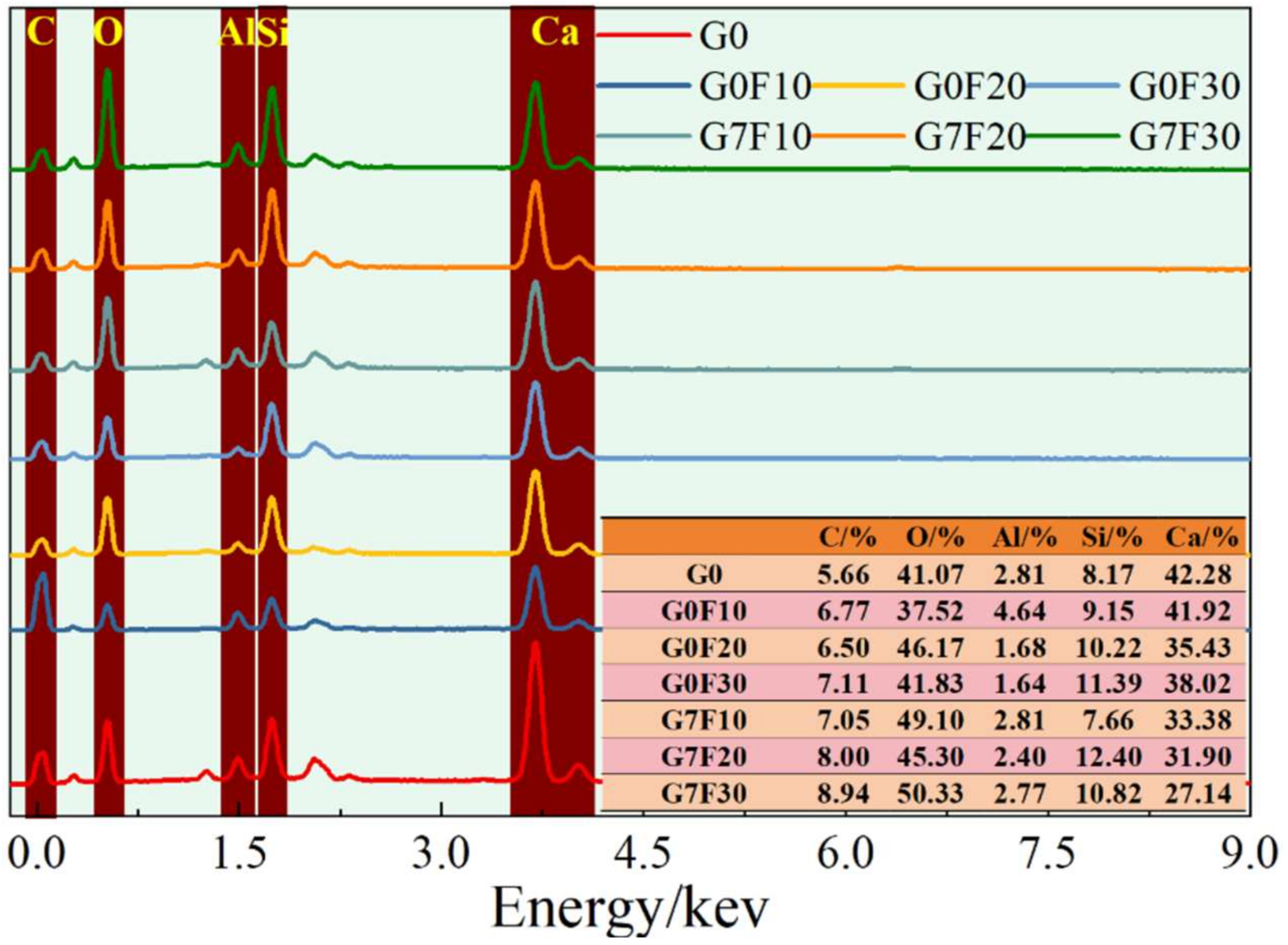
Figure 9 shows the SEM morphologies and elemental mapping results at 28 days, where the left-hand images correspond to G0F30 and the right-hand images correspond to G7F30. In addition, the EDS results presented in
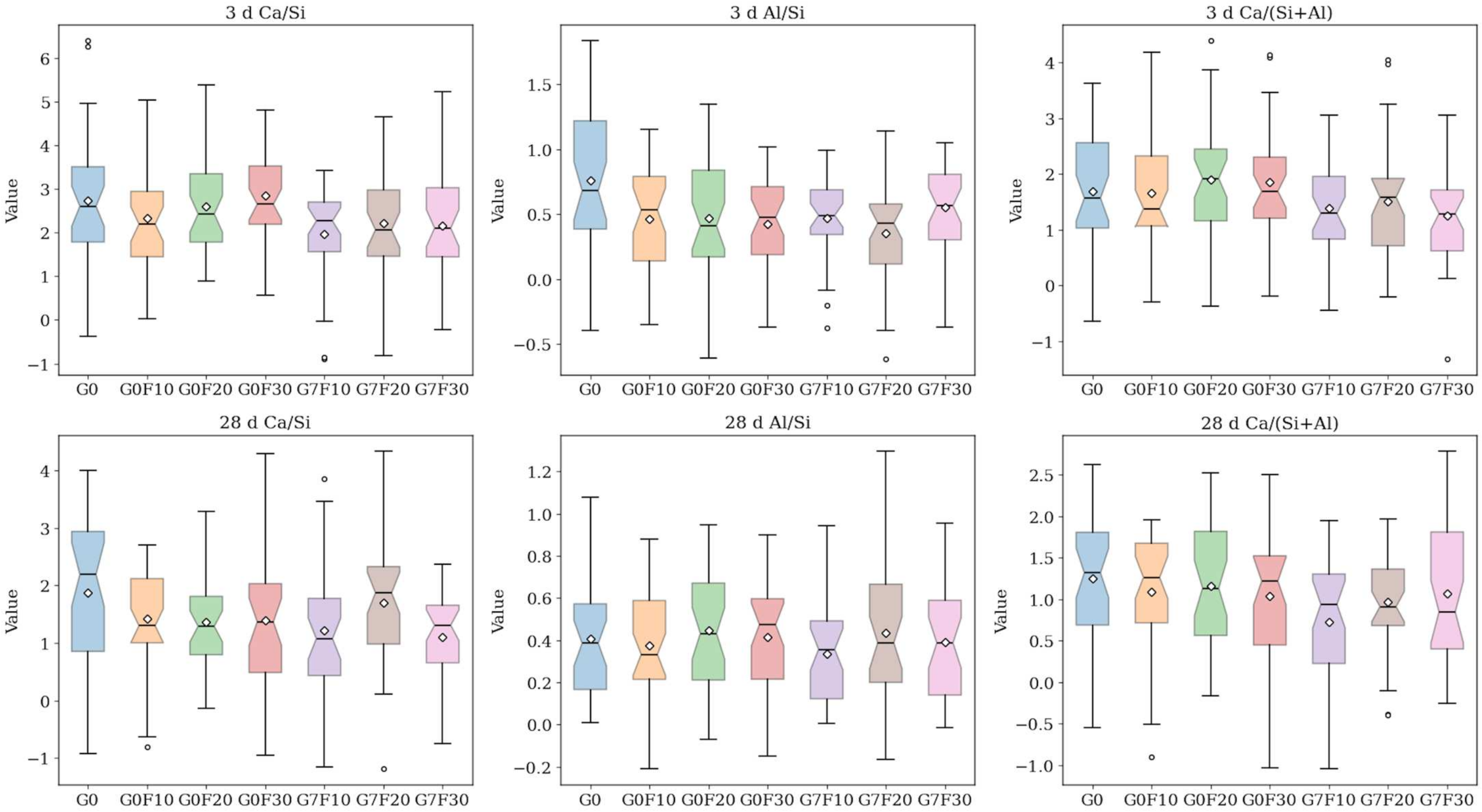
Figure 10 provide the average values and standard deviations of Ca/Si, Al/Si, and Ca/(Si + Al) at 3 and 28 days for the fly ash-blended mixtures with and without GO. These results offer important morphological and compositional evidence for understanding the microstructural evolution induced by fly ash and GO.
At 28 days, the SEM image of G0F30 shows a relatively heterogeneous microstructure. Large plate-like CH crystals are still clearly visible, as highlighted in the left-hand micrograph, and some local pores or loosely packed regions can also be identified. The coexistence of coarse CH and discontinuous matrix regions indicates that, although hydration and pozzolanic reaction had progressed by 28 days, the microstructure of the GO-free high-fly-ash mixture was still not fully homogenized. The corresponding elemental mapping also shows that Ca is relatively concentrated in certain local domains, whereas Si and Al are less uniformly distributed. This non-uniform elemental distribution is consistent with the presence of CH-rich regions and a matrix in which the gel phase is not yet fully continuous.
By contrast, the G7F30 micrograph exhibits a markedly denser and more integrated matrix. Compared with G0F30, the amount of coarse plate-like CH appears reduced, while the surrounding matrix shows a more compact gel-like morphology with fewer obvious loose regions. Although some residual CH can still be identified, it is less dominant and more embedded within the surrounding hydration products. The elemental maps further show a more homogeneous distribution of Si and Al in the GO-containing sample, while the Ca-rich domains appear less sharply localized than in G0F30. This suggests that GO promoted a more uniform spatial organization of hydration products and reduced the tendency for CH to segregate into coarse isolated crystals.
The EDS quantitative results provide additional support for this interpretation. At 3 days, the average Ca/Si ratio decreased from 2.808 for G0 to 2.634, 2.507, and 2.454 for G0F10, G0F20, and G0F30, respectively, indicating that the incorporation of fly ash reduced the calcium dominance in the hydration products and increased the relative contribution of silicate-rich phases. After GO addition, the Ca/Si values decreased further to 1.993, 1.975, and 1.938 for G7F10, G7F20, and G7F30, respectively. A similar trend was observed for the Ca/(Si + Al) ratio, which decreased from 1.626 for G0 to 1.755, 1.659, and 1.724 for the GO-free fly ash mixtures at 3 days, and then to 1.370, 1.452, and 1.254 for G7F10, G7F20, and G7F30. Although the GO-free values did not show strict monotonicity, the overall reduction induced by GO is clear. These results indicate that GO promoted the formation of hydration products with lower calcium content and relatively higher silicate/aluminate incorporation, which is usually associated with the development of C-(A)-S-H gels rather than CH-dominated microstructures.
At 28 days, this trend became even more pronounced. The Ca/Si ratio of G0 decreased to 1.757, reflecting the general progress of hydration and the increasing contribution of gel products over time. For the GO-free fly ash mixtures, the Ca/Si values further declined slightly to 1.557, 1.549, and 1.543 for G0F10, G0F20, and G0F30, respectively. After GO addition, the values decreased again to 1.417, 1.397, and 1.382 for G7F10, G7F20, and G7F30. Likewise, the Ca/(Si + Al) ratio decreased from 1.253 for G0 to 1.151, 1.127, and 1.093 for G0F10, G0F20, and G0F30, and then to 1.014, 0.938, and 1.029 for G7F10, G7F20, and G7F30. These lower Ca/Si and Ca/(Si + Al) ratios indicate that the hydration products in the GO-modified systems became more silicate- and aluminosilicate-rich, which is consistent with more advanced pozzolanic reaction and greater incorporation of fly ash-derived Si and Al into the gel structure [
40,
41,
42].
The Al/Si ratio provides further information on the compositional evolution of the binding gel. At 3 days, the Al/Si ratio decreased from 0.726 for G0 to 0.501, 0.511, and 0.423 for G0F10, G0F20, and G0F30, respectively, and to 0.454, 0.360, and 0.546 for G7F10, G7F20, and G7F30. At 28 days, the Al/Si values were 0.402 for G0, 0.352–0.412 for the GO-free fly ash mixtures, and 0.343–0.489 for the GO-containing mixtures. Although the Al/Si trend was not as regular as the Ca/Si trend, the combined EDS evidence still indicates that the GO-modified systems favored a gel chemistry with lower Ca enrichment and stronger participation of silicate/aluminosilicate units. Considering that fly ash provides both reactive silica and alumina, this compositional shift strongly supports the conclusion that GO facilitated the incorporation of fly ash-derived species into the hydration products.
Another important observation concerns the standard deviations of Ca/Si and Al/Si. In the 3-day GO-free mixtures, the Ca/Si standard deviation ranged from 0.956 to 1.101, whereas in the corresponding GO-containing mixtures, it ranged from 0.982 to 1.262. At 28 days, the Ca/Si standard deviation of G7F30 decreased to 0.843, lower than the value of 1.075 for G0F30. This reduction suggests that, at least in the high-fly-ash mixture, GO improved the later-age compositional uniformity of the matrix. This observation is in good agreement with the elemental mapping, where G7F30 exhibits a more homogeneous distribution of Si and Al and less obvious segregation of Ca-rich CH domains. Therefore, GO appears not only to modify the average gel chemistry, but also to improve the spatial uniformity of the hydration products in the matrix.
When the SEM–EDS results are integrated with the XRD, TG, and 29Si MAS NMR analyses, the strengthening mechanism of GO becomes much clearer. XRD demonstrated that GO reduced the crystallite size of CH, while TG showed that the retained CH content decreased, especially in the high-fly-ash mixture. The 29Si MAS NMR results further revealed increased MCL and enhanced Q3 + Q4 fractions in the GO-modified systems, indicating a more polymerized silicate gel structure. The SEM–EDS observations presented here provide direct microstructural confirmation of these changes: the GO-containing matrix is denser, coarse CH is less dominant, and the elemental distribution is more compatible with the formation of silicate/aluminosilicate-rich gels. Therefore, the role of GO can be summarized as a coupled regulation effect involving CH refinement, CH conversion, gel polymerization, and matrix homogenization.
For the high-fly-ash system represented by G7F30, this coupled effect is particularly significant. In the GO-free G0F30 sample, the microstructure still contains relatively coarse CH and locally heterogeneous regions at 28 days, indicating incomplete coordination between cement hydration and fly ash reaction. In contrast, the GO-modified G7F30 sample shows a denser matrix, lower Ca/Si ratio, lower Ca/(Si + Al) ratio, and higher MCL, all of which point to a more mature C-(A)-S-H gel network. This microstructural evolution explains why G7F30 achieved the highest 28-day compressive strength among all the investigated mixtures. Thus, the SEM–EDS results provide the final morphological and compositional evidence that GO effectively enhanced the utilization of fly ash and promoted the formation of a stronger and more continuous binding framework. Accordingly, the enhancement in compressive strength by GO should be interpreted as the consequence of multiscale structural regulation, including CH refinement, promoted CH utilization, silicate gel polymerization, and matrix densification, rather than a simple filler or dispersion effect.