

The Early Age Hydration Products and Mechanical Properties of Autoclaved Cement Paste Incorporating Supplementary Cementitious Materials
 , , and
Abstract
1. Introduction
2. Results and Discussion
2.1. Results of Material Characterization
2.1.1. Chemical Composition Analysis
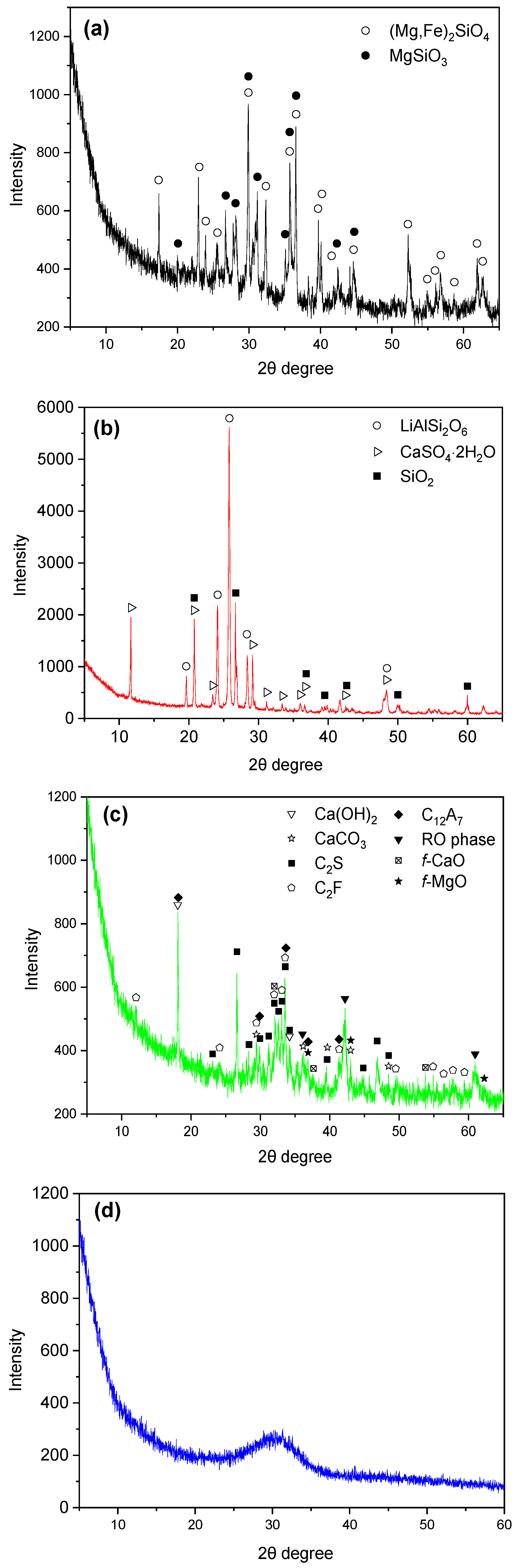
2.1.2. Mineral Composition
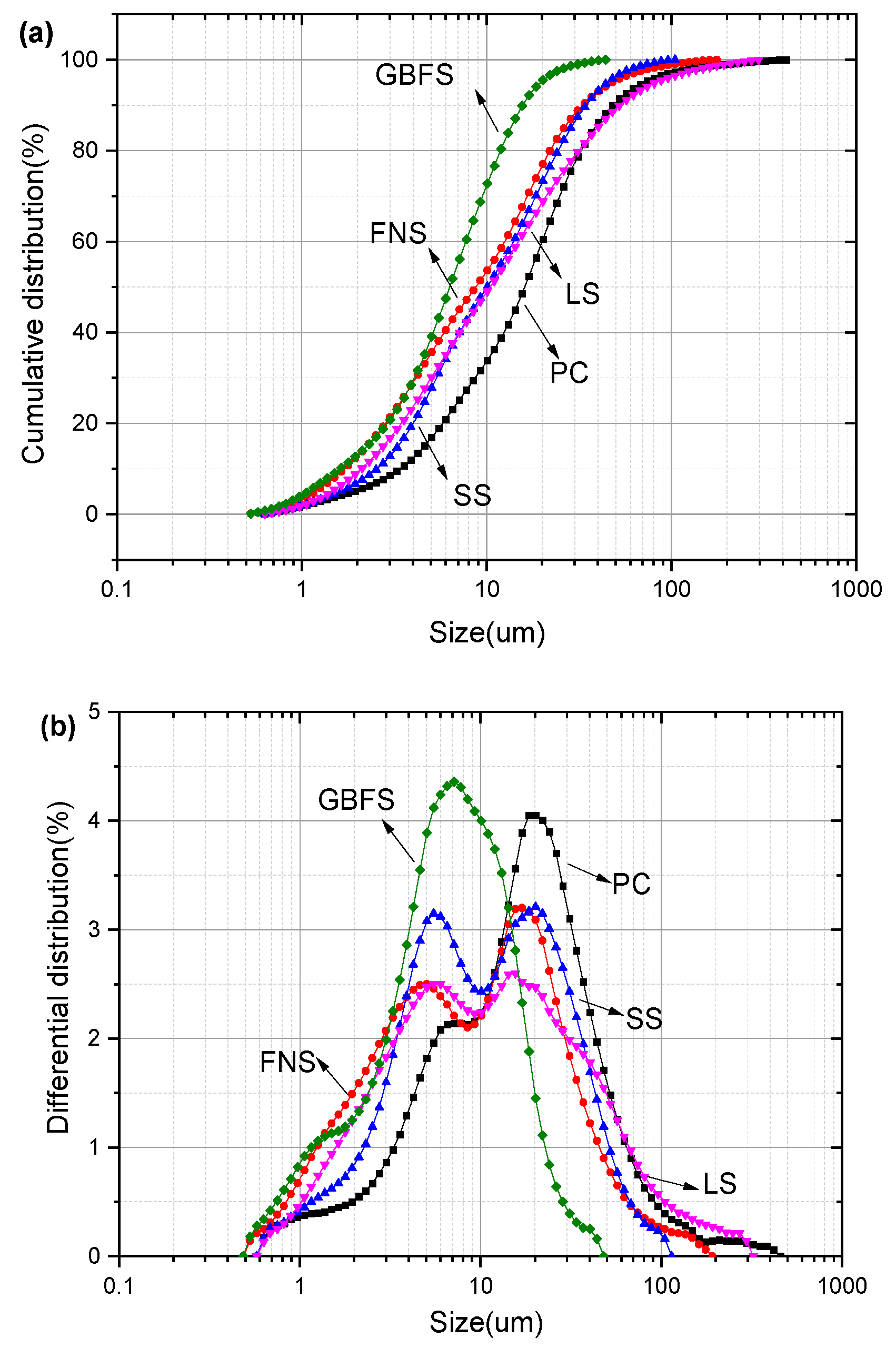
2.1.3. Particle Size Distribution
2.1.4. Thermal and Physical Characteristics
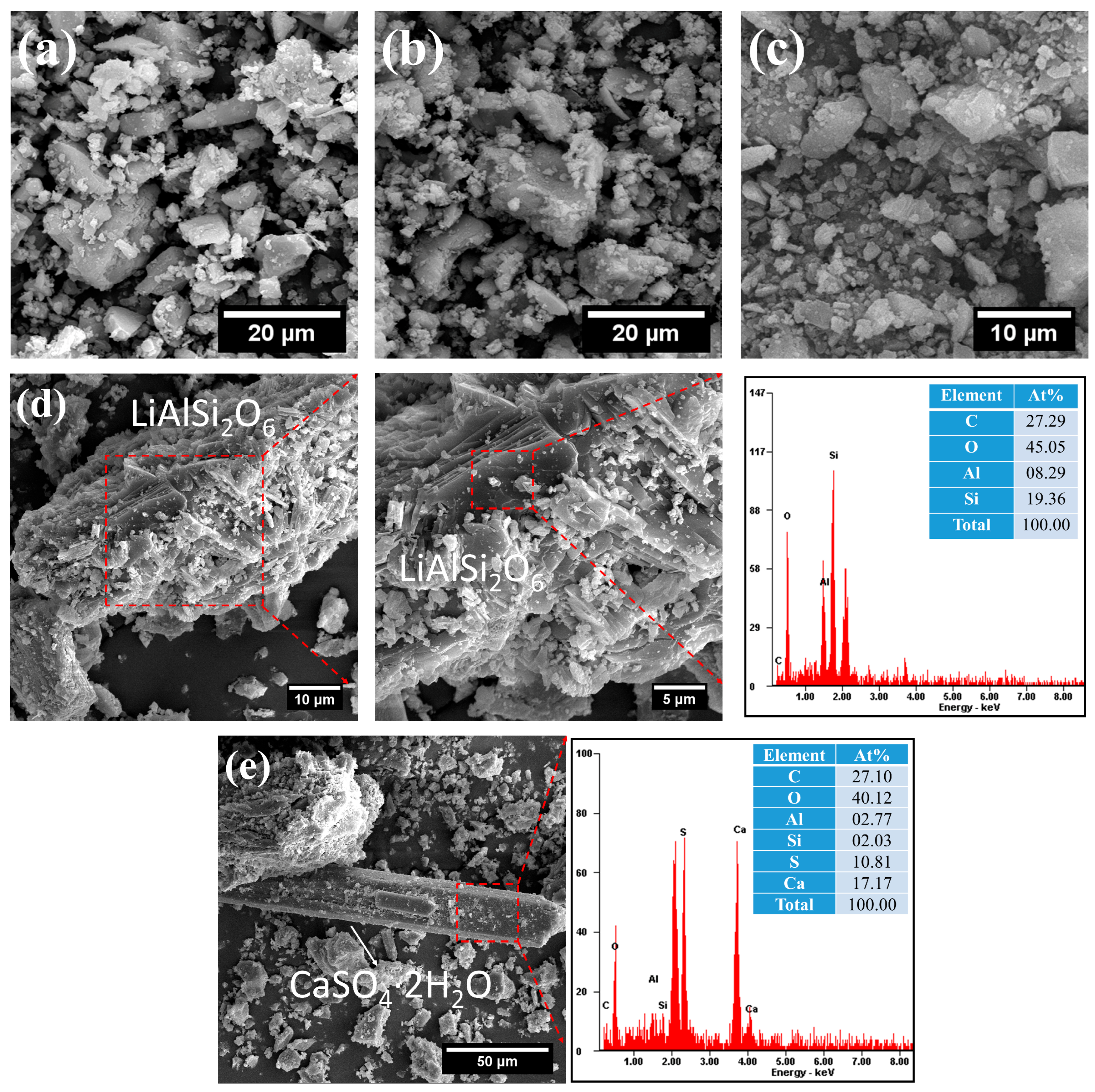
2.1.5. Morphological Analysis
2.1.6. Reactivity Considerations
2.2. Water Demand, Setting Time, Soundness and Fluidity
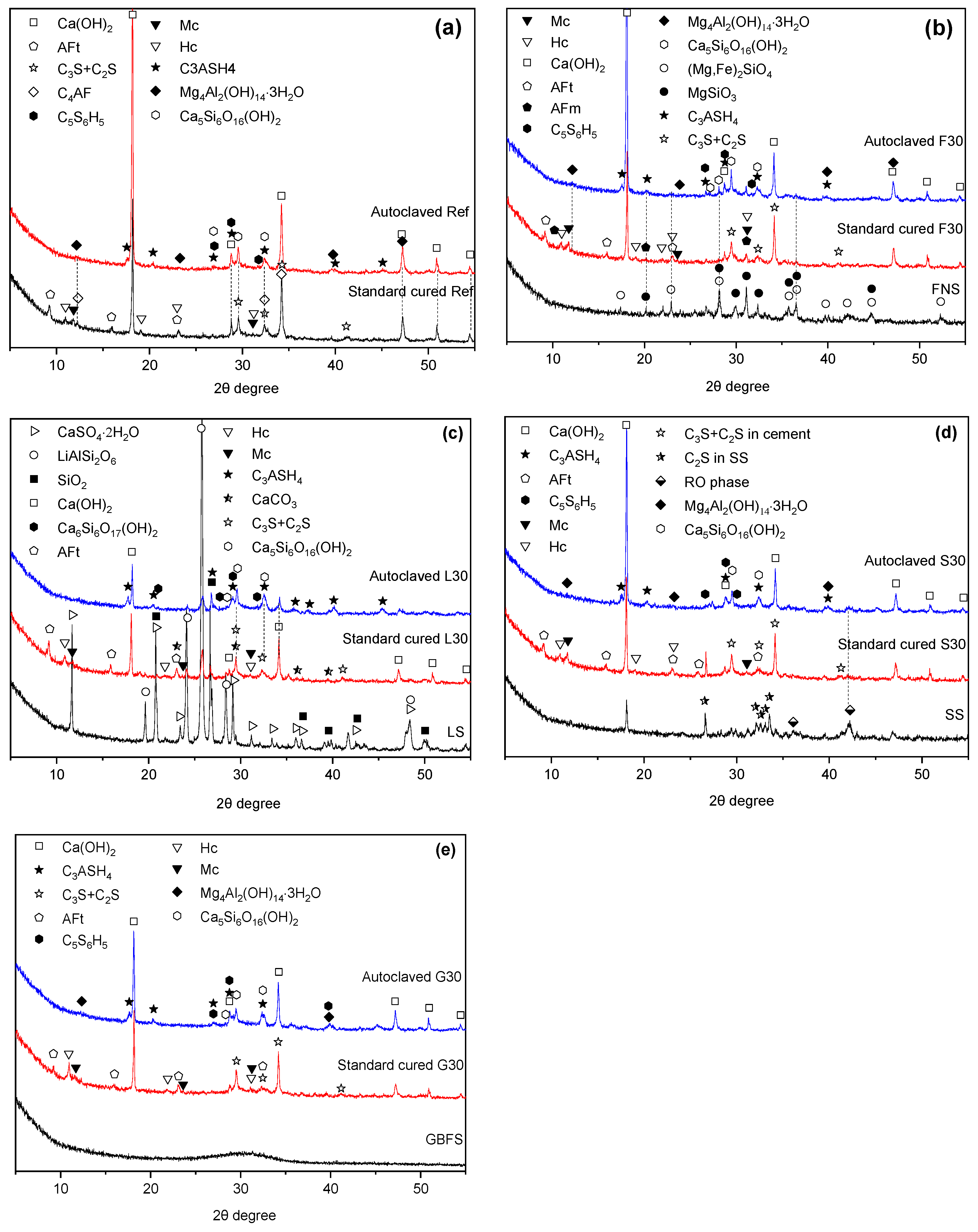
2.3. XRD Analysis of Hydration Products
2.3.1. Hydration Products Under Standard Curing Condition
2.3.2. Hydration Products Under Autoclave Curing
- (1)
- Comparison of hydration products: autoclaved vs. standard curing
- (2)
- The impact of FNS
- (3)
- The impact of LS
- (4)
- The impact of SS and GBFS
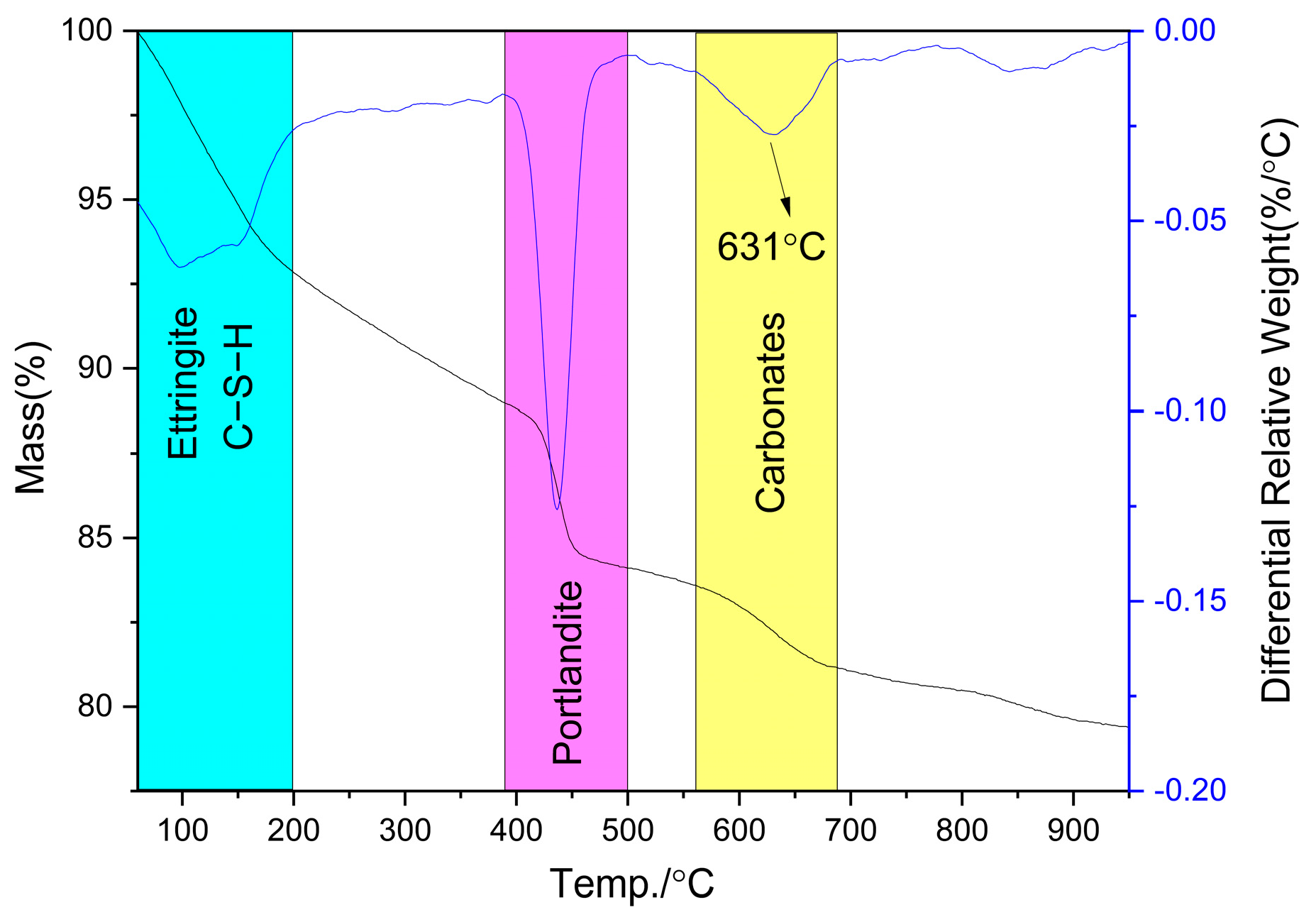
2.4. TG/DTG Analysis of Hydration Products
2.4.1. Hydration Products Under Standard Curing Condition
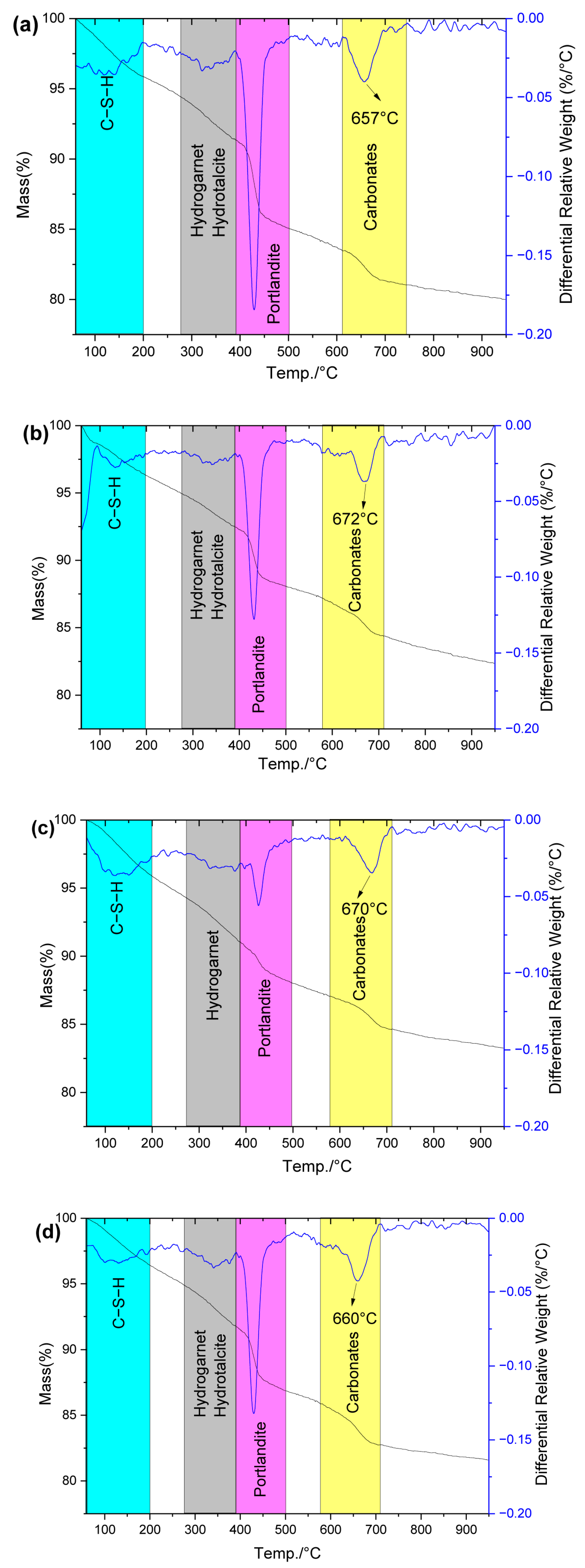
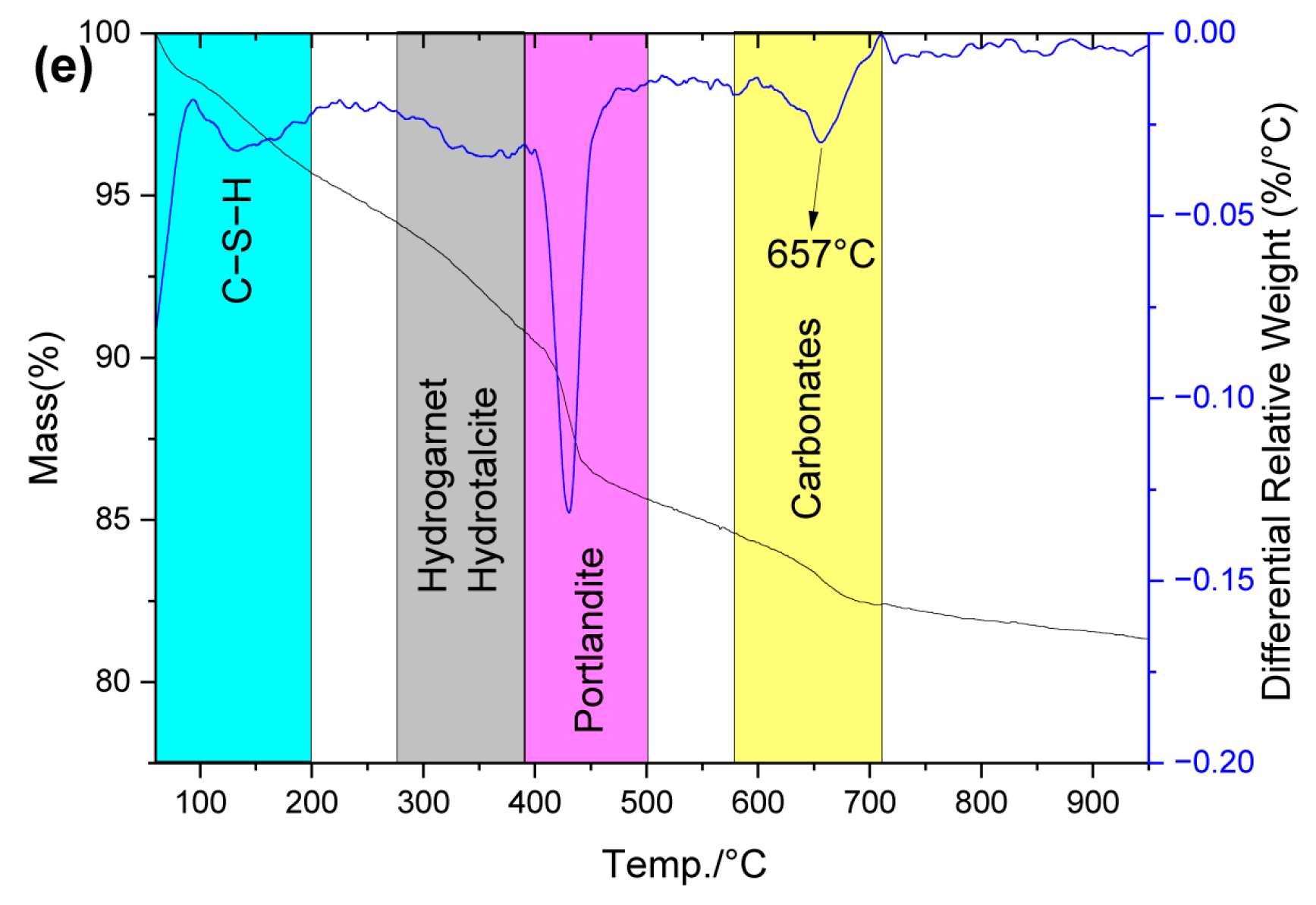
2.4.2. Hydration Products Under Autoclave Curing Condition
- (1)
- Types of hydration products
- (2)
- Content of C−S−H and hydrogarnet
- (3)
- CH Content
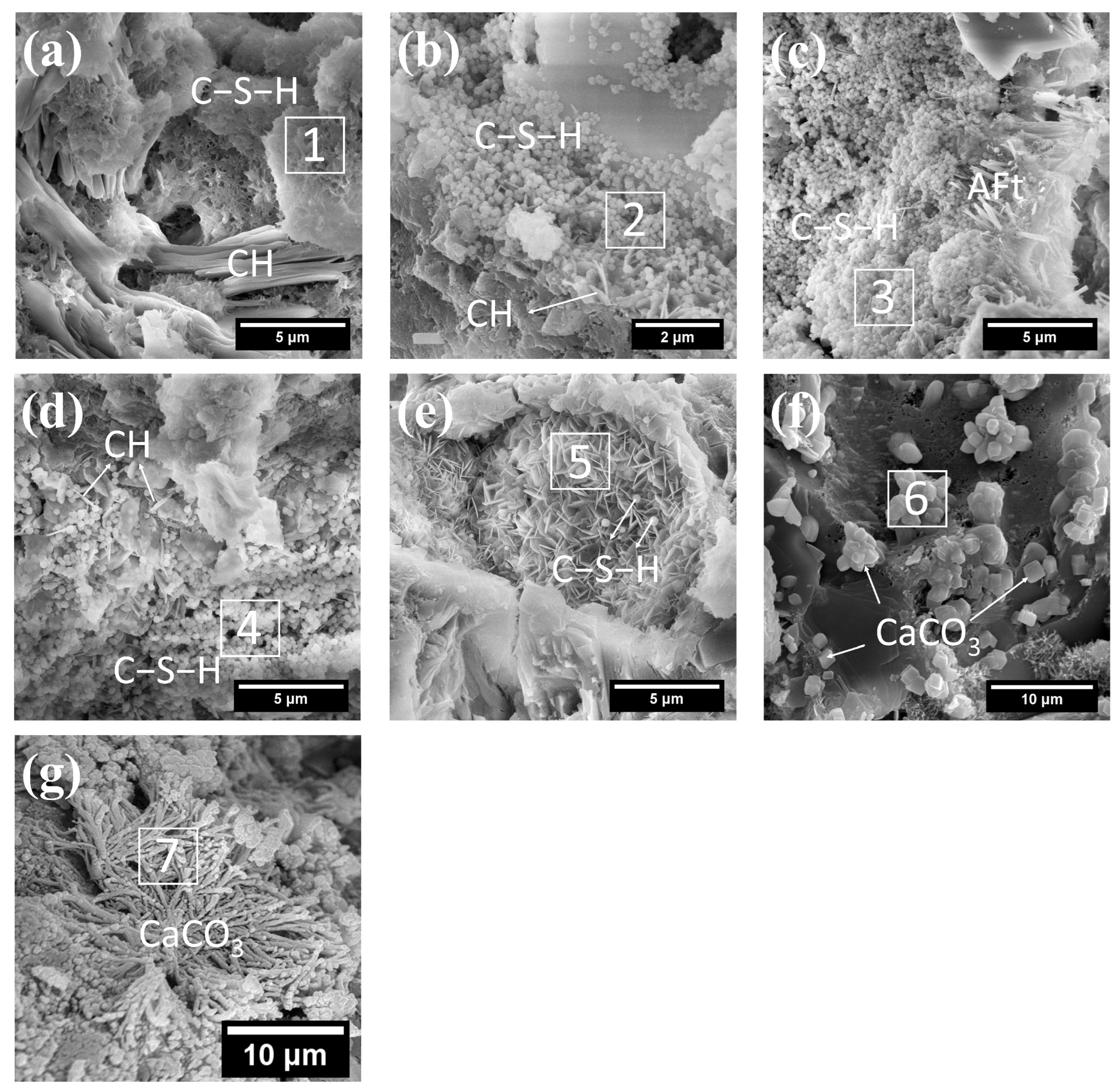
2.5. SEM-EDS Analysis of Hydration Products
2.5.1. Hydration Products of Cement Paste After 28d Standard Curing
- (1)
- C−S−H
- (2)
- CH
- (3)
- CaCO3
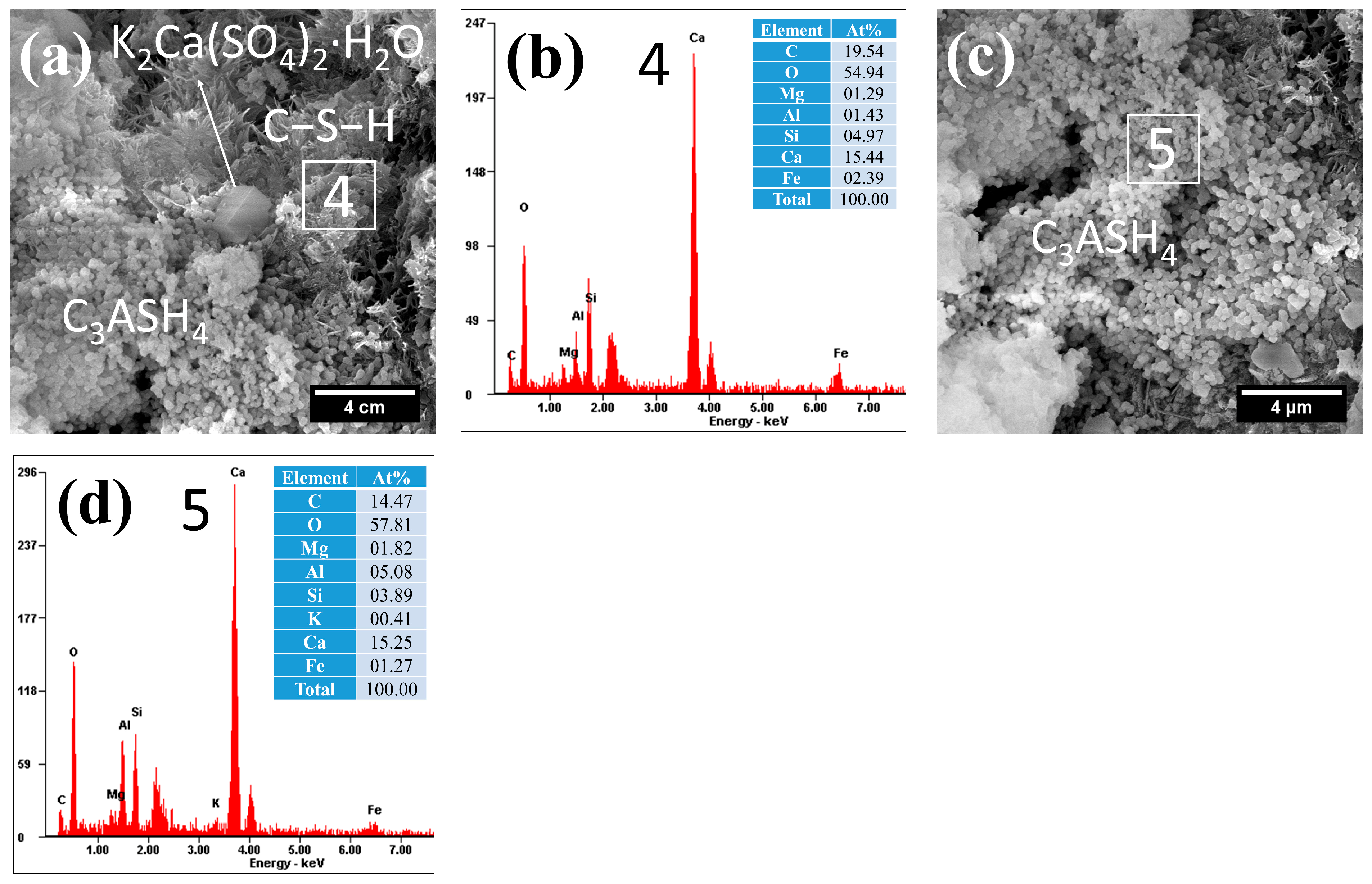
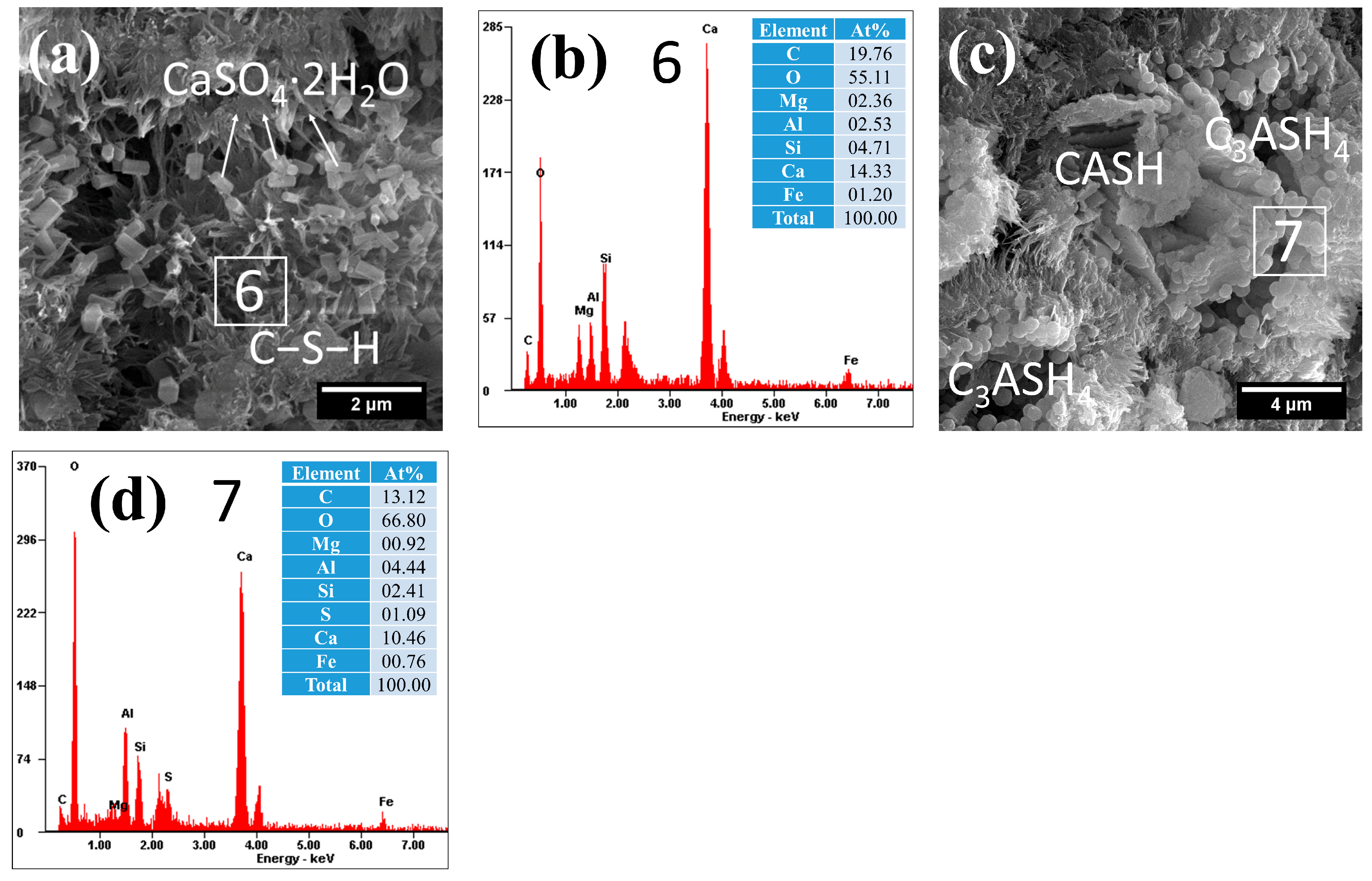
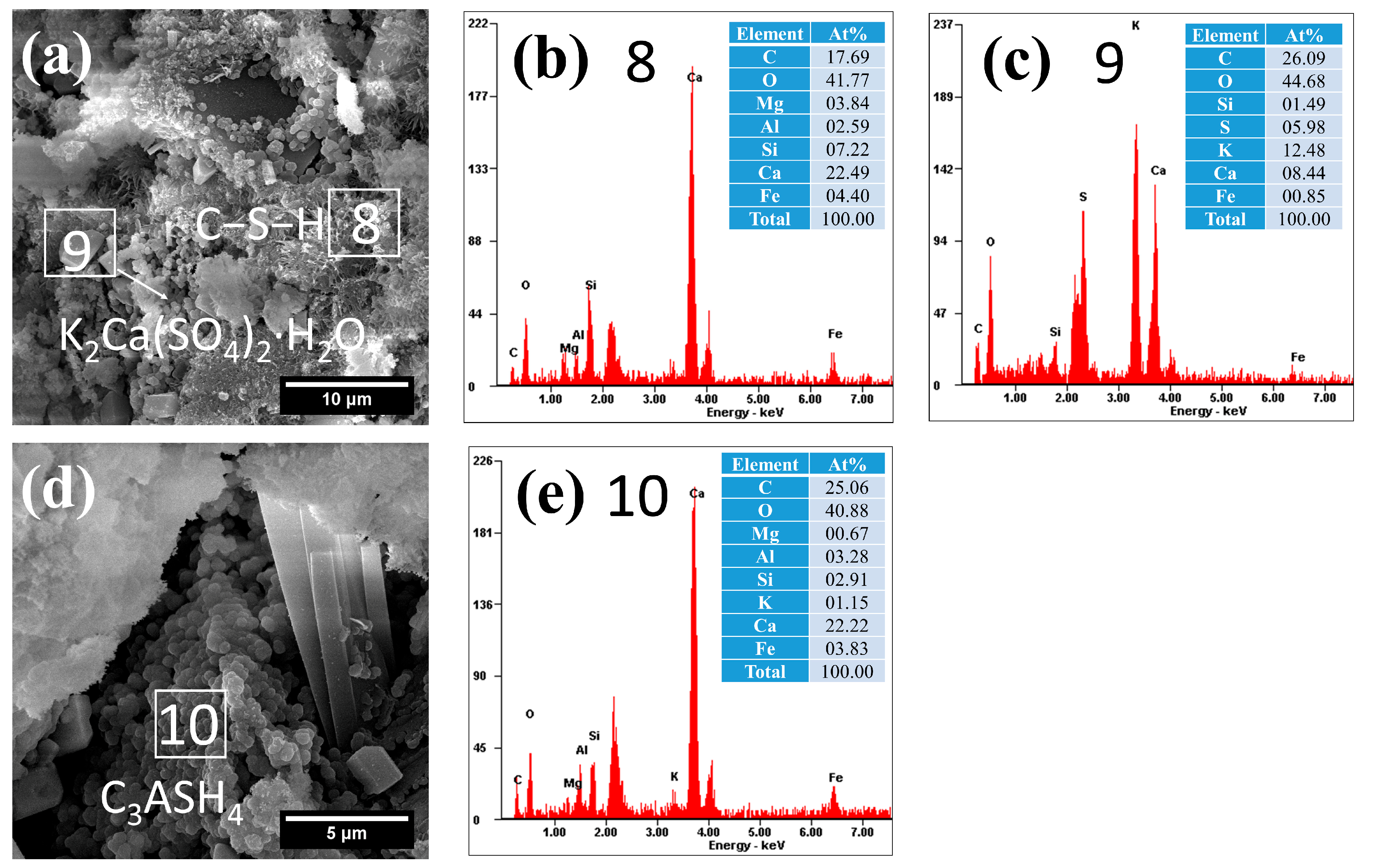
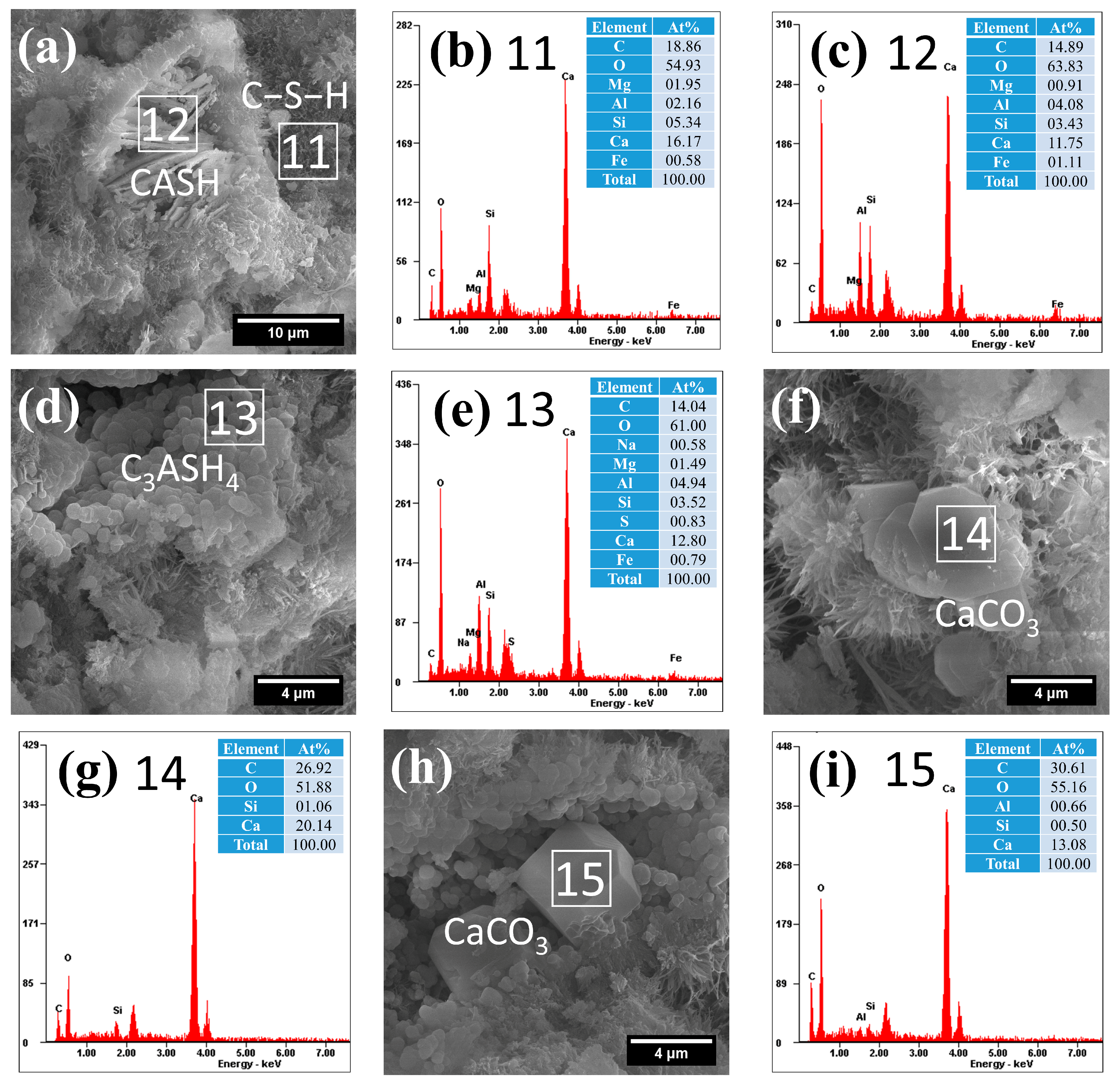
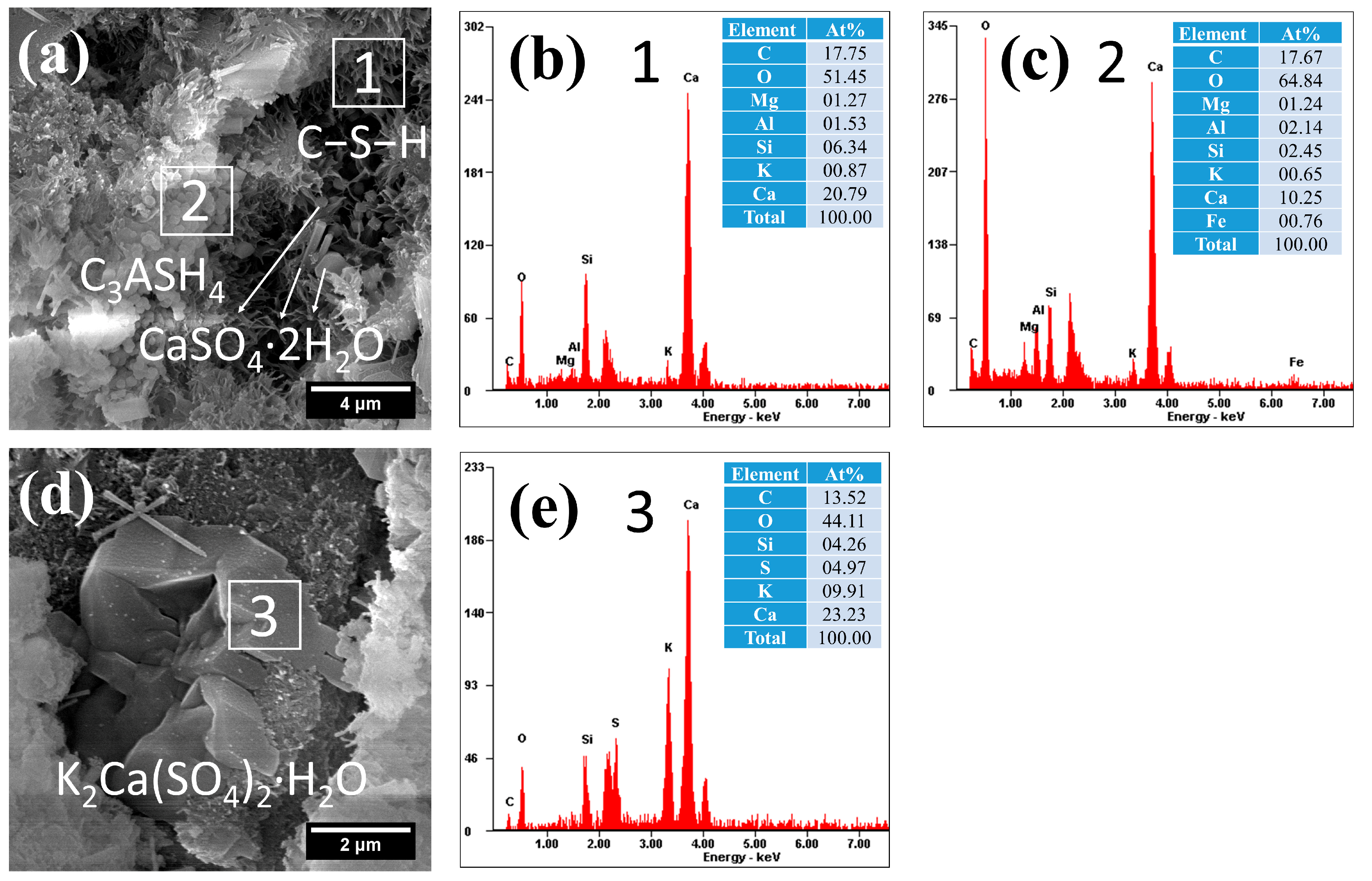
2.5.2. Hydration Products of Cement Paste Under Autoclave Curing Conditions
- (1)
- C−S−H
- (2)
- Hydrogarnet
- (3)
- Gypsum-like products
- (4)
- Crystalline CASH
- (5)
- CaCO3
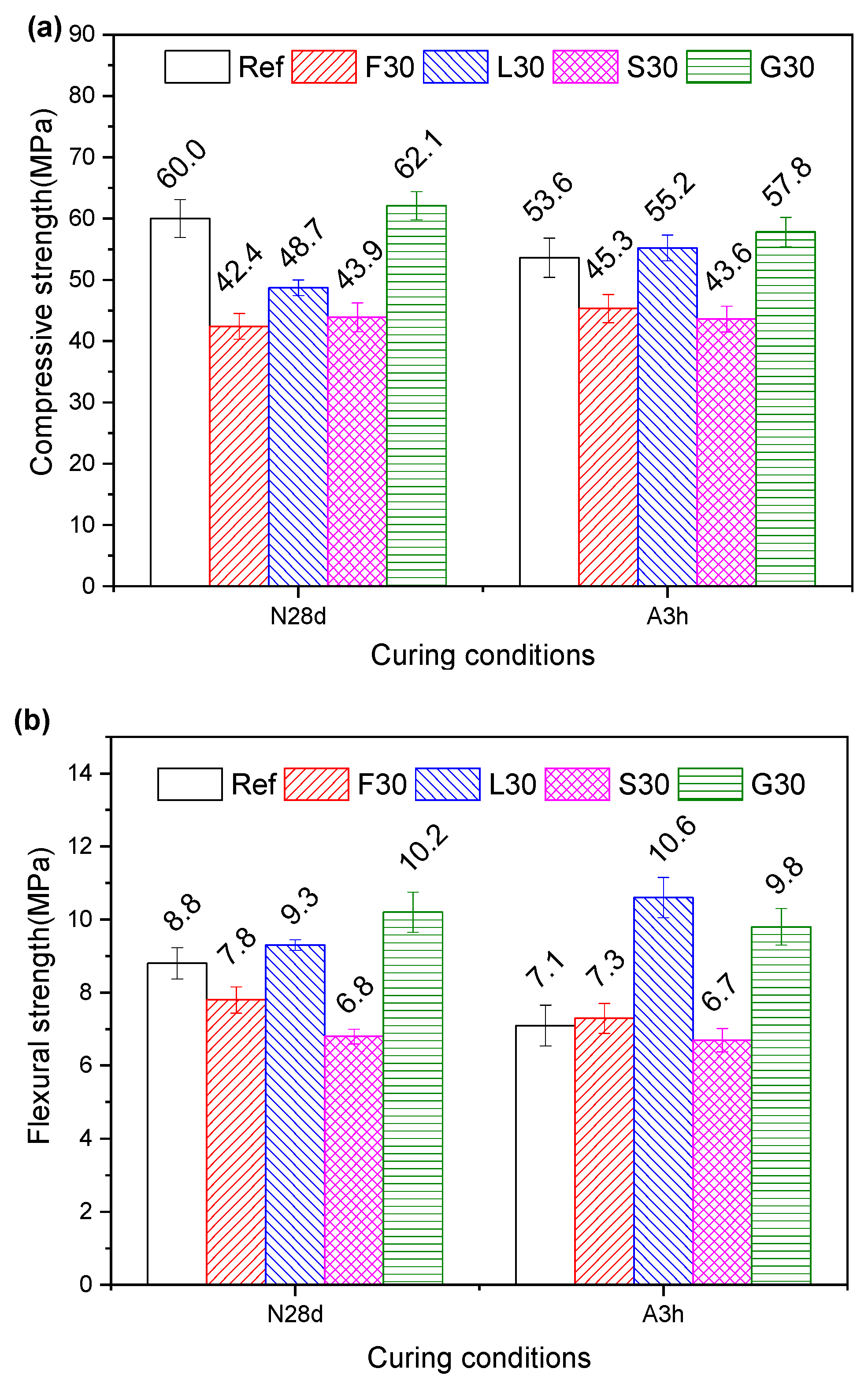
2.6. Mechanical Property
2.6.1. Compressive Strength
2.6.2. Flexural Strength
2.7. Discussion
2.7.1. Hydration Products of Cement Paste Under Autoclave Curing Conditions
2.7.2. The Reactivity of SCMs
- (1)
- Under standard curing conditions
- (2)
- Under autoclave curing conditions
2.7.3. Future Investigations
3. Conclusions
- (1)
- LS incorporation facilitated the extensive formation of ettringite, endowing the cementitious system with superior flexural strength development compared with systems incorporating FNS and SS. However, a considerable proportion of Al2O3 and SiO2 in LS were encapsulated within inert crystalline phases, which restricted its pozzolanic reactivity under standard curing conditions and resulted in mechanical performance inferior to that of GBFS.
- (2)
- SCMs facilitated the formation of low Ca/Si ratio C−S−H gels with spherical morphology and enhanced Al incorporation under standard curing conditions.
- (3)
- Autoclaving significantly enhanced the reactivity of all SCMs, as evidenced by TG/DTG analysis. Compared to plain cement, the mass loss below 390 °C varied from 87.2% (FNS) to 106.5% (GBFS), while the content below 200 °C ranged between 87.0% (SS) and 104.6% (GBFS). Notably, CH content decreased substantially, with reductions to 70.1% (FNS), 47.7% (LS), 77.9% (SS), and 82.4% (GBFS) of the control values.
- (4)
- Among all SCMs, autoclave curing exhibited the most significant activating effect on LS, which consequently demonstrated the greatest potential as a GBFS alternative in autoclaved concrete products. However, the low CaO content and acidic nature of LS inherently limit its use to low replacement levels unless supplementary alkalinity and CaO sources are incorporated.
- (5)
- Compared to standard 28-day curing, autoclave curing resulted in a lower overall yield of hydration products in the cementitious systems and exhibited a marked tendency for CH formation. It also accelerated the crystallization of gypsum, hydrogarnet, and CASH phases, which are detrimental to the long-term performance of concrete.
- (6)
- Autoclave curing transformed the calcium carbonate morphology in cementitious materials from the cubic or fibrous forms of standard curing into plate-like or polyhedral configurations.
4. Materials and Methods
4.1. Materials
4.2. Sample Preparation and Test Methods
4.2.1. Sample Preparation
4.2.2. Test Methods
Author Contributions
Funding
Data Availability Statement
Acknowledgments
Conflicts of Interest
Abbreviations
| SCMs | Supplementary cementitious materials |
| FNS | Ferronickel slag |
| LS | Lithium slag |
| SS | Steel slag |
| GBFS | Ground granulated blast-furnace slag |
| ASR | Alkali-silica reaction |
| UHPC | Ultra-high performance concrete |
| f-CaO | Free calcium oxide |
| f-MgO | Free magnesium oxide |
| C−S−H | Calcium silicate hydrate |
| DEF | Delayed ettringite formation |
| PC | Portland cement |
| XRF | X-ray fluorescence |
| LOI | Loss on ignition |
| XRD | X-ray diffractometer |
| SEM-EDS | Scanning electron microscope coupled with an X-ray energy dispersive spectrometer |
| TG-DTG | Thermogravimetric and derivative thermogravimetric analyses |
| CH | Calcium hydroxide |
| AFt | Ettringite |
| Mc | Monocarbonate |
| Hc | Hemicarbonate |
| AFm | Monosulfoaluminate hydrate |
| LDH | Layered double hydroxide |
| ITZ | Interfacial transition zone |
| CASH | Calcium aluminosilicate hydrate |
References
- Alhozaimy, A.; Jaafar, M.S.; Al-Negheimish, A.; Abdullah, A.; Taufiq-Yap, Y.H.; Noorzaei, J.; Alawad, O.A. Properties of high strength concrete using white and dune sands under normal and autoclaved curing. Constr. Build. Mater. 2012, 27, 218–222. [Google Scholar] [CrossRef] [Scilit]
- Yazıcı, H.; Yardımcı, M.Y.; Aydın, S.; Karabulut, A.Ş. Mechanical properties of reactive powder concrete containing mineral admixtures under different curing regimes. Constr. Build. Mater. 2009, 23, 1223–1231. [Google Scholar] [CrossRef] [Scilit]
- Li, G.; Chen, X.; Zhang, Y.; Zhuang, Z.; Lv, Y. Studies of nano-SiO2 and subsequent water curing on enhancing the frost resistance of autoclaved PHC pipe pile concrete. J. Build. Eng. 2023, 69, 106209. [Google Scholar] [CrossRef] [Scilit]
- Narayanan, N.; Ramamurthy, K. Structure and properties of aerated concrete: A review. Cem. Concr. Compos. 2000, 22, 321–329. [Google Scholar] [CrossRef] [Scilit]
- Lehmann, C.; Fontana, P.; Müller, U. Evolution of phases and microstructure in hydrothermally cured Ultra-High Performance Concrete (UHPC). In Nanotechnology in Construction 3; Springer: Berlin/Heidelberg, Germany, 2009; pp. 287–293. [Google Scholar] [CrossRef] [Scilit]
- Wang, Q.; Shi, M.; Zhang, Z. Hydration properties of steel slag under autoclaved condition. J. Therm. Anal. Calorim. 2015, 120, 1241–1248. [Google Scholar] [CrossRef] [Scilit]
- Gao, P.; Wu, S.; Lu, X.; Deng, M.; Lin, P.; Wu, Z.; Tang, M. Soundness evaluation of concrete with MgO. Constr. Build. Mater. 2007, 21, 132–138. [Google Scholar] [CrossRef] [Scilit]
- Zdeb, T. An analysis of the steam curing and autoclaving process parameters for reactive powder concretes. Constr. Build. Mater. 2017, 131, 758–766. [Google Scholar] [CrossRef] [Scilit]
- Dong, S.; Ouyang, X.; Yoo, D.Y.; Han, B. Influence of early thermal curing regimes on properties of ultra-high performance concrete: A review. J. Build. Eng. 2024, 96, 110494. [Google Scholar] [CrossRef] [Scilit]
- Shen, P.; Lu, L.; He, Y.; Wang, F.; Hu, S. The effect of curing regimes on the mechanical properties, nano-mechanical properties and microstructure of ultra-high performance concrete. Cem. Concr. Res. 2019, 118, 1–13. [Google Scholar] [CrossRef] [Scilit]
- Yazıcı, H.; Deniz, E.; Baradan, B. The effect of autoclave pressure, temperature and duration time on mechanical properties of reactive powder concrete. Constr. Build. Mater. 2013, 42, 53–63. [Google Scholar] [CrossRef] [Scilit]
- Ilić, B.; Mitrović, A.; Miličić, L.; Zdujić, M. Compressive strength and microstructure of ordinary cured and autoclaved cement-based composites with mechanically activated kaolins. Constr. Build. Mater. 2018, 178, 92–101. [Google Scholar] [CrossRef] [Scilit]
- Taylor, H.F.; Famy, C.; Scrivener, K. Delayed ettringite formation. Cem. Concr. Res. 2001, 31, 683–693. [Google Scholar] [CrossRef] [Scilit]
- Lea, F.M. Lea’s Chemistry of Cement and Concrete, 4th ed.; Edward Arnold: London, UK, 1998. [Google Scholar]
- Kurdowski, W. Cement and Concrete Chemistry; Springer: Dordrecht, The Netherlands, 2014. [Google Scholar] [CrossRef] [Scilit]
- Bahafid, S.; Ghabezloo, S.; Duc, M.; Faure, P.; Sulem, J. Effect of the hydration temperature on the microstructure of Class G cement: C−S−H composition and density. Cem. Concr. Res. 2017, 95, 270–281. [Google Scholar] [CrossRef] [Scilit]
- Tan, K.; Zhu, J. Influences of steam and autoclave curing on the strength and chloride permeability of high strength concrete. Mater. Struct. 2017, 50, 56. [Google Scholar] [CrossRef] [Scilit]
- Aldea, C.M.; Young, F.; Wang, K.; Shah, S.P. Effects of curing conditions on properties of concrete using slag replacement. Cem. Concr. Res. 2000, 30, 465–472. [Google Scholar] [CrossRef] [Scilit]
- Chen, T.; Gao, X.; Ren, M. Effects of autoclave curing and fly ash on mechanical properties of ultra-high performance concrete. Constr. Build. Mater. 2018, 158, 864–872. [Google Scholar] [CrossRef] [Scilit]
- Thomas, M. The effect of supplementary cementing materials on alkali-silica reaction: A review. Cem. Concr. Res. 2011, 41, 1224–1231. [Google Scholar] [CrossRef] [Scilit]
- Chappex, T.; Scrivener, K.L. The influence of aluminium on the dissolution of amorphous silica and its relation to al-kali silica reaction. Cem. Concr. Res. 2012, 42, 1645–1649. [Google Scholar] [CrossRef] [Scilit]
- Shi, Z.; Ma, B.; Lothenbach, B. Effect of Al on the formation and structure of alkali-silica reaction products. Cem. Concr. Res. 2021, 140, 106311. [Google Scholar] [CrossRef] [Scilit]
- Tapas, M.J.; Thomas, P.; Vessalas, K.; Sirivivatnanon, V. Mechanisms of Alkali-Silica Reaction Mitigation in AMBT Conditions: Comparative Study of Traditional Supplementary Cementitious Materials. J. Mater. Civ. Eng. 2022, 34, 04021460. [Google Scholar] [CrossRef] [Scilit]
- Duchesne, J.; Bérubé, M.-A. Long-term effectiveness of supplementary cementing materials against alkali–silica reac-tion. Cem. Concr. Res. 2001, 31, 1057–1063. [Google Scholar] [CrossRef] [Scilit]
- Xiao, R.; Prentice, D.; Collin, M.; Balonis, M.; La Plante, E.; Torabzadegan, M.; Gadt, T.; Sant, G. Calcium nitrate effectively mitigates alkali–silica reaction by surface passivation of reactive aggregates. J. Am. Ceram. Soc. 2024, 107, 7513–7527. [Google Scholar] [CrossRef] [Scilit]
- Yazıcı, H.; Yardımcı, M.Y.; Yiğiter, H.; Aydın, S.; Türkel, S. Mechanical properties of reactive powder concrete containing high volumes of ground granulated blast furnace slag. Cem. Concr. Compos. 2010, 32, 639–648. [Google Scholar] [CrossRef] [Scilit]
- Rahman, M.A.; Sarker, P.K.; Shaikh, F.U.A.; Saha, A.K. Soundness and compressive strength of Portland cement blended with ground granulated ferronickel slag. Constr. Build. Mater. 2017, 140, 194–202. [Google Scholar] [CrossRef] [Scilit]
- Li, B.; Cao, R.; You, N.; Chen, C.; Zhang, Y. Products and properties of steam cured cement mortar containing lithium slag under partial immersion in sulfate solution. Constr. Build. Mater. 2019, 220, 596–606. [Google Scholar] [CrossRef] [Scilit]
- Liu, L.; Liu, L.; Liu, Z.; Yang, C.; Li, X.; Huang, Y. Effects of the Aging Treatment Process on the Properties of Steel Slag. J. Mater. Civ. Eng. 2024, 36, 04024019. [Google Scholar] [CrossRef] [Scilit]
- Li, B.; Lu, X.; Huo, B.; Du, Y.; Liu, Y.; Cheng, Y.; Liu, Z. The early age hydration products and mechanical properties of cement paste with steel slag powder as additive under steam curing conditions. Buildings 2023, 13, 2192. [Google Scholar] [CrossRef] [Scilit]
- Li, B.; Wang, S.; Pan, D.; Zhang, Y. Hydration Products and Mechanical Properties of Ferronickel Slag Blended Cement Mortar under Steam Curing. J. Chin. Ceram. Soc. 2019, 47, 891–899. (In Chinese) [Google Scholar]
- GB/T 1346-2024; Code for Test Methods for Water Requirement of Normal Consistency, Setting Time and Soundness of the Portland Cement. China Standard Press: Beijing, China, 2024.
- Altun, I.A.; Yılmaz, İ. Study on steel furnace slags with high MgO as additive in Portland cement. Cem. Concr. Res. 2002, 32, 1247–1249. [Google Scholar] [CrossRef] [Scilit]
- Hu, S.; He, Y.; Lu, L.; Ding, Q. Effect of fine steel slag powder on the early hydration process of Portland cement. J. Wuhan Univ. Technol.-Mater. Sci. Edit. 2006, 21, 147–149. [Google Scholar] [CrossRef] [Scilit]
- Péra, J.; Ambroise, J.; Chabannet, M. Properties of blast-furnace slags containing high amounts of manganese. Cem. Concr. Res. 1999, 29, 171–177. [Google Scholar] [CrossRef] [Scilit]
- Matschei, T.; Lothenbach, B.; Glasser, F.P. The role of calcium carbonate in cement hydration. Cem. Concr. Res. 2007, 37, 551–558. [Google Scholar] [CrossRef] [Scilit]
- Li, B.; Tang, Z.; Huo, B.; Liu, Z.; Cheng, Y.; Ding, B.; Zhang, P. The early age hydration products and mechanical properties of cement paste containing GBFS under steam curing condition. Buildings 2022, 12, 1746. [Google Scholar] [CrossRef] [Scilit]
- Yang, Z.; Fischer, H.; Polder, R. Modified hydrotalcites as a new emerging class of smart additive of reinforced concrete for anticorrosion applications: A literature review. Mater. Corros. 2013, 64, 1066–1074. [Google Scholar] [CrossRef] [Scilit]
- Yan, X.; Jiang, L.; Guo, M.; Chen, Y.; Song, Z.; Bian, R. Evaluation of sulfate resistance of slag contained concrete under steam curing. Constr. Build. Mater. 2019, 195, 231–237. [Google Scholar] [CrossRef] [Scilit]
- Taylor, H.F.W. Hydrothermal reactions in the system CaO–SiO2–H2O and the steam curing of cement and cement-silica products. In Proceedings of the 4th International Symposium on the Chemistry of Cement, Washington, DC, USA, 2–7 October 1960; Volume 3, pp. 167–190. [Google Scholar]
- Taylor, H.F. 33. Hydrated calcium silicates. Part V. The water content of calcium silicate hydrate (I). J. Chem. Soc. 1953, 163–171. [Google Scholar] [CrossRef] [Scilit]
- Kalousek, G.L.; Roy, R. Crystal chemistry of hydrous calcium silicates: II, characterization of interlayer water. J. Am. Ceram. Soc. 1957, 40, 236–239. [Google Scholar] [CrossRef] [Scilit]
- Li, B.; You, N.; Zhu, G.; Huo, B.; Zhang, Y. Hydration products and mechanical properties of steam cured lithium slag blended cement. Mater. Rep. 2019, 33, 4072–4077. (In Chinese) [Google Scholar]
- Vance, K.; Aguayo, M.; Oey, T.; Sant, G.; Neithalath, N. Hydration and strength development in ternary portland cement blends containing limestone and fly ash or metakaolin. Cem. Concr. Compos. 2013, 39, 93–103. [Google Scholar] [CrossRef] [Scilit]
- Taylor, H.F. Cement Chemistry; Thomas Telford: London, UK, 1997; Volume 2, p. 459. [Google Scholar]
- Alarcon-Ruiz, L.; Platret, G.; Massieu, E.; Ehrlacher, A. The use of thermal analysis in assessing the effect of temperature on a cement paste. Cem. Concr. Res. 2005, 35, 609–613. [Google Scholar] [CrossRef] [Scilit]
- Vágvölgyi, V.; Palmer, S.J.; Kristóf, J.; Frost, R.L.; Horváth, E. Mechanism for hydrotalcite decomposition: A controlled rate thermal analysis study. J. Colloid Interface Sci. 2008, 318, 302–308. [Google Scholar] [CrossRef] [Scilit] [PubMed]
- Klimesch, D.S.; Ray, A. Effects of quartz particle size on hydrogarnet formation during autoclaving at 180 °C in the CaO-Al2O3-SiO2-H2O system. Cem. Concr. Res. 1998, 28, 1309–1316. [Google Scholar] [CrossRef] [Scilit]
- Aye, T.; Oguchi, C.T. Resistance of plain and blended cement mortars exposed to severe sulfate attacks. Constr. Build. Mater. 2011, 25, 2988–2996. [Google Scholar] [CrossRef] [Scilit]
- Hu, C.; Yao, S.; Zou, F.; Nie, S.; Liu, Z.; Wang, F. Insights into the influencing factors on the micro-mechanical proper-ties of calcium-silicate-hydrate gel. J. Am. Ceram. Soc. 2018, 102, 1942–1952. [Google Scholar] [CrossRef] [Scilit]
- Yan, Y.; Geng, G. Does nano basic building-block of C−S−H exist?—A review of direct morphological observations. Mater. Des. 2024, 238, 112699. [Google Scholar] [CrossRef] [Scilit]
- Li, B.; Li, J.; Li, Y.; Shang, H.; Yu, H.; Huo, B.; Liu, Y. The Effect of GBFS on the Mechanical Properties and Hydration Products of Steam-Cured Cement Mortar. Gels 2026, 12, 110. [Google Scholar] [CrossRef] [Scilit]
- Jennings, H.M.; Thomas, J.J.; Gevrenov, J.S.; Constantinides, G.; Ulm, F.J. A multi-technique investigation of the nanoporosity of cement paste. Cem. Concr. Res. 2007, 37, 329–336. [Google Scholar] [CrossRef] [Scilit]
- Shen, W.; Zhang, T.; Hu, J.; Ma, W.; Zhou, M. Self similarity of the spherical C−S−H particle in cement paste. J. Wuhan Univ. Technol.-Mater. Sci. Edit. 2009, 24, 684–687. [Google Scholar] [CrossRef] [Scilit]
- Tang, S.; Wang, Y.; Geng, Z.; Xu, X.; Yu, W.; He, A.; Chen, J. Structure, Fractality, Mechanics and Durability of Calcium Silicate Hydrates. Fract. Fract. 2021, 5, 47. [Google Scholar] [CrossRef] [Scilit]
- Deschner, F.; Winnefeld, F.; Lothenbach, B.; Seufert, S.; Schwesig, P.; Dittrich, S.; Goetz-Neunhoeffer, F.; Neubauer, J. Hydration of Portland cement with high replacement by siliceous fly ash. Cem. Concr. Res. 2012, 42, 1389–1400. [Google Scholar] [CrossRef] [Scilit]
- Zhang, T.; Yu, Q.; Wei, J.; Gao, P.; Chen, P.; Hu, J. Micro-structural development of gap-graded blended cement pastes containing a high amount of supplementary cementitious materials. Cem. Concr. Compos. 2012, 34, 1024–1032. [Google Scholar] [CrossRef] [Scilit]
- Manoli, F.; Dalas, E. Spontaneous precipitation of calcium carbonate in the presence of ethanol, isopropanol and diethylene glycol. J. Cryst. Growth 2000, 218, 359–364. [Google Scholar] [CrossRef] [Scilit]
- Stolarski, J.; van Dijk, I.; Benning, L.G. Controls on CaCO3 Polymorphism: From Laboratory Precipitation to Biominer-alization across Geological Time. Elements 2025, 21, 92–97. [Google Scholar] [CrossRef] [Scilit]
- Sondi, I.; Matijević, E. Homogeneous Precipitation of Calcium Carbonates by Enzyme Catalyzed Reaction. J. Colloid Interface Sci. 2001, 238, 208–214. [Google Scholar] [CrossRef] [Scilit]
- Boulos, R.A.; Zhang, F.; Tjandra, E.S.; Martin, A.D.; Spagnoli, D.; Raston, C.L. Spinning up the polymorphs of calcium carbonate. Sci. Rep. 2014, 4, 3616. [Google Scholar] [CrossRef] [Scilit]
- Quillin, K.; Osborne, G.; Majumdar, A.; Singh, B. Effects of w/c ratio and curing conditions on strength development in BRECEM concretes. Cem. Concr. Res. 2001, 31, 627–632. [Google Scholar] [CrossRef] [Scilit]
- Jappy, T.G.; Glasser, F.P. Synthesis and stability of silica-substituted hydrogarnet Ca3Al2Si3-xO12-4x(OH)4x. Adv. Cem. Res. 1991, 4, 1–8. [Google Scholar] [CrossRef] [Scilit]
- Inazumi, S.; Sano, H.; Yamada, M. Estimation of gypsum hemihydrate content in recycled gypsums derived from gyp-sum boards. J. Mater. Cycles Waste Manag. 2014, 18, 168–176. [Google Scholar] [CrossRef] [Scilit]
- Lothenbach, B.; Scrivener, K.; Hooton, R.D. Supplementary cementitious materials. Cem. Concr. Res. 2011, 41, 1244–1256. [Google Scholar] [CrossRef] [Scilit]
- Collepardi, M. A state-of-the-art review on delayed ettringite attack on concrete. Cem. Concr. Compos. 2003, 25, 401–407. [Google Scholar] [CrossRef] [Scilit]
- Nguyen, V.H.; Leklou, N.; Aubert, J.E.; Mounanga, P. The effect of natural pozzolan on delayed ettringite formation of the heat-cured mortars. Constr. Build. Mater. 2013, 48, 479–484. [Google Scholar] [CrossRef] [Scilit]
- Emminger, Y.H.; Ladner, L.; Ruiz-Agudo, C. Comparative study of the early stages of crystallization of calcium silicate hydrate (CSH) and calcium aluminate silicate hydrate (CASH). Cem. Concr. Res. 2025, 193, 107873. [Google Scholar] [CrossRef] [Scilit]
- Escalante-Garcia, J.I.; Sharp, J.H. Effect of temperature on the hydration of the main clinker phases in Portland cements: Part I, neat cements. Cem. Concr. Res. 1998, 28, 1245–1257. [Google Scholar] [CrossRef] [Scilit]
- Kjellsen, K.O.; Detwiler, R.J. Reaction kinetics of Portland cement mortars hydrated at different temperatures. Cem. Concr. Res. 1992, 22, 112–120. [Google Scholar] [CrossRef] [Scilit]
- Tadros, M.E.; Skalny, J.; Kalyoncu, R.S. Early hydration of tricalcium silicate. J. Am. Ceram. Soc. 1976, 59, 344–347. [Google Scholar] [CrossRef] [Scilit]
- Scrivener, K.; Ouzia, A.; Juilland, P.; Mohamed, A.K. Advances in understanding cement hydration mechanisms. Cem. Concr. Res. 2019, 124, 105823. [Google Scholar] [CrossRef] [Scilit]
- Kantro, D.L.; Brunauer, S.; Weise, C.H. Development of surface in the hydration of calcium silicates. II. Extension of investigations to earlier and later stages of hydration. J. Phys. Chem. 1962, 66, 1804–1809. [Google Scholar] [CrossRef] [Scilit]
- Scrivener, K.L.; Crumbie, A.K.; Laugesen, P. The Interfacial Transition Zone (ITZ) Between Cement Paste and Aggregate in Concrete. Interface Sci. 2004, 12, 411–421. [Google Scholar] [CrossRef] [Scilit]
- Diamond, S.; Huang, J. The ITZ in concrete—A different view based on image analysis and SEM observations. Cem. Concr. Compos. 2001, 23, 179–188. [Google Scholar] [CrossRef] [Scilit]
- Sha, W. Differential scanning calorimetry study of the hydration products in portland cement pastes with metakaolin replacement. Adv. Build. Technol. 2002, 1, 881–888. [Google Scholar] [CrossRef] [Scilit]
- Ramanathan, S.; Tuen, M.; Suraneni, P. Influence of supplementary cementitious material and filler fineness on their reactivity in model systems and cementitious pastes. Mater. Struct. 2022, 55, 136. [Google Scholar] [CrossRef] [Scilit]
- Overmann, S.; Weiler, L.; Haufe, J.; Vollpracht, A.; Matschei, T. Statistical assessment of the factors influencing fly ash reactivity. Constr. Build. Mater. 2024, 426, 136151. [Google Scholar] [CrossRef] [Scilit]
- Wei, Y.-L.; Cheng, S.-H.; Chen, W.-J.; Lu, Y.-H.; Chen, K.; Wu, P.-C. Influence of various sodium salt species on for-mation mechanism of lightweight aggregates made from coal fly ash-based material. Constr. Build. Mater. 2020, 239, 117890. [Google Scholar] [CrossRef] [Scilit]
- Campos, A.; Lopez, C.M.; Blanco, A.; Aguado, A. Effects of an internal sulfate attack and an alkali-aggregate reaction in a concrete dam. Constr. Build. Mater. 2018, 166, 668–683. [Google Scholar] [CrossRef] [Scilit]
- Kawamura, M.; Fuwa, H. Effects of lithium salts on ASR gel composition and expansion of mortars. Cem. Concr. Res. 2003, 33, 913–919. [Google Scholar] [CrossRef] [Scilit]
- Wang, Y.; Wang, D.; Chen, Y.; Zhang, D.; Li, Z. Micro-morphology and phase composition of lithium slag from lithium carbonate production by sulphuric acid process. Constr. Build. Mater. 2019, 203, 304–313. [Google Scholar] [CrossRef] [Scilit]
- GB/T 2419-2005; Code for Test Method for Fluidity of Cement Mortar. China Standard Press: Beijing, China, 2017.
- GB/T 17671-2021; Code for Test Method of Cement Mortar Strength (ISO Method). China Metrology Press: Beijing, China, 2018.





| Materials | CaO | SiO2 | Al2O3 | SO3 | Fe2O3 | MgO | Na2O | K2O | Cr |
|---|---|---|---|---|---|---|---|---|---|
| PC | 64.47 | 20.87 | 4.87 | 2.52 | 3.59 | 2.13 | 0.11 | 0.65 | 0.04 |
| FNS | 11.49 | 47.61 | 6.56 | 0.52 | 13.24 | 15.94 | 0.80 | 0.18 | 0.70 |
| LS | 4.53 | 62.40 | 22.10 | 6.73 | 1.06 | 0.49 | 0.89 | 0.52 | - |
| SS | 38.62 | 18.46 | 7.12 | 1.08 | 22.5 | 6.60 | 0.21 | 0.15 | - |
| GBFS | 36.05 | 34.67 | 16.52 | 2.53 | 0.29 | 3.90 | - | 0.33 | - |
| Materials | Mineral Composition | LOI (%) | Density (g/cm3) |
|---|---|---|---|
| PC | C3S, C2S, C3A, C4AF, CaCO3, CaSO4·2H2O | 2.4 | 3.05 |
| FNS | (Mg, Fe)2SiO4, MgSiO3 | 1.4 | 2.99 |
| LS | LiAlSi2O6, CaSO4·2H2O, SiO2 | 5.7 | 2.60 |
| SS | C2S, C2F, C12A7, RO phase, Ca(OH)2, CaCO3, f-CaO, f-MgO | 6.2 | 3.27 |
| GBFS | Amorphous phase | 2.0 | 2.90 |
| Samples | Water Demand (wt.%) | Setting Time (h: min) | Le Chatelier Soundness (mm) | Flow of Mortar (mm) | |
|---|---|---|---|---|---|
| Initial | Final | ||||
| Ref | 27.4 | 2:52 | 3:57 | 0.5 | 210 |
| F30 | 27.4 | 4:10 | 5:25 | 0.5 | 210 |
| L30 | 28.9 | 3:30 | 4:40 | 0.5 | 190 |
| S30 | 27.2 | 4:40 | 6:25 | 3.0 | 220 |
| G30 | 28.2 | 3:45 | 5:00 | 0.5 | 200 |
| Curing Condition | Samples | Mass Loss | <390 °C | <200 °C | 280~390 °C | CH | CaCO3 |
|---|---|---|---|---|---|---|---|
| Standard curing | Ref | 20.62 | 11.04 | 7.18 | 2.10 | 20.00 | 6.77 |
| Autoclave curing | Ref | 19.96 | 8.65 | 4.15 | 2.99 | 26.39 | 5.65 |
| F30 | 18.66 | 7.54 | 3.72 | 2.39 | 18.50 | 3.68 | |
| L30 | 16.71 | 9.07 | 4.16 | 3.17 | 12.58 | 4.70 | |
| S30 | 18.41 | 8.28 | 3.61 | 3.05 | 20.55 | 8.36 | |
| G30 | 18.67 | 9.21 | 4.34 | 3.26 | 21.74 | 4.45 |
| Phases | C | O | Si | Ca | Al | S | Fe | Mg | K |
|---|---|---|---|---|---|---|---|---|---|
| 1 | 38.38 | 15.13 | 40.95 | 2.07 | 0.99 | 1.82 | 0.66 | ||
| 2 | 60.87 | 22.96 | 12.04 | 0.94 | 2.43 | 0.76 | |||
| 3 | 62.19 | 11.13 | 18.39 | 4.29 | 1.45 | 1.27 | 0.70 | 0.57 | |
| 4 | 14.21 | 66.69 | 5.81 | 8.39 | 1.60 | 0.27 | 0.61 | 1.49 | 0.94 |
| 5 | 20.45 | 52.87 | 8.75 | 12.56 | 1.95 | 0.55 | 2.48 | 0.38 | |
| 6 | 38.50 | 37.95 | 1.48 | 21.33 | 0.73 | ||||
| 7 | 32.56 | 43.80 | 5.59 | 18.05 |
Disclaimer/Publisher’s Note: The statements, opinions and data contained in all publications are solely those of the individual author(s) and contributor(s) and not of MDPI and/or the editor(s). MDPI and/or the editor(s) disclaim responsibility for any injury to people or property resulting from any ideas, methods, instructions or products referred to in the content. |
© 2026 by the authors. Licensee MDPI, Basel, Switzerland. This article is an open access article distributed under the terms and conditions of the Creative Commons Attribution (CC BY) license.
Share and Cite
Li, B.; Wail, S.; Shi, L.; Arif, A.; Huo, B.; Cheng, Y. The Early Age Hydration Products and Mechanical Properties of Autoclaved Cement Paste Incorporating Supplementary Cementitious Materials. Gels 2026, 12, 160. https://doi.org/10.3390/gels12020160
Li B, Wail S, Shi L, Arif A, Huo B, Cheng Y. The Early Age Hydration Products and Mechanical Properties of Autoclaved Cement Paste Incorporating Supplementary Cementitious Materials. Gels. 2026; 12(2):160. https://doi.org/10.3390/gels12020160
Chicago/Turabian StyleLi, Baoliang, Sahi Wail, Liying Shi, Arifuggaman Arif, Binbin Huo, and Yongzhen Cheng. 2026. "The Early Age Hydration Products and Mechanical Properties of Autoclaved Cement Paste Incorporating Supplementary Cementitious Materials" Gels 12, no. 2: 160. https://doi.org/10.3390/gels12020160
APA StyleLi, B., Wail, S., Shi, L., Arif, A., Huo, B., & Cheng, Y. (2026). The Early Age Hydration Products and Mechanical Properties of Autoclaved Cement Paste Incorporating Supplementary Cementitious Materials. Gels, 12(2), 160. https://doi.org/10.3390/gels12020160