Review

Interactions of Polyphenolic Compounds with Gelling Agents: Health-Promoting Properties and Application in Food Systems


Department of Food Technology and Human Nutrition, Faculty of Technology and Life Sciences, University of Rzeszow, 4 Zelwerowicza St., 35-601 Rzeszow, Poland
*
Author to whom correspondence should be addressed.
Gels 2026, 12(1), 30; https://doi.org/10.3390/gels12010030 (registering DOI)
Submission received: 29 November 2025 / Revised: 21 December 2025 / Accepted: 26 December 2025 / Published: 30 December 2025
(This article belongs to the Special Issue Natural Bioactive Compounds and Gels)

Abstract

Despite their numerous advantages, polyphenolic compounds are characterized by low bioavailability during gastrointestinal digestion and high sensitivity to technological processes during food preparation and storage. Therefore, numerous studies conducted over the past decade have identified overcoming these challenges as the undisputed goal of fully utilizing their functional properties. One solution to these challenges is the use of gelling agents. Their use as carriers for polyphenolic compounds has improved their stability during digestion and subsequent technological applications. This study analyzed the latest available scientific reports to determine the effect of combining polyphenolic compounds with gelling agents on the bioavailability, biological activity, and subsequent technological applications of the resulting ingredients.

1. Introduction

Polyphenolic compounds are a group of secondary metabolites generated by plants in response to environmental stress, performing protective functions against biotic and abiotic factors [1]. Chemically, they are composed of at least one aromatic ring and two or more hydroxyl groups. Five classes of these compounds can be distinguished: phenolic acids, flavonoids (anthocyanins, flavanols, flavonols, flavanones, isoflavones), stilbenes, lignans, and tannins. Each of these classes differs significantly in terms of physicochemical and functional properties. Polyphenolic compounds are present in various morphological parts of plant materials, including flowers, fruits, seeds, leaves, stems, bark, and roots [2,3,4]. In the human diet, their main sources are fruits, vegetables, cereals, nuts, plant drinks and spices [5]. For centuries, polyphenols have also been an important focus of research in the context of health-promoting properties, being the subject of interest of the medical, cosmetic, nutraceutical and food industries [6]. In vitro and in vivo studies have shown a significant correlation between the consumption of polyphenols and a reduced risk of developing diseases such as diabetes, obesity, cardiovascular diseases, cancer, diseases caused by chronic inflammation, and bacterial infections [7,8]. However, despite these numerous advantages, polyphenols (mainly flavonoids) are among the compounds with low stability and bioavailability during digestion in the gastrointestinal tract, as well as high sensitivity to technological processes during food preparation and storage. Therefore, in numerous studies over the last decade, overcoming these challenges has become an undoubted task in order to fully utilize their health-promoting properties [9,10].
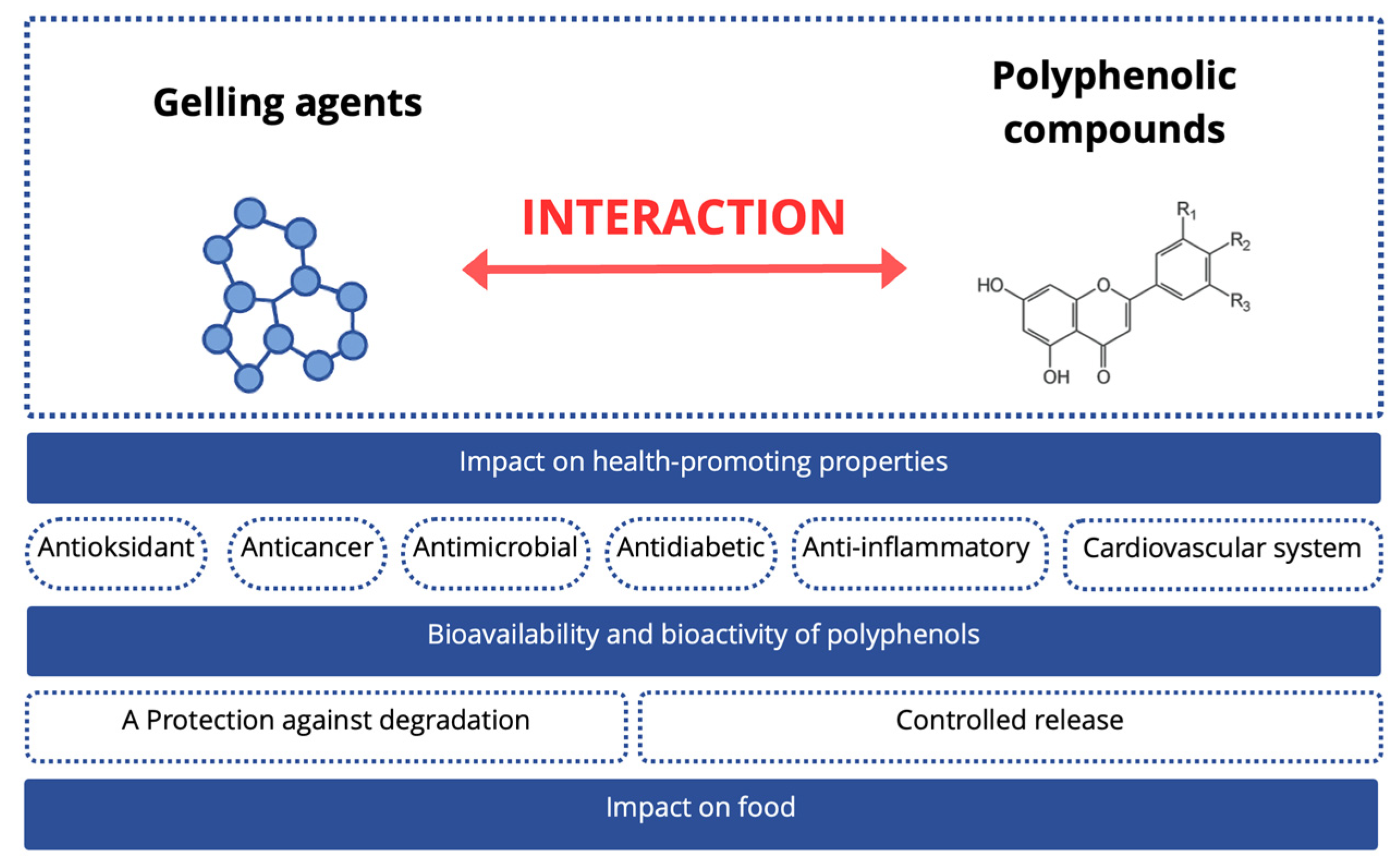
Gelling agents are substances that have the ability to form gels, which are three-dimensional network structures capable of retaining fluids. A characteristic feature of gels is that they possess the properties of both solids (texture, shape) and liquids (moisture, elasticity) [11]. The properties of gelling materials are a result of the interaction between these two components. Based on their chemical nature, gelling agents can be classified as polysaccharides (pectins, alginates, agar, vegetable gums, carrageenans, hyaluronic acid), proteins (gelatin, caseinates), starches (potato starch, corn starch, tapioca starch, modified starches), and synthetic and semi-synthetic agents (carboxymethylcellulose (CMC), methylcellulose (MC), hydroxypropylmethylcellulose (HPMC), sodium polyacrylate) [12]. These substances differ in their gelation mechanisms. Gelation can occur physically, by changing the solution’s pH, changing temperature, using salt ions, or through enzyme activity. Chemical methods of gel formation can also be distinguished, including induction with metal ions and organic compounds, as well as the latest methods, such as high pressure, ultrasound, and microwaves [13]. Gels obtained in this way play a key role in many applications in the food, pharmaceutical and cosmetics industries; packaging design; tissue engineering; and wound dressings (Figure 1) [14].
In recent years, gelling agents combined with polyphenolic compounds have been extensively studied for their impact on the bioavailability and bioactive properties of absorbed polyphenols, as well as on the mechanisms of formation and stability of gel structures [15,16]. Depending on the gel type, polyphenolic compounds can be soluble in the gel matrix, adsorbed on its surface, encapsulated in the core, or immobilized in a polymer network. Such strategies can potentially modify the stability, bioavailability, and biological activity of polyphenols, as well as influence the rheological and structural properties of gel matrices, determining their behavior during processing, storage, and digestion. Ultimately, these interactions influence the potential use of the resulting formulations as food products. However, despite numerous studies, a recent report combining these achievements is still lacking.
Therefore, the aim of this work was to thoroughly analyze the latest research reports on the impact of systems composed of polyphenolic compounds and gelling agents on their functional and health-promoting properties, as well as their bioavailability during gastrointestinal digestion. Furthermore, the nature and mechanisms of interactions between polyphenols and gel matrices are discussed; their impact on the rheological, structural, biological, and technological properties of gels is assessed; and the latest breakthroughs in their application in food production are presented. We believe that this report, developed in accordance with this goal, will represent an important addition to our current knowledge on polyphenol–gelling agent systems and be important for both the scientific and technological communities.

2. Results and Discussion

2.1. Mechanisms of Interaction Between Polyphenols and Gelling Agents

Gelling agents such as polysaccharides, proteins and synthetic polymers interact with polyphenolic compounds mainly through hydrogen bonds, electrostatic, hydrophobic and π-π interactions [17]. These interactions directly impact the physicochemical, nutritional, functional, sensory, and safety properties of the resulting formulations. Hydrogen bonding occurs primarily between the hydroxyl groups of polyphenols and the carboxyl, hydroxyl, or amine groups of gelling agents [18]. Hydrophobic interactions occur between the aromatic rings of polyphenols and nonpolar fragments of protein chains or hydrophobic regions of polysaccharides [19]. Electrostatic interactions, in turn, occur between the ionized phenolic groups of polyphenols and charged functional groups in gelling materials, such as positively charged amino groups in proteins or negatively charged carboxyl groups in polysaccharides. In contrast, π-π arrangements are generated between the aromatic rings of polyphenols and aromatic amino acid residues in proteins (e.g., phenylalanine, tryptophan, tyrosine) [20]. These interactions typically interact to form reversible or irreversible complexes. They also determine their chemical and physical behavior, causing changes in food color, flavor, and turbidity, ultimately impacting their potential applications. They also modulate the bioavailability of polyphenols and their storage and thermal stability. Furthermore, the structure of polysaccharides, proteins, and polyphenols, their concentration, temperature, pH, processing time, and their ionic strength can influence the degree of binding and stability of these interactions [21]. Identification and evaluation of the strength, adsorption kinetics, and structural changes in interactions between polyphenols and gelling agents can be performed using Fourier transform infrared spectroscopy (FT-IR), size exclusion chromatography, X-ray diffraction, ultraviolet-visible spectrophotometry, atomic force microscopy, transmission electron microscopy (TEM), scanning electron microscopy (SEM), and Zeta potential analysis [22].
In summary, the aforementioned interactions may increase the utility of polyphenols by improving their stability and solubility, thereby further improving their bioavailability during gastrointestinal digestion. This value may ultimately translate into increased biological activity of the resulting components. Furthermore, these interactions influence the physicochemical properties of polysaccharides and the conformation and conjugation of proteins, impacting their practical applications in food, cosmetics, and medicine.

2.2. Impact on Health-Promoting Properties

The latest reports on gel agents and polyphenolic compounds focus on creating stable gel structures that protect bioactive compounds in order to fully utilize their health-promoting properties [23]. Therefore, it is crucial to understand the impact of these interactions on functional properties, which may have significant implications for the fields of food science, human nutrition, and medicine. Suspension of polyphenols in gelling substances may contribute to improving their stability by protecting them against degradation and enable modulation of their release in the gastrointestinal tract, which, depending on the properties of the system and digestive conditions, may affect the bioavailability and effectiveness of the health-promoting effects of these compounds [10]. This increases their bioavailability and the effectiveness of their health-promoting effects. Furthermore, interactions between polyphenols and the gelling matrix can positively influence the activity of polyphenols, enhancing their therapeutic effect. This is particularly important in the context of designing functional foods and dietary supplements [24]. The most frequently reported therapeutic effects include enhanced antioxidant, anti-inflammatory, anticancer, antimicrobial, antidiabetic and anti-circulatory system activity.

2.2.1. Antioxidant Activity

Antioxidant properties are the most widely studied and recognized effects of polyphenolic compounds. These properties stem primarily from the large number of hydroxyl groups in their structure, which have been shown to scavenge free radicals and chelate metal ions [25]. By improving the stability and solubility of polyphenols as a result of their binding in the gelling matrix, their ability to transfer protons to free radicals is also increased, which leads to enhanced antioxidant activity [26]. For example, β-lactoglobulin (β-Lg) and gum arabic (GA) nanoparticles used to encapsulate epigallocatechin gallate (EGCG) have demonstrated a synergistic effect enhancing antioxidant activity. This was considered to be due to the increased stability of EGCG via hydrogen bonds with β-Lg and GA during simulated in vitro digestion [27]. Furthermore, interactions of polyphenols with gelling agents improve the water solubility of hydrophobic polyphenolic compounds, thereby increasing their radical scavenging activity. For example, the antioxidant activity of curcumin was nearly doubled when suspended in an alginate gel [28]. Additionally, suspending polyphenols in gelling agents is a good way to protect their antioxidant activity from the effects of high temperature and storage time. Tan et al. [29] demonstrated that encapsulation of black rice anthocyanins in pectin and their storage for 80 h at 50 °C reduced the loss of antioxidant activity in the chemical model by over 18.0%. Covering the capsules with a second layer of carboxymethylcellulose reduced the loss by another 5%. Packaging films, which act as a gel matrix for suspended polyphenols, also enable increased antioxidant activity and extended the shelf life of food through the controlled release of bioactive compounds [30]. Active coatings for fish fillets made of gelatin with incorporated conjugates of myricetin, kaempferol, and quercetin resulted in increased antioxidant activity, which contributed to the extension of the product’s shelf life [31]. This effect was stronger than when gelatin or polyphenols alone were used as a coating. The antioxidant activity of polyphenol–gelling agent components was also confirmed in vivo. In Wistar rats, administration of chitosan nanoparticles with a black carrot anthocyanin core resulted in an increase in serum catalase and superoxide dismutase activity [32]. Increased activity of antioxidant enzymes indicates an enhanced defense response against oxidative stress and the protective effect of the encapsulated compound [33].

2.2.2. Anticancer Activity

Many reports have highlighted the importance of polyphenols in regulating cancer cell proliferation, which stems from their ability to modulate the cell cycle, induce cell death, and inhibit invasion and metastasis. Furthermore, as components of gelling agents, polyphenols represent a promising strategy for increasing therapeutic efficacy in cancer treatment [34]. The incorporation of polyphenols into the gel matrix allows many of their disadvantages to be overcome, which in turn leads to increased cellular uptake and more effective counteraction of drug resistance mechanisms [35].
A common way to target therapeutic systems to cancer cells is to use pH-sensitive gel matrices. Low pH (5.6) is a key characteristic of the tumor microenvironment [36]. Hence, Dutta et al. developed CuO-ZnO nanoparticles with bound Trichosanthes dioica fruit extract, coated with a pH-sensitive gelatin coating [37]. The drug release experiment demonstrated a pH-dependent release profile, with concentrated (99%) release at pH 5.6 and approximately 25% at pH 7.4. The formed nanocapsules also demonstrated a synergistic effect of the components used, enhancing cytotoxicity against cervical cancer cells (HeLa cell line). Protonation at low pH is also characteristic of chitosan polysaccharide [38]. For this reason, it was used to develop EGCG nanoparticle formulations targeting prostate cancer (line 22Rv1), inhibiting tumor growth and PSA (prostate-specific antigen) levels more effectively than free EGCG [39]. However, many types of cancer require multiple therapeutic approaches to maximize treatment outcomes. In this context, a gelatin hydrogel with chitosan nanoparticles loaded with curcumin was developed, which was sensitive to both pH and temperature. Under optimal conditions such as pH 5.0 and NIR radiation, curcumin release was 1.4 times higher than at pH 7.4 [40]. In addition to designing systems sensitive to endo- and exogenous factors, gelling agents can enhance the cytotoxic activity of polyphenols by modifying their hydrophobicity, improving delivery efficiency and cellular uptake [41]. One such polyphenol is quercetin, which has been proven to induce apoptosis of cancer cells by increasing the expression of pro-apoptotic proteins (Bad, Bax) and reducing the expression of anti-apoptotic proteins (Bcl-2, Bcl-xL) [42]. However, due to its low solubility, this compound is not a reliable choice for anticancer therapy. Hence, a recent study reported that gelatin nanofibers loaded with quercetin demonstrated a higher cytotoxic effect against liver cancer cells (HCT-116 cell line) than the free compound. The nanocomposite induced apoptosis and cell cycle arrest in the G0/G1 phase by increasing the mRNA expression of p53, p21, Bax, cytochrome C, and caspase-3 [43]. To improve the targeted delivery of anticancer drugs and reduce the side effects of therapy, research has been undertaken to develop their components with polyphenols, suspended together in gel materials. In this regard, 5-fluorouracil and methotrexate, combined with quercetin and encapsulated in chitosan, demonstrated synergistic effects by inducing intracellular production of reactive oxygen species (ROS), resulting in cancer cell apoptosis [44,45].

2.2.3. Antimicrobial Activity

Polyphenolic compounds play an important role in maintaining food safety through their antimicrobial activity. This activity is primarily due to the presence of hydroxyl groups in their structure and electron delocalization, which interact with microbial organelles [46]. These interactions can affect metabolic pathways and lead to damage to cell membranes, proteins and nucleic acids of microorganisms [47].
Numerous studies suggest that conjugates of polyphenols with gelling agents may enhance their antimicrobial properties [48]. This may occur by protecting polyphenols from abiotic and biotic stressors such as temperature, light, pH changes, mechanical action, fermentation, and digestion. This effect was achieved through the use of gel carriers. Polysaccharides such as chitosan and pectin, and proteins such as gelatin, are most commonly used in this context [49]. Due to their good solubility, non-toxicity and biodegradability, these carriers are perfect for creating active food packaging [48]. For the active coating on apples made of quercetin with carboxymethyl chitosan, a 2-fold increase in the inhibition of mold and yeast growth was demonstrated [50]. An increase in polyphenol activity in chitosan or starch films has also been demonstrated in other studies [51,52]. Moreover, higher susceptibility to common foodborne pathogens such as Escherichia coli and Staphylococcus aureus was demonstrated after the use of hydrogels composed of gelatin with Bletilla striata polysaccharides and tea polyphenols, as well as pectin, whey protein concentrate and chlorogenic acid [53,54]. Also, edible coatings on apples and potatoes made from pectin and polyphenolic extract from apricot fruit (Mimusopsis comersonii) were able to reduce the level of aerobic mesophiles to 2 log CFU/g and also to reduce enzymatic browning [55]. In addition to their use in microbiological protection of food, polyphenols are also widely used to treat diseases associated with bacterial overgrowth, which is often the result of antibiotic resistance. One such condition is acne [56]. In one report, nanoliposomes with polyphenolic extract from algae (Sargassum tenerrimum) suspended in a film made of chitosan and sodium alginate were developed [57]. The films demonstrated higher MIC and MBC activity against acne-causing bacteria than the extract alone, resulting from improved stability and sustained release of polyphenolic compounds. Furthermore, coated polyphenols may bypass antibiotic resistance through various mechanisms, including increased production of intracellular ROS [58].

2.2.4. Antidiabetic Activity

Recent studies indicate that polyphenols have antidiabetic effects through insulin-independent and insulin-dependent mechanisms, including protection of pancreatic beta cells, stimulation of insulin secretion, inhibition of glucose absorption, and modification of the inflammatory response [59]. Gel matrices can be used as materials to reduce glucose levels due to their ability to form a gel and bind sugars in the digestive tract [60]. In addition, these materials can regulate glycemia by protecting pancreatic beta cells, promoting insulin secretion, modulating intestinal microflora and resulting metabolites; they can also alleviate diabetic complications such as tetinopathy, nephropathy, and neuropathy [61,62].
Naringenin is a polyphenol with proven antidiabetic effects by improving insulin sensitivity, lowering blood glucose levels, and inhibiting monocyte chemotactic protein. However, due to its low water solubility and poor bioavailability, its therapeutic use is significantly limited [63]. Hence, nanoparticles with a naringenin core and covered with two layers composed first of chitosan and then of sodium alginate were developed [64]. Following oral administration to diabetic rats, a significant decrease in blood glucose levels was demonstrated, without toxic effects. This effect was explained by the stimulating effect of naringenin on beta cell islet regeneration, as well as the slow and long-term release of polyphenol from nanoparticles. Phenolic acids have also been shown to have high antidiabetic potential [65]. Hence, in one study, chitosan nanoparticles with ferulic acid were developed [66]. In an oral glucose tolerance test, Wistar rats demonstrated significantly lower blood glucose levels compared to the group treated with ferulic acid alone or the antidiabetic drug glibenclamide. Additionally, animals treated with nanoparticles experienced a 2.1% weight loss. Ferulic acid, as well as chitosan alone, may reduce diabetic hyperglycemia by increasing glucose uptake from skeletal muscle and inhibiting the activity of carbohydrate-hydrolyzing enzymes [60]. One of the undoubted advantages of gel materials is their high biocompatibility, which is why they are commonly tested in studies targeting diabetes complications. For example, alginate–chitosan nanoparticles have been shown to have anti-inflammatory properties, reducing complications associated with diabetic wounds [67]. In the treatment of wounds in patients with diabetes, dressings based on gel materials in the form of foil, hydrogel, nanofiber matrices or powders are widely used [68].

2.2.5. Anti-Inflammatory Activity

The anti-inflammatory properties of polyphenols involve modulating molecular pathways and mediators responsible for inflammation. They can influence various levels of the inflammatory response, from cell signaling to gene expression to enzyme activity [25]. As a result, the potential of polyphenols in gel matrices to reduce inflammation and regulate the immune system response has become the subject of numerous studies [69,70].
Modifying gel materials to carry polyphenols can help enhance their functionality. For example, rutin was encapsulated in a chitosan hydrogel modified with 4-carboxyphenylboronic acid, which provided temperature-dependent adhesion and painless dressing removal [71]. In addition to its high biocompatibility and potent antimicrobial properties, this hydrogel demonstrated anti-inflammatory activity through the induction of anti-inflammatory markers (Arg1 and CD206) and inhibition of pro-inflammatory cytokine expression (TNF-α, IL-6), ultimately accelerating wound healing. The anti-inflammatory properties of chitosan have also been confirmed in in vivo studies. Raman et al. [72] used male Wistar rats with gastric ulcers to demonstrate the anti-inflammatory effect of chitosan nanoparticles with anthocyanin extract from black carrot. Oral administration of the nanoparticles alleviated inflammation by inhibiting the production of proinflammatory cytokines (interferon gamma, IFN-γ) and inducing the expression of anti-inflammatory cytokines (interleukin 4, IL-4). A significantly weaker effect was observed in the group tested with anthocyanins and empty chitosan nanoparticles alone. Another polysaccharide commonly used to organize bioactive polyphenol delivery systems is starch. Thanks to hydrogen bonds and hydrophobic interactions, it forms a stable composite with polyphenols [73]. Lutein-loaded lotus flower starch nanoparticles were developed [74]. The resulting nanoparticles enabled controlled release of lutein, demonstrating anti-inflammatory activity. The nanoparticles reduced ROS production, NF-κB pathway activation, and the secretion of interleukins (IL-1β, IL-6) and TNF-α. Notably, these effects were stronger than those observed with uncoated lutein and better in the prophylactic group than in the treated group.

2.2.6. Impact on the Cardiovascular System

One factor that reduces the risk of cardiovascular disease is a diet rich in polyphenolic compounds. The most important cardioprotective mechanisms of polyphenols include reducing the level of asymmetric dimethylarginine (ADMA), regulating the antioxidant response factor (Nrf2-ARE), and inhibiting the activation of nuclear factor kappa B (NF-κB), which is sensitive to redox reactions and regulates the inflammatory response [75].
Protecting cardiomyocytes from cellular stress may be possible through the development of scaffolds composed of chitosan components combined with polyphenolic compounds. Chitosan may create a suitable environment for cardiomyocyte regeneration while reducing inflammation [76,77]. In this context, treatment of lipopolysaccharide-induced human endothelial cells with chitosan nanoparticles with a polyphenol-rich extract (standardized to gallic acid) led to a cardioprotective effect by reducing the levels of interleukin-6 (IL-6), TNF-α, and cyclooxygenase-2 (COX-2)-dependent prostaglandin E2 [78]. Chitosan was also used together with sodium alginate in another study to bind the polyphenolic fraction of Olea ferruginea leaves [79]. The resulting nanogel demonstrated efficacy in a rat model for the treatment of cardiovascular disease, primarily through antioxidant mechanisms through mitigating cardiac remodeling induced by excessive ROS concentrations. However, attempts to demonstrate the cardioprotective activity of polyphenols in carriers in humans have been unsuccessful due to low chemical stability and poor gastrointestinal bioavailability [23,80].
Analysis of the above reports indicates that the use of gelling agents to bind polyphenols can lead to increased biological activity, which is becoming an interesting area for development in food design and processing. However, future research should pay particular attention to and investigate other exogenous and endogenous factors influencing the relationship between polyphenol structures and gelling agents, which may modulate biological activity. Examples of reports examining other health-promoting properties of complexes of polyphenolic compounds with gelling agents are included in Table 1.

2.3. Bioavailability and Bioactivity of Polyphenolic Compounds

The bioavailability of polyphenols is the degree to which polyphenols contained in food are released from the food matrix, absorbed in the gastrointestinal tract, and available in the body to exert their biological effects. In turn, bioactivity is the ability of a compound (e.g., polyphenols) to cause specific biological effects in the body by interacting with cells, enzymes or metabolic pathways [94]. The value of these parameters is determined by many factors. It may depend on the given class or subclass of phenolic compounds, their physicochemical properties, the food matrix in which they are found, and the degree of technological processing (thermal or mechanical treatment) [95]. However, mainly due to their limited solubility and rapid metabolism, these compounds are commonly classified as substances with low bioavailability [96]. One potential solution to this problem is to suspend them in gelling matrices [15]. The use of such an approach may enable the protection of these compounds from unfavorable conditions in the gastrointestinal tract (e.g., low pH, action of digestive enzymes) and also promote their controlled release, improved solubility, and selective interaction with intestinal microbes [8]. Moreover, polyphenol–polysaccharidose and/or –protein complexes may constitute a favorable microenvironment, stabilizing the chemical structures of polyphenols, which directly translates into improved bioavailability, increased biological activity, and ultimately enhanced therapeutic effectiveness of these compounds [97].

2.3.1. Protection Against Degradation in the Gastrointestinal Tract

So far, micro- and nanoencapsulation processes have been used to protect polyphenolic compounds from degradation in the gastrointestinal tract, including spray drying, freeze-drying, ionic gelation, coacervation, emulsion-based encapsulation, fluidized bed coating, and liposomal entrapment [17,98]. The function of these components after oral administration, depending on their final purpose, is to protect polyphenolic compounds against destabilizing factors, such as low pH of gastric fluid, alkaline pH of intestinal contents, action of digestive enzymes, and/or action of intestinal microflora [99]. Polyphenol protection occurs primarily through the physical barrier created by the gelling material. This improved stability and bioavailability of bioactive compounds allows for the preservation of polyphenol functionality compared to their untreated counterparts [100,101].
Gastric digestion may affect the bioavailability of polyphenolic compounds due to the action of pepsin and acid hydrolysis [102]. For some classes of compounds, an increase in concentration after digestion in the gastric phase by up to 45% is noted, which is the result of degradation into smaller units, mainly oligomeric flavonoids [103,104]. For others, such as phenolic acids, a decrease of 23–55% is observed, which is significantly dependent on the chemical structure, mainly the number of hydroxyl substituents of polyphenols [105,106]. However, it is generally accepted that it is more beneficial for polyphenolic compounds to reach the rest of the gastrointestinal tract in an unchanged state. One such method has been found to be suspension in microcapsules composed of sodium alginate and inulin carriers obtained by spray drying [107]. The stability of phenolic acids from propolis extract increased the stability of these compounds in the gastric phase by 15% compared to the free extract. Sodium alginate shrinks in a low-pH fluid, ensuring the stability of the microcapsules, but swells strongly at neutral or alkaline pH (intestinal fluid) [9]. Moreover, for nanocarriers composed of chitosan and pectin to protect anthocyanins from the influence of hydrochloric acid, a significantly lower release in the stomach (5%) than in the intestinal lumen (40%) has been proven [108]. Due to the fact that chitosan can dissolve in the stomach environment, the addition of pectin generated additional electrostatic interactions and hydrogen bonds, eliminating this disadvantage [17,109]. In another study, Xu et al. [110] developed a nanogel using calcium lactate-crosslinked alginate loaded with resveratrol to protect it from release in the stomach. The authors demonstrated that the technology used increased the stability of resveratrol in an acidic environment by more than 25% compared to the unencapsulated compound. Protection of polyphenolic compounds from degradation by gastric acid was not demonstrated compared to starch gels. According to a study by Yang et al. [111], a complex of gallic acid and resveratrol with rice starch gel released 60–80% of polyphenols in simulated gastric fluid. This was also confirmed in another study [112]. However, one study found that the kinetics of polyphenolic compounds’ release from the starch gel matrix is more dependent on the structure of polyphenols than on the pH value [113]. Moreover, it was found that noncovalent hydrogen bonds formed between polyphenols and starch influenced the textural properties of the gel, leading to the formation of a loose structure [114]. The most importance is attributed to the ability of polyphenols to increase the stretching of the polar covalent bond (O-H) of starch, which is crucial in the formation of hydrogen bonds [115].
The small intestine is the primary site of absorption of polyphenolic compounds. However, their chemical stability is also lowest there due to their high sensitivity to alkaline conditions, which favor their degradation [116]. Anthocyanins are the most sensitive to pH increases and undergo rapid degradation to form colorless chalcones [117]. Hence, in one of the articles, microcapsules were developed using sodium alginate combined with psyllium mucus to encapsulate polyphenolic extract from plum (Carissa macrocarpa) [118]. The results showed an anthocyanin bioavailability of 85.4% after the intestinal phase, significantly exceeding the value for microcapsules with alginate alone (66.4%). In another study, nanocapsules of chokeberry (Aronia melanocarpa) anthocyanins were developed in a chitosan gel, which led to a significant slowing of degradation and maintenance of antioxidant activity after simulated digestion in the small intestine [119]. Moreover, suspension of chokeberry extract in a mixture of gum arabic and maltodexrin also led to an increase in anthocyanin retention to a level of 75% compared to 58% for the pure extract [120].
Another important reason for the low bioavailability of polyphenols in the small intestine is oxidative degradation. The sensitivity of polyphenols to autoxidation is particularly high in intestinal conditions due to the presence of oxygen and transition metals [116]. One of the phenolic compounds highly sensitive to oxidation in a weakly alkaline environment is 2-aminobenzamide 2c (AV-2c), which is found in oats. As a result of its nanoencapsulation with a caseinate solution, its intestinal bioavailability more than doubled, and the cellular uptake rate in the Caco-2 model increased by 0.6% [121].
Moreover, it has been reported that an important factor influencing the low bioavailability of polyphenols in the lumen of the small intestine is the activity of hydrolytic enzymes, in particular intestinal esterases and glucosidases [116]. These enzymes can break down glycosidic bonds in polyphenols and lead to the formation of aglycones, which are less stable and more easily degraded [122]. In this context, microencapsulation creates a physical barrier that delays access of intestinal enzymes to polyphenols, which leads to an increased chance of absorption in their biologically active form. The use of gelling agents to prevent enzymatic degradation has been demonstrated for EGCG in chitosan and gelatin matrices, among others [123]. Also, embedding isoquercetin in a gelatin complex with okra polysaccharides allowed for the increased protection of isoquercetin against the acidic environment of the stomach and digestive enzymes [124].
Moreover, the low bioavailability of some classes of polyphenols is influenced by their low solubility, which limits their availability for absorption [125]. This mainly concerns curcumin, which, due to its crystalline and hydrophobic structure, is poorly soluble both in water and bile salts [126]. Studies have shown that suspending curcumin in a caseinate shell increased its solubility by more than 2500 times [127]. This increase in solubility was also confirmed for the gum arabic matrix [128]. The improved solubility of curcumin can be attributed to its amorphous structure within the encapsulating materials [129]. Moreover, suspending curcumin in nanocapsules led to an increase in its surface area, which facilitated its dissolution by bile salt micelles and thus increased its bioavailability [128].
In short, the problem of the low bioavailability of polyphenols can be overcome by suspending them in gel matrices. These effects result, on the one hand, from the improved solubility and protection provided by the carrier materials, ensuring their intact delivery to the absorption sites. On the other hand, cellular adhesion and nanoparticle size enhance absorption through intestinal membranes, improving bioavailability.

2.3.2. Controlled Release

One promising solution for increasing the bioavailability of polyphenols is their controlled release from gel matrices. The goal is to maintain the active ingredient’s stability as much as possible during its passage through the gastrointestinal tract, with maximum release at the site where it is to be absorbed or fulfill its other function [116,130]. The most common technique used for controlled release of active substances is encapsulation, where the protection, transport, and controlled release of polyphenolic compounds takes place through reactions to various physiological factors, such as enzymes, pH and temperature [131]. The physicochemical properties of the carrier materials used have a key impact on the release kinetics of polyphenols, including their porous structure, ability to form gel networks, and sensitivity to environmental factors such as pH, the presence of digestive enzymes, and ionic strength. Numerous studies are currently being conducted on the use of gel matrices for targeted delivery of polyphenols to the large intestine [132].
The delivery of bioactive compounds to the large intestine causes many difficulties due to the need to overcome various barriers within the digestive tract [133]. These include changes in pH, type, and level of enzyme activity; transit time; volume of digestive fluids; mucus structure; and variability in the gut microbiota [134]. Nevertheless, many studies have proven measurable health effects after maintaining a high concentration of polyphenols in the colonic lumen [94,133]. In this context, we mainly talk about proanthocyanidins and anthocyanins, which, when they reach the large intestine intact, have a beneficial effect on colonocytes, protecting against inflammatory diseases and colon cancer [135]. One study also found an increase in the antioxidant activity of polyphenols as a result of metabolism by gut microflora [136] as well as a beneficial effect on the gut microflora itself. For these reasons, many authors have sought to develop oral formulations that modulate the bioavailability of polyphenols by protecting them from chemical degradation in the upper gastrointestinal tract, with peak release in the colon. In one study, a nanogel based on sodium alginate and selenized konjac glucomannan was developed for targeted and pH-dependent delivery of blueberry (Vaccinium corymbosum) anthocyanins to the large intestine [137]. The nanogel disintegrated and released anthocyanins only upon contact with intestinal fluids, demonstrating a mucoadhesive effect. It has also been shown that polyphenols not absorbed in the stomach and small intestine can reach the colon, where they interact with the gut microbiota, modulating its composition and metabolic activity, including participating in the regulation of microbial metabolic pathways and indirectly promoting the production of short-chain fatty acids (SCFAs). The produced SCFAs serve as energy for intestinal cells, while also positively influencing intestinal homeostasis. Therefore, in one study, sodium alginate and chitosan nanoparticles were developed with a polyphenolic extract from Siberian apple (Malus baccata) [138]. Studies in mouse feces revealed more than twice the concentrations of acetic acid, n-butyric acid, and propionic acid for nanoencapsulated polyphenols, which resulted from the polyphenols being delivered intact to the colon. Carboxymethyl chitosan with gallic acid also demonstrated a significant effect on the colonic microbiota, including an increase in the levels of Enterococcus and Enterobacter strains and a decrease in the levels of Escherichia and Shigella [139].
In recent years, active targeting of micro- and nanoparticles has become one of the treatment methods for colon cancer. This involves decorating their surfaces with various ligands, which allow the nanoparticles to accumulate in tumors through interactions with receptors [140]. A characteristic feature of cancer cells is the overexpression of various receptors, and in the case of colorectal cancer, the most well-known are folate receptor, transferrin receptor, and epidermal growth factor receptor (EGFR) [141]. Hence, one study designed nanoparticles of guar gum with curcumin, decorated with folic acid on the surface. The study showed that curcumin release in colonic fluid was 74%, while in gastric fluid, it was only 12% [142]. Generally speaking, guar gum is considered one of the most important matrices for the design of carriers targeting the colon due to its non-ionic and uncharged properties, which prevent its disintegration in the upper gastrointestinal tract but cause its degradation by the colonic microbiota [143].
Based on the above literature, it can be concluded that gelling agents constitute a valuable matrix for optimizing the efficiency of polyphenol delivery to the colon, taking into account factors such as digestive enzymes, pH, and gut microbiota. Their interactions highlight the potential of these systems for targeted prevention and/or treatment of chronic colonic diseases. Importantly, future human clinical trials confirming targeted delivery and beneficial effects on colon health should also be considered in this context.

2.4. Interactions of Polyphenols with Gelling Substances in Food Processing

Interactions between polyphenols and proteins and polyphenols and polysaccharides influence the structure and texture of food products, which translates into improved functionality and quality. These effects result primarily from the synergistic interaction of polyphenols with selected macromolecular components [21]. Food products based on polysaccharides and proteins enriched with polyphenolic compounds exhibit increased storage stability and improved quality properties, highlighting the importance of these interactions in designing foods with enhanced utility. These properties have applications in food preservation and the production of bioactive packaging, in the production of hydrogels and nanocomplexes, and in improving starch properties, such as modifying pasting, gelatinization, and retrogradation properties [144,145].
In products such as jellies, jams, and jellies, whose gel structure is based on gelatin or gelling polysaccharides, polyphenols contribute, among other things, to supporting gel formation and its structural integrity. These properties are utilized in products where the creation of a firm and cohesive cardboard is desired [146]. Polysaccharides with gelling properties (e.g., starch, agar and pectin) combined with polyphenolic compounds create a stable texture, and the gels are elastic or springy [147,148]. In foods enriched with phenolic compounds, the most frequently studied interactions are those with proteins and saccharides, because those interactions influence the sensory and technological properties of food products [149].

2.4.1. Polyphenol–Protein Interactions

Protein gels are three-dimensional network structures that entrap a liquid. This structure is supported by intermolecular covalent and noncovalent protein bonds. The preference for noncovalent or covalent interactions depends on the conditions under which the interactions occur as well as the initial properties of the proteins or polyphenols. The challenge in studying such interactions lies in the structural diversity of proteins, as well as the diversity of polyphenolic compounds [149] There are different types of gels, but the most common ones found in food are those induced by heating, protein denaturation, and cross-linking. Proteins subjected to high temperatures form gels in three stages: (I) protein unfolding and dissociation, (II) aggregation of unfolded proteins, and (III) interaction of aggregates to form a space-filling gel network [150].
Noncovalent interactions between proteins and polyphenols are mainly stabilized by a combination of reversible hydrophilic and hydrophobic interactions (including hydrogen bonds, ionic or electrostatic interactions, and hydrophobic stacking interactions). The van der Waals forces with nonaromatic hydrophobic protein side chains of some amino acids (e.g., isoleucine, leucine) make a small contribution to the interactions [151]. The covalent bond in the protein–phenol system is formed primarily through the oxidation of a polyphenolic compound, followed by coupling reactions. The most well-known mechanism of the protein–phenol reaction is the Michael addition of nucleophilic groups from the protein side chains to electron-deficient or p-quinones resulting from the oxidation of phenolic compounds. The physicochemical conditions influencing protein–phenolic interactions are temperature, pH value, and ionic strength [151]. Another important factor is the chemical structure of phenols. A noncovalent interaction with proteins is stronger for polyphenolic compounds that contain multiple phenolic moieties. Polyphenolic compounds may affect the protein’s technological properties, e.g., gelation process, foam or emulsion stabilization [151].
Interactions of Polyphenols with Myofibrillar Proteins in the Form of Gels
Myofibrillar proteins (MPs) are primarily responsible for the textural properties of processed meat products. Myosin and actin in myofibrillar proteins contribute most to the development of desirable gel properties in processed meat products [146]. Thermal gelation of myosin creates a three-dimensional network structure that maintains water in a less mobile state. During network formation, fat and water retention increases, which affects the yield, texture, and consistency of the final product and also determines the gelling ability of MP proteins. During food processing, myofibrous proteins are susceptible to free radical attack, leading to changes in their physicochemical and functional properties, such as gelling ability. Therefore, oxidative stress-induced modification of MP proteins is currently widely studied and discussed in food and technology [152]. The concentration of polyphenols in the polyphenol–protein system plays a key role in the formation of gels from myofibrillar proteins. Too low a concentration contributes to the participation of a larger number of active groups in gel formation and increases protein aggregation but does not significantly regulate protein cross-linking and aggregation. High polyphenol concentrations, on the other hand, can cause excessive and disordered protein aggregation and cross-linking, resulting in protein precipitation and the destruction of their structure [153]. Rutin at low concentrations (10, 50, 100 μmol/g) can improve gel strength but reduce water retention capacity. Higher rutin concentrations (200 μmol/g) can have a negative effect on the gel in question. However, regardless of the rutin concentration used in the myofibrillar protein (MP) gel, the samples were characterized by a higher final elastic storage modulus and transformed into gels with dominant elasticity. This indicates that higher rutin concentrations can improve MP gel properties, which is related to rutin-induced protein conformational changes [154]. Jiang et al. [155] added three polyphenols—including gallic acid (GA), quercetin (QR), and rutin (RH)—to goose myofibrillar protein (GMP) to explore effects on the gel properties and structures of GMP. After adding polyphenols, the water holding capacity (WHC) and texture characteristics of GMP gel were significantly improved. In one study, based on the noncovalent interaction between polyphenols and proteins, all three polyphenols improved the gel properties of GMP, with QR demonstrating the most significant effect, which was associated with structural changes in GMP.
Cheng et al. [156] evaluated the effects of five dominant phenolic compounds (cyanidin 3-O-glucoside, cyanidin 3-O-rutinoside, caffeic acid, quercetin, and rutin) presented in mulberry polyphenol-enriched sausage on the configuration and functionality of MP. The studied phenolic compounds significantly affected the structure of the myofibrillar protein. All phenolic compounds were involved in the changes in meat product quality, but caffeic acid and rutin were the most critical ones. Modified myofibrillar protein increased antioxidative activity and decreased thermal stability. Rutin did not affect myofibrillar protein in thermal stability but improved emulsifying properties. Quercetin had little effect on the secondary structure of myofibrillar protein. Caffeic acid resulted in protein exhibiting the strongest solubility and antioxidant activity among all samples. Ni et al. [157] investigated the impact of tea polyphenols (epicatechin, epigallocatechin, and epigallocatechin gallate) on the structural changes, emulsifying properties, water-holding capacity, and gel characteristics of myofibrillar protein of freshwater fish species under oxidative conditions.
All three tea polyphenol compounds slowed down the oxidation process of myofibrillar proteins and decreased the production of oxidative products. Moreover, tea polyphenols optimized gel strength, improved water holding capacity, and altered rheological properties. Epigallocatechin gallate, due to its unique chemical structure with more phenolic rings, formed complexes with myofibrillar proteins that exhibited greater antioxidant activity. Tea polyphenols can be a natural antioxidant in modifying surimi products, offering theoretical and technical support for the development of high-quality aquatic products. Leicht et al. [158] conducted by preparing myofibrillar protein gels enriched with polyphenol-rich plant-based additives (blackcurrant juice, blackcurrant pomace, Melissa officinalis extract, and Centella asiatica extract). The addition of M. officinalis enriched the product in anthocyanin and significantly improved the color and antioxidant capacity of myofibrillar protein samples.
The inclusion of plant extracts in products such as myofibrillar protein gels is currently an increasingly common trend in research on food enrichment and their impact on product quality. The use of plant extracts rich in polyphenolic compounds, which exhibit antioxidant properties, contributes to increased nutritional value of meat, poultry, and other products, as well as microbiological stability and sensory properties.
Protein Gels’ Interactions with Polyphenols in Dairy Products
Incorporating polyphenolic compounds into dairy products is one method for improving their technological functionality and nutritional value. This is due to the fact that proteins readily interact with polyphenols, primarily through hydrogen bonds and hydrophobic interactions. These interactions are primarily pH-dependent and are observed at the isoelectric point. Polyphenolic compounds or polyphenolic-rich extracts can be ideal ingredients for adding to dairy gels, as they can improve nutritional value and rheological properties [159]. Harbourne et al. [160] studied the effect of simple phenols (gallic acid) and hydrolysable tannins (tannic acid) on the rheological properties, changes in water mobility, and syneresis of acid milk gels. The addition of simple phenols and hydrolysable tannins influenced the rheological properties and water mobility of acidified milk gels and formed a strong gel. The rheological properties and water mobility in milk systems with acidified gels can be additionally influenced by introducing other gel-like substances, such as modified starches [161] or pectin [162].
Some studies show that polyphenols can weaken gel network formation; for example, compounds contained in tea contributed to the formation of weak pea protein gels [163]. In the study by Jia et al. [164] the addition of chlorogenic acid to sunflower protein had a negative effect on gel strength, similar to the case of canola protein gels using sinapic acid or thomasidioic acid [165].
Noncovalent interactions between proteins and polyphenolic compounds appear to hinder gel network formation, but covalent interactions at lower levels tend to produce stiff gels. Covalent interactions in protein gels with polyphenols (polyphenol–milk protein complexes) become firmer and thermally stable and can produce the enhanced gelation properties of the complexes. The protein in whey, β-lactoglobulin, is the primary gelling agent that dominates the thermal behavior of the entire whey protein system. This lactoglobulin modified by green tea polyphenols exhibited an increased gelation property when the gelling temperature and gelling time were decreased [166]. Han et al. [167] produced milk gels with polyphenolic compounds (including catechin, epigallocatechin gallate, tannic acid, homovanillic acid, hesperetin, and flavone) along with natural crude compounds (such as grape extract, green tea extract, and dehydrated cranberry powder). Cheese curds containing polyphenolic compounds at a concentration of 0.5 mg/mL showed a decrease in curd moisture content, but the gel strength was not affected. The addition of polyphenolic compounds resulted in rough and granular structures of the cheese.

2.4.2. Interactions of Polyphenols with Starch Gels

Starch is a carbohydrate consisting of two types of chains—amylose and amylopectin—whose characteristic phenomenon is retrogradation [168]. Starch heated in an aqueous environment undergoes gelatinization, meaning that starch granules in excess water undergo a transformation during which water diffuses into the granules, swelling them, followed by loss of starch granule crystallinity and leaching of amylose into the aqueous environment. After the gelatin cools, the amylose and amylopectin chains form a partially ordered gel structure [169,170]. Both amylose and amylopectin influence this process, contributing to what is known as short- and long-term starch retrogradation, respectively. The retrogradation of starch pastes and gels is both a desirable and undesirable process in food products. Due to changes in food consistency and the occurrence of syneresis, food texture undergoes unfavorable changes [171]. From a nutritional perspective, the so-called resistant starch (RS) is formed, which acts as a dietary fiber and prebiotic [172,173].
Wu et al. [174] studied the effect of tea polyphenolic compounds on rice starch retrogradation using X-ray diffraction and differential scanning calorimetry. According to the cited authors, these methods can demonstrate whether the addition of polyphenolic compounds can extend the shelf life of starch-based products. The highly reactive -OH groups contained in tea compounds interact with the OH groups of starch, forming hydrogen bonds (hydrogen bridges), which disrupt the alignment of starch chains. According to Wu et al. [174], the important aspect here is the reactivity of OH groups, not their number, as they believe [175]. Zhu et al. [176] added 25 polyphenolic compounds with different molecular structures to wheat starch. All phenolic acids caused a decrease in the hardness and adhesion of starch gels. However, chrysin, trans-chalcone, and trans-stilbene increased the hardness and adhesion. Moreover, most flavonoids did not affect the adhesion of starch gels [177]. As assessed by DSC and X-ray diffraction, the addition of various plant extracts and pure polyphenolic compounds has a strong influence on starch retrogradation to varying degrees [174,178,179]. A series of studies showed that the effect of tea polyphenols on starch retrogradation was dependent on the type of starch and the concentration of polyphenolic compounds. While most studies found that tea polyphenols inhibited the retrogradation of starches of various botanical origins [174,179], another study showed that black tea polyphenol extract reduced the retrogradation of rice and corn starch and had little effect on this property in potato starch [178]. The hydroxyl groups of polyphenols can interact with water and the hydroxyl groups of starch through hydrogen bonds, thus preventing the retrogradation of starch [180,181].

3. Methods

Reports required for this article were searched in PubMed, Google Scholar, and ScienceDirect. The search was conducted between July and October 2025. A MeSH database and keyword strategy were used to electronically search for articles. A combination of relevant keywords and phrases was used: “Gelling Agent,” “Gelling Substances,” “Food Gels,” “Gelation,” “Hydrogels,” “Gels,” “Microcapsules,” “Nanocapsules,” “Fibers,” “Polyphenolic Compounds,” “Health-Promoting Properties,” “Bioactivity,” “Bioavailability,” “Proteins,” “Polysaccharides,” “Texture,” “Rheology,” “Gel Stability,” and “Gelation Mechanism.” Inclusion criteria included original and review articles published in peer-reviewed journals; studies directly related to gels or their formulations and their applications in the aforementioned areas; and papers available in full text. Exclusion criteria included non-scientific publications; articles outside the scope of the topic; and conference proceedings without full text. The article selection process was conducted in three stages: identification, initial screening based on title and abstract, and analysis of full texts according to the adopted criteria. A total of 482 records were identified from database searches; after removing duplicates and items that did not meet the initial criteria, 232 articles were considered for full-text review, of which 183 were ultimately included in a detailed narrative analysis. The quality assessment of the included studies was based on the following criteria: methodological reliability, relevance to the review questions, and the relevance of their findings to the discussed applications of gels and functional materials. Articles with low methodological quality or insufficient description of methods were omitted from the synthesis of results to ensure the reliability and substantive value of the final conclusions.

4. Summary and Conclusions for Future Research

The novelty of this work is the comprehensive discussion of recent advances in enhancing the functional properties of polyphenolic compounds by binding them in gelling agents. Over the years, gelling agents have gained importance as effective matrices enabling the optimization of the functional properties of phytochemicals. Their use in the form of hydrogels, microcapsules, nanocapsules, films, membranes, or fibers can overcome the problems associated with polyphenolic compounds related to low bioavailability, solubility, autoxidation, and stability, contributing to the development of innovative and effective delivery systems for bioactive ingredients and advanced functional food formulations.
The suspension of polyphenolic compounds in gelling systems also creates a number of significant challenges that should be addressed in future research. One challenge is the production costs of these formulations, which require the use of specialized equipment and high energy consumption, which can ultimately generate higher production costs compared to traditional methods. From a sustainable development perspective, it is also crucial to develop eco-friendly, energy-efficient synthetic methods that incorporate the use of waste and renewable raw materials while maintaining economic viability. Another important factor is the need to develop standardized procedures for the synthesis and conjugation of polyphenols with gelling agents to obtain reproducible results and enable the development of scalable technologies. Finally, this development should include the confirmation of results in in vitro and in vivo models, emphasizing the need to develop more representative gastrointestinal models to confirm the effectiveness of improving the bioavailability and bioactivity of phytochemicals as well as conducting clinical trials. In this context, it is also crucial to deepen toxicological studies and assess the biocompatibility of the developed systems; it is also necessary to consider the impact of long-term use on human health. All of the above challenges constitute a necessary step towards the full commercialization and application (both food-based and medical) of polyphenolic compounds bound in gelling systems.

Author Contributions

Conceptualization, N.Ż. and G.A.; writing—original draft preparation, N.Ż. and G.A.; writing—review and editing, N.Ż. and G.A.; visualization, N.Ż. and G.A.; supervision, G.A.; project administration, N.Ż. All authors have read and agreed to the published version of the manuscript.

Funding

This research received no external funding.

Institutional Review Board Statement

Not applicable.

Informed Consent Statement

Not applicable.

Data Availability Statement

No new data were created or analysed in this study. Data sharing is not applicable to this article.

Conflicts of Interest

The authors declare no conflicts of interest.

References

  1. Wu, W.; Wu, H.; Liang, R.; Huang, S.; Meng, L.; Zhang, M.; Xie, F.; Zhu, H. Light Regulates the Synthesis and Accumulation of Plant Secondary Metabolites. Front. Plant Sci. 2025, 16, 1644472. [Google Scholar] [CrossRef]
  2. Żurek, N.; Świeca, M.; Kapusta, I.T. Berries, Leaves, and Flowers of Six Hawthorn Species (Crataegus L.) as a Source of Compounds with Nutraceutical Potential. Molecules 2024, 29, 5786. [Google Scholar] [CrossRef]
  3. Żurek, N.; Kapusta, I. Fractionation of Polyphenolic Extract from Walnut Male Flowers (Juglans regia L.) and Evaluation of Biological Activity towards Cancer Cells. Biocatal. Agric. Biotechnol. 2025, 70, 103850. [Google Scholar] [CrossRef]
  4. Żurek, N.; Pluta, S.; Świeca, M.; Potocki, L.; Seliga, Ł.; Kapusta, I. Bioactive Compounds and In Vitro Health-Promoting Activity of the Fruit Skin and Flesh of Different Haskap Berry (Lonicera caerulea Var. Kamtschatica Sevast.) Cultivars. Int. J. Mol. Sci. 2025, 26, 6618. [Google Scholar] [CrossRef]
  5. Li, W.; Chen, H.; Xu, B.; Wang, Y.; Zhang, C.; Cao, Y.; Xing, X. Research Progress on Classification, Sources and Functions of Dietary Polyphenols for Prevention and Treatment of Chronic Diseases. J. Future Foods 2023, 3, 289–305. [Google Scholar] [CrossRef]
  6. De Araújo, F.F.; De Paulo Farias, D.; Neri-Numa, I.A.; Pastore, G.M. Polyphenols and Their Applications: An Approach in Food Chemistry and Innovation Potential. Food Chem. 2021, 338, 127535. [Google Scholar] [CrossRef]
  7. Rana, A.; Samtiya, M.; Dhewa, T.; Mishra, V.; Aluko, R.E. Health Benefits of Polyphenols: A Concise Review. J. Food Biochem. 2022, 46, e14264. [Google Scholar] [CrossRef]
  8. Vivarelli, S.; Costa, C.; Teodoro, M.; Giambò, F.; Tsatsakis, A.M.; Fenga, C. Polyphenols: A Route from Bioavailability to Bioactivity Addressing Potential Health Benefits to Tackle Human Chronic Diseases. Arch. Toxicol. 2023, 97, 3–38. [Google Scholar] [CrossRef]
  9. Żurek, N.; Świeca, M.; Pawłowska, A.; Kapusta, I.T. Microencapsulation of Blueberry (Vaccinium myrtillus L.) Extracts via Ionotropic Gelation: In Vitro Assessment of Bioavailability of Phenolic Compounds and Their Activity against Colon Cancer Cells. Appl. Sci. 2024, 14, 7842. [Google Scholar] [CrossRef]
  10. Żurek, N.; Kaliciak, J.; Świeca, M.; Kapusta, I. Microencapsulation of the Polyphenolic Fraction of Cranberry Fruit (Vaccinium oxycoccos) with Coatings Based on Protein Isolates: In Vitro Assessment of the Bioavailability of Polyphenolic Compounds. Food Bioprod. Process. 2025, 154, 1–12. [Google Scholar] [CrossRef]
  11. Lam, Y.B.; Yusri, A.S.; Sarbon, N.M. Effect of Gelling Agents on the Techno-Functional, Collagen Bioavailability and Phytochemical Properties of Botanic Gummy Jelly Containing Marine Hydrolyzed Collagen. Food Chem. Adv. 2025, 6, 100915. [Google Scholar] [CrossRef]
  12. Pirsa, S.; Hafezi, K. Hydrocolloids: Structure, Preparation Method, and Application in Food Industry. Food Chem. 2023, 399, 133967. [Google Scholar] [CrossRef]
  13. Guo, Y.; Ma, C.; Xu, Y.; Du, L.; Yang, X. Food Gels Based on Polysaccharide and Protein: Preparation, Formation Mechanisms, and Delivery of Bioactive Substances. Gels 2024, 10, 735. [Google Scholar] [CrossRef]
  14. Nath, P.C.; Debnath, S.; Sridhar, K.; Inbaraj, B.S.; Nayak, P.K.; Sharma, M. A Comprehensive Review of Food Hydrogels: Principles, Formation Mechanisms, Microstructure, and Its Applications. Gels 2022, 9, 1. [Google Scholar] [CrossRef]
  15. Tan, C.; Sun, Y.; Yao, X.; Zhu, Y.; Jafari, S.M.; Sun, B.; Wang, J. Stabilization of Anthocyanins by Simultaneous Encapsulation-Copigmentation via Protein-Polysaccharide Polyelectrolyte Complexes. Food Chem. 2023, 416, 135732. [Google Scholar] [CrossRef]
  16. Pan, F.; Liu, X.; Qiao, M.; Liu, J.; Pang, Y.; Zhang, M.; Yu, W. Innovative Composite Systems for Enhancing Plant Polyphenol Stability and Bioavailability. Food Sci. Biotechnol. 2025, 34, 1819–1834. [Google Scholar] [CrossRef]
  17. Wang, Y.; Lu, W.; Yang, X.; Zhao, H. Polyphenolic Nano-Encapsulation Systems: A Review of Their Formation Mechanism, Bioavailability, and Antioxidant Activity. J. Food Meas. Charact. 2025, 19, 8132–8143. [Google Scholar] [CrossRef]
  18. Jiang, S.Q.; Dai, S.P.; Liu, W.M.; Wang, Y.; Li, Z.Y.; Chen, Y.W.; Park, H.J.; Zhou, H.Y. Cyclodextrin Grafted Chitosan Thermosensitive Hydrogel Using Dual Gelling Agents: Drug Delivery and Antibacterial Materials. J. Mol. Struct. 2025, 1321, 140095. [Google Scholar] [CrossRef]
  19. Liu, G.; Hu, B.; Lai, X.; Chen, Z.; Duan, Y.; Yan, D.; Liu, X.; Zhang, W.; Zhang, H.; Qiu, L.; et al. Synthesis and Application of Non-Crosslinked Acrylamide-Based Hydrogels as Water Retaining Agents Based on Hydrogen Bonding and Hydrophobic Interaction. Colloids Surf. A Physicochem. Eng. Asp. 2025, 718, 136901. [Google Scholar] [CrossRef]
  20. Djabali, D.; Naimi, D.; Panzavolta, S.; Caliceti, C.; Punzo, A.; Bramki, A.; Di Matteo, V.; Bouhadjar, M. Harnessing Helix aspersa Mucins as an Innovative Gelling Agent for the Synthesis of Punica granatum Peel Extract-Loaded Chitosan Nanoparticles (CSNPs-M) with Enhanced Biological Properties. Int. J. Biol. Macromol. 2025, 308, 142152. [Google Scholar] [CrossRef]
  21. Xue, H.; Gao, Y.; Shi, Z.; Gao, H.; Xie, K.; Tan, J. Interactions between Polyphenols and Polysaccharides/Proteins: Mechanisms, Effect Factors, and Physicochemical and Functional Properties: A Review. Int. J. Biol. Macromol. 2025, 309, 142793. [Google Scholar] [CrossRef] [PubMed]
  22. Wang, Z.; Xiao, N.; Guo, S.; Tian, X.; Ai, M. Tea Polyphenol-Mediated Network Proteins Modulate the NaOH-Heat Induced Egg White Protein Gelling Properties. Food Hydrocoll. 2024, 149, 109514. [Google Scholar] [CrossRef]
  23. Ozkan, G.; Ceyhan, T.; Çatalkaya, G.; Rajan, L.; Ullah, H.; Daglia, M.; Capanoglu, E. Encapsulated Phenolic Compounds: Clinical Efficacy of a Novel Delivery Method. Phytochem. Rev. 2024, 23, 781–819. [Google Scholar] [CrossRef]
  24. Sahraeian, S.; Abdollahi, B.; Rashidinejad, A. Biopolymer-Polyphenol Conjugates: Novel Multifunctional Materials for Active Packaging. Int. J. Biol. Macromol. 2024, 280, 135714. [Google Scholar] [CrossRef] [PubMed]
  25. Pacheco-Hernández, B.; Ayora-Talavera, T.; Cano-Sosa, J.; Noriega, L.G.; Pacheco-López, N.A.; Vargas-Morales, J.M.; Medina-Vera, I.; Guevara-Cruz, M.; Chim-Aké, R.; Gutiérrez-Solis, A.L.; et al. Antioxidant and Anti-Inflammatory Effects of Traditional Medicinal Plants for Urolithiasis: A Scoping Review. Plants 2025, 14, 2032. [Google Scholar] [CrossRef]
  26. Zhang, Z.-H.; Wang, H.; Han, X.; Huang, X.; Zeng, Q.; Li, X.; Gao, X. The Effect of Different Wall Materials on the Physicochemical Properties and Antioxidant Activity of Pomegranate Peel Polyphenols (PPP) Microcapsules. Int. J. Biol. Macromol. 2025, 298, 139958. [Google Scholar] [CrossRef] [PubMed]
  27. Gao, J.; Mao, Y.; Xiang, C.; Cao, M.; Ren, G.; Wang, K.; Ma, X.; Wu, D.; Xie, H. Preparation of β-Lactoglobulin/Gum Arabic Complex Nanoparticles for Encapsulation and Controlled Release of EGCG in Simulated Gastrointestinal Digestion Model. Food Chem. 2021, 354, 129516. [Google Scholar] [CrossRef]
  28. Zhang, Y.; Sun, B.; Wang, L.; Shen, W.; Shen, S.; Cheng, X.; Liu, X.; Xia, H. Curcumin-Loaded Liposomes in Gel Protect the Skin of Mice against Oxidative Stress from Photodamage Induced by UV Irradiation. Gels 2024, 10, 596. [Google Scholar] [CrossRef]
  29. Tan, S.; Zeng, X.; Li, J.; Ding, X.; Luo, Y.; Li, W.; Mo, Y. Storage Stability and in Vitro Release Characteristics of Black Rice Anthocyanins Microencapsulated by Pectin and Sodium Carboxymethyl Cellulose. LWT 2024, 207, 116654. [Google Scholar] [CrossRef]
  30. Abedi-Firoozjah, R.; Bahramian, B.; Tavassoli, M.; Majlesi, M.; Ghaderi, S.; Assadpour, E.; Zhang, F.; Sadeghi, E.; Bangar, S.P.; Jafari, S.M. Alginate-Based Edible Films/Coatings/Nanofibers in Food Packaging: A Comprehensive Review of Recent Advances. Carbohydr. Polym. Technol. Appl. 2025, 11, 100955. [Google Scholar] [CrossRef]
  31. Yong, H.; Hu, H.; Yun, D.; Jin, C.; Liu, J. Horseradish Peroxidase Catalyzed Grafting of Chitosan Oligosaccharide with Different Flavonols: Structures, Antioxidant Activity and Edible Coating Application. J. Sci. Food Agric. 2022, 102, 4363–4372. [Google Scholar] [CrossRef]
  32. Chatterjee, N.S.; Dara, P.K.; Perumcherry Raman, S.; Vijayan, D.K.; Sadasivam, J.; Mathew, S.; Ravishankar, C.N.; Anandan, R. Nanoencapsulation in Low-molecular-weight Chitosan Improves in Vivo Antioxidant Potential of Black Carrot Anthocyanin. J. Sci. Food Agric. 2021, 101, 5264–5271. [Google Scholar] [CrossRef] [PubMed]
  33. Xie, Y.; Gu, Y.; Li, Z.; Zhang, L.; Hei, Y. Effects of Exercise on Different Antioxidant Enzymes and Related Indicators: A Systematic Review and Meta-Analysis of Randomized Controlled Trials. Sci. Rep. 2025, 15, 12518. [Google Scholar] [CrossRef] [PubMed]
  34. Wang, M.; Wang, Y.; Zhang, H. Dietary Polyphenols for Tumor Therapy: Bioactivities, Nano-Therapeutic Systems and Delivery Strategies. Food Funct. 2025, 16, 853–866. [Google Scholar] [CrossRef]
  35. Jia, W.; Zhou, L.; Li, L.; Zhou, P.; Shen, Z. Nano-Based Drug Delivery of Polyphenolic Compounds for Cancer Treatment: Progress, Opportunities, and Challenges. Pharmaceuticals 2023, 16, 101. [Google Scholar] [CrossRef]
  36. Glaviano, A.; Lau, H.S.-H.; Carter, L.M.; Lee, E.H.C.; Lam, H.Y.; Okina, E.; Tan, D.J.J.; Tan, W.; Ang, H.L.; Carbone, D.; et al. Harnessing the Tumor Microenvironment: Targeted Cancer Therapies through Modulation of Epithelial-Mesenchymal Transition. J. Hematol. Oncol. 2025, 18, 6. [Google Scholar] [CrossRef]
  37. Dutta, G.; Sugumaran, A.; Narayanasamy, D. pH-Responsive Nanocapsules Loaded with 5-Fluorouracil-Coated Green-Synthesized CuO–ZnO NPs for Enhanced Anticancer Activity against HeLa Cells. Med. Oncol. 2025, 42, 300. [Google Scholar] [CrossRef]
  38. Picos-Corrales, L.A.; Morales-Burgos, A.M.; Ruelas-Leyva, J.P.; Crini, G.; García-Armenta, E.; Jimenez-Lam, S.A.; Ayón-Reyna, L.E.; Rocha-Alonzo, F.; Calderón-Zamora, L.; Osuna-Martínez, U.; et al. Chitosan as an Outstanding Polysaccharide Improving Health-Commodities of Humans and Environmental Protection. Polymers 2023, 15, 526. [Google Scholar] [CrossRef] [PubMed]
  39. Yang, M.; He, Y.; Ni, Q.; Zhou, M.; Chen, H.; Li, G.; Yu, J.; Wu, X.; Zhang, X. Polyphenolic Nanomedicine Regulating Mitochondria REDOX for Innovative Cancer Treatment. Pharmaceutics 2024, 16, 972. [Google Scholar] [CrossRef]
  40. Mahdian, M.; Akbari Asrari, S.; Ahmadi, M.; Madrakian, T.; Rezvani Jalal, N.; Afkhami, A.; Moradi, M.; Gholami, L. Dual Stimuli-Responsive Gelatin-Based Hydrogel for pH and Temperature-Sensitive Delivery of Curcumin Anticancer Drug. J. Drug Deliv. Sci. Technol. 2023, 84, 104537. [Google Scholar] [CrossRef]
  41. Lai, J.; Azad, A.K.; Sulaiman, W.M.A.W.; Kumarasamy, V.; Subramaniyan, V.; Alshehade, S.A. Alginate-Based Encapsulation Fabrication Technique for Drug Delivery: An Updated Review of Particle Type, Formulation Technique, Pharmaceutical Ingredient, and Targeted Delivery System. Pharmaceutics 2024, 16, 370. [Google Scholar] [CrossRef] [PubMed]
  42. Li, X.-R.; Qi, L.; Zhang, X.-W.; Wei, C.; Yu, B.; Pei, T.-L. Quercetin and Nano-Derivatives: Potential and Challenges in Cancer Therapy. Int. J. Nanomed. 2025, 20, 6701–6720. [Google Scholar] [CrossRef]
  43. Li, S.-F.; Hu, T.-G.; Wu, H. Development of Quercetin-Loaded Electrospun Nanofibers through Shellac Coating on Gelatin: Characterization, Colon-Targeted Delivery, and Anticancer Activity. Int. J. Biol. Macromol. 2024, 277, 134204. [Google Scholar] [CrossRef] [PubMed]
  44. Dadashi, H.; Nazemiyeh, A.R.; Karimian-Shaddel, A.; Mashinchian, M.; Mohabbat, A.; Faragheh, S.K.; Vandghanooni, S.; Eskandani, M. Enhancing Ovarian Cancer Treatment: Synergistic Effects of Methotrexate (Methotrexate)- and Quercetin-Loaded Chitosan Nanoparticles. Carbohydr. Polym. Technol. Appl. 2024, 8, 100619. [Google Scholar] [CrossRef]
  45. Das, S.; Saha, M.; Mahata, L.C.; China, A.; Chatterjee, N.; Das Saha, K. Quercetin and 5-Fu Loaded Chitosan Nanoparticles Trigger Cell-Cycle Arrest and Induce Apoptosis in HCT116 Cells via Modulation of the P53/P21 Axis. ACS Omega 2023, 8, 36893–36905. [Google Scholar] [CrossRef]
  46. Mandal, M.K.; Domb, A.J. Antimicrobial Activities of Natural Bioactive Polyphenols. Pharmaceutics 2024, 16, 718. [Google Scholar] [CrossRef]
  47. De Rossi, L.; Rocchetti, G.; Lucini, L.; Rebecchi, A. Antimicrobial Potential of Polyphenols: Mechanisms of Action and Microbial Responses—A Narrative Review. Antioxidants 2025, 14, 200. [Google Scholar] [CrossRef]
  48. Xu, W.; Lin, Z.; Cortez-Jugo, C.; Qiao, G.G.; Caruso, F. Antimicrobial Phenolic Materials: From Assembly to Function. Angew. Chem. Int. Ed. 2025, 64, e202423654. [Google Scholar] [CrossRef]
  49. Sun, J.; Zhou, Q.; Wei, Z.; Xue, C. Multifunctional Intelligent Indication Labels Featuring Antibacterial Properties Based on Pectin/Carboxymethyl Chitosan Incorporated with Porous Microspheres Loaded with Anthocyanins: A New Approach for Salmon Preservation and Freshness Detection. Food Hydrocoll. 2025, 158, 110571. [Google Scholar] [CrossRef]
  50. Sela, A.; Shkuri, N.; Tish, N.; Vinokur, Y.; Rodov, V.; Poverenov, E. Carboxymethyl Chitosan-Quercetin Conjugate: A Sustainable One-Step Synthesis and Use for Food Preservation. Carbohydr. Polym. 2023, 316, 121084. [Google Scholar] [CrossRef]
  51. Singh, A.; Mittal, A.; Benjakul, S. Chitosan, Chitooligosaccharides and Their Polyphenol Conjugates: Preparation, Bioactivities, Functionalities and Applications in Food Systems. Food Rev. Int. 2023, 39, 2297–2319. [Google Scholar] [CrossRef]
  52. Yong, H.; Bai, R.; Bi, F.; Liu, J.; Qin, Y.; Liu, J. Synthesis, Characterization, Antioxidant and Antimicrobial Activities of Starch Aldehyde-Quercetin Conjugate. Int. J. Biol. Macromol. 2020, 156, 462–470. [Google Scholar] [CrossRef]
  53. Ma, H.; Axi, Y.; Lu, Y.; Dai, C.; Huang, S.; Kong, Z.; Jimo, R.; Li, H.; Chen, G.; Li, P.; et al. A Dual Network Cross-Linked Hydrogel with Multifunctional Bletilla Striata Polysaccharide/Gelatin/Tea Polyphenol for Wound Healing Promotion. Int. J. Biol. Macromol. 2024, 265, 130780. [Google Scholar] [CrossRef] [PubMed]
  54. Zhang, Y.; Li, S.; Yang, Y.; Wang, C.; Zhang, T. Formation and Characterization of Noncovalent Ternary Complexes Based on Whey Protein Concentrate, High Methoxyl Pectin, and Phenolic Acid. J. Dairy Sci. 2022, 105, 2963–2977. [Google Scholar] [CrossRef]
  55. Lima, E.M.F.; Matsumura, C.H.S.; Da Silva, G.L.; Patrocínio, I.C.S.; Santos, C.A.; Pereira, P.A.P.; Hassimotto, N.M.A.; Pinto, U.M.; Da Cunha, L.R. Antimicrobial and Antioxidant Activity of Apricot (Mimusopsis comersonii) Phenolic-Rich Extract and Its Application as an Edible Coating for Fresh-Cut Vegetable Preservation. BioMed Res. Int. 2022, 2022, 8440304. [Google Scholar] [CrossRef]
  56. Puspadewi, R.; Milanda, T.; Muhaimin, M.; Chaerunisaa, A.Y. Nanoparticle-Encapsulated Plant Polyphenols and Flavonoids as an Enhanced Delivery System for Anti-Acne Therapy. Pharmaceuticals 2025, 18, 209. [Google Scholar] [CrossRef]
  57. Mohammadi, E.; Shabanpour, B.; Pourashouri, P.; Payamnoor, V.; Sharifian, S.; Bita, S. Nanoliposome-Encapsulated and Biopolymer-Coated Phlorotannin Extract of Sargassum Tenerrimum: A Promising Approach for Enhanced Antibacterial Activity against Acne-Related Bacteria. Iran. J. Fish. Sci. 2024, 23, 31–49. [Google Scholar] [CrossRef]
  58. Rao, M.J.; Zheng, B. The Role of Polyphenols in Abiotic Stress Tolerance and Their Antioxidant Properties to Scavenge Reactive Oxygen Species and Free Radicals. Antioxidants 2025, 14, 74. [Google Scholar] [CrossRef]
  59. Martiniakova, M.; Sarocka, A.; Penzes, N.; Biro, R.; Kovacova, V.; Mondockova, V.; Sevcikova, A.; Ciernikova, S.; Omelka, R. Protective Role of Dietary Polyphenols in the Management and Treatment of Type 2 Diabetes Mellitus. Nutrients 2025, 17, 275. [Google Scholar] [CrossRef] [PubMed]
  60. Tzeng, H.-P.; Liu, S.-H.; Chiang, M.-T. Antidiabetic Properties of Chitosan and Its Derivatives. Mar. Drugs 2022, 20, 784. [Google Scholar] [CrossRef]
  61. Qiang, T.; Wang, J.; Jiang, L.; Xiong, K. Modulation of Hyperglycemia by Sodium Alginate Is Associated with Changes of Serum Metabolite and Gut Microbiota in Mice. Carbohydr. Polym. 2022, 291, 119359. [Google Scholar] [CrossRef]
  62. Astaneh, M.E.; Fereydouni, N. A Focused Review on Hyaluronic Acid Contained Nanofiber Formulations for Diabetic Wound Healing. Int. J. Biol. Macromol. 2023, 253, 127607. [Google Scholar] [CrossRef] [PubMed]
  63. Stoleru, O.A.; Burlec, A.F.; Mircea, C.; Felea, M.G.; Macovei, I.; Hăncianu, M.; Corciovă, A. Multiple Nanotechnological Approaches Using Natural Compounds for Diabetes Management. J. Diabetes Metab. Disord. 2024, 23, 267–287. [Google Scholar] [CrossRef]
  64. Maity, S.; Mukhopadhyay, P.; Kundu, P.P.; Chakraborti, A.S. Alginate Coated Chitosan Core-Shell Nanoparticles for Efficient Oral Delivery of Naringenin in Diabetic Animals—An in Vitro and in Vivo Approach. Carbohydr. Polym. 2017, 170, 124–132. [Google Scholar] [CrossRef]
  65. Filho, R.R.B.X.; Ribeiro, P.R.V.; Silva, L.M.A.E.; Pereira, L.L.; Freire, G.A.; Martins, C.B.R.; Wong, D.V.T.; Dionísio, A.P.; De Alencar, N.M.N.; Frederico, M.J.S.; et al. Chemical Composition and Antidiabetic Potential of a Phenolic-Rich Extract from Cashew Fiber. ACS Food Sci. Technol. 2025, 5, 1687–1698. [Google Scholar] [CrossRef]
  66. Panwar, R.; Raghuwanshi, N.; Srivastava, A.K.; Sharma, A.K.; Pruthi, V. In-Vivo Sustained Release of Nanoencapsulated Ferulic Acid and Its Impact in Induced Diabetes. Mater. Sci. Eng. C 2018, 92, 381–392. [Google Scholar] [CrossRef] [PubMed]
  67. Sheir, M.M.; Nasra, M.M.A.; Abdallah, O.Y. Chitosan Alginate Nanoparticles as a Platform for the Treatment of Diabetic and Non-Diabetic Pressure Ulcers: Formulation and in Vitro/in Vivo Evaluation. Int. J. Pharm. 2021, 607, 120963. [Google Scholar] [CrossRef] [PubMed]
  68. Shi, S.; Wang, L.; Song, C.; Yao, L.; Xiao, J. Recent Progresses of Collagen Dressings for Chronic Skin Wound Healing. Collagen Leather 2023, 5, 31. [Google Scholar] [CrossRef]
  69. Muñoz-Molina, N.; Parada, J.; Zambrano, A.; Chipon, C.; Robert, P.; Mariotti-Celis, M.S. Ultrasound-Assisted Extraction and Microencapsulation of Durvillaea Incurvata Polyphenols: Toward a Stable Anti-Inflammatory Ingredient for Functional Foods. Foods 2025, 14, 2240. [Google Scholar] [CrossRef]
  70. Bernal-Millán, M.J.; Roa-Coria, J.E.; Flores-Murrieta, F.J.; Huerta-Cruz, J.C.; Gutiérrez-Grijalva, E.P.; León-Félix, J.; Angulo-Escalante, M.A.; Heredia, J.B.; Carrasco-Portugal, M.C. Anti-Inflammatory Effect of Free and Microencapsulated Extract of Lippia graveolens Kunth in a Carrageenan-Induced Paw Edema Model and an Ovalbumin-Induced Asthma Model in Mice. J. Ethnopharmacol. 2025, 348, 119905. [Google Scholar] [CrossRef]
  71. An, R.; Shi, C.; Tang, Y.; Cui, Z.; Li, Y.; Chen, Z.; Xiao, M.; Xu, L. Chitosan/Rutin Multifunctional Hydrogel with Tunable Adhesion, Anti-Inflammatory and Antibacterial Properties for Skin Wound Healing. Carbohydr. Polym. 2024, 343, 122492. [Google Scholar] [CrossRef]
  72. Perumcherry Raman, S.; Dara, P.K.; Vijayan, D.K.; Chatterjee, N.S.; Raghavankutty, M.; Mathew, S.; Ravishankar, C.N.; Anandan, R. Anti-Ulcerogenic Potential of Anthocyanin-Loaded Chitosan Nanoparticles against Alcohol-HCl Induced Gastric Ulcer in Rats. Nat. Prod. Res. 2022, 36, 1306–1310. [Google Scholar] [CrossRef]
  73. Luo, W.; Bai, L.; Zhang, J.; Li, Z.; Liu, Y.; Tang, X.; Xia, P.; Xu, M.; Shi, A.; Liu, X.; et al. Polysaccharides-Based Nanocarriers Enhance the Anti-Inflammatory Effect of Curcumin. Carbohydr. Polym. 2023, 311, 120718. [Google Scholar] [CrossRef]
  74. Zhang, Y.; Song, J.; Wu, C.; Deng, G. Lutein-Loaded Lotus Root Starch Nanoparticles: Preparation, Release, and in Vitro Anti-Inflammatory Activity. Int. J. Biol. Macromol. 2025, 304, 140785. [Google Scholar] [CrossRef]
  75. Stankovic, S.; Mutavdzin Krneta, S.; Djuric, D.; Milosevic, V.; Milenkovic, D. Plant Polyphenols as Heart’s Best Friends: From Health Properties, to Cellular Effects, to Molecular Mechanisms of Action. Int. J. Mol. Sci. 2025, 26, 915. [Google Scholar] [CrossRef]
  76. Hu, R.; Qin, M.; Zhang, Q. Carboxymethyl Chitosan-Based Nanocarrier for Dexmedetomidine Delivery: Inhibiting Hypoxia-Reoxygenation-Injured H9c2 Cardiomyocytes. Mater. Lett. 2025, 403, 139459. [Google Scholar] [CrossRef]
  77. Gao, Y.; Hu, X.; Zhang, H.; Chen, S.; Yu, J.; Dong, D.; Zhan, H.; Gao, B.; Li, D.; Qin, Z.; et al. Injectable Resveratrol Micelles Loaded Chitosan Hydrogel for Protecting Myocardial Cell from Injure in Oxidative Stress Microenvironment. Int. J. Biol. Macromol. 2025, 322, 146803. [Google Scholar] [CrossRef] [PubMed]
  78. Beconcini, D.; Felice, F.; Zambito, Y.; Fabiano, A.; Piras, A.M.; Macedo, M.H.; Sarmento, B.; Di Stefano, R. Anti-Inflammatory Effect of Cherry Extract Loaded in Polymeric Nanoparticles: Relevance of Particle Internalization in Endothelial Cells. Pharmaceutics 2019, 11, 500. [Google Scholar] [CrossRef]
  79. Sharif, N.; Murtaza, I.; Shahnaz, G.; Saeed, A.; Ishtiaq, A.; Tabassum, S.; Rahdar, A.; Fathi-karkan, S.; Pandey, S. Precision Nanophytomedicine: Alginate-Chitosan Nanogels Encapsulating Olea ferruginea Ethyl Acetate Fraction for Enhanced Cardiovascular Protection. Int. J. Biol. Macromol. 2025, 318, 144656. [Google Scholar] [CrossRef] [PubMed]
  80. Trindade, L.R.; Da Silva, D.V.T.; Baião, D.D.S.; Paschoalin, V.M.F. Increasing the Power of Polyphenols through Nanoencapsulation for Adjuvant Therapy against Cardiovascular Diseases. Molecules 2021, 26, 4621. [Google Scholar] [CrossRef]
  81. El-Demerdash, F.M.; Ahmed, M.M.; Kang, W.; Mohamed, T.M.; Radwan, A.M. Hepatoprotective Effect of Silymarin-Chitosan Nanocomposite against Aluminum-Induced Oxidative Stress, Inflammation, and Apoptosis. Tissue Cell 2024, 91, 102591. [Google Scholar] [CrossRef] [PubMed]
  82. Koç, S.T.; Koç, S.T.; Kök, S.; Ersoy, O.; Atalay, S. Effects of Microencapsulated and Non-Capsulated Aronia Extract on Serum Lipid Profile and Liver Histology in Sprague-Dawley Rats Fed a High Fat Diet. J. Elem. 2024, 29, 769–788. [Google Scholar] [CrossRef]
  83. Idoudi, S.; Elfalleh, W.; Bouajila, J.; Bellassoued, K.; Ben Mansour, F.; Romdhane, M.; Tourrette, A. Characterization, in Vitro and in Vivo Biological Activities of P. equisetiforme Extract Powder, and Preformulation Studies for Hard Gelatin Capsules. Biocatal. Agric. Biotechnol. 2025, 65, 103565. [Google Scholar] [CrossRef]
  84. Abou El-Naga, H.M.H.; El-Hashash, S.A.; Yasen, E.M.; Leporatti, S.; Hanafy, N.A.N. Starch-Based Hydrogel Nanoparticles Loaded with Polyphenolic Compounds of Moringa Oleifera Leaf Extract Have Hepatoprotective Activity in Bisphenol A-Induced Animal Models. Polymers 2022, 14, 2846. [Google Scholar] [CrossRef] [PubMed]
  85. Khalid, M.; Masoud, M.S.; Tariq, M.; Rehman, A.U.; Masood, N.; Khalid, H.; Mazhar, T.; El-Shazly, M.; Ibrahim, L.; Saleh, N. Therapeutic Potential of Polyphenolic Enriched Extract of Aesculus indica for Attenuation of Liver Fibrosis through Pectin/Acrylic Acid Based Slow-Release Formulation. J. Drug Deliv. Sci. Technol. 2025, 108, 106938. [Google Scholar] [CrossRef]
  86. Ju, J.; Kim, S.D.; Shin, M. Pomegranate Polyphenol-Derived Injectable Therapeutic Hydrogels to Enhance Neuronal Regeneration. Mol. Pharm. 2023, 20, 4786–4795. [Google Scholar] [CrossRef]
  87. Liu, Z.; Zhang, S.; Ran, Y.; Geng, H.; Gao, F.; Tian, G.; Feng, Z.; Xi, J.; Ye, L.; Su, W. Nanoarchitectonics of Tannic Acid Based Injectable Hydrogel Regulate the Microglial Phenotype to Enhance Neuroplasticity for Poststroke Rehabilitation. Biomater. Res. 2023, 27, 108. [Google Scholar] [CrossRef]
  88. Odrobińska-Baliś, J.; Procner, M.; Krużel, K.; Regulska, M.; Leśkiewicz, M.; Duraczyńska, D.; Zapotoczny, S.; Lasoń, W.; Szczepanowicz, K. Chitosan-Based Nanocapsules as a Delivery System of Hydrophobic Carnosic Acid, A Model Neuroprotective Drug. Nanotechnol. Sci. Appl. 2024, 17, 259–271. [Google Scholar] [CrossRef]
  89. Conte, R.; De Luca, I.; Valentino, A.; Cerruti, P.; Pedram, P.; Cabrera-Barjas, G.; Moeini, A.; Calarco, A. Hyaluronic Acid Hydrogel Containing Resveratrol-Loaded Chitosan Nanoparticles as an Adjuvant in Atopic Dermatitis Treatment. J. Funct. Biomater. 2023, 14, 82. [Google Scholar] [CrossRef]
  90. Alsakhawy, M.A.; Abdelmonsif, D.A.; Haroun, M.; Sabra, S.A. Naringin-Loaded Arabic Gum/Pectin Hydrogel as a Potential Wound Healing Material. Int. J. Biol. Macromol. 2022, 222, 701–714. [Google Scholar] [CrossRef]
  91. Bâldea, I.; Lung, I.; Opriş, O.; Stegarescu, A.; Kacso, I.; Soran, M.-L. Antioxidant, Anti-Inflammatory Effects and Ability to Stimulate Wound Healing of a Common-Plantain Extract in Alginate Gel Formulations. Gels 2023, 9, 901. [Google Scholar] [CrossRef] [PubMed]
  92. Hendawy, O.M.; Al-Sanea, M.M.; Mohammed Elbargisy, R.; Ur Rahman, H.; Hassan, Y.A.; Elshaarawy, R.F.M.; Khedr, A.I.M. Alginate-Chitosan-Microencapsulated Tyrosols/Oleuropein-Rich Olive Mill Waste Extract for Lipopolysaccharide-Induced Skin Fibroblast Inflammation Treatment. Int. J. Pharm. 2023, 643, 123260. [Google Scholar] [CrossRef]
  93. Studzińska-Sroka, E.; Paczkowska-Walendowska, M.; Erdem, C.; Paluszczak, J.; Kleszcz, R.; Hoszman-Kulisz, M.; Cielecka-Piontek, J. Anti-Aging Properties of Chitosan-Based Hydrogels Rich in Bilberry Fruit Extract. Antioxidants 2024, 13, 105. [Google Scholar] [CrossRef]
  94. Eran Nagar, E.; Okun, Z.; Shpigelman, A. Digestive Fate of Polyphenols: Updated View of the Influence of Chemical Structure and the Presence of Cell Wall Material. Curr. Opin. Food Sci. 2020, 31, 38–46. [Google Scholar] [CrossRef]
  95. Grosso, G.; Godos, J.; Currenti, W.; Micek, A.; Falzone, L.; Libra, M.; Giampieri, F.; Forbes-Hernández, T.Y.; Quiles, J.L.; Battino, M.; et al. The Effect of Dietary Polyphenols on Vascular Health and Hypertension: Current Evidence and Mechanisms of Action. Nutrients 2022, 14, 545. [Google Scholar] [CrossRef]
  96. El-Saadony, M.T.; Yang, T.; Saad, A.M.; Alkafaas, S.S.; Elkafas, S.S.; Eldeeb, G.S.; Mohammed, D.M.; Salem, H.M.; Korma, S.A.; Loutfy, S.A.; et al. Polyphenols: Chemistry, Bioavailability, Bioactivity, Nutritional Aspects and Human Health Benefits: A Review. Int. J. Biol. Macromol. 2024, 277, 134223. [Google Scholar] [CrossRef]
  97. Shahidi, F.; Athiyappan, K.D. Polyphenol-Polysaccharide Interactions: Molecular Mechanisms and Potential Applications in Food Systems—A Comprehensive Review. Food Prod. Process. Nutr. 2025, 7, 42. [Google Scholar] [CrossRef] [PubMed]
  98. Liga, S.; Paul, C. Flavonoid-Based Nanogels: A Comprehensive Overview. Gels 2025, 11, 267. [Google Scholar] [CrossRef]
  99. Yuan, D.; Guo, Y.; Pu, F.; Yang, C.; Xiao, X.; Du, H.; He, J.; Lu, S. Opportunities and Challenges in Enhancing the Bioavailability and Bioactivity of Dietary Flavonoids: A Novel Delivery System Perspective. Food Chem. 2024, 430, 137115. [Google Scholar] [CrossRef] [PubMed]
  100. Cortés-Ferré, H.E.; Arredondo-Ochoa, T.; Gaytán-Martínez, M. Polysaccharides-Polyphenolic Interactions: Formation, Functionality and Applications. Trends Food Sci. Technol. 2025, 163, 105117. [Google Scholar] [CrossRef]
  101. Ren, S.; Yu, Z.; Wu, X.; Chen, X.; Wang, Q.; Wang, L.; Yang, X. Effect of Different Polyphenols on the Stability and Digestibility of Multilayer Emulsions Fabricated from Polyphenol-Protein Covalent Complexes. J. Food Meas. Charact. 2025, 19, 6677–6693. [Google Scholar] [CrossRef]
  102. Verônica Cardoso De Souza, B.; De Morais Sousa, M.; Augusto Gasparotto Sattler, J.; Cristina Sousa Gramoza Vilarinho Santana, A.; Bruno Fonseca De Carvalho, R.; De Sousa Lima Neto, J.; De Matos Borges, F.; Angelica Neri Numa, I.; Braga Ribeiro, A.; César Cunha Nunes, L. Nanoencapsulation and Bioaccessibility of Polyphenols of Aqueous Extracts from Bauhinia forficata Link. Food Chem. Mol. Sci. 2022, 5, 100144. [Google Scholar] [CrossRef]
  103. Calvo, L.G.; Celeiro, M.; Lores, M.; Abril, A.G.; De Miguel, T. Assessing the Effect of Gastrointestinal Conditions and Solubility on the Bioaccessibility of Polyphenolic Compounds from a White Grape Marc Extract. Food Chem. 2025, 480, 143810. [Google Scholar] [CrossRef]
  104. Odriozola-Serrano, I.; Nogueira, D.P.; Esparza, I.; Vaz, A.A.; Jiménez-Moreno, N.; Martín-Belloso, O.; Ancín-Azpilicueta, C. Stability and Bioaccessibility of Phenolic Compounds in Rosehip Extracts during In Vitro Digestion. Antioxidants 2023, 12, 1035. [Google Scholar] [CrossRef]
  105. Li, C.X.; Wang, F.R.; Zhang, B.; Deng, Z.Y.; Li, H.Y. Stability and Antioxidant Activity of Phenolic Compounds during in Vitro Digestion. J. Food Sci. 2023, 88, 696–716. [Google Scholar] [CrossRef]
  106. Yang, P.; Yuan, C.; Wang, H.; Han, F.; Liu, Y.; Wang, L.; Liu, Y. Stability of Anthocyanins and Their Degradation Products from Cabernet Sauvignon Red Wine under Gastrointestinal pH and Temperature Conditions. Molecules 2018, 23, 354. [Google Scholar] [CrossRef] [PubMed]
  107. Cea-Pavez, I.; Manteca-Bautista, D.; Morillo-Gomar, A.; Quirantes-Piné, R.; Quiles, J.L. Influence of the Encapsulating Agent on the Bioaccessibility of Phenolic Compounds from Microencapsulated Propolis Extract during In Vitro Gastrointestinal Digestion. Foods 2024, 13, 425. [Google Scholar] [CrossRef] [PubMed]
  108. Zhao, X.; Zhang, X.; Tie, S.; Hou, S.; Wang, H.; Song, Y.; Rai, R.; Tan, M. Facile Synthesis of Nano-Nanocarriers from Chitosan and Pectin with Improved Stability and Biocompatibility for Anthocyanins Delivery: An in Vitro and in Vivo Study. Food Hydrocoll. 2020, 109, 106114. [Google Scholar] [CrossRef]
  109. Long, M.; Wang, H.; Li, Y.; Chen, Z.; Zeng, Z.; Luo, J.; Tian, Z.; Zhang, F.; Liu, X. Preparation and Characterization of Novel Acylated Chitosan/Carboxymethyl Konjac Glucomannan Nanogels for the Encapsulation of Polyphenols. LWT 2025, 223, 117759. [Google Scholar] [CrossRef]
  110. Xu, J.; Zhang, Y.; Yao, X.; Wang, S.; Lv, K.; Luo, G.; Wang, J.; Li, G. Intestinal Targeted Nanogel with Broad-Spectrum Autonomous ROS Scavenging Performance for Enhancing the Bioactivity of Trans-Resveratrol. Int. J. Nanomed. 2024, 19, 5995–6014. [Google Scholar] [CrossRef] [PubMed]
  111. Yang, J.; Dong, M.; Fang, F.; Li, Y.; Li, C. Effects of Varied Preparation Processes on Polyphenol-Rice Starch Complexes, in Vitro Starch Digestion, and Polyphenols Release. Food Chem. 2024, 450, 139330. [Google Scholar] [CrossRef]
  112. Zhu, P.; He, J.; Huang, S.; Han, L.; Chang, C.; Zhang, W. Encapsulation of Resveratrol in Zein-Polyglycerol Conjugate Stabilized O/W Nanoemulsions: Chemical Stability, in Vitro Gastrointestinal Digestion, and Antioxidant Activity. LWT 2021, 149, 112049. [Google Scholar] [CrossRef]
  113. Wang, R.; Li, M.; Brennan, M.A.; Dhital, S.; Kulasiri, D.; Brennan, C.S.; Guo, B. Complexation of Starch and Phenolic Compounds during Food Processing and Impacts on the Release of Phenolic Compounds. Comp. Rev. Food Sci. Food Saf. 2023, 22, 3185–3211. [Google Scholar] [CrossRef]
  114. Mu, J.; Wang, L.; Lv, J.; Chen, Z.; Brennan, M.; Ma, Q.; Wang, W.; Liu, W.; Wang, J.; Brennan, C. Phenolics from Sea Buckthorn (Hippophae rhamnoides L.) Modulate Starch Digestibility through Physicochemical Modifications Brought about by Starch—Phenolic Molecular Interactions. LWT 2022, 165, 113682. [Google Scholar] [CrossRef]
  115. Ren, N.; Ma, Z.; Li, X.; Hu, X. Preparation of Rutin-Loaded Microparticles by Debranched Lentil Starch-Based Wall Materials: Structure, Morphology and in Vitro Release Behavior. Int. J. Biol. Macromol. 2021, 173, 293–306. [Google Scholar] [CrossRef] [PubMed]
  116. Williamson, G. Bioavailability of Food Polyphenols: Current State of Knowledge. Annu. Rev. Food Sci. Technol. 2025, 16, 315–332. [Google Scholar] [CrossRef]
  117. Li, F.; Sun, Q.; Chen, L.; Zhang, R.; Zhang, Z. Unlocking the Health Potential of Anthocyanins: A Structural Insight into Their Varied Biological Effects. Crit. Rev. Food Sci. Nutr. 2025, 65, 2134–2154. [Google Scholar] [CrossRef]
  118. Seke, F.; Manhivi, V.E.; Slabbert, R.M.; Sultanbawa, Y.; Sivakumar, D. In Vitro Release of Anthocyanins from Microencapsulated Natal Plum (Carissa macrocarpa) Phenolic Extract in Alginate/Psyllium Mucilage Beads. Foods 2022, 11, 2550. [Google Scholar] [CrossRef]
  119. Wang, M.; Li, L.; Wan, M.; Lin, Y.; Tong, Y.; Cui, Y.; Deng, H.; Tan, C.; Kong, Y.; Meng, X. Preparing, Optimising, and Evaluating Chitosan Nanocapsules to Improve the Stability of Anthocyanins from Aronia melanocarpa. RSC Adv. 2021, 11, 210–218. [Google Scholar] [CrossRef]
  120. Jang, Y.; Koh, E. Effect of Encapsulation on Stability of Anthocyanins and Chlorogenic Acid Isomers in Aronia during in Vitro Digestion and Their Transformation in a Model System. Food Chem. 2024, 434, 137443. [Google Scholar] [CrossRef] [PubMed]
  121. Chen, C.; Chen, Z.; Zhong, Q. Caseinate Nanoparticles Co-Loaded with Quercetin and Avenanthramide 2c Using a Novel Two-Step pH-Driven Method: Formation, Characterization, and Bioavailability. Food Hydrocoll. 2022, 129, 107669. [Google Scholar] [CrossRef]
  122. Yang, J.; Sun, Y.; Dong, X.; Li, M.; Qin, Y.; Dai, L.; Sun, Q. Interaction of Starch Nanoparticles with Digestive Enzymes and Its Effect on the Release of Polyphenols in Simulated Gastrointestinal Fluids. Food Chem. 2025, 472, 142883. [Google Scholar] [CrossRef]
  123. Gómez-Mascaraque, L.G.; Soler, C.; Lopez-Rubio, A. Stability and Bioaccessibility of EGCG within Edible Micro-Hydrogels. Chitosan vs. Gelatin, a Comparative Study. Food Hydrocoll. 2016, 61, 128–138. [Google Scholar] [CrossRef]
  124. Li, J.; Yang, X.; Li, X.; Zhang, Z.; Wei, Z.; Xing, Z.; Deng, S.; Duan, F. Okra Polysaccharides/Gelatin Complex Coacervate as pH-Responsive and Intestine-Targeting Delivery Protects Isoquercitin Bioactivity. Int. J. Biol. Macromol. 2020, 159, 487–496. [Google Scholar] [CrossRef]
  125. Montenegro, I.; González, B.; Domínguez, Á.; Gómez, E. Solubility Study of Several Polyphenolic Compounds in Pure and Binary Solvents. J. Chem. Thermodyn. 2025, 203, 107434. [Google Scholar] [CrossRef]
  126. Kan, G.; Chen, L.; Zhang, W.; Bian, Q.; Wang, X.; Zhong, J. Recent Advances in the Development and Application of Curcumin-Loaded Micro/Nanocarriers in Food Research. Adv. Colloid Interface Sci. 2025, 335, 103333. [Google Scholar] [CrossRef] [PubMed]
  127. Yang, B.; Dong, Y.; Wang, F.; Zhang, Y. Nanoformulations to Enhance the Bioavailability and Physiological Functions of Polyphenols. Molecules 2020, 25, 4613. [Google Scholar] [CrossRef]
  128. Jain, S.; Zhong, Q. Enhanced Acid Stability and Bioaccessibility of Curcumin-Loaded Nanodispersions Prepared with Shellac, Gum Arabic, and Tween 20. Int. J. Biol. Macromol. 2025, 320, 146003. [Google Scholar] [CrossRef] [PubMed]
  129. Jain, S.; Lenaghan, S.; Dia, V.; Zhong, Q. Co-Delivery of Curcumin and Quercetin in Shellac Nanocapsules for the Synergistic Antioxidant Properties and Cytotoxicity against Colon Cancer Cells. Food Chem. 2023, 428, 136744. [Google Scholar] [CrossRef]
  130. Kaseke, T.; Chew, S.C.; Magangana, T.P.; Fawole, O.A. Elucidating the Microencapsulation of Bioactives from Pomegranate Fruit Waste for Enhanced Stability, Controlled Release, Biological Activity, and Application. Food Bioprocess Technol. 2025, 18, 4222–4250. [Google Scholar] [CrossRef]
  131. Jovanović, A.A.; Dekanski, D.; Milošević, M.D.; Mitić, N.; Rašković, A.; Martić, N.; Pirković, A. Liposomal Encapsulation of Carob (Ceratonia siliqua L.) Pulp Extract: Design, Characterization, and Controlled Release Assessment. Pharmaceutics 2025, 17, 776. [Google Scholar] [CrossRef] [PubMed]
  132. Chai, Y.; Zhou, Y.; Zhang, K.; Shao, P. Resveratrol Nanoparticles Coated by Metal-Polyphenols Supramolecular Enhance Antioxidant Activity and Long-Term Stability of Dietary Gel. Food Chem. 2025, 465, 141987. [Google Scholar] [CrossRef]
  133. Wang, Y.; Li, Z.; Bao, Y.; Cui, H.; Li, J.; Song, B.; Wang, M.; Li, H.; Cui, X.; Chen, Y.; et al. Colon-Targeted Delivery of Polyphenols: Construction Principles, Targeting Mechanisms and Evaluation Methods. Crit. Rev. Food Sci. Nutr. 2025, 65, 64–86. [Google Scholar] [CrossRef]
  134. Kumari Singh, S.; Solanki, R.; Patel, S. Nano Pharmaceutical Delivery in Combating Colorectal Cancer. Med. Drug Discov. 2024, 21, 100173. [Google Scholar] [CrossRef]
  135. Kawabata, K.; Yoshioka, Y.; Terao, J. Role of Intestinal Microbiota in the Bioavailability and Physiological Functions of Dietary Polyphenols. Molecules 2019, 24, 370. [Google Scholar] [CrossRef]
  136. Rocchetti, G.; Lucini, L.; Giuberti, G.; Bhumireddy, S.R.; Mandal, R.; Trevisan, M.; Wishart, D.S. Transformation of Polyphenols Found in Pigmented Gluten-Free Flours during in Vitro Large Intestinal Fermentation. Food Chem. 2019, 298, 125068. [Google Scholar] [CrossRef]
  137. Xu, J.; Zhang, Y.; Yao, X.; Wang, S.; Luo, G.; Lv, K.; Zhang, Y.; Li, G. Broad-Spectrum ROS Autonomous Scavenging Polysaccharide-Based Vehicle to Improve the Bioactivity of Blueberry Anthocyanidins through Intestinal Synergistic Mucoadhesion. Food Hydrocoll. 2024, 152, 109899. [Google Scholar] [CrossRef]
  138. Zhu, H.; Jiang, Q.; Gao, D.; Wang, L.; Li, X. Construction, Characterization and Gastrointestinal Digestion and Absorption Kinetics of the Nanoparticles Loaded with Malus baccata (Linn.) Polyphenols. Food Biosci. 2024, 61, 104600. [Google Scholar] [CrossRef]
  139. Chen, D.; Bai, R.; Yong, H.; Zong, S.; Jin, C.; Liu, J. Improving the Digestive Stability and Prebiotic Effect of Carboxymethyl Chitosan by Grafting with Gallic Acid: In Vitro Gastrointestinal Digestion and Colonic Fermentation Evaluation. Int. J. Biol. Macromol. 2022, 214, 685–696. [Google Scholar] [CrossRef] [PubMed]
  140. Narayana, S.; Gowda, B.H.J.; Hani, U.; Shimu, S.S.; Paul, K.; Das, A.; Ashique, S.; Ahmed, M.G.; Tarighat, M.A.; Abdi, G. Inorganic Nanoparticle-Based Treatment Approaches for Colorectal Cancer: Recent Advancements and Challenges. J. Nanobiotechnol. 2024, 22, 427. [Google Scholar] [CrossRef] [PubMed]
  141. Wang, K.; Shen, R.; Meng, T.; Hu, F.; Yuan, H. Nano-Drug Delivery Systems Based on Different Targeting Mechanisms in the Targeted Therapy of Colorectal Cancer. Molecules 2022, 27, 2981. [Google Scholar] [CrossRef]
  142. Kumbhar, P.S.; Kolekar, K.A.; Khandale, N.B.; Vishwas, S.; Nadaf, S.; Patil, K.S.; Shete, A.S.; Gupta, G.; Gurav, S.S.; Singh, S.K.; et al. Expanding Arsenal against Colorectal Cancer Using Guar Gum-Based Nanocarriers: A Review. Int. J. Biol. Macromol. 2025, 320, 145765. [Google Scholar] [CrossRef] [PubMed]
  143. Amjed, N.; Zeshan, M.; Farooq, A.; Naz, S. Applications of Guar Gum Polysaccharide for Pharmaceutical Drug Delivery: A Review. Int. J. Biol. Macromol. 2024, 257, 128390. [Google Scholar] [CrossRef] [PubMed]
  144. Xue, H.; Zhang, G.; Han, T.; Li, R.; Liu, H.; Gao, B.; Tu, Y.; Zhao, Y. Improvement of Gel Properties and Digestibility of the Water-Soluble Polymer of Tea Polyphenol-Egg White under Thermal Treatment. Food Chem. 2022, 372, 131319. [Google Scholar] [CrossRef]
  145. Aktaş, H.; Szpicer, A.; Strojny-Cieślak, B.; Borucki, W.; Schweiggert-Weisz, U.; Kurek, M.A. Molecular Interplay Between Plant Proteins and Polyphenols: pH as a Switch for Structural and Functional Assembly. Foods 2025, 14, 3991. [Google Scholar] [CrossRef]
  146. Jongberg, S.; Racanicci, A.M.C.; Skibsted, L.H. Mate Extract Is Superior to Green Tea Extract in the Protection against Chicken Meat Protein Thiol Oxidation. Food Chem. 2019, 300, 125134. [Google Scholar] [CrossRef]
  147. Adamczyk, G.; Pawłowska, A.M.; Bobel, I.; Szwengiel, A.; Krystyjan, M. Effect of Chokeberry (Aronia melanocarpa) Extracts on the Physicochemical Properties of Wheat Starch Pastes and Gels Stored Under Refrigerated Conditions. Molecules 2025, 30, 4213. [Google Scholar] [CrossRef]
  148. Szpicer, A.; Onopiuk, A.; Barczak, M.; Kurek, M. The Optimization of a Gluten-Free and Soy-Free Plant-Based Meat Analogue Recipe Enriched with Anthocyanins Microcapsules. LWT 2022, 168, 113849. [Google Scholar] [CrossRef]
  149. Kieserling, H.; De Bruijn, W.J.C.; Keppler, J.; Yang, J.; Sagu, S.T.; Güterbock, D.; Rawel, H.; Schwarz, K.; Vincken, J.; Schieber, A.; et al. Protein–Phenolic Interactions and Reactions: Discrepancies, Challenges, and Opportunities. Comp. Rev. Food Sci. Food Saf. 2024, 23, e70015. [Google Scholar] [CrossRef] [PubMed]
  150. Nicolai, T.; Chassenieux, C. Heat-Induced Gelation of Plant Globulins. Curr. Opin. Food Sci. 2019, 27, 18–22. [Google Scholar] [CrossRef]
  151. Dai, S.; Lian, Z.; Qi, W.; Chen, Y.; Tong, X.; Tian, T.; Lyu, B.; Wang, M.; Wang, H.; Jiang, L. Non-Covalent Interaction of Soy Protein Isolate and Catechin: Mechanism and Effects on Protein Conformation. Food Chem. 2022, 384, 132507. [Google Scholar] [CrossRef]
  152. Lv, Y.; Feng, X.; Wang, Y.; Guan, Q.; Qian, S.; Xu, X.; Zhou, G.; Ullah, N.; Chen, L. The Gelation Properties of Myofibrillar Proteins Prepared with Malondialdehyde and (−)-Epigallocatechin-3-Gallate. Food Chem. 2021, 340, 127817. [Google Scholar] [CrossRef] [PubMed]
  153. Cheng, J.; Tang, D.; Yang, H.; Wang, X.; Zhu, M.; Liu, X. The Dose-Dependent Effects of Polyphenols and Malondialdehyde on the Emulsifying and Gel Properties of Myofibrillar Protein-Mulberry Polyphenol Complex. Food Chem. 2021, 360, 130005. [Google Scholar] [CrossRef] [PubMed]
  154. Jia, N.; Zhang, F.; Liu, Q.; Wang, L.; Lin, S.; Liu, D. The Beneficial Effects of Rutin on Myofibrillar Protein Gel Properties and Related Changes in Protein Conformation. Food Chem. 2019, 301, 125206. [Google Scholar] [CrossRef]
  155. Jiang, S.; Huang, Y.; Li, Q.; Luo, T.; Guan, T. Effects of Three Polyphenols on the Gel Properties and Structures of Goose Myofibrillar Protein. Food Hydrocoll. 2025, 167, 111407. [Google Scholar] [CrossRef]
  156. Cheng, J.; Zhu, M.; Liu, X. Insight into the Conformational and Functional Properties of Myofibrillar Protein Modified by Mulberry Polyphenols. Food Chem. 2020, 308, 125592. [Google Scholar] [CrossRef]
  157. Ni, X.; Li, M.; Huang, Z.; Wei, Y.; Duan, C.; Li, R.; Fang, Y.; Wang, X.; Xu, M.; Yu, R. Study on the Regulation of Tea Polyphenols on the Structure and Gel Properties of Myofibrillar Protein from Neosalanx Taihuensis. Food Chem. X 2025, 25, 102243. [Google Scholar] [CrossRef]
  158. Leicht, K.; Okpala, C.O.R.; Nowicka, P.; Pérez-Alvarez, J.A.; Korzeniowska, M. Antioxidant, Polyphenol, Physical, and Sensory Changes in Myofibrillar Protein Gels Supplemented with Polyphenol-Rich Plant-Based Additives. Nutrients 2025, 17, 1232. [Google Scholar] [CrossRef]
  159. O’Connell, J.E.; Fox, P.F. Significance and Applications of Phenolic Compounds in the Production and Quality of Milk and Dairy Products: A Review. Int. Dairy J. 2001, 11, 103–120. [Google Scholar] [CrossRef]
  160. Harbourne, N.; Jacquier, J.C.; O’Riordan, D. Effects of Addition of Phenolic Compounds on the Acid Gelation of Milk. Int. Dairy J. 2011, 21, 185–191. [Google Scholar] [CrossRef]
  161. Oh, H.E.; Wong, M.; Pinder, D.N.; Hemar, Y.; Anema, S.G. Effect of pH Adjustment at Heating on the Rheological Properties of Acid Skim Milk Gels with Added Potato Starch. Int. Dairy J. 2007, 17, 1384–1392. [Google Scholar] [CrossRef]
  162. Matiamerino, L.; Singh, H. Acid-Induced Gelation of Milk Protein Concentrates with Added Pectin: Effect of Casein Micelle Dissociation. Food Hydrocoll. 2007, 21, 765–775. [Google Scholar] [CrossRef]
  163. Chen, D.; Zhu, X.; Ilavsky, J.; Whitmer, T.; Hatzakis, E.; Jones, O.G.; Campanella, O.H. Polyphenols Weaken Pea Protein Gel by Formation of Large Aggregates with Diminished Noncovalent Interactions. Biomacromolecules 2021, 22, 1001–1014. [Google Scholar] [CrossRef]
  164. Jia, W.; Sethi, D.S.; Van Der Goot, A.J.; Keppler, J.K. Covalent and Non-Covalent Modification of Sunflower Protein with Chlorogenic Acid: Identifying the Critical Ratios That Affect Techno-Functionality. Food Hydrocoll. 2022, 131, 107800. [Google Scholar] [CrossRef]
  165. Xu, L.; Diosady, L.L. Interactions between Canola Proteins and Phenolic Compounds in Aqueous Media. Food Res. Int. 2000, 33, 725–731. [Google Scholar] [CrossRef]
  166. Von Staszewski, M.; Jara, F.L.; Ruiz, A.L.T.G.; Jagus, R.J.; Carvalho, J.E.; Pilosof, A.M.R. Nanocomplex Formation between β-Lactoglobulin or Caseinomacropeptide and Green Tea Polyphenols: Impact on Protein Gelation and Polyphenols Antiproliferative Activity. J. Funct. Foods 2012, 4, 800–809. [Google Scholar] [CrossRef]
  167. Han, J.; Britten, M.; St-Gelais, D.; Champagne, C.P.; Fustier, P.; Salmieri, S.; Lacroix, M. Effect of Polyphenolic Ingredients on Physical Characteristics of Cheese. Food Res. Int. 2011, 44, 494–497. [Google Scholar] [CrossRef]
  168. Ning, J.; Fu, B.; Tang, X.; Hao, Y.; Zhang, Y.; Wang, X. Starch Retrogradation in Starch-Based Foods: Mechanisms, Influencing Factors, and Mitigation Strategies. Int. J. Biol. Macromol. 2025, 300, 140354. [Google Scholar] [CrossRef]
  169. Zhang, L.; Zhao, J.; Li, F.; Jiao, X.; Zhang, Y.; Yang, B.; Li, Q. Insight to Starch Retrogradation through Fine Structure Models: A Review. Int. J. Biol. Macromol. 2024, 273, 132765. [Google Scholar] [CrossRef]
  170. Lu, H.; Zhan, J.; Shen, W.; Ma, R.; Tian, Y. Assessing Starch Retrogradation from the Perspective of Particle Order. Foods 2024, 13, 911. [Google Scholar] [CrossRef]
  171. Fu, Z.; Chen, J.; Luo, S.; Liu, C.; Liu, W. Effect of Food Additives on Starch Retrogradation: A Review. Starch Stärke 2015, 67, 69–78. [Google Scholar] [CrossRef]
  172. Hu, H.; Jiang, H.; Sang, S.; McClements, D.J.; Jiang, L.; Wen, J.; Jin, Z.; Qiu, C. Research Advances in Origin, Applications, and Interactions of Resistant Starch: Utilization for Creation of Healthier Functional Food Products. Trends Food Sci. Technol. 2024, 148, 104519. [Google Scholar] [CrossRef]
  173. Farooq, M.A.; Yu, J. Recent Advances in Physical Processing Techniques to Enhance the Resistant Starch Content in Foods: A Review. Foods 2024, 13, 2770. [Google Scholar] [CrossRef] [PubMed]
  174. Wu, Y.; Chen, Z.; Li, X.; Li, M. Effect of Tea Polyphenols on the Retrogradation of Rice Starch. Food Res. Int. 2009, 42, 221–225. [Google Scholar] [CrossRef]
  175. Smits, A.L.M.; Kruiskamp, P.H.; Van Soest, J.J.G.; Vliegenthart, J.F.G. The Influence of Various Small Plasticisers and Malto-Oligosaccharides on the Retrogradation of (Partly) Gelatinised Starch. Carbohydr. Polym. 2003, 51, 417–424. [Google Scholar] [CrossRef]
  176. Zhu, F.; Cai, Y.-Z.; Sun, M.; Corke, H. Effect of Phytochemical Extracts on the Pasting, Thermal, and Gelling Properties of Wheat Starch. Food Chem. 2009, 112, 919–923. [Google Scholar] [CrossRef]
  177. Zhu, F.; Cai, Y.; Sun, M.; Corke, H. Effect of Phenolic Compounds on the Pasting and Textural Properties of Wheat Starch. Starch Stärke 2008, 60, 609–616. [Google Scholar] [CrossRef]
  178. Xiao, H.; Lin, Q.; Liu, G.-Q.; Yu, F. Evaluation of Black Tea Polyphenol Extract Against the Retrogradation of Starches from Various Plant Sources. Molecules 2012, 17, 8147–8158. [Google Scholar] [CrossRef]
  179. Xiao, H.; Lin, Q.; Liu, G.-Q.; Wu, Y.; Wu, W.; Fu, X. Inhibitory Effects of Green Tea Polyphenols on the Retrogradation of Starches from Different Botanical Sources. Food Bioprocess Technol. 2013, 6, 2177–2181. [Google Scholar] [CrossRef]
  180. Wu, W.; Shi, C.; Zi, Y.; Gong, H.; Chen, L.; Kan, G.; Wang, X.; Zhong, J. Effects of Polyphenol and Gelatin Types on the Physicochemical Properties and Emulsion Stabilization of Polyphenol-Crosslinked Gelatin Conjugates. Food Chem. X 2024, 22, 101250. [Google Scholar] [CrossRef]
  181. Chai, Y.; Wang, M.; Zhang, G. Interaction between Amylose and Tea Polyphenols Modulates the Postprandial Glycemic Response to High-Amylose Maize Starch. J. Agric. Food Chem. 2013, 61, 8608–8615. [Google Scholar] [CrossRef] [PubMed]
Figure 1. Interactions between polyphenolic compounds and gelling agents.
Gels 12 00030 g001
Table 1. Example of reports examining other health-promoting properties of complexes of polyphenolic compounds with gelling agents.
NoActionGelling AgentPolyphenolic CompoundsFormDemonstrated ActivityReferences
1HepatoprotectiveChitosanSilymarinNanoparticlesEnhancement of silimatin bioavailability; improvement in inhibition of aluminum (Al)-induced liver damage; reduction of ALT, AST, ALP and LDH.[81]
2HepatoprotectiveGum arabic, maltodextrin-dextroseChokeberry extract (Aronia melanocarpa)MicrocapsulesEnhanced protection against liver damage caused by a high-fat diet; decrease in ALT, AST, TC TG, and LDL-C.[82]
3HepatoprotectiveMicrocrystalline cellulose, wheat starchCommon knotweed extract (Polygonum equisetiforme)MicrocapsulesImproved inhibition of nickel (Ni)-induced damage; reduction of AST, ALT, ALP, and LDH.[83]
4HepatoprotectiveStarch, bovine serum albuminMoringa oleifera leaf extract (Moringa oleifera Lam)NanoparticlesEnhancement of inhibition of liver damage caused by bisphenol A; reduction of ALT, AST, and ALP after treatment with bisphenol A; improvement of the distribution and density of liver collagen fibers.[84]
5HepatoprotectivePectin, polyacrylic acidIndian horse chestnut extract (Aesculus indica)HydrogelIncreased effectiveness in reducing liver fibrosis; reduction of inflammatory infiltration after CCl4 treatment.[85]
6Neuroprotectivehyaluronic acid, collagenPomegranate polyphenol extract (Punica granatum L.)HydrogelEnhancement of stimulation of neuronal growth and differentiation.[86]
7NeuroprotectiveCarboxymethyl chitosanTannic acidHydrogelSustained release of tannic acid; enhancement of neuroplasticity after stroke.[87]
8NeuroprotectiveChitosan Carnosic acidNanocapsulesImproving the protective effect of carnosic acid against toxic concentrations of H2O2.[88]
9Atopic dermatitisHyaluronic acid, chitosanResveratrolHydrogel with nanoparticlesControlled release of resveratrol; reduction of IL-4, IL-6 and IL-33 secretion; inhibition of ROS production by keratinocytes.[89]
10Wound healingGum arabic, apple pectinNaringenina HydrogelAcceleration of wound healing through increased angiogenesis, reepithelialization and collagen deposition.[90]
11Wound healingSodium alginateRibwort plantain extract (Plantago major L.)MicrocapsulesAccelerated wound healing; reduction of IL1α and IL1β.[91]
12DermatitisSodium alginate, chitosanOlive waste extract (Olea europaea)MicrocapsulesAttenuation of the release of TNF-α, IL 6, IL1β and IL 12.[92]
13Anti-agingChitosanBlueberry fruit extract (Vaccinium myrtillus)Hydrogel Improved inhibition of hyaluronidase and tyrosinase activity.[93]
Disclaimer/Publisher’s Note: The statements, opinions and data contained in all publications are solely those of the individual author(s) and contributor(s) and not of MDPI and/or the editor(s). MDPI and/or the editor(s) disclaim responsibility for any injury to people or property resulting from any ideas, methods, instructions or products referred to in the content.