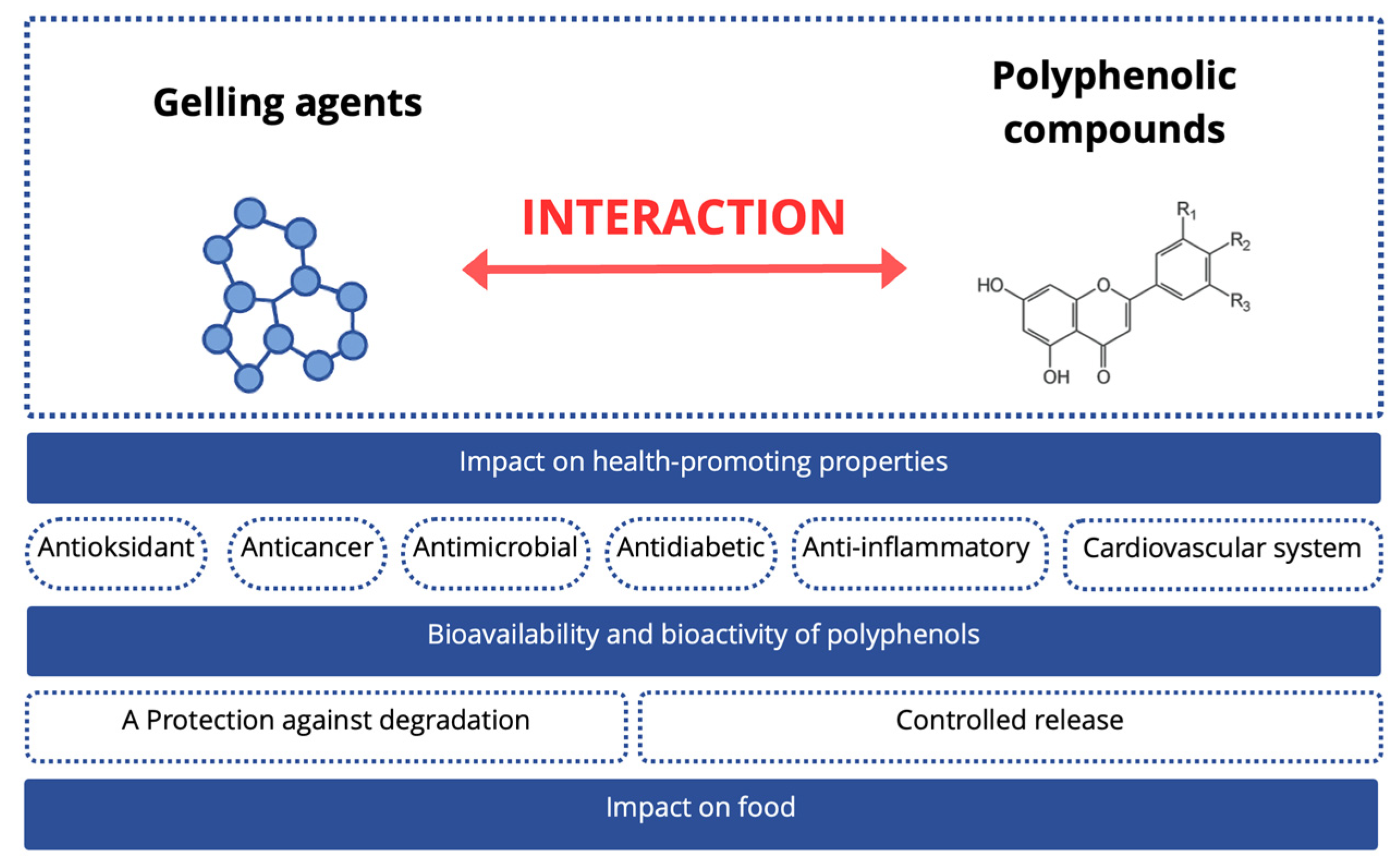
Interactions of Polyphenolic Compounds with Gelling Agents: Health-Promoting Properties and Application in Food Systems



Abstract
1. Introduction
2. Results and Discussion
2.1. Mechanisms of Interaction Between Polyphenols and Gelling Agents
2.2. Impact on Health-Promoting Properties
2.2.1. Antioxidant Activity
2.2.2. Anticancer Activity
2.2.3. Antimicrobial Activity
2.2.4. Antidiabetic Activity
2.2.5. Anti-Inflammatory Activity
2.2.6. Impact on the Cardiovascular System
2.3. Bioavailability and Bioactivity of Polyphenolic Compounds
2.3.1. Protection Against Degradation in the Gastrointestinal Tract
2.3.2. Controlled Release
2.4. Interactions of Polyphenols with Gelling Substances in Food Processing
2.4.1. Polyphenol–Protein Interactions
Interactions of Polyphenols with Myofibrillar Proteins in the Form of Gels
Protein Gels’ Interactions with Polyphenols in Dairy Products
2.4.2. Interactions of Polyphenols with Starch Gels
3. Methods
4. Summary and Conclusions for Future Research
Author Contributions
Funding
Institutional Review Board Statement
Informed Consent Statement
Data Availability Statement
Conflicts of Interest
References
- Wu, W.; Wu, H.; Liang, R.; Huang, S.; Meng, L.; Zhang, M.; Xie, F.; Zhu, H. Light Regulates the Synthesis and Accumulation of Plant Secondary Metabolites. Front. Plant Sci. 2025, 16, 1644472. [Google Scholar] [CrossRef] [Scilit]
- Żurek, N.; Świeca, M.; Kapusta, I.T. Berries, Leaves, and Flowers of Six Hawthorn Species (Crataegus L.) as a Source of Compounds with Nutraceutical Potential. Molecules 2024, 29, 5786. [Google Scholar] [CrossRef] [Scilit]
- Żurek, N.; Kapusta, I. Fractionation of Polyphenolic Extract from Walnut Male Flowers (Juglans regia L.) and Evaluation of Biological Activity towards Cancer Cells. Biocatal. Agric. Biotechnol. 2025, 70, 103850. [Google Scholar] [CrossRef] [Scilit]
- Żurek, N.; Pluta, S.; Świeca, M.; Potocki, L.; Seliga, Ł.; Kapusta, I. Bioactive Compounds and In Vitro Health-Promoting Activity of the Fruit Skin and Flesh of Different Haskap Berry (Lonicera caerulea Var. Kamtschatica Sevast.) Cultivars. Int. J. Mol. Sci. 2025, 26, 6618. [Google Scholar] [CrossRef] [Scilit]
- Li, W.; Chen, H.; Xu, B.; Wang, Y.; Zhang, C.; Cao, Y.; Xing, X. Research Progress on Classification, Sources and Functions of Dietary Polyphenols for Prevention and Treatment of Chronic Diseases. J. Future Foods 2023, 3, 289–305. [Google Scholar] [CrossRef] [Scilit]
- De Araújo, F.F.; De Paulo Farias, D.; Neri-Numa, I.A.; Pastore, G.M. Polyphenols and Their Applications: An Approach in Food Chemistry and Innovation Potential. Food Chem. 2021, 338, 127535. [Google Scholar] [CrossRef] [Scilit]
- Rana, A.; Samtiya, M.; Dhewa, T.; Mishra, V.; Aluko, R.E. Health Benefits of Polyphenols: A Concise Review. J. Food Biochem. 2022, 46, e14264. [Google Scholar] [CrossRef] [Scilit]
- Vivarelli, S.; Costa, C.; Teodoro, M.; Giambò, F.; Tsatsakis, A.M.; Fenga, C. Polyphenols: A Route from Bioavailability to Bioactivity Addressing Potential Health Benefits to Tackle Human Chronic Diseases. Arch. Toxicol. 2023, 97, 3–38. [Google Scholar] [CrossRef] [Scilit]
- Żurek, N.; Świeca, M.; Pawłowska, A.; Kapusta, I.T. Microencapsulation of Blueberry (Vaccinium myrtillus L.) Extracts via Ionotropic Gelation: In Vitro Assessment of Bioavailability of Phenolic Compounds and Their Activity against Colon Cancer Cells. Appl. Sci. 2024, 14, 7842. [Google Scholar] [CrossRef] [Scilit]
- Żurek, N.; Kaliciak, J.; Świeca, M.; Kapusta, I. Microencapsulation of the Polyphenolic Fraction of Cranberry Fruit (Vaccinium oxycoccos) with Coatings Based on Protein Isolates: In Vitro Assessment of the Bioavailability of Polyphenolic Compounds. Food Bioprod. Process. 2025, 154, 1–12. [Google Scholar] [CrossRef] [Scilit]
- Lam, Y.B.; Yusri, A.S.; Sarbon, N.M. Effect of Gelling Agents on the Techno-Functional, Collagen Bioavailability and Phytochemical Properties of Botanic Gummy Jelly Containing Marine Hydrolyzed Collagen. Food Chem. Adv. 2025, 6, 100915. [Google Scholar] [CrossRef] [Scilit]
- Pirsa, S.; Hafezi, K. Hydrocolloids: Structure, Preparation Method, and Application in Food Industry. Food Chem. 2023, 399, 133967. [Google Scholar] [CrossRef] [Scilit]
- Guo, Y.; Ma, C.; Xu, Y.; Du, L.; Yang, X. Food Gels Based on Polysaccharide and Protein: Preparation, Formation Mechanisms, and Delivery of Bioactive Substances. Gels 2024, 10, 735. [Google Scholar] [CrossRef] [Scilit]
- Nath, P.C.; Debnath, S.; Sridhar, K.; Inbaraj, B.S.; Nayak, P.K.; Sharma, M. A Comprehensive Review of Food Hydrogels: Principles, Formation Mechanisms, Microstructure, and Its Applications. Gels 2022, 9, 1. [Google Scholar] [CrossRef] [Scilit]
- Tan, C.; Sun, Y.; Yao, X.; Zhu, Y.; Jafari, S.M.; Sun, B.; Wang, J. Stabilization of Anthocyanins by Simultaneous Encapsulation-Copigmentation via Protein-Polysaccharide Polyelectrolyte Complexes. Food Chem. 2023, 416, 135732. [Google Scholar] [CrossRef] [Scilit]
- Pan, F.; Liu, X.; Qiao, M.; Liu, J.; Pang, Y.; Zhang, M.; Yu, W. Innovative Composite Systems for Enhancing Plant Polyphenol Stability and Bioavailability. Food Sci. Biotechnol. 2025, 34, 1819–1834. [Google Scholar] [CrossRef] [Scilit]
- Wang, Y.; Lu, W.; Yang, X.; Zhao, H. Polyphenolic Nano-Encapsulation Systems: A Review of Their Formation Mechanism, Bioavailability, and Antioxidant Activity. J. Food Meas. Charact. 2025, 19, 8132–8143. [Google Scholar] [CrossRef] [Scilit]
- Jiang, S.Q.; Dai, S.P.; Liu, W.M.; Wang, Y.; Li, Z.Y.; Chen, Y.W.; Park, H.J.; Zhou, H.Y. Cyclodextrin Grafted Chitosan Thermosensitive Hydrogel Using Dual Gelling Agents: Drug Delivery and Antibacterial Materials. J. Mol. Struct. 2025, 1321, 140095. [Google Scholar] [CrossRef] [Scilit]
- Liu, G.; Hu, B.; Lai, X.; Chen, Z.; Duan, Y.; Yan, D.; Liu, X.; Zhang, W.; Zhang, H.; Qiu, L.; et al. Synthesis and Application of Non-Crosslinked Acrylamide-Based Hydrogels as Water Retaining Agents Based on Hydrogen Bonding and Hydrophobic Interaction. Colloids Surf. A Physicochem. Eng. Asp. 2025, 718, 136901. [Google Scholar] [CrossRef] [Scilit]
- Djabali, D.; Naimi, D.; Panzavolta, S.; Caliceti, C.; Punzo, A.; Bramki, A.; Di Matteo, V.; Bouhadjar, M. Harnessing Helix aspersa Mucins as an Innovative Gelling Agent for the Synthesis of Punica granatum Peel Extract-Loaded Chitosan Nanoparticles (CSNPs-M) with Enhanced Biological Properties. Int. J. Biol. Macromol. 2025, 308, 142152. [Google Scholar] [CrossRef] [Scilit]
- Xue, H.; Gao, Y.; Shi, Z.; Gao, H.; Xie, K.; Tan, J. Interactions between Polyphenols and Polysaccharides/Proteins: Mechanisms, Effect Factors, and Physicochemical and Functional Properties: A Review. Int. J. Biol. Macromol. 2025, 309, 142793. [Google Scholar] [CrossRef] [Scilit] [PubMed]
- Wang, Z.; Xiao, N.; Guo, S.; Tian, X.; Ai, M. Tea Polyphenol-Mediated Network Proteins Modulate the NaOH-Heat Induced Egg White Protein Gelling Properties. Food Hydrocoll. 2024, 149, 109514. [Google Scholar] [CrossRef] [Scilit]
- Ozkan, G.; Ceyhan, T.; Çatalkaya, G.; Rajan, L.; Ullah, H.; Daglia, M.; Capanoglu, E. Encapsulated Phenolic Compounds: Clinical Efficacy of a Novel Delivery Method. Phytochem. Rev. 2024, 23, 781–819. [Google Scholar] [CrossRef] [Scilit]
- Sahraeian, S.; Abdollahi, B.; Rashidinejad, A. Biopolymer-Polyphenol Conjugates: Novel Multifunctional Materials for Active Packaging. Int. J. Biol. Macromol. 2024, 280, 135714. [Google Scholar] [CrossRef] [Scilit] [PubMed]
- Pacheco-Hernández, B.; Ayora-Talavera, T.; Cano-Sosa, J.; Noriega, L.G.; Pacheco-López, N.A.; Vargas-Morales, J.M.; Medina-Vera, I.; Guevara-Cruz, M.; Chim-Aké, R.; Gutiérrez-Solis, A.L.; et al. Antioxidant and Anti-Inflammatory Effects of Traditional Medicinal Plants for Urolithiasis: A Scoping Review. Plants 2025, 14, 2032. [Google Scholar] [CrossRef] [Scilit]
- Zhang, Z.-H.; Wang, H.; Han, X.; Huang, X.; Zeng, Q.; Li, X.; Gao, X. The Effect of Different Wall Materials on the Physicochemical Properties and Antioxidant Activity of Pomegranate Peel Polyphenols (PPP) Microcapsules. Int. J. Biol. Macromol. 2025, 298, 139958. [Google Scholar] [CrossRef] [Scilit] [PubMed]
- Gao, J.; Mao, Y.; Xiang, C.; Cao, M.; Ren, G.; Wang, K.; Ma, X.; Wu, D.; Xie, H. Preparation of β-Lactoglobulin/Gum Arabic Complex Nanoparticles for Encapsulation and Controlled Release of EGCG in Simulated Gastrointestinal Digestion Model. Food Chem. 2021, 354, 129516. [Google Scholar] [CrossRef] [Scilit]
- Zhang, Y.; Sun, B.; Wang, L.; Shen, W.; Shen, S.; Cheng, X.; Liu, X.; Xia, H. Curcumin-Loaded Liposomes in Gel Protect the Skin of Mice against Oxidative Stress from Photodamage Induced by UV Irradiation. Gels 2024, 10, 596. [Google Scholar] [CrossRef] [Scilit]
- Tan, S.; Zeng, X.; Li, J.; Ding, X.; Luo, Y.; Li, W.; Mo, Y. Storage Stability and in Vitro Release Characteristics of Black Rice Anthocyanins Microencapsulated by Pectin and Sodium Carboxymethyl Cellulose. LWT 2024, 207, 116654. [Google Scholar] [CrossRef] [Scilit]
- Abedi-Firoozjah, R.; Bahramian, B.; Tavassoli, M.; Majlesi, M.; Ghaderi, S.; Assadpour, E.; Zhang, F.; Sadeghi, E.; Bangar, S.P.; Jafari, S.M. Alginate-Based Edible Films/Coatings/Nanofibers in Food Packaging: A Comprehensive Review of Recent Advances. Carbohydr. Polym. Technol. Appl. 2025, 11, 100955. [Google Scholar] [CrossRef] [Scilit]
- Yong, H.; Hu, H.; Yun, D.; Jin, C.; Liu, J. Horseradish Peroxidase Catalyzed Grafting of Chitosan Oligosaccharide with Different Flavonols: Structures, Antioxidant Activity and Edible Coating Application. J. Sci. Food Agric. 2022, 102, 4363–4372. [Google Scholar] [CrossRef] [Scilit]
- Chatterjee, N.S.; Dara, P.K.; Perumcherry Raman, S.; Vijayan, D.K.; Sadasivam, J.; Mathew, S.; Ravishankar, C.N.; Anandan, R. Nanoencapsulation in Low-molecular-weight Chitosan Improves in Vivo Antioxidant Potential of Black Carrot Anthocyanin. J. Sci. Food Agric. 2021, 101, 5264–5271. [Google Scholar] [CrossRef] [Scilit] [PubMed]
- Xie, Y.; Gu, Y.; Li, Z.; Zhang, L.; Hei, Y. Effects of Exercise on Different Antioxidant Enzymes and Related Indicators: A Systematic Review and Meta-Analysis of Randomized Controlled Trials. Sci. Rep. 2025, 15, 12518. [Google Scholar] [CrossRef] [Scilit] [PubMed]
- Wang, M.; Wang, Y.; Zhang, H. Dietary Polyphenols for Tumor Therapy: Bioactivities, Nano-Therapeutic Systems and Delivery Strategies. Food Funct. 2025, 16, 853–866. [Google Scholar] [CrossRef] [Scilit]
- Jia, W.; Zhou, L.; Li, L.; Zhou, P.; Shen, Z. Nano-Based Drug Delivery of Polyphenolic Compounds for Cancer Treatment: Progress, Opportunities, and Challenges. Pharmaceuticals 2023, 16, 101. [Google Scholar] [CrossRef] [Scilit]
- Glaviano, A.; Lau, H.S.-H.; Carter, L.M.; Lee, E.H.C.; Lam, H.Y.; Okina, E.; Tan, D.J.J.; Tan, W.; Ang, H.L.; Carbone, D.; et al. Harnessing the Tumor Microenvironment: Targeted Cancer Therapies through Modulation of Epithelial-Mesenchymal Transition. J. Hematol. Oncol. 2025, 18, 6. [Google Scholar] [CrossRef] [Scilit]
- Dutta, G.; Sugumaran, A.; Narayanasamy, D. pH-Responsive Nanocapsules Loaded with 5-Fluorouracil-Coated Green-Synthesized CuO–ZnO NPs for Enhanced Anticancer Activity against HeLa Cells. Med. Oncol. 2025, 42, 300. [Google Scholar] [CrossRef] [Scilit]
- Picos-Corrales, L.A.; Morales-Burgos, A.M.; Ruelas-Leyva, J.P.; Crini, G.; García-Armenta, E.; Jimenez-Lam, S.A.; Ayón-Reyna, L.E.; Rocha-Alonzo, F.; Calderón-Zamora, L.; Osuna-Martínez, U.; et al. Chitosan as an Outstanding Polysaccharide Improving Health-Commodities of Humans and Environmental Protection. Polymers 2023, 15, 526. [Google Scholar] [CrossRef] [Scilit] [PubMed]
- Yang, M.; He, Y.; Ni, Q.; Zhou, M.; Chen, H.; Li, G.; Yu, J.; Wu, X.; Zhang, X. Polyphenolic Nanomedicine Regulating Mitochondria REDOX for Innovative Cancer Treatment. Pharmaceutics 2024, 16, 972. [Google Scholar] [CrossRef] [Scilit]
- Mahdian, M.; Akbari Asrari, S.; Ahmadi, M.; Madrakian, T.; Rezvani Jalal, N.; Afkhami, A.; Moradi, M.; Gholami, L. Dual Stimuli-Responsive Gelatin-Based Hydrogel for pH and Temperature-Sensitive Delivery of Curcumin Anticancer Drug. J. Drug Deliv. Sci. Technol. 2023, 84, 104537. [Google Scholar] [CrossRef] [Scilit]
- Lai, J.; Azad, A.K.; Sulaiman, W.M.A.W.; Kumarasamy, V.; Subramaniyan, V.; Alshehade, S.A. Alginate-Based Encapsulation Fabrication Technique for Drug Delivery: An Updated Review of Particle Type, Formulation Technique, Pharmaceutical Ingredient, and Targeted Delivery System. Pharmaceutics 2024, 16, 370. [Google Scholar] [CrossRef] [Scilit] [PubMed]
- Li, X.-R.; Qi, L.; Zhang, X.-W.; Wei, C.; Yu, B.; Pei, T.-L. Quercetin and Nano-Derivatives: Potential and Challenges in Cancer Therapy. Int. J. Nanomed. 2025, 20, 6701–6720. [Google Scholar] [CrossRef] [Scilit]
- Li, S.-F.; Hu, T.-G.; Wu, H. Development of Quercetin-Loaded Electrospun Nanofibers through Shellac Coating on Gelatin: Characterization, Colon-Targeted Delivery, and Anticancer Activity. Int. J. Biol. Macromol. 2024, 277, 134204. [Google Scholar] [CrossRef] [Scilit] [PubMed]
- Dadashi, H.; Nazemiyeh, A.R.; Karimian-Shaddel, A.; Mashinchian, M.; Mohabbat, A.; Faragheh, S.K.; Vandghanooni, S.; Eskandani, M. Enhancing Ovarian Cancer Treatment: Synergistic Effects of Methotrexate (Methotrexate)- and Quercetin-Loaded Chitosan Nanoparticles. Carbohydr. Polym. Technol. Appl. 2024, 8, 100619. [Google Scholar] [CrossRef] [Scilit]
- Das, S.; Saha, M.; Mahata, L.C.; China, A.; Chatterjee, N.; Das Saha, K. Quercetin and 5-Fu Loaded Chitosan Nanoparticles Trigger Cell-Cycle Arrest and Induce Apoptosis in HCT116 Cells via Modulation of the P53/P21 Axis. ACS Omega 2023, 8, 36893–36905. [Google Scholar] [CrossRef] [Scilit]
- Mandal, M.K.; Domb, A.J. Antimicrobial Activities of Natural Bioactive Polyphenols. Pharmaceutics 2024, 16, 718. [Google Scholar] [CrossRef] [Scilit]
- De Rossi, L.; Rocchetti, G.; Lucini, L.; Rebecchi, A. Antimicrobial Potential of Polyphenols: Mechanisms of Action and Microbial Responses—A Narrative Review. Antioxidants 2025, 14, 200. [Google Scholar] [CrossRef] [Scilit]
- Xu, W.; Lin, Z.; Cortez-Jugo, C.; Qiao, G.G.; Caruso, F. Antimicrobial Phenolic Materials: From Assembly to Function. Angew. Chem. Int. Ed. 2025, 64, e202423654. [Google Scholar] [CrossRef] [Scilit]
- Sun, J.; Zhou, Q.; Wei, Z.; Xue, C. Multifunctional Intelligent Indication Labels Featuring Antibacterial Properties Based on Pectin/Carboxymethyl Chitosan Incorporated with Porous Microspheres Loaded with Anthocyanins: A New Approach for Salmon Preservation and Freshness Detection. Food Hydrocoll. 2025, 158, 110571. [Google Scholar] [CrossRef] [Scilit]
- Sela, A.; Shkuri, N.; Tish, N.; Vinokur, Y.; Rodov, V.; Poverenov, E. Carboxymethyl Chitosan-Quercetin Conjugate: A Sustainable One-Step Synthesis and Use for Food Preservation. Carbohydr. Polym. 2023, 316, 121084. [Google Scholar] [CrossRef] [Scilit]
- Singh, A.; Mittal, A.; Benjakul, S. Chitosan, Chitooligosaccharides and Their Polyphenol Conjugates: Preparation, Bioactivities, Functionalities and Applications in Food Systems. Food Rev. Int. 2023, 39, 2297–2319. [Google Scholar] [CrossRef] [Scilit]
- Yong, H.; Bai, R.; Bi, F.; Liu, J.; Qin, Y.; Liu, J. Synthesis, Characterization, Antioxidant and Antimicrobial Activities of Starch Aldehyde-Quercetin Conjugate. Int. J. Biol. Macromol. 2020, 156, 462–470. [Google Scholar] [CrossRef] [Scilit]
- Ma, H.; Axi, Y.; Lu, Y.; Dai, C.; Huang, S.; Kong, Z.; Jimo, R.; Li, H.; Chen, G.; Li, P.; et al. A Dual Network Cross-Linked Hydrogel with Multifunctional Bletilla Striata Polysaccharide/Gelatin/Tea Polyphenol for Wound Healing Promotion. Int. J. Biol. Macromol. 2024, 265, 130780. [Google Scholar] [CrossRef] [Scilit] [PubMed]
- Zhang, Y.; Li, S.; Yang, Y.; Wang, C.; Zhang, T. Formation and Characterization of Noncovalent Ternary Complexes Based on Whey Protein Concentrate, High Methoxyl Pectin, and Phenolic Acid. J. Dairy Sci. 2022, 105, 2963–2977. [Google Scholar] [CrossRef] [Scilit]
- Lima, E.M.F.; Matsumura, C.H.S.; Da Silva, G.L.; Patrocínio, I.C.S.; Santos, C.A.; Pereira, P.A.P.; Hassimotto, N.M.A.; Pinto, U.M.; Da Cunha, L.R. Antimicrobial and Antioxidant Activity of Apricot (Mimusopsis comersonii) Phenolic-Rich Extract and Its Application as an Edible Coating for Fresh-Cut Vegetable Preservation. BioMed Res. Int. 2022, 2022, 8440304. [Google Scholar] [CrossRef] [Scilit]
- Puspadewi, R.; Milanda, T.; Muhaimin, M.; Chaerunisaa, A.Y. Nanoparticle-Encapsulated Plant Polyphenols and Flavonoids as an Enhanced Delivery System for Anti-Acne Therapy. Pharmaceuticals 2025, 18, 209. [Google Scholar] [CrossRef] [Scilit]
- Mohammadi, E.; Shabanpour, B.; Pourashouri, P.; Payamnoor, V.; Sharifian, S.; Bita, S. Nanoliposome-Encapsulated and Biopolymer-Coated Phlorotannin Extract of Sargassum Tenerrimum: A Promising Approach for Enhanced Antibacterial Activity against Acne-Related Bacteria. Iran. J. Fish. Sci. 2024, 23, 31–49. [Google Scholar] [CrossRef]
- Rao, M.J.; Zheng, B. The Role of Polyphenols in Abiotic Stress Tolerance and Their Antioxidant Properties to Scavenge Reactive Oxygen Species and Free Radicals. Antioxidants 2025, 14, 74. [Google Scholar] [CrossRef] [Scilit]
- Martiniakova, M.; Sarocka, A.; Penzes, N.; Biro, R.; Kovacova, V.; Mondockova, V.; Sevcikova, A.; Ciernikova, S.; Omelka, R. Protective Role of Dietary Polyphenols in the Management and Treatment of Type 2 Diabetes Mellitus. Nutrients 2025, 17, 275. [Google Scholar] [CrossRef] [Scilit] [PubMed]
- Tzeng, H.-P.; Liu, S.-H.; Chiang, M.-T. Antidiabetic Properties of Chitosan and Its Derivatives. Mar. Drugs 2022, 20, 784. [Google Scholar] [CrossRef] [Scilit]
- Qiang, T.; Wang, J.; Jiang, L.; Xiong, K. Modulation of Hyperglycemia by Sodium Alginate Is Associated with Changes of Serum Metabolite and Gut Microbiota in Mice. Carbohydr. Polym. 2022, 291, 119359. [Google Scholar] [CrossRef] [Scilit]
- Astaneh, M.E.; Fereydouni, N. A Focused Review on Hyaluronic Acid Contained Nanofiber Formulations for Diabetic Wound Healing. Int. J. Biol. Macromol. 2023, 253, 127607. [Google Scholar] [CrossRef] [Scilit] [PubMed]
- Stoleru, O.A.; Burlec, A.F.; Mircea, C.; Felea, M.G.; Macovei, I.; Hăncianu, M.; Corciovă, A. Multiple Nanotechnological Approaches Using Natural Compounds for Diabetes Management. J. Diabetes Metab. Disord. 2024, 23, 267–287. [Google Scholar] [CrossRef] [Scilit]
- Maity, S.; Mukhopadhyay, P.; Kundu, P.P.; Chakraborti, A.S. Alginate Coated Chitosan Core-Shell Nanoparticles for Efficient Oral Delivery of Naringenin in Diabetic Animals—An in Vitro and in Vivo Approach. Carbohydr. Polym. 2017, 170, 124–132. [Google Scholar] [CrossRef] [Scilit]
- Filho, R.R.B.X.; Ribeiro, P.R.V.; Silva, L.M.A.E.; Pereira, L.L.; Freire, G.A.; Martins, C.B.R.; Wong, D.V.T.; Dionísio, A.P.; De Alencar, N.M.N.; Frederico, M.J.S.; et al. Chemical Composition and Antidiabetic Potential of a Phenolic-Rich Extract from Cashew Fiber. ACS Food Sci. Technol. 2025, 5, 1687–1698. [Google Scholar] [CrossRef] [Scilit]
- Panwar, R.; Raghuwanshi, N.; Srivastava, A.K.; Sharma, A.K.; Pruthi, V. In-Vivo Sustained Release of Nanoencapsulated Ferulic Acid and Its Impact in Induced Diabetes. Mater. Sci. Eng. C 2018, 92, 381–392. [Google Scholar] [CrossRef] [Scilit] [PubMed]
- Sheir, M.M.; Nasra, M.M.A.; Abdallah, O.Y. Chitosan Alginate Nanoparticles as a Platform for the Treatment of Diabetic and Non-Diabetic Pressure Ulcers: Formulation and in Vitro/in Vivo Evaluation. Int. J. Pharm. 2021, 607, 120963. [Google Scholar] [CrossRef] [Scilit] [PubMed]
- Shi, S.; Wang, L.; Song, C.; Yao, L.; Xiao, J. Recent Progresses of Collagen Dressings for Chronic Skin Wound Healing. Collagen Leather 2023, 5, 31. [Google Scholar] [CrossRef] [Scilit]
- Muñoz-Molina, N.; Parada, J.; Zambrano, A.; Chipon, C.; Robert, P.; Mariotti-Celis, M.S. Ultrasound-Assisted Extraction and Microencapsulation of Durvillaea Incurvata Polyphenols: Toward a Stable Anti-Inflammatory Ingredient for Functional Foods. Foods 2025, 14, 2240. [Google Scholar] [CrossRef] [Scilit]
- Bernal-Millán, M.J.; Roa-Coria, J.E.; Flores-Murrieta, F.J.; Huerta-Cruz, J.C.; Gutiérrez-Grijalva, E.P.; León-Félix, J.; Angulo-Escalante, M.A.; Heredia, J.B.; Carrasco-Portugal, M.C. Anti-Inflammatory Effect of Free and Microencapsulated Extract of Lippia graveolens Kunth in a Carrageenan-Induced Paw Edema Model and an Ovalbumin-Induced Asthma Model in Mice. J. Ethnopharmacol. 2025, 348, 119905. [Google Scholar] [CrossRef] [Scilit]
- An, R.; Shi, C.; Tang, Y.; Cui, Z.; Li, Y.; Chen, Z.; Xiao, M.; Xu, L. Chitosan/Rutin Multifunctional Hydrogel with Tunable Adhesion, Anti-Inflammatory and Antibacterial Properties for Skin Wound Healing. Carbohydr. Polym. 2024, 343, 122492. [Google Scholar] [CrossRef] [Scilit]
- Perumcherry Raman, S.; Dara, P.K.; Vijayan, D.K.; Chatterjee, N.S.; Raghavankutty, M.; Mathew, S.; Ravishankar, C.N.; Anandan, R. Anti-Ulcerogenic Potential of Anthocyanin-Loaded Chitosan Nanoparticles against Alcohol-HCl Induced Gastric Ulcer in Rats. Nat. Prod. Res. 2022, 36, 1306–1310. [Google Scholar] [CrossRef] [Scilit]
- Luo, W.; Bai, L.; Zhang, J.; Li, Z.; Liu, Y.; Tang, X.; Xia, P.; Xu, M.; Shi, A.; Liu, X.; et al. Polysaccharides-Based Nanocarriers Enhance the Anti-Inflammatory Effect of Curcumin. Carbohydr. Polym. 2023, 311, 120718. [Google Scholar] [CrossRef] [Scilit]
- Zhang, Y.; Song, J.; Wu, C.; Deng, G. Lutein-Loaded Lotus Root Starch Nanoparticles: Preparation, Release, and in Vitro Anti-Inflammatory Activity. Int. J. Biol. Macromol. 2025, 304, 140785. [Google Scholar] [CrossRef] [Scilit]
- Stankovic, S.; Mutavdzin Krneta, S.; Djuric, D.; Milosevic, V.; Milenkovic, D. Plant Polyphenols as Heart’s Best Friends: From Health Properties, to Cellular Effects, to Molecular Mechanisms of Action. Int. J. Mol. Sci. 2025, 26, 915. [Google Scholar] [CrossRef] [Scilit]
- Hu, R.; Qin, M.; Zhang, Q. Carboxymethyl Chitosan-Based Nanocarrier for Dexmedetomidine Delivery: Inhibiting Hypoxia-Reoxygenation-Injured H9c2 Cardiomyocytes. Mater. Lett. 2025, 403, 139459. [Google Scholar] [CrossRef] [Scilit]
- Gao, Y.; Hu, X.; Zhang, H.; Chen, S.; Yu, J.; Dong, D.; Zhan, H.; Gao, B.; Li, D.; Qin, Z.; et al. Injectable Resveratrol Micelles Loaded Chitosan Hydrogel for Protecting Myocardial Cell from Injure in Oxidative Stress Microenvironment. Int. J. Biol. Macromol. 2025, 322, 146803. [Google Scholar] [CrossRef] [Scilit] [PubMed]
- Beconcini, D.; Felice, F.; Zambito, Y.; Fabiano, A.; Piras, A.M.; Macedo, M.H.; Sarmento, B.; Di Stefano, R. Anti-Inflammatory Effect of Cherry Extract Loaded in Polymeric Nanoparticles: Relevance of Particle Internalization in Endothelial Cells. Pharmaceutics 2019, 11, 500. [Google Scholar] [CrossRef] [Scilit]
- Sharif, N.; Murtaza, I.; Shahnaz, G.; Saeed, A.; Ishtiaq, A.; Tabassum, S.; Rahdar, A.; Fathi-karkan, S.; Pandey, S. Precision Nanophytomedicine: Alginate-Chitosan Nanogels Encapsulating Olea ferruginea Ethyl Acetate Fraction for Enhanced Cardiovascular Protection. Int. J. Biol. Macromol. 2025, 318, 144656. [Google Scholar] [CrossRef] [Scilit] [PubMed]
- Trindade, L.R.; Da Silva, D.V.T.; Baião, D.D.S.; Paschoalin, V.M.F. Increasing the Power of Polyphenols through Nanoencapsulation for Adjuvant Therapy against Cardiovascular Diseases. Molecules 2021, 26, 4621. [Google Scholar] [CrossRef] [Scilit]
- El-Demerdash, F.M.; Ahmed, M.M.; Kang, W.; Mohamed, T.M.; Radwan, A.M. Hepatoprotective Effect of Silymarin-Chitosan Nanocomposite against Aluminum-Induced Oxidative Stress, Inflammation, and Apoptosis. Tissue Cell 2024, 91, 102591. [Google Scholar] [CrossRef] [Scilit] [PubMed]
- Koç, S.T.; Koç, S.T.; Kök, S.; Ersoy, O.; Atalay, S. Effects of Microencapsulated and Non-Capsulated Aronia Extract on Serum Lipid Profile and Liver Histology in Sprague-Dawley Rats Fed a High Fat Diet. J. Elem. 2024, 29, 769–788. [Google Scholar] [CrossRef] [Scilit]
- Idoudi, S.; Elfalleh, W.; Bouajila, J.; Bellassoued, K.; Ben Mansour, F.; Romdhane, M.; Tourrette, A. Characterization, in Vitro and in Vivo Biological Activities of P. equisetiforme Extract Powder, and Preformulation Studies for Hard Gelatin Capsules. Biocatal. Agric. Biotechnol. 2025, 65, 103565. [Google Scholar] [CrossRef] [Scilit]
- Abou El-Naga, H.M.H.; El-Hashash, S.A.; Yasen, E.M.; Leporatti, S.; Hanafy, N.A.N. Starch-Based Hydrogel Nanoparticles Loaded with Polyphenolic Compounds of Moringa Oleifera Leaf Extract Have Hepatoprotective Activity in Bisphenol A-Induced Animal Models. Polymers 2022, 14, 2846. [Google Scholar] [CrossRef] [Scilit] [PubMed]
- Khalid, M.; Masoud, M.S.; Tariq, M.; Rehman, A.U.; Masood, N.; Khalid, H.; Mazhar, T.; El-Shazly, M.; Ibrahim, L.; Saleh, N. Therapeutic Potential of Polyphenolic Enriched Extract of Aesculus indica for Attenuation of Liver Fibrosis through Pectin/Acrylic Acid Based Slow-Release Formulation. J. Drug Deliv. Sci. Technol. 2025, 108, 106938. [Google Scholar] [CrossRef] [Scilit]
- Ju, J.; Kim, S.D.; Shin, M. Pomegranate Polyphenol-Derived Injectable Therapeutic Hydrogels to Enhance Neuronal Regeneration. Mol. Pharm. 2023, 20, 4786–4795. [Google Scholar] [CrossRef] [Scilit]
- Liu, Z.; Zhang, S.; Ran, Y.; Geng, H.; Gao, F.; Tian, G.; Feng, Z.; Xi, J.; Ye, L.; Su, W. Nanoarchitectonics of Tannic Acid Based Injectable Hydrogel Regulate the Microglial Phenotype to Enhance Neuroplasticity for Poststroke Rehabilitation. Biomater. Res. 2023, 27, 108. [Google Scholar] [CrossRef] [Scilit]
- Odrobińska-Baliś, J.; Procner, M.; Krużel, K.; Regulska, M.; Leśkiewicz, M.; Duraczyńska, D.; Zapotoczny, S.; Lasoń, W.; Szczepanowicz, K. Chitosan-Based Nanocapsules as a Delivery System of Hydrophobic Carnosic Acid, A Model Neuroprotective Drug. Nanotechnol. Sci. Appl. 2024, 17, 259–271. [Google Scholar] [CrossRef] [Scilit]
- Conte, R.; De Luca, I.; Valentino, A.; Cerruti, P.; Pedram, P.; Cabrera-Barjas, G.; Moeini, A.; Calarco, A. Hyaluronic Acid Hydrogel Containing Resveratrol-Loaded Chitosan Nanoparticles as an Adjuvant in Atopic Dermatitis Treatment. J. Funct. Biomater. 2023, 14, 82. [Google Scholar] [CrossRef] [Scilit]
- Alsakhawy, M.A.; Abdelmonsif, D.A.; Haroun, M.; Sabra, S.A. Naringin-Loaded Arabic Gum/Pectin Hydrogel as a Potential Wound Healing Material. Int. J. Biol. Macromol. 2022, 222, 701–714. [Google Scholar] [CrossRef] [Scilit]
- Bâldea, I.; Lung, I.; Opriş, O.; Stegarescu, A.; Kacso, I.; Soran, M.-L. Antioxidant, Anti-Inflammatory Effects and Ability to Stimulate Wound Healing of a Common-Plantain Extract in Alginate Gel Formulations. Gels 2023, 9, 901. [Google Scholar] [CrossRef] [Scilit] [PubMed]
- Hendawy, O.M.; Al-Sanea, M.M.; Mohammed Elbargisy, R.; Ur Rahman, H.; Hassan, Y.A.; Elshaarawy, R.F.M.; Khedr, A.I.M. Alginate-Chitosan-Microencapsulated Tyrosols/Oleuropein-Rich Olive Mill Waste Extract for Lipopolysaccharide-Induced Skin Fibroblast Inflammation Treatment. Int. J. Pharm. 2023, 643, 123260. [Google Scholar] [CrossRef] [Scilit]
- Studzińska-Sroka, E.; Paczkowska-Walendowska, M.; Erdem, C.; Paluszczak, J.; Kleszcz, R.; Hoszman-Kulisz, M.; Cielecka-Piontek, J. Anti-Aging Properties of Chitosan-Based Hydrogels Rich in Bilberry Fruit Extract. Antioxidants 2024, 13, 105. [Google Scholar] [CrossRef] [Scilit]
- Eran Nagar, E.; Okun, Z.; Shpigelman, A. Digestive Fate of Polyphenols: Updated View of the Influence of Chemical Structure and the Presence of Cell Wall Material. Curr. Opin. Food Sci. 2020, 31, 38–46. [Google Scholar] [CrossRef] [Scilit]
- Grosso, G.; Godos, J.; Currenti, W.; Micek, A.; Falzone, L.; Libra, M.; Giampieri, F.; Forbes-Hernández, T.Y.; Quiles, J.L.; Battino, M.; et al. The Effect of Dietary Polyphenols on Vascular Health and Hypertension: Current Evidence and Mechanisms of Action. Nutrients 2022, 14, 545. [Google Scholar] [CrossRef] [Scilit]
- El-Saadony, M.T.; Yang, T.; Saad, A.M.; Alkafaas, S.S.; Elkafas, S.S.; Eldeeb, G.S.; Mohammed, D.M.; Salem, H.M.; Korma, S.A.; Loutfy, S.A.; et al. Polyphenols: Chemistry, Bioavailability, Bioactivity, Nutritional Aspects and Human Health Benefits: A Review. Int. J. Biol. Macromol. 2024, 277, 134223. [Google Scholar] [CrossRef] [Scilit]
- Shahidi, F.; Athiyappan, K.D. Polyphenol-Polysaccharide Interactions: Molecular Mechanisms and Potential Applications in Food Systems—A Comprehensive Review. Food Prod. Process. Nutr. 2025, 7, 42. [Google Scholar] [CrossRef] [Scilit] [PubMed]
- Liga, S.; Paul, C. Flavonoid-Based Nanogels: A Comprehensive Overview. Gels 2025, 11, 267. [Google Scholar] [CrossRef] [Scilit]
- Yuan, D.; Guo, Y.; Pu, F.; Yang, C.; Xiao, X.; Du, H.; He, J.; Lu, S. Opportunities and Challenges in Enhancing the Bioavailability and Bioactivity of Dietary Flavonoids: A Novel Delivery System Perspective. Food Chem. 2024, 430, 137115. [Google Scholar] [CrossRef] [Scilit] [PubMed]
- Cortés-Ferré, H.E.; Arredondo-Ochoa, T.; Gaytán-Martínez, M. Polysaccharides-Polyphenolic Interactions: Formation, Functionality and Applications. Trends Food Sci. Technol. 2025, 163, 105117. [Google Scholar] [CrossRef] [Scilit]
- Ren, S.; Yu, Z.; Wu, X.; Chen, X.; Wang, Q.; Wang, L.; Yang, X. Effect of Different Polyphenols on the Stability and Digestibility of Multilayer Emulsions Fabricated from Polyphenol-Protein Covalent Complexes. J. Food Meas. Charact. 2025, 19, 6677–6693. [Google Scholar] [CrossRef] [Scilit]
- Verônica Cardoso De Souza, B.; De Morais Sousa, M.; Augusto Gasparotto Sattler, J.; Cristina Sousa Gramoza Vilarinho Santana, A.; Bruno Fonseca De Carvalho, R.; De Sousa Lima Neto, J.; De Matos Borges, F.; Angelica Neri Numa, I.; Braga Ribeiro, A.; César Cunha Nunes, L. Nanoencapsulation and Bioaccessibility of Polyphenols of Aqueous Extracts from Bauhinia forficata Link. Food Chem. Mol. Sci. 2022, 5, 100144. [Google Scholar] [CrossRef] [Scilit]
- Calvo, L.G.; Celeiro, M.; Lores, M.; Abril, A.G.; De Miguel, T. Assessing the Effect of Gastrointestinal Conditions and Solubility on the Bioaccessibility of Polyphenolic Compounds from a White Grape Marc Extract. Food Chem. 2025, 480, 143810. [Google Scholar] [CrossRef] [Scilit]
- Odriozola-Serrano, I.; Nogueira, D.P.; Esparza, I.; Vaz, A.A.; Jiménez-Moreno, N.; Martín-Belloso, O.; Ancín-Azpilicueta, C. Stability and Bioaccessibility of Phenolic Compounds in Rosehip Extracts during In Vitro Digestion. Antioxidants 2023, 12, 1035. [Google Scholar] [CrossRef] [Scilit]
- Li, C.X.; Wang, F.R.; Zhang, B.; Deng, Z.Y.; Li, H.Y. Stability and Antioxidant Activity of Phenolic Compounds during in Vitro Digestion. J. Food Sci. 2023, 88, 696–716. [Google Scholar] [CrossRef] [Scilit]
- Yang, P.; Yuan, C.; Wang, H.; Han, F.; Liu, Y.; Wang, L.; Liu, Y. Stability of Anthocyanins and Their Degradation Products from Cabernet Sauvignon Red Wine under Gastrointestinal pH and Temperature Conditions. Molecules 2018, 23, 354. [Google Scholar] [CrossRef] [Scilit] [PubMed]
- Cea-Pavez, I.; Manteca-Bautista, D.; Morillo-Gomar, A.; Quirantes-Piné, R.; Quiles, J.L. Influence of the Encapsulating Agent on the Bioaccessibility of Phenolic Compounds from Microencapsulated Propolis Extract during In Vitro Gastrointestinal Digestion. Foods 2024, 13, 425. [Google Scholar] [CrossRef] [Scilit] [PubMed]
- Zhao, X.; Zhang, X.; Tie, S.; Hou, S.; Wang, H.; Song, Y.; Rai, R.; Tan, M. Facile Synthesis of Nano-Nanocarriers from Chitosan and Pectin with Improved Stability and Biocompatibility for Anthocyanins Delivery: An in Vitro and in Vivo Study. Food Hydrocoll. 2020, 109, 106114. [Google Scholar] [CrossRef] [Scilit]
- Long, M.; Wang, H.; Li, Y.; Chen, Z.; Zeng, Z.; Luo, J.; Tian, Z.; Zhang, F.; Liu, X. Preparation and Characterization of Novel Acylated Chitosan/Carboxymethyl Konjac Glucomannan Nanogels for the Encapsulation of Polyphenols. LWT 2025, 223, 117759. [Google Scholar] [CrossRef] [Scilit]
- Xu, J.; Zhang, Y.; Yao, X.; Wang, S.; Lv, K.; Luo, G.; Wang, J.; Li, G. Intestinal Targeted Nanogel with Broad-Spectrum Autonomous ROS Scavenging Performance for Enhancing the Bioactivity of Trans-Resveratrol. Int. J. Nanomed. 2024, 19, 5995–6014. [Google Scholar] [CrossRef] [Scilit] [PubMed]
- Yang, J.; Dong, M.; Fang, F.; Li, Y.; Li, C. Effects of Varied Preparation Processes on Polyphenol-Rice Starch Complexes, in Vitro Starch Digestion, and Polyphenols Release. Food Chem. 2024, 450, 139330. [Google Scholar] [CrossRef] [Scilit]
- Zhu, P.; He, J.; Huang, S.; Han, L.; Chang, C.; Zhang, W. Encapsulation of Resveratrol in Zein-Polyglycerol Conjugate Stabilized O/W Nanoemulsions: Chemical Stability, in Vitro Gastrointestinal Digestion, and Antioxidant Activity. LWT 2021, 149, 112049. [Google Scholar] [CrossRef] [Scilit]
- Wang, R.; Li, M.; Brennan, M.A.; Dhital, S.; Kulasiri, D.; Brennan, C.S.; Guo, B. Complexation of Starch and Phenolic Compounds during Food Processing and Impacts on the Release of Phenolic Compounds. Comp. Rev. Food Sci. Food Saf. 2023, 22, 3185–3211. [Google Scholar] [CrossRef] [Scilit]
- Mu, J.; Wang, L.; Lv, J.; Chen, Z.; Brennan, M.; Ma, Q.; Wang, W.; Liu, W.; Wang, J.; Brennan, C. Phenolics from Sea Buckthorn (Hippophae rhamnoides L.) Modulate Starch Digestibility through Physicochemical Modifications Brought about by Starch—Phenolic Molecular Interactions. LWT 2022, 165, 113682. [Google Scholar] [CrossRef] [Scilit]
- Ren, N.; Ma, Z.; Li, X.; Hu, X. Preparation of Rutin-Loaded Microparticles by Debranched Lentil Starch-Based Wall Materials: Structure, Morphology and in Vitro Release Behavior. Int. J. Biol. Macromol. 2021, 173, 293–306. [Google Scholar] [CrossRef] [Scilit] [PubMed]
- Williamson, G. Bioavailability of Food Polyphenols: Current State of Knowledge. Annu. Rev. Food Sci. Technol. 2025, 16, 315–332. [Google Scholar] [CrossRef] [Scilit]
- Li, F.; Sun, Q.; Chen, L.; Zhang, R.; Zhang, Z. Unlocking the Health Potential of Anthocyanins: A Structural Insight into Their Varied Biological Effects. Crit. Rev. Food Sci. Nutr. 2025, 65, 2134–2154. [Google Scholar] [CrossRef] [Scilit]
- Seke, F.; Manhivi, V.E.; Slabbert, R.M.; Sultanbawa, Y.; Sivakumar, D. In Vitro Release of Anthocyanins from Microencapsulated Natal Plum (Carissa macrocarpa) Phenolic Extract in Alginate/Psyllium Mucilage Beads. Foods 2022, 11, 2550. [Google Scholar] [CrossRef] [Scilit]
- Wang, M.; Li, L.; Wan, M.; Lin, Y.; Tong, Y.; Cui, Y.; Deng, H.; Tan, C.; Kong, Y.; Meng, X. Preparing, Optimising, and Evaluating Chitosan Nanocapsules to Improve the Stability of Anthocyanins from Aronia melanocarpa. RSC Adv. 2021, 11, 210–218. [Google Scholar] [CrossRef] [Scilit]
- Jang, Y.; Koh, E. Effect of Encapsulation on Stability of Anthocyanins and Chlorogenic Acid Isomers in Aronia during in Vitro Digestion and Their Transformation in a Model System. Food Chem. 2024, 434, 137443. [Google Scholar] [CrossRef] [Scilit] [PubMed]
- Chen, C.; Chen, Z.; Zhong, Q. Caseinate Nanoparticles Co-Loaded with Quercetin and Avenanthramide 2c Using a Novel Two-Step pH-Driven Method: Formation, Characterization, and Bioavailability. Food Hydrocoll. 2022, 129, 107669. [Google Scholar] [CrossRef] [Scilit]
- Yang, J.; Sun, Y.; Dong, X.; Li, M.; Qin, Y.; Dai, L.; Sun, Q. Interaction of Starch Nanoparticles with Digestive Enzymes and Its Effect on the Release of Polyphenols in Simulated Gastrointestinal Fluids. Food Chem. 2025, 472, 142883. [Google Scholar] [CrossRef] [Scilit]
- Gómez-Mascaraque, L.G.; Soler, C.; Lopez-Rubio, A. Stability and Bioaccessibility of EGCG within Edible Micro-Hydrogels. Chitosan vs. Gelatin, a Comparative Study. Food Hydrocoll. 2016, 61, 128–138. [Google Scholar] [CrossRef] [Scilit]
- Li, J.; Yang, X.; Li, X.; Zhang, Z.; Wei, Z.; Xing, Z.; Deng, S.; Duan, F. Okra Polysaccharides/Gelatin Complex Coacervate as pH-Responsive and Intestine-Targeting Delivery Protects Isoquercitin Bioactivity. Int. J. Biol. Macromol. 2020, 159, 487–496. [Google Scholar] [CrossRef] [Scilit]
- Montenegro, I.; González, B.; Domínguez, Á.; Gómez, E. Solubility Study of Several Polyphenolic Compounds in Pure and Binary Solvents. J. Chem. Thermodyn. 2025, 203, 107434. [Google Scholar] [CrossRef] [Scilit]
- Kan, G.; Chen, L.; Zhang, W.; Bian, Q.; Wang, X.; Zhong, J. Recent Advances in the Development and Application of Curcumin-Loaded Micro/Nanocarriers in Food Research. Adv. Colloid Interface Sci. 2025, 335, 103333. [Google Scholar] [CrossRef] [Scilit] [PubMed]
- Yang, B.; Dong, Y.; Wang, F.; Zhang, Y. Nanoformulations to Enhance the Bioavailability and Physiological Functions of Polyphenols. Molecules 2020, 25, 4613. [Google Scholar] [CrossRef] [Scilit]
- Jain, S.; Zhong, Q. Enhanced Acid Stability and Bioaccessibility of Curcumin-Loaded Nanodispersions Prepared with Shellac, Gum Arabic, and Tween 20. Int. J. Biol. Macromol. 2025, 320, 146003. [Google Scholar] [CrossRef] [Scilit] [PubMed]
- Jain, S.; Lenaghan, S.; Dia, V.; Zhong, Q. Co-Delivery of Curcumin and Quercetin in Shellac Nanocapsules for the Synergistic Antioxidant Properties and Cytotoxicity against Colon Cancer Cells. Food Chem. 2023, 428, 136744. [Google Scholar] [CrossRef] [Scilit]
- Kaseke, T.; Chew, S.C.; Magangana, T.P.; Fawole, O.A. Elucidating the Microencapsulation of Bioactives from Pomegranate Fruit Waste for Enhanced Stability, Controlled Release, Biological Activity, and Application. Food Bioprocess Technol. 2025, 18, 4222–4250. [Google Scholar] [CrossRef] [Scilit]
- Jovanović, A.A.; Dekanski, D.; Milošević, M.D.; Mitić, N.; Rašković, A.; Martić, N.; Pirković, A. Liposomal Encapsulation of Carob (Ceratonia siliqua L.) Pulp Extract: Design, Characterization, and Controlled Release Assessment. Pharmaceutics 2025, 17, 776. [Google Scholar] [CrossRef] [Scilit] [PubMed]
- Chai, Y.; Zhou, Y.; Zhang, K.; Shao, P. Resveratrol Nanoparticles Coated by Metal-Polyphenols Supramolecular Enhance Antioxidant Activity and Long-Term Stability of Dietary Gel. Food Chem. 2025, 465, 141987. [Google Scholar] [CrossRef] [Scilit]
- Wang, Y.; Li, Z.; Bao, Y.; Cui, H.; Li, J.; Song, B.; Wang, M.; Li, H.; Cui, X.; Chen, Y.; et al. Colon-Targeted Delivery of Polyphenols: Construction Principles, Targeting Mechanisms and Evaluation Methods. Crit. Rev. Food Sci. Nutr. 2025, 65, 64–86. [Google Scholar] [CrossRef] [Scilit]
- Kumari Singh, S.; Solanki, R.; Patel, S. Nano Pharmaceutical Delivery in Combating Colorectal Cancer. Med. Drug Discov. 2024, 21, 100173. [Google Scholar] [CrossRef] [Scilit]
- Kawabata, K.; Yoshioka, Y.; Terao, J. Role of Intestinal Microbiota in the Bioavailability and Physiological Functions of Dietary Polyphenols. Molecules 2019, 24, 370. [Google Scholar] [CrossRef] [Scilit]
- Rocchetti, G.; Lucini, L.; Giuberti, G.; Bhumireddy, S.R.; Mandal, R.; Trevisan, M.; Wishart, D.S. Transformation of Polyphenols Found in Pigmented Gluten-Free Flours during in Vitro Large Intestinal Fermentation. Food Chem. 2019, 298, 125068. [Google Scholar] [CrossRef] [Scilit]
- Xu, J.; Zhang, Y.; Yao, X.; Wang, S.; Luo, G.; Lv, K.; Zhang, Y.; Li, G. Broad-Spectrum ROS Autonomous Scavenging Polysaccharide-Based Vehicle to Improve the Bioactivity of Blueberry Anthocyanidins through Intestinal Synergistic Mucoadhesion. Food Hydrocoll. 2024, 152, 109899. [Google Scholar] [CrossRef] [Scilit]
- Zhu, H.; Jiang, Q.; Gao, D.; Wang, L.; Li, X. Construction, Characterization and Gastrointestinal Digestion and Absorption Kinetics of the Nanoparticles Loaded with Malus baccata (Linn.) Polyphenols. Food Biosci. 2024, 61, 104600. [Google Scholar] [CrossRef] [Scilit]
- Chen, D.; Bai, R.; Yong, H.; Zong, S.; Jin, C.; Liu, J. Improving the Digestive Stability and Prebiotic Effect of Carboxymethyl Chitosan by Grafting with Gallic Acid: In Vitro Gastrointestinal Digestion and Colonic Fermentation Evaluation. Int. J. Biol. Macromol. 2022, 214, 685–696. [Google Scholar] [CrossRef] [Scilit] [PubMed]
- Narayana, S.; Gowda, B.H.J.; Hani, U.; Shimu, S.S.; Paul, K.; Das, A.; Ashique, S.; Ahmed, M.G.; Tarighat, M.A.; Abdi, G. Inorganic Nanoparticle-Based Treatment Approaches for Colorectal Cancer: Recent Advancements and Challenges. J. Nanobiotechnol. 2024, 22, 427. [Google Scholar] [CrossRef] [Scilit] [PubMed]
- Wang, K.; Shen, R.; Meng, T.; Hu, F.; Yuan, H. Nano-Drug Delivery Systems Based on Different Targeting Mechanisms in the Targeted Therapy of Colorectal Cancer. Molecules 2022, 27, 2981. [Google Scholar] [CrossRef] [Scilit]
- Kumbhar, P.S.; Kolekar, K.A.; Khandale, N.B.; Vishwas, S.; Nadaf, S.; Patil, K.S.; Shete, A.S.; Gupta, G.; Gurav, S.S.; Singh, S.K.; et al. Expanding Arsenal against Colorectal Cancer Using Guar Gum-Based Nanocarriers: A Review. Int. J. Biol. Macromol. 2025, 320, 145765. [Google Scholar] [CrossRef] [Scilit] [PubMed]
- Amjed, N.; Zeshan, M.; Farooq, A.; Naz, S. Applications of Guar Gum Polysaccharide for Pharmaceutical Drug Delivery: A Review. Int. J. Biol. Macromol. 2024, 257, 128390. [Google Scholar] [CrossRef] [Scilit] [PubMed]
- Xue, H.; Zhang, G.; Han, T.; Li, R.; Liu, H.; Gao, B.; Tu, Y.; Zhao, Y. Improvement of Gel Properties and Digestibility of the Water-Soluble Polymer of Tea Polyphenol-Egg White under Thermal Treatment. Food Chem. 2022, 372, 131319. [Google Scholar] [CrossRef] [Scilit]
- Aktaş, H.; Szpicer, A.; Strojny-Cieślak, B.; Borucki, W.; Schweiggert-Weisz, U.; Kurek, M.A. Molecular Interplay Between Plant Proteins and Polyphenols: pH as a Switch for Structural and Functional Assembly. Foods 2025, 14, 3991. [Google Scholar] [CrossRef] [Scilit]
- Jongberg, S.; Racanicci, A.M.C.; Skibsted, L.H. Mate Extract Is Superior to Green Tea Extract in the Protection against Chicken Meat Protein Thiol Oxidation. Food Chem. 2019, 300, 125134. [Google Scholar] [CrossRef] [Scilit]
- Adamczyk, G.; Pawłowska, A.M.; Bobel, I.; Szwengiel, A.; Krystyjan, M. Effect of Chokeberry (Aronia melanocarpa) Extracts on the Physicochemical Properties of Wheat Starch Pastes and Gels Stored Under Refrigerated Conditions. Molecules 2025, 30, 4213. [Google Scholar] [CrossRef] [Scilit]
- Szpicer, A.; Onopiuk, A.; Barczak, M.; Kurek, M. The Optimization of a Gluten-Free and Soy-Free Plant-Based Meat Analogue Recipe Enriched with Anthocyanins Microcapsules. LWT 2022, 168, 113849. [Google Scholar] [CrossRef] [Scilit]
- Kieserling, H.; De Bruijn, W.J.C.; Keppler, J.; Yang, J.; Sagu, S.T.; Güterbock, D.; Rawel, H.; Schwarz, K.; Vincken, J.; Schieber, A.; et al. Protein–Phenolic Interactions and Reactions: Discrepancies, Challenges, and Opportunities. Comp. Rev. Food Sci. Food Saf. 2024, 23, e70015. [Google Scholar] [CrossRef] [Scilit] [PubMed]
- Nicolai, T.; Chassenieux, C. Heat-Induced Gelation of Plant Globulins. Curr. Opin. Food Sci. 2019, 27, 18–22. [Google Scholar] [CrossRef] [Scilit]
- Dai, S.; Lian, Z.; Qi, W.; Chen, Y.; Tong, X.; Tian, T.; Lyu, B.; Wang, M.; Wang, H.; Jiang, L. Non-Covalent Interaction of Soy Protein Isolate and Catechin: Mechanism and Effects on Protein Conformation. Food Chem. 2022, 384, 132507. [Google Scholar] [CrossRef] [Scilit]
- Lv, Y.; Feng, X.; Wang, Y.; Guan, Q.; Qian, S.; Xu, X.; Zhou, G.; Ullah, N.; Chen, L. The Gelation Properties of Myofibrillar Proteins Prepared with Malondialdehyde and (−)-Epigallocatechin-3-Gallate. Food Chem. 2021, 340, 127817. [Google Scholar] [CrossRef] [Scilit] [PubMed]
- Cheng, J.; Tang, D.; Yang, H.; Wang, X.; Zhu, M.; Liu, X. The Dose-Dependent Effects of Polyphenols and Malondialdehyde on the Emulsifying and Gel Properties of Myofibrillar Protein-Mulberry Polyphenol Complex. Food Chem. 2021, 360, 130005. [Google Scholar] [CrossRef] [Scilit] [PubMed]
- Jia, N.; Zhang, F.; Liu, Q.; Wang, L.; Lin, S.; Liu, D. The Beneficial Effects of Rutin on Myofibrillar Protein Gel Properties and Related Changes in Protein Conformation. Food Chem. 2019, 301, 125206. [Google Scholar] [CrossRef] [Scilit]
- Jiang, S.; Huang, Y.; Li, Q.; Luo, T.; Guan, T. Effects of Three Polyphenols on the Gel Properties and Structures of Goose Myofibrillar Protein. Food Hydrocoll. 2025, 167, 111407. [Google Scholar] [CrossRef] [Scilit]
- Cheng, J.; Zhu, M.; Liu, X. Insight into the Conformational and Functional Properties of Myofibrillar Protein Modified by Mulberry Polyphenols. Food Chem. 2020, 308, 125592. [Google Scholar] [CrossRef] [Scilit]
- Ni, X.; Li, M.; Huang, Z.; Wei, Y.; Duan, C.; Li, R.; Fang, Y.; Wang, X.; Xu, M.; Yu, R. Study on the Regulation of Tea Polyphenols on the Structure and Gel Properties of Myofibrillar Protein from Neosalanx Taihuensis. Food Chem. X 2025, 25, 102243. [Google Scholar] [CrossRef] [Scilit]
- Leicht, K.; Okpala, C.O.R.; Nowicka, P.; Pérez-Alvarez, J.A.; Korzeniowska, M. Antioxidant, Polyphenol, Physical, and Sensory Changes in Myofibrillar Protein Gels Supplemented with Polyphenol-Rich Plant-Based Additives. Nutrients 2025, 17, 1232. [Google Scholar] [CrossRef] [Scilit]
- O’Connell, J.E.; Fox, P.F. Significance and Applications of Phenolic Compounds in the Production and Quality of Milk and Dairy Products: A Review. Int. Dairy J. 2001, 11, 103–120. [Google Scholar] [CrossRef] [Scilit]
- Harbourne, N.; Jacquier, J.C.; O’Riordan, D. Effects of Addition of Phenolic Compounds on the Acid Gelation of Milk. Int. Dairy J. 2011, 21, 185–191. [Google Scholar] [CrossRef] [Scilit]
- Oh, H.E.; Wong, M.; Pinder, D.N.; Hemar, Y.; Anema, S.G. Effect of pH Adjustment at Heating on the Rheological Properties of Acid Skim Milk Gels with Added Potato Starch. Int. Dairy J. 2007, 17, 1384–1392. [Google Scholar] [CrossRef] [Scilit]
- Matiamerino, L.; Singh, H. Acid-Induced Gelation of Milk Protein Concentrates with Added Pectin: Effect of Casein Micelle Dissociation. Food Hydrocoll. 2007, 21, 765–775. [Google Scholar] [CrossRef] [Scilit]
- Chen, D.; Zhu, X.; Ilavsky, J.; Whitmer, T.; Hatzakis, E.; Jones, O.G.; Campanella, O.H. Polyphenols Weaken Pea Protein Gel by Formation of Large Aggregates with Diminished Noncovalent Interactions. Biomacromolecules 2021, 22, 1001–1014. [Google Scholar] [CrossRef] [Scilit]
- Jia, W.; Sethi, D.S.; Van Der Goot, A.J.; Keppler, J.K. Covalent and Non-Covalent Modification of Sunflower Protein with Chlorogenic Acid: Identifying the Critical Ratios That Affect Techno-Functionality. Food Hydrocoll. 2022, 131, 107800. [Google Scholar] [CrossRef] [Scilit]
- Xu, L.; Diosady, L.L. Interactions between Canola Proteins and Phenolic Compounds in Aqueous Media. Food Res. Int. 2000, 33, 725–731. [Google Scholar] [CrossRef] [Scilit]
- Von Staszewski, M.; Jara, F.L.; Ruiz, A.L.T.G.; Jagus, R.J.; Carvalho, J.E.; Pilosof, A.M.R. Nanocomplex Formation between β-Lactoglobulin or Caseinomacropeptide and Green Tea Polyphenols: Impact on Protein Gelation and Polyphenols Antiproliferative Activity. J. Funct. Foods 2012, 4, 800–809. [Google Scholar] [CrossRef] [Scilit]
- Han, J.; Britten, M.; St-Gelais, D.; Champagne, C.P.; Fustier, P.; Salmieri, S.; Lacroix, M. Effect of Polyphenolic Ingredients on Physical Characteristics of Cheese. Food Res. Int. 2011, 44, 494–497. [Google Scholar] [CrossRef] [Scilit]
- Ning, J.; Fu, B.; Tang, X.; Hao, Y.; Zhang, Y.; Wang, X. Starch Retrogradation in Starch-Based Foods: Mechanisms, Influencing Factors, and Mitigation Strategies. Int. J. Biol. Macromol. 2025, 300, 140354. [Google Scholar] [CrossRef] [Scilit]
- Zhang, L.; Zhao, J.; Li, F.; Jiao, X.; Zhang, Y.; Yang, B.; Li, Q. Insight to Starch Retrogradation through Fine Structure Models: A Review. Int. J. Biol. Macromol. 2024, 273, 132765. [Google Scholar] [CrossRef] [Scilit]
- Lu, H.; Zhan, J.; Shen, W.; Ma, R.; Tian, Y. Assessing Starch Retrogradation from the Perspective of Particle Order. Foods 2024, 13, 911. [Google Scholar] [CrossRef] [Scilit]
- Fu, Z.; Chen, J.; Luo, S.; Liu, C.; Liu, W. Effect of Food Additives on Starch Retrogradation: A Review. Starch Stärke 2015, 67, 69–78. [Google Scholar] [CrossRef] [Scilit]
- Hu, H.; Jiang, H.; Sang, S.; McClements, D.J.; Jiang, L.; Wen, J.; Jin, Z.; Qiu, C. Research Advances in Origin, Applications, and Interactions of Resistant Starch: Utilization for Creation of Healthier Functional Food Products. Trends Food Sci. Technol. 2024, 148, 104519. [Google Scholar] [CrossRef] [Scilit]
- Farooq, M.A.; Yu, J. Recent Advances in Physical Processing Techniques to Enhance the Resistant Starch Content in Foods: A Review. Foods 2024, 13, 2770. [Google Scholar] [CrossRef] [Scilit] [PubMed]
- Wu, Y.; Chen, Z.; Li, X.; Li, M. Effect of Tea Polyphenols on the Retrogradation of Rice Starch. Food Res. Int. 2009, 42, 221–225. [Google Scholar] [CrossRef] [Scilit]
- Smits, A.L.M.; Kruiskamp, P.H.; Van Soest, J.J.G.; Vliegenthart, J.F.G. The Influence of Various Small Plasticisers and Malto-Oligosaccharides on the Retrogradation of (Partly) Gelatinised Starch. Carbohydr. Polym. 2003, 51, 417–424. [Google Scholar] [CrossRef] [Scilit]
- Zhu, F.; Cai, Y.-Z.; Sun, M.; Corke, H. Effect of Phytochemical Extracts on the Pasting, Thermal, and Gelling Properties of Wheat Starch. Food Chem. 2009, 112, 919–923. [Google Scholar] [CrossRef] [Scilit]
- Zhu, F.; Cai, Y.; Sun, M.; Corke, H. Effect of Phenolic Compounds on the Pasting and Textural Properties of Wheat Starch. Starch Stärke 2008, 60, 609–616. [Google Scholar] [CrossRef] [Scilit]
- Xiao, H.; Lin, Q.; Liu, G.-Q.; Yu, F. Evaluation of Black Tea Polyphenol Extract Against the Retrogradation of Starches from Various Plant Sources. Molecules 2012, 17, 8147–8158. [Google Scholar] [CrossRef] [Scilit]
- Xiao, H.; Lin, Q.; Liu, G.-Q.; Wu, Y.; Wu, W.; Fu, X. Inhibitory Effects of Green Tea Polyphenols on the Retrogradation of Starches from Different Botanical Sources. Food Bioprocess Technol. 2013, 6, 2177–2181. [Google Scholar] [CrossRef] [Scilit]
- Wu, W.; Shi, C.; Zi, Y.; Gong, H.; Chen, L.; Kan, G.; Wang, X.; Zhong, J. Effects of Polyphenol and Gelatin Types on the Physicochemical Properties and Emulsion Stabilization of Polyphenol-Crosslinked Gelatin Conjugates. Food Chem. X 2024, 22, 101250. [Google Scholar] [CrossRef] [Scilit]
- Chai, Y.; Wang, M.; Zhang, G. Interaction between Amylose and Tea Polyphenols Modulates the Postprandial Glycemic Response to High-Amylose Maize Starch. J. Agric. Food Chem. 2013, 61, 8608–8615. [Google Scholar] [CrossRef] [Scilit] [PubMed]


| No | Action | Gelling Agent | Polyphenolic Compounds | Form | Demonstrated Activity | References |
|---|---|---|---|---|---|---|
| 1 | Hepatoprotective | Chitosan | Silymarin | Nanoparticles | Enhancement of silimatin bioavailability; improvement in inhibition of aluminum (Al)-induced liver damage; reduction of ALT, AST, ALP and LDH. | [81] |
| 2 | Hepatoprotective | Gum arabic, maltodextrin-dextrose | Chokeberry extract (Aronia melanocarpa) | Microcapsules | Enhanced protection against liver damage caused by a high-fat diet; decrease in ALT, AST, TC TG, and LDL-C. | [82] |
| 3 | Hepatoprotective | Microcrystalline cellulose, wheat starch | Common knotweed extract (Polygonum equisetiforme) | Microcapsules | Improved inhibition of nickel (Ni)-induced damage; reduction of AST, ALT, ALP, and LDH. | [83] |
| 4 | Hepatoprotective | Starch, bovine serum albumin | Moringa oleifera leaf extract (Moringa oleifera Lam) | Nanoparticles | Enhancement of inhibition of liver damage caused by bisphenol A; reduction of ALT, AST, and ALP after treatment with bisphenol A; improvement of the distribution and density of liver collagen fibers. | [84] |
| 5 | Hepatoprotective | Pectin, polyacrylic acid | Indian horse chestnut extract (Aesculus indica) | Hydrogel | Increased effectiveness in reducing liver fibrosis; reduction of inflammatory infiltration after CCl4 treatment. | [85] |
| 6 | Neuroprotective | hyaluronic acid, collagen | Pomegranate polyphenol extract (Punica granatum L.) | Hydrogel | Enhancement of stimulation of neuronal growth and differentiation. | [86] |
| 7 | Neuroprotective | Carboxymethyl chitosan | Tannic acid | Hydrogel | Sustained release of tannic acid; enhancement of neuroplasticity after stroke. | [87] |
| 8 | Neuroprotective | Chitosan | Carnosic acid | Nanocapsules | Improving the protective effect of carnosic acid against toxic concentrations of H2O2. | [88] |
| 9 | Atopic dermatitis | Hyaluronic acid, chitosan | Resveratrol | Hydrogel with nanoparticles | Controlled release of resveratrol; reduction of IL-4, IL-6 and IL-33 secretion; inhibition of ROS production by keratinocytes. | [89] |
| 10 | Wound healing | Gum arabic, apple pectin | Naringenina | Hydrogel | Acceleration of wound healing through increased angiogenesis, reepithelialization and collagen deposition. | [90] |
| 11 | Wound healing | Sodium alginate | Ribwort plantain extract (Plantago major L.) | Microcapsules | Accelerated wound healing; reduction of IL1α and IL1β. | [91] |
| 12 | Dermatitis | Sodium alginate, chitosan | Olive waste extract (Olea europaea) | Microcapsules | Attenuation of the release of TNF-α, IL 6, IL1β and IL 12. | [92] |
| 13 | Anti-aging | Chitosan | Blueberry fruit extract (Vaccinium myrtillus) | Hydrogel | Improved inhibition of hyaluronidase and tyrosinase activity. | [93] |
Disclaimer/Publisher’s Note: The statements, opinions and data contained in all publications are solely those of the individual author(s) and contributor(s) and not of MDPI and/or the editor(s). MDPI and/or the editor(s) disclaim responsibility for any injury to people or property resulting from any ideas, methods, instructions or products referred to in the content. |
© 2025 by the authors. Licensee MDPI, Basel, Switzerland. This article is an open access article distributed under the terms and conditions of the Creative Commons Attribution (CC BY) license.
Share and Cite
Żurek, N.; Adamczyk, G. Interactions of Polyphenolic Compounds with Gelling Agents: Health-Promoting Properties and Application in Food Systems. Gels 2026, 12, 30. https://doi.org/10.3390/gels12010030
Żurek N, Adamczyk G. Interactions of Polyphenolic Compounds with Gelling Agents: Health-Promoting Properties and Application in Food Systems. Gels. 2026; 12(1):30. https://doi.org/10.3390/gels12010030
Chicago/Turabian StyleŻurek, Natalia, and Greta Adamczyk. 2026. "Interactions of Polyphenolic Compounds with Gelling Agents: Health-Promoting Properties and Application in Food Systems" Gels 12, no. 1: 30. https://doi.org/10.3390/gels12010030
APA StyleŻurek, N., & Adamczyk, G. (2026). Interactions of Polyphenolic Compounds with Gelling Agents: Health-Promoting Properties and Application in Food Systems. Gels, 12(1), 30. https://doi.org/10.3390/gels12010030