Stomatitis Healing via Hydrogels Comprising Proline, Carboxyvinyl Polymer, and Water

 ,
,  and
and
Abstract
1. Introduction
2. Results and Discussion
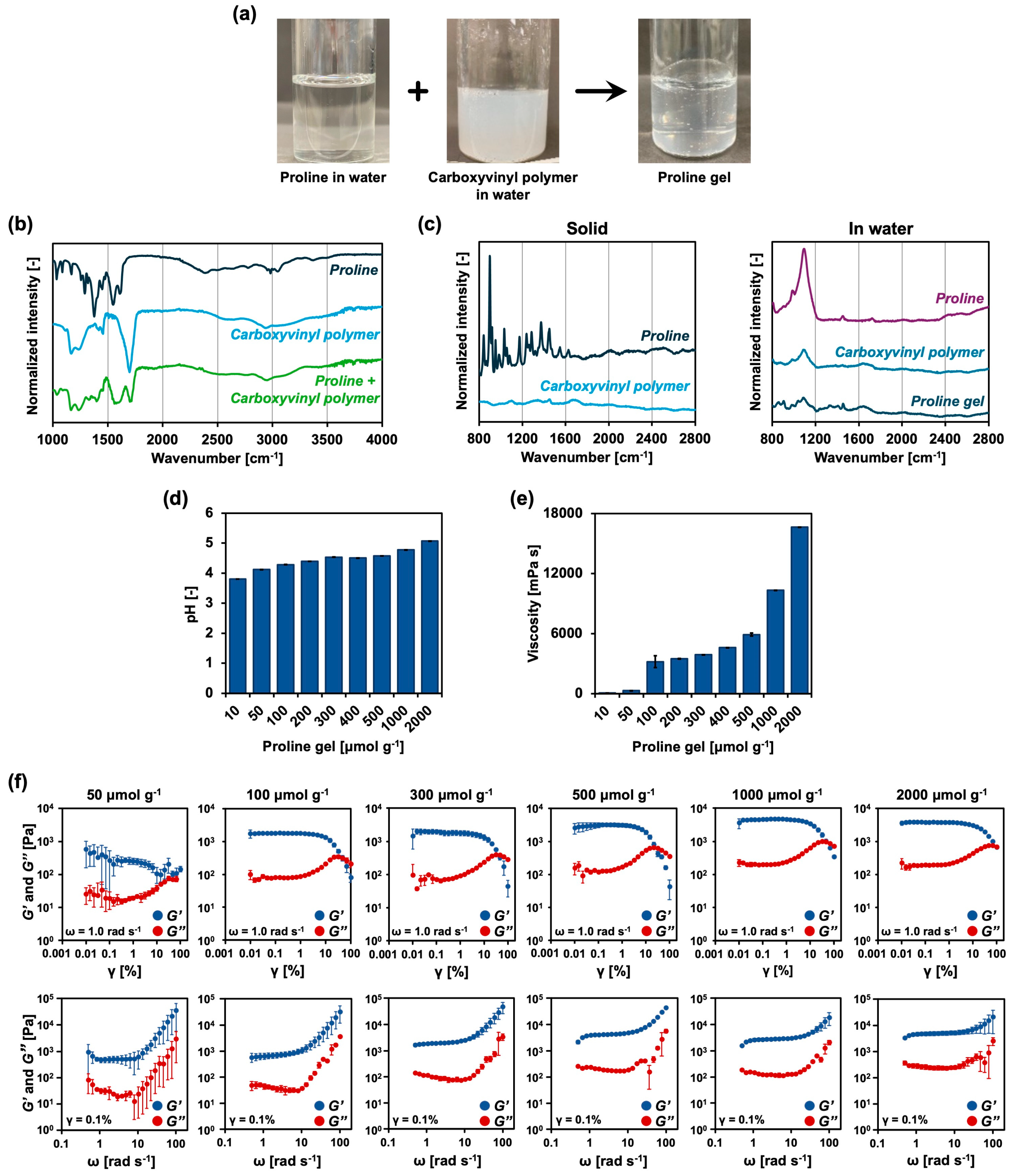
2.1. Characterization of Proline Gels
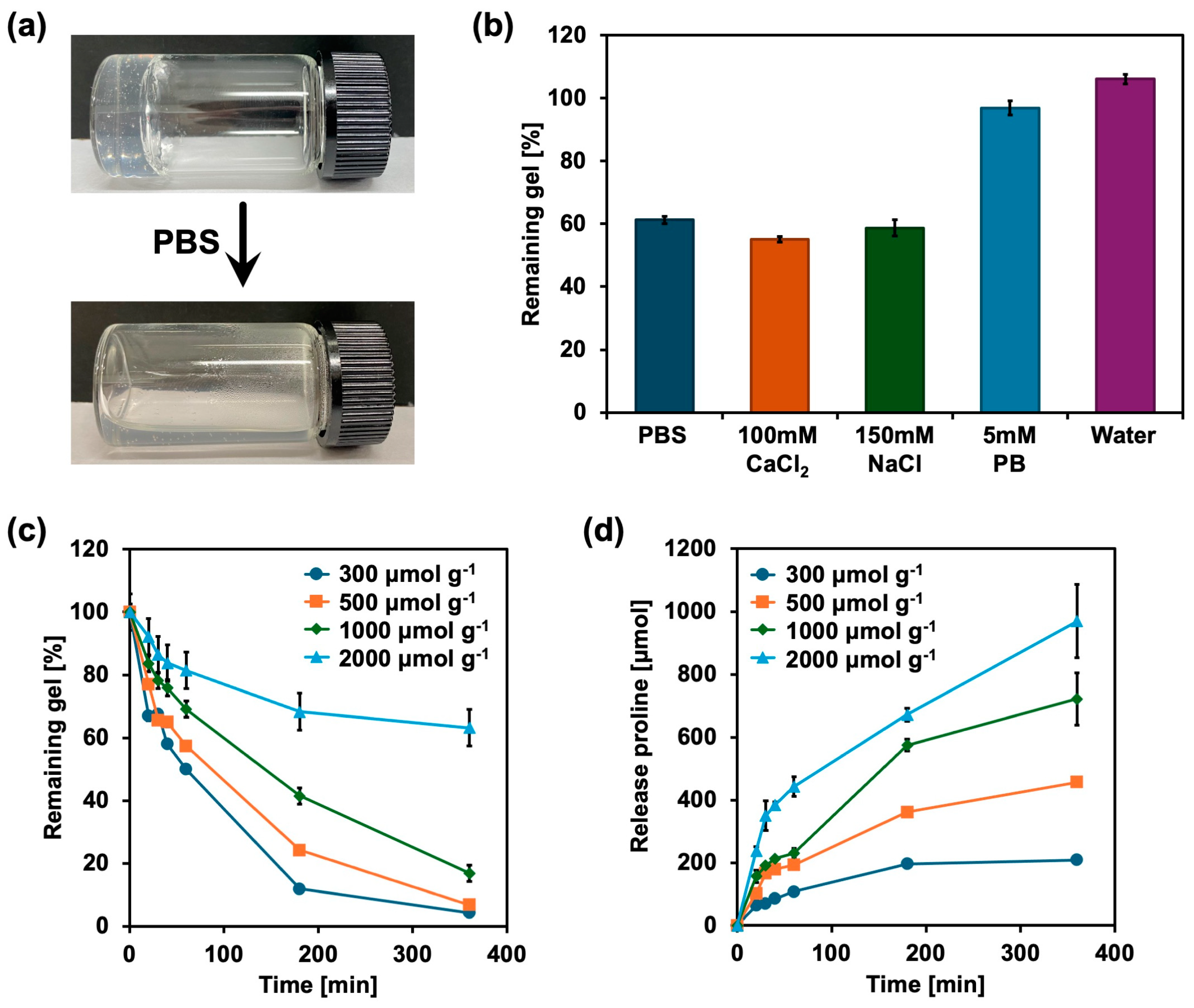
2.2. Degradation and Release Behavior of Proline Gels
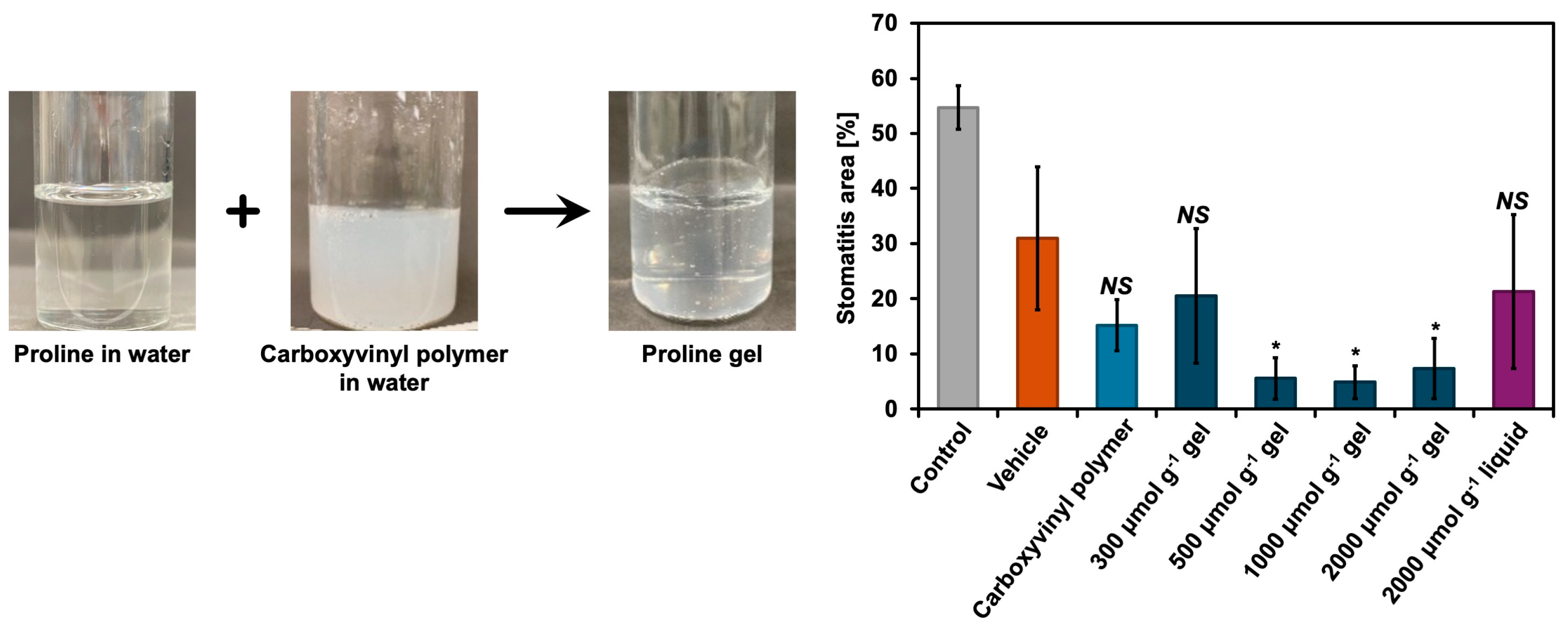
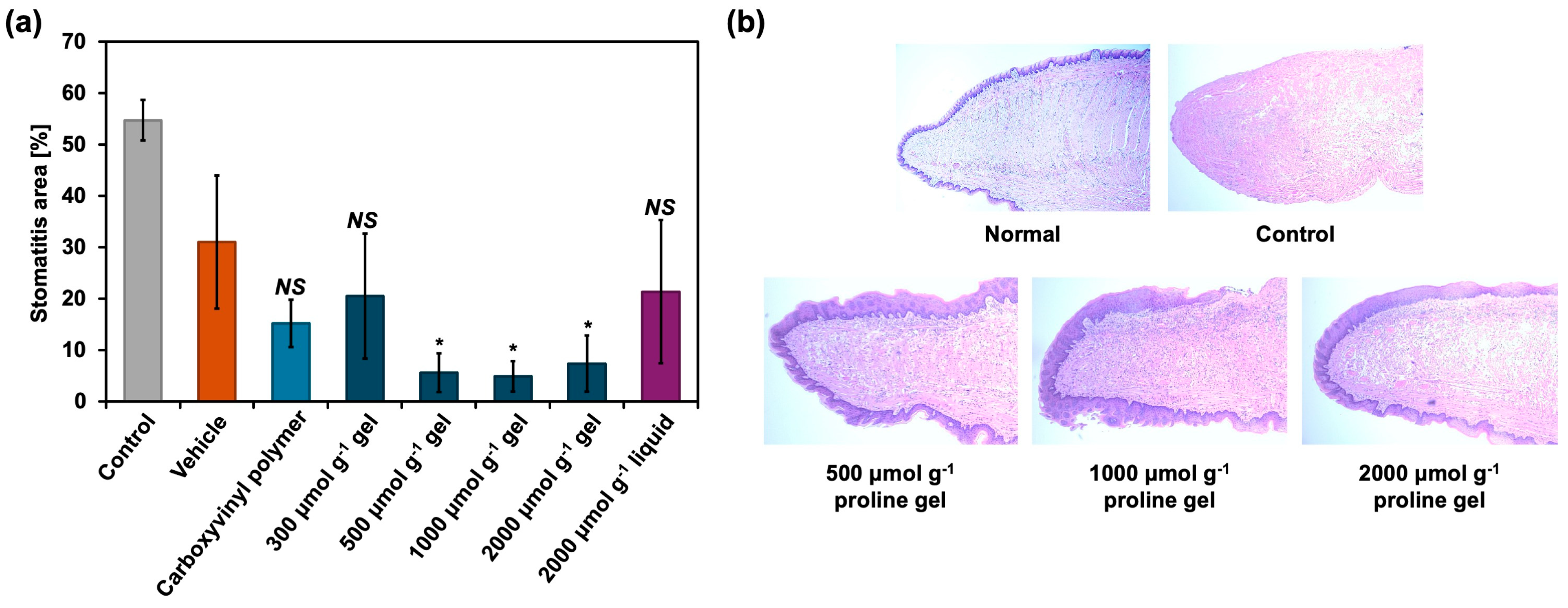
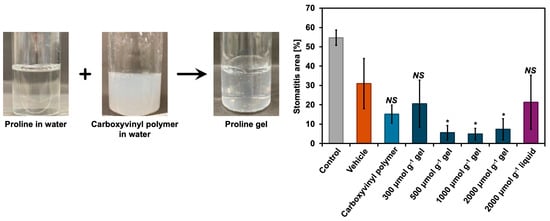
2.3. Stomatitis Healing In Vivo
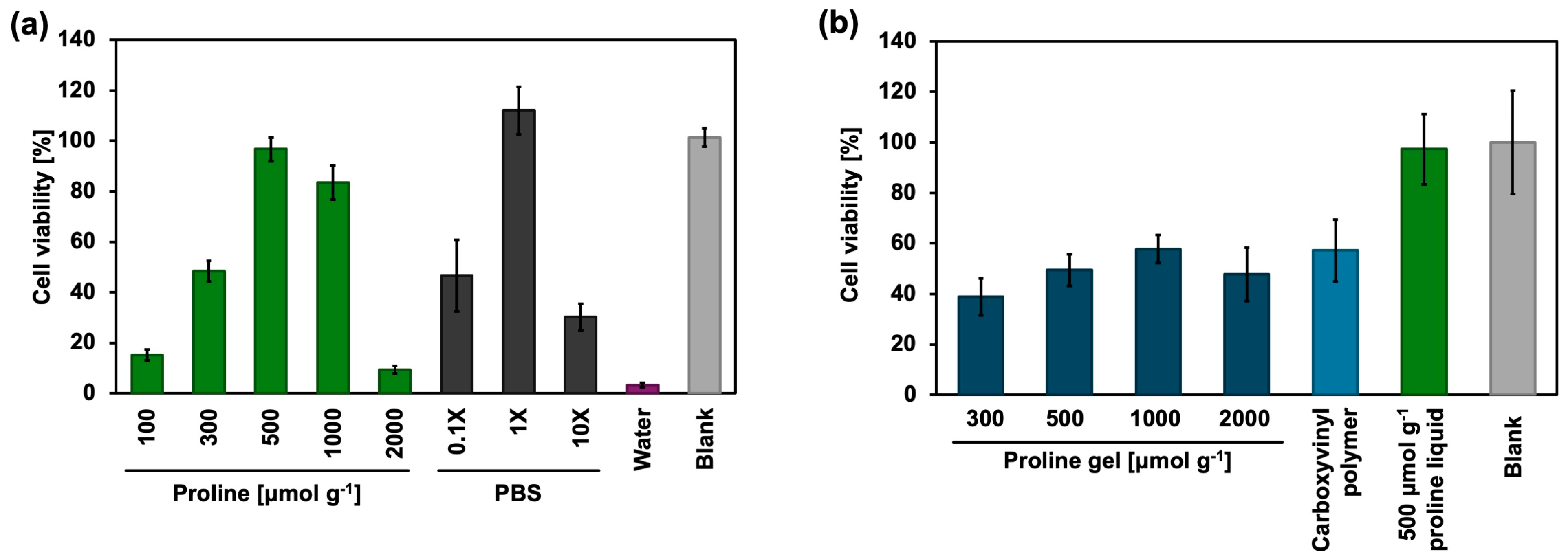
2.4. Cytotoxicity and Cell Proliferation In Vitro
3. Conclusions
4. Materials and Methods
4.1. Preparation of Proline Gels
4.2. FTIR and Raman Spectrum
4.3. Gelation, pH, Viscosity, and Viscoelasticity Measurements of Proline Gels
4.4. Degradation and Release Behavior of Proline Gels
4.5. Stomatitis Healing In Vivo
4.6. Cytotoxicity and Cell Proliferation In Vitro
4.7. Statistical Analysis
Author Contributions
Funding
Institutional Review Board Statement
Informed Consent Statement
Data Availability Statement
Acknowledgments
Conflicts of Interest
References
- Sung, H.; Ferlay, J.; Siegel, R.L.; Laversanne, M.; Soerjomataram, I.; Jemal, A.; Bray, F. Global Cancer Statistics 2020: GLOBOCAN Estimates of Incidence and Mortality Worldwide for 36 Cancers in 185 Countries. CA A Cancer J. Clin. 2021, 71, 209–249. [Google Scholar] [CrossRef]
- Vodenkova, S.; Buchler, T.; Cervena, K.; Veskrnova, V.; Vodicka, P.; Vymetalkova, V. 5-fluorouracil and other fluoropyrimidines in colorectal cancer: Past, present and future. Pharmacol. Ther. 2020, 206, 107447. [Google Scholar] [CrossRef]
- Sonis, S.T.; Elting, L.S.; Keefe, D.; Peterson, D.E.; Schubert, M.; Hauer-Jensen, M.; Bekele, B.N.; Raber-Durlacher, J.; Donnelly, J.P.; Rubenstein, E.B. Perspectives on cancer therapy-induced mucosal injury. Cancer 2004, 100, 1995–2025. [Google Scholar] [CrossRef]
- Lee, J.J.; Beumer, J.H.; Chu, E. Therapeutic drug monitoring of 5-fluorouracil. Cancer Chemother. Pharmacol. 2016, 78, 447–464. [Google Scholar] [CrossRef]
- Wilberg, P.; Hjermstad, M.J.; Ottesen, S.; Herlofson, B.B. Chemotherapy-Associated Oral Sequelae in Patients with Cancers Outside the Head and Neck Region. J. Pain Symptom Manag. 2014, 48, 1060–1069. [Google Scholar] [CrossRef] [PubMed]
- Elad, S.; Yarom, N.; Zadik, Y.; Kuten-Shorrer, M.; Sonis, S.T. The broadening scope of oral mucositis and oral ulcerative mucosal toxicities of anticancer therapies. CA A Cancer J. Clin. 2022, 72, 57–77. [Google Scholar] [CrossRef]
- Su, Y.; Cui, H.; Yang, C.; Li, L.; Xu, F.; Gao, J.; Zhang, W. Hydrogels for the treatment of radiation-induced skin and mucosa damages: An up-to-date overview. Front. Mater. 2022, 9, 1018815. [Google Scholar] [CrossRef]
- Prete, S.; Dattilo, M.; Patitucci, F.; Pezzi, G.; Parisi, O.I.; Puoci, F. Natural and Synthetic Polymeric Biomaterials for Application in Wound Management. J. Funct. Biomater. 2023, 14, 455. [Google Scholar] [CrossRef] [PubMed]
- Guo, S.; Zhang, Q.; Li, X.; Wang, Q.; Li, X.; Wang, P.; Xue, Q. Bacterial-responsive biodegradable silver nanoclusters composite hydrogel for infected wound therapy. Colloids Surf. B Biointerfaces 2025, 245, 114213. [Google Scholar] [CrossRef] [PubMed]
- Xu, Y.; Chen, H.; Fang, Y.; Wu, J. Hydrogel Combined with Phototherapy in Wound Healing. Adv. Healthc. Mater. 2022, 11, 2200494. [Google Scholar] [CrossRef] [PubMed]
- He, C.; Bi, S.; Zhang, R.; Chen, C.; Liu, R.; Zhao, X.; Gu, J.; Yan, B. A hyaluronic acid hydrogel as a mild photothermal antibacterial, antioxidant, and nitric oxide release platform for diabetic wound healing. J. Control. Release 2024, 370, 543–555. [Google Scholar] [CrossRef] [PubMed]
- Wu, Z.; Wu, W.; Zhang, C.; Zhang, W.; Li, Y.; Ding, T.; Fang, Z.; Jing, J.; He, X.; Huang, F. Enhanced diabetic foot ulcer treatment with a chitosan-based thermosensitive hydrogel loaded self-assembled multi-functional nanoparticles for antibacterial and angiogenic effects. Carbohydr. Polym. 2025, 347, 122740. [Google Scholar] [CrossRef]
- Harada, K.; Ferdous, T.; Horinaga, D.; Uchida, K.; Mano, T.; Mishima, K.; Park, S.; Hanazawa, H.; Takahashi, S.; Okita, A.; et al. Efficacy of elemental diet on prevention for chemoradiotherapy-induced oral mucositis in patients with oral squamous cell carcinoma. Support. Care Cancer 2016, 24, 953–959. [Google Scholar] [CrossRef] [PubMed]
- Harada, K.; Ferdous, T.; Kobayashi, H.; Ueyama, Y. Elemental Diet Accelerates the Recovery from Oral Mucositis and Dermatitis Induced by 5-Fluorouracil Through the Induction of Fibroblast Growth Factor 2. Integr. Cancer Ther. 2018, 17, 423–430. [Google Scholar] [CrossRef]
- Harada, K.; Ferdous, T.; Mizukami, Y.; Mishima, K. Elemental diet inhibits pro-inflammatory cytokine production in keratinocytes through the suppression of NF-κB activation. Oncol. Rep. 2018, 40, 361–368. [Google Scholar] [CrossRef] [PubMed]
- Harada, K.; Takenawa, T.; Ferdous, T.; Mizukami, Y.; Mishima, K. Elemental diet directly affects chemotherapy-induced dermatitis and raw wound areas. Mol. Clin. Oncol. 2020, 13, 209–215. [Google Scholar] [CrossRef] [PubMed]
- Hagan, J.B.; Wasserman, R.L.; Baggish, J.S.; Spycher, M.O.; Berger, M.; Shashi, V.; Lohrmann, E.; Sullivan, K.E. Safety of L-proline as a stabilizer for immunoglobulin products. Expert Rev. Clin. Immunol. 2012, 8, 169–178. [Google Scholar] [CrossRef]
- Zhu, G.; Zhu, X.; Fan, Q.; Wan, X. Raman spectra of amino acids and their aqueous solutions. Spectrochim. Acta Part A Mol. Biomol. Spectrosc. 2011, 78, 1187–1195. [Google Scholar] [CrossRef] [PubMed]
- Di Giuseppe, E.; Corbi, F.; Funiciello, F.; Massmeyer, A.; Santimano, T.N.; Rosenau, M.; Davaille, A. Characterization of Carbopol® hydrogel rheology for experimental tectonics and geodynamics. Tectonophysics 2015, 642, 29–45. [Google Scholar] [CrossRef]
- Cheng, H.; Tian, G.; Liu, H.; Bai, D.; Zhang, Y.; Wang, Q.; Zhao, M.; Cao, S.; Deng, D.; Wang, X. A molybdenum sulfide based nitric oxide controlled release oral gel for rapid healing of oral mucosal ulcers. J. Colloid Interface Sci. 2025, 678, 560–571. [Google Scholar] [CrossRef]
- Mary, Y.S.; Ushakumari, L.; Harikumar, B.; Varghese, H.T.; Panicker, C.Y. FT-IR, FT-raman and SERS spectra of L-proline. J. Iran. Chem. Soc. 2009, 6, 138–144. [Google Scholar] [CrossRef]
- Sahoo, S.; Chakraborti, C.K.; Behera, P.K.; Mishra, S.C. FTIR and Raman Spectroscopic Investigations of a Norfloxacin/Carbopol934 Polymerie Suspension. J. Young Pharm. 2012, 4, 138–145. [Google Scholar] [CrossRef] [PubMed]
- Islam, M.T.; Rodríguez-Hornedo, N.; Ciotti, S.; Ackermann, C. Fourier transform infrared spectroscopy for the analysis of neutralizer-carbomer and surfactant-carbomer interactions in aqueous, hydroalcoholic, and anhydrous gel formulations. AAPS J. 2004, 6, 35. [Google Scholar] [CrossRef] [PubMed]
- Shafiei, M.; Balhoff, M.; Hayman, N.W. Chemical and microstructural controls on viscoplasticity in Carbopol hydrogel. Polymer 2018, 139, 44–51. [Google Scholar] [CrossRef]
- Houlleberghs, M.; Verheyden, L.; Voorspoels, F.; Chandran, C.V.; Duerinckx, K.; Radhakrishnan, S.; Martens, J.A.; Breynaert, E. Dispersing carbomers, mixing technology matters! RSC Adv. 2022, 12, 7830–7834. [Google Scholar] [CrossRef]
- Bonacucina, G.; Martelli, S.; Palmieri, G.F. Rheological, mucoadhesive and release properties of Carbopol gels in hydrophilic cosolvents. Int. J. Pharm. 2004, 282, 115–130. [Google Scholar] [CrossRef]
- Ritger, P.L.; Peppas, N.A. A simple equation for description of solute release I. Fickian and non-fickian release from non-swellable devices in the form of slabs, spheres, cylinders or discs. J. Control. Release 1987, 5, 23–36. [Google Scholar] [CrossRef]
- Ritger, P.L.; Peppas, N.A. A simple equation for description of solute release II. Fickian and anomalous release from swellable devices. J. Control. Release 1987, 5, 37–42. [Google Scholar] [CrossRef]



| Proline [μmol g−1] | 10 | 50 | 100 | 200 | 300 | 400 | 500 | 1000 | 1500 | 2000 | 2500 |
| State | Sol | Sol | Sol | Sol | Gel | Gel | Gel | Gel | Gel | Gel | Gel |
| Proline Gels | n [-] | k [min−n] |
|---|---|---|
| 300 μmol g−1 | 0.46 ± 0.01 | 0.059 ± 0.007 |
| 500 μmol g−1 | 0.51 ± 0.16 | 0.041 ± 0.021 |
| 1000 μmol g−1 | 0.58 ± 0.09 | 0.025 ± 0.005 |
| 2000 μmol g−1 | 0.60 ± 0.02 | 0.014 ± 0.000 |
Disclaimer/Publisher’s Note: The statements, opinions and data contained in all publications are solely those of the individual author(s) and contributor(s) and not of MDPI and/or the editor(s). MDPI and/or the editor(s) disclaim responsibility for any injury to people or property resulting from any ideas, methods, instructions or products referred to in the content. |
© 2025 by the authors. Licensee MDPI, Basel, Switzerland. This article is an open access article distributed under the terms and conditions of the Creative Commons Attribution (CC BY) license (https://creativecommons.org/licenses/by/4.0/).
Share and Cite
Hanaki, R.; Harada, K.; Sasaki, Y.; Matsumoto, M.; Tahara, Y. Stomatitis Healing via Hydrogels Comprising Proline, Carboxyvinyl Polymer, and Water. Gels 2025, 11, 108. https://doi.org/10.3390/gels11020108
Hanaki R, Harada K, Sasaki Y, Matsumoto M, Tahara Y. Stomatitis Healing via Hydrogels Comprising Proline, Carboxyvinyl Polymer, and Water. Gels. 2025; 11(2):108. https://doi.org/10.3390/gels11020108
Chicago/Turabian StyleHanaki, Raichi, Koji Harada, Yoshihiro Sasaki, Michiaki Matsumoto, and Yoshiro Tahara. 2025. "Stomatitis Healing via Hydrogels Comprising Proline, Carboxyvinyl Polymer, and Water" Gels 11, no. 2: 108. https://doi.org/10.3390/gels11020108
APA StyleHanaki, R., Harada, K., Sasaki, Y., Matsumoto, M., & Tahara, Y. (2025). Stomatitis Healing via Hydrogels Comprising Proline, Carboxyvinyl Polymer, and Water. Gels, 11(2), 108. https://doi.org/10.3390/gels11020108