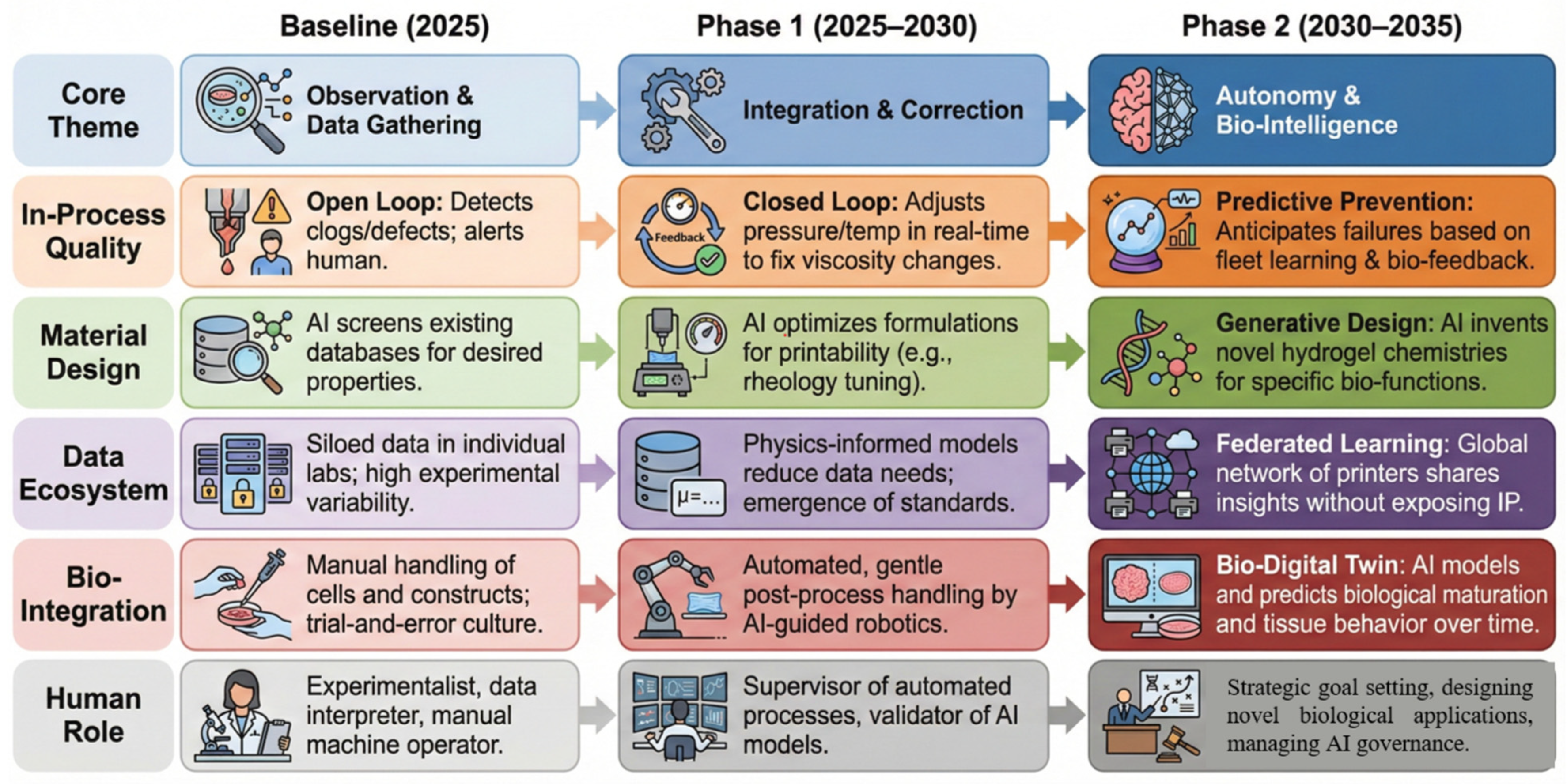

Artificial Intelligence Informed Hydrogel Biomaterials in Additive Manufacturing

Abstract
1. Introduction
2. Hydrogel Material Design and 3D Printability by Artificial Intelligence
2.1. Artificial Intelligence Design for Hydrogel
2.2. Artificial Intelligence Design for 3D Printability
3. Recent AI Application in Hydrogel Additive Manufacturing
3.1. Reasons to Use Machine Learning
3.2. Wide Availability of Resources
3.3. AI Applications in Hydrogel Additive Manufacturing
4. Outlook
Author Contributions
Funding
Data Availability Statement
Conflicts of Interest
References
- Martin, T.B.; Audus, D.J. Emerging Trends in Machine Learning: A Polymer Perspective. ACS Polym. Au 2023, 3, 239–258. [Google Scholar] [CrossRef] [PubMed]
- Theus, A.S.; Ning, L.; Hwang, B.; Gil, C.; Chen, S.; Wombwell, A.; Mehta, R.; Serpooshan, V. Bioprintability: Physiomechanical and Biological Requirements of Materials for 3D Bioprinting Processes. Polymers 2020, 12, 2262. [Google Scholar] [CrossRef]
- Schwab, A.; Levato, R.; D’Este, M.; Piluso, S.; Eglin, D.; Malda, J. Printability and Shape Fidelity of Bioinks in 3D Bioprinting. Chem. Rev. 2020, 120, 11028–11055. [Google Scholar] [CrossRef] [PubMed]
- Herrada-Manchón, H.; Fernández, M.A.; Aguilar, E. Essential Guide to Hydrogel Rheology in Extrusion 3D Printing: How to Measure It and Why It Matters? Gels 2023, 9, 517. [Google Scholar] [CrossRef]
- Kim, S.; Schroeder, C.M.; Jackson, N.E. Open Macromolecular Genome: Generative Design of Synthetically Accessible Polymers. ACS Polym. Au 2023, 3, 318–330. [Google Scholar] [CrossRef]
- Kuenneth, C.; Ramprasad, R. polyBERT: A Chemical Language Model to Enable Fully Machine-Driven Ultrafast Polymer Informatics. Nat. Commun. 2023, 14, 4099. [Google Scholar] [CrossRef]
- Cheng, Y.; Chan, K.H.; Wang, X.-Q.; Ding, T.; Li, T.; Lu, X.; Ho, G.W. Direct-Ink-Write 3D Printing of Hydrogels into Biomimetic Soft Robots. ACS Nano 2019, 13, 13176–13184. [Google Scholar] [CrossRef]
- Rau, D.A.; Williams, C.B.; Bortner, M.J. Rheology and Printability: A Survey of Critical Relationships for Direct Ink Write Materials Design. Prog. Mater. Sci. 2023, 140, 101188. [Google Scholar] [CrossRef]
- Yuk, H.; Zhao, X. A New 3D Printing Strategy by Harnessing Deformation, Instability, and Fracture of Viscoelastic Inks. Adv. Mater. 2018, 30, 1704028. [Google Scholar] [CrossRef]
- Zhang, L.; Lee, W.; Li, X.; Jiang, Y.; Fang, N.X.; Dai, G.; Liu, Y. 3D Direct Printing of Mechanical and Biocompatible Hydrogel Meta-Structures. Bioact. Mater. 2022, 10, 48–55. [Google Scholar] [CrossRef] [PubMed]
- Jiang, P.; Lin, P.; Yang, C.; Qin, H.; Wang, X.; Zhou, F. 3D Printing of Dual-Physical Cross-Linking Hydrogel with Ultrahigh Strength and Toughness. Chem. Mater. 2020, 32, 9983–9995. [Google Scholar] [CrossRef]
- Magdassi, S. The Chemistry of Inkjet Inks; World Scientific: Singapore, 2009; ISBN 981-4470-92-9. [Google Scholar]
- Derby, B. Inkjet Printing of Functional and Structural Materials: Fluid Property Requirements, Feature Stability, and Resolution. Annu. Rev. Mater. Res. 2010, 40, 395–414. [Google Scholar] [CrossRef]
- Reis, N.; Derby, B. Ink Jet Deposition of Ceramic Suspensions: Modeling and Experiments of Droplet Formation. MRS Online Proc. Libr. (OPL) 2000, 625, 117. [Google Scholar] [CrossRef]
- Paxton, N.; Smolan, W.; Böck, T.; Melchels, F.; Groll, J.; Jungst, T. Proposal to Assess Printability of Bioinks for Extrusion-Based Bioprinting and Evaluation of Rheological Properties Governing Bioprintability. Biofabrication 2017, 9, 044107. [Google Scholar] [CrossRef]
- Saunders, R.E.; Derby, B. Inkjet Printing Biomaterials for Tissue Engineering: Bioprinting. Int. Mater. Rev. 2014, 59, 430–448. [Google Scholar] [CrossRef]
- Xu, T.; Jin, J.; Gregory, C.; Hickman, J.J.; Boland, T. Inkjet Printing of Viable Mammalian Cells. Biomaterials 2005, 26, 93–99. [Google Scholar] [CrossRef]
- Hong, S.; Sycks, D.; Chan, H.F.; Lin, S.; Lopez, G.P.; Guilak, F.; Leong, K.W.; Zhao, X. 3D Printing of Highly Stretchable and Tough Hydrogels into Complex, Cellularized Structures. Adv. Mater. 2015, 27, 4035. [Google Scholar] [CrossRef]
- Kwon, K.-S.; Kim, W. A Waveform Design Method for High-Speed Inkjet Printing Based on Self-Sensing Measurement. Sens. Actuators A Phys. 2007, 140, 75–83. [Google Scholar] [CrossRef]
- Lee, M.; Kang, D.; Kim, N.; Kim, H.; James, S.; Yoon, S. A Study of Ejection Modes for Pulsed-DC Electrohydrodynamic Inkjet Printing. J. Aerosol Sci. 2012, 46, 1–6. [Google Scholar] [CrossRef]
- Stringer, J.; Derby, B. Formation and Stability of Lines Produced by Inkjet Printing. Langmuir 2010, 26, 10365–10372. [Google Scholar] [CrossRef] [PubMed]
- Alparslan, C.; Bayraktar, Ş. Advances in Digital Light Processing (DLP) Bioprinting: A Review of Biomaterials and Its Applications, Innovations, Challenges, and Future Perspectives. Polymers 2025, 17, 1287. [Google Scholar] [CrossRef] [PubMed]
- Zhu, W.; Ma, X.; Gou, M.; Mei, D.; Zhang, K.; Chen, S. 3D Printing of Functional Biomaterials for Tissue Engineering. Curr. Opin. Biotechnol. 2016, 40, 103–112. [Google Scholar] [CrossRef]
- O’Connell, C.D.; Zhang, B.; Onofrillo, C.; Duchi, S.; Blanchard, R.; Quigley, A.; Bourke, J.; Gambhir, S.; Kapsa, R.; Di Bella, C. Tailoring the Mechanical Properties of Gelatin Methacryloyl Hydrogels through Manipulation of the Photocrosslinking Conditions. Soft Matter 2018, 14, 2142–2151. [Google Scholar] [CrossRef]
- Yue, K.; Trujillo-de Santiago, G.; Alvarez, M.M.; Tamayol, A.; Annabi, N.; Khademhosseini, A. Synthesis, Properties, and Biomedical Applications of Gelatin Methacryloyl (GelMA) Hydrogels. Biomaterials 2015, 73, 254–271. [Google Scholar] [CrossRef]
- Hospodiuk, M.; Dey, M.; Sosnoski, D.; Ozbolat, I.T. The Bioink: A Comprehensive Review on Bioprintable Materials. Biotechnol. Adv. 2017, 35, 217–239. [Google Scholar] [CrossRef] [PubMed]
- Ma, X.; Qu, X.; Zhu, W.; Li, Y.-S.; Yuan, S.; Zhang, H.; Liu, J.; Wang, P.; Lai, C.S.E.; Zanella, F. Deterministically Patterned Biomimetic Human iPSC-Derived Hepatic Model via Rapid 3D Bioprinting. Proc. Natl. Acad. Sci. USA 2016, 113, 2206–2211. [Google Scholar] [CrossRef]
- Grigoryan, B.; Paulsen, S.J.; Corbett, D.C.; Sazer, D.W.; Fortin, C.L.; Zaita, A.J.; Greenfield, P.T.; Calafat, N.J.; Gounley, J.P.; Ta, A.H. Multivascular Networks and Functional Intravascular Topologies within Biocompatible Hydrogels. Science 2019, 364, 458–464. [Google Scholar] [CrossRef] [PubMed]
- Miri, A.K.; Nieto, D.; Iglesias, L.; Goodarzi Hosseinabadi, H.; Maharjan, S.; Ruiz-Esparza, G.U.; Khoshakhlagh, P.; Manbachi, A.; Dokmeci, M.R.; Chen, S. Microfluidics-enabled Multimaterial Maskless Stereolithographic Bioprinting. Adv. Mater. 2018, 30, 1800242. [Google Scholar] [CrossRef]
- Chan, V.; Zorlutuna, P.; Jeong, J.H.; Kong, H.; Bashir, R. Three-Dimensional Photopatterning of Hydrogels Using Stereolithography for Long-Term Cell Encapsulation. Lab Chip 2010, 10, 2062. [Google Scholar] [CrossRef]
- Fairbanks, B.D.; Schwartz, M.P.; Bowman, C.N.; Anseth, K.S. Photoinitiated Polymerization of PEG-Diacrylate with Lithium Phenyl-2, 4, 6-Trimethylbenzoylphosphinate: Polymerization Rate and Cytocompatibility. Biomaterials 2009, 30, 6702–6707. [Google Scholar] [CrossRef]
- Bártolo, P.J. Stereolithography: Materials, Processes and Applications; Springer Science & Business Media: Berlin/Heidelberg, Germany, 2011; ISBN 0-387-92904-5. [Google Scholar]
- Karakurt, I.; Aydoğdu, A.; Çıkrıkcı, S.; Orozco, J.; Lin, L. Stereolithography (SLA) 3D Printing of Ascorbic Acid Loaded Hydrogels: A Controlled Release Study. Int. J. Pharm. 2020, 584, 119428. [Google Scholar] [CrossRef]
- Morales, M.; Munoz-Martin, D.; Marquez, A.; Lauzurica, S.; Molpeceres, C. Laser-Induced Forward Transfer Techniques and Applications. Adv. Laser Mater. Process. 2018, 339–379. [Google Scholar]
- Fernández-Pradas, J.M.; Serra, P. Laser-Induced Forward Transfer: A Method for Printing Functional Inks. Crystals 2020, 10, 651. [Google Scholar] [CrossRef]
- Unger, C.; Gruene, M.; Koch, L.; Koch, J.; Chichkov, B.N. Time-Resolved Imaging of Hydrogel Printing via Laser-Induced Forward Transfer. Appl. Phys. A 2011, 103, 271–277. [Google Scholar] [CrossRef]
- Serra, P.; Piqué, A. Laser-induced Forward Transfer: Fundamentals and Applications. Adv. Mater. Technol. 2019, 4, 1800099. [Google Scholar] [CrossRef]
- Nadernezhad, A.; Groll, J. Machine Learning Reveals a General Understanding of Printability in Formulations Based on Rheology Additives. Adv. Sci. 2022, 9, 2202638. [Google Scholar] [CrossRef] [PubMed]
- Jeong, E.H.; Choi, J.; Park, H.B.; Lee, J.W.; Bae, S.Y.; Kim, B.S.; Yoon, C.; Park, J.D. Data-Driven Printability Modeling of Hydrogels for Precise Direct Ink Writing Based on Rheological Properties. Adv. Sci. 2025, e07639. [Google Scholar] [CrossRef]
- Mohammadrezaei, D.; Podina, L.; Silva, J.D.; Kohandel, M. Cell Viability Prediction and Optimization in Extrusion-Based Bioprinting via Neural Network-Based Bayesian Optimization Models. Biofabrication 2024, 16, 025016. [Google Scholar] [CrossRef]
- Müller, S.J.; Fabry, B.; Gekle, S. Predicting Cell Stress and Strain during Extrusion Bioprinting. Phys. Rev. Appl. 2023, 19, 064061. [Google Scholar] [CrossRef]
- Boularaoui, S.; Al Hussein, G.; Khan, K.A.; Christoforou, N.; Stefanini, C. An Overview of Extrusion-Based Bioprinting with a Focus on Induced Shear Stress and Its Effect on Cell Viability. Bioprinting 2020, 20, e00093. [Google Scholar] [CrossRef]
- Barjuei, E.S.; Shin, J.; Kim, K.; Lee, J. Precision Improvement of Robotic Bioprinting via Vision-Based Tool Path Compensation. Sci. Rep. 2024, 14, 17764. [Google Scholar] [CrossRef]
- Ho, B.; Zhao, J.; Liu, J.; Tang, L.; Guan, Z.; Li, X.; Li, M.; Howard, E.; Wheeler, R.; Bae, J. SEMPro: A Data-Driven Pipeline To Learn Structure–Property Insights from Scanning Electron Microscopy Images. ACS Mater. Lett. 2023, 5, 3117–3125. [Google Scholar] [CrossRef]
- Cheng, C.; Williamson, E.J.; Chiu, G.T.-C.; Han, B. Engineering Biomaterials by Inkjet Printing of Hydrogels with Functional Particulates. Med-X 2024, 2, 9. [Google Scholar] [CrossRef]
- Ishii, M.; Ito, T.; Sado, H.; Kuwajima, I. NIMS Polymer Database PoLyInfo (I): An Overarching View of Half a Million Data Points. Sci. Technol. Adv. Mater. Methods 2024, 4, 2354649. [Google Scholar] [CrossRef]
- Lin, T.-S.; Coley, C.W.; Mochigase, H.; Beech, H.K.; Wang, W.; Wang, Z.; Woods, E.; Craig, S.L.; Johnson, J.A.; Kalow, J.A.; et al. BigSMILES: A Structurally-Based Line Notation for Describing Macromolecules. ACS Cent. Sci. 2019, 5, 1523–1531. [Google Scholar] [CrossRef] [PubMed]
- Schneider, L.; Walsh, D.; Olsen, B.; de Pablo, J. Generative BigSMILES: An Extension for Polymer Informatics, Computer Simulations & ML/AI. Digit. Discov. 2024, 3, 51–61. [Google Scholar] [CrossRef]
- Hayashi, Y.; Shiomi, J.; Morikawa, J.; Yoshida, R. RadonPy: Automated Physical Property Calculation Using All-Atom Classical Molecular Dynamics Simulations for Polymer Informatics. npj Comput. Mater. 2022, 8, 222. [Google Scholar] [CrossRef]
- Kim, C.; Chandrasekaran, A.; Huan, T.D.; Das, D.; Ramprasad, R. Polymer Genome: A Data-Powered Polymer Informatics Platform for Property Predictions. J. Phys. Chem. C 2018, 122, 17575–17585. [Google Scholar] [CrossRef]
- Tom, G.; Schmid, S.P.; Baird, S.G.; Cao, Y.; Darvish, K.; Hao, H.; Lo, S.; Pablo-García, S.; Rajaonson, E.M.; Skreta, M.; et al. Self-Driving Laboratories for Chemistry and Materials Science. Chem. Rev. 2024, 124, 9633–9732. [Google Scholar] [CrossRef]
- Wang, C.; Kim, Y.-J.; Vriza, A.; Batra, R.; Baskaran, A.; Shan, N.; Li, N.; Darancet, P.; Ward, L.; Liu, Y.; et al. Autonomous Platform for Solution Processing of Electronic Polymers. Nat. Commun. 2025, 16, 1498. [Google Scholar] [CrossRef]
- Bilbrey, J.A.; Firoz, J.S.; Lee, M.-S.; Choudhury, S. Uncertainty Quantification for Neural Network Potential Foundation Models. npj Comput. Mater. 2025, 11, 109. [Google Scholar] [CrossRef]
- Blais, C.J.; Xu, C.; West, R.H. Uncertainty Quantification of Linear Scaling, Machine Learning, and Density Functional Theory Derived Thermodynamics for the Catalytic Partial Oxidation of Methane on Rhodium. J. Phys. Chem. C 2024, 128, 17418–17433. [Google Scholar] [CrossRef]
- Rau, D.A.; Bortner, M.J.; Williams, C.B. A Rheology Roadmap for Evaluating the Printability of Material Extrusion Inks. Addit. Manuf. 2023, 75, 103745. [Google Scholar] [CrossRef]
- Kolibaba, T.J.; Killgore, J.P.; Caplins, B.W.; Higgins, C.I.; Arp, U.; Miller, C.C.; Poster, D.L.; Zong, Y.; Broce, S.; Wang, T.; et al. Results of an Interlaboratory Study on the Working Curve in Vat Photopolymerization. Addit. Manuf. 2024, 84, 104082. [Google Scholar] [CrossRef]
- Wendland, R.J.; Kolibaba, T.J.; Worthington, K.S.; Killgore, J.P. A Practical Guide to Hydrogel Working Curves for Bioprinting. Addit. Manuf. Lett. 2025, 14, 100293. [Google Scholar] [CrossRef]
- Mohammad, S.; Akand, R.; Cook, K.M.; Nilufar, S.; Chowdhury, F. Leveraging Deep Learning and Generative AI for Predicting Rheological Properties and Material Compositions of 3D Printed Polyacrylamide Hydrogels. Gels 2024, 10, 660. [Google Scholar] [CrossRef]
- Xu, S.; Chen, X.; Wang, S.; Chen, Z.; Pan, P.; Huang, Q. Integrating Machine Learning for the Optimization of Polyacrylamide/Alginate Hydrogel. Regen. Biomater. 2024, 11, rbae109. [Google Scholar] [CrossRef]
- Krishna, D.V.; Sankar, M.R. Machine Learning-Assisted Extrusion-Based 3D Bioprinting for Tissue Regeneration Applications. Ann. 3D Print. Med. 2023, 12, 100132. [Google Scholar] [CrossRef]
- Xu, L.; Liu, S.; Lin, A.; Su, Z.; Liang, D. Interpretable Prediction and Analysis of PVA Hydrogel Mechanical Behavior Using Machine Learning. Gels 2025, 11, 550. [Google Scholar] [CrossRef]
- Dhand, A.P.; H. Bean, R.; Chiaradia, V.; J. Commisso, A.; Dranseike, D.; E. Fowler, H.; M. Fraser, J.; Howard, H.; Kaneko, T.; Kim, J.-W.; et al. Advances in Vat Photopolymerization: Early-Career Researchers Shine Light on a Path Forward. RSC Appl. Polym. 2025, 3, 574–591. [Google Scholar] [CrossRef]
- Krishnamoorthy, S.; Wadnap, S.; Noorani, B.; Xu, H.; Xu, C. Investigation of Gelatin Methacrylate Working Curves in Dynamic Optical Projection Stereolithography of Vascular-like Constructs. Eur. Polym. J. 2020, 124, 109487. [Google Scholar] [CrossRef]
- Rane, A.; Hart, S.; Ramesh, S.; Deep, A. Surrogate-Assisted Multi-Objective Bayesian Optimization for Improved Rheological Design of Bioinks. Manuf. Lett. 2024, 41, 1405–1414. [Google Scholar] [CrossRef]
- Zhang, Z.; Zhou, X.; Fang, Y.; Xiong, Z.; Zhang, T. AI-Driven 3D Bioprinting for Regenerative Medicine: From Bench to Bedside. Bioact. Mater. 2025, 45, 201–230. [Google Scholar] [CrossRef]
- Lookman, T.; Balachandran, P.V.; Xue, D.; Yuan, R. Active Learning in Materials Science with Emphasis on Adaptive Sampling Using Uncertainties for Targeted Design. npj Comput. Mater. 2019, 5, 21. [Google Scholar] [CrossRef]
- Jin, Z.; Zhang, Z.; Shao, X.; Gu, G.X. Monitoring Anomalies in 3D Bioprinting with Deep Neural Networks. ACS Biomater. Sci. Eng. 2023, 9, 3945–3952. [Google Scholar] [CrossRef]
- Barui, S. 3D Inkjet Printing of Biomaterials: Principles and Applications. Med. Devices Sens. 2021, 4, e10143. [Google Scholar] [CrossRef]
- Zhao, D.; Zhou, H.; Wang, Y.; Yin, J.; Huang, Y. Drop-on-Demand (DOD) Inkjet Dynamics of Printing Viscoelastic Conductive Ink. Addit. Manuf. 2021, 48, 102451. [Google Scholar] [CrossRef]
- Zhu, J.; Tao, J.; Yan, W.; Song, W. Pathways toward Wearable and High-Performance Sensors Based on Hydrogels: Toughening Networks and Conductive Networks. Natl. Sci. Rev. 2023, 10, nwad180. [Google Scholar] [CrossRef] [PubMed]
- Wang, S.; Sun, Z. Hydrogel and Machine Learning for Soft Robots’ Sensing and Signal Processing: A Review. J. Bionic Eng. 2022, 20, 845–857. [Google Scholar] [CrossRef]
- He, L.; Ge, Z.; Teng, R.; Liu, D.; Zhang, W.; Liu, S.; Hu, W.; Tang, J.; Zhou, Y.; Sun, M.; et al. Machine Learning-Assisted Real-Time Inflammation Monitoring and Optimal Treatment of Diabetic Wounds Based on a Ratiometric Fluorescent Sensing Peptide Hydrogel. Nano Lett. 2025, 25, 13284–13293. [Google Scholar] [CrossRef]
- Ding, M.; Jing, L.; Yang, H.; Machnicki, C.E.; Fu, X.; Li, K.; Wong, I.Y.; Chen, P.-Y. Multifunctional Soft Machines Based on Stimuli-Responsive Hydrogels: From Freestanding Hydrogels to Smart Integrated Systems. Mater. Today Adv. 2020, 8, 100088. [Google Scholar] [CrossRef]
- Cao, Y.; Xu, B.; Li, B.; Fu, H. Advanced Design of Soft Robots with Artificial Intelligence. Nano-Micro Lett. 2024, 16, 214. [Google Scholar] [CrossRef]
- Mao, Z.; Suzuki, S.; Nabae, H.; Miyagawa, S.; Suzumori, K.; Maeda, S. Machine Learning-Enhanced Soft Robotic System Inspired by Rectal Functions to Investigate Fecal Incontinence. Bio-Des. Manuf. 2025, 8, 482–494. [Google Scholar] [CrossRef]
- Yu, C.; Schimelman, J.; Wang, P.; Miller, K.L.; Ma, X.; You, S.; Guan, J.; Sun, B.; Zhu, W.; Chen, S. Photopolymerizable Biomaterials and Light-Based 3D Printing Strategies for Biomedical Applications. Chem. Rev. 2020, 120, 10695–10743. [Google Scholar] [CrossRef]
- Su, H.; Yan, H.; Zhang, X.; Zhong, Z. Multiphysics-Informed Deep Learning for Swelling of pH/Temperature Sensitive Cationic Hydrogels and Its Inverse Problem. Mech. Mater. 2022, 175, 104498. [Google Scholar] [CrossRef]
- Doan Tran, H.; Kim, C.; Chen, L.; Chandrasekaran, A.; Batra, R.; Venkatram, S.; Kamal, D.; Lightstone, J.P.; Gurnani, R.; Shetty, P.; et al. Machine-Learning Predictions of Polymer Properties with Polymer Genome. J. Appl. Phys. 2020, 128, 171104. [Google Scholar] [CrossRef]
- Zhang, Z.; Jiang, C.; Lu, M. Fusion of Sentiment and Market Signals for Bitcoin Forecasting: A SentiStack Network Based on a Stacking LSTM Architecture. Big Data Cogn. Comput. 2025, 9, 161. [Google Scholar] [CrossRef]
- Wei, C.; Gu, H.; Zhang, Z.; Chueh, Y.-H.; Li, L. Laser and Arc-Based Methods for Additive Manufacturing of Multiple Material Components—From Design to Manufacture. In Additive Manufacturing Technology; John Wiley & Sons, Ltd: Hoboken, NJ, USA, 2023; pp. 155–184. ISBN 978-3-527-83393-1. [Google Scholar]
- Sha, Y.; Zhu, M.; Huang, K.; Zhang, Y.; Moissinac, F.; Zhang, Z.; Cheng, D.; Mativenga, P.; Liu, Z. Towards a New Avenue for Rapid Synthesis of Electrocatalytic Electrodes via Laser-Induced Hydrothermal Reaction for Water Splitting. Int. J. Extrem. Manuf. 2023, 6, 015502. [Google Scholar] [CrossRef]
- Zhang, Z. Study of Deep Learning Method for Prediction the Mechanical Properties of 3D Printing 316L Stainless Steel. CNKI 2019. [Google Scholar] [CrossRef]
- Zhang, Z.; Mativenga, P.; Huang, S. Manufacturing, Microstructure, and Mechanics of 316L SS Biomaterials by Laser Powder Bed Fusion. J. Funct. Biomater. 2025, 16, 280. [Google Scholar] [CrossRef] [PubMed]
- Zhang, Z.; Mativenga, P.; Zhang, W.; Huang, S. Deep Learning-Driven Prediction of Mechanical Properties of 316L Stainless Steel Metallographic by Laser Powder Bed Fusion. Micromachines 2024, 15, 1167. [Google Scholar] [CrossRef]
- Zhang, Z.; Williams, C.J.; Maddison, G.; Sha, Y.; Zhu, M.; Cheng, D.; Wei, C.; Zhong, X.; Liu, Z.; Mativenga, P.; et al. Laser Additive Manufacturing of Ultra-High Temperature Ta4HfC5 Ceramic Components. J. Manuf. Process. 2025, 152, 1051–1066. [Google Scholar] [CrossRef]
- Zhang, Z. Molten Pools of 316L Steel Biomaterials by Laser Additive Manufacturing. 2025. Available online: https://figshare.com/articles/figure/Molten_Pools_of_316L_Steel_Biomaterials_by_Laser_Additive_Manufacturing/30017716 (accessed on 3 December 2025).
- Bunin, A.; Harari-Steinberg, O.; Kam, D.; Kuperman, T.; Friedman-Gohas, M.; Shalmon, B.; Larush, L.; Duvdevani, S.I.; Magdassi, S. Digital Light Processing Printing of Non-Modified Protein-Only Compositions. Mater. Today Bio 2025, 30, 101384. [Google Scholar] [CrossRef]
- Bom, S.; Ribeiro, R.; Ribeiro, H.M.; Santos, C.; Marto, J. On the Progress of Hydrogel-Based 3D Printing: Correlating Rheological Properties with Printing Behaviour. Int. J. Pharm. 2022, 615, 121506. [Google Scholar] [CrossRef] [PubMed]
- Chen, H.; Liu, Y.; Balabani, S.; Hirayama, R.; Huang, J. Machine Learning in Predicting Printable Biomaterial Formulations for Direct Ink Writing. Research 2023, 6, 0197. [Google Scholar] [CrossRef]
- Kim, S.; Choi, J.H.; Sohn, D.K.; Ko, H.S. Printability of Inkjet According to Supply Pressure. Phys. Fluids 2023, 35, 053304. [Google Scholar] [CrossRef]
- Zhang, Z.; Jin, Y.; Yin, J.; Xu, C.; Xiong, R.; Christensen, K.; Ringeisen, B.R.; Chrisey, D.B.; Huang, Y. Evaluation of Bioink Printability for Bioprinting Applications. Appl. Phys. Rev. 2018, 5, 041304. [Google Scholar] [CrossRef]
- Alamán, J.; Alicante, R.; Peña, J.I.; Sánchez-Somolinos, C. Inkjet Printing of Functional Materials for Optical and Photonic Applications. Materials 2016, 9, 910. [Google Scholar] [CrossRef]
- Yang, S.; Wang, L.; Chen, Q.; Xu, M. In Situ Process Monitoring and Automated Multi-Parameter Evaluation Using Optical Coherence Tomography during Extrusion-Based Bioprinting. Addit. Manuf. 2021, 47, 102251. [Google Scholar] [CrossRef]
- Yang, S.; Chen, Q.; Wang, L.; Xu, M. In Situ Defect Detection and Feedback Control with Three-Dimensional Extrusion-Based Bioprinter-Associated Optical Coherence Tomography. Int. J. Bioprint. 2022, 9, 624. [Google Scholar] [CrossRef]
- Wang, X.; Yuan, X.; Shi, L. Optical Coherence Tomography—In Situ and High-Speed 3D Imaging for Laser Materials Processing. Light Sci. Appl. 2022, 11, 280. [Google Scholar] [CrossRef] [PubMed]
- Tian, Y.; Li, T.; Pang, J.; Zhou, Y.; Xue, D.; Ding, X.; Lookman, T. Materials Design with Target-Oriented Bayesian Optimization. npj Comput. Mater. 2025, 11, 209. [Google Scholar] [CrossRef]
- Khatamsaz, D.; Vela, B.; Singh, P.; Johnson, D.D.; Allaire, D.; Arróyave, R. Bayesian Optimization with Active Learning of Design Constraints Using an Entropy-Based Approach. npj Comput. Mater. 2023, 9, 49. [Google Scholar] [CrossRef]
- Zhang, C.; Elvitigala, K.C.M.L.; Mubarok, W.; Okano, Y.; Sakai, S. Machine Learning-Based Prediction and Optimisation Framework for as-Extruded Cell Viability in Extrusion-Based 3D Bioprinting. Virtual Phys. Prototyp. 2024, 19, e2400330. [Google Scholar] [CrossRef]
- Jablonka, K.M.; Jothiappan, G.M.; Wang, S.; Smit, B.; Yoo, B. Bias Free Multiobjective Active Learning for Materials Design and Discovery. Nat. Commun. 2021, 12, 2312. [Google Scholar] [CrossRef]
- Wu, Y.; Zhang, Y.; Yan, M.; Hu, G.; Li, Z.; He, W.; Wang, X.; Abulimit, A.; Li, R. Research Progress on the Application of Inkjet Printing Technology Combined with Hydrogels. Appl. Mater. Today 2024, 36, 102036. [Google Scholar] [CrossRef]
- Wang, Y.; Wallmersperger, T.; Ehrenhofer, A. Prediction of Hydrogel Swelling States Using Machine Learning Methods. Eng. Rep. 2024, 6, e12893. [Google Scholar] [CrossRef]
- Queen, O.; McCarver, G.A.; Thatigotla, S.; Abolins, B.P.; Brown, C.L.; Maroulas, V.; Vogiatzis, K.D. Polymer Graph Neural Networks for Multitask Property Learning. npj Comput. Mater. 2023, 9, 90. [Google Scholar] [CrossRef]
- Park, J.; Shim, Y.; Lee, F.; Rammohan, A.; Goyal, S.; Shim, M.; Jeong, C.; Kim, D.S. Prediction and Interpretation of Polymer Properties Using the Graph Convolutional Network. ACS Polym. Au 2022, 2, 213–222. [Google Scholar] [CrossRef]
- Zhou, X.; Zhou, Y.; Yu, L.; Qi, L.; Oh, K.-S.; Hu, P.; Lee, S.-Y.; Chen, C. Gel Polymer Electrolytes for Rechargeable Batteries toward Wide-Temperature Applications. Chem. Soc. Rev. 2024, 53, 5291–5337. [Google Scholar] [CrossRef]
- Zhang, J.; Liu, Y.; Chandra Sekhar, P.D.; Singh, M.; Tong, Y.; Kucukdeger, E.; Yoon, H.Y.; Haring, A.P.; Roman, M.; Kong, Z.; et al. Rapid, Autonomous High-Throughput Characterization of Hydrogel Rheological Properties via Automated Sensing and Physics-Guided Machine Learning. Appl. Mater. Today 2023, 30, 101720. [Google Scholar] [CrossRef]
- Mahmoudabadbozchelou, M.; Jamali, S. Rheology-Informed Neural Networks (RhINNs) for Forward and Inverse Metamodelling of Complex Fluids. Sci. Rep. 2021, 11, 12015. [Google Scholar] [CrossRef] [PubMed]
- Filippi, M.; Mekkattu, M.; Katzschmann, R.K. Sustainable Biofabrication: From Bioprinting to AI-Driven Predictive Methods. Trends Biotechnol. 2025, 43, 290–303. [Google Scholar] [CrossRef] [PubMed]
- Weeks, R.D.; Ruddock, J.M.; Berrigan, J.D.; Lewis, J.A.; Hardin, J.O. In-Situ Rheology Measurements via Machine-Learning Enhanced Direct-Ink-Writing. Adv. Intell. Syst. 2025, 7, 2400293. [Google Scholar] [CrossRef]
- Shin, J.; Kang, R.; Hyun, K.; Li, Z.; Kumar, H.; Kim, K.; Park, S.S.; Kim, K. Machine Learning-Enhanced Optimization for High-Throughput Precision in Cellular Droplet Bioprinting. Adv. Sci. 2025, 12, 2412831. [Google Scholar] [CrossRef]
- Zhao, Y.; Zhang, X.; Hao, Y.; Zhao, Y.; Ding, P.; Zhai, W.; Dai, K.; Zheng, G.; Liu, C.; Shen, C. Multifunctional PVA/PNIPAM Conductive Hydrogel Sensors Enabled Human-Machine Interaction Intelligent Rehabilitation Training. Adv. Compos. Hybrid Mater. 2024, 7, 245. [Google Scholar] [CrossRef]
- Zhang, S.; Wang, H.; Liu, F.; Su, Y.; Han, K.; Liu, Y.; Guan, F.; Liu, H.; Ma, S. Artificial Intelligence-Enabled Hydrogels: Innovations and Applications. J. Mater. Chem. B 2025. [Google Scholar] [CrossRef]
- Gurnani, R.; Kuenneth, C.; Toland, A.; Ramprasad, R. Polymer Informatics at Scale with Multitask Graph Neural Networks. Chem. Mater. 2023, 35, 1560–1567. [Google Scholar] [CrossRef]
- Gao, Q.; Dukker, T.; Schweidtmann, A.M.; Weber, J.M. Self-Supervised Graph Neural Networks for Polymer Property Prediction. Mol. Syst. Des. Eng. 2024, 9, 1130–1143. [Google Scholar] [CrossRef]
- Verheyen, C.A.; Uzel, S.G.M.; Kurum, A.; Roche, E.T.; Lewis, J.A. Integrated Data-Driven Modeling and Experimental Optimization of Granular Hydrogel Matrices. Matter 2023, 6, 1015–1036. [Google Scholar] [CrossRef]
- Huan, T.D.; Mannodi-Kanakkithodi, A.; Kim, C.; Sharma, V.; Pilania, G.; Ramprasad, R. A Polymer Dataset for Accelerated Property Prediction and Design. Sci. Data 2016, 3, 160012. [Google Scholar] [CrossRef] [PubMed]
- Ma, R.; Luo, T. PI1M: A Benchmark Database for Polymer Informatics. J. Chem. Inf. Model. 2020, 60, 4684–4690. [Google Scholar] [CrossRef]
- Ishii, M.; Ito, T.; Sakamoto, K. NIMS Polymer Database PoLyInfo (II): Machine-Readable Standardization of Polymer Knowledge Expression. Sci. Technol. Adv. Mater. Methods 2024, 4, 2354651. [Google Scholar] [CrossRef]
- Yoshimura, T.; Kato, H.; Oikawa, S.; Inagaki, T.; Asano, S.; Sugawara, T.; Miyao, T.; Matsubara, T.; Ajiro, H.; Fujii, M.; et al. CopDDB: A Descriptor Database for Copolymers and Its Applications to Machine Learning. Digit. Discov. 2025, 4, 195–203. [Google Scholar] [CrossRef]
- Koch, F.; Thaden, O.; Tröndle, K.; Zengerle, R.; Zimmermann, S.; Koltay, P. Open-Source Hybrid 3D-Bioprinter for Simultaneous Printing of Thermoplastics and Hydrogels. HardwareX 2021, 10, e00230. [Google Scholar] [CrossRef]
- Hagemann, C.; Bailey, M.C.D.; Carraro, E.; Stankevich, K.S.; Lionello, V.M.; Khokhar, N.; Suklai, P.; Moreno-Gonzalez, C.; O’Toole, K.; Konstantinou, G.; et al. Low-Cost, Versatile, and Highly Reproducible Microfabrication Pipeline to Generate 3D-Printed Customised Cell Culture Devices with Complex Designs. PLoS Biol. 2024, 22, e3002503. [Google Scholar] [CrossRef]
- Kiyotake, E.A.; Douglas, A.W.; Thomas, E.E.; Nimmo, S.L.; Detamore, M.S. Development and Quantitative Characterization of the Precursor Rheology of Hyaluronic Acid Hydrogels for Bioprinting. Acta Biomater. 2019, 95, 176–187. [Google Scholar] [CrossRef]
- Itxaso Calafel, M.; Criado-Gonzalez, M.; Aguirresarobe, R.; Fernández, M.; Mijangos, C. From Rheological Concepts to Additive Manufacturing Assessment of Hydrogel-Based Materials for Advanced Bioprinting Applications. Mater. Adv. 2025, 6, 4566–4597. [Google Scholar] [CrossRef]
- Yamada, H.; Takasuka, S.; Oikawa, S.; Harashima, Y.; Takayama, T.; Nag, A.; Wakiuchi, A.; Ando, T.; Sugawara, T.; Hatanaka, M.; et al. Multi-Objective Bayesian Optimization for Experimental Design in Copolymerization and Revealing Chemical Mechanism of Pareto Fronts. ACS Appl. Eng. Mater. 2025, 3, 2402–2415. [Google Scholar] [CrossRef]
- Tan, J.D.; Low, A.K.Y.; Ying, S.T.R.; Yu Tan, S.; Zhao, W.; Lim, Y.-F.; Li, Q.; A. Khan, S.; Ramalingam, B.; Hippalgaonkar, K. Multi-Objective Synthesis Optimization and Kinetics of a Sustainable Terpolymer. Digit. Discov. 2024, 3, 2628–2636. [Google Scholar] [CrossRef]
- Jansen, S.A.H.; Markvoort, A.J.; de Graaf, F.V.; Rutten, M.G.T.A.; Dankers, P.Y.W.; Vantomme, G.; de Greef, T.F.A.; Meijer, E.W. Bayesian Optimization for Multicomponent Supramolecular Systems. J. Am. Chem. Soc. 2025, 147, 33607–33614. [Google Scholar] [CrossRef]
- Jiang, T.; Munguia-Lopez, J.G.; Flores-Torres, S.; Kort-Mascort, J.; Kinsella, J.M. Extrusion Bioprinting of Soft Materials: An Emerging Technique for Biological Model Fabrication. Appl. Phys. Rev. 2019, 6, 011310. [Google Scholar] [CrossRef]
- Köpf, M.; Nasehi, R.; Kreimendahl, F.; Jockenhoevel, S.; Fischer, H. Bioprinting-Associated Shear Stress and Hydrostatic Pressure Affect the Angiogenic Potential of Human Umbilical Vein Endothelial Cells. Int. J. Bioprint. 2022, 8, 606. [Google Scholar] [CrossRef] [PubMed]
- Segneanu, A.-E.; Bejenaru, L.E.; Bejenaru, C.; Blendea, A.; Mogoşanu, G.D.; Biţă, A.; Boia, E.R. Advancements in Hydrogels: A Comprehensive Review of Natural and Synthetic Innovations for Biomedical Applications. Polymers 2025, 17, 2026. [Google Scholar] [CrossRef]
- Keshavarz, M.; Jahanshahi, M.; Hasany, M.; Kadumudi, F.B.; Mehrali, M.; Shahbazi, M.-A.; Alizadeh, P.; Orive, G.; Dolatshahi-Pirouz, A. Smart Alginate Inks for Tissue Engineering Applications. Mater. Today Bio 2023, 23, 100829. [Google Scholar] [CrossRef] [PubMed]
- Flory, P.J.; Rehner, J., Jr. Statistical Mechanics of Cross-Linked Polymer Networks II. Swelling. J. Chem. Phys. 1943, 11, 521–526. [Google Scholar] [CrossRef]
- Liao, H.; Hu, S.; Yang, H.; Wang, L.; Tanaka, S.; Takigawa, I.; Li, W.; Fan, H.; Gong, J.P. Data-Driven de Novo Design of Super-Adhesive Hydrogels. Nature 2025, 644, 89–95. [Google Scholar] [CrossRef]
- Bediaga-Bañeres, H.; Moreno-Benítez, I.; Arrasate, S.; Pérez-Álvarez, L.; Halder, A.K.; Cordeiro, M.N.D.S.; González-Díaz, H.; Vilas-Vilela, J.L. Artificial Intelligence-Driven Modeling for Hydrogel Three-Dimensional Printing: Computational and Experimental Cases of Study. Polymers 2025, 17, 121. [Google Scholar] [CrossRef]
- Oh, D.; Kim, D.; Nam, S.Y. Predicting Printability in Suspended Bioprinting Using a Rheology-Informed Hierarchical Machine Learning Approach. Bioprinting 2025, 50, e00427. [Google Scholar] [CrossRef]
- Lommel, R.V.; Zhao, J.; Borggraeve, W.M.D.; Proft, F.D.; Alonso, M. Molecular Dynamics Based Descriptors for Predicting Supramolecular Gelation. Chem. Sci. 2020, 11, 4226–4238. [Google Scholar] [CrossRef]
- Gupta, J.K.; J. Adams, D.; G. Berry, N. Will It Gel? Successful Computational Prediction of Peptide Gelators Using Physicochemical Properties and Molecular Fingerprints. Chem. Sci. 2016, 7, 4713–4719. [Google Scholar] [CrossRef]
- Amorim, P.A.; d’Ávila, M.A.; Anand, R.; Moldenaers, P.; Van Puyvelde, P.; Bloemen, V. Insights on Shear Rheology of Inks for Extrusion-Based 3D Bioprinting. Bioprinting 2021, 22, e00129. [Google Scholar] [CrossRef]
- Chen, B.; Dong, J.; Ruelas, M.; Ye, X.; He, J.; Yao, R.; Fu, Y.; Liu, Y.; Hu, J.; Wu, T. Artificial Intelligence-assisted High-throughput Screening of Printing Conditions of Hydrogel Architectures for Accelerated Diabetic Wound Healing. Adv. Funct. Mater. 2022, 32, 2201843. [Google Scholar] [CrossRef]
- Ruberu, K.; Senadeera, M.; Rana, S.; Gupta, S.; Chung, J.; Yue, Z.; Venkatesh, S.; Wallace, G. Coupling Machine Learning with 3D Bioprinting to Fast Track Optimisation of Extrusion Printing. Appl. Mater. Today 2021, 22, 100914. [Google Scholar] [CrossRef]
- Jin, Z.; Zhang, Z.; Gu, G.X. Autonomous In-Situ Correction of Fused Deposition Modeling Printers Using Computer Vision and Deep Learning. Manuf. Lett. 2019, 22, 11–15. [Google Scholar] [CrossRef]
- Etefagh, A.H.; Razfar, M.R. Bayesian Optimization of 3D Bioprinted Polycaprolactone/Magnesium Oxide Nanocomposite Scaffold Using a Machine Learning Technique. Proc. Inst. Mech. Eng. Part B J. Eng. Manuf. 2024, 238, 1448–1462. [Google Scholar] [CrossRef]
- Ma, Y.; Potappel, J.; Chauhan, A.; Schutyser, M.A.I.; Boom, R.M.; Zhang, L. Improving 3D Food Printing Performance Using Computer Vision and Feedforward Nozzle Motion Control. J. Food Eng. 2023, 339, 111277. [Google Scholar] [CrossRef]
- Liu, C.; Yang, C.; Liu, J.; Tang, Y.; Lin, Z.; Li, L.; Liang, H.; Lu, W.; Wang, L. Error Correction Based on Computer Vision Method in Extrusion-Based Bioprinting. Mater. Today Proc. 2022, 70, 328–332. [Google Scholar] [CrossRef]
- Müller, S.J.; Mirzahossein, E.; Iftekhar, E.N.; Bächer, C.; Schrüfer, S.; Schubert, D.W.; Fabry, B.; Gekle, S. Flow and Hydrodynamic Shear Stress inside a Printing Needle during Biofabrication. PLoS ONE 2020, 15, e0236371. [Google Scholar] [CrossRef] [PubMed]
- Deng, B.; Chen, S.; Lasaosa, F.L.; Xue, X.; Xuan, C.; Mao, H.; Cui, Y.; Gu, Z.; Doblare, M. Predicting Rheological Properties of HAMA/GelMA Hybrid Hydrogels via Machine Learning. J. Mech. Behav. Biomed. Mater. 2025, 168, 107005. [Google Scholar] [CrossRef]
- Characterization and Machine Learning-Driven Property Prediction of a Novel Hybrid Hydrogel Bioink Considering Extrusion-Based 3D Bioprinting. Available online: https://www.mdpi.com/2310-2861/11/1/45? (accessed on 9 November 2025).
- Zhang, Z.; Wang, Y.; Wang, W. Machine Learning in Gel-Based Additive Manufacturing: From Material Design to Process Optimization. Gels 2025, 11, 582. [Google Scholar] [CrossRef] [PubMed]
- Shi, X.; Sun, Y.; Tian, H.; Abhilash, P.M.; Luo, X.; Liu, H. Material Extrusion Filament Width and Height Prediction via Design of Experiment and Machine Learning. Micromachines 2023, 14, 2091. [Google Scholar] [CrossRef]
- Oh, D.; Shirzad, M.; Kim, M.C.; Chung, E.-J.; Nam, S.Y. Rheology-Informed Hierarchical Machine Learning Model for the Prediction of Printing Resolution in Extrusion-Based Bioprinting. Int. J. Bioprint. 2023, 9, 1280. [Google Scholar] [CrossRef]
- Shokrollahi, Y.; Dong, P.; Gamage, P.T.; Patrawalla, N.; Kishore, V.; Mozafari, H.; Gu, L. Finite Element-Based Machine Learning Model for Predicting the Mechanical Properties of Composite Hydrogels. Appl. Sci. 2022, 12, 10835. [Google Scholar] [CrossRef]
- Li, H.; Bartolo, P.J.D.S.; Zhou, K. Direct 4D Printing of Hydrogels Driven by Structural Topology. Virtual Phys. Prototyp. 2025, 20, e2462962. [Google Scholar] [CrossRef]
- Wei, Q.; Li, M.; An, Y.; Zhao, X.; Sun, D. Optimization of Hydrogel Extrusion Printing Process Parameters Based on Numerical Simulation. Phys. Fluids 2024, 36, 117152. [Google Scholar] [CrossRef]
- Neuburger, N.A.; Eichinger, B.E. Critical Experimental Test of the Flory-Rehner Theory of Swelling. Macromolecules 1988, 21, 3060–3070. [Google Scholar] [CrossRef]
- Baniasadi, H.; Abidnejad, R.; Fazeli, M.; Lipponen, J.; Niskanen, J.; Kontturi, E.; Seppälä, J.; Rojas, O.J. Innovations in Hydrogel-Based Manufacturing: A Comprehensive Review of Direct Ink Writing Technique for Biomedical Applications. Adv. Colloid Interface Sci. 2024, 324, 103095. [Google Scholar] [CrossRef]
- Zhu, J.-A.; Jia, Y.; Lei, J.; Liu, Z. Deep Learning Approach to Mechanical Property Prediction of Single-Network Hydrogel. Mathematics 2021, 9, 2804. [Google Scholar] [CrossRef]
- Menon, D.; Ranganathan, R. A Generative Approach to Materials Discovery, Design, and Optimization. ACS Omega 2022, 7, 25958–25973. [Google Scholar] [CrossRef]
- Jeznach, O.; Tabakoglu, S.; Zaszczyńska, A.; Sajkiewicz, P. Review on Machine Learning Application in Tissue Engineering: What Has Been Done so Far? Application Areas, Challenges, and Perspectives. J. Mater. Sci. 2024, 59, 21222–21250. [Google Scholar] [CrossRef]
- Urifa, J.; Shah, K.W. Developmental Framework and Umbrella Review of AI-Driven Strategies for Hydrogel Microneedles. Preprint 2025. [Google Scholar]
- Madadian Bozorg, N.; Leclercq, M.; Lescot, T.; Bazin, M.; Gaudreault, N.; Dikpati, A.; Fortin, M.-A.; Droit, A.; Bertrand, N. Design of Experiment and Machine Learning Inform on the 3D Printing of Hydrogels for Biomedical Applications. Biomater. Adv. 2023, 153, 213533. [Google Scholar] [CrossRef]
- Xu, H.; Liu, Q.; Casillas, J.; Mcanally, M.; Mubtasim, N.; Gollahon, L.S.; Wu, D.; Xu, C. Prediction of Cell Viability in Dynamic Optical Projection Stereolithography-Based Bioprinting Using Machine Learning. J. Intell. Manuf. 2022, 33, 995–1005. [Google Scholar] [CrossRef]
- Wu, D.; Xu, C. Predictive Modeling of Droplet Formation Processes in Inkjet-Based Bioprinting. J. Manuf. Sci. Eng. 2018, 140, 101007. [Google Scholar] [CrossRef]
- Carou-Senra, P.; Ong, J.J.; Castro, B.M.; Seoane-Viano, I.; Rodríguez-Pombo, L.; Cabalar, P.; Alvarez-Lorenzo, C.; Basit, A.W.; Pérez, G.; Goyanes, A. Predicting Pharmaceutical Inkjet Printing Outcomes Using Machine Learning. Int. J. Pharm. X 2023, 5, 100181. [Google Scholar] [CrossRef] [PubMed]
- He, Y.; Yang, F.; Zhao, H.; Gao, Q.; Xia, B.; Fu, J. Research on the Printability of Hydrogels in 3D Bioprinting. Sci. Rep. 2016, 6, 29977. [Google Scholar] [CrossRef] [PubMed]
- He, N.; Wang, X.; Shi, L.; Li, J.; Mo, L.; Chen, F.; Huang, Y.; Liu, H.; Zhu, X.; Zhu, W.; et al. Photoinhibiting via Simultaneous Photoabsorption and Free-Radical Reaction for High-Fidelity Light-Based Bioprinting. Nat. Commun. 2023, 14, 3063. [Google Scholar] [CrossRef] [PubMed]
- Florczak, S.; Größbacher, G.; Ribezzi, D.; Longoni, A.; Gueye, M.; Grandidier, E.; Malda, J.; Levato, R. Adaptive and Context-Aware Volumetric Printing. Nature 2025, 645, 108–114. [Google Scholar] [CrossRef]
- Xie, M.; Lian, L.; Mu, X.; Luo, Z.; Garciamendez-Mijares, C.E.; Zhang, Z.; López, A.; Manríquez, J.; Kuang, X.; Wu, J.; et al. Volumetric Additive Manufacturing of Pristine Silk-Based (Bio)Inks. Nat. Commun. 2023, 14, 210. [Google Scholar] [CrossRef]
- Kim, M.H.; Singh, Y.P.; Celik, N.; Yeo, M.; Rizk, E.; Hayes, D.J.; Ozbolat, I.T. High-Throughput Bioprinting of Spheroids for Scalable Tissue Fabrication. Nat. Commun. 2024, 15, 10083. [Google Scholar] [CrossRef] [PubMed]
- Ayan, B.; Heo, D.N.; Zhang, Z.; Dey, M.; Povilianskas, A.; Drapaca, C.; Ozbolat, I.T. Aspiration-Assisted Bioprinting for Precise Positioning of Biologics. Sci. Adv. 2020, 6, eaaw5111. [Google Scholar] [CrossRef] [PubMed]
- Pawar, A.A.; Saada, G.; Cooperstein, I.; Larush, L.; Jackman, J.A.; Tabaei, S.R.; Cho, N.-J.; Magdassi, S. High-Performance 3D Printing of Hydrogels by Water-Dispersible Photoinitiator Nanoparticles. Sci. Adv. 2016, 2, e1501381. [Google Scholar] [CrossRef]
- Yang, T.; Jin, Y.; Smith, L.M.; Dahotre, N.B.; Neogi, A. Real-Time in-Situ Ultrasound Monitoring of Soft Hydrogel 3D Printing with Subwavelength Resolution. Commun. Eng. 2024, 3, 162. [Google Scholar] [CrossRef]
- Mohammadrezaei, D.; Moghimi, N.; Vandvajdi, S.; Powathil, G.; Hamis, S.; Kohandel, M. Predicting and Elucidating the Post-Printing Behavior of 3D Printed Cancer Cells in Hydrogel Structures by Integrating in-Vitro and in-Silico Experiments. Sci. Rep. 2023, 13, 1211. [Google Scholar] [CrossRef]
- Lamberger, Z.; Schubert, D.W.; Buechner, M.; Cabezas, N.C.; Schrüfer, S.; Murenu, N.; Schaefer, N.; Lang, G. Advanced Optical Assessment and Modeling of Extrusion Bioprinting. Sci. Rep. 2024, 14, 13972. [Google Scholar] [CrossRef]
- Liu, C.; Wang, L.; Lu, W.; Liu, J.; Yang, C.; Fan, C.; Li, Q.; Tang, Y. Computer Vision-Aided Bioprinting for Bone Research. Bone Res. 2022, 10, 21. [Google Scholar] [CrossRef]
- Pappalardo, A.; Alvarez Cespedes, D.; Fang, S.; Herschman, A.R.; Jeon, E.Y.; Myers, K.M.; Kysar, J.W.; Abaci, H.E. Engineering Edgeless Human Skin with Enhanced Biomechanical Properties. Sci. Adv. 2023, 9, eade2514. [Google Scholar] [CrossRef]
- Jorgensen, A.M.; Gorkun, A.; Mahajan, N.; Willson, K.; Clouse, C.; Jeong, C.G.; Varkey, M.; Wu, M.; Walker, S.J.; Molnar, J.A.; et al. Multicellular Bioprinted Skin Facilitates Human-like Skin Architecture in Vivo. Sci. Transl. Med. 2023, 15, eadf7547. [Google Scholar] [CrossRef]
- Shiwarski, D.J.; Hudson, A.R.; Tashman, J.W.; Bakirci, E.; Moss, S.; Coffin, B.D.; Feinberg, A.W. 3D Bioprinting of Collagen-Based High-Resolution Internally Perfusable Scaffolds for Engineering Fully Biologic Tissue Systems. Sci. Adv. 2025, 11, eadu5905. [Google Scholar] [CrossRef] [PubMed]
- Schaffner, M.; Rühs, P.A.; Coulter, F.; Kilcher, S.; Studart, A.R. 3D Printing of Bacteria into Functional Complex Materials. Sci. Adv. 2017, 3, eaao6804. [Google Scholar] [CrossRef]
- Kreutzer, J. Tunable Porosity in 3D Bioprinting. Nat. Synth. 2025, 4, 780. [Google Scholar] [CrossRef]
- Tang, M.; Jiang, S.; Huang, X.; Ji, C.; Gu, Y.; Qi, Y.; Xiang, Y.; Yao, E.; Zhang, N.; Berman, E.; et al. Integration of 3D Bioprinting and Multi-Algorithm Machine Learning Identified Glioma Susceptibilities and Microenvironment Characteristics. Cell Discov. 2024, 10, 39. [Google Scholar] [CrossRef] [PubMed]
- McDonald, S.M.; Augustine, E.K.; Lanners, Q.; Rudin, C.; Catherine Brinson, L.; Becker, M.L. Applied Machine Learning as a Driver for Polymeric Biomaterials Design. Nat. Commun. 2023, 14, 4838. [Google Scholar] [CrossRef]



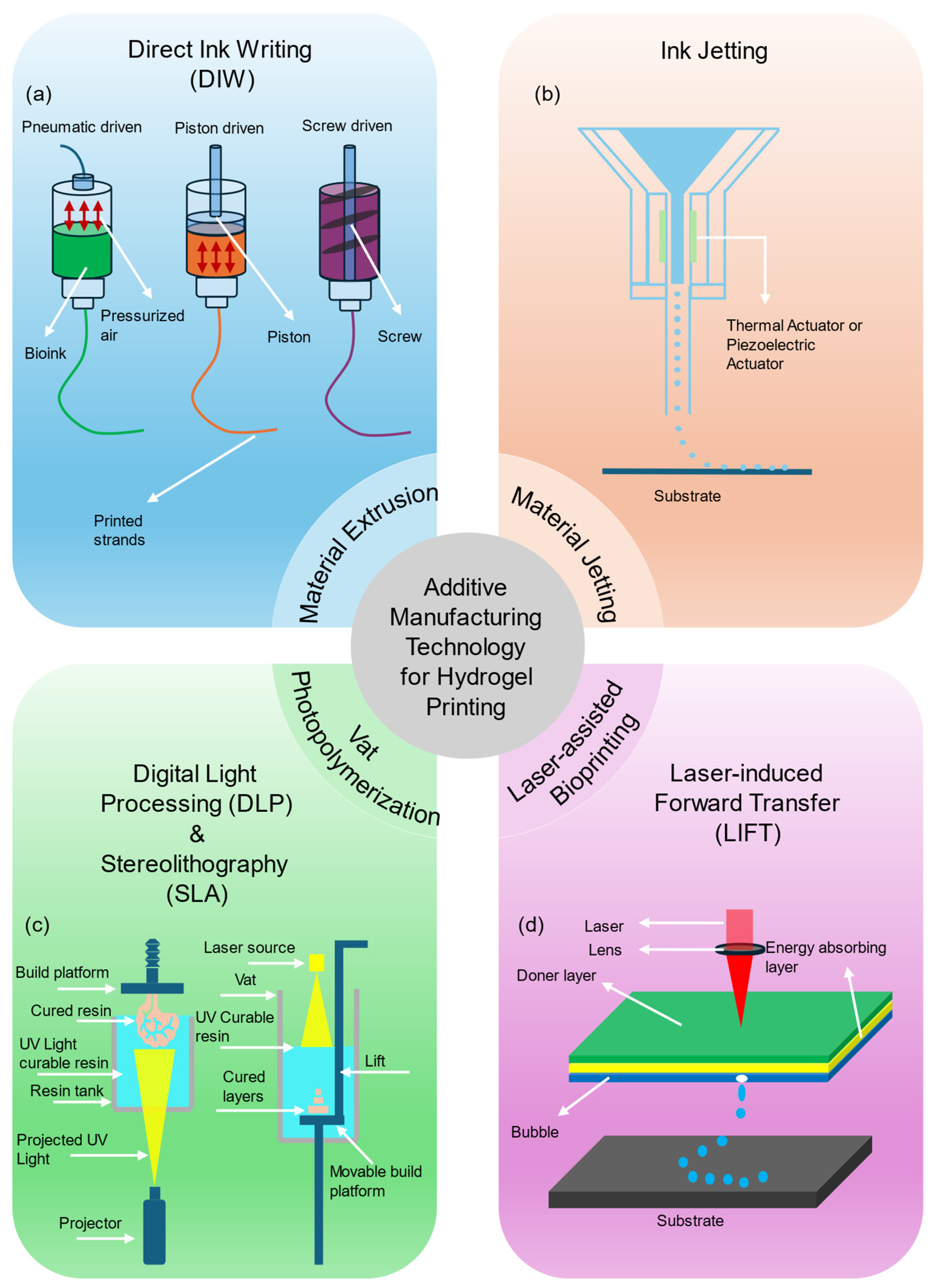
| AM Technology | Printing Types | Printing Parameters |
|---|---|---|
| Material extrusion | Direct ink writing (DIW) [7] | Shear thinning behavior, Viscoelastic modulus, Yield stress [8]; Nozzle diameter, Extrusion pressure, Printing speed [9], Extrusion pressure [10], Crosslinking [11] |
| Material jetting | Ink jetting [12] | Viscosity [13], Surface tension [14], Shear thinning behavior [15], Nozzle diameter [16], Cytocompatibility [17], Crosslinking [18], Driving waveform [19], Ejection frequency [20], Line stability [21] |
| Vat photopolymerization | Digital light processing (DLP) [22] | Photoinitiator type and concentration, Light wavelength [23], Light intensity, Exposure time [24], Pre-polymer type and concentration [25], Additives [26], Cell concentration and type [27], Post-printing processes [28], Layer thickness [29] |
| Stereolithography (SLA) [30] | Photoinitiator type and concentration [31], Laser wavelength, Laser power, Scanning speed [32], Exposure energy [24], Layer thickness [33], Prepolymer concentration, Cell parameters [30] | |
| Laser-assisted bioprinting | Laser-induced forward transfer (LIFT) [34] | Laser wavelength, Fluence [35], Donor film thickness, Viscosity, Surface tension [36], Donor-receiving substrate spacing, Scanning speed and repetition rate [37] |
| Open-Source Package | Model | Dataset Size and Type | Application | Metrics | Ref. |
|---|---|---|---|---|---|
| Scikit learn, XGBoost, Optuna | Gaussian process, random forest | 180 formulations, protein-inspired | Underwater adhesion optimization | Adhesion exceeded 1 MPa | [131] |
| Scikit learn | Interpretable classifier | 180 formulations, rheology indices | Printability from rheology | Thirteen key rheology descriptors | [38] |
| Scikit learn | Multi-model classifiers | 150 printed hydrogels | Rheology to printability mapping | Curated cross-chemistry mapping | [39] |
| Scikit learn | Ensemble classification | 1568 bioprinting assays | Multi-property print quality | Sixteen properties standardized | [132] |
| Scikit learn | Neural network classifier | Literature PNIPAAm set | Swelling state prediction | Reported discrete state accuracy | [101] |
| PyTorch | Multiphysics-informed deep learning | Experimental swelling curves | pH-responsive swelling modeling | Reduced error versus baselines | [77] |
| Scikit learn | Hierarchical model | Suspended bioprinting set | Resolution prediction | Rheology-informed hierarchy improved | [133] |
| Scikit learn | Surrogate Bayesian optimization | Experimental prints, tens of trials | Process parameter optimization | Pareto improvement shown | [98] |
| Scikit learn | Vision-based regression | In situ test patterns | Rheology estimation from prints | Viscosity and yield stress predicted | [108] |
| Open-source hybrid bioprinter | Empirical mapping plus regression | Multiple gel prints reported | Dual material biofabrication | Open hardware enabled datasets | [119] |
| Scikit learn | Decision tree, neural network | Urea gelator library | Supramolecular gelation prediction | Physically motivated descriptors | [134] |
| Scikit learn | Quantitative structure models | Dipeptide gelator set | Gelation propensity classification | First predictive success reported | [135] |
| Scikit learn | Mixed regression models | Ten hydrogels, varied prints | Print width and porosity | Unified integrity metric used | [132] |
| Scikit learn | Random forest, SHAP analysis | 180 formulations, rheology | General printability principles | Cross-chemistry transfer shown | [38] |
| Scikit learn | Regression on imaging features | Hydrogel SEM image set | Modulus prediction from images | Elastic moduli predicted | [132] |
| AI Method Model | Applications | AM Methods | Ref. |
|---|---|---|---|
| Convolutional Neural Network (CNN) | In situ defect detection | Digital Light Processing (DLP), Stereolithography (SLA) | [154] |
| Generative Adversarial Networks (GAN) | Generate new samples that closely approximate the distribution of real data | Digital Light Processing (DLP), Stereolithography (SLA) | [155] |
| Bayesian Optimization (BO) | Rapidly optimize the parameters of extrusion 3D bioprinting (such as temperature, pressure, and speed) | Direct Ink Writing (DIW) | [138] |
| Artificial Neural Network (ANN) | Predicting rheological properties | Digital Light Processing (DLP) | [156] |
| Graph Neural Networks (GNN) | Design ink from the source of molecular structure, unlock a novel material system | Digital Light Processing (DLP) | [157] |
| Supported Vector Machines (SVM) | predicted the gel weight error, surface area error, and topographical heterogeneity | Direct Ink Writing (DIW) | [158] |
| Deep learning (DL) | Rheological properties and composition prediction | Stereolithography (SLA) | [58] |
| Decision Tree (DT), Random Forest (RF), Deep Learning (DL) | Printability prediction for bioinks | Direct Ink Writing (DIW) | [89] |
| Polynomial Fit (PF), Decision Tree (DT), Random Forest (RF) | Rheology and viscosity prediction | Direct Ink Writing (DIW) | [145] |
| Ridge regression (RR), K-nearest neighbor (KNN), Random Forest (RF), Neural Network (NN) | Regression/classification prediction | Stereolithography (SLA) | [159] |
| Random Forest (RF), LASSO, Extreme Gradient Boosting (XGBoost), Support Vector Regression (SVR) | Predicted against actual droplet velocity and volume | Ink Jetting | [160] |
| Random Forest (RF), Artificial Neural Network (ANN), Support Vector Machine (SVM) | To predict printability and drug dose | Ink Jetting | [161] |
Disclaimer/Publisher’s Note: The statements, opinions and data contained in all publications are solely those of the individual author(s) and contributor(s) and not of MDPI and/or the editor(s). MDPI and/or the editor(s) disclaim responsibility for any injury to people or property resulting from any ideas, methods, instructions or products referred to in the content. |
© 2025 by the authors. Licensee MDPI, Basel, Switzerland. This article is an open access article distributed under the terms and conditions of the Creative Commons Attribution (CC BY) license (https://creativecommons.org/licenses/by/4.0/).
Share and Cite
Zhang, Z.; Tao, Z.Z.; Du, R.; Huo, R.; Zheng, X. Artificial Intelligence Informed Hydrogel Biomaterials in Additive Manufacturing. Gels 2025, 11, 981. https://doi.org/10.3390/gels11120981
Zhang Z, Tao ZZ, Du R, Huo R, Zheng X. Artificial Intelligence Informed Hydrogel Biomaterials in Additive Manufacturing. Gels. 2025; 11(12):981. https://doi.org/10.3390/gels11120981
Chicago/Turabian StyleZhang, Zhizhou, Zach Z. Tao, Ruiling Du, Runxin Huo, and Xiangrui Zheng. 2025. "Artificial Intelligence Informed Hydrogel Biomaterials in Additive Manufacturing" Gels 11, no. 12: 981. https://doi.org/10.3390/gels11120981
APA StyleZhang, Z., Tao, Z. Z., Du, R., Huo, R., & Zheng, X. (2025). Artificial Intelligence Informed Hydrogel Biomaterials in Additive Manufacturing. Gels, 11(12), 981. https://doi.org/10.3390/gels11120981