
Estimating Efficacy of Indigenous Isolates of Three Trichoderma Species as Biocontrol Agents Against Alternaria alternata and Curvularia spicifera

 ,
,  ,
,  , and
, and 
Abstract
1. Introduction
2. Materials and Methods
2.1. Fungal Species
2.2. In Vitro Plant-Growth-Promoting Traits and Extracellular Enzymes
2.3. Physiological Properties of the Tested Trichoderma Species
2.4. In Vitro Antagonistic Activity of the Tested Trichoderma Species Against Alternaria alternata and Curvularia spicifera
2.5. Efficacy of Trichoderma Fungal Suspension on Tomato Seedlings Growth
2.6. In Vivo Evaluation of Trichoderma Fungal Suspension Biocontrol Effect on Tomato Fruits Inoculated with Alternaria alternata and Curvularia spicifera
2.7. Statistical Analysis
3. Results
3.1. Plant-Growth-Promoting and Extracellular Enzymes Produced by the Trichoderma Species
3.2. Temperature and pH Conditions Modulate Trichoderma Species Mycelial Growth
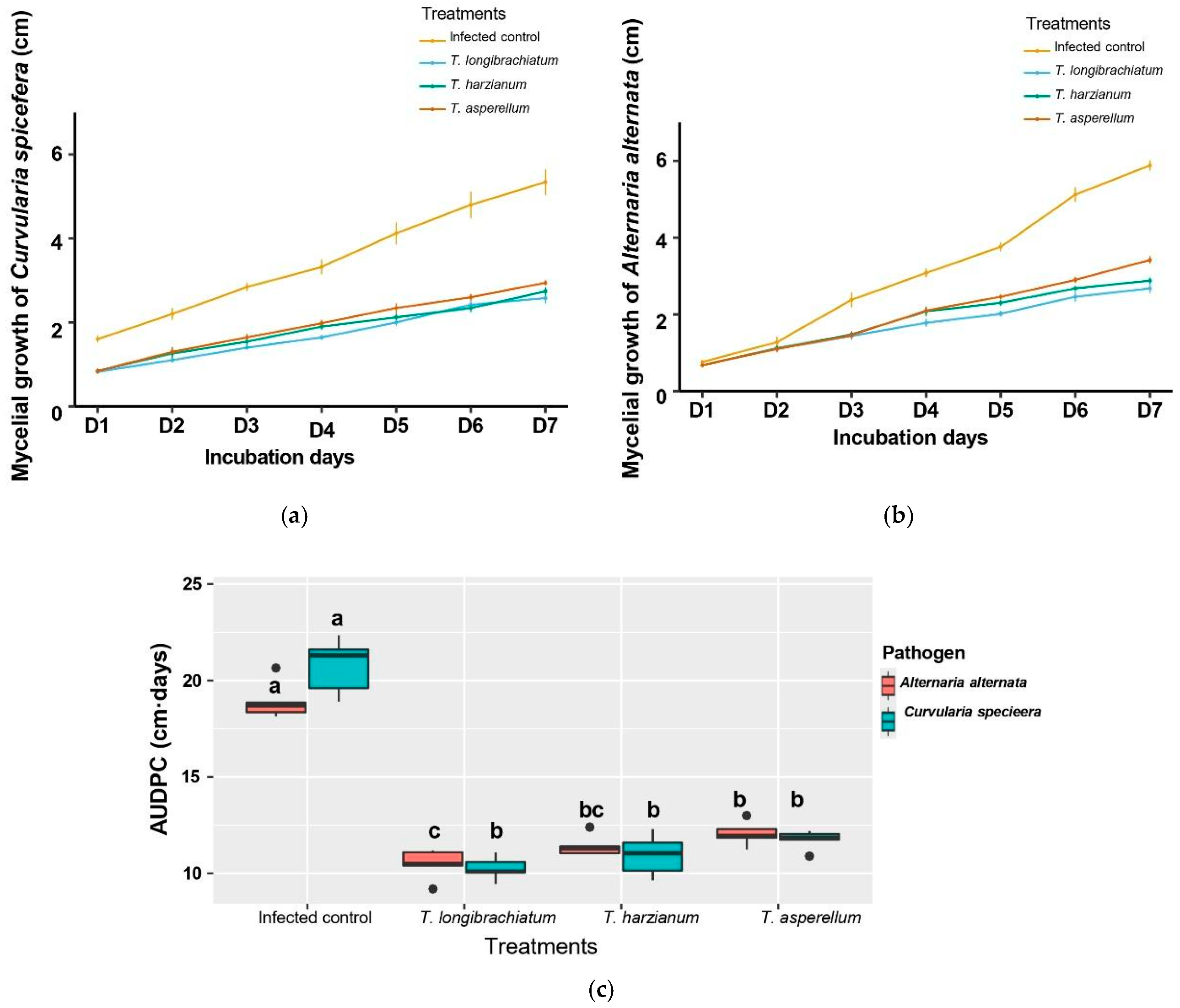
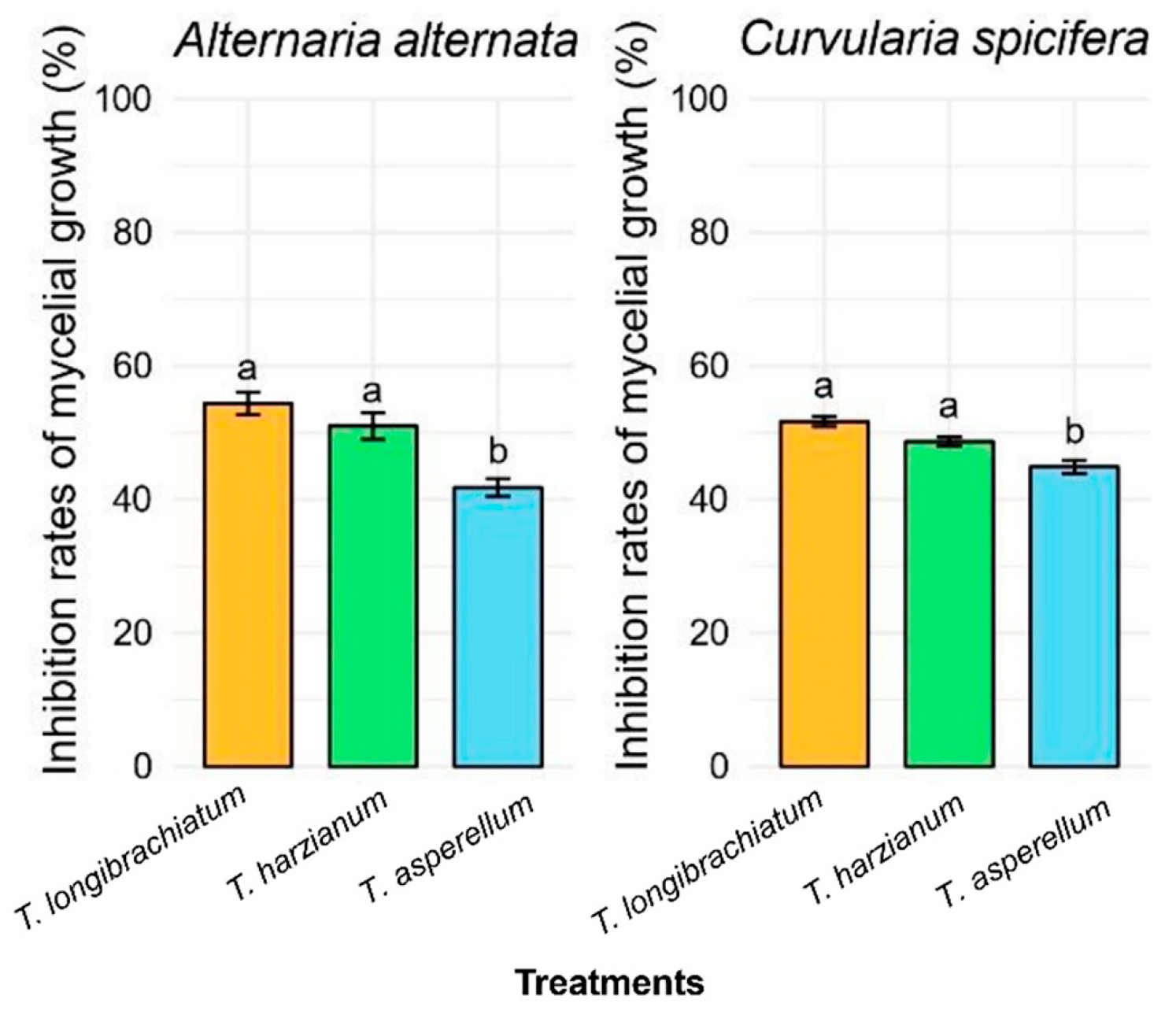
3.3. Mycelial Growth Inhibition of Trichoderma Species Against Alternaria alternata and Curvularia spicifera
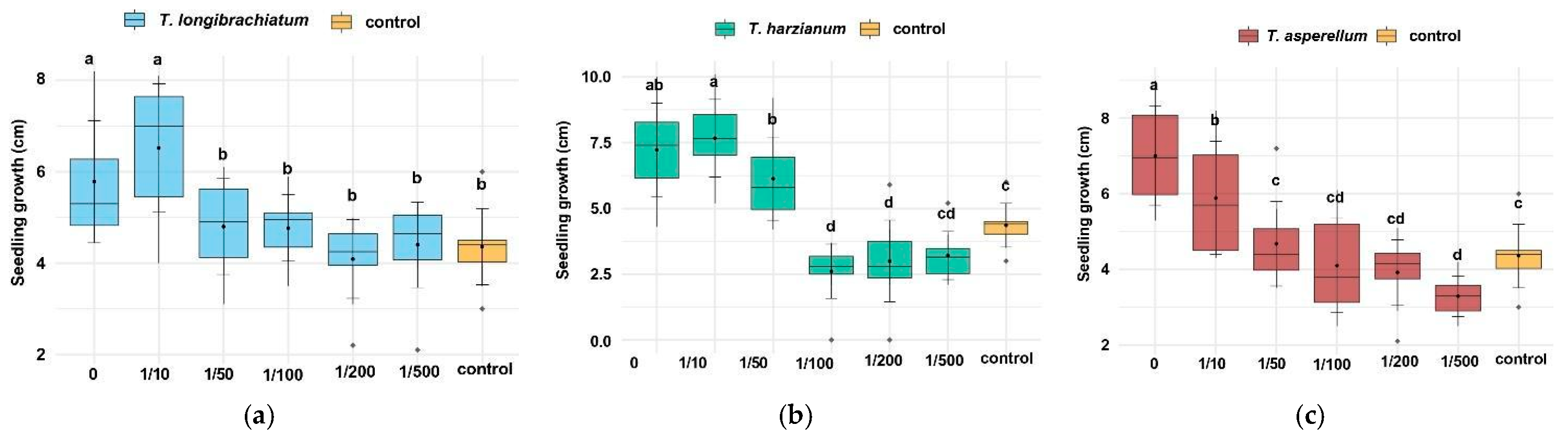
3.4. Trichoderma Species Culture Filtrates Stimulate Tomato Seedling Growth in a Dose-Dependent Manner
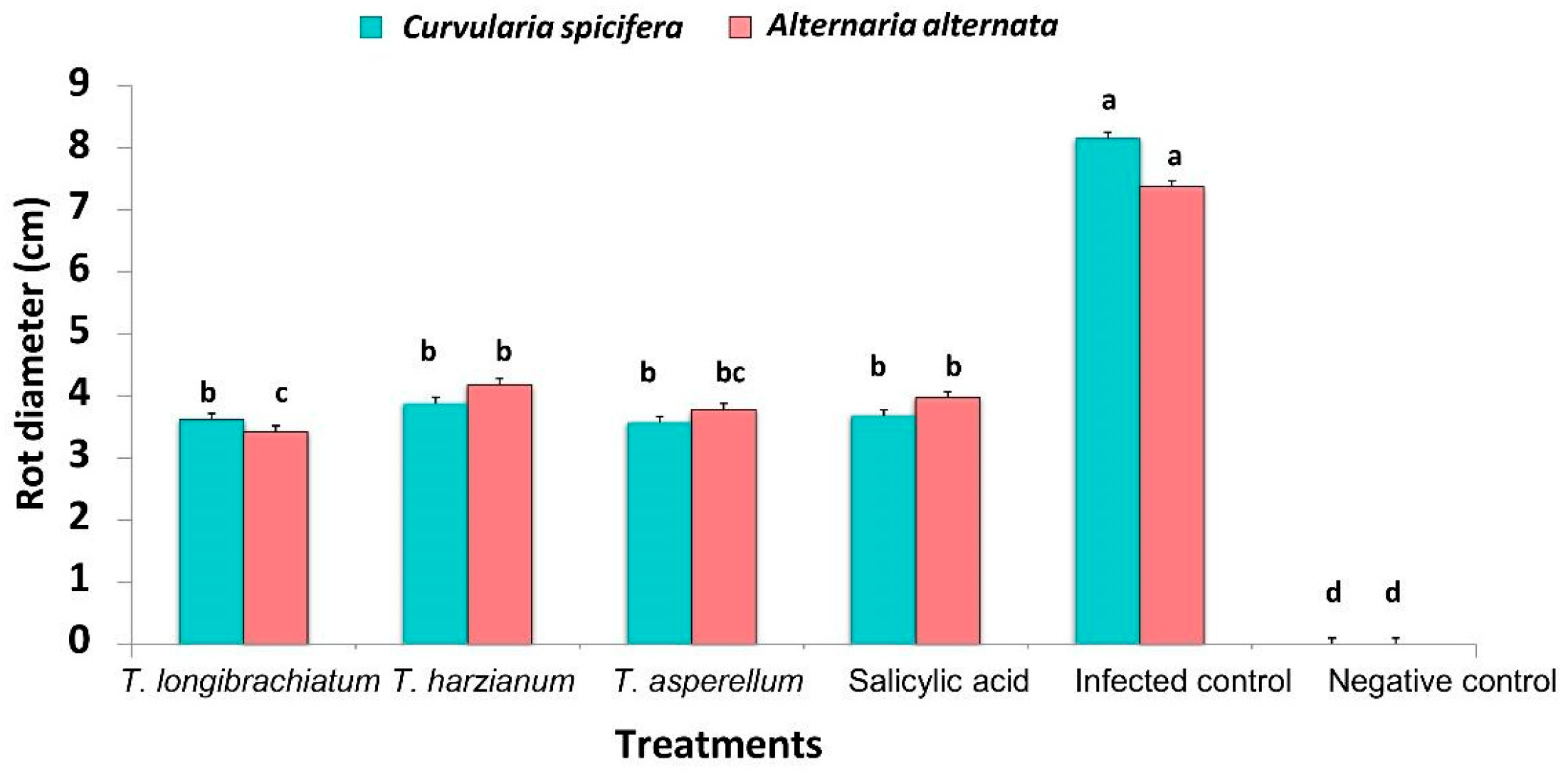
3.5. Biocontrol Potential of the Studied Trichoderma Species Against Alternaria alternata and Curvularia spicifera in Tomato Fruits
4. Discussion
5. Conclusions
Supplementary Materials
Author Contributions
Funding
Data Availability Statement
Acknowledgments
Conflicts of Interest
References
- Kumar, M.; Chandran, D.; Tomar, M.; Bhuyan, D.J.; Grasso, S.; Sá, A.G.A.; Carciofi, B.A.M.; Radha; Dhumal, S.; Singh, S.; et al. Valorization potential of tomato (Solanum lycopersicum L.) seed: Nutraceutical quality; food properties; safety aspects; and application as a health-promoting ingredient in foods. Horticulturae 2022, 8, 265. [Google Scholar] [CrossRef]
- Food and Agriculture Organization of the United Nations. FAOSTAT Database. Available online: https://www.fao.org/faostat/en/#home (accessed on 16 March 2026).
- Pacini, T.; D’Amore, T.; Sdogati, S.; Verdini, E.; Bibi, R.; Caporali, A.; Cristofani, E.; Maresca, C.; Orsini, S.; Pelliccia, A.; et al. Assessment of Alternaria toxins and pesticides in organic and conventional tomato products: Insights into contamination patterns and food safety implications. Toxins 2025, 17, 12. [Google Scholar] [CrossRef] [PubMed]
- Alsudani, A.A. The most important diseases caused by fungi in tomato seeds: A review. GSC Adv. Res. Rev. 2025, 22, 20–30. [Google Scholar] [CrossRef]
- Al-Saif, A.M.; Ahmed, M.E.M.; Taha, M.A.; Sharma, A.; El-Sheshtawy, A.-N.A.; Abouelsaad, I.A.; El-Serafy, R.S.; Mahdy, R.M. Preharvest Applications Improve the Postharvest Storage and Quality of Tomato Fruits by Enhancing the Nutritional Value and Antioxidant System. Horticulturae 2024, 10, 1248. [Google Scholar] [CrossRef]
- López-López, M.E.; Del-Toro-Sánchez, C.L.; Gutiérrez-Lomelí, M.; Ochoa-Ascencio, S.; Aguilar-López, J.A.; Robles-García, M.A.; Plascencia-Jatomea, M.; Bernal-Mercado, A.T.; Martínez-Cruz, O.; Ávila-Novoa, M.G. Isolation and characterization of Trichoderma spp. for antagonistic activity against avocado (Persea americana Mill) fruit pathogens. Horticulturae 2022, 8, 714. [Google Scholar] [CrossRef]
- Islam, T.; Danishuddin, N.T.; Matin, M.N.; Barai, H.R.; Haque, M.A. Resistance mechanisms of plant pathogenic fungi to fungicide; Environmental impacts of fungicides; and sustainable solutions. Plants 2024, 13, 2737. [Google Scholar] [CrossRef]
- Becker, E.; Rajakulendran, N.; Shamoun, S.F. Biocontrol potential of Trichoderma spp. against Phytophthora ramorum. Pathogens 2025, 14, 136. [Google Scholar] [CrossRef]
- Awad-Allah, E.F.A.; Shams, A.H.M.; Helaly, A.A.; Ragheb, E.I.M. Effective applications of Trichoderma spp. as biofertilizers and biocontrol agents mitigate tomato Fusarium wilt disease. Agriculture 2022, 12, 1950. [Google Scholar] [CrossRef]
- Hajji-Hedfi, L.; Rhouma, A.; Hajlaoui, H.; Hajlaoui, F.; Rebouh, N.Y. Understanding the influence of applying two culture filtrates to control gray mold disease (Botrytis cinerea) in tomato. Agronomy 2023, 13, 1774. [Google Scholar] [CrossRef]
- Aamir, M.; Shanmugam, V.; Dubey, M.K.; Thakur, N.; Thakur, N.; Maurya, D.K.; Patil, S.; Baghel, S.; Thakur, S.; Tripathi, A.; et al. Transcriptomic characterization of Trichoderma harzianum T34 primed tomato plants: Assessment of biocontrol agent induced host specific gene expression and plant growth promotion. BMC Plant Biol. 2023, 23, 552. [Google Scholar] [CrossRef]
- Kubiak, A.; Wolna-Maruwka, A.; Pilarska, A.A.; Niewiadomska, A.; Piotrowska-Cyplik, A. Fungi of the Trichoderma Genus: Future Perspectives of Benefits in Sustainable Agriculture. Appl. Sci. 2023, 13, 6434. [Google Scholar] [CrossRef]
- Baninaiem, E.; Dastjerdi, A.M. Enhancement of storage life and maintenance of quality in tomato fruits by preharvest salicylic acid treatment. Front. Sustain. Food Syst. 2023, 7, 1180243. [Google Scholar] [CrossRef]
- Khairy, A.; Elattaapy, A.M.; Yousef, S.A.; Hamada, M.S.; Amin, B.H.; Elsherbiny, E.A. Effective biocontrol of Botrytis cinerea by antifungal metabolites of Trichoderma reesei T1 for gray mold in postharvest tomato. Int. J. Food Microbiol. 2025, 436, 111203. [Google Scholar] [CrossRef]
- Chóez-Guaranda, I.; Espinoza-Lozano, F.; Reyes-Araujo, D.; Romero, C.; Manzano, P.; Galarza, L.; Sosa, D. Chemical Characterization of Trichoderma spp. Extracts with Antifungal Activity against Cocoa Pathogens. Molecules 2023, 28, 3208. [Google Scholar] [CrossRef]
- Ávila-Oviedo, J.L.; Chávez-Avilés, M.N. Ecological versatility and biocontrol mechanisms of Trichoderma spp.: Toward sustainable agriculture. Discov. Appl. Sci. 2026, 8, 230. [Google Scholar] [CrossRef]
- Hajji-Hedfi, L.; Hlaoua, W.; Al-Judaibi, A.A.; Rhouma, A.; Horrigue-Raouani, N.; Abdel-Azeem, A.M. Comparative effectiveness of filamentous fungi in biocontrol of Meloidogyne javanica and activated defense mechanisms on tomato. J. Fungi 2023, 9, 37. [Google Scholar] [CrossRef]
- Hajji-Hedfi, L.; Wannassi, T.; Khlif, A.; Kavhiza, N.J.; Rebouh, N.Y. Investigating the biocontrol and plant growth-promoting potential of Pseudomonas yamanorum for sustainable management of tomato early blight (Alternaria alternata). Plants 2025, 14, 3117. [Google Scholar] [CrossRef]
- Hajji-Hedfi, L.; Rhouma, A.; Wannassi, T.; Utkina, A.O.; Rebouh, N.Y. Biocontrol assessment of Trichoderma species on tomato crops infested by Curvularia spicifera: Toward sustainable farming systems. Front. Sustain. Food Syst. 2025, 9, 1627903. [Google Scholar] [CrossRef]
- Milagres, A.M.F.; Machuca, A.; Napoleão, D. Detection of siderophore production from several fungi and bacteria by a modification of Chrome Azurol S (CAS) agar plate assay. J. Microbiol. Methods 1999, 37, 1–6. [Google Scholar] [CrossRef]
- Bhattacharyya, C.; Banerjee, S.; Acharya, U.; Mitra, A.; Mallick, I.; Haldar, A.; Haldar, S.; Ghosh, A.; Ghosh, A. Evaluation of plant growth promotion properties and induction of antioxidative defense mechanism by tea rhizobacteria of Darjeeling, India. Sci. Rep. 2020, 10, 15536. [Google Scholar] [CrossRef]
- El-Mageed, T.A.A.; El-Mageed, S.A.A.; El-Saadony, M.T.; Abdelaziz, S.; Abdou, N.M. Plant growth-promoting rhizobacteria improve growth; morph-physiological responses; water productivity; and yield of rice plants under full and deficit drip irrigation. Rice 2022, 15, 16. [Google Scholar] [CrossRef]
- Namasivayam, E.; Mariappan, K.; Jiji, A.; Kumar, M.; Richard, L. Production of extracellular pectinase by Bacillus cereus isolated from market solid waste. J. Bioanal. Biomed. 2011, 3, 3. [Google Scholar] [CrossRef]
- Naik, P.R.; Raman, G.; Narayanan, K.B.; Sakthivel, N. Assessment of genetic and functional diversity of phosphate solubilizing fluorescent pseudomonads isolated from rhizospheric soil. BMC Microbiol. 2008, 8, 230. [Google Scholar] [CrossRef] [PubMed]
- Yassin, M.T.; Mostafa, A.A.F.; Al-Askar, A.A.; Sayed, S.R.; Rady, A.M. Antagonistic activity of Trichoderma harzianum and Trichoderma viride strains against some fusarial pathogens causing stalk rot disease of maize, in vitro. J. King Saud Univ.-Sci. 2021, 33, 101363. [Google Scholar] [CrossRef]
- Simko, I.; Piepho, H.P. The area under the disease progress stairs: Calculation; advantage; and application. Phytopathology 2012, 102, 381–389. [Google Scholar] [CrossRef]
- Wang, J.; Mu, H.; Liu, S.; Qi, S.; Mou, S. Effects of Trichoderma harzianum on growth and rhizosphere microbial community of continuous cropping Lagenaria siceraria. Microorganisms 2024, 12, 1987. [Google Scholar] [CrossRef]
- Halifu, S.; Deng, X.; Song, X.; Song, R. Effects of two Trichoderma strains on plant growth; rhizosphere soil nutrients; and fungal community of Pinus sylvestris var. mongolica annual seedlings. Forests 2019, 10, 758. [Google Scholar] [CrossRef]
- Jahn, L.; Hofmann, U.; Ludwig-Müller, J. Indole-3-acetic acid is synthesized by the endophyte Cyanodermella asteris via a tryptophan-dependent and -independent way and mediates the interaction with a non-host plant. Int. J. Mol. Sci. 2021, 22, 2651. [Google Scholar] [CrossRef]
- Natsiopoulos, D.; Tziolias, A.; Lagogiannis, I.; Mantzoukas, S.; Eliopoulos, P.A. Growth-promoting and protective effect of Trichoderma atrobrunneum and T. simmonsii on tomato against soil-borne fungal pathogens. Crops 2022, 2, 202–217. [Google Scholar] [CrossRef]
- Sood, M.; Kapoor, D.; Kumar, V.; Sheteiwy, M.S.; Ramakrishnan, M.; Landi, M.; Araniti, F.; Sharma, A. Trichoderma: The “secrets” of a multitalented biocontrol agent. Plants 2020, 9, 762. [Google Scholar] [CrossRef]
- Hamann, P.R.V.; Reis, M.C.C.; Noronha, E.F. Production of Pectin Degrading Enzymes by Trichoderma harzianum TR274: Biochemical Properties, Pectin Hydrolysis, and Impact of Lignocellulose-Derived Phenolics. Waste Biomass Valor. 2026. [Google Scholar] [CrossRef]
- Go, W.Z.; Chin, K.L.; H’ng, P.S.; Wong, M.Y.; Lee, C.L.; Khoo, P.S. Exploring the biocontrol efficacy of Trichoderma spp. against Rigidoporus microporus; the causal agent of white root rot disease in rubber trees (Hevea brasiliensis). Plants 2023, 12, 1066. [Google Scholar] [CrossRef]
- Saravanakumar, K.; Park, S.; Sathiyaseelan, A.; Mariadoss, A.V.A.; Park, S.; Kim, S.-J.; Wang, M.H. Isolation of polysaccharides from Trichoderma harzianum with antioxidant; anticancer; and enzyme inhibition properties. Antioxidants 2021, 10, 1372. [Google Scholar] [CrossRef]
- Carro-Huerga, G.; Mayo-Prieto, S.; Rodríguez-González, Á.; Álvarez-García, S.; Gutiérrez, S.; Casquero, P.A. The influence of temperature on the growth; sporulation; colonization; and survival of Trichoderma spp. in grapevine pruning wounds. Agronomy 2021, 11, 1771. [Google Scholar] [CrossRef]
- Tyśkiewicz, R.; Nowak, A.; Ozimek, E.; Jaroszuk-Ściseł, J. Trichoderma: The current status of its application in agriculture for the biocontrol of fungal phytopathogens and stimulation of plant growth. Int. J. Mol. Sci. 2022, 23, 2329. [Google Scholar] [CrossRef]
- Hewedy, O.A.; Abdel Lateif, K.S.; Seleiman, M.F.; Shami, A.; Albarakaty, F.M.; El-Meihy, R.M. Phylogenetic diversity of Trichoderma strains and their antagonistic potential against soil-borne pathogens under stress conditions. Biology 2020, 9, 189. [Google Scholar] [CrossRef]
- Rimkus, A.; Namina, A.; Dzierkale, M.T.; Grigs, O.; Senkovs, M.; Larsson, S. Impact of growth conditions on the viability of Trichoderma asperellum during storage. Microorganisms 2023, 11, 1084. [Google Scholar] [CrossRef]
- Cabral-Miramontes, J.P.; Olmedo-Monfil, V.; Lara-Banda, M.; Zúñiga-Romo, E.R.; Aréchiga-Carvajal, E.T. Promotion of plant growth in arid zones by selected Trichoderma spp. strains with adaptation plasticity to alkaline pH. Biology 2022, 11, 1206. [Google Scholar] [CrossRef] [PubMed]
- Heflish, A.A.; Abdelkhalek, A.; Al-Askar, A.A.; Behiry, S.I. Protective and curative effects of Trichoderma asperelloides Ta41 on tomato root rot caused by Rhizoctonia solani Rs33. Agronomy 2021, 11, 1162. [Google Scholar] [CrossRef]
- Almaghasla, M.I.; El-Ganainy, S.M.; Ismail, A.M. Biological activity of four Trichoderma species confers protection against Rhizoctonia solani; the causal agent of cucumber damping-off and root rot diseases. Sustainability 2023, 15, 7250. [Google Scholar] [CrossRef]
- Pacheco-Trejo, J.; Aquino-Torres, E.; Reyes-Santamaría, M.I.; Islas-Pelcastre, M.; Pérez-Ríos, S.R.; Madariaga-Navarrete, A.; Saucedo-García, M. Plant defensive responses triggered by Trichoderma spp. as tools to face stressful conditions. Horticulturae 2022, 8, 1181. [Google Scholar] [CrossRef]
- Abbas, A.; Mubeen, M.; Zheng, H.; Sohail, M.A.; Shakeel, Q.; Solanki, M.K.; Iftikhar, Y.; Sharma, S.; Kashyap, B.K.; Hussain, S.; et al. Trichoderma spp. genes involved in the biocontrol activity against Rhizoctonia alternata. Front. Microbiol. 2022, 13, 884469. [Google Scholar] [CrossRef]
- Correa-Delgado, R.; Brito-López, P.; Cardoza, R.E.; Jaizme Vega, M.C.; Laich, F.; Gutiérrez, S. Biocontrol potential of a native Trichoderma collection against Fusarium oxysporum f. sp. cubense subtropical race 4. Agriculture 2024, 14, 2016. [Google Scholar] [CrossRef]
- Benigno, A.; Aglietti, C.; Cacciola, S.O.; Moricca, S. Trunk injection delivery of biocontrol strains of Trichoderma spp. effectively suppresses nut rot by Gnomoniopsis castaneae in chestnut (Castanea sativa Mill.). Biology 2024, 13, 143. [Google Scholar] [CrossRef]
- Gutiérrez-Moreno, K.; Ruocco, M.; Monti, M.M.; Vega, O.M.d.l.; Heil, M. Context-dependent effects of Trichoderma seed inoculation on anthracnose disease and seed yield of bean (Phaseolus vulgaris): Ambient conditions override cultivar-specific differences. Plants 2021, 10, 1739. [Google Scholar] [CrossRef]
- Al-Shuaibi, B.K.; Kazerooni, E.A.; Al-Maqbali, D.; Al-Kharousi, M.; Al-Yahya’ei, M.N.; Hussain, S.; Velazhahan, R.; Al-Sadi, A.M. Biocontrol potential of Trichoderma ghanense and Trichoderma citrinoviride toward Pythium aphanidermatum. J. Fungi 2024, 10, 284. [Google Scholar] [CrossRef]
- Panchalingam, H.; Powell, D.; Adra, C.; Foster, K.; Tomlin, R.; Quigley, B.L.; Nyari, S.; Hayes, R.A.; Shapcott, A.; Kurtböke, D.İ. Assessing the various antagonistic mechanisms of Trichoderma strains against the brown root rot pathogen Pyrrhoderma noxium infecting heritage fig trees. J. Fungi 2022, 8, 1105. [Google Scholar] [CrossRef] [PubMed]



| Trichoderma Species | Cat | Pec | Pro | Amy | Glu | IAA | HCN | N | P |
|---|---|---|---|---|---|---|---|---|---|
| T. longibrachiatum | + | − | − | − | − | + | + | − | + |
| T. harzianum | + | − | − | − | − | − | + | − | + |
| T. asperellum | + | − | − | − | − | + | + | − | + |
| Treatments | Temperature (°C) | D1 | D2 | D3 | D4 | D5 | D6 | D7 |
|---|---|---|---|---|---|---|---|---|
| T. longibrachiatum | 19 | 0.07 ± 0.11 b | 0.4 ± 0.36 b | 2 ± 0.26 b | 2.17 ± 0.30 b | 2.53 ± 0.55 b | 2.9 ± 0.81 b | 3 ± 0.79 b |
| 30 | 1.7 ± 0.4 a | 1.93 ± 0.23 a | 2.77 ± 0.50 a | 4.77 ± 0.64 a | 6.33 ± 0.47 a | 7.43 ± 0.41 a | 7.63 ± 0.41 a | |
| 45 | 0 ± 0 b | 0 ± 0 b | 0.67 ± 0.15 c | 1.4 ± 0.50 b | 1.9 ± 0.09 b | 2.47 ± 0.15 b | 2.6 ± 0.1 b | |
| p-value | <0.01 | <0.01 | <0.01 | <0.01 | <0.01 | <0.01 | <0.01 | |
| T. harzianum | 19 | 0.17 ± 0.15 b | 1.03 ± 0.11 b | 2.57 ± 0.49 ab | 3.17 ± 0.05 b | 4.03 ± 0.28 b | 5.47 ± 0.49 b | 5.6 ± 0.51 b |
| 30 | 2.7 ± 0.19 a | 2.93 ± 0.25 a | 3.07 ± 0.20 a | 4.43 ± 0.72 a | 5.4 ± 0.62 a | 6.8 ± 0.26 a | 7.27 ± 0.37 a | |
| 45 | 0 ± 0 b | 0 ± 0 c | 2.13 ± 0.25 b | 2.47 ± 0.20 b | 2.97 ± 0.41 c | 3.27 ± 0.66 c | 3.37 ± 0.75 c | |
| p-value | <0.01 | <0.01 | <0.05 | <0.01 | <0.01 | <0.01 | <0.01 | |
| T. asperellum | 19 | 0.63 ± 0.11 b | 1.03 ± 0.15 b | 3.43 ± 0.11 a | 4 ± 0.17 a | 4.33 ± 0.32 b | 4.9 ± 0.43 ab | 5.13 ± 0.47 b |
| 30 | 2.6 ± 0.34 a | 3 ± 0.17 a | 3.27 ± 0.32 a | 4.23 ± 0.51 a | 5.67 ± 0.45 a | 6.3 ± 0.40 a | 6.63 ± 0.25 a | |
| 45 | 0.1 ± 0.01 c | 0.13 ± 0.05 c | 0.23 ± 0.11 b | 2.03 ± 0.15 b | 3.1 ± 0.60 c | 4.03 ± 0.96 b | 4.17 ± 0.80 b | |
| p-value | <0.01 | <0.01 | <0.01 | <0.01 | <0.01 | <0.05 | <0.01 | |
| Treatments | pH | D1 | D2 | D3 | D4 | D5 | D6 | D7 |
|---|---|---|---|---|---|---|---|---|
| T. longibrachiatum | 5 | 1.23 ± 0.15 a | 1.53 ± 0.05 a | 1.97 ± 0.11 a | 2.47 ± 0.30 a | 2.93 ± 0.37 a | 4.4 ± 0.7 a | 4.63 ± 0.51 a |
| 7 | 0.83 ± 0.30 ab | 1.17 ± 0.20 ab | 1.53 ± 0.05 ab | 2.13 ± 0.25 a | 4.2 ± 1.30 a | 5.13 ± 0.96 a | 5.77 ± 0.30 a | |
| 9 | 0.47 ± 0.05 bc | 0.73 ± 0.15 bc | 1 ± 0.26 bc | 2.9 ± 1.32 a | 4.73 ± 2.46 a | 8.63 ± 1.30 a | 8.7 ± 2.30 a | |
| 11 | 0.13 ± 0.11 c | 0.33 ± 0.28 c | 0.47 ± 0.40 c | 1.83 ± 0.61 a | 3.37 ± 0.66 a | 4.93 ± 0.37 a | 5.13 ± 0.20 a | |
| p-value | <0.01 | <0.01 | <0.01 | >0.05 | >0.05 | >0.05 | >0.05 | |
| T. harzianum | 5 | 2.77 ± 0.40 a | 3.03 ± 0.41 a | 3.60 ± 0.36 a | 3.87 ± 0.20 a | 4.57 ± 0.50 a | 5.3 ± 0.09 a | 5.37 ± 0.11 a |
| 7 | 1.33 ± 0.11 b | 1.63 ± 0.20 b | 1.93 ± 0.23 b | 2.63 ± 0.41 a | 3.87 ± 0.35 a | 5.6 ± 0.26 a | 5.97 ± 0.15 a | |
| 9 | 0.53 ± 0.32 c | 0.77 ± 0.30 c | 1.17 ± 0.31 bc | 3.63 ± 1.05 a | 5.17 ± 1.92 a | 6.77 ± 1.77 a | 7.1 ± 1.74 a | |
| 11 | 0.07 ± 0.11 c | 0.23 ± 0.25 c | 0.47 ± 0.45 c | 0.93 ± 0.95 b | 2.50 ± 0.52 a | 4.13 ± 0.30 a | 4.30 ± 0.26 a | |
| p-value | <0.01 | <0.01 | <0.01 | <0.01 | >0.05 | >0.05 | >0.05 | |
| T. asperellum | 5 | 1.90 ± 0.36 a | 2.13 ± 0.25 a | 2.67 ± 0.28 a | 3 ± 0.26 bc | 3.73 ± 0.32 b | 4.83 ± 0.15 b | 5.17 ± 0.11 b |
| 7 | 2.97 ± 0.46 a | 3.2 ± 0.43 a | 3.6 ± 0.36 a | 5.33 ± 1.56 a | 6.87 ± 1.71 a | 8.47 ± 3.19 ab | 8.67 ± 2.99 ab | |
| 9 | 2.43 ± 0.68 a | 2.63 ± 0.61 a | 3.03 ± 0.41 a | 4.53 ± 0.55 ab | 7.33 ± 1.53 a | 12.2 ± 1.64 a | 12.27 ± 1.61 a | |
| 11 | 0.37 ± 0.35 b | 0.50 ± 0.45 b | 0.73 ± 0.60 b | 1.30 ± 0.62 c | 3.07 ± 1.09 b | 4.30 ± 0.60 b | 4.43 ± 0.49 b | |
| p-value | <0.01 | <0.01 | <0.01 | <0.01 | <0.01 | <0.01 | <0.01 | |
| Treatments | pH | Electrical Conductivity (mS/cm) | Sugar Content (°Brix) | Titratable Acidity (g/10 mL) | Nitrate Content (µg/mL) | Firmness |
|---|---|---|---|---|---|---|
| Alternaria alternata | ||||||
| T. longibrachiatum | 4.24 ± 0.07 bcd | 4.43 ± 0.02 d | 6.47 ± 0.15 b | 7 ± 0.5 c | 1633.33 ± 2.08 d | 2.43 ± 0.31 bc |
| T. harzianum | 4.1 ± 0.01 cd | 4.35 ± 0.19 d | 6.47 ± 0.06 b | 8.1 ± 0.3 a | 2466.67 ± 1.15 b | 2.07 ± 0.72 c |
| T. asperellum | 4.5 ± 0.04 abc | 6.17 ± 0.04 a | 4.57 ± 0.31 d | 3.97 ± 0.15 f | 2866.67 ± 1.16 a | 2.87 ± 0.25 ab |
| Salicylic acid | 4.64 ± 0.26 ab | 5.95 ± 0.07 b | 5.83 ± 0.12 c | 5.33 ± 0.06 d | 1500 ± 1 d | 3.13 ± 0.25 ab |
| C+ | 4.71 ± 0.48 a | 1.4 ± 0.11 e | 6.53 ± 0.06 b | 4.7 ± 0.20 e | 690 ± 0.2 e | 0.5 ± 0.17 d |
| C− | 4.06 ± 0.03 d | 5.48 ± 0.10 c | 7.5 ± 0.10 a | 7.53 ± 0.25 b | 1966.7 ± 0.6 c | 3.43 ± 0.47 a |
| p-value | <0.05 | <0.01 | <0.01 | <0.01 | <0.01 | <0.01 |
| Curvularia spicifera | ||||||
| T. longibrachiatum | 4.4 ± 0.11 a | 6.49 ± 0.04 a | 4.63 ± 0.15 d | 5.63 ± 0.25 c | 2400 ± 1 a | 2.67 ± 0.25 b |
| T. harzianum | 4.17 ± 0.02 b | 6.19 ± 0.24 b | 6.7 ± 0.09 b | 5.2 ± 0.19 d | 2466.67 ± 1.1 a | 1.43 ± 0.15 c |
| T. asperellum | 4.24 ± 0.06 b | 2.35 ± 0.20 d | 6.4 ± 0.17 c | 4.67 ± 0.21 e | 2333.33 ± 2.08 a | 2.47 ± 0.15 b |
| Salicylic acid | 4.16 ± 0.02 b | 1.25 ± 0.02 e | 6.3 ± 0.10 c | 6.67 ± 0.21 b | 2266.67 ± 1.15 ab | 1.1 ± 0.20 c |
| C+ | 4.02 ± 0.03 c | 1.03 ± 0.02 e | 6.47 ± 0.06 c | 4.37 ± 0.15 e | 2266.67 ± 2.89 ab | 0.53 ± 0.47 d |
| C− | 4.06 ± 0.04 c | 5.48 ± 0.1 c | 7.5 ± 0.10 a | 7.53 ± 0.25 a | 1966.67 ± 0.58 b | 3.43 ± 0.47 a |
| p-value | <0.01 | <0.01 | <0.01 | <0.01 | <0.05 | <0.01 |
| Treatments | Malondialdehyde (µmol/g) | Total Protein Content (mg/g) | Total Phenolic Content (µg/g) |
|---|---|---|---|
| Alternaria alternata | |||
| T. longibrachiatum | 2.22 ± 0.007 b | 26.2 ± 0.01 a | 1.11 ± 0.02 a |
| T. harzianum | 2.46 ± 0.008 a | 19.22 ± 0.01 a | 0.84 ± 0.06 bc |
| T. asperellum | 1.38 ± 0.005 d | 21.32 ± 0.004 a | 0.68 ± 0.01 c |
| Salicylic acid | 2.12 ± 0.006 bc | 22.87 ± 0.02 a | 0.71 ± 0.007 c |
| Infected control | 2.13 ± 0.003 bc | 17.21 ± 0.004 a | 0.39 ± 0.006 d |
| Negative control | 2.04 ± 0.02 c | 14.88 ± 0.05 a | 1.04 ± 0.01 ab |
| p-value | <0.01 | ≥0.05 | <0.01 |
| Curvularia spicifera | |||
| T. longibrachiatum | 1.86 ± 0.01 d | 19.46 ± 0.02 b | 0.91 ± 0.009 b |
| T. harzianum | 2.73 ± 0.006 b | 12.71 ± 0.007 b | 0.7 ± 0.003 c |
| T. asperellum | 2.32 ± 0.006 c | 31.24 ± 0.02 ab | 0.78 ± 0.01 c |
| Salicylic acid | 2.11 ± 0.007 cd | 50.85 ± 0.1 a | 0.74 ± 0.003 c |
| Infected control | 3.32 ± 0.004 a | 15.5 ± 0.02 b | 0.59 ± 0.01 d |
| Negative control | 2.04 ± 0.02 cd | 14.88 ± 0.05 b | 1.04 ± 0.01 a |
| p-value | <0.01 | <0.01 | <0.01 |
Disclaimer/Publisher’s Note: The statements, opinions and data contained in all publications are solely those of the individual author(s) and contributor(s) and not of MDPI and/or the editor(s). MDPI and/or the editor(s) disclaim responsibility for any injury to people or property resulting from any ideas, methods, instructions or products referred to in the content. |
© 2026 by the authors. Licensee MDPI, Basel, Switzerland. This article is an open access article distributed under the terms and conditions of the Creative Commons Attribution (CC BY) license.
Share and Cite
Hajji-Hedfi, L.; Al-Ani, L.K.T.; Wannassi, T.; Khlif, A.; L’taief, B.; Acheampong, M.A. Estimating Efficacy of Indigenous Isolates of Three Trichoderma Species as Biocontrol Agents Against Alternaria alternata and Curvularia spicifera. J. Fungi 2026, 12, 421. https://doi.org/10.3390/jof12060421
Hajji-Hedfi L, Al-Ani LKT, Wannassi T, Khlif A, L’taief B, Acheampong MA. Estimating Efficacy of Indigenous Isolates of Three Trichoderma Species as Biocontrol Agents Against Alternaria alternata and Curvularia spicifera. Journal of Fungi. 2026; 12(6):421. https://doi.org/10.3390/jof12060421
Chicago/Turabian StyleHajji-Hedfi, Lobna, Laith Khalil Tawfeeq Al-Ani, Takwa Wannassi, Amira Khlif, Boulbaba L’taief, and Mavis Agyeiwaa Acheampong. 2026. "Estimating Efficacy of Indigenous Isolates of Three Trichoderma Species as Biocontrol Agents Against Alternaria alternata and Curvularia spicifera" Journal of Fungi 12, no. 6: 421. https://doi.org/10.3390/jof12060421
APA StyleHajji-Hedfi, L., Al-Ani, L. K. T., Wannassi, T., Khlif, A., L’taief, B., & Acheampong, M. A. (2026). Estimating Efficacy of Indigenous Isolates of Three Trichoderma Species as Biocontrol Agents Against Alternaria alternata and Curvularia spicifera. Journal of Fungi, 12(6), 421. https://doi.org/10.3390/jof12060421