


Abstract
Pneumocystis is a respiratory fungal pathogen that causes life-threatening pneumonia in immunocompromised patients. While Pneumocystis can colonize healthy hosts by resisting and transiently evading innate immunity, a functional adaptive immune response is essential to prevent progressive infection. Impairments in adaptive immunity, particularly defects in CD4+ T cell function, are strongly associated with the development of severe Pneumocystis pneumonia (PCP) in humans and a wide range of mammalian species. Immune activation by Pneumocystis has strong genetic determinants, and a major gap in our understanding of PCP pathogenesis lies in uncovering the mechanisms by which Pneumocystis escapes alveolar macrophages and evades pulmonary innate immunity. Prior research determined that FVB/NJ mice display an unusual resistance to Pneumocystis infection. Further susceptibility testing across several inbred mouse strains revealed that the AKR/J strain, which is phylogenetically distant from the FVB/NJ strain, also exhibits a rarely described form of protective innate immunity against PCP. Notably, the mechanism of AKR/J resistance does not require CD4+ or CD8+ T lymphocytes. However, depleting alveolar macrophages prior to infection rendered AKR/J mice susceptible to PCP, highlighting the critical role of macrophages for this protective innate immune response. These novel findings establish the AKR/J inbred strain as a valuable model for investigating the interaction between Pneumocystis and macrophages, offering a unique opportunity to explore how these interactions lead to differential outcomes between resistant and susceptible mouse strains. Additionally, it may offer key insights into the mechanisms by which Pneumocystis evades macrophage-mediated innate immunity in the majority of mammalian hosts, including humans.
1. Introduction
Fungal infections, including those caused by Pneumocystis jirovecii (P. jirovecii), are an underappreciated threat to public health throughout the world [1,2,3,4,5,6]. P. jirovecii is a respiratory fungal pathogen that causes life-threatening pneumonia in patients suffering from various conditions that impair certain aspects of adaptive immunity [7,8]. Both the general term Pneumocystis Pneumonia (PCP), which refers to pneumonia caused by any Pneumocystis species, and P. jirovecii Pneumonia (PJP), which refers specifically to the disease caused by the human pathogen, are found in the medical and research literature. Pneumocystis species cannot be cultured ex vivo, and, to date, the only identified reservoir of infectious P. jirovecii is the human lung. Human-to-human transmission is the presumed mode of exposure, and although immunocompromised patients are highly susceptible to developing active PCP, P. jirovecii also transiently infects healthy individuals, particularly children, allowing this pathogen to persist. Thus, infectious P. jirovecii is widespread throughout the human population, and a large number of at-risk patients receive prophylaxis against PCP because they are very likely to be exposed [9,10,11,12,13]. PCP remains among the most common HIV-associated diseases [9,10,14,15], and recent trends indicate that the frequency of non-HIV-related PCP is rising significantly [16,17,18]. The adoption of certain immunomodulatory therapies for the clinical management of patients with inflammatory and autoimmune conditions and cancer has resulted in the appearance of PCP in patients previously not considered to be at risk [19,20,21]. In addition to its role as a primary cause of infectious pneumonia, Pneumocystis also exacerbates other forms of acute and chronic lung disease, including COPD and asthma [22,23,24,25,26]. P. jirovecii is included among the several fungal priority pathogens specified by the World Health Organization [27].
In order to cause disease, human fungal pathogens must either evade the human immune system, target immunocompromised patients, or both. Studies in human patients and animal models have demonstrated that intact adaptive immunity is required for effective host defense against Pneumocystis [28,29,30,31] and that immune defects that impair CD4+ T cell function or number place hosts at risk for developing PCP. Pulmonary innate immunity is typically not sufficient for protection against Pneumocystis, and immunocompetent humans and animals become transiently infected with Pneumocystis because of its ability to evade innate immunity through as-yet unknown mechanisms [32,33,34,35,36]. However, genetic determinants importantly influence this response [37]. Our prior work found that mice of the FVB/NJ inbred strain display effective innate immunity against Pneumocystis murina (P. murina), the species that infects mice [33,38], raising the possibility that a naturally occurring mechanism of pulmonary innate immunity against PCP exists. The discovery of mouse strains that are resistant to PCP provides an opportunity to compare how Pneumocystis interacts with the pulmonary innate immune system in susceptible and resistant mouse strains, with the goal of elucidating the specific mechanisms that lead to innate immune resistance. These important model systems may inform the design of novel antifungal treatments that either directly damage Pneumocystis or stimulate the innate immune system to enhance fungal recognition and eradication.
Mouse models of Pneumocystis infection have proven extraordinarily versatile and useful for the study of PCP in humans because of their close recapitulation of most aspects of human disease. Mouse models can be manipulated to reflect several underlying immunocompromised conditions that are known to render human patients susceptible to PCP. Furthermore, the existence of many distinct inbred laboratory mouse strains provides a platform to evaluate how host genetic diversity affects the life cycle and pathogenicity of Pneumocystis in vivo. In order to further investigate the rarity of effective antifungal innate immunity in genetically diverse laboratory mice, susceptibility testing was performed in additional inbred strains that are not closely related to the FVB/NJ strain. This work identified the AKR/J strain as exhibiting protective innate immunity against Pneumocystis infection even in the absence of T cell-mediated adaptive immunity. Additional studies revealed that functional alveolar macrophages are required for AKR/J resistance and that the resistance phenotype is passed to offspring in a dominant manner. These findings identify another mouse model to study how the initial host–pathogen interaction dictates the outcome of Pneumocystis infection and may provide insight into how Pneumocystis evades innate immunity in susceptible hosts.
2. Materials and Methods
2.1. Mice
All experimental mice were housed in the specific-pathogen-free colony at the University of Rochester. Animals received sterilized food and water, were housed in ventilated racks, and were handled using microisolator technology. Severe combined immunodeficient (SCID) mice on the C.B-17 background were co-housed with Pneumocystis murina-infected SCID mice and used as a source of infectious organisms for inoculations of experimental mice. AKR/J (JAX strain# 000648), BALB/cJ (JAX strain# 000651), C57BL/6J (JAX strain# 000664), DBA/1J (JAX strain# 000670), DBA/2J (JAX strain# 000671), 129S1/SvImJ (JAX strain# 002448), and FVB/NJ (JAX strain# 001800) were purchased from The Jackson Laboratory. Male and female animals were included. All research animals were treated in accordance with the regulations of the Association for Assessment and Accreditation of Laboratory Care International (AAALAC International). The research studies were approved by the University Committee on Animal Resources of the University of Rochester.
2.2. P. murina Infection
The lungs of heavily P. murina-infected SCID mice were perfused in situ through the right ventricle of the heart with PBS and surgically removed. Infectious P. murina organisms were then isolated from the dissociated lung tissue as previously described [39]. The final preparation was diluted, dropped on slides, and stained with Modified Grocott Methenamine Silver (Sigma-Aldrich, St. Louis, MO, USA) to enumerate cysts. In addition, P. murina preparations were cultured on chocolate blood agar plates to ensure the absence of contaminating microorganisms. Experimental mice were continuously depleted of CD4+ T cells by twice weekly intra-peritoneal injections of 0.3 mg/mouse of anti-mouse CD4 monoclonal antibody (clone GK1.5/TIB207, BioXCell, Lebanon, NH, USA) beginning 1 week prior to infection. Each mouse received 1 × 10⁶ P. murina organisms by direct intra-tracheal inoculation under isofluorane anesthesia. Some experimental mice were additionally depleted of CD8+ T cells by twice weekly intra-peritoneal injections of 0.25 mg/mouse of anti-mouse CD8 monoclonal antibody (clone 2.43/TIB210, BioXCell). The individual mice chosen to receive either control CD4-depletion or double CD4/CD8-depletion were selected randomly prior to any experimental manipulation. Each mouse then received 1 × 10⁶ P. murina organisms by direct intra-tracheal inoculation under isofluorane anesthesia. Mice were evaluated and weighed weekly following infection to determine whether any mice exhibited unexpected morbidity.
2.3. Alveolar Macrophage Depletion
Continuous depletion of resident alveolar macrophages was accomplished by once weekly intra-tracheal administration of clodronate-liposomes as we have described previously [33]. This technique has been used successfully to study alveolar macrophage function in vivo during Pneumocystis pneumonia and in other disease conditions [40,41,42]. Clodronate-liposomes or PBS-liposomes were synthesized at the University of Rochester according to published methods [43,44]. Control PBS-liposomes were prepared in an identical manner except that clodronate was omitted from the formulation. The liposomes were processed using sterile technique to minimalize the risk of contamination and were used within one week. The dosage required to deplete approximately 80% of the tissue resident AMs with a single dose was determined empirically. The clodronate-liposomes and PBS-liposomes were administered to experimental mice by direct intra-tracheal inoculation under isofluorane anesthesia. The individual mice chosen to receive either control PBS-liposomes or AM-depleting clodronate-liposomes were selected randomly prior to any experimental manipulation.
2.4. Determination of P. murina Lung Burden
The total lung P. murina burden of experimental mice was quantified by a real-time quantitative PCR (qPCR) assay as described previously [45]. A primer/probe set recognizing a portion of the single-copy Pneumocystis murina kexin gene was used in conjunction with a Bio-Rad CFX96 real-time PCR detection system (Hercules, CA, USA) for determination of total lung burden. The primer/probe sequences used were: forward primer, 5′-GCACGCATTTATACTACGGATGTT-3′; reverse primer, 5′-GAGCTATAACGCCTGCTGCAA-3′; and fluorogenic probe, 5′-CAGCACTGTACATTCTGGATCTTCTGCT TCC-3′. In addition, lung homogenates (LH) were stained with Modified Grocott Methenamine Silver Stain Kit (Sigma-Aldrich) to determine a direct visual quantification of P. murina asci and confirm the qPCR results. Briefly, triplicate 10 μL drops of each lung homogenate were air-dried and heat fixed. Following GMS staining according to the manufacturer’s instructions, cysts were counted in ten to fifty 100× oil immersion microscope fields (OIF). The total number of cysts were calculated by the following formula: (cysts/OIF) × (54,000 OIF/mL) × (Dilution Factor) × (Total Volume LH (mL)). GMS-stained slides were assigned a random identifier and counted in a blinded manner.
2.5. Flow Cytometry
For confirmation of antibody-mediated CD4-depletion in AKR/J mice, spleens were dissociated by forcing through a stainless-steel mesh in 10 mL of ice-cold RPMI 1640 media. The cells were passed sequentially through 70 micron and 40 micron filters, and red blood cells (RBC) were lysed with RBC lysis buffer (ThermoFisher, Waltham, MA, USA). Splenocytes were collected by centrifugation at 250× g for 10 min at 4 °C and washed with RPMI 1640 media. Recovered cells were resuspended in FACS buffer (1X PBS, 0.5% BSA, 0.05% sodium azide), incubated in Fc block (clone 2.4G2), and stained with anti-mouse CD4 mAb (clone RM4-4, BD Pharmingen, San Diego, CA, USA) and anti-mouse CD8 mAb (clone 53-6.7, BD Pharmingen) monoclonal antibodies. Importantly, the anti-mouse CD4 mAb used for flow cytometry (clone RM4-4) binds to a different epitope on mouse CD4 than the mAb used for depletion (clone GK1.5/TIB-207). A FACS LSRII machine (Becton Dickinson, Franklin Lakes, NJ, USA, University of Rochester Medical Center Flow Cytometry Core facility) was used to identify T cell subsets in isolated splenocyte populations. and data was analyzed with FlowJo v10.
2.6. Statistical Analyses
The significance of observed differences between experimental groups was determined using analysis of variance with Bonferroni’s multiple-comparison posttest (p-values of ≤0.05). Unpaired t tests were used for direct comparison of two groups. GraphPad Prism version 10.6.1 (GraphPad Software, San Diego, CA, USA) was used for statistical analyses. The numerical value used for the P. murina burden of animals without detectable organisms by qPCR or GMS staining was equivalent to the limit of detection of the specific assay. Based on our experience with the mouse model of P. murina infection, a sample size of 6–8 mice is sufficient to determine resistance or susceptibility to infection. Animals were not excluded from analyses unless they unexpectedly died prior to the established endpoint of the experiment and were not available for determination of Pneumocystis burden. The current studies involved continued depletion of CD4+ T cells, CD8+ T cells, or AM beginning prior to P. murina infection. Because these treatments given during the 5-week study timeline were to maintain the already depleted state, confounders related to treatment order were not intentionally controlled.
3. Results
3.1. CD4+ T Cell-Depleted AKR/J Mice Are Highly Resistant to Pneumocystis Infection
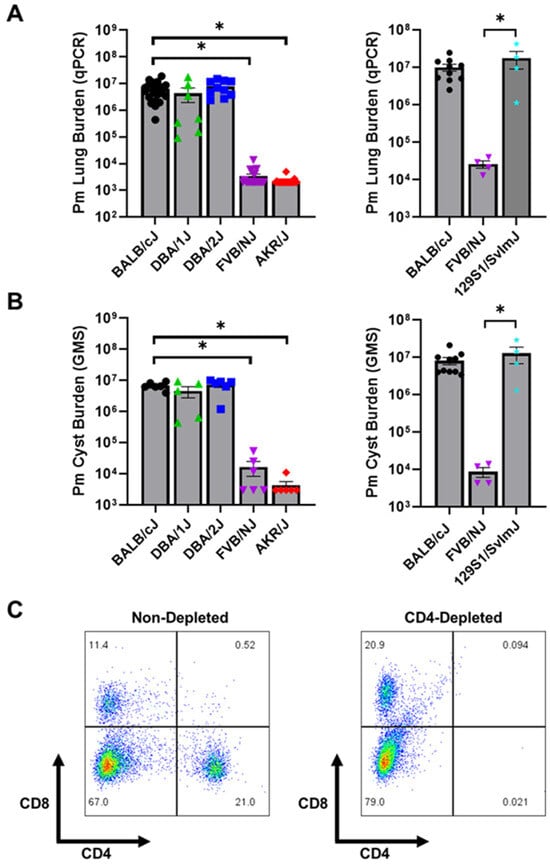
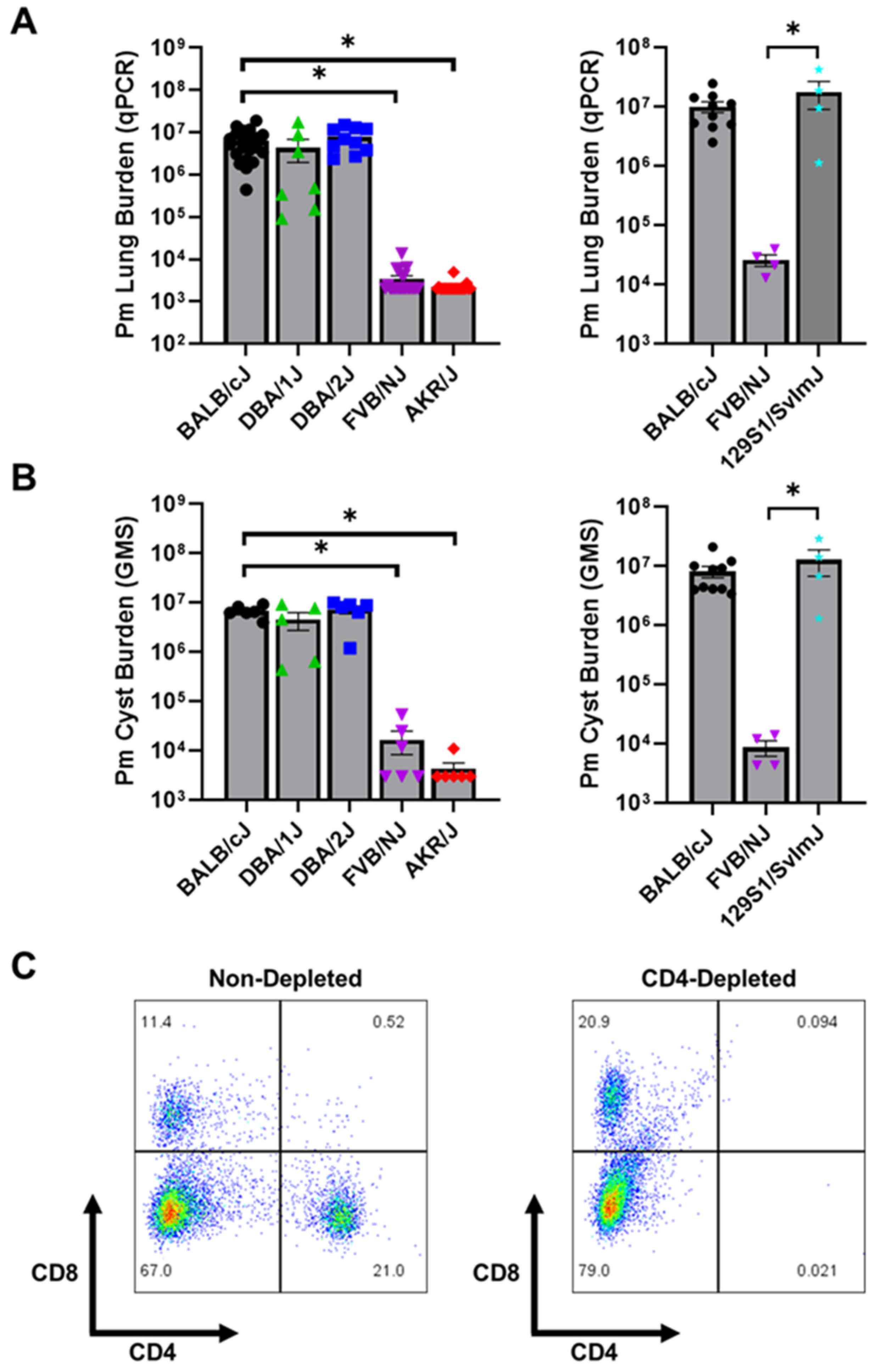
Our prior work determined that, unlike most other inbred laboratory mouse strains, FVB/NJ mice remain resistant to Pneumocystis murina infection even in the absence of CD4+ T cell-dependent adaptive immunity [33,38]. In order to determine whether other genetically distinct mouse strains display effective innate immunity against Pneumocystis, several inbred strains not closely related to FVB/NJ were CD4-depleted and infected with P. murina via intra-tracheal inoculation. As expected, BALB/cJ mice were extremely susceptible to P. murina infection and harbored high fungal burdens as assessed by both real-time PCR quantification of P. murina DNA and direct counting of Grocott-Gomori Methenamine Silver (GMS)-stained cyst forms in lung homogenates (Figure 1A,B). CD4-depleted DBA/1J, DBA/2J, and 129S1/SVimJ were also found to be highly susceptible based on qPCR and GMS staining. In contrast, AKR/J mice displayed robust resistance to infection even in the absence of CD4+ T cells (Figure 1A,B). These mice had mean P. murina lung burdens that were near the limit of detection for the assay, and approximately three logs lower than the burden in susceptible BALB/cJ, DBA/1J, DBA/2J, and 129S1/SVimJ mice. Flow cytometry of the splenocyte population of CD4-depleted and non-depleted mice was used to confirm that anti-CD4 monoclonal antibody effectively depleted CD4+ T cells in resistant AKR/J background mice in vivo (Figure 1C). These data demonstrate that an additional mouse strain, AKR/J, displays innate resistance to Pneumocystis infection in the absence of functional adaptive immunity.
Figure 1.
AKR/J mice display effective innate immunity against P. murina infection. CD4-depleted AKR/J (n = 22), BALB/cJ (n = 22), DBA/1J (n = 7), DBA/2J (n = 10), and FVB/NJ (n = 20) mice were intratracheally inoculated with 1 × 10⁶ freshly isolated P. murina. In a separate experiment, CD4-depleted BALB/cJ (n = 10), FVB/NJ (n = 4), and 129S1/SvImJ (n = 4), were also infected with P. murina. At 5 weeks post-infection the lungs of experimental mice were assessed for total P. murina burden by qPCR and asci counts by GMS stain (A,B). Mean ± 1 standard error measurement (SEM) are reported for each group. * denotes p < 0.05 compared to BALB/cJ mice. Flow cytometry was used to confirm the effective depletion CD4+ T cells in resistant AKR/J background mice (C).
3.2. CD8+ T Cells Are Not Required for Effective Innate Immunity in AKR/J Mice
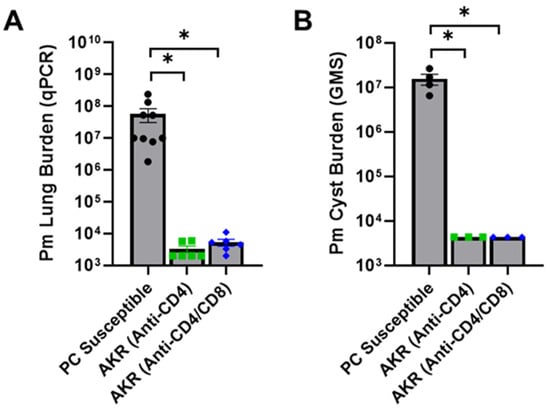
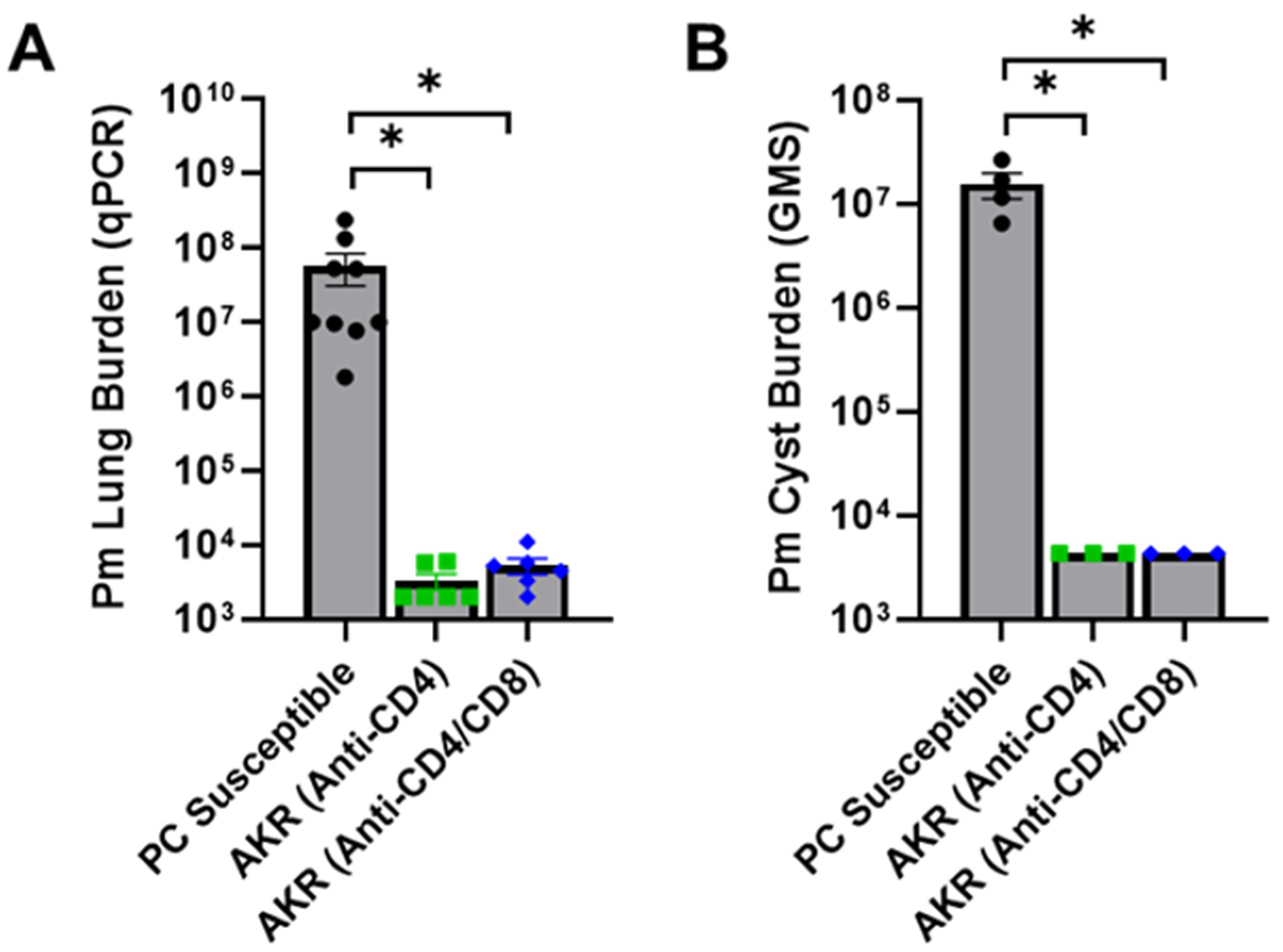
Although CD8+ T cells do not typically provide meaningful host defense against Pneumocystis infection, previous reports have indicated that under certain circumstances CD8+ T cells can provide a degree of protection against P. murina in CD4-depleted mice [46,47]. Therefore, to determine whether AKR/J mice mount a distinct CD8+ T cell response that compensates for the loss of CD4+ T cell function and mediates protective immunity against PCP when CD4+ T cells are depleted, AKR/J mice were double depleted of both CD4+ and CD8+ T cells and then inoculated with P. murina. As expected, control Pneumocystis susceptible mice harbored large fungal burdens as assessed by qPCR and GMS staining (Figure 2). However, AKR/J mice remained robustly resistant to infection when either depleted of only CD4+ T cells, or double depleted of both CD4+ and CD8+ T cells (Figure 2). These data demonstrate that CD8+ T cells do not contribute to AKR/J resistance to respiratory fungal infection with P. murina, and suggest that T cell-independent innate immune mechanisms protect these mice from infection.
Figure 2.
CD8+ T lymphocytes are not required for effective antifungal innate immunity in AKR/J mice. CD4-depleted (n = 6) and CD4/CD8 double-depleted (n = 6) AKR/J mice were intratracheally inoculated with 1 × 10⁶ freshly isolated P. murina. CD4-depleted BALB/cJ and C57BL/6J mice were also infected and used as Pneumocystis-susceptible controls (n = 9). At 5 weeks post-infection the lungs of experimental mice were assessed for total P. murina burden by qPCR and cyst counts by GMS stain (A,B). Mean ± 1 standard error measurement (SEM) are reported for each group. * denotes p < 0.05 compared to BALB/cJ mice.
3.3. Alveolar Macrophages Are Required for AKR/J Resistance to P. murina Infection
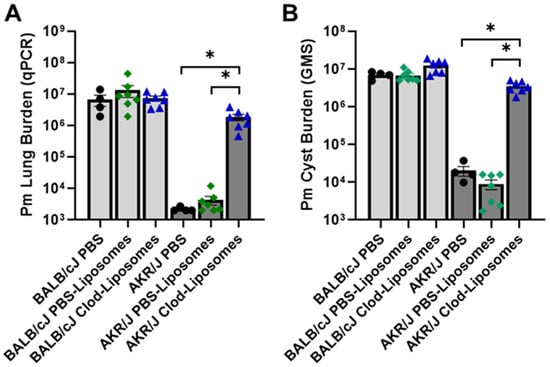
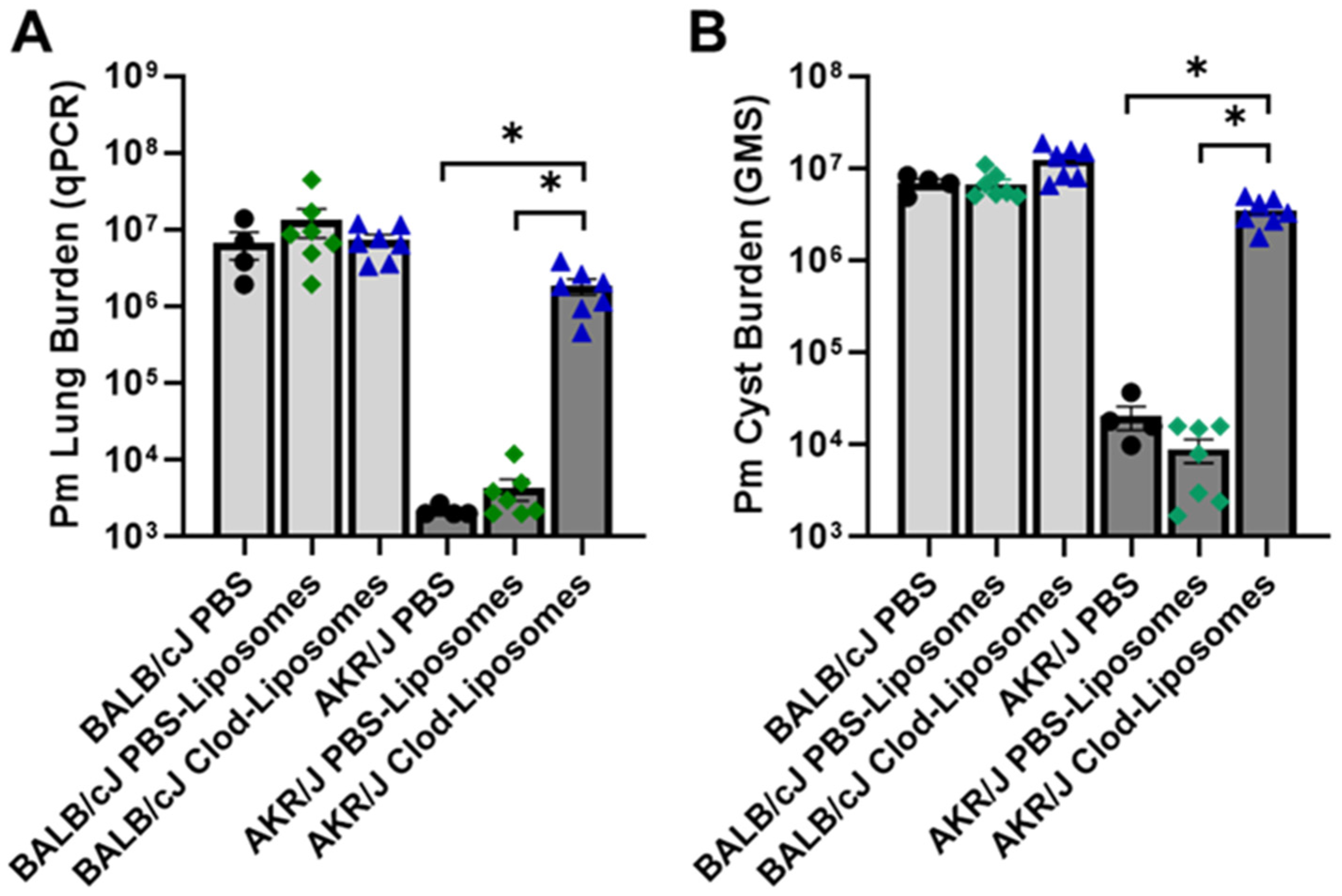
Lung-resident alveolar macrophages (AMs) are front-line innate immune cells that patrol the host–pathogen interface. While AMs contribute to pulmonary host defense against Pneumocystis [42,48,49], they are generally inadequate to protect against Pneumocystis pneumonia (PCP) in the absence of functional adaptive immunity [32]. In order to determine the contribution of the resident AM population to AKR/J innate immune resistance to Pneumocystis, mice were chronically depleted of AM using serial intra-tracheal administration of clodronate-liposomes, as we and others have described in previous studies [33,50,51]. Susceptible BALB/cJ and resistant AKR/J mice were subjected to double depletion of CD4+ T cell and AMs and then challenged with infectious P. murina. Control mice of each strain were CD4+ T cell-depleted and inoculated with either PBS or PBS-containing liposomes prior to challenge. The alveolar macrophage depletion efficiency achieved with clodronate-liposomes was approximately 80%. As expected, all susceptible BALB/c mice that were CD4+ T cell-depleted and treated with PBS, PBS-liposomes, or clodronate-liposomes developed high lung P. murina burdens after challenge, as confirmed by qPCR and cyst counts (Figure 3A,B). Also as expected, control CD4+ T cell-depleted AKR/J mice treated with PBS or PBS-liposomes remained resistant to infection. However, CD4+ T cell-depleted AKR/J mice that were also depleted of AMs with clodronate-liposomes became susceptible to P. murina infection (Figure 3A,B). These data demonstrate that alveolar macrophages are essential innate immune effectors for resistance against PCP in AKR/J mice. This contrasts with the typical ineffectiveness of AMs in providing protective host defense against PCP in hosts with diminished CD4+ T cell number or function.
Figure 3.
Alveolar macrophage (AM) depletion renders AKR/J mice susceptible to P. murina infection. CD4-depleted BALB/cJ and AKR/J mice were intra-tracheally instilled with either PBS-liposomes (n = 7) or AM-depleting clodronate-liposomes (n = 7) beginning one week prior to inoculation with 1 × 10⁶ freshly isolated P. murina. Control CD4-depleted BALB/cJ and AKR/J mice received PBS (n = 4). At 5 weeks post-infection the lungs of experimental mice were assessed for total P. murina burden by qPCR and cyst counts by GMS stain (A,B). Mean ± 1 standard error measurement (SEM) are reported for each group. * denotes p < 0.05 compared to BALB/cJ mice.
3.4. The AKR/J Innate Resistance Phenotype Is Genetically Dominant
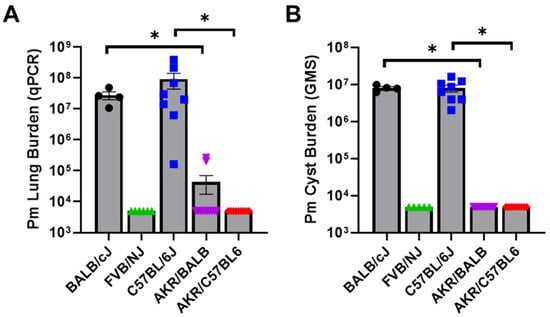
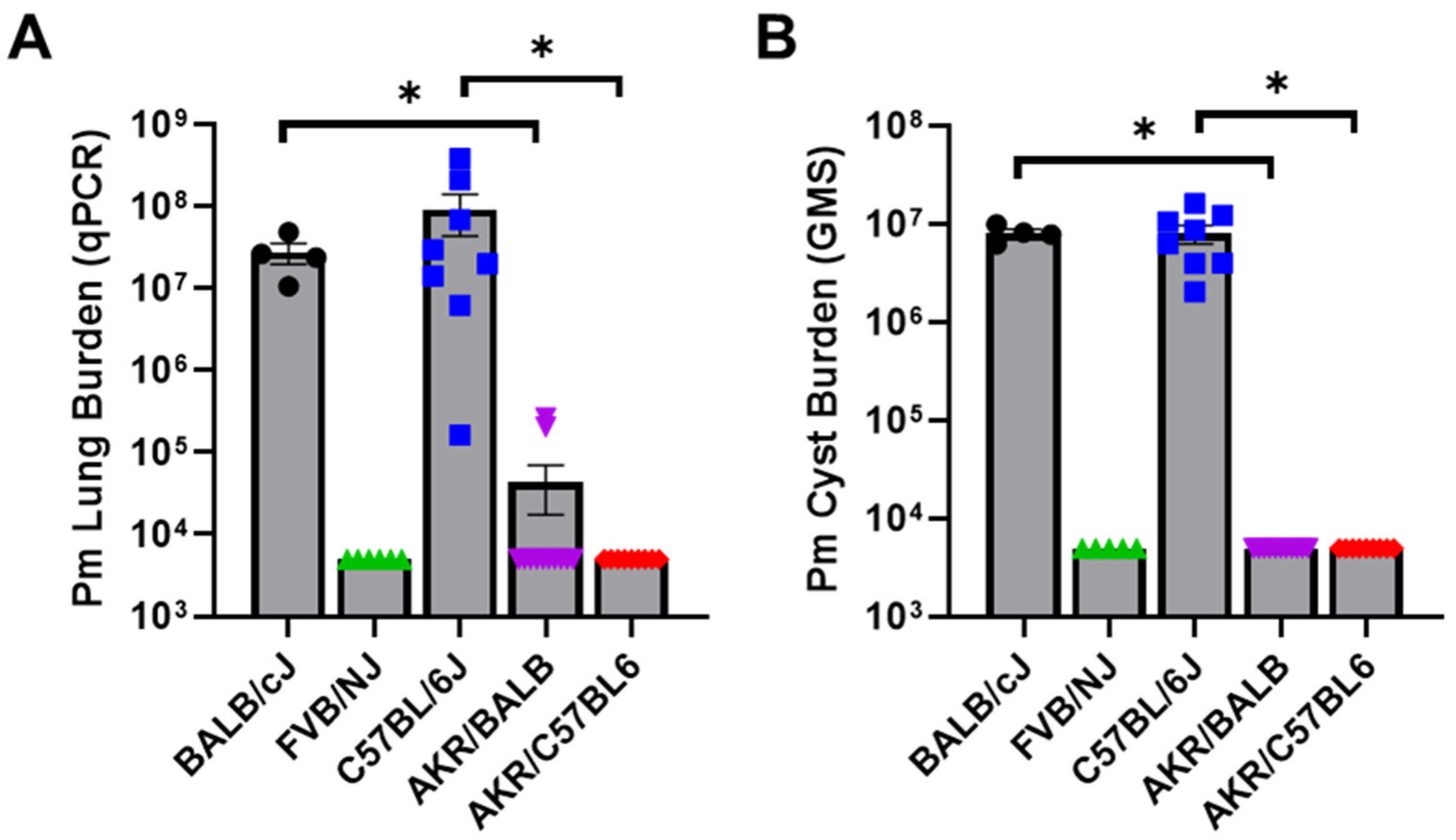
In order to determine whether AKR/J innate resistance is a genetically dominant or recessive trait, F1 hybrids were generated by crossing susceptible BALB/cJ or C57BL/6J mice with resistant AKR/J mice. F1 hybrid mice were depleted of CD4+ T cells and challenged with P. murina. The BALB/cJ and C57BL/6J parent strains were used as controls. The fungal lung burden of experimental mice was determined by qPCR and GMS staining at 5 weeks post-infection. As expected, the BALB/cJ and C57BL/6J parent strains were both highly susceptible to P. murina infection when depleted of CD4+ T cells (Figure 4A,B). In contrast, both AKR/BALB and AKR/C57BL6 hybrid mice were highly resistant to P. murina infection (Figure 4A,B). These data suggest that a single copy of the critical genetic locus that regulates AKR/J antifungal innate immunity is sufficient for mice to express the resistant phenotype. Further genetic studies will be necessary to map this specific locus to a chromosomal location.
Figure 4.
The AKR/J innate resistance phenotype is a genetically dominant trait. CD4-depleted BALB/cJ (n = 4), C57BL/6J (n = 8), FVB/NJ (n = 6), AKR/J x BALB/cJ F1 (n = 12) and AKR/J x C57BL/6J F1 (n = 9) mice were intratracheally inoculated with 1 × 10⁶ freshly isolated P. murina. At 5 weeks post-infection the lungs of experimental mice were assessed for total P. murina burden by qPCR and cyst counts by GMS stain (A,B). Mean ± 1 standard error measurement (SEM) are reported for each group. * denotes p < 0.05 compared to BALB/cJ mice.
4. Discussion
Pneumocystis is widely recognized as a classic opportunistic fungal pathogen, primarily affecting individuals with compromised immune systems. In healthy humans and animals, Pneumocystis species are adept at evading early pulmonary innate immunity, allowing them to establish a limited local infection. However, this infection is typically transient, as the normal adaptive immune response effectively controls pathogen growth. This balance changes dramatically in individuals with diminished CD4+ T cell numbers or impaired CD4+ T cell function, such as patients with HIV/AIDS. In these immunocompromised hosts, Pneumocystis can cause severe and life-threatening Pneumocystis pneumonia (PCP), a condition that remains a significant cause of morbidity and mortality in this population. Despite its clinical importance, the precise mechanisms that enable Pneumocystis to evade the host’s innate immune defenses remain incompletely understood. This gap in knowledge represents a critical barrier to both fully understanding the pathogenicity of this fungal organism, and developing targeted therapeutic strategies. In this context, the current study highlights the discovery of an inbred mouse strain, AKR/J, which displays protective innate immunity against Pneumocystis infection, even in the absence of a functional adaptive immune system. This finding is particularly significant, as AKR/J is only the second mouse strain identified as resistant to Pneumocystis infection, along with the previously identified FVB/NJ strain. Importantly, AKR/J and FVB/NJ are phylogenetically distant inbred strains, with substantial genetic differences [52]. This genetic divergence raises the intriguing possibility that each strain employs a distinct mechanism to mount an effective innate immune response against Pneumocystis. Understanding these unique responses could provide valuable insights into the interplay between host genetics and immune defense mechanisms. Future research comparing the innate immune responses of resistant strains, such as AKR/J and FVB/NJ, to those of susceptible strains offers a promising avenue for uncovering the underlying mechanisms of effective innate immunity. Such studies could shed light on the specific factors that enable resistant strains to control Pneumocystis infection, as well as the vulnerabilities that lead to progressive infection in susceptible hosts. These findings could have broader implications for understanding host–pathogen interactions and may inform the development of novel therapeutic approaches to enhance innate immunity in immunocompromised individuals. By addressing these critical questions, researchers can take significant steps toward closing the knowledge gap surrounding Pneumocystis pathogenicity and improving outcomes for at-risk populations.
The current studies highlight alveolar macrophages as key players in the innate immune resistance to Pneumocystis observed in AKR/J mice. Although the administration of clodronate-liposomes only depleted approximately 80% of the resident alveolar macrophages, this level was sufficient to remove the natural innate immune protection of AKR/J mice and render them susceptible to PCP (Figure 3). While 20% of the AM population remained, they were unable to effectively control the infection. The most straightforward explanation for this finding would be that the smaller number of AM following clodronate treatment was not sufficient to patrol the large surface area of the lung, leaving unprotected niches where Pneumocystis could establish infection undetected. Alternatively, it is possible that AMs communicate with other cell types to initiate the innate immune cascade that eradicates Pneumocystis, and that the smaller number of AM remaining after clodronate-liposome treatments cannot generate a strong enough signal to produce an effective immune cascade. Further studies will be needed to determine the threshold number of AM required to maintain innate immunity in AKR/J mice.
The current findings demonstrating that alveolar macrophages are required for the effective innate resistance of AKR/J mice do not exclude the possibility that other innate immune mechanisms collaborate with alveolar macrophages to produce the resistant phenotype. For example, mice possess detectable levels of natural IgM antibodies that recognize multiple fungal pathogens, providing protection even in the absence of adaptive immunity [53]. Elevated levels of natural antifungal antibodies in AKR/J mice could potentially boost opsonization of P. murina, facilitating more efficient recognition and phagocytosis by resident alveolar macrophages. Alternatively, enhanced activity or differential polarization of pulmonary innate lymphoid cells (ILCs) in AKR/J mice might compensate for the absence of CD4+ T cells by releasing cytokines that activate resident alveolar macrophages for improved antifungal activity [54]. Alveolar epithelial cells (AT1 and AT2) are also known to regulate pulmonary innate immunity, and the life cycle of Pneumocystis requires attachment to the apical alveolar surface [55,56,57]. Therefore, crosstalk between alveolar epithelial cells and macrophages may further contribute to the innate resistance observed in AKR/J mice. While this study provides a foundation for future research comparing resistant and susceptible mouse strains, it also raises many additional important questions about the interactions and mechanisms that govern host susceptibility and resistance to Pneumocystis.
Although Pneumocystis is classified as a fungal pathogen, traditional antifungal treatments are often ineffective against this opportunist. Instead, Bactrim (trimethoprim-sulfamethoxazole) is widely regarded as the gold-standard therapy for Pneumocystis pneumonia (PCP) and is also commonly used as a prophylactic measure for individuals at high risk of infection due to underlying conditions. Despite its efficacy, Bactrim presents certain limitations, and treatment failures and toxicity have been reported [58,59,60,61]. Furthermore, mutations that confer Bactrim resistance in other species have been identified in P. jirovecii, and the heavy reliance on a single therapeutic agent raises concerns about the potential emergence of antibiotic resistance [59,62,63]. These challenges underscore the urgent need for innovative strategies to address both treatment and prevention of PCP, as well as other fungal infections in humans. In our research, we have identified two genetically distinct inbred mouse strains that exhibit protective innate immunity against Pneumocystis infection. This discovery presents a unique opportunity to investigate the underlying mechanisms of resistance, with the goal of determining whether these processes can be leveraged for the development of novel in vivo treatments. Such studies have the potential to uncover innovative approaches, including strategies to directly damage Pneumocystis, inhibit fungal attachment within the lung, enhance macrophage-mediated recognition and phagocytosis of the pathogen, or disrupt its ability to acquire essential nutrients as an obligate biotroph. Advancing our understanding of these mechanisms could pave the way for transformative therapies that address the limitations of current antifungal treatments.
The discovery of protective innate immunity in certain mouse strains offers a promising avenue for understanding the complex host–pathogen interactions that govern Pneumocystis recognition and eradication. In resistant strains, innate immunity appears to play a pivotal role in controlling infection, whereas in susceptible strains immune evasion by Pneumocystis leads to progressive infection. This dichotomy highlights the pathogen’s ability to adapt to and evade host defenses. Notably, the requirement for adaptive immunity in most humans and mammals to mount an effective defense against Pneumocystis pneumonia suggests that the pathogen typically survives the initial encounter with innate immunity. Evidence supporting Pneumocystis immune evasion strategies includes findings that healthy, immunocompetent humans and rodents can experience transient infections [34,35]. These observations imply that Pneumocystis has evolved sophisticated mechanisms to bypass or suppress innate and adaptive immune responses, allowing it to persist in the host. Evasion of adaptive immunity by Pneumocystis species has been attributed to antigenic variation in the major surface glycoprotein (MSG)/glycoprotein A (gpA) family of surface proteins [64,65]. Pneumocystis possesses many distinct copies of the gene encoding MSG/gpA, and switching of the expressed isoform can alter the recognition of Pneumocystis organisms by antigen-specific T cells and antibodies. This antigenic modification of the Pneumocystis surface may help the pathogen avoid adaptive immunity long enough to initiate infection and ensure spread. However, there is little evidence that antigenic variation in MSG/gpA provides an advantage for Pneumocystis during its interaction with the innate immune system and alveolar macrophages. While the exact strategies of innate immune evasion are not completely understood, they may include direct suppression of innate immune cell activity or the ability to avoid detection by innate immune sensors. Previous studies have shown that the trophic form of Pneumocystis suppresses pro-inflammatory responses in innate immune cells [66,67]. Additionally, the MSG/gpA family of surface proteins plays a critical role in masking Pneumocystis β-glucan from detection, thereby impairing the activation of the innate immune system [68,69]. MSG/gpA proteins also directly suppress macrophage pro-inflammatory responses to β-glucan by interacting with inhibitory C-type lectins [70]. These combined mechanisms likely contribute to the ability of Pneumocystis to evade innate immunity in susceptible hosts and provide a foundation for exploring how macrophages from the resistant AKR/J mouse strain overcome innate immune suppression.
Unraveling the mechanisms by which Pneumocystis evades innate immunity could have significant implications for developing novel therapeutic approaches. Such insights could inform strategies to bolster innate immune defenses or disrupt the pathogen’s immune evasion capabilities, ultimately reducing the risk of infection in immunocompromised individuals. Advancing our understanding in this area is critical for improving outcomes in vulnerable populations and addressing the limitations of current prophylactic and therapeutic measures.
Although it is currently unclear whether AKR/J and FVB/NJ mice utilize similar or distinct mechanisms of innate antifungal resistance, there is compelling reason to speculate that these strains may have evolved diverse strategies to combat infection. Notably, AKR/J and FVB/NJ mice are each more closely related to several susceptible strains than they are to one another, making it unlikely that their resistance mechanisms stem from a shared ancestral trait. This genetic divergence suggests that their antifungal resistance may have arisen independently, potentially through distinct evolutionary pressures. A key difference between these strains lies in their immune profiles. AKR/J mice are generally associated with a type 1-biased immune response [71,72], while FVB/NJ mice exhibit a type 2-biased immune profile [33,73,74]. This distinction is supported by their responses to certain other pathogens. For instance, FVB/NJ mice demonstrate strong resistance to helminth infections, such as Nippostrongylus brasiliensis and Trichuris muris, which is consistent with their type 2 immune bias [75,76]. In contrast, AKR/J mice are permissive to these infections, likely due to their type 1 immune bias [71,77]. Furthermore, AKR/J mice, but not FVB/NJ mice, exhibit protective innate immunity against mousepox infection [78]. This resistance in AKR/J mice is associated with early IFNγ responses and natural killer cell activation and is genetically dominant [78,79,80]. Interestingly, our prior research demonstrated that IFNγ, while critical for AKR/J resistance to certain pathogens, suppresses host defense against Pneumocystis and renders resistant FVB/NJ mice susceptible to infection [33]. This finding underscores the complexity of immune responses and suggests that the mechanisms underlying resistance in AKR/J and FVB/NJ mice may be fundamentally different. The contrasting immune profiles and pathogen-specific responses of these strains highlight the potential for diverse pathways of innate antifungal resistance.
The identification of AKR/J as an additional resistant strain provides a valuable opportunity to further investigate the interaction between Pneumocystis and the pulmonary innate immune system. By comparing the resistance mechanisms of these two strains, future studies may uncover novel insights into the pathways that mediate innate immunity and identify potential targets for therapeutic intervention in immunocompromised hosts.
Author Contributions
Conceptualization, T.W.W. and F.G.; Methodology, T.W.W. and P.C.I.; Validation, T.W.W. and P.C.I.; Formal Analysis, T.W.W. and P.C.I.; Data Curation, P.C.I.; Writing—Original Draft Preparation, T.W.W. and P.C.I.; Writing—Review and Editing, T.W.W. and P.C.I.; Funding Acquisition, T.W.W. and F.G. All authors have read and agreed to the published version of the manuscript.
Funding
This research was funded by National Institutes of Allergy and Infectious Diseases (NIAID) grant numbers R01 AI146035 and R01 HL113495.
Institutional Review Board Statement
Animal studies were performed in accordance with the recommendations of the Association for Assessment and Accreditation of Laboratory Care International (AAALAC International). The animal studies were approved by the University of Rochester Committee on Animal Resources (protocol# 2011-050E, 16 November 2023).
Informed Consent Statement
Not applicable.
Data Availability Statement
The original contributions presented in this study are included in the article. Further inquiries can be directed to the corresponding author.
Conflicts of Interest
The authors declare no conflicts of interest.
Abbreviations
| PCP | Pneumocystis Pneumonia. |
| PJP | Pneumocystis jirovecii Pneumonia |
| AM | Alveolar Macrophage |
| qPCR | Real-time quantitative polymerase chain reaction |
| HIV | Human Immunodeficiency Virus |
| Clodronate | Dichloromethylene diphosphonate |
| IFNγ | Interferon gamma |
References
- Stop neglecting fungi. Nat. Microbiol. 2017, 2, 17120. [CrossRef] [Scilit] [PubMed]
- Armstrong-James, D.; Meintjes, G.; Brown, G.D. A neglected epidemic: Fungal infections in HIV/AIDS. Trends Microbiol. 2014, 22, 120–127. [Google Scholar] [CrossRef] [Scilit] [PubMed]
- Bongomin, F.; Gago, S.; Oladele, R.O.; Denning, D.W. Global and Multi-National Prevalence of Fungal Diseases-Estimate Precision. J. Fungi 2017, 3, 57. [Google Scholar] [CrossRef] [Scilit] [PubMed]
- Brown, G.D.; Denning, D.W.; Gow, N.A.; Levitz, S.M.; Netea, M.G.; White, T.C. Hidden killers: Human fungal infections. Sci. Transl. Med. 2012, 4, 165rv113. [Google Scholar] [CrossRef] [Scilit]
- Kohler, J.R.; Hube, B.; Puccia, R.; Casadevall, A.; Perfect, J.R. Fungi that Infect Humans. Microbiol. Spectr. 2017, 5. [Google Scholar] [CrossRef] [Scilit]
- Wang, Y.; Han, L.; Gong, J.; Liu, L.; Miao, B.; Xu, J. Research advances and public health strategies in China on WHO priority fungal pathogens. Mycology 2025, 16, 1437–1477. [Google Scholar] [CrossRef] [Scilit]
- Gigliotti, F.; Limper, A.H.; Wright, T. Pneumocystis. Cold Spring Harb. Perspect. Med. 2014, 4, a019828. [Google Scholar] [CrossRef] [Scilit]
- Krajicek, B.J.; Thomas, C.F., Jr.; Limper, A.H. Pneumocystis pneumonia: Current concepts in pathogenesis, diagnosis, and treatment. Clin. Chest Med. 2009, 30, 265–278. [Google Scholar] [CrossRef] [Scilit]
- Siegel, M.; Masur, H.; Kovacs, J. Pneumocystis jirovecii Pneumonia in Human Immunodeficiency Virus Infection. Semin. Respir. Crit. Care Med. 2016, 37, 243–256. [Google Scholar] [CrossRef] [Scilit]
- Buchacz, K.; Lau, B.; Jing, Y.; Bosch, R.; Abraham, A.G.; Gill, M.J.; Silverberg, M.J.; Goedert, J.J.; Sterling, T.R.; Althoff, K.N.; et al. Incidence of AIDS-Defining Opportunistic Infections in a Multicohort Analysis of HIV-infected Persons in the United States and Canada, 2000–2010. J. Infect. Dis. 2016, 214, 862–872. [Google Scholar] [CrossRef] [Scilit]
- Gigliotti, F.; Wright, T.W. Pneumocystis: Where does it live? PLoS Pathog. 2012, 8, e1003025. [Google Scholar] [CrossRef] [Scilit]
- Cisse, O.H.; Ma, L.; Kovacs, J.A. Retracing the evolution of Pneumocystis species, with a focus on the human pathogen Pneumocystis jirovecii. Microbiol. Mol. Biol. Rev. 2024, 88, e0020222. [Google Scholar] [CrossRef] [Scilit]
- Medrano, F.J.; Montes-Cano, M.; Conde, M.; de la Horra, C.; Respaldiza, N.; Gasch, A.; Perez-Lozano, M.J.; Varela, J.M.; Calderon, E.J. Pneumocystis jirovecii in general population. Emerg. Infect. Dis. 2005, 11, 245–250. [Google Scholar] [CrossRef] [Scilit]
- Shibata, S.; Kikuchi, T. Pneumocystis pneumonia in HIV-1-infected patients. Respir. Investig. 2019, 57, 213–219. [Google Scholar] [CrossRef] [Scilit]
- Lopez-Sanchez, C.; Falco, V.; Burgos, J.; Navarro, J.; Martin, M.T.; Curran, A.; Miguel, L.; Ocana, I.; Ribera, E.; Crespo, M.; et al. Epidemiology and long-term survival in HIV-infected patients with Pneumocystis jirovecii pneumonia in the HAART era: Experience in a university hospital and review of the literature. Medicine 2015, 94, e681. [Google Scholar] [CrossRef] [Scilit]
- Wickramasekaran, R.N.; Jewell, M.P.; Sorvillo, F.; Kuo, T. The changing trends and profile of pneumocystosis mortality in the United States, 1999–2014. Mycoses 2017, 60, 607–615. [Google Scholar] [CrossRef] [Scilit]
- Salzer, H.J.F.; Schafer, G.; Hoenigl, M.; Gunther, G.; Hoffmann, C.; Kalsdorf, B.; Alanio, A.; Lange, C. Clinical, Diagnostic, and Treatment Disparities between HIV-Infected and Non-HIV-Infected Immunocompromised Patients with Pneumocystis jirovecii Pneumonia. Respir. Int. Rev. Thorac. Dis. 2018, 96, 52–65. [Google Scholar] [CrossRef] [Scilit]
- Avino, L.J.; Naylor, S.M.; Roecker, A.M. Pneumocystis jirovecii Pneumonia in the Non-HIV-Infected Population. Ann. Pharmacother. 2016, 50, 673–679. [Google Scholar] [CrossRef] [Scilit] [PubMed]
- Vallabhaneni, S.; Chiller, T.M. Fungal Infections and New Biologic Therapies. Curr. Rheumatol. Rep. 2016, 18, 29. [Google Scholar] [CrossRef] [Scilit] [PubMed]
- Rutherford, A.I.; Patarata, E.; Subesinghe, S.; Hyrich, K.L.; Galloway, J.B. Opportunistic infections in rheumatoid arthritis patients exposed to biologic therapy: Results from the British Society for Rheumatology Biologics Register for Rheumatoid Arthritis. Rheumatology 2018, 57, 997–1001. [Google Scholar] [CrossRef] [Scilit]
- Chin, S.; Fox, L.; Majumdar, A.; Oliver, M.; Choy, M.C.; De Cruz, P. Pneumocystis jirovecii Pneumonia Complicating Use of Upadacitinib in a Patient with Ulcerative Colitis and Primary Sclerosing Cholangitis: A Case Report. Inflamm. Bowel Dis. 2024, 30, 1435–1436. [Google Scholar] [CrossRef] [Scilit] [PubMed]
- Fitzpatrick, M.E.; Tedrow, J.R.; Hillenbrand, M.E.; Lucht, L.; Richards, T.; Norris, K.A.; Zhang, Y.; Sciurba, F.C.; Kaminski, N.; Morris, A. Pneumocystis jirovecii colonization is associated with enhanced Th1 inflammatory gene expression in lungs of humans with chronic obstructive pulmonary disease. Microbiol. Immunol. 2014, 58, 202–211. [Google Scholar] [CrossRef] [Scilit] [PubMed]
- Morris, A.; Alexander, T.; Radhi, S.; Lucht, L.; Sciurba, F.C.; Kolls, J.K.; Srivastava, R.; Steele, C.; Norris, K.A. Airway obstruction is increased in Pneumocystis-colonized human immunodeficiency virus-infected outpatients. J. Clin. Microbiol. 2009, 47, 3773–3776. [Google Scholar] [CrossRef] [Scilit]
- Bonnet, P.; Le Gal, S.; Calderon, E.; Delhaes, L.; Quinio, D.; Robert-Gangneux, F.; Ramel, S.; Nevez, G. Pneumocystis jirovecii in Patients with Cystic Fibrosis: A Review. Front. Cell Infect. Microbiol. 2020, 10, 571253. [Google Scholar] [CrossRef] [Scilit]
- Morris, A.; Norris, K.A. Colonization by Pneumocystis jirovecii and its role in disease. Clin. Microbiol. Rev. 2012, 25, 297–317. [Google Scholar] [CrossRef] [Scilit]
- Davey, E.L.; Colombo, R.E.; Fiorentino, C.; Fahle, G.; Davey, R.T., Jr.; Olivier, K.N.; Kovacs, J.A. Pneumocystis colonization in asthmatic patients not receiving oral corticosteroid therapy. J. Investig. Med. 2017, 65, 800–802. [Google Scholar] [CrossRef] [Scilit]
- WHO. WHO Fungal Priority Pathogens List to Guide Research, Development and Public Health Action. 2022. Available online: https://www.who.int/publications/i/item/9789240060241 (accessed on 1 February 2026).
- Harmsen, A.G.; Stankiewicz, M. Requirement for CD4+ cells in resistance to Pneumocystis carinii pneumonia in mice. J. Exp. Med. 1990, 172, 937–945. [Google Scholar] [CrossRef] [Scilit]
- Shellito, J.; Suzara, V.V.; Blumenfeld, W.; Beck, J.M.; Steger, H.J.; Ermak, T.H. A new model of Pneumocystis carinii infection in mice selectively depleted of helper T lymphocytes. J. Clin. Investig. 1990, 85, 1686–1693. [Google Scholar] [CrossRef] [Scilit]
- Montgomery, A.B. Prophylaxis of Pneumocystis carinii pneumonia in patients infected with the human immunodeficiency virus type 1. Semin. Respir. Infect. 1989, 4, 311–317. [Google Scholar]
- Phair, J.; Munoz, A.; Detels, R.; Kaslow, R.; Rinaldo, C.; Saah, A. The risk of Pneumocystis carinii pneumonia among men infected with human immunodeficiency virus type 1. Multicenter AIDS Cohort Study Group. N. Engl. J. Med. 1990, 322, 161–165. [Google Scholar] [CrossRef] [Scilit] [PubMed]
- Hanano, R.; Kaufmann, S.H. Activation of pulmonary macrophages is not sufficient for in vivo containment of Pneumocystis carinii. J. Eukaryot. Microbiol. 1997, 44, 17S. [Google Scholar] [CrossRef] [Scilit] [PubMed]
- Bhagwat, S.P.; Gigliotti, F.; Wang, J.; Wang, Z.; Notter, R.H.; Murphy, P.S.; Rivera-Escalera, F.; Malone, J.; Jordan, M.B.; Elliott, M.R.; et al. Intrinsic Programming of Alveolar Macrophages for Protective Antifungal Innate Immunity Against Pneumocystis Infection. Front. Immunol. 2018, 9, 2131. [Google Scholar] [CrossRef] [Scilit] [PubMed]
- Gigliotti, F.; Harmsen, A.G.; Wright, T.W. Characterization of transmission of Pneumocystis carinii f. sp. muris through immunocompetent BALB/c mice. Infect. Immun. 2003, 71, 3852–3856. [Google Scholar] [CrossRef] [Scilit]
- Vargas, S.L.; Ponce, C.A.; Gigliotti, F.; Ulloa, A.V.; Prieto, S.; Munoz, M.P.; Hughes, W.T. Transmission of Pneumocystis carinii DNA from a patient with P. carinii pneumonia to immunocompetent contact health care workers. J. Clin. Microbiol. 2000, 38, 1536–1538. [Google Scholar] [CrossRef] [Scilit]
- Vargas, S.L.; Hughes, W.T.; Santolaya, M.E.; Ulloa, A.V.; Ponce, C.A.; Cabrera, C.E.; Cumsille, F.; Gigliotti, F. Search for primary infection by Pneumocystis carinii in a cohort of normal, healthy infants. Clin. Infect. Dis. An. Off. Publ. Infect. Dis. Soc. Am. 2001, 32, 855–861. [Google Scholar] [CrossRef] [Scilit]
- Meissner, N.N.; Swain, S.; Tighe, M.; Harmsen, A.; Harmsen, A. Role of type I IFNs in pulmonary complications of Pneumocystis murina infection. J. Immunol. 2005, 174, 5462–5471. [Google Scholar] [CrossRef] [Scilit] [PubMed]
- Mousso, T.; Pollock, S.J.; Inzerillo, P.C.; Gigliotti, F.; Wright, T.W. Protective innate immunity against Pneumocystis does not require Stat6-dependent macrophage polarization. Infect. Immun. 2024, 92, e0022224. [Google Scholar] [CrossRef] [Scilit]
- Wang, J.; Gigliotti, F.; Maggirwar, S.; Johnston, C.; Finkelstein, J.N.; Wright, T.W. Pneumocystis carinii activates the NF-kappaB signaling pathway in alveolar epithelial cells. Infect. Immun. 2005, 73, 2766–2777. [Google Scholar] [CrossRef] [Scilit]
- Van Rooijen, N.; Sanders, A. Liposome mediated depletion of macrophages: Mechanism of action, preparation of liposomes and applications. J. Immunol. Methods 1994, 174, 83–93. [Google Scholar] [CrossRef] [Scilit]
- van Rooijen, N.; Sanders, A.; van den Berg, T.K. Apoptosis of macrophages induced by liposome-mediated intracellular delivery of clodronate and propamidine. J. Immunol. Methods 1996, 193, 93–99. [Google Scholar] [CrossRef] [Scilit]
- Limper, A.H.; Hoyte, J.S.; Standing, J.E. The role of alveolar macrophages in Pneumocystis carinii degradation and clearance from the lung. J. Clin. Investig. 1997, 99, 2110–2117. [Google Scholar] [CrossRef] [Scilit]
- Hashimoto, S.; Pittet, J.F.; Hong, K.; Folkesson, H.; Bagby, G.; Kobzik, L.; Frevert, C.; Watanabe, K.; Tsurufuji, S.; Wiener-Kronish, J. Depletion of alveolar macrophages decreases neutrophil chemotaxis to Pseudomonas airspace infections. Am. J. Physiol. 1996, 270, L819–L828. [Google Scholar] [CrossRef] [Scilit]
- Szoka, F., Jr.; Papahadjopoulos, D. Procedure for preparation of liposomes with large internal aqueous space and high capture by reverse-phase evaporation. Proc. Natl. Acad. Sci. USA 1978, 75, 4194–4198. [Google Scholar] [CrossRef] [Scilit]
- Wright, T.W.; Pryhuber, G.S.; Chess, P.R.; Wang, Z.; Notter, R.H.; Gigliotti, F. TNF receptor signaling contributes to chemokine secretion, inflammation, and respiratory deficits during Pneumocystis pneumonia. J. Immunol. 2004, 172, 2511–2521. [Google Scholar] [CrossRef] [Scilit]
- Kolls, J.K.; Habetz, S.; Shean, M.K.; Vazquez, C.; Brown, J.A.; Lei, D.; Schwarzenberger, P.; Ye, P.; Nelson, S.; Summer, W.R.; et al. IFN-gamma and CD8+ T cells restore host defenses against Pneumocystis carinii in mice depleted of CD4+ T cells. J. Immunol. 1999, 162, 2890–2894. [Google Scholar] [CrossRef] [Scilit]
- McAllister, F.; Steele, C.; Zheng, M.; Young, E.; Shellito, J.E.; Marrero, L.; Kolls, J.K. T cytotoxic-1 CD8+ T cells are effector cells against Pneumocystis in mice. J. Immunol. 2004, 172, 1132–1138. [Google Scholar] [CrossRef] [Scilit]
- Nandakumar, V.; Hebrink, D.; Jenson, P.; Kottom, T.; Limper, A.H. Differential Macrophage Polarization from Pneumocystis in Immunocompetent and Immunosuppressed Hosts: Potential Adjunctive Therapy during Pneumonia. Infect. Immun. 2017, 85. [Google Scholar] [CrossRef] [Scilit]
- Wang, J.; Gigliotti, F.; Bhagwat, S.P.; George, T.C.; Wright, T.W. Immune modulation with sulfasalazine attenuates immunopathogenesis but enhances macrophage-mediated fungal clearance during Pneumocystis pneumonia. PLoS Pathog. 2010, 6, e1001058. [Google Scholar] [CrossRef] [Scilit]
- Leemans, J.C.; Juffermans, N.P.; Florquin, S.; van Rooijen, N.; Vervoordeldonk, M.J.; Verbon, A.; van Deventer, S.J.; van der Poll, T. Depletion of alveolar macrophages exerts protective effects in pulmonary tuberculosis in mice. J. Immunol. 2001, 166, 4604–4611. [Google Scholar] [CrossRef] [Scilit]
- Hickman-Davis, J.M.; Michalek, S.M.; Gibbs-Erwin, J.; Lindsey, J.R. Depletion of alveolar macrophages exacerbates respiratory mycoplasmosis in mycoplasma-resistant C57BL mice but not mycoplasma-susceptible C3H mice. Infect. Immun. 1997, 65, 2278–2282. [Google Scholar] [CrossRef] [Scilit]
- Petkov, P.M.; Graber, J.H.; Churchill, G.A.; DiPetrillo, K.; King, B.L.; Paigen, K. Evidence of a large-scale functional organization of mammalian chromosomes. PLoS Genet. 2005, 1, e33. [Google Scholar] [CrossRef] [Scilit]
- Rapaka, R.R.; Ricks, D.M.; Alcorn, J.F.; Chen, K.; Khader, S.A.; Zheng, M.; Plevy, S.; Bengten, E.; Kolls, J.K. Conserved natural IgM antibodies mediate innate and adaptive immunity against the opportunistic fungus Pneumocystis murina. J. Exp. Med. 2010, 207, 2907–2919. [Google Scholar] [CrossRef] [Scilit] [PubMed]
- Mi, L.L.; Zhu, Y.; Lu, H.Y. A crosstalk between type 2 innate lymphoid cells and alternative macrophages in lung development and lung diseases (Review). Mol. Med. Rep. 2021, 23, 403. [Google Scholar] [CrossRef] [Scilit]
- Bello-Irizarry, S.N.; Wang, J.; Olsen, K.; Gigliotti, F.; Wright, T.W. The alveolar epithelial cell chemokine response to Pneumocystis requires adaptor molecule MyD88 and interleukin-1 receptor but not toll-like receptor 2 or 4. Infect. Immun. 2012, 80, 3912–3920. [Google Scholar] [CrossRef] [Scilit]
- Perez-Nazario, N.; Rangel-Moreno, J.; O’Reilly, M.A.; Pasparakis, M.; Gigliotti, F.; Wright, T.W. Selective ablation of lung epithelial IKK2 impairs pulmonary Th17 responses and delays the clearance of Pneumocystis. J. Immunol. 2013, 191, 4720–4730. [Google Scholar] [CrossRef] [Scilit]
- Kottom, T.J.; Carmona, E.M.; Limper, A.H. Lung Epithelial Cell Line Immune Responses to Pneumocystis. J. Fungi 2023, 9, 729. [Google Scholar] [CrossRef] [Scilit]
- Ahmadi, F.; McArthur, E.; Garcia-Bournissen, F.; Rieder, M.J.; Muanda, F.T. Trimethoprim-Sulfamethoxazole and Acute Respiratory Failure in Adolescents and Young Adults. JAMA Netw. Open 2025, 8, e2545251. [Google Scholar] [CrossRef] [Scilit]
- Singh, Y.; Mirdha, B.R.; Guleria, R.; Kabra, S.K.; Mohan, A.; Chaudhry, R.; Kumar, L.; Dwivedi, S.N.; Agarwal, S.K. Genetic polymorphisms associated with treatment failure and mortality in pediatric Pneumocystosis. Sci. Rep. 2019, 9, 1192. [Google Scholar] [CrossRef] [Scilit]
- Miller, J.O.; Taylor, J.; Goldman, J.L. Severe Acute Respiratory Failure in Healthy Adolescents Exposed to Trimethoprim-Sulfamethoxazole. Pediatrics 2019, 143, e20183242. [Google Scholar] [CrossRef] [Scilit]
- Helweg-Larsen, J.; Benfield, T.; Atzori, C.; Miller, R.F. Clinical efficacy of first- and second-line treatments for HIV-associated Pneumocystis jirovecii pneumonia: A tri-centre cohort study. J. Antimicrob. Chemother. 2009, 64, 1282–1290. [Google Scholar] [CrossRef] [Scilit]
- Singh, Y.; Mirdha, B.R.; Guleria, R.; Kabra, S.K.; Mohan, A.; Chaudhry, R.; Kumar, L.; Dwivedi, S.N.; Agarwal, S.K. Novel dihydropteroate synthase gene mutation in Pneumocystis jirovecii among HIV-infected patients in India: Putative association with drug resistance and mortality. J. Glob. Antimicrob. Resist. 2019, 17, 236–239. [Google Scholar] [CrossRef] [Scilit]
- Ponce, C.A.; Chabe, M.; George, C.; Cardenas, A.; Duran, L.; Guerrero, J.; Bustamante, R.; Matos, O.; Huang, L.; Miller, R.F.; et al. High Prevalence of Pneumocystis jirovecii Dihydropteroate Synthase Gene Mutations in Patients with a First Episode of Pneumocystis Pneumonia in Santiago, Chile, and Clinical Response to Trimethoprim-Sulfamethoxazole Therapy. Antimicrob. Agents Chemother. 2017, 61, e01290-16. [Google Scholar] [CrossRef] [Scilit]
- Ma, L.; Chen, Z.; Huang, D.W.; Cisse, O.H.; Rothenburger, J.L.; Latinne, A.; Bishop, L.; Blair, R.; Brenchley, J.M.; Chabe, M.; et al. Diversity and Complexity of the Large Surface Protein Family in the Compacted Genomes of Multiple Pneumocystis Species. mBio 2020, 11, e02878-19. [Google Scholar] [CrossRef] [Scilit]
- Meier, C.S.; Pagni, M.; Richard, S.; Muhlethaler, K.; Almeida, J.; Nevez, G.; Cushion, M.T.; Calderon, E.J.; Hauser, P.M. Fungal antigenic variation using mosaicism and reassortment of subtelomeric genes’ repertoires. Nat. Commun. 2023, 14, 7026. [Google Scholar] [CrossRef] [Scilit] [PubMed]
- Evans, H.M.; Bryant, G.L., 3rd; Garvy, B.A. The life cycle stages of Pneumocystis murina have opposing effects on the immune response to this opportunistic, fungal pathogen. Infect. Immun. 2016, 84, 3195–3205. [Google Scholar] [CrossRef] [Scilit]
- Evans, H.M.; Simpson, A.; Shen, S.; Stromberg, A.J.; Pickett, C.L.; Garvy, B.A. The Trophic Life Cycle Stage of the Opportunistic Fungal Pathogen Pneumocystis murina Hinders the Ability of Dendritic Cells To Stimulate CD4(+) T Cell Responses. Infect. Immun. 2017, 85, e00396-17. [Google Scholar] [CrossRef] [Scilit]
- Kutty, G.; Davis, A.S.; Ferreyra, G.A.; Qiu, J.; Huang, D.W.; Sassi, M.; Bishop, L.; Handley, G.; Sherman, B.; Lempicki, R.; et al. Beta-Glucans Are Masked but Contribute to Pulmonary Inflammation During Pneumocystis Pneumonia. J. Infect. Dis. 2016, 214, 782–791. [Google Scholar] [CrossRef] [Scilit] [PubMed]
- Sassi, M.; Kutty, G.; Ferreyra, G.A.; Bishop, L.R.; Liu, Y.; Qiu, J.; Huang, D.W.; Kovacs, J.A. The Major Surface Glycoprotein of Pneumocystis murina Does Not Activate Dendritic Cells. J. Infect. Dis. 2018, 218, 1631–1640. [Google Scholar] [CrossRef] [Scilit] [PubMed]
- Kottom, T.J.; Hebrink, D.M.; Carmona, E.M.; Limper, A.H. Pneumocystis carinii Major Surface Glycoprotein Dampens Macrophage Inflammatory Responses to Fungal beta-Glucan. J. Infect. Dis. 2020, 222, 1213–1221. [Google Scholar] [CrossRef] [Scilit]
- Smita, S.; Webb, L.M.; Mooney, B.; Fruh, S.P.; Oyesola, O.O.; Matheson, M.K.; Peng, S.A.; Wojno, E.D.T. Basophil responses in susceptible AKR mice upon infection with the intestinal helminth parasite Trichuris muris. Parasite Immunol. 2023, 45, e12999. [Google Scholar] [CrossRef] [Scilit]
- deSchoolmeester, M.L.; Little, M.C.; Rollins, B.J.; Else, K.J. Absence of CC chemokine ligand 2 results in an altered Th1/Th2 cytokine balance and failure to expel Trichuris muris infection. J. Immunol. 2003, 170, 4693–4700. [Google Scholar] [CrossRef] [Scilit]
- Whitehead, G.S.; Walker, J.K.; Berman, K.G.; Foster, W.M.; Schwartz, D.A. Allergen-induced airway disease is mouse strain dependent. Am. J. Physiol. Lung Cell Mol. Physiol. 2003, 285, L32–L42. [Google Scholar] [CrossRef] [Scilit]
- Schwartzer, J.J.; Careaga, M.; Coburn, M.A.; Rose, D.R.; Hughes, H.K.; Ashwood, P. Behavioral impact of maternal allergic-asthma in two genetically distinct mouse strains. Brain Behav. Immun. 2017, 63, 99–107. [Google Scholar] [CrossRef] [Scilit]
- Knott, M.L.; Hogan, S.P.; Wang, H.; Matthaei, K.I.; Dent, L.A. FVB/N mice are highly resistant to primary infection with Nippostrongylus brasiliensis. Parasitology 2009, 136, 93–106. [Google Scholar] [CrossRef] [Scilit]
- Bhardwaj, E.K.; Else, K.J.; Rogan, M.T.; Warhurst, G. Increased susceptibility to Trichuris muris infection and exacerbation of colitis in Mdr1a-/- mice. World J. Gastroenterol. 2014, 20, 1797–1806. [Google Scholar] [CrossRef] [Scilit]
- Else, K.J.; Hultner, L.; Grencis, R.K. Cellular immune responses to the murine nematode parasite Trichuris muris. II. Differential induction of TH-cell subsets in resistant versus susceptible mice. Immunology 1992, 75, 232–237. [Google Scholar]
- Wallace, G.D.; Buller, R.M.; Morse, H.C., 3rd. Genetic determinants of resistance to ectromelia (mousepox) virus-induced mortality. J. Virol. 1985, 55, 890–891. [Google Scholar] [CrossRef] [Scilit]
- Niemialtowski, M.G.; Spohr de Faundez, I.; Gierynska, M.; Malicka, E.; Toka, F.N.; Schollenberger, A.; Popis, A. The inflammatory and immune response to mousepox (infectious ectromelia) virus. Acta Virol. 1994, 38, 299–307. [Google Scholar]
- Burshtyn, D.N. NK cells and poxvirus infection. Front. Immunol. 2013, 4, 7. [Google Scholar] [CrossRef] [Scilit]
Disclaimer/Publisher’s Note: The statements, opinions and data contained in all publications are solely those of the individual author(s) and contributor(s) and not of MDPI and/or the editor(s). MDPI and/or the editor(s) disclaim responsibility for any injury to people or property resulting from any ideas, methods, instructions or products referred to in the content. |
© 2026 by the authors. Licensee MDPI, Basel, Switzerland. This article is an open access article distributed under the terms and conditions of the Creative Commons Attribution (CC BY) license.