Article

In Vitro Modeling of Mycelium Biomass Growth Kinetics of the Novel Fungicolous Species Xylaria karsticola NBIMCC 9097, with Insights into Its Antimicrobial Potential


Department of Microbiology and Biotechnology, University of Food Technologies, 26 Maritsa Blvd., 4002 Plovdiv, Bulgaria
*
Author to whom correspondence should be addressed.
J. Fungi 2026, 12(3), 177; https://doi.org/10.3390/jof12030177
Submission received: 10 February 2026 / Revised: 25 February 2026 / Accepted: 27 February 2026 / Published: 1 March 2026

Abstract

Xylaria karsticola NBIMCC 9097 is a recently described and rare fungicolous species originating from Bulgaria. Understanding its growth behavior and bioactive potential is essential for evaluating its biotechnological and pharmaceutical relevance. In the presented study, we model the in vitro growth kinetics of X. karsticola mycelium under submerged cultivation and assess its antimicrobial activity. Optimization of MCM and MYB media markedly increased biomass yields to 20.11 and 23.25 g/dm3, respectively, compared with non-optimized media (9.9 ± 0.21 and 10.8 ± 0.28 g/dm3). The maximum specific growth rate was higher in the MCM (0.803 ± 0.004 h−1) in comparison with the MYB medium (0.711 ± 0.003 h−1); however, the MYB medium supported greater biomass accumulation and more efficient substrate utilization, reflected by a higher utilization coefficient (0.9900 ± 0.001 versus 0.9644 ± 0.005). The antimicrobial activity was evaluated using agar disk diffusion and minimum inhibitory concentration assays against Gram-positive and Gram-negative bacteria and yeasts. Hexane and ethyl acetate extracts were most effective against Pseudomonas aeruginosa ATCC 9027 (MIC 0.067 and 0.059 mg/cm3), while notable anti-yeast activity was observed, particularly against Wickerhamomyces anomalus, Saccharomycodes ludwigii, and Pichia membranifaciens. The lowest MIC (0.02 mg/cm3) was recorded for the water biomass extract against S. ludwigii indicating potent antimicrobial activity against the tested microorganism. These findings identify X. karsticola as a potential source of antimicrobial metabolites and provide a strong motivation for comprehensive metabolomic profiling and systematic optimization of its cultivation.

1. Introduction

The demand for innovative and efficacious natural products that can provide therapeutic effect across a wide range of human diseases continues to expand, presenting an ongoing challenge for modern medicine [1,2,3,4]. Nature is increasingly recognized as a significant reservoir of bioactive molecules, essential for the discovery and development of new pharmaceuticals targeting a variety of disorders. As the global threat of antibiotic resistance continues to escalate, the pursuit of new antimicrobial agents has become increasingly urgent [5,6,7].
Fungi, in particular, represent a vast yet largely untapped reservoir of biologically active compounds with significant potential for pharmaceutical and nutraceutical development [8]. Despite this, fewer than 10% of all fungal species have been described, and only a small proportion have been systematically investigated for their therapeutic properties [9,10,11,12]. The continuous emergence of multidrug-resistant pathogens has intensified the search for novel antimicrobial agents from unexplored fungal taxa, particularly those occupying specialized ecological niches such as fungicolous species [13,14]. Occupying highly competitive microhabitats, these fungi have evolved intricate biochemical strategies to secure ecological niches, often relying on the production of specialized metabolites with antimicrobial or cytotoxic functions. Such compounds are thought to mediate antagonistic interactions, inhibit competitors, or modulate host physiology, thereby providing a selective advantage [15,16]. Consequently, fungicolous fungi are hypothesized to possess unique biosynthetic pathways that give rise to chemical scaffolds rarely encountered in saprotrophic or endophytic species [17,18]. The production of secondary metabolites in fungi is profoundly influenced by their growth behavior under controlled conditions, which is crucial for optimizing both biomass accumulation and metabolite synthesis. Mycelial biomass serves as a key indicator of fungal growth and metabolic activity, reflecting the organism’s physiological responses to environmental and nutritional factors [19]. Investigating biomass growth dynamics under in vitro conditions enables systematic evaluation of variables that affect fungal metabolism and facilitates the establishment of standardized culture protocols for downstream biotechnological applications [20]. Controlled in vitro cultivation thus provides a robust framework for modulating growth parameters in a reproducible manner, ultimately enhancing the yield and structural diversity of bioactive metabolites [21,22,23,24]. Despite their ecological and evolutionary significance, the chemical and physiological potential of fungicolous fungi remains insufficiently characterized [25,26].
The genus Xylaria Hill ex Schrank (Ascomycota, Xylariaceae) represents a taxonomically and ecologically diverse group of ascomycetous fungi, distinguished by their ability to colonize a wide range of terrestrial and marine habitats and by the presence of both anamorphic and teleomorphic stages in their life cycle [27,28,29,30]. Xylaria species are predominantly saprotrophic, decomposing lignocellulosic plant material such as decaying wood, bark, and leaf litter, and thereby playing a crucial role in nutrient cycling and carbon turnover within forest ecosystems [30]. Although current evidence on the occurrence and distribution of Xylaria species colonizing mushroom fruiting bodies remains scarce, recent studies have reported the presence of fungicolous Xylaria species [31,32]. The interaction between fungi and their hosts are believed to exert strong evolutionary pressures that have driven the diversification of their secondary metabolism [33,34,35].
Owing to the remarkable biochemical and ecological diversity of the Xylaria genus, the past few decades have witnessed systematic investigations into its species for their potential in secondary metabolite production [10,36]. Notably, the most significant recent discoveries of bioactive metabolites have predominantly originated from endophytic Xylaria species [37,38]. From a chemical standpoint, Xylaria nigripes, Xylaria polymorha, Xylaria hypoxylon, Xylaria curta, Xylaria longipes, Xylaria arbuscula, and Xylaria primorskensis are the most reported as a prolific producer of diverse classes of secondary metabolites, including xyloketals, cytochalasins, xylariolides, xanthones, terpenoids, and polyketides, many of which exhibit antimicrobial, cytotoxic, antioxidant, immunosuppressive, anti-inflammatory, neuroprotective, and enzyme-inhibitory activities, rendering them highly attractive for drug discovery and agrochemical development [10,32,39,40,41,42,43,44,45,46,47,48,49]. Despite the increasing recognition of Xylaria species as prolific producers of bioactive metabolites, the information on their in vitro growth under controlled culture conditions and the modeling of associated growth parameters remains scarce.
Xylaria karsticola NBIMCC 9097 was isolated from the basidiocarp of Macrolepiota procera (Basidiomycota) collected in the Stara Planina Mountain, Bulgaria, representing the second report of this species in Europe [31]. The ecological origin of this strain suggests the presence of complex biotic interactions that may stimulate the biosynthesis of antimicrobial metabolites as competitive or defensive responses. However, the influence of nutritional parameters on its mycelial growth dynamics has not yet been systematically investigated. Understanding these physiological and ecological aspects is essential for identifying optimal cultivation strategies to maximize mycelial biomass yield—an important potential source of antimicrobial and other bioactive compounds. Such insights could advance both ecological understanding and biotechnological exploitation of fungicolous Xylaria species.
In light of these considerations, the present study focuses on X. karsticola NBIMCC 9097, a fungicolous isolate maintained in the National Bank for Industrial Microorganisms and Cell Cultures of Bulgaria (NBIMCC, Bulgaria). The primary objectives were to establish reproducible in vitro submerged cultivation in different nutrients, to evaluate the effects of nutritional modeling on the mycelial growth dynamics, and to provide insight into the antimicrobial potential of the strain.

2. Materials and Methods

2.1. Fungal Strain

The ascomycete strain X. karsticola is part of the microbial collection of the Department of Microbiology and Biotechnology, University of Food Technologies, Plovdiv, Bulgaria. This strain was previously isolated, molecularly identified, and deposited in the National Bank for Industrial Microorganisms and Cell Cultures under accession number 9097. The culture was grown on Mushroom Complete Medium (MCM) comprising 20.0 g/dm3 glucose, 0.5 g/dm3 KH2PO4, 1.0 g/dm3 K2HPO4, 0.5 g/dm3 MgSO4·H2O, 2.0 g/dm3 peptone, 2.0 g/dm3 yeast extract, and 2.0 g/dm3 agar, with a pH of 5.5 prior to sterilization, and incubated at 25 °C for 7 days. The full-grown culture was maintained on the same medium at 4 °C, and subculturing onto fresh medium was performed every 90 days.

2.2. In Vitro Cultivation Procedures

2.2.1. Screening of Carbon Sources

The effect of different carbon sources and nutrient medium on the mycelial growth of X. karsticola was evaluated under in vitro conditions. To screen carbon sources, X. karsticola was cultivated on MCM agar in which glucose was individually substituted with fructose, sucrose, maltose, raffinose, arabinose, cellobiose, or cellulose at a concentration of 20 g/dm3. The sterilized media were cooled to 45 °C and poured into 90 mm Petri dishes, which were inoculated with 10 mm agar discs from a 7-day-old culture, placed in the center of the Petri dishes and incubated at 25 ± 1 °C. Mycelial growth was assessed by measuring colony diameter at regular intervals and by visual assessment of colony density until full agar coverage. All treatments were conducted in triplicate (n = 3), and the mean values were used for analysis.

2.2.2. Screening of Nutrient Media and Composition Optimization

To evaluate the effect of nutrient media on mycelial biomass production, X. karsticola was cultivated under submerged conditions in five liquid media (Table 1). Cultivations were performed in 500 cm3 Erlenmeyer flasks containing 100 cm3 of medium. The flasks were inoculated with vegetative biomass obtained from a 7-day-old single MCM slant culture and incubated at 25 °C, with agitation at 220 rpm for 7 days in the dark. Mycelial biomass was harvested by filtration and quantified as dry weight (g/dm3).
Optimization of medium composition for enhanced mycelial biomass production was conducted using a statistically designed experimental approach. An orthogonal central composite design (CCD; 23) with axial (star) points and block structure was employed. The axial distance (α) was determined based on the number of center-point replications. The range and the levels of the variables investigated in this study are given in Section 3.2.
After identifying the significant influencing factors and constructing the experimental design, the initial variables were coded using the following relationship:
x i = Z i Z i 0 Δ Z i
where xi is the coded value of the variable Zi; Zi0 is the natural (actual) value of the variable at the center point of the design; and ΔZi is the variation interval of the i-variable. The actual values of the factors at the axial (star) points were determined using Equation (2).
To ensure the orthogonality of the experimental design matrix, the algorithm of Statgraphics Centurion XVIII® (Version 18.1.16) performed a linear transformation of the quadratic terms in the experimental matrix:
X j = X j 2   X ¯ j 2 = X j 2 i = 2 N X ij 2 N
where N is the number of experiments.
All remaining transformations, as well as the determination of the main statistical parameters used to evaluate the influence of individual factors and the adequacy of the mathematical model, were incorporated into the algorithm of Statgraphics Centurion XVIII®.
The dynamics of mycelial biomass accumulation and the estimation of the growth kinetic parameters were performed by cultivation of X. karsticola in the optimized media for 15 days, where the mycelial biomass was harvested by filtration and quantified as dry weight (g/dm3) in 48 h intervals.

2.2.3. Modeling of the Mycelium Growth Kinetics

For the modeling of the growth kinetics, two approaches were employed: the logistic growth model (Equation (3)) and the reversible autocatalytic growth model (Equation (4)) [50,51,52].
dX d τ = μ max . X β . X 2 dX d τ = μ max . X μ max X max X 2 X = X 0 . X max X 0 + X max X 0 e μ max τ
dX d τ = k 1 S 0 X S 0 k 1 X max X 2 X = X 0 S 0 K 1 + K X 0 S 0 K 1 + K X 0 e k 1 S 0 τ X max = S 0 K 1 + K
where µmax is the maximum specific growth rate (d−1); X0, X, and Xmax are the initial, current, and maximum biomass concentrations (g/dm3); β is the intrapopulation competition coefficient (g/dm3·d); k1 is the biomass formation rate constant (d−1); S0′ is the initial substrate amount in cell units (g/dm3); K/(1 + K) represents the substrate utilization coefficient; and τ is the cultivation time (days).

2.3. Assessment of the Antibacterial Potential

2.3.1. Submerged Cultivation of X. karsticola in the Optimized Medium

The submerged cultivation was conducted in 500 cm3 Erlenmeyer’s flasks containing 100 cm3 nutrient medium with optimized composition. The flasks were placed on a rotary shaker at 220 rpm and 25 °C for 9 days. At the end of the cultivation process the mycelium biomass was harvested by filtration, washed with distilled water, lyophilized, and then ground into a fine powder and used for extract preparation.

2.3.2. Preparation of Extracts from Mycelial Biomass and Cultural Liquid

Extracts from the mycelial biomass were prepared according to Stefanova et al. [53]. The solvents used for the extract preparation were of analytical grade unless otherwise stated. The lyophilized mycelial biomass (0.5 ± 0.05 g) was combined with 20 mL of each solvent—water, methanol, ethanol, butanol, ethyl acetate, methylene chloride, or hexane. For the cultural liquid—methylene chloride, buthanol, hexane, and ethyl acetate were used in a 1:1 ratio. The mixtures were shaken at 150 rpm for 24 h at 25 °C, followed by centrifugation at 6000 rpm for 15 min at 4 °C, and the resulting supernatants were collected and stored at −18 °C. A second extraction was carried out under identical conditions by adding fresh solvent to the remaining biomass/cultural liquid, followed by centrifugation and collection of the new supernatants. All extractions were performed in triplicate. The obtained extracts from each extraction were combined and concentrated to dryness under vacuum at 40 °C. The dried residues were then reconstituted in dimethyl sulfoxide (DMSO) to achieve a final concentration of 10 mg dry weight/mL and sterilized by filtration through 0.45 µm sterile PTFE syringe filters (Merck, Darmstadt, Germany).

2.3.3. Determination of the Antimicrobial Activity of the X. karsticola Extracts

In the antimicrobial assays, the following strains from the collection of the Department of Microbiology and Biotechnology at the University of Food Technologies, Plovdiv, Bulgaria were used: Escherichia coli ATCC 8739, Eterococcus faecalis ATCC 19433, Salmonella enterica ssp. enterica ser. Enetritidis ATCC 13076, Staphylococcus aureus ATCC 25923, Pseudomonas aeruginosa ATCC 9027, Listeria monocytegenes ATCC 8787, Proteus vulgaris G, Klebsiella pneumonia ATCC 13883, Bacillus subtilis ATCC 6633, Bacillus cereus ATCC 11778, Wickerhamomyces anomalus, Rhodotorula mucilaginosa, Saccharomyces cerevisiae, Saccharomycodes ludwigii, and Pichia membranifaciens. The bacterial strains and C. albicans were maintained on LBG agar with the following composition (g/dm3): peptone from casein—10.0; yeast extract—5.0; glucose—10.0; NaCl—10.0; agar—15.0; and a pH of 7.0 prior to sterilization. The yeast strains were maintained on Wort agar.
The disk diffusion assay procedure involved spreading a suspension of each test microorganism (106 CFU/cm3) onto specific nutrient agar media (LBG for both the bacteria and C. albicans and Wort agar for the rest of the yeasts). On the surface of the nutrient medium, paper disks soaked in the tested extracts were placed. The Petri dishes were then incubated at appropriate temperatures (37 °C for bacteria and C. albicans, and 30 °C for the rest of the yeasts) for 24–48 h. After incubation, the inhibition zones around each disk were measured, with zones larger than 6 mm considered zones of inhibition. Each test was performed in triplicate, and the results were reported as mean values of the inhibition zone diameters.
The minimum inhibitory concentration for each extract was evaluated according to the CLSI methods M07-A9 and M27-A3 [54,55]. The extracts were subjected to serial two-fold dilutions in Mueller–Hinton broth (Merck, Germany) for the bacteria and RPMI-1640 medium for the yeasts using a 96-well microtiter plates. Then, each well was inoculated with a bacterial suspension with concentration of 5 × 10⁵ CFU/cm3 or yeast suspension with a concentration of 5 × 10³ CFU/cm3. After mixing, the plates were incubated at 37 °C for 18 h for the bacteria and C. albicans and 30 °C for 24 h for the rest of the yeasts. The MIC was the lowest concentration of extract which completely inhibited the growth of the test microorganism.

2.4. Statistical Analysis

All the experiments were conducted in triplicate (n = 3), and the values were expressed as mean values ± SD. The statistical significance was determined by the analysis of variance (ANOVA and Tukey’s test and Games -Howell test); the value of p < 0.05 indicated a statistical difference.

3. Results and Discussion

The subject of this study, X. karsticola, was isolated from the basidiocarp of Macrolepiota procera (Basidiomycota) collected in the Stara Planina Mountain region of Bulgaria, representing only the second documented occurrence of this species in Europe [31]. Although species of the genus Xylaria are in the focus of scientific interest due to the production of diverse array of bioactive secondary metabolites, to date, no studies have examined the kinetics of the mycelium growth, the metabolic potential nor the biological activity of X. karsticola biomass obtained by in vitro submerged cultivation.

3.1. Screening of Carbon Sources

Since X. karsticola is a newly identified species no in vitro physiological, nutritional, or cultivation data have been reported to date. Consequently, its growth requirements under controlled conditions have remained entirely unknown. The applied screening approach enabled the identification of nutrient components that significantly promote biomass production and establishes a foundational framework for future optimization, kinetic analyses, and biotechnological investigations of this species.
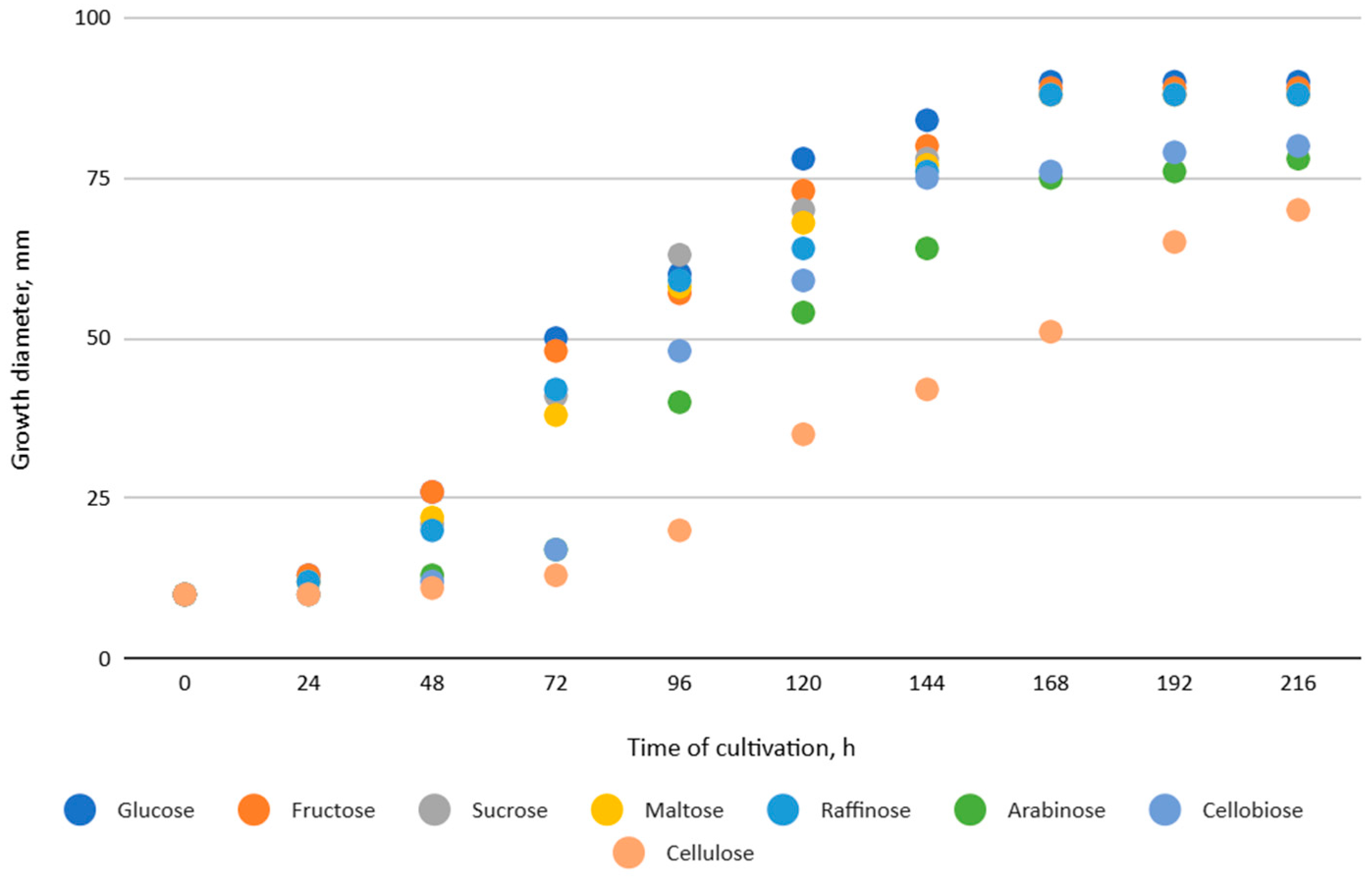
Xylaria karsticola grew on all tested carbon sources, demonstrating broad metabolic versatility (Figure 1 and Table 2A,B). The most rapid and robust mycelial development occurred on glucose, fructose, sucrose, maltose, and raffinose.
Substrate mycelium expanded radially from the colony center, forming interwoven structures, while aerial mycelium appeared white and velvety within 24–48 h (Table 2A). The culture showed the highest initial growth rates, with colony diameters doubling to 20 mm within 48 h, followed by sustained expansion and almost full Petri dish coverage within 144 h. Glucose supported central pigmentation in later stages, whereas fructose produced similar growth without pigment. Maltose, sucrose and raffinose promoted rapid, uniform expansion, peaking between 96 and 120 h, during which the colony expanded by approximately 4 mm per day, followed by gradual decreases in mycelial density, with an average radial increase of about 2 mm per day, likely due to depletion of the available substrate. Differences among these carbon substrates were primarily in mycelial density, and pigment formation. Our observations suggest that pigment formation in X. karsticola reflects the physiological maturity of the culture. The use of pigment-producing cultures appears to promote faster adaptation to new growth conditions, as evidenced by a shortened lag phase and accelerated subsequent growth. This indicates that pigment production may be associated with metabolic readiness and enhanced developmental capacity in X. karsticola.
Cultivation of X. karsticola on arabinose—and cellobiose-containing medium (Table 2B)—demonstrated moderate growth, and even after 216 h there was no full Petri dish coverage. When arabinose was used, the colony diameter increased by only 7 mm after 72 h. The mycelium displayed a wavy morphology, with colonies forming raised concentric margins resembling a floral pattern. These colonies exhibited an atypical structure and did not produce pigment. X. karsticola grew moderate on cellobiose, indicating slower efficiency in utilizing this disaccharide compared to simpler sugars. Nevertheless, the fungus formed dense, white mycelium, suggesting active biomass accumulation despite reduced radial expansion. Colony growth plateaued after 192 h, likely reflecting nutrient limitation. Although X. karsticola grows robustly on woody substrates in its natural habitat, growth on cellulose as the sole carbon source was limited. Aerial mycelium was sparse, and colony diameter doubled only after 96 h. This likely reflects the slow enzymatic hydrolysis of cellulose and the absence of complementary nutrients present in wood that support rapid mycelial development.
The relatively rapid assimilation of glucose, fructose, saccharose, and maltose indicates a flexible carbon metabolism that could be advantageous for cultivation and different biotechnological applications. The type of carbon source influences not only mycelial biomass accumulation but also the metabolic profile and yield of bioactive secondary metabolites produced by the fungus. Liu et al. [56] applied the one-factor-at-a-time method and evaluated the mycelial biomass growth of Xylaria striata by measuring mycelial dry weight. Their results indicated that maltose, glucose, or corn powder served as optimal carbon sources, which is consistent with our findings. In this study, glucose was selected as the primary carbon source, providing a baseline for growth of X. karsticola and its metabolic evaluation. Future investigations will examine the effects of alternative carbon sources on mycelial development and metabolite production.

3.2. Screening of Nutrient Media and Composition Optimization

Cultivation optimization is a key strategy to enhance both mycelial biomass and metabolite production. Given the critical role of nutrient composition, five media formulations with glucose as carbon source were evaluated for their ability to support mycelial growth under submerged cultivation, and the results are presented in Table 3.
As shown in Table 3, mycelial biomass production varied among the tested media, with the highest values observed on MYB (10.8 g/dm3) and MCM (9.9 g/dm3). In contrast, PDB, MEB, and CDB supported comparatively lower biomass accumulation. These findings suggest that media containing complex nutrient components, particularly yeast extract, malt extract and peptone, may better support the growth of X. karsticola.
As mentioned above, the nutritional preferences of X. karsticola have not been previously investigated, which complicates direct comparison with our findings. Studies on other species within the genus Xylaria are also limited; however, several investigations have been reported. Prior to exploring Xylaria papulis as a potential and sustainable source of bioactive compounds with high functional activity, López et al. [57] first investigated the optimal liquid media and physical culture conditions for mycelial growth of endophytic fungi Xylaria sp. BCC 1067. Among the media evaluated—potato sucrose broth, corn meal broth, rice bran broth, and coconut water—the highest mycelial biomass was obtained in potato sucrose broth. Similarly, Jayasekara et al. [58] reported that yeast extract sucrose medium supported higher biomass production, whereas the highest biological activity was observed in a malt extract peptone medium, highlighting the influence of culture medium composition on both growth and functional performance. Liquid fermentation of Xylaria longipes on PDB and glucose peptone yeast resulted in different secondary metabolites anti-psoriasis potential [32].
Overall, our results provide preliminary insights into the nutritional requirements and growth behavior of X. karsticola and may serve as a useful reference for future studies on this species and other related Xylaria taxa. Based on their superior performance, MYB and MCM were selected for subsequent optimization experiments aimed at refining nutrient composition and improving biomass yield.
The composition of the MCM and MYB media was optimized using an orthogonal central composite design of the 23 type, with star points and a block structure. The star arm length was set at ±α = 1.28719. The response variable selected was the amount of absolutely dry biomass, expressed in g/dm3.
The region containing the optimum of the regression model was defined as quasi-stationary and is characterized by pronounced nonlinearity:
Y = b 0 + i = 1 k b i X i + 1 < j < i < k k b i j X i X j + i = 1 n b i i X i 2
A single-factor experiments were conducted to assess the effects of independent variables (factors), and the corresponding variation ranges were determined. The defined ranges for each medium are presented in Table 4 and Table 5.
The experimental design for the two selected media was generated using Statgraphics Centurion XVIII® software (Version 18.1.16) and are presented in Table 6 and Table 7.
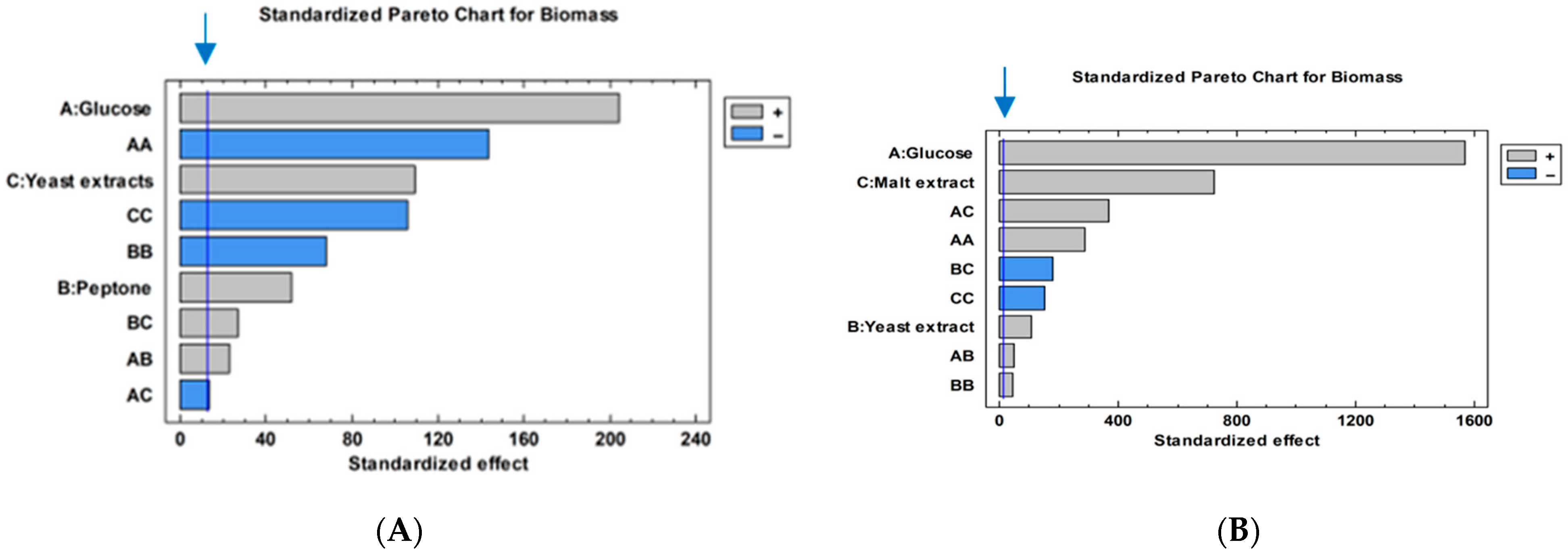
A Pareto chart was constructed to evaluate the statistical significance and effects of independent factors of MCM and MYB on X. karsticola biomass yield; it also showed the interaction strength between each independent variable (Figure 2). According to the Pareto chart (Figure 2A), glucose, yeast extract, and peptone demonstrate a statistically significant positive effect on the development of X. karsticola when cultivated in MCM.
A positive effect on fungal biomass accumulation was also observed for the combined effects of peptone with yeast extract and peptone with glucose. In contrast, the combined effect of glucose and yeast extract was found to be statistically insignificant. As a result of this analysis, the following quadratic mathematical model describing X. karsticola biomass yield in MCM was developed:
Biomass = −18.2068 + 0.927325*Glu + 2.68178*P + 5.56438*YE − 0.00974099*Glu^2 + 0.0129453*Glu*P − 0.462471*P^2 + 0.150078*P*YE − 0.722127*YE^2
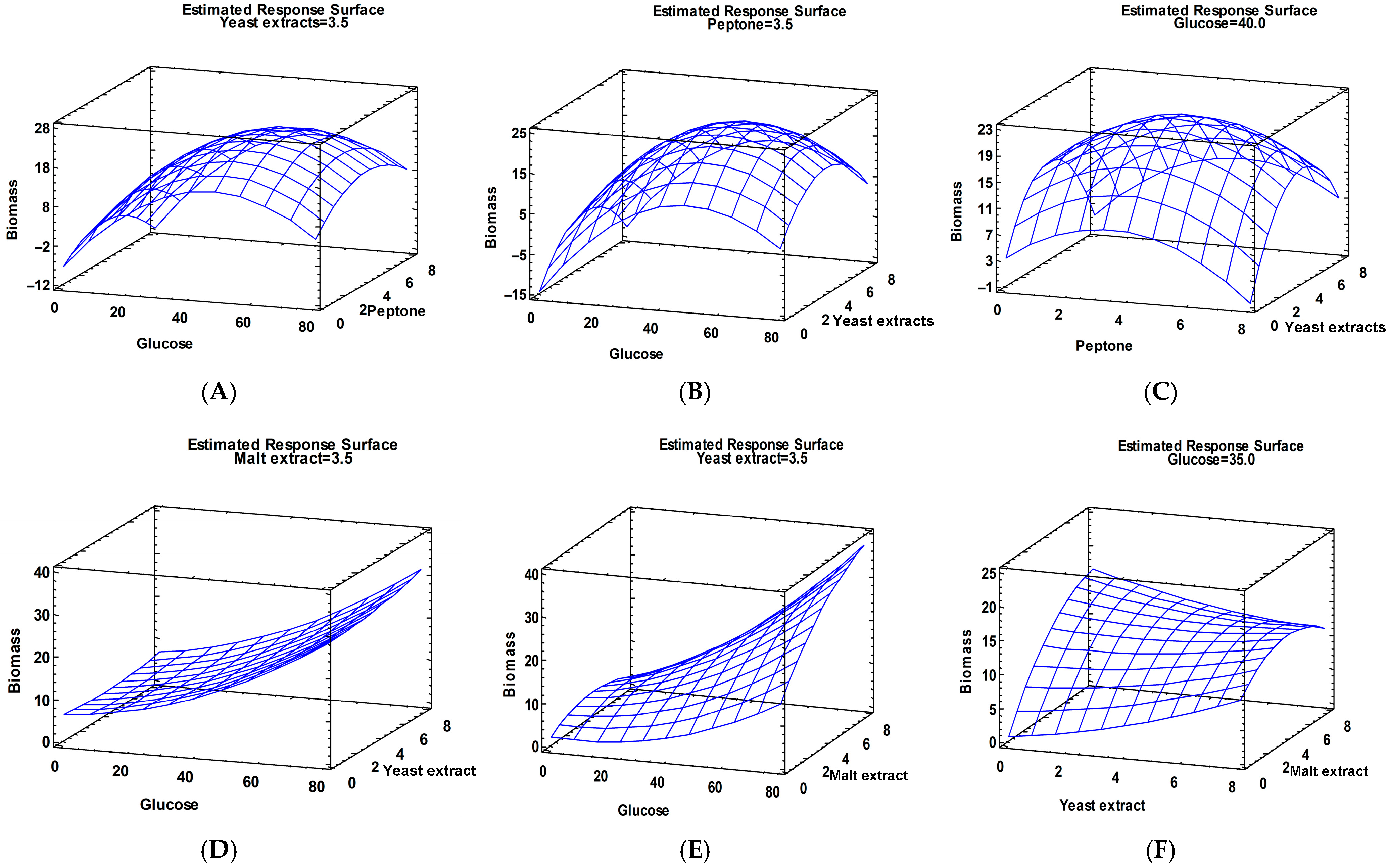
From the response surface plots (Figure 3A–C) and the derived quadratic model, it is evident that increasing the concentrations of glucose, yeast extract, and peptone leads to a decrease in the biomass yield of X. karsticola. This trend is further supported by the negative values of the quadratic coefficients for glucose, peptone, and yeast extract, indicating an inhibitory effect of higher concentrations of these components on biomass production.
An analysis of the Pareto diagram (Figure 2B) revealed that glucose, malt extract, and yeast extract exerted a statistically significant positive effect on the growth of X. karsticola in MYB medium. Biomass accumulation of the strain cultivated in MYB medium was likewise positively influenced by the combined effects of glucose with malt extract, glucose with yeast extract, elevated glucose concentration, and yeast extract as an individual factor. In contrast, a negative effect on biomass production was observed for the combined factors yeast extract–malt extract and the doubling of malt extract concentration.
Based on these findings, the quadratic mathematical model describing biomass growth in MYB is expressed as follows:
Biomass = −0.0490127 − 0.0733714*Glu + 0.371431*YE + 2.58111*ME + 0.00270046*Glu^2 + 0.004785*Glu*YE + 0.035765*Glu*ME + 0.0645289*YE^2 − 0.21925*YE*ME − 0.225931*ME^2
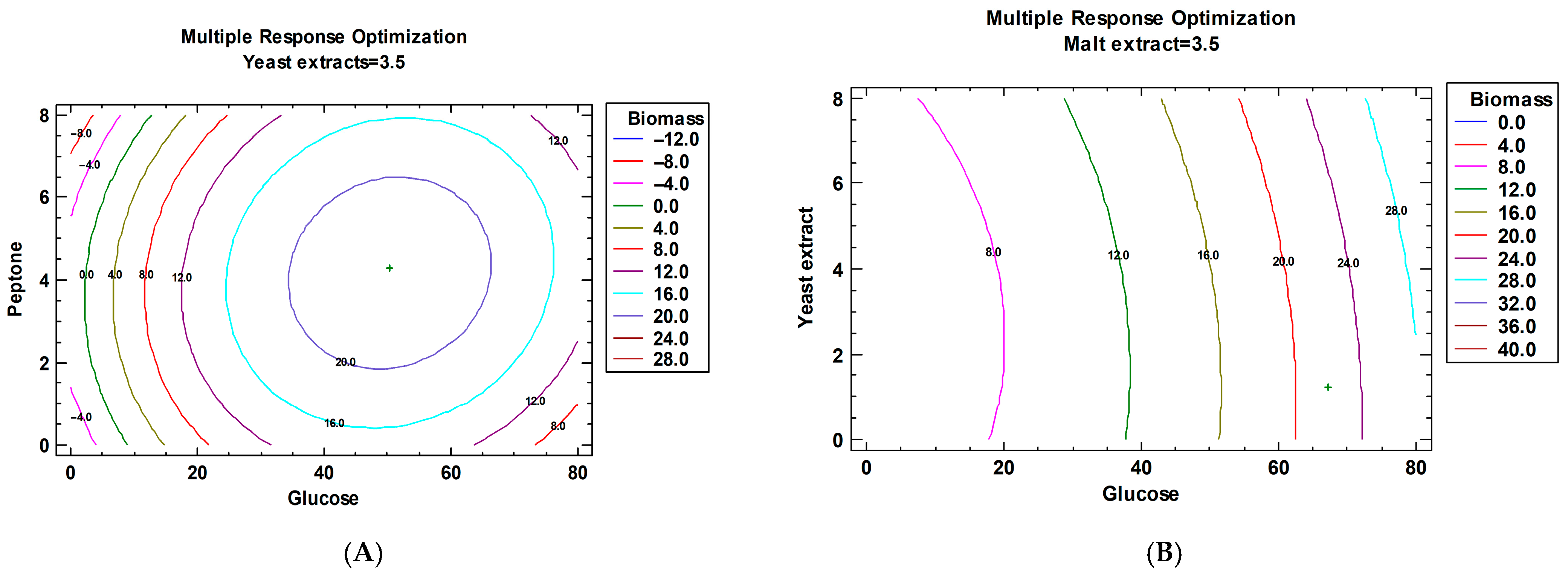
The estimated response surface charts are presented in Figure 3 and illustrate the combined effects and interactions of the components of MCM and MYB on biomass production, revealing distinct regions associated with maximal responses. These trends were subsequently integrated using multiple response optimization (Figure 4), which identified the optimal combination of factor levels yielding the highest predicted biomass.
The optimized compositions of the MCM and MYB media (Table 8 and Table 9) reveal distinct nutrient requirements for maximal biomass production. In both media, glucose emerged as a key factor influencing fungal growth; however, its optimal concentration differed markedly between the two formulations. In the MCM (Table 8), the optimal glucose concentration (50.46 g/dm3) was close to, but not at, the upper limit of the tested range, indicating that high carbon availability enhances biomass accumulation up to a threshold beyond which substrate inhibition is observed. A similar trend is observed for the nitrogen sources. These results indicate that, in MCM, the balance between the carbon and nitrogen sources plays a critical role in biomass production.
In contrast, the optimization of the MYB medium (Table 9) resulted in an optimal glucose concentration corresponding to the upper boundary of the investigated range (67.18 g/dm3), suggesting that glucose was the primary growth-limiting factor under these conditions. This result indicates a stronger dependence on carbon supply in MYB compared with MCM.
Differences were also observed in the optimal nitrogen and complex nutrient sources. In the MCM, the optimal concentrations of peptone and yeast extract were intermediate within the tested ranges (approximately 4.30 g/dm3), implying that balanced nitrogen supplementation is required to support efficient growth without inhibitory effects. Conversely, in the MYB medium, the optimal yeast extract concentration was relatively low (1.24 g/dm3), whereas the malt extract was optimal at its highest tested level (6.07 g/dm3). This combination suggests that malt extract may provide additional growth-promoting components, such as vitamins or trace elements, reducing the need for higher yeast extract supplementation.
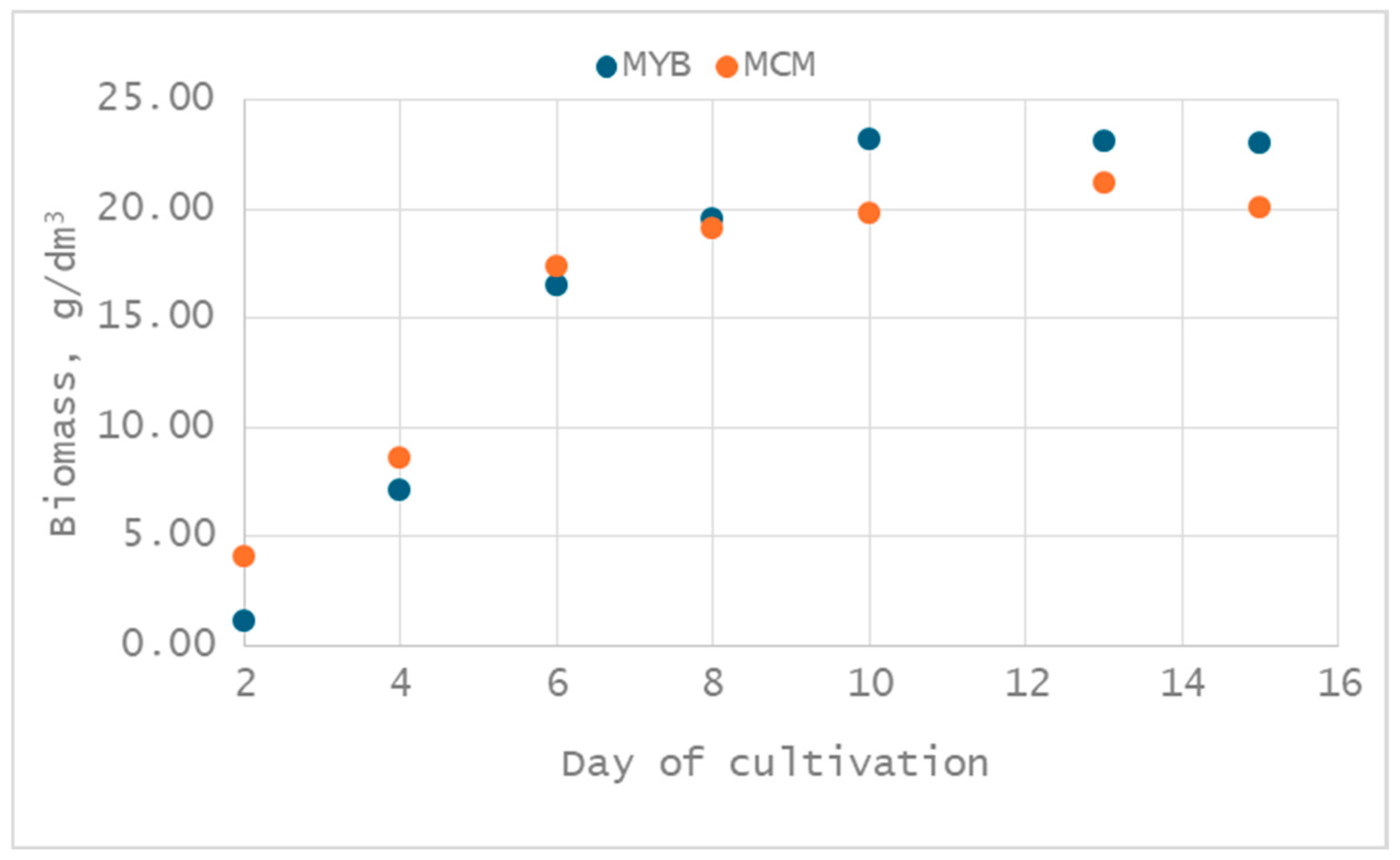
Overall, the optimized media compositions underscore the importance of medium-specific nutrient balancing. While both formulations rely heavily on glucose as the principal carbon source, the contrasting requirements for nitrogen and complex extracts highlight differences in nutrient utilization pathways and growth kinetics, consistent with the observed variations in biomass accumulation between MCM and MYB media. After establishing the optimal composition of the two studied media, a cultivation process was carried out to confirm the optimal composition. The dynamics of biomass change in the two optimized nutrient media were monitored, and the results of the studies conducted are shown in Figure 5.
A comparative analysis of the growth kinetics in MYB and MCM media demonstrates clear differences in both the rate and extent of biomass accumulation. In both media intensive growth was observed from the early stages of cultivation; however, MYB supported a more rapid transition to the stationary phase. In the MYB medium, active biomass accumulation occurred up to day 10, at which point a high biomass concentration of approximately 23.25 g/dm3 was achieved and subsequently maintained with minimal variation until the end of cultivation. This rapid attainment of maximal biomass suggests that MYB provides a more readily assimilable nutrient composition, enabling earlier saturation of fungal growth. In contrast, cultivation in the MCM resulted in a more prolonged growth phase, with biomass accumulation continuing until day 13 and reaching a slightly lower maximum concentration of 21.24 g/dm3. Although the final biomass concentration decreased marginally to 20.11 g/dm3, the extended growth period indicates slower but sustained nutrient utilization in MCM. Consequently, the optimal cultivation time for biomass production in MCM is longer than in MYB, reflecting differences in medium composition and nutrient availability. Importantly, validation experiments confirmed that optimization of both media led to substantial improvements in biomass yield compared with their non-optimized counterparts. The optimized MYB medium resulted in a markedly higher biomass concentration (23.25 g/dm3) relative to the non-optimized MYB (10.8 g/dm3), while a similar enhancement was observed for MCM, where biomass increased from 9.9 g/dm3 in the non-optimized medium to over 20 g/dm3 following optimization. Overall, MYB proved to be more efficient for rapid biomass accumulation, whereas MCM supported extended growth with a slightly lower maximum yield, underscoring the importance of medium-specific optimization strategies for fungal cultivation.
Liu et al. [58] employed an orthogonal experimental design and determined that maltose (4%) and soybean powder (0.8%) were the optimal carbon and nitrogen sources that supported the mycelial growth of X. stirata. Under those conditions, the highest mycelial biomass was achieved at pH 7, with shaking at 25 °C for 13 days. Culture condition optimization was applied for improving the productivity of 19, 20-Epoxy-cytochalasin Q (B5A) in Xylaria sp. sof11 by Zhang et al. [59]. The effects of major medium components, including the carbon and organic nitrogen sources, as well as the concentration of sea salt, were, respectively, investigated through single-factor experiments. As a result, sucrose and fish meal were determined to be the key factors affecting the production of B5A. Response surface analysis confirmed the optimal levels of response variables, which were sucrose, fish meals and filling volume. Eucalyptene A production by Xylaria sp. 2508 was optimized using response surface analysis, which identified glucose (2.86% w/v), peptone (0.78% w/v) and yeast extract (0.35% w/v) as the optimal medium components. Under these conditions, eucalyptene A reached a yield of 4.89 × 10⁻⁷ g/cm3 [60].

3.3. Modeling of the Mycelium Growth Kinetics

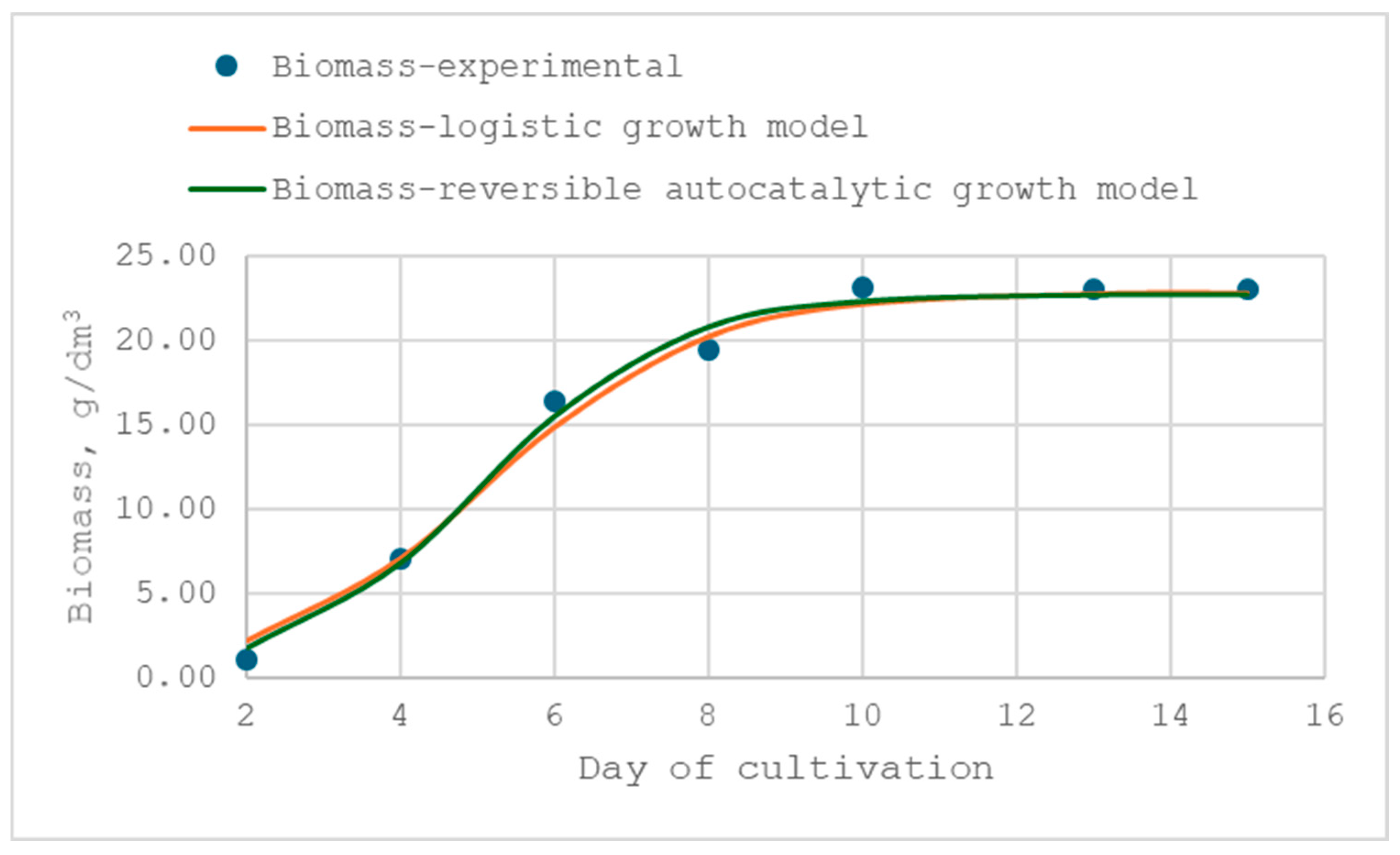
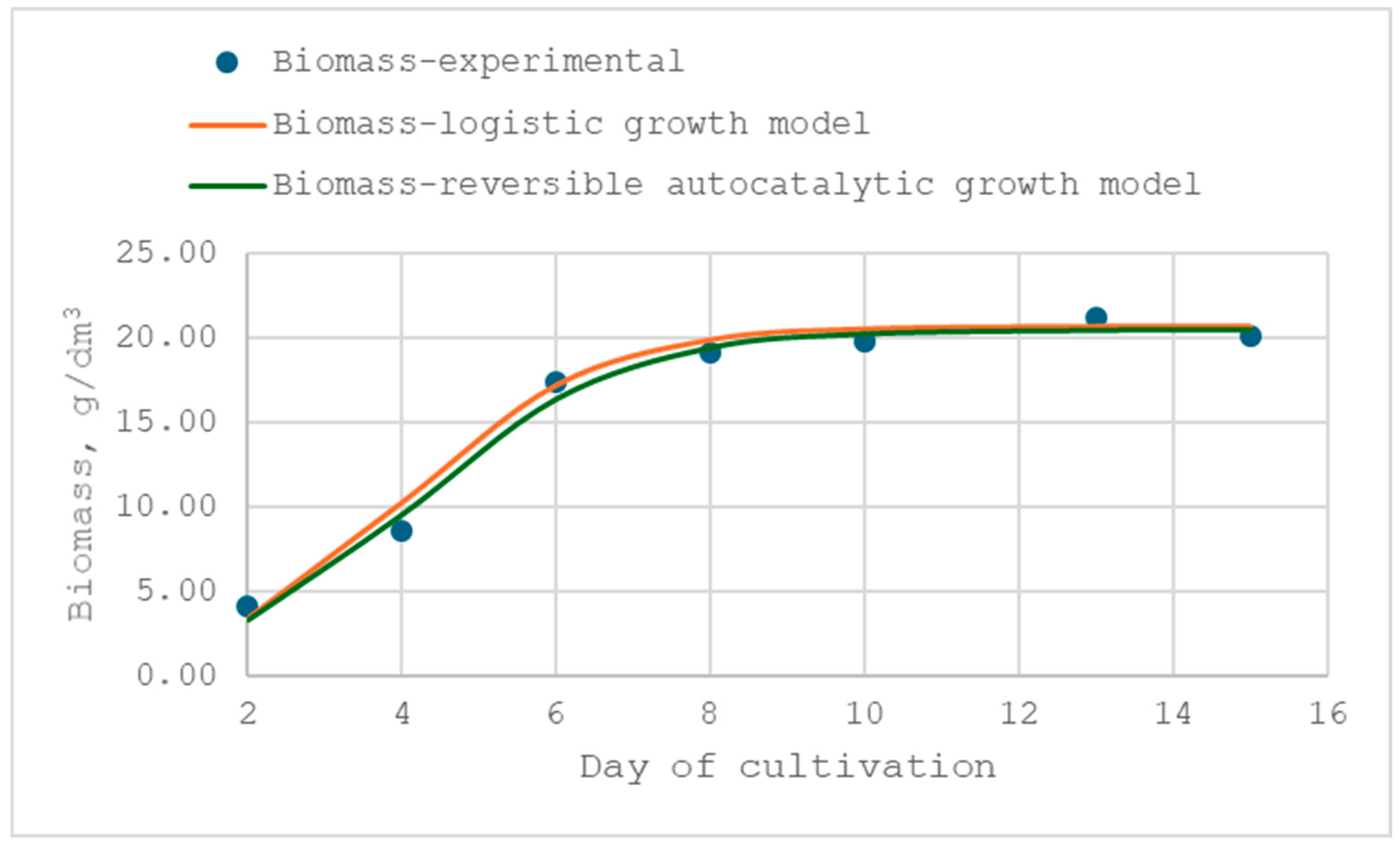
A comprehensive understanding of process kinetics is crucial for the successful biotechnological application of fungi. The logistic curve and reversible autocatalytic growth models were used to model the kinetics of the growth of X. karsticola in submerged cultivation in the previously optimized media. The main observed quantity by which the growth of the fungus was modelled was the biomass. A comparison of the experimental data and those from the models was made, and the results of this comparison could be seen in Figure 6 and Figure 7, and the identified kinetic parameters of the models are presented in Table 10.
The data presented in the figures demonstrate that the applied kinetic models describe the experimental results with high accuracy, as confirmed by the high correlation coefficients. For both media, the coefficients of determination (R2) ranged from 0.9868 to 0.9963, indicating an excellent fit between the predicted and experimental values. This confirms the suitability of the selected kinetic model for quantitative characterization of the growth dynamics under the tested conditions. An analysis of the estimated kinetic parameters revealed distinct differences in the growth behavior of X. karsticola depending on the cultivation medium. The fungus exhibited a higher maximum specific growth rate in the MCM (µmax = 0.803 ± 0.004 d−1) compared with MYB medium (µmax = 0.711 ± 0.003 d−1). In contrast, no statistically significant difference was observed for the biomass formation rate constant, with comparable values obtained for MYB (0.0363 ± 0.0012 d−1) and MCM (0.0359 ± 0.0004 d−1).
A comparison of the two maximum growth rates shows that the absolute difference between the two optimized media is small—Δμmax is 0.091 d−1. This corresponds to an approximately 13% increase in µmax in the MCM relative to MYB. This slight acceleration of growth in the initial stages of the process carried out in the MCM does not represent a significant advantage in the industrial cultivation of the strain for the production of biomass and biologically active products. In practical terms, such a difference would result in only a marginal reduction in cultivation time under batch conditions. This conclusion is also confirmed by the close values of the statistically insignificant rate constants of biomass formation, which are 0.0363 ± 0.0012 d−1 and 0.0359 ± 0.0004 d−1 for MYB and MCM media, respectively. Therefore, although statistically significant, the higher µmax in MCM should be interpreted as biologically measurable but technologically moderate.
The kinetic parameters summarized in Table 10 further indicate that the substrate reserve expressed in cellular units in the optimized media is comparable to the experimentally achieved biomass concentrations. Specifically, the estimated substrate reserve (S′0) was higher for the MYB medium (23.05 ± 0.08 g/dm3) than for the MCM (21.27 ± 0.04 g/dm3), which accounts for the observed differences in final biomass concentrations. The composition of the MYB medium thus provides a larger pool of readily assimilable substrates, supporting higher biomass accumulation relative to MCM. This finding is particularly relevant for applications where final biomass yield, rather than rapid initial growth, is the primary objective.
A statistically significant difference was also observed in the substrate utilization efficiency coefficient (K/(1 + K)), which was higher in the MYB medium (0.9900 ± 0.001) than in the MCM (0.9644 ± 0.005), indicating more efficient substrate conversion into biomass under MYB conditions. Conversely, cultivation in the MCM was associated with a higher coefficient of intra-population competition (β = 0.0389 ± 0.0002 g/dm3·d) compared with the MYB medium (β = 0.0311 ± 0.0002 g/dm3·d). This suggests stronger competition among cells for available substrates in MCM, likely due to the lower substrate reserve per cellular unit in this medium. Together, these parameters provide mechanistic insight into the observed growth pat-terns and highlight how medium composition influences both growth kinetics and biomass yield.
In conclusion, the kinetic analysis indicates that although X. karsticola exhibits a higher maximum specific growth rate in MCM, the MYB medium is more suitable for cultivation aimed at maximizing biomass yield. The higher substrate availability and utilization efficiency in MYB ultimately compensate for the lower growth rate, resulting in superior biomass production compared with MCM. Importantly, the comparative kinetic characterization of the two optimized media provides a rational basis for medium selection depending on the intended biotechnological goal—rapid biomass accumulation versus maximal yield.
As mentioned above, the nutritional preferences of X. karsticola have not yet been investigated. Moreover, studies on other species within the genus Xylaria are limited, which makes direct comparison of our results challenging. Nevertheless, our findings provide novel baseline data on the nutritional preferences of this species and contribute to a broader understanding of metabolic diversity within the genus. Given the limited kinetic data available for representatives of this genus, the present study establishes quantitative reference parameters that may support future strain improvement, metabolic studies, and process scale-up.

3.4. Assessment of the Antibacterial Potential

Although many Xylaria species are recognized for producing bioactive secondary metabolites, the antimicrobial potential of Xylaria karsticola remains unexplored, motivating this study to evaluate its solvent-extractable compounds against bacteria and yeasts. The antimicrobial activity was evaluated using agar disk diffusion and minimal inhibitory concentration (MIC) assays against a panel of Gram-positive and Gram-negative bacteria, as well as yeasts (Table 11). Extracts were prepared from fungal biomass and culture liquid using solvents with different polarity to assess the contribution of chemically diverse metabolites.
Overall, the antimicrobial activity of X. karsticola extracts was selective and strongly dependent on both extraction solvent and target microorganism. The aqueous, methanolic, ethanolic, and butanolic biomass extracts did not exhibit measurable antibacterial effects, suggesting that highly polar constituents play a limited role in antibacterial activity under the tested conditions. A reported disk diffusion screening of methanolic and ethyl acetate extracts from multiple Xylaria isolates demonstrated selective antimicrobial activity, with inhibition primarily observed against Gram-positive bacteria and C. albicans, while Gram-negative bacteria were largely resistant [39,61]. Among the tested bacteria, the Gram-negative P. aeruginosa ATCC 9027 was the most susceptible organism. Several biomass-derived extracts demonstrated measurable inhibition zones, including methanol, butanol, hexane, ethyl acetate, and methylene chloride extracts, whereas culture liquid extracts were largely inactive. Inhibition zones of 8–9 mm, although only slightly larger than the 6 mm disk diameter, were consistently observed in independent replicates (Table 11). These values therefore represent weak but measurable antimicrobial activity rather than experimental variability. Nevertheless, they should be interpreted as low-intensity effects.
MIC data supported these results, with the hexane biomass extract exhibiting the strongest antibacterial activity (MIC = 0.067 mg/cm3), followed by the ethyl acetate extract (MIC = 0.59 mg/cm3) (Table 12). Certain Xylaria strains have been reported to display markedly stronger antibacterial activity, with MIC values in the low microgram per cm3 range against S. aureus and Pseudomonas species, emphasizing the variability in antimicrobial potency across the genus [62,63,64].
Most other Gram-negative bacteria, including E. coli, S. enterica, P. vulgaris, and K. pneumoniae were resistant to all tested extracts, with only weak inhibition observed for E. coli using methylene chloride biomass extract. Several other authors report lack of antimicrobial activity against E. coli. In an investigation of the antimicrobial activity of methanol and ethyl acetate extracts derived from six fungal isolates, including Xylaria sp., none of the isolates inhibited the Gram-negative test microorganisms [61]. The same result was observed for the lipophilic and aqueous methanolic crude extracts of Xyleria feejeensis [65]. The crude extract of Xylaria venustula biomass exhibited MIC of 5 mg/cm3, which is comparable to the results for the methylene chloride biomass extract in this study [66].
Moderate antibacterial effects were also observed against the Gram-positive Bacillus species. Bacillus subtilis ATCC 6633 was inhibited by ethyl acetate biomass extract, corresponding to an MIC of 1.66 mg/cm3, while B. cereus ATCC 11778 was susceptible to ethyl acetate culture liquid extract, with an MIC of 6.25 mg/cm3. Comparable solvent-dependent activity has been described for endophytic Xylaria isolates, where ethyl acetate extracts frequently exhibited higher potency than polar extracts against both Gram-positive and Gram-negative bacteria [67].
No inhibitory activity was detected against the rest of the Gram-positive bacteria, including S. aureus ATCC 25923 in this study. The only exception is the weak activity of the methylene chloride extracts against L. monocytogenes. This contrasts with reports of strong activity against S. aureus in some Xylaria strains and highlights the strain- and species-specific nature of antimicrobial metabolite production. For example, crude ethyl acetate extracts of wild Xylaria sp. strain R005 showed moderate activity against multidrug-resistant S. aureus and P. aeruginosa (MIC = 120–625 µg/cm3) [67]. Canli et al. (2016) reported on inhibition zones of 16 mm against S. aureus [68], and Santiago et al. determined an MIC of 2.5 mg/cm3 for Xylaria venustula against S. aureus [66].
Several extracts demonstrated antifungal or anti-yeast activity, particularly against Candida albicans ATCC 10231 and non-Candida yeasts. Inhibition of C. albicans was observed for ethyl acetate, methylene chloride, and butanol extracts, with the MIC value for the butanol culture liquid extract indicating low-to-moderate antifungal potency. Stronger activity was observed against W. anomalus, S. ludwigii, and P. membranifaciens, with particularly low MIC values of the water biomass extract and hexane culture liquid extract against S. ludwigii and P. membranifaciens, suggesting potent anti-yeast metabolites. The lowest value was observed for the water biomass extract against S. ludwigii—0.02 mg/cm3. Such yeast-targeted activity has received less attention in prior studies, which have largely focused on filamentous fungi or clinically relevant pathogens. The antifungal activity is consistent with the known ability of Xylaria species to produce polyketide-derived secondary metabolites. Chemical studies of Xylaria liquid cultures have identified griseofulvin and dechlorogriseofulvin as major antifungal constituents, exhibiting strong activity against multiple phytopathogenic fungi [39]. However, no chemical characterization of the extracts was performed in the present study; therefore, the specific compounds responsible for the observed activity remain to be identified.
Xylaria species produce a wide range of structurally diverse secondary metabolites with documented antimicrobial activity. Most bioactive compounds fall into major classes, including polyketides, terpenoids, nitrogen-containing metabolites, lactones, and other small heterocyclic molecules [40]. Polyketides, including griseofulvin-type derivatives, are the best characterized antimicrobial class, showing strong antifungal and moderate antibacterial activity [39,40]. The anti-yeast and moderate antifungal effects observed for X. karsticola extracts, particularly in ethyl acetate and methylene chloride fractions, could hypothetically be associated with polyketide-type compounds; however, this assumption requires experimental confirmation. Terpenoids and terpenoid hybrids, frequently reported from Xylaria, have demonstrated weak to moderate antibacterial activity [37] and could potentially contribute to the inhibition of Bacillus spp. and P. aeruginosa. Nitrogen-containing metabolites, lactones, and other small heterocyclic molecules (e.g., pyranones, phthalides) have been reported to exhibit antimicrobial properties and might act additively or synergistically, which could partly explain the selective antimicrobial profile [37,40].
Although comparative data for Xylaria species remain limited, previously reported studies indicate considerable variability in antimicrobial potential within the genus. Reported antimicrobial activities range from weak to pronounced effects depending on species, extraction method, and target organism. However, differences in cultivation conditions and assay methodologies complicate direct quantitative comparisons. Within this context, the present study represents the first comprehensive evaluation of X. karsticola antimicrobial activity using both disk diffusion and MIC assays. Unlike many previously investigated Xylaria species, X. karsticola exhibited a distinct profile: moderate antibacterial activity against P. aeruginosa, coupled with pronounced anti-yeast activity against W. anomalus, S. ludwigii, and P. membranifaciens. The strong solvent-dependence of activity suggests the involvement of lipophilic secondary metabolites, highlighting X. karsticola as a previously unexplored source of bioactive fungal compounds.

4. Conclusions

This study provides the first insights into the in vitro nutritional preferences, mycelial growth kinetics and antimicrobial potential of the little-known fungicolous species Xylaria karsticola NBIMCC 9097, contributing to a broader understanding of the genus Xylaria. Optimization of culture medium composition and cultivation duration revealed that maximum biomass production was achieved using MYB media with an incubation period of 10 days. These findings establish a foundation for efficient mycelial growth and targeted bioactive metabolite production in X. karsticola. De novo whole-genome sequencing (WGS), genome annotation, and targeted gene mining in the future are expected to reveal how the genetic potential of this newly identified strain drives the directed biosynthesis of novel metabolites. Further work should focus on bioassay-guided fractionation of the most active solvent extracts to enable the isolation and structural characterization of bioactive compounds. In addition, investigating potential synergistic interactions among distinct metabolite classes may help elucidate the mechanisms underlying the observed selective antibacterial and antifungal activities.

Author Contributions

Conceptualization, G.A. and D.B.; methodology, B.G., M.B., Z.G., and D.B.; software, B.G. and M.B.; validation, N.K., Z.G., and P.S.; formal analysis, Z.G. and N.K.; investigation, Z.G.; resources, M.B.; data curation, B.G.; writing—original draft preparation, G.A., B.G., and D.B.; writing—review and editing, M.B., D.B., and G.A.; visualization, M.B.; supervision, G.A.; project administration, M.B.; funding acquisition, G.A. All authors have read and agreed to the published version of the manuscript.

Funding

This research was funded by the National Science Fund of Bulgaria under Contract No. KΠ-06-H87/9 from 6 December 2024 “Xylaria karsticola (Ascomycota)—cell-based cultivation and MULTI-OMICS approach for bioprospecting and revealing the potential for obtaining new bioactive metabolites with therapeutic properties”.

Institutional Review Board Statement

Not applicable.

Informed Consent Statement

Not applicable.

Data Availability Statement

Data is contained within the article.

Conflicts of Interest

The authors declare no conflicts of interest.

Abbreviations

The following abbreviations are used in this manuscript:
NBIMCCNational Bank of Industrial Microorganisms and Cell Cultures
MCMMushroom Complete Medium
MEBMalt extract broth
MYBMalt extract yeast extract broth
PDBPotato dextrose broth
CDBCzapek–Dox Broth
CCDCentral Composite Design
PTFEPolytetrafluoroethylene
ATCCThe American Type Culture Collection
CFUColony-Forming Unit
CLSIClinical and Laboratory Standards Institute
SDStandard deviation
GluGlucose
YEYeast extract
PPeptone
MICMinimal inhibitory concentration
BWEBiomass Water Extract
BMEBiomass Methanol Extract
BEEBiomass Ethanol Extract
BBEBiomass Buthanol Extract
BHEBiomass Hexane Extract
BEAEBiomass Ethyl Acetate Extract
BMCEBiomass Methylene Chloride Extract
CLMCECultural Liquid Methylene Chloride Extract
CLBECultural Liquid Buthanol Extract
CLHECultural Liquid Hexane Extract
CLEAECultural Liquid Ethyl Acetate Extract

References

  1. Dzobo, K. The role of natural products as sources of therapeutic agents for innovative drug discovery. Compr. Pharmacol. 2022, 408–422. [Google Scholar] [CrossRef]
  2. Aware, C.B.; Patil, D.N.; Suryawanshi, S.S.; Mali, P.R.; Rane, M.R.; Gurav, R.G.; Jadhav, J.P. Natural bioactive products as promising therapeutics: A review of natural product-based drug development. S. Afr. J. Bot. 2022, 151, 512–528. [Google Scholar] [CrossRef]
  3. Lee, S.-H. Therapeutic effects of natural products on human diseases. Life 2024, 14, 1166. [Google Scholar] [CrossRef]
  4. Atanasov, A.G.; Zotchev, S.B.; Dirsch, V.M.; Supuran, C.T. Natural products in drug discovery: Advances and opportunities. Nat. Rev. Drug Discov. 2021, 20, 200–216. [Google Scholar] [CrossRef]
  5. Nwobodo, D.C.; Ugwu, M.C.; Anie, C.O.; Al-Ouqaili, M.T.S.; Ikem, J.C.; Chigozie, V.U.; Saki, M. Antibiotic resistance: The challenges and some emerging strategies for tackling a global menace. J. Clin. Lab. Anal. 2022, 36, e24655. [Google Scholar] [CrossRef]
  6. Salam, M.A.; Al-Amin, M.Y.; Salam, M.T.; Pawar, J.S.; Akhter, N.; Rabaan, A.A.; Alqumber, M.A.A. Antimicrobial resistance: A growing serious threat for global public health. Healthcare 2023, 11, 1946. [Google Scholar] [CrossRef] [PubMed]
  7. Ahmed, S.K.; Hussein, S.; Qurbani, K.; Ibrahim, R.H.; Fareeq, A.; Mahmood, K.A.; Mohamed, M.G. Antimicrobial resistance: Impacts, challenges, and future prospects. J. Med. Surg. Public Health 2024, 2, 100081. [Google Scholar] [CrossRef]
  8. Schrey, H.; Lambert, C.; Stadler, M. Fungi: Pioneers of chemical creativity—Techniques and strategies to uncover fungal chemistry. IMA Fungus 2025, 16, e142462. [Google Scholar] [CrossRef] [PubMed]
  9. Dai, G.; Shen, Q.; Zhang, Y.; Bian, X. Biosynthesis of fungal natural products involving two separate pathway crosstalk. J. Fungi 2022, 8, 320. [Google Scholar] [CrossRef] [PubMed]
  10. Meshram, P.A.; Nischitha, R. Harnessing the bioactive potential of endophytic Xylaria species: A comprehensive review on natural drug discovery and biotechnological applications. Physiol. Mol. Plant Pathol. 2025, 140, 102963. [Google Scholar] [CrossRef]
  11. Paterson, R.R.M.; Solaiman, Z.; Santamaria, O. Guest edited collection: Fungal evolution and diversity. Sci. Rep. 2023, 13, 21438. [Google Scholar] [CrossRef]
  12. Wall, G.; Lopez-Ribot, J.L. Current antimycotics, new prospects, and future approaches to antifungal therapy. Antibiotics 2020, 9, 445. [Google Scholar] [CrossRef]
  13. Karwehl, S.; Stadler, M. Exploitation of fungal biodiversity for discovery of novel antibiotics. Curr. Top. Microbiol. Immunol. 2017, 398, 303–338. [Google Scholar] [CrossRef]
  14. Niño-Vega, G.A.; Padró-Villegas, L.; López-Romero, E. New ground in antifungal discovery and therapy for invasive fungal infections: Innovations, challenges, and future directions. J. Fungi 2024, 10, 871. [Google Scholar] [CrossRef] [PubMed]
  15. Spiteller, P. Chemical defence strategies of higher fungi. Chem. Eur. J. 2008, 14, 9100–9110. [Google Scholar] [CrossRef]
  16. Bills, G.F.; Gloer, J.B. Biologically active secondary metabolites from the fungi. Microbiol. Spectr. 2016, 4, FUNK-0009-2016. [Google Scholar] [CrossRef] [PubMed]
  17. Sun, J.-Z.; Liu, X.-Z.; McKenzie, E.H.C.; Jeewon, R.; Li, Y.-L.; Lin, C.-G.; Tian, Q. Fungicolous fungi: Terminology, diversity, distribution, evolution, and species checklist. Fungal Divers. 2019, 95, 337–430. [Google Scholar] [CrossRef]
  18. Maurice, S.; Arnault, G.; Nordén, J.; Botnen, S.S.; Miettinen, O.; Kauserud, H. Fungal sporocarps house diverse and host-specific communities of fungicolous fungi. ISME J. 2021, 15, 1445–1457. [Google Scholar] [CrossRef] [PubMed]
  19. Pan, R.; Bai, X.; Chen, J.; Zhang, H.; Wang, H. Exploring structural diversity of microbe secondary metabolites using the OSMAC strategy: A literature review. Front. Microbiol. 2019, 10, 294. [Google Scholar] [CrossRef]
  20. Shin, H.-J.; Ro, H.-S.; Kawauchi, M.; Honda, Y. Review on mushroom mycelium-based products and their production process: From upstream to downstream. Bioresour. Bioprocess. 2025, 12, 3. [Google Scholar] [CrossRef]
  21. Rämä, T.; Quandt, C.A. Improving fungal cultivability for natural products discovery. Front. Microbiol. 2021, 12, 706044. [Google Scholar] [CrossRef] [PubMed]
  22. Bakratsas, G.; Polydera, A.; Katapodis, P.; Stamatis, H. Recent trends in submerged cultivation of mushrooms and their application as a source of nutraceuticals and food additives. Future Foods 2021, 4, 100086. [Google Scholar] [CrossRef]
  23. Krupodorova, T.; Barshteyn, V.; Sekan, A. Review of the basic cultivation conditions influence on the growth of basidiomycetes. Curr. Res. Environ. Appl. Mycol. 2021, 11, 494–531. [Google Scholar] [CrossRef]
  24. Tang, Y.-J.; Zhu, L.-W.; Li, H.-M.; Li, D.-S. Submerged culture of mushrooms in bioreactors—Challenges, current state-of-the-art, and future prospects. Food Technol. Biotechnol. 2007, 45, 221–229. [Google Scholar]
  25. Röhrich, C.R.; Iversen, A.; Jaklitsch, W.M.; Voglmayr, H.; Vilcinskas, A.; Nielsen, K.F.; Thrane, U.; von Döhren, H.; Brückner, H.; Degenkolb, T. Screening the biosphere: The fungicolous fungus Trichoderma phellinicola, a prolific source of hypophellins, new 17-, 18-, 19-, and 20-residue peptaibiotics. Chem. Biodivers. 2013, 10, 787–812. [Google Scholar] [CrossRef]
  26. Kaur, A.; Rogers, K.D.; Swenson, D.E.; Dowd, P.F.; Wicklow, D.T.; Gloer, J.B. Bioactive natural products from fungicolous Hawaiian isolates: Secondary metabolites from a Phialemoniopsis sp. Mycology 2014, 3, 120–129. [Google Scholar] [CrossRef][Green Version]
  27. Rogers, J.; Ju, Y.-M. The Xylariaceae of the Hawaiian Islands. N. Am. Fungi 2012, 7, 1–35. [Google Scholar] [CrossRef]
  28. Fournier, J.; Flessa, F.; Persoh, D.; Stadler, M. Three new Xylaria species from southwestern Europe. Mycol. Prog. 2011, 10, 33–52. [Google Scholar] [CrossRef]
  29. Fournier, J. Update on European Species of Xylaria. Available online: http://www.ascofrance.fr/uploads/xylaria/201406.pdf (accessed on 10 January 2026).
  30. Cañón, E.R.P.; de Albuquerque, M.P.; Alves, R.P.; Pereira, A.B.; Victoria, F.d.C. Morphological and molecular characterization of three endolichenic isolates of Xylaria. Plants 2019, 8, 399. [Google Scholar] [CrossRef] [PubMed]
  31. Angelova, G.; Stefanova, P.; Brazkova, M.; Krastanov, A. Molecular and morphological characterization of Xylaria karsticola. PLoS ONE 2023, 18, e0287679. [Google Scholar] [CrossRef]
  32. Zhao, Z.-Z.; Wang, Y.; Wang, X.-Y.; Chen, H.; Wang, Z.-Z.; Wang, J.-K.; Wang, L.-L.; Shen, M.-J.; Pang, X.; Feng, W.-S. Diverse metabolites with anti-psoriasis potential from different fermentations of the fungicolous fungus Xylarialongipes HFG1018. IMA Fungus 2025, 16, e153522. [Google Scholar] [CrossRef] [PubMed]
  33. Elhamouly, N.A.; Hewedy, O.A.; Zaitoon, A.; Miraples, A.; Elshorbagy, O.T.; Hussien, S.; El-Tahan, A.; Peng, D. The hidden power of secondary metabolites in plant–fungi interactions and sustainable phytoremediation. Front. Plant Sci. 2022, 13, 1044896. [Google Scholar] [CrossRef]
  34. Sun, J.-Z.; Liu, X.-Z.; Jeewon, R.; Li, Y.-L.; Lin, C.-G.; Tian, Q.; Zhao, Q.; Xiao, X.-P.; Hyde, K.-D.; Nilthong, S. Fifteen fungicolous ascomycetes on edible and medicinal mushrooms in China and Thailand. Asian J. Mycol. 2019, 2, 129–169. [Google Scholar] [CrossRef]
  35. Liu, D.; He, X.; Chater, C.; Perez-Moreno, J.; Yu, F. Microbiome community structure and Functional Gene Partitioning in different micro-niches within a sporocarp-forming fungus. Front. Microbiol. 2021, 12, 629352. [Google Scholar] [CrossRef]
  36. Deshmukh, S.K.; Sridhar, K.R.; Saxena, S.; Gupta, M.K. Recent advances in the discovery of bioactive metabolites from Xylaria. In Biology, Cultivation and Applications of Mushrooms; Arya, A., Rusevska, K., Eds.; Springer: Singapore, 2022; pp. 59–92. [Google Scholar] [CrossRef]
  37. Becker, K.; Stadler, M. Recent progress in biodiversity research on the Xylariales and their secondary metabolism. J. Antibiot. 2021, 74, 1–23. [Google Scholar] [CrossRef]
  38. Pham, N.S.; Le, T.T.X.; Pham, Q.A.; Vu, T.H.N.; Quach, N.T.; Nguyen, T.T.L.; Do, T.T.; Do, H.A.; Tran, H.Q.; Chu, K.-S.; et al. The Cytotoxicity and Antioxidant Potentials of the Endophytic Fungus Xylaria sp. KET18 Associated with Keteleeria evelyniana Mast. Appl. Sci. 2024, 14, 11070. [Google Scholar] [CrossRef]
  39. Rakshith, D.; Gurudatt, D.M.; Rao, H.Y.; Mohana, N.C.; Nuthan, B.R.; Ramesha, K.P.; Satish, S. Bioactivity-Guided Isolation of Antimicrobial Metabolite from Xylaria sp. Process Biochem. 2020, 92, 378–385. [Google Scholar] [CrossRef]
  40. Chen, W.; Yu, M.; Chen, S.; Gong, T.; Xie, L.; Liu, J.; Bian, C.; Huang, G.; Zheng, C. Structures and Biological Activities of Secondary Metabolites from Xylaria spp. J. Fungi 2024, 10, 190. [Google Scholar] [CrossRef]
  41. Chapla, V.M.; Zeraik, M.L.; Cafeu, M.C.; Silva, G.H.; Cavalheiro, A.J.; Bolzani, V.S.; Young, M.C.M.; Pfenning, L.H.; Araujo, A.R. Griseofulvin, Diketopiperazines and Cytochalasins from Endophytic Fungi Colletotrichum crassipes and Xylaria sp., and Their Antifungal, Antioxidant and Anticholinesterase Activities. J. Braz. Chem. Soc. 2018, 29, 1707–1713. [Google Scholar] [CrossRef]
  42. Chen, H.P.; Li, J.; Zhao, Z.Z.; Li, X.; Liu, S.-L.; Wang, Q.-Y.; Liu, J.-K. Diterpenes with Bicyclo[2.2.2]octane Moieties from the Fungicolous Fungus Xylaria longipes HFG1018. Org. Biomol. Chem. 2020, 18, 2410–2415. [Google Scholar] [CrossRef]
  43. Chen, H.P.; Zhao, Z.Z.; Cheng, G.G.; Zhao, K.; Han, K.-Y.; Zhou, L.; Feng, T.; Li, Z.-H.; Liu, J.-K. Immunosuppressive Nor-Isopimarane Diterpenes from Cultures of the Fungicolous Fungus Xylaria longipes HFG1018. J. Nat. Prod. 2020, 83, 401–412. [Google Scholar] [CrossRef]
  44. Li, J.; Tan, Y.-F.; Zhou, S.-Q.; Liu, S.; Wang, W.-X.; Jiang, Y.-P.; Long, H.-P.; Liu, J.-K. Neuroprotective Methylsuccinic Acid and Enoic Acid Derivatives from the Fungus Xylaria longipes. Phytochemistry 2023, 210, 113652. [Google Scholar] [CrossRef]
  45. Macías-Rubalcava, M.L.; Sánchez-Fernández, R.E. Secondary Metabolites of Endophytic Xylaria Species with Potential Applications in Medicine and Agriculture. World J. Microbiol. Biotechnol. 2017, 33, 15. [Google Scholar] [CrossRef]
  46. Wei, S.-S.; Lai, J.-Y.; Chen, C.; Zhang, Y.-J.; Nong, X.-M.; Qiu, K.-D.; Duan, F.-F.; Zou, Z.-X.; Tan, H.-B. Sesquiterpenes and α-Pyrones from an Endophytic Fungus Xylaria curta YSJ-5. Phytochemistry 2024, 220, 114011. [Google Scholar] [CrossRef]
  47. Liang, A.-L.; Tan, Y.-F.; Lu, W.-Y.; Xu, P.-J.; Yuan, Y.-Y.; Chen, Q.-A.; Long, H.-P.; Wang, W.-X.; Li, J. A Comprehensive Review of the Metabolites, Biological Activities, and Clinical Application of a Medicinal Fungus Xylaria nigripes. J. Ethnopharmacol. 2025, 350, 120041. [Google Scholar] [CrossRef] [PubMed]
  48. Jang, Y.W.; Lee, I.K.; Kim, Y.S.; Seok, S.J.; Yu, S.H.; Yun, B.S. Chemical Constituents of the Fruiting Body of Xylaria polymorpha. Mycobiology 2009, 37, 207–210. [Google Scholar] [CrossRef]
  49. Atamanchuk, A.R.; Bisko, N.A. Isolation and Characterisation of Melanin Pigment from Mycelial Cultures of Xylaria polymorpha (Ascomycota). Ukr. Bot. J. 2024, 81, 8–15. [Google Scholar] [CrossRef]
  50. Bouguettoucha, A.; Balannec, B.; Amrane, A. Unstructured Models for Lactic Acid Fermentation—A Review. Food Technol. Biotechnol. 2011, 49, 3–12. [Google Scholar]
  51. Ibarz, A.; Augusto, P.E. An Autocatalytic Kinetic Model for Describing Microbial Growth during Fermentation. Bioprocess Biosyst. Eng. 2015, 38, 199–205. [Google Scholar] [CrossRef]
  52. Gaponov, K.P. Processes and Apparatus for Microbiological Industry; Legkaya i Pishchevaya Promyshlennost: Moscow, Russia, 1981; p. 240. (In Russian) [Google Scholar]
  53. Stefanova, P.; Georgieva, A.; Brazkova, M.; Baldzhieva, R.; Goranov, B.; Blazheva, D.; Slavov, A.; Angelova, G. Molecular Identification, Mycelial Growth Kinetics, and Antimicrobial Potential of Newly Isolated Medicinal Mushroom Fomitopsis pinicola from Bulgaria. J. Fungi 2025, 11, 727. [Google Scholar] [CrossRef] [PubMed]
  54. Clinical and Laboratory Standards Institute (CLSI). Methods for Dilution Antimicrobial Susceptibility Tests for Bacteria That Grow Aerobically: Approved Standard, 9th ed.; CLSI Document M07-A9; CLSI: Wayne, PA, USA, 2012. [Google Scholar]
  55. Clinical and Laboratory Standards Institute (CLSI). Reference Method for Broth Dilution Antifungal Susceptibility Testing of Yeasts, 4th ed.; CLSI Document M27-A3; CLSI: Wayne, PA, USA, 2017. [Google Scholar]
  56. Liu, X.; Gao, C.; Zhong, Y.T.; Yuan, X.H.; He, X.S.; Ma, L. Optimization of Submerged Culture Conditions for Xylaria striata Mycelium. Zhong Yao Cai 2014, 37, 1317–1321. [Google Scholar] [PubMed]
  57. Lopez, M.K.S.; Kalaw, S.P.; Dulay, R.M.R.; De Leon, A.M.; Reyes, R.G. Optimization of Mycelial Growth of Xylaria papulis Lloyd (Xylariaceae) in Indigenous Liquid Culture Conditions, Science City of Muñoz, Nueva Ecija, Philippines. Stud. Fungi 2022, 7, 21. [Google Scholar] [CrossRef]
  58. Jayasekara, L.A.C.B.; Poonsawad, A.; Watchaputi, K.; Wattanachaisaereekul, S.; Soontorngun, N. Media Optimization of Antimicrobial Activity Production and Beta-Glucan Content of Endophytic Fungus Xylaria sp. BCC 1067. Biotechnol. Rep. 2022, 35, e00742. [Google Scholar] [CrossRef]
  59. Zhang, Y.; Cai, J.; Huang, L.; Xu, Z.; Yang, X.; Li, J.; Zhu, X. Improving the Productivity of 19,20-Epoxy-Cytochalasin Q in Xylaria sp. sof11 with Culture Condition Optimization. Prep. Biochem. Biotechnol. 2016, 46, 461–466. [Google Scholar] [CrossRef]
  60. Zeng, X.; Wang, H.; He, L.; Lin, Y.; Li, Z. Medium Optimization of Carbon and Nitrogen Sources for the Production of Eucalyptene A and Xyloketal A from Xylaria sp. 2508 Using Response Surface Methodology. Process Biochem. 2006, 41, 293–298. [Google Scholar] [CrossRef]
  61. Panjaitan, D.; Fastanti, F.S.; Naibaho, F.G. Antimicrobial and Antioxidant Activities of Some Xylariaceous Fungi. Biotropika J. Trop. Biol. 2025, 13, 149–157. [Google Scholar] [CrossRef]
  62. Yadav, G.; Sonigra, P.; Nagda, A.; Mehta, T.; Sahoo, A.; Meena, M.; Swapnil, P. Phytochemical and Bioactive Insights into Endophytic Fungi from Wrightia tinctoria with Emphasis on Xylaria rohrensis Metabolites Potential. Sci. Rep. 2026, 16, 475. [Google Scholar] [CrossRef]
  63. Ramesh, V.; Arivudainambi, U.E.; Thalavaipandian, A.; Karunakaran, C.; Rajendran, A. Antibacterial Activity of Wild Xylaria sp. Strain R005 (Ascomycetes) against Multidrug-Resistant Staphylococcus aureus and Pseudomonas aeruginosa. Int. J. Med. Mushrooms 2012, 14, 47–53. [Google Scholar] [CrossRef] [PubMed]
  64. Yong, D.L.; López, O.G.; Castro, A.S.; Romero, E.S.M.; Palma, J.J.Z.; Rodríguez, J.R. Antibacterial Activity and Virulence Factors Inhibition by Xylaria sp. (Xylariaceae, Ascomycota): A Study of Bioactive Potential. Trop. Subtrop. Agroecosyst. 2023, 26, 116. [Google Scholar] [CrossRef]
  65. Rajendran, S.; Robertson, L.P.; Kosgahakumbura, L.; Fernando, C.; Göransson, U.; Wang, H.; Hettiarachchi, C.; Gunasekera, S. Antibacterial Eremophilane Sesquiterpenoids from Xylaria feejeensis, an Endophytic Fungus of the Medicinal Plant Geophila repens. Fitoterapia 2023, 167, 105496. [Google Scholar] [CrossRef] [PubMed]
  66. Santiago, K.A.A.; Edrada-Ebel, R.; Dela Cruz, T.E.E.; Cheow, Y.L.; Ting, A.S.Y. Biodiscovery of Potential Antibacterial Diagnostic Metabolites from the Endolichenic Fungus Xylaria venustula Using LC–MS-Based Metabolomics. Biology 2021, 10, 191. [Google Scholar] [CrossRef]
  67. Ramesh, V.; Karunakaran, C.; Rajendran, A. Evaluation of Synergistic and Antibacterial Activity of Xylaria curta against Drug-Resistant Staphylococcus aureus and Pseudomonas aeruginosa. Mycology 2012, 3, 252–257. [Google Scholar] [CrossRef]
  68. Canli, K.; Akata, I.; Altuner, E.M. In Vitro Antimicrobial Activity Screening of Xylaria hypoxylon. Afr. J. Tradit. Complement. Altern. Med. 2016, 13, 42–46. [Google Scholar] [CrossRef] [PubMed]
Figure 1. Mycelial growth of X. karsticola on different carbon sources.
Jof 12 00177 g001
Figure 2. Pareto chart for submerged biomass production by X. karsticola in MCM (A) and MYB (B): positive estimated effects (gray bars); negative estimated effects (blue bars).
Jof 12 00177 g002
Figure 3. Estimate response surface curves of mycelium biomass from X. karsticola, showing the interaction between the concentration of glucose and peptone (A), glucose and yeast extract (B), and peptone and yeast extract (C) in MCM and glucose and yeast extract (D), glucose and malt extract (E), and yeast extract and malt extract in MYB (F).
Jof 12 00177 g003
Figure 4. Multiple response optimization—independent variables of MCM (A) and independent variables of MYB (B).
Jof 12 00177 g004
Figure 5. Dynamics of biomass change of X. karsticola cultivated in optimized MYB and MCM at 25 °C.
Jof 12 00177 g005
Figure 6. Comparison of experimental biomass concentration data for the X. karsticola strain with predictions of the logistic and reversible autocatalytic growth models in MYB medium.
Jof 12 00177 g006
Figure 7. Comparison of experimental biomass concentration data for the X. karsticola strain with predictions of the logistic and reversible autocatalytic growth models in MCM.
Jof 12 00177 g007
Table 1. Composition of the liquid culture media used for submerged cultivation and kinetics modelling of mycelium biomass growth (g/dm3).
MCMMEB *MYB *PDB *CDB *
Glucose20.0-1020.0-
Sucrose----30.0
Peptone2.03.0---
Yeast extract2.0-5.0--
Malt extract-30.03.0--
Potato extract---4.0-
NaNO3----2.0
MgSO4·7H2O0.5---0.5
K2HPO41.0---1.0
KH2PO40.5----
KCl----0.5
FeSO4·7H2O----0.01
* MEB—malt extract broth; MYB—malt extract yeast extract broth; PDB—potato dextrose broth; CDB—Czapek–Dox broth.
Table 2. Mycelial growth of X. karsticola on different carbon sources (A)—24–168 h; (B)—48–216 h.
(A)24 h48 h72 h96 h120 h144 h168 h
GlucoseJof 12 00177 i001Jof 12 00177 i002Jof 12 00177 i003Jof 12 00177 i004Jof 12 00177 i005Jof 12 00177 i006Jof 12 00177 i007
FructoseJof 12 00177 i008Jof 12 00177 i009Jof 12 00177 i010Jof 12 00177 i011Jof 12 00177 i012Jof 12 00177 i013Jof 12 00177 i014
SucroseJof 12 00177 i015Jof 12 00177 i016Jof 12 00177 i017Jof 12 00177 i018Jof 12 00177 i019Jof 12 00177 i020Jof 12 00177 i021
MaltoseJof 12 00177 i022Jof 12 00177 i023Jof 12 00177 i024Jof 12 00177 i025Jof 12 00177 i026Jof 12 00177 i027Jof 12 00177 i028
RafinoseJof 12 00177 i029Jof 12 00177 i030Jof 12 00177 i031Jof 12 00177 i032Jof 12 00177 i033Jof 12 00177 i034Jof 12 00177 i035
(B)48 h72 h96 h144 h168 h192 h216 h
Arabinose
Jof 12 00177 i036Jof 12 00177 i037Jof 12 00177 i038Jof 12 00177 i039Jof 12 00177 i040Jof 12 00177 i041Jof 12 00177 i042
CelobioseJof 12 00177 i043Jof 12 00177 i044Jof 12 00177 i045Jof 12 00177 i046Jof 12 00177 i047Jof 12 00177 i048Jof 12 00177 i049
CelluloseJof 12 00177 i050Jof 12 00177 i051Jof 12 00177 i052Jof 12 00177 i053Jof 12 00177 i054Jof 12 00177 i055Jof 12 00177 i056
Table 3. Biomass yield after submerged cultivation on different media.
MCMMEBMYBPDBCDB
Biomass, g/dm39.9 ± 0.21 b8.8 ± 0.18 c10.8 ± 0.28 a7.8 ± 0.16 d6.0 ± 0.14 e
Data are expressed as mean ± SD (n = 3); a, b, c, d, e—different letters in the rows indicate significantly different values (Tukey HSD tests, p < 0.05).
Table 4. Experimental range and levels of the independent variables (g/dm3) for the MCM.
Component, g/dm3 α Lower LevelBasic LevelHigher Level + α
Glucose14.2620406065.74
Yeast extract0.931.53.55.56.07
Peptone0.931.53.55.56.07
Table 5. Experimental range and levels of the independent variables (g/dm3) for the MYB.
Component, g/dm3 α Lower LevelBasic LevelHigher Level + α
Glucose2.8210356067.18
Yeast extract0.931.53.55.56.07
Malt extract0.931.53.55.56.07
Table 6. Experimental design for optimization of the MCM to enhance mycelial biomass production.
Independent VariablesResponse
Glucose, g/dm3Peptone, g/dm3Yeast extract, g/dm3Biomass, g/dm3
40.03.53.521.04
60.05.51.516.47
40.03.53.520.15
65.743.53.520.04
20.01.55.59.11
40.03.50.9311.00
40.03.56.0720.52
20.05.55.511.04
40.00.933.517.17
14.263.53.510.11
20.05.51.57.245
60.05.55.519.37
60.01.55.515.07
40.06.073.519.78
20.01.51.57.41
60.01.51.514.87
Table 7. Experimental design for optimization of the MYB medium to enhance mycelial biomass production.
Independent VariablesResponses
Glucose, g/dm3Peptone, g/dm3Yeast extract, g/dm3Biomass, g/dm3
10.05.51.56.06
60.05.51.517.23
2.823.53.54.530
35.06.073.511.33
10.05.55.57.41
35.03.50.933.70
35.03.56.0714.68
67.183.53.522.44
10.01.55.56.70
60.01.51.512.06
10.01.51.55.48
35.03.53.512.18
35.03.53.512.2
60.01.55.522.84
35.00.933.510.91
60.05.55.522.10
Table 8. Ranges and optimal concentrations of independent variables of the MCM obtained from the response surface model.
Independent VariableLow, g/dm3High, g/dm3Optimum, g/dm3
Glucose14.256265.743850.4581
Peptone0.9256236.074384.30301
Yeast extracts0.9256236.074384.30061
Table 9. Ranges and optimal concentrations of independent variables of MYB obtained from the response surface model.
Independent VariableLow, g/dm3High, g/dm3Optimum, g/dm3
Glucose2.8202967.179767.1797
Yeast extract0.9256236.074381.24238
Malt extract0.9256236.074386.07438
Table 10. Kinetic parameters of X. karsticola growth models in optimized medium.
MediumLogistic Curve ModelReversible Autocatalytic Growth
µmax, d−1β, g/dm3·dR2k1, d−1 S 0 , g/dm3K/1 + KR2
MYB0.711 ± 0.003 b0.0311 ± 0.0002 b0.99460.0363 ± 0.0012 a23.05 ± 0.08 a0.9900 ± 0.001 a0.9913
MCM0.803 ± 0.004 a0.0389 ± 0.0002 a0.99630.0359 ± 0.0004 a21.27 ± 0.04 b0.9644 ± 0.005 b0.9868
Data are expressed as mean ± SD (n = 3); a, b: different letters in the rows indicate significantly different values (Tukey HSD tests, p < 0.05).
Table 11. Disk diffusion assay.
Biomass ExtractsCulture Liquid
Extracts
Controls
(10 µg/disk)
BWEBMEBEEBBEBHEBEAEBMCECLMCECLBECLHECLEAEGentamicinKetonazole
Escherichia coli
ATCC 8739
------9.67 ± 0.58----10 ±
0.00
-
Eterococcus faecalis
ATCC 19433
-----------15 ±
0.58
-
Salmonella enterica
ssp. enterica ser. Enetritidis
ATCC 13076
-----------16 ±
0.58
-
Listeria monocytogenes
ATCC 8787
------8 ±
0.00
9 ±
0.58
---23 ±
1.00
-
Staphylococcus aureus
ATCC 25923
-----------13 ±
0.00
-
Pseudomonas aeruginosa
ATCC 9027
-11 ±
1.00
-15 ±
0.58
16 ± 1.0020 ± 1.5315 ±
0.58
---8 ±
0.00
17 ±
0.58
-
Proteus vulgaris G-----------22 ±
0.58
-
Klebsiella pneumoniae
ATCC 13883
-----------13 ±
1.00
-
Candida albicans
ATCC 10231
-----8 ±
0.00
8 ±
0.00
8 ±
0.00
9 ±
0.58
---20 ±
0.58
Bacillus subtilis
ATCC 6633
----8 ±
0.00
9 ±
0.58
---20 ±
1.00
-
Bacillus cereus
ATCC 11778
------9 ±
0.58
9 ±
1.00
--11 ±
0.00
18 ±
1.00
-
Wickerhamomyces
anomalus
8 ±
0.00
-24 * ± 0.58-----9 ±
1.00
---28 ±
0.58
Rhodotorula mucilaginosa------------34 ± 1.00
Saccharomyces cerevisiae------------25 ±
0.58
Saccharomycodes ludwigii10 ±
0.00
----12 ± 1.00---12 ±
0.58
--26 ± 1.00
Pichia membranifaciens9 ±
0.58
10 ±
0.58
----------38 ± 1.00
Data are expressed as mean ± SD (n = 3); ddisk = 6 mm; “-”—no inhibition zone; *—single colonies present in the inhibition zone.
Table 12. Minimal inhibitory concentration of the X. karsticola extracts.
Test-MicroorganismMinimal Inhibitory Concentration, mg/cm3
BWEBHEBEAEBMCECLBECLHECLEAEGentamicinKetonazole
Escherichia coli ATCC 8739---2.12---0.02-
Pseudomonas aeruginosa
ATCC 9027
-0.0670.59----0.0025-
Candida albicans
ATCC 10231
----3.22---0.00063
Bacillus subtilis
ATCC 6633
--1.66----0.0025-
Bacillus cereus
ATCC 11778
------6.250.0012-
Wickerhamomyces anomalus----1.61---0.005
Saccharomycodes ludwigii0.02----0.04--0.02
Pichia membranifaciens0.05-------0.0012
Disclaimer/Publisher’s Note: The statements, opinions and data contained in all publications are solely those of the individual author(s) and contributor(s) and not of MDPI and/or the editor(s). MDPI and/or the editor(s) disclaim responsibility for any injury to people or property resulting from any ideas, methods, instructions or products referred to in the content.