


Trichosporonaceae as (Re-)Emerging Pathogens: A Warning to the Medical Community
 , ,
, ,
Abstract
1. Introduction
2. Material and Methods
2.1. Study Participants
2.2. Review of Medical Records
2.3. Fungal Culture
2.4. Yeast Identification
2.5. Susceptibility Testing to Antifungal Agents
2.6. Statistical Analysis
3. Results

4. Discussion
5. Conclusions
Author Contributions
Funding
Institutional Review Board Statement
Data Availability Statement
Conflicts of Interest
References
- do Espírito Santo, E.P.T.; Monteiro, R.C.; da Costa, A.R.F.; Marques-da-Silva, S.H. Molecular Identification, Genotyping, Phenotyping, and Antifungal Susceptibilities of Medically Important Trichosporon, Apiotrichum, and Cutaneotrichosporon Species. Mycopathologia 2019, 185, 307–317. [Google Scholar] [CrossRef]
- Liu, X.Z.; Wang, G.M.; Göker, M.; Groenewald, M.; Kachalkin, A.V.; Lumbsch, H.T.; Millanes, A.M.; Wedin, M.; Yurkov, A.M.; Boekhout, T.; et al. Towards an integrated phylogenetic classification of the Tremellomycetes. Stud. Mycol. 2015, 81, 85–147. [Google Scholar] [CrossRef]
- Chagas-Neto, T.C.; Chaves, G.M.; Colombo, A.L. Update on the genus Trichosporon. Mycopathologia 2008, 166, 121–132. [Google Scholar] [CrossRef]
- Lara, B.R.; de Camargo, B.B.; Paula, C.R.; Junior, D.P.L.; Garces, H.G.; Arnoni, M.V.; Silveira, M.; Gimenes, V.M.F.; Siqueira, L.P.M.; Takahashi, J.P.F.; et al. Comparing the phenotypic, genotypic, and proteomic identification of Trichosporon species: A globally emerging yeast of medical importance. Med. Mycol. 2021, 59, 1181–1190. [Google Scholar] [CrossRef]
- Colombo, A.L.; Padovan, A.C.; Chaves, G.M. Current knowledge of Trichosporon spp. and Trichosporonosis. Clin. Microbiol. Rev. 2011, 24, 682–700. [Google Scholar] [CrossRef] [PubMed] [PubMed Central]
- Matsumoto, Y.; Yoshikawa, A.; Nagamachi, T.; Sugiyama, Y.; Yamada, T.; Sugita, T. A critical role of calcineurin in stress responses, hyphal formation, and virulence of the pathogenic fungus Trichosporon asahii. Sci. Rep. 2022, 12, 16126. [Google Scholar] [CrossRef]
- Chagas-Neto, T.C.; Chaves, G.M.; Melo, C.O.M.O.; Colombo, A.L. Bloodstream infections due to Trichosporon asahii genotypes determined on the basis of ribosomal DNA intergenic spacer 1 sequencing, and antifungal susceptibility testing. J. Clin. Microbiol. 2009, 47, 1074–1081. [Google Scholar] [CrossRef] [PubMed]
- Guo, L.N.; Yu, S.Y.; Hsueh, P.R.; Al-Hatmi, A.M.S.; Meis, J.F.; Hagen, F.; Xiao, M.; Wang, H.; Barresi, C.; Zhou, M.L.; et al. Invasive Infections due to Trichosporon: Species Distribution, Genotyping, and Antifungal Susceptibilities from a Multicenter Study in China. J. Clin. Microbiol. 2019, 57, e01505-18. [Google Scholar] [CrossRef] [PubMed]
- Lee, E.H.; Choi, M.H.; Lee, K.H.; Song, Y.G.; Han, S.H. Differences of clinical characteristics and outcome in proven invasive Trichosporon infections caused by asahii and non-asahii species. Mycoses 2023, 66, 992–1002. [Google Scholar] [CrossRef]
- Mehta, V.; Nayyar, C.; Gulati, N.; Singla, N.; Rai, S.; Chandar, J. A Comprehensive Review of Trichosporon spp.: An Invasive and Emerging Fungus. Cureus 2021, 13, e17345. [Google Scholar] [CrossRef]
- de Almeida, J.N.; Moreno, L.; Francisco, E.C.; Marques, G.N.; Mendes, A.V.; Barberino, M.G.; Colombo, A.L. Trichosporon asahii superinfections in critically ill COVID-19 patients overexposed to antimicrobials and corticosteroids. Mycoses 2021, 64, 817–822. [Google Scholar] [CrossRef]
- Duarte-Oliveira, C.; Rodrigues, F.; Gonçalves, S.M.; Goldman, G.H.; Carvalho, A.; Cunha, C. The Cell Biology of the Trichosporon-Host Interaction. Front. Cell. Infect. Microbiol. 2017, 7, 118. [Google Scholar] [CrossRef]
- Lo, S.; Tseng, Y.; Chen, Y.; Ho, M.; Lee, C.; Lu, P.; Lin, S. In vitro activity of isavuconazole, ravuconazole, and comparison of the Sensititre Yeast One and CLSI broth microdilution methods against clinical isolates of Trichosporon species. J. Clin. Microbiol. 2025, 63, e00319-25. [Google Scholar] [CrossRef]
- Chen, S.C.; Perfect, J.; Colombo, A.L.; Cornely, O.A.; Groll, A.H.; Seidel, D.; Albus, K.; de Almedia, J.N., Jr.; Garcia-Effron, G.; Gilroy, N.; et al. Global guideline for the diagnosis and management of rare yeast infections: An initiative of the ECMM in cooperation with ISHAM and ASM. Lancet Infect. Dis. 2021, 21, e375–e386. [Google Scholar] [CrossRef] [PubMed]
- de Almeida Júnior, J.N.; Hennequin, C. Invasive Trichosporon Infection: A Systematic Review on a Re-emerging Fungal Pathogen. Front. Microbiol. 2016, 7, 1629. [Google Scholar] [CrossRef]
- Ellsworth, M.; Ostrosky-Zeichner, L. Isavuconazol: Mecanismo de ação, eficácia clínica e resistência. J. Fungi 2020, 6, 324. [Google Scholar] [CrossRef] [PubMed]
- Feugray, G.; Krzisch, D.; Dehais, M.; Razakandrainibe, R.; Gargala, G.; Favennec, L.; Leprêtre, S.; Camus, V.; Costa, D. Successful treatment of Trichosporon asahii fungemia with isavuconazole in a patient with hematologic malignancies. Infect. Drug Resist. 2019, 12, 2015–2018. [Google Scholar] [CrossRef]
- Itoh, K.; Iwasaki, H.; Negoro, E.; Shigemi, H.; Tokimatsu, I.; Tsutani, H.; Yamauchi, T. Successful treatment of breakthrough Trichosporon asahii fungemia by the combination therapy of fluconazole and liposomal amphotericin B in a patient with follicular lymphoma. Mycopathologia 2021, 186, 117–121. [Google Scholar] [CrossRef] [PubMed]
- Silvestre Junior, A.M.; Miranda, M.A.B.R.; Camargo, Z.P.D. Trichosporon species isolated from the perigenital region, urine and catheters of a Brazilian population. Braz. J. Microbiol. 2010, 41, 628–634. [Google Scholar] [CrossRef]
- Diogo, H.C.; Sarpieri, A.; Pires, M.C. Preservação de fungos em água destilada. An. Bras. Dermatol. 2005, 80, 591–594. [Google Scholar] [CrossRef]
- CLSI. Method for Antifungal Disk Diffusion Susceptibility Testing of Yeasts, 3rd ed.; CLSI supplement M44; Clinical and Laboratory Standards Institute: Malvern, PA, USA, 2018. [Google Scholar]
- Pfaller, M.A.; Diekema, D.J.; Gibbs, D.L.; Newell, V.A.; Ellis, D.; Tullio, V.; Rodloff, A.; Fu, W.; Ling, T.A.; Global Antifungal Surveillance Group. Results from the ARTEMIS DISK Global Antifungal Surveillance Study, 1997 to 2007: A 10.5-year analysis of susceptibilities of Candida Species to fluconazole and voriconazole as determined by CLSI standardized disk diffusion. J. Clin. Microbiol. 2010, 48, 1366–1377. [Google Scholar] [CrossRef]
- Menezes, E.A.; Marinho, J.A.; Angelo, M.R.; Cunha, M.d.C.; Cunha, F.A.; Vasconcelos Júnior, A.A. Isolation and antifungal susceptibility testing of Trichosporon asahii in Ceará, Brazil. Rev. Inst. Med. Trop. Sao Paulo 2012, 54, 1–3. [Google Scholar] [CrossRef] [PubMed]
- Liofilchem. Discs for Antigungal Susceptibility Test of Yeasts; Antifungal Disc. Terano, Liofilchem: Roseto degli Abruzzi, Italy, 2021. [Google Scholar]
- CLSI. Performance Standards for Antifungal Susceptibility Testing of Yeasts, 2nd ed.; CLSI supplement M60; Clinical and Laboratory Standards Institute: Wayne, PA, USA, 2020. [Google Scholar]
- Li, H.; Guo, M.; Wang, C.; Li, Y.; Fernandez, A.M.; Ferraro, T.N.; Yang, R.; Chen, Y. Epidemiological study of Trichosporon asahii infections over the past 23 years. Epidemiol. Infect. 2020, 148, e169. [Google Scholar] [CrossRef]
- Alboloshi, G.J.; Jiman-Fatani, A.; Attallah, D.; Mokhtar, J.; Al-Abdullah, N.A.; Alkuwaity, K.; Kaki, R.; Al-Rabia, M.W.; Alfadil, A.; Ibrahem, K.; et al. The Prevalence and Risk Factors of Trichosporonosis at King Abdulaziz University Hospital. Int. J. Gen. Med. 2024, 17, 1297–1310. [Google Scholar] [CrossRef]
- Martínez-Herrera, E.; Duarte-Escalante, E.; Reyes-Montes, M.D.R.; Arenas, R.; Acosta-Altamirano, G.; Moreno-Coutiño, G.; Vite-Garín, T.M.; Meza-Robles, A.; Frías-De-León, M.G. Molecular identification of yeasts from the order Trichosporonales causing superficial infections. Rev. Iberoam. Micol. 2021, 38, 119–124. [Google Scholar] [CrossRef]
- Andrade, I.B.; de Sousa Araújo, G.R.; Brito-Santos, F.; Figueiredo-Carvalho, M.H.G.; Zancopé-Oliveira, R.M.; Frases, S.; Almeida-Paes, R. Comparative biophysical and ultrastructural analysis of melanins produced by clinical strains of different species from the Trichosporonaceae family. Front. Microbiol. 2022, 13, 876611. [Google Scholar] [CrossRef]
- Montoya, A.M.; González, A.S.; Palma-Nicolás, J.P.; Gómez-Treviño, A.; González, J.G.; González, G.M. Genotyping, extracellular compounds, and antifungal susceptibility testing of Trichosporon asahii isolated from Mexican patients. Med. Mycol. 2015, 53, 505–511. [Google Scholar] [CrossRef] [PubMed]
- Robles-Tenorio, A.; Lepe-Moreno, K.Y.; Mayorga-Rodríguez, J. White Piedra, a Rare Superficial Mycosis: An Update. Curr. Fungal Infect. Rep. 2020, 14, 197–202. [Google Scholar] [CrossRef]
- Lopez Luis, B.A.; León-Palacios, K.A.; Acosta-Ruiz, A.; Gonzalez-Cardel, A.M.; Rodriguez-Zuñiga, G. Clinical significance of nosocomial Trichosporon asahii in urine: A retrospective cohort study. Infect. Dis. Now 2025, 55, 105059. [Google Scholar] [CrossRef]
- Mattede, M.G.S.; Piras, C.; Mattede, K.D.S.; Ferrari, A.T.; Baldotto, L.S.; Assbu, M.S.Z. Infecções urinárias causadas por Trichosporon spp. em pacientes graves internados em unidade de terapia intensiva. Rev. Bras. Ter. Intensiv. 2015, 27, 247–251. [Google Scholar]
- Acampora, N.; Frizza, A.; Brau, F.; Torelli, R.; Vella, A.; De Carolis, E.; Fantoni, M. A case of Trichosporon asahii urinary tract infection in a frail elderly patient. Infez. Med. 2019, 27, 93–96. [Google Scholar] [PubMed]
- Cronyn, V.; Howard, J.; Chiang, L.; Le, L.; Tims-Cook, Z.; Gertz, A.M. Trichosporon asahii Urinary Tract Infection in a Patient with Severe COVID-19. Case Rep. Infect. Dis. 2021, 2021, 6841393. [Google Scholar] [CrossRef]
- Turunen, J.; Paalanne, N.; Reunanen, J.; Tapiainen, T.; Tejesvi, M.V. Development of gut mycobiome in infants and young children: A prospective cohort study. Pediatr. Res. 2023, 94, 486–494. [Google Scholar] [CrossRef]
- Abegg, P.T.G.M.; Silva, L.L. Controle de infecção hospitalar em unidade de terapia intensiva: Estudo retrospectivo. Semin. Ciências Biológicas Saúde 2011, 32, 47–58. [Google Scholar] [CrossRef]
- Oliveira, A.C.; Paula, A.O.; Iquipaza, R.A.; Lacerda, A.C.S. Infecções relacionadas à assistência em saúde e gravidade clínica em uma unidade de terapia intensiva. Rev. Gaúcha Enferm. 2012, 33, 89–96. [Google Scholar] [CrossRef]
- Cordeiro, A.L.A.O.; Oliveira, M.M.C.; Fernandes, J.D.; Barros, C.S.M.A.; Castro, L.M.C. Equipment contamination in an intensive care unit. Acta Paul. Enferm. 2015, 28, 160–165. [Google Scholar] [CrossRef]
- Mahl, S.; Rossi, E.M. Susceptibilidade antimicrobiana de bactérias isoladas de colchões hospitalares. Rev. Bras. Análises Clínicas 2017, 49, 371–375. [Google Scholar]
- Mariné, M.; Brown, N.A.; Riaño-Pachón, D.M.; Goldman, G.H. On and Under the Skin: Emerging Basidiomycetous Yeast Infections Caused by Trichosporon Species. PLoS Pathog. 2015, 11, e1004982. [Google Scholar] [CrossRef]
- Ramírez, I.; Moncada, D. Fatal Disseminated Infection by Trichosporon asahii Under Voriconazole Therapy in a Patient with Acute Myeloid Leukemia: A Review of Breakthrough Infections by Trichosporon spp. Mycopathologia 2019, 185, 377–388. [Google Scholar] [CrossRef]
- Alonso, V.P.P.; Lemos, J.G.; Nascimento, M.D.S.D. Yeast biofilms on abiotic surfaces: Adhesion factors and control methods. Int. J. Food Microbiol. 2023, 400, 110265. [Google Scholar] [CrossRef]
- Piecuch, A.; Cal, M.; Ogórek, R. Adhesion and biofilm formation by two clinical isolates of Trichosporon cutaneum in various environmental conditions. Braz. J. Microbiol. 2024, 55, 1793–1800. [Google Scholar] [CrossRef]
- Ministério da saúde Triscosporonose. Available online: https://www.gov.br/saude/pt-br/assuntos/saude-de-a-a-z/t/triscosporonose (accessed on 3 February 2026).
- Yasir, M.; Goyal, A.; Sonthalia, S. Corticosteroid Adverse Effects; StatPearls Publishing: Treasure Island, FL, USA, 2025. Available online: https://www.ncbi.nlm.nih.gov/books/NBK531462/ (accessed on 3 February 2026).
- Bhatia, M. Trichosporon Infections: Background, Pathophysiology, Epidemiology. Medscape e Medicine. Atualizado em 30 Set. 2024. Available online: https://emedicine.medscape.com/article/230705-overview?form=fpf (accessed on 3 February 2026).
- de Sá, I.W.A.; Magalhães, M.D.A.; de Andrande, M.G.P.; de Araújo, S.G.L.; Domingues, M.T.D.S.; de Araújo, P.S.R.; Avelino, L.N.T.; Júnior, M.L.F. Infeccção de corrente sanguínea por Trichosporon asahii em paciente COVID-19. Braz. J. Infect. Dis. 2022, 26, 101801. [Google Scholar] [CrossRef]
- Gil, Ó.; Hernández-Pabón, J.C.; Tabares, B.; Lugo-Sánchez, C.; Firacative, C. Rare Yeasts in Latin America: Uncommon Yet Meaningful. J. Fungi 2023, 9, 747. [Google Scholar] [CrossRef]
- Nivoix, Y.; Ledoux, M.-P.; Herbrecht, R. Antifungal therapy: New and evolving therapies. Semin. Respir. Crit. Care Med. 2020, 41, 158–174. [Google Scholar] [CrossRef]
- Santos, C.O.; Zijlstra, J.G.; Porte, R.J.; Kampinga, G.A.; van Diepeningen, A.D.; Sinha, B.; Bathoorn, E. Emerging pan-resistance in Trichosporon species: A case report. BMC Infect. Dis. 2016, 16, 148. [Google Scholar] [CrossRef]
- Sprute, R.; Bethe, U.; Chen, S.C.-A.; Cornely, O.A. EQUAL Trichosporon Score 2022: An ECMM score to measure Quality of the clinical management of invasive Trichosporon infections. J. Antimicrob. Chemother. 2022, 77, 1779–1784. [Google Scholar] [CrossRef] [PubMed]
- Prasad, R.; Shah, A.H.; Rawal, M.K. Antifungals: Mechanism of action and drug resistance. Adv. Exp. Med. Biol. 2016, 892, 327–349. [Google Scholar]
- Basu, S.; Tilak, R.; Kumar, A. Multidrug-resistant Trichosporon: An unusual fungal sepsis in preterm neonates. Pathog. Glob. Health 2015, 109, 202–206. [Google Scholar] [PubMed]
- Lima, Y.P.; Dias, V.C. Trichosporon spp.: What’s new? Future Microbiol. 2024, 19, 373–375. [Google Scholar] [CrossRef] [PubMed]
- de Almeida, J.N.; Francisco, E.C.; Ruiz, A.H.; Cuéllar, L.E.; Aquino, V.R.; Mendes, A.V.; Queiroz-Telles, F.; Santos, D.W.; Guimarães, T.; Chaves, G.M.; et al. Epidemiology, clinical aspects, outcomes and prognostic factors associated with Trichosporon fungaemia: Results of an international multicentre study carried out at 23 medical centres. J. Antimicrob. Chemother. 2021, 76, 1907–1915. [Google Scholar] [CrossRef]
- World Health Organization. WHO Fungal Priority Pathogens List to Guide Research, Development and Public Health Action; WHO: Genebra, Switzerland, 2022; Available online: https://www.who.int/publications/i/item/9789240060241 (accessed on 3 August 2025).
- Brandt, M.E.; Park, B.J. Think fungus–prevention and control of fungal infections. Emerg. Infect. Dis. 2013, 19, 1688–1689. [Google Scholar] [CrossRef] [PubMed]

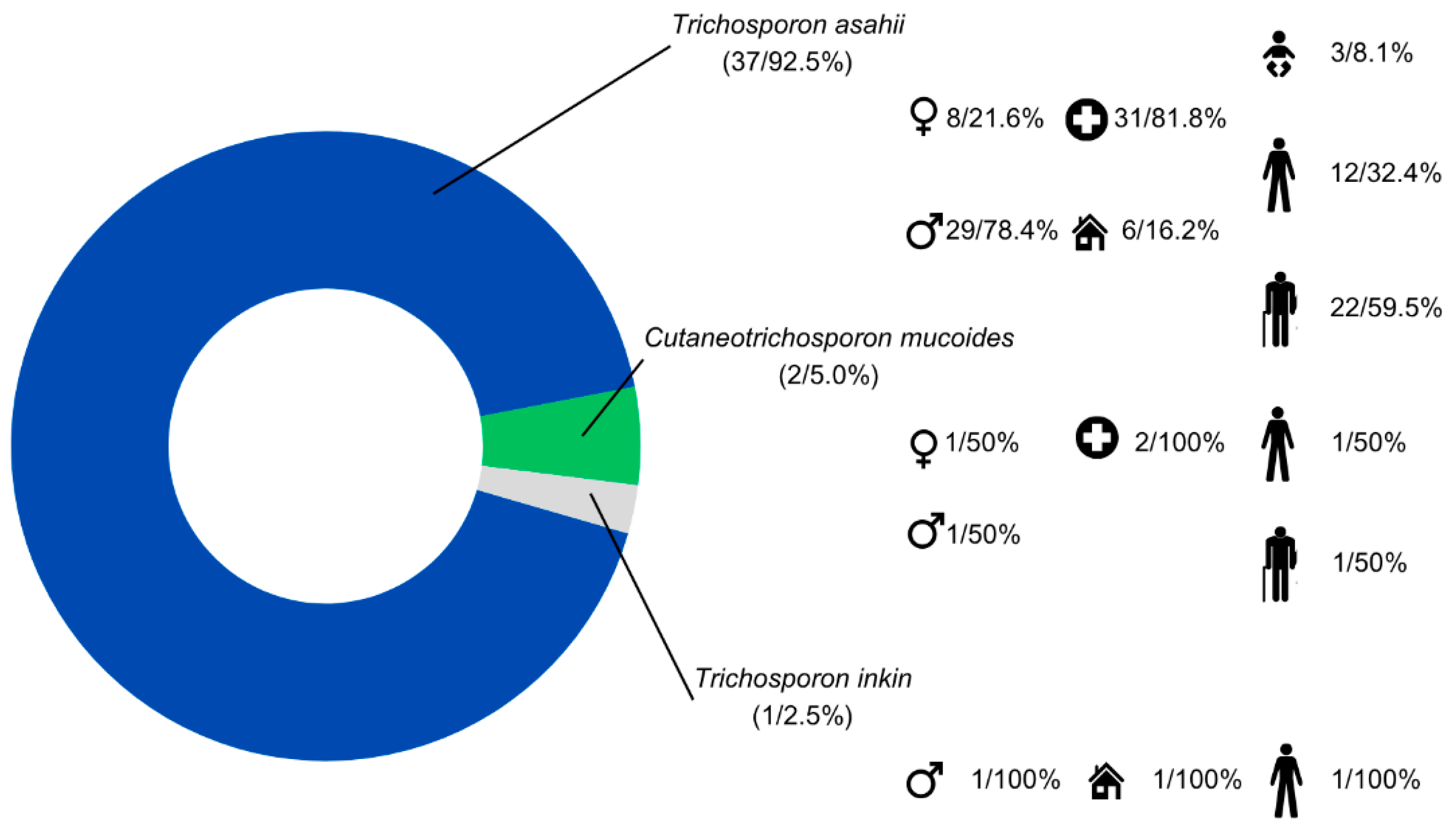
 hospitalized or
  non-hospitalized), and clinical condition (
 neonates,
  adults, and
  elderly (individuals older than 60 years)). The values indicate the absolute number and percentage of cases for each variable.
hospitalized or non-hospitalized), and clinical condition ( neonates, adults, and elderly (individuals older than 60 years)). The values indicate the absolute number and percentage of cases for each variable.
elderly (individuals older than 60 years)). The values indicate the absolute number and percentage of cases for each variable.
hospitalized or non-hospitalized), and clinical condition ( neonates, adults, and elderly (individuals older than 60 years)). The values indicate the absolute number and percentage of cases for each variable.


| Clinical and Epidemiological Parameters | Trichosporonaceae (n = 40) |
|---|---|
| Type of infection: n = 40 | |
| Surface | 5 (12.5) |
| Invasive | 35 (87.5) |
| Length of hospital stay (in days): average (range) | 34.8 (1–102) |
| Origin non-hospitalized: n = 40 | |
| Non-hospitalized Origin hospitalized: n = 33 | 7 (17.5) |
| Coronary unit | 1 (3.1) |
| Impatient unit | 9 (27.2) |
| Surgical center | 6 (18.1) |
| General ICU | 4 (12.2) |
| Neurological ICU | 11 (33.3) |
| Neonatal ICU Reason for hospitalization: n = 33 | 2 (6.1) |
| Cancer | 3 (9.1) |
| Hemorrhage | 1 (3.1) |
| Hydrocele and spermatocele | 1 (3.1) |
| Respiratory infection | 8 (24.2) |
| Heart failure | 1 (3.1) |
| Liver failure | 1 (3.1) |
| Acute renal failure | 7 (21.2) |
| Respiratory failure | 2 (6.1) |
| Osteomyelitis | 1 (3.1) |
| Septicemia | 4 (12.2) |
| Pulmonary tuberculosis | 1 (3.1) |
| Pressure ulcer | 3 (9.1) |
| Clinical outcome: n = 33 | |
| Hospital discharge | 16 (48.5) |
| Death | 17 (51.5) |
| Prior use of corticosteroids: n = 33 | |
| No | 12 (36.4) |
| Yes | 21 (63.6) |
| Clinical condition: n = 40 | |
| No | 25 (62.5) |
| Yes | 15 (37.5) |
| Yes—Hemodialysis | 4 (10.0) |
| Yes—Prematurity/twins | 1 (2.5) |
| Yes—Surgery | 1 (2.5) |
| Yes—Transplant | 2 (5.0) |
| Yes—Bronchoscopy | 6 (15.0) |
| Yes—Bronchofibroscopy and video laparoscopy | 1 (2.5) |
| Clinical and Epidemiological Parameters | Trichosporonaceae (n = 40) |
|---|---|
| Prior use of antimicrobials: 40 | n (%) |
| No | 11 (27.5) |
| Yes | 29 (72.5) |
| Yes—Combination therapy | 24 (60.0) |
| Yes—Ceftriaxone | 1 (2.5) |
| Yes—Cefuroxime | 1 (2.5) |
| Yes—Piperacillin-tazobactam | 3 (7.5) |
| Use of antifungals after diagnosis: 33 | |
| No | 26 (65.0) |
| Yes | 14 (35.0) |
| Yes—Combination therapy | 3 (7.5) |
| Yes—Fluconazole | 7 (17.5) |
| Yes—Itraconazole | 3 (7.5) |
| Yes—Nystatin | 1 (2.5) |
| Variable | Survivors n (%) | Death n (%) | OR (95% CI) | p-Value |
|---|---|---|---|---|
| ICU admission | 3 (18.7) | 15 (88.2) | 32.5 (4.3–245.0) | <0.001 |
| Prior use of antimicrobials | 11 (68.7) | 17 (100) | 16.3 (0.8–331.0) | 0.018 |
| Prior use of corticosteroids | 6 (37.5) | 15 (88.2) | 11.5 (2.0–66.0) | 0.004 |
| Use of antifungals after diagnosis | 4 (25.0) | 10 (58.8) | 4.3 (0.9–20.0) | 0.080 |
| Age * | Lower median | Higher median | — | 0.004 |
| Length of hospital stay * | Shorter median | Longer median | — | 0.040 |
Disclaimer/Publisher’s Note: The statements, opinions and data contained in all publications are solely those of the individual author(s) and contributor(s) and not of MDPI and/or the editor(s). MDPI and/or the editor(s) disclaim responsibility for any injury to people or property resulting from any ideas, methods, instructions or products referred to in the content. |
© 2026 by the authors. Licensee MDPI, Basel, Switzerland. This article is an open access article distributed under the terms and conditions of the Creative Commons Attribution (CC BY) license.
Share and Cite
Lima, Y.P.; Bastos, R.V.; de Andrade Bastos, V.Q.; de Andrade Bastos, L.Q.; Hipólito, J.R.; Bastos, A.N.; Diniz, C.G.; Da Silva, V.L.; Dias, V.C. Trichosporonaceae as (Re-)Emerging Pathogens: A Warning to the Medical Community. J. Fungi 2026, 12, 167. https://doi.org/10.3390/jof12030167
Lima YP, Bastos RV, de Andrade Bastos VQ, de Andrade Bastos LQ, Hipólito JR, Bastos AN, Diniz CG, Da Silva VL, Dias VC. Trichosporonaceae as (Re-)Emerging Pathogens: A Warning to the Medical Community. Journal of Fungi. 2026; 12(3):167. https://doi.org/10.3390/jof12030167
Chicago/Turabian StyleLima, Yasmim Passos, Ricardo Villela Bastos, Victor Quinet de Andrade Bastos, Lucas Quinet de Andrade Bastos, João Renato Hipólito, André Netto Bastos, Cláudio Galuppo Diniz, Vania Lucia Da Silva, and Vanessa Cordeiro Dias. 2026. "Trichosporonaceae as (Re-)Emerging Pathogens: A Warning to the Medical Community" Journal of Fungi 12, no. 3: 167. https://doi.org/10.3390/jof12030167
APA StyleLima, Y. P., Bastos, R. V., de Andrade Bastos, V. Q., de Andrade Bastos, L. Q., Hipólito, J. R., Bastos, A. N., Diniz, C. G., Da Silva, V. L., & Dias, V. C. (2026). Trichosporonaceae as (Re-)Emerging Pathogens: A Warning to the Medical Community. Journal of Fungi, 12(3), 167. https://doi.org/10.3390/jof12030167