
Morphological Diversity of Epichloë sinensis from Festuca sinensis Germplasm on the Qinghai–Tibet Plateau
 , , ,
, , ,
Abstract
1. Introduction
2. Materials and Methods
2.1. Experimental Materials
2.2. Isolation of Fungal Endophytes
2.3. Determination of Colony Growth Rate
2.4. Morphological Observation of Fungal Endophyte Strains
2.5. DNA Extraction, Endophyte Detection and Characterization by Multiplex PCR
2.6. Phylogenetic Analysis
2.7. Data Analysis
3. Results
3.1. Colony Morphology
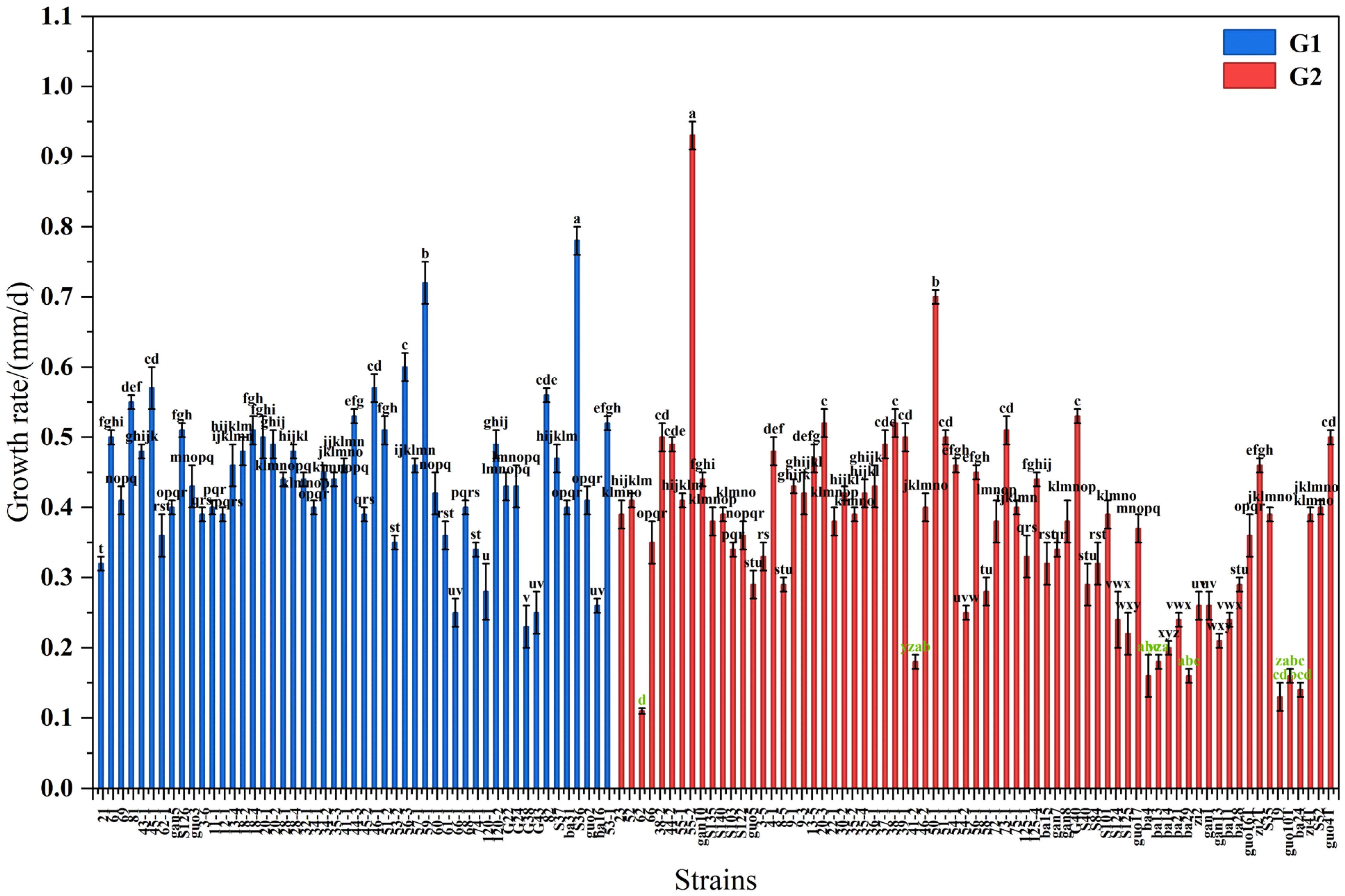
3.2. Growth Rate
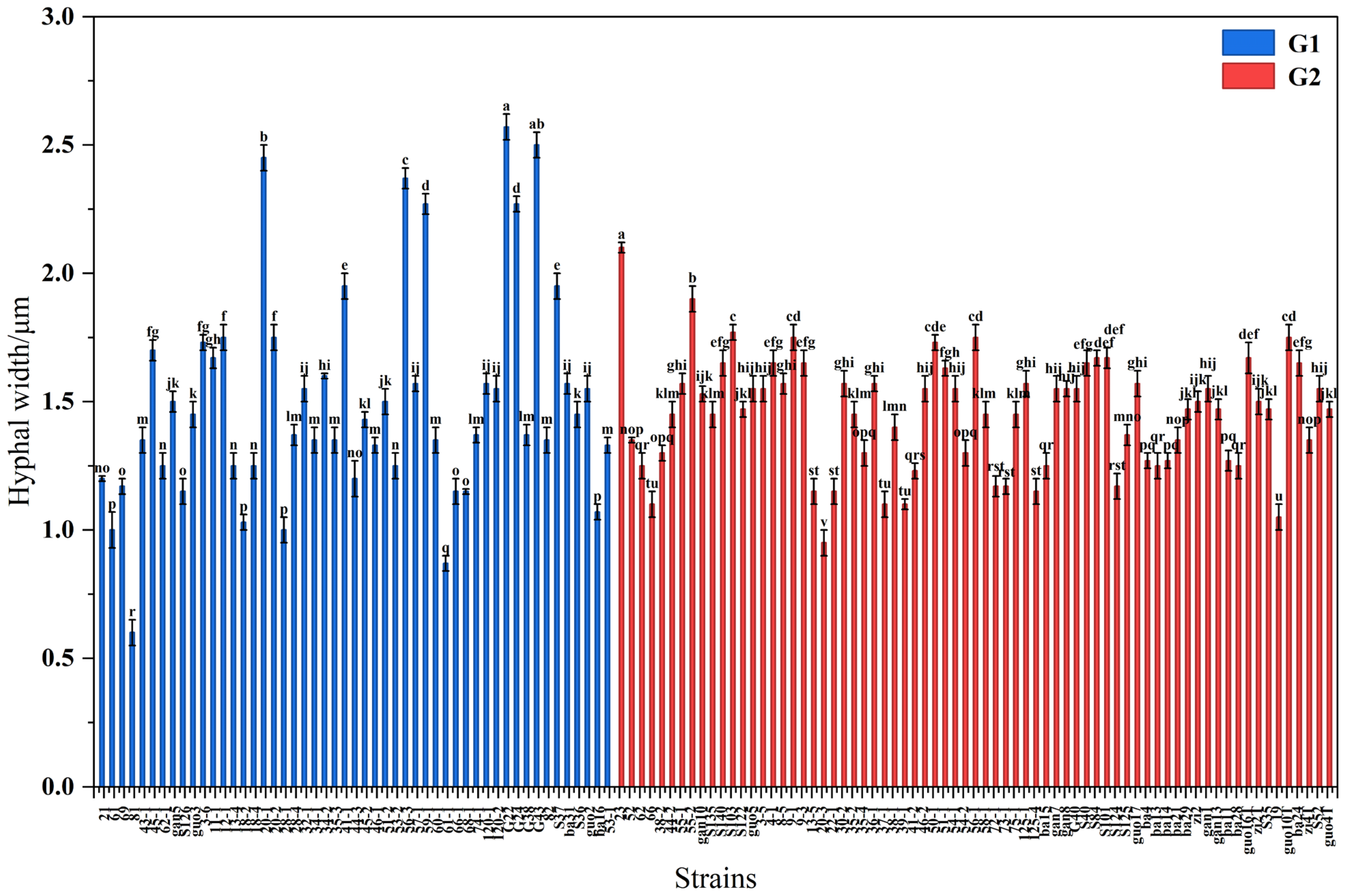
3.3. Hyphal Width
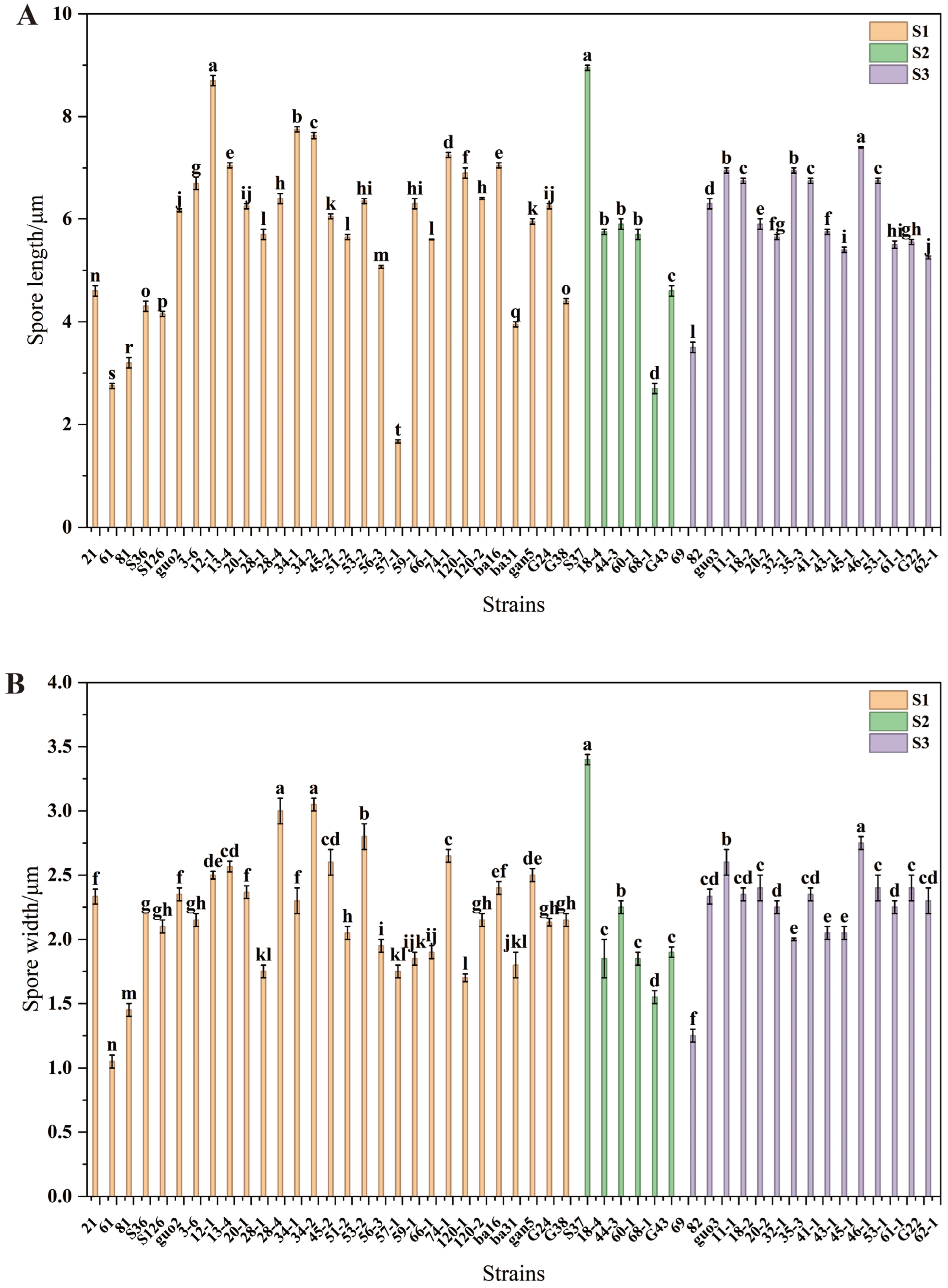
3.4. Length and Width of Spores
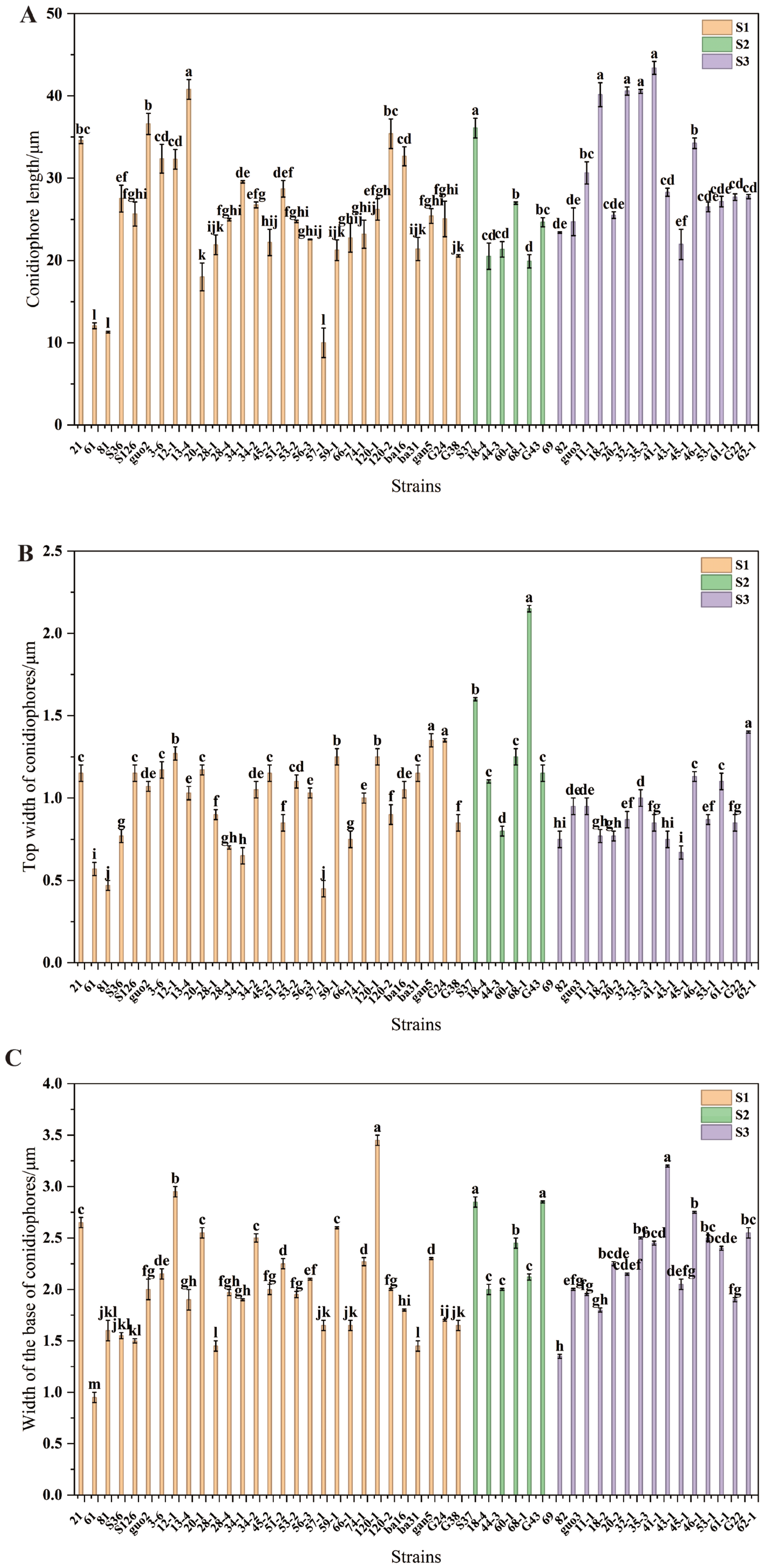
3.5. Length, Top Width, and Base Width of Conidiophores
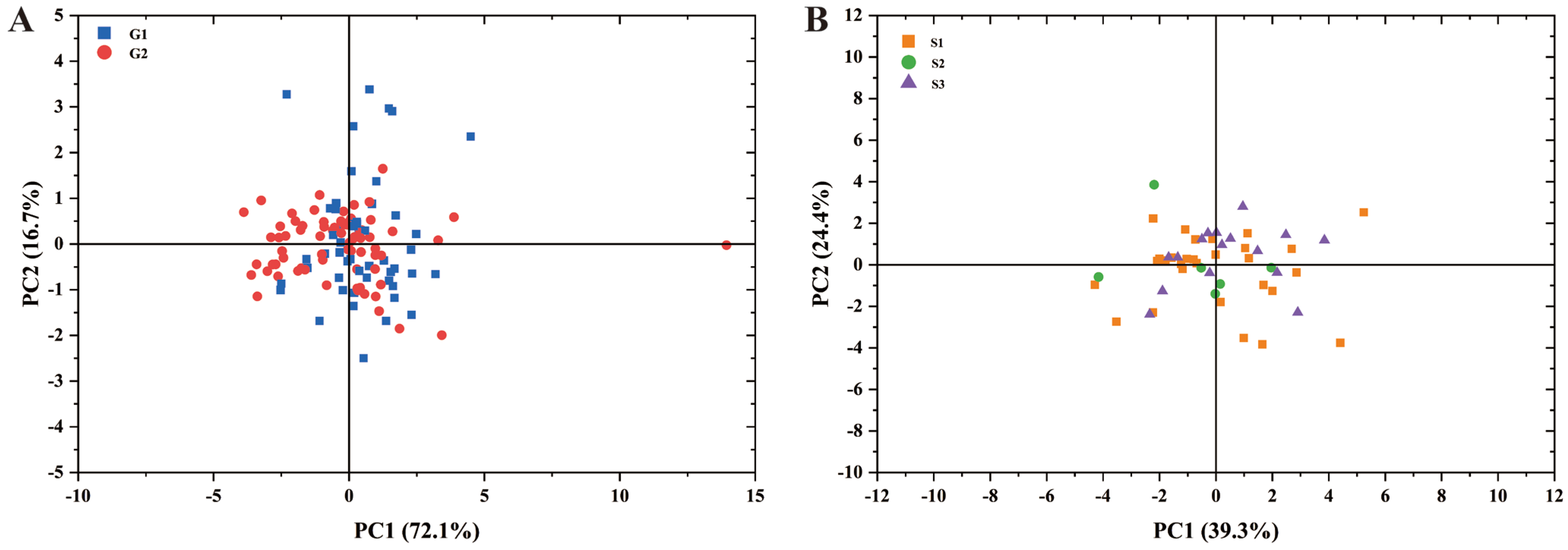
3.6. Principal Component Analysis (PCA)
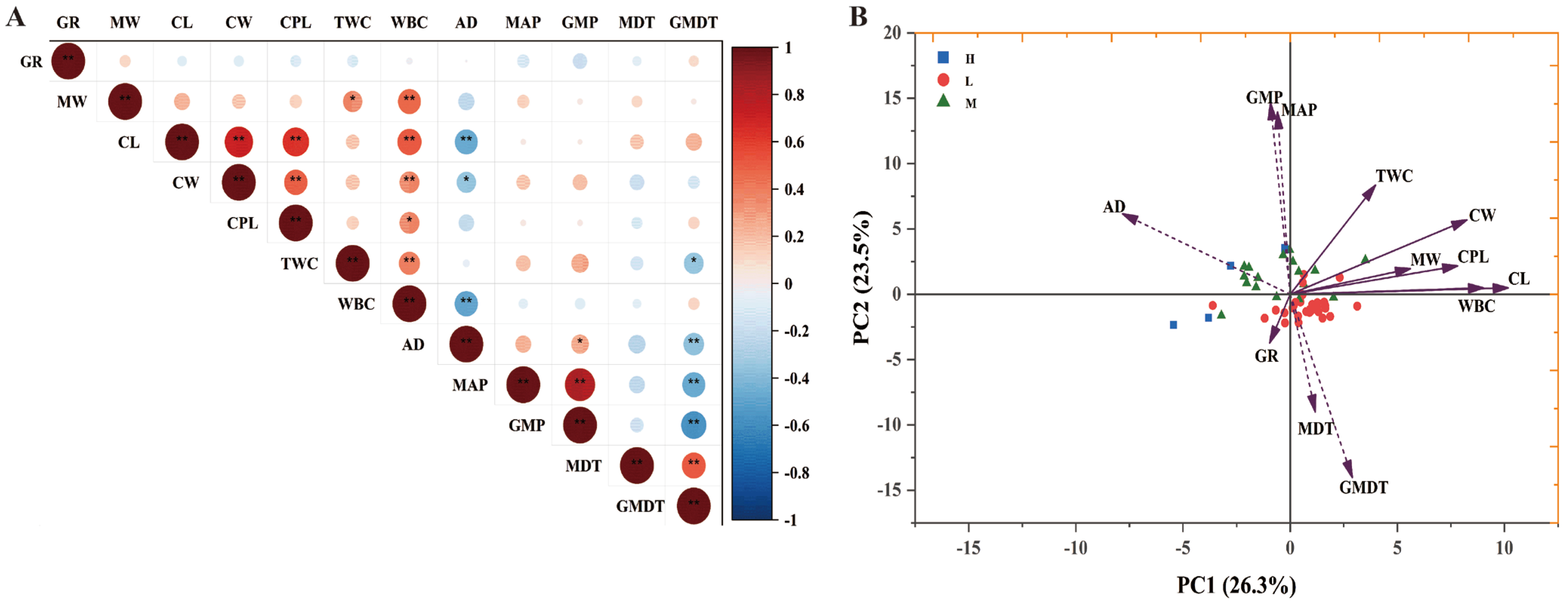
3.7. Correlation Analysis Between Various Indicators of F. sinensis and Climatic Characteristics
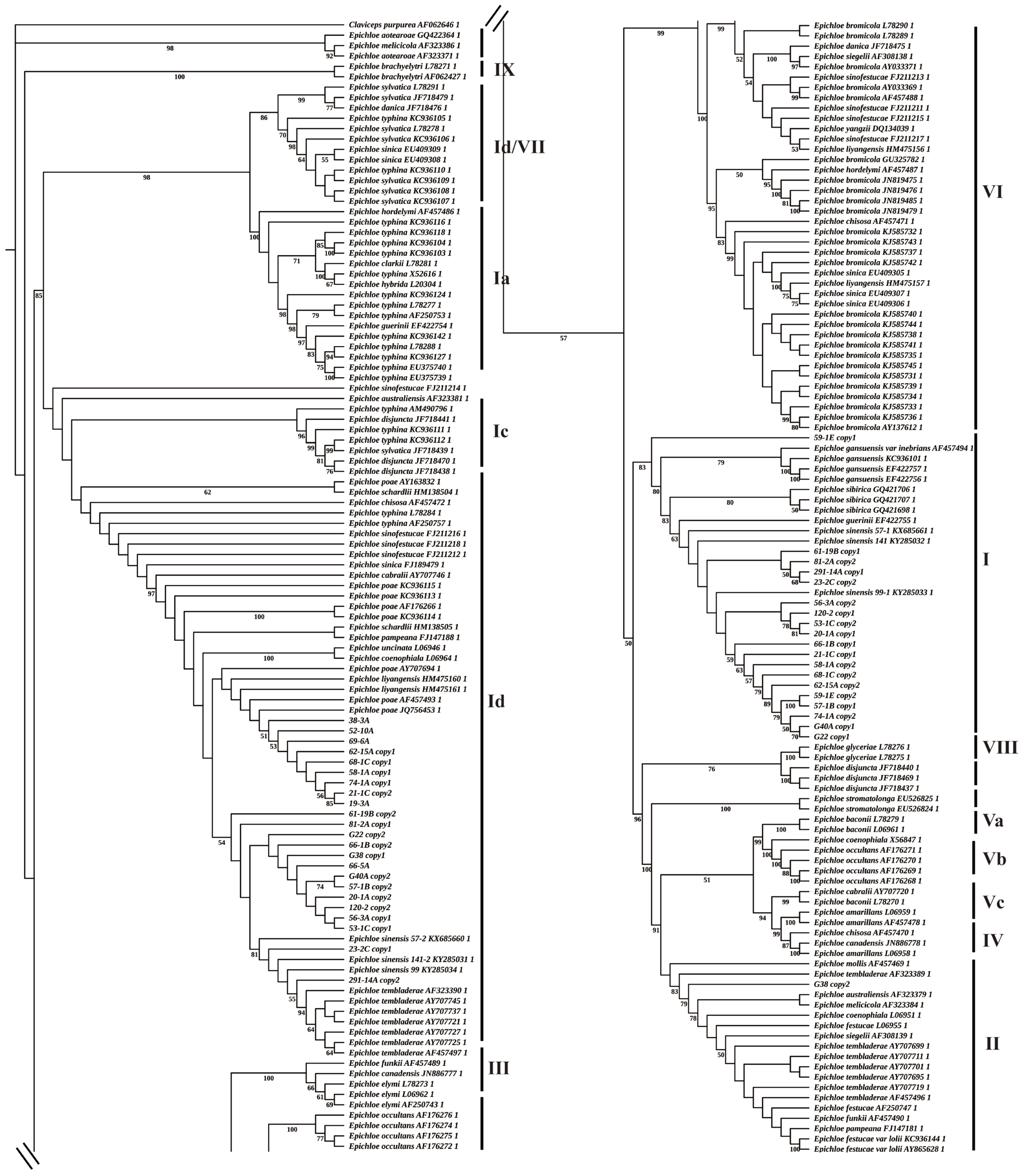
3.8. tef-α and tubB Amplification in E. sinensis
3.9. Mating Types and Alkaloid Gene Profiling
4. Discussion
4.1. Diversity of E. sinensis
4.2. The Impact of Environmental Factors on the Diversity of E. sinensis
5. Conclusions
Supplementary Materials
Author Contributions
Funding
Institutional Review Board Statement
Informed Consent Statement
Data Availability Statement
Acknowledgments
Conflicts of Interest
References
- Wang, M.N.; Tian, P.; Gao, M.; Li, M.M. The promotion of Festuca sinensis under heavy metal treatment mediated by Epichloë endophyte. Agronomy 2021, 11, 2049. [Google Scholar] [CrossRef]
- Wang, Y.B.; Luo, Y.; Tian, P.; Peng, H.; Feng, J. Preliminary evaluation of the disease resistance of Festuca sinensis infected by Epichloë sinensis. J. Phytopathol. 2021, 169, 623–629. [Google Scholar] [CrossRef]
- Saikkonen, K.; Saari, S.; Helander, M. Defensive mutualism between plants and endophytic fungi? Fungal Divers. 2010, 41, 101–113. [Google Scholar] [CrossRef]
- Saikkonen, K.; Ruokolainen, K.; Huitu, O.; Gundel, P.E.; Piltti, T.; Hamilton, C.E.; Helander, M. Fungal endophytes help prevent weed invasions. Agric. Ecosyst. Environ. 2013, 165, 1–5. [Google Scholar] [CrossRef]
- Du, M.X.; Wang, T.; Li, C.J.; Chen, T.X. Advances in the Taxonomy of the Genus Epichloë endophytic fungi in grasses. Acta Agrestia Sin. 2023, 31, 3575–3586. [Google Scholar] [CrossRef]
- Schardl, C.L.; Florea, S.; Nagabhyru, P.; Pan, J.; Farman, M.L.; Young, C.A.; Rahnama, M.; Leuchtmann, A.; Sabzalian, M.R.; Torkian, M.; et al. Chemotypic diversity of bioprotective grass endophytes based on genome analyses, with new insights from a Mediterranean-climate region in Isfahan Province, Iran. Mycologia 2025, 117, 34–59. [Google Scholar] [CrossRef] [PubMed]
- Li, C.J.; Nan, Z.B.; Paul, V.H.; Dapprich, P.; Liu, Y. A new Neotyphodium species symbiotic with drunken horse grass (Achnatherum inebrians) in China. Mycotaxon 2004, 90, 141–147. [Google Scholar] [CrossRef]
- White, J.F.J.; Morganjones, G. Endophyte-host associations in forage grasses VI. Acremonium chisosum, a new species isolated from Stipa eminens in Texas. Mycotaxon 1987, 28, 179–189. [Google Scholar] [CrossRef]
- Moon, D.; Guillaumin, J.J.; Ravel, C.; Li, C.J. New Neotyphodium endophyte species from the grass tribes Stipeae and Meliceae. Mycologia 2007, 99, 895–905. [Google Scholar] [CrossRef]
- Christensen, M.J.; Latch, G.C.M. Variation among isolates of Acremonium endophytes (A. coenophialum and possibly) from tall fescue (Festuca arundinacea). Mycol. Res. 1991, 95, 1123–1126. [Google Scholar] [CrossRef]
- Ren, A.Z.; Gao, Y.B.; Wang, Y.H.; Zhang, X.; Wei, Y.K. Diversity of clavicipitaceous fungal endophytes in Achnatherum sibiricunm in natural grasslands of China. Symbiosis 2013, 46, 21–31. [Google Scholar] [CrossRef]
- Kang, Y.; Ji, Y.L.; Sun, X.H.; Zhan, L.H.; Li, W.; Yu, H.S.; Wang, Z.W. Taxonomy of Neotyphodium endophytes of Chinese native Roegneria plants. Mycologia 2009, 101, 211–219. [Google Scholar] [CrossRef]
- Zhu, M.J.; Ren, A.Z.; Wen, W.; Gao, Y.B. Diversity and taxonomy of endophytes from Leymus chinensis in the Inner Mongolia steppe of China. FEMS Microbiol. Lett. 2013, 340, 135–145. [Google Scholar] [CrossRef]
- Zhou, L.; Li, C.; White, J.F.; Johnson, R.D. Synergism between calcium nitrate applications and fungal endophytes to increase sugar concentration in Festuca sinensis under cold stress. PeerJ 2021, 9, e10568. [Google Scholar] [CrossRef]
- Yang, Y.; Chen, N.; Li, C.J. The morphological diversity of endophytic fungus in Festuca sinensis in Gansu Province. Pratacul. Sci. 2011, 28, 273–278. [Google Scholar] [CrossRef]
- Xu, W.B.; Li, M.M.; Lin, W.H.; Nan, Z.B.; Tian, P. Effects of Epichloë sinensis endophyte and host ecotype on physiology of Festuca sinensis under different soil moisture conditions. Plants 2021, 10, 1649. [Google Scholar] [CrossRef]
- Song, H.; Nan, Z. Origin, Divergence, and phylogeny of asexual Epichloë endophyte in Elymus species from western China. PLoS ONE 2015, 10, e0127096. [Google Scholar] [CrossRef]
- Shi, Q.; Matthew, C.; Liu, W.; Nan, Z. Alkaloid contents in Epichloë endophyte-infected Elymus tangutorum sampled along an elevation gradient on the Qinghai-Tibetan Plateau. Agronomy 2020, 10, 1812. [Google Scholar] [CrossRef]
- Ma, L.L.; Liu, N.X.; Zheng, Y.H.; Li, Z.; Liu, J.; Yi, Z.G.; Dong, Z.M.; Wang, S.M. Study on the high efficiency culture method of growth and sporulation of Soybean frogeye leaf spot pathogen. Soybean Sci. 2019, 38, 589–596. [Google Scholar]
- Moon, C.D.; Miles, C.O.; Järlfors, U.; Schardl, C.L. The evolutionary origins of three new Neotyphodium endophyte species from grasses indigenous to the Southern Hemisphere. Mycologia 2002, 94, 694–711. [Google Scholar] [CrossRef] [PubMed]
- Wang, T.; Chen, T.; White, J.F.; Li, C.J. Identification of three Epichloë endophytes from Hordeum bogdanii Wilensky in China. J. Fungi 2022, 8, 928. [Google Scholar] [CrossRef] [PubMed]
- Wong, K.M.; Suchard, M.A.; Huelsenbeck, J.P. Alignment uncertainty and genomic analysis. Science 2008, 319, 473–476. [Google Scholar] [CrossRef] [PubMed]
- Zhang, D.; Gao, F.; Jakovlić, I.; Zou, H.; Zhang, J.; Li, W.X.; Wang, G.T. PhyloSuite: An integrated and scalable desktop platform for streamlined molecular sequence data management and evolutionary phylogenetics studies. Mol. Ecol. Resour. 2020, 20, 348–355. [Google Scholar] [CrossRef]
- Nguyen, L.T.; Schmidt, H.A.; von Haeseler, A.; Minh, B.Q. IQ-TREE: A fast and effective stochastic algorithm for estimating maximum-likelihood phylogenies. Mol. Biol. Evol. 2015, 32, 268–274. [Google Scholar] [CrossRef]
- Schardl, C.L.; Leuchtmann, A. Three new species of Epichloë symbiotic with North American grasses. Mycologia 1999, 91, 95–107. [Google Scholar] [CrossRef]
- Tian, P.; Xu, W.B.; Li, C.J.; Song, H.; Wang, M.N.; Schardl, C.L.; Nan, Z.B. Phylogenetic relationship and taxonomy of a hybrid Epichloë species symbiotic with Festuca sinensis. Mycol. Prog. 2020, 19, 526–532. [Google Scholar] [CrossRef]
- Hamilton, C.E.; Faeth, S.H.; Dowling, T.E. Distribution of hybrid fungal symbionts and environmental stress. Microb. Ecol. 2009, 58, 408–413. [Google Scholar] [CrossRef]
- Bao, G.; Song, M.; Wang, Y.; Saikkonen, K.; Li, C. Does Epichloë endophyte enhance host tolerance to root Hemiparasite? Microb. Ecol. 2021, 82, 35–48. [Google Scholar] [CrossRef]
- Li, X.Z.; Yao, X.; Li, C.J.; Nan, Z.B. Potential analysis of grass endophytes Neotyphodium as biocontrol agents. Chin. J. Plant Ecol. 2015, 39, 621–634. [Google Scholar] [CrossRef]
- Lukito, Y.; Chujo, T.; Scott, B. Molecular and cellular analysis of the pH response transcription factor PacC in the fungal symbiont Epichloë festucae. Fungal Genet. Biol. 2015, 85, 25–37. [Google Scholar] [CrossRef] [PubMed]
- Poulin, R.; Krasnov, B.R.; Mouillo, T.D. Host specificity in phylogenetic and geographic space. Trends. Parasitol. 2011, 27, 355–361. [Google Scholar] [CrossRef]
- Quenu, M.; Treindl, A.D.; Lee, K.; Takemoto, D.; Thünen, T.; Ashrafi, S.; Winter, D.; Ganley, A.R.D.; Leuchtmann, A.; Young, C.A.; et al. Telomere-to-telomere genome sequences across a single genus reveal highly variable chromosome rearrangement rates but absolute stasis of chromosome number. J. Fungi 2022, 8, 670. [Google Scholar] [CrossRef] [PubMed]
- Wei, Y.K.; Gao, Y.B.; Li, C.; Xu, H.; Ren, A.Z. Genetic diversity of Neotyphodium endophytes isolated from Achnatherum sibiricum populations in Mid-And eastern Inner Mongolia steppe, China. Chinese J. Plant Ecol. 2006, 30, 640–649. [Google Scholar]
- Clement, S.L.; Elbersona, L.R.; Youssef, N.N.; Davitt, C.M.; Doss, R.P. Incidence and diversity of Neotyphodium fungal endophytes in tall fescue from Morocco, Tunisia, and Sardinia. Crop. Sci. 2001, 41, 570–576. [Google Scholar] [CrossRef]
- Latch, G.C.M.; Christensen, M.J.; Samuels, G.J. Five endophytes of Lolium and Festuca in New Zealand. Mycotaxon 1984, 20, 535–550. [Google Scholar] [CrossRef]
- White, J.F.; Morgan-Jones, G. Endophyte-host associations in forage grasses. X. cultural studies on some species of Acremoniumsect. albo-lanosa, including a new species, A. starrii. Mycotaxon 1987, 30, 87–95. [Google Scholar] [CrossRef]
- Ju, H.J.; Hill, N.S.; Abbott, T.; Ingram, K.T. Temperature influences on endophyte growth in tall fescue. Corp. Sci. 2006, 46, 404–412. [Google Scholar] [CrossRef]
- Kirkby, K.A.; Pratley, J.E.; Hume, D.E.; Faville, M.J.; An, M.; Wu, H. Incidence of endophyte Neotyphodium occultans in Lolium rigidum from Australia. Weed Res. 2011, 51, 261–272. [Google Scholar] [CrossRef]
- Zurek, G.; Wiewiora, B.; Gozdowski, D. Relations between bioclimatic variables and endophyte colonization of grasses in Poland. Fungal Ecol. 2013, 6, 554–556. [Google Scholar] [CrossRef]
- Jia, M.; Chen, L.; Xin, H.L.; Khalid, R.; Han, T.; Qin, L.P. A friendly relationship between endophytic fungi and medicinal plants: A systematic review. Front. Microbiol. 2016, 7, 906. [Google Scholar] [CrossRef]
- Tadych, M.; Blaszkowski, J. Succession of arbuscular mycorrhizal fungi in a deflation hollow of the Slowinski National Park, Poland. Acta Soc. Bot. Pol. 2014, 69, 223–236. [Google Scholar] [CrossRef]
- Schardl, C.L.; Florea, S.; Pan, J.; Nagabhyru, P.; Bec, S.; Calie, P.J. The epichloae: Alkaloid diversity and roles in symbiosis with grasses. Curr. Opin. Plant. Biol. 2013, 16, 480–488. [Google Scholar] [CrossRef]
- Yan, K.; Yanling, J.; Kunran, Z.; Hui, W.; Huimin, M.; Zhiwei, W. A new Epichloë species with interspecific hybrid origins from Poa pratensis ssp. pratensis in Liyang, China. Mycologia 2011, 103, 1341–1350. [Google Scholar] [CrossRef]
- Chen, T.X.; Simpson, W.R.; Song, Q.Y.; Chen, S.H.; Li, C.J.; Ahmad, R.Z. Identification of Epichloë endophytes associated with wild barley (Hordeum brevisubulatum) and characterisation of their alkaloid biosynthesis. J. Agric. Res. 2019, 62, 131–149. [Google Scholar] [CrossRef]
- Schardl, C.L.; Young, C.A.; Faulkner, J.R.; Florea, S.; Pan, J. Chemotypic diversity of Epichloë, fungal symbionts of grasses. Fungal Ecol. 2012, 5, 331–344. [Google Scholar] [CrossRef]



| Strain | Total Number | Loline Genes | ||||||
|---|---|---|---|---|---|---|---|---|
| lolM | lolA | lolC | lolU | lolF | lolD | lolT | ||
| 19-3A | 1 | + | + | + | + | + | + | + |
| 53-1C | 1 | − | − | + | − | − | − | − |
| 21-1C, 23-2C, 69-6A, 52-10A, 66-5A, 56-3A, 57-1B, 58-1A, 59-1E, 66-1B, 68-1C, 74-1C, 120-2 | 13 | − | − | + | − | − | + | − |
| 61-19B, 81-2A, 62-15A, 20-1A, G40A | 5 | − | − | − | − | − | + | − |
| G22, G38 | 2 | − | − | − | − | − | − | − |
| 57A | 1 | − | + | − | − | − | − | |
| Strain | Total Number | ppzA (Formerly Known as perA) Genes | |||||||
|---|---|---|---|---|---|---|---|---|---|
| ppzA-A2 | ppzA-M | ppzA-T1 | ppzA-R * | ppzA-C | ppzA-A1 | ppzA-∆R * | ppzA-T2 | ||
| 21-1C | 1 | + | − | + | + | − | + | − | + |
| 23-2C | 1 | + | + | + | + | − | + | − | + |
| 61-19B | 1 | − | + | − | − | − | + | − | + |
| 81-2A | 1 | − | − | − | − | − | + | − | + |
| 69-6A | 1 | + | + | − | − | − | − | − | + |
| 52-10A | 1 | − | + | + | − | − | + | − | + |
| 62-15A | 1 | − | + | + | − | − | + | − | − |
| 66-5A | 1 | − | + | − | + | − | + | − | + |
| G22A | 1 | − | − | + | − | + | − | − | + |
| G38 | 1 | − | − | + | − | + | + | − | + |
| G40A | 1 | + | − | + | − | + | + | − | + |
| 19-3A, 20-1A, 58-1A, 68-1C | 4 | + | + | + | + | + | + | − | + |
| 53-1C, 56-3A, 59-1E, 74-1C, 120-2 | 5 | + | + | + | + | + | + | + | + |
| 57-1B, 66-1B | 2 | − | + | + | + | + | + | − | + |
| 57A | 1 | + | + | ||||||
| Strain | Total Number | Indole-Diterpene Genes | ||||||||||
|---|---|---|---|---|---|---|---|---|---|---|---|---|
| ltmJ | ltmE | ltmS | ltmG | ltmF | ltmM | ltmC | ltmP | ltmQ | ltmB | ltmK | ||
| 19-3A | 1 | − | − | + | + | − | * | − | − | − | − | * |
| 21-1C | 1 | − | − | + | − | − | − | + | − | + | + | + |
| 23-2C | 1 | − | − | + | + | − | + | + | − | + | + | + |
| 61-19B | 1 | − | − | + | − | − | + | − | − | − | + | − |
| 81-2A | 1 | − | − | + | − | − | + | − | − | + | + | + |
| 69-6A | 1 | − | − | + | − | − | − | + | − | − | + | + |
| 52-10A | 1 | − | − | + | + | − | + | + | − | + | + | + |
| 62-15A | 1 | − | − | + | + | − | − | + | − | − | + | + |
| 66-5A | 1 | − | − | + | + | − | + | + | + | + | + | + |
| 57-1B | 1 | − | * | + | + | + | − | + | − | + | + | + |
| 66-1B, 120-2 | 2 | − | − | + | + | + | + | + | − | + | + | + |
| G22A | 1 | − | − | + | + | − | + | + | − | − | + | + |
| 20-1A, 56-3A, 58-1A, 68-1C, 74-1C, G38, G40A | 7 | − | − | + | + | + | + | + | + | + | + | + |
| 53-1C, 59-1E | 2 | − | * | + | + | + | + | + | + | + | + | + |
| 57A | 1 | − | − | + | + | + | + | + | + | + | + | |
| Strain | Total Number | Ergot Alkaloid Genes | ||||||||||||
|---|---|---|---|---|---|---|---|---|---|---|---|---|---|---|
| dmaW | easA | easF | easE | easD | easG | easH | easO | easP | cloA | lpsB | lpsA | lpsC | ||
| 19-3A | 1 | + | * | − | * | * | * | * | * | − | − | − | − | − |
| 21-1C | 1 | + | * | − | * | * | − | * | * | − | − | − | − | − |
| 58-1A, 59-1E, 74-1C | 3 | − | − | − | − | − | − | + | − | − | − | − | − | − |
| 23-2C, 81-2A, 61-19B, 52-10A, 62-15A, G22, G38, G40, 69-6A, 66-1B, 66-5A, 20-1A, 53-1C, 56-3A, 57-1B, 68-1C, 120-2 | 17 | − | − | − | − | − | − | − | − | − | − | − | − | − |
| 57A | 1 | − | − | − | − | − | − | − | − | − | − | − | − | − |
| Strain | Total Number | Mating-Type Genes | |
|---|---|---|---|
| MtaC | MtbA | ||
| 19-3A, G38 | 2 | + | − |
| 21-1C, 23-2C, 61-19B, 81-2A, 69-6A, 52-10A, 62-15A, 66-5A, 20-1A, 53-1C, 56-3A, 57-1B, 58-1A, 59-1E, 66-1B, 68-1C, 74-1C, 120-2, G22A, G40A | 20 | + | + |
| 57A | 1 | + | + |
Disclaimer/Publisher’s Note: The statements, opinions and data contained in all publications are solely those of the individual author(s) and contributor(s) and not of MDPI and/or the editor(s). MDPI and/or the editor(s) disclaim responsibility for any injury to people or property resulting from any ideas, methods, instructions or products referred to in the content. |
© 2026 by the authors. Licensee MDPI, Basel, Switzerland. This article is an open access article distributed under the terms and conditions of the Creative Commons Attribution (CC BY) license.
Share and Cite
Liu, J.; Sun, J.; Zhao, Y.; Li, Z.; Zhang, M.; Cui, L.; Shen, J.; Luo, Y.; Gao, Y.; Zhou, W.; et al. Morphological Diversity of Epichloë sinensis from Festuca sinensis Germplasm on the Qinghai–Tibet Plateau. J. Fungi 2026, 12, 166. https://doi.org/10.3390/jof12030166
Liu J, Sun J, Zhao Y, Li Z, Zhang M, Cui L, Shen J, Luo Y, Gao Y, Zhou W, et al. Morphological Diversity of Epichloë sinensis from Festuca sinensis Germplasm on the Qinghai–Tibet Plateau. Journal of Fungi. 2026; 12(3):166. https://doi.org/10.3390/jof12030166
Chicago/Turabian StyleLiu, Junying, Jiawen Sun, Yanqun Zhao, Zhongxiang Li, Mei Zhang, Longxuan Cui, Jinhui Shen, Yang Luo, Yue Gao, Wei Zhou, and et al. 2026. "Morphological Diversity of Epichloë sinensis from Festuca sinensis Germplasm on the Qinghai–Tibet Plateau" Journal of Fungi 12, no. 3: 166. https://doi.org/10.3390/jof12030166
APA StyleLiu, J., Sun, J., Zhao, Y., Li, Z., Zhang, M., Cui, L., Shen, J., Luo, Y., Gao, Y., Zhou, W., Chen, T., Wang, T., Du, M., Liu, W., Xia, C., Hu, T., & Tian, P. (2026). Morphological Diversity of Epichloë sinensis from Festuca sinensis Germplasm on the Qinghai–Tibet Plateau. Journal of Fungi, 12(3), 166. https://doi.org/10.3390/jof12030166