Article

Novel Freshwater Ascomycetes from Submerged Plant Debris in the Zújar River (Extremadura Community, Spain)

by
María Barnés-Guirado
,
Alberto Miguel Stchigel
* and
José Francisco Cano-Lira
Mycology Unit, Medical School, Universitat Rovira i Virgili, C/Sant Llorenç 21, 43201 Reus, Spain
*
Author to whom correspondence should be addressed.
J. Fungi 2026, 12(2), 102; https://doi.org/10.3390/jof12020102
Submission received: 9 December 2025 / Revised: 14 January 2026 / Accepted: 29 January 2026 / Published: 31 January 2026
(This article belongs to the Special Issue Ascomycota: Diversity, Taxonomy and Phylogeny, 3rd Edition)

Abstract

Freshwater fungi remain insufficiently documented in the Mediterranean river systems despite their key roles in organic-matter turnover. Here, we surveyed filamentous fungi associated with submerged decaying plant debris in the Zújar River (Extremadura, southwestern Spain) using a culture-based approach combined with phenotypic characterization and multilocus phylogenetic analyses (ITS, LSU, rpb1, rpb2 and tef-1α). A total of 49 strains were isolated and identified, revealing a diverse assemblage of Ascomycota. Five taxa are described as new to science: Arachnopeziza torrehermosensis, Conioscypha clavatispora, Neoanungitea torrehermosensis, Ophioceras diversisporum and Polyscytalum submersum. Notably, Polyscytalum submersum represents the first record of the genus for the Iberian Peninsula, while Arachnopeziza torrehermosensis, Neoanungitea torrehermosensis and Ophioceras diversisporum constitute the first records of their respective genera for Spain (and Neoanungitea torrehermosensis also for Europe). In addition, phylogenetic evidence supports taxonomic refinements within the orders Magnaporthales and Conioscyphales, including the establishment of Protophioceras to accommodate Ophioceras sichuanense and the establishment of Protoconioscypha for two previously misclassified Conioscypha species. Overall, this first mycological report of submerged plant debris in the Zújar River substantially expands knowledge of freshwater fungal diversity in the region and provides a refined framework for the taxonomy of several lineages of aquatic-associated ascomycetes.

1. Introduction

Freshwater ecosystems cover only ~0.8% of the Earth’s surface and account for ~0.01% of global water volume, yet they host nearly 7% of global biodiversity [1,2]. Despite their ecological importance, these habitats are increasingly threatened by climate change, hydrological alterations, pollution, and other anthropogenic pressures. In the Iberian Peninsula, some rivers follow a Mediterranean hydrological regime characterized by seasonal variability, including flash floods and prolonged summer droughts [3], while reservoirs and artificial wetlands constitute most lentic systems due to extensive hydraulic infrastructure [4].
Fungi constitute an essential but understudied inhabitant of freshwater ecosystems, where they participate in nutrient cycling, organic matter decomposition, and symbiotic interactions [5]. Taxonomically, freshwater fungi span several phyla, with Ascomycota being the most diverse group [6]. They are usually classified into four ecological groups: Ingoldian, aero-aquatic, terrestrial-aquatic, and submerged-aquatic fungi [6]. Ingoldian fungi, which sporulate underwater and often produce distinctive scolecoid or stauroid conidia, are particularly abundant in lotic systems, where they play a central role in decomposing allochthonous plant material [7,8]. Aero-aquatic fungi, in contrast, sporulate only after exposure to air and typically inhabit lentic environments [5,9]. Other groups, such as terrestrial-aquatic and submerged-aquatic fungi, colonize plant material at the water–land interface or in submerged substrates [10,11,12].
The Zújar River, a 215 km tributary of the Guadiana Basin in southwestern Spain, drains ~8500 km2 under a Mediterranean climate marked by low rainfall (<500 mm/year) and pronounced seasonal fluctuations in discharge [13,14,15]. Its riparian vegetation includes Populus alba, P. nigra, Fraxinus angustifolia and Salix spp., together with shrubs such as Nerium oleander and Tamarix africana. Aquatic vegetation comprises submerged (Ceratophyllum demersum, Potamogeton spp.), floating (Lemna minor, Ranunculus aquatilis) and emergent taxa (Carex spp., Phragmites australis, Typha latifolia) [13,16,17,18,19]. The river crosses intensively cultivated landscapes dominated by cereals and olives, and its course has been heavily modified by reservoirs and irrigation channels [14,20].
Although the flora and aquatic fauna of the Zújar River and its basin have been studied, information on its microbial and, particularly, fungal diversity remains unexplored. The present study addresses this gap by investigating freshwater ascomycetes associated with submerged plant debris in the Zújar River using culture-dependent isolation and a polyphasic taxonomic approach, and by describing novel taxa that contribute to our understanding of the freshwater mycobiota of Mediterranean river systems.

2. Materials and Methods

2.1. Sampling and Fungal Isolation

Thirty-one samples of submerged decomposing plant material (leaves and wood) were collected in autumn 2022 from the Zújar River along a transect ranging from 38°25′13.9″ N, 5°34′36.5″ W to 38°25′58.5″ N, 5°34′15.6″ W (BA-159). Samples were placed in sterile self-sealing plastic bags, transported to the laboratory at room temperature (20–25 °C), and stored at 4 °C until processing. Samples were rinsed two to five times, depending on the amount of sediment present, by adding 500 mL of tap water to the transport bags. After rinsing, each sample was placed in 90 mm-diameter Petri dishes lined with three layers of sterile filter paper moistened with sterile distilled water and incubated in the dark at room temperature. Fungal development was monitored daily for up to 2 months using a stereomicroscope (Leica Microsystems, model EZ4, Wetzlar, Germany). Fertile structures (mostly) or hyphal tips were transferred using sterile disposable tuberculin-type needles to oatmeal agar medium (OA; 15 g filtered oat flakes and 7.5 g agar in 500 mL tap water [21]) in 50 mm-diameter Petri dishes. The OA plates were incubated under the same conditions, and transfers were repeated until axenic cultures of each isolate were obtained. Fungal strains representing scarcely reported taxa and putative novel species were deposited in the culture collection of the Faculty of Medicine of Reus (FMR; Reus, Tarragona Province, Spain). Ex-type strains and holotype specimens (dried cultures) were deposited at the Westerdijk Fungal Biodiversity Institute (CBS; Utrecht, the Netherlands).

2.2. Phenotypic Study

The macroscopic characterization of the colonies was performed on potato carrot agar (PCA; 10 g potato, 10 g carrot, 6.5 g agar, 500 mL distilled water [22]), potato dextrose agar (PDA; Laboratorios Conda S.A., Madrid, Spain), OA and 2% malt extract agar (MEA; Difco Inc., Detroit, MI, USA) after incubation in darkness at 25 °C for 14 days. The cardinal growth temperatures of each strain of interest were determined on PDA medium at 5–40 °C in 5 °C intervals, with an additional measurement at 37 °C.
Microscopic characterization was carried out by growing the fungal strains on OA at 25 °C in the dark for 14 days. Vegetative and reproductive structures were observed and measured (at least 30 measurements per structure type) from mounts prepared in Shear’s medium (3 g potassium acetate, 60 mL glycerol, 90 mL 95% ethanol, and 150 mL distilled water) [23] under an Olympus BH-2 bright-field microscope (Olympus Corporation, Tokyo, Japan). Photomicrographs were taken with a Zeiss Axio Imager M1 light microscope (Zeiss, Oberkochen, Germany) equipped with a DeltaPix InfinityX digital camera (DeltaPix, Smoerum, Denmark).

2.3. DNA Extraction, Amplification, and Sequencing

Total genomic DNA was extracted from colonies grown on PDA at 25 °C in the dark for 7–10 days following a modified protocol of Müller et al. [24] and quantified using a Nanodrop 2000 spectrophotometer (Thermo Scientific, Madrid, Spain). The set of molecular markers amplified for each fungal strain was selected based on the literature. The primer pairs ITS5/ITS4 [25] and LR0R/LR5 [26] were used to amplify the internal transcribed spacer (ITS) region and the D1–D2 domains of the 28S nrRNA (LSU), respectively. Additional markers included actin (act), fragments of the translation elongation factor 1α (tef-1α), and the RNA polymerase II subunits 1 and 2 (rpb1, rpb2), amplified with primers ACT-512F/ACT-783R [27], 983F/2218R [28], Bt2a/Bt2b [29], RPB2-5F2/fRPB2-7cR [30,31], and RPB1A-Ac/RPB1-Cr [32]. PCR products yielding a single band on agarose gels were stored at -20 °C and sequenced at Macrogen Europe (Macrogen Inc., Madrid, Spain) using the same primers. Consensus sequences were assembled using SeqMan v. 7.0.0 (DNAStar Lasergene, Madison, WI, USA).

2.4. Phylogenetic Analysis

To clarify the taxonomic placement of the studied strains and to evaluate their phylogenetic relationships within the corresponding lineages, a series of single-locus and multilocus phylogenetic analyses were conducted. Separate phylogenetic trees were inferred for each genus containing putatively novel taxa, using different combinations of molecular markers depending on data availability and their proven phylogenetic informativeness at the genus and family levels. Ribosomal DNA regions (ITS and LSU) were used as a backbone for all analyses due to their widespread use in fungal systematics and the availability of reference sequences, whereas protein-coding genes (tef-1α, rpb1 and rpb2) were incorporated when available to improve phylogenetic resolution and nodal support. In total, five independent phylogenetic reconstructions were performed, each corresponding to a different taxonomic group, allowing robust assessment of species boundaries and higher-level relationships.
Consensus sequences were compared against the National Center for Biotechnology Information (NCBI) database using the Basic Local Alignment Search Tool (BLAST+ version 2.17.0; https://blast.ncbi.nlm.nih.gov/Blast.cgi, accessed on 28 November 2025), and Mycobank Databases (https://www.mycobank.org/Pairwise_alignment, accessed on 28 November 2025) to obtain a preliminary molecular identification of the strains. A maximum level of identity (MLI) of ≥98% was considered sufficient for species-level identification, whereas lower values were interpreted as indicative of putative undescribed taxa [33,34]. Based on the BLAST results, single-locus and combined phylogenetic analyses were conducted for strains within each genus. Individual loci were aligned in MEGA v.7.0 [35] using the ClustalW algorithm [36], refined with MUSCLE [37], and manually adjusted when necessary. After confirming the absence of topological incongruence among single-locus datasets, alignments were concatenated into a single dataset. Phylogenetic reconstruction was performed using Maximum Likelihood (ML) and Bayesian Inference (BI). The ML analysis was carried out on the CIPRES Science Gateway [38] with RA × ML-HPC2 on XSEDE v.8.2.12 [39], applying the best-fit substitution model automatically selected by the portal. Node support was assessed with 1000 bootstrap pseudoreplicates, considering values ≥70% as significant [40]. The BI analysis was conducted with MrBayes v.3.2.6 [41], using the substitution model established by using jModelTest v.2.1.3 [38,42] under the Akaike Information Criterion. Analyses were run for 5 million MCMC generations with four chains (one cold and three heated), sampling every 1000 generations. The first 25% of sampled trees were discarded as burn-in, and posterior probabilities (pp) ≥ 0.95 were regarded as significant [43]. Phylogenetic trees were visualized with FigTree v.1.3.1 (http://tree.bio.ed.ac.uk/software/figtree/, accessed on 28 November 2025). Sequence alignments and phylogenetic trees were deposited in Zenodo (https://zenodo.org, accessed on 28 November 2025), whereas newly generated DNA sequences were deposited in GenBank (Table 1). Novel taxa were registered in MycoBank (https://www.mycobank.org/, accessed on 28 November 2025).

3. Results

As a result of our investigation, 49 strains of filamentous fungi were isolated. These strains, along with their identification based on phenotypic characterization and nucleotide sequence identity (>98%) of selected molecular markers and the accession numbers of the culture collections where the holotype and living strains have been deposited, are listed in Table A1.
After careful examination of the phenotypic features, as well as the sequence identity of selected molecular markers (Table 2), we concluded that certain strains of ours constituted putatively new species.
To ascertain that the strains listed in Table 2 represent species new to science, phylogenetic analyses based on single-locus and concatenated molecular markers (when possible) were conducted for each genus in which these strains were placed. Analyses of individual molecular markers for each genus revealed no topological incongruence among trees with ≥70% reciprocal bootstrap support, thereby validating the use of a combined multilocus approach.
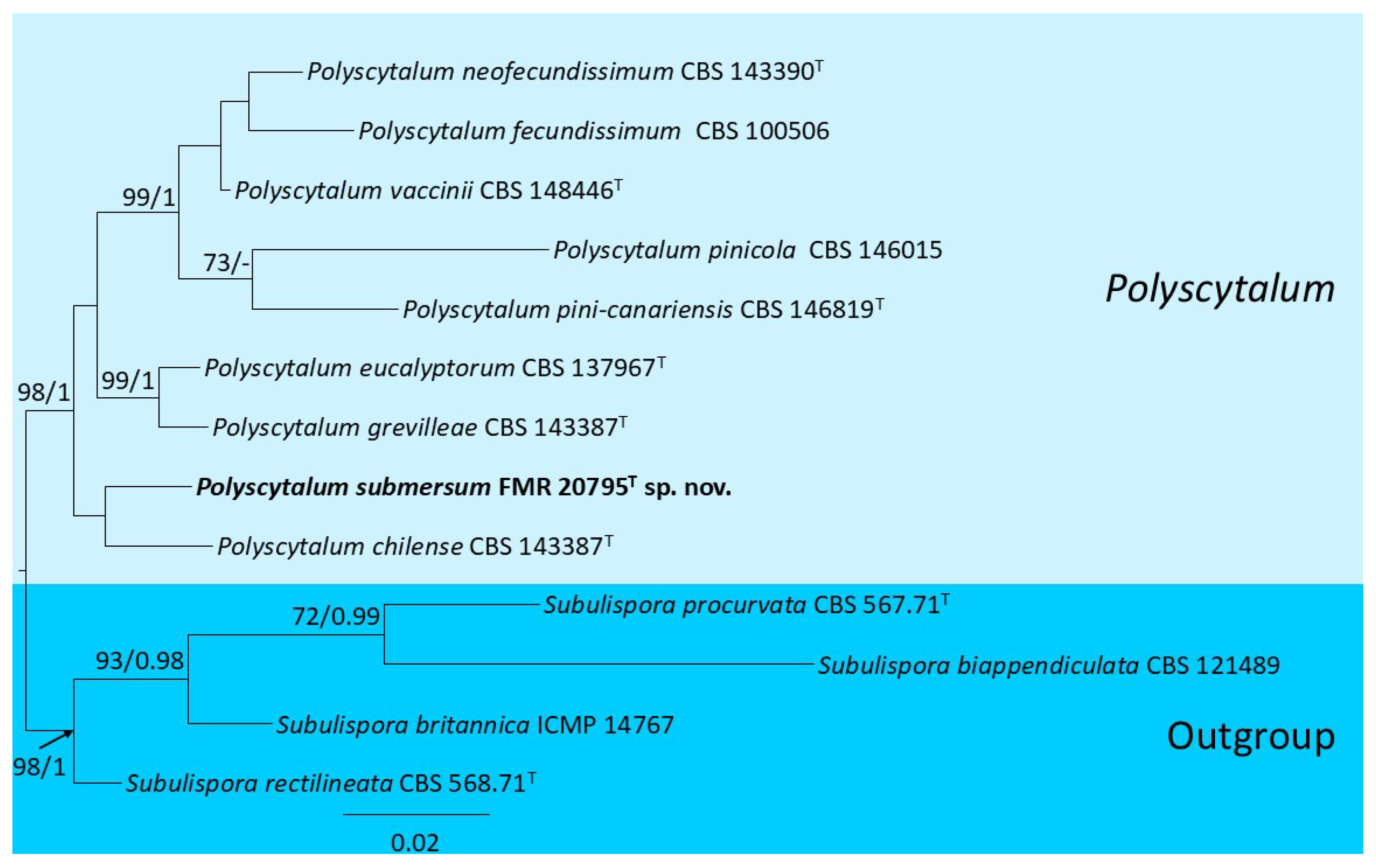
For Polyscytalum spp., the concatenated ITS  +  LSU dataset comprised nine ingroup strains (including our strain FMR 20795) and four outgroup strains (species of the genus Subulispora), yielding an alignment of 1425 characters (ITS = 586, LSU = 839). Of this total, 204 positions were variable (ITS = 116, LSU = 88), and 80 were parsimony informative (ITS = 65, LSU = 15). Maximum likelihood (ML) and Bayesian inference (BI) analyses produced congruent topologies. For ML, the best-fit substitution models were Tamura 3-parameter + γ (T92 + G) for ITS and Kimura 2-parameter + γ + I (K2 + G + I) for LSU; for BI, the preferred models were Hasegawa–Kishino–Yano + γ (HKY + G) for ITS and HKY variant + I (HK80 + I) for LSU. Support values exhibited only minimal differences between methods yet remained broadly concordant. The resultant phylogeny (Figure 1) resolved a strongly supported Polyscytalum spp. clade (98% BS; 1 PP), which bifurcates into two subclades. One contains most of the described species, while the other comprises the ex-type strain of Polyscytalum chilense (CBS 143387) and the strain FMR 20795. The genetic distance among these taxa is sufficient to consider FMR 20795 as a distinct species of P. chilense.
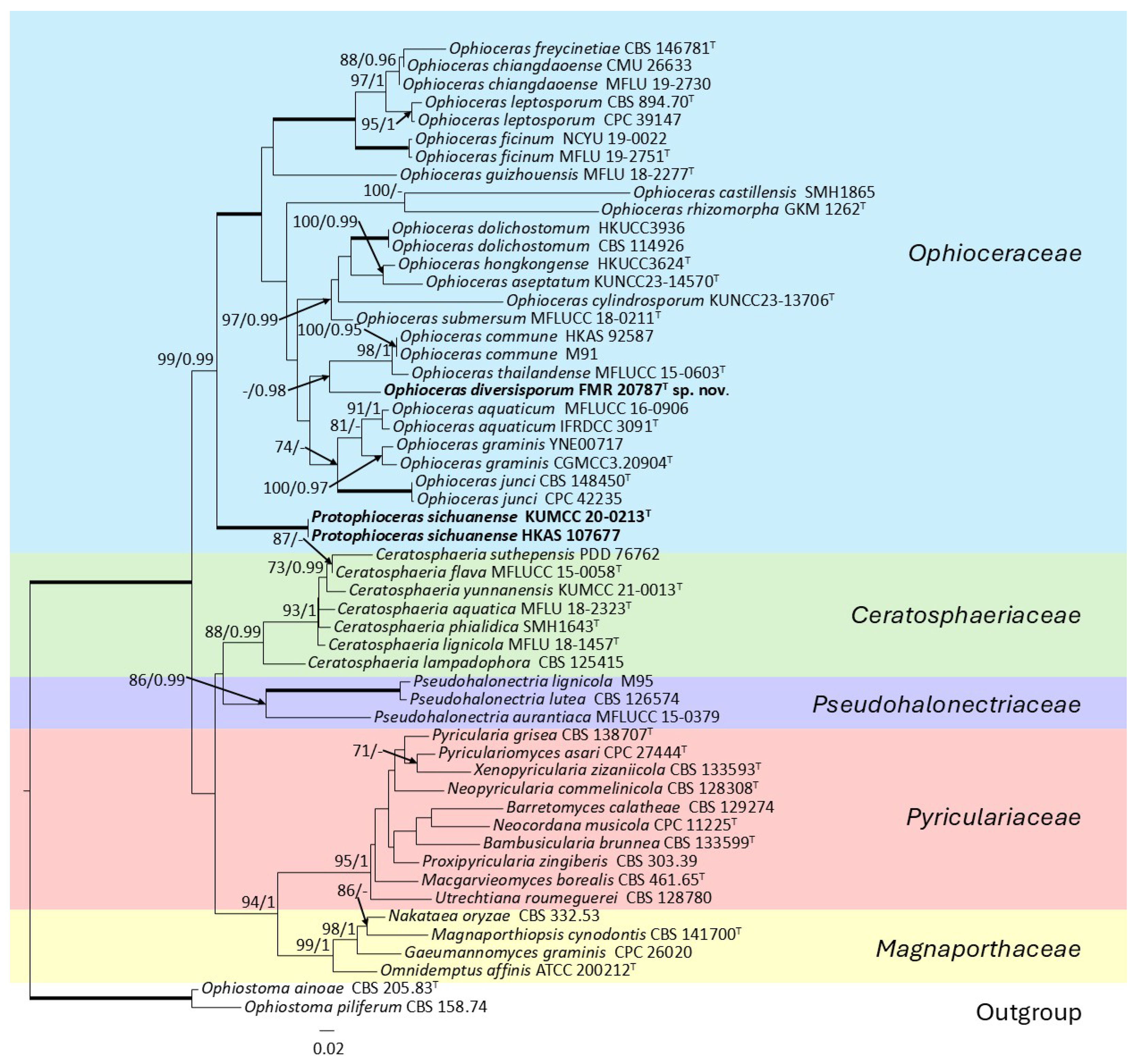
The phylogenetic inference for Ophioceras spp., as well as for other members of the order Magnaporthales, was built based on a concatenated ITS + LSU + rpb1 nucleotide alignment comprising 52 ingroup strains, comprising our strain, FMR 20787, and two outgroup strains of the genus Ophiostoma. The final dataset encompassed 2597 characters (including gaps): 729 bp for ITS, 869 bp for LSU, and 999 bp for rpb1. Among these positions, 1235 were variable (ITS = 412; LSU = 251; rpb1 = 572) and 939 were parsimony informative (ITS = 297; LSU = 199; rpb1 = 443). Maximum likelihood (ML) and Bayesian inference (BI) analyses yielded congruent topologies, indicating methodological consistency. For the ML analysis, the best-fit substitution models were K2 + G + I for ITS, K2 + G for LSU, and TN93 + G for rpb1. In the BI framework, the general GTR + G + I model was selected for all three molecular markers. Phylogenetic reconstruction (Figure 2) resolved two major clades, one exclusively comprising the family Ophioceraceae and the other encompassing the remaining Magnaporthales, each further subdivided into two strongly supported subclades. Within Ophioceraceae, all known species of Ophioceras form a monophyletic lineage, with the sole exception of O. sichuanense, which emerges as a fully supported, deeply divergent branch. Its pronounced phylogenetic distinctness and basal position justify its recognition as a new genus. Likewise, the strain FMR 20787 occupies a unique terminal branch within the core Ophioceras clade, sister to O. commune and O. thailandense, justifying its description as a novel species.
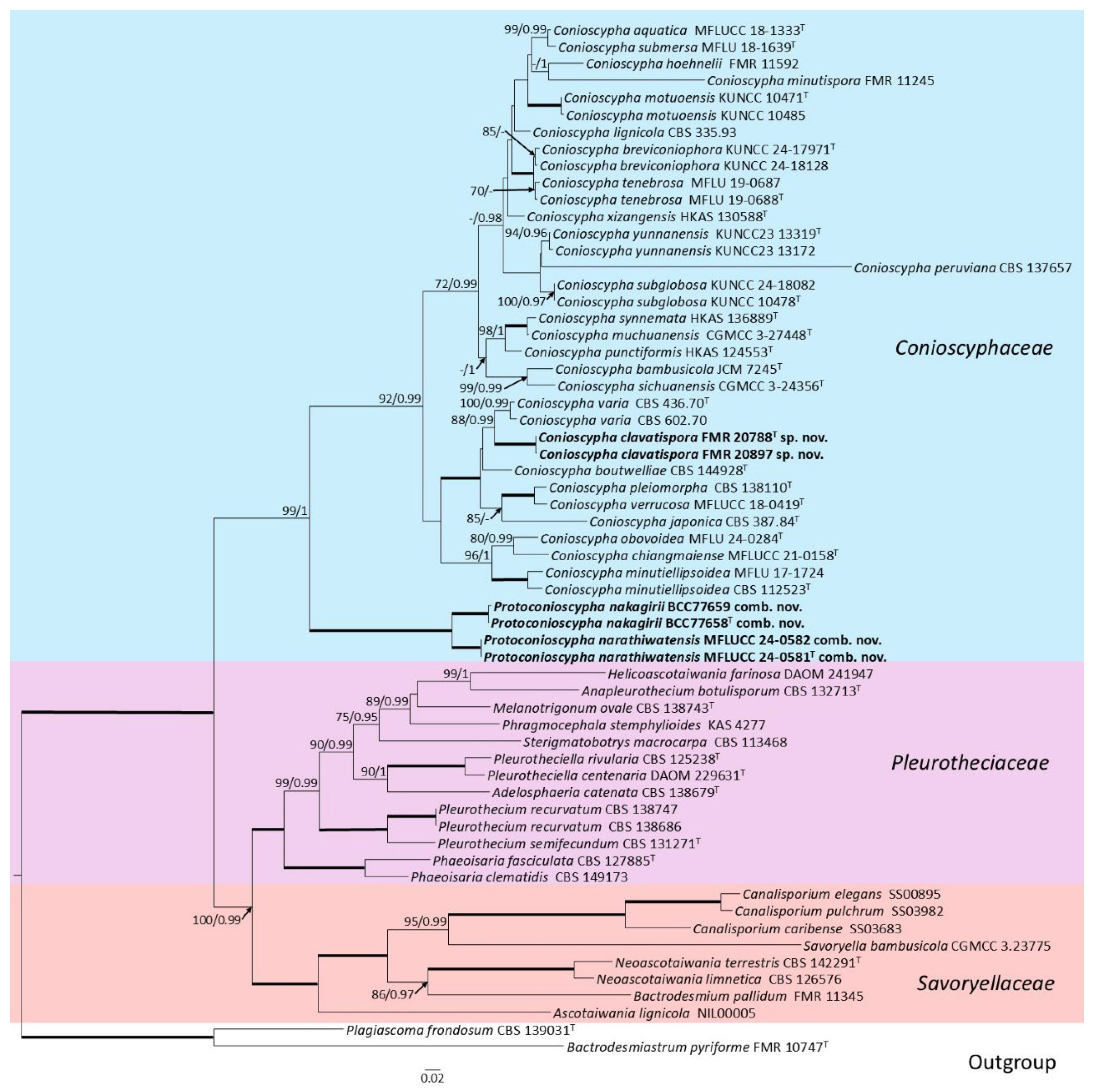
Phylogenetic analysis of the families Conioscyphaceae, Pleurotheciaceae, and Savoryellaceae was conducted on a concatenated ITS–LSU–rpb2 dataset comprising 59 ingroup strains, containing the strains FMR 20788 and FMR 20897, and two outgroups (Bactrodesmiastrum pyriforme and Plagiascoma frondosum). The total length of the final alignment was 2680 characters (including gaps: 864 ITS, 860 LSU, 956 rpb2), of which 1224 were parsimony informative (545 ITS, 262 LSU, 417 rpb2) and 1511 were variable sites (660 ITS, 367 LSU, 484 rpb2). Maximum likelihood (ML) and Bayesian inference (BI) analyses produced congruent topologies. For ML, the best-fit substitution models were T92 + G (ITS), TN93 + G (LSU) and T92 + G + I (rpb2); in BI, a unified GTR + I + G model was applied to all three phylogenetic markers. Phylogenetic reconstruction (Figure 3) resolved two principal clades, one exclusively comprising the family Conioscyphaceae and the other encompassing the families Pleurotheciaceae and Savoryellaceae, and further subdividing the Conioscyphaceae into two strongly supported subclades: one containing the bulk of Conioscypha species, in which the strains FMR 20788 and FMR 20897 form a fully supported terminal branch sister to C. varia, and the other harboring exclusively C. nakagirii and C. narathiwatensis on its own distinct, fully supported branch. Given the pronounced phylogenetic divergence and discrete placements of FMR 20788 and FMR 20897 and of C. nakagirii and C. narathiwatensis, they warrant formal recognition as a novel species and as a novel genus, respectively.
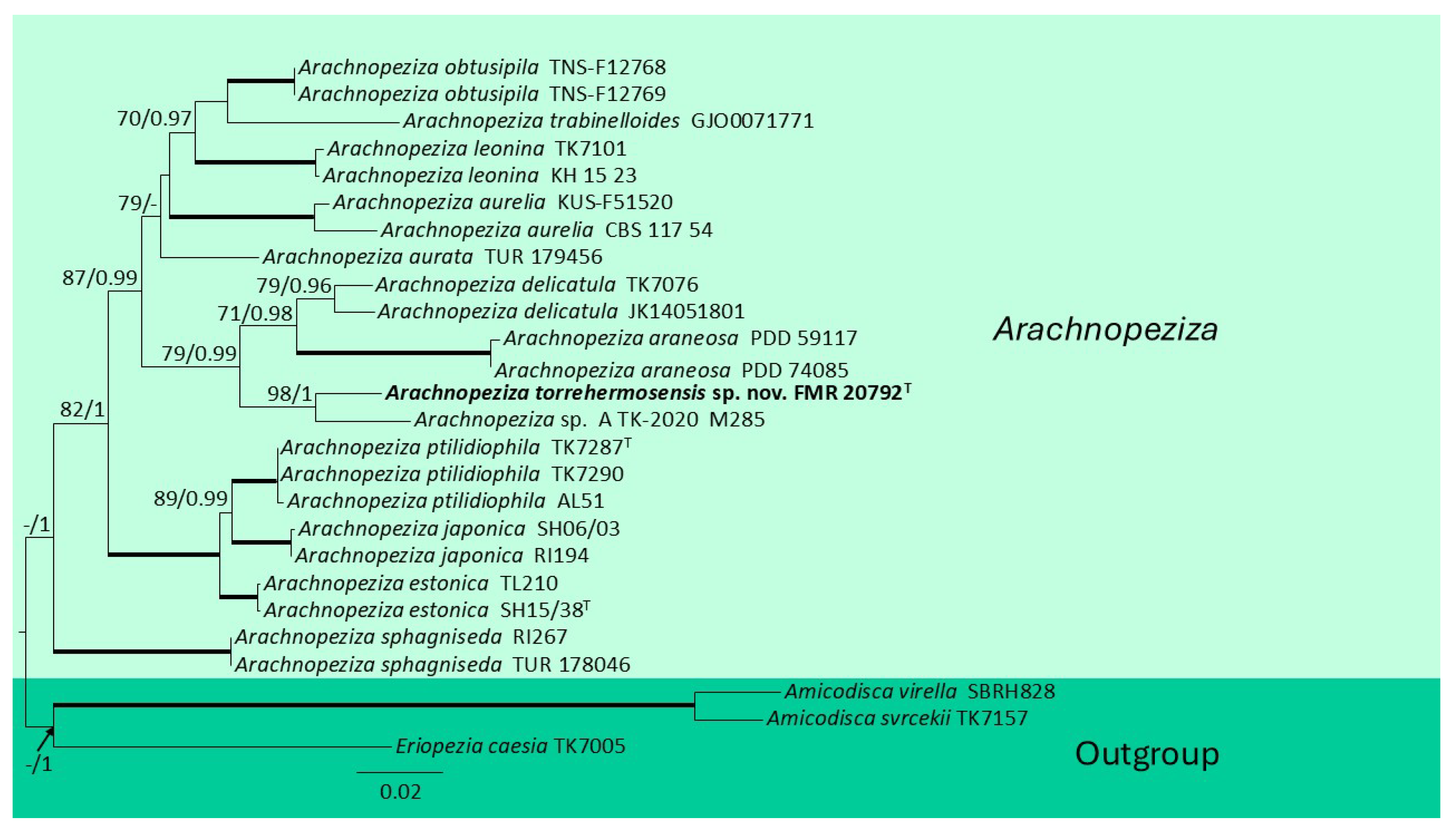
For the phylogenetic inference of Arachnopeziza spp., the ultimate concatenated ITS + LSU+ tef-1α +rpb1 dataset encompassed 23 ingroup strains, including the strain FMR 20792, and three outgroup strains (of the genera Amicodisca and Eriopezia). The alignment length reached 2532 characters including gaps (511 for ITS, 548 for LSU, 732 for tef-1α and 741 for rpb1), 457 of them being parsimony informative (120 for ITS, 44 for LSU, 94 for tef-1α and 199 for rpb1) and 592 of them variable sites (146 for ITS, 73 for LSU, 140 for tef-1α and 233 for rpb1). The similar topologies and scarce differences in both the ML and the BI analysis indicated that they were congruent. The best fitting model for each molecular marker in the ML analysis was K2 + G for ITS, tef-1α, and rpb1 and JC for LSU. The best fitting model for each molecular marker in the BI analysis was SYM + G for ITS and tef-1α, K80 + G for LSU and rpb1. The phylogenetic analysis (Figure 4) revealed that our strain FMR 20792 was placed in an independent, well-supported branch within the phylogenetic tree, close to A. delicatula, but at a sufficient genetic distance to be considered a distinct species; thus, FMR 20792 represents a novel species of Arachnopeziza.
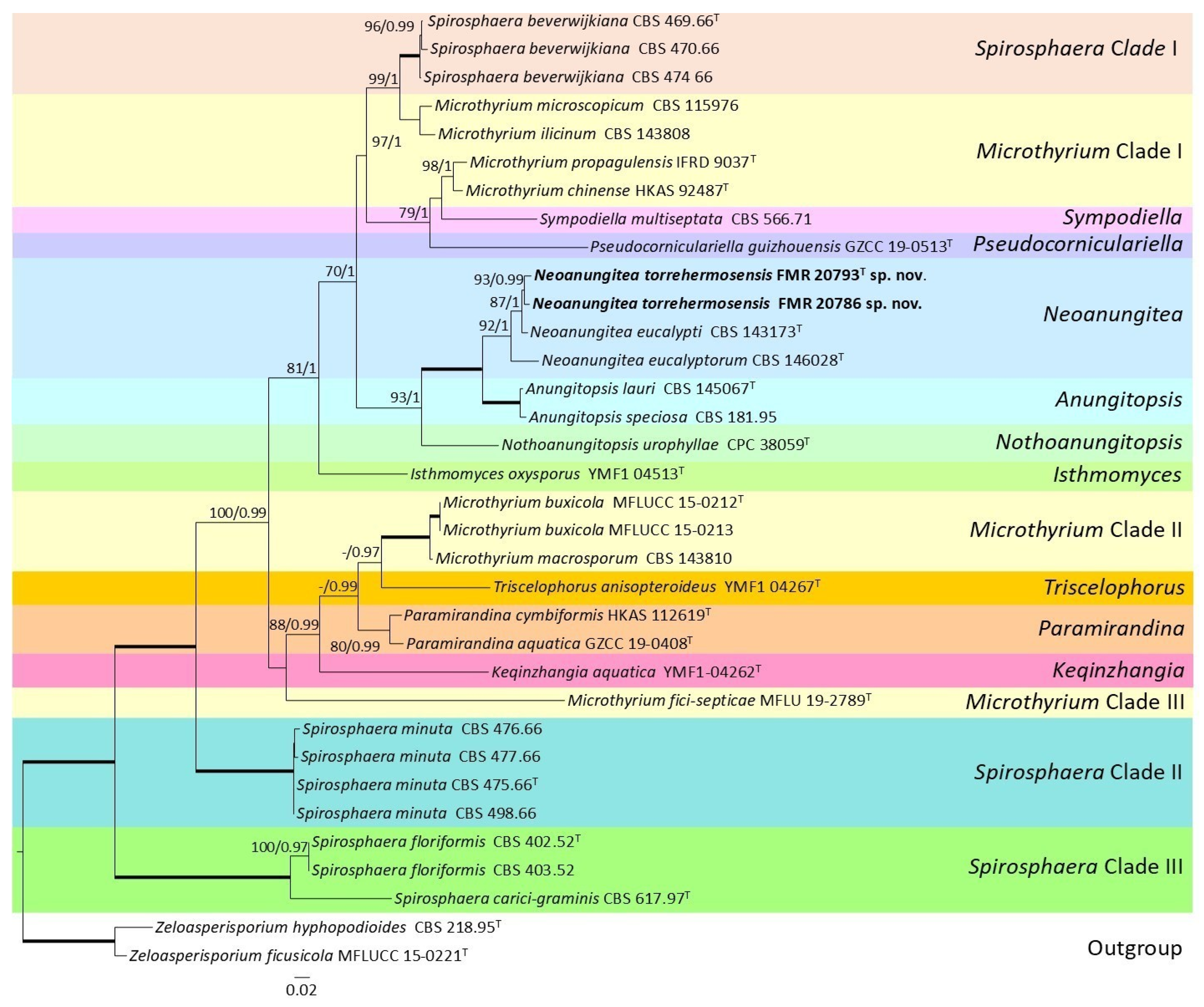
Regarding the phylogenetic analysis of members of the Microthyriaceae, whose taxa were molecularly the closest to our strains FMR 20793 and FMR 20786, the concatenated ITS + LSU dataset contained 32 ingroup strains (including our strains) and two outgroup strains of the genus Zeloasperisporium. The length of the alignment, including gaps, was 1549 characters (594 for ITS and 955 for LSU). Among the total characters of the alignment, 636 of them were parsimony informative (358 for ITS and 278 for LSU) and 791 of them were variable sites (429 for ITS and 362 for LSU). The ML and BI analysis were both considered congruent because they displayed little to no differences. The model that fitted the best for every molecular marker in the ML analysis was K2 + G for ITS and TN93 + G for LSU. The model that fitted the best for every molecular marker in the BI analysis was HKY + I + G for ITS and GTR + I + G for LSU. The phylogenetic tree (Figure 5) displayed sixteen terminal clades within the Microthyriaceae, revealing the polyphyletic nature of the genera Microthyrium and Spirosphaera. Our strains FMR 20793 and FMR 20786 clustered within a well-supported terminal branch comprising species of Neoanungitea, closely related to Neoanungitea eucalypti. This branch is part of a broader, well-supported terminal clade that also includes species of Anungitopsis, with Nothoanungitopsis urophyllae occupying a basal position.

Taxonomy

Xylariales Nannf., Nova Acta R. Soc. Scient. upsal., Ser. 4 8 (no. 2): 66 (1932). Mycobank MB 90505.
Polyscytalum Riess, Bot. Ztg. 11: 138 (1853). Mycobank MB 9508.
Polyscytalum submersum Barnés-Guirado, Cano & Stchigel, sp. nov. MycoBank MB 859383. Figure 6.
Etymology. From Latin submersum, submerged, because the fungus was isolated from plant debris submerged into freshwater.
Description: Hyphae septate, hyaline to pale brown, smooth- and thick-walled, branching, 1.0–3.0 µm wide. Conidiophores semi-micronematous, solitary, erect, straight to flexuous, 1–5-septate, unbranched, pale brown, smooth- and thin-walled, cylindrical to subcylindrical, 7.0–35.0 × 2.0–3.0 µm. Conidiogenous cells terminal, mostly integrated, sometimes discrete, pale brown, smooth-walled, cylindrical, subcylindrical or irregularly shaped, 4.0–15.0 × 2.0–3.0 µm, proliferating sympodially, with flat-tipped scars. Conidia holoblastic, 1–3-septate, pale brown, smooth- and thin-walled, disposed in chains of up to 5 conidia, cylindrical with truncated ends, 8.0–23.0 × 2.0–3.0 µm, non-guttulate, linked among them through anastomosis tubes.
Culture characteristics (after 14 d at 25 °C)—Colonies on PDA 15 mm diam., raised at the center, flattened at the edges, velvety, wrinkled at the center, smooth at the margins, golden yellow (5B6) to brownish yellow (5C7) at the center, white (1A1) at the margins, lobulated, filamentous margins, sporulation absent; reverse yellowish brown (5C5) to yellowish brown (5C8) at the center, white (1A1) at the edges, soluble pigment absent. Colonies on PCA reaching 17 mm diam., circular, slightly raised at the center, flattened at the margins, cottony to velvety, radially sulcate, dark brown (6F7) to brown (6E7) at the center, white (1A1) towards the irregular margins, sporulation absent; reverse dark brown (6F8) at the center, white (1A1) at the margins; soluble pigment absent. Colonies on OA reaching 16 mm diam., circular, flattened, velvety to powdery, smooth margins, olive brown (4F7) at the center, white (1A1) at the filamentous margins, sporulation absent; reverse olive brown (4F8) at the center, white (1A1) at the margins; soluble pigment absent. Colonies on MEA reaching 24 mm diam., circular, slightly raised at the center, flattened at the margins, felty, radially sulcate, brown (5F8) at the center, grayish brown (5D3) at the filamentous margins, sporulation absent; reverse brown (5F8) at the center, yellowish brown (5E4) to white (1A1) at the margins; soluble pigment absent. Cardinal temperatures of growth: minimum 5 °C, optimum 25 °C, and maximum 30 °C.
Typus. SPAIN, Extremadura community, Badajoz province, Zújar River (38°24′31.4″ N 5°34′47.9″ W) (Granja de Torrehermosa), isolated from submerged decomposing unidentified leaf, 12 November 2022, collected by Juan R. García Martínez, isolated by María Barnés Guirado (holotype CBS H-25763; cultures ex-type CBS 154003 = FMR 20795).
Notes: The genus Polyscytalum is characterized by producing hyaline to pale brown and smooth-walled, septate, cylindrical conidia with truncated ends, features observed in the new species, Polyscytalum submersum. Morphologically, P. submersum differs from its closest species, P. chilense, by having 1–5-septate conidiophores (1–3-septate in P. chilense), and non-guttulate and anastomosing conidia (guttulate and non-anastomosing in P. chilense).
Magnaporthales Thongk., Vijaykr. & K.D. Hyde, Fungal Diversity 34: 168 (2009).
Ophioceraceae Klaubauf, E.G. LeBrun & Crous, Stud. Mycol. 79: 103 (2014). Mycobank MB 810201.
Ophioceras Sacc., Syll. fung. (Abellini) 2: 358 (1883). Mycobank MB 3595.
Ophioceras diversisporum Barnés-Guirado, Stchigel & Cano, sp. nov. MycoBank MB 859384. Figure 7.
Etymology. From Latin diversus-, different, and -sporae, spores, because the fungus produces two types of conidia.
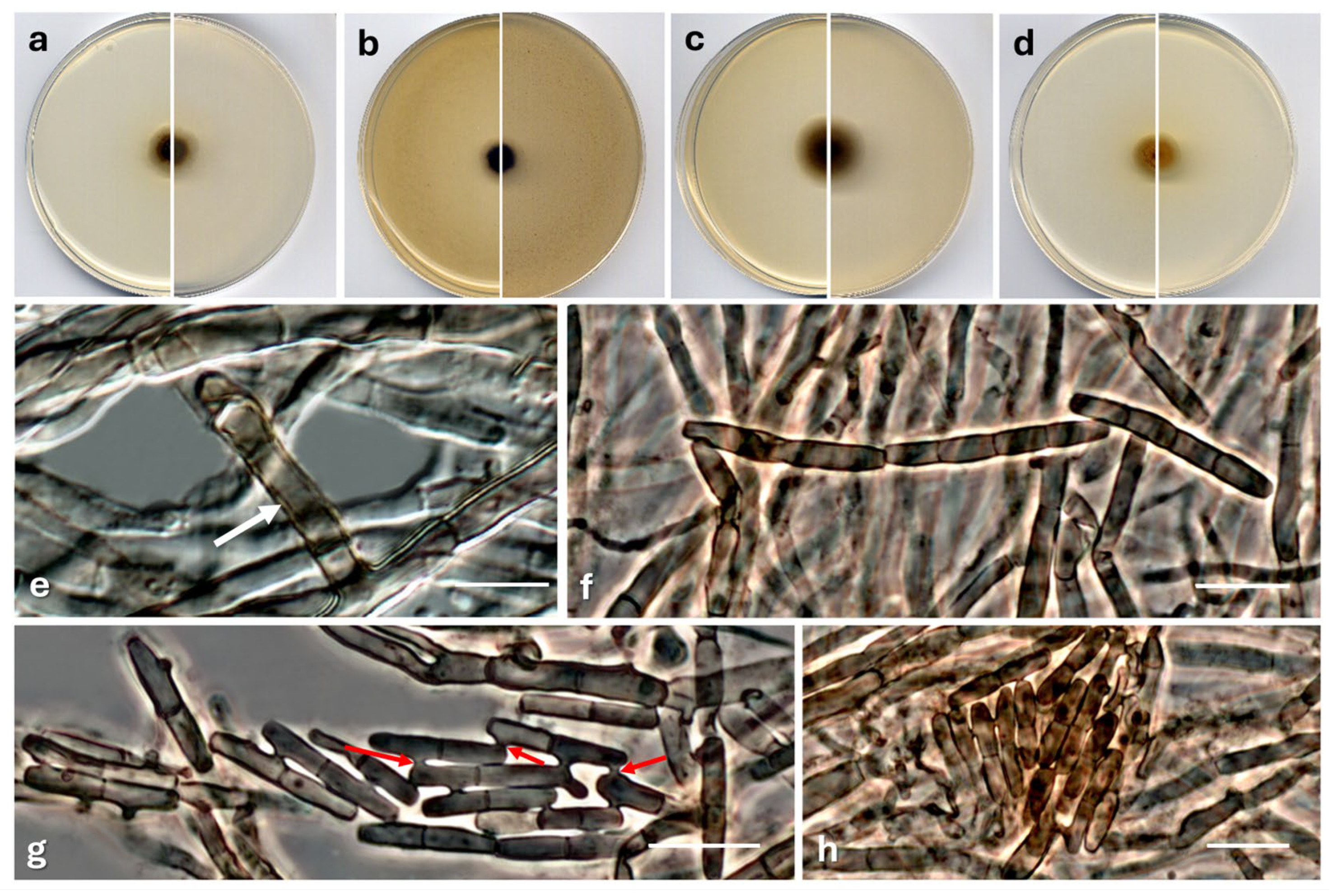
Description: Hyphae hyaline to subhyaline, septate, smooth- and thick-walled, branched, 1.0–2.0 µm wide. Asexual morphConidiophores semi-micronematous to micronematous, reduced to the conidiogenous cells. Conidiogenous cells phialidic, terminal or lateral, hyaline, smooth- and thin-walled, cylindrical to flask-shaped, 8.0–17.0 × 1.0–2.0 µm, conical when integrated (adelophialides) and measuring 1.0–2.0 × 1.0 µm, producing conidia in mucous masses. Conidia unicellular, enteroblastic, solitary, hyaline, smooth- and thick-walled, 2–3-guttulate, ellipsoidal to slightly reniform, 7.0–10.0 × 3.0–4.5 µm. SynanamorphConidiophores micronematous, reduced to the conidiogenous cells. Conidiogenous cells uni- or polyblastic, lateral or terminal, integrated and indistinguishable from the vegetative hyphae. Conidia holoblastic, 0–2-septate, mostly fusiform to navicular, sometimes clavate (when terminal), flattened at the base or both ends, 11.0–30.0 × 2.0–4.0 µm, guttulate, disposed in straight or single branching acropetal chains of up to 8 conidia. Appressoria abundant, single, dark brown, lateral or terminal on the vegetative hyphae mameliform, pyriform or irregularly shaped and with lobulated margins, 4.0–14.0 × 2.5–8.5 µm, flattened at the base and with a lateral or terminal germ pore; in this later case, a new hypha protrudes through the pore and eventually generates a new terminal appressorium, which can eventually proliferate again.
Culture characteristics (after 14 d at 25 °C)—Colonies on PDA reaching 24 mm diam., circular, umbonate, velvety, slightly wrinkled, pale gray (1B1) at the center and white (1A) at the margins, margins entire, sporulation abundant; reverse white (1A1); soluble pigment absent. Colonies on PCA reaching 12 mm diam., circular, slightly raised at the center, flattened at the margins, velvety to powdery, white (1A1), entire, sporulation scarce; reverse yellowish brown (5D8) at the center, white (1A1) at the margins; soluble pigment absent. Colonies on OA reaching 28 mm diam., circular, flattened, velvety to powdery, pale yellow (4A4) to grayish yellow (4B5) at the center, white (1A1) at the margins, entire, sporulation moderate to abundant; reverse grayish yellow (4B6) to light (4A4) at the center, grayish yellow (4C6) to white (1A1) towards margins; soluble pigment absent. Colonies on MEA reaching 15 mm diam., lobulated, irregular and spreading, slightly raised at the center, flattened at the margins, velvety to powdery, white (1A1), sporulation absent; reverse yellowish brown (5E8) at the center, white (1A1) at the edges; soluble pigment absent. Cardinal temperatures of growth: minimum 15 °C, optimum 25 °C, and maximum 30 °C.
Typus. SPAIN, Extremadura community, Badajoz province, Zújar River (38°24′31.4″ N 5°34′47.9″ W) (Granja de Torrehermosa), isolated from submerged decomposing unidentified twig, 12 November 2022, collected by Juan R. García Martínez, isolated by María Barnés Guirado (holotype CBS H-25764; cultures ex-type CBS 154004 = FMR 20787).
Notes: The genus Ophioceras is characterized by the production of immersed, globose, dark, ostiolate perithecia; cylindrical, elongated asci; and typically filiform, septate ascospores. Most species do not produce an asexual morph, with the exceptions of O. graminis, which also lacks a sexual morph, and O. rhizomorphum. Although O. diversisporum is phylogenetically closely related to O. commune, it only produces an asexual morph, like O. graminis. However, O. diversisporum differs morphologically from O. graminis by producing ellipsoidal to slightly reniform, 2–3-guttulate conidia, in contrast to the lunate, allantoid to fusiform conidia of O. graminis. Additionally, O. diversisporum produces a synanamorph, a feature not reported in O. graminis, as well as appressoria, whereas O. graminis forms hyphopodia. In contrast, O. rhizomorpha produces a didymobotryum-like asexual morph, characterized by synnemata bearing an apical fertile region with tretic conidiophores. This morphology is distinct from the known anamorphs of O. graminis and O. diversisporum.
Protophioceras Barnés-Guirado, Cano & Stchigel, gen. nov. MycoBank MB 859580.
Etymology. From Latin protos- meaning ‘first’, referring to the fungus’ phylogenetic relationship, as it occupies a basal position relative to the species of Ophioceras.
Description: Pseudostromata carbonaceous, scattered, solitary, semi-immersed to erumpent, 1–5-loculate, glabrous, ostiolate, papillate; locules immersed within the pseudostroma, clustered, subglobose to ampulliform, with a long black periphysate neck; peridium of textura angularis to textura prismatica, thick-walled, composed of several layers of broad and flattened pseudoparenchymatous cells; paraphyses present; asci 8-spored, unitunicate, cylindrical, sessile to subsessile, with a bulbous-like base and a J-shaped apical ring; ascospores hyaline, parallelly disposed or overlapping, filiform to sigmoidal, aseptate, thin- and smooth-walled, multi-guttulate. Asexual morph not observed.
Type species: Protophioceras sichuanense (Jiang, Phookamsak & Hyde) Barnés-Guirado, Cano & Stchigel, comb. nov. MycoBank MB 859589.
Description: H.B. Jiang, Phookamsak and K.D. Hyde (2021) [44].
Notes: Despite the overall similarity in ascus and ascospore morphology between Protophioceras sichuanense and species of Ophioceras, the two taxa differ markedly in their ascomatal architecture. Protophioceras sichuanense is characterized by the formation of well-developed, polyloculate pseudostromata bearing multiple ostiolate necks, a feature not observed in Ophioceras. In contrast, species of Ophioceras consistently produce solitary, uniloculate perithecial ascomata with a single neck, lacking any stromatic tissue. This fundamental difference in ascomatal organization reflects distinct developmental patterns and has traditionally been regarded as taxonomically informative at the generic level within the Magnaporthales. Moreover, the separation of P. sichuanense from Ophioceras is strongly supported by multilocus phylogenetic analyses, in which P. sichuanense forms a deeply divergent, fully supported lineage basal to the core Ophioceras clade. The congruence between these pronounced morphological differences and the phylogenetic evidence supports the recognition of Protophioceras as a distinct genus.
Conioscyphales Réblová & Seifert, in Réblová, Seifert, Fournier & Štěpánek, Persoonia 37: 63 (2016). MycoBank MB 813226.
Conioscyphaceae Réblová & Seifert, in Réblová, Seifert, Fournier & Štěpánek, Persoonia 37: 63 (2016). MycoBank MB 813227.
Conioscypha Höhn., Annls mycol. 2 (1): 58 (1904). MycoBank MB 7754.
Conioscypha clavatispora Barnés-Guirado, Cano & Stchigel, sp. nov. MycoBank MB 859385. Figure 8.
Etymology. From Latin clavatum-, clavate, and -sporae, spores, due to the morphology of the conidia.
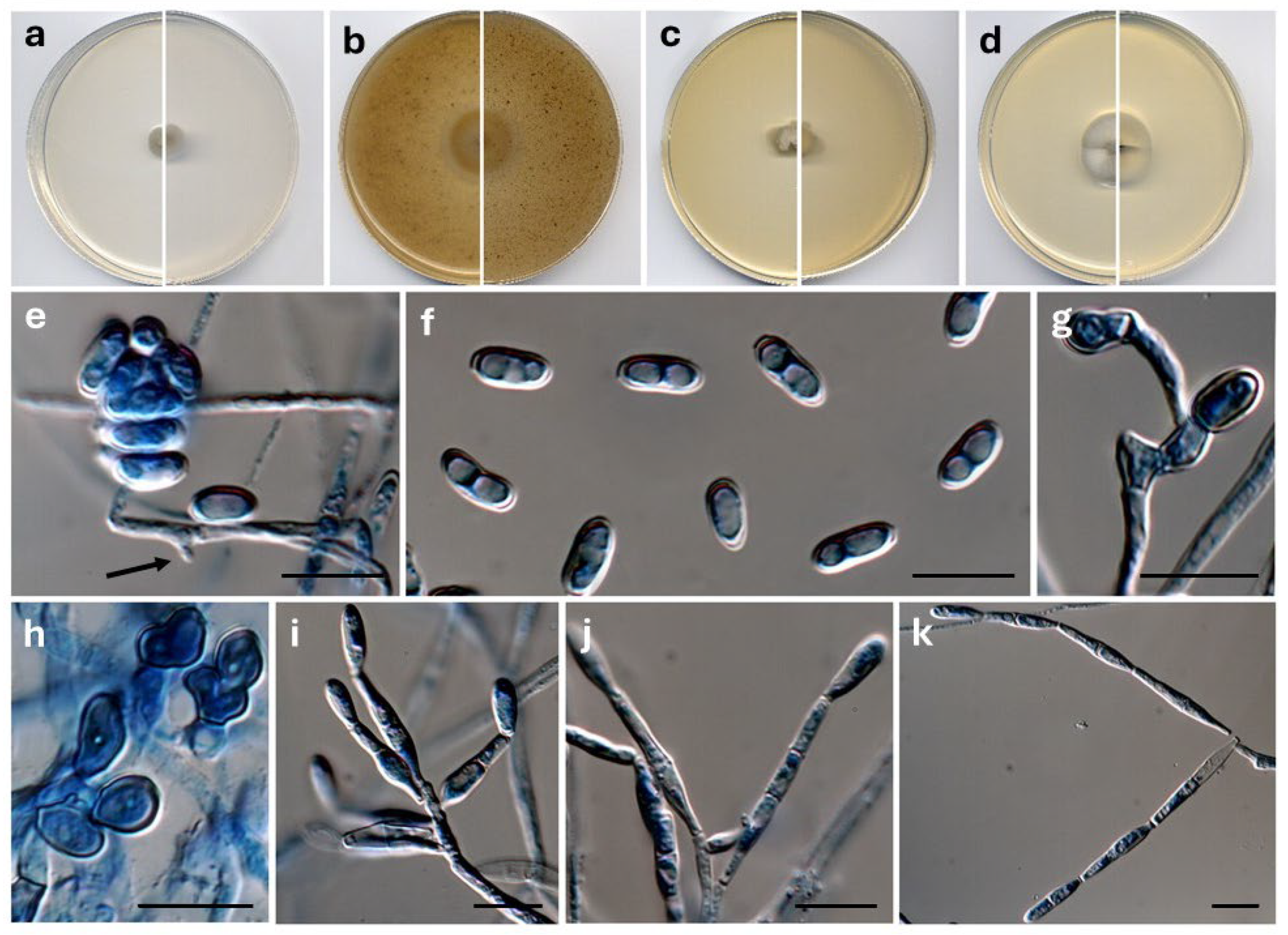
Description: Hyphae mostly immersed, septate, hyaline, branched, smooth- and thin-walled, 0.5–1.0 μm wide. Conidiophores micronematous, mononematous, reduced to conidiogenous cells. Conidiogenous cells monoblastic, discrete, sessile, arising terminally or laterally on the hyphae, solitary or in small clusters, hyaline, smooth- and thin-walled, cupulate, 14.0–30.0 μm long, 5.0–12.0 μm in the widest part, with a multi-layered cupulate collarette after two percurrent elongations. Conidia partially holoblastic, unicellular, solitary, endogenous, pale brown to brown, smooth-walled to asperulate, thick-walled, ellipsoidal to clavate, 9.5–22.0 × 4.5–10.0 μm, truncated at the base and with a median pore, rounded at the top, non-guttulate or mono- to multi-guttulate.
Culture characteristics (after 14 d at 25 °C)—Colonies on PDA reaching 14 mm diam., flat, round, velvety, margins radiate and filamentous, reddish yellow (4A6 to 4A7), sporulation absent; reverse yellowish orange (4B7), dark yellow (4C8) at the center; soluble pigment absent. Colonies on PCA reaching 12 mm diam., cottony to velvety, slightly raised at the center, margins filamentous and slightly lobulated, reddish yellow (4A7), sporulation moderate to abundant, reverse deep orange (5A8), golden yellow (5B7) at the center; soluble pigment absent. Colonies on OA reaching 27 mm diam., flat, velvety, margins filamentous, pale yellow (3A5), grayish yellow (3B7) at the center, sporulation abundant; reverse yellow (3A6), grayish yellow (3B7) at the center; soluble pigment absent. Colonies on MEA reaching 17 mm diam., slightly raised at the center, cottony to velvety, margins filamentous and slightly lobulated, reddish yellow (4A6), sporulation abundant; reverse deep yellow (4A8); soluble pigment absent. Cardinal temperatures of growth: minimum 15 °C, optimum 25 °C, and maximum 37 °C.
Typus. SPAIN, Extremadura community, Badajoz province, Zújar River (38°24′31.4″ N 5°34′47.9″ W) (Granja de Torrehermosa), isolated from submerged plant debris, 12/11/2022, collected by Juan R. García Martínez, isolated by María Barnés Guirado (holotype CBS H-25765; cultures ex-type CBS 154005 = FMR 20788).
Other specimens. SPAIN, Extremadura community, Badajoz province, Zújar River (38°24′31.4″ N 5°34′47.9″ W) (Granja de Torrehermosa), isolated from submerged decomposing unidentified twig, 12 November 2022, collected by Juan R. García Martínez, isolated by María Barnés Guirado (living culture FMR 20897).
Notes: While Conioscypha clavatispora shares with other species in the genus the morphology of the conidiophores, conidiogenous cells, and conidiogenesis, it differs from its closest relative, Conioscypha varia, in several key features. The conidia of C. clavatispora are ellipsoidal to clavate, whereas those of C. varia are ovoid, flamiform, navicular, or subellipsoidal. Additionally, the conidia of C. clavatispora (9.5–22 × 4.5–10 μm) are larger than those of C. varia (8.4–15 × 5.6–8.5 μm). The conidial apex in C. clavatispora is rounded with a truncated base, while in C. varia the apex may be rounded or pointed, and the base may be rounded or truncated. These species also differ in conidial wall ornamentation: conidia in C. clavatispora are smooth to asperulate, while those in C. varia are smooth. Furthermore, conidia of C. clavatispora typically exhibits a median pore and guttules, which are absent in C. varia.
Protoconioscypha Barnés-Guirado, Cano & Stchigel, gen. nov. MycoBank MB859603.
Etymology. From Latin protos- meaning ‘first’, referring to the fungus’s phylogenetic relationship, as it occupies a basal position relative to the species of Conioscypha.
Description: Hyphae superficial to immersed, branched, smooth-walled, septate, brown, pale brown or hyaline. Conidiophores micronematous to semi-macronematous, mononematous, erect, arising terminally or laterally on the hyphae, solitary or in small clusters. Conidiogenous cells monoblastic, integrate or discrete, sessile or over small conidiophores, cuneiform, cylindrical, smooth-walled, percurrently proliferating, from multiple or a single cup-shaped collarettes up to 50 mm wide at the apex to no collarettes. Conidia solitary, turbinate to pyriform, smooth-walled, unicellular, aseptate, rounded at apex, rounded to truncate with a pore to no pore at the base. Sexual morph not observed.
Type species: Protoconioscypha nakagirii (Chuaseeharonnachai, Somrithipol, Suetrong & Boonyuen) Barnés-Guirado, Cano & Stchigel, comb. nov. MycoBank MB 859605.
Description: Chuaseeharonnachai, Somrithipol, Suetrong and Boonyuen (2016) [45].
Other species: Protoconioscypha narathiwatensis (Karimi, Asghari & Hyde) Barnés-Guirado, Cano & Stchigel, comb. nov. MycoBank MB861481.
Description: Karimi, Asghari and Hyde (2025) [46].
Notes: Although there are several morphological similarities between Protoconioscypha nakagirii, Protoconioscypha narathiwatensis and the species of the genus Conioscypha, the formers produce turbinate to pyriform conidia, feature not observed in any of the species of Conioscypha. Moreover, the conidia in P. nakagirii and P. narathiwatensis are larger than any conidia produced by a Conioscypha spp.
Helotiales Nannf., Nova Acta R. Soc. Scient. upsal., Ser. 4 8 (no. 2): 68 (1932). MycoBank MB 90476.
Arachnopezizaceae Hosoya, J.G. Han & Baral, in Baral, Index Fungorum 225: 1 (2015). MycoBank MB 551075.
Arachnopeziza Fuckel, Jb. nassau. Ver. Naturk. 23–24: 303 (1870). MycoBank MB 294.
Arachnopeziza torrehermosensis Barnés-Guirado, Stchigel & Cano, sp. nov. MycoBank MB 859386.
Etymology. From the name of the municipal district where the samples from the Zújar River were collected, “Granja de Torrehermosa”.
Description: Mycelium composed of septate, hyaline, refringent, smooth- and thin-walled, sinuous to loosely coiled, branching hyphae of 1.0–3.0 (–4.0) μm wide, with mostly thickened septa, occasionally narrowing at the level of the septum into a series of consecutive cells, sometimes incrusted of uncolored crystals. Asexual or sexual morphs not produced in all culture media tested after two months.
Culture characteristics (after 14 d at 25 °C)—Colonies on PDA reaching 25 mm diam., umbonate, velvety, wrinkled at the center, smooth at the margins, light gray (1D1) to white (1A1) at the center, white (1A1) at the margins, filamentous margins, sporulation absent; reverse yellowish brown (5F8) to golden brown (5D7) at the center, white (1A1) at the margins; soluble pigment absent. Colonies on PCA reaching 18 mm diam., slightly raised at the center, flattened at the margins, velvety, smooth, yellow (5C8) at the center, light orange (5A4) towards the margins, entire, sporulation absent; reverse orange (5B8) at the center, light orange (5A5) at the margins; soluble pigment absent. Colonies on OA reaching 9 mm diam., slightly raised at the center, flattened at the margins, velvety, smooth, filamentous margins, white (1A1) at the center, grayish yellow (4B4) at the margins, sporulation absent; reverse reddish yellow (4A6) at the center, pale yellow (4A3) at the margins; soluble pigment absent. Colonies on MEA reaching 25 mm diam., slightly raised at the center, flattened at the margins, cottony at the center, velvety at the margins, smooth, filamentous margins, white (1A1) at the center, grayish yellow (4B4) at the margins, sporulation absent; reverse dark yellow (4C8) at the center, grayish yellow (4B4) towards margins; soluble pigment absent. Cardinal temperatures of growth: minimum 5 °C, optimum 25 °C, and maximum 30 °C.
Typus. SPAIN, Extremadura community, Badajoz province, Zújar River (38°24′31.4″ N 5°34′47.9″ W) (Granja de Torrehermosa), isolated from submerged decomposing unidentified leaf, 12 November 2022, collected by Juan R. García Martínez, isolated by María Barnés Guirado (holotype CBS H-25766; cultures ex-type FMR 20792).
Notes: Although our efforts to induce the production of reproductive structures by the strain FMR 20792 were unsuccessful, the phylogenetic distance and placement respect to the rest of the species of that genus are consistent enough to consider Arachnopeziza torrehermosensis as a novel species.
Microthyriales G. Arnaud, Les Astérinées: 85 (1918). MycoBank MB 90485.
Microthyriaceae Sacc., Syll. fung. (Abellini) 2: 658 (1883). MycoBank MB 81008.
Neoanungitea Crous, in Crous et al., Persoonia 39: 359 (2017). MycoBank MB 823489.
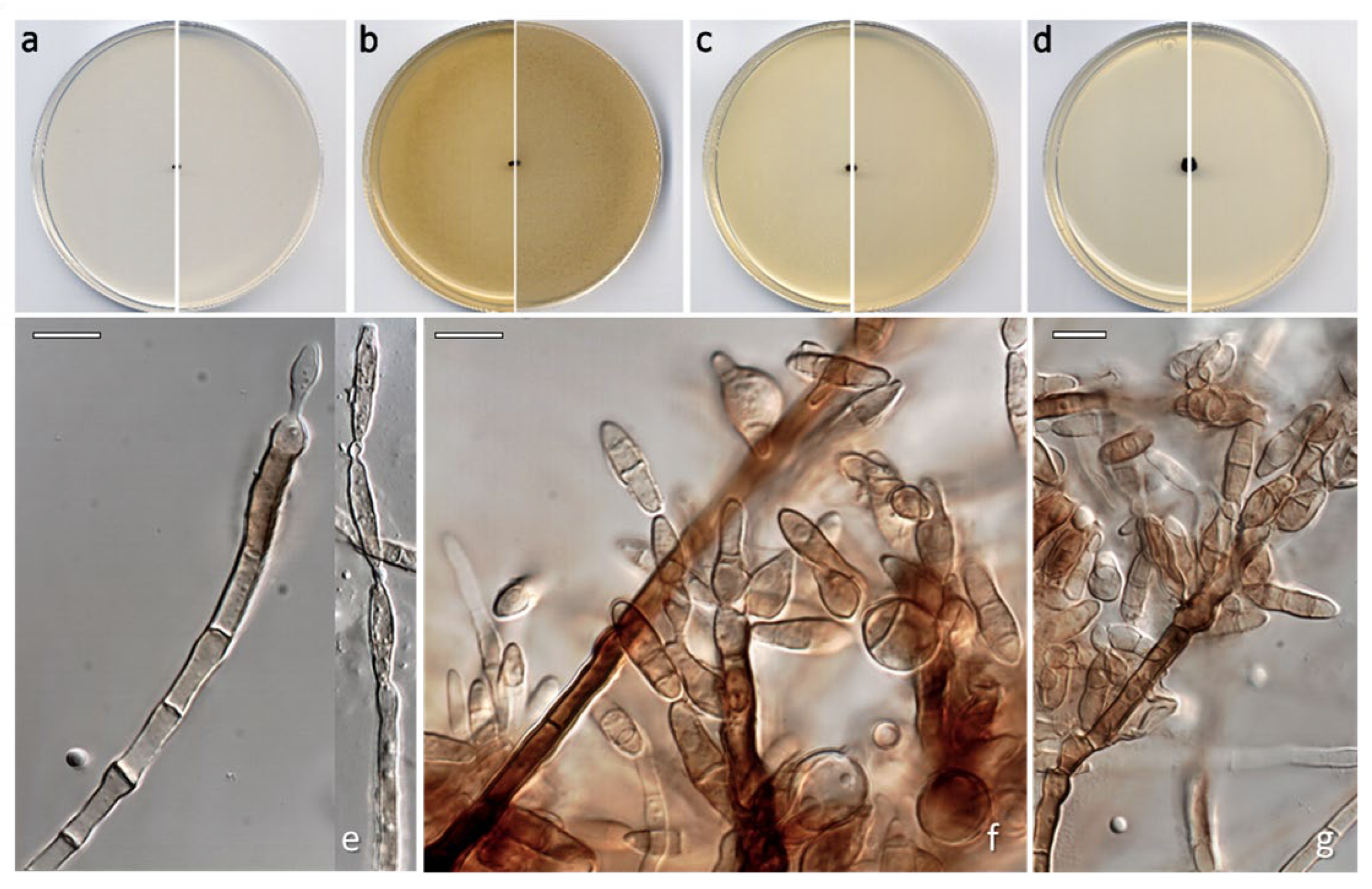
Neoanungitea torrehermosensis Barnés-Guirado, Stchigel & Cano, sp. nov. MycoBank MB 859387. Figure 9.
Etymology. From the name of the municipal district where the samples from the Zújar River were collected, “Granja de Torrehermosa”.
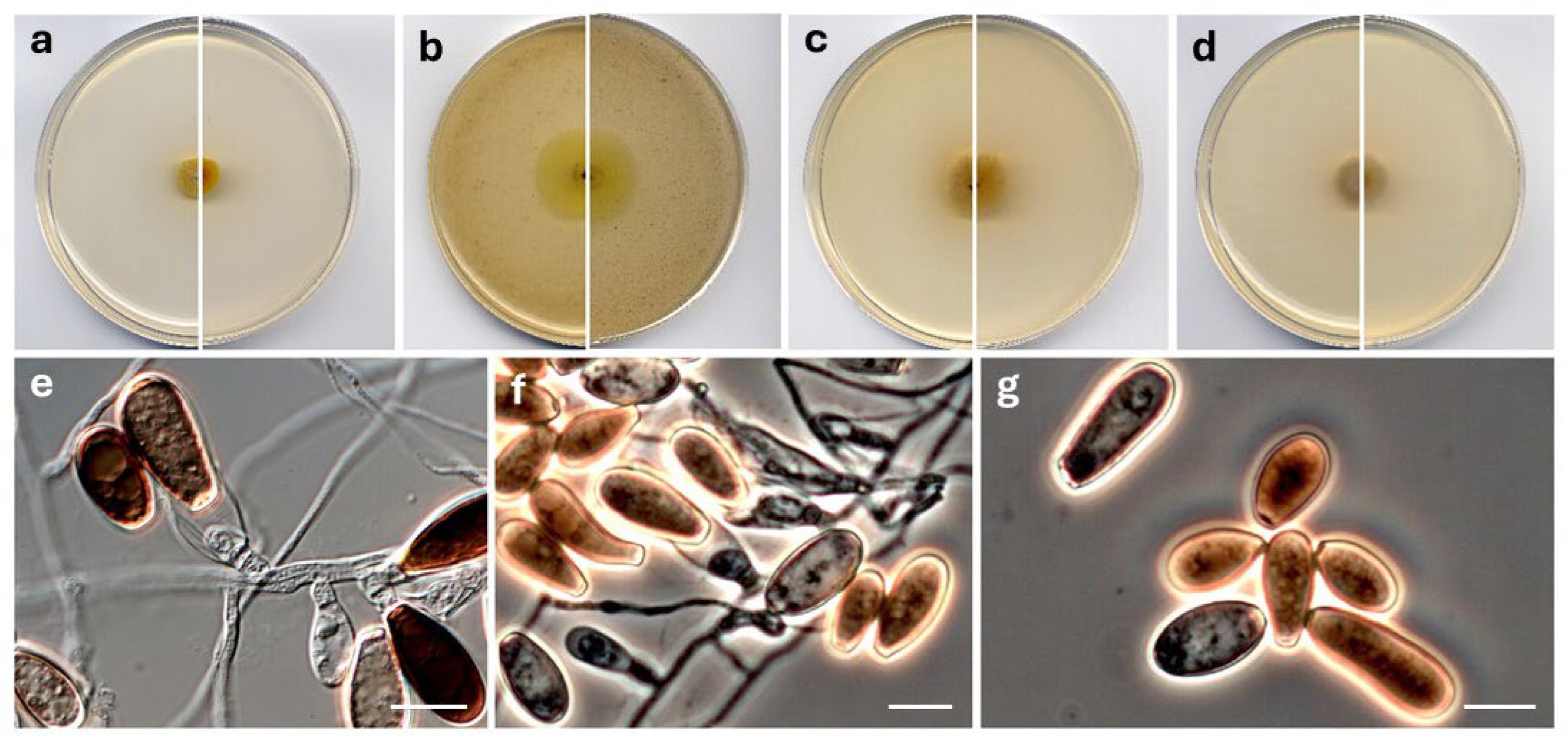
Description: Hyphae brown, septate, slightly verrucose, thick-walled, branching, 2–3 µm wide. Conidiophores macronematous, erect, dark brown, (1–)2–5-septate, straight at the base, slightly flexuous at the upper part, smooth- and thick-walled, subcylindrical, 60–250 × 4–8 µm. Conidiogenous cells sympodially proliferating, hyaline to dark brown, terminal or subterminal, in the latter case due to the percurrent proliferation of the conidiophore, cylindrical, barrel-shaped to ellipsoid with a truncate base, 21–37 × 3–6 µm, sometimes geniculate at the apex, bearing 1–7 not darkened nor thickened inconspicuous scars. Ramoconidia scarce, 0–3-septate, pale brown to brown, in acropetal chains of up to 3 conidia, smooth-walled to slightly verrucose, thin- to moderately thick-walled, cylindric, ellipsoidal or irregularly shaped, 17.5–32 × 3–5 µm, with a basal scar and lateral and apical scars, sometimes proliferating sympodially. Conidia holoblastic, (0) 1–3-septated, rarely with one oblique septum, in acropetal chains of up to 4 conidia, pale brown to brown, cylindric, fusiform, navicular, rarely pyriform to limoniform, 8.5–31 × 3–13 µm, truncated at the base (1–2 µm diam.) or (rarely) at both ends, not constricted or slightly constricted at the septum.
Culture characteristics (after 14 d at 25 °C)—Colonies on PDA reaching 5 mm diam., slightly raised at the center, flattened at the margins, velvety, smooth, dark brown (6F7), filamentous and irregular margins, sporulation moderate to abundant; reverse dark brown (6F8), soluble pigment absent. Colonies on PCA reaching 2 mm diam., raised, velvety, smooth, dark brown (6F7), filamentous margins, moderate to abundant sporulation; reverse dark brown (6F8), soluble pigment absent. Colonies on OA reaching 4 mm diam., raised, velvety, wrinkled, dark brown (6F6), slightly irregular margins, abundant sporulation; reverse dark brown (6F7), soluble pigment absent. Colonies on MEA reaching 4 mm diam., raised at the center, flattened at the edges, velvety, wrinkled, olive brown (4F7), irregular margins, abundant sporulation; reverse olive brown (4F8), soluble pigment absent. Cardinal temperatures of growth: minimum 15 °C, optimum 25 °C, and maximum 30 °C.
Specimen: SPAIN, Extremadura community, Badajoz province, Zújar River (38°24′31.4″ N 5°34′47.9″ W) (Granja de Torrehermosa), isolated from submerged decomposing unidentified leaf, 12 November 2022, collected by Juan R. García Martínez, isolated by María Barnés Guirado (holotype CBS H-25767; cultures ex-type CBS 154006 = FMR 20793).
Other specimens: SPAIN, Extremadura community, Badajoz province, Zújar River (38°24′31.4″ N 5°34′47.9″ W) (Granja de Torrehermosa), isolated from submerged plant debris, 12/11/2022, collected by Juan R. García Martínez, isolated by María Barnés Guirado (living culture FMR 20786).
Notes: Neoanungitea torrehermosensis differs from its closest species, Neoanungitea eucalypti, in producing smooth-walled (roughened in N. eucalypti) and much larger (60–250 × 4–8 µm in N. torrehermosensis vs. 30–160 × 4–6 µm in N. eucalypti) conidiophores. Neoanungitea torrehermosensis produces ramoconidia, which has not been reported for N. eucalypti. Moreover, the conidia of N. torrehermosensis are bigger than those of N. eucalypti (8.5–31 × 3–13 µm in N. torrehermosensis vs. 13–22 × 3.5–5 µm in N. eucalypti) and very variable in size (regularly cylindric-fusiform to navicular in N. eucalypti).

4. Discussion

Our survey of submerged, decaying plant debris in the Zújar River yielded a cultured assemblage of 49 isolates representing 24 taxa (Table 2), among which five species are newly described based on phylogenetic and phenotypic evidence. This combination of novelty and uneven taxon frequencies is reflected in a community structure dominated by a small number of recurrent saprobes (Paraphaeosphaeria sporulosa and Hongkongmyces brunneosporus) and a long tail of low-frequency taxa. This pattern is typical of freshwater-associated fungal communities retrieved by culturing, where a few competitively successful decomposers are repeatedly isolated while many taxa are detected sporadically. Together, these findings underscore how incomplete the inventory of freshwater fungi remains in Mediterranean river systems.
The genus Polyscytalum was established by Riess in 1853 to accommodate Polyscytalum fecundissimum [47]. According to Index Fungorum, to date, the genus includes 23 species [https://www.indexfungorum.org, accessed on 28 November 2025]; however, only eight of them have available molecular data. This genus has an extensive geographical distribution (e.g., the Americas, Australasia, Europe, and Malaysia). Regarding the species reported from Spain, Polyscytalum pini-canariensis and Polyscytalum gracilisporum have been isolated from the Canary Islands. Consequently, Polyscytalum submersum is the first report of the genus for the Iberian Peninsula [47,48,49,50,51,52,53]. The species of Polyscytalum are typically found on dead plant material/hosts belonging to the genera Cedrus, Eucalyptus, Fagus, Grevillea, Nothofagus, Pinus, Quercus, Syzygium and Vaccinium [47,48,49,50,51,52,53], and although Polyscytalum submersum was isolated from unidentified submerged plant debris, the Zújar River nearby harbors some of the plant genera reported as substrates for Polyscytalum spp., like Eucalyptus, Quercus and Pinus [13,14]. Despite being mostly isolated from dead plant material, Polyscytalum spp. are rarely reported as pathogenic [50,51,54,55]. Morphologically, the genus Polyscytalum can be divided into two main groups: one including those species producing acropetal chains of blastic cylindric conidia, and a second forming arthroconidia arising at the top of the verticillate conidiophores [51,56,57]. This morphological variability has led to the misplacement of some Polyscytalum species in genera like Anungitea, Cylindrium, and Sympodiella, and vice versa [47,50,52,53,57,58,59]. Polyscytalum submersum, belongs to the former group, sharing characteristics with the other species, such as the production of septate, hyaline to pale brown, cylindrical conidia, truncated at both ends. However, P. submersum is easily distinguishable from the rest of the species of the genus because of the production of anastomosing conidia throughout connectives [50,51,57].
Otherwise, the order Magnaporthales was established by Thongkantha et al. in 2009 to accommodate the family Magnaporthaceae [60]. Approximately 50% of all taxa in the family are pathogenic for monocotyledons, including Pyricularia oryzae, the rice blast fungus, Nakataea oryzae, the stem rot pathogen of rice, and Gaeumannomyces graminis, the most important rot pathogen of wheat and other cereals like barley, rye and triticale [61,62]. In 2014, Klaubauf et al. introduced two new families in the Magnaporthales, Ophioceraceae and Pyriculariaceae, to accommodate the genera Ophioceras and Pyricularia, respectively [32,63]. Currently, the genus includes 48 species, according to the Index Fungorum [https://www.indexfungorum.org, accessed on 28 November 2025], being typified by O. dolichostomum. This genus is characterized by producing immersed sub-carbonaceous perithecia, with globose bodies and long conic-cylindrical necks, unitunicate asci and septate filiform ascospores, being features in family delimitation [63,64,65,66]. Species of the genus have been isolated from Africa, Asia, Australasia, Central Africa, the Americas, the Netherlands and the UK [44,60,64,67,68,69,70,71,72,73,74,75,76]. Ophioceras diversisporum was isolated from a decomposing unidentified twig submerged in freshwater, a fact frequently reported for species of the genus; however, it represents the first report of the genus for Spain [44]. Although species of Ophioceras are generally characterized by the morphological features of their sexual morphs, O. diversisporum and O. graminis are the only species for which the sexual stage remains unknown. Additionally, only two species, O. rhizomorpha and O. graminis, are known to produce an asexual morph. Ophioceras rhizomorpha forms a didymobotryum-like anamorph, which differs markedly from the anamorph of O. diversisporum. Key differences include the presence of synnemata in O. rhizomorpha (absent in O. diversisporum). Furthermore, the conidiophores, conidiogenous cells, and conidia in O. rhizomorpha are dark brown, whereas those in O. diversisporum are hyaline. The conidia of O. rhizomorpha are septate, in contrast to the aseptate conidia of O. diversisporum. Notably, O. diversisporum also produces a synanamorph and appressoria, a fact not reported for O. rhizomorpha [44,77,78]. On the other hand, O. graminis produces lunate, allantoid to fusiform conidia and curved conidiogenous cells, along with hyphopodia, but lacks a synanamorph. In contrast, O. diversisporum produces ellipsoidal to slightly reniform, 2–3-guttulate conidia, and straight conidiogenous cells, appressoria, and a distinct synanamorph [78]. The species of Ophioceras are not known for pathogenic activity; in fact, some strains have been reported to exhibit antifungal properties against plant pathogens [79]. Conversely, although appressoria have been described in epiphytes, endophytes, and saprobes, they are primarily known as infective structures used by pathogens to penetrate host tissues [80]. Consequently, although there is currently no information regarding the pathogenicity of O. diversisporum, it may be considered a potential plant pathogen. Further studies are needed to clarify the nature of its relationship with host plants. Additionally, the phylogenetic analysis showed that O. sichuanense was placed in a basal, fully supported branch phylogenetically distant from the clade containing the remaining species of Ophioceras. This, along with its production of polyloculate pseudostromata with multiple necks, distinct from the uniloculate perithecial ascomata with a single long neck in other Ophioceras spp., led us to reclassify O. sichuanense into a new genus, Protophioceras.
The family Conioscyphaceae and the order Conioscyphales were stablished by Réblová et al. [81] to accommodate the genus Conioscypha [81] previously erected by Höhnel in 1904, with Conioscypha lignicola as a type species [82]. Nowadays, the genus contains 33 species, according to the Index Fungorum [https://www.indexfungorum.org, accessed on 28 November 2025]. Species of this genus have been reported from countries on every continent (including Spain) and are typically recovered from wood and other sorts of decaying plant material submerged in freshwater, conditions under which our novel species, Conioscypha clavatispora, was also found [64,83,84,85,86,87,88,89,90]. The species of this genus mostly present an asexual stage characterized by the production of cup-shaped, percurrently proloferating, multi-collaretted phialides from which the dematiaceous aseptate conidia are released [80,86,89]. Conioscypha clavatispora fits well within the genus based on both phenotypic and phylogenetic evidence. However, C. clavatispora is readily distinguishable from its closest relatives due to its phylogenetic divergence and distinctive conidial morphology. The conidia are ellipsoidal to clavate and large (9.5–22 × 4.5–10 μm), being ovoid, flamiform, navicular, or subellipsoidal and smaller (8.4–15 × 5.6–8.5 μm) in C. varia, the phylogenetical nearest species. Additionally, the conidia of C. clavatispora have a median pore and guttules, features not observed in C. varia [45,91,92]. Furthermore, due to the significant phylogenetic distance between C. nakagirii, C. narathiwatensis and the clade containing the rest of the species of Conioscypha, as well as its production of large, smooth-walled, turbinate to pyriform conidia, features not observed in any other species within the genus, we transferred C. nakagirii and C narathiwatensis to a new genus, Protoconioscypha [45,46,92].
The genus Arachnopeziza, erected by Fuckel in 1870 [93], currently includes 38 species, based on the Index Fungorum [https://www.indexfungorum.org, accessed on 28 November 2025], and it is included in the family Arachnopezizaceae together with the genera Austropezia, Eriopezia and Parachnopeziza [94]. There are two species of this genus traditionally considered the type species: Arachnopeziza aurata and Arachnopeziza aurelia. Both were described by Fuckel in 1870, A. aurata being the most widely accepted as type species [93,95]. The species of Arachnopeziza have a global distribution, being reported in Asia, Australasia, Europe and USA, and isolated from plants (both fresh and decaying) belonging to the genera Arctostaphylos, Fagus, Juncus, Populus, Salix, Sphagnum, Calamagrostis, Festuca, Koeleria, Pinus, and Tilia, as well on Gramineae [95,96,97,98,99,100,101]. Arachnopeziza torrehermosensis, our new species, represents the first report of the genus for Spain [95,96,97,98,99,100,101]. Arachnopeziza torrehermosensis was isolated from a freshwater submerged undetermined decomposing leaf, but the riparian flora of the Zújar River includes some plant genera from which species of the genus Arachnopeziza have been reported, such as Festuca, Pinus, Populus, and Salix [13]. Morphologically, the genus Arachnopeziza features uncolored to orange apothecia settled on a subiculum, with straight hairs and a hyaline excipulum, 8-spored cylindrical to claviform asci with an apical pore stained in blue with iodine solutions, and 1-7-septate ascospores [100]. Unfortunately, A. torrehermosensis did not produce fertile structures in natural subtract nor onto culture media at the lab; thus, it is not possible to perform a phenotypic comparison with other species of the genus. However, our phylogenetic analysis shows that A. torrehermosensis is placed in a well-supported branch within the genus and that the phylogenetic distance is sufficient to support its recognition as a distinct species within the genus, but not so long to suspect that it may belong to any other genus.
Lastly, the family Microthyriaceae was established by Saccardo in 1883 to accommodate the genus Microthyrium [66]. This family comprises 16 genera, eight of which reproduce asexually. The asexual stage is characterized by the production of micronematous to macronematous, mononematous, branched or unbranched conidiophores; the conidiogenous cells are terminal or integrated, mono- to polyblastic, and determinate or sympodial; the conidia are typically subcylindrical to ellipsoid or obclavate, verrucose, aseptate to multiseptate, and solitarily or in branched chains; the ramoconidia, when present, are aseptate, verrucose, and subcylindrical to fusoid-ellipsoid [102,103]. One of these asexual genera is the genus Neoanungitea, which was erected by Crous in 2017 [104]. Nowadays, the genus contains two species, Neoanungitea eucalypti and Neoanungitea eucalyptorum [https://www.indexfungorum.org, accessed on 28 November 2025], both isolated from Australia and from different species of Eucalyptus [104,105]. Consequently, our strains FMR 20793 and FMR 20786, in addition to representing a new species, also constitute the first report of the genus for Europe [104,105]. Although, as was mentioned above, the identity of the decomposing leaf from which both strains have been recovered remains unknown, we previously mentioned the presence of Eucalyptus near the Zújar River, a fact consistent with the substrate from which the other species of the genus have been isolated. Morphologically, the genus Neoanungitea is characterized by the production of erect, solitary, flexuous, subcylindrical conidiophores arising from brown stroma or from superficial hyphae. These conidiophores are multiseptate, thick-walled, roughened, and brown. The conidiogenous cells are terminal, subcylindrical, flat-tipped, thin-walled, finely roughened, and brown, forming a terminal rachis with several sympodial loci. The conidia are short, fusoid-ellipsoid, roughened, septate, pale brown, and arranged in branched chains, with obtuse ends and slightly thickened hila [104]. Neoanungitea torrehermosensis shares several diagnostic features with other species of the genus, yet it is distinguishable from its phylogenetically closest relative, N. eucalypti, by a suite of morphological differences. Neoanungitea torrehermosensis produces macronematous conidiophores straight at the base and slightly flexuous at the upper part, smooth-walled, and relatively large, measuring 60–250 × 4–8 µm. Its conidiogenous cells are cylindrical, barrel-shaped to ellipsoid, terminal or subterminal due to percurrent proliferation, occasionally geniculate at the apex, and comparatively short, ranging 21–37 × 3–6 µm. The conidia are cylindric, fusiform, or navicular, (1–)3-septate horizontally, occasionally with an oblique septum, truncated at the base or rarely at both ends, sometimes constricted at the septa, and relatively large, measuring 8.5–31 × 3–13 µm. In contrast, N. eucalypti (the phylogenetically nearest species) displays roughened and shorter conidiophores (30–160 × 4–6 µm), and terminal, subcylindrical, non-geniculate conidiogenous cells that are larger (20–60 × 4–7 µm). Its conidia are (0–)3-septate with no oblique septa, fusoid-ellipsoid, obtuse at both ends, not constricted at the septa, and shorter (13–22 × 3.5–5 µm). Additionally, N. torrehermosensis produces ramoconidia, which has not been observed in N. eucalypti. These distinct morphological characteristics, in combination with phylogenetic evidence, clearly support the recognition of N. torrehermosensis as a novel species within the genus [103,106].

5. Conclusions

This study provides the first culture-based survey of filamentous fungi associated with submerged, decaying plant debris in the Zújar River. From this substrate, we obtained 49 isolates representing 24 taxa, with the assemblage dominated by Paraphaeosphaeria sporulosa and Hongkongmyces brunneosporus. Importantly, seven isolates formed five well-supported, genetically distinct lineages that, together with diagnostic phenotypic characters, justify the description of five new species: Arachnopeziza torrehermosensis, Conioscypha clavatispora, Neoanungitea torrehermosensis, Ophioceras diversisporum, and Polyscytalum submersum. Beyond documenting local diversity, our results reinforce the value of a polyphasic approach for freshwater fungal systematics and provide taxonomic and phylogenetic evidence that supports a more robust classification of aquatic-associated ascomycete lineages.

Author Contributions

Conceptualization, A.M.S. and J.F.C.-L.; methodology, M.B.-G., A.M.S. and J.F.C.-L.; software, M.B.-G. and J.F.C.-L.; validation, A.M.S. and J.F.C.-L.; formal analysis, M.B.-G., A.M.S. and J.F.C.-L.; investigation, M.B.-G.; resources, J.F.C.-L.; data curation, M.B.-G.; writing—original draft preparation, M.B.-G.; writing—review and editing, M.B.-G., A.M.S. and J.F.C.-L.; visualization, M.B.-G., A.M.S. and J.F.C.-L.; supervision, A.M.S. and J.F.C.-L.; project administration, J.F.C.-L.; and funding acquisition, J.F.C.-L. All authors have read and agreed to the published version of the manuscript.

Funding

This work was supported by the Spanish Ministerio de Economía y Competitividad, grant CGL2017-88094-P.

Institutional Review Board Statement

Not applicable.

Informed Consent Statement

Not applicable.

Data Availability Statement

DNA sequence data generated in this study have been deposited in GenBank under accession numbers (see Table 1). The alignments, tree files, and associated metadata have been deposited in Zenodo (DOI: 10.5281/zenodo.17955457). The ex-type and reference cultures are deposited in CBS and FMR (see Table 1 and Table 2).

Acknowledgments

M.B.-G. is grateful to University Rovira i Virgili and the Diputación de Tarragona for a Martí-Franquès grant, and to Juan R. García Martínez for his kind help in collecting the samples for this study.

Conflicts of Interest

The authors declare no conflicts of interest.

Abbreviations

The following abbreviations are used in this manuscript:
actActin
BCCBIOTEC Culture Collection
BIBayesian Inference
BLASTBasic Local Alignment Search Tool
BSBootstrap Support
CBSCentraalbureau voor Schimmelcultures, Westerdijk Fungal Biodiversity Institute
CGMCCChina General Microbiological Culture Collection Center
comb. nov.Novel Combination
CPCCulture Collection of P.W. Crous
DAOMNational Mycological Herbarium, Department of Agriculture Ottawa
FMRFaculty of Medicine of Reus
GJOUniversalmuseum Joanneum
GKMG.K. Mugambi personal culture collection
GZAASGuizhou Academic of Agriculture Sciences
GZCCGuizhou Culture Collection
HKASHerbarium of the Kunming Institute of Botany
HKUCCUniversity of Hong Kong Culture Collection
HVVVPersonal collection of Wayne Pitt from Vitis vinifera
ICMPInternational Collection of Microorganisms
IFRDCCInternational Fungal Research & Development Centre Culture Collection
ITSInternal Transcribed Spacers
JCMJapan Collection of Microorganisms
JKUniversity of Turku
KASKunming Institute of Botany Academia Sinica Culture Collection
KUMCC/KUNCCKunming Institute of Botany Culture Collection
LSUD1–D2 Domains of the 28S nrRNA
MCMCMarkov–Monte Carlo Chains
MEA2% Malt Extract Agar
MEGAMolecular Evolutionary Genetics Analysis
MFLUHerbarium of the Mae Fah Luang University
MFLUCCCulture Collection of the Mae Fah Luang University
mmMillimeter
MLMaximum Likelihood
MLIMaximum Level of Identity
MUSCLEComparison of Multiple Sequences by Expectation
NILStrains in BCC
OAOatmeal Agar
PCAPotato Carrot Agar
PCRPolymerase Chain Reaction
PDAPotato Dextrose Agar
PPPosterior Probability
rpb1RNA Polymerase II Subunit 1
rpb2RNA Polymerase II Subunit 2
SBRHSwedish Museum of Natural History
sp.Species
spp.Species (plural)
tef-Translation Elongation Factor 1α
TKTomsk State University
YMFKey Laboratory of Industrial Microbiology and Fermentation Technology of Yunnan
YNFStrains in CGMCC

Appendix A

Table A1. Main data of the fungal strains from submerged decaying plant material in the Zújar River (Extremadura, Spain).
Living Strains (and Holotype)IdentificationMolecular MarkersSequence Identity (%) *GenBank Accession Number
FMR 20899Acremonium sclerotigenumITS100%MF075142
LSU100%MH868961
FMR 20792
(CBS H-25766)
Arachnopeziza torrehermosensisITS97.12%MT231651
LSU98.84%MT231655
tef-94.50%MT254566
rpb193.07%MT216587
FMR 20502Bartalinia robillardoidesITS100%NR_126145
LSU99.71%EU552102
FMR 20796Bartalinia robillardoidesITS100%NR_126145
LSU100%EU552102
FMR 20811Cladosporium ramotenellumtef-98.44%KT600533
act99.39%KT600622
FMR 20788 = CBS 154005 (CBS H-25765)Conioscypha clavatisporaITS93.18%NR_168821
LSU97.93%MH871548
rpb288.36%MN061668
FMR 20897Conioscypha clavatisporaITS93.18%NR_168821
LSU97.89%MH871654
rpb288.55%MN061668
FMR 20789Dichotomopilus indicustub299.40%JF772451
FMR 20781Fusarium oxysporumITS99.80%OM977105
LSU99.54%MH876100
tef-1α98.74%JQ429355
FMR 20552Hongkongmyces brunneosporusLSU99.57%MW004646
FMR 20798Hongkongmyces brunneosporusLSU100%MW004643
FMR 20799Hongkongmyces brunneosporusLSU100%MW004645
FMR 20803Hongkongmyces brunneosporusLSU99.76%MW004646
FMR 20805Hongkongmyces brunneosporusLSU99.51%MW004645
FMR 20810Hongkongmyces brunneosporusLSU99.76%MW004644
FMR 20898Hongkongmyces brunneosporusLSU99.86%MW004643
FMR 20553Hongkongmyces snookiorumITS99.49%OR004657
LSU99.52%MW757254
FMR 20780Hongkongmyces snookiorumITS99.35%MH161189
FMR 20813Lecanicillium psalliotaeITS99.44%JN797793
FMR 20801Lecanicillium saksenaeITS99.64%PP620758
LSU100.00%MH861374
FMR 20786 = CBS 154006 (CBS H-25767)Neoanungitea torrehermosensisITS94.68%NR_156383
LSU99.76%MG386031
FMR 20793Neoanungitea torrehermosensisITS94.70%NR_156383
LSU99.76%MG386031
FMR 20787 = CBS 154004 (CBS H-25764)Ophioceras diversisporumITS88.69%NR_197509
LSU97.00%NG_067778
rpb183.52%JX134731
FMR 20541Paraphaeosphaeria sporulosaITS100%JX496045
LSU100%JX496175
FMR 20665Paraphaeosphaeria sporulosaITS100%JX496114
FMR 20783Paraphaeosphaeria sporulosaITS100%JX496110
FMR 20785Paraphaeosphaeria sporulosaITS100%JX496108
LSU100%JX496187
FMR 20791Paraphaeosphaeria sporulosaITS100%MH854865
FMR 20800Paraphaeosphaeria sporulosaITS99.82%JX496084
LSU99.79%MH871696
FMR 20802Paraphaeosphaeria sporulosaITS100%JX496045
FMR 20804Paraphaeosphaeria sporulosaITS99.82%JX496114
LSU100%MH866362
FMR 20809Paraphaeosphaeria sporulosaITS99.85%JX496114
FMR 20895Paraphaeosphaeria sporulosaLSU98.71%JX496186
FMR 20504Paraphaeosphaeria sporulosaITS100%JX496108
FMR 20500Parascedosporium putredinisITS100%MN047111
FMR 20669Phialophora americanaLSU100%MH877539
FMR 20794Phialophora americanatef-98.12%MH048681
FMR 20797Plectosphaerella cucumerinaITS99.81%MH862743
LSU100%MH874350
FMR 20795 = CBS 154003 (CBS H-25763)Polyscytalum submersumITS95.68%KJ869118
LSU99.38%NG_074425
FMR 20812Prosthemium neobetulinumITS98.77%MH856774
FMR 20807Stagonospora pseudoperfectaITS100%MK442625
LSU100%NG_059399
FMR 20782Sympoventuria capensisITS98.89%NR_121323
FMR 20790Sympoventuria capensisITS99.10%NR_121323
FMR 20660Talaromyces muroiitub299.74%KJ865727
FMR 20676Talaromyces muroiitub299.73%KM066151
FMR 20505Typhicola typharumITS99.85%KF251192
FMR 20663Typhicola typharumITS99.27%MK442590
FMR 20806Typhicola typharumITS99.57%KF251192
LSU99.88%MK442530
FMR 20501Vermiculariopsiella dichapetaliITS100%MH107924
LSU100%MH107970
CBS-H = CBS Herbarium, Westerdijk Fungal Biodiversity Institute, Utrecht, the Netherlands. FMR = Faculty of Medicine, Reus culture collection, Spain. Data corresponding to a putatively new species are shown in bold. * Using BLAST+ version 2.17.0 (https://blast.ncbi.nlm.nih.gov/Blast.cgi, accessed on 28 November 2025) and Mycobank (https://www.mycobank.org/Pairwise_alignment, accessed on 28 November 2025).

References

  1. Dudgeon, D.; Arthington, A.H.; Gessner, M.O.; Kawabata, Z.I.; Knowler, D.J.; Lévêque, C.; Naiman, R.J.; Prieur-Richard, A.H.; Soto, D.; Stiassny, M.L.J.; et al. Freshwater biodiversity: Importance, threats, status and conservation challenges. Biol. Rev. 2006, 81, 163–182. [Google Scholar] [CrossRef]
  2. Cantonati, M.; Poikane, S.; Pringle, C.M.; Stevens, L.E.; Turak, E.; Heino, J.; Richardson, J.S.; Bolpagni, R.; Borrini, A.; Cid, N.; et al. Characteristics, main impacts, and stewardship of natural and artificial freshwater environments: Consequences for biodiversity conservation. Water 2020, 12, 260. [Google Scholar] [CrossRef]
  3. Gallart, F.; Llorens, P.; Latron, J.; Regüés, D. Hydrological processes and their seasonal controls in a small Mediterranean mountain catchment in the Pyrenees. Hydrol. Earth. Syst. Sci. 2002, 6, 527–537. [Google Scholar] [CrossRef]
  4. Navarro, R.S.; Stewardson, M.; Breil, P.; De Jalón, D.G.; Eisele, M. Hydrological impacts affecting endangered fish species: A Spanish case study. River. Res. Appl. 2007, 23, 511–523. [Google Scholar] [CrossRef]
  5. Goh, T.K.; Hyde, K.D. Biodiversity of Freshwater Fungi. J. Ind. Microbiol. Biotechnol. 1996, 17, 328–345. [Google Scholar] [CrossRef]
  6. Calabon, M.S.; Hyde, K.D.; Jones, E.B.G.; Bao, D.F.; Bhunjun, C.S.; Phukhamsakda, C.; Shen, H.W.; Gentekaki, E.; Al Sharie, A.H.; Barros, J.; et al. Freshwater fungal biology. Mycosphere 2023, 14, 195–413. [Google Scholar] [CrossRef]
  7. Calabon, M.S.; Hyde, K.D.; Jones, E.B.G.; Luo, Z.L.; Dong, W.; Hurdeal, V.G.; Gentekaki, E.; Rossi, W.; Leonardi, M.; Thiyagaraja, V.; et al. Freshwater fungal numbers. Fungal. Divers. 2022, 114, 3–235. [Google Scholar] [CrossRef]
  8. Fiuza, P.O.; de Paiva Ottoni-Boldrini, B.M.; Monteiro, J.S.; Catena, N.R.; Hamada, N.; Gusmão, L.F.P. First Records of Ingoldian Fungi from the Brazilian Amazon. Braz. J. Bot. 2015, 38, 615–621. [Google Scholar] [CrossRef]
  9. Yamaguchi, K. Recent studies on aero-aquatic fungi, with special reference to diversity of conidial morphology and convergent evolution. Mycoscience 2023, 64, 128–135. [Google Scholar] [CrossRef]
  10. Révay, Á.; Gönczöl, J. Rainborne hyphomycete conidia from evergreen trees. Nova Hedwigia 2010, 91, 151–163. [Google Scholar] [CrossRef]
  11. Ingold, C.T. An illustrated guide to aquatic and water-borne hyphomycetes fungi imperfecti with notes on their biology. Sci. Publ. Freshw. Biol. Assoc. 1975, 30, 1–96. [Google Scholar]
  12. Goh, T.K. Tropical Freshwater Hyphomycetes. In Biodiversity of Tropical Microfungi, 1st ed.; Hyde, K.D., Ed.; Hong Kong University Press: Hong Kong, China, 1997; pp. 189–227. [Google Scholar]
  13. Jiménez, M.J.; Ruíz de Clavijo, E. Catálogo florístico de la Cuenca Hidrográfica del Río Zújar. Monograf. Jard. Bot. 1997, 6, 5–89. [Google Scholar]
  14. Cardenal, M.M.; Corrales, J.M.; Hernández, A.M.; Maldonado, J.J.; Rodríguez, M.; Vázquez, J. Conociendo El Medio Natural, Social y Cultural de La Siberia, 1st ed.; Diputación de Badajoz: Badajoz, Spain, 2017; pp. 1–213. [Google Scholar]
  15. Schnabel, S.; Francisco, J.; Contador, L.; Gómez, A.; García, R. Aportaciones a la Geografía Física de Extremadura Con Especial Referencia a Las Dehesas, 1st ed.; Asociación Profesional para la Ordenación del Territorio, el Ambiente y el Desarrollo Sostenible: Valencia, Spain, 2010; pp. 1–256. [Google Scholar]
  16. Hermoso, V.; Blanco-Garrido, F.; Prenda, J. Spatial distribution of exotic fish species in the Guadiana river basin, with two new records. Limnetica 2008, 27, 189–194. [Google Scholar] [CrossRef]
  17. López-Albacete, I.; Gavira, O.; Blanco-Garrido, F.; Herrera-Grao, A. Nueva especie de helófito (Butomus umbellatuss) a incluir en el catálogo de flora de Extremadura. Acta Bot. Malacit. 2010, 35, 145–147. [Google Scholar] [CrossRef]
  18. Méndez, L.; Perdices, A.; Machordom, A. Genetic Structure and Diversity of the Iberian Populations of the Freshwater Blenny Salaria Fluviatilis (Asso, 1801) and Its Conservation Implications. Conserv. Genet. 2019, 20, 1223–1236. [Google Scholar] [CrossRef]
  19. Benovics, M.; Desdevises, Y.; Šanda, R.; Vukić, J.; Scheifler, M.; Doadrio, I.; Sousa-Santos, C.; Šimková, A. High diversity of fish ectoparasitic monogeneans (Dactylogyrus) in the Iberian Peninsula: A case of adaptive radiation? Parasitology 2020, 147, 418–430. [Google Scholar] [CrossRef]
  20. Arroyo, B.; Pinilla, A.; Mougeot, F.; Crystal, F.; Guerrero, A.; Palacios, M.J. Selección de hábitat y zonas de caza del aguilucho cenizo en Extremadura: Implicaciones para la conservación. In Conservación y Situación Poblacional de los Aguiluchos en Eurasia, 1st ed.; Alarcos, S., Ed.; Dirección General del Medio Natural. Consejería de Industria, Energía y Medio Ambiente. Junta de Extremadura: Extremadura, Spain, 2009; pp. 51–59. [Google Scholar]
  21. Samson, R.A.; Houbraken, J.; Thrane, U.; Frisvad, J.C.; Andersen, B. Food and Indoor Fungi, 2nd ed.; CBS-KNAW Fungal Biodiversity Centre: Utrecht, The Netherlands, 2010; pp. 1–475. [Google Scholar]
  22. Onions, A.H.S. Preservation of Fungi. In Methods in Microbiology, 1st ed.; Gurtler, V., Ed.; Academic Press: London, UK, 1971; Volume 4, pp. 113–151. [Google Scholar]
  23. Chupp, C. Further notes on double cover-glass mounts. Mycologia 1940, 32, 269–270. [Google Scholar] [CrossRef]
  24. Müller, F.M.; Werner, K.E.; Kasai, M.; Francesconi, A.; Chanock, S.J.; Walsh, T.J. Rapid extraction of genomic DNA from medically important yeasts and filamentous fungi by high-speed cell disruption. J. Clin. Microbiol. 1998, 36, 1625–1629. [Google Scholar] [CrossRef] [PubMed]
  25. White, T.J.; Bruns, T.; Lee, S.J.W.T.; Taylor, J. Amplification and direct sequencing of fungal ribosomal RNA genes for phylogenetics. In PCR Protocols: A Guide to Methods and Applications, 1st ed.; Innis, M.A., Gelfand, D.H., Sninsky, J.J., White, T.J., Eds.; Academic Press: San Diego, CA, USA, 1990; pp. 315–322. [Google Scholar]
  26. Vilgalys, R.; Hester, M. Rapid genetic identification and mapping of enzymatically amplified ribosomal DNA from several Cryptococcus species. J. Bacteriol. 1990, 172, 4238–4246. [Google Scholar] [CrossRef]
  27. Carbone, I.; Kohn, L.M. A method for designing primer sets for speciation studies in filamentous Ascomycetes. Mycologia 1999, 91, 553–556. [Google Scholar] [CrossRef]
  28. Rehner, S.A.; Buckley, E. A Beauveria phylogeny inferred from nuclear ITS and EF1-α sequences: Evidence for cryptic diversification and links to Cordyceps teleomorphs. Mycologia 2005, 97, 84–98. [Google Scholar] [CrossRef] [PubMed]
  29. Glass, N.L.; Donaldson, G.C. Development of Primer Sets Designed for Use with the PCR To Amplify Conserved Genes from Filamentous Ascomycetes. Appl. Environ. Microbiol. 1995, 61, 1323–1330. [Google Scholar] [CrossRef]
  30. Sung, G.H.; Sung, J.M.; Hywel-Jones, N.L.; Spatafora, J.W. A multi-gene phylogeny of Clavicipitaceae (Ascomycota, Fungi): Identification of localized incongruence using a combinational bootstrap approach. Mol. Phylogenet. Evol. 2007, 44, 1204–1223. [Google Scholar] [CrossRef]
  31. Liu, Y.J.; Whelen, S.; Hall, B.D. Phylogenetic relationships among Ascomycetes: Evidence from an RNA Polymerse II Subunit. Mol. Biol. Evol. 1999, 16, 1799–1808. [Google Scholar] [CrossRef]
  32. Feng, J.W.; Liu, W.T.; Chen, J.J.; Zhang, C.L. Biogeography and ecology of Magnaporthales: A case study. Front. Microbiol. 2021, 12, 654380. [Google Scholar] [CrossRef]
  33. Rodríguez-Andrade, E.; Cano-Lira, J.F.; Wiederhold, N.; Pérez-Cantero, A.; Guarro, J.; Stchigel, A.M. A revision of Malbranchea-like fungi from clinical specimens in the United States of America reveals unexpected novelty. IMA Fungus 2021, 12, 25. [Google Scholar] [CrossRef]
  34. Torres-Garcia, D.; García, D.; Cano-Lira, J.F.; Gené, J. Two novel genera, Neostemphylium and Scleromyces (Pleosporaceae) from freshwater sediments and their global biogeography. J. Fungi 2022, 8, 868. [Google Scholar] [CrossRef]
  35. Tamura, K.; Stecher, G.; Peterson, D.; Filipski, A.; Kumar, S. MEGA7: Molecular evolutionary genetics analysis version 7.0. Mol. Biol. Evol. 2013, 30, 2725–2729. [Google Scholar] [CrossRef] [PubMed]
  36. Thompson, J.D.; Higgins, D.G.; Gibson, T.J. CLUSTAL W: Improving the sensitivity of progressive multiple sequence alignment through sequence weighting, position-specific gap penalties and weight matrix choice. Nucleic Acids Res. 1994, 22, 4673–4680. [Google Scholar] [CrossRef]
  37. Edgar, R.C. MUSCLE: Multiple sequence alignment with high accuracy and high throughput. Nucleic Acids Res. 2004, 32, 1792–1797. [Google Scholar] [CrossRef] [PubMed]
  38. Miller, M.A.; Pfeifferm, W.; Schwartz, T. The CIPRES science gateway: Enabling high-impact science for phylogenetics researchers with limited resources. In Proceedings of the 1st Conference of the Extreme Science and Engineering Discovery Environment: Bridging from the Extreme to the Campus and Beyond, Chicago, IL, USA, 16–20 July 2012; Association for Computing Machinery: New York, NY, USA, 2012; pp. 1–8. [Google Scholar]
  39. Stamatakis, A. RAxML version 8: A tool for phylogenetic analysis and post-analysis of large phylogenies. Bioinformatics 2014, 30, 1312–1313. [Google Scholar] [CrossRef]
  40. Hillis, D.M.; Bull, J.J. An Empirical Test of Bootstrapping as a Method for Assessing Confidence in Phylogenetic Analysis. Syst. Biol. 1993, 42, 182–192. [Google Scholar] [CrossRef]
  41. Ronquist, F.; Teslenko, M.; Van Der Mark, P.; Ayres, D.L.; Darling, A.; Höhna, S.; Larget, B.; Liu, L.; Suchard, M.A.; Huelsenbeck, J.P. Mrbayes 3.2: Efficient Bayesian Phylogenetic Inference and Model Choice across a Large Model Space. Syst. Biol. 2012, 61, 539–542. [Google Scholar] [CrossRef] [PubMed]
  42. Darriba, D.; Taboada, G.L.; Doallo, R.; Posada, D. JModelTest 2: More Models, New Heuristics and Parallel Computing. Nat. Methods 2012, 9, 772. [Google Scholar] [CrossRef] [PubMed]
  43. Hespanhol, L.; Vallio, C.S.; Costa, L.M.; Saragiotto, B.T. Understanding and Interpreting Confidence and Credible Intervals around Effect Estimates. Braz. J. Phys. Ther. 2019, 23, 290–301. [Google Scholar] [CrossRef]
  44. Jiang, H.B.; Hyde, K.D.; Yang, E.F.; Kakumyan, P.; Bahkali, A.H.; Elgorban, A.M.; Karunarathna, S.C.; Phookamsak, R.; Lumyong, S. Morphological and phylogenetic appraisal of Ophioceras (Ophioceraceae, Magnaporthales). PLoS ONE 2021, 16, e0253853. [Google Scholar] [CrossRef]
  45. Chuaseeharonnachai, C.; Somrithipol, S.; Suetrong, S.; Klaysuban, A.; Pornputtapong, N.; Gareth Jones, E.B.; Boonyuen, N. Conioscypha nakagirii, a new species from naturally submerged wood in Thailand based on morphological and molecular data. Mycoscience 2017, 58, 424–431. [Google Scholar] [CrossRef]
  46. Karimi, O.; Hyde, K.; Asghari, R.; Chethana, K.; Kaewchai, S.; Al-Otibi, F.; Li, Q. Peat Swamp Ascomycota Associated with Palms (Arecaceae) from Narathiwat, Thailand. Mycosphere 2025, 16, 2456–2575. [Google Scholar] [CrossRef]
  47. Riess, H. Beiträge zur Pilzkunde. Bot. Zeitung 1853, 11, 129–140. [Google Scholar]
  48. Spegazzini, C. Mycetes Argentinenses (Series V). Anales Mus. Nac. Hist. Nat. Buenos Aires 1910, 13, 329–467. [Google Scholar]
  49. Castañeda, R.F.; Kendrick, B. Ninety-nine conidial fungi from Cuba and three from Canada. Univ. Waterloo Biol. Ser. 1991, 35, 1–132. [Google Scholar]
  50. Crous, P.W.; Schumacher, R.K.; Wingfield, M.J.; Akulov, A.; Denman, S.; Roux, J.; Braun, U.; Burgess, T.I.; Carnegie, A.J.; Váczy, K.Z.; et al. New and interesting fungi 1. Fungal. Syst. Evol. 2018, 1, 169–215. [Google Scholar] [CrossRef] [PubMed]
  51. Cooper, J.A. New Zealand hyphomycete fungi: Additional records, new species, and notes on interesting collections. New Zealand J. Bot. 2005, 43, 323–349. [Google Scholar] [CrossRef][Green Version]
  52. Kirk, P.M. New or Interesting Microfungi II. Dematiaceous Hyphomycetes from Esher Common, Surrey. Trans. Br. Mycol. Soc. 1981, 77, 279–297. [Google Scholar] [CrossRef]
  53. Sutton, B.C.; Hodges, C.S. Eucalyptus microfungi: Miscellaneous Hyphomycetes. Nova Hedwigia 1977, 28, 487–498. [Google Scholar]
  54. Cheewangkoon, R.; Groenewald, J.Z.; Summerell, B.A.; Hyde, K.D.; To-anun, C.; Crows, P.W. Myrtaceae, a cache of fungal biodiversity. Persoonia 2009, 23, 55–85. [Google Scholar] [CrossRef]
  55. Crous, P.W.; Wingfield, M.J.; Schumacher, R.K.; Akulov, A.; Bulgakov, T.S.; Carnegie, A.J.; Jurjevic, Ž.; Decock, C.; Denman, S.; Lombard, L.; et al. New and interesting fungi 3. Fungal. Syst. Evol. 2020, 6, 157–231. [Google Scholar] [CrossRef]
  56. Barron, G.L. The Genera of Hyphomycetes From Soil, 1st ed.; Williams & Wilkins: Baltimore, MD, USA, 1968; pp. 1–310. [Google Scholar]
  57. Marvanová, L.; Landvik, S.; Fisher, P.J.; Moss, S.T.; Ainsworth, A.M. A new fungus with arthroconidia from foam. Nova Hedwig. 2002, 75, 255–269. [Google Scholar] [CrossRef]
  58. Sutton, B.C. Three new hyphomycetes from Britain. Trans. Br. Mycol. Soc. 1978, 71, 167–171. [Google Scholar] [CrossRef]
  59. Kirk, P.M. New or interesting microfungi I. Dematiaceous hyphomycetes from Devon. Trans. Br. Mycol. Soc. 1981, 76, 71–87. [Google Scholar] [CrossRef]
  60. Thongkantha, S.; Jeewon, R.; Vijaykrishna, D.; Lumyong, S.; McKenzie, E.H.C.; Hyde, K.D. Molecular Phylogeny of Magnaporthaceae (Sordariomycetes) with a New Species, Ophioceras chiangdaoense from Dracaena loureiroi in Thailand. Fungal Divers. 2014, 34, 157–173. [Google Scholar]
  61. Zhang, N.; Luo, J.; Rossman, A.Y.; Aoki, T.; Chuma, I.; Crous, P.W.; Dean, R.; De Vries, R.P.; Donofrio, N.; Hyde, K.D.; et al. Generic names in Magnaporthales. IMA Fungus 2016, 7, 155–159. [Google Scholar] [CrossRef] [PubMed]
  62. Freeman, J.; Ward, E. Gaeumannomyces graminis, the take-all fungus and its relatives. Mol. Plant. Pathol. 2004, 5, 235–252. [Google Scholar] [CrossRef]
  63. Klaubauf, S.; Tharreau, D.; Fournier, E.; Groenewald, J.Z.; Crous, P.W.; de Vries, R.P.; Lebrun, M.H. Resolving the polyphyletic nature of Pyricularia (Pyriculariaceae). Stud. Mycol. 2014, 79, 85–120. [Google Scholar] [CrossRef]
  64. Luo, Z.L.; Hyde, K.D.; Liu, J.K.; Maharachchikumbura, S.S.N.; Jeewon, R.; Bao, D.F.; Bhat, D.J.; Lin, C.G.; Li, W.L.; Yang, J.; et al. Freshwater Sordariomycetes. Fungal. Divers. 2019, 99, 451–660. [Google Scholar] [CrossRef]
  65. Hyde, K.; Norphanphoun, C.; Maharachchikumbura, S.S.N.; Bhat, D.J.; Jones, E.B.G.; Bundhun, D.; Chen, Y.J.; Bao, D.F.; Boonmee, S.; Calabon, M.S.; et al. Refined Families of Sordariomycetes. Mycosphere 2020, 11, 305–1059. [Google Scholar] [CrossRef]
  66. Saccardo, P.A. Sylloge Pyrenomycetum, Vol. II. Syll. Fung. 1883, 2, 1–813. [Google Scholar]
  67. Hu, D.M.; Cai, L.; Hyde, K.D. Three New Ascomycetes from Freshwater in China. Mycologia 2012, 104, 1478–1489. [Google Scholar] [CrossRef] [PubMed]
  68. Shearer, C.A.; Crane, J.L.; Chen, W. Freshwater Ascomycetes: Ophioceras species. Mycologia 1999, 91, 145–156. [Google Scholar] [CrossRef]
  69. Höhnel, F.V. Fragmente zur Mykologie: VI. Mitteilung (Nr. 182 bis 288). Sitz. -Ber. K. Akad. Wiss. Math.-Naturw. Kl. Abt. I. 1909, 118, 275–452. [Google Scholar]
  70. Tilak, S.T.; Kale, S.B. Contribution to our knowledge of Ascomycetes of India-XI. Mycopathol. Mycol. Appl. 1966, 38, 377–382. [Google Scholar] [CrossRef]
  71. Walker, J. Gaeumannomyces, Linocarpon, Ophiobolus and several other genera of scolecospored Ascomycetes and Phialophora conidial states, with a note on hyphopodia. Mycotaxon 1980, 11, 1–129. [Google Scholar] [CrossRef]
  72. Matsushima, T. Matsushima. Mycol. Mem. 2003, 10, 1–214. [Google Scholar]
  73. Tsui, C.K.M.; Leung, Y.M.; Hyde, K.D.; Hodgkiss, I.J. Three new Ophioceras species (Ascomycetes) from the Tropics. Mycoscience 2001, 42, 321–326. [Google Scholar] [CrossRef]
  74. Tennakoon, D.S.; Kuo, C.H.; Maharachchikumbura, S.S.N.; Thambugala, K.M.; Gentekaki, E.; Phillips, A.J.L.; Bhat, D.J.; Wanasinghe, D.N.; de Silva, N.I.; Promputtha, I.; et al. Taxonomic and phylogenetic contributions to Celtis formosana, Ficus ampelas, F. septica, Macaranga tanarius and Morus australis leaf litter inhabiting microfungi. Fungal Divers. 2021, 108, 1–215. [Google Scholar] [CrossRef]
  75. Crous, P.W.; Cowan, D.A.; Maggs-Kölling, G.; Yilmaz, N.; Thangavel, R.; Wingfield, M.J.; Noordeloos, M.E.; Dima, B.; Brandrud, T.E.; Jansen, G.M.; et al. Fungal Planet Description Sheets: 1182–1283. Persoonia 2021, 46, 313–528. [Google Scholar] [CrossRef]
  76. Crous, P.W.; Osieck, E.R.; Jurjević, Ž.; Boers, J.; Van Iperen, A.L.; Starink-Willemse, M.; Dima, B.; Balashov, S.; Bulgakov, T.S.; Johnston, P.R.; et al. Fungal Planet Description Sheets: 1284–1382. Persoonia 2021, 47, 178–374. [Google Scholar] [CrossRef]
  77. Huhndorf, S.M.; Greif, M.; Mugambi, G.K.; Miller, A.N. Two new genera in the Magnaporthaceae, a new addition to Ceratosphaeria and two new species of Lentomitella. Mycologia 2008, 100, 940–955. [Google Scholar] [CrossRef] [PubMed]
  78. Feng, J.W.; Chen, X.Y.; Chen, K.Y.; Druzhinina, I.S.; Voglmayr, H.; Crous, P.W.; Kubicek, C.P.; Zhang, C.L. A reappraisal of families within the order Magnaporthales and description of new endophytic taxa associated with Poaceae plants in China. Mycosphere 2024, 15, 6240–6346. [Google Scholar] [CrossRef]
  79. Dong, J.Y.; Wang, L.; Song, H.C.; Wang, L.M.; Shen, K.Z.; Sun, R.; Li, G.H.; Li, L.; Zhang, K.Q. Ophiocerol, a novel macrocylic neolignan from the aquatic fungus Ophioceras dolichostomum YMF1.00988. Nat. Prod. Res. 2010, 24, 1004–1012. [Google Scholar] [CrossRef] [PubMed]
  80. Chethana, K.W.T.; Jayawardena, R.S.; Chen, Y.J.; Konta, S.; Tibpromma, S.; Abeywickrama, P.D.; Gomdola, D.; Balasuriya, A.; Xu, J.; Lumyong, S.; et al. Diversity and Function of Appressoria. Pathogens 2021, 10, 746. [Google Scholar] [CrossRef] [PubMed]
  81. Réblová, M.; Seifert, K.A.; Fournier, J.; Štepánek, V. Newly recognised lineages of perithecial Ascomycetes: The new orders Coni-oscyphales and Pleurotheciales. Persoonia 2016, 37, 57–81. [Google Scholar] [CrossRef]
  82. Höhnel, F.V. Mycologische Fragmente. Ann. Mycol. 1904, 2, 38–60. [Google Scholar]
  83. Crous, P.W.; Luangsa-Ard, J.J.; Wingfield, M.J.; Carnegie, A.J.; Hernández-Restrepo, M.; Lombard, L.; Roux, J.; Barreto, R.W.; Baseia, I.G.; Cano-Lira, J.F.; et al. Fungal Planet Description Sheets: 785–867. Persoonia 2018, 41, 239–251. [Google Scholar] [CrossRef] [PubMed]
  84. Matsushima, T. Matsushima Mycological Memoirs. No. 9; Matsushima Fungus Collection: Kobe, Japan, 1996; 120p. [Google Scholar]
  85. Kirk, P.M. New or interesting microfungi XII. A new species of Conioscypha (Hyphomycetes). Trans. Br. Mycol. Soc. 1984, 82, 177–178. [Google Scholar] [CrossRef]
  86. Shearer, C.A.; Motta, J.J. Ultrastructure and conidiogenesis in Conioscypha (Hyphomycetes). Can. J. Bot. 1973, 51, 1747–1751. [Google Scholar] [CrossRef]
  87. Zelski, S.E.; Raja, H.A.; Miller, A.N.; Shearer, C.A. Conioscypha peruviana sp. nov., its phylogenetic placement based on 28S rRNA gene, and a report of Conioscypha gracilis comb. nov. from Peru. Mycoscience 2015, 56, 319–325. [Google Scholar] [CrossRef]
  88. Crous, P.W.; Shivas, R.G.; Quaedvlieg, W.; van der Bank, M.; Zhang, Y.; Summerell, B.A.; Guarro, J.; Wingfield, M.J.; Wood, A.R.; Alfenas, A.C.; et al. Fungal Planet Description Sheets: 214–280. Persoonia 2014, 32, 184–306. [Google Scholar] [CrossRef]
  89. Hernández-Restrepo, M.; Gené, J.; Castañeda-Ruiz, R.F.; Mena-Portales, J.; Crous, P.W.; Guarro, J. Phylogeny of saprobic microfungi from Southern Europe. Stud. Mycol. 2017, 86, 53–97. [Google Scholar] [CrossRef]
  90. Li, L.; Du, H.Z.; Thiyagaraja, V.; Bhat, D.J.; Phookamsak, R.; Cheewangkoon, R. Two novel freshwater hyphomycetes, in Acrogenospora (Minutisphaerales, Dothideomycetes) and Conioscypha (Conioscyphales, Sordariomycetes) from Southwestern China. MycoKeys 2024, 101, 249–273. [Google Scholar] [CrossRef]
  91. Shearer, C.A. Fungi of the Chesapeake Bay and its tributaries II. The genus Conioscypha. Mycologia 1973, 65, 128–136. [Google Scholar] [CrossRef]
  92. Liu, N.G.; Bhat, D.J.; Hyde, K.D.; Liu, J.K.J. Conioscypha tenebrosa sp. nov. (Conioscyphaceae) from China and notes on Conioscypha species. Phytotaxa 2019, 413, 159–171. [Google Scholar] [CrossRef]
  93. Fuckel, L. Symbolae mycologicae. Beiträge zur Kenntniss der Rheinischen Pilze. Jahrb. Nassau. Ver. Naturkd. 1870, 23–24, 1–459. [Google Scholar]
  94. Hosoya, T.; Han, J.-G.; Baral, H. Arachnopezizaceae. Index Fungorum 2015, 225, 1–3. [Google Scholar]
  95. Kosonen, T.; Huhtinen, S.; Hansen, K. Taxonomy and systematics of Hyaloscyphaceae and Arachnopezizaceae. Persoonia 2021, 46, 26–62. [Google Scholar] [CrossRef]
  96. Cash, E.K. Some Ascomycetes new to California. Mycologia 1936, 28, 247–252. [Google Scholar] [CrossRef]
  97. Yu, Z.H.; Zhuang, W.Y. New taxa and new records of Lachnum and Arachnopeziza (Helotiales, Hyaloscyphaceae) from Tropical China. Nova Hedwigia 2002, 74, 415–428. [Google Scholar] [CrossRef]
  98. Baral, H.O. Beiträge zur Taxonomie der Discomyceten I. Z. Mykol. 1989, 55, 119–130. [Google Scholar]
  99. Raitviír, A. New or forgotten Helotiales from Greenland 1. Dermateaceae and Hyaloscyphaceae. Mycotaxon 2003, 87, 359–378. [Google Scholar] [CrossRef]
  100. Wang, Y.Z. A new species of Arachnopeziza from Taiwan. Mycotaxon 2009, 108, 485–489. [Google Scholar] [CrossRef]
  101. Korf, R.P. A Monograph of the Arachnopezizeae. Lloydia 1951, 14, 129–180. [Google Scholar]
  102. Hongsanan, S.; Hyde, K.D.; Phookamsak, R.; Wanasinghe, D.N.; McKenzie, E.H.C.; Sarma, V.V.; Lücking, R.; Boonmee, S.; Bhat, J.D.; Liu, N.G.; et al. Refined families of Dothideomycetes: Orders and families Incertae sedis in Dothideomycetes. Fungal Divers. 2020, 105, 17–318. [Google Scholar] [CrossRef]
  103. Liu, L.; Yang, J.; Zhou, S.; Gu, X.; Gou, J.; Wei, Q.; Zhang, M.; Liu, Z. Novelties in Microthyriaceae (Microthyriales): Two new asexual genera with three new species from freshwater habitats in Guizhou province, China. J. Fungi 2023, 9, 178. [Google Scholar] [CrossRef] [PubMed]
  104. Crous, P.W.; Wingfield, M.J.; Burgess, T.I.; Carnegie, A.J.; Hardy, G.E.S.J.; Smith, D.; Summerell, B.A.; Cano-Lira, J.F.; Guarro, J.; Houbraken, J.; et al. Fungal Planet Description Sheets: 625–715. Persoonia 2017, 39, 270–467. [Google Scholar] [CrossRef]
  105. Crous, P.W.; Wingfield, M.J.; Lombard, L.; Roets, F.; Swart, W.J.; Alvarado, P.; Carnegie, A.J.; Moreno, G.; Luangsa-Ard, J.; Thangavel, R.; et al. Fungal Planet Description Sheets: 951–1041. Persoonia 2019, 43, 223–425. [Google Scholar] [CrossRef]
  106. Shen, H.-W.; Bao, D.-F.; Wu, N.; Al-Otibi, F.; Luo, Z.-L.; Hyde, K.D. Paramirandina guttulata (Microthyriaceae, Microthyriales), a new lignicolous freshwater fungi from a plateau lake in Yunnan province, China. Biodivers. Data J. 2024, 12, e137989. [Google Scholar] [CrossRef]
Figure 1. Maximum-likelihood analysis of the ITS  +  LSU concatenated alignment of strain FMR 20795 and eight species of Polyscytalum. RA × ML bootstrap support values (BS ≥ 70%) and Bayesian posterior probabilities (PP ≥ 0.95) are shown above the branches, and the novel species are shown in bold. The tree is rooted with Subulispora biappendiculata CBS 121489, S. britannica ICMP 14767, S. procurvata CBS 567.71, and S. rectilineata CBS 568.71. T = ex-type strain.
Jof 12 00102 g001
Figure 2. Maximum-likelihood analysis of the ITS  +  LSU  +  rpb1 concatenated nucleotide sequences of the Magnaporthales, comprising strain FMR 20787 and 52 representative species of the order. RA × ML bootstrap support values (BS ≥ 70%) and Bayesian posterior probabilities (PP ≥ 0.95) are shown above the branches. Fully supported branches (100% BS/1 PP) are represented as thick lines. Novel species and combinations are shown in bold. The tree was rooted using Ophiostoma ainoae CBS 205.83 and O. piliferum CBS 158.74. T = ex-type strain.
Jof 12 00102 g002
Figure 3. Maximum-likelihood analysis of the ITS  +  LSU  +  rpb2 concatenated nucleotide sequences of 59 representative taxa of the families Conioscyphaceae, Pleurotheciaceae, and Savoryellaceae, together with strains FMR 20788 and FMR 20897 and two outgroup taxa. RAxML bootstrap support values (BS ≥ 70%) and Bayesian posterior probabilities (PP ≥ 0.95) are shown above the branches. Fully supported branches (100% BS/1 PP) are represented as thick lines. Novel species and combinations are shown in bold. The tree was rooted using Bactrodesmiastrum pyriforme FMR 10747 and Plagiascoma frondosum CBS 139031. T = ex-type strain.
Jof 12 00102 g003
Figure 4. Maximum-likelihood analysis of the ITS  +  LSU  +  tef-1α  +  rpb1 concatenated nucleotide sequences of species of the genus Arachnopeziza, including our strain Arachnopeziza torrehermosensis FMR 20792T. RA × ML bootstrap support values (BS ≥ 70%) and Bayesian posterior probabilities (PP ≥ 0.95) are shown above the branches. Fully supported branches (100% BS/1 PP) are represented as thick lines. New species are shown in bold. The tree was rooted using Amicodisca svrcekii TK7157, A. virella SBRH828, and Eriopezia caesia TK7005. T = ex-type strain.
Jof 12 00102 g004
Figure 5. Phylogenetic analysis of members of the family Microthyriaceae obtained from the combined ITS and LSU nucleotide sequences of 32 representative taxa of the family, including strains FMR 20793 and FMR 20786. RA × ML bootstrap support values (BS ≥ 70%) and Bayesian posterior probabilities (PP ≥ 0.95) are shown above the branches. Fully supported branches (100% BS/1 PP) are represented as thick lines. New species are shown in bold. The tree was rooted with Zeloasperisporium ficusicola MFLUCC 15-0221 and Zeloasperisporium hyphopodioides CBS 218.95. T = ex-type strain.
Jof 12 00102 g005
Figure 6. Polyscytalum submersum CBS 154003T. Colonies on PCA (a), OA (b), MEA (c), and PDA (d) after two weeks at 25 °C ((left), surface; (right), reverse). Conidiophore (white arrow) (e). Conidia in chains (f). Anastomosing conidia (red arrows, anastomosis tubes) (g,h). Scale bars (eh) = 10 µm.
Jof 12 00102 g006
Figure 7. Ophioceras diversisporum CBS 154004T. Colonies on PCA (a), OA (b), MEA (c) and PDA (d) after two weeks at 25 °C ((left), surface; (right), reverse). Conidia grouped in a mucous mass. Down, an adelophialide (black arrow) (e). Free conidia (f). Appressoria (g,h). Synanamorph: conidiophores producing chains of conidia (ik). Scale bars (ek) = 10 µm.
Jof 12 00102 g007
Figure 8. Conioscypha clavatispora CBS 154005T. Colonies on PCA (a), OA (b), MEA (c) and PDA (d) after two weeks at 25 °C ((left), surface; (right), reverse). Conidiogenous cells and conidia (e,f). Free conidia (g). Scale bars ((eg) = 10 µm).
Jof 12 00102 g008
Figure 9. Neoanungitea torrehermosensis CBS 154006T. Colonies on PCA (a), OA (b), MEA (c) and PDA (d) after two weeks at 25 °C ((left), surface; (right), reverse). Young (e) and mature (f,g) conidiophores and conidia. Scale bars ((eg) = 10 µm).
Jof 12 00102 g009
Table 1. Taxa and GenBank accession numbers of the molecular markers used in the phylogenetic analysis.
TaxonStrainGenBank Sequence Accession
ITSLSUrpb1rpb2tef-
Adelosphaeria catenataCBS 138679TNR_145396NG_057081-KT278743
Amicodisca svrcekiiTK7157MT231647MT231647MT216583-MT434824
Amicodisca virellaSBRH828MT231648MT231648MT216584-MT254577
Anapleurothecium botulisporumCBS 132713TKY853423KY853483---
Anungitopsis lauriCBS 145067TNR_161129----
Anungitopsis speciosaCBS 181.95EU035401EU035401---
Arachnopeziza araneosaPDD 59117MH578555----
Arachnopeziza araneosaPDD 74085MH578557----
Arachnopeziza aureliaKUS-F51520JN033409JN086712---
Arachnopeziza aureliaCBS 117.54MH857261MH868796---
Arachnopeziza aurataTUR 179456MT231649MT231649- MT241676
Arachnopeziza delicatulaTK7076MT231650MT231650MT216585--MT254567
Arachnopeziza delicatulaJK14051801MT231651MT231651MT216586-MT241687
Arachnopeziza estonicaSH15/38TMT231657MT231657MT216589-MT241693
Arachnopeziza estonicaTL210MT231658MT231658MT216590-MT241677
Arachnopeziza japonicaSH06/03MT231661MT231661MT216593-MT241683
Arachnopeziza japonicaRI194MT231662MT231662MT216594-MT241684
Arachnopeziza leoninaTK7101MT231666MT231666MT216598-MT241694
Arachnopeziza leoninaKH.15.23MT231665MT231665MT216597-MT254566
Arachnopeziza obtusipilaTNS-F12768JN033445JN086746---
Arachnopeziza obtusipilaTNS-F12769JN033446JN086747---
Arachnopeziza ptilidiophilaTK7287TMT231668MT231668MT216600--
Arachnopeziza ptilidiophilaTK7290MT231670MT231670---
Arachnopeziza ptilidiophilaAL51MT231671MT435517MT216603-MT241681
Arachnopeziza sp.TM285MT435517MT435517MT216603-MT241681
Arachnopeziza sphagnisedaRI267MT231676MT231676MT216608--
Arachnopeziza sphagnisedaTUR 178046MT231677MT231677---
Arachnopeziza torrehermosensisFMR 20792TPV029860PV029867PV014926-PV014925
Arachnopeziza trabinelloidesGJO0071771MT231679MT231679MT216609-MT241697
Ascotaiwania lignicolaNIL00005HQ446341HQ446364-HQ446419-
Bactrodesmiastrum pyriformFMR 10747TNR_152536FR870265---
Bactrodesmium pallidumFMR 11345KY853425KY853485---
Bambusicularia brunneaCBS 133599TNR_145387----
Barretomyces calatheaeCBS 129274MH865202-KM485045--
Canalisporium caribenseSS03683GQ390284GQ390268-HQ446421-
Canalisporium elegansSS00895GQ390286GQ390271---
Canalisporium pulchrumSS03982GQ390292GQ390277- -
Ceratosphaeria aquaticaMFLU 18-2323TNR_168793NG_068628---
Ceratosphaeria flavaMFLUCC 15-0058TOP377883OP377969---
Ceratosphaeria lampadophoraCBS 125415MH863598MH875074---
Ceratosphaeria lignicolaMFLU 18-1457TNR_168794MK835813---
Ceratosphaeria phialidicaSMH1643T AY346295---
Ceratosphaeria suthepensisPDD 76762 NG_079624---
Ceratosphaeria yunnanensisKUMCC 21-0013TNR_184381NG_149017---
Conioscypha aquaticaMFLUCC 18-1333TMK878383MK835857-MN194030-
Conioscypha bambusicolaJCM 7245TNR_154660NG_059037---
Conioscypha boutwelliaeCBS 144928TLR025182LR025183---
Conioscypha breviconiophoraKUNCC 24-17971TPQ168253PQ152641---
Conioscypha breviconiophoraKUNCC 24-18128PQ168252PQ152640---
Conioscypha chiangmaienseMFLUCC 21-0158TNR_182481NG_149018---
Conioscypha clavatisporaFMR 20788TPV029859PV029866-PV014924-
Conioscypha clavatisporaFMR 20897PV029858PV029865-PV014923-
Conioscypha hoehneliiFMR 11592KY853437KY853497---
Conioscypha japonicaCBS 387.84T-AY484514-JQ429259-
Conioscypha lignicolaCBS 335.93-AY484513-JQ429260-
Conioscypha minutiellipsoideaCBS 112523TNR_175115NG_078663---
Conioscypha minutiellipsoideaMFLU 17-1724MN513033MN512342-MT150077-
Conioscypha minutisporaFMR 11245TNR_137847KF924559---
Conioscypha motuoensisKUNCC 10471TOR458372OR473154---
Conioscypha motuoensisKUNCC 10485PP087960PP087963---
Conioscypha muchuanensisCGMCC 3.27448TPQ067931PQ067761-PQ186983-
Conioscypha obovoideaMFLU 24-0284TPQ570854PQ570871---
Conioscypha peruvianaCBS 137657-NG_058867---
Conioscypha pleiomorphaCBS 138110TKY853438KY853498---
Conioscypha punctiformisHKAS 124553TPP657272PP657307-PP887801-
Conioscypha sichuanensisCGMCC 3.24356TNR_197543NG_243946-OR862128-
Conioscypha subglobosaKUNCC 10478TOR458379PQ152638---
Conioscypha subglobosaKUNCC 24-18082-PQ152639---
Conioscypha submersaMFLU 18-1639TMK878382MK835856---
Conioscypha synnemataHKAS 136889TPQ570853PQ570870---
Conioscypha tenebrosaMFLU 19-0688TMK804506MK804508-MK828514-
Conioscypha tenebrosaMFLU 19-0687MK804507MK804509-MK828515-
Conioscypha variaCBS 436.70TMH859785MH871548---
Conioscypha variaCBS 602.70MH859868MH871654---
Conioscypha verrucosaMFLUCC 18-0419TMN061350NG_068893-MN061668-
Conioscypha xizangensisHKAS 130588TOR674790OR674849-OR684565-
Conioscypha yunnanensisKUNCC23-13319TOR234669OR478379-OR487158-
Conioscypha yunnanensisKUNCC23-13172OR478183OR478380-OR487157-
Eriopezia caesiaTK7005MT231685MT231685MT216615-MT241673
Gaeumannomyces graminisCPC 26020KX306498KX306568KX306633--
Helicoascotaiwania farinosaDAOM 241947JQ429145JQ429230---
Isthmomyces oxysporusYMF1.04513TMF740793MF740793---
Keqinzhangia aquaticaYMF1.04262TMK569507MK569507---
Macgarvieomyces borealisCBS 461.65TNR_145384NG_058088KM485070--
Magnaporthiopsis cynodontisCBS 141700TNR_172813NG_075193---
Melanotrigonum ovaleCBS 138743TNR_145397NG_058197-KT278745-
Microthyrium buxicolaMFLUCC 15-0212T-KT306551---
Microthyrium buxicolaMFLUCC 15-0213-KT306552---
Microthyrium chinensHKAS 92487T-NG_241900---
Microthyrium fici-septicaeMFLU 19-2789T-NG_079545---
Microthyrium ilicinumCBS 143808-MG844151---
Microthyrium macrosporumCBS 143810-MG844159---
Microthyrium microscopicumCBS 115976OL739259OL739259---
Microthyrium propagulensisIFRDCC 9037T-NG_060339---
Nakataea oryzaeCBS 332.53MH857230MH868767KM485083--
Neoanungitea eucalyptiCBS 143173T MG386031MG386031---
Neoanungitea eucalyptorumCBS 146028TNR_166310NR_166310---
Neoanungitea torrehermosensisFMR 20793TPV029861PV029868---
Neoanungitea torrehermosensisFMR 20786PV029862PV029869---
Neoascotaiwania limneticaCBS 126576KY853452KY853513---
Neoascotaiwania terrestrisCBS 142291TNR_154260NG_058460---
Neocordana musicolaCPC 11225TNR_154266----
Neopyricularia commelinicolaCBS 128308TNR_154226NG_058112KM485087--
Nothoanungitopsis urophyllaeCPC 38059TMW883433MW883433---
Omnidemptus affinisATCC 200212TNR_154292NG_059478JX134728--
Ophioceras aquaticumIFRDCC 3091TNR_165842NG_067778---
Ophioceras aquaticumMFLUCC 16-0906MK828611MK835810---
Ophioceras aseptatumKUNCC:23-14570TOR589313OR600961---
Ophioceras castillensisSMH1865-EU527997---
Ophioceras chiangdaoenseCMU 26633-NG_066356---
Ophioceras chiangdaoenseMFLU 19-2730-MW114438---
Ophioceras communeHKAS 92587MH795814MH795819---
Ophioceras communeM91JX134675JX134687JX134729--
Ophioceras cylindrosporumKUNCC:23-13706TOR589314OR600962---
Ophioceras diversisporumFMR 20787TPV029857PV029864PV014922--
Ophioceras dolichostomumCBS 114926JX134677JX134689JX134731--
Ophioceras dolichostomumHKUCC3936-DQ341508---
Ophioceras ficinumMFLU 19-2751T-NG_079552---
Ophioceras ficinumNCYU 19-0022-MW114437---
Ophioceras freycinetiaeCBS 146781TNR_173031NG_076724---
Ophioceras graminisCGMCC3.20904TMW479093-MW482855--
Ophioceras graminisYNE00717MW479094-MW482856--
Ophioceras guizhouensisMFLU 18-2277TNR_191278----
Ophioceras hongkongenseHKUCC3624T-NG_088007---
Ophioceras junciCBS 148450TNR_175243OK663789OK651155--
Ophioceras junciCPC 42235OK664751OK663790OK651156--
Ophioceras leptosporumCBS 894.70TNR_111768NG_057959JX134732--
Ophioceras leptosporumCPC 39147MW883435MW883827---
Ophioceras rhizomorphaGKM 1262T-NG_153826/EU527998---
Ophioceras submersumMFLUCC 18-0211T-NG_068627---
Ophioceras thailandenseMFLUCC 15-0603TOP377882NG_243762---
Ophiostoma ainoaeCBS 205.83TNR_147579NG_067421---
Ophiostoma piliferumCBS 158.74-DQ470955DQ471147--
Paramirandina aquaticaGZCC 19-0408TOQ025199OQ025199---
Paramirandina cymbiformisHKAS 112619T-NG_243192---
Phaeoisaria clematidisCBS 149173ON811520ON811578---
Phaeoisaria fasciculataCBS 127885TNR_145395NG_064241---
Phragmocephala stemphylioidesDAOM 673211KT278730KT278717---
Plagiascoma frondosumCBS 139031T-NG_058198-KT278749-
Pleurotheciella centenariaDAOM 229631TNR_111709NG_060098-JQ429265-
Pleurotheciella rivulariaCBS 125238TNR_111711NG_057950-JQ429263-
Pleurothecium recurvatumCBS 138747-KT278714---
Pleurothecium recurvatumCBS 138686KT278727KT278715---
Pleurothecium semifecunduCBS 131271TNR_111710NG_057951-JQ429270-
Polyscytalum chilenseCBS 143387TNR_158958MH107954---
Polyscytalum eucalyptorumCBS 137967NR_132904KJ869176---
Polyscytalum fecundissimumCBS 100506EU035441EU035441---
Polyscytalum grevilleaeCBS 141282TNR_154719KX228304---
Polyscytalum neofecundissimumCBS 143390TNR_158959NG_066207---
Polyscytalum pini-canariensisCBS 146819TNR_171768NG_074496---
Polyscytalum pinicolaCPC 36759TNR_170062NG_074425---
Polyscytalum vacciniiCPC 39935OK664709OK663748---
Polyscytalum submersumFMR 20795TPV029856PV029863---
Protoconioscypha nakagiriiBCC77658TKY859266KU509985-KU513952-
Protoconioscypha nakagiriiBCC77659 KY859267OR478379-KU513953-
Protoconioscypha narathiwatensisMFLUCC 24-0581TPV271887PV271926-PV340529-
Protoconioscypha narathiwatensisMFLUCC 24-0582PV271888PV271927-PV340534-
Protophioceras sichuanenseKUMCC 20-0213TMT995045MT995046---
Protophioceras sichuanenseHKAS 107677MW057782MW057779---
Proxipyricularia zingiberisCBS 303.39KM484871KM484989KM485092--
Pseudocorniculariella guizhouensisGZCC 19-0513TOQ025200OQ025200---
Pseudohalonectria aurantiacaMFLUCC 15-0379OP377881----
Pseudohalonectria lignicolaM95JX134679JX134691JX134733--
Pseudohalonectria luteaCBS 126574MH864160----
Pyricularia griseaCBS 138707TNR_172230MH877665---
Pyriculariomyces asariCPC 27444TNR_145407NG_058246KX228368--
Savoryella bambusicolaCGMCC 3.23775OQ428269OQ428261-OQ437185-
Spirosphaera beverwijkianaCBS 469.66THQ696657HQ696657---
Spirosphaera beverwijkianaCBS 470.66MH858860MH870500---
Spirosphaera beverwijkianaCBS 474.66MH858861MH858861---
Spirosphaera carici-graminisCBS 617.97TNR_171738----
Spirosphaera floriformisCBS 402.52TNR_138376MH868632---
Spirosphaera floriformisCBS 403.52MH857098MH868633---
Spirosphaera minutaCBS 475.66T-NG_064056---
Spirosphaera minutaCBS 476.66HQ696659MH870503---
Spirosphaera minutaCBS 477.66MH858862MH870504---
Spirosphaera minutaCBS 498.66MH858870MH870511---
Sterigmatobotrys macrocarpaCBS 113468JQ429154--JQ429271-
Subulispora biappendiculataCBS 121489MH863112MH874667---
Subulispora britannicaICMP 14767EF029198----
Subulispora procurvataCBS 567.71MH860265----
Subulispora rectilineataCBS 568.71MH860266MH872029---
Sympodiella multiseptataCBS 566.71MH860264MH860264---
Triscelophorus anisopteroideusYMF1 04267TMK569511MK569511---
Utrechtiana roumeguereiCBS 128780MH865092-KM485047--
Xenopyricularia zizaniicolaCBS 133593TNR_185354-KM485161--
Zeloasperisporium ficusicolaMFLUCC 15-0221T-NG_059598---
Zeloasperisporium hyphopodioidesCBS 218.95TEU035442EU035442---
T = Ex-type strains. In bold, sequences generated in this study. BCC = BIOTEC Culture Collection (Thailand). CBS = Centraalbureau voor Schimmelcultures, Fungal Biodiversity Centre (the Netherlands). CGMCC = China General Microbiological Culture Collection Center (China). CPC = Collection of P.W. Crous (CBS; the Netherlands). DAOM = National Mycological Herbarium, Department of Agriculture, Ottawa (Canada). FMR = Faculty of Medicina, Reus culture collection (Spain). GKM = G.K. Mugambi personal culture collection (China and Thailand). GJO = Universalmuseum Joanneum (Austria). GZAAS = Guizhou Academy of Agriculture Sciences (China). HKAS = Herbarium of Cryptogams, Kunming Institute of Botany Academia Sinica (China). GZCC = Guizhou Culture Collection (China). HKUCC = University of Hong Kong Culture Collection (China). ICMP = International Collection of Microorganisms (New Zealand). IFRDCC = International Fungal Research & Development Centre Culture Collection (China). JCM = Japan Collection of Microorganisms (Japan). JK and SBRH = strains in the University of Turku (Finland) and in the Swedish Museum of Natural History (Sweden). KAS = Kunming Institute of Botany Academia Sinica culture collection (China). KUMCC = Kumamoto University Microbial Culture Collection (Japan). KUNCC = Culture Collection Center, Kunming (China). MFLUCC = Mae Fah Luang culture collection (Thailand). NIL = strain sin BCC. TK = Tomsk State University (Russia). YMF = Key Laboratory of Industrial Microbiology and Fermentation Technology of Yunnan (China). YNE = strains in CGMCC.
Table 2. Fungal strains with less than 98% identity (ITS) compared to the nucleotide sequence of the molecular marker of the closest species.
StrainLocusClosest Species and Strain% Identity *Identical/Total **GapsGenBank AccessionOrder
FMR 20795ITSPolyscytalum eucalyptorum CBS 13796795.68339/3531JF449466Xylariales
Polyscytalum chilense CBS 14338794.70482/5093NR_158958
LSUPolyscytalum pinicola CPC 36759
Polyscytalum chilense CBS 143387
99.38798/8031NG_074425
99.29834/8402MH107954
FMR 20787ITSOphioceras thailandense MFLUCC 15-060388.69345/38913NR_197509Magnaportales
LSUOphioceras aquaticum IFRDCC 309197.00777/8010NG_067778
rpb1Ophioceras dolichostomum CBS 11492683.50522/6257JX134731
FMR 20788ITSConioscypha submersa MFLU 18-163993.18205/2202NR_168820Conioscyphales
LSUConioscypha varia CBS 436.7097.93805/8224MH871548
rpb2Conioscypha verrucosa MFLU 18-150388.36774/8764MN061668
FMR 20897ITSConioscypha submersa MFLU 18-163993.18205/2202NR_168820Conioscyphales
LSUConioscypha varia CBS 436.7097.89788/8054MH871548
rpb2Conioscypha verrucosa MFLU 18-150388.55781/8824MN061668
FMR 20792ITSArachnopeziza delicatula JK1405180197.12512/5254HM030576Helotiales
LSUArachnopeziza delicatula TK715298.84682/6901MT231656
tef-Arachnopeziza leonina KH.15.2394.50790/8360MT254566
rpb1Arachnopeziza delicatula JP665593.07658/7072MT216587.1
FMR 20786ITSNeoanungitea eucalypti CBS 14317394.40354/3759NR_156383.1Xylariales *
LSUNeoanungitea eucalypti CBS 14317399.76831/8331MG386031.2
FMR 20793ITSNeoanungitea eucalypti CBS 14317394.37620/65714NR_156383.1Xylariales *
LSUNeoanungitea eucalypti CBS 14317399.76830/8320MG386031.2
FMR = Faculty of Medicine, Reus culture collection, Spain. * Based on BLAST search results. ** Number of identical nucleotides over the total sequence.
Disclaimer/Publisher’s Note: The statements, opinions and data contained in all publications are solely those of the individual author(s) and contributor(s) and not of MDPI and/or the editor(s). MDPI and/or the editor(s) disclaim responsibility for any injury to people or property resulting from any ideas, methods, instructions or products referred to in the content.