
New Species of Ascomycetes from Two Hypersaline Endorheic Lagoon Complexes in Zaragoza Province (Aragon Community, Spain)





Abstract
1. Introduction

| Parameter | Salada Grande (Saladas de Chiprana Lagoon Complex) [14] | La Playa (Saladas de Sástago-Bujaraloz Lagoon Complex) |
|---|---|---|
| pH | 9.2, 9.6 | 8.0 [15], 6.75–8.3 [39], 8.2 [40] |
| Temperature (°C; at surface) | 8.85, 11.4 | 23.8 [15], 16.4 [40] |
| Salinity (g/L) | 70–80 | 18.38 [40] |
| Conductivity (mS/cm) | 46, 40 | >200 [15], 28.8 [40] |
| Dissolved O2 (mg/L) | 8.65, 7.86 | 9.4 [15], 9.1 [40] |
| Phosphates (ppb) | ND | <100 [15] |
| Nitrates (ppm) | ND | <1 [15], <2 [40] |
| Ammonia (ppm) | 2.5 | 0.6 [15] |
| Cl− (ppm) | 8214 | 27,050–166,371 [39] |
| SO42− (ppm) | 25,679 | 8309–94,955 [39] |
| Na+ (ppm) | 9619 | 19,237–120,657 [39] |
| K+ (ppm) | 192 | 605–16,750 [39] |
| Ca2+ (ppm) | 586 | 84–968 [39] |
| Mg2+ (ppm) | 8233 | 3037–25,235 [39] |
2. Materials and Methods
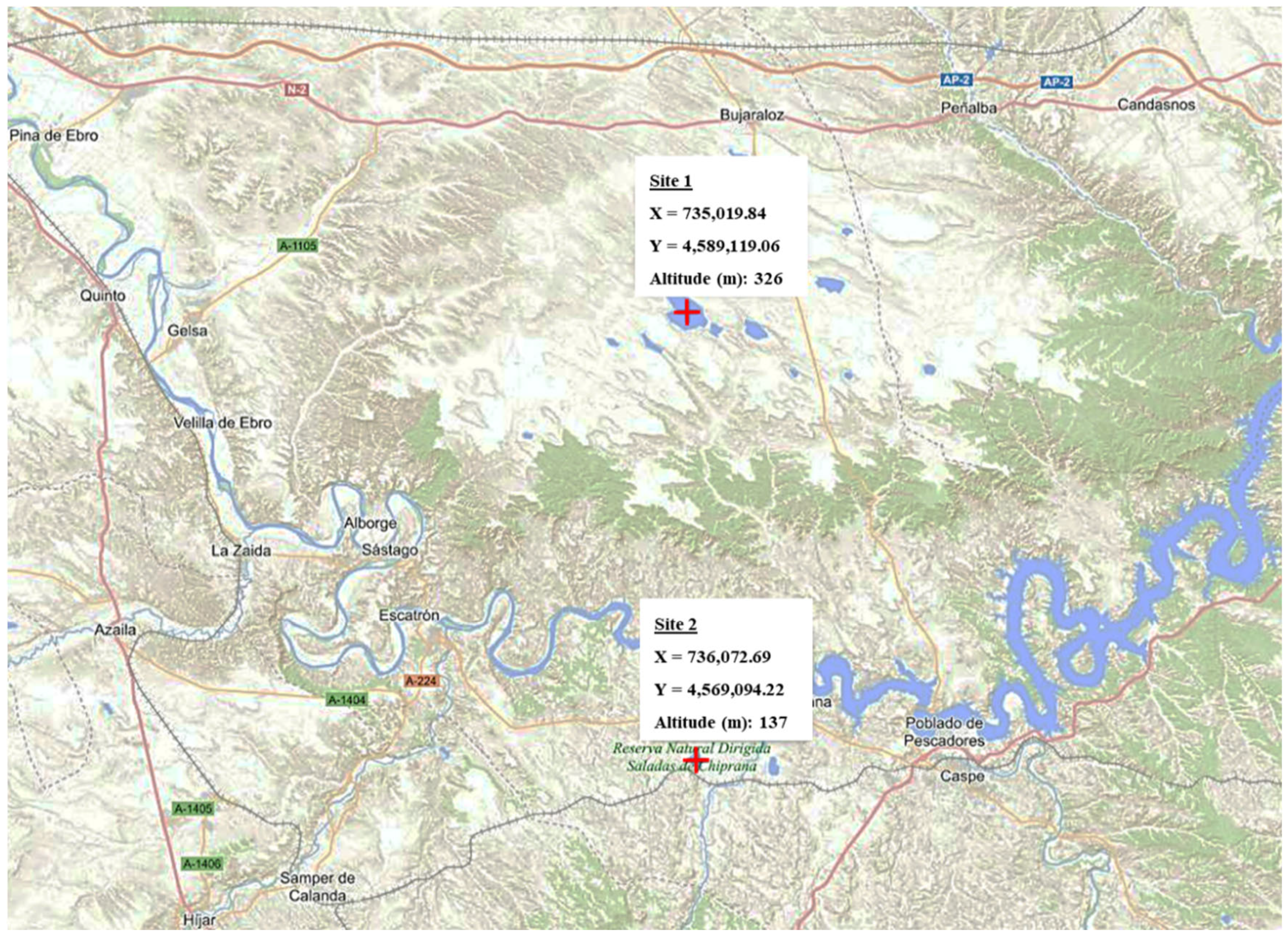
2.1. Characterization of the Studied Area
2.2. Sampling and Fungal Isolation
2.3. Phenotypic Study
2.4. DNA Extraction, Amplification, and Sequencing
2.5. Phylogenetic Analysis
3. Results
3.1. Salinity and pH of the Water Samples
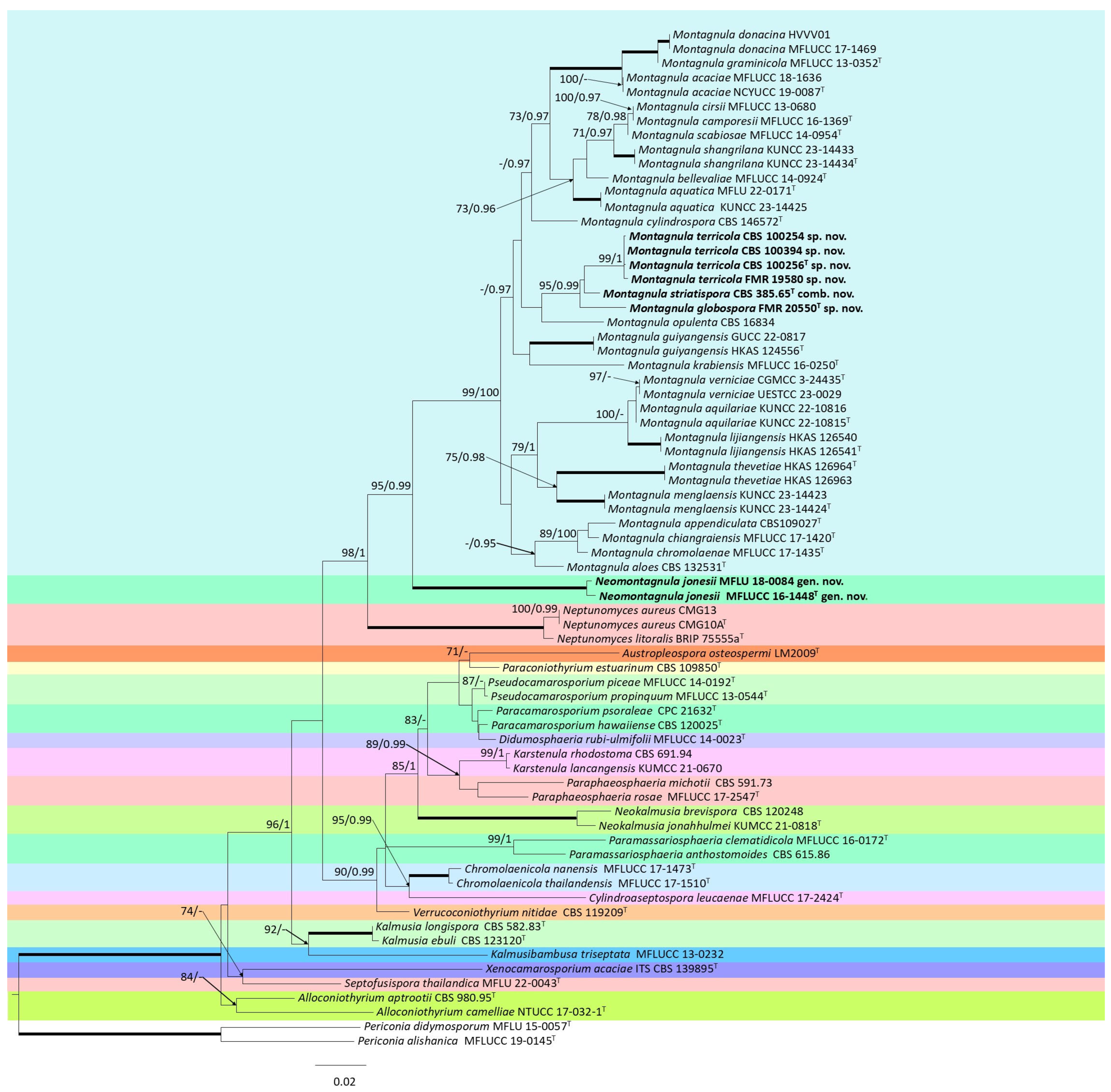
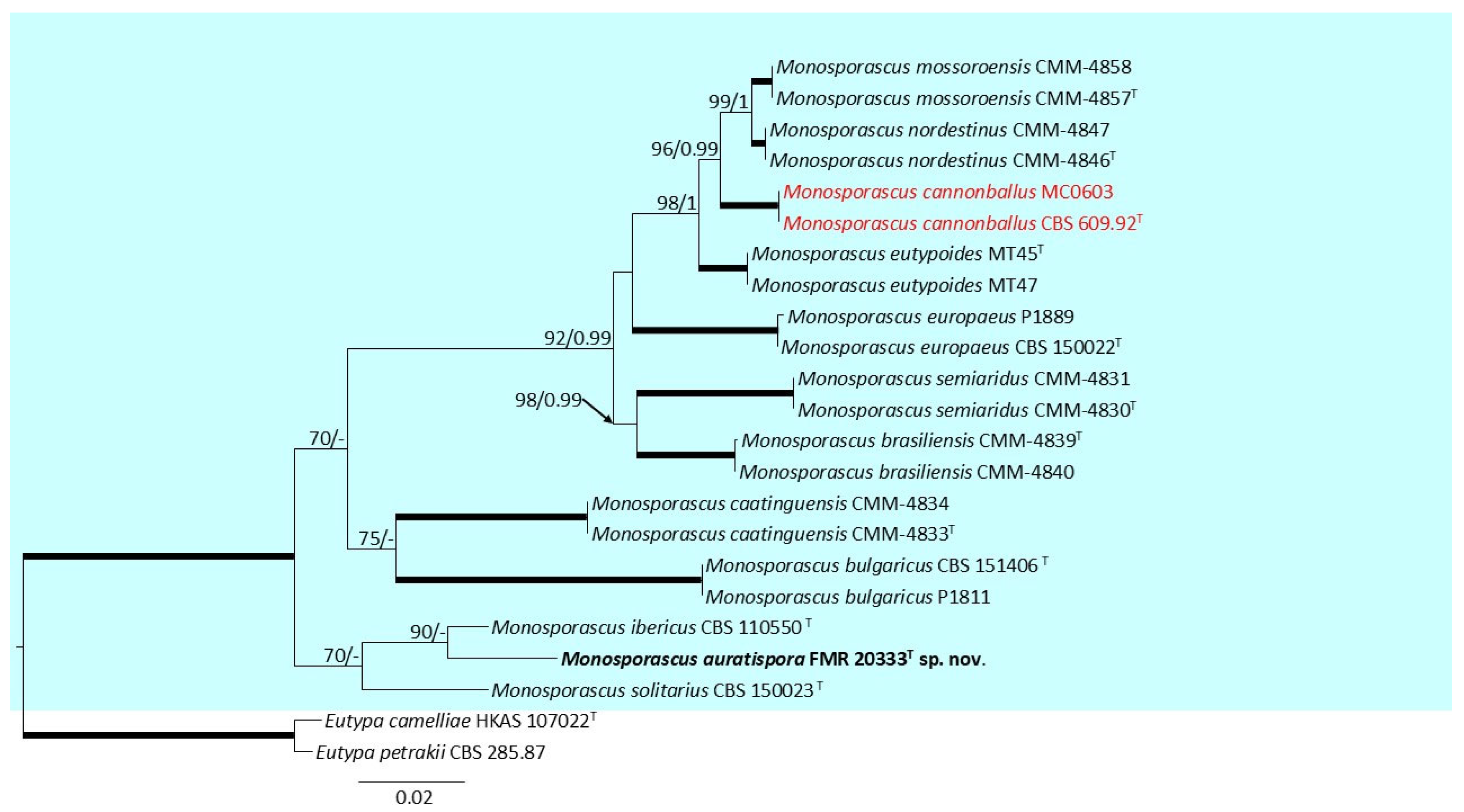
3.2. Phylogeny
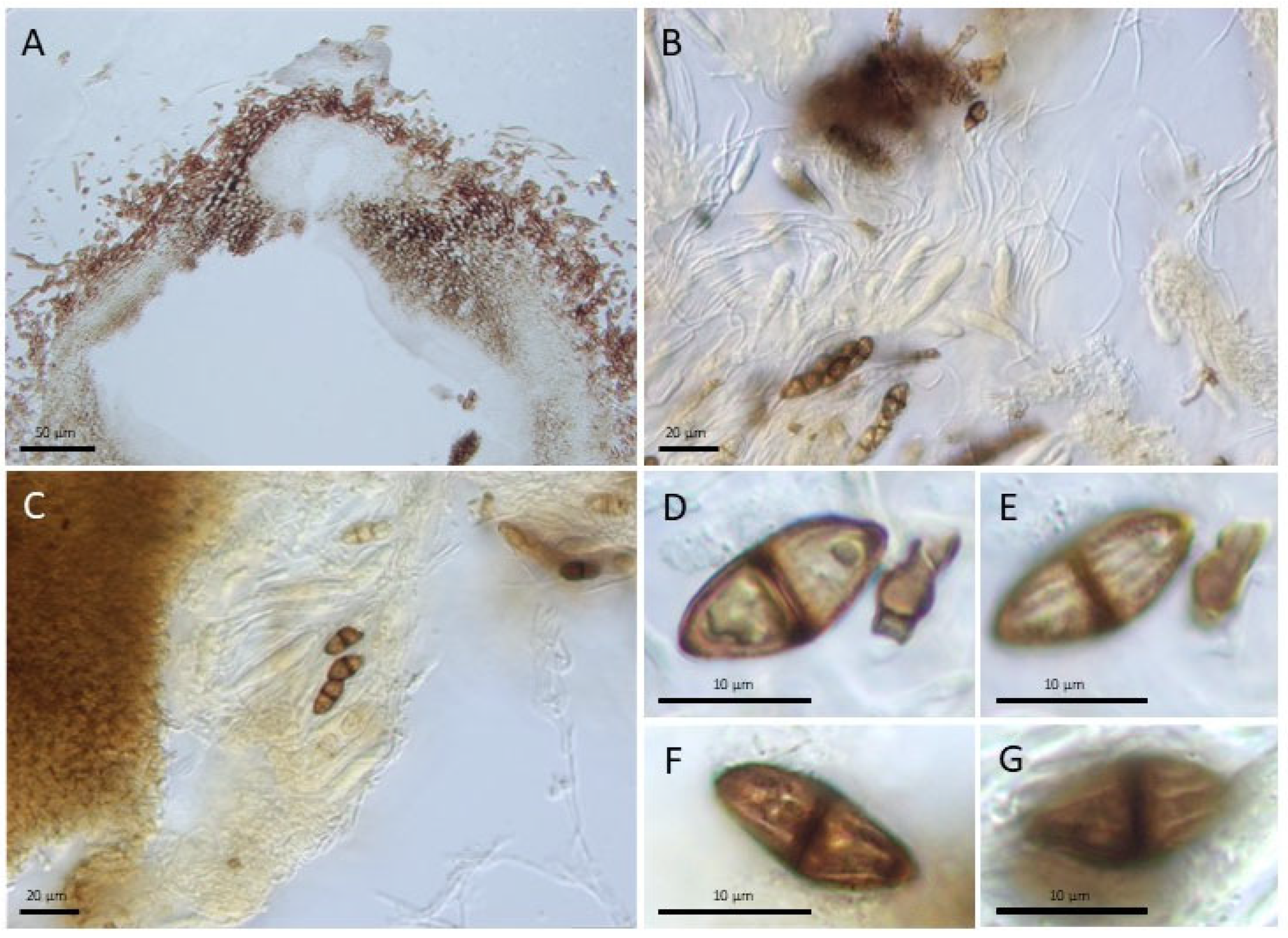
3.3. Taxonomy
4. Discussion
5. Conclusions
Supplementary Materials
Author Contributions
Funding
Institutional Review Board Statement
Informed Consent Statement
Data Availability Statement
Acknowledgments
Conflicts of Interest
Abbreviations
| AA | Ascospore Agar |
| BI | Bayesian Inference |
| BLAST | Basic Local Alignment Search Tool |
| BRIP | The Plant Pathology Herbarium |
| BS | Bootstrap Support |
| CBS | Westerdijk Fungal Biodiversity Institute |
| CGMCC | China General Microbiological Culture Collection Center |
| CMG | Culture collection of Mark Gleason |
| CMM | Culture Collection of Phytopathogenic Fungi Prof. Maria Menezes |
| CPC | Culture Collection of P.W. Crous |
| FMR | Faculty of Medicine of Reus |
| G18 | 18% of Glycerol Agar |
| GUCC | Culture Collection at Department of Plant Pathology, Agriculture College, Guizhou University |
| HKAS | Herbarium of the Kunming Institute of Botany |
| HVVV | Personal collection of Wayne Pitt from Vitis vinifera |
| ITS | Internal Transcribed Spacers |
| KUMCC/KUNCC | Kunming Institute of Botany Culture Collection Kunming |
| LSU | D1-D2 domains of the 28S nrRNA |
| M. | Montagnula |
| MEA | 2% Malt Extract Agar |
| MEGA | Molecular Evolutionary Genetics Analysis |
| MFLU | Herbarium of the Mae Fah Luang University |
| MFLUCC | Culture Collection of the Mae Fah Luang University |
| ML | Maximum Likelihood |
| MLI | Maximum Level of Identity |
| Mo. | Monosporascus |
| NCY-UCC | National Chiayi University Culture Collection |
| NTUCC | National Taiwan University Culture Collection |
| OA | Oatmeal Agar |
| PCA | Potato–Carrot Agar |
| PDA | Potato–Dextrose Agar |
| PP | Posterior Probability |
| TEF-1α | Fragments of the Translation Elongation Factor 1α |
| tub2 | Beta-tubulin gene |
| UESTCC | University of Electronic Science and Technology Culture Collection |
References
- Yapiyev, V.; Sagintayev, Z.; Inglezakis, V.J.; Samarkhanov, K.; Verhoef, A. Essentials of Endorheic Basins and Lakes: A Review in the Context of Current and Futurewater Resource Management and Mitigation Activities in Central Asia. Water 2017, 9, 798. [Google Scholar] [CrossRef] [Scilit]
- Wang, J.; Song, C.; Reager, J.T.; Yao, F.; Famiglietti, J.S.; Sheng, Y.; MacDonald, G.M.; Brun, F.; Schmied, H.M.; Marston, R.A.; et al. Recent Global Decline in Endorheic Basin Water Storages. Nat. Geosci. 2018, 11, 926–932. [Google Scholar] [CrossRef] [Scilit] [PubMed]
- Ondiba, R.; Omondi, R.; Nyakeya, K.; Abwao, J.; Musa, S.; Oyoo-Okoth, E. Environmental Constraints on Macrophyte Distribution and Diversity in a Tropical Endorheic Freshwater Lake (Lake Baringo, Kenya). Int. J. Fish. Aquat. 2018, 6, 251–259. [Google Scholar]
- Doyle, C.; Schröder, S.; Corella, J.P.; Valero Garces, B. Facies Variability and Depositional Settings of Laguna Salada de Chiprana, an Iberian Hypersaline Lake. Sedimentology 2022, 69, 2615–2641. [Google Scholar] [CrossRef] [Scilit]
- van den Broeck, M.; Waterkeyn, A.; Rhazi, L.; Grillas, P.; Brendonck, L. Assessing the Ecological Integrity of Endorheic Wetlands, with Focus on Mediterranean Temporary Ponds. Ecol. Indic. 2015, 54, 1–11. [Google Scholar] [CrossRef] [Scilit]
- Nicolet, P.; Biggs, J.; Fox, G.; Hodson, M.J.; Reynolds, C.; Whitfield, M.; Williams, P. The Wetland Plant and Macroinvertebrate Assemblages of Temporary Ponds in England and Wales. Biol. Conserv. 2004, 120, 261–278. [Google Scholar] [CrossRef] [Scilit]
- Ramsar Convention Secretariat. Designating Ramsar Sites: Strategic Framework and guidelines for the future development of the List of Wetlands of International Importance. In Ramsar Handbooks for the Wise Use of Wetlands, 4th ed.; Ramsar Convention Secretariat: Gland, Switzerland, 2010; pp. 17–116. [Google Scholar]
- Jódar, J.; Rubio, F.M.; Custodio, E.; Martos-Rosillo, S.; Pey, J.; Herrera, C.; Turu, V.; Pérez-Bielsa, C.; Ibarra, P.; Lambán, L.J. Hydrogeochemical, Isotopic and Geophysical Characterization of Saline Lake Systems in Semiarid Regions: The Salada de Chiprana Lake, Northeastern Spain. Sci. Total Environ. 2020, 728, 138848. [Google Scholar] [CrossRef] [Scilit]
- Doyle, C.; Corella, J.P.; Schröder, S.; Strauss, H.; Bishop, T.; Yarwood, J.; Valero-Garcés, B. Spatio-Temporal Variations in the Geochemistry of Laguna Salada de Chiprana, NE Spain. Geosciences 2022, 12, 381–412. [Google Scholar] [CrossRef] [Scilit]
- Domínguez-Castro, F.; García-Herrera, R.; Ribera, P.; Barriendos, M. A Shift in the Spatial Pattern of Iberian Droughts during the 17th Century. Clim. Past 2010, 6, 553–563. [Google Scholar] [CrossRef] [Scilit]
- Castañeda, C.; Herrero, J.; Conesa, J.A. Distribution, morphology and habitats of saline wetlands: A case study from Monegros, Spain. Geol. Acta 2013, 11, 371–388. [Google Scholar] [CrossRef] [Scilit]
- Conesa, J.A.; Castañeda, C.; Pedrol, J. Las Saladas de Monegros y Su Entorno: Hábitats y Paisaje Vegetal, 1st ed.; Consejo de Protección de la Naturaleza de Aragón: Zaragoza, Spain, 2011; pp. 1–538. [Google Scholar]
- Castañeda, C.; García-Vera, M.Á. Water Balance in the Playa-Lakes of an Arid Environment, Monegros, NE Spain. Hydrogeol. J. 2008, 16, 87–102. [Google Scholar] [CrossRef] [Scilit]
- Doyle, C.J.C. Sedimentary Sequences and Microbial Mats of Iberian Saline Lakes as Tools for the Investigation of Modern and Sub-Recent Environmental Processes. Ph.D. Thesis, Degree of Doctor of Philosophy-University of Manchester, Manchester, UK, 2023. [Google Scholar]
- Abbas, N. Anàlisi Estructural Del Biofilm Microbià de Les Llacunes Salades Dels Monegros. Bachelor’s Thesis, University of Girona, Girona, Spain, 2016. [Google Scholar]
- Guerrero, M.C.; Balsa, J.; Pascual, M.; Martínez, B.; Montes, C. Caracterización limnológica de la Laguna Salada de Chiprana (Zaragoza, España) y sus comunidades de bacterias fototróficas. Limnetica 1991, 7, 83–96. [Google Scholar] [CrossRef] [Scilit]
- Jonkers, H.M.; Ludwig, R.; De Wit, R.; Pringault, O.; Muyzer, G.; Niemann, H.; Finke, N.; De Beer, D. Structural and Functional Analysis of a Microbial Mat Ecosystem from a Unique Permanent Hypersaline Inland Lake: “La Salada de Chiprana” (NE Spain). FEMS Microbiol. Ecol. 2003, 44, 175–189. [Google Scholar] [CrossRef] [Scilit] [PubMed]
- Anadón, M.S.; Ascaso, J.; Yera, F.J. Catálogo Florístico de La Reserva Natural de Las Saladas de Chiprana (Zaragoza), 1st ed.; Consejo de Protección de la Naturaleza de Aragón: Zaragoza, Spain, 2021; pp. 1–231. [Google Scholar]
- Casamayor, E.O.; Triadó-Margarit, X.; Castañeda, C. Microbial Biodiversity in Saline Shallow Lakes of the Monegros Desert, Spain. FEMS Microbiol. Ecol. 2013, 85, 503–518. [Google Scholar] [CrossRef] [Scilit]
- Butinar, L.; Zalar, P.; Frisvad, J.C.; Gunde-Cimerman, N. The genus Eurotium—Members of indigenous fungal community in hypersaline waters of salterns. FEMS Microbiol. Ecol. 2005, 51, 155–166. [Google Scholar] [CrossRef] [Scilit]
- Butinar, L.; Santos, S.; Spencer-Martins, I.; Oren, A.; Gunde-Cimerman, N. Yeast diversity in hypersaline habitats. FEMS Microbiol. Lett. 2005, 244, 229–234. [Google Scholar] [CrossRef] [Scilit]
- Gunde-Cimerman, N.; Zalar, P.; de Hoog, G.S.; Plemenitaš, A. Hypersaline waters in salterns—Natural ecological niches for halophilic black yeasts. FEMS Microbiol. Ecol. 2000, 32, 235–240. [Google Scholar] [CrossRef] [Scilit]
- Gunde-Cimerman, N.; Ramos, J.; Plemenitaš, A. Halotolerant and halophilic fungi. Mycol. Res. 2009, 113, 1231–1241. [Google Scholar] [CrossRef] [Scilit]
- Zalar, P.; de Hoog, G.S.; Schroers, H.J.; Frank, J.M.; Gunde-Cimerman, N. Taxonomy and phylogeny of the xerophilic genus Wallemia (Wallemiomycetes and Wallemiales, cl. et ord. nov.). Antonie Van Leeuwenhoek 2005, 87, 311–328. [Google Scholar] [CrossRef] [Scilit]
- Gostinčar, C.; Grube, M.; de Hoog, G.S.; Zalar, P.; Gunde-Cimerman, N. Extremotolerance in fungi: Evolution on the edge. FEMS Microbiol. Ecol. 2010, 71, 2–11. [Google Scholar] [CrossRef] [Scilit]
- Gostinčar, C.; Lenassi, M.; Gunde-Cimerman, N.; Plemenitaš, A. Fungal adaptation to extremely high salt concentrations. Adv. Appl. Microbiol. 2011, 77, 71–96. [Google Scholar]
- Lenassi, M.; Gostinčar, C.; Jackman, S.; Turk, M.; Sadowski, I.; Nislow, C.; Jones, S.; Birol, I.; Cimerman, N.G.; Plemenitaš, A. Whole genome duplication and enrichment of metal cation transporters revealed by de novo genome sequencing of extremely halotolerant black yeast Hortaea werneckii. PLoS ONE 2013, 8, e71328. [Google Scholar] [CrossRef] [Scilit] [PubMed]
- Zajc, J.; Liu, Y.; Dai, W.; Yang, Z.; Hu, J.; Gostinčar, C.; Gunde-Cimerman, N. Genome and transcriptome sequencing of the halophilic fungus Wallemia ichthyophaga: Haloadaptations present and absent. BMC Genom. 2013, 14, 617–637. [Google Scholar] [CrossRef] [Scilit] [PubMed]
- Buchalo, A.S.; Nevo, E.; Wasser, S.P.; Oren, A.; Molitoris, H.P. Fungal life in the extremely hypersaline water of the Dead Sea: First records. Proc. R. Soc. Lond. 1998, 265, 1461–1465. [Google Scholar] [CrossRef] [Scilit]
- Barnés-Guirado, M.; Stchigel, A.M.; Cano-Lira, J.F. A new genus of the Microascaceae (Ascomycota) family from a hypersaline lagoon in Spain and the delimitation of the genus Wardomyces. J. Fungi 2024, 10, 236–253. [Google Scholar] [CrossRef] [Scilit]
- Varrella, S.; Barone, G.; Tangherlini, M.; Rastelli, E.; Dell’anno, A.; Corinaldesi, C. Diversity, ecological role and biotechnological potential of antarctic marine fungi. J. Fungi 2021, 7, 391–414. [Google Scholar] [CrossRef] [Scilit]
- Ali, I.; Khaliq, S.; Sajid, S.; Akbar, A. Biotechnological applications of halophilic fungi: Past, present, and future. In Fungi in Extreme Environments: Ecological Role and Biotechnological Significance, 1st ed.; Tiquia-Arashiro, S.M., Grube, M., Eds.; Springer Nature: Cham, Switzerland, 2019; pp. 291–306. [Google Scholar]
- Barone, G.; Varrella, S.; Tangherlini, M.; Rastelli, E.; Dell’Anno, A.; Danovaro, R.; Corinaldesi, C. Marine fungi: Biotechnological perspectives from deep-hypersaline anoxic basins. Diversity 2019, 11, 113–135. [Google Scholar] [CrossRef] [Scilit]
- Gomoiu, I.; Cojoc, R.; Ruginescu, R.; Neagu, S.; Enache, M.; Maria, G.; Dumbrăvician, M.; Olteanu, I.; Rădvan, R.; Ratoiu, L.C.; et al. Brackish and hypersaline lakes as potential reservoir for enzymes involved in decomposition of organic materials on frescoes. Fermentation 2022, 8, 462–485. [Google Scholar] [CrossRef] [Scilit]
- Georgieva, M.L.; Bilanenko, E.N.; Ponizovskaya, V.B.; Kokaeva, L.Y.; Georgiev, A.A.; Efimenko, T.A.; Markelova, N.N.; Kuvarina, A.E.; Sadykova, V.S. Haloalkalitolerant fungi from sediments of the Big Tambukan Saline Lake (Northern Caucasus): Diversity and antimicrobial potential. Microorganisms 2023, 11, 2587–2617. [Google Scholar] [CrossRef] [Scilit]
- Ismail, M.A.; Moubasher, A.H.; Mohamed, A.R.; Al-Bedak, O.A. Extremophilic fungi and chemical analysis of hypersaline, alkaline lakes of Wadi-El-Natrun, Egypt. Int. J. Tech. 2017, 1, 345–363. [Google Scholar]
- Parrott, D.L.; Baxter, B.K. Fungi of Great Salt Lake, Utah, USA: A Spatial Survey. Front. Fungal. Biol. 2024, 5, 1438347. [Google Scholar] [CrossRef] [Scilit]
- Moubasher, A.-A.H.; Abdel-Sater, M.A.; Soliman, Z.S.M. Diversity of yeasts and filamentous fungi in mud from hypersaline and freshwater bodies in Egypt. Czech Mycol. 2018, 70, 1–32. [Google Scholar] [CrossRef] [Scilit]
- López, P.L.; Auqué, L.F.; Mandado, J.; Valles, V.; Gimeno, M.J.; Gómez, J. Determinación de la secuencia de precipitación salina en la Laguna la Playa (Zaragoza, España). I. condiciones de equilibrio mineral y simulación teórica del proceso. Estud. Geol. 1999, 55, 27–44. [Google Scholar] [CrossRef]
- Piazuelo, S. Estudio de la Comunidad Planctónica y del Estado de Conservación de las Saladas Monegrinas del Conjunto Endorreico Bujaraloz-Sástago: Contextualización en España. Bachelor’s Thesis, University of Zaragoza, Zaragoza, Spain, 2017. [Google Scholar]
- Samson, R.A.; Houbraken, J.; Thrane, U.; Frisvad, J.C.; Andersen, B. Food and Indoor Fungi, 2nd ed.; CBS-KNAW Fungal Biodiversity Centre: Utrecht, The Netherlands, 2010; pp. 1–475. [Google Scholar]
- Hawksworth, D.L.; Kirk, P.M.; Sutton, B.C.; Pegler, D.N. Ainsworth & Bisby’s Dictionary of the Fungi, 8th ed.; CAB International: Oxon, UK, 1995; p. 616. [Google Scholar]
- Börner, G.V.; Cha, R.S. Induction and analysis of synchronous meiotic yeast cultures. Cold Spring Harb. Protoc. 2015, 10, 908–913. [Google Scholar] [CrossRef] [Scilit] [PubMed]
- Hocking, A.D.; Pitt, J.I. Dichloran-Glycerol medium for enumeration of xerophilic fungi from low-moisture foods. Appl. Environ. Microbiol. 1980, 39, 488–492. [Google Scholar] [CrossRef] [Scilit] [PubMed]
- Ulfig, K.; Guarro, J.; Cano, J.; Gené, J.; Vidal, R.; Figueras, M.J. General Assessment of the Occurrence of Keratinolytic Fungi in River and Marine Beach Sediments of Catalonian Waters (Spain). Water Air Soil Poll. 1997, 94, 275–287. [Google Scholar] [CrossRef] [Scilit]
- Furuya, K.; Naito, A. Stimulation of ascospore germination by phenolic compounds in members of the Sordariaceae. Trans. Mycol. Soc. 1980, 21, 77–85. [Google Scholar]
- Furuya, K.; Naito, A. An effective method for isolation of Boothiella tetraspora from soil. Trans. Mycol. Soc. 1979, 20, 309–311. [Google Scholar]
- Kornerup, A.; Wanscher, J.H. Methuen Handbook of Colour, 3rd ed.; Methuen: London, UK, 1978. [Google Scholar]
- Chupp, C. Further notes on double cover-glass mounts. Mycologia 1940, 32, 269–270. [Google Scholar] [CrossRef] [Scilit]
- Müller, F.M.; Werner, K.E.; Kasai, M.; Francesconi, A.; Chanock, S.J.; Walsh, T.J. Rapid extraction of genomic DNA from medically important yeasts and filamentous fungi by high-speed cell disruption. J. Clin. Microbiol. 1998, 36, 1625–1629. [Google Scholar] [CrossRef] [Scilit]
- White, T.J.; Bruns, T.; Lee, S.J.W.T.; Taylor, J. Amplification and direct sequencing of fungal ribosomal RNA genes for phylogenetics. In PCR Protocols: A Guide to Methods and Applications, 1st ed.; Innis, M.A., Gelfand, D.H., Sninsky, J.J., White, T.J., Eds.; Academic Press: San Diego, CA, USA, 1990; pp. 315–322. [Google Scholar]
- Vilgalys, R.; Hester, M. Rapid genetic identification and mapping of enzymatically amplified ribosomal DNA from several Cryptococcus species. J. Bacteriol. 1990, 172, 4238–4246. [Google Scholar] [CrossRef] [Scilit] [PubMed]
- Glass, N.L.; Donaldson, G.C. Development of primer sets designed for use with the PCR to amplify conserved genes from filamentous Ascomycetes. Appl. Environ. Microbiol. 1995, 61, 1323–1330. [Google Scholar] [CrossRef] [Scilit] [PubMed]
- Rehner, S.A.; Buckley, E. A Beauveria phylogeny inferred from nuclear ITS and EF1-α sequences: Evidence for cryptic diversification and links to Cordyceps teleomorphs. Mycologia 2005, 97, 84–98. [Google Scholar] [CrossRef] [Scilit] [PubMed]
- Iturrieta-González, I.; García, D.; Gené, J. Novel Species of Cladosporium from Environmental Sources in Spain. MycoKeys 2021, 77, 1–25. [Google Scholar] [CrossRef] [Scilit]
- Torres-Garcia, D.; García, D.; Cano-Lira, J.F.; Gené, J. Two novel genera, Neostemphylium and Scleromyces (Pleosporaceae) from freshwater sediments and their global biogeography. J. Fungi 2022, 8, 868–891. [Google Scholar] [CrossRef] [Scilit]
- Tamura, K.; Stecher, G.; Peterson, D.; Filipski, A.; Kumar, S. MEGA7: Molecular evolutionary genetics analysis version 7.0. Mol. Biol. Evol. 2013, 30, 2725–2729. [Google Scholar] [CrossRef] [Scilit]
- Thompson, J.D.; Higgins, D.G.; Gibson, T.J. CLUSTAL W: Improving the sensitivity of progressive multiple sequence alignment through sequence weighting, position-specific gap penalties and weight matrix choice. Nucleic Acids Res. 1994, 22, 4673–4680. [Google Scholar] [CrossRef] [Scilit]
- Edgar, R.C. MUSCLE: Multiple sequence alignment with high accuracy and high throughput. Nucleic Acids Res. 2004, 32, 1792–1797. [Google Scholar] [CrossRef] [Scilit]
- Stamatakis, A. RAxML version 8: A tool for phylogenetic analysis and post-analysis of large phylogenies. Bioinformatics 2014, 30, 1312–1313. [Google Scholar] [CrossRef] [Scilit]
- Miller, M.A.; Pfeifferm, W.; Schwartz, T. The CIPRES science gateway: Enabling high-impact science for phylogenetics researchers with limited resources. In Proceedings of the 1st Conference of the Extreme Science and Engineering Discovery Environment: Bridging from the Extreme to the Campus and Beyond, Chicago, IL, USA, 16–20 July 2012; Association for Computing Machinery: New York, NY, USA, 2012; pp. 1–8. [Google Scholar]
- Ronquist, F.; Teslenko, M.; Van Der Mark, P.; Ayres, D.L.; Darling, A.; Höhna, S.; Larget, B.; Liu, L.; Suchard, M.A.; Huelsenbeck, J.P. Mrbayes 3.2: Efficient Bayesian Phylogenetic Inference and Model Choice across a Large Model Space. Syst. Biol. 2012, 61, 539–542. [Google Scholar] [CrossRef] [Scilit]
- Darriba, D.; Taboada, G.L.; Doallo, R.; Posada, D. JModelTest 2: More Models, New Heuristics and Parallel Computing. Nat. Methods 2012, 9, 772. [Google Scholar] [CrossRef] [Scilit] [PubMed]
- Hillis, D.M.; Bull, J.J. An Empirical Test of Bootstrapping as a Method for Assessing Confidence in Phylogenetic Analysis. Syst. Biol. 1993, 42, 182–192. [Google Scholar] [CrossRef] [Scilit]
- Hespanhol, L.; Vallio, C.S.; Costa, L.M.; Saragiotto, B.T. Understanding and Interpreting Confidence and Credible Intervals around Effect Estimates. Braz. J. Phys. Ther. 2019, 23, 290–301. [Google Scholar] [CrossRef] [Scilit]
- Tennakoon, D.S.; Hyde, K.D.; Wanasinghe, D.N.; Bahkali, A.H.; Camporesi, E.; Khan, S.; Phookamsak, R. Taxonomy and phylogenetic appraisal of Montagnula jonesii sp. nov. (Didymosphaeriaceae, Pleosporales). Mycosphere 2016, 7, 1346–1356. [Google Scholar] [CrossRef] [Scilit]
- Sun, Y.R.; Zhang, J.Y.; Hyde, K.D.; Wang, Y.; Jayawardena, R.S. Morphology and phylogeny reveal three Montagnula species from China and Thailand. Plants 2023, 12, 738. [Google Scholar] [CrossRef] [Scilit]
- Wanasinghe, D.N.; Nimalrathna, T.S.; Xian, L.Q.; Faraj, T.K.; Xu, J.; Mortimer, P.E. Taxonomic novelties and global biogeography of Montagnula (Ascomycota, Didymosphaeriaceae). MycoKeys 2024, 101, 191–232. [Google Scholar] [CrossRef] [Scilit]
- Gonçalves, M.F.M.; Vicente, T.F.L.; Esteves, A.C.; Alves, A. Neptunomyces aureus gen. et sp. nov. (Didymosphaeriaceae, Pleosporales) isolated from algae in Ria de Aveiro, Portugal. MycoKeys 2019, 60, 31–44. [Google Scholar] [CrossRef] [Scilit]
- Munk, A. The system of the Pyrenomycetes. Dan. Bot. Ark. 1953, 15, 1–163. [Google Scholar]
- Tennakoon, D.S.; Luo, Z.; Thambugala, K.M.; de Silva, N.I.; Suwannarach, N.; Lumyong, S. A taxonomic assessment of novel and remarkable fungal species in Didymosphaeriaceae (Pleosporales, Dothideomycetes) from plant litter. Front. Microbiol. 2022, 13, 1016285. [Google Scholar] [CrossRef] [Scilit]
- Berlese, A.N. Icones Fungorum. Pyrenomycetes 1896, 2, 1–216. [Google Scholar]
- Crous, P.W.; Wingfield, M.J.; Chooi, Y.H.; Gilchrist, C.L.M.; Lacey, E.; Pitt, J.I.; Roets, F.; Swart, W.J.; Cano-Lira, J.F.; Valenzuela-Lopez, N.; et al. Fungal Planet Description Sheets: 1042-1111. Persoonia 2020, 44, 301–459. [Google Scholar] [CrossRef] [Scilit]
- Hyde, K.D.; Norphanphoun, C.; Ma, J.; Yang, H.D.; Zhang, J.Y.; Du, T.Y.; Gao, Y.; Gomes de Farias, A.R.; Gui, H.; He, S.C.; et al. Mycosphere Notes 387–412—Novel species of fungal taxa from around the world. Mycosphere 2023, 14, 663–744. [Google Scholar] [CrossRef] [Scilit]
- Li, W.; Liang, R.; Dissanayake, A.; Liu, J. Mycosphere Notes 413–448: Dothideomycetes associated with woody oil plants in China. Mycosphere 2023, 14, 1436–1529. [Google Scholar] [CrossRef] [Scilit]
- Ariyawansa, H.A.; Tanaka, K.; Thambugala, K.M.; Phookamsak, R.; Tian, Q.; Camporesi, E.; Hongsanan, S.; Monkai, J.; Wanasinghe, D.N.; Mapook, A.; et al. A molecular phylogenetic reappraisal of the Didymosphaeriaceae (=Montagnulaceae). Fungal Divers. 2014, 68, 69–104. [Google Scholar] [CrossRef] [Scilit]
- Nitschke, T.R.J. Grundlage eines Systems der Pyrenomyceten. Verh. Naturhistorischen Ver. Preuss. Rheinl. Westfal. Regierungsbezirks Osnabrück 1869, 262, 70–77. [Google Scholar]
- Afshari, N.; Karimi, O.; Gomes de Farias, A.R.; Suwannarach, N.; Bhunjun, C.S.; Zeng, X.Y.; Lumyong, S. Additions to Diatrypaceae (Xylariales): Novel taxa and new host associations. J. Fungi 2023, 9, 1151–1180. [Google Scholar] [CrossRef] [Scilit]
- Li, Q.-R.; Long, S.-H.; Lin, Y.; Wu, Y.-P.; Wu, Q.-Z.; Hu, H.-M.; Shen, X.-C.; Zhang, X.; Wijayawardene, N.N.; Kang, J.-C.; et al. Diversity, morphology, and molecular phylogeny of Diatrypaceae from southern China. Front. Microbiol. 2023, 14, 1140190. [Google Scholar] [CrossRef] [Scilit]
- Negreiros, A.M.P.; Sales, R.; Rodrigues, A.P.M.S.; León, M.; Armengol, J. Prevalent weeds collected from cucurbit fields in Northeastern Brazil reveal new species diversity in the genus Monosporascus. Ann. Appl. Biol. 2019, 174, 349–363. [Google Scholar] [CrossRef] [Scilit]
- Collado, J.; González, A.; Platas, G.; Stchigel, A.M.; Guarro, J.; Peláez, F. Monosporascus ibericus sp. nov., an endophytic ascomycete from plants on saline soils, with observations on the position of the genus based on sequence analysis of the 18S rDNA. Mycol. Res. 2002, 106, 118–127. [Google Scholar] [CrossRef] [Scilit]
- Cohen, R.; Pivonia, S.; Crosby, K.M.; Martyn, R.D. Advances in the biology and management of Monosporascus vine decline and wilt of melons and other cucurbits. In Horticultural Reviews, 1st ed.; Janick, J., Ed.; John Wiley & Sons Inc.: Hoboken, NJ, USA, 2012; Volume 39, pp. 77–120. [Google Scholar]
- Lumbsch, H.T.; Huhndorf, S.M. Whatever happened to the Pyrenomycetes and Loculoascomycetes? Mycol. Res. 2007, 111, 1064–1074. [Google Scholar] [CrossRef] [Scilit]
- Greif, M.D.; Stchigel, A.M.; Miller, A.N.; Huhndorf, S.M. A re-evaluation of genus Chaetomidium based on molecular and morphological characters. Mycologia 2009, 101, 554–564. [Google Scholar] [CrossRef] [Scilit] [PubMed]
- Wang, X.W.; Han, P.J.; Bai, F.Y.; Luo, A.; Bensch, K.; Meijer, M.; Kraak, B.; Han, D.Y.; Sun, B.D.; Crous, P.W.; et al. Taxonomy, phylogeny and identification of Chaetomiaceae with emphasis on thermophilic species. Stud. Mycol. 2022, 101, 121–243. [Google Scholar] [CrossRef] [Scilit] [PubMed]
- Quijada, L.; Matočec, N.; Kušan, I.; Tanney, J.B.; Johnston, P.R.; Mešić, A.; Pfister, D.H. Apothecial ancestry, evolution, and re-evolution in Thelebolales (Leotiomycetes, Fungi). Biology 2022, 11, 583–611. [Google Scholar] [CrossRef] [Scilit]


| Taxon | Strain Number | GenBank Accession Number | |||
|---|---|---|---|---|---|
| ITS | LSU | TEF-1α | tub2 | ||
| Alloconiothyrium camelliae | NTUCC 17-032-1T* | MT112294 | MT071270 | MT232967 | |
| Alloconiothyrium aptrootii | CBS 980.95T | JX496121 | JX496234 | ||
| Austropleospora osteospermi | BRIP51628T | FJ481946 | |||
| Chromolaenicola nanensis | MFLUCC 17-1473T | MN325015 | MN325003 | ||
| Chromolaenicola thailandensis | MFLUCC 17-1510T | MN325018 | MN325006 | MN335651 | |
| Cylindroaseptospora leucaenae | MFLUCC 17-2424T | NR_163333 | NG_066310 | MK360047 | |
| Didymosphaeria rubi-ulmifolii | MFLUCC 14-0023T | KJ436586 | |||
| Eutypa camelliae | HKAS 107022T | NR_175674 | NG_081500 | ||
| Eutypa petrakii | CBS 285.87 | MH862077 | MH873766 | ||
| Kalmusia ebuli | CBS 123120T | KF796674 | NG_070920 | ||
| Kalmusia longispora | CBS 582.83T | MH861658 | NG_070449 | ||
| Kalmusibambusa triseptata | MFLUCC 13-0232 | KY682697 | KY682695 | ||
| Karstenula lancangensis | KUMCC 21-0670T | OP058969 | OP059060 | ||
| Karstenula rhodostoma | CBS 691.94 | LC014559 | AB807531 | AB808506 | |
| Monosporascus auratispora sp. nov. | FMR 20333T | PP973385 | PP973719 | PP973931 | PP973383 |
| Monosporascus brasiliensis | CMM-4839T | MG735234 | MG748803 | MG720040 | MG725317 |
| CMM-4840 | MG735235 | MG748804 | MG720041 | MG725318 | |
| Monosporascus bulgaricus | CBS 151406T | KT269184 | PP454707 | PP460994 | |
| P1811 | KT269083 | ||||
| Monosporascus caatinguensis | CMM-4833T | MG735228 | MG748797 | MG720034 | MG725311 |
| CMM-4834 | MG735229 | MG748798 | MG720035 | MG725312 | |
| Monosporascus cannonballus | CBS 609.92T | NR_111370 | |||
| MC0603 | JQ762364 | MG748824 | JQ907314 | JQ907307 | |
| Monosporascus europaeus | CBS 150022T | KT269082 | PP454705 | PP481183 | |
| P1889 | KT269158 | PP454706 | |||
| Monosporascus eutypoides | MT45T | JQ958963 | MG748827 | JQ958959 | JQ973834 |
| MT47 | JQ958964 | JQ958956 | |||
| Monosporascus ibericus | CBS 110550T | JQ973832 | JQ958958 | JQ958958 | JQ973833 |
| Monosporascus mossoroensis | CMM-4857T | MG735252 | MG720058 | MG720058 | MG725335 |
| CMM-4858 | MG735253 | MG720059 | MG720059 | MG725336 | |
| Monosporascus nordestinus | CMM-4846T | MG735241 | MG720047 | MG720047 | MG725324 |
| CMM-4847 | MG735242 | MG720048 | MG720048 | MG725325 | |
| Monosporascus solitarius | CBS 150023T | KT269777 | PP454708 | ||
| Monosporascus semiaridus | CMM-4830T | MG735222 | MG748791 | MG720028 | MG725305 |
| CMM-4831 | MG735223 | MG748792 | MG720029 | MG725306 | |
| Montagnula acaciae | MFLUCC 18-1636 | ON117280 | ON117298 | ||
| NCYUCC 19-0087T | ON117281 | ON117299 | |||
| Montagnula aloes | CBS 132531T | NR_111757 | NG_042676 | ||
| Montagnula appendiculata | CBS 109027T | DQ435529 | AY772016 | ||
| Montagnula aquatica | MFLU 22-0171T | OP605992 | OP605986 | ||
| KUNCC 23-14425 | OR583097 | OR583116 | OR588088 | ||
| Montagnula aquilariae | KUNCC 22-10815T | OP452927 | OP482265 | OP426318 | |
| KUNCC 22-10816 | OP554219 | OP482266 | OP426319 | ||
| Montagnula bellevaliae | MFLUCC 14-0924T | KT443906 | KT443902 | ||
| Montagnula camporesii | MFLUCC 16-1369T | MN401746 | NG_070946 | MN397908 | |
| Montagnula chiangraiensis | MFLUCC 17-1420T | NR_168864 | NG_068707 | ||
| Montagnula chromolaenae | MFLUCC 17-1435T | NR_168865 | NG_068708 | ||
| Montagnula cirsii | MFLUCC 13-0680 | KX274242 | KX274249 | KX284707 | |
| Montagnula cylindrospora | CBS 146572T | LT796834 | LN907351 | LT797074 | |
| Montagnula donacina | HVVV01 | KJ628375 | KJ628377 | ||
| MFLUCC 17-1469 | NR_168866 | NG_070948 | MT235773 | ||
| Montagnula graminícola | MFLUCC 13-0352T | KM658314 | KM658315 | ||
| Montagnula guiyangensis | HKAS 124556T | OP605989 | OP600484 | ||
| GUCC 22–0817 | OP605990 | OP600485 | |||
| Montagnula krabiensis | MFLUCC 16-0250T | NR168179 | NG068826 | MH412776 | |
| Montagnula lijiangensis | HKAS 126540 | OR583107 | OR583126 | OR588098 | |
| HKAS 126541T | OR583108 | OR583127 | OR588099 | ||
| Montagnula menglaensis | KUNCC 23-14424T | OR583111 | OR583130 | OR588102 | |
| KUNCC 23-14423 | OR583110 | OR583129 | OR588101 | ||
| Montagnula opulenta | CBS 168.34 | DQ678086 | DQ678086 | ||
| Montagnula scabiosae | MFLUCC 14-0954T | NR_155378 | NG_059602 | ||
| Montagnula shangrilana | KUNCC 23-14433 | OR583112 | OR583131 | OR588103 | |
| KUNCC 23-14434T | OR583113 | OR583132 | OR588104 | ||
| Montagnula striatispora | CBS 385.65T | MH858624 | NG_064048 | ||
| Montagnula terricola sp.nov. | FMR 19580 | OQ708962 | PP973381 | PP973930 | |
| CBS 100254 | OQ708960 | PP973379 | PP973928 | ||
| CBS 100256T | OQ708961 | PP973380 | PP973929 | ||
| CBS 100394 | OQ708959 | PP973378 | PP973927 | ||
| Montagnula thevetiae | HKAS 126963 | OR583114 | OR583133 | OR588105 | |
| HKAS 126964T | OR583115 | OR583134 | OR588106 | ||
| Montagnula globospora sp.nov. | FMR 20550T | PP973384 | PP973382 | PP973931 | |
| Montagnula verniciae | CGMCC 3.24435T | OR269139 | OR253273 | OR251166 | |
| UESTCC 23.0029 | OR269140 | OR253274 | OR251167 | ||
| Neokalmusia brevispora | CBS 120248 | MH863078 | MH874633 | ||
| Neokalmusia jonahhulmei | KUMCC 21-0818T | ON007043 | ON007039 | ON009133 | |
| Neomontagnula jonesii gen. nov. | MFLUCC 16-1448T | KY313619 | KY273276 | KY313620 | |
| MFLU 18-0084 | ON117282 | ON117300 | ON158095 | ||
| Neptunomyces aureus | CMG10AT | MK912119 | MK947998 | ||
| CMG13 | MK912122 | MK948001 | |||
| Neptunomyces litoralis | BRIP 75555aT | OR271911 | NG_242141 | ||
| Paracamarosporium psoraleae | CPC 21632T | KF777143 | KF777199 | ||
| Paracamarosporium hawaiiense | CBS 120025T | NR_154287 | NG_070608 | ||
| Paraconiothyrium estuarinum | CBS 109850T | NR_166007 | MH874432 | ||
| Paramassariosphaeria anthostomoides | CBS 615.86 | MH862005 | MH873693 | ||
| Paramassariosphaeria clematidicola | MFLUCC 16-0172 | KU743206 | KU743207 | ||
| Paraphaeosphaeria michotii | CBS 591.73 | MH860778 | GU456326 | GU456267 | |
| Paraphaeosphaeria rosae | MFLUCC 17-2547T | MG828935 | MG829044 | MG829222 | |
| Periconia didymosporum | MFLU 15-0057T | NR_176693 | NG_081448 | KP761727 | |
| Periconia alishanica | MFLUCC 19-0145T | MW063165 | MW063229 | MW183790 | |
| Pseudocamarosporium piceae | MFLUCC 14-0192T | KJ747046 | KJ803030 | ||
| Pseudocamarosporium propinquum | MFLUCC 13-0544T | NR_154309 | NG_069202 | ||
| Septofusispora thailandica | MFLU 22-0043T | OP058971 | OP059062 | OP135945 | |
| Verrucoconiothyrium nitidae | CBS 119209T | EU552112 | EU552112 | ||
| Xenocamarosporium acaciae | CBS 139895T | NR_137982 | NG_058163 | ||
| Strain | Molecular Marker | Closest Species | Identity (%) | GenBank Accession Number | Identities |
|---|---|---|---|---|---|
| FMR 19580 | ITS | Aporospora terricola * | 99.78% | AF049088.1 | 446/447 (no gaps) |
| Herpotrichia striatispora CBS 385.65 | 98.43% | MH858624.1 | 440/447 (no gaps) | ||
| LSU | Herpotrichia striatispora CBS 385.65 | 99.50% | NG_064048.1 | 796/800 (no gaps) | |
| Montagnula cylindrospora UTHSC DI16-208 | 98.75% | LN907351.1 | 790/800 (4 gaps) | ||
| Montagnula bellevaliae MFLUCC 14-0924 | 98.50% | NG_059601.1 | 788/800 (2 gaps) | ||
| TEF-1α | Montagnula donacina MFLU 22-0046 | 95.91% | OP135938.1 | 820/855 (no gaps) | |
| Montagnula puerensis KUMCC:20-0225 | 95.49% | MW573959.1 | 763/799 (no gaps) | ||
| FMR 20550 | ITS | Herpotrichia striatispora CBS 385.65 | 96.42% | MH858624.1 | 431/447 (7 gaps) |
| Montagnula terricola FMR 19580 | 96.42% | OQ708962.1 | 431/447 (7 gaps) | ||
| LSU | Herpotrichia striatispora CBS 385.65 | 98.26% | NG_064048.1 | 791/805 (6 gaps) | |
| Montagnula cirsii MFLUCC:13-0680 | 97.86% | KX274249.1 | 787/804 (6 gaps) | ||
| TEF-1α | Montagnula donacina MFLUCC:22-0046 | 96.23% | OP135938.1 | 842/875 (no gaps) | |
| Montagnula chromolaenicola MFLUCC:17-1469 | 96.03% | MT235773 | 846/881 (no gaps) | ||
| FMR 20333 | ITS | Monosporascus ibericus CBS 110550 | 96.60% | JQ973832 | 454/470 (5 gaps) |
| LSU | Monosporascus caatinguensis CMM-4832 | 97.37% | MG748796 | 667/685 (5 gaps) | |
| Monosporascus eutypoides CBS:132472 | 96.93% | MH877468 | 664/685 (8 gaps) | ||
| tub2 TEF-1α | Monosporascus ibericus CBS 110550 | 98.62% | JQ973833 | 502/509 (1 gap) | |
| Monosporascus ibericus CBS 110550 | 93.27% | JQ958958 | 554/594 (6 gaps) |
Disclaimer/Publisher’s Note: The statements, opinions and data contained in all publications are solely those of the individual author(s) and contributor(s) and not of MDPI and/or the editor(s). MDPI and/or the editor(s) disclaim responsibility for any injury to people or property resulting from any ideas, methods, instructions or products referred to in the content. |
© 2025 by the authors. Licensee MDPI, Basel, Switzerland. This article is an open access article distributed under the terms and conditions of the Creative Commons Attribution (CC BY) license (https://creativecommons.org/licenses/by/4.0/).
Share and Cite
Barnés-Guirado, M.; Cano-Lira, J.F.; Miller, A.N.; Stchigel, A.M. New Species of Ascomycetes from Two Hypersaline Endorheic Lagoon Complexes in Zaragoza Province (Aragon Community, Spain). J. Fungi 2025, 11, 139. https://doi.org/10.3390/jof11020139
Barnés-Guirado M, Cano-Lira JF, Miller AN, Stchigel AM. New Species of Ascomycetes from Two Hypersaline Endorheic Lagoon Complexes in Zaragoza Province (Aragon Community, Spain). Journal of Fungi. 2025; 11(2):139. https://doi.org/10.3390/jof11020139
Chicago/Turabian StyleBarnés-Guirado, María, José F. Cano-Lira, Andrew N. Miller, and Alberto M. Stchigel. 2025. "New Species of Ascomycetes from Two Hypersaline Endorheic Lagoon Complexes in Zaragoza Province (Aragon Community, Spain)" Journal of Fungi 11, no. 2: 139. https://doi.org/10.3390/jof11020139
APA StyleBarnés-Guirado, M., Cano-Lira, J. F., Miller, A. N., & Stchigel, A. M. (2025). New Species of Ascomycetes from Two Hypersaline Endorheic Lagoon Complexes in Zaragoza Province (Aragon Community, Spain). Journal of Fungi, 11(2), 139. https://doi.org/10.3390/jof11020139