Article

Five New Species of Gibellula (Hypocreales, Cordycipitaceae) from China

1
State Key Laboratory of Functions and Applications of Medicinal Plants, Guizhou Medical University, Guian New District, Guiyang 561113, China
2
State Key Laboratory of Discovery and Utilization of Functional Components in Traditional Chinese Medicine & School of Pharmaceutical Sciences, Guizhou Medical University, Guian New District, Guiyang 561113, China
3
The High Efficacy Application of Natural Medicinal Resources Engineering Center of Guizhou Province, Guizhou Medical University, Guian New District, Guiyang 561113, China
*
Author to whom correspondence should be addressed.
These authors contributed equally to this work.
J. Fungi 2025, 11(12), 891; https://doi.org/10.3390/jof11120891
Submission received: 1 November 2025 / Revised: 10 December 2025 / Accepted: 15 December 2025 / Published: 17 December 2025
(This article belongs to the Special Issue Fungal Diversity in Various Environments, 4th Edition)

Abstract

The genus Gibellula (Cordycipitaceae, Hypocreales) comprises highly specialized, obligate pathogens that exclusively parasitize spiders. In this study, five new species were delimited based on morphological and phylogenetic evidence from a six-locus dataset (nrSSU, ITS, nrLSU, tef-1α, rpb1, rpb2). Specimens were collected from northeastern (Jilin and Liaoning Provinces) and southwestern (Yunnan Province) China. Phylogenetic analyses resolved these collections into five distinct, well-supported lineages, described as G. baishanensis, G. jilinensis, G. kunmingensis, G. paralongispora, and G. yunnanensis spp. nov. Among these, G. baishanensis and G. jilinensis were identified as sister taxa, whereas G. kunmingensis formed an independent lineage. Gibellula paralongispora was recovered as a sister to G. longispora, and G. yunnanensis as a sister to G. attenboroughii; both new species are supported by significant morphological distinctions (e.g., conidiophore length and conidial shape). This study provides detailed descriptions, illustrations, and morphological comparisons for these taxa, thereby enriching the taxonomy of Gibellula. Furthermore, the records from Jilin and Liaoning represent only the second documented occurrence of the genus in northeastern China, significantly expanding its known geographic range.

1. Introduction

The order Hypocreales (Sordariomycetes, Ascomycota) comprises a diverse group of fungi, many of which are entomopathogens known to infect insects and spiders [1,2]. Among these, the families Clavicipitaceae, Cordycipitaceae, Ophiocordycipitaceae, and Polycephalomycetaceae represent the most species-rich lineages of arthropod-pathogenic fungi [3,4,5,6,7]. To date, approximately 90 fungal species have been reported as pathogens of spiders (Araneae), spanning 16 families [8]. These arachnopathogenic fungi are distributed across 16 genera, including Arachnidicola, Beauveria, Clonostachys, Cordyceps, Engyodontium, Gibellula, Hevansia, Hirsutella, Hymenostilbe, Jenniferia, Lecanicillium, Ophiocordyceps, Parahevansia, Polystromomyces, Purpureocillium, and Torrubiella [9,10,11,12]. Of particular interest is the genus Gibellula, which is distinguished by its exclusive pathogenicity to spiders and its high degree of host specificity.
The genus Gibellula was established by Cavara in 1894, with G. pulchra designated as the type species [13]. This taxon is characterized by aspergillus-like conidiophores terminating in a vesicle that bears metulae, each supporting clusters of phialides which, in turn, produce chains of conidia. Despite its distinctive morphology, the taxonomic framework of Gibellula remains partially unresolved, primarily due to the absence of a clearly designated type specimen and viable cultures of G. pulchra, leading to persistent nomenclatural ambiguity [10]. Phylogenetic studies currently recognize 23 species, although molecular data are still lacking for several taxa. Sexual–asexual connections have been confirmed for only nine species; the sexual morphs typically form superficial, ovoid perithecia on loose mycelial mats, with cylindrical asci featuring a thickened apex and filiform ascospores that disarticulate into part-spores [10,14,15,16,17,18]. Most species, however, are known exclusively from their asexual morphs, which exhibit either aspergillus-like or penicillium-like conidiophores [10].
Gibellula species, commonly found on spiders inhabiting the abaxial surfaces of dicotyledonous leaves, dead stems, and other substrates, exhibit a broad global distribution across temperate, subtropical, and tropical regions, from Argentina and Brazil to China, Japan, the United States, and elsewhere [9,10]. Despite this wide distribution and the documentation of more than ten species in China to date [14,15,16,17,18,19,20], the diversity of Gibellula in East Asia remains incompletely explored, particularly in under-surveyed regions. The continual discovery of new taxa through integrated morphological and phylogenetic approaches underscores the need for further investigation.
In this study, we report five spider-pathogenic fungal isolates collected from Jilin, Liaoning and Yunnan Provinces, China. Based on comprehensive morphological examinations and multi-locus phylogenetic analyses, these isolates are proposed as five new species of Gibellula. Detailed descriptions and comparisons with morphologically and phylogenetically related taxa are provided.

2. Materials and Methods

2.1. Specimen Collection and Fungus Isolation

The fungal specimens examined in this study were mainly collected from Jilin Province, with supplementary materials obtained from Yunnan Province, China. During field surveys, specimens were photographed in situ, and relevant ecological data were documented. Samples were transported under controlled conditions (4 °C) in plastic containers and subsequently transferred to the laboratory for identification. Voucher specimens were deposited in the Herbarium of Guizhou Medical University (GMB). For fungal isolation, samples were first subjected to surface sterilization by immersion in 30% hydrogen peroxide for five minutes, followed by two rinses with sterile distilled water. Excess moisture was removed using sterile filter paper [21]. Following aseptic removal of the epidermis, tissue fragments were transferred onto potato dextrose agar (PDA) plates. Purified cultures were obtained by sub-culturing and maintained either on PDA slants at 4 °C for long-term storage or in an incubator at 25 °C for active growth [22]. Living cultures have been deposited in the Guizhou Medical University Culture Collection (GMBC).

2.2. Morphological Observations

Morphological characterization was based on asexual reproductive structures developed on the host. Observations were conducted at multiple levels, from macroscopic assessment to detailed examination using dissecting and compound microscopes. Macroscopic characterization focused on the number, colour, shape, and length of synnemata, as well as the colour of the mycelium covering the host. These characteristics were examined using a Nikon SMZ745T stereomicroscope (Tokyo, Japan). Microscopic characterization included assessment of the shape and size of vesicles, metulae, phialides, conidial heads, conidia, and conidiophores, as well as the arrangement pattern of conidiophores on the synnematal surface. Microscopic examination and image capture were performed using a Nikon ECLIPSE Ni compound microscope (Nikon, Tokyo, Japan) equipped with a Canon EOS 700D digital camera. Asexual structures such as phialides and conidia were mounted in lactophenol cotton blue solution for detailed observation. Measurements were conducted using Tarosoft (R) Image Frame Work (v.0.9.7). PDA cultures were studied for important morphological characters such as conidia and phialides.

2.3. DNA Extraction, Polymerase Chain Reaction (PCR), and Sequencing

The samples were put in a sterile centrifuge tube and processed until they were completely pulverized using sterile fine rods. The genomic DNA purification kit (Qiagen GmbH, Hilden, Germany) was used to isolate genomic DNA in accordance with the manufacturer’s instructions. The purified DNA was stored at −20 °C. The PCR mixture (25 µL) consisted of 1 µL of DNA template, 1 µL of each forward and reverse primer (10 µM each), 9.5 µL of ddH2O, and 12.5 µL of 2× Taq PCR Master Mix (TIANGEN, Beijing, China). The primer combination NS1 and NS4 were used to amplify the nuclear ribosomal small subunit (nrSSU) [23]. The primer combination ITS4 and ITS5 were used to amplify the nuclear ribosomal internal transcribed spacer region (ITS) [23]. The primer pair 28F and 28R was used to amplify the nuclear ribosomal large subunit (nrLSU) [24]. The primer combination TEF-F and TEF-R were used to amplify the translation elongation factor 1α (tef-1α) [25,26]. The primer pairs CRPB1-5′F and CRPB1-5′R, as well as fRPB2-5F and fRPB2-7cR, were used to amplify the largest and second largest subunits of RNA polymerase II (rpb1 and rpb2) [25,27,28]. The PCR assays of the six genes were conducted as described by Wang et al. [29]. An automatic sequence analyzer (BGI Co, Ltd., Shenzhen, China) was used to sequence the PCR products after they had been separated by electrophoresis in 1.0% agarose gels and purified using the Gel Band Purification Kit (Bio Teke Co, Ltd., Beijing, China).

2.4. Phylogenetic Analyses

Sequence data for six loci (nrSSU, ITS, nrLSU, tef-1α, rpb1, and rpb2) were obtained from GenBank; relevant taxonomic information and accession numbers are provided in Table 1. Sequence alignment was performed using MAFFT v.7 (https://mafft.cbrc.jp/alignment/server/ (accessed on 20 October 2025)) and MEGA 7.0.26 [30], with manual adjustments made where necessary. The aligned sequences were concatenated into a single dataset using MEGA 7.0.26. Phylogenetic analyses were conducted using both Maximum Likelihood (ML) and Bayesian Inference (BI) methods. For ML analysis, the GTR + FO + G model was selected as the best-fit model, and branch support was evaluated with 1000 rapid bootstrap replicates. ML analyses were performed using RAxML v.7.0.3 [31], with additional ML analysis carried out in IQ-TREE v.2.1.3, where TIM3 + F + I + G4 was identified as the optimal model based on the Bayesian Information Criterion (BIC), and node support was assessed via ultrafast bootstrapping [32]. For BI, substitution models were selected using jModelTest v.2.1.4 [33]; the GTR + I + G model was applied to nrSSU, ITS, nrLSU, and tef-1α partitions, while GTR + I was used for rpb1 and rpb2. Bayesian analysis was run for 5 million generations in MrBayes v.3.2.7a [34]. Blackwellomyces kaihuaensis (HMAS 285455) and Blackwellomyces lateris (MFLU 18-0663) were designated as outgroup taxa. Phylogenetic trees were visualized and edited using FigTree v.1.4.4 (http://tree.bio.ed.ac.uk/software/figtree (accessed on 20 October 2025)).

3. Results

3.1. Sequencing and Phylogenetic Analyses

A six-locus dataset (nrSSU, ITS, nrLSU, tef-1α, rpb1, and rpb2) with a total length of 5696 bp (nrSSU: 1076 bp; ITS: 776 bp; nrLSU: 949 bp; tef-1α: 992 bp; rpb1: 776 bp; rpb2: 1127 bp) was assembled to elucidate the phylogenetic relationships of Gibellula and allied genera in Cordycipitaceae. The alignment included 80 fungal specimens/isolates, comprising 66 of Gibellula, six of Hevansia, six of Jenniferia, and two outgroup specimens of Blackwellomyces. Phylogenetic trees reconstructed using maximum likelihood (IQ-TREE, RAxML) and Bayesian inference exhibited highly congruent topologies, with nodal support values (IQ-TREE-BS/RAxML-BS/PP) indicated in Figure 1.
Phylogenetic analyses strongly supported the monophyly of three genera: Gibellula (100%/100%/1), Hevansia (100%/100%/1), and Jenniferia (100%/100%/1). Hevansia and Jenniferia formed a well-supported sister clade (98%/94%/1), which in turn grouped with Gibellula with full support (100%/100%/1). Within the Gibellula clade, the five proposed new species each formed well-supported independent lineages: G. kunmingensis (GMBC 3148, 3149) as a distinct terminal branch; G. yunnanensis (GMB 3142, 3143) forming a sister clade to G. attenboroughii; G. paralongispora (GMBC 3162, 3163) forming a sister clade to G. longispora; and G. baishanensis (GMBC 3152, 3153) together with G. jilinensis (GMBC 3154, 3157, 3160) forming a distinct clade without a clear sister relationship to any other known Gibellula species. The majority of recognized Gibellula species were resolved into species-specific clades with high statistical support, further validating the current taxonomic framework.
The combined molecular dataset thus provided robust phylogenetic evidence for the monophyly of Gibellula, its phylogenetic position relative to Hevansia and Jenniferia, and the recognition of five novel species. These results offer a solid foundation for taxonomic revision and evolutionary studies of Gibellula and related genera in Cordycipitaceae.

3.2. Taxonomy

Gibellula baishanensis Y. Wang & H. Chen, sp. nov.
Mycobank No: 861165
Etymology. The specific epithet refers to Baishan City in Jilin Province, China, where the holotype was collected.
Type. China, Jilin Province, Baishan City, Fusong County (42.37° N, 127.43° E; alt. 775 m), on a spider on a dead stem, July 2024, Yao Wang (holotype: GMB 3152; ex-type living culture: GMBC 3152).
Description. Host surface covered by a dense white mycelial mat. Synnemata white, numerous, arising directly from the entire host body, becoming purplish-grey upon drying. Stipes are short, erect, cylindrical, resembling a narrow head. Conidiophores 69–89 × 8–11 ( X ¯ = 81 × 9, n = 30) μm, few, solitary, white, arising directly from the dorsal surface or legs of the host; erect, thick-walled, septate, with wider spacing between septa toward the apex; simple, with verrucose to globose ornamentation near the apex and conspicuous septal thickening. Terminal cell of conidiophores smooth, thin-walled, 18–29 ( X ¯ = 24, n = 30) μm long, bearing a stipe 6–8 ( X ¯ = 7.3, n = 30) μm long, apically swollen. Vesicles spatulate to conical, 5–11 × 3–5 ( X ¯ = 9.3 × 3.3, n = 30) μm, smooth. Metulae broadly ovoid to broadly ellipsoid, 5–11 × 6–7 ( X ¯ = 8.6 × 6.6, n = 30) μm, borne on vesicles; vesicles together with metulae and phialides forming spherical to ovoid heads, 69–89 × 34.5–44 ( X ¯ = 80 × 39, n = 30) μm. Phialides 10–14 × 2–3 ( X ¯ = 11 × 2.3, n = 30) μm, smooth, tapering, producing conidia in chains. Conidia hyaline, smooth, lacrimoid to subclavate, gradually narrowing toward the base, thin-walled, aseptate, 5.5–7 × 2–4 ( X ¯ = 6 × 3, n = 50) μm. Sexual morph not observed.
Culture characteristics. Colonies on PDA grow relatively rapidly at 25 °C, reaching 28–33 mm in diameter after 30 days. Mycelium initially greyish-white to cream-white, with colony margins gradually turning pale yellow. Colonies are loose superficially and compact at the central base. Sporulation not observed in culture.
Distribution. China, Jilin Province, Baishan City.
Other Material Examined. China, Jilin Province, Baishan City, Fusong County (42.46° N, 127.59° E; alt. 637 m), on a spider on a dead stem, July 2024, Yao Wang (GMB 3153; living culture: GMBC 3153).
Notes. Phylogenetically, G. baishanensis forms a highly supported clade (IQ-TREE-BS/RAxML-BS/BI-PP = 100%/100%/1) as a sister species to G. jilinensis. Morphologically, it is characterized by its large, spherical to ovoid conidial heads (69–89 × 34.5–44 µm) and medium-sized, lacrimoid to subclavate conidia (5.5–7 × 2–4 µm). The size of the conidial heads distinguishes it from species with smaller heads, such as G. attenboroughii and G. agrofloretalis, while its conidial shape separates it from species with narrowly fusiform conidia and longer conidiophores, such as G. longispora and G. penicillioides. The combined molecular and morphological evidence supports the recognition of G. baishanensis as a distinct species.
Gibellula jilinensis Y. Wang & H. Chen, sp. nov.
Mycobank No: 861166
Etymology. The specific epithet refers to Jilin Province, China, where the species was collected.
Type. China, Jilin Province, Yanbian Korean Autonomous Prefecture, Dunhua County (43.98° N, 128.31° E; alt. 636 m), on a spider on a dead stem, 26 August 2025, Kun Zhang (holotype: GMB 3160; ex-type living culture: GMBC 3160).
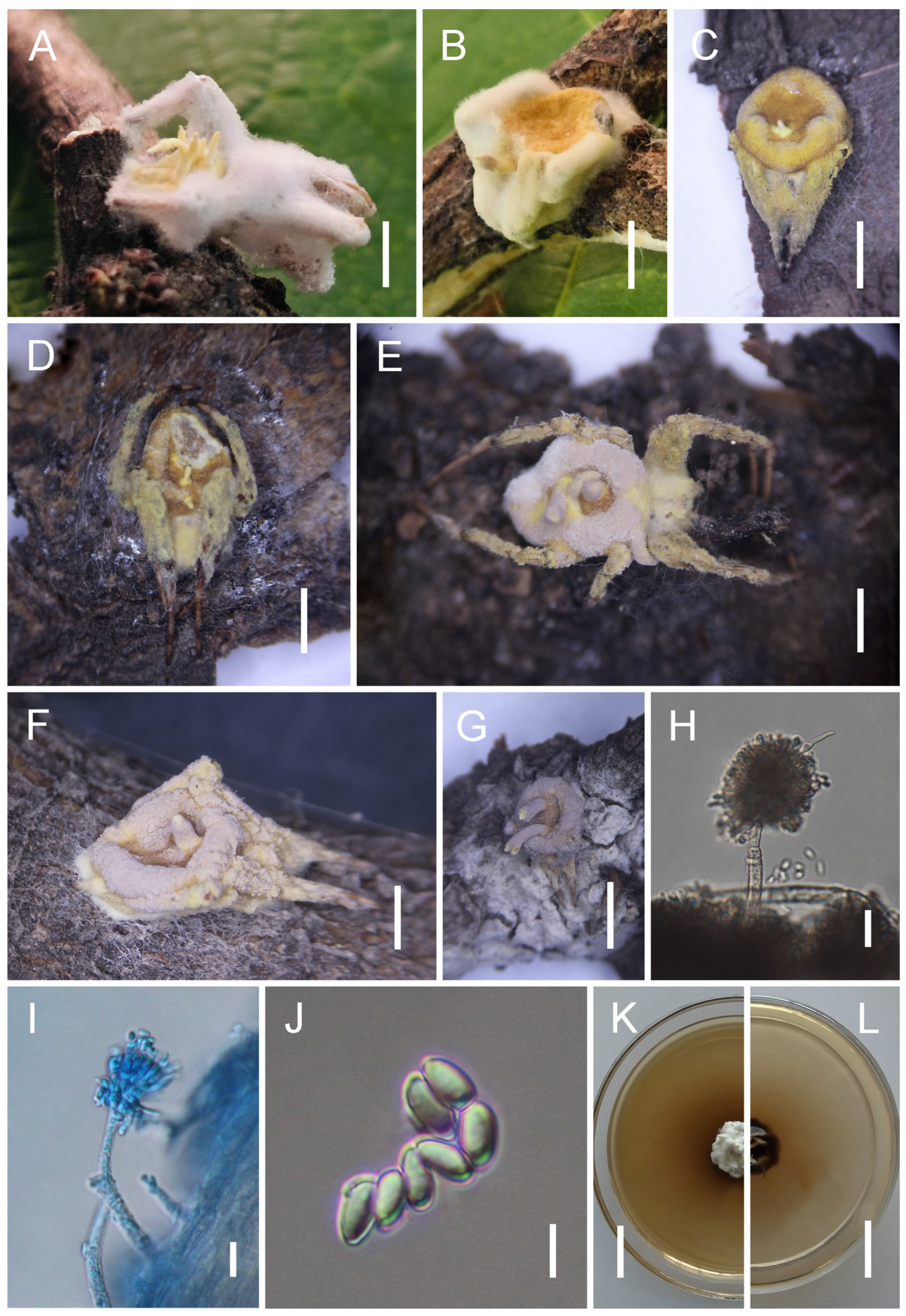
Description. Host surface covered by a dense white mycelial mat. Synnemata white, numerous, and arise exclusively from the dorsal surface of the host. During drying, their colour transitions from white to pale yellow, then to deep yellow or brown, and finally to purplish-grey, with spores aggregating on the dorsal surface. Stipes short and stout, cylindrical. Conidiophores few, solitary, yellow to brown, erect, thick-walled, septate, with wider spacing between septa toward the apex, simple, 78–109 × 6–8 ( X ¯ = 86 × 7.5, n = 30) µm. Terminal cell of conidiophores smooth, thin-walled, 18–25 ( X ¯ = 21, n = 30) µm long, bearing a stipe 6–8 ( X ¯ = 7.6, n = 30) µm long, apically swollen; vesicles spatulate to conical, 14–19 × 7–9 ( X ¯ = 17.1 × 8.2, n = 30) µm. Metulae broadly ovoid to broadly ellipsoid, 7–10 × 5–7 ( X ¯ = 7.6 × 6, n = 30) µm, borne on vesicles. Phialides cylindrical to lageniform, 9–15 × 2–3 ( X ¯ = 13.5 × 2.2, n = 30) µm. Vesicles together with metulae and phialides forming spherical to ovoid heads, 37–59 × 28–44 ( X ¯ = 44 × 35, n = 30) µm. Conidia hyaline, smooth, lacrimoid to subclavate, gradually narrowing toward the base, thin-walled, aseptate, 5.5–6.5 × 2–3 ( X ¯ = 6 × 2.5, n = 50) µm. Sexual morph not observed.
Culture characteristics. Colonies on PDA grow slowly at 25 °C, reaching 15–19 mm in diameter after 30 days. Mycelium initially greyish-white to cream-white, with colony margins gradually turning pale yellow. The central base darkens, and colonies are compact on the surface. Sporulation not observed in culture.
Distribution. China, Jilin Province, Baishan City and Yanbian Korean Autonomous Prefecture.
Other Material Examined. China, Jilin Province, Baishan City, Fusong County (42.69° N, 127.40° E; alt. 639 m), on a spider attached to a dead stem, July 2024, Yao Wang (GMB 3154; living culture: GMBC 3154). Yanbian Korean Autonomous Prefecture, Dunhua County (43.68° N, 128.11° E; alt. 647 m), on spiders attached to dead stems, 26 August 2024, Yao Wang (GMB 3155, GMB 3156, GMB 3157; living cultures: GMBC 3155, GMBC 3156, GMBC 3157); 1 September 2024, Yao Wang (GMB 3158, GMB 3159; living cultures: GMBC 3158, GMBC 3159).
Notes. Gibellula jilinensis forms a maximally supported sister clade with G. baishanensis (IQ-TREE-BS/RAxML-BS/BI-PP = 100%/100%/1), confirming their close relationship while underscoring their distinct species status. Morphologically, G. jilinensis is distinguished by synnemata that are restricted to the host’s dorsal surface, unlike in G. baishanensis where they also occur on the legs. Furthermore, its synnemata undergo a distinct colour transition during drying, progressing from white to pale yellow, then to deep yellow or brown, and finally to purplish-grey, with spores aggregating dorsally. The species also produces notably smaller conidial heads (37–59 × 28–44 µm) and significantly larger vesicles (14–19 × 7–9 µm) than G. baishanensis. These consistent morphological differences, supported by molecular data, validate the recognition of G. jilinensis as a new species.
Gibellula kunmingensis Y. Wang & H. Chen, sp. nov.
Mycobank No: 861167
Etymology. The species epithet refers to Kunming City in Yunnan Province, China, where the holotype was collected.
Type. China, Yunnan Province, Kunming City, Wild Duck Lake Forest Park (25.21° N, 102.85° E; alt. 2110 m), on a spider attached to the underside of a leaf, August 2024, Yao Wang (holotype: GMB 3148; ex-type living culture: GMBC 3148).
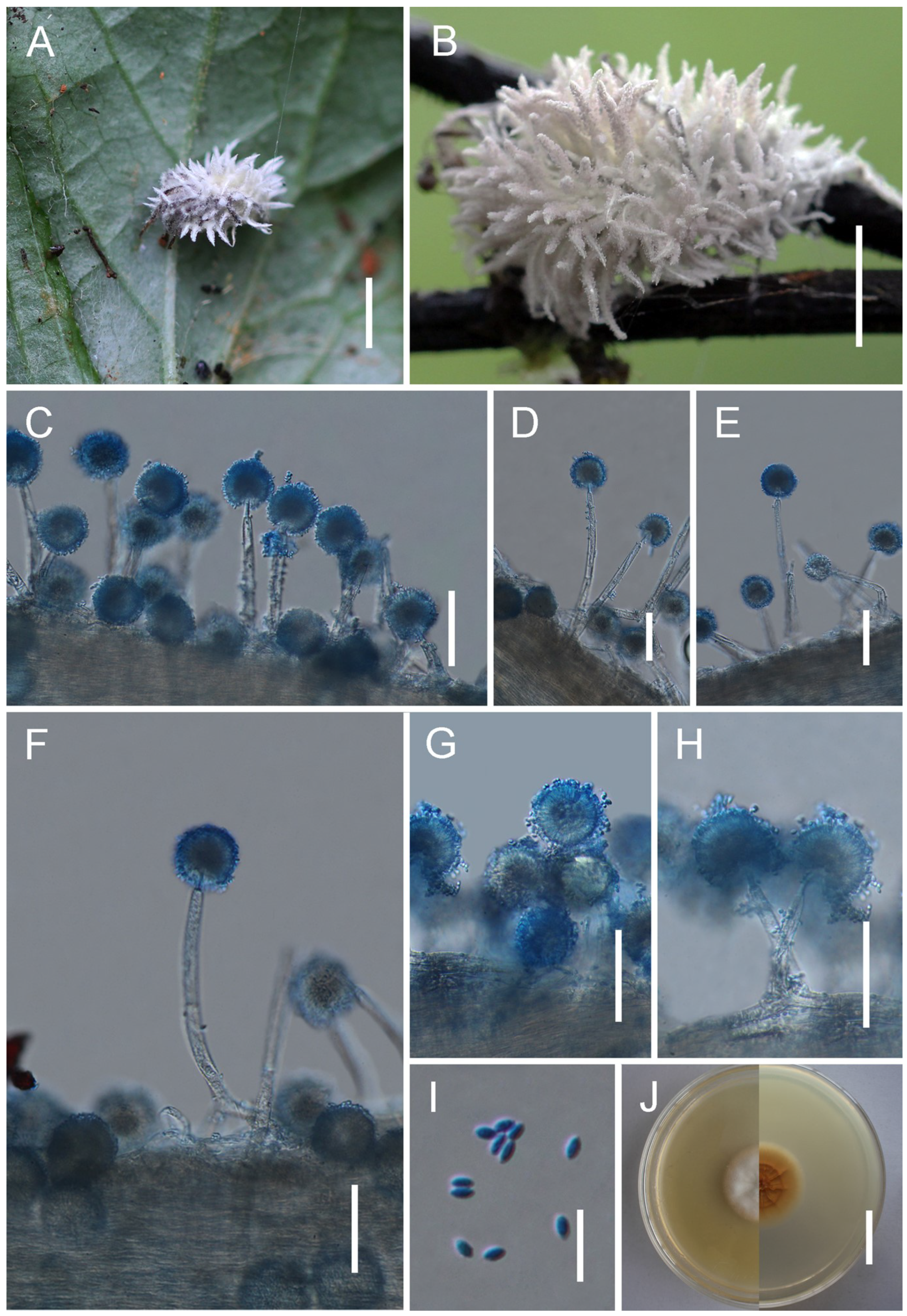
Description. The host surface is densely covered by a white mycelial mat. Synnemata are white, numerous, and arise directly from the entire host body. The stipes are short, erect, cylindrical, and resemble a narrow head, ca. 5 mm long. Conidiophores numerous, distinctly clustered, white, arising directly from the mycelium covering the host or along the synnemata; erect, thick-walled, septate, with wider spacing between septa toward the apex; simple, with verrucose to globose ornamentation near the apex and conspicuous septal thickening, 52–120 × 14–16 ( X ¯ = 88 × 15, n = 30) µm, abruptly narrowing at the terminal cell to 7–8 ( X ¯ = 7.5, n = 30) µm. Terminal cell of conidiophores smooth, thin-walled, 14–21 ( X ¯ = 18, n = 30) µm long, bearing a stipe 5–7 ( X ¯ = 6, n = 30) µm long, apically swollen. Vesicles spatulate to conical, 13–17 × 5–7 ( X ¯ = 14.5 × 6.5, n = 30) µm, smooth, bearing broadly ovoid to broadly ellipsoid metulae, 13–17 × 5–7 ( X ¯ = 15.5 × 6, n = 30) µm, each supporting cylindrical to lageniform phialides, 12–21 × 7–8 ( X ¯ = 16 × 7, n = 30) µm. Vesicles together with metulae and phialides forming spherical to ovoid heads, 36–49 × 25–35 ( X ¯ = 44 × 31, n = 30) µm, occasionally much reduced in size and complexity. Conidia hyaline, smooth, lacrimoid to subclavate, gradually narrowing toward the base, thin-walled, aseptate, 2–4 × 1.2–2 ( X ¯ = 3.2 × 1.5, n = 50) µm. Sexual morph not observed.
Culture characteristics. Colonies on PDA grow slowly at 25 °C, reaching 28–32 mm in diameter after 30 days. Mycelium initially greyish-white to cream-white, with the colony margin gradually turning pale yellow with age. Colonies are loose on the surface but compact at the base. Sporulation not observed in culture.
Distribution. Currently known only from Kunming City, Yunnan Province, China.
Other Material Examined. China, Yunnan Province, Kunming City (25.35° N, 102.58° E; alt. 1987 m), on spiders attached to dead stems, August 2025, Hui Chen (GMB 3149, GMB 3150, GMB 3151; living cultures: GMBC 3149, GMBC 3150, GMBC 3151).
Notes. Morphological comparisons between G. kunmingensis and similar species are summarized in Table 2. Although G. kunmingensis resembles G. pulchra in the production of numerous synnemata, it is distinguished by a combination of shorter synnemata (approximately 5 mm long), spatulate to conical vesicles, and smaller conidial heads (36–49 × 25–35 µm). Furthermore, while other related species listed in Table 2 typically produce paired or multiple synnemata ranging in colour from white to brownish-white, those of G. kunmingensis are consistently numerous and milky white. Phylogenetically, G. kunmingensis forms an independent clade with moderate support (IQ-TREE-BS/RAxML-BS/BI-PP = 74/94/-). The distinct morphological characteristics, coupled with its phylogenetic isolation, support the recognition of G. kunmingensis as a new species.
Gibellula paralongispora Y. Wang & H. Chen, sp. nov.
Mycobank No: 861168
Etymology. The specific epithet refers to the morphological resemblance to Gibellula longispora.
Type. China, Jilin Province, Yanbian Korean Autonomous Prefecture, Dunhua County (43.07° N, 128.01° E; alt. 637 m), on a spider attached to the underside of a leaf, 26 August 2024, Yao Wang (holotype: GMB 3162; ex-type living culture: GMBC 3162).
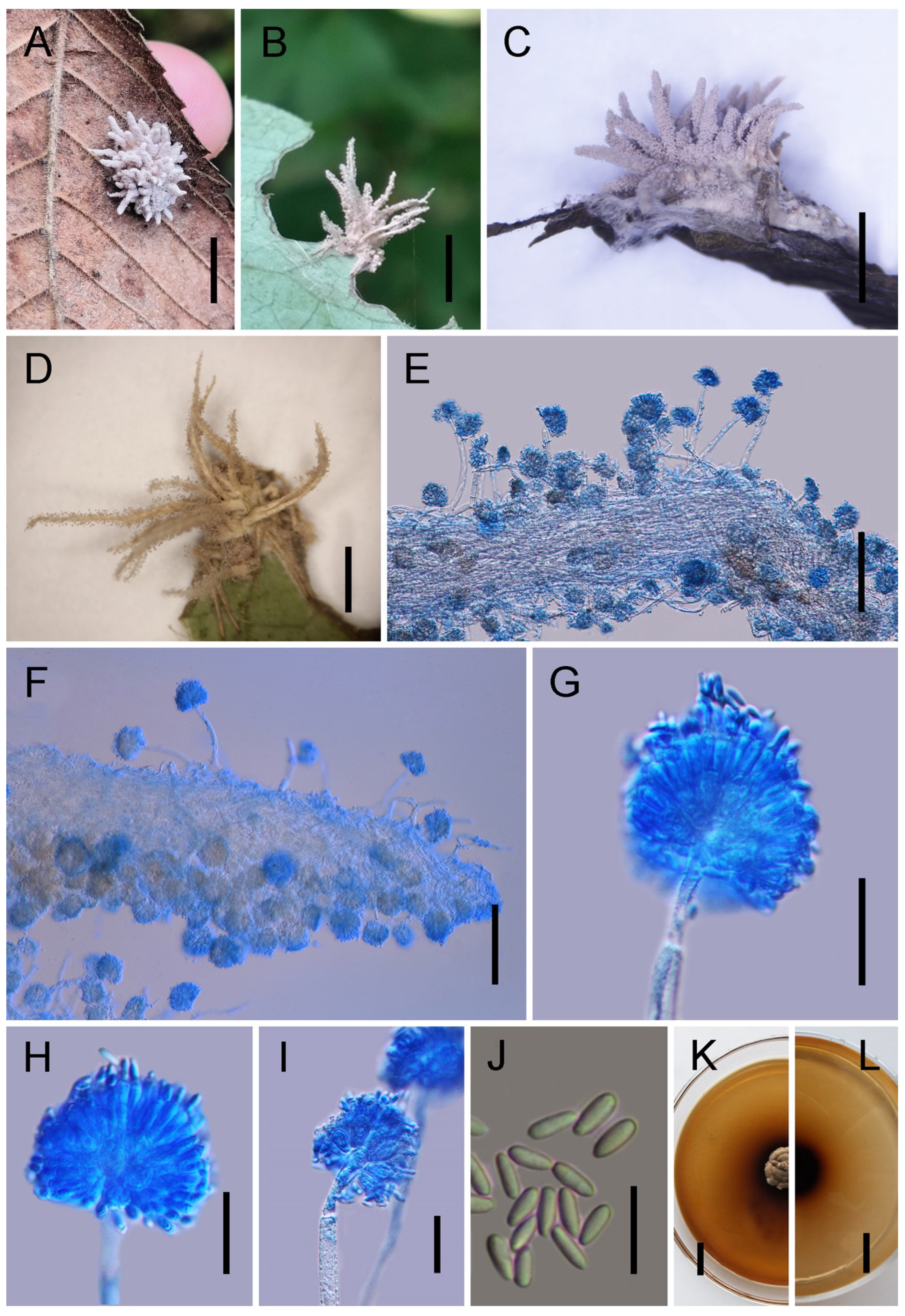
Description. Mycelium covering the host, white to cream, floccose, becoming light greyish brown to violaceous-brown upon drying. Synnemata multiple, cylindrical, arising from the abdomen of the host spider, cream to yellowish white. Conidiophores 111–188 × 8–10 ( X ¯ = 168 × 9, n = 30) μm, densely arranged, arising secondarily from hyphae loosely attached to the synnematal surface; verrucose, multiseptate, abruptly narrowing at the apex and forming a globose vesicle, 8–10.5 × 5–8 ( X ¯ = 9.5 × 6, n = 30) μm. Conidial heads spherical, composed of vesicles, metulae, and phialides, 28.5–40 × 25–36.5 ( X ¯ = 37 × 32, n = 30) μm. Metulae broadly obovate to oval, 6–11 × 4–7 ( X ¯ = 8 × 5.5, n = 30) μm, borne on vesicles, each bearing several clavate phialides, 9–11 × 2–5 ( X ¯ = 10 × 4, n = 30) μm. Conidia narrowly fusiform, 4.5–6 × 1.5–2 ( X ¯ = 5 × 1.8, n = 50) μm. Neither teleomorph nor granulomanus-like synanamorph observed.
Culture characteristics. Colonies on PDA grow slowly at 25 °C, reaching 18–21 mm in diameter after 30 days. Mycelium initially greyish-white to cream-white, with margins gradually turning pale yellow to brown with age. Colonies are compact both superficially and at the base. Sporulation not observed in culture.
Distribution. Currently known from Baishan City and Yanbian Korean Autonomous Prefecture in Jilin Province, and Tieling City in Liaoning Province, China.
Other Material Examined. China, Jilin Province, Baishan City, Fusong County (42°37′ N, 127°59′ E; alt. 639 m), on a spider attached to the underside of a leaf, 29 July 2025, collected by Kun Zhang (GMB 3161; living culture: GMBC 3161); Yanbian Korean Autonomous Prefecture, Dunhua County (43.10° N, 128.05° E; alt. 630 m), on spiders attached to the underside of leaves, 26 August 2025, Kun Zhang (GMB 3163, GMB 3164; living culture: GMBC 3163, GMBC 3164); Liaoning Province, Tieling City, Xifeng County (42°54′ N, 124°41′ E; alt. 346 m), on a spider attached to the underside of a leaf, 25 September 2025, collected by Kun Zhang (GMB 3165; living culture: not available).
Notes. Gibellula paralongispora forms a sister clade to G. longispora in the phylogeny, with strong support (IQ-TREE-BS/RAxML-BS/BI-PP = 97%/96%/0.99). Morphologically, both species share similar conidiophore structures and globose conidial heads. However, G. paralongispora differs in its narrower conidia (4.5–6 × 1.5–2 μm vs. 5–7 × 1–2 μm in G. longispora) and longer conidiophores (111–188 μm vs. 60–153.5 μm). These consistent morphological distinctions, together with molecular phylogenetic evidence, support the recognition of G. paralongispora as a distinct species.
Gibellula yunnanensis Y. Wang & H. Chen, sp. nov.
Mycobank No: 861190
Etymology. The specific epithet refers to Yunnan Province, China, where the species was collected.
Type. China, Yunnan Province, Kunming City, Wild Duck Lake Forest Park (25.68° N, 102.47° E, alt. 2100 m), on a spider attached to the underside of a leaf, 26 August 2024, Yao Wang (holotype: GMB 3142; ex-type living culture: not available).
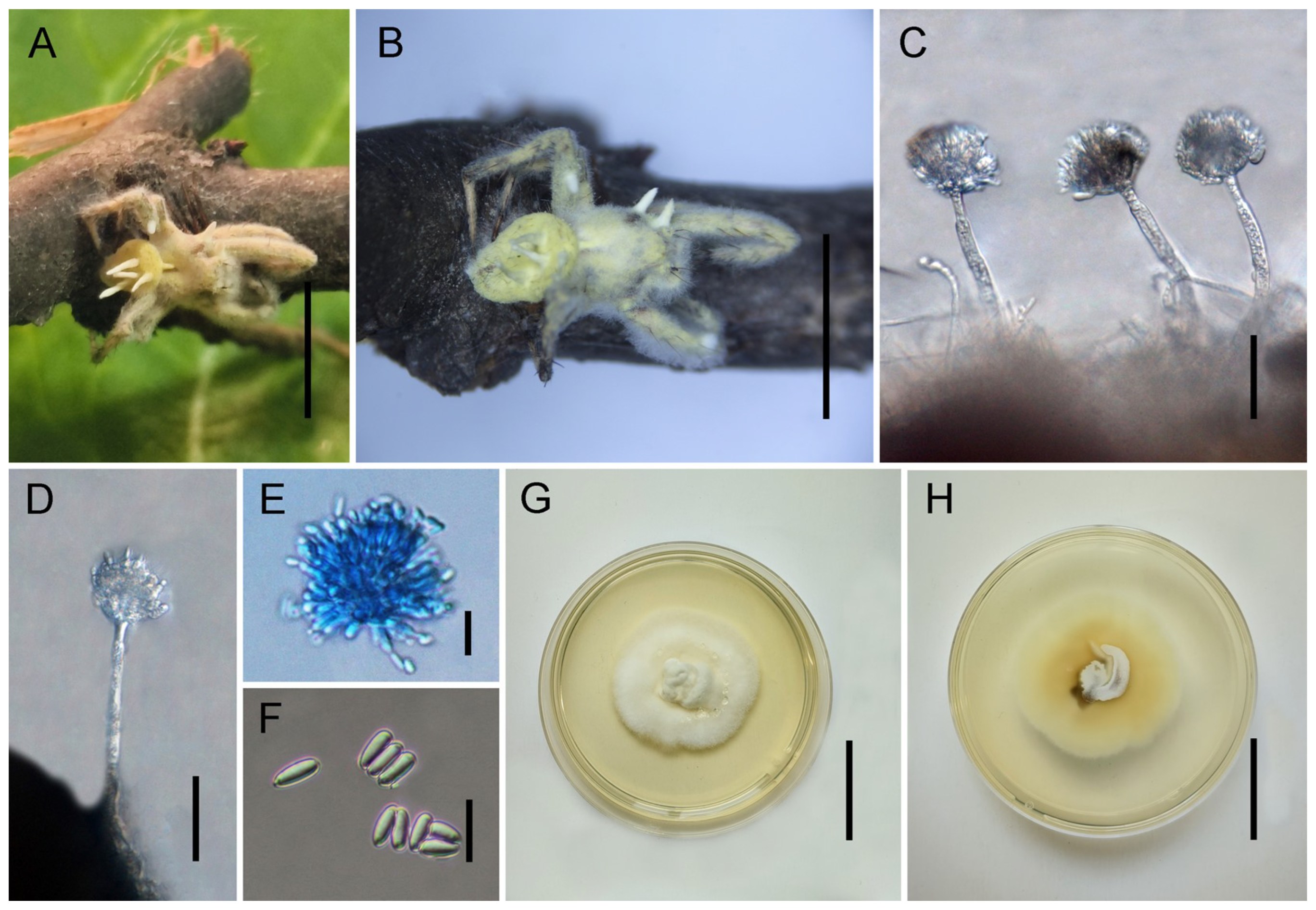
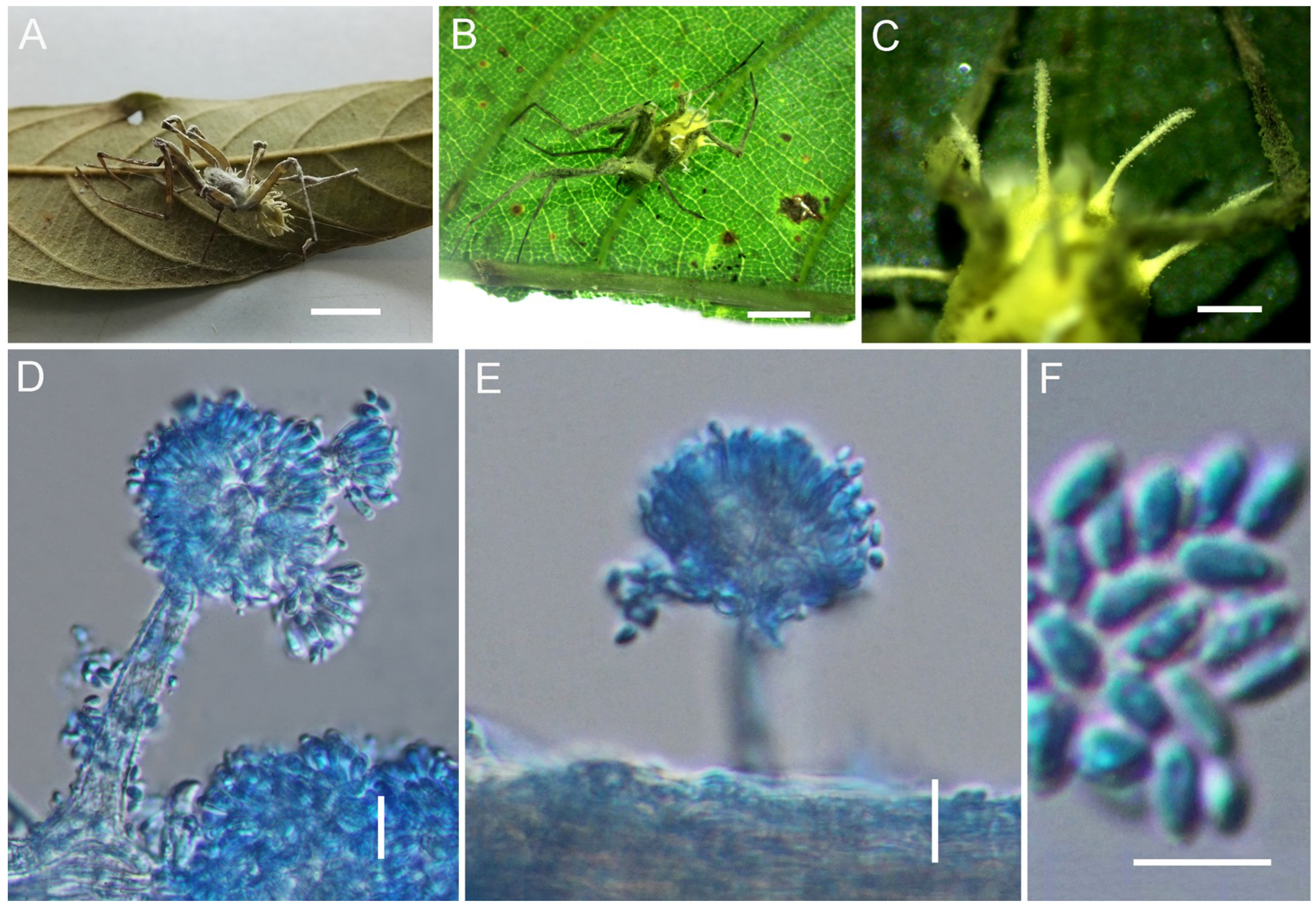
Description. Mycelium covering the host, white to creamy yellow, becoming light greyish-brown to violaceous-brown when dried. Synnemata multiple, cylindrical, arising from the abdomen of the host spider, cream to yellowish white. Conidiophores 27–58 × 3–8 ( X ¯ = 33 × 6, n = 30) μm, crowded, arising from hyphae loosely attached to the surface of the synnema, verrucose, multiseptate, suddenly narrowing to a tip, and forming a globose vesicle, 6–9 × 5.5–8 ( X ¯ = 7.5 × 6, n = 30) μm. Conidial heads composed of vesicle, metulae, and phialides, 22.5–31 × 36–46.5 ( X ¯ = 25 × 42, n = 30) μm. Metulae broadly obovate to oval, 6.4–9.7 × 5–7 ( X ¯ = 8 × 6, n = 30) μm, borne on vesicles. Phialides clavate, 6–8 × 2–3 ( X ¯ = 7 × 2.2, n = 30) μm, several per metula. Conidia narrowly fusiform, 6–9 × 2.2–3.1 ( X ¯ = 7.6 × 2.8, n = 50) μm. Teleomorph and granulomanus-like synanamorphs not observed.
Distribution. Currently known from Kunming City and Puer City in Yunnan Province, China.
Other Material Examined. China, Yunnan Province, Puer City (22.58° N, 99.97° E, alt. 1287 m), on a spider attached to the underside of a leaf, August 2025, Hui Chen (GMB 3143; living culture: not available).
Notes. In the phylogeny, G. yunnanensis clusters with G. attenboroughii and G. flava, forming a highly supported sister clade with G. attenboroughii (IQ-TREE-BS/RAxML-BS/BI-PP = 99%/90%/0.92). Morphologically, G. yunnanensis resembles G. attenboroughii and G. flava in producing multiple synnemata and aspergillate, distinctly roughened conidiophores. However, G. yunnanensis differs from G. attenboroughii in several stable morphological features. The conidia of G. yunnanensis are distinctly longer and narrower, whereas those of G. attenboroughii are ellipsoidal to fusoid (6–9 × 2.2–3.1 μm vs. 4–6 × 1.5–2 μm). In addition, the conidial heads of G. yunnanensis are densely arranged, while those of G. attenboroughii are relatively loose. These consistent morphological distinctions, combined with its stable phylogenetic position, support the recognition of G. yunnanensis as an independent species.

4. Discussion

In China, research on spider-pathogenic fungi has a relatively long history, yet the diversity of Gibellula has only recently gained fuller appreciation. By the 1980s, only a single species—initially reported as G. pulchra [51]—was known. This record was later revised to G. leiopus, a species characterized by extremely short conidiophores that confer a compact appearance [20]. Subsequent studies in the 1990s described several new taxa from Taiwan and Anhui Province, and over the past decade, systematic work has significantly expanded the known diversity [40,45,50]. To date, a total of 14 species and/or varieties of Gibellula have been reported from China, including G. clavispora, G. clavulifera, G. clavulifera var. major, G. curvispora, G. dabieshanensis, G. dimorpha, G. flava, G. leiopus, G. longispora, G. penicillioides, G. pulchra, G. shennongjiaensis, G. unica, and G. liaoningensis [14,17,19,45,50,52]. Among these, G. pulchra and G. leiopus are commonly encountered in southern China. The discovery of the five new species in this study, particularly those from Jilin and Liaoning Provinces, therefore significantly contributes new distribution records for Gibellula in Northeast China and underscores the ongoing potential for taxonomic discovery even in previously studied geographic contexts.
Host specificity offers critical insights for evaluating both the virulence of pathogens and their potential application as biological control agents [40]. Concurrently, increasing attention is being directed towards the secondary metabolites produced by Gibellula species. For instance, the novel antimicrobial compound EPF083CE was isolated from G. pulchra EPF083 [53]; pigmentosins A and B were obtained from the spider-associated fungus G. pigmentosinum [54]; and gibellamines A and B were characterized from G. gamsii [43]. Notably, pigmentosin B and gibellamines appear to be unique to G. pigmentosinum and G. gamsii, respectively, suggesting their potential utility as chemotaxonomic markers [40].
Members of Gibellula are notoriously fastidious and often challenging to establish in pure culture. In this study, however, we achieved successful isolation of the majority of the newly described taxa, with four out of the five species grown on potato dextrose agar (PDA) from conidial sources, despite their generally slow growth rates. This cultivation success represents a significant step forward, paving the way for utilizing these isolates in the discovery of novel bioactive metabolites and for identifying chemical markers valuable in taxonomic studies.

Author Contributions

Conceptualization, Y.W.; methodology, B.T. and H.C.; software, X.Z.; validation, Y.-H.G. and D.-X.T.; formal analysis, Q.-R.L.; investigation, H.C., Y.-H.G. and Y.W.; resources, Y.W.; data curation, X.Z.; writing—original draft preparation, B.T. and H.C.; writing—review and editing, Y.W.; visualization, Y.-H.G.; supervision, Y.W.; project administration, Y.W.; funding acquisition, Y.W. All authors have read and agreed to the published version of the manuscript.

Funding

This study was jointly supported by the National Natural Science Foundation of China under grant [32460004], and the Science and Technology Planning Project of Guizhou Province ([2024]023).

Institutional Review Board Statement

Not applicable.

Informed Consent Statement

Not applicable.

Data Availability Statement

The DNA sequence data obtained in this study have been deposited in GenBank. The accession numbers can be found in the article (Table 1).

Conflicts of Interest

The authors declare no conflicts of interest.

References

  1. Maharachchikumbura, S.S.; Hyde, K.D.; Jones, E.B.; McKenzie, E.H.; Huang, S.; Abdel-Wahab, M.A.; Daranagama, D.A.; Dayarathne, M.C.; D’souza, M.J.; Goonasekara, I.D.; et al. Towards a natural classification and backbone tree for Sordariomycetes. Fungal Divers. 2015, 72, 199–301. [Google Scholar] [CrossRef]
  2. Wijayawardene, N.N.; Hyde, K.D.; Lumbsch, H.T.; Liu, J.; Maharachchikumbura, S.S.; Ekanayaka, A.H.; Tian, Q.; Phookamsak, R. Outline of Ascomycota: 2017. Fungal Divers. 2018, 88, 167–263. [Google Scholar] [CrossRef]
  3. Xiao, Y.P.; Wen, T.C.; Hongsanan, S.; Jeewon, R.; Luangsa-Ard, J.J.; Brooks, S.; Wanasinghe, D.N.; Long, F.Y.; Hyde, K.D. Multigene phylogenetics of Polycephalomyces (Ophiocordycipitaceae, Hypocreales), with two new species from Thailand. Sci. Rep. 2018, 8, 18087. [Google Scholar] [CrossRef] [PubMed]
  4. Xiao, Y.P.; Wang, Y.B.; Hyde, K.D.; Eleni, G.; Sun, J.Z.; Yang, Y.; Meng, J.; Yu, H.; Wen, T.C. Polycephalomycetaceae, a new family of clavicipitoid fungi segregates from Ophiocordycipitaceae. Fungal Divers. 2023, 120, 1–76. [Google Scholar] [CrossRef]
  5. Wei, D.P.; Wanasinghe, D.N.; Xu, J.C.; To-Anun, C.; Mortimer, P.E.; Hyde, K.D.; Elgorban, A.M.; Madawala, S.; Suwannarach, N.; Karunarathna, S.C.; et al. Three novel entomopathogenic fungi from China and Thailand. Front. Microbiol. 2021, 11, 608991. [Google Scholar] [CrossRef]
  6. Wei, D.P.; Gentekaki, E.; Wanasinghe, D.; Tang, S.; Hyde, K.D. Diversity, molecular dating and ancestral character state reconstruction of entomopathogenic fungi in Hypocreales. Mycosphere 2023, 13, 281–351. [Google Scholar] [CrossRef]
  7. Peng, X.C.; Wen, T.C.; Wei, D.P.; Liao, Y.H.; Wang, Y.; Zhang, X.; Wang, G.Y.; Zhou, Y.; Tangtrakulwanich, K.; Liang, J.D. Two new species and one new combination of Ophiocordyceps (Hypocreales, Ophiocordycipitaceae) in Guizhou. MycoKeys 2024, 102, 245–266. [Google Scholar] [CrossRef] [PubMed]
  8. Kuephadungphan, W.; Petcharad, B.; Tasanathai, K.; Thanakitpipattana, D.; Kobmoo, N.; Khonsanit, A.; Samson, R.A.; Luangsa-Ard, J.J. Multilocus phylogeny unmasks hidden species within the specialised spider-parasitic fungus, Gibellula (Hypocreales, Cordycipitaceae) in Thailand. Stud. Mycol. 2022, 101, 245–286. [Google Scholar] [CrossRef]
  9. Shrestha, B.; Kubátová, A.; Tanaka, E.; Oh, J.; Yoon, D.H.; Sung, J.M.; Sung, G.H. Spider-pathogenic fungi within Hypocreales (Ascomycota): Their current nomenclature, diversity, and distribution. Mycol. Prog. 2019, 18, 983–1003. [Google Scholar] [CrossRef]
  10. Mongkolsamrit, S.; Noisripoom, W.; Tasanathai, K.; Kobmoo, N.; Thanakitpipattana, D.; Khonsanit, A.; Petcharad, B.; Himaman, W. Comprehensive treatise of Hevansia and three new genera Jenniferia, Parahevansia and Polystromomyces on spiders in Cordycipitaceae from Thailand. MycoKeys 2022, 91, 113–149. [Google Scholar] [CrossRef]
  11. Joseph, R.A.; Masoudi, A.; Valdiviezo, M.J.; Keyhani, N.O. Discovery of Gibellula floridensis from infected spiders and analysis of the surrounding fungal entomopathogen community. J. Fungi 2024, 10, 694. [Google Scholar] [CrossRef]
  12. Khonsanit, A.; Thanakitpipattana, D.; Mongkolsamrit, S.; Kobmoo, N.; Phosrithong, N.; Samson, R.A.; Crous, P.W.; Luangsa-Ard, J.J. A phylogenetic assessment of Akanthomyces sensu lato in Cordycipitaceae (Hypocreales, Sordariomycetes): Introduction of new genera, and the resurrection of Lecanicillium. Fungal Syst. Evol. 2024, 14, 271–305. [Google Scholar] [CrossRef] [PubMed]
  13. Samson, R.A.; Evans, H.C. Notes on entomogenous fungi from Ghana: I. The genera Gibellula and Pseudogibellula. Acta Bot. Neerl. 1973, 22, 522–528. [Google Scholar] [CrossRef]
  14. Huang, B.; Ding, D.G.; Fan, M.Z.; Li, Z.Z. A new entomopathogenic fungus on spiders. Mycosystema 1998, 17, 109–113. [Google Scholar]
  15. Han, Y.F.; Chen, W.H.; Zou, X.; Liang, Z.Q. Gibellula curcispora, a new species of Gibellula. Mycosystema 2013, 32, 777–780. [Google Scholar]
  16. Chen, W.H.; Han, Y.F.; Liang, Z.Q.; Wang, Y.R.; Zou, X. Classification of Gibellula spp. by DELTA system. Microbiol. China 2014, 41, 399–407. [Google Scholar] [CrossRef]
  17. Chen, W.H.; Han, Y.F.; Liang, Z.Q.; Zou, X. Morphological traits, DELTA system, and molecular analysis for Gibellula clavispora sp. nov. from China. Mycotaxon 2016, 131, 111–121. [Google Scholar] [CrossRef]
  18. Chen, M.; Wang, T.; Lin, Y.; Huang, B. Morphological and molecular analyses reveal two new species of Gibellula (Cordycipitaceae, Hypocreales) from China. MycoKeys 2022, 90, 53–69. [Google Scholar] [CrossRef]
  19. Zou, X.; Chen, W.H.; Han, Y.F.; Liang, Z.Q. A new species of the genus Gibellula. Mycosystema 2016, 35, 1161–1168. [Google Scholar] [CrossRef]
  20. Wang, T.; Chang, X.Y.; Huang, B.; Li, Z.Z.; Chen, M.J. Species diversity of spider-pathogenic fungi in China. Mycosystema 2024, 43, 230–243. [Google Scholar]
  21. Sun, T.; Zou, W.Q.; Dong, Q.Y.; Huang, O.; Tang, D.X.; Yu, H. Morphology, phylogeny, mitogenomics and metagenomics reveal a new entomopathogenic fungus Ophiocordyceps nujiangensis (Hypocreales, Ophiocordycipitaceae) from Southwestern China. MycoKeys 2022, 94, 91–108. [Google Scholar] [CrossRef]
  22. Wang, Y.B.; Wang, Y.; Fan, Q.; Duan, D.E.; Zhang, G.D.; Dai, R.Q.; Dai, Y.D.; Zeng, W.B.; Chen, Z.H.; Li, D.D.; et al. Multigene phylogeny of the family Cordycipitaceae (Hypocreales): New taxa and the new systematic position of the Chinese cordycipitoid fungus Paecilomyces hepiali. Fungal Divers. 2020, 103, 1–46. [Google Scholar] [CrossRef]
  23. White, T.J.; Bruns, T.; Lee, S.; Taylor, J.W. Amplification and direct sequencing of fungal ribosomal RNA genes for phylogenetics. In PCR Protocols: A Guide to Methods and Applications; Academic Press: San Diego, CA, USA, 1990; pp. 315–322. [Google Scholar] [CrossRef]
  24. Rehner, S.A.; Samuels, G.J. Taxonomy and phylogeny of Gliocladium analysed from nuclear large subunit ribosomal DNA sequences. Mycol. Res. 1994, 98, 625–634. [Google Scholar] [CrossRef]
  25. Bischoff, J.F.; Rehner, S.A.; Humber, R.A. Metarhizium frigidum sp. nov.: A cryptic species of M. anisopliae and a member of the M. flavoviride complex. Mycologia 2006, 98, 737–745. [Google Scholar] [CrossRef]
  26. Sung, G.H.; Hywel-Jones, N.L.; Sung, J.M.; Luangsa-ard, J.J.; Shrestha, B.; Spatafora, J.W. Phylogenetic classification of Cordyceps and the clavicipitaceous fungi. Stud. Mycol. 2007, 57, 5–59. [Google Scholar] [CrossRef]
  27. Liu, Y.J.; Whelen, S.; Hall, B.D. Phylogenetic relationships among ascomycetes: Evidence from an RNA polymerase II subunit. Mol. Biol. Evol. 1999, 16, 1799–1808. [Google Scholar] [CrossRef] [PubMed]
  28. Castlebury, L.A.; Rossman, A.Y.; Sung, G.H.; Hyten, A.S.; Spatafora, J.W. Multigene phylogeny reveals new lineage for Stachybotrys chartarum, the indoor air fungus. Mycol. Res. 2004, 108, 864–872. [Google Scholar] [CrossRef] [PubMed]
  29. Wang, Y.B.; Yu, H.; Dai, Y.D.; Chen, Z.H.; Zeng, W.B.; Yuan, F.; Liang, Z.Q. Polycephalomyces yunnanensis (Hypocreales), a new species of Polycephalomyces parasitizing Ophiocordyceps nutans and stink bugs (hemipteran adults). Phytotaxa 2015, 208, 34–44. [Google Scholar] [CrossRef]
  30. Tamura, K.; Stecher, G.; Peterson, D.; Filipski, A.; Nei, M.; Kumar, S. MEGA6: Molecular evolutionary genetics analysis version 6.0. Mol. Biol. Evol. 2013, 30, 2725–2729. [Google Scholar] [CrossRef]
  31. Stamatakis, A.; Hoover, P.; Rougemont, J. A rapid bootstrap algorithm for the RAxML Web servers. Syst. Biol. 2008, 57, 758–771. [Google Scholar] [CrossRef]
  32. Minh, B.Q.; Schmidt, H.A.; Chernomor, O.; Schrempf, D.; Woodhams, M.D.; von Haeseler, A.; Lanfear, R. IQ-TREE 2: New models and efficient methods for phylogenetic inference in the genomic era. Mol. Biol. Evol. 2020, 37, 1530–1534. [Google Scholar] [CrossRef]
  33. Darriba, D.; Taboada, G.L.; Doallo, R.; Posada, D. jModelTest 2: More models, new heuristics and parallel computing. Nat. Methods 2012, 9, 772. [Google Scholar] [CrossRef]
  34. Ronquist, F.; Teslenko, M.; van der Mark, P.; Ayres, D.L.; Darling, A.; Höhna, S.; Larget, B.; Liu, L.; Suchard, M.A.; Huelsenbeck, J.P. MrBayes 3.2: Efficient Bayesian phylogenetic inference and model choice across a large model space. Syst. Biol. 2012, 61, 539–542. [Google Scholar] [CrossRef] [PubMed]
  35. Li, Y.; Zhao, X.C.; Wu, L.X.; Wang, Y.; Xu, A.; Lin, W.F. Blackwellomyces kaihuaensis and Metarhizium putuoense (Hypocreales), two new entomogenous fungi from subtropical forests in Zhejiang Province, Eastern China. Forests 2023, 14, 2333. [Google Scholar] [CrossRef]
  36. Hyde, K.D.; Tennakoon, D.S.; Jeewon, R.D.; Bhat, J.; Maharachchikumbura, S.S.N.; Rossi, W.; Leonardi, M.; Lee, H.B.; Mun, H.Y.; Houbraken, J.; et al. Fungal diversity notes 1036–1150: Taxonomic and phylogenetic contributions on genera and species of fungal taxa. Fungal Divers. 2019, 96, 1–242. [Google Scholar] [CrossRef]
  37. Alves, J.E.R.; Santos, A.C.S.; Belo Pedroso, S.K.; Ribeiro Melo, R.F.; Tiago, P.V. Untangling a web of spider fungi: Gibellula agroflorestalis (Hypocreales, Ascomycota), a new species of spider parasite from Brazil. J. Invertebr. Pathol. 2025, 209, 108278. [Google Scholar] [CrossRef]
  38. Evans, H.C.; Fogg, T.; Buddie, A.G.; Yeap, Y.T.; Araújo, J.P.M. The araneopathogenic genus Gibellula (Cordycipitaceae: Hypocreales) in the British Isles, including a new zombie species on orb-weaving cave spiders (Metainae: Tetragnathidae). Fungal Syst. Evol. 2025, 15, 153–178. [Google Scholar] [CrossRef]
  39. Mendes-Pereira, T.; de Araújo, J.P.M.; Mendes, F.; Fonseca, E. Gibellula aurea sp. nov. (Ascomycota, Cordycipitaceae): A new golden spider-devouring fungus from a Brazilian Atlantic Rainforest. Phytotaxa 2022, 573, 85–102. [Google Scholar] [CrossRef]
  40. Kuephadungphan, W.; Tasanathai, K.; Petcharad, B.; Khonsanit, A.; Stadler, M.; Luangsa-ard, J.J. Phylogeny- and morphology-based recognition of new species in the spider-parasitic genus Gibellula (Hypocreales, Cordycipitaceae) from Thailand. MycoKeys 2020, 72, 17–42. [Google Scholar] [CrossRef] [PubMed]
  41. Kepler, R.M.; Sung, G.H.; Ban, S.; Nakagiri, A.; Chen, M.J.; Huang, B.; Li, Z.; Spatafora, J.W. New teleomorph combinations in the entomopathogenic genus Metacordyceps. Mycologia 2012, 104, 182–197. [Google Scholar] [CrossRef]
  42. Spatafora, J.W.; Sung, G.H.; Sung, J.M.; Hywel-Jones, N.L.; White, J.F. Phylogenetic evidence for an animal pathogen origin of ergot and the grass endophytes. Mol. Ecol. 2007, 16, 1701–1711. [Google Scholar] [CrossRef] [PubMed]
  43. Kuephadungphan, W.; Macabeo, A.P.G.; Luangsa-Ard, J.J.; Tasanathai, K.; Thanakitpipattana, D.; Phongpaichit, S.; Yuyama, K.; Stadler, M. Studies on the biologically active secondary metabolites of the new spider parasitic fungus Gibellula gamsii. Mycol. Prog. 2019, 18, 135–146. [Google Scholar] [CrossRef]
  44. Kepler, R.M.; Luangsa-Ard, J.J.; Hywel-Jones, N.L.; Quandt, C.A.; Sung, G.H.; Rehner, S.A.; Aime, M.C.; Henkel, T.W.; Sanjuan, T.; Zare, R.; et al. A phylogenetically-based nomenclature for Cordycipitaceae (Hypocreales). IMA Fungus 2017, 8, 335–353. [Google Scholar] [CrossRef]
  45. Liu, Z.L.; Wei, D.P.; Chen, J.H.; Wu, W.J.; Liu, Z.H.; Zhang, W.; Chen, H.; Peng, X.C.; Kang, J.C.; Qian, Y.X.; et al. A new spider-pathogenic species Gibellula liaoningensis (Cordycipitaceae) from Liaoning Province, China. Phytotaxa 2025, 702, 48–60. [Google Scholar] [CrossRef]
  46. Johnson, D.; Sung, G.H.; Hywel-Jones, N.L.; Luangsa-Ard, J.J.; Bischoff, J.F.; Kepler, R.M.; Spatafora, J.W. Systematics and evolution of the genus Torrubiella (Hypocreales, Ascomycota). Mycol. Res. 2009, 113, 279–289. [Google Scholar] [CrossRef] [PubMed]
  47. Mendes-Pereira, T.; de Araújo, J.P.M.; Kloss, T.G.; Costa-Rezende, D.H.; de Carvalho, D.S.; Góes-Neto, A. Disentangling the taxonomy, systematics, and life history of the spider-parasitic fungus Gibellula (Cordycipitaceae, Hypocreales). J. Fungi 2023, 9, 457. [Google Scholar] [CrossRef]
  48. Tan, Y.P.; Shivas, R.G. Nomenclatural novelties. Index Aust. Fungi 2023, 10, 1–17. [Google Scholar]
  49. Mongkolsamrit, S.; Noisripoom, W.; Tasanathai, K.; Khonsanit, A.; Thanakitpipattana, D.; Himaman, W.; Kobmoo, N.; Luangsa-Ard, J.J. Molecular phylogeny and morphology reveal cryptic species in Blackwellomyces and Cordyceps (Cordycipitaceae) from Thailand. Mycol. Prog. 2020, 19, 957–983. [Google Scholar] [CrossRef]
  50. Chen, M.J.; Wang, T.; Lin, Y.A.N.; Huang, B.O. Gibellula flava sp. nov. (Cordycipitaceae, Hypocreales), a new pathogen of spider from China. Phytotaxa 2021, 527, 125–133. [Google Scholar] [CrossRef]
  51. Gao, R.X. Description of a parasitic fungus Gibellula suffulta on spiders in Fujian. Acta Microbiol. Sin. 1981, 21, 308–310. [Google Scholar]
  52. Tzean, S.S.; Hsieh, L.S.; Wu, W.J. Torrubiella dimorpha, a new species of spider parasite from Taiwan. Mycol. Res. 1998, 102, 1350–1354. [Google Scholar] [CrossRef]
  53. Kuephadungphan, W.; Phongpaichit, S.; Luangsa-Ard, J.J.; Rukachaisirikul, V. Antimicrobial activity of invertebrate-pathogenic fungi in the genera Akanthomyces and Gibellula. Mycoscience 2013, 55, 127–133. [Google Scholar] [CrossRef]
  54. Helaly, S.E.; Kuephadungphan, W.; Phainuphong, P.; Ibrahim, M.A.A.; Tasanathai, K.; Mongkolsamrit, S.; Luangsa-Ard, J.J.; Phongpaichit, S.; Rukachaisirikul, V.; Stadler, M. Pigmentosins from Gibellula sp. as antibiofilm agents and a new glycosylated asperfuran from Cordyceps javanica. Beilstein J. Org. Chem. 2019, 15, 2968–2981. [Google Scholar] [CrossRef] [PubMed]
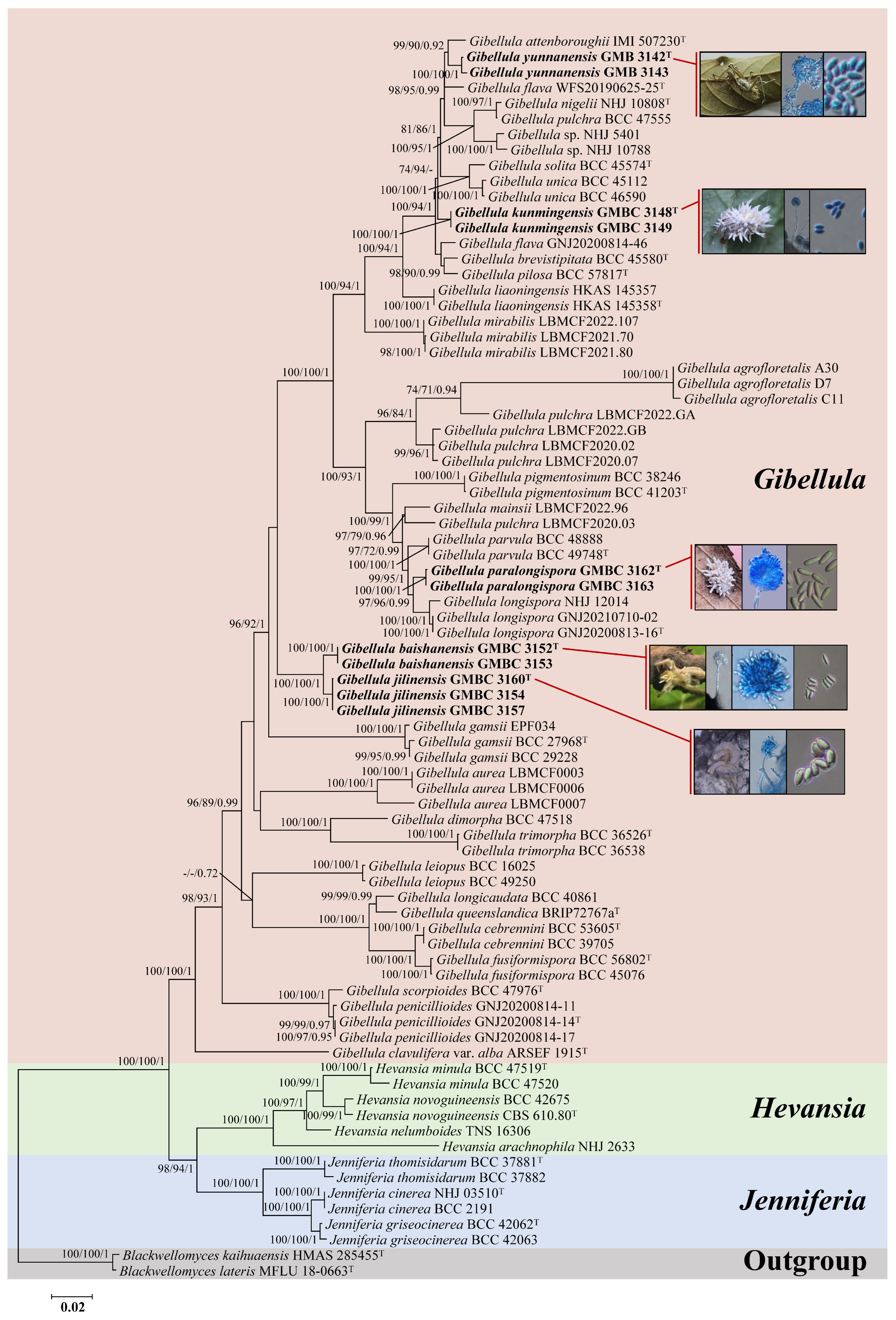
Figure 1. Phylogenetic tree of Gibellula and related genera based on a combined six-locus dataset (nrSSU + ITS + nrLSU + tef-1a + rpb1 + rpb2). Branch support values (IQ-TREE-BS/RAxML-BS/BI-PP) above 70%/70%/0.7 are shown. Ex-type materials are marked with “T”. Bold labels indicate sequences generated in this study.
Jof 11 00891 g001
Figure 2. Morphology of Gibellula baishanensis. (A,B) Fungus on a spider. (CE) Conidiophores showing conidial heads. (F) Conidia. (G,H) Colonies on PDA (front and reverse). Scale bars: 10 mm (A,B); 100 µm (C,D); 30 µm (E); 10 µm (F); 20 mm (G,H).
Jof 11 00891 g002
Figure 3. Morphology of Gibellula jilinensis. (AG) Fungus on a spider. (H,I) Conidiophores showing conidial heads. (J) Conidia. (K,L) Colony on PDA(front and reverse). Scale bars: 10 mm (AG); 40 µm (H,I); 5 µm (J); 15 mm (K,L).
Jof 11 00891 g003
Figure 4. Morphology of Gibellula kunmingensis. (A,B) Fungus on a spider. (CH) Conidiophores showing conidial heads. (I) Conidia. (J) Colonies on PDA (front and reverse). Scale bars: 10 mm (A,B); 50 µm (CH); 10 µm (I); 20 mm (J).
Jof 11 00891 g004
Figure 5. Morphology of Gibellula paralongispora. (AD) Fungus on a spider. (EI) Conidiophores showing conidial heads. (J) Conidia. (K,L) Colony on PDA(front and reverse). Scale bars: 10 mm (A,B); 5 mm (C,D); 100 µm (E,F); 20 µm (GI); 10 µm (J); 15 mm (K,L).
Jof 11 00891 g005
Figure 6. Morphology of Gibellula yunnanensis. (AC) Fungus on a spider. (D,E) Conidiophores showing conidial heads. (F) Conidia. Scale bars: 10 mm (AC); 10 µm (DF).
Jof 11 00891 g006
Table 1. Relevant species information and GenBank accession numbers for phylogenetic research in this study.
SpeciesVoucher/InformationGenBank Accession NumberReferences
nrSSUITSnrLSUtef-1αrpb1rpb2
Blackwellomyces kaihuaensisHMAS 285455TOQ981975OQ981961OQ981968OQ980401OQ980409OQ980408[35]
Blackwellomyces laterisMFLU 18-0663TMK086057MK086059MK086061MK069471MK084615MK079354[36]
Gibellula agrofloretalisA30PP958494N/AN/APP965288N/AN/A[37]
Gibellula agrofloretalisC11PP958496N/AN/APP965293N/AN/A[37]
Gibellula agrofloretalisD7PP958504N/APP958435PP965304N/AN/A[37]
Gibellula attenboroughiiIMI 507230TPQ036924N/APQ036929PQ046101N/AN/A[38]
Gibellula aureaLBMCF0003OK329880N/AN/AOK392618N/AOL117022[39]
Gibellula aureaLBMCF0006N/AN/AOK329875OK392624N/AOK315662[39]
Gibellula aureaLBMCF0007N/AOK329885OK329876OK392622N/AOK315663[39]
Gibellula baishanensisGMBC 3152TPX425053PX425062PX425069PX434402PX434411PX434420This study
Gibellula baishanensisGMBC 3153PX425054PX425063PX425070PX434403PX434412PX434421This study
Gibellula brevistipitataBCC 45580TN/AOK040729OK040706OK040697OK040715N/A[7]
Gibellula cebrenniniBCC 53605TN/AMT477069MT477062MT503328MT503321MT503336[40]
Gibellula cebrenniniBCC 39705N/AMH532874MH394673MH521895MH521822MH521859[40]
Gibellula clavulifera var. albaARSEF 1915TDQ522562JN049837DQ518777DQ522360DQ522408DQ522467[41,42]
Gibellula dimorphaBCC 47518N/AMH532884MH394679MH521892MH521819MH521863[7]
Gibellula flavaGNJ20200814-46MW969660N/AMW969673MW961413MW980146N/A[18]
Gibellula flavaWFS20190625-25TMW036749N/AMW084343MW091325MW384883N/A[18]
Gibellula fusiformisporaBCC 56802TN/AMT477070MT477063MT503329MT503322MT503337[40]
Gibellula fusiformisporaBCC 45076N/AMH532882N/AN/AMH521823MH521860[40]
Gibellula gamsiiBCC 27968TN/AMH152529MH152539MH152560MH152547N/A[43]
Gibellula gamsiiBCC 29228N/AMH152533MH152543MH152564MH152551MH152558[43]
Gibellula gamsiiEPF034N/AJX192720JX192753JX192817N/AN/A[43]
Gibellula jilinensisGMBC 3154PX425050PX425059PX425066PX434399PX434408PX434417This study
Gibellula jilinensisGMBC 3157PX425051PX425060PX425067PX434400PX434409PX434418This study
Gibellula jilinensisGMBC 3160TPX425052PX425061PX425068PX434401PX434410PX434419This study
Gibellula kunmingensisGMBC 3148TPX425057PX425064PX425073PX434406PX434415PX434424This study
Gibellula kunmingensisGMBC 3149PX425058PX425065PX425074PX434407PX434416PX434425This study
Gibellula leiopusBCC 16025N/AN/AMF416548MF416492MF416649N/A[44]
Gibellula leiopusBCC 49250N/AOK070780OK070781OK070782OK070783OK070784[7]
Gibellula liaoningensisHKAS 145357PQ817100PQ817098PQ817102PQ815114PQ815116PQ815118[45]
Gibellula liaoningensisHKAS 145358TPQ817099PQ817097PQ817101PQ815113PQ815115PQ815117[45]
Gibellula longicaudataBCC 40861N/AOK040730OK040707OK040698OK040716OK040724[7]
Gibellula longisporaNHJ 12014EU369098N/AN/AEU369017EU369055EU369075[46]
Gibellula longisporaGNJ20200813-16N/AN/AN/AMW961414MW980145N/A[18]
Gibellula longisporaGNJ20210710-02OL854201N/AOL854212OL981628N/AOL981635[18]
Gibellula mainsiiLBMCF2022.96OQ585789OQ589484N/AOQ658392N/AN/A[47]
Gibellula mirabilisLBMCF2021.70OQ585786OQ589481OQ585976OQ658389N/AN/A[47]
Gibellula mirabilisLBMCF2021.80OQ585787OQ589482OQ585977OQ658390N/AN/A[47]
Gibellula mirabilisLBMCF2022.107OQ585792N/AOQ585979OQ658395N/AN/A[47]
Gibellula nigeliiNHJ 10808TEU369099N/AEU369035EU369018EU369056EU369076[46]
Gibellula paralongisporaGMBC 3162TPX425055N/APX425071PX434404PX434413PX434422This study
Gibellula paralongisporaGMBC 3163PX425056N/APX425072PX434405PX434414PX434423This study
Gibellula parvulaBCC 48888N/AOK040731OK040708OK040699OK040717OK040725[7]
Gibellula parvulaBCC 49748TN/AOK040732OK040709OK040700OK040718OK040726[7]
Gibellula penicillioidesGNJ20200814-11MW969650MW969669MW969661MW961415MZ215998N/A[18]
Gibellula penicillioidesGNJ20200814-14TMW969651MW969670MW969662MW961416MZ215999N/A[18]
Gibellula penicillioidesGNJ20200814-17MW969652MW969671MW969663MW961417N/AN/A[18]
Gibellula pigmentosinumBCC 38246N/AMH532872MH394672MH521893MH521800MH521855[40]
Gibellula pigmentosinumBCC 41203TN/AMT477071MT477064MT503330MT503323N/A[40]
Gibellula pilosaBCC 57817TN/AOK040733OK040710OK040701OK040719N/A[7]
Gibellula pulchraBCC 47555N/AMH532885N/AMH521897MH521804N/A[7]
Gibellula pulchraLBMCF2020.02OQ585783N/AOQ585973OQ658386N/AN/A[47]
Gibellula pulchraLBMCF2020.03OQ585784N/AOQ585974OQ658387N/AN/A[47]
Gibellula pulchraLBMCF2020.07OQ585785N/AOQ585975OQ658388N/AN/A[47]
Gibellula pulchraLBMCF2022.GAOQ585780N/AOQ585970OQ658383N/AN/A[47]
Gibellula pulchraLBMCF2022.GBOQ585781OQ589487OQ585971OQ658384N/AN/A[47]
Gibellula queenslandicaBRIP 72767aTN/AOR452099OR452103OR459912N/AOR459907[48]
Gibellula scorpioidesBCC 47976TN/AMT477078MT477066MT503335MT503325MT503339[40]
Gibellula solitaBCC 45574TN/AOK040736OK040712OK040703OK040721N/A[7]
Gibellula sp.NHJ 5401EU369102N/AN/AN/AEU369059EU369079[46]
Gibellula sp.NHJ 10788EU369101N/AEU369036EU369019EU369058EU369078[46]
Gibellula trimorphaBCC 36526TN/AOK040737N/AOK040704OK040722OK040728[7]
Gibellula trimorphaBCC 36538N/AMH532867MH394668MH521890MH521817MH521861[7]
Gibellula unicaBCC 45112N/AOK040738N/AOK040705OK040723N/A[7]
Gibellula unicaBCC 46590N/AMH532883MH394678N/AMH521803MH521866[7]
Gibellula yunnanensisGMB 3142TPX354537PX354531PX354543PX370035PX371911PX371921This study
Gibellula yunnanensisGMB 3143PX354538PX354532PX354544PX370036PX371912PX371922This study
Hevansia arachnophilaNHJ 2633N/AMH532900GQ249978MH521917MH521843MH521884[43]
Hevansia minulaBCC 47519TN/AMZ684087MZ684002MZ707811MZ707826MZ707833[9]
Hevansia minulaBCC 47520N/AMZ684088MZ684003MZ707812MZ707827MZ707834[9]
Hevansia nelumboidesTNS 16306MF416585N/AN/AMF416475N/AMF416438[44]
Hevansia novoguineensisBCC 42675N/AMZ684089MZ684004MZ707814N/AMZ707835[9]
Hevansia novoguineensisCBS 610.80TN/AMH532831MH394646MH521885N/AMH521844[49]
Jenniferia cinereaNHJ 03510TN/AN/AN/AEU369009EU369048EU369070[46]
Jenniferia cinereaBCC 2191GQ249956GQ250000GQ249971GQ250029N/AN/A[43]
Jenniferia griseocinereaBCC 42062TN/AMZ684091MZ684006MZ707815MZ707828MZ707837[9]
Jenniferia griseocinereaBCC 42063N/AMZ684092MZ684007MZ707816MZ707829MZ707838[9]
Jenniferia thomisidarumBCC 37881TN/AMZ684099MZ684010MZ707823MZ707830MZ707843[9]
Jenniferia thomisidarumBCC 37882N/AMZ684100MZ684011MZ707824MZ707831MZ707844[9]
Boldface: data generated in this study; T: ex-type material. Institutional acronyms: ARSEF: Agricultural Research Service Collection of Entomopathogenic Fungal Cultures (culture collection); BCC: BIOTEC Culture Collection (culture collection); CBS: Westerdijk Fungal Biodiversity Institute (culture collection); GMB: Herbarium of Guizhou Medical University (herbarium); GMBC: Guizhou Medical University Culture Collection (culture collection); HKAS: Herbarium of Cryptogams, Kunming Institute of Botany, Chinese Academy of Sciences (herbarium); IMI: CABI Bioscience UK Centre (includes both cultures and herbarium specimens); NHJ: National Herbarium of Japan (herbarium); TNS: National Museum of Nature and Science (herbarium); MFLU: Mae Fah Luang University (herbarium).
Table 2. Comparison of the morphological characters of G. baishangensis, G. jilinensis, G. kunmingensis, G. paralongispora and related species.
SpeciesConidiophore (μm)Metulae (μm)Phialide (μm)Conidia (μm)References
Gibellula attenboroughiiVerrucose, 80–120 × 5–8Borne on vesicle, 10–12 × 6–8Cylindrical to narrowly clavate, 7.5–9.5 × 2.5–3.5 Hyaline, smooth, 4–6 × 1.5–2[38]
G. baishangensisVerrucose to globose, 69–89 × 8–11Broadly ovoid to broadly ellipsoid, 5–11 × 6–7Spherical to ovoid, 10–14 × 2–3Hyaline, smooth, 5.5–7 × 2–4This study
G. flavaVerrucose, 33.5–123.5 × 4–9.5Obovoid to broadly obovoid, 5.5–7 × 3.5–5.5Narrowly obovate to clavate, 5.5–7 × 1.5–2.5Fusiform, 3–4 × 1–2[50]
G. jilinensisVerrucose, 78–109 × 6–8Broadly ovoid to broadly ellipsoid, 7–10 × 5–7Cylindrical to lageniform, 9–15 × 2–3Hyaline, smooth, 5.5–6.5 × 2–3This study
G. kunmingensisVerrucose to globose, 52–120 × 14–16Broadly ovoid to broadly ellipsoid, 13–17 × 5–7Cylindrical to lageniform, borne on vesicles, 12–21 × 7–8Hyaline, smooth, 2–4 × 1.2–2This study
G. longisporaMultiseptate, minutely roughened, 159.5–290.5 × 8.5–11Broadly obovoid, 7.5–9.5 × 6–6.5Narrowly clavate to cylindrical, 9.5–11 × 3–3.5Bacilliform to cylindrical, 5.5–8 × 1–1.5[8]
G. paralongisporaVerrucose, 111–188 × 8–10Broadly obovate to oval, 6–11 × 4–7Clavate, 9–11 × 2–5Narrowly fusiform, 4.5–6 × 1.5–2This study
G. penicillioidesPenicillate, smooth, mostly biverticillate or terverticillate, 52.5–92 × 4.5–6Obovoid to cylindrical, 13–17.5 × 3.5–5Broadly cylindrical, 12.5–15.5 × 3–47.5–9 × 2.5–3.5[18]
G. pigmentosinumSmooth to verrucose, 97.5–170 × 7–10Broadly obovoid, 6–8 × 4–6Obovoid to clavate, 5.5–8 × 2–3Obovoid with an acute
Apex 3.5–5 × 1–2
[40]
G. pilosaMinutely roughened, 151–265 × 9–11Broadly obovoid, 9.5–11 × 7–8Narrowly clavate to cylindrical, 7–9 × 2.5–3Narrowly almond shaped, 3–4 × 1.5–2[8]
G. pulchraVerrucose, 155–170 × 7.5–10Cylindrical, 6.2–7.5 × 5–6Clavate, 7.5–8 × 1.5–2.5Fusiform to fusiform ellipsoid, 3–5 × 1.5–2.5[17]
G. solitaVerrucose, 82–146 × 7.5–9.5Broadly obovoid, 7–7.5 × 5–6Narrowly clavate to cylindrical, 6–7 × 2–2.5Occasionally globose, 2–2.5 × 1–1.5[8]
G. yunnanensisVerrucose, 27–58 × 3–8Broadly obovate to oval, 6.4–9.7 × 5–7Borne on vesicle, 6.4–9.7 × 5–7Narrowly fusiform, 6–9 × 2.2–3.1This study
Note: Bold labels indicate the morphological data of the new species described in this study.
Disclaimer/Publisher’s Note: The statements, opinions and data contained in all publications are solely those of the individual author(s) and contributor(s) and not of MDPI and/or the editor(s). MDPI and/or the editor(s) disclaim responsibility for any injury to people or property resulting from any ideas, methods, instructions or products referred to in the content.