Article

Analysis of Microbial Community Structure and Cultivation Performance Assessment in Tremella fuciformis Liquid Inoculum


1
Institute of Edible Mushroom, Fujian Academy of Agricultural Sciences, Fuzhou 350002, China
2
College of Life Sciences, Fujian Agriculture and Forestry University, Fuzhou 350002, China
3
Fujian Edible Fungus Technology Promotion General Station, Fuzhou 350002, China
*
Authors to whom correspondence should be addressed.
These authors contribute equally to this work.
J. Fungi 2025, 11(12), 825; https://doi.org/10.3390/jof11120825
Submission received: 31 October 2025 / Revised: 19 November 2025 / Accepted: 20 November 2025 / Published: 22 November 2025
(This article belongs to the Special Issue Research Progress on Edible Fungi)

Abstract

Liquid inoculum is widely adopted in the mushroom industry, yet preparing Tremella fuciformis liquid inoculum remains challenging due to its complex microbial community and dimorphic growth. This study aimed to establish a reliable protocol for T. fuciformis liquid inoculum and assess its practical application. Initially, liquefied spawn was produced by liquefying solid spawn. The application of standard liquefied spawn increased fruiting body yield by 8.2% (502.4 g/kg dry substrate) compared to solid spawn, but exhibited substantial batch-to-batch variation due to unstable microbial communities and low Tremellomycetes abundance. To address these limitations, liquid spawn was developed via pre-culture of pure T. fuciformis and Annulohypoxylon stygium mycelia. Cultivation tests demonstrated significantly enhanced performance with 608.2 g of fruiting bodies, which represented 11.1% improvement compared to solid spawn. Moreover, consistent yields could be observed across multiple batches. This stability was attributed to stable microbial community structure and the dominance of Tremellomycetes (abundance > 50%) in the fungal community. These results confirm the cultivation performance of T. fuciformis liquid spawn, highlighting its potential as an effective alternative to solid spawn for T. fuciformis industrial production.

1. Introduction

Tremella fuciformis is commonly known as white jelly mushroom, snow ear, or silver ear fungus, and belongs to the class Tremellomycetes, order Tremellales, and family Tremellaceae. As a typical dimorphic fungus, it exhibits two distinct morphological transitions: (i) the yeast-to-pseudohyphae transition and (ii) the yeast-to-hyphae transition [1,2]. The fruiting body of T. fuciformis contains abundant nutritional components, notably polysaccharides, proteins, dietary fibers, vitamins, and essential mineral elements [3]. Otherwise, T. fuciformis has demonstrated significant utility in both cosmeceutical and pharmaceutical applications owing to its diverse biological activities, including antioxidant, immunomodulatory, neuroprotective, and antitumor activities [4,5,6]. T. fuciformis is a geographically widespread fungus, frequently colonizing decaying broadleaf tree branches in tropical regions [7]. Although initially discovered in Brazil, industrial scale cultivation has established it as a major commercially cultivated species in China, with total production value reaching approximately 25.5 billion RMB (about 3.5 billion USD) in 2024 [8]. The industrial cultivation process employs a standardized substrate formulation comprising primarily wheat bran and cottonseed hulls, with T. fuciformis harvested on a bimonthly basis. This industrialized method dominates T. fuciformis production, accounting for over 90% of the global market.
In all environments including cultivation conditions, the fruiting body formation of T. fuciformis is obligately dependent on its companion ascomycete Annulohypoxylon stygium [9]. A. stygium is a white-rot filamentous fungus belonging to the family Xylariaceae [10], which can be routinely isolated from both woody substrates adjacent to T. fuciformis basidiomes and spawn cultures used in cultivation systems. As an associated fungus, A. stygium exhibits exceptional enzymatic capability in degrading lignin and carbohydrates, thereby generating essential nutrients that support T. fuciformis fruiting body development [11,12]. During the artificial cultivation of mushrooms, inoculation of the spawn into the substrate constitutes a crucial procedural step. Currently, solid spawn remains the standard inoculum in T. fuciformis cultivation protocols. Prior to inoculation, the solid spawn must undergo thorough homogenization to guarantee that each inoculation unit contains viable hyphae of both T. fuciformis and A. stygium. However, this method faces critical limitations, including high technical difficulty in spawn preparation, prolonged spawn running time [13], high contamination risk, poor stability of solid spawn preparation [14], and pronounced spawn degeneration [15]. These factors collectively contribute to batch-to-batch variability in the yield and quality of T. fuciformis, posing a major bottleneck for standardized, large-scale production.
Liquid inoculum has been developed for more than 30 years, with liquefied spawn and liquid spawn representing the two most prevalent forms. The former is produced by liquification of solid mother spawn, whereas the latter is obtained through the pure liquid culture of mycelium. These inoculum types are garnering heightened attention from mycologists and commercial cultivators due to its multifaceted advantages including shortened preparation period, reduced space requirements, lower production costs, rapid substrate colonization capacity, compatibility with automated inoculation equipment, and facilitated uniform dispersion within growth substrates [16,17]. Numerous commercially important edible mushrooms such as Lentinula edodes [18], Pleurotus eryngii [19], Ganoderma lucidum [20] and Flammulina filiformis [21], have successfully developed and implemented standardized industrial-scale protocols for liquid inoculum production. High-quality liquid inoculum enhances edible mushroom cultivation efficiency by reducing the production cycle and simultaneously boosting yield and fruiting body quality [22]. However, T. fuciformis lacks both standardized liquid spawn protocols and systematic studies on this cultivation method. This gap is particularly challenging due to the unique dimorphic growth characteristics of T. fuciformis and the markedly divergent growth dynamics with its companion A. stygium in liquid culture systems, which introduce significant technical barriers to liquid culture development [23,24]. Addressing this critical knowledge gap in mycological cultivation research is imperative to establish fundamental biological understanding and develop optimized liquid culture protocols for this species.
This study systematically investigated two distinct preparation methods for T. fuciformis liquid spawn: (1) solid spawn liquefaction and (2) pure mycelial liquid culture. Cultivation experiments were conducted to validate their application feasibility. Microbial community structures in both types of liquid spawn were comparatively analyzed through high throughput sequencing, analyzing the fluctuations in microbial community structures and fruiting body yield across multiple liquid spawn batches to estimate the application performance. The findings provide both theoretical foundations and practical references for standardizing, orienting, and scaling up industrial production of T. fuciformis liquid spawn, while proposing innovative strategies to enhance the sustainable development of the entire T. fuciformis cultivation industry.

2. Materials and Methods

2.1. Chemicals and Reagents

Analytical Reagent including glucose (CAS Number: 50-99-7), KH2PO4 (CAS Number: 7778-77-0), MgSO4 (CAS Number: 7487-88-9), K2HPO4 (CAS Number: 7758-11-4), absolute ethanol (CAS Number: 64-17-5), phenol (CAS Number: 108-95-2), sulfuric acid (CAS Number: 7664-93-9), NaOH (CAS Number: 1310-73-2), HCl with a concentration of 36.0–38.0% (CAS Number: 7647-01-0) and agar powder (CAS Number: 9002-18-0) were purchased from Sinopharma Chemical Reagent Co., Ltd. (Shanghai, China). Thiamine HCl (CAS Number: 67-03-8) was bought from Sigma Aldrich (Shanghai, China). Oxoid™ Yeast Extract Powder (Code: LP0021) and Tryptone (Code: LP0042) were purchased from Thermo Fisher Scientific (Waltham, MA, USA). Potato, corn flour, and soybean flour were obtained from a local supermarket (Fuzhou, China). The cultivation substrate components including cottonseed hull, wheat bran, and gypsum were purchased from a specialized market for edible mushroom raw and auxiliary materials in Gutian, Ningde (Fujian, China).

2.2. Strains and Culture Conditions

The Tremella fuciformis strain Tr21 and its companion fungus Annulohypoxylon stygium were isolated from high-quality fruiting bodies of T. fuciformis (Jianhong Agricultural Development Co., Ltd., Ningde, China), and subsequently identified through ITS region amplification and sequencing analysis. Both strains were separately cultured on PDA plates (potato 200 g/L, glucose 20 g/L, peptone 5 g/L, KH2PO4 2 g/L, MgSO4 1 g/L, agar 20 g/L, Thiamine HCl 0.01 g/L) at 25 °C. The cultures were cryopreserved at −80 °C with the addition of 30% glycerol at the Gutian Edible Fungi Research Institute, Fujian Agriculture and Forestry University, Fuzhou, China.

2.3. The Method of T. fuciformis Liquefied Spawn Preparation

The liquefied spawn of T. fuciformis was prepared by modifying established literature protocols [25]. Mother spawn of T. fuciformis, obtained from a pure co-culture of A. stygium and T. fuciformis mycelia on a lignocellulose substrate in glass bottles, characterized by round white mycelial aggregates on the substrate surface and vigorous hyphal growth of A. stygium, was selected for liquefied spawn preparation. A 3 cm-deep substrate layer beneath the surface was homogenized using a sterile mixer (Zhongchong (Jining, China), TJ3). Subsequently, 50 g of the homogenized substrate was mixed with 150 mL of sterile water (1:3, w/v). The mixture was ground at 10,000 rpm for 40 s under aseptic conditions using a knife mill homogenizer (Retsch (Haan, Germany), GRINDOMIX GM 300) to prepare the mother suspension. Aliquots (0.3 g) of the mother suspension were inoculated into liquefied spawn media I-VII (Table 1). These cultures were incubated at 24 °C and 140 rpm for 4 days to produce the T. fuciformis liquefied spawn. The optimal medium was screened based on mycelial pellet density and average pellet diameter. Additionally, the effects of inoculum amount of mother suspension (0.1–0.9 g), grinding time (30–90 s), medium volume (50–150 mL), and initial medium pH (4–9.5) on the quality of liquefied spawn were evaluated. Mycelial pellet density was determined by transferring 5 mL of liquefied spawn into a transparent Petri dish and counting the pellets under 10× magnification (five replicates). Mycelial pellet diameter was assessed by linearly aligning ten randomly selected pellets using an inoculating needle and measuring the total length to calculate the mean diameter (five replicates).

2.4. Physiological Parameter Assay of T. fuciformis Liquefied Spawn

The physiological parameters of T. fuciformis liquefied spawn during the cultivation process were measured for the optimal incubation time. Morphological indicators, including mycelial pellet growth performance and changes in broth color, were macroscopically observed. Four key parameters including pH value, biomass, soluble protein and glucose concentration were quantitatively analyzed. The detailed procedures were as follows: 20 mL of T. fuciformis liquefied spawn culture was transferred to a 50 mL beaker, and the pH value was measured using a pH meter (Mettler-Toledo (Changzhou, China), FE28). For biomass determination, 10 mL of the culture was centrifuged at 10,000× g rpm for 20 min to collect mycelial pellets from the supernatant. The harvested mycelial pellets were washed twice with deionized water. Excess moisture was removed using filter paper, and the mycelia were dried to a constant weight in an oven at 55 °C. The supernatant was used for further analysis of soluble protein and glucose concentration. Soluble protein concentration was quantified using the Bradford method, while glucose concentration was determined via the DNS (3,5-dinitrosalicylic acid) method [26].
Melanin and polysaccharide content are critical quality indicators for T. fuciformis strains. The detailed protocols for analyzing intracellular and extracellular polysaccharides, as well as melanin content in T. fuciformis liquefied spawn cultures, are outlined below: Intracellular and extracellular polysaccharides were obtained from T. fuciformis culture medium according to the method of Liu et al. [27]. For extracellular polysaccharide analysis, 10 mL of culture was subjected to high-speed centrifugation (10,000× g rpm, 10 min) to collect the supernatant. The supernatant was concentrated to 2 mL using a rotary evaporator (Shanghai Yarong (Shanghai, China), RE-52AA), followed by precipitation with three volumes of absolute ethanol. The mixture was vortexed thoroughly and stored at 4 °C for 10–12 h to allow complete polysaccharide precipitation. Precipitates were collected by centrifugation (10,000× g rpm, 10 min), dissolved in distilled water, and re-centrifuged to remove insoluble residues. For intracellular polysaccharide analysis, mycelia were harvested from 10 mL of culture by centrifugation and washed twice with sterile water. Cell lysis was achieved by adding six volumes (v/w) of sterile water to the mycelial pellet, followed by three freeze–thaw cycles (−80 °C for 1 h and 60 °C water bath for 2 h per cycle). After centrifugation (10,000× g rpm, 10 min) to remove cellular debris, the supernatant was treated with three volumes of ethanol and incubated at 4 °C for 10–12 h. Precipitates were collected by centrifugation (10,000× g rpm, 10 min), dissolved in distilled water, and re-centrifuged to eliminate insoluble residues. The extracellular and intracellular polysaccharide content was quantified using the phenol-sulfuric acid method. For melanin analysis, 10 mL of culture was mixed with an equal volume of 1 mol/L NaOH and boiled for 3 h. After cooling to room temperature, the mixture was centrifuged (10,000× g rpm, 5 min) to remove biomass. The supernatant pH was adjusted to 2.0 with 1 mol/L HCl, followed by incubation at 70 °C for 14 h. The precipitated melanin was collected by centrifugation and dried to a constant weight at 55 °C [28].

2.5. Microbial Community Structure Analysis

The microbial community structure of T. fuciformis liquid spawn was analyzed as described by Zhou et al. [29]. Mycelia were collected by centrifugation, and genomic DNA was extracted using the CTAB method. DNA integrity was assessed via 1.0% agarose gel electrophoresis, while concentration and purity were quantified using a NanoDrop 2000 ultra-micro spectrophotometer (Thermo Fisher, Waltham, MA, USA). Microbial conserved regions were amplified by PCR. The bacterial 16S rRNA V3–V4 regions were amplified using the primers 5′-ACTCCTACGGGAGGCAGCA-3′ and 5′-GGACTACHVGGGTWTCTAAT-3′. The fungal ITS1 regions were amplified using the 5′-CTTGGTCATTTAGAGGAAGTAA-3′ and 5′-GCTGCGTTCTTCATCGATGC-3′ [30]. PCR products integrity was verified by 1.0% agarose gel electrophoresis, and qualified samples were submitted to Biomarker Technologies Co., Ltd. (Beijing, China) for Illumina NovaSeq 6000 sequencing. Sequencing libraries were prepared using the VAHTSTM Universal DNA Library Prep Kit (Vazyme, Najing, China), quality-checked with a Qsep-400 analyzer (Bioptic Inc, Changzhou, China), and quantified with a Qubit 3.0 fluorometer (Thermo Fisher, Waltham, MA, USA). Raw sequencing reads were assembled and subjected to quality control to generate Clean Tags. Chimeric sequences were filtered to obtain Effective Tags. OTUs (operational taxonomic units) were clustered at a similarity threshold of ≥97% based on 16S rRNA and ITS1 gene sequences. Shared and unique OTUs were visualized using Venn diagrams in R (version 3.3.1). Alpha diversity indices (Shannon, Simpson, Good’s coverage) were calculated using QIIME 1.9.1 with rarefaction analysis. Differences in community composition and diversity were analyzed in R (v3.6.3), and Venn diagrams were generated using the VennDiagram package (v1.7.3). Taxonomic composition was visualized as percentage stacked bar plots in Microsoft Excel.

2.6. Preparation of T. fuciformis Liquid Spawn

To prepare T. fuciformis liquid spawn, the A. stygium metabolic extract was prepared from post-harvest T. fuciformis cultivation substrates. Briefly, 400 g of the substrate was homogenized with 1 L of ultrapure water using a commercial blender (Zhongchong (Jining, China), TJ3). The mixture was subjected to thermal extraction in a boiling water bath for 30 min, followed by filtration to remove solid residues. The filtrate was then adjusted to a final volume of 1 L with ultrapure water, sterilized at 115 °C for 30 min, and stored at 4 °C for subsequent use. This aqueous extract, containing water-soluble metabolites derived from A. stygium metabolic activity during T. fuciformis cultivation, was designated as the A. stygium metabolic extract. Cryopreserved T. fuciformis Tr21 spores (stored at −80 °C) were streaked onto PDA plates and incubated at 24 °C until hyphal growth emerged from colony margins. Hyphal tips were then transferred to fresh PDA plates supplemented with 30% (v/v) A. stygium metabolic extract and cultured at 24 °C until mycelia covered approximately one-third of the plate. The resulting culture was used as pure T. fuciformis solid spawn. Concurrently, cryopreserved A. stygium was revived on PDA plates at 24 °C. Agar plugs (diameter φ = 0.5 cm) from colonies with culture medium darken were transferred to fresh PDA plates to obtain A. stygium solid pawn. Subsequently, pure T. fuciformis solid spawn plugs (φ = 0.5 cm) were inoculated into 100 mL PDB (potato 200 g/L, glucose 20 g/L, peptone 5 g/L, KH2PO4 2 g/L, MgSO4 1 g/L, Thiamine HCl 0.01 g/L) supplemented with 30% A. stygium metabolic extract and incubated at 24 °C, 140 rpm to produce pure T. fuciformis liquid spawn. Similarly, A. stygium solid spawn was inoculated into PDB to prepare A. stygium liquid spawn. Physiological parameters were monitored to determine the optimal cultivation period. Finally, liquid spawns of pure T. fuciformis and A. stygium were mixed at defined ratios to produce the final T. fuciformis liquid spawn.

2.7. Cultivation Tests

2.7.1. Cultivation Test of Liquefied Spawn

For the T. fuciformis cultivation tests, the cultivation medium was composed of cottonseed hull, wheat bran, and gypsum at a ratio of 85:14:1. The moisture content of the cultivation substrate was adjusted to 58–60% (w/w) using a moisture meter (LXT, Recht (Collingwood, Melbourne, VI, Australia)). A total of 1500 g of the moistened substrate was packed into polyethylene bags (55 × 13 cm). After perforation and sealing with adhesive tape, the bags were autoclaved at 121 °C for 150 min. Once cooled to room temperature, 5 mL of T. fuciformis liquefied spawn was aseptically inoculated into each bag through the perforation site. The inoculation sites were then resealed, and the bags were incubated in a fruiting room under standard fruiting management conditions. To evaluate cultivation stability, four consecutive batches were conducted, each consisting of 60 bags. Fruiting performance was assessed based on fruiting yield and ratio. Parallel comparisons with solid spawn controls were carried out to determine yield differences. The fruiting body yield and fruiting ratio were calculated according to the following formula:
Y i e l d   ( g / k g ) = F r u i t i n g   b o d y   m a s s ( g ) D r y   s u b s t r a t e   m a s s ( k g )
Fruiting body mass: The weight of T. fuciformis fruiting body per bag.
Dry substrate (ds) mass: Wet substrate weight per bag × (1 − substrate moisture).
F r u i t i n g   r a t i o   ( % ) = F r u i t i n g   b o d y   n u m b e r s P e r f o r a t i o n   n u m b e r s × 100 %
Fruiting body numbers: The total number of fruiting bodies harvested from 60 bags.
Perforation numbers: 60 bags × 3 perforation numbers per bag.

2.7.2. Cultivation Test of Liquid Spawn

Liquid spawns of pure T. fuciformis (cultivated for 7 days) and A. stygium (cultivated for 3 days) were directly mixed under sterile condition at various volume ratios (5:1, 4:1, 3:1, 2:1, and 1:1, v/v). For each mixing ratio, 5 mL of the liquid spawn mixture was inoculated into substrate bags following the procedure outlined in Section 2.7.1. Fruiting performance was analyzed to identify the optimal mixing ratio, with solid spawn used as the control. Additionally, industrial-scale tests were also performed to evaluate the practical application of liquid spawn in commercial production.

2.8. Statistical Analysis

Statistical analyses were conducted using GraphPad Prism 9 and Origin 2018. Fruiting performance was evaluated based on yield, fruiting ratio, and agronomic traits of fruiting bodies (diameter, convexity, central diameter, and thickness). One-way analysis of variance (ANOVA) was performed using SPSS 22.0. Duncan’s Multiple Range Test was used to determine significant differences (p < 0.05) and highly significant differences (p < 0.01). Results are presented as mean ± standard deviation.

3. Results and Discussion

3.1. Preparation of T. fuciformis Liquefied Spawn

In edible mushroom cultivation, inoculum production systems are traditionally categorized into solid inoculum and liquid inoculum methodologies [31]. The liquefied spawn was produced by homogenizing high-quality solid spawn in sterile water, followed by sequential scale-up regeneration. This innovative approach addresses key limitations, including the long spawn running time [14], technical complexity, and high capital costs. The preparation of T. fuciformis liquefied spawn was systematically developed. A vigorously growing, contamination-free mother spawn was homogenized to produce a mother suspension. This suspension was then inoculated into seven different liquefied spawn media I-VII for mycelial rehabilitation. As shown in Figure 1A, Medium IV exhibited the highest mycelial pellet density (28.8 × 10³/L), followed by Media I (26 × 103/L), VI (24.4 × 10³/L), and VII (23 × 103/L). Mycelial pellet diameters remained relatively consistent across all media (0.29–0.35 cm). Media II, V, and VII showed structural friability, characterized by increased free hyphae, while Media III and IV contained abundant insoluble residues due to excessive sawdust and soybean powder (Figure 1B). These results indicated that nutritional conditions strongly influenced mycelial growth [32]. Medium VII was ultimately selected due to its cost-effectiveness and ease of preparation. Key preparation parameters including inoculum amount, grinding time, medium volume, and initial pH value were further optimized. As shown in Figure 1C, increasing inoculum amount from 0.1 g to 0.5 g enhanced mycelial pellet density from 51.4 × 10³/L to 112.8 × 10³/L. Beyond this point, mycelial pellet counts stabilized with no significant quantitative changes. Mycelial pellet diameter showed the inverse trend, decreasing from 0.22 cm to 0.15 cm. The highest densities were observed at 30 s and 45 s. Prolonged grinding caused hyphal damage, reducing pellet numbers (Figure 1D). Medium volume had a limited impact on liquefied spawn quality. Mycelial pellet densities remained comparable (>100 × 103/L) at volumes between 50 and 100 mL (Figure 1E). Volumes exceeding 100 mL led to oxygen transfer limitations and insufficient hydrodynamic shear stress [33], resulting in reduced pellet density and increased mean diameters. In contrast, medium initial pH exerted a significant regulatory effect on mycelial growth. The maximum pellet density (100.6 × 10³/L) was achieved at pH 6.0 within the viable range (pH 6.0–8.5). Extreme acidity or alkalinity (pH < 5.0 or >8.5) inhibited mycelial proliferation. Pellet diameters exhibited pH-dependent expansion (Figure 1F). Considering both yield efficiency and morphological characteristics, the final protocol was established with the following specifications: Medium VII formulation, 0.5 g inoculum amount, 30 s grinding time, 100 mL medium volume, and initial pH 6.0. Under these optimized conditions, high-quality T. fuciformis liquefied spawn was successfully produced.

3.2. Quality Dynamics of T. fuciformis Liquefied Spawn During the Cultivation Process

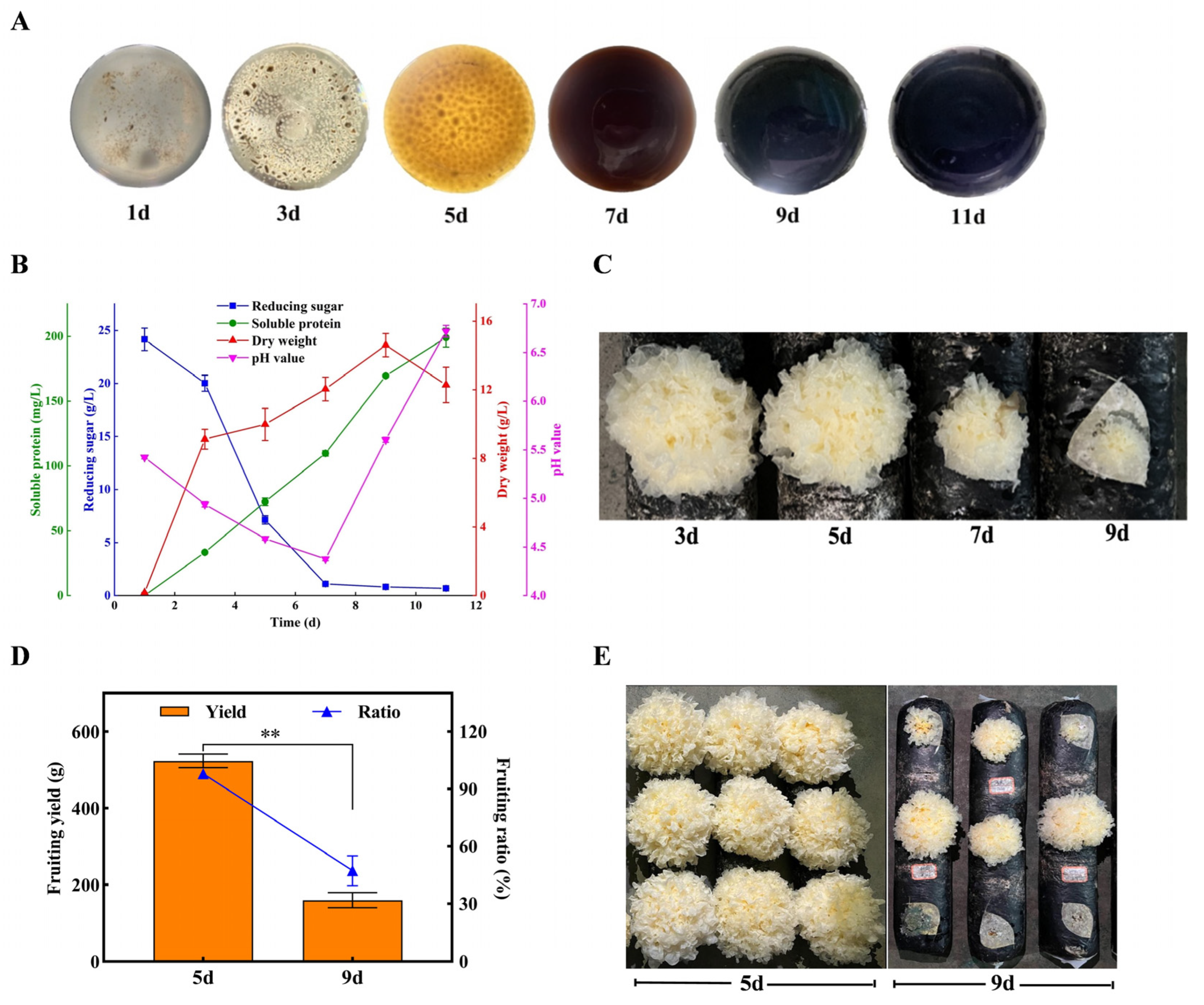
Spawn quality plays a critical role in subsequent fruiting yield [34]. Systematic monitoring of physiological changes during liquid cultivation elucidates spawn quality dynamics, establishes cultivation endpoints, and provides a reference for the optimal incubation period [35,36]. Comprehensive analysis of T. fuciformis liquefied spawn revealed phase-dependent physiological and morphological patterns. As shown in Figure 2A, the cultivation process exhibited characteristic morphological evolution. Mycelia germinated rapidly, forming ovoid pellets by day 3. It subsequently expanded into spherical pellets as hyphae thickened around the periphery. Chromatic transitions mirrored metabolic activity [37]. The chromatic evolution of the culture medium demonstrated transitioning from initial translucent suspension to pale yellow pigmentation by day 5, progressing through browning phases to complete media blackening at day 9. These visual biomarkers correlated with biochemical transformations, providing critical morphological criteria for assessing spawn maturation stages. Physiological parameter analysis (pH, mycelial dry weight, soluble protein, glucose concentration) in T. fuciformis liquefied spawn delineated two metabolically distinct phases (Figure 2B). Post-inoculation glucose catabolism exhibited rapid substrate utilization kinetics, with concentration plummeting from initial 34.2 g/L to 1.10 g/L by day 7, concomitant with biomass accumulation peaking at 14.6 g/L by day 9. Metabolic acidogenesis during glycolysis decreased medium pH to 4.38 by day 7 [38], followed by pH rebound potentially attributable to the utilization of amino nitrogen compounds and the generation of NH3/NH4+ after carbon source depletion [39]. Soluble protein exhibited linear accumulation, reaching 199.08 mg/L at day 11. These results suggest two distinct phases: a nutrient-rich growth phase (0–7 days), characterized by accelerated carbon assimilation and biomass production with concomitant pH decline; and a nutrient-depleted stationary phase (after day 7), marked by carbon starvation, growth stagnation, and pH elevation. The influence of spawn harvest time on fruiting performance was systematically evaluated through cultivation test. As illustrated in Figure 2C, inoculation of pre-browning spawn (3–5 days) supported normal fruiting body morphogenesis. Conversely, post-day-7 spawn under identical cultivation conditions results in significantly smaller fruiting bodies, delayed growth rate, and malformed fruiting bodies. Quantitative comparative analysis of cultivation performance between standard (5d) and browned (9d) T. fuciformis liquefied spawn revealed critical performance divergences (Figure 2D,E). The application of standard spawn demonstrated its cultivation performance, yielding 523.4 g/kg ds (dry substrate) with a fruiting ratio of 98.2%, while exhibiting uniform size and plump morphology of fruiting body. Conversely, the browning spawn exhibited severe performance deterioration with yield decline to 159.3 g (69.5% reduction), and fruiting ratio collapse to 47.3%. Meanwhile, fruiting bodies were small, deformed, or unable to initiate primordia. Overall, these findings indicate that the optimal cultivation time for T. fuciformis liquefied spawn is 4–5 days. After 7 days, mycelial growth enters a nutrient-depleted stationary phase, during which it begins to metabolize intracellular reserves and extensively secretes secondary metabolites. This physiological shift is accompanied by visible browning of the culture and a significant deterioration in spawn quality. Consequently, T. fuciformis yield decreases substantially.

3.3. Comparative Analysis of Microbial Community Shifts During Liquefied Spawn Browning

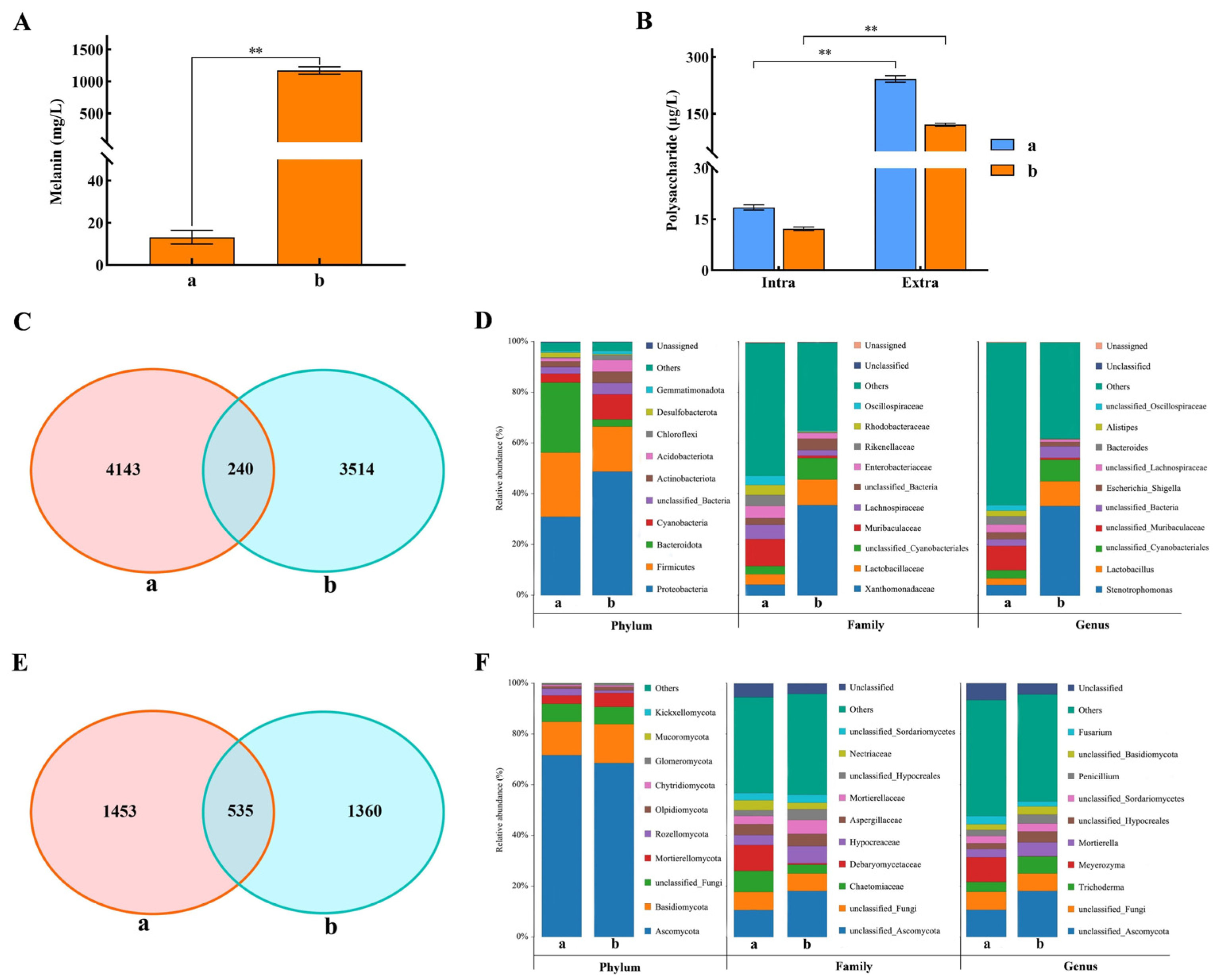
T. fuciformis spawn inherently comprises two essential fungal components—the T. fuciformis strain and its companion A. stygium [40]—and latent contamination from solid spawn further complicated the microbial community structure in liquefied spawn [41]. Browning typically occurs around day 7 of cultivation, potentially associated with melanin secretion by A. stygium. Polysaccharides represent the primary metabolic products of T. fuciformis [42]. Therefore, melanin and polysaccharide contents in liquefied spawn were quantified before and after browning. As illustrated in Figure 3A, melanin content increased dramatically after browning, rising from 13.2 mg/L in the standard liquefied spawn (Group a) to 1168 mg/L in the browned spawn (Group b), representing an 88.5-fold increase. This result indicates that the browning of liquefied spawn is primarily driven by the excessive production of melanin by A. stygium [43]. Meanwhile, both intracellular and extracellular polysaccharide contents decreased significantly after browning, by 33.95% and 49.83%, respectively (Figure 3B), suggesting a reduction in the relative abundance of T. fuciformis within the microbial community. Microbial community composition was further analyzed. For bacterial communities (Figure 3C,D), a total of 7897 OTUs were identified, among which 240 OTUs (3.04%) were shared between groups. Group a and Group b contained 4143 and 3514 unique OTUs, respectively. At the family and genus levels, Xanthomonadaceae (Stenotrophomonas) and Lactobacillaceae (Lactobacillus) exhibited marked increases in relative abundance, with Stenotrophomonas rising from 3.7% to 34.3%. Stenotrophomonas is a pathogenic species and has been shown to inhibit fungal growth [44]. For fungal communities (Figure 3E,F), a total of 3348 OTUs were identified, with 535 shared OTUs accounting for 15.98% of the total. Group a and Group b contained 1453 and 1360 unique OTUs, respectively. At the phylum level, overall differences were minimal, although Basidiomycota and Mortierellomycota showed slight increases in Group b. The relative abundance of yeast (Meyerozyma) decreased markedly, while populations of potentially harmful fungi, including Mortierella and Trichoderma were increased. These proliferating pathogens can infect both T. fuciformis and A. stygium mycelia, directly compromising biological activity and ultimately degrading spawn quality through suppressed metabolic function and structural damage. Notably, T. fuciformis and A. stygium accounted for 4% and 13% of the fungal community (Group a), respectively, whereas in the browned spawn (Group b), their relative abundances declined to 1% and increased to 16%, respectively. These findings demonstrate that browning is associated with a significant reduction in T. fuciformis abundance and a concomitant rise in A. stygium, a trend consistent with the observed changes in melanin and polysaccharide levels. In conclusion, browning of T. fuciformis liquefied spawn is primarily driven by melanin overproduction from its companion A. stygium. Following browning, significant alterations occur in the microbial community structure, characterized by increased abundances of detrimental fungi and pathogenic bacteria. Notably, an imbalance emerges between T. fuciformis and A. stygium, with T. fuciformis abundance declining markedly, while A. stygium increases. These microbial and symbiotic shifts constitute a key factor contributing to the substantial decline in spawn quality after browning.

3.4. Cultivation Performance of T. fuciformis Liquefied Spawn

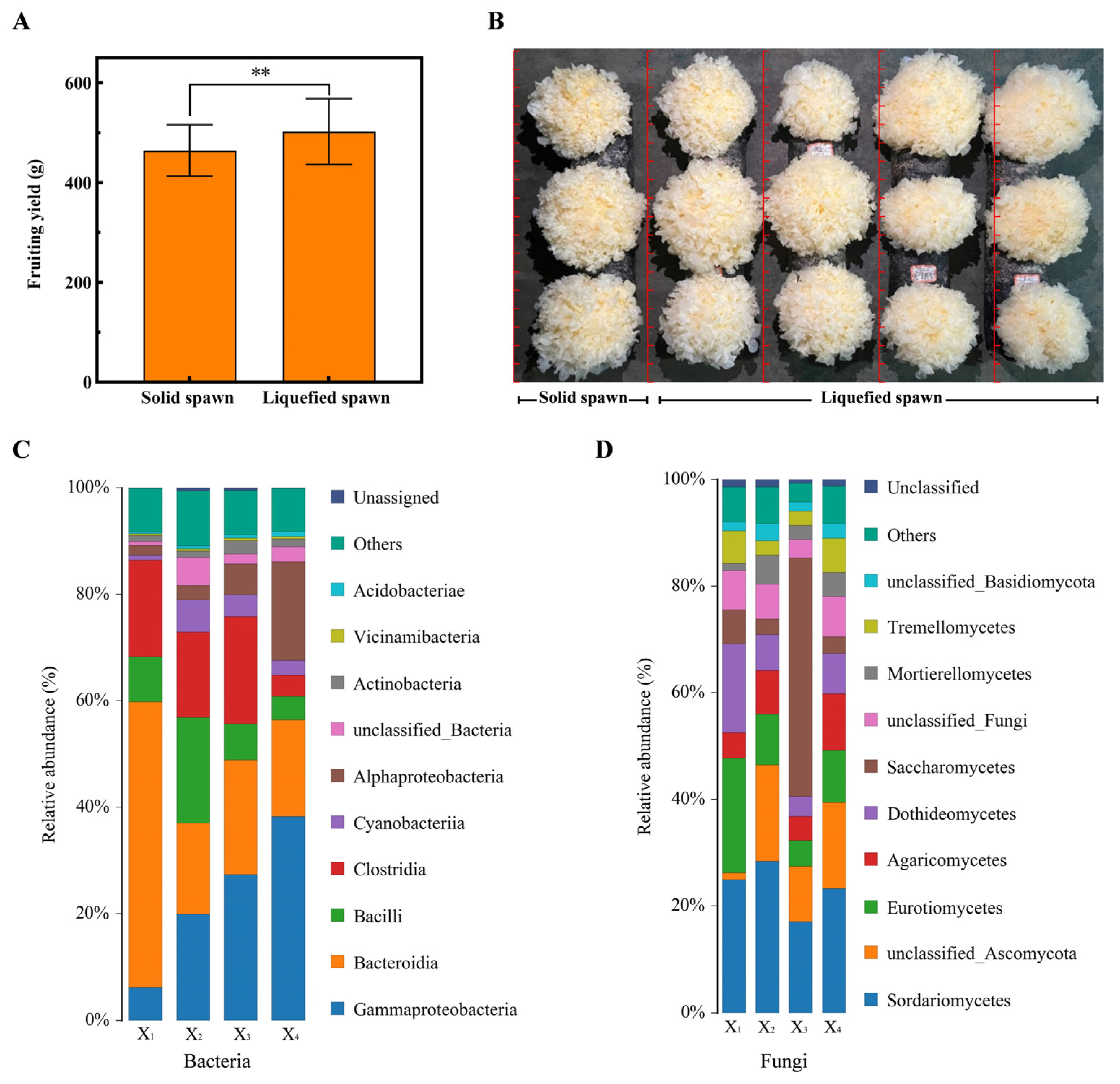
T. fuciformis liquefied spawn and traditional solid spawn were separately inoculated into cultivation substrates to evaluate and compare their cultivation performance. As shown in Figure 4A,B, the average yield was 464.4 g/kg ds for liquefied spawn and 502.4 g ds for solid spawn, reflecting an improvement of 8.2% (p = 0.000806, highly significant difference). Fruiting bodies derived from liquefied spawn exhibited plumper morphology with reduced basal development, thereby enhancing the edible portion. However, variability in fruiting body size remained a limitation. Stability of cultivation performance is a critical parameter for assessing spawn applicability [45]. To evaluate this characteristic, four consecutive cultivation batches were conducted using liquefied spawn. Considerable yield variability was observed across batches, with average yields measuring 549.8 g/kg ds, 489.2 g/kg ds, 510.6 g/kg ds, and 537.9 g/kg ds, respectively. Notably, the yield difference between the first and second batches reached 12.4% (Table 2). Microbial community analysis across the four batches (Figure 4C,D) revealed significant compositional variation. In bacterial communities, the relative abundances of Gammaproteobacteria, Bacteroidia, and Bacilli exhibited pronounced fluctuations. In fungal communities, dominant classes such as Sordariomycetes, Eurotiomycetes, and Agaricomycetes also showed substantial variation. The instability of microbial communities posed a substantial threat to yield consistency in bioprocess systems [29]. Importantly, the first and fourth batches displayed higher abundances of Tremellomycetes compared to the second and third batches, which corresponded with the observed differences in yield performance. Consequently, quantitative detection of Tremellomycetes abundance should be implemented as a mandatory quality control parameter prior to using T. fuciformis liquefied spawn for inoculation. These findings collectively demonstrate that while T. fuciformis liquefied spawn provides measurable yield advantages over traditional solid spawn, its complex and unstable microbial community directly contributes to production inconsistency, thereby limiting its commercial-scale application.

3.5. Preparation of T. fuciformis Liquid Spawn and Physiological Parameter Assay

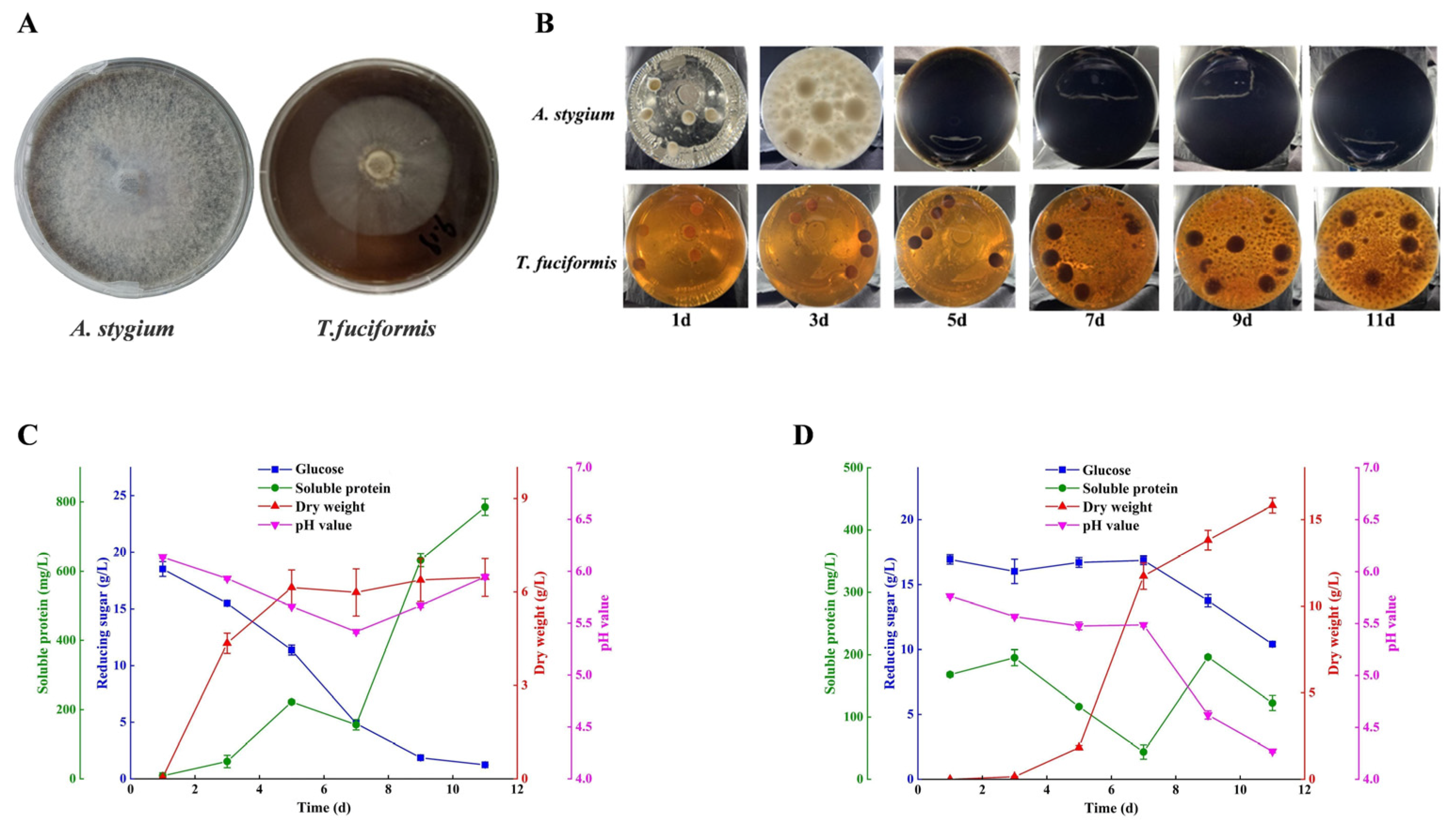
To address the limitations of T. fuciformis liquefied spawn mentioned above, liquid spawn was prepared using pure mycelia of T. fuciformis and A. stygium. First, solid plate cultures were established. The mycelial growth rates of pure T. fuciformis and A. stygium on solid plates differed markedly: A. stygium grew rapidly, covering the plate within 6–8 days, whereas pure T. fuciformis grew slowly, reaching only half the plate diameter after 30 days under identical conditions (Figure 5A). During substrate cultivation, T. fuciformis grows slowly, while A. stygium rapidly degrades the substrate, supplying abundant nutrients for T. fuciformis [46]. When co-inoculated into liquid culture, the substantial difference in mycelial growth rates can lead to an imbalance in their proportions, resulting in malformed or failed fruiting body formation following inoculation onto lignocellulosic substrates. In this study, pure T. fuciformis and A. stygium mycelia were initially cultivated separately to generate their respective liquid spawns. Physiological parameters were monitored during cultivation to determine the optimal growth periods. As illustrated in Figure 5B, A. stygium germinated rapidly after inoculation into PDB. By day 3, extensive mycelial colonization had occurred. This was followed by rapid browning, which occurred earlier than observed in T. fuciformis liquefied spawn. Consistent with plate culture observations, T. fuciformis mycelia exhibited significantly slower growth, with germination becoming visible around day 5 and dense mycelial growth established by day 9. Physiological parameters of liquid spawns were further analyzed. For A. stygium liquid spawn, key physiological indicators including pH, biomass, soluble protein, and glucose concentration are presented in Figure 5C. Glucose was rapidly consumed, decreasing to 1.86 g/L by day 9. Biomass peaked at 6.14 g/L by day 5 and subsequently entered a stable phase. The pH of the medium initially declined before gradually increasing, reaching its lowest value of 5.42 on day 7. Soluble protein content steadily increased to 783.50 mg/L, a trend consistent with that observed in T. fuciformis liquefied spawn. In contrast, T. fuciformis exhibited slower glucose consumption and mycelial biomass accumulation. During the first 7 days, glucose levels decreased gradually, with a more pronounced decline after day 7, resulting in a final concentration of 10.4 g/L on day 11. Biomass increased slowly to 1.83 g/L within the first 5 days, followed by a rapid increase to 11.74 g/L between days 5 and 7. The pH of the medium followed a pattern similar to glucose consumption, reaching a final value of 4.27 on day 11. Soluble protein content initially declined, reaching a minimum of 43.9 mg/L on day 7 (Figure 5D). In summary, the optimal cultivation period for A. stygium liquid spawn is 3 days, whereas that for pure T. fuciformis liquid spawn is 7–9 days. The two are subsequently combined at a defined ratio to produce T. fuciformis liquid spawn.

3.6. Cultivation Test of T. fuciformis Liquid Spawn

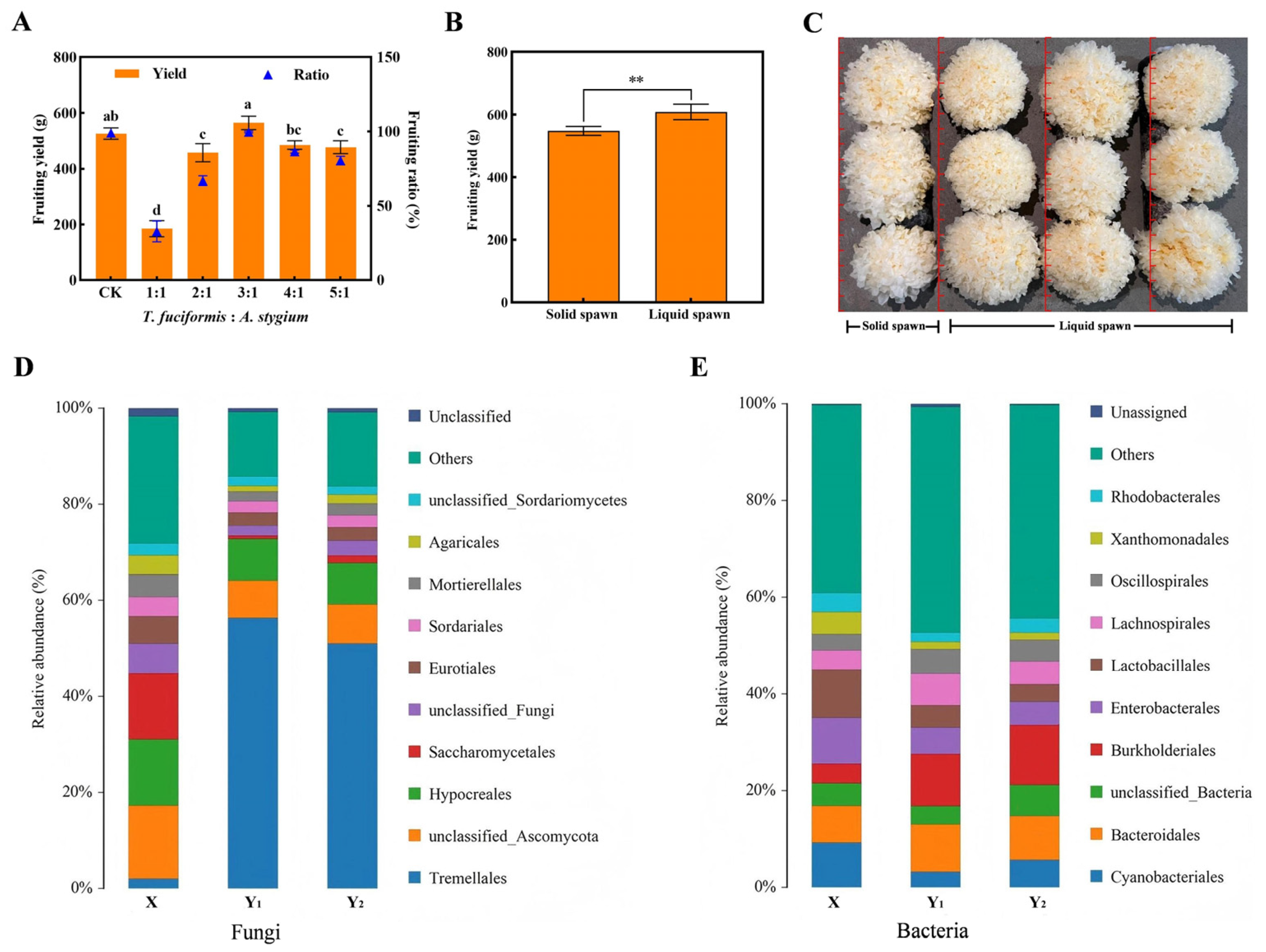
Pure T. fuciformis and A. stygium liquid spawn were prepared and combined to produce T. fuciformis liquid spawn. The effect of different mixing ratios on fruiting yield was evaluated. As shown in Figure 6A, increasing the proportions of pure T. fuciformis and A. stygium liquid spawn initially enhanced both yield and fruiting ratio, which subsequently declined. The highest fruiting body yield (564.4 g/kg ds) and fruiting ratio (98%) were achieved at a mixing ratio of 3:1 (pure T. fuciformis: A. stygium), representing a 7.3% increase compared to solid spawn (526.0 g). Based on this optimal ratio, large-scale T. fuciformis liquid spawn was produced and applied in industrial cultivation using large substrate bags (approximately 1800 g wet substrate per bag). As illustrated in Figure 6B,C, the application of liquid spawn significantly improved both yield and quality. The average yield reached 608.2 g/kg ds, 11.1% higher than that obtained with traditional solid spawn (547.6 g). The resulting fruiting bodies were plump, thick, and uniform, with smaller basal portions, and exhibited superior commercial characteristics. Microbial community analysis revealed that two batches of T. fuciformis liquid spawn exhibited similar and stable community structures. In contrast, significant differences were observed between liquefied spawn and liquid spawn, particularly in fungal composition. Liquefied spawn was predominantly composed of Hypocreales, Saccharomycetales, and Eurotiales, whereas liquid spawn was dominated by Tremellales and Hypocreales, with Tremellales representing the absolute dominant group (>50%). Other fungal contaminants were markedly reduced in liquid spawn. Differences in bacterial communities were relatively minor; compared with liquefied spawn, T. fuciformis liquid spawn showed decreased abundances of Xanthomonadales, Lactobacillales, Enterobacterales, and Cyanobacteriales, but increased abundances of Burkholderiales and Bacteroidales (Figure 6D,E). Therefore, the stable community composition and high abundance of Tremellales contribute to the consistent and reliable cultivation performance of T. fuciformis liquid spawn. In summary, the developed T. fuciformis liquid spawn demonstrates significant application potential and can fully replace solid spawn for commercial cultivation of T. fuciformis.

4. Conclusions

This study developed liquid inoculum of Tremella fuciformis and evaluated its practical application. The standard liquefied spawn prepared from solid spawn liquification yielded 502.4 g/kg ds, an 8.2% increase over solid spawn, but exhibited unstable cultivation performance due to large fluctuations in microbial community composition and a notably low abundance of Tremellomycetes (4%) in the fungal community. In contrast, liquid spawn generated by co-culturing pure mycelia of T. fuciformis and A. stygium achieved a yield of 608.2 g/kg ds, 11.1% higher than solid spawn, and demonstrated stable and reliable performance. This stability was closely associated with a consistent microbial community structure and the dominance of Tremellomycetes (abundance > 50%) in fungal community. Overall, these findings indicate that T. fuciformis liquid spawn is more suitable for industrial-scale application than liquefied spawn, as its microbial stability ensures reproducible outcomes and provides a scientific basis for establishing quality control standards in T. fuciformis spawn production. Building on these findings, our future research will investigate the dimorphic growth mechanism in T. fuciformis, the stimulatory effects of A. stygium on T. fuciformis mycelial development, and functional roles of key microbial community members. These studies will provide fundamental insights for optimizing high-quality liquid spawn production systems.

Author Contributions

Conceptualization, L.Z. and S.S.; methodology, Q.X., W.H. (Wenxuan Huang), H.L., L.Z., X.D. and Y.Y.; formal analysis, H.L., Q.X., L.Z. and W.H. (Wenlin Huang); investigation, Q.X., H.L. and S.L.; resources, L.Z., S.L. and S.S.; data curation, Q.X., W.H. (Wenxuan Huang), X.D. and H.L.; writing—original draft preparation, H.L., L.Z. and Y.Y.; writing—review and editing, L.Z., H.L., W.H. (Wenxuan Huang), X.D., Y.Y., W.H. (Wenlin Huang) and S.S.; visualization, H.L. and L.Z.; supervision, L.Z. and S.S.; project administration, L.Z. and S.S.; funding acquisition, L.Z., S.S. and H.L. All authors have read and agreed to the published version of the manuscript.

Funding

This work was supported by the National Natural Science Foundation of China (No. 32402650), the technological innovation project of Fujian Agriculture and Forestry University (No. KFB23077A), Fujian Aquatic Seed Industry Innovation and Industrialization Project (No. 2021FJSCZY03), Project of Modern Agricultural Industrial Technology System of Edible Fungi in Fujian Province and the Specialized Research Foundation of Fujian Provincial Department of Science & Technology of China (Nos. 2022R10130010 and 2023J011325).

Institutional Review Board Statement

Not applicable.

Informed Consent Statement

Not applicable.

Data Availability Statement

The original contributions presented in this study are included in the article. Further inquiries can be directed to the corresponding authors.

Acknowledgments

The authors thank the Edible Fungi Research Institute (Gutian) and the laboratories of Specialty Edible Fungus Strain Innovation and Metabolic Engineering at Fujian Agriculture and Forestry University for their invaluable support.

Conflicts of Interest

The authors declare no conflicts of interest.

References

  1. Deng, Y.; Guo, L.; Lin, L.; Li, Y.; Zhang, J.; Zhang, Y.; Yuan, B.; Ke, L.; Xie, B.; Ming, R. Meiosis in an asymmetric dikaryotic genome of Tremella fuciformis Tr01 facilitates new chromosome formation. Genome Biol. 2023, 24, 280. [Google Scholar] [CrossRef] [PubMed]
  2. Li, Y.; Zhan, G.; Tu, M.; Wang, Y.; Cao, J.; Sun, S. A chromosome-scale genome and proteome draft of Tremella fuciformis. Int. J. Biol. Macromol. 2023, 247, 125749. [Google Scholar] [CrossRef]
  3. Li, Y.; Li, J.; Fan, L. Effects of combined drying methods on physicochemical and rheological properties of instant Tremella fuciformis soup. Food Chem. 2022, 396, 133644. [Google Scholar] [CrossRef]
  4. Xu, Y.; Xie, L.; Zhang, Z.; Zhang, W.; Tang, J.; He, X.; Zhou, J.; Peng, W. Tremella fuciformis Polysaccharides Inhibited Colonic Inflammation in Dextran Sulfate Sodium-Treated Mice via Foxp3+ T Cells, Gut Microbiota, and Bacterial Metabolites. Front. Immunol. 2021, 12, 648162. [Google Scholar] [CrossRef]
  5. Zhu, H.; Tian, B.; Liu, W.; Zhang, S.; Cao, C.; Zhang, Y.; Zou, W. A three-stage culture process for improved exopolysaccharide production by Tremella fuciformis. Bioresour. Technol. 2012, 116, 526–528. [Google Scholar] [CrossRef]
  6. Xie, L.; Yang, K.; Liang, Y.; Zhu, Z.; Yuan, Z.; Du, Z. Tremella fuciformis polysaccharides alleviate induced atopic dermatitis in mice by regulating immune response and gut microbiota. Front. Pharmacol. 2022, 13, 944801. [Google Scholar] [CrossRef]
  7. Wu, Y.J.; Wei, Z.X.; Zhang, F.M.; Linhardt, R.J.; Sun, P.L.; Zhang, A.Q. Structure, bioactivities and applications of the polysaccharides from Tremella fuciformis mushroom: A review. Int. J. Biol. Macromol. 2019, 121, 1005–1010. [Google Scholar] [CrossRef]
  8. Lo, H.C.; Wasser, S.P. Medicinal mushrooms for glycemic control in diabetes mellitus: History, current status, future perspectives, and unsolved problems (review). Int. J. Med. Mushrooms 2011, 13, 401–426. [Google Scholar] [CrossRef] [PubMed]
  9. Huang, N.L.; Chen, A.W. Mixed-Culture Cultivation of Edible and Medicinal Mushroom Tremella fudformis Berk. (Phragmobasidiomycetes) on Synthetic Logs. Int. J. Med. Mushrooms 2002, 4, 6. [Google Scholar] [CrossRef]
  10. Tong, Q.; Yang, L.; Zhang, J.; Zhang, Y.; Jiang, Y.; Liu, X.; Deng, Y. Comprehensive investigations of 2-phenylethanol production by the filamentous fungus Annulohypoxylon stygium. Appl. Microbiol. Biotechnol. 2024, 108, 374. [Google Scholar] [CrossRef] [PubMed]
  11. Wingfield, B.D.; Bills, G.F.; Dong, Y.; Huang, W.; Nel, W.J.; Swalarsk-Parry, B.S.; Vaghefi, N.; Wilken, P.M.; An, Z.; de Beer, Z.W.; et al. IMA Genome-F 9: Draft genome sequence of Annulohypoxylon stygium, Aspergillus mulundensis, Berkeleyomyces basicola (syn. Thielaviopsis basicola), Ceratocystis smalleyi, two Cercospora beticola strains, Coleophoma cylindrospora, Fusarium fracticaudum, Phialophora cf. hyalina, and Morchella septimelata. IMA Fungus 2018, 9, 199–223. [Google Scholar]
  12. Deng, Y.; Hsiang, T.; Li, S.; Lin, L.; Wang, Q.; Chen, Q.; Xie, B.; Ming, R. Comparison of the Mitochondrial Genome Sequences of Six Annulohypoxylon stygium Isolates Suggests Short Fragment Insertions as a Potential Factor Leading to Larger Genomic Size. Front. Microbiol. 2018, 9, 2079. [Google Scholar] [CrossRef] [PubMed]
  13. Berovic, M.; Zhong, J.J. Advances in Pilot-Scale Stirred Bioreactors in Solid-State and Submerged Cultivations of Medicinal Mushrooms. Adv. Biochem. Eng. Biotechnol. 2023, 184, 163–185. [Google Scholar]
  14. Ma, L.; Lin, Y.Q.; Yang, C.; Ying, Z.H.; Jiang, X.L. Production of liquid spawn of an edible mushroom, Sparassis latifolia by submerged fermentation and mycelial growth on pine wood sawdust. Sci. Hortic. 2016, 209, 22–30. [Google Scholar] [CrossRef]
  15. Pérez, G.; Lopez-Moya, F.; Chuina, E.; Ibañez-Vea, M.; Garde, E.; López-Llorca, L.V.; Pisabarro, A.G.; Ramírez, L. Strain Degeneration in Pleurotus ostreatus: A Genotype Dependent Oxidative Stress Process Which Triggers Oxidative Stress, Cellular Detoxifying and Cell Wall Reshaping Genes. J. Fungi 2021, 7, 862. [Google Scholar] [CrossRef]
  16. Friel, M.; Mcloughlin, A.J. Production of a liquid inoculum/spawn of Agaricus bisporus. Biotechnol. Lett. 2000, 22, 351–354. [Google Scholar] [CrossRef]
  17. Zhang, W.R.; Liu, S.R.; Kuang, Y.B.; Zheng, S.Z. Development of a Novel Spawn (Block Spawn) of an Edible Mushroom, Pleurotus ostreatus, in Liquid Culture and its Cultivation Evaluation. Mycobiology 2019, 47, 97–104. [Google Scholar] [CrossRef]
  18. Kawai, G.; Kobayashi, H.; Fukushima, Y.; Ohsaki, K. Effect of liquid mycelial culture used as a spawn on sawdust cultivation of shiitake (Lentinula edodes). Mycoscience 1996, 37, 201–207. [Google Scholar] [CrossRef]
  19. Zhang, R.Y.; Hu, D.D.; Ma, X.T.; Li, S.G.; Gu, J.G.; Hu, Q.X. Adopting stick spawn reduced the spawn running time and improved mushroom yield and biological efficiency of Pleurotus eryngii. Sci. Hortic. 2014, 175, 156–159. [Google Scholar] [CrossRef]
  20. Guo, J.; Liu, Y.F.; Tang, C.H.; Zhang, J.S.; Feng, J. The key technologies of Ganoderma lucidum liquid spawn preparation and scale expansion. World J. Microbiol. Biotechnol. 2023, 39, 138. [Google Scholar] [CrossRef]
  21. Kim, J.M.; Ra, K.S.; Noh, D.O.; Suh, H.J. Optimization of submerged culture conditions for the production of angiotensin converting enzyme inhibitor from Flammulina velutipes. J. Ind. Microbiol. Biotechnol. 2002, 29, 292–295. [Google Scholar] [CrossRef]
  22. Ren, H.H.; Zhang, Y.J.; Wang, Y.J.; Xiao, S.S.; Liu, S.Y.; Sun, B.Y.; Li, S.M.; Li, M.; Wen, Z.Q.; Li, X. Advancing Industrial Production of White Grifola frondosa: Liquid Inoculum Culture Parameter Optimization and Molecular Insights into Fruiting Body Development. Horticulturae 2025, 11, 1151. [Google Scholar] [CrossRef]
  23. Zhu, H.; Sun, X.; Liu, D.; Zheng, L.; Chen, L.; Ma, A. An Improved Total RNA Extraction Method for White Jelly Mushroom Tremella fuciformis Rich in Polysaccharides. Mycobiology 2017, 45, 434–437. [Google Scholar] [CrossRef]
  24. Zhu, H.; Yuan, Y.; Liu, J.; Zheng, L.; Chen, L.; Ma, A. Comparing the sugar profiles and primary structures of alkali-extracted water-soluble polysaccharides in cell wall between the yeast and mycelial phases from Tremella fuciformis. J. Microbiol. 2016, 54, 381–386. [Google Scholar] [CrossRef]
  25. Tang, Q.Q.; Zou, D.R.; Shi, G.P. Contrast Test on Pleurotus eryngii Cultivation of Liquefied Solid Spawn and Solid Spawn. Edible Fungi China 2018, 37, 16–45. [Google Scholar]
  26. Lombardi, V.; Trande, M.; Back, M.; Patwardhan, S.V.; Benedetti, A. Facile Cellulase Immobilisation on Bioinspired Silica. Nanomaterials 2022, 12, 626. [Google Scholar] [CrossRef]
  27. Liu, Y.; Wang, Y.; Cao, L.; Huang, Z.; Zhou, Y.; Fan, R.; Li, C. Preparation and Characterization of Intracellular and Exopolysaccharides during Cycle Cultivation of Spirulina platensis. Foods 2023, 12, 1067. [Google Scholar] [CrossRef] [PubMed]
  28. Liu, R.; Mo, C.; Meng, X.; Wei, X.; Ma, A. Production, physico-chemical properties and antioxidant activity of melanin from Annulohypoxylon stygium (Lév.). Nat. Prod. Res. 2025, 39, 3021–3030. [Google Scholar] [CrossRef] [PubMed]
  29. Zhou, J.; Wang, J.; Zhou, Y.; Liu, K.; Lu, Y.; Zhu, L.; Chen, X. Microbial community structure and interactions between Aspergillus oryzae and bacteria in traditional solid-state fermentation of Jiangqu. Food Microbiol. 2023, 116, 104346. [Google Scholar] [CrossRef] [PubMed]
  30. Jin, Y.; Li, D.; Ai, M.; Tang, Q.; Huang, J.; Ding, X.; Wu, C.; Zhou, R. Correlation between volatile profiles and microbial communities: A metabonomic approach to study Jiang-flavor liquor Daqu. Food Res. Int. 2019, 121, 422–432. [Google Scholar] [CrossRef]
  31. Liu, S.; Zhang, W.R.; Kuang, Y.B. Production of stalk spawn of an edible mushroom (Pleurotus ostreatus) in liquid culture as a suitable substitute for stick spawn in mushroom cultivation. Sci. Hortic. 2018, 240, 572–577. [Google Scholar] [CrossRef]
  32. Abdullah, N.; Ismail, R.; Johari, N.M.K.; Annuar, M.S.M. Production of liquid spawn of an edible grey oyster mushroom, Pleurotus pulmonarius (Fr.) Quél by submerged fermentation and sporophore yield on rubber wood sawdust. Sci. Hortic. 2013, 161, 65–69. [Google Scholar] [CrossRef]
  33. Wang, L.Y.; Cheong, K.L.; Wu, D.T.; Meng, L.Z.; Zhao, J.; Li, S.P. Fermentation optimization for the production of bioactive polysaccharides from Cordyceps sinensis fungus UM01. Int. J. Biol. Macromol. 2015, 79, 180–185. [Google Scholar] [CrossRef]
  34. Avila, I.A.F.; da Silva Alves, L.; Zied, D.C. Bioconversion of rice straw by Lentinula edodes under different spawn formulations. Braz. J. Microbiol. 2023, 54, 3137–3146. [Google Scholar] [CrossRef]
  35. Lu, F.; Wang, Z.; Zhao, W.; Chu, J.; Zhuang, Y. A simple novel approach for real-time monitoring of sodium gluconate production by on-line physiological parameters in batch fermentation by Aspergillus niger. Bioresour. Technol. 2016, 202, 133–141. [Google Scholar] [CrossRef] [PubMed]
  36. Zalai, D.; Hevér, H.; Lovász, K.; Molnár, D.; Wechselberger, P.; Hofer, A.; Párta, L.; Putics, Á.; Herwig, C. A control strategy to investigate the relationship between specific productivity and high-mannose glycoforms in CHO cells. Appl. Microbiol. Biotechnol. 2016, 100, 7011–7024. [Google Scholar] [CrossRef]
  37. Gao, J.; Wenderoth, M.; Doppler, M.; Schuhmacher, R.; Marko, D.; Fischer, R. Fungal Melanin Biosynthesis Pathway as Source for Fungal Toxins. mBio 2022, 13, e0021922. [Google Scholar] [CrossRef] [PubMed]
  38. Wang, Y.; Li, X.; Mao, Y.; Blaschek, H.P. Genome-wide dynamic transcriptional profiling in Clostridium beijerinckii NCIMB 8052 using single-nucleotide resolution RNA-Seq. BMC Genom. 2012, 13, 102. [Google Scholar] [CrossRef]
  39. Lobeda, K.; Jin, Q.; Wu, J.; Zhang, W.; Huang, H. Lactic acid production from food waste hydrolysate by Lactobacillus pentosus: Focus on nitrogen supplementation, initial sugar concentration, pH, and fed-batch fermentation. J. Food Sci. 2022, 87, 3071–3083. [Google Scholar] [CrossRef]
  40. Liu, D.; Pujiana, D.; Wang, Y.; Zhang, Z.; Zheng, L.; Chen, L.; Ma, A. Comparative transcriptomic analysis identified differentially expressed genes and pathways involved in the interaction between Tremella fuciformis and Annulohypoxylon stygium. Anton. Leeuw. Int. J. G. 2019, 112, 1675–1689. [Google Scholar] [CrossRef] [PubMed]
  41. Sun, S.; Li, F.; Xu, X.; Liu, Y.; Kong, X.; Chen, J.; Liu, T.; Chen, L. Study on the community structure and function of symbiotic bacteria from different growth and developmental stages of Hypsizygus marmoreus. BMC Microbiol. 2020, 20, 311. [Google Scholar] [CrossRef]
  42. Xu, J.; Zou, Y.; Guo, L.; Lin, J.; Jiang, Z.; Zheng, Q. Rheological and microstructural properties of polysaccharide obtained from the gelatinous Tremella fuciformis fungus. Int. J. Biol. Macromol. 2023, 228, 153–164. [Google Scholar] [CrossRef]
  43. Liu, D.; Sun, X.; Yan, B.; Ma, A. Alternative oxidase is involved in oxidative stress resistance and melanin synthesis in Annulohypoxylon stygium, a companion fungus of Tremella fuciformis. Anton. Leeuw. Int. J. G. 2022, 115, 365–374. [Google Scholar] [CrossRef]
  44. Ahsan, T.; Mahnoor; Alharbi, S.A.; Alshiekheid, M.A.; Sabour, A.A.A.; Khan, I.; Ansari, M.J. Genome Mining and Antagonism of Stenotrophomonas geniculata MK-1, Against Peanut Foliage Fungus Diseases. J. Basic. Microbiol. 2025, 65, e70016. [Google Scholar] [CrossRef] [PubMed]
  45. Zhu, W.; Hu, J.; Chi, J.; Li, Y.; Yang, B.; Hu, W.; Chen, F.; Xu, C.; Chai, L.; Bao, Y. Label-Free Proteomics Reveals the Molecular Mechanism of Subculture Induced Strain Degeneration and Discovery of Indicative Index for Degeneration in Pleurotus ostreatus. Molecules 2020, 25, 4920. [Google Scholar] [CrossRef] [PubMed]
  46. Xu, Y.; Dong, Q.; Zhang, S.; Xie, L.; Zhang, Q.; Shu, X.; Zhou, J.; Peng, W. Lignocellulose adaptation drives polysaccharide biosynthesis in Tremella fuciformis: Metabolomic and proteomic insights into CAZyme regulation. Front. Fungal. Biol. 2025, 6, 1617458. [Google Scholar] [CrossRef] [PubMed]
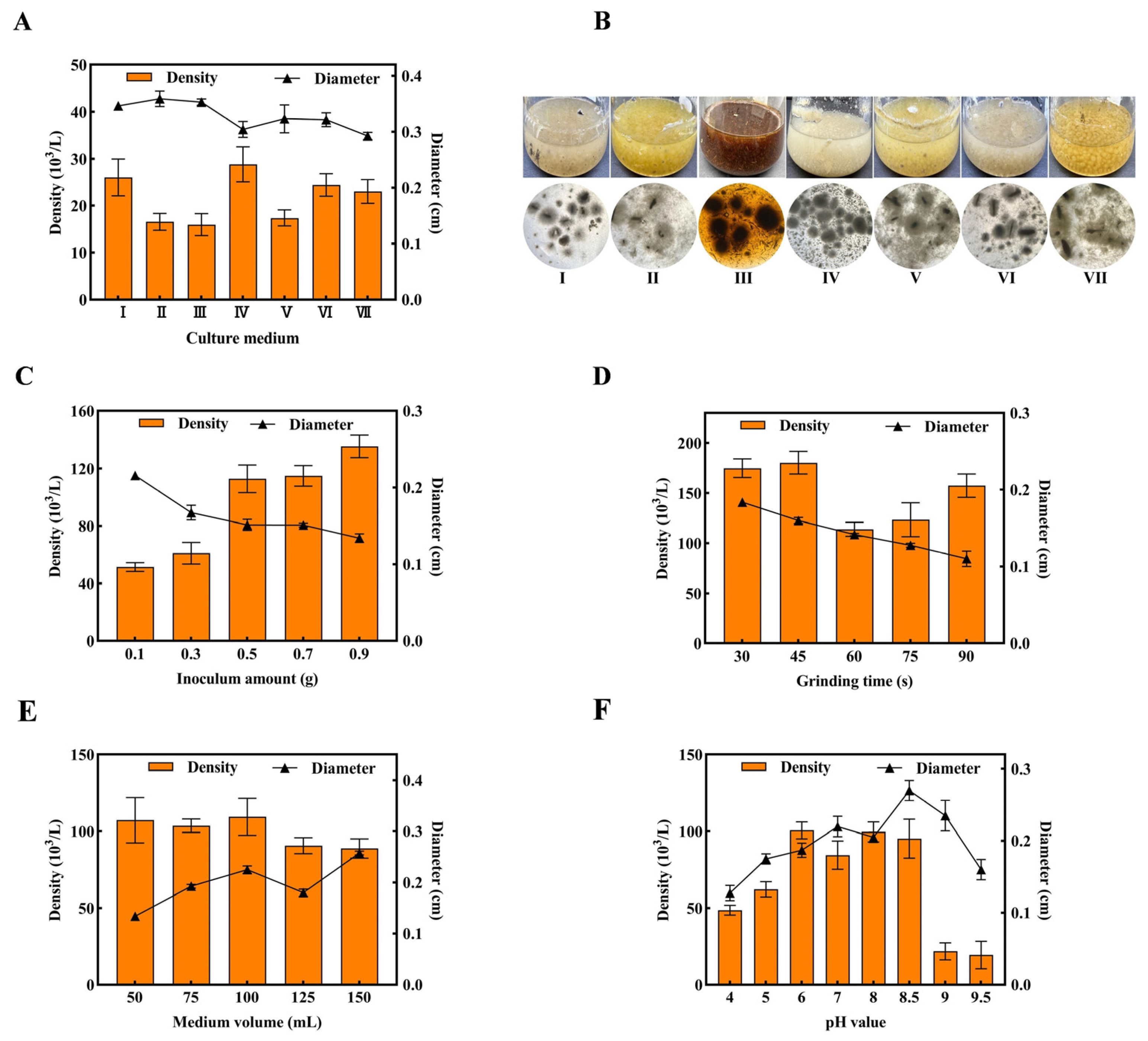
Figure 1. Optimization of T. fuciformis liquefied spawn preparation. (A) Screening of liquefied media; (B) Pellet morphology in different media; (C) Inoculum amount; (D) Grinding time; (E) Medium volume; (F) Initial pH value.
Jof 11 00825 g001
Figure 2. Physiological parameters and cultivation performance of T. fuciformis liquefied spawn. (A) Morphological evolution; (B) Physiological parameter evolution; (C) The influence of spawn harvest time on fruiting evolution; (D) Yield and fruiting ratio of standard (5d) and browned (9d) T. fuciformis liquefied spawn; (E) Fruiting body growth performance. ** significance at p < 0.01.
Jof 11 00825 g002
Figure 3. Microbial community dynamics during browning of T. fuciformis liquefied spawn. (A) Melanin concentration, (B) Intra/extra-cellular polysaccharide profiles, (C) Venn diagram of bacterial OTUs, (D) Bacterial community composition, (E) Venn diagram of fungal OTUs, and (F) Fungal community composition. Groups a (day-5 standard spawn) and b (day-9 browned spawn) represent pre- and post-browning stages, respectively. ** significance at p < 0.01.
Jof 11 00825 g003
Figure 4. Cultivation performance of T. fuciformis liquefied spawn. (A) Fruiting body yield, (B) Fruiting body growth performance, (C) Inter-batch variation in bacterial community structure, (D) Inter-batch variation in fungal community structure. ** significance at p < 0.01.
Jof 11 00825 g004
Figure 5. Variations in physiological parameters during the cultivation of pure A. stygium and T. fuciformis liquid spawn. (A) Pure A. stygium and T. fuciformis mycelia, (B) Morphological evolution of liquid spawn, (C) Physiological parameter evolution in pure A. stygium liquid spawn, (D) Physiological parameter evolution in pure T. fuciformis liquid spawn.
Jof 11 00825 g005
Figure 6. Cultivation performance of T. fuciformis liquid spawn. (A) Optimization of mixing ratios of pure T. fuciformis and A. stygium liquid spawns, (B) Industrial-scale batch cultivation test, (C) Fruiting body growth performance, (D) Comparative analysis of fungal community structures, (E) Comparative analysis of bacterial community structures. Group X represents T. fuciformis liquefied spawn, while Group Y represents T. fuciformis liquid spawn. The different lowercase letters denote statistically significant differences (p < 0.05). ** Represented significant difference, p < 0.01.
Jof 11 00825 g006
Table 1. Formulations of liquefied spawn media.
No.Formulation (g/L)
IPotato 200, KH2PO4 3, Glucose 20, MgSO4 1.5, Thiamine HCl 0.01;
IIPotato 200, Glucose 20, Peptone 5, KH2PO4 2, Mg SO4 1, Thiamine HCl 0.01;
IIIPotato 200, Sawdust 50, Glucose 20, Peptone 6, KH2PO4 0.5, Thiamine HCl 0.01;
IVCorn flour 10, Soybean flour 7, Glucose 20, Yeast extract 1, Peptone 1, KH2PO4 0.5, MgSO4 0.5;
VPotato 200, Glucose 20, KH2PO4 3, Peptone 3, K2HPO4 3, MgSO4 1, Thiamine HCl 0.01, Corn flour 1;
VIPotato 200, Yeast extract 3, Glucose 20, MgSO4 1, KH2PO4 1;
VIIGlucose 30, KH2PO4 0.5, Peptone 8.3, MgSO4·7H2O 3, Thiamine HCl 0.01.
Table 2. Application stability evaluation of T. fuciformis liquefied spawn.
BatchYield (g)Fruiting Ratio (%)Diameter (mm)Height (mm)
X1549.8 ± 11.0 a96129.0 ± 7.9 a65.9 ± 2.4 a
X2489.2 ± 11.9 d98116.9 ± 14.6 c60.7 ± 3.1 c
X3510.6 ± 16.2 c98118.6 ± 11.8 c62.1 ± 3.9 bc
X4537.9 ± 5.6 b98122.5 ± 9.6 b64.3 ± 4.3 ab
Note: The different lower-case letters indicate statistically significant difference (p < 0.05).
Disclaimer/Publisher’s Note: The statements, opinions and data contained in all publications are solely those of the individual author(s) and contributor(s) and not of MDPI and/or the editor(s). MDPI and/or the editor(s) disclaim responsibility for any injury to people or property resulting from any ideas, methods, instructions or products referred to in the content.