Article

Tamaricicola fenicei sp. nov. (Pleosporaceae, Pleosporales), a New Marine Fungus with Significant Antiviral Activity


by
Marcella Pasqualetti
1,2,*,†,
Martina Braconcini
1,†,
Susanna Gorrasi
1,
Paolo Barghini
1,
Emilia Palazzotto
3,
Donatella Ferraro
3 and
Domenico Schillaci
4
1
Department of Biological and Ecological Sciences, University of Tuscia, Largo dell’Università snc, 01100 Viterbo, Italy
2
Laboratory of Ecology of Marine Fungi (CoNISMa), University of Tuscia, Largo dell’Università snc, 01100 Viterbo, Italy
3
Microbiology Section, Department of Health Promotion, Mother and Child Care, Internal Medicine and Medical Specialties ‘G. D’Alessandro’, University of Palermo, 90133 Palermo, Italy
4
Department of Biological, Chemical and Pharmaceutical Sciences and Technologies (STEBICEF), University of Palermo, Via Archirafi 32, 90123 Palermo, Italy
*
Author to whom correspondence should be addressed.
These authors share first authorship.
J. Fungi 2025, 11(11), 801; https://doi.org/10.3390/jof11110801
Submission received: 10 October 2025 / Revised: 3 November 2025 / Accepted: 7 November 2025 / Published: 11 November 2025
(This article belongs to the Special Issue Utilizing Fungal Diversity for Sustainable Biotechnology)

Abstract

In this study, seven Pleosporaceae strains isolated from the seagrass Posidonia oceanica and the jellyfish Pelagia noctiluca in the central Tyrrhenian Sea were characterized using a polyphasic approach (morpho-physiological, molecular, and phylogenetic analyses). Based on multi-locus phylogenetic inference and morphological characters, a new species, Tamaricicola fenicei sp. nov. was proposed. Multi-locus phylogenetic analyses, using the nuclear ribosomal regions of DNA (nrITS1-nr5.8S-nrITS2, nrLSU, and nrSSU) as well as the rpb2 and tef-1α gene sequences, strongly supported the new taxon. The phylogenetic inference, estimated using Maximum Likelihood and Bayesian Inference, clearly indicates that Tamaricicola fenicei sp. nov. forms a distinct clade within the monospecific genus Tamaricicola. The antimicrobial activity of the chloroformic and butanolic extracts from malt agar cultures of the new species exhibited interesting antiviral and antibiofilm properties. In particular, a MIC of 3.0 µg/mL was observed against the Echovirus E11 in Vero-76 cells; moreover, a biofilm BIC50 reduction at 53 µg/mL was observed against Staphylococcus aureus ATCC 25923.

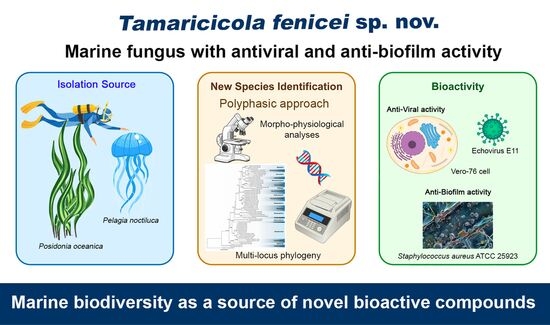
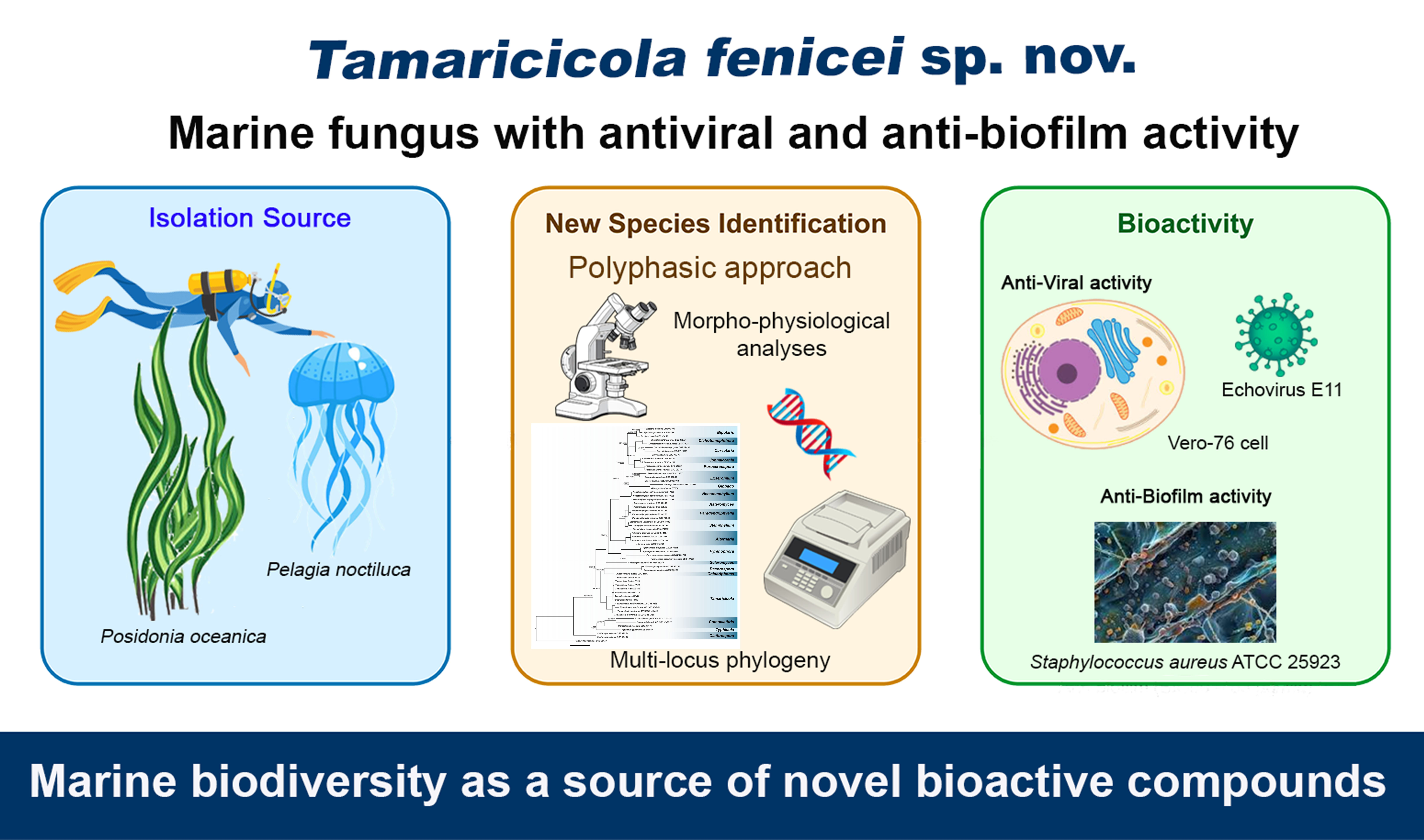
Graphical Abstract

1. Introduction

Marine environments represent a huge reservoir of biological and biochemical diversity, which is yet mostly unexplored. Occupying about 70% of the surface of our planet, the oceans support a substantial portion of Earth’s biodiversity. To date, 245,000 species have been reported [1]. Several researchers have recently emphasized the need to expand our knowledge of marine fungal biodiversity, which is estimated to exceed 12,500 species, although only about 2000 of them have been formally recorded to date [2,3]. Understanding the biodiversity and species distribution of marine fungi is crucial for gaining deeper insights into their ecological roles. The vast and largely unexplored diversity of marine fungi, shaped by unique environmental conditions, offers a rich source of novel enzymes and bioactive metabolites with promising biotechnological and pharmaceutical applications, including the development of new drugs against multi-drug-resistant infections [4,5,6,7,8,9,10,11].
The majority of known marine fungi belongs to the phylum Ascomycota (82%), followed by Basidiomycota (8.3%) and Microsporidia (6.7%); while phyla such as Chytridiomycota and Mucoromycota are less common, each representing less than 1.5% of recorded species [12]. The class Dothideomycetes (Ascomycota) includes numerous marine species, particularly in the orders Pleosporales and Dothideales. The family Pleosporaceae is one of the largest within the order Pleosporales, comprising 23 genera and more than 200 species [13]. The members of the family are morphologically characterized by the presence of globose ascomata with thick walled peridium, bitunicate cylindrical asci producing eight, septate, sometimes muriforms, ascospores [14,15]. For a long time, the genera of the family were primarily distinguished by their ascospore features. However, phylogenetic molecular investigations have recently led to include in the Pleosporaceae family new taxa that produce only asexual structures, such as the two novel genera Neostemphylium and Scleromyces, isolated from freshwater sediments in Spain [16]. The species of Pleosporaceae generally exhibit dematiaceous hyphomycetous anamorphs that produce phragmo- or dyctioconidia from blastic conidiogenous cells on macronematous conidiophores, even if coelomycetous anamorphs with phialidic or anellydic conidia have also been reported [15].
The pleosporalen species exhibit a wide range of behaviors; they can be saprophytic, endo-/epiphytic, or parasitic on a variety of hosts in both terrestrial and marine environments. The family includes common ubiquitous species distributed worldwide (e.g., Alternaria spp.) and others with a narrower distribution such as the species of the genus Tamaricicola [15,17].
The genus Tamaricicola was introduced to accommodate a new taxon T. muriformis isolated from Tamarix gallica [17]. Up to this date the genus is monospecific even if some new strains, possibly representing new lineages, have been isolated from Limonium majus and L. insigne (CF-288959, CF-288916, CF-090279), from lungs of Antigone canadensis tabida (Greater sandhill crane) and from the ascidian Ciona intestinalis (CHG59) [18,19,20]. Some strains of Tamaricicola (CF-288959 and CHG59) have been tested for their biological activity; in particular, antimicrobial and anticancer activities were tested. It is worth noting that Tamaricicola sp. strain CF-288959 showed interesting antifungal activity against Candida albicans [18], while Tamaricicola sp. strain CHG59 exhibited antibacterial activity against methicillin-resistant Staphylococcus aureus and Acinetobacter baumannii [19]. To the best of our knowledge, no antiviral screening was carried out using Tamaricicola extracts.
The search for new antiviral compounds is of particular importance due to the clinical relevance of several infections linked to the emergence of new variants and the lack of effective therapies. Enteroviruses belonging to the Picornaviridae family are well-recognized for their capacity to cause a wide spectrum of human diseases. Due to their high variability, no universal vaccines exist for non-polio enteroviruses. Therefore, there is an urgent need to identify new, effective compounds with anti-enterovirus activity. Despite extensive research efforts, many compounds, showing promising in vitro anti-Enterovirus activity, have failed to demonstrate comparable efficacy in vivo [21,22]. Echovirus 11 (E11), an enterovirus B species, historically linked to mild febrile illness, has gained renewed attention due to its association with severe neonatal disease. Between 2023 and 2025, ECDC and WHO identified Echovirus 11 as a re-emerging pathogen responsible for severe neonatal infections characterized by fulminant hepatitis and multiorgan failure [23]. Recent studies suggested the global dissemination of a new, highly virulent lineage [24,25,26].
During an extensive investigation aimed at expanding our knowledge of marine fungal biodiversity in the Tyrrhenian Sea, seven strains belonging to the genus Tamaricicola have been isolated from the seagrass Posidonia oceanica (IG108, IG114) and the jellyfish Pelagia noctiluca (PN23, PN28, PN32, PN38, PN39) [3,27]. Preliminary analyses suggested that these strains could represent a novel lineage within the genus [3,27]. This study aimed to characterize this novel species based on morphological, physiological, and molecular analyses. In addition, considering the biotechnological potential of pleosporalen marine fungi [28,29,30,31], the antibacterial, antifungal, and antiviral activities of different extracts were assessed. For this purpose, reference fungal and bacterial strains (Staphylococcus aureus ATCC 25923, Pseudomonas aeruginosa ATCC 15442, Escherichia coli ATCC 25922, Enterococcus faecalis ATCC 29212 and the yeast Candida albicans ATCC 10231) and a member of the Enterovirus genus were used as test strains.

2. Materials and Methods

2.1. Fungal Isolates

The fungal strains analyzed in this study were isolated from different substrata collected from the “Cala Cupa” cove (42°22008.0300 N, 10°55004.0900 E), Giglio Island (Tuscan Archipelago, North Tyrrhenian Sea), at 10–15 m depth by scuba divers. Strains IG108 and IG114 were isolated from the leaves of the seagrass P. oceanica (15 m depth—May 2015), while strains PN23, PN28, PN32, PN38, and PN39 were isolated from the inner tissues of the jellyfish P. noctiluca (10 m depth—May 2019) [3,27]. All strains were cryogenically maintained at −40 °C in the culture collection of microorganisms of the “Laboratory of Ecology of Marine Fungi” (Department of Ecological and Biological Sciences—DEB, University of Tuscia). Strain PN38 (MUT6838) is also preserved in the Mycotheca Universitatis Taurinensis (MUT) culture collection, Italy.

2.2. Morphological Analysis on Different Media

Strains had been revitalized and sub-cultured on Potato Dextrose Agar seawater (PDAs; 39 g PDA dissolved in 1 L of filtered seawater) at 23 °C. Morphological analyses were carried out on PDAs, Malt Extract Agar seawater (MEAs; 30 g malt extract, 5 g peptone, 15 g agar, dissolved in 1 L of seawater), Malt Extract Broth seawater, Corn Meal Agar seawater (CMAs; 17 g CMA dissolved in 1 L of seawater) and Oatmeal Agar seawater (OAs; 30 g oatmeal powder, 20 g agar dissolved in 1 L of seawater). All media and components were purchased from Sigma-Aldrich, St. Louis, MO, USA. Petri dishes (5 cm diameter) were inoculated with an agar plug (2 mm2) taken from the margin of 15-days-old PDAs cultures and incubated at 23 °C in sealed plastic boxes. Growth was assessed over a 28-day period, and both macroscopic and microscopic traits were recorded. To induce sexual reproduction, Mycelia sterilia were inoculated on natural substrata: barks (Quercus robur, Pinus halepensis), pine needles (P. halepensis), twigs (Tamarix gallica, T. africana) and Posidonia leaves [32]. All substrata were cut into small pieces (3 × 1 cm), sterilized, and placed on the surface of well-developed colonies. The plates were incubated for 1 month at 23 °C to allow substrata colonization. Following this period, some of the inoculated fragments were transferred into tubes containing 20 mL of sterile seawater to simulate natural conditions, while others were transferred into moist chambers and further incubated for 18 months at 23 °C. All inoculated fragments were checked regularly. All experiments were carried out in triplicate. Microscopic characterization of somatic and reproductive structures was carried out on slides with lactic acid. Conidioma sections (10–15 μm) were obtained using Leica cryostat (Leica Biosystems, Nussloch, Germany), reproductive structures were collected, embedded in OCT-Optimal Cutting Temperature-mounting media (VWR, International, Radnor, PA, USA), frozen in liquid N2, and maintained at −20 °C before sectioning. All samples were observed using a Zeiss AxioPhot microscope (Carl Zeiss Microscopy GmbH, Jena, Germany), and micrographs were taken with a Jenoptik ProgRes® camera (JenOptik AG, Jena, Germany). Dimensions of structures in species descriptions were based on at least 35 measurements.

2.3. Molecular Analysis

Genomic DNA was extracted from fresh mycelium using the ZR Fungal/Bacterial DNA MiniPrep Kit (Zymo Research, Irvine, CA, USA) following the manufacturer’s instructions. The extracted DNA was spectrophotometrically quantified (Qubit, Thermo Fisher Scientific, Waltham, MA, USA) and stored at −20 °C. For each strain several loci were amplified and sequenced: ITSrDNA, LSUrDNA, SSU rDNA, tef-1α (translation elongation factor) and rpb2 (RNA polymerase II subunit). Primers for the amplifications were reported in Table 1.
Amplifications were performed in a 25 µL reaction volume containing: 2 µL of genomic DNA, 0.5 µL of each primer (10 µM), 2.5 µL of MgCl2 (25 mM), 1.5 µL of 5× buffer, 0.5 µL of dNTPs (10 mM), 0.2 µL of Go-Taq Polymerase (Promega, Madison, WI, USA); the final volume was reached by adding ultrapure water. Amplifications were performed using a 2720 Thermal Cycler (Applied Biosystem, Waltham, MA, USA) using different PCR conditions (Table 1).
Amplicons were purified (E.Z.N.A. Cycle Pure kit, Omega Bio-tek, Norcross, GA, USA) and sequenced (Eurofins Genomics, Ebersberg, Germany). The sequences obtained were inspected and trimmed with the Chromas Lite 2.1 program. Newly generated sequences were deposited in GenBank NCBI (National Center for Biotechnology Information) (Table 2).

2.4. Sequence Alignment and Phylogenetic Analyses

For the phylogenetic analyses a concatenated dataset of nrSSU, nrITS, nrLSU, rpb2, and tef-1α sequences (Table 2) including the most representative species of the family Pleosporaceae was used [16,17]. The single gene sequence datasets were aligned with the Clustal X 2.1 software [37]. Alignments were checked and edited with BioEdit Alignment Editor 7.2.5 [38] and manually adjusted in MEGA 11 [39], when necessary. For the multi-locus phylogenetic analysis, alignments of different markers were concatenated with MEGA 11. Phylogenetic inference was estimated using Maximum Likelihood (ML) and Bayesian Inference (BI) as previously reported by Pasqualetti et al. [3]. The best-scoring trees were depicted using FigTree v.1.4 (http://tree.bio.ed.ac.uk/software/figtree/; accessed on 10 August 2025).

2.5. Antimicrobial and Antiviral Activity

2.5.1. Cultivation and Extraction

Since no differences in the biological activity among the various Tamaricicola strains were recorded, one of them (PN38) was designated as the type strain of the new species and used for the subsequent investigation.
Strain PN38 was cultivated on two different media: MEAs and Glucose Yeast Peptone seawater (GYPs; 1 g glucose, 0.5 g peptone special, 0.1 g yeast extract, 15 g agar dissolved in 1 L of filtered seawater). For each medium fifty plates (9 cm Ø), were inoculated as previously reported, and incubated at 23 °C for 30 and 60 days for MEAs and GYPs, respectively. Subsequently, the fungal cultures were cut into small pieces and extracted overnight with MeOH (1 L × 2 times). The MeOH extract solution was concentrated to dryness by a rotary evaporator. Subsequently the n-BuOH, and CHCl3 fractions of the extract were obtained.

2.5.2. Antimicrobial Activity Assay

In total, four fractions were tested: n-BuOH fraction from MEAs and GYPs and CHCl3 fraction from MEAs and GYPs. The minimum inhibitory concentrations (MICs) of extracts were determined using a microdilution method against reference strains-Staphylococcus aureus ATCC 25923, Pseudomonas aeruginosa ATCC 15442, Escherichia coli ATCC 25922, Enterococcus faecalis ATCC 29212 and the yeast Candida albicans ATCC 10231-as recommended by the Clinical and Laboratory Standards Institute [40]. Each sample was tested at concentrations ranging from 0.3 to 2.5 mg/mL using two-fold serial dilution in Mueller–Hinton broth (Sigma Aldrich) for bacteria and Sabouraud broth (Sigma Aldrich) for yeast [41,42]. The assay was performed in a 96-well plate, using a stock solution of 50 mg/mL of the n-BuOH, and CHCl3 extract fractions diluted in Dimethyl Sulfoxide (DMSO).
The microbial inoculum was obtained from cultures grown at 37 °C for 24 h on Tryptic Soy Agar (TSA-Sigma Aldrich) for bacteria and Sabouraud agar for the yeast. The concentration was adjusted to 1.5 × 10⁸ CFU/mL (McFarland standard 0.5) using 0.9% NaCl saline solution. Ten microliters of each microbial suspension were used as inoculum. A positive control (microorganism and medium without PN38 extract), a negative control (medium without inoculum), and a substance control (medium with extract without microbial inoculum, to evaluate the absorbance of extracts), were also included in the 96-well plate. Moreover, controls with DMSO (to exclude biological activity of the diluent at the tested concentrations of extract) and with a known antibiotic, Amikacin (for quality control of antibacterial experiments, without comparative purposes) were also made.
The 96-well plates were incubated at 37 °C for 24 h and MICs were determined by a microplate spectrophotometer (GloMax®-Multi Detection System, Promega, Madison, WI, USA) as the lowest concentration of extract whose OD, read at 570 nm, was comparable with the negative control wells. Each assay was performed in triplicate. The biofilm inhibition formation was tested on S. aureus ATCC 25923. The strain was incubated in Tryptic Soy Broth (TSB) supplemented with 2% (w/v) glucose at 37 °C for 24 h. After incubation, 2.5 μL of microbial suspension was added to each well of a flat-bottom 96-well plate containing 200 μL of TSB with 2% glucose. Aliquots of each extract at sub-MIC concentration, ranging from 500 to 1.5 μg/mL, were directly added to the wells; positive, negative and substrate control were also included.
The microplates were incubated at 37 °C for 24 h. Following biofilm formation, the wells were washed twice with sterile NaCl 0.9% solution, and the sessile biomass was stained with 100 μL of 0.1% crystal violet solution for 30 min at 37 °C. After incubation, the plate was washed twice, and 200 μL of ethanol was added into each well. The plate was then incubated for 10 min at room temperature, and the optical density (OD) was measured at 540 nm (Glomax Multidetection System TM297). The percentage of biofilm inhibition was determined through the following formula:
I n h i b i t i o n   % =   O D   g r o w t h   c o n t r o l     O D   s a m p l e   O D   g r o w t h   c o n t r o l   ×   100
BIC50 (concentration at which the percentage of inhibition of biofilm formation is equal to 50%), was obtained by comparing the ODs of control wells with that of the sample wells at different concentrations, and the value was calculated using AAT Quest GraphTM IC50 Calculator (v.1) (Bioquest, Inc., Sunnyvale, CA, USA) retrieved from https://www.aatbio.com/tools/ic50-calculator (accessed on 1 July 2025). Each assay was performed in triplicate.

2.5.3. Antiviral Activity Assay

For the antiviral assay, as in the antibacterial test, stock solutions (50 mg/mL) of the n-BuOH and CHCl3 extract fractions of MEAs and GYPs were prepared in dimethyl sulfoxide (DMSO).
Virus—Epithelial monkey kidney Vero-76 cells [ATCC CRL 1587, Cercopithecus aethiops] were maintained in Dulbecco’s modified Eagle’s medium (DMEM; Sigma-Aldrich) supplemented with 1% penicillin-streptomycin, and 2 mM L-glutamine (Sigma-Aldrich), and 10% fetal bovine serum (FBS; Sigma-Aldrich), at 37 °C and 5% CO2. Echovirus 11 lineage 1, was maintained and propagated in Vero-76 cells. The virus was stored in small aliquots at −80 °C. All experimental work involving the virus was conducted with the appropriate biosafety level containment.
Cytotoxicity evaluation by optical microscopy—Cytotoxicity of the extracts from different media was assessed by monitoring morphological alterations in Vero-76 cells. In addition, cell viability was determined using the crystal violet staining method. In particular, Vero-76 cells were seeded in a 96-well plate at 2 × 10⁴ cell/mL, in DMEM medium. After 24 h, the cell monolayers were treated with different dilutions (50–0.75 µg/mL) of PN38 extract for 24 h; DMSO was utilized as control. Absorbance was read at 570 nm, and the percentage of cell viability was calculated using the following formula:
C e l l   v i a b i l i t y % =   S a m p l e   a b s o r b a n c e   t r e a t e d   s a m p l e s C o n t r o l   a b s o r b a n c e   C o n t r o l   a b s o r b a n c e   ×   100
The experiment was conducted in triplicate.
Cytopathic effect inhibition assay—The potential antiviral activity of PN38 extract against E11 was evaluated by the cytopathic effect (CPE) inhibition assay in a co-treatment antiviral assay: Vero-76 cells were seeded into 96-well plate (2 × 10⁴ cell/mL) and incubated overnight at 37 °C in a humidified atmosphere containing 5% CO2. Different concentrations of PN38 extract (25–0.75 μg/mL) and E11 at a multiplicity of infection (MOI) of 0.01 were added to the cell monolayer and incubated for 48 h at 37 °C in DMEM supplemented with 5% FBS. CPE reduction was evaluated by optical microscopy observation. Also, cells were fixed with 4% formaldehyde for 15 min at room temperature and then stained with 0.1% (w/v) crystal violet for 30 min at room temperature. The intensity of the crystal violet stain was evaluated by spectrophotometry at 595 nm. The minimal inhibition concentration (MIC) was defined by serial dilution of PN38 extract (25–0.75 μg/mL). Infective events were counted microscopically to evaluate the viability of extract-treated cell cultures infected with E11, as well as untreated cell cultures infected with E11 (Control Virus, CV). Uninfected cell cultures were also used as controls (Control Cells, CC) [43]. All experiments were carried out in triplicate.
E11 genome quantification in Vero-76 infected cells—The E11 viral genome copies in the supernatants of infected cells treated with different concentrations of PN38 (25–0.75 μg/mL) were quantified. After 48 h post-infection, viral RNA was extracted from the supernatant of treated and control cells and quantified by qRT-PCR using the automated Elite InGenius one step RNA Enterovirus ELITe MGB® Kit (ELITechGroup, Torino, Italy), according to manufacturer’s protocols. Each experiment was performed in triplicate, and RNA yields are reported as the mean values of three independent assays.

2.5.4. Statistical Analysis

One-way ANOVA and post hoc tests (Tukey) were performed to compare results of assays [44]. Statistical significance was set at p < 0.05.

3. Results

3.1. Phylogenetic Analyses

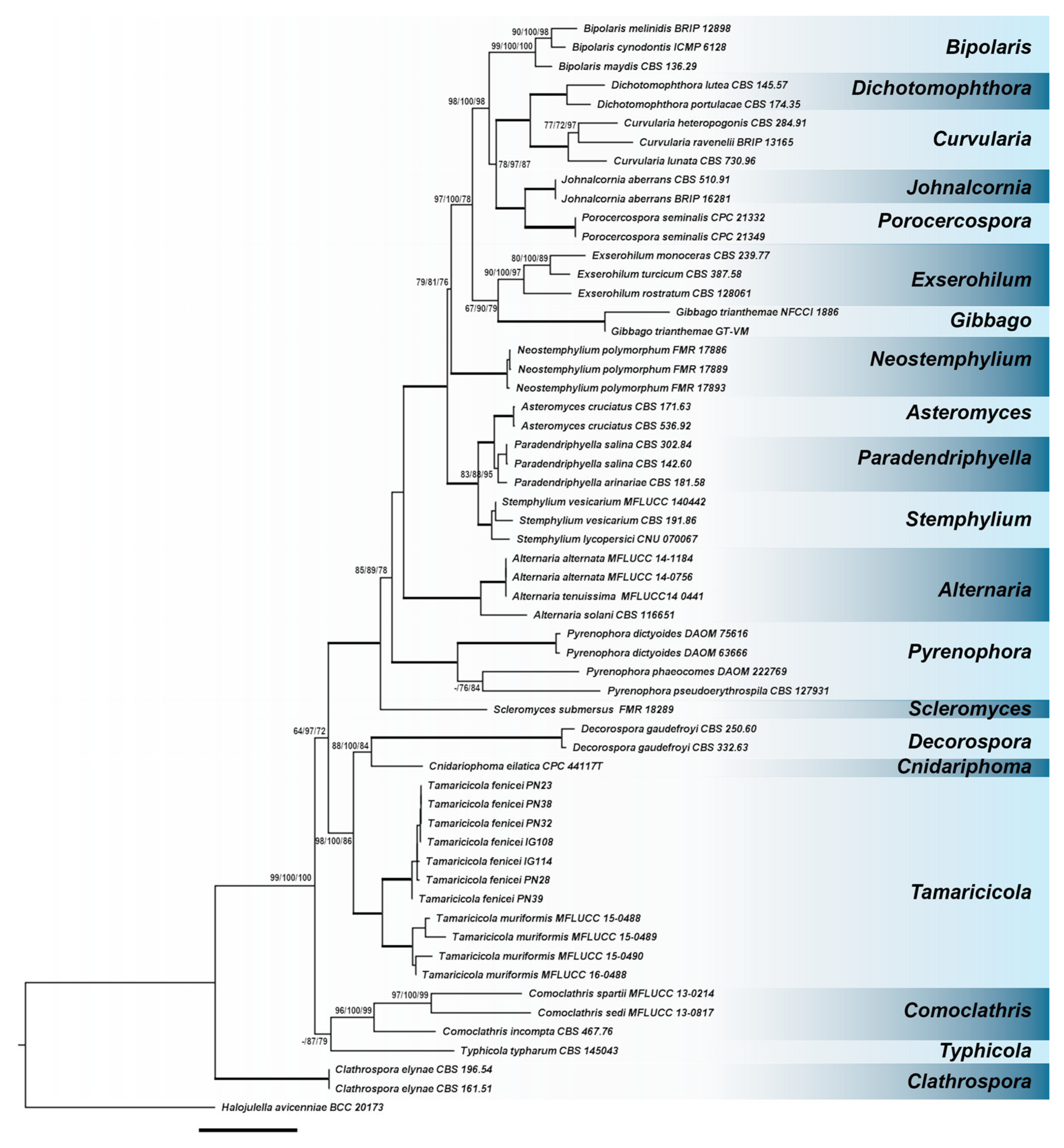
A preliminary phylogenetic analysis was carried out separately for nrLSU, nrITS, nrSSU, rpb2, and tef-1α. As no incongruences were observed among the single-locus phylogenetic trees, a multi-locus analysis was performed. The final dataset included 58 strains, representing 37 species, and 21 genera within the family Pleosporaceae. In total, 33 sequences were newly generated, while 176 sequences were retrieved from GenBank (Table 2). The concatenated alignment included 4534 characters (861 for nrLSU, 636 for nrITS, 1020 for nrSSU, 851 for rpb2, and 1166 for tef-1α) including gaps. Among them, 1337 distinct patterns, 882 parsimony-informative sites, 304 singleton sites, and 3348 constant sites, were observed. ML analysis yielded a best-scoring three with a final optimized likelihood value of −22,563.004. The ML and BI analyses produced generally congruent topologies, thus, only the ML tree with BS and BYPP values was reported (Figure 1).
Phylogenetic analysis of the concatenated dataset showed that the seven isolates under investigation formed a well-supported clade (BS = 100%; BYPP = 100%) within the genus Tamaricicola clearly distinguished by T. muriformis.
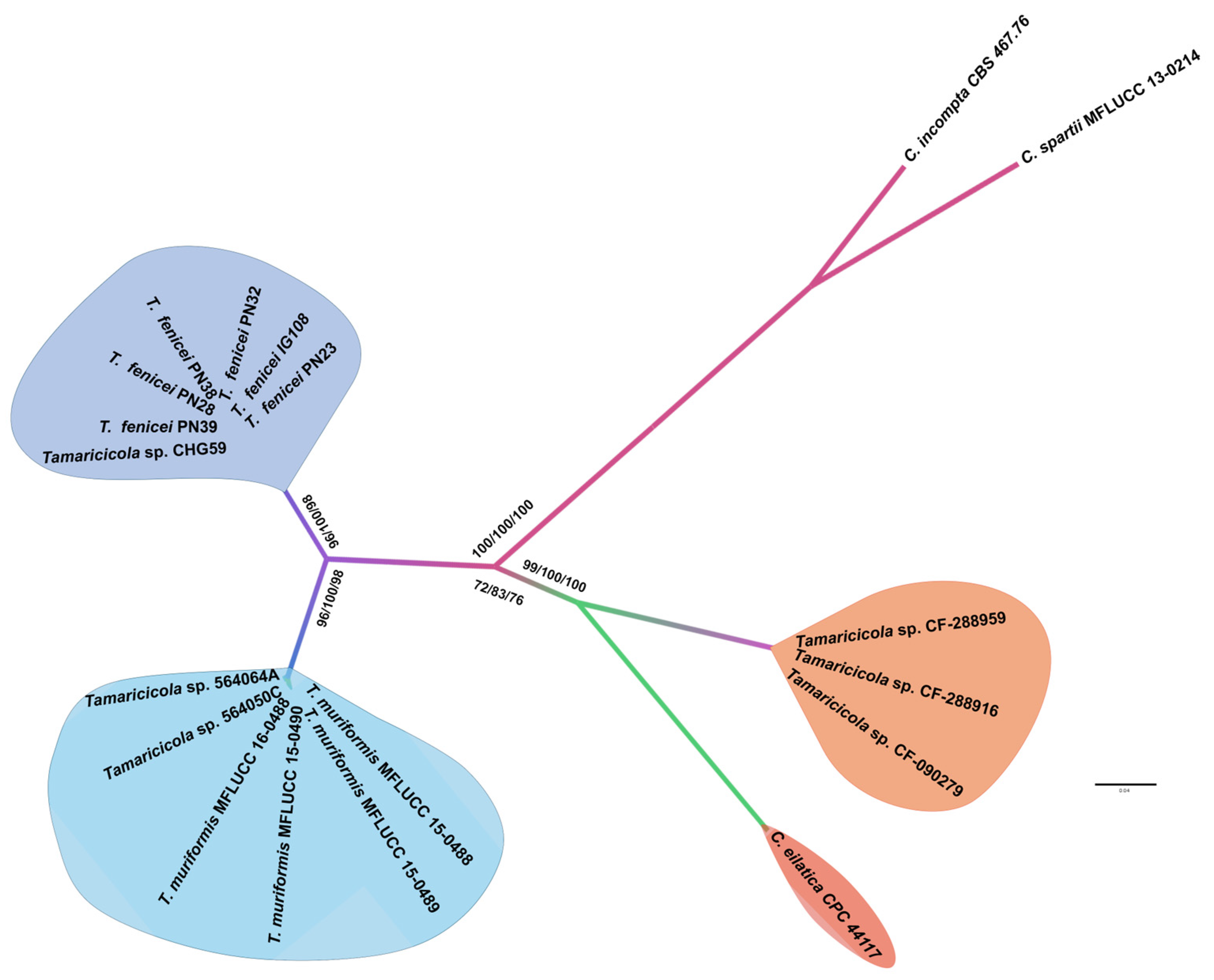
Although T. muriformis remains the only species formally described within the genus to date, several other Tamaricicola strains, beyond those investigated in this study, have been reported from marine and terrestrial substrates. Notably, two strains were isolated from avian lungs [20], three from Limonium spp. [18], and one from the ascidian Ciona intestinalis [19]. These strains were not included in the global phylogenetic analyses carried out for the Pleosporaceae family, as only nrITS sequences are currently available for them. For these reasons, a supplementary ITS-based phylogenetic analysis, incorporating all known Tamaricicola strains, was performed (Figure 2). The sixteen strains attributed to the genus were resolved into three distinct and well-supported clades. The strains Tamaricicola sp. 56406A and Tamaricicola sp. 56405C clustered with T. muriformis, while Tamaricicola sp. CHG59 grouped with the strains of the newly proposed species T. fenicei. The remaining three strains—Tamaricicola sp. CF-288959, CF-288916, and CF-090279—appear to represent a separate lineage. Interestingly, this latter lineage shows phylogenetic affinity with the newly established genus and species Cnidariophoma eilatica, described from a coral-associated strain [45]. Based on ITS sequence data alone, the three strains (Tamaricicola sp. CF-288959, CF-288916, and CF-090279) appear not to belong to Tamaricicola but, instead, represent a distinct lineage within or closely related to Cnidariophoma.
Phylogenetic analyses strongly indicated that the seven investigated strains belong to a new lineage within the genus Tamaricicola: the new species Tamaricicola fenicei is herein proposed.

3.2. Taxonomy

Tamaricicola fenicei Pasqualetti & Braconcini sp. nov. (Figure 3)
MycoBank. MB861134
Etimology. In honour of the Italian Microbiologist Massimiliano Fenice.
Type. Italy, Tuscany, Mediterranean Sea, Giglio Island (Grosseto), Cala Cupa, 4222008.0300 N, 1055004.0900 E, 10 m depth. Isolated from the jellyfish Pelagia noctiluca, May 2019, Marcella Pasqualetti. Holotype MUT6838 (strain PN38), living culture permanently preserved in a metabolically inactive state at the Mycotheca Universitatis Taurinenesis (MUT, affiliated to the World Federation Culture Collections WFCC).
Diagnosis. T. fenicei is introduced to accommodate seven novel strains retrieved on two different substrata in the Tyrrhenian Sea. T. fenicei is a biotic marine fungus associated with P. noctiluca and P. oceanica. Multi-locus phylogenetic analysis showed that T. fenicei clustered into a distinct clade in the monospecific genus Tamaricicola and differs from its closest phylogenetic neighbour T. muriformis by genetic characters in nrITS, nrLSU, nrSSU, tef-1α, and rpb2 sequences and in conidia dimensions as well as in the production of large, thick-walled, and muriform resting spore (chlamydospore). Morphologically, T. fenicei resembles the species T. muriformis in having similar asexual reproductive structures [17].
Description. Growing on Posidonia oceanica leaves, internal tissues of Pelagia noctiluca, Quercus robur and Pinus halepensis barks, P. halepensis pine needle and twigs of Tamarix gallica and T. africana.
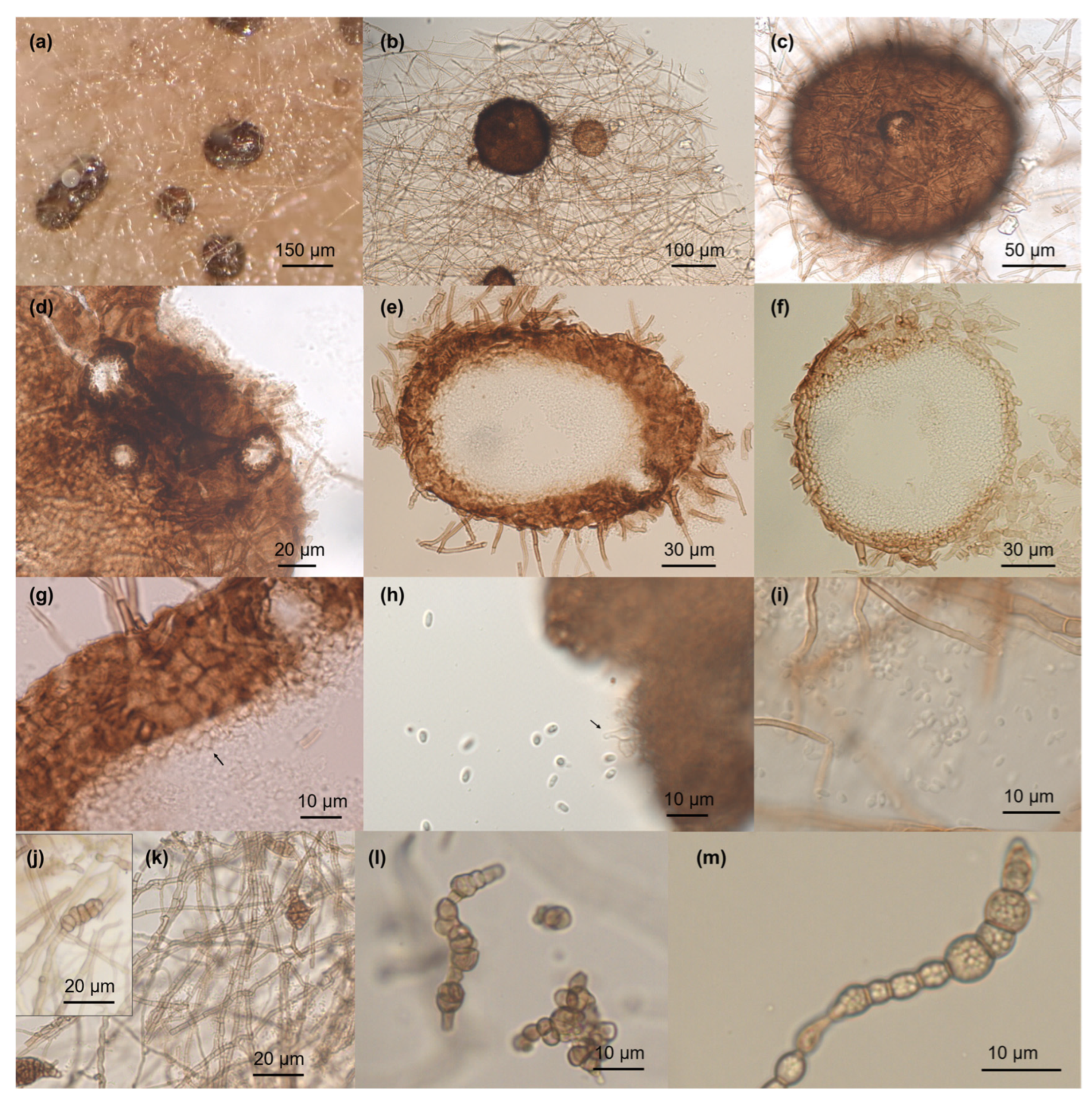
Hyphae 2.2–4.5 µm wide, irregular, septate, sometimes toruloid containing large amount of lipid droplets, sub-hyaline to slightly pigmented. Sexual morph not observed. Asexual morph coelomycetous. Conidiomata 80–190 μm diam, pycnidial, superficial or partially immersed, dark brown to black, spheroidal to sub-spheroidal, ostiolate (1–3). Conidiomatal wall 10–15 μm wide, comprising few layers of dark brown to hyaline cells of textura angularis. Conidiophores micronematous, reduced to conidiogenous cells. Conidiogenous cells 3–4.5 × 2–4 μm, phialidic, hyaline, smooth, ampulliform. Conidia 1.8–4 × 1.5–2.3 μm, ellipsoidal to cylindrical, hyaline, rounded at both ends, 1-celled, smooth-walled, slightly falcate. Chlamydospores 18–25 × 7.5–10 μm, muriform, irregular, with several transverse, longitudinal, and oblique septa.
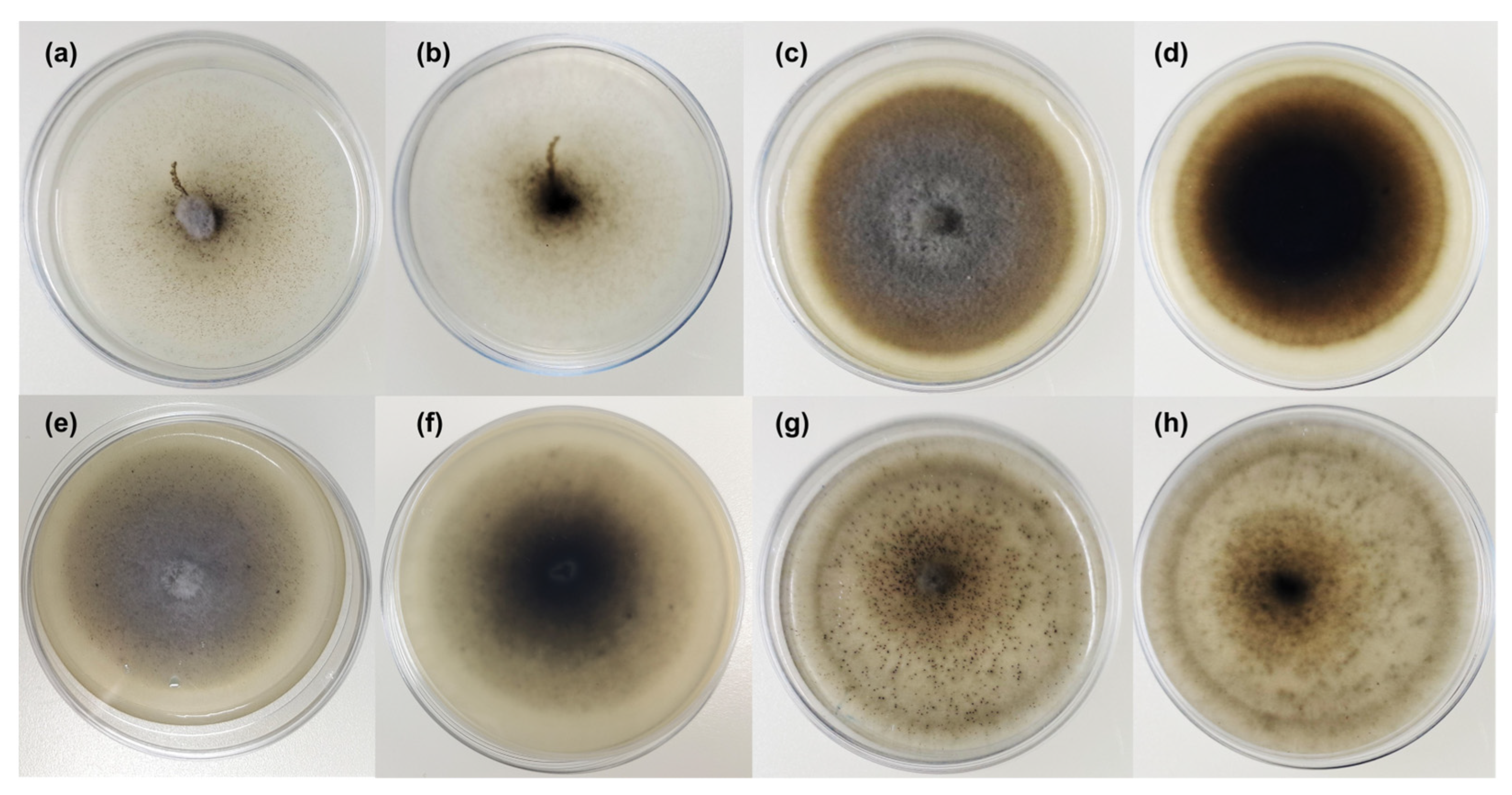
Colony description (Figure 4). Colonies on MEAs-PDAs, reaching 48–50 mm diameter after 21 days at 23 °C, plane, umbonate, surface velutinous centrally feltrose, grey, with a light brown marginal area; aerial mycelium sparse, whitish to light brown, mainly in the central area; margins regular moderately deep, reverse dark grey. Soluble pigment and exudates absent. Conidiomata produced on PDAs, not observed on MEAs. Colonies on OAs, reaching 50 mm diameter after 21 days at 23 °C, plane, surface slightly feltrose, whitish, margins regular, reverse white-grey darker in the center. Soluble pigment and exudates absent. Conidiomata produced in very large amounts. Colonies on CMAs, reaching 48 mm diameter after 21 days at 23 °C, surface slightly feltrose, greyish, mycelium prevalently immersed, margins regular, reverse hyaline to greyish. Soluble pigment and exudates absent. Conidiomata present.
Notes. No sexual form (ascomata) was detected in artificial and natural substrata. In liquid media the mycelium, prevalently toruloid, shows characteristic rounded cells full of a large amount of small lipidic droplets (Figure 3).
Based on a Megablast search on NCBI nucleotide database, the closest hits of nrITS sequences are Ascomycota sp. Di283-2 (GenBank accession no. OR367423; identities 554/554—100%); Ascomycota sp. San Juan 55-1 (GenBank accession no. KF638538; identities533/533—100%) and Tamaricicola sp. strain CHG59 (GenBank accession no. MW064152; identities 494/494—100%).
The closest hits using the nrLSU sequences are Pleosporaceae sp. M306 (GenBank accession no. KJ443126; identities 1276/1306—98%, 7 gaps), Comoclathris typhicola MUT<ITA>: 4379 (GenBank accession no. KF636774; identities 1275/1306–98%, 10 gaps) and Comoclathris typhicola strain CBS 132.69 (GenBank accession no. JF740325; identities 1275/1306—98%, 10 gaps). The closest hit using the nrSSU sequences is T. muriformis isolate IT_9172 (GenBank accession no. KU870908; identities 1043/1049—99%, 6 gaps). The closest hit using the tef-1α sequences is T. muriformis isolate IT_9175 (GenBank accession no. KU600014; 922/947—97%, 0 gaps). The closest hits using the rpb2 sequence (ON887328) are Cnidariophoma eilatica CPC 44117 (GenBank accession no. OQ627943; identities 610/656—93%, 0 gaps) and T. muriformis isolate IT_9173 (GenBank accession no. KU820870; identities 551/579—95%, 0 gaps).
Additional material examined. Italy, Tuscany, Mediterranean Sea, Giglio Island (Grosseto), Cala Cupa, 4222008.0300 N, 1055004.0900 E, 10 m depth. Isolated from the jellyfish P. noctiluca, May 2019, Marcella Pasqualetti, living culture PN23, PN28, PN32, PN39. Italy, Tuscany, Mediterranean Sea, Giglio Island (Grosseto), Cala Cupa, 4222008.0300 N, 1055004.0900 E, 15 m depth. Isolated from P. oceanica, May 2015, Marcella Pasqualetti, living culture IG108, IG114.

3.3. Screening for Antimicrobial and Antiviral Activity

The n-butanol (n-BuOH) and chloroform (CHCl3) extracts of strain PN38 cultivated in MEAs and GYPs were evaluated for antimicrobial and antiviral activity. No antiviral, antibacterial or antibiofilm activities were detected at the maximum tested concentrations for the extracts obtained from cultures grown in GYPs medium. Therefore, only the results for extracts derived from MEAs cultures are reported.
To assess antibacterial and antifungal activity the extracts were tested against several pathogenic organisms (S. aureus ATCC 25923, P. aeruginosa ATCC 15442, E. coli ATCC 25922, E. faecalis ATCC 29212 and C. albicans ATCC 10231) using the microdilution method.
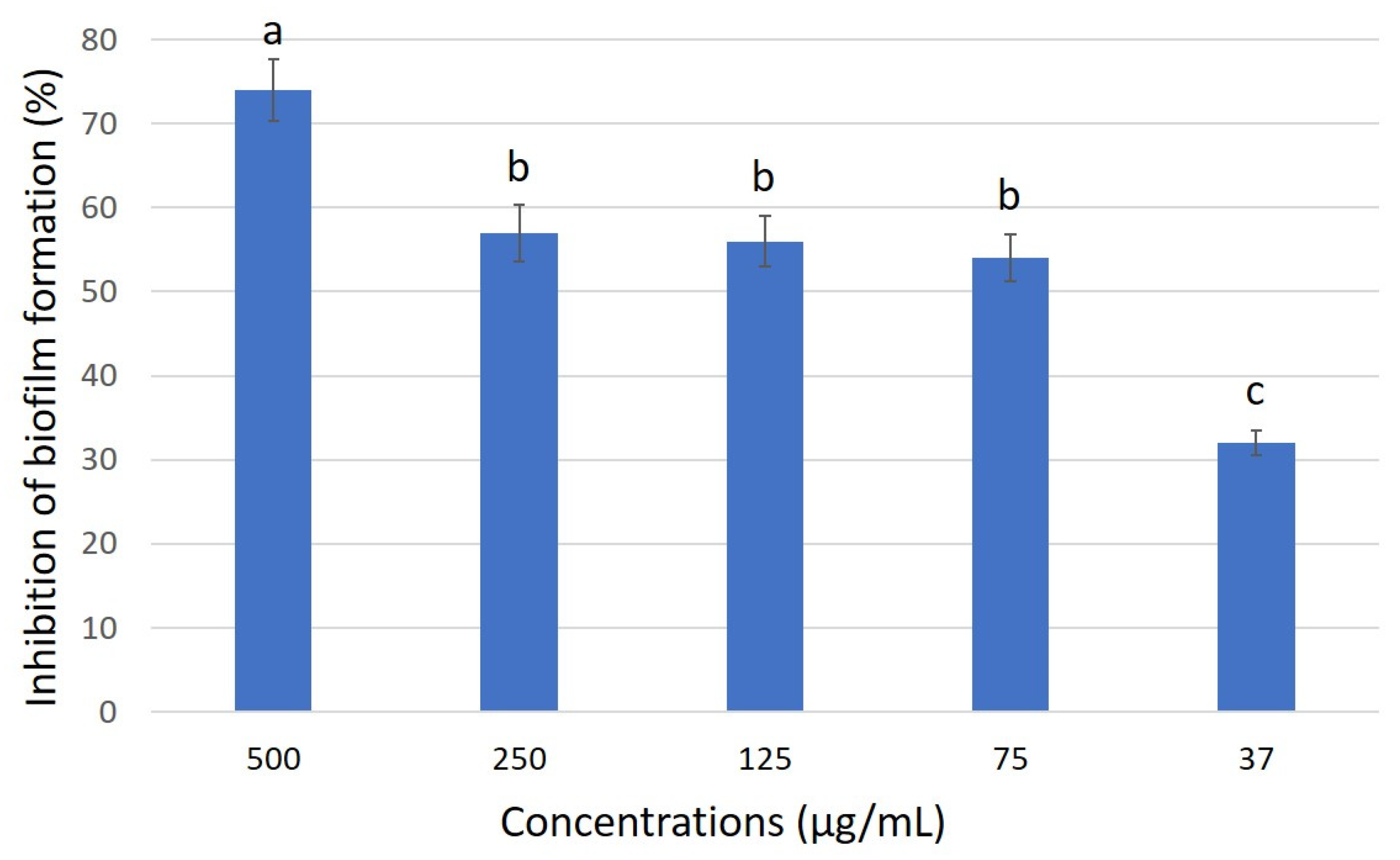
No activity was observed against bacterial and fungal strains at the screening concentration of 2.5 mg/mL for extracts obtained by MEAs cultures. However, an interesting anti-biofilm activity against S. aureus ATCC 25923 was observed at sub-MIC concentration of MEAs n-BuOH extract with a BIC50 value of 53 μg/mL (Figure 5).
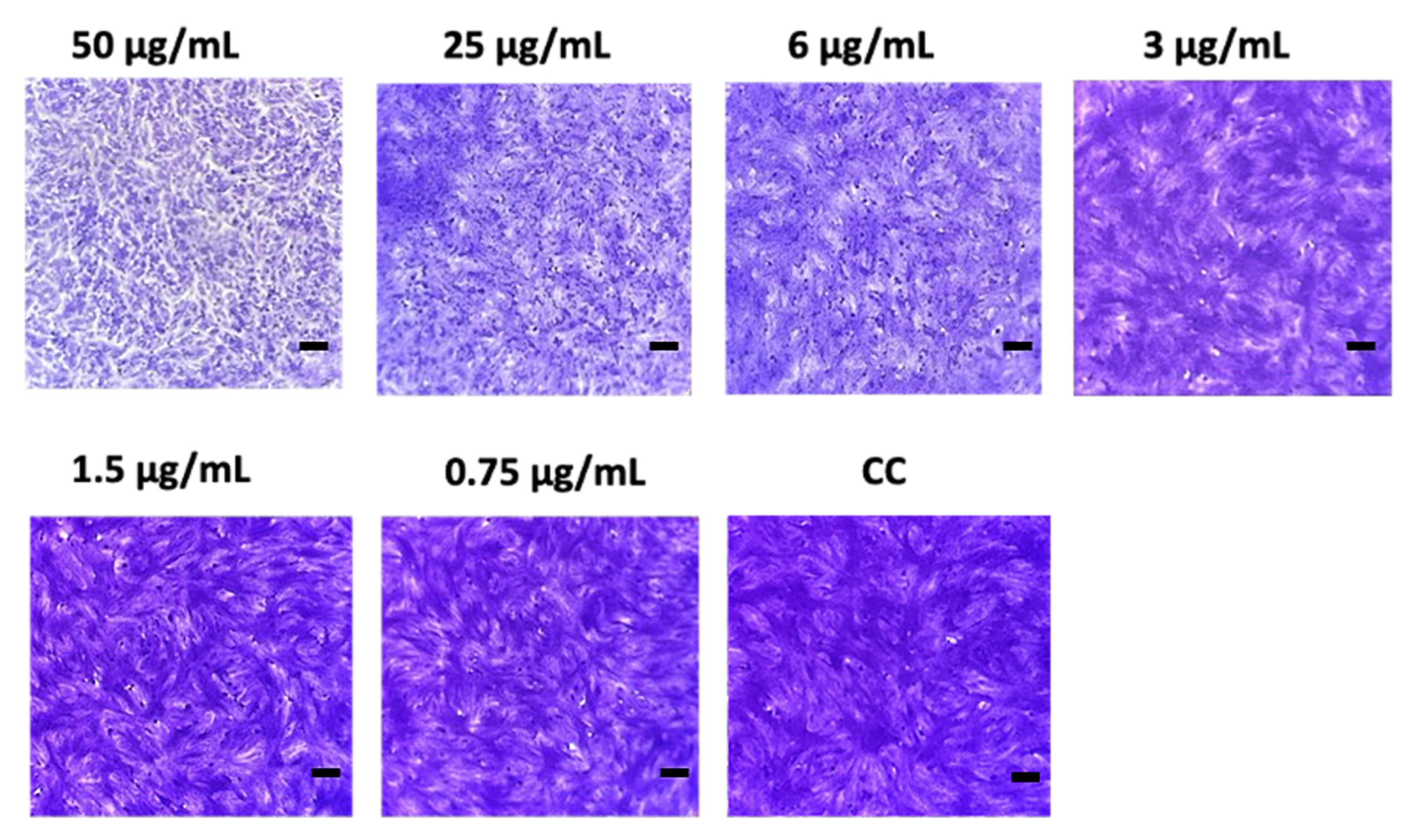
The antiviral activity was assessed only on the CHCl3 extract due to the cell toxicity of the n-BuOH extract. The optical microscopy observation revealed a dose-dependent cytotoxic effect of MEAs CHCl3 extract on Vero-76 cells. A marked viability decrease was observed at concentration of 50 µg/mL showing a strong cytotoxic effect (Figure 6). The 25 µg/mL concentration was the first with a reduced cytotoxicity, while 6 μg/mL was the highest non-cytotoxic concentration observed (cell viability > 99%). On the basis of these results, scalar concentrations from 25 to 0.75 µg/mL were used for the antiviral assay.
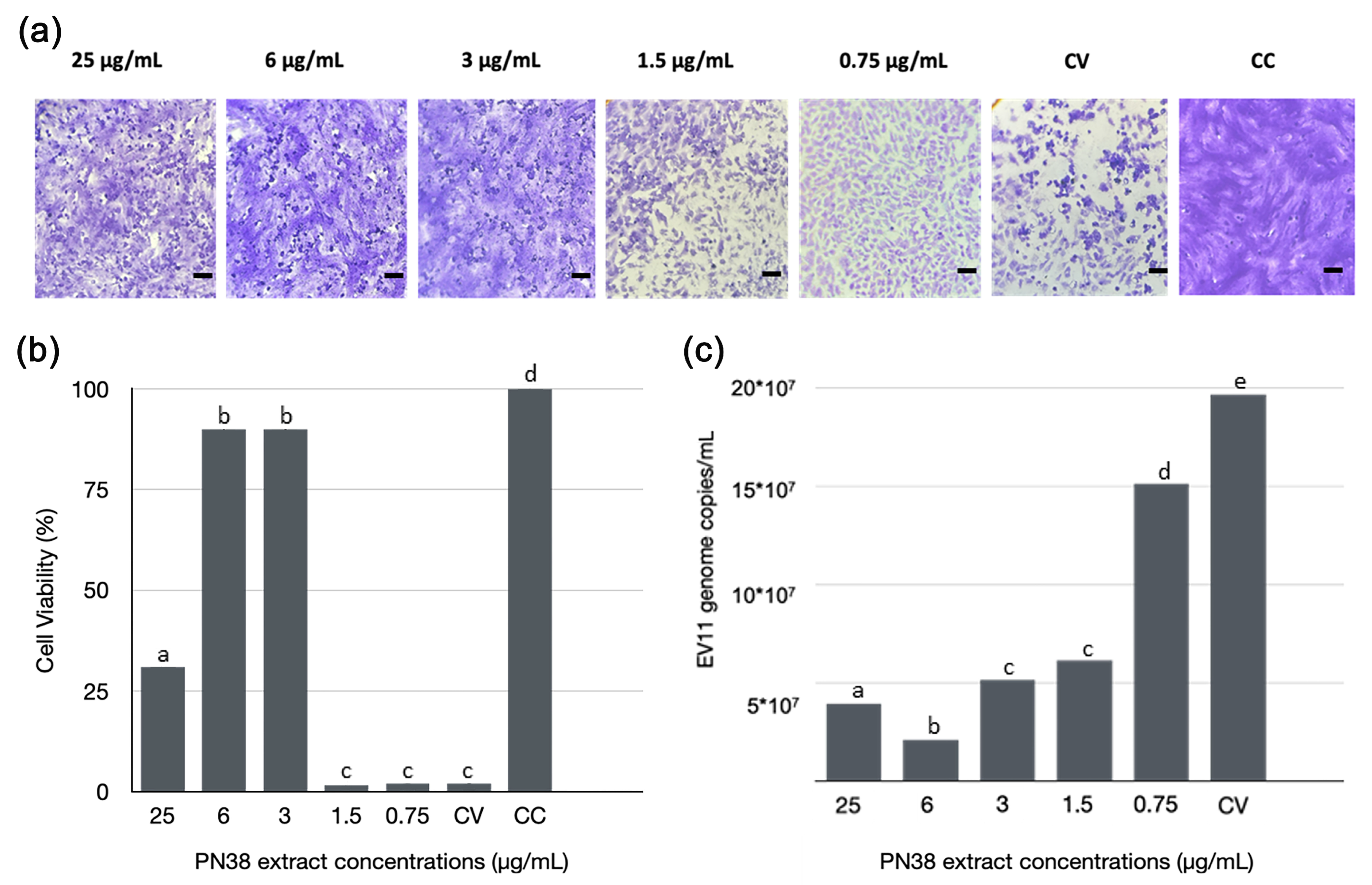
The potential antiviral activity of strain PN38 was evaluated by assessing its ability to inhibit viral replication in cell culture. The assay measured the reduction in the cytopathic effect (CPE) induced by Echovirus 11 (E11) in comparison with two controls: a negative control (non-infected cell cultures) and a positive control (infected cell cultures not treated with PN38) [43]. The co-treatment assay with MEAs CHCl3 extract (25–0.75 μg/mL) and E11 (MOI of 0.01), showed a strong antiviral effect, with a 90% CPE reduction at 3 and 6 μg/mL, identifying 3 μg/mL as the MIC (Figure 7). This activity was confirmed by the reduction of viral RNA levels in infected Vero-76 supernatants, 86% and 94% at 3 and 6 μg/mL, respectively, compared to the untreated cells (CV) (Figure 7c).

4. Discussion

Marine fungi have long been considered an “exotic” group of microorganisms with low species richness and abundance [46]. However, it has become increasingly evident that they represent a substantial proportion of marine microbial diversity and contribute to various key ecological processes in the marine environments (e.g., aquatic carbon pump efficiency and regulation of phytoplankton composition). Despite recent progress in marine mycology, our knowledge of marine fungi remains limited. In this context, research focused on underexplored habitats and substrates can significantly enhance our understanding of these neglected organisms, particularly regarding their distribution, ecology, and contributions to marine ecosystem services. It is worth noting that in recent years, numerous new taxa have been established from marine substrata that had not previously been studied mycologically [32,47].
The seven strains investigated in this study were isolated from the leaves of the seagrass P. oceanica (IG108, IG114) and the inner tissues of the jellyfish P. noctiluca (PN23, PN28, PN32, PN38, PN39) [3,27]. P. oceanica is an endemic seagrass of the Mediterranean Sea; the seagrass meadows rank amongst the most valuable coastal ecosystems on Earth in terms of benefits and services they provide. P. oceanica is one of the most studied substrata from marine mycologists [27,48,49,50,51,52,53,54,55,56]. In contrast, P. noctiluca mycobiota was only studied by Pasqualetti and co-authors [3]. The isolated strains do not produce reproductive structures on MEAs, utilized for their maintenance. The experiments to promote sexual or asexual reproduction [57,58,59] led only to the development of coelomycetous conidiomata (asexual structures) in PDAs, CMAs and OAs and natural inoculated substrata (barks of Q. robur, P. halepensis, pine needles of P. halepensis, twigs of T. gallica, T. africana and Posidonia leaves) while ascomata were not detected.
A preliminary molecular characterization based on nrITS, nrLSU, and nrSSU allowed us to place the strains IG108, IG114, PN23, PN28, PN32, PN38, PN39 in the family Pleosporaceae [3]. The analysis suggested that the strains were strictly related to the monospecific genus Tamaricicola and also indicated that they could represent a new lineage inside the genus [3,27]. To confirm these preliminary observations, a multi-locus phylogenetic analysis, based on molecular markers usually utilized to study the taxonomy of the Pleosporaceae family, was performed [16,17]. The phylogenetic tree (Figure 1), including the genera of the family Pleosporaceae, showed that the strains formed a well-supported clade within the genus Tamaricicola, separated from the species T. muriformis. Thus, the new species T. fenicei was proposed and established. T. fenicei is the second species ascribed to the genus Tamaricicola. Nevertheless, in the literature some other strains are attributed to the genus Tamaricicola: three terrestrial strains isolated from L. majus and L. insigne, two isolated from avian lung and a marine strain (CHG59) isolated from the gut of the ascidian C. intestinalis sampled in the German North Sea [18,19,20].
The nrITS phylogenetic analysis, including all strains attributed to Tamaricicola, clearly reveals the presence of three distinct evolutionary lineages: one corresponding to the terrestrial strains of T. muriformis, another to the marine strains of T. fenicei, and a third comprising the strains isolated from L. majus and L. insigne. González-Menéndez and collaborators [18] suggested that the Limonium-associated strains might represent a novel species within Tamaricicola. However, the phylogenetic analysis conducted in this study (Figure 2) indicates that these strains may instead constitute a distinct lineage within the recently established genus Cnidariophoma [45], rather than a new lineage within Tamaricicola.
Considering the ecology of T. fenicei, it is worth noting that strains IG108, IG114, and PN23, PN28, PN32, PN38, and PN39 were isolated from different types of substrates (plant and animal) during two sampling campaigns in the same area (Cala Cupa—Giglio Island) in the Central Tyrrhenian Sea. Thus, it seems reasonable that this species could have a not-specialized habitus [60] even considering the similarity, and probably identity, with the strain Tamaricicola sp. CHG59 isolated from C. intestinalis. Nevertheless, up to this date the new species seems strictly marine with biontic behavior. The identification of novel taxa significantly contributes to the advancement of knowledge on marine fungi, confirming that the marine ecosystem represents a vast, largely unexplored reservoir of biodiversity and chemo-diversity in particular for its microbial components. It is worth noting that new lineages could be extremely interesting from a blue-biotechnological perspective considering the biological activity of their extract.
The preliminary results of this study revealed the potential in vitro antiviral activity of the PN38 extract against the newly identified E11 variant. Specifically, co-treatment with PN38 extract showed an inhibition of viral replication evaluated by cytopathic effect (CPE) reduction in Vero-76 cells, confirmed by the decrease of viral RNA levels by 86% and 94% at concentrations of 3 and 6 μg/mL, respectively, identifying 3 μg/mL as the MIC.
This value appears to be quite low if compared to similar research, even if carried out on other viruses. In recent publications the 50% of inhibition (EC50: half maximal effective concentration, or concentration of a compound that reduces viral infectivity by 50%) was obtained with similar or much higher concentrations of crude extracts [43,61]. For example, Florio and coworkers [43] considered the range 1.18 to 45 μg/mL of EC50 activity as significant for the selection of fungal strains for further deeper investigations in order to identify new antiviral compounds. These preliminary findings suggest that PN38 extract may contain compounds capable of inhibiting E11 replication in Vero-76 cells, underscoring its potential as a source of secondary metabolites with antiviral properties.
In view of this, the potential in vitro antiviral activity of the PN38 extract against the E11 variant represents a valuable assumption for the future development of new antiviral leads. This work is the first report on antiviral activity of T. fenicei; the next step will be the purification and characterization of antiviral compounds and the study of their mechanism of action.
In addition, the ability of n-BuOH extract of PN38 (growth in MEAs) to inhibit biofilm formation represents a noteworthy biological activity. The control of infectious diseases associated with biofilms remains a significant challenge, and there is a pressing need for new, effective molecules. The extract from T. fenicei showed no activity at the screening concentration against planktonic microbial tested strains; however, it has the ability to tackle the growth as a sessile multistratified community (biofilm) of the relevant nosocomial pathogen S. aureus. Biofilm formation is a common virulence factor contributing to invasiveness, ability to evade the host’s defence system, persistence of infection and antibiotic resistance. The preliminary observation of the significant decrease in biofilm formation at low concentration (BIC50 equal to 53 µg/mL) of PN38 extract, encourages us to carry out more in-depth studies, for example those concerning interference with regulatory mechanisms of biofilm formation [62]. Although further studies are necessary to identify the specific bioactive compounds of the tested extract and to elucidate their mechanisms of action, the results suggest that the T. fenicei PN38 strain is a promising producer of compounds with both antiviral and anti-biofilm activities.

5. Conclusions

This study provides a morphological and phylogenetic characterization of seven strains isolated from P. oceanica leaves and the inner tissues of P. noctiluca collected in the central Tyrrhenian Sea; the mycobiota of this jellyfish has not been previously investigated. The strains represent a new lineage within the genus Tamaricicola (family Pleosporaceae) leading to the establishment of the new species Tamaricicola fenicei. The identification of new species contributes to the advancement of knowledge about this genus that until now included only a terrestrial species. It is worth noting that all strains attributed to Tamaricicola fenicei derived from marine substrata. Finally, the CHCl3 extract of T. fenicei PN38 exhibits significant antiviral activity against Echovirus 11, while the n-BuOH extract markedly reduces biofilm formation by S. aureus suggesting that this strain may have high biotechnological potential for drug discovery.
The emergence of drug-resistant pathogens and novel infections has moved toward the sea the search for new pharmaceuticals, and undoubtedly the potential of marine fungi, particularly of novel taxa, in this context is very promising.

Author Contributions

Conceptualization, M.P. and M.B.; methodology, M.P., M.B., D.F. and D.S.; validation and formal analysis, M.P., M.B., E.P., D.F. and D.S.; investigation, M.P., M.B., S.G., P.B., E.P., D.F. and D.S.; resources, M.P., D.F. and D.S.; data curation and visualization, M.B., S.G., P.B., E.P.; supervision, M.P., D.F. and D.S.; project administration, M.P.; funding acquisition, M.P. and D.S. All authors have read and agreed to the published version of the manuscript.

Funding

This research was funded by “Progetto di Ricerca di Interesse Nazionale” (PRIN)-Production and characterization of new bioactive molecules against emerging and/or multidrug-resistant pathogens by neglected polyextremophilic marine fungi (MYCOSEAS, no. 2022MPTT35).

Institutional Review Board Statement

Not applicable.

Informed Consent Statement

Not applicable.

Data Availability Statement

The original contributions presented in this study are included in the article. Further inquiries can be directed to the corresponding author.

Acknowledgments

The Research project implemented under the National Recovery and Resilience Plan (NRRP), Mission 4 Component 2 Investment 1.4—Call for tender No. 3138 of 16 December 2021, rectified by Decree No. 3175 of 18 December 2021 of Italian Ministry of University and Research funded by the European Union—Next Generation EU. Project code CN_00000033, Concession Decree No. 1034 of 17 June 2022 adopted by the Italian Ministry of University and Research, CUP J83C22000860007, Project title “National Biodiversity Future Center—NBFC”.

Conflicts of Interest

The authors declare no conflicts of interest.

References

  1. World Register of Marine Species. Available online: www.marinespecies.org (accessed on 7 October 2025).
  2. Jones, E.G.; Pang, K.L.; Abdel-Wahab, M.A.; Scholz, B.; Hyde, K.D.; Boekhout, T.; Ebel, R.; Rateb, M.E.; Henderson, L.; Sakayaroj, J.; et al. An online resource for marine fungi. Fungal Divers. 2019, 96, 347–433. [Google Scholar] [CrossRef]
  3. Pasqualetti, M.; Braconcini, M.; Barghini, P.; Gorrasi, S.; Schillaci, D.; Ferraro, D.; Della Sala, G.; De Marino, S.; Fenice, M. From marine neglected substrata new fungal taxa of potential biotechnological interest: The case of Pelagia noctiluca. Front. Microbiol. 2024, 15, 1473269. [Google Scholar] [CrossRef]
  4. Giovannini, V.; Barghini, P.; Gorrasi, S.; Massimiliano, F.; Pasqualetti, M. Marine fungi: A potential source of novel enzymes for environmental and biotechnological applications. J. Environ. Prot. Ecol. 2019, 20, 1214–1222. [Google Scholar]
  5. Pasqualetti, M.; Barghini, P.; Giovannini, V.; Fenice, M. High production of chitinolytic activity in halophilic conditions by a new marine strain of Clonostachys rosea. Molecules 2019, 24, 1880. [Google Scholar] [CrossRef]
  6. Hou, X.M.; Hai, Y.; Gu, Y.C.; Wang, C.Y.; Shao, C.L. Chemical and bioactive marine natural products of coral-derived microorganisms (2015–2017). Curr. Med. Chem. 2019, 26, 6930–6941. [Google Scholar] [CrossRef] [PubMed]
  7. Botta, L.; Saladino, R.; Barghini, P.; Fenice, M.; Pasqualetti, M. Production and identification of two antifungal terpenoids from the Posidonia oceanica epiphytic Ascomycota Mariannaea humicola IG100. Microb. Cell Fact. 2020, 19, 184. [Google Scholar] [CrossRef] [PubMed]
  8. Teng, Y.F.; Xu, L.; Wei, M.Y.; Wang, C.Y.; Gu, Y.C.; Shao, C.L. Recent progresses in marine microbial-derived antiviral natural products. Arch. Pharm. Res. 2020, 43, 1215–1229. [Google Scholar] [CrossRef] [PubMed]
  9. Ameen, F.; AlNadhari, S.; Al-Homaidan, A.A. Marine microorganisms as an untapped source of bioactive compounds. Saudi J. Biol. Sci. 2021, 28, 224–231. [Google Scholar] [CrossRef]
  10. Pasqualetti, M.; Gorrasi, S.; Giovannini, V.; Braconcini, M.; Fenice, M. Polyextremophilic chitinolytic activity by a marine strain (IG119) of Clonostachys rosea. Molecules 2022, 27, 688. [Google Scholar] [CrossRef]
  11. Pang, K.L.; Jones, E.G.; Abdel-Wahab, M.A.; Adams, S.J.; Alves, A.; Azevedo, E.; Bahkali, A.H.; Barata, M.; Burgaud, G.; Caeiro, M.F.; et al. Recent progress in marine mycological research in different countries, and prospects for future developments worldwide. Bot. Mar. 2023, 66, 239–269. [Google Scholar] [CrossRef]
  12. Calabon, M.S.; Jones, E.G.; Pang, K.L.; Abdel-Wahab, M.A.; Jin, J.; Devadatha, B.; Sadaba, R.B.; Apurillo, C.C.; Hyde, K.D. Updates on the classification and numbers of marine fungi. Bot. Mar. 2023, 66, 213–238. [Google Scholar] [CrossRef]
  13. Available online: www.indexfungorum.org (accessed on 7 October 2025).
  14. Dong, J.; Chen, W.; Crane, J.L. Phylogenetic studies of the Leptosphaeriaceae, Pleosporaceae and some other Loculoascomycetes based on nuclear ribosomal DNA sequences. Mycol. Res. 1998, 102, 151–156. [Google Scholar] [CrossRef]
  15. Ariyawansa, H.A.; Thambugala, K.M.; Manamgoda, D.S.; Jayawardena, R.; Camporesi, E.; Boonmee, S.; Wanasinghe, D.N.; Phookamsak, R.; Hongsanan, S.; Singtripop, C.; et al. Towards a natural classification and backbone tree for Pleosporaceae. Fungal Divers. 2015, 71, 85–139. [Google Scholar] [CrossRef]
  16. Torres-Garcia, D.; García, D.; Cano-Lira, J.F.; Gené, J. Two novel genera, Neostemphylium and Scleromyces (Pleosporaceae) from freshwater sediments and their global biogeography. J. Fungi 2022, 8, 868. [Google Scholar] [CrossRef]
  17. Thambugala, K.M.; Daranagama, D.A.; Phillips, A.J.; Bulgakov, T.S.; Bhat, D.J.; Camporesi, E.; Bahkali, A.H.; Eungwanichayapant, P.D.; Liu, Z.-Y.; Hyde, K.D. Microfungi on Tamarix. Fungal Divers. 2017, 82, 239–306. [Google Scholar] [CrossRef]
  18. González-Menéndez, V.; Crespo, G.; De Pedro, N.; Diaz, C.; Martín, J.; Serrano, R.; Mackenzie, T.A.; Justicia, C.; González-Tejero, M.R.; Casares, M.; et al. Fungal endophytes from arid areas of Andalusia: High potential sources for antifungal and antitumoral agents. Sci. Rep. 2018, 8, 9729. [Google Scholar] [CrossRef]
  19. Utermann, C.; Echelmeyer, V.A.; Oppong-Danquah, E.; Blümel, M.; Tasdemir, D. Diversity, bioactivity profiling and untargeted metabolomics of the cultivable gut microbiota of Ciona intestinalis. Mar. Drugs 2020, 19, 6. [Google Scholar] [CrossRef] [PubMed]
  20. Salazar-Hamm, P.S.; Gadek, C.R.; Mann, M.A.; Steinberg, M.; Montoya, K.N.; Behnia, M.; Gyllenhaal, E.F.; Brady, S.S.; Takano, O.M.; Williamson, J.L.; et al. Phylogenetic and ecological drivers of the avian lung mycobiome and its potentially pathogenic component. Commun. Biol. 2025, 8, 634. [Google Scholar] [CrossRef]
  21. Thibaut, H.J.; Leyssen, P.; Puerstinger, G.; Muigg, A.; Neyts, J.; De Palma, A.M. Towards the design of combination therapy for the treatment of enterovirus infections. Antivir. Res. 2011, 90, 213–217. [Google Scholar] [CrossRef] [PubMed]
  22. Wang, J.; Hu, Y.; Zheng, M. Enterovirus A71 antivirals: Past, present, and future. Acta Pharm. Sin. B 2022, 12, 1542–1566. [Google Scholar] [CrossRef]
  23. World Health Organization. Enterovirus-Echovirus 11 Infection-the European Region. WHO. Available online: https://www.Who.Int/Emergencies/Disease-Outbreak-News/Item/2023-DON474 (accessed on 27 February 2024).
  24. European Centre for Disease Prevention and Control—Epidemiological up-date: Echovirus 11 infections in neonates. Available online: https://www.ecdc.europa.eu/en/news-events/epidemiological-update-echovirus-11-infections-neonates (accessed on 19 July 2023).
  25. Gad, B.; Kłosiewicz, P.; Oleksiak, K.; Krzysztoszek, A.; Toczyłowski, K.; Sulik, A.; Wieczorek, T.; Wieczorek, M. Intensified circulation of echovirus 11 after the COVID-19 pandemic in Poland: Detection of a highly pathogenic virus variant. Viruses 2024, 16, 1011. [Google Scholar] [CrossRef]
  26. Giammanco, G.M.; Filizzolo, C.; Pizzo, M.; Sanfilippo, G.L.; Cacioppo, F.; Bonura, F.; Fontana, S.; Buttinelli, G.; Stefanelli, P.; De Grazia, S. Detection of Echovirus 11 lineage 1 in wastewater samples in Sicily. Sci. Total Environ. 2024, 918, 170519. [Google Scholar] [CrossRef] [PubMed]
  27. Pasqualetti, M.; Giovannini, V.; Barghini, P.; Gorrasi, S.; Fenice, M. Diversity and ecology of culturable marine fungi associated with Posidonia oceanica leaves and their epiphytic algae Dictyota dichotoma and Sphaerococcus coronopifolius. Fungal Ecol. 2020, 44, 100906. [Google Scholar] [CrossRef]
  28. Linnakoski, R.; Reshamwala, D.; Veteli, P.; Cortina-Escribano, M.; Vanhanen, H.; Marjomäki, V. Antiviral agents from fungi: Diversity, mechanisms and potential applications. Front. Microbiol. 2018, 9, 2325. [Google Scholar] [CrossRef]
  29. Yang, J.; Jiao, R.H.; Yao, L.Y.; Han, W.B.; Lu, Y.H.; Tan, R.X. Control of fungal morphology for improved production of a novel antimicrobial alkaloid by marine-derived fungus Curvularia sp. IFB-Z10 under submerged fermentation. Process Biochem. 2016, 51, 185–194. [Google Scholar] [CrossRef]
  30. Cao, F.; Meng, Z.H.; Mu, X.; Yue, Y.F.; Zhu, H.J. Absolute configuration of bioactive azaphilones from the marine-derived fungus Pleosporales sp. CF09-1. J. Nat. Prod. 2019, 82, 386–392. [Google Scholar] [CrossRef] [PubMed]
  31. Han, Y.; Sun, C.; Li, C.; Zhang, G.; Zhu, T.; Li, D.; Che, Q. Antibacterial phenalenone derivatives from marine-derived fungus Pleosporales sp. HDN1811400. Tetrahedron Lett. 2021, 68, 152938. [Google Scholar] [CrossRef]
  32. Braconcini, M.; Gorrasi, S.; Fenice, M.; Barghini, P.; Pasqualetti, M. Rambellisea gigliensis and Rambellisea halocynthiae gen. et spp. nov. (Lulworthiaceae) from the marine tunicate Halocynthia papillosa. J. Fungi 2024, 10, 127. [Google Scholar] [CrossRef]
  33. White, T.J.; Bruns, T.; Lee, S.; Taylor, J. Amplification and direct sequencing of fungal ribosomal RNA genes for phylogenetics. In PCR Protocols; Elsevier: Amsterdam, The Netherlands; Academic Press: New York, NY, USA, 1990; pp. 315–322. [Google Scholar] [CrossRef]
  34. Vilgalys, R.; Hester, M. Rapid genetic identification and mapping of enzymatically amplified ribosomal DNA from several Cryptococcus species. J. Bacteriol. 1990, 172, 4238–4246. [Google Scholar] [CrossRef]
  35. Rehner, S.A.; Buckley, E. A Beauveria phylogeny inferred from nuclear ITS and EF1-α sequences: Evidence for cryptic diversification and links to Cordyceps teleomorphs. Mycologia 2005, 97, 84–98. [Google Scholar] [CrossRef]
  36. Liu, Y.J.; Whelen, S.; Hall, B.D. Phylogenetic relationships among ascomycetes: Evidence from an RNA polymerase II subunit. Mol. Biol. Evol. 1999, 16, 1799–1808. [Google Scholar] [CrossRef] [PubMed]
  37. Thompson, J.D.; Gibson, T.J.; Plewniak, F.; Jeanmougin, F.; Higgins, D.G. The CLUSTAL_X windows interface: Flexible strategies for multiple sequence alignment aided by quality analysis tools. Nucleic Acids Res. 1997, 25, 4876–4882. [Google Scholar] [CrossRef]
  38. Hall, T.A. BioEdit: A user-friendly biological sequence alignment editor and analysis program for Windows 95/98/NT. Nucleic Acids Symp. 1990, 41, 95–98. [Google Scholar]
  39. Tamura, K.; Stecher, G.; Kumar, S. MEGA11: Molecular evolutionary genetics analysis version 11. Mol. Biol. Evol. 2021, 38, 3022–3037. [Google Scholar] [CrossRef] [PubMed]
  40. CLSI M07-A9; Methods for Dilution Antimicrobial Susceptibility Tests for Bacteria That Grow Aerobically; Approved Standard, 9th ed. Clinical and Laboratory Standards Institute: Wayne, PA, USA, 2012.
  41. Plescia, F.; Venturella, F.; Lauricella, M.; Catania, V.; Polito, G.; Schillaci, D.; Piccionello, A.P.; Giuseppe, D.; D’anneo, A.; Raffa, D. Chemical composition, cytotoxic effects, antimicrobial and antibiofilm activity of Artemisia arborescens (Vaill.) L. growing wild in the province of Agrigento, Sicily, Italy. Plant Biosyst. 2022, 156, 1336–1345. [Google Scholar] [CrossRef]
  42. Plescia, F.; Venturella, F.; D’Anneo, A.; Catania, V.; Gargano, M.L.; Polito, G.; Schillaci, D.; Piccionello, A.P.; Lauricella, M.; Venturella, G.; et al. Phytochemical-Rich Extracts of Helianthemum lippii Possess Antimicrobial, Anticancer, and Anti-Biofilm Activities. Plant Biosyst. 2022, 156, 1314–1324. [Google Scholar] [CrossRef]
  43. Florio Furno, M.; Laizé, V.; Arduino, I.; Pham, G.N.; Spina, F.; Mehiri, M.; Lembo, D.; Gavaia, P.J.; Varese, G.C. Bioprospecting marine fungi from the plastisphere: Osteogenic and antiviral activities of fungal extracts. Mar. Drugs 2025, 23, 115. [Google Scholar] [CrossRef]
  44. SYSTAT, Version 8.0. Getting Started. SPSS Inc., Ed.; Prentice Hall PTR: Upper Saddle River, NJ, USA, 1999.
  45. Crous, P.W.; Osieck, E.R.; Shivas, R.G.; Tan, Y.P.; Bishop-Hurley, S.L.; Esteve-Raventós, F.; Larsson, E.; Luangsa-Ard, J.; Pancorbo, F.; Balashov, S.; et al. Fungal Planet description sheets: 1478–1549. Persoonia 2023, 50, 158–310. [Google Scholar] [CrossRef]
  46. Gonçalves, M.F.; Esteves, A.C.; Alves, A. Marine fungi: Opportunities and challenges. Encyclopedia 2022, 2, 559–577. [Google Scholar] [CrossRef]
  47. Bovio, E.; Garzoli, L.; Poli, A.; Prigione, V.; Firsova, D.; McCormack, G.; Varese, G. The culturable mycobiota associated with three Atlantic sponges, including two new species: Thelebolus balaustiformis and T. spongiae. Fungal Syst. Evol. 2018, 1, 141–167. [Google Scholar] [CrossRef]
  48. Cuomo, V.; Vanzanella, F.; Fresi, E.; Cinelli, F.; Mazzella, L. Fungal flora of Posidonia oceanica and its ecological significance. Trans. Br. Mycol. Soc. 1985, 84, 35–40. [Google Scholar] [CrossRef]
  49. Cuomo, V.; Jones, E.B.G.; Grasso, S. Occurrence and distribution of marine fungi along the coast of the Mediterranean Sea. Prog. Oceanogr. 1988, 21, 189–200. [Google Scholar] [CrossRef]
  50. Panno, L.; Bruno, M.; Voyron, S.; Anastasi, A.; Gnavi, G.; Miserere, L.; Varese, G.C. Diversity, ecological role and potential biotechnological applications of marine fungi associated to the seagrass Posidonia oceanica. New Biotechnol. 2013, 30, 685–694. [Google Scholar] [CrossRef]
  51. Gnavi, G.; Ercole, E.; Panno, L.; Vizzini, A.; Varese, G.C. Dothideomycetes and Leotiomycetes sterile mycelia isolated from the Italian seagrass Posidonia oceanica based on rDNA data. SpringerPlus 2014, 3, 1–11. [Google Scholar] [CrossRef]
  52. Vohník, M.; Borovec, O.; Župan, I.; Vondrášek, D.; Petrtýl, M.; Sudová, R. Anatomically and morphologically unique dark septate endophytic association in the roots of the Mediterranean endemic seagrass Posidonia oceanica. Mycorrhiza 2015, 25, 663–672. [Google Scholar] [CrossRef]
  53. Vohník, M.; Borovec, O.; Kolařík, M.; Sudová, R. Fungal root symbionts of the seagrass Posidonia oceanica in the central Adriatic Sea revealed by microscopy, culturing and 454-pyrosequencing. Mar. Ecol. Prog. Ser. 2017, 583, 107–120. [Google Scholar] [CrossRef]
  54. Vohník, M.; Borovec, O.; Kolaříková, Z.; Sudová, R.; Réblová, M. Extensive sampling and high-throughput sequencing reveal Posidoniomyces atricolor gen. et sp. nov. (Aigialaceae, Pleosporales) as the dominant root mycobiont of the Mediterranean seagrass Posidonia oceanica. MycoKeys 2019, 55, 59. [Google Scholar] [CrossRef]
  55. Poli, A.; Bovio, E.; Ranieri, L.; Varese, G.C.; Prigione, V. Fungal diversity in the Neptune forest: Comparison of the mycobiota of Posidonia oceanica, Flabellia petiolata, and Padina pavonica. Front. Microbiol. 2020, 11, 933. [Google Scholar] [CrossRef] [PubMed]
  56. Torta, L.; Burruano, S.; Giambra, S.; Conigliaro, G.; Piazza, G.; Mirabile, G.; Pirrotta, M.; Calvo, R.; Bellissimo, G.; Calvo, S.; et al. Cultivable fungal endophytes in roots, rhizomes and leaves of Posidonia oceanica (L.) Delile along the coast of Sicily, Italy. Plants 2022, 11, 1139. [Google Scholar] [CrossRef]
  57. Panebianco, C.; Tam, W.Y.; Jones, E.B.G. The effect of pre-inoculation of balsa wood by selected marine fungi and their effect on subsequent colonisation in the sea. Fungal Divers. 2002, 10, 77–88. [Google Scholar]
  58. Su, Y.Y.; Qi, Y.L.; Cai, L. Induction of sporulation in plant pathogenic fungi. Mycology 2012, 3, 195–200. [Google Scholar] [CrossRef]
  59. Senanayake, I.C.; Rathnayaka, A.R.; Marasinghe, D.S.; Calabon, M.S.; Gentekaki, E.; Lee, H.B.; Hurdeal, V.G.; Pem, D.; Dis-sanayake, L.S.; Wijesinghe, S.N.; et al. Morphological approaches in studying fungi: Collection, examination, isolation, sporulation and preservation. Mycosphere 2020, 11, 2678–2754. [Google Scholar] [CrossRef]
  60. Pasqualetti, M.; Mulas, B.; Rambelli, A.; Tempesta, S. Saprotrophic litter fungi in a Mediterranean ecosystem: Behaviour on different substrata. Plant Biosyst. 2014, 148, 342–356. [Google Scholar] [CrossRef]
  61. Giugliano, R.; Ferraro, V.; Chianese, A.; Della Marca, R.; Zannella, C.; Galdiero, F.; Fasciana, T.M.A.; Giammanco, A.; Salerno, A.; Cannillo, J.; et al. Antiviral properties of Moringa oleifera leaf extracts against respiratory viruses. Viruses 2024, 16, 1199. [Google Scholar] [CrossRef] [PubMed]
  62. Xiang, S.L.; Xu, K.Z.; Yin, L.J.; Jia, A.Q. An Investigation of Quorum Sensing Inhibitors against Bacillus cereus in The Endophytic Fungus Pithomyces sacchari of the Laurencia sp. Mar. Drugs 2024, 22, 161. [Google Scholar] [CrossRef]
Figure 1. Phylogenetic analysis on nrLSU, nrITS, nrSSU, rpb2, and tef-1α using the Maximum likelihood method. Halojulella avicenniae was used as the outgroup to root the tree. Branch numbers indicate SH-aLRT/BYPP/BS values. Bold branches indicate SH-aLRT/BYPP/BS values of 100/100/100. Bar = expected changes per site (0.06). Evolution models used: part1 TNe + G4; part2 JC + I + G4; part3 TIM2e + G4; part4 TIM2e + I + G4; part5 TNe + I + G4; part6 K2P + I; part7 TNe + G4; part8 TN + F + I + G4.
Jof 11 00801 g001
Figure 2. Phylogenetic inference based on nrITS using the Maximum likelihood method. The tree is rooted in the species Comoclathris incompta CBS 467.76 and Comoclathris spartii MFLUCC 13-0214. Branch numbers represent SH-aLRT/BYPP/BS values. The scale bar indicates the expected number of substitutions per site (0.04).
Jof 11 00801 g002
Figure 3. Tamaricicola fenicei sp. nov. (a)—Conidioma on Corn Meal Agar, white drops of released conidia are present; (b)—Conidioma in different stage of maturation; (c,d)—Conidioma with single and multiple ostiole; (e,f)—Conidiomata section; (g)—Details of conidiomata section; the arrow indicates the conidiogenous cells; (h)—Conidiogenous cells (arrow) and conidia; (i)—Conidia; (j,k)—Mycelium and muriform chlamydospores; (l,m)—Toruloid mycelium with abundant lipids globules.
Jof 11 00801 g003
Figure 4. Tamaricicola fenicei 21-day-old colonies on different media (Ø 5 cm): (a,b) CMAs; (c,d) MEAs; (e,f) PDAs; (g,h) OAs. For each substratum front and reverse pictures were reported.
Jof 11 00801 g004
Figure 5. Inhibition of biofilm formation of the strain PN38 (MEAs n-BuOH extract) against S. aureus ATCC 25923. Different letters represent significant differences (p < 0.05, Post Hoc test).
Jof 11 00801 g005
Figure 6. Cytotoxic effects of MEAs CHCl3 extract assessed by monitoring morphological alterations in Vero-76 cells. Representative microscopy images of crystal violet stained Vero-76 cells exposed for 24 h to increasing concentrations of PN38 extract, or DMSO (CC) are shown. A strong cytotoxic effect was observed at 50 µg/mL. Scale bar: 100 µm.
Jof 11 00801 g006
Figure 7. (a,b) Cytopathic effect inhibition assay. Vero-76 cells infected with E11 (MOI 0.01) treated with different concentrations (25–0.75 µg/mL) of MEAs CHCl3 PN38 extract. Control Virus (CV-untreated cell cultures infected with E11) and Control Cells (CC—uninfected and untreated cell cultures) were used as positive and negative controls, respectively. (a) Microscopy images of crystal violet stained cells. Scale bar: 100 µm. (b) Cell viability of infected and treated Vero-76 cells and relative controls. (c) Genome quantification in Vero-76 infected cells, viral RNA detected in the supernatant of Vero-76 cells infected with E11 and treated with PN38 extracts and relative controls (CC and CV) was quantified; the genome copies are reported in scientific notation, the symbol * represents ×. Different letters represent significant differences (p < 0.05, Post Hoc test).
Jof 11 00801 g007
Table 1. PCR amplification protocols used for the different markers.
Molecular Marker
(Primer F/Primer R)
Thermocycler ConditionsReferences
nrITS
(ITS5/ITS4)
94 °C × 2 min, (94 °C × 40 s, 55 °C: 30 s, 72 °C: 45 s) × 35 cycles; 72 °C: 10 min[33]
nrLSU
(LR0R/LR7)
95 °C: 10 min, (95 °C: 60 s, 50 °C: 30 s, 72 °C: 90 s) × 40 cycles; 72 °C: 10 min[34]
nrSSU
(NS1/NS4)
95 °C: 10 min, (95 ◦C: 60 s, 50 °C: 30 s, 72 °C: 90 s) × 40 cycles; 72 °C: 10 min[33]
tef-1α
(EF1-983F/EF1-2218R)
95 °C: 10 min, (95 °C: 30 s, 55 °C: 30 s, 72 °C: 60 s) × 40 cycles; 72 °C: 10 min[35]
rpb2
(fRPB2-5F/fRPB2-7CR)
94 °C: 5 min, (94 °C: 45 s, 60 °C: 45 s, 72 °C: 120 s) × 5 cycles; (94 °C: 45 s, 58 °C: 45 s, 72 °C: 120 s) × 5 cycles; (94 °C: 45 s, 54 °C: 45 s, 72 °C: 120 s) × 30 cycles; 72 °C: 8 min[36]
nrITS = nuclear ribosomal Internal Transcribed Spacer, nrLSU = nuclear ribosomal Large SubUnit; nrSSU = nuclear ribosomal Small SubUnit; tef-1α = translation elongation factor; rpb2 = RNA polymerase II subunit.
Table 2. Taxa used for the phylogenetic analyses and GenBank accession number. Newly generated sequences are indicated in bold.
SpeciesStrainGenBank Accesion Number
nrITSnrLSUnrSSUrpb2tef-1α
Alternaria alternataMFLUCC 14-1184KP334711KP334701KP334721KP334737KP334735
A. alternataMFLUCC 14-0756KP334712KP334702KP334722KP334738KP334736
Alternaria solaniCBS 116651KC584217KC584306KC584562KC584430KC584688
Alternaria tenuissimaMFLUCC140441KU752186KU561876KU870907-KU577440
Alternaria cruciatusCBS 171.63 MH858254MH869856-ON703247ON542234
Alternaria cruciatusCBS 536.92ON773141ON773155-ON703248ON542235
Bipolaris cynodontisICMP 6128JX256412JX256380--JX266581
Bipolaris maydisCBS 136.29MH855024MH866491-HF934828-
Bipolaris melinidisBRIP 12898JN192382 JN600994 --KM093771
Clathrospora elynaeCBS 196.54MH857290KC584371KC584629KC584496-
Clathrospora elynaeCBS 161.51KC584370KC584628KC584495--
Cnidariophoma eilaticaCPC 44117OQ628480OQ629062-OQ627943-
Comoclathris incomptaCBS 467.76KY940770GU238087GU238220KC584504-
Comoclathris sediMFLUCC13-0817KP334715KP334705KP334725--
Comoclathris spartiiMFLUCC13-0214KM577159KM577160KM577161--
Curvularia heteropogonisCBS 284.91MH862253LT631396-HF934821-
Curvularia lunataCBS 730.96MG722981LT631416-HF934813-
Curvularia raveneliiBRIP 13165JN192386JN601001--JN601024
Decorospora gaudefroyiCBS 250.60MH857974MH869526---
Decorospora gaudefroyiCBS 332.63MH858305MH869915---
Dichotomophthora luteaCBS 145.57MH857676NG069497-LT990634-
Dichotomophthora portulacaeCBS 174.35NR158421MH867137-LT990638LT990668
Exserohilum monocerasCBS 239.77LT837474LT883405-LT852506-
Exserohilum rostratumCBS 128061KT265240MH877986-LT715752-
Exserohilum turcicumCBS 387.58MH857820LT883412-LT852514-
Gibbago trianthemaeNFCCI 1886HM448998----
G.ibbago trianthemaeGT-VMKJ825852----
Halojulella avicenniaeBCC 20173-GU371822GU371830GU371786GU371815
Johnalcornia aberransCBS 510.91MH862272KM243286-LT715737-
J.ohnalcornia aberransBRIP 16281KJ415522 KJ415475 --KJ415473
Neostemphylium polymorphumFMR 17886 OU195609OU195892-OU196009ON368192
Neostemphylium polymorphumFMR 17889OU195610OU195914-OU196957ON368193
Neostemphylium polymorphumFMR 17893OU195631OU195915-OU197255ON368194
Paradendriphyella arinariaeCBS 181.58 MH857747KC793338NG062992DQ435065-
Paradendriphyella salinaCBS 302.84 MH873443KC584325KC584583KC584450KC584709
Paradendriphyella salinaCBS 142.60MH857928MH869472KF156098DQ435066DQ414251
Porocercospora seminalisCPC 21332HF934941HF934862-HF934843-
Porocercospora seminalisCPC 21349HF934945HF934861-HF934845-
Pyrenophora dictyoidesDAOM 75616JN943654JN940079JN940962JN993617-
Pyrenophora dictyoidesDAOM 63666JN943653JN940080---
Pyrenophora phaeocomesDAOM 222769JN943649JN940093JN940960DQ497614DQ497607
P. pseudoerythrospilaCBS 127931 NR164465NG066344---
Tamaricicola feniceiIG108MG977425MG976984MG976980PX411237PX431678
Tamaricicola feniceiIG114-PX091581PX412374-PX431679
Tamaricicola feniceiPN23OP793911PX412372PX412375PX431674PX431680
Tamaricicola feniceiPN28OP793912PX412373PX412376PX431675PX431681
Tamaricicola feniceiPN32OP793995PX412371PX412377PX431676PX431682
Tamaricicola feniceiPN38ON807355PX091580PX412378ON887328ON952522
Tamaricicola feniceiPN39OP794025PX412370PX412379PX431677PX431683
Tamaricicola muriformisMFLUCC150488KU752187KU561879KU870909KU820870KU577441
Tamaricicola muriformisMFLUCC150489KU752188KU729857KU870910-KU600013
Tamaricicola muriformisMFLUCC150490KU752189KU729856KU870911-KU600014
Tamaricicola muriformisMFLUCC160488KU900317KU900293KU870908--
Tamaricicola sp. CF-288959MG065814----
Tamaricicola sp.CF-288916MG065815----
Tamaricicola sp.CF-090279 MG065816----
Tamaricicola sp.CHG59MW064152----
Tamaricicola sp.56405CPP804371----
Tamaricicola sp.56406APP804313----
Scleromyces submersusFMR 18289OU195893OU195959-OU197244OU196982
Stemphylium lycopersiciCNU 070067JF417683--JF417698JX213347
Stemphylium vesicariumCBS 191.86MH861935JX681120-KC584471KC584731
Stemphylium vesicariumMFLUCC 140442KU752185KU561878KU870906--
Typhicola typharumCBS 145043MK442590MK442530-MK442666MK442696
nrITS = nuclear ribosomal Internal Transcribed Spacer, nrLSU = nuclear ribosomal Large SubUnit; nrSSU = nuclear ribosomal Small SubUnit; tef-1α = translation elongation factor; rpb2 = RNA polymerase II subunit.
Disclaimer/Publisher’s Note: The statements, opinions and data contained in all publications are solely those of the individual author(s) and contributor(s) and not of MDPI and/or the editor(s). MDPI and/or the editor(s) disclaim responsibility for any injury to people or property resulting from any ideas, methods, instructions or products referred to in the content.