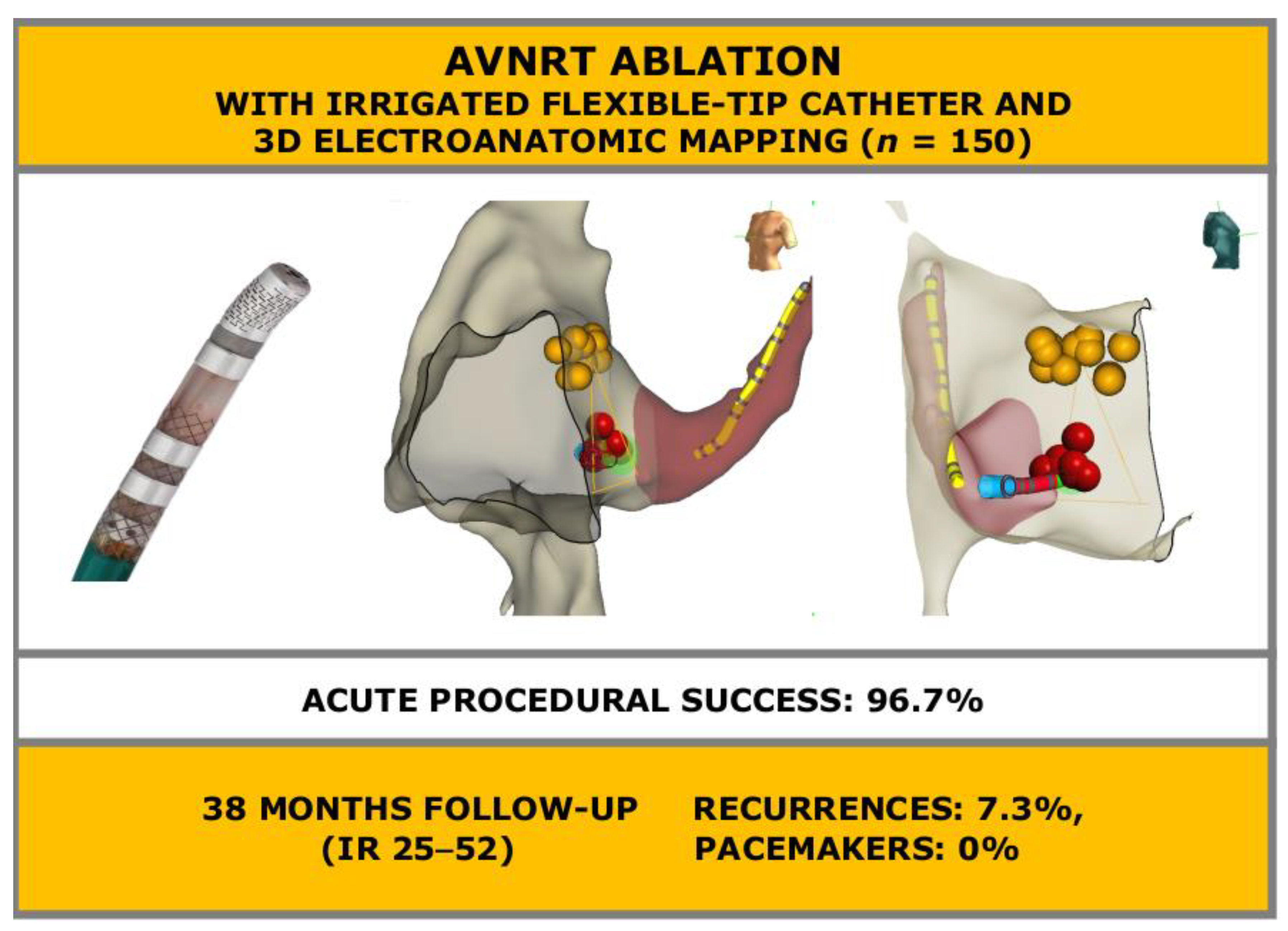

Ablation of Atrioventricular Nodal Re-Entrant Tachycardia Combining Irrigated Flexible-Tip Catheters and Three-Dimensional Electroanatomic Mapping: Long-Term Outcomes

 ,
,  , , and
Abstract
Share and Cite
Malagù, M.; Vitali, F.; Marchini, F.; Fiorio, A.; Sirugo, P.; Mele, D.; Brieda, A.; Balla, C.; Bertini, M. Ablation of Atrioventricular Nodal Re-Entrant Tachycardia Combining Irrigated Flexible-Tip Catheters and Three-Dimensional Electroanatomic Mapping: Long-Term Outcomes. J. Cardiovasc. Dev. Dis. 2021, 8, 61. https://doi.org/10.3390/jcdd8060061
Malagù M, Vitali F, Marchini F, Fiorio A, Sirugo P, Mele D, Brieda A, Balla C, Bertini M. Ablation of Atrioventricular Nodal Re-Entrant Tachycardia Combining Irrigated Flexible-Tip Catheters and Three-Dimensional Electroanatomic Mapping: Long-Term Outcomes. Journal of Cardiovascular Development and Disease. 2021; 8(6):61. https://doi.org/10.3390/jcdd8060061
Chicago/Turabian StyleMalagù, Michele, Francesco Vitali, Federico Marchini, Alessio Fiorio, Paolo Sirugo, Daniela Mele, Alessandro Brieda, Cristina Balla, and Matteo Bertini. 2021. "Ablation of Atrioventricular Nodal Re-Entrant Tachycardia Combining Irrigated Flexible-Tip Catheters and Three-Dimensional Electroanatomic Mapping: Long-Term Outcomes" Journal of Cardiovascular Development and Disease 8, no. 6: 61. https://doi.org/10.3390/jcdd8060061
APA StyleMalagù, M., Vitali, F., Marchini, F., Fiorio, A., Sirugo, P., Mele, D., Brieda, A., Balla, C., & Bertini, M. (2021). Ablation of Atrioventricular Nodal Re-Entrant Tachycardia Combining Irrigated Flexible-Tip Catheters and Three-Dimensional Electroanatomic Mapping: Long-Term Outcomes. Journal of Cardiovascular Development and Disease, 8(6), 61. https://doi.org/10.3390/jcdd8060061