Review

Lifestyle and Pharmacological Interventions to Prevent Anthracycline-Related Cardiotoxicity in Cancer Patients


by
Luigi Spadafora
1,2,*,
Francesca Maria Di Muro
3,
Chiara Intonti
4,
Ludovica Massa
5,
Mauro Monelli
6,
Roberto Franco Enrico Pedretti
7,8,
Edvige Palazzo Adriano
6,
Pasquale Guarini
9,10,
Gaia Cantiello
1,
Marco Bernardi
1,2,
Federico Russo
11,
Stefano Cacciatore
12,13,
Pierre Sabouret
14,
Michele Golino
15,
Giuseppe Biondi Zoccai
1,16,
Francesca Romana Zimatore
17 and
Laura Adelaide Dalla Vecchia
6,*
1
Department of Medical-Surgical Sciences and Biotechnologies, Sapienza University of Rome, 04100 Latina, Italy
2
Division of Cardiology and Interventional Cardiology, Santa Maria Goretti Hospital, 04100 Latina, Italy
3
Department of Medicine, Surgery and Dentistry, University of Salerno, Baronissi, Salvador Allende Street 43, 84081 Salerno, Italy
4
Department of Clinical, Internal Medicine, Anesthesiology and Cardiovascular Sciences, Sapienza University of Rome, 00161 Rome, Italy
5
Department of Biomedical Sciences and Community Health, University of Milan, Via Mangiagalli 31, 20133 Milan, Italy
6
Department of Cardiology, IRCCS Istituti Clinici Scientifici Maugeri, 20138 Milan, Italy
7
School of Medicine and Surgery, University of Milano Bicocca, 20216 Milan, Italy
8
Cardiology Unit, Hospital of Erba, 22036 Erba, Italy
9
UO Cardiologia, Clinica Sanatrix, 80127 Naples, Italy
10
Centro Studi SICOA, 80127 Naples, Italy
11
Department of Clinical and Molecular Medicine, Sapienza University of Rome, 00185 Rome, Italy
12
Department of Geriatrics, Orthopedics, and Rheumatology, Università Cattolica del Sacro Cuore, L.go F. Vito 1, 00168 Rome, Italy
13
Fondazione Policlinico Universitario “Agostino Gemelli” IRCCS, L.go A. Gemelli 8, 00168 Rome, Italy
14
Heart Institute and Action Group, Pitié-Salpétrière, Sorbonne University, 75013 Paris, France
15
VCU Pauley Heart Center, Virginia Commonwealth University, Richmond, VA 23298, USA
16
Maria Cecilia Hospital, GVM Care & Research, 48033 Cotignola, Italy
17
Cardiovascular Diseases Residency Program, Azienda Ospedaliera Universitaria Integrata di Verona, 37126 Verona, Italy
*
Authors to whom correspondence should be addressed.
J. Cardiovasc. Dev. Dis. 2025, 12(6), 212; https://doi.org/10.3390/jcdd12060212
Submission received: 17 March 2025 / Revised: 26 May 2025 / Accepted: 29 May 2025 / Published: 4 June 2025
(This article belongs to the Section Epidemiology, Lifestyle, and Cardiovascular Health)

Abstract

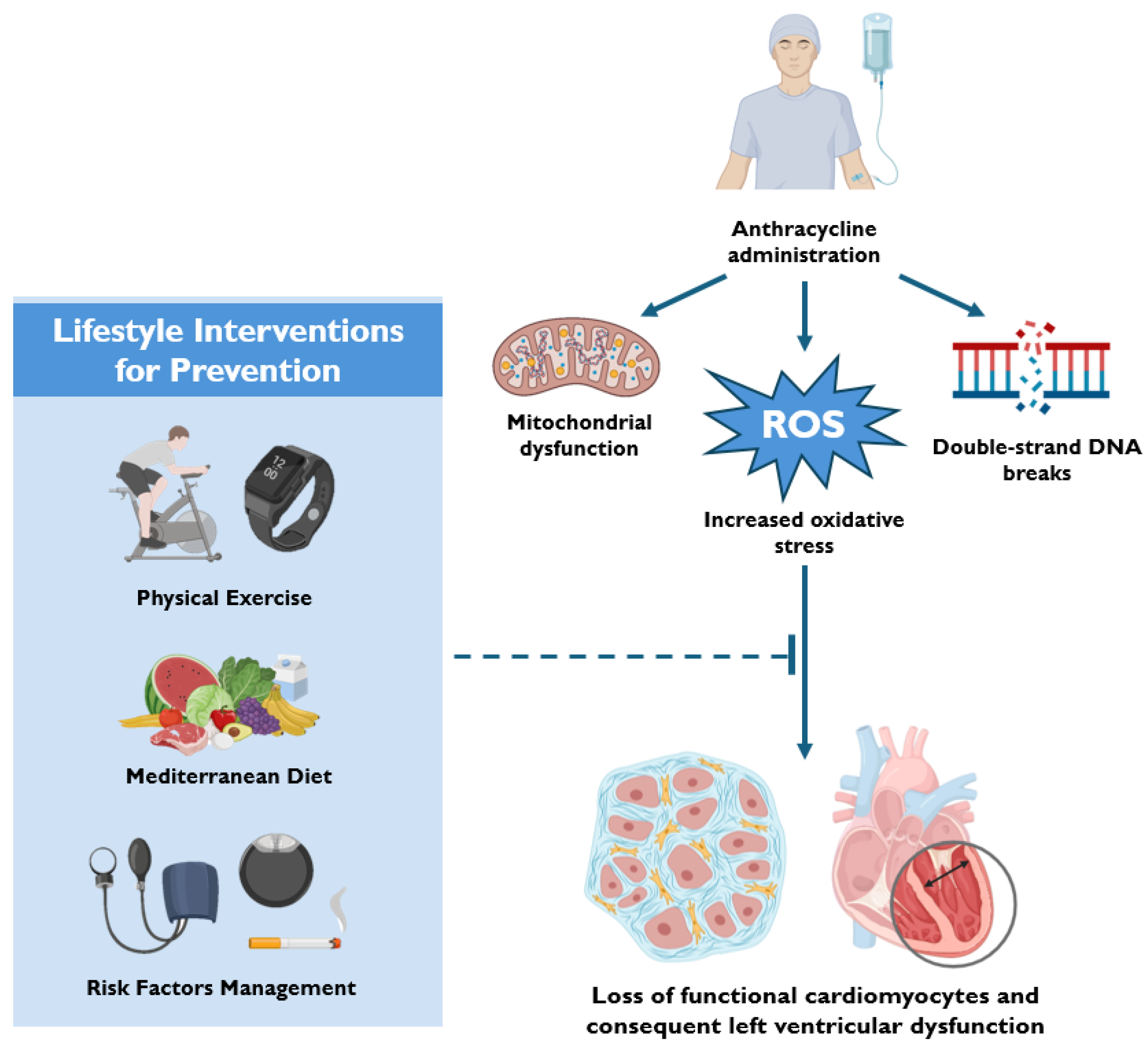
Anthracyclines remain a cornerstone of cancer therapy but are associated with a significant risk of cardiotoxicity, which can lead to overt heart failure. The risk is modulated by cumulative dose, pre-existing cardiovascular disease, and patient-specific factors. As cancer survival improves, the long-term cardiovascular consequences of anthracycline exposure have become a growing concern, underscoring the need for effective preventive strategies. This narrative review examines lifestyle and pharmacological interventions aimed at mitigating anthracycline-induced cardiotoxicity. Evidence suggests that structured exercise programs and antioxidant-rich diets may enhance cardiovascular resilience, while beta-blockers, renin-angiotensin system inhibitors, and dexrazoxane remain central pharmacological options. Emerging therapies, including sodium-glucose co-transporter 2 inhibitors and sacubitril/valsartan, show promise but require further investigation. A comprehensive approach that integrates lifestyle modifications with pharmacological strategies within a multidisciplinary cardio-oncology framework may provide optimal protection, improving long-term cardiovascular outcomes in cancer patients receiving anthracyclines.
Keywords: anthracyclines; anthracycline-induced cardiotoxicity; prevention; exercise; pharmacological strategies; cardio-oncology; cardiac rehabilitation; cardiac pre-habilitation anthracyclines; anthracycline-induced cardiotoxicity; prevention; exercise; pharmacological strategies; cardio-oncology; cardiac rehabilitation; cardiac pre-habilitation