
Advancing Minimally Invasive Mitral Valve Surgery: Early Outcomes of a Total Endoscopic 2D and 3D Approach

 ,
,  , , ,
, , ,  and
and
Abstract
1. Introduction
2. Materials and Methods
2.1. Study Population
2.2. Operative Strategy
2.3. Statistical Analysis
3. Results
3.1. Patients’ Characteristics
3.2. Intraoperative Characteristics
3.3. In-Hospital Outcomes
3.4. Risk Factor Analysis
4. Discussion
- -
- development of multicenter registries to validate predictors of AF and transfusion in heterogeneous populations;
- -
- standardized reporting of surgeon experience to refine learning-curve models;
- -
- prospective randomized or cluster-randomized comparisons of robotic-assisted versus totally endoscopic MVR;
- -
- dedicated evaluation of 3D versus 2D endoscopy regarding precision, operative efficiency, and clinical outcomes.
Limitations
5. Conclusions
Author Contributions
Funding
Institutional Review Board Statement
Informed Consent Statement
Data Availability Statement
Acknowledgments
Conflicts of Interest
References
- Iung, B.; Baron, G.; Butchart, E.G.; Delahaye, F.; Gohlke-Bärwolf, C.; Levang, O.W.; Tornos, P.; Vanoverschelde, J.-L.; Vermeer, F.; Boersma, E.; et al. A prospective survey of patients with valvular heart disease in Europe: The Euro Heart Survey on Valvular Heart Disease. Eur. Heart J. 2003, 24, 1231–1243. [Google Scholar] [CrossRef] [PubMed]
- Vahanian, A.; Beyersdorf, F.; Praz, F.; Milojevic, M.; Baldus, S.; Bauersachs, J.; Capodanno, D.; Conradi, L.; De Bonis, M.; De Paulis, R.; et al. ESC/EACTS Scientific Document Group. 2021 ESC/EACTS Guidelines for the management of valvular heart disease. Eur. Heart J. 2022, 43, 561–632, Erratum in: Eur. Heart J. 2022. [Google Scholar] [CrossRef] [PubMed]
- Praz, F.; Borger, M.A.; Lanz, J.; Marin-Cuartas, M.; Abreu, A.; Adamo, M.; Marsan, N.A.; Barili, F.; Bonaros, N.; Cosyns, B.; et al. ESC/EACTS Scientific Document Group. 2025 ESC/EACTS Guidelines for the management of valvular heart disease. Eur. Heart J. 2025, 46, 4635–4736. [Google Scholar] [CrossRef] [PubMed]
- Lazam, S.; Vanoverschelde, J.L.; Tribouilloy, C.; Grigioni, F.; Suri, R.M.; Avierinos, J.F.; de Meester, C.; Barbieri, A.; Rusinaru, D.; Russo, A.; et al. MIDA Investigators. Twenty-year outcome after mitral repair versus replacement for severe degenerative mitral regurgitation: Analysis of a large, prospective, multicenter, international registry. Circulation 2017, 135, 410–422. [Google Scholar] [CrossRef]
- Akowuah, E.F.; Maier, R.H.; Hancock, H.C.; Kharatikoopaei, E.; Vale, L.; Fernandez-Garcia, C.; Ogundimu, E.; Wagnild, J.; Mathias, A.; Walmsley, Z.; et al. Minithoracotomy vs Conventional Sternotomy for Mitral Valve Repair: A Randomized Clinical Trial. JAMA 2023, 329, 1957–1966. [Google Scholar] [CrossRef]
- Olsthoorn, J.R.; Heuts, S.; Houterman, S.; Maessen, J.G.; Nia, P.S.; the Cardiothoracic Surgery Registration Committee of the Netherlands Heart Registration. Effect of minimally invasive mitral valve surgery compared to sternotomy on short- and long-term outcomes: A retrospective multicentre interventional cohort study based on Netherlands Heart Registration. Eur. J. Cardio-Thoracic Surg. 2022, 61, 1099–1106. [Google Scholar] [CrossRef] [PubMed]
- Speziale, G.; Nasso, G.; Esposito, G.; Conte, M.; Greco, E.; Fattouch, K.; Fiore, F.; Del Giglio, M.; Coppola, R.; Tavazzi, L. Results of mitral valve repair for Barlow disease (bileaflet prolapse) via right minithoracotomy versus conventional median sternotomy: A randomized trial. J. Thorac. Cardiovasc. Surg. 2011, 142, 77–83. [Google Scholar] [CrossRef]
- Cardiocentro, N.M.; Maselli, D.; Nardella, S.; Santise, G.; Iavazzo, A.; Chiariello, L. Micro-Invasive 3D Endoscopic Mitral Valve Surgery. Surg. Technol. Online 2022, 40, 227–234. [Google Scholar] [CrossRef]
- Fiorentino, M.; Mikus, E.; Sangiorgi, D.; Tripodi, A.; Calvi, S.; Tenti, E.; Costantino, A.; Savini, C. Does Body Mass Index Impact Outcomes in Patients Undergoing Minimally Invasive Mitral Valve Surgery? Medicina 2025, 61, 903. [Google Scholar] [CrossRef]
- Fiorentino, M.; Mikus, E.; Sangiorgi, D.; Calvi, S.; Costantino, A.; Tenti, E.; Tripodi, A.; Savini, C. Minimally Invasive Mitral Valve Surgery in Patients Aged ≥75 Years: An Expanding Standard of Care. J. Clin. Med. 2025, 14, 5798. [Google Scholar] [CrossRef] [PubMed]
- Jiang, Q.; Yu, T.; Huang, K.; Liu, L.; Zhang, X.; Hu, S. Feasibility, safety, and short-term outcome of totally thoracoscopic mitral valve procedure. J. Cardiothorac. Surg. 2018, 13, 133. [Google Scholar] [CrossRef]
- Cheng, L.; Zhu, H.; Xing, W.; Fu, M.; Ke, Y. Minimal Invasive Thoracoscopic Mitral Valve Surgery. Rev. Bras. Cir. Cardiovasc. 2022, 37, 688–693. [Google Scholar] [CrossRef]
- Fan, H.; Ming, Q.X.; Min, Z.W.; Dong, C.H. Comparison of Totally Thoracoscopic and Traditional Sternotomy Approaches for Mitral Valve Replacement. Hear. Surg. Forum 2019, 22, E310–E314. [Google Scholar] [CrossRef]
- Liu, J.; Chen, B.; Zhang, Y.-Y.; Fang, L.-Z.; Xie, B.; Huang, H.-L.; Liu, J.; Lu, C.; Gu, W.-D.; Chen, Z.; et al. Mitral valve replacement via minimally invasive totally thoracoscopic surgery versus traditional median sternotomy: A propensity score matched comparative study. Ann. Transl. Med. 2019, 7, 341. [Google Scholar] [CrossRef] [PubMed]
- Pojar, M.; Karalko, M.; Dergel, M.; Vojacek, J. Minimally invasive or sternotomy approach in mitral valve surgery: A propensity-matched comparison. J. Cardiothorac. Surg. 2021, 16, 228. [Google Scholar] [CrossRef] [PubMed]
- Al Shamry, A.; Jegaden, M.; Ashafy, S.; Eker, A.; Jegaden, O. Minithoracotomy versus sternotomy in mitral valve surgery: Meta-analysis from recent matched and randomized studies. J. Cardiothorac. Surg. 2023, 18, 101. [Google Scholar] [CrossRef]
- Ascaso, M.; Sandoval, E.; Muro, A.; Barriuso, C.; Quintana, E.; Alcocer, J.; Sitges, M.; Vidal, B.; Pomar, J.-L.; Castellà, M.; et al. Repair of mitral prolapse: Comparison of thoracoscopic minimally invasive and conventional approaches. Eur. J. Cardio-Thoracic Surg. 2023, 64, ezad235. [Google Scholar] [CrossRef]
- Eikelboom, R.; Sanjanwala, R.; Le, M.-L.; Yamashita, M.H.; Arora, R.C. Postoperative Atrial Fibrillation After Cardiac Surgery: A Systematic Review and Meta-Analysis. Ann. Thorac. Surg. 2021, 111, 544–554. [Google Scholar] [CrossRef]
- Alghosoon, H.; Arafat, A.A.; Albabtain, M.A.; Alsubaie, F.F.; Alangari, A.S. Long-Term Effects of Postoperative Atrial Fibrillation following Mitral Valve Surgery. J. Cardiovasc. Dev. Dis. 2023, 10, 302. [Google Scholar] [CrossRef] [PubMed]
- Amar, D.; Zhang, H.; Leung, D.H.Y.; Roistacher, N.; Kadish, A.H. Older Age Is the Strongest Predictor of Postoperative Atrial Fibrillation. Anesthesiology 2002, 96, 352–356. [Google Scholar] [CrossRef]
- Kodaka, M.; Ichikawa, J.; Komori, M. Relationship between perioperative cardiopulmonary bypass time, platelet count, fibrinogen level, rotational thromboelastometry data, antithrombin level, and blood loss volume and the effects of deep hypothermic circulatory arrest: An observational study. Perfusion 2024, 39, 816–822. [Google Scholar] [CrossRef] [PubMed]
- Kontar, L.; Beaubien-Souligny, W.; Couture, E.J.; Jacquet-Lagrèze, M.; Lamarche, Y.; Levesque, S.; Babin, D.; Denault, A.Y. Prolonged cardiovascular pharmacological support and fluid management after cardiac surgery. PLoS ONE 2023, 18, e0285526. [Google Scholar] [CrossRef]
- Messner, B.; Bernhard, D. Smoking and cardiovascular disease: Mechanisms of endothelial dysfunction and early atherogenesis. Arterioscler. Thromb. Vasc. Biol. 2014, 34, 509–515. [Google Scholar] [CrossRef]
- Räsänen, J.; Ellam, S.; Hartikainen, J.; Juutilainen, A.; Halonen, J. Sex Differences in Red Blood Cell Transfusions and 30-Day Mortality in Cardiac Surgery: A Single Center Observational Study. J. Clin. Med. 2023, 12, 7674. [Google Scholar] [CrossRef]
- Doenst, T.; Berretta, P.; Nguyen, T.C.; Bonaros, N.; Gerdisch, M.; Rinaldi, M.; Kempfert, J.; Lamelas, J.; Van Praet, F.; Yan, T.; et al. Endoscopic and direct vision approaches in minimally-invasive mitral and tricuspid valve surgery—Insights from the mini-mitral registry. J. Cardiothorac. Surg. 2025, 20, 448. [Google Scholar] [CrossRef]
- Berretta, P.; Pitsis, A.; Kempfert, J.; Van Praet, F.; Yan, T.; Rinaldi, M.; Salvador, L.; Lamelas, J.; Nguyen, T.C.; Doenst, T.; et al. Endoscopic mitral valve surgery: Picture from the real world—Sub-analysis from the Mini-Mitral International Registry. J. Vis. Surg. 2025, 11, 17. [Google Scholar] [CrossRef]
- Vo, A.T.; Nguyen, D.H.; Van Hoang, S.; Le, K.M.; Nguyen, T.T.; Nguyen, V.L.; Nguyen, B.H.; Truong, B.Q. Learning curve in minimally invasive mitral valve surgery: A single-center experience. J. Cardiothorac. Surg. 2019, 14, 213. [Google Scholar] [CrossRef]
- Ko, K.; Verhagen, A.F.T.M.; de Kroon, T.L.; Morshuis, W.J.; van Garsse, L.A.F.M. Decision Making during the Learning Curve of Minimally Invasive Mitral Valve Surgery: A Focused Review for the Starting Minimally Invasive Surgeon. J. Clin. Med. 2022, 11, 5993. [Google Scholar] [CrossRef] [PubMed]
- De Jesus, J.; Estrella, J.; Jesse, J.; Binny, V.; Parthasarathy, P.S.R.; Kabir, Y.M.; Nallamotu, S.M.; Guntupalli, S.V.M.; Cai, L.Y.; Al-Tawil, M. Robotic Versus Thoracoscopic Minimally Invasive Mitral Valve Surgery: A Systematic Review and Meta-Analysis of Matched Studies. Cardiol. Rev. 2024. [Google Scholar] [CrossRef]
- Wei, S.; Zhang, X.; Cui, H.; Zhang, L.; Gong, Z.; Li, L.; Ren, T.; Gao, C.; Jiang, S. Comparison of clinical outcomes between robotic and thoracoscopic mitral valve repair. Cardiovasc. Diagn. Ther. 2020, 10, 1167–1174. [Google Scholar] [CrossRef]



| Pre-Operative Characteristics | |
|---|---|
| n | 239 |
| Sex, male, n (%) | 154 (64.4) |
| Age, median (Q1–Q3) | 63 (55–69) |
| BMI, median (Q1–Q3) | 24.2 (21.9–26.2) |
| Hypertension, n (%) | 112 (46.9) |
| Diabetes, n (%) | 9 (3.8) |
| Dyslipidemia, n (%) | 102 (42.7) |
| Smoking, n (%) | 96 (40.1) |
| Chronic lung disease, n (%) | 10 (4.2) |
| Preoperative Atrial Fibrillation, n (%) | 43 (17.6) |
| Previous Pacemaker, n (%) | 1 (0.4) |
| NYHA class n (%) (n, %) | |
| - I | 86 (36) |
| - II | 130 (54.4) |
| - III | 22 (9.2) |
| - IV | 1 (0.4) |
| Acute heart failure n (%) (n, %) | 7 (2.9) |
| Previous stroke n (%) (n, %) | 2 (0.8) |
| Previous myocardial infarction n (%) | 2 (0.8) |
| Creatinine, mg/dL, median (Q1–Q3) | 0.89 (0.78–1.00) |
| Renal Impairment (GFR < 40 mL/min) n (%) (n, %) | 39 (16.3) |
| Previous cardiac surgery, n (%) | 0 (0.0) |
| Infective endocarditis, n (%) | 6 (2.5) |
| Systolic pulmonary artery pressure, median (Q1–Q3) | 30 (25–37) |
| Pulmonary hypertension (PAPs > 30 mmHg) | 114 (47.7) |
| EuroSCORE logistic, median (Q1–Q3) | 2.53 (1.72–4.90) |
| EuroSCORE II, median (Q1–Q3) | 0.83 (0.61–1.25) |
| Intra-Operative Characteristics | |
|---|---|
| n | 239 |
| Annuloplasty, n (%) | 237 (99.2) |
| Ring, n (%) | 230 (96.2) |
| Band, n (%) | 2 (0.8) |
| Pericardium, n (%) | 5 (2.1) |
| Gore-Tex chordae implantation, n (%) | 188 (78.6) |
| Posterior leaflet resection, n (%) | 15 (6.3) |
| Edge-to-edge suturing, n (%) | 28 (11.7) |
| Concomitant procedures, n (%) | 39 (16.3) |
| PFO closure, n (%) | 25 (10.5) |
| Left atrial appendage exclusion, n (%) | 12 (5) |
| Tricuspid valve repair, n (%) | 11 (4.6) |
| Mitral repair failures, n (%) | 0 (0) |
| Cross-Clamp time, median (Q1–Q3) | 114 (100–133) |
| CPB time, median (Q1–Q3) | 175 (155–196) |
| In Hospital Outcomes | |
|---|---|
| n | 239 |
| Postoperative inotropic support, n (%) | 13 (5.4) |
| IAPB support, n (%) | 4 (1.7) |
| Postoperative troponin peak, median (Q1–Q3) | 897 (648–1380) |
| Post-operative Atrial Fibrillation, n (%) | 64 (26.8) |
| Pacemaker implantation, n (%) | 2 (0.8) |
| Stroke, n (%) | 1 (0.4) |
| Perioperative myocardial infarction, n (%) | 6 (2.5) |
| Re-exploration for bleeding, n (%) | 9 (3.8) |
| Sepsis, n (%) | 5 (2.1) |
| Multi Organ Failure, n (%) | 3 (1.3) |
| Postoperative creatinine peak, median (Q1–Q3) | 0.92 (0.79–1.15) |
| Dialysis, n (%) | 3 (1.3) |
| Ventilation time, median (Q1–Q3) | 5 (4–7.5) |
| Intubation > 24 h or reintubation, n (%) | 5 (2.1) |
| Tracheostomy, n (%) | 2 (0.8) |
| Re-exploration for bleeding, n (%) | 9 (3.8) |
| Patients requiring RBC transfusions, n (%) | 94 (39.3) |
| In-hospital mortality, n (%) | 3 (1.3) |
| ICU days, median (Q1–Q3) | 2 (2–2) |
| LOS days, median (Q1–Q3) | 7 (7–8) |
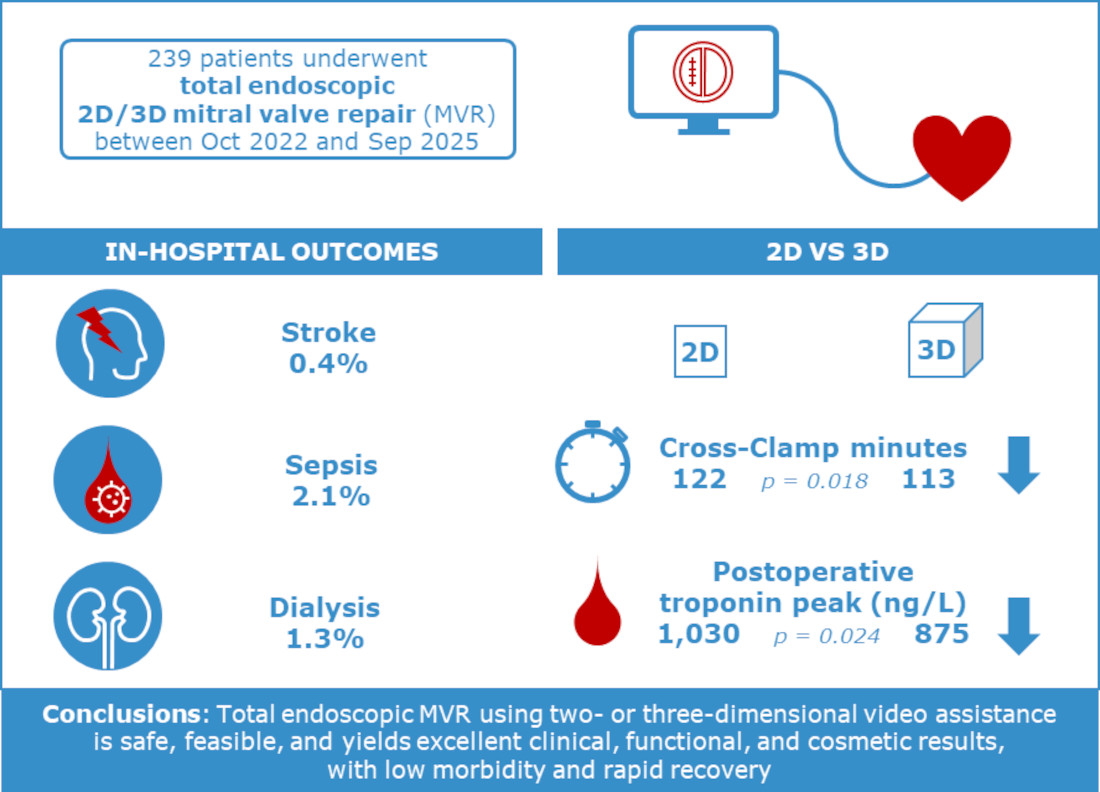
| 2D | 3D | p | |
|---|---|---|---|
| n | 62 | 177 | |
| Cross-Clamp time median (Q1–Q3) | 122 (106, 141) | 113 (99, 131) | 0.018 |
| CPB time, median (Q1–Q3) | 180 (157, 196) | 174 (153, 195) | 0.350 |
| Postoperative inotropic support, n (%) | 4 (6.5) | 9 (5.1) | 0.746 |
| IAPB support, n (%) | 2 (3.2) | 2 (1.1) | 0.277 |
| Postoperative troponin peak, median (Q1–Q3) | 1030 (760, 1518) | 875 (619, 1371) | 0.024 |
| Post-operative Atrial Fibrillation, n (%) | 16 (25.8) | 48 (27.1) | 1.000 |
| Pacemaker implantation, n (%) | 0 (0.0) | 2 (1.1) | 1.000 |
| Stroke, n (%) | 1 (1.6) | 0 (0.0) | 0.259 |
| Perioperative myocardial infarction, n (%) | 3 (4.8) | 3 (1.7) | 0.240 |
| Re-exploration for bleeding, n (%) | 4 (6.5) | 5 (2.8) | 0.243 |
| Sepsis, n (%) | 2 (3.2) | 3 (1.7) | 0.607 |
| Multi Organ Failure, n (%) | 1 (1.6) | 2 (1.1) | 1.000 |
| Postoperative creatinine peak, median (Q1–Q3) | 0.90 (0.76, 1.05) | 0.93 (0.80, 1.17) | 0.103 |
| Dialysis, n (%) | 0 (0.0) | 3 (1.7) | 0.570 |
| Ventilation time, median (Q1–Q3) | 5 (4, 6) | 5 (4, 8) | 0.410 |
| Intubation > 24 h or reintubation, n (%) | 1 (1.6) | 3 (1.7) | 1.000 |
| Tracheostomy, n (%) | 0 (0.0) | 2 (1.1) | 1.000 |
| Re-exploration for bleeding, n (%) | 4 (6.5) | 5 (2.8) | 0.243 |
| Patients requiring RBC transfusions, n (%) | 20 (32.3) | 74 (41.8) | 0.227 |
| In-hospital mortality, n (%) | 1 (1.6) | 2 (1.1) | 1.000 |
| ICU days, median (Q1–Q3) | 2 (2, 2) | 2 (2, 3) | 0.001 |
| LOS days, median (Q1–Q3) | 7 (7, 8) | 7 (7, 8) | 0.215 |
Disclaimer/Publisher’s Note: The statements, opinions and data contained in all publications are solely those of the individual author(s) and contributor(s) and not of MDPI and/or the editor(s). MDPI and/or the editor(s) disclaim responsibility for any injury to people or property resulting from any ideas, methods, instructions or products referred to in the content. |
© 2025 by the authors. Licensee MDPI, Basel, Switzerland. This article is an open access article distributed under the terms and conditions of the Creative Commons Attribution (CC BY) license (https://creativecommons.org/licenses/by/4.0/).
Share and Cite
Savini, C.; Fiorentino, M.; Sangiorgi, D.; Calvi, S.; Costantino, A.; Tenti, E.; Mikus, E. Advancing Minimally Invasive Mitral Valve Surgery: Early Outcomes of a Total Endoscopic 2D and 3D Approach. J. Cardiovasc. Dev. Dis. 2025, 12, 501. https://doi.org/10.3390/jcdd12120501
Savini C, Fiorentino M, Sangiorgi D, Calvi S, Costantino A, Tenti E, Mikus E. Advancing Minimally Invasive Mitral Valve Surgery: Early Outcomes of a Total Endoscopic 2D and 3D Approach. Journal of Cardiovascular Development and Disease. 2025; 12(12):501. https://doi.org/10.3390/jcdd12120501
Chicago/Turabian StyleSavini, Carlo, Mariafrancesca Fiorentino, Diego Sangiorgi, Simone Calvi, Antonino Costantino, Elena Tenti, and Elisa Mikus. 2025. "Advancing Minimally Invasive Mitral Valve Surgery: Early Outcomes of a Total Endoscopic 2D and 3D Approach" Journal of Cardiovascular Development and Disease 12, no. 12: 501. https://doi.org/10.3390/jcdd12120501
APA StyleSavini, C., Fiorentino, M., Sangiorgi, D., Calvi, S., Costantino, A., Tenti, E., & Mikus, E. (2025). Advancing Minimally Invasive Mitral Valve Surgery: Early Outcomes of a Total Endoscopic 2D and 3D Approach. Journal of Cardiovascular Development and Disease, 12(12), 501. https://doi.org/10.3390/jcdd12120501