


Article

Comparison of Feed Digestibility between Ponies, Standardbreds and Andalusian Horses Fed Three Different Diets

by
Samantha J. Potter
1,
Nicholas J. Bamford
1,*,
Courtnay L. Baskerville
1,
Patricia A. Harris
2 and
Simon R. Bailey
1
1
Faculty of Veterinary and Agricultural Sciences, The University of Melbourne, Parkville, VIC 3052, Australia
2
Waltham Petcare Science Institute, Melton Mowbray LE14 4RT, Leicestershire, UK
*
Author to whom correspondence should be addressed.
Vet. Sci. 2022, 9(1), 15; https://doi.org/10.3390/vetsci9010015
Submission received: 19 November 2021 / Revised: 22 December 2021 / Accepted: 30 December 2021 / Published: 31 December 2021

Abstract

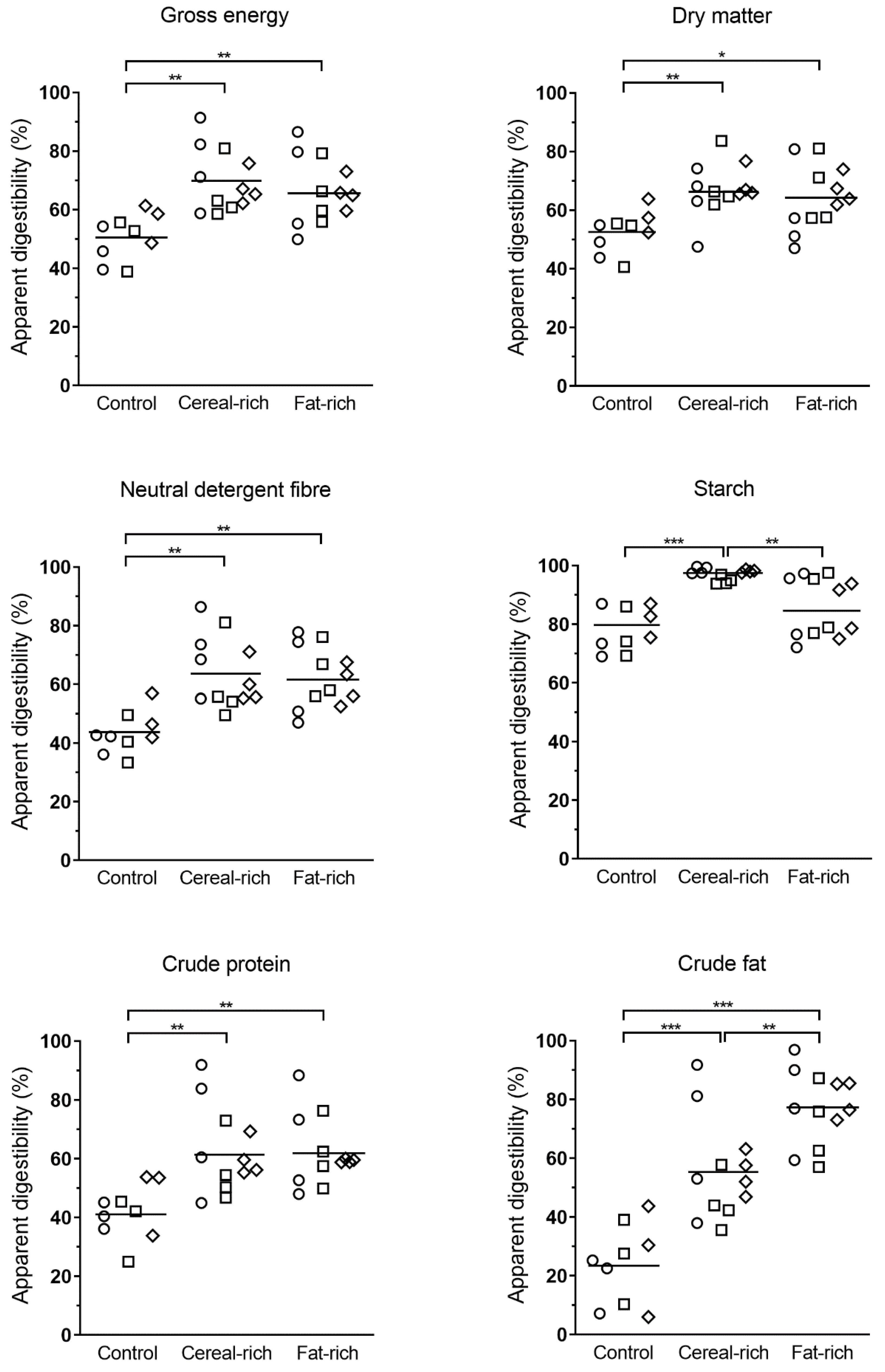
Ponies and some horse breeds such as Andalusians exhibit an ‘easy keeper’ phenotype and tend to become obese more readily than other breeds such as Standardbreds. Various hypotheses have been proposed, including differences in appetite or metabolic efficiency. This study aimed to investigate the effect of breed on nutrient digestibility. Ponies, Standardbreds and Andalusian horses were adapted to consuming either a control fibre-based diet (n = 9), a hypercaloric cereal-rich diet (n = 12) or a hypercaloric fat-rich diet (n = 12) over 20 weeks. Total faecal collection was performed over 24 h to determine apparent total tract digestibility of gross energy, dry matter (DM), neutral detergent fibre (NDF), starch, crude protein and crude fat. There was no effect of breed on apparent digestibility for any of the nutrients studied (all p > 0.05). However, there was a significant effect of diet, with animals consuming the cereal-rich or fat-rich diets demonstrating higher digestibility of gross energy, DM, NDF and crude protein compared with those consuming the control diet (all p < 0.05). Animals adapted to the cereal-rich diet demonstrated higher digestibility of starch (p < 0.001) and animals adapted to the fat-rich diet demonstrated higher digestibility of fat (p < 0.001). This study found that horses and ponies had similar nutrient digestibility when adapted to the same diets and management conditions. Limitations included the relatively small number of animals from each breed per diet group and the short period of total faecal collection. The tendency towards increased adiposity in ponies and Andalusian-type horse breeds is more likely to reflect differences in metabolism, rather than differences in feed digestibility.
Keywords: digestibility; equine; insulin dysregulation; laminitis; nutrition; obesity digestibility; equine; insulin dysregulation; laminitis; nutrition; obesity

