
Computational Identification of Natural Inhibitors Targeting Fiber Proteins of FAdV-1 and FAdV-4 Through Integrated Virtual Screening and Molecular Dynamics Simulations
 ,
, 
Simple Summary
Abstract
1. Introduction
2. Materials and Methods
2.1. Databasess Preparation
2.2. Proteins Preparation
2.3. Molecular Docking
2.4. Pharmacokinetic Properties and Drug-likeness
2.5. Molecular Dynamic Simulation
3. Results
3.1. Virtual Screening and Molecular Docking
3.2. Drug Metabolism and Toxicity Profiling
3.3. Molecular Dynamic Simulation
3.3.1. Root Mean Square Deviation
3.3.2. Root Mean Square Fluctuation
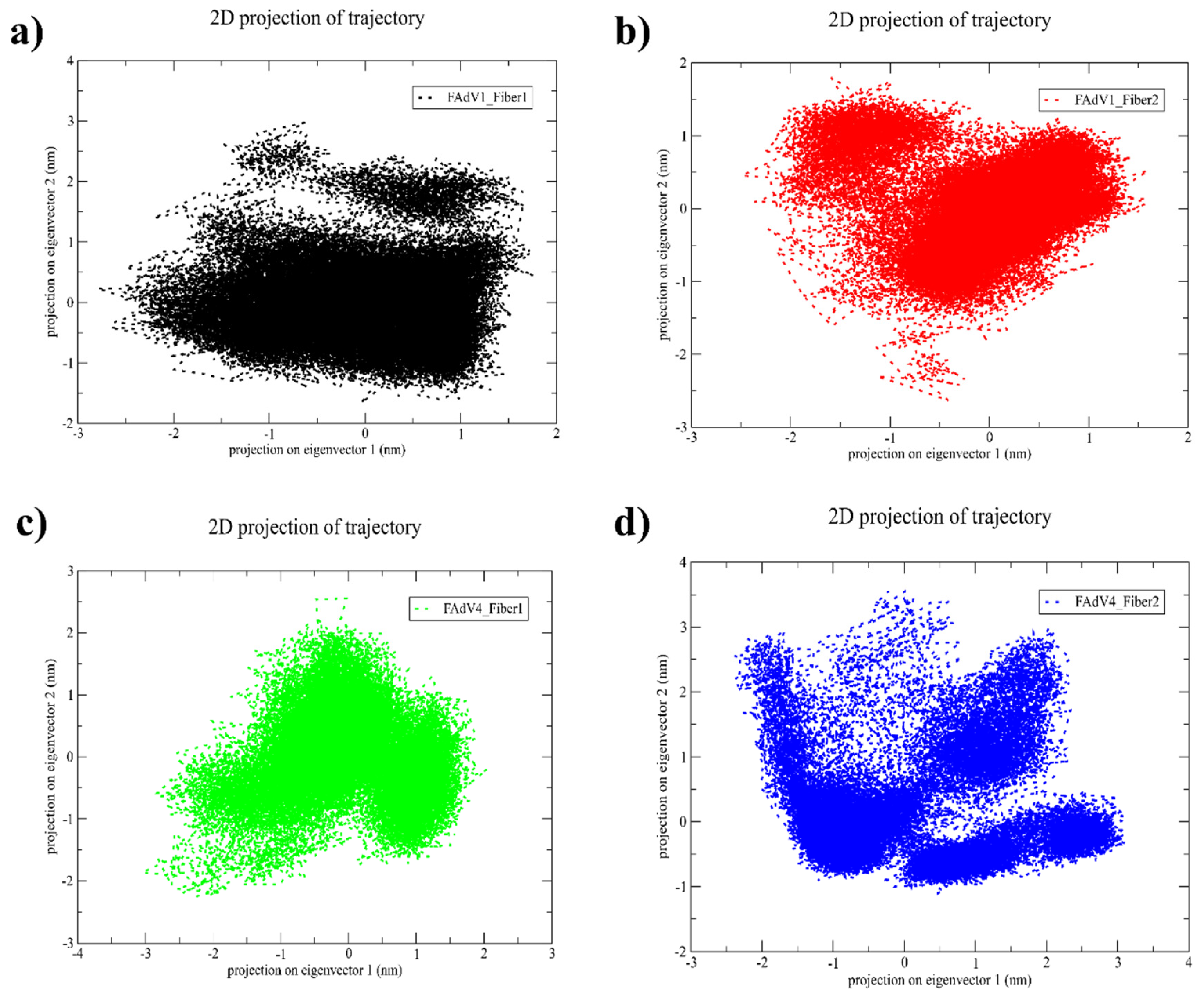
3.3.3. Two-Dimensional Principal Component Projection
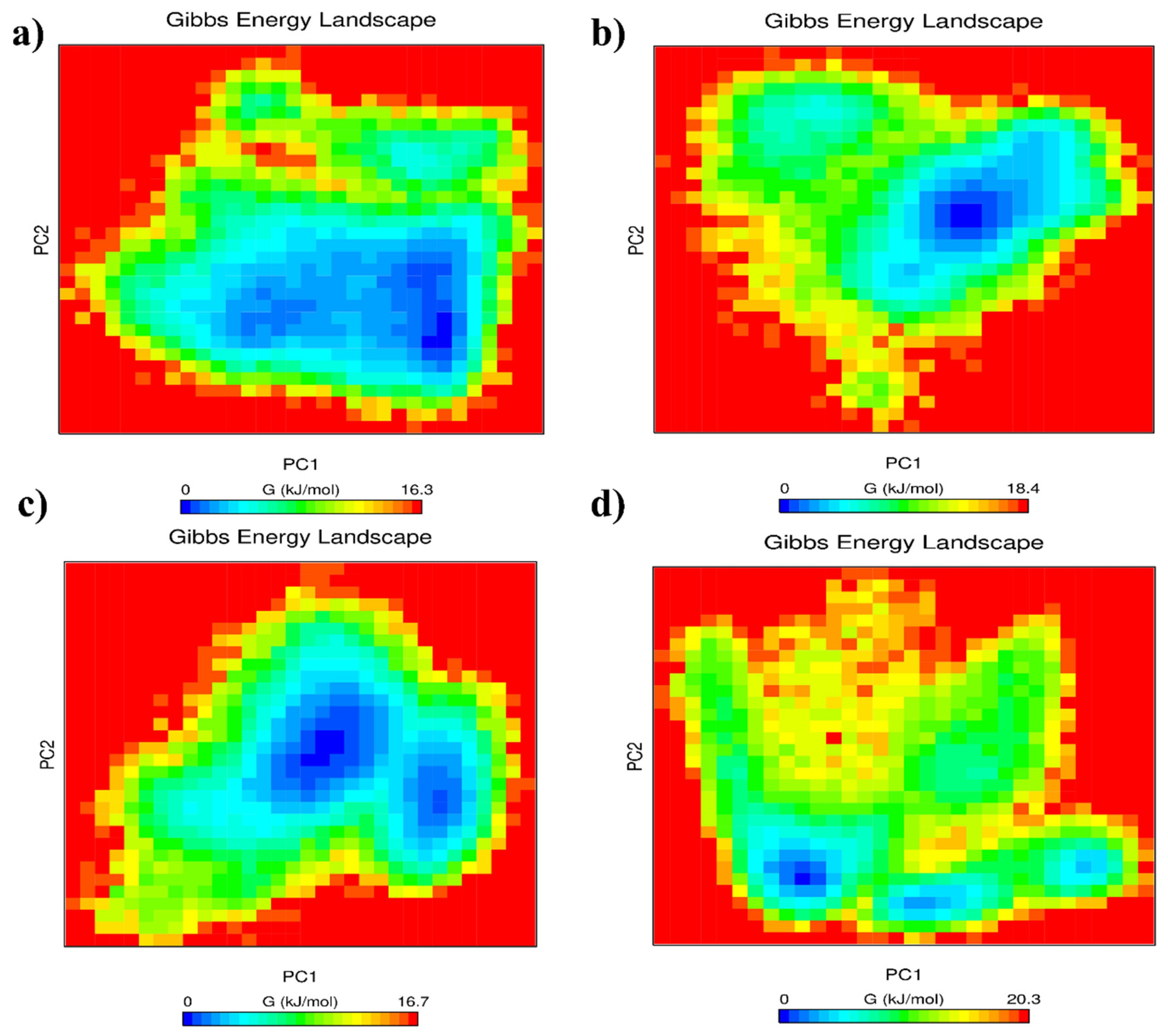
3.3.4. Gibbs Free Energy Landscape Analysis
4. Discussion
5. Conclusions and Perspective
Supplementary Materials
Author Contributions
Funding
Institutional Review Board Statement
Informed Consent Statement
Data Availability Statement
Acknowledgments
Conflicts of Interest
References
- Kardoudi, A.; Siham, F.; Abdelmounaaim, A.; Faouzi, K.; Ikram, O.; Thomas, J.; Abdelouaheb, B. A snapshot on molecular technologies for diagnosing FAdV infections. Front. Vet. Sci. 2025, 12, 1558257. [Google Scholar] [CrossRef]
- Meulemans, G.; Boschmans, M.; Van Den Berg, T.P.; Decaesstecker, M. Polymerase chain reaction combined with restriction enzyme analysis for detection and differentiation of fowl adenoviruses. Avian Pathol. 2001, 30, 655–660. [Google Scholar] [CrossRef]
- Kiss, I.; Homonnay, Z.; Mató, T.; Bányai, K.; Palya, V. Research Note: An overview on distribution of fowl adenoviruses. Poult. Sci. 2021, 100, 101052. [Google Scholar] [CrossRef]
- Abghour, S.; Zro, K.; Mouahid, M.; Tahiri, F.; Tarta, M.; Berrada, J.; Kichou, F. Isolation and characterization of fowl aviadenovirus serotype 11 from chickens with inclusion body hepatitis in Morocco. PLoS ONE 2019, 14, e0227004. [Google Scholar] [CrossRef]
- Ouchhour, I.; Fellahi, S.; Khantour, A.E.; Darkaoui, S.; Mouahid, M.; Touzani, C.D.; Abghour, S.; Kichou, F. Fowl aviadenoviruses in Moroccan poultry: Pathological characteristics and phylogenetic analysis of circulating fowl aviadenovirus strains from 2012 to 2024. Avian Pathol. 2025, 54, 657–666. [Google Scholar] [CrossRef]
- Kardoudi, A.; Benani, A.; Allaoui, A.; Kichou, F.; Biskri, L.; Ouchhour, I.; Fellahi, S. Fowl Adenovirus Serotype 1: From Gizzard Erosion to Comprehensive Insights into Genome Organization, Epidemiology, Pathogenesis, Diagnosis, and Prevention. Vet. Sci. 2025, 12, 378. [Google Scholar] [CrossRef]
- Ouchhour, I.; Fellahi, S.; Arbani, O.; Mastour, M.; Kadmiri, A.A.E.; Mouahid, M.; Kardoudi, A.; Benani, A.; Allaoui, A.; Kichou, F. Gizzard Erosion and Ulceration Syndrome in Moroccan Poultry Flocks and Molecular Characterization of Fowl Adenoviruses (FAdV). Avian Dis. 2024, 68, 217–224. [Google Scholar] [CrossRef]
- Nakamura, K.; Tanaka, H.; Mase, M.; Imada, T.; Yamada, M. Pancreatic necrosis and ventricular erosion in adenovirus-associated hydropericardium syndrome of broilers. Vet. Pathol. 2002, 39, 403–406. [Google Scholar] [CrossRef]
- Li, P.H.; Zheng, P.P.; Zhang, T.F.; Wen, G.Y.; Shao, H.B.; Luo, Q.P. Fowl adenovirus serotype 4: Epidemiology, pathogenesis, diagnostic detection, and vaccine strategies. Poult. Sci. 2017, 96, 2630–2640. [Google Scholar] [CrossRef]
- Kim, J.N.; Byun, S.H.; Kim, M.J.; Kim, J.J.; Sung, H.W.; Mo, I.P. Outbreaks of Hydropericardium Syndrome and Molecular Characterization of Korean Fowl Adenoviral Isolates. Avian Dis. 2008, 52, 526–530. [Google Scholar] [CrossRef]
- Niu, Y.; Sun, Q.; Zhang, G.; Sun, W.; Liu, X.; Xiao, Y.; Shang, Y.; Liu, S. Epidemiological investigation of outbreaks of fowl adenovirus infections in commercial chickens in China. Transbound. Emerg. Dis. 2018, 65, e121–e126. [Google Scholar] [CrossRef] [PubMed]
- Isolation of An Adeno Virus from Hydropericardium Syndrome in Broiler Chicks. CABI Databases. Available online: https://www.cabidigitallibrary.org/doi/full/10.5555/19892293775 (accessed on 20 January 2026).
- Ganesh, K.; Raghavan, R. Hydropericardium hepatitis syndrome of broiler poultry: Current status of research. Res. Vet. Sci. 2000, 68, 201–206. [Google Scholar] [CrossRef] [PubMed]
- Abe, T.; Nakamura, K.; Tojo, H.; Mase, M.; Shibahara, T.; Yamaguchi, S.; Yuasa, N. Histology, Immunohistochemistry, and Ultrastructure of Hydropericardium Syndrome in Adult Broiler Breeders and Broiler Chicks. Avian Dis. 1998, 42, 606–612. [Google Scholar] [CrossRef] [PubMed]
- Hafshejani, E.F.; Gholami-Ahangaran, M.; Sami, M. The detection of fowl adenovirus in chickens with hydropericardium syndrome in Isfahan and Charmahal-Va-Bakhtiyari provinces, Iran. J. Biol. Res. 2023, 96, 10353. [Google Scholar] [CrossRef]
- Hussein, E.; Anwar, N.F.; Elsebaey, H.S.; Abdelmagid, M.A.; Abo Elkhair, M.; Mahana, O. Isolation and Characterization of Fowl Adenoviruses Associated with Hydro-pericardium Syndrome from Broiler Chickens in Egypt. J. World’s Poult. Res. 2023, 13, 149–160. [Google Scholar] [CrossRef]
- Lai, V.D.; Min, K.; Lai, H.T.L.; Mo, J. Epidemiology of fowl adenovirus (FAdV) infections in South Korean chickens during 2013–2019 following introduction of FAdV-4 vaccines. Avian Pathol. 2021, 50, 182–189. [Google Scholar] [CrossRef]
- Abdul-Aziz, T.; Hasan, S. Hydropericardium syndrome in broiler chickens: Its contagious nature and pathology. Res. Veter- Sci. 1995, 59, 219–221. [Google Scholar] [CrossRef]
- Hemida, M.; Alhammadi, M. Prevalence and molecular characteristics of fowladenovirus serotype 4 in eastern Saudi Arabia. Turk. J. Vet. Anim. Sci. 2017, 41, 506–513. [Google Scholar] [CrossRef]
- Ono, M.; Okuda, Y.; Yazawa, S.; Shibata, I.; Tanimura, N.; Kimura, K.; Haritani, M.; Mase, M.; Sato, S. Epizootic Outbreaks of Gizzard Erosion Associated with Adenovirus Infection in Chickens. Avian Dis. 2001, 45, 268–275. [Google Scholar] [CrossRef]
- Okuda, Y.; Ono, M.; Shibata, I.; Sato, S. Pathogenicity of serotype 8 fowl adenovirus isolated from gizzard erosions of slaughtered broiler chickens. J. Vet. Med. Sci. 2004, 66, 1561–1566. [Google Scholar] [CrossRef]
- Cui, J.; Xu, Y.; Zhou, Z.; Xu, Q.; Wang, J.; Xiao, Y.; Li, Z.; Bi, D. Pathogenicity and Molecular Typing of Fowl Adenovirus-Associated With Hepatitis/Hydropericardium Syndrome in Central China (2015–2018). Front. Vet. Sci. 2020, 7, 190. [Google Scholar] [CrossRef]
- Grafl, B.; Garcia-Rueda, C.; Cargill, P.; Wood, A.; Schock, A.; Liebhart, D.; Schachner, A.; Hess, M. Fowl aviadenovirus serotype 1 confirmed as the aetiological agent of gizzard erosions in replacement pullets and layer flocks in Great Britain by laboratory and in vivo studies. Avian Pathol. 2018, 47, 63–72. [Google Scholar] [CrossRef]
- Lim, T.-H.; Lee, H.-J.; Lee, D.-H.; Lee, Y.-N.; Park, J.-K.; Youn, H.-N.; Kim, M.-S.; Youn, H.-S.; Lee, J.-B.; Park, S.-Y.; et al. Identification and Virulence Characterization of Fowl Adenoviruses in Korea. Avian Dis. 2011, 55, 554–560. [Google Scholar] [CrossRef] [PubMed]
- Li, S.; Zhao, R.; Yang, Q.; Wu, M.; Ma, J.; Wei, Y.; Pang, Z.; Wu, C.; Liu, Y.; Gu, Y.; et al. Phylogenetic and pathogenic characterization of current fowl adenoviruses in China. Infect. Genet. Evol. 2022, 105, 105366. [Google Scholar] [CrossRef] [PubMed]
- Jakab, S.; Bali, K.; Homonnay, Z.; Kaszab, E.; Ihász, K.; Fehér, E.; Mató, T.; Kiss, I.; Palya, V.; Bányai, K.; et al. Genomic Epidemiology and Evolution of Fowl Adenovirus 1. Animals 2023, 13, 2819. [Google Scholar] [CrossRef] [PubMed]
- Mirzazadeh, A.; Grafl, B.; Abbasnia, M.; Emadi-Jamali, S.; Abdi-Hachesoo, B.; Schachner, A.; Hess, M. Reduced Performance Due to Adenoviral Gizzard Erosion in 16-Day-Old Commercial Broiler Chickens in Iran, Confirmed Experimentally. Front. Vet. Sci. 2021, 8, 635186. [Google Scholar] [CrossRef]
- Bulbule, N.R.; Deshmukh, V.V.; Raut, S.D.; Meshram, C.D.; Chawak, M.M. Pathogenicity and Genotyping of Fowl Adenoviruses Associated with Gizzard Erosion in Commerciallayer Grower Chicken in India. Indian, J. Comp. Microbiol. Immunol. Infect. Dis. 2016, 37, 84–91. [Google Scholar] [CrossRef]
- Manarolla, G.; Pisoni, G.; Moroni, P.; Gallazzi, D.; Sironi, G.; Rampin, T. Adenoviral gizzard erosions in Italian chicken flocks. Vet. Rec. 2009, 164, 754–756. [Google Scholar] [CrossRef]
- Lindgren, Y.; Banihashem, F.; Berg, M.; Eriksson, H.; Zohari, S.; Jansson, D.S. Gizzard erosions in broiler chickens in Sweden caused by fowl adenovirus serotype 1 (FAdV-1): Investigation of outbreaks, including whole-genome sequencing of an isolate. Avian Pathol. 2022, 51, 257–266. [Google Scholar] [CrossRef]
- Matczuk, A.K.; Niczyporuk, J.S.; Kuczkowski, M.; Woźniakowski, G.; Nowak, M.; Wieliczko, A. Whole genome sequencing of Fowl aviadenovirus A—A causative agent of gizzard erosion and ulceration, in adult laying hens. Infect. Genet. Evol. 2017, 48, 47–53. [Google Scholar] [CrossRef]
- Kaján, G.L.; Kecskeméti, S.; Harrach, B.; Benkő, M. Molecular typing of fowl adenoviruses, isolated in Hungary recently, reveals high diversity. Vet. Microbiol. 2013, 167, 357–363. [Google Scholar] [CrossRef] [PubMed]
- Garmyn, A.; Bosseler, L.; Braeckmans, D.; Van Erum, J.; Verlinden, M. Adenoviral Gizzard Erosions in Two Belgian Broiler Farms. Avian Dis. 2018, 62, 322–325. [Google Scholar] [CrossRef] [PubMed]
- Levkutova, M.; Levkut, M.; Herich, R.; Revajova, V.; Seman, V.; Cechova, M.; Levkut, M. Fowl adenovirus-induced different manifestations of the disease in two consecutive chicken breeding flocks in a poultry hall. Vet. Med. 2023, 68, 38–42. [Google Scholar] [CrossRef] [PubMed]
- Adel, A.; Mohamed, A.A.E.; Samir, M.; Hagag, N.M.; Erfan, A.; Said, M.; Arafa, A.E.S.; Hassan, W.M.M.; Zowalaty, M.E.E.; Shahien, M.A. Epidemiological and molecular analysis of circulating fowl adenoviruses and emerging of serotypes 1, 3, and 8b in Egypt. Heliyon 2021, 7, e08366. [Google Scholar] [CrossRef] [PubMed]
- Wellehan, J.F.X., Jr.; Greenacre, C.B.; Fleming, G.J.; Stetter, M.D.; Childress, A.L.; Terrell, S.P. Siadenovirus infection in two psittacine bird species. Avian Pathol. 2009, 38, 413–417. [Google Scholar] [CrossRef]
- Mackie, J.T.; Black, D.; Prior, H. Enteritis associated with adeno-virus-like particles in captive lorikeets. Aust. Vet. J. 2003, 81, 293–295. [Google Scholar] [CrossRef]
- Ishag, H.Z.A.; Terab, A.M.A.; Tigani-Asil, E.T.A.E.; Bensalah, O.K.; Khalil, N.A.H.; Khalafalla, A.I.; Hammadi, Z.M.A.H.A.; Shah, A.A.M.; Muhairi, S.S.M.A.; Ishag, H.Z.A.; et al. Pathology and Molecular Epidemiology of Fowl Adenovirus Serotype 4 Outbreaks in Broiler Chicken in Abu Dhabi Emirate, UAE. Vet. Sci. 2022, 9, 154. [Google Scholar] [CrossRef]
- Wang, W.; Liu, Q.; Li, T.; Geng, T.; Chen, H.; Xie, Q.; Shao, H.; Wan, Z.; Qin, A.; Ye, J. Fiber-1, Not Fiber-2, Directly Mediates the Infection of the Pathogenic Serotype 4 Fowl Adenovirus via Its Shaft and Knob Domains. J. Virol. 2020, 94, 10–1128. [Google Scholar] [CrossRef]
- Lu, H.; Guo, Y.; Xu, Z.; Wang, W.; Lian, M.; Li, T.; Wan, Z.; Shao, H.; Qin, A.; Xie, Q.; et al. Fiber-1 of serotype 4 fowl adenovirus mediates superinfection resistance against serotype 8b fowl adenovirus. Front. Microbiol. 2022, 13, 1086383. [Google Scholar] [CrossRef]
- Xie, Q.; Wang, W.; Kan, Q.; Mu, Y.; Zhang, W.; Chen, J.; Li, L.; Fu, H.; Li, T.; Wan, Z.; et al. FAdV-4 without Fiber-2 Is a Highly Attenuated and Protective Vaccine Candidate. Microbiol. Spectr. 2022, 10, e0143621. [Google Scholar] [CrossRef]
- Rashid, F.; Xie, Z.; Wei, Y.; Xie, Z.; Xie, L.; Li, M.; Luo, S. Biological features of fowl adenovirus serotype-4. Front. Cell. Infect. Microbiol. 2024, 14, 1370414. [Google Scholar] [CrossRef]
- Chiocca, S.; Kurzbauer, R.; Schaffner, G.; Baker, A.; Mautner, V.; Cotten, M. The complete DNA sequence and genomic organization of the avian adenovirus CELO. J. Virol. 1996, 70, 2939–2949. [Google Scholar] [CrossRef] [PubMed]
- Tan, P.K.; Michou, A.-I.; Bergelson, J.M.; Cotten, M. Defining CAR as a cellular receptor for the avian adenovirus CELO using a genetic analysis of the two viral fibre proteins. J. Gen. Virol. 2001, 82, 1465–1472. [Google Scholar] [CrossRef] [PubMed]
- Song, Y.; Tao, M.; Liu, L.; Wang, Y.; Zhao, Z.; Huang, Z.; Gao, W.; Wei, Q.; Li, X. Variation in the affinity of three representative avian adenoviruses for the cellular coxsackievirus and adenovirus receptor. Vet. Res. 2024, 55, 23. [Google Scholar] [CrossRef] [PubMed]
- Rizvi, S.A.A.; Einstein, G.P.; Tulp, O.L.; Sainvil, F.; Branly, R.; Rizvi, S.A.A.; Einstein, G.P.; Tulp, O.L.; Sainvil, F.; Branly, R. Introduction to Traditional Medicine and Their Role in Prevention and Treatment of Emerging and Re-Emerging Diseases. Biomolecules 2022, 12, 1442. [Google Scholar] [CrossRef]
- Thakur, M.; Singh, K.; Khedkar, R. Phytochemicals: Extraction process, safety assessment, toxicological evaluations, and regulatory issues. In Functional and Preservative Properties of Phytochemicals; Academic Press: Cambridge, MA, USA, 2020; pp. 341–361. [Google Scholar] [CrossRef]
- Prakash, O.; Kumar, A.; Kumar, P. Ajeet Anticancer Potential of Plants and Natural Products: A Review. Am. J. Pharmacol. Sci. 2013, 1, 104–115. [Google Scholar] [CrossRef]
- Olajide, O.A.; Sarker, S.D. Anti-inflammatory natural products. In Annual Reports in Medicinal Chemistry; Academic Press: Cambridge, MA, USA, 2020; Volume 55, pp. 153–177. [Google Scholar] [CrossRef]
- Ivorra, M.D.; Payá, M.; Villar, A. A review of natural products and plants as potential antidiabetic drugs. J. Ethnopharmacol. 1989, 27, 243–275. [Google Scholar] [CrossRef]
- Dias, D.A.; Urban, S.; Roessner, U. A historical overview of natural products in drug discovery. Metabolites 2012, 2, 303–336. [Google Scholar] [CrossRef]
- Beutler, J.A. Natural Products as a Foundation for Drug Discovery. Curr. Protoc. Pharmacol. 2009, 46, 9–11. [Google Scholar] [CrossRef]
- Jain, A.N. Virtual screening in lead discovery and optimization. Curr. Opin. Drug Discov. Devel 2004, 7, 396–403. [Google Scholar]
- Shoichet, B.K. Virtual screening of chemical libraries. Nature 2004, 432, 862–865. [Google Scholar] [CrossRef] [PubMed]
- Simoben, C.V.; Qaseem, A.; Moumbock, A.F.A.; Telukunta, K.K.; Günther, S.; Sippl, W.; Ntie-Kang, F. Pharmacoinformatic Investigation of Medicinal Plants from East Africa. Mol. Inform. 2020, 39, e2000163. [Google Scholar] [CrossRef] [PubMed]
- Ntie-Kang, F.; Telukunta, K.K.; Döring, K.; Simoben, C.V.; Moumbock, A.F.A.; Malange, Y.I.; Njume, L.E.; Yong, J.N.; Sippl, W.; Günther, S. NANPDB: A Resource for Natural Products from Northern African Sources. J. Nat. Prod. 2017, 80, 2067–2076. [Google Scholar] [CrossRef] [PubMed]
- Laskowski, R.A. PDBsum1: A standalone program for generating PDBsum analyses. Protein Sci. 2022, 31, e4473. [Google Scholar] [CrossRef]
- Jakubec, D.; Skoda, P.; Krivak, R.; Novotny, M.; Hoksza, D. PrankWeb 3: Accelerated ligand-binding site predictions for experimental and modelled protein structures. Nucleic Acids Res. 2022, 50, W593–W597. [Google Scholar] [CrossRef]
- Guardado-Calvo, P.; Llamas-Saiz, A.L.; Fox, G.C.; Langlois, P.; van Raaij, M.J. Structure of the C-terminal head domain of the fowl adenovirus type 1 long fiber. J. Gen. Virol. 2007, 88, 2407–2416. [Google Scholar] [CrossRef]
- Andavar, C.; Rajamanickam, S.N.; Sampathkumar, Y.; Chandramohan, D.; Duraiswamy, A.; Thamilchelvam, K.; Prabhaharan, M. Molecular docking and simulation studies of antiviral compounds against to fowl adenovirus type 4 receptor from—Psittacine bird—Melopsittacus undulates. Microb. Pathog. 2023, 181, 106208. [Google Scholar] [CrossRef]
- Hassanzadeh, E.; Khademvatan, S.; Jafari, B.; Jafari, A.; Yousefi, E. In vitro and in silico scolicidal effect of sanguinarine on the hydatid cyst protoscoleces. PLoS ONE 2023, 18, e0290947. [Google Scholar] [CrossRef]
- Mahmud, S.; Uddin, M.A.R.; Paul, G.K.; Shimu, M.S.S.; Islam, S.; Rahman, E.; Islam, A.; Islam, M.S.; Promi, M.M.; Emran, T.B.; et al. Virtual screening and molecular dynamics simulation study of plant-derived compounds to identify potential inhibitors of main protease from SARS-CoV-2. Brief. Bioinform. 2021, 22, 1402–1414. [Google Scholar] [CrossRef]
- Xiong, G.; Wu, Z.; Yi, J.; Fu, L.; Yang, Z.; Hsieh, C.; Yin, M.; Zeng, X.; Wu, C.; Lu, A.; et al. ADMETlab 2.0: An integrated online platform for accurate and comprehensive predictions of ADMET properties. Nucleic Acids Res. 2021, 49, W5–W14. [Google Scholar] [CrossRef]
- Xin, J.; Zhou, C.; Wang, Y.; Chen, H.; Yin, K.; Gao, L.; Shao, S. Unraveling DINCH—Induced hepatotoxicity mechanisms via network toxicology and molecular docking with experimental validation. Ecotoxicol. Environ. Saf. 2025, 299, 118305. [Google Scholar] [CrossRef]
- Banerjee, P.; Kemmler, E.; Dunkel, M.; Preissner, R. ProTox 3.0: A webserver for the prediction of toxicity of chemicals. Nucleic Acids Res. 2024, 52, W513–W520. [Google Scholar] [CrossRef] [PubMed]
- Li, N.-R.; Zeng, Y.-X.; Gu, Y.-F.; Xie, P.; Deng, B.-Y.; Lu, S.-F.; Li, W.-A.; Liu, Y. Aspartame increases the risk of liver cancer through CASP1 protein: A comprehensive network analysis insights. Ecotoxicol. Environ. Saf. 2025, 294, 118089. [Google Scholar] [CrossRef] [PubMed]
- Chávez Thielemann, H.; Cardellini, A.; Fasano, M.; Bergamasco, L.; Alberghini, M.; Ciorra, G.; Chiavazzo, E.; Asinari, P. From GROMACS to LAMMPS: GRO2LAM: A converter for molecular dynamics software. J. Mol. Model. 2019, 25, 147. [Google Scholar] [CrossRef] [PubMed]
- Yu, D.; Li, H.; Liu, Y.; Yang, X.; Yang, W.; Fu, Y.; Zuo, Y.-A.; Huang, X. Application of the molecular dynamics simulation GROMACS in food science. Food Res. Int. 2024, 190, 114653. [Google Scholar] [CrossRef]
- Daina, A.; Zoete, V. Application of the SwissDrugDesign Online Resources in Virtual Screening. Int. J. Mol. Sci. 2019, 20, 4612. [Google Scholar] [CrossRef]
- Niu, Y.; Sun, W.; Zhang, G.; Qu, Y.; Wang, P.; Sun, H.; Xiao, Y.; Liu, S. Hydropericardium syndrome outbreak caused by fowl adenovirus serotype 4 in China in 2015. J. Gen. Virol. 2016, 97, 2684–2690. [Google Scholar] [CrossRef]
- Schachner, A.; Matos, M.; Grafl, B.; Hess, M. Fowl adenovirus-induced diseases and strategies for their control—A review on the current global situation. Avian Pathol. 2018, 47, 111–126. [Google Scholar] [CrossRef]
- Kontoyianni, M. Docking and Virtual Screening in Drug Discovery. Methods Mol. Biol. 2017, 1647, 255–266. [Google Scholar] [CrossRef]
- Romanutti, C.; Bruttomesso, A.C.; Castilla, V.; Galagovsky, L.R.; Wachsman, M.B. Anti-adenovirus activity of epiandrosterone and dehydroepiandrosterone derivatives. Chemotherapy 2010, 56, 158–165. [Google Scholar] [CrossRef]
- Webb, S.J.; Geoghegan, T.E.; Prough, R.A.; Miller, K.K.M. The Biological Actions of Dehydroepiandrosterone Involves Multiple Receptors. Drug Metab. Rev. 2006, 38, 89–116. [Google Scholar] [CrossRef]



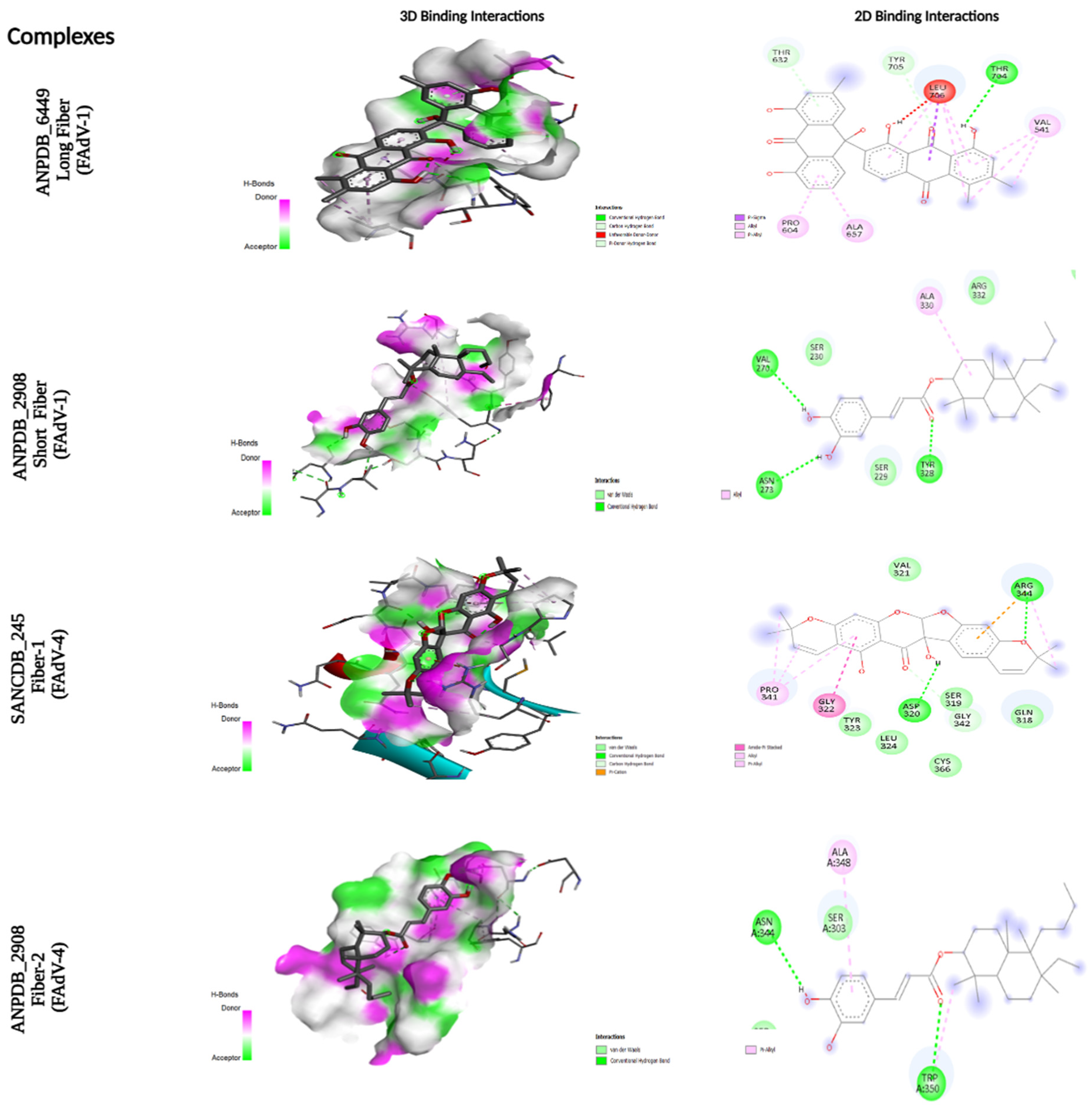
| Ligands | Target Protein | Binding Affinity | Residues Involved in Conventional Hydrogen Bond Formation | Number of Hydrogen Bonds Formed | Residues Involved in Hydrophobic Interactions | Residues Involved in Other Interactions |
|---|---|---|---|---|---|---|
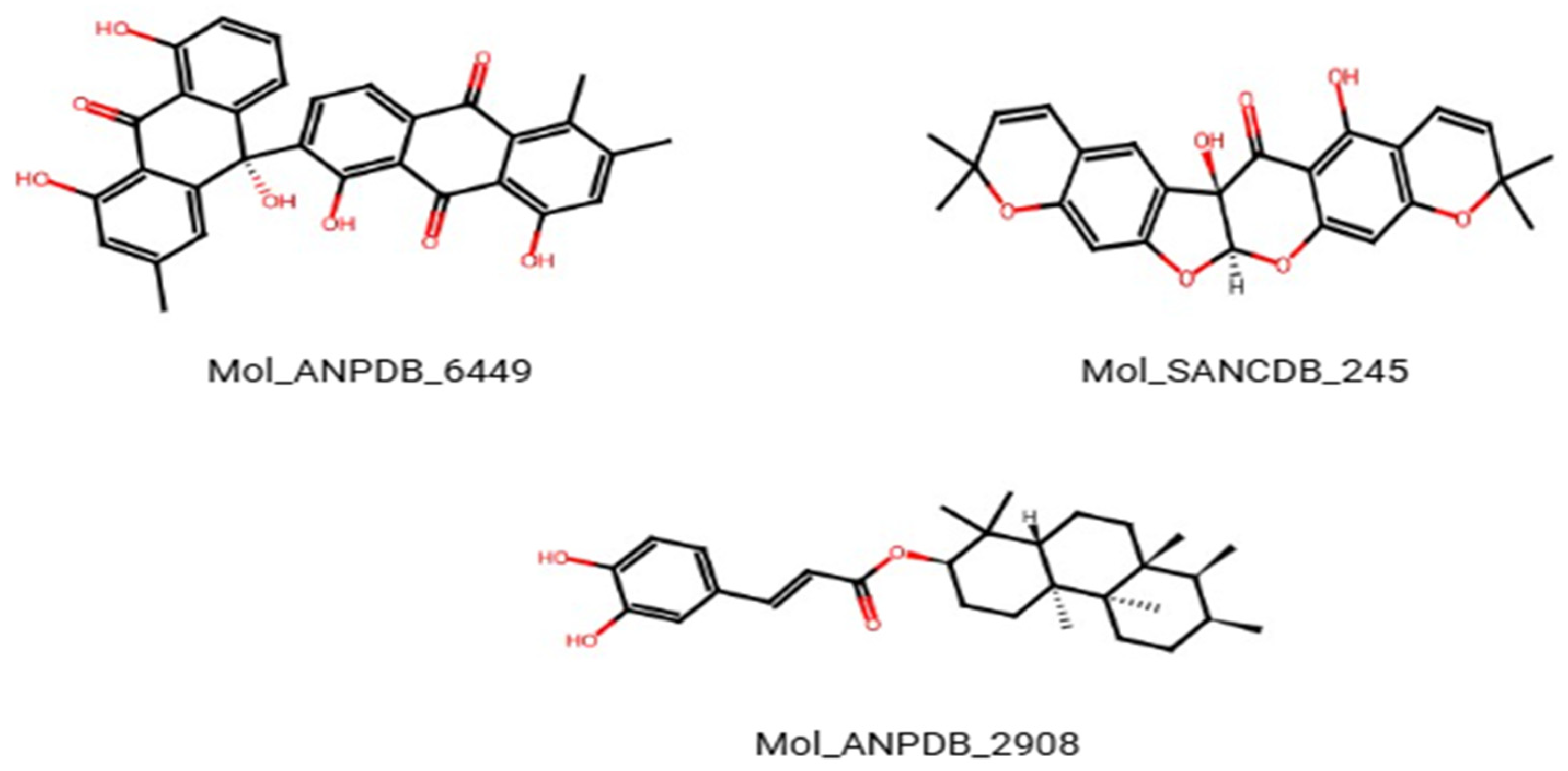
| Mol_ANPDB_6449 | Long Fiber FAdV-1 | −10.3 | Thr704 | 3 | Thr632, Tyr705 | Pro604, Ala657, VAL541 |
| Mol_ANPDB_2908 | Short Fiber FAdV-1 | −10.2 | Asn344, Trp350 | 2 | 0 | Ala348 |
| Mol_SANCDB_245 | Fiber-1 FAdV-4 | −9.2 | Asp320, Arg344 | 3 | Try323, Gly324 | Pro341, Gly322 |
| Mol_ANPDB_2908 | Fiber-2 FAdV-4 | −10 | Val270, Asn273, Tyr328 | 0 | 0 | Ala330 |
| Property | Model Name | ANPDB_6449 | ANPDB_2908 | SANCDB_245 |
|---|---|---|---|---|
| Absorption | Caco-2 Permeability (cm/s) | −5.228 | −5.191 | −5.02 |
| HIA | --- | --- | --- | |
| Distribution | BBB penetration (cm/s) | - | - | - |
| PPB (%) | 97.0 | 92.7 | 96.5 | |
| VD (L/Kg) | 0.667 | 0.174 | 0.295 | |
| Metabolism | CYP1A2 inhibitor | + | --- | --- |
| CYP2C19 inhibitor | --- | --- | - | |
| CYP2C9 inhibitor | +++ | --- | +++ | |
| CYP2D6 inhibitor | -- | --- | --- | |
| CYP3A4 inhibitor | - | --- | --- | |
| Excretion | CL plasma(mL/min/Kg) | 2.02 | 15.265 | 5.692 |
| T1/2 (H) | 1.815 | 0.999 | 1.546 | |
| Toxicity | hERG blockers | 0.012 | 0.063 | 0.169 |
Disclaimer/Publisher’s Note: The statements, opinions and data contained in all publications are solely those of the individual author(s) and contributor(s) and not of MDPI and/or the editor(s). MDPI and/or the editor(s) disclaim responsibility for any injury to people or property resulting from any ideas, methods, instructions or products referred to in the content. |
© 2026 by the authors. Licensee MDPI, Basel, Switzerland. This article is an open access article distributed under the terms and conditions of the Creative Commons Attribution (CC BY) license.
Share and Cite
Kardoudi, A.; Redouane, S.; Benani, A.; Kichou, F.; Touzani, C.D.; Fellahi, S. Computational Identification of Natural Inhibitors Targeting Fiber Proteins of FAdV-1 and FAdV-4 Through Integrated Virtual Screening and Molecular Dynamics Simulations. Vet. Sci. 2026, 13, 223. https://doi.org/10.3390/vetsci13030223
Kardoudi A, Redouane S, Benani A, Kichou F, Touzani CD, Fellahi S. Computational Identification of Natural Inhibitors Targeting Fiber Proteins of FAdV-1 and FAdV-4 Through Integrated Virtual Screening and Molecular Dynamics Simulations. Veterinary Sciences. 2026; 13(3):223. https://doi.org/10.3390/vetsci13030223
Chicago/Turabian StyleKardoudi, Amina, Salaheddine Redouane, Abdelouaheb Benani, Faouzi Kichou, Charifa Drissi Touzani, and Siham Fellahi. 2026. "Computational Identification of Natural Inhibitors Targeting Fiber Proteins of FAdV-1 and FAdV-4 Through Integrated Virtual Screening and Molecular Dynamics Simulations" Veterinary Sciences 13, no. 3: 223. https://doi.org/10.3390/vetsci13030223
APA StyleKardoudi, A., Redouane, S., Benani, A., Kichou, F., Touzani, C. D., & Fellahi, S. (2026). Computational Identification of Natural Inhibitors Targeting Fiber Proteins of FAdV-1 and FAdV-4 Through Integrated Virtual Screening and Molecular Dynamics Simulations. Veterinary Sciences, 13(3), 223. https://doi.org/10.3390/vetsci13030223