
Isolation of Madariaga Virus (MADV) in a Horse Coinfected with Equine Infectious Anemia in Venezuela: A Review of MADV Circulation in the Country

 , , and
Simple Summary
Abstract
1. Introduction
2. Materials and Methods
2.1. Specimens
2.2. Detection of Parasites and Antibodies Against Equine Infectious Anemia and Rabies Viruses
2.3. Detection of Alphaviruses
2.4. Cell Culture
2.5. Sequencing
2.6. Phylogenetic Analysis
3. Results
4. Discussion
- -
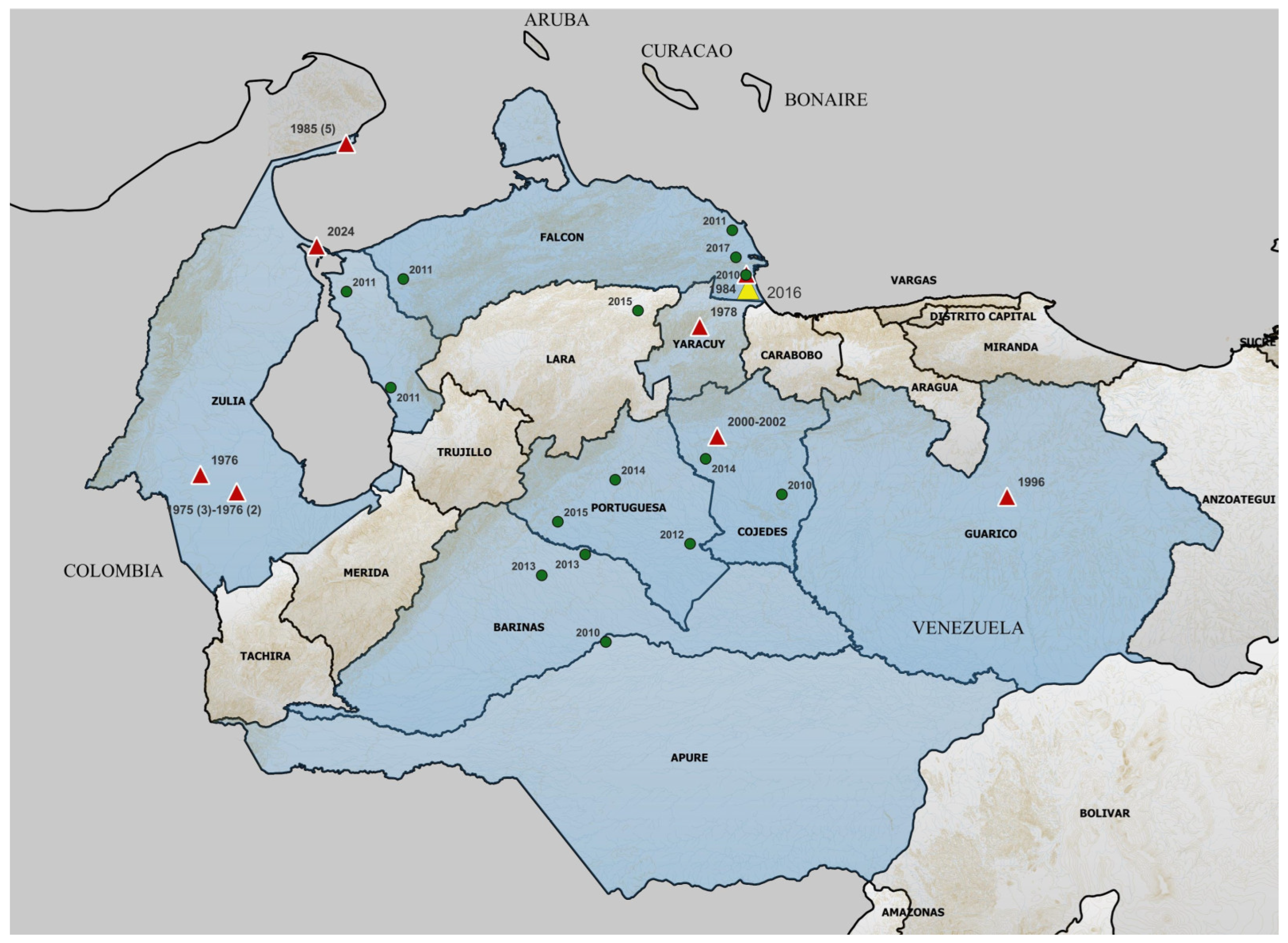
- The presence of vectors: Culex spp. have been proposed, in addition to other mosquitoes such as Aedes taeniorhynchus, as vectors of MADV [1]. Culex spp. have been identified circulating in the north-western region of Venezuela, including states where MADV cases have not been reported, although these are surrounded by states with documented presence of the virus. The case-free states (Tachira, Merida, Trujillo, and Lara, Figure 2) house the Venezuelan mountain “Cordillera de los Andes” [18].
- -
- The presence of reservoirs: Both birds and rodents have been proposed as reservoirs for this virus [1]. A serosurvey in Panama showed that the short-tailed cane mouse (Zygodontomys brevicauda) exhibited the highest levels of seroprevalence against MADV [19]. This rodent is common in the Venezuelan region where MADV cases have been reported [20,21]. Other potential reservoirs include other rodents, marsupials, bats, birds, and even reptiles [19,22]. However, the dynamic and ecological pattern of transmission of MADV is still fairly unknown compared to EEEV. For EEEV, active transmission is limited by the seasonal activity of vectors in the northern part of the USA, while it is continuous in the southern states of the country. EEEV from southern foci is actively transported by infected birds to disperse the virus in the north [23].
- -
- The presence of susceptible equids: The states of Venezuela with confirmed MADV cases have traditionally been associated with equine production [24].
5. Conclusions
Author Contributions
Funding
Institutional Review Board Statement
Informed Consent Statement
Data Availability Statement
Conflicts of Interest
Abbreviations
| EEEV | Eastern Equine Encephalitis Virus |
| EIAV | Equine Infectious Anemia Virus |
| INSAI | Instituto Nacional de Salud Agrícola Integral |
| MADV | Madariaga Virus |
| ORF | Open Reading Frame |
| qRT-PCR | Quantitative Reverse Transcriptase Polymerase Chain Reaction |
| VEEV | Venezuelan Equine Encephalitis Virus |
References
- Magalhaes, T.; Hamer, G.L.; de Carvalho-Leandro, D.; Ribeiro, V.M.L.; Turell, M.J. Uncertainties Surrounding Madariaga Virus, a Member of the Eastern Equine Encephalitis Virus Complex. Vector Borne Zoonotic Dis. 2024, 24, 633–640. [Google Scholar] [CrossRef] [PubMed]
- Bonilla-Aldana, D.K.; Bonilla Carvajal, C.D.; Moreno-Ramos, E.; Barboza, J.J.; Rodriguez-Morales, A.J. Mapping Eastern (EEE) and Venezuelan Equine Encephalitides (VEE) among Equines Using Geographical Information Systems, Colombia, 2008–2019. Viruses 2023, 15, 707. [Google Scholar] [CrossRef] [PubMed]
- Medina, G.; Zambrano, J.L.; Loureiro, C.L.; Garzaro, D.J.; Barrios, M.; Salas, R.A.; Weaver, S.C.; Pujol, F.H. Eastern Equine Encephalitis Virus Exhibits More Charged Amino Acids in Its Envelope Proteins, Compared to Madariaga Virus. Am. J. Trop. Med. Hyg. 2025, 113, 879–882. [Google Scholar] [CrossRef] [PubMed]
- Ciota, A.T. Eastern Equine Encephalitis Virus Taxonomy, Genomics, and Evolution. J. Med. Entomol. 2022, 59, 14–19. [Google Scholar] [CrossRef]
- Walder, R.; Suárez, O.M. Studies of arboviruses in Southwestern Venezuela: I. Isolations of Venezuelan and Eastern Equine Encephalitis viruses from sentinel hamsters in the Catatumbo region. Int. J. Epidemiol. 1976, 5, 375–378. [Google Scholar] [CrossRef]
- Blohm, G.M.; Lednicky, J.A.; White, S.K.; Mavian, C.N.; Márquez, M.C.; González-García, K.P.; Salemi, M.; Morris, J.G., Jr.; Paniz-Mondolfi, A.E. Madariaga Virus: Identification of a Lineage III Strain in a Venezuelan Child With Acute Undifferentiated Febrile Illness, in the Setting of a Possible Equine Epizootic. Clin. Infect. Dis. 2018, 67, 619–621. [Google Scholar] [CrossRef]
- Dean, D.J.; Abelseth, M.K.; Atanasiu, P. The fluorescent antibody test. In Laboratory Techniques in Rabies; Meslin, F.X., Kaplan, M., Koprowski, H., Eds.; WHO: Geneva, Switzerland, 1996; Chapter 7; pp. 88–95. [Google Scholar]
- Coggins, L.; Norcross, N.L.; Nusbaum, S.R. Diagnosis of equine infectious anaemia by inmunodiffusion test. Am. J. Vet. Res. 1972, 197233, 11–18. [Google Scholar] [CrossRef]
- Sánchez-Seco, M.P.; Rosario, D.; Quiroz, E.; Guzmán, G.; Tenorio, A. A generic nested-RT-PCR followed by sequencing for detection and identification of members of the alphavirus genus. J. Virol. Methods 2001, 95, 153–161. [Google Scholar] [CrossRef]
- Carrera, J.-P.; Araúz, D.; Rojas, A.; Cardozo, F.; Stittleburg, V.; Morales Claro, I.; Galue, J.; Lezcano-Coba, C.; Romero Rebello Moreira, F.; Rivera, L.F.; et al. Real-time RT-PCR for Venezuelan equine encephalitis complex, Madariaga, and Eastern equine encephalitis viruses: Application in human and mosquito public health surveillance in Panama. J. Clin. Microbiol. 2023, 61, e0015223. [Google Scholar] [CrossRef]
- Medina, G.; Garzaro, D.J.; Barrios, M.; Auguste, A.J.; Weaver, S.C.; Pujol, F.H. Genetic diversity of Venezuelan alphaviruses and circulation of a Venezuelan equine encephalitis virus subtype IAB strain during an interepizootic period. Am. J. Trop. Med. Hyg. 2015, 93, 7–10. [Google Scholar] [CrossRef]
- Tamura, K.; Stecher, G.; Kumar, S. MEGA11: Molecular Evolutionary Genetics Analysis Version 11. Mol. Biol. Evol. 2021, 38, 3022–3027. [Google Scholar] [CrossRef]
- Hasegawa, M.; Kishino, H.; Yano, T. Dating of the human-ape splitting by a molecular clock of mitochondrial DNA. J. Mol. Evol. 1985, 22, 160–174. [Google Scholar] [CrossRef]
- Thieulent, C.J.; Carossino, M.; Reis, J.K.P.D.; Vissani, M.A.; Barrandeguy, M.E.; Valle-Casuso, J.C.; Balasuriya, U.B.R. Equine infectious anemia virus worldwide prevalence: A 24-year retrospective review of a global equine health concern with far-reaching implications. Vet. Microbiol. 2025, 306, 110548. [Google Scholar] [CrossRef]
- Márquez-Alvarado, Y.; Márquez-Alvarado, A.; Meléndez-Pereira, C.; Villarreal-Alvarez, V.; Salas-Araujo, Y.; Canelón-Pérez, J. Comparison of AGID and cELISA test for Equine Infectious Anemia diagnosis in creole horses from Venezuela. Rev. Cient. FCV-LUZ 2015, 25, 381–385. [Google Scholar]
- Craigo, J.K.; Montelaro, R.C. Equine Infectious Anemia virus infection and immunity: Lessons for AIDS vaccine development. Future Virol. 2011, 6, 139–142. [Google Scholar] [CrossRef] [PubMed]
- Benvenuto, D.; Cella, E.; Fogolari, M.; De Florio, L.; Borsetti, A.; Donati, D.; Garilli, F.; Spoto, S.; Ceccarelli, G.; Angeletti, S.; et al. The transmission dynamic of Madariaga Virus by bayesian phylogenetic analysis: Molecular surveillance of an emergent pathogen. Microb. Pathog. 2019, 13, 80–86. [Google Scholar] [CrossRef] [PubMed]
- Navarro, J.C.; Del Ventura, F.; Zorrilla, A.; Lira, J. Registros de mayor altitud para mosquitos (Diptera: Culicidae) en Venezuela. Rev. Biol. Trop. 2010, 58, 245–254. [Google Scholar] [CrossRef]
- Vittor, A.Y.; Armien, B.; Gonzalez, P.; Carrera, J.P.; Dominguez, C.; Valderrama, A.; Glass, G.E.; Beltran, D.; Cisneros, J.; Wang, E.; et al. Epidemiology of Emergent Madariaga Encephalitis in a Region with Endemic Venezuelan Equine Encephalitis: Initial Host Studies and Human Cross-Sectional Study in Darien, Panama. PLoS Negl. Trop. Dis. 2016, 10, e0004554. [Google Scholar] [CrossRef]
- Poleo, C.J.; Fuentes, L.; Vivas, L. Caracterización reproductiva de una población de Zygodontomys brevicauda (Rodentia: Cricetidae) capturada en siembras de arroz del estado Guárico, Venezuela. Agron. Trop. 2010, 60, 43–48. [Google Scholar]
- Utrera, A.; Duno, G. Preferencias de hábitat de Sigmodon alstoni y Zygodontomys brevicauda (Rodentia, Cricetidae) en agroecosistemas de los llanos de Venezuela. Interciencia 2007, 32, 471–476. [Google Scholar]
- Gil, L.H.V.G.; Magalhaes, T.; Santos, B.S.A.S.; Oliveira, L.V.; Oliveira-Filho, E.F.; Cunha, J.L.R.; Fraiha, A.L.S.; Rocha, B.M.M.; Longo, B.C.; Ecco, R.; et al. Active Circulation of Madariaga Virus, a Member of the Eastern Equine Encephalitis Virus Complex, in Northeast Brazil. Pathogens 2021, 10, 983. [Google Scholar] [CrossRef]
- Burkett-Cadena, N.D.; Day, J.F.; Unnasch, T.R. Ecology of Eastern Equine Encephalitis Virus in the Southeastern United States: Incriminating Vector and Host Species Responsible for Virus Amplification, Persistence, and Dispersal. J. Med. Entomol. 2022, 59, 41–48. [Google Scholar] [CrossRef]
- Canelon, J.L.; Paez, J.; Rojas, C. Morfometría de caballos criollos venezolanos en un hato del Estado Apure. Veterinaria (Montevideo) 2004, 3, 51–54. [Google Scholar]
- Zhang, Y.; Wang, M.; Huang, M.; Zhao, J. Innovative strategies and challenges in mosquito-borne disease control amidst climate change. Front. Microbiol. 2024, 15, 1488106. [Google Scholar] [CrossRef]
- Valero, N.; Arias, J.; Pérez, M.; Medina, A.; Rodriguez, E.; Nardone, M. Post-vaccination antibody titles in equines vaccinated with TC83 strain of the Venezuelan equine encephalitis virus. Rev. Cient. (Maracaibo) 2007, 17, 15–20. [Google Scholar]
- Strizki, J.M.; Repik, P.M. Differential reactivity of immune sera from human vaccinees with field strains of eastern equine encephalitis virus. Am. J. Trop. Med. Hyg. 1995, 53, 564–570. [Google Scholar] [CrossRef]
- Frabasile, S.; Morel, N.; Pérez, R.; Marrero, L.M.; Burgueño, A.; Cortinas, M.N.; Bassetti, L.; Negro, R.; Rodríguez, S.; Bórmida, V.; et al. Equine Encephalomyelitis Outbreak, Uruguay, 2023–2024. Emerg. Infect. Dis. 2025, 31, 180–183. [Google Scholar] [CrossRef]
- Lorenz, C.; de Azevedo, T.S.; Chiaravalloti-Neto, F. Effects of climate change on the occurrence and distribution of Western equine encephalitis virus in South America. Public Health 2025, 239, 1–8. [Google Scholar] [CrossRef] [PubMed]



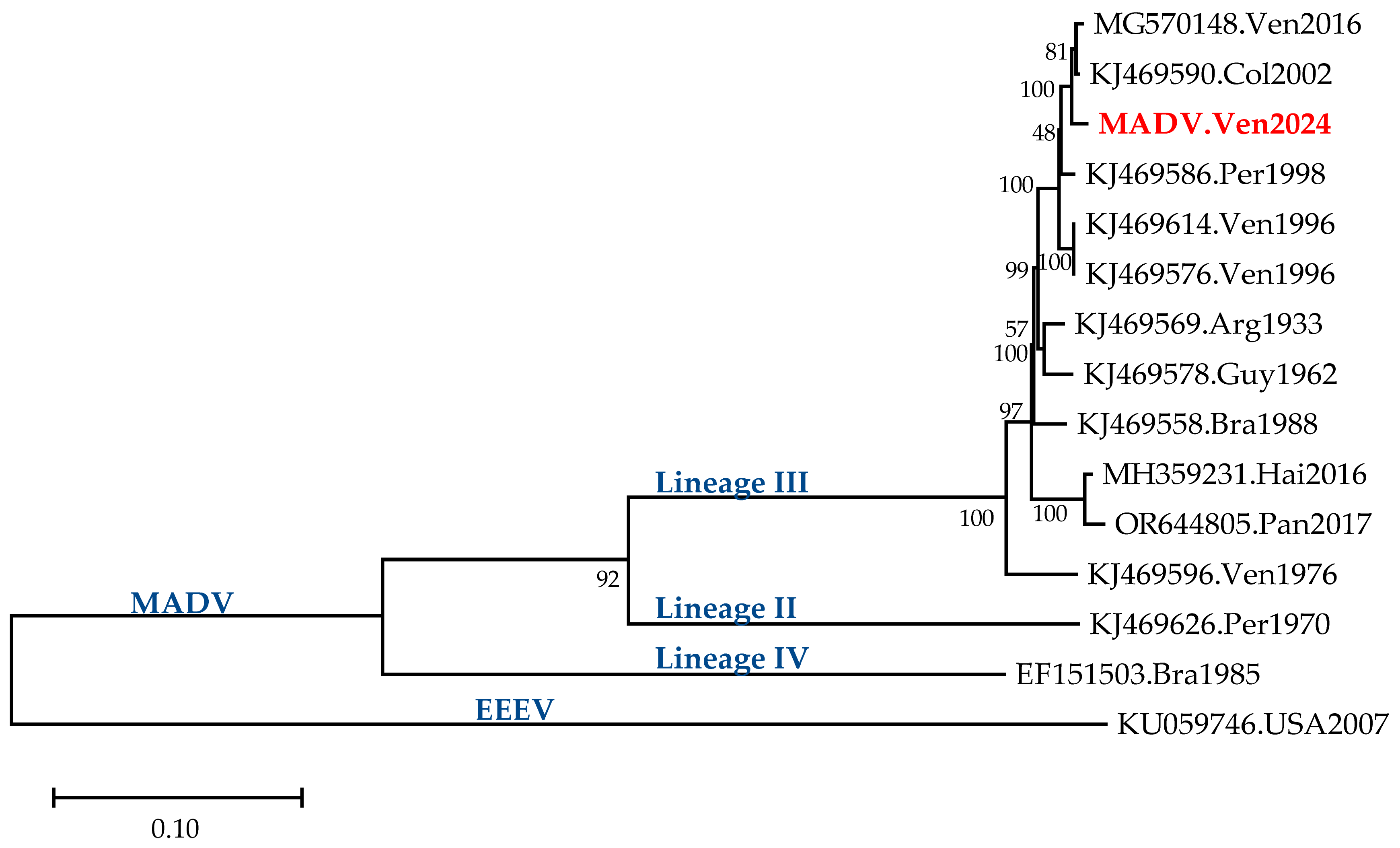
| Virus | Isolate Name 1 | % Divergence with MADV.Ven2024 |
|---|---|---|
| MADV Lineage III | MG570148.Ven2016 | 99.05 |
| KJ469590.Col2002 | 99.26 | |
| KJ469586.Per1998 | 98.52 | |
| KJ469614.Ven1996 | 98.47 | |
| KJ469576.Ven1996 | 98.47 | |
| KJ469569.Arg1933 | 97.40 | |
| KJ469578.Guy1962 | 97.20 | |
| KJ469558.Bra1988 | 97.00 | |
| MH359231.Hai2016 | 96.04 | |
| OR644805.Pan2017 | 95.60 | |
| KJ469596.Ven1976 | 95.11 | |
| MADV Lineage II | KJ469626.Per1970 | 83.28 |
| MADV Lineage IV | EF151503.Bra1985 | 80.50 |
| EEEV | GU001914.USA2003 | 76.72 |
Disclaimer/Publisher’s Note: The statements, opinions and data contained in all publications are solely those of the individual author(s) and contributor(s) and not of MDPI and/or the editor(s). MDPI and/or the editor(s) disclaim responsibility for any injury to people or property resulting from any ideas, methods, instructions or products referred to in the content. |
© 2026 by the authors. Licensee MDPI, Basel, Switzerland. This article is an open access article distributed under the terms and conditions of the Creative Commons Attribution (CC BY) license.
Share and Cite
Garzaro, D.; Rodríguez, N.; Medina, G.; Alcazar, W.; Gualdron, M.; Siem, J.A.; Sulbaran, Y.; Barrios, M.; Liprandi, F.; Jaspe, R.C.; et al. Isolation of Madariaga Virus (MADV) in a Horse Coinfected with Equine Infectious Anemia in Venezuela: A Review of MADV Circulation in the Country. Vet. Sci. 2026, 13, 71. https://doi.org/10.3390/vetsci13010071
Garzaro D, Rodríguez N, Medina G, Alcazar W, Gualdron M, Siem JA, Sulbaran Y, Barrios M, Liprandi F, Jaspe RC, et al. Isolation of Madariaga Virus (MADV) in a Horse Coinfected with Equine Infectious Anemia in Venezuela: A Review of MADV Circulation in the Country. Veterinary Sciences. 2026; 13(1):71. https://doi.org/10.3390/vetsci13010071
Chicago/Turabian StyleGarzaro, Domingo, Nardraka Rodríguez, Gladys Medina, Wilmer Alcazar, Marisol Gualdron, José Alejandro Siem, Yoneira Sulbaran, Miguel Barrios, Ferdinando Liprandi, Rossana C. Jaspe, and et al. 2026. "Isolation of Madariaga Virus (MADV) in a Horse Coinfected with Equine Infectious Anemia in Venezuela: A Review of MADV Circulation in the Country" Veterinary Sciences 13, no. 1: 71. https://doi.org/10.3390/vetsci13010071
APA StyleGarzaro, D., Rodríguez, N., Medina, G., Alcazar, W., Gualdron, M., Siem, J. A., Sulbaran, Y., Barrios, M., Liprandi, F., Jaspe, R. C., & Pujol, F. H. (2026). Isolation of Madariaga Virus (MADV) in a Horse Coinfected with Equine Infectious Anemia in Venezuela: A Review of MADV Circulation in the Country. Veterinary Sciences, 13(1), 71. https://doi.org/10.3390/vetsci13010071