

Prevalence of Helminthiasis Among African Elephants in Tsavo and Laikipia-Samburu Ecosystems, Kenya



Simple Summary
Abstract
1. Introduction
2. Materials and Methods
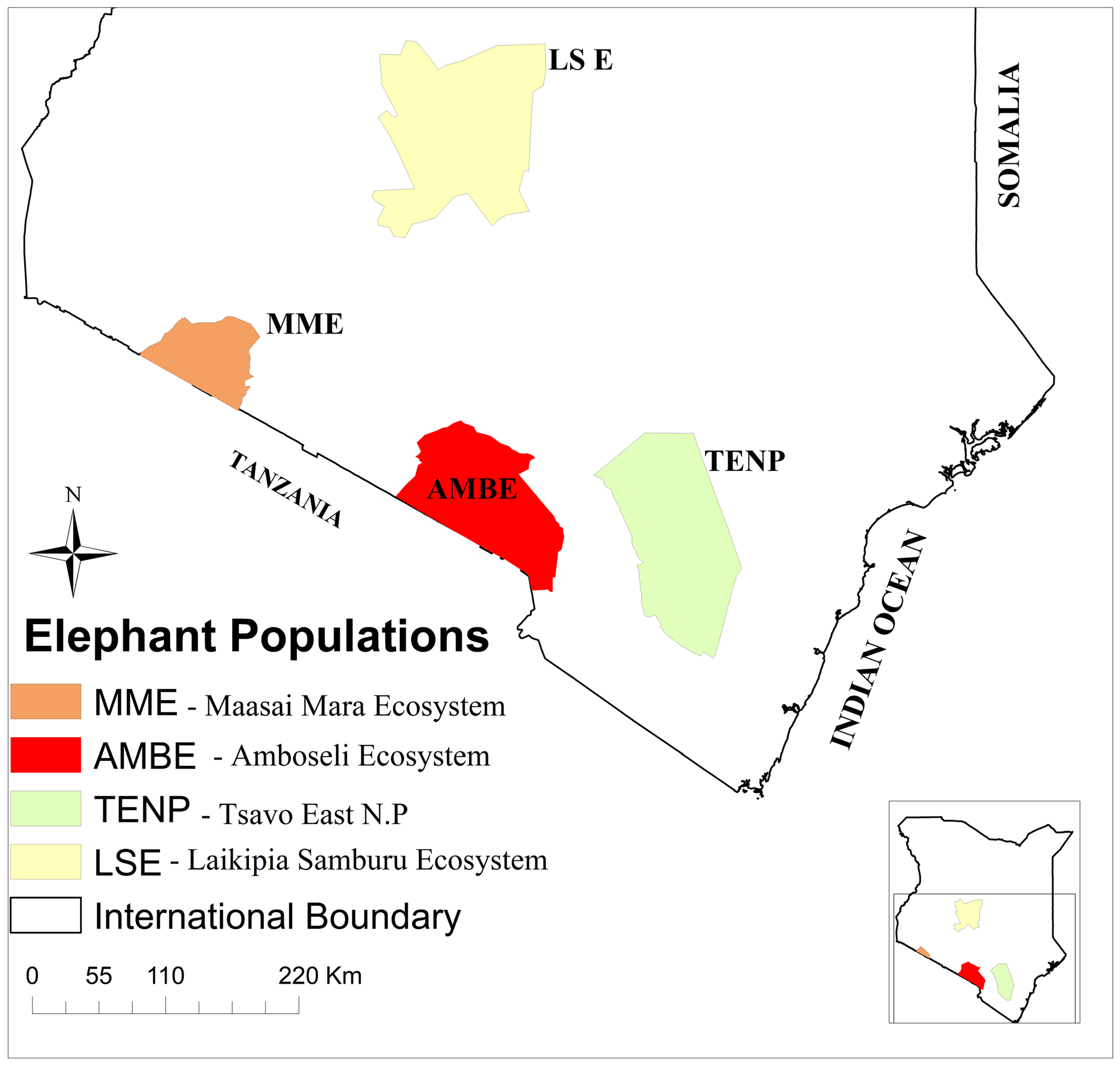
2.1. Study Area
2.2. Sample Collection
2.3. Sample Processing and Analysis
2.3.1. Centrifugal Flotation Method
2.3.2. Sedimentation Method
2.3.3. McMaster Method
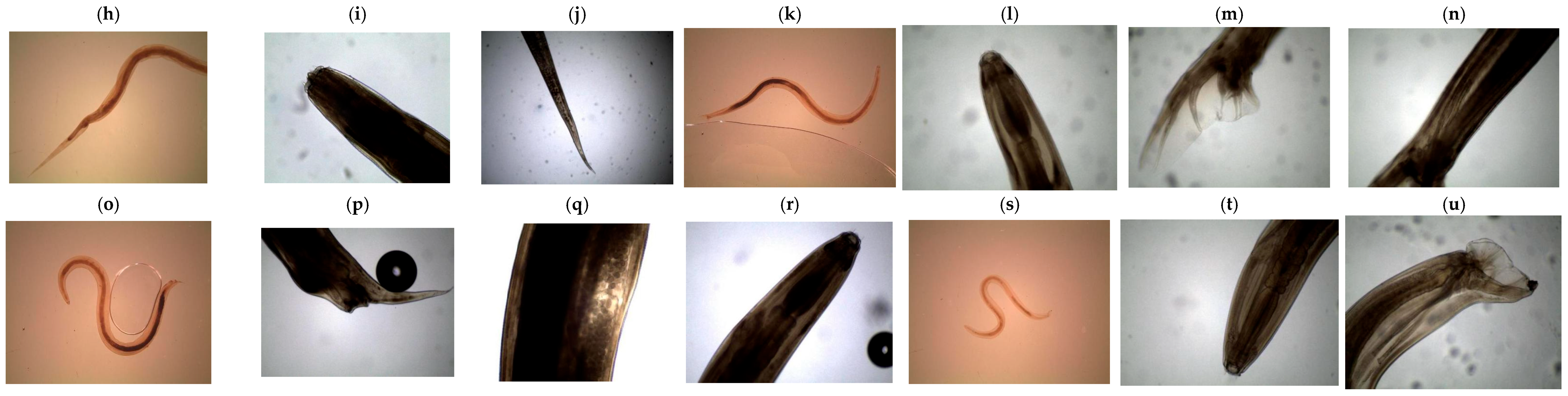
2.3.4. Adult Worm Identification
2.4. Data Analysis
3. Results
3.1. Intestinal Parasites in Elephants from TENP and LSE Areas
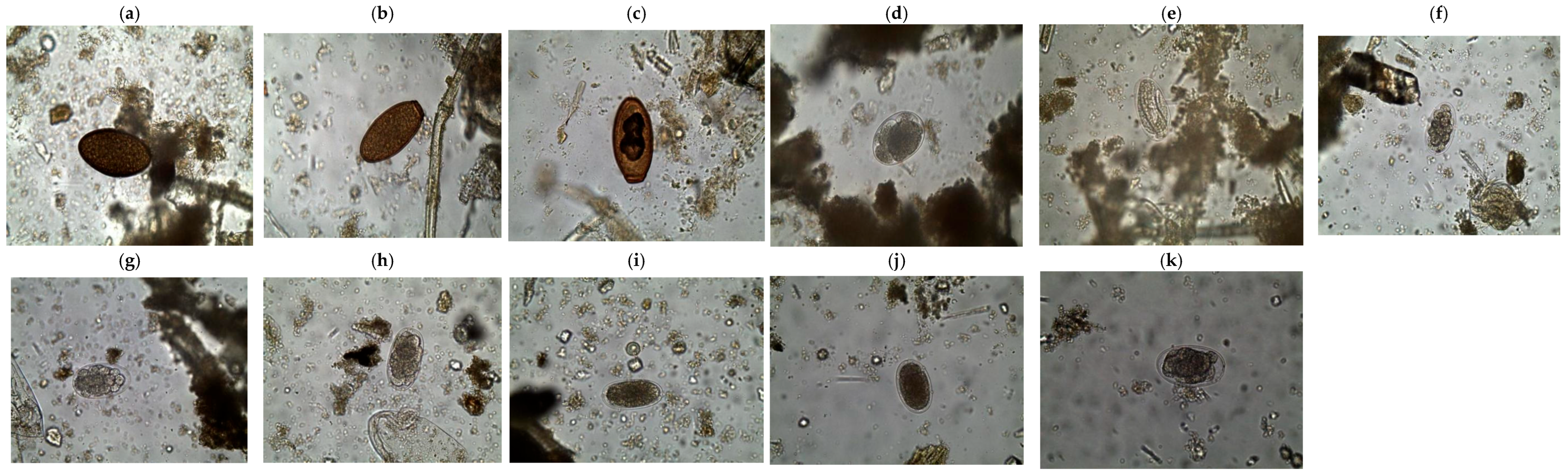
Egg Morphology and Morphometry and Adult Worm Identification
3.2. Comparison of Helminth Occurrence in TENP and the LSE
Comparison of Prevalence
3.3. Comparison of Worm Burden
4. Discussion
5. Conclusions
Author Contributions
Funding
Institutional Review Board Statement
Informed Consent Statement
Data Availability Statement
Acknowledgments
Conflicts of Interest
Abbreviations
| CI | Confidence interval |
| EPGs | eggs per gram |
| GI | gastro-intestinal |
| GLM | Generalized Linear Model |
| IBM | International Business Machines Corporation |
| KWS | Kenya Wildlife Service |
| LSE | Laikipia-Samburu ecosystem |
| SPSS | Statistical Package for the Social Sciences |
| TENP | Tsavo East National Park |
References
- Baines, L.; Morgan, E.R.; Ofthile, M.; Evans, K. Occurence and seasonality of internal parasite infectionin elephants, Loxodonta africana, in the Okavango Delta, Botswana. Int. J. Parasitol. Parasites Wildl. 2015, 4, 43–48. [Google Scholar] [CrossRef] [PubMed]
- Condy, J.B. Observations on internal parasites in Rhodesian elephant, Loxodonta africana Blumenbach 1797. Proceeings Trans. Rhod. Sci. Assoc. 1974, 55, 63–99. [Google Scholar]
- Obanda, V.; Gakuya, F.; Lekolool, I.; Kariuki, J. Composition of intestinal ciliate fauna of free-ranging African elephants in Tsavo West National Park, Kenya. Pachyderm 2007, 42, 90–94. [Google Scholar] [CrossRef]
- Kenya Wildlife Service. Aerial Total Count of Elephants, Buffaloes and Giraffes in the Tsavo-Mkomazi Ecosystem in February; 2017. Available online: https://www.kws.go.ke/article/aerial-total-count-elephants-buffaloes-and-giraffes-tsavo-mkomazi-ecosystem-february-2017 (accessed on 20 August 2018).
- Parker, J.M.; Goldenberg, S.Z.; Letitiya, D.; Wittemyer, G. Strongylid infection varies with age, sex, movement and social factors in wild African elephants. Strongylid infection varies with age, sex, movement and social factors in wild African elephants. Parasitology 2020, 147, 348–359. [Google Scholar] [CrossRef] [PubMed]
- Qurratul-Saadah, Z.; Che-Amat, A.; Syed-Hussain, S.S.; Kamaludden, J.; Ariffin, S.M.Z.; Basripuzi, N.H.; Nor-Azlina, A.A. Gastrointestinal Parasites in Asian and African Elephants: A Systematic Review. Trop. Biomed. 2023, 40, 55–64. [Google Scholar] [CrossRef] [PubMed]
- Elsheikha, H.; Obanda, V. Parasitic impact on elephant conservation: A Kenyan view. Vet Times 2010, 17, 1–6. [Google Scholar]
- Hota, S.R.; Sahoo, S.; Dash, M.; Pahari, A.; Mohanty, B.; Sahoo, N. Molecular detection of Mushidia linstowi in a free-ranging dead elephant calf. J. Threat. Taxa 2020, 12, 15359–15363. [Google Scholar] [CrossRef]
- Fowler, M.E.; Mikota, S.K. Biology, Medicine an Surgery of Elephants, 1st ed.; Blackwell Publishing: Hoboken, IA, USA, 2006; 592p. [Google Scholar]
- Kenya Wildlife Service (KWS). Tsavo East National Park. Available online: https://kws.go.ke/tsavo-east-national-park (accessed on 14 October 2025).
- King’ori, E.; Obanda, V.; Chiyo, P.I.; Soriguer, R.C.; Morrondo, P.; Angelone, S. Patterns of helminth infection in Kenyan elephant populations. Parasites Vectors 2020, 13, 145. [Google Scholar] [CrossRef] [PubMed]
- Kenya Wildlife Service. Results of Censuses of Elephant, Buffalo, Giraffe and Grevy’S Zebra Counted in Five Key Ecosystems Conducted in 2016 and 2017. Available online: https://www.kws.go.ke/node/307 (accessed on 20 August 2018).
- Foreyt, W.J. Veterinary Parasitology Reference Manual, 5th ed.; Blackwell Publishing: Hoboken, IA, USA, 2001; 235p. [Google Scholar]
- McLean, E.R.; Kinsella, J.M.; Chiyo, P.; Obanda, V.; Moss, C.; Archie, E.A. Genetic identification of five Strongyle nematode parasites in wild African elephants (Loxodonta africana). J. Wildife Dis. 2012, 48, 707–716. [Google Scholar] [CrossRef] [PubMed]
- Anderson, R.C.; Chabaud, A.G.; Willmott, S.; Bureaux, C.A. (Eds.) CIH Keys to the Nematode Parasites of Vertebrates; Commonwealth Agricultural Bureaux: Farnham Royal, Slough, UK, 1974; Volume 1, 17p. [Google Scholar]
- Monnig, H.O. On some strongylid nematodes of the African elephant. Trans. R. Soc. South Afr. 1925, 13, 313–321. [Google Scholar] [CrossRef]
- Van Der Westhuysen, O.P. A Monograph of the Helminth Parasites of the Elephant. Onderstepoort J. Vet. Sci. Anim. Ind. 1938, 10, 49–190. [Google Scholar]
- Elsheikha, H.; Patel, J.; Obanda, V. Altered helminth fauna in African elephants in response to resource availability. Vet Times 2010, 72, 885–888. [Google Scholar]
- Olkeba, B.K.; Boets, P.; Mereta, S.T.; Yeshigeta, M.; Akessa, G.M.; Ambelu, A.; Goethals, P.L. Environmental and biotic factors affecting freshwater snail intermediate hosts in the Ethiopian Rift Valley region. Parasites Vectors 2020, 13, 292. [Google Scholar] [CrossRef] [PubMed]
- Thurber, M.I.; O’Connell-Rodwell, C.E.; Turner, W.C.; Nambandi, K.; Kinzley, C.; Rodwell, T.C.; Faulkner, C.T.; Felt, S.A.; Bouley, D.M. Effects of rainfall, host demography and musth on strongyle fecal egg counts in African elephants (Loxodanta africana) in Namibia. J. Wildl. Dis. 2011, 47, 172–181. [Google Scholar] [CrossRef] [PubMed]
- Mbaya, A.W.; Ogwiji, M.; Kumshe, H.A. Effects of Host Demography, Season and Rainfall on the Prevalence and Parasitic Load of Gastrointestinal Parasites of Free-Living Elephants (Loxodonta africana) of the Chad Basin National Park, Nigeria. Pak. J. Biol. Sci. 2013, 16, 1152–1158. [Google Scholar] [CrossRef] [PubMed]
- Wato, Y.A.; Prins, H.H.T.; Heitkonig, I.M.A.; Wahungu, G.M.; Ngene, S.M.; Njumbi, S.; Langevelde, F.V. Movement patterns of African elephants (Loxodonta africana) in a semi-arid savanna suggest that they have information on the location of dispersed water sources. Front. Ecol. Evol. 2018, 6, 167. [Google Scholar] [CrossRef]
- Muteti, D.; Ngene, S.M.; Maingi, J. Biophysical and human factors determine the distribution of poached elephants in Tsavo East National Park, Kenya. Pachyderm 2011, 49, 48–60. [Google Scholar] [CrossRef]
- Ihwagi, F.W.; Wang, T.; Wittemyer, G.; Skidmore, A.K.; Toxopeus, A.G.; Ngene, S.; King, J.; Worden, J.; Omondi, P.; Douglas-Hamilton, I. Using Poaching Levels and Elephant Distribution to Assess the Conservation Efficacy of Private, Communal and Government Land in Northern Kenya. PLoS ONE 2015, 10, e0139079. [Google Scholar] [CrossRef] [PubMed]



| Category | Group/Age Class | TENP (n) | LSE (n) | Total (n) % |
|---|---|---|---|---|
| Social grouping | Male groups | 65 | 30 | 95 (34.8) |
| Family groups | 72 | 106 | 178 (65.2) | |
| Age class | Adults | 87 | 73 | 160 (58.6) |
| Sub-adults | 30 | 38 | 68 (24.9) | |
| Juveniles | 20 | 25 | 45 (16.5) |
| Category | Variables | TENP | LSE | Total | χ2 | p-Value |
|---|---|---|---|---|---|---|
| Total Count (N) | 137 | 136 | 273 | |||
| Nematode infection | Number infected (n) | 131 | 134 | 265 | ||
| Prevalence (%) | 95.6 | 98.5 | 97.1 | 4.72 | <0.05 | |
| Trematode infection | Number infected (n) | 54 | 35 | 89 | ||
| Prevalence (%) | 39.4 | 25.7 | 32.6 | 6.47 | <0.05 | |
| χ2 = 71.63, p < 0.05 | χ2 = 112.03, p < 0.05 | χ2 = 90.80, p < 0.05 |
| Category | Variables | TENP | LSE | Total |
|---|---|---|---|---|
| Male social group | Count (N) | 65 | 30 | 95 |
| Nematode infections | Number infected (n) | 61 | 28 | 89 |
| Prevalence (%) | 93.9 | 93.3 | 93.7 | |
| Trematode infections | Number infected (n) | 31 | 5 | 36 |
| Prevalence (%) | 47.7 | 16.7 | 37.9 | |
| Family social group | Count (N) | 72 | 106 | 178 |
| Nematode infections | Number infected (n) | 70 | 106 | 176 |
| Prevalence (%) | 97.2 | 100 | 98.9 | |
| Trematode infections | Number infected (n) | 23 | 30 | 53 |
| Prevalence (%) | 31.9 | 28.3 | 29.8 |
| Category | Variables | TENP | LSE | Total |
|---|---|---|---|---|
| Adult | Count (N) | 87 | 73 | 160 |
| Nematode infections | Number infected (n) | 83 | 71 | 154 |
| Prevalence (%) | 95.4 | 97.3 | 96.3 | |
| Trematode infections | Number infected (n) | 34 | 18 | 52 |
| Prevalence (%) | 39.1 | 24.7 | 32.5 | |
| Sub-adult | Count (N) | 30 | 38 | 68 |
| Nematode infections | Number infected (n) | 28 | 38 | 66 |
| Prevalence (%) | 93.3 | 100 | 97.1 | |
| Trematode infections | Number infected (n) | 10 | 10 | 20 |
| Prevalence (%) | 33.3 | 26.3 | 29.4 | |
| Juvenile | Count (N) | 20 | 25 | 45 |
| Nematode infections | Number infected (n) | 20 | 25 | 45 |
| Prevalence (%) | 100 | 100 | 100 | |
| Trematode infections | Number infected (n) | 10 | 7 | 17 |
| Prevalence (%) | 50 | 28 | 37.8 |
| Elephant Population | N | Mean EPG ± SD | Median EPG |
|---|---|---|---|
| TENP | 137 | 623.06 ± 653.798 | 400 |
| Family social group | 72 | 630.68 ± 591.977 | 425 |
| Male social group | 65 | 624.59 ± 741.542 | 400 |
| Adult | 80 | 733.73 ± 737.709 | 500 |
| Sub-adult | 30 | 566.67 ± 545.567 | 375 |
| Juvenile | 20 | 280.45 ± 247.252 | 225 |
| LSE | 136 | 589.34 ± 589.237 | 400 |
| Family social group | 106 | 685.85 ± 623.727 | 525 |
| Male social group | 30 | 248.33 ± 230.996 | 150 |
| Adult | 73 | 469.29 ± 536.717 | 300 |
| Sub-Adult | 38 | 847.56 ± 648.648 | 750 |
| Juvenile | 25 | 502.00 ± 509.591 | 300 |
| Total female EPG | 101 | 706.89 ± 625.963 | 600 |
| Total male EPG | 127 | 555.12 ± 650.788 | 350 |
| Total populations’ EPG | 273 | 606.26 ± 621.558 | 400 |
Disclaimer/Publisher’s Note: The statements, opinions and data contained in all publications are solely those of the individual author(s) and contributor(s) and not of MDPI and/or the editor(s). MDPI and/or the editor(s) disclaim responsibility for any injury to people or property resulting from any ideas, methods, instructions or products referred to in the content. |
© 2025 by the authors. Licensee MDPI, Basel, Switzerland. This article is an open access article distributed under the terms and conditions of the Creative Commons Attribution (CC BY) license (https://creativecommons.org/licenses/by/4.0/).
Share and Cite
Mogaka, S.K.; Mwangi, E.M.; Fasina, F.O.; Mutahi, W.W. Prevalence of Helminthiasis Among African Elephants in Tsavo and Laikipia-Samburu Ecosystems, Kenya. Vet. Sci. 2025, 12, 1161. https://doi.org/10.3390/vetsci12121161
Mogaka SK, Mwangi EM, Fasina FO, Mutahi WW. Prevalence of Helminthiasis Among African Elephants in Tsavo and Laikipia-Samburu Ecosystems, Kenya. Veterinary Sciences. 2025; 12(12):1161. https://doi.org/10.3390/vetsci12121161
Chicago/Turabian StyleMogaka, Sophia K., Evans M. Mwangi, Folorunso O. Fasina, and Wilkinson W. Mutahi. 2025. "Prevalence of Helminthiasis Among African Elephants in Tsavo and Laikipia-Samburu Ecosystems, Kenya" Veterinary Sciences 12, no. 12: 1161. https://doi.org/10.3390/vetsci12121161
APA StyleMogaka, S. K., Mwangi, E. M., Fasina, F. O., & Mutahi, W. W. (2025). Prevalence of Helminthiasis Among African Elephants in Tsavo and Laikipia-Samburu Ecosystems, Kenya. Veterinary Sciences, 12(12), 1161. https://doi.org/10.3390/vetsci12121161