
Article

Ecological Diversity of Migratory Birds and Their Associated Bacterial Species in South Korea: A Preliminary Study Including Antimicrobial Resistance Profiles

1
Jeollanamdo Veterinary Service Laboratory, Gangjin 59213, Republic of Korea
2
Department of Veterinary Zoonotic Diseases, College of Veterinary Medicine, Chonnam National University, Gwangju 61186, Republic of Korea
3
BK21 FOUR Program, Department of Veterinary Pathology, College of Veterinary Medicine, Chonnam National University, Gwangju 61186, Republic of Korea
4
Department of Veterinary Pathology, College of Veterinary Medicine, Chonnam National University, Gwangju 61186, Republic of Korea
5
The Wings Co., Ltd. 807, Industry-Academic Cooperation Center 1, Chonnam National University, Gwangju 61186, Republic of Korea
6
Human & Nature Institute (HNI), 115-1704, Sejong-si 30124, Republic of Korea
7
Department of Veterinary Microbiology, College of Veterinary Medicine, Chonnam National University, Gwangju 61186, Republic of Korea
8
Department of Veterinary Epidemiology, College of Veterinary Medicine, Chonnam National University, Gwangju 61186, Republic of Korea
9
Department of Food and Environmental Hygiene, College of Veterinary Medicine, Chonnam National University, Gwangju 61186, Republic of Korea
10
Division of Zoonotic and Vector-Borne Disease Research, Center for Infectious Diseases Research, National Institute of Health, Cheongju 28159, Republic of Korea
*
Authors to whom correspondence should be addressed.
These authors contributed equally to this work.
Vet. Sci. 2025, 12(12), 1157; https://doi.org/10.3390/vetsci12121157
Submission received: 24 October 2025 / Revised: 28 November 2025 / Accepted: 2 December 2025 / Published: 4 December 2025

Simple Summary

Migratory birds travel long distances and encounter various environmental sources of bacteria. In this study, we examined 35 dead migratory birds from key stopover sites in South Korea. Most of these birds were from the Emberiza genus, which often uses coastal islands during migration. We identified 54 bacterial isolates from various organs of birds. The main types of bacteria include Enterococcus, coliform bacteria, Bacillus, Staphylococcus, and Serratia. Many of these bacteria are resistant to clinically important antimicrobials. One-third of them were resistant to multiple antimicrobials, including vancomycin-resistant Enterococcus and carbapenem- and colistin-resistant Escherichia coli strains. These results suggest that migratory birds may help spread antimicrobial-resistant bacteria and cause environmental contamination. Thus, it is important to continue monitoring wildlife to understand its role in public health.

Abstract

Migratory birds travel long distances and interact with diverse environments, making them potential reservoirs and disseminators of antimicrobial-resistant bacteria. This study investigated the species distribution of migratory birds, bacterial isolates from bird internal organs, and the corresponding antimicrobial resistance (AMR) profiles in South Korea. A total of 35 bird carcasses representing 20 species were collected from five major stopover sites on the Sinan-gun islands along the East Asian–Australasian Flyway. More than half of the sampled birds belonged to the genus Emberiza, reflecting the prevalence of small migratory passerines in coastal habitats. From these carcasses, 54 bacterial isolates belonging to 24 species were identified, including Enterococcus spp., coliforms such as Enterobacter spp. and Escherichia coli, and opportunistic pathogens including Bacillus spp., Staphylococcus spp., and Serratia spp. Antimicrobial susceptibility testing revealed that 18 isolates (33.3%) were multidrug-resistant (MDR). Enterococcus isolates displayed high resistance to tigecycline and daptomycin, and two vancomycin-resistant strains were identified. Coliform isolates were resistant to third- and fourth-generation cephalosporins, carbapenems, and colistin. The two E. coli strains exhibited concurrent carbapenem–colistin resistance, posing a significant public health concern. These findings provide the first organ-level AMR dataset for migratory birds in South Korea and highlight the potential role of small passerines as ecological sentinels of environmental contamination. The detection of MDR strains underscores the need to integrate wildlife surveillance into One Health strategies for AMR monitoring.

1. Introduction

Migratory birds play a crucial epidemiological role in the spread of microorganisms due to their long-range movements and exposure to anthropogenic sources such as urban wastewater and landfills [1]. They acquire and disperse bacteria across regions by traversing long expanses of water, deserts, and forests during migrations [2]. Each year, approximately 5 billion birds traverse continents [3], facilitating the global dissemination of various bacterial species. Migratory birds have been identified as carriers of various opportunistic pathogens, including Escherichia coli [4], Enterococcus [5], Salmonella [6], Campylobacter [7], Listeria monocytogenes [8], and Staphylococcus [9]. Moreover, indirect transmission of these pathogens to humans has been reported [10].
In addition to their role as carriers of surface- and gut-associated pathogens, birds can harbor bacteria within internal organs, such as the liver, spleen, kidneys, lungs, and gastrointestinal tract. Necropsy-based surveys of wild and captive birds have shown that systemic infections with bacterial pathogens often lead to colonization of these organs, including E. coli, Salmonella, L. monocytogenes, Pasteurella multocida, Erysipelothrix rhusiopathiae, and other Gram-negative bacteria [8,11]. However, most microbiome studies on birds have focused on fecal or intestinal communities [12,13], and organ-specific, culture-based data for migratory birds is relatively scarce, particularly outside the context of recognized disease outbreaks. In South Korea, previous studies have mainly targeted specific enteric or respiratory pathogens, such as Campylobacter spp., Salmonella spp., Chlamydia psittaci, and avian influenza viruses, using cloacal swabs, feces, or pooled organ samples [14,15]. To our knowledge, few studies have systematically compared culturable bacterial communities across multiple internal organs of migratory birds along the East Asian–Australasian Flyway (EAAF).
South Korea is located in the EAAF, one of the nine major migratory routes used by more than 50 million birds during their migration for breeding and wintering [16,17]. The large areas along the southwestern coast of the Korean Peninsula provide important habitats for migratory birds [18]. These coastal wetlands serve as crucial stopover sites where birds can rest and refuel during spring and autumn. Each year, approximately 50 bird species visit South Korea and interact with wetlands, agricultural landscapes, and urban environments [19]. Among these, buntings of the genus Emberiza are the most common migratory songbirds in South Korea. Long-term analyses have shown that species such as the Yellow-throated (E. elegans) and Black-faced (E. spodocephala) buntings remain common, playing a significant role in shaping the bunting community composition [20]. Despite a recent decline in its population, E. elegans remains a major bunting species in South Korea. It breeds in the Russian Far East, northern China, and the Korean Peninsula and winters in China, Japan, and Taiwan [21]. Although research on the gut microbiota of Emberiza is limited, a previous study identified the dominant bacterial phyla in the microbiota of E. jankowskii as Proteobacteria (52.45%), Firmicutes (13.87%), Bacteroidetes (5.76%), and Actinobacteria (4.95%) [22].
In particular, island archipelagos in Jeollanam-do such as Sinan-gun provide extensive tidal flats and coastal agricultural mosaics that have been recognized as internationally important stopover and wintering habitats within the EAAF [18,23,24]. Seasonal surveys in the Sinan-gun islands have documented high species richness and pronounced turnover in migratory bird communities throughout spring, summer, autumn, and winter, underscoring the ecological connectivity between these coastal landscapes and distant breeding and wintering areas [23]. These island complexes support large populations of migratory shorebirds and waterbirds, such as Kentish Plover (Charadrius alexandrines) and Little Egret (Egretta alba modesta), as well as abundant migratory passerines including Barn Swallow (Hirundo rustica) and Eurasian Tree Sparrow (Passer montanus) [25]. Moreover, an overwhelming proportion of the Korean avifauna—up to ~90% of bird species—is migratory, highlighting the national importance of conserving these stopover sites [26]. Therefore, carcass sampling along the southwestern coast, including island habitats used by Emberiza buntings and other small passerines, provides an opportunity to link organ-level bacterial carriage with well-characterized patterns of migratory bird movement and habitat use in this region.
Antimicrobial resistance (AMR) has become a significant threat to public health in the 21st century. The overuse and misuse of antimicrobials in human medicine and livestock farming has led to the spread of antimicrobial-resistant bacteria [27]. Although considerable attention has been given to monitoring AMR in clinical- and livestock-associated bacterial isolates, there has been relatively less focus on tracking AMR in wild animals [28]. However, wild animals, particularly migratory birds, are important for establishing ecological connections between humans, livestock, and the environment [29]. Therefore, gaining insight into the detection of antimicrobial-resistant bacteria in wild animals is essential for developing comprehensive surveillance systems within the One Health framework. Recent studies have demonstrated the presence of critically important antimicrobials (CIAs)-resistant bacteria in migratory birds. Notably, carbapenem-resistant and extended-spectrum β-lactamase (ESBL)-producing E. coli [30,31,32,33,34], vancomycin-resistant Enterococcus (VRE) [5,35,36,37], fluoroquinolone-resistant Salmonella [38,39] and Campylobacter [14,40], and methicillin-resistant Staphylococcus (MRSA) [37,41] have been isolated from birds worldwide. These findings highlight the global importance of migratory birds as potential reservoirs of clinically important bacteria.
Despite its geographic importance, comprehensive monitoring of AMR in migratory birds remains insufficient in South Korea. Therefore, this study aimed to investigate the species distribution and AMR profiles of bacterial isolates from migratory birds in South Korea. We hypothesized that birds in this region may harbor multidrug-resistant (MDR) bacteria, including those resistant to CIAs for human medicine, reflecting environmental contamination and potential interspecies transmission of AMR. By integrating ecological, microbiological, and AMR data, this study provides the first baseline evidence on the occurrence and diversity of antimicrobial-resistant bacteria in migratory birds in South Korea.

2. Materials and Methods

2.1. Sampling Methods

We selected five coastal areas in the Sinan-gun islands that are historically known as major habitats for migratory birds in South Korea. These areas were designated by the Korean Ministry of Environment as regular survey sites to monitor the migratory status of wild birds that use the Yellow Sea as a stopover site [18]. Sampling was conducted in vegetated areas near wetlands and bird-resting habitats at July and October in 2025. Thirty-five carcasses of birds found dead near stopover sites were collected for analysis. When necropsy could not be conducted on the sampling day, the carcasses were stored at −20 °C overnight to prevent further tissue decomposition. All carcasses were stored for the shortest possible duration, and tissues were processed immediately after thawing to limit additional stress on bacterial cells. In most cases, necropsy and bacterial isolation were performed on the same day as sample collection. During necropsy, major organs, including the liver, spleen, kidney, gastrointestinal tracts, bursa of Fabricius, lungs, brain, and trachea, were collected aseptically. All tissues were homogenized using beads (Bertin technologies, Montigny-le-Bretonneux, France). Bird species were identified by morphological characteristics confirmed by field ornithologists, and biosafety precautions were followed during carcass handling to ensure ethical and safe procedures.

2.2. Bacterial Isolation

For bacterial isolation, one loop of the organ homogenate was streaked onto blood agar plates (BAP) (Synergy Innovation, Gyeonggi, Korea). The plates were examined for visibly well-developed colonies after incubation at 37 °C for 24 h. Each colony was streaked onto a BAP to obtain pure colonies. The resulting colonies were stored at −80 °C in 25% (v/v) glycerol stocks. Each isolate was identified using a matrix-assisted laser desorption/ionization time-of-flight mass spectrometry (MALDI-TOF MS) system (Bruker Daltonics, Bremen, Germany) according to the manufacturer’s instructions. MALDI-TOF MS was validated to provide accuracy comparable to 16S rRNA gene sequencing [42,43].

2.3. Antimicrobial Susceptibility Test

The antimicrobial susceptibility of bacterial isolates was assessed by determining the minimum inhibitory concentrations (MICs) using the broth microdilution method with the Sensititre panels (TREK Diagnostic Systems, Cleveland, OH, USA). Briefly, bacterial colonies grown on BAP were suspended in 2 mL of distilled water to achieve a McFarland standard of 0.5. These bacterial suspensions were subsequently diluted with 11 mL of cation-adjusted Muller Hinton broth (TREK Diagnostic Systems, Cleveland, OH, USA) and dispensed onto a Sensititre panel. The panels were incubated at 37 °C for 20 h, and susceptibility was interpreted in accordance with the guidelines of the Clinical and Laboratory Standards Institute (CLSI, 2024), National Antimicrobial Resistance Monitoring System (NARMS, 2024), and European Committee on Antimicrobial Susceptibility Testing (EUCAST, 2024). However, for some bacterial species, breakpoints required to classify antimicrobial susceptibility (susceptible, intermediate, or resistant) are not available in any of the interpretive standards. To maintain methodological rigor and data transparency, these isolates were reported as “not interpretable” rather than being excluded or arbitrarily categorized.
For Gram-positive bacteria, 16 antimicrobials including tetracycline (TET, 2–128 μg/mL), ciprofloxacin (CIP, 0.25–16 μg/mL), daptomycin (DAP, 0.5–32 μg/mL), erythromycin (ERY, 1–64 μg/mL), tylosin (TYL, 1–64 μg/mL), linezolid (LZD, 0.5–16 μg/mL), tigecycline (TIG, 0.12–2 μg/mL), gentamicin (GEN, 128–2048 μg/mL), kanamycin (KAN, 128–2048 μg/mL), streptomycin (STR, 128–2048 μg/mL), quinupristin/dalfopristin (QUD, 1–32 μg/mL), vancomycin (VAN, 2–32 μg/mL), ampicillin (AMP, 1–16 μg/mL), chloramphenicol (CHL, 2–32 μg/mL), florfenicol (FLO, 2–32 μg/mL), and salinomycin (SAL, 2–32 μg/mL) were tested using the KRVP2F panel. For Gram-negative bacteria, 16 antimicrobials including CIP (0.12–16 μg/mL), amoxicillin/clavulanic acid (AMC, 2–32 μg/mL), cefoxitin (CXI, 1–32 μg/mL), CHL (2–64 μg/mL), STR (16–128 μg/mL), GEN (1–64 μg/mL), TET (2–128 μg/mL), nalidixic acid (NAL, 2–128 μg/mL), ceftazidime (CTZ, 1–16 μg/mL), trimethoprim/sulfamethoxazole (TRS, 0.12–4 μg/mL), cefepime (CEP, 0.25–16 μg/mL), cefotaxime (CTA, 0.5–8 μg/mL), meropenem (MER, 0.25–4 μg/mL), AMP (2–64 μg/mL), colistin (COL, 2–16 μg/mL), sulfisoxazole (SIS, 16–256 μg/mL) were tested using the KRNV6F panel.

3. Results

3.1. Species Distribution of Migratory Birds and Bacterial Isolates

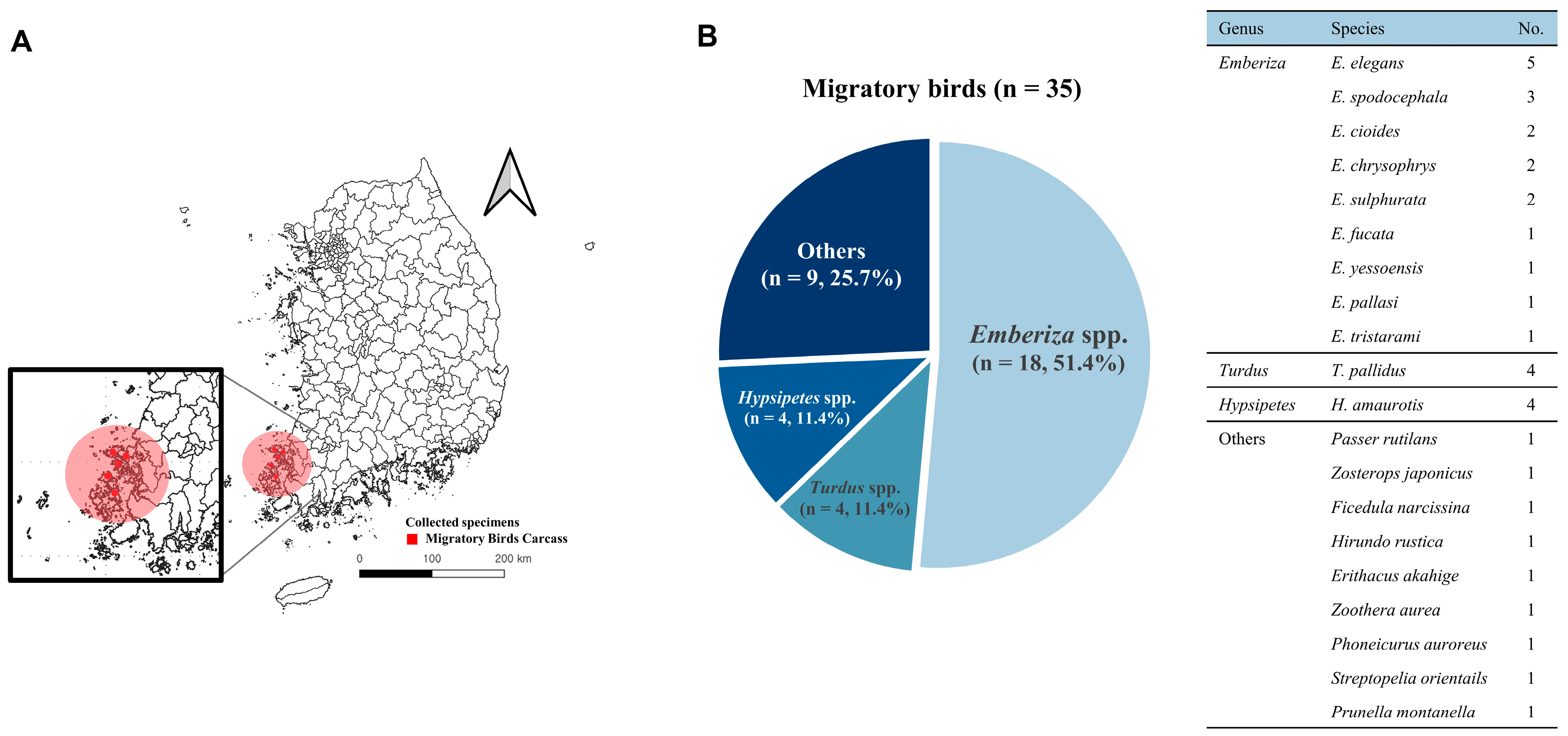
All carcasses were collected from five coastal areas that are historically known as major habitats for migratory birds in Jeollanam-do, South Korea (Figure 1A). Among the 35 bird carcasses collected in this study, 18 birds (51.4%) were morphologically identified as Emberiza species: Emberiza elegans (n = 5), E. spodocephala (n = 3), E. cioides (n = 2), E. chrysophrys (n = 2), E. sulphurata (n = 2), E. fucata (n = 1), E. yessoensis (n = 1), E. pallasi (n = 1), and E. tristarami (n = 1) (Figure 1B). The remaining 17 birds were identified as Turdus pallidus (n = 4), Hypsipetes amaurotis (n = 4), Passer rutilans (n = 1), Zosterops japonicus (n = 1), Ficedula narcissina (n = 1), Hirundo rustica (n = 1), Erithacus akahige (n = 1), Zoothera aurea (n = 1), Phoneicurus auroreus (n = 1), Streptopelia orientails (n = 1), and Prunella montanella (n = 1).
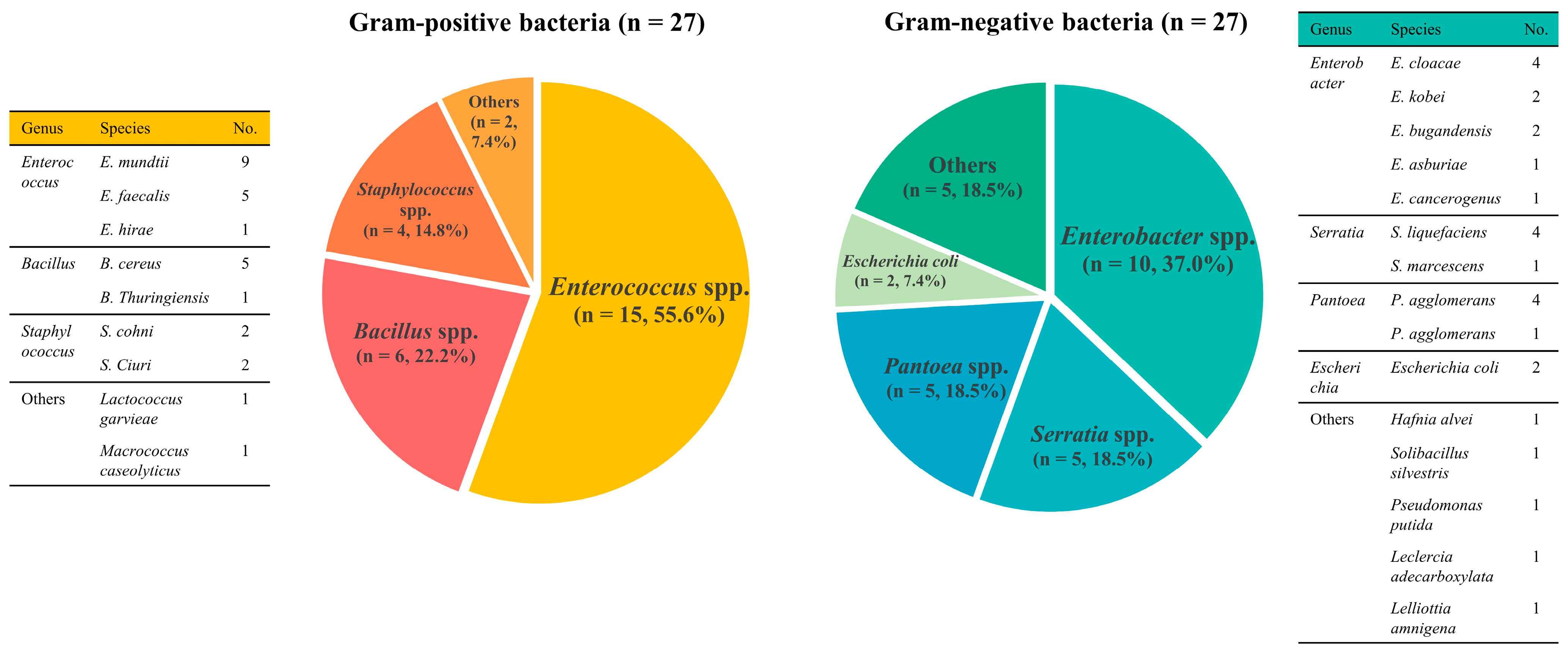
A total of 54 bacterial strains were isolated from 35 bird carcasses (Figure 2). The most frequently isolated species were Enterococcus spp. (n = 15): E. mundtii (n = 9), E. faecalis (n = 5), and E. hirae (n = 1). The other Gram-positive bacteria were identified as Bacillus spp. (n = 6), Staphylococcus spp. (n = 4), Lactococcus garvieae (n = 1), and Macrococcus caseolyticus (n = 1). Among the Gram-negative bacteria, 12 isolates belonged to the coliform group, including 10 Enterobacter spp. and two E. coli. The Enterobacter spp. included Enterobacter cloacae (n = 4), E. kobei (n = 2), E. bugandensis (n = 2), E. asburiae (n = 1), and E. cancerogenus (n = 1). The remaining Gram-negative bacteria were identified as Serratia spp. (n = 5), Pantoea spp. (n = 5), Hafnia alvei (n = 1), Solibacillus silvestris (n = 1), Pseudomonas putida (n = 1), Leclercia adecarboxylata (n = 1), and Lelliottia amnigena (n = 1).

3.2. AMR Susceptibility of Bacterial Isolates

To enhance our understanding of AMR pattern in wildlife, all bacterial isolates were subjected to AMR susceptibility test. However, the lack of standardized interpretive criteria makes it difficult to classify resistance in some species. Therefore, MIC values are provided with categorical interpretation only for Enterococcus spp., Enterobacter spp., E. coli, Staphylococcus spp., Bacillus spp., and Serratia spp. (Supplementary Table S1). Among the 54 isolates, 18 (33.3%) were identified as MDR bacteria, resistant to three or more subclasses of antimicrobial agents. These included E. faecalis (n = 5), E. mundtii (n = 3), E. coli (n = 2), E. cloacae (n = 2), E. kobei (n = 1), E. cancerogenus (n = 1), E. bugandensis (n = 1), S. cohnii (n = 1), B. cereus (n = 1), and E. hirae (n = 1).
Since Enterococcus spp. and coliform bacteria (Enterobacter spp. and E. coli) are key indicators used to assess fecal contamination, originating from the intestinal tracts of humans and animals, the following analysis focused on these microorganisms. For Enterococcus spp., the resistance rates to DAP and TIG were high at 80.0% (Table 1). The resistance rates to VAN, LZD, TYL, QUD, CIP, and SAL varied between 20.0% and 60.0%. In contrast, resistance to GEN, KAN, STR, AMP, ERY, CHL, FLO, and TET was either absent or low (0.0–13.3%). In the case of coliform bacteria, including Enterobacter spp. and E. coli, resistance rates to GEN, STR, AMP, AMC, CXI, CTA, CTZ, CEP, MER, CIP, SIS, COL, and NAL varied between 33.3% and 66.7% (Table 2). Resistance TRS, CHL, and TET was either absent or low (0.0–8.3%).
In addition to fecal indicator microorganisms, opportunistic pathogens, including Staphylococcus spp., Bacillus spp., and Serratia spp., for which birds can serve as infectious sources, were also analyzed. For Staphylococcus spp., resistance rates to CIP, ERY, CHL, and SYN ranged from 25% to 50% (Supplementary Table S2). No resistance was detected against VAN, LZD, and TET. MIC breakpoints for other antimicrobials are not available. In the case of Bacillus spp., resistance rates to AMP, VAN, ERY, LZD, and TET varied between 16.7% and 100.0% (Supplementary Table S3). No resistance was observed against CIP and CHL. MIC breakpoints for other antimicrobials are not available. For Serratia spp., resistance rates to AMC and TET were 60.0% and 20.0%, respectively (Supplementary Table S4). No resistance was observed against CTA, MER, CIP, TRS, and CHL. MIC breakpoints for other antimicrobials are not available.

4. Discussion

Notably, the species distribution of our necropsied carcasses does not mirror the dominant species reported in community surveys from the Sinan-gun islands. For example, bird counts on Bigeum-do and Docho-do revealed substantial populations of Barn Swallow (Hirundo rustica) and Eurasian Tree Sparrow (Passer montanus), together with coastal species such as Kentish Plover (Charadrius alexandrines) and Little Egret (Egretta alba modesta) [25]. In contrast, more than half of the carcasses in our study were Emberiza buntings (E. elegans, E. spodocephala, E. cioides, E. chrysophrys, E. sulphurata, E. fucata, E. yessoensis, E. pallasi, E. tristrami), and the remaining individuals included other small passerines such as Turdus pallidus, Hypsipetes amaurotis, Passer rutilans, Zosterops japonicus, Ficedula narcissina, Hirundo rustica, Erithacus akahige, Zoothera aurea, Phoenicurus auroreus, Streptopelia orientalis and Prunella montanella. This discrepancy likely arises from the differences between live-count surveys and carcass-based sampling: the former quantifies all birds present on the islands at a given time, whereas the latter depends on mortality events, drift, and recovery of dead individuals, and thus is biased towards species with higher local mortality or higher detection probability. Therefore, our organ-level bacterial data should be interpreted as being most representative of small migratory landbirds that suffered mortality during the sampling period, rather than of the entire bird community using southwestern Korean coastal habitats.
Second, the ecological context of our sampling sites helped to interpret the observed AMR patterns. The five coastal areas in Jeollanam-do from which carcasses were collected include tidal flats and island habitats that have been recognized as internationally important for migratory shorebirds and landbirds within the EAAF [18,23,24]. Long-term bird surveys in Sinan-gun and other southwestern islands have reported that Emberiza buntings, Passer rutilans, and other small passerines constitute a substantial proportion of the landbird community, exhibiting marked seasonal variations in their distribution and abundance [25]. In this study, Emberiza species accounted for more than half of the carcasses examined, whereas only a single P. rutilans individual was included, suggesting a potential bias in our sample towards species suffering higher mortality or those more likely to be found and submitted for necropsy in these coastal habitats. Nonetheless, the overlap in key bird species between our dataset and previous Sinan-gun surveys suggests that the organ-level bacterial AMR profiles reported here are likely to be broadly representative of common small migratory landbirds using southwestern Korean coastal ecosystems.
Third, temporal and ecological heterogeneity should be considered when comparing the bacterial findings of the present study with those of previous studies. Seasonal surveys in Sinan-gun and Wando-gun have documented pronounced changes in waterbird and landbird assemblages among seasons [23], and our sampling window (July–October) corresponds mainly to the late breeding and southward migration periods rather than the peak wintering season. This temporal focus, together with the small sample size, may partly explain why some classical avian bacterial pathogens such as Salmonella spp. or Campylobacter spp., which have been detected in migratory birds in other Korean studies [14,44], were not isolated from our carcasses. Instead, we observed that widely distributed commensal and environmental bacteria with opportunistic potential—Enterococcus, Enterobacter, E. coli, Bacillus, Staphylococcus, Serratia, Pantoea and others—were present in multiple organs, indicating ongoing exposure to fecal contamination and environmental reservoirs in the coastal agricultural landscapes where these birds forage and rest. Taken together, this ecological interpretation and the AMR profiles we report suggest that migratory birds in southwestern Korea may act as sentinels integrating signals of environmental contamination across both space (different stopover sites) and time (seasonal movements), even when the available sample size is limited.
Migrating birds have been implicated in the long-distance spread of pathogens. However, the lack of data on the microbial carriage of birds makes them promising subjects for elucidating their potential role in the transmission of antimicrobial-resistant pathogens. In this study, MDR opportunistic pathogens including E. coli, E. faecalis, E. cloacae, S. cohnii, and B. cereus were isolated from birds. E. faecalis is currently recognized as the third important nosocomial pathogen globally [45,46]. Moreover, the frequent acquisition and spread of antimicrobial resistance genes (ARGs) in Enterococcus have exacerbated the morbidity and mortality rates [47]. E. cloacae is another crucial nosocomial pathogen, associated with high morbidity and mortality among intensive care patients due to its resistance to multiple antimicrobials [48]. S. cohnii is an uncommon opportunistic pathogen, but it can cause bacteremia, sepsis, and urinary tract infections [49]. B. cereus is a spore-forming foodborne pathogen that is exhibits resistance to various environmental stresses [50]. Moreover, we reviewed previous studies to identify additional or unexpected bacterial species; however, no novel species were detected in this study. Nevertheless, even commonly reported bacteria are rarely found in the internal organs of migratory birds, and such information remains limited. For a more comprehensive study on bacterial diversity, further research should include additional sampling seasons and geographic location to explore novel pathogens and AMR patterns.
Although migratory birds are increasingly recognized as reservoirs and disseminators of AMR, research on this topic in South Korea is limited. In the 2010s, two studies addressed this issue. Oh et al. [44] identified plasmid-mediated quinolone resistance (PMQR) genes, such as qnrS and aac(6′)-Ib-cr, in E. coli isolated from various bird species, suggesting the potential for long-distance spread of PMQR genes through bird migration [44]. Another study investigated the prevalence and AMR profile of Campylobacter spp. isolates from migratory birds and found low resistance rates to CIP (3.0%) and TET (1.8%) [14]. However, both studies were limited to specific bacterial species and sampling periods around 2009–2010. Since then, no reports on AMR among bacterial isolates from migratory birds in South Korea has been published. This prolonged research gap contrasts with the expanding surveillance efforts in livestock and humans, leaving the ecological role of birds in AMR transmission largely unexplored in South Korea to date.
In this study, we identified MDR bacterial isolates from migratory birds in South Korea. The detection of resistance to VAN, LZD, TIG, and DAP in Enterococcus isolates raises serious public health concerns. Although VAN has been used as a crucial antimicrobial for treating MDR Enterococcus, the emergence of VAN resistance in these strains has created a therapeutic dilemma for clinicians [51]. Currently, only a few last-resort antimicrobials, including LZD, DAP, and TIG, are available for treating VRE [52]. Notably, we report for the first time that two VRE isolates (one E. mundtii and one E. faecalis) from migratory birds in South Korea exhibited resistance to LZD, DAP, and TIG. Such concurrent resistance to VAN and last-resort antimicrobials in Enterococcus suggest the environmental spread of AMR originated from hospitals and agricultural sites [53,54]. In addition, coliform bacterial isolates exhibited the resistance to CIAs, including third- and fourth-generation cephalosporins, carbapenems, and colistin. Notably, our two E. coli isolates exhibited concurrent carbapenem-colistin resistance. Such AMR profiles are concerning, as these antimicrobials are last-resort agents for treating MDR Gram-negative bacterial infections in humans [55]. Although Enterococcus and E. coli are commensal bacteria, they are commonly implicated in infections in human and animals [56,57]. This necessitates the use of antimicrobials and raise public health concerns due to the spread of MDR Enterococcus and E. coli into wildlife.
Intrinsic resistance, unlike acquired resistance, arises from chromosomally encoded mechanisms that naturally exist in bacterial species and do not rely on horizontal gene transfer. For example, Enterococcus spp. exhibit intrinsic resistance to clindamycin and QUD because of the presence of endogenous lsa genes, which encode ATP-binding efflux pumps [58]. Similarly, Enterobacter spp. have inducible chromosomal ampC β-lactamase genes that confer intrinsic resistance to ampicillin and first-generation cephalosporins [59]. These intrinsic mechanisms complicate the interpretation of multidrug resistance profiles, particularly in isolates from environments with limited antibiotic exposure, such as migratory birds. Therefore, distinguishing intrinsic from acquired resistance is essential for accurate ecological risk assessment and understanding the baseline resistome of wildlife populations. Future genomic investigations should include the characteristics of these intrinsic determinants. Nevertheless, AMR patterns observed in our Enterococcus isolates from the internal organs of migratory birds, rather than from environmental or fecal sources, are rarely reported and provide scientific novelty.

5. Conclusions

This study provides the first organ-level evidence that migratory birds in South Korea harbor diverse MDR bacteria, including VRE and carbapenem- and colistin-resistant E. coli. These findings highlight the potential role of migratory birds as ecological sentinels and reservoirs contributing to the environmental dissemination of high-risk AMR. Continued One Health-based wildlife surveillance is essential to better characterize AMR transmission pathways and assess associated public health risks. However, it should be recognized that the present study has some limitations. First, the small sample size limits the representativeness of our findings. Collecting fresh migratory bird carcasses suitable for necropsy and organ sampling is challenging for the following reasons—(i) the mortality events of migratory birds are unpredictable, (ii) carcasses must be collected rapidly before decomposition to avoid microbiological alterations, (iii) weather and predation can rapidly degrade carcasses. Therefore, although we cannot calculate the prevalence or characterize bacterial diversity at the population level, we can identify the presence of clinically significant AMR phenotypes in migratory birds, which can be achieved with a modest sample size. Second, the potential contamination by environmental bacteria cannot be excluded. Third, the antimicrobial susceptibility test based solely on the broth microdilution method, which does not reveal the genetic mechanisms of resistance. Since this study represents a preliminary investigation, future research with an expanded sample size, broader species coverage, and enhanced bacteriological profiling is required. Despite these limitations, we provide valuable baseline data for incorporating wildlife surveillance into the national monitoring frameworks, which aligns with the scope of veterinary sciences.

Supplementary Materials

The following supporting information can be downloaded at https://www.mdpi.com/article/10.3390/vetsci12121157/s1. Table S1: Antimicrobial resistance profiles of 54 bacterial isolates from 35 migratory birds; Table S2: MICs of 16 antimicrobial agents against 4 Staphylococcus spp. isolates; Table S3: MICs of 16 antimicrobial agents against 6 Bacillus spp. isolates; Table S4: MICs of 16 antimicrobial agents against 5 Serratia spp. isolates.

Author Contributions

Conceptualization, H.L. and J.-G.P.; methodology, H.L., J.-G.P., B.-G.J. and J.B.L.; software, D.S.Y.; validation, B.-G.J. and J.B.L.; formal analysis, Y.-B.B. and S.-I.P.; investigation, H.L., J.-G.P., C.-D.L., G.L., J.C., H.J.M., S.S. and G.-C.B.; resources, W.-Y.K. and K.-J.L.; data curation, Y.-B.B. and D.S.Y.; writing—original draft preparation, H.L. and J.-G.P.; writing—review and editing, H.L., J.-G.P., K.-J.L. and S.-I.P.; visualization, W.-Y.K.; supervision, K.-J.L. and S.-I.P.; project administration, K.-J.L. and S.-I.P.; funding acquisition, J.-G.P. and S.-I.P. All authors have read and agreed to the published version of the manuscript.

Funding

This research was supported by the National Institute of Health (NIH) research project (grant No. 2024ER210101 and 2024ER210300). Additional support was provided by the “Regional Innovation System & Education (RISE)” through the Gwangju RISE Center, funded by the Ministry of Education (MOE) and the Gwangju Metropolitan Government, Republic of Korea (2025-RISE-05-011). Funding was also received from the Korea Institute of Planning and Evaluation for Technology in Food, Agriculture and Forestry (IPET) and Korea Smart Farm R&D Foundation (KosFarm) through Smart Farm Innovation Technology Development Program, funded by Ministry of Agriculture, Food and Rural Affairs (MAFRA) and Ministry of Science and ICT (MSIT), Rural Development Administration (RDA) (RS-2025-0221738140982119420101). This research was partially supported by the Commercialization of Strategic Technology Research Results Program through the INNOPOLIS Foundation, funded by the Ministry of Science and ICT (Grant No. 2024-GJ-RD-0033).

Institutional Review Board Statement

This study did not require Institutional Review Board (IRB) approval, as it did not involve experimental procedures on live animals.

Informed Consent Statement

Not applicable.

Data Availability Statement

The original contributions presented in this study are included in the article/Supplementary Material. Further inquiries can be directed to the corresponding authors.

Conflicts of Interest

Woo-Yuel Kim and Seulgi Seo are employees in The Wings Co., Ltd. The remaining authors have no conflicts of interest to declare.

References

  1. Ahlstrom, C.A.; van Toor, M.L.; Woksepp, H.; Chandler, J.C.; Reed, J.A.; Reeves, A.B.; Waldenstrom, J.; Franklin, A.B.; Douglas, D.C.; Bonnedahl, J.; et al. Evidence for continental-scale dispersal of antimicrobial resistant bacteria by landfill-foraging gulls. Sci. Total Environ. 2021, 764, 144551. [Google Scholar] [CrossRef] [PubMed]
  2. Skarzynska, M.; Zaja, C.M.; Bomba, A.; Bocian, L.; Kozdrun, W.; Polak, M.; Wia Cek, J.; Wasyl, D. Antimicrobial Resistance Glides in the Sky-Free-Living Birds as a Reservoir of Resistant Escherichia coli With Zoonotic Potential. Front. Microbiol. 2021, 12, 656223. [Google Scholar] [CrossRef] [PubMed]
  3. Berthold, P. Bird Migration: A General Survey; Oxoford University Press on Demand: Oxford, UK, 2001. [Google Scholar]
  4. Mbuthia, C.W.; Hoza, A.S. Wild birds as potential reservoirs of antimicrobial-resistant Escherichia coli: A systematic review. Front. Microbiol. 2025, 16, 1615826. [Google Scholar] [CrossRef]
  5. Cagnoli, G.; Bertelloni, F.; Interrante, P.; Ceccherelli, R.; Marzoni, M.; Ebani, V.V. Antimicrobial-Resistant Enterococcus spp. in Wild Avifauna from Central Italy. Antibiotics 2022, 11, 852. [Google Scholar] [CrossRef]
  6. Reed, K.D.; Meece, J.K.; Henkel, J.S.; Shukla, S.K. Birds, migration and emerging zoonoses: West nile virus, lyme disease, influenza A and enteropathogens. Clin. Med. Res. 2003, 1, 5–12. [Google Scholar] [CrossRef]
  7. Waldenstrom, J.; Broman, T.; Carlsson, I.; Hasselquist, D.; Achterberg, R.P.; Wagenaar, J.A.; Olsen, B. Prevalence of Campylobacter jejuni, Campylobacter lari, and Campylobacter coli in different ecological guilds and taxa of migrating birds. Appl. Environ. Microbiol. 2002, 68, 5911–5917. [Google Scholar] [CrossRef]
  8. Benskin, C.M.; Wilson, K.; Jones, K.; Hartley, I.R. Bacterial pathogens in wild birds: A review of the frequency and effects of infection. Biol. Rev. Camb. Philos. Soc. 2009, 84, 349–373. [Google Scholar] [CrossRef]
  9. Brittingham, M.C.; Temple, S.A.; Duncan, R.M. A survey of the prevalence of selected bacteria in wild birds. J. Wildl. Dis. 1988, 24, 299–307. [Google Scholar] [CrossRef]
  10. Tsiodras, S.; Kelesidis, T.; Kelesidis, I.; Bauchinger, U.; Falagas, M.E. Human infections associated with wild birds. J. Infect. 2008, 56, 83–98. [Google Scholar] [CrossRef]
  11. Lacerda, M.; de Magalhaes Santos, W.H.; Lopes, M.C.; Fonseca, C.S.; de Carvalho, M.P.N.; da Silva Martins, N.R.; Ecco, R. A Survey of Diseases in Different Species of Wild, Captive, and Illegally Traded Birds in Brazil. Animals 2023, 14, 25. [Google Scholar] [CrossRef] [PubMed]
  12. Laviad-Shitrit, S.; Izhaki, I.; Lalzar, M.; Halpern, M. Comparative Analysis of Intestine Microbiota of Four Wild Waterbird Species. Front. Microbiol. 2019, 10, 1911. [Google Scholar] [CrossRef]
  13. Oliveira, B.C.M.; Murray, M.; Tseng, F.; Widmer, G. The fecal microbiota of wild and captive raptors. Anim. Microbiome 2020, 2, 15. [Google Scholar] [CrossRef]
  14. Kwon, Y.K.; Oh, J.Y.; Jeong, O.M.; Moon, O.K.; Kang, M.S.; Jung, B.Y.; An, B.K.; Youn, S.Y.; Kim, H.R.; Jang, I.; et al. Prevalence of Campylobacter species in wild birds of South Korea. Avian Pathol. 2017, 46, 474–480. [Google Scholar] [CrossRef]
  15. Kim, H.R.; Kwon, Y.K.; Jang, I.; Lee, Y.J.; Kang, H.M.; Lee, E.K.; Song, B.M.; Lee, H.S.; Joo, Y.S.; Lee, K.H.; et al. Pathologic Changes in Wild Birds Infected with Highly Pathogenic Avian Influenza A(H5N8) Viruses, South Korea, 2014. Emerg. Infect. Dis. 2015, 21, 775–780. [Google Scholar] [CrossRef]
  16. Bamford, M.; Watkins, D.; Bancroft, W.; Tischer, G.; Wahl, J. Migratory Shorebirds of the East Asian—Australasian Flyway; Population Estimates and Internationally Important Sites; Wetlands International Oceania: Canberra, Australia, 2008. [Google Scholar]
  17. Amano, T.; Székely, T.; Koyama, K.; Amano, H.; Sutherland, W.J. A framework for monitoring the status of populations: An example from wader populations in the East Asian-Australasian flyway. Biol. Conserv. 2010, 143, 2238–2247. [Google Scholar] [CrossRef]
  18. Lee, J.H.; Kim, I.C.; Lee, S.W.; Son, J.J.; Jang, J.U.; Sung, H.C. International importance of tidal flats in the Republic of Korea as shorebird stopover sites in the East Asian-Australasian flyway. Avian Conserv. Ecol. 2023, 18, 23. [Google Scholar] [CrossRef]
  19. Kim, H.; Mo, Y.; Choi, C.Y.; McComb, B.C.; Betts, M.G. Declines in Common and Migratory Breeding Landbird Species in South Korea Over the Past Two Decades. Front. Ecol. Evol. 2021, 9, 627765. [Google Scholar] [CrossRef]
  20. Choi, C.Y.; Nam, H.Y.; Kim, H.K.; Park, S.Y.; Park, J.G. Changes in bunting communities and populations spanning 100 years in Korea. PLoS ONE 2020, 15, e0233121. [Google Scholar] [CrossRef] [PubMed]
  21. Heim, W.; Antonov, A.; Kunz, F.; Sander, M.M.; Bastardot, M.; Beermann, I.; Heim, R.J.; Thomas, A.; Volkova, V. Habitat use, survival, and migration of a little-known East Asian endemic, the yellow-throated bunting Emberiza elegans. Ecol. Evol. 2023, 13, e10030. [Google Scholar] [CrossRef]
  22. Shang, W.; Li, S.; Zhang, L.; Wu, H.; Jiang, Y. The Composition of Gut Microbiota Community Structure of Jankowski’s Bunting (Emberiza jankowskii). Curr. Microbiol. 2020, 77, 3731–3737. [Google Scholar] [CrossRef]
  23. Park, J.M.; Kim, S.J. A Study on the Status of Waterbirds by Taxon and Seasonal Arrival in the South-West Coast Islands. Int. J. Adv. Cult. Technol. 2023, 11, 349–355. [Google Scholar]
  24. Son, S.J.; Do, M.S.; Choi, G.; Nam, H.K. Identifying research trends in avian migration tracking in Korea using text mining. J. Asia-Pac. Biodivers. 2024, 17, 303–308. [Google Scholar] [CrossRef]
  25. Jin, S.D.; Yu, J.P.; Paik, I.H.; Park, C.Y.; Kim, W.B.; Kim, I.K.; Kang, T.H.; Han, S.W.; Han, S.W.; Pai, W.K. Bird diversity of Bigeum-do and Docho-do Islands in Sinan-gun, Korea. J. Korean Nat. 2012, 5, 59–63. [Google Scholar] [CrossRef][Green Version]
  26. Birds Korea. Korea, Korean birds and the COP 14 of the Convention on Migratory Species (CMS). 2024. Available online: https://www.birdskoreablog.org/?p=28514 (accessed on 20 February 2024).
  27. Walsh, T.R. A one-health approach to antimicrobial resistance. Nat. Microbiol. 2018, 3, 854–855. [Google Scholar] [CrossRef]
  28. Li, X.; Mowlaboccus, S.; Jackson, B.; Cai, C.; Coombs, G.W. Antimicrobial resistance among clinically significant bacteria in wildlife: An overlooked one health concern. Int. J. Antimicrob. Agents 2024, 64, 107251. [Google Scholar] [CrossRef]
  29. Bonnedahl, J.; Jarhult, J.D. Antibiotic resistance in wild birds. Upsala J. Med. Sci. 2014, 119, 113–116. [Google Scholar] [CrossRef]
  30. Vergara, A.; Pitart, C.; Montalvo, T.; Roca, I.; Sabate, S.; Hurtado, J.C.; Planell, R.; Marco, F.; Ramirez, B.; Peracho, V.; et al. Prevalence of Extended-Spectrum-beta-Lactamase- and/or Carbapenemase-Producing Escherichia coli Isolated from Yellow-Legged Gulls from Barcelona, Spain. Antimicrob. Agents Chemother. 2017, 61, 5. [Google Scholar] [CrossRef] [PubMed]
  31. Bonnedahl, J.; Hernandez, J.; Stedt, J.; Waldenstrom, J.; Olsen, B.; Drobni, M. Extended-spectrum beta-lactamases in Escherichia coli and Klebsiella pneumoniae in Gulls, Alaska, USA. Emerg. Infect. Dis. 2014, 20, 897–899. [Google Scholar] [CrossRef] [PubMed]
  32. Mukerji, S.; Stegger, M.; Truswell, A.V.; Laird, T.; Jordan, D.; Abraham, R.J.; Harb, A.; Barton, M.; O’Dea, M.; Abraham, S. Resistance to critically important antimicrobials in Australian silver gulls (Chroicocephalus novaehollandiae) and evidence of anthropogenic origins. J. Antimicrob. Chemother. 2019, 74, 2566–2574. [Google Scholar] [CrossRef] [PubMed]
  33. Mohsin, M.; Raza, S.; Schaufler, K.; Roschanski, N.; Sarwar, F.; Semmler, T.; Schierack, P.; Guenther, S. High Prevalence of CTX-M-15-Type ESBL-Producing E. coli from Migratory Avian Species in Pakistan. Front. Microbiol. 2017, 8, 2476. [Google Scholar] [CrossRef]
  34. Athanasakopoulou, Z.; Diezel, C.; Braun, S.D.; Sofia, M.; Giannakopoulos, A.; Monecke, S.; Gary, D.; Krahmer, D.; Chatzopoulos, D.C.; Touloudi, A.; et al. Occurrence and Characteristics of ESBL- and Carbapenemase- Producing Escherichia coli from Wild and Feral Birds in Greece. Microorganisms 2022, 10, 1217. [Google Scholar] [CrossRef]
  35. Ben Yahia, H.; Chairat, S.; Hamdi, N.; Gharsa, H.; Ben Sallem, R.; Ceballos, S.; Torres, C.; Ben Slama, K. Antimicrobial resistance and genetic lineages of faecal enterococci of wild birds: Emergence of vanA and vanB2 harbouring Enterococcus faecalis. Int. J. Antimicrob. Agents 2018, 52, 936–941. [Google Scholar] [CrossRef]
  36. Gonzalez-Martin, M.R.; Suarez-Perez, A.; Alamo-Pena, A.; Valverde Tercedor, C.; Corbera, J.A.; Tejedor-Junco, M.T. Antimicrobial Susceptibility of Enterococci Isolated from Nestlings of Wild Birds Feeding in Supplementary Feeding Stations: The Case of the Canarian Egyptian Vulture. Pathogens 2024, 13, 855. [Google Scholar] [CrossRef]
  37. Kutkowska, J.; Turska-Szewczuk, A.; Kucharczyk, M.; Kucharczyk, H.; Zalewska, J.; Urbanik-Sypniewska, T. Methicillin-resistant Staphylococcus aureus and glycopeptide-resistant enterococci in fecal samples of birds from South-Eastern Poland. BMC Vet. Res. 2019, 15, 472. [Google Scholar] [CrossRef]
  38. Begum, R.; Asha, N.A.; Dipu, D.C.C.; Roy, M.; Rahman, A.; Chowdhury, M.S.R.; Hossain, H.; Islam, M.R.; Uddin, M.B.; Rahman, M.M.; et al. Virulence and Antimicrobial Resistance Patterns of Salmonella spp. Recovered From Migratory and Captive Wild Birds. Vet. Med. Sci. 2024, 10, e70102. [Google Scholar] [CrossRef]
  39. Card, R.M.; Chisnall, T.; Begum, R.; Sarker, M.S.; Hossain, M.S.; Sagor, M.S.; Mahmud, M.A.; Uddin, A.; Karim, M.R.; Lindahl, J.F.; et al. Multidrug-resistant non-typhoidal Salmonella of public health significance recovered from migratory birds in Bangladesh. Front. Microbiol. 2023, 14, 1162657. [Google Scholar] [CrossRef]
  40. Sippy, R.; Sandoval-Green, C.M.; Sahin, O.; Plummer, P.; Fairbanks, W.S.; Zhang, Q.; Blanchong, J.A. Occurrence and molecular analysis of Campylobacter in wildlife on livestock farms. Vet. Microbiol. 2012, 157, 369–375. [Google Scholar] [CrossRef] [PubMed]
  41. Tareen, A.R.; Zahra, R. Community acquired methicillin resistant Staphylococci (CA-MRS) in fecal matter of wild birds—A ‘one health’ point of concern. J. Infect. Public Health 2023, 16, 877–883. [Google Scholar] [CrossRef] [PubMed]
  42. Cobo, F.; Perez-Carrasco, V.; Martin-Hita, L.; Garcia-Salcedo, J.A.; Navarro-Mari, J.M. Comparative evaluation of MALDI-TOF MS and 16S rRNA gene sequencing for the identification of clinically relevant anaerobic bacteria: Critical evaluation of discrepant results. Anaerobe 2023, 82, 102754. [Google Scholar] [CrossRef] [PubMed]
  43. Timperio, A.M.; Gorrasi, S.; Zolla, L.; Fenice, M. Evaluation of MALDI-TOF mass spectrometry and MALDI BioTyper in comparison to 16S rDNA sequencing for the identification of bacteria isolated from Arctic sea water. PLoS ONE 2017, 12, e0181860. [Google Scholar] [CrossRef]
  44. Oh, J.Y.; Kwon, Y.K.; Tamang, M.D.; Jang, H.K.; Jeong, O.M.; Lee, H.S.; Kang, M.S. Plasmid-Mediated Quinolone Resistance in Escherichia coli Isolates from Wild Birds and Chickens in South Korea. Microb. Drug Resist. 2016, 22, 69–79. [Google Scholar] [CrossRef]
  45. Mendes, R.E.; Castanheira, M.; Farrell, D.J.; Flamm, R.K.; Sader, H.S.; Jones, R.N. Longitudinal (2001-14) analysis of enterococci and VRE causing invasive infections in European and US hospitals, including a contemporary (2010-13) analysis of oritavancin in vitro potency. J. Antimicrob. Chemother. 2016, 71, 3453–3458. [Google Scholar] [CrossRef]
  46. Weisser, M.; Theilacker, C.; Tschudin Sutter, S.; Babikir, R.; Bertz, H.; Gotting, T.; Dettenkofer, M.; Kern, W.V.; Widmer, A.F.; Hospital Infection Surveillance System for Patients With Haematologic/Oncologic Malignancies Study Group. Secular trends of bloodstream infections during neutropenia in 15 181 haematopoietic stem cell transplants: 13-year results from a European multicentre surveillance study (ONKO-KISS). Clin. Microbiol. Infect. 2017, 23, 854–859. [Google Scholar] [CrossRef]
  47. Farsi, S.; Salama, I.; Escalante-Alderete, E.; Cervantes, J. Multidrug-Resistant Enterococcal Infection in Surgical Patients, What Surgeons Need to Know. Microorganisms 2023, 11, 238. [Google Scholar] [CrossRef] [PubMed]
  48. Elbehiry, A.; Al Shoaibi, M.; Alzahrani, H.; Ibrahem, M.; Moussa, I.; Alzaben, F.; Alsubki, R.A.; Hemeg, H.A.; Almutairi, D.; Althobaiti, S.; et al. Enterobacter cloacae from urinary tract infections: Frequency, protein analysis, and antimicrobial resistance. AMB Express 2024, 14, 17. [Google Scholar] [CrossRef] [PubMed]
  49. Lei, Y.; Guo, Q.; Liu, J.; Huang, H.; Han, P. Staphylococcus cohnii infection diagnosed by metagenomic next generation sequencing in a patient on hemodialysis with cirrhotic ascites: A case report. Front. Cell. Infect. Microbiol. 2023, 13, 1240283. [Google Scholar] [CrossRef]
  50. Ehling-Schulz, M.; Lereclus, D.; Koehler, T.M. The Bacillus cereus Group: Bacillus Species with Pathogenic Potential. Microbiol. Spectr. 2019, 7, 35. [Google Scholar] [CrossRef] [PubMed]
  51. Ahmed, M.O.; Baptiste, K.E. Vancomycin-Resistant Enterococci: A Review of Antimicrobial Resistance Mechanisms and Perspectives of Human and Animal Health. Microb. Drug Resist. 2018, 24, 590–606. [Google Scholar] [CrossRef]
  52. Bender, J.K.; Cattoir, V.; Hegstad, K.; Sadowy, E.; Coque, T.M.; Westh, H.; Hammerum, A.M.; Schaffer, K.; Burns, K.; Murchan, S.; et al. Update on prevalence and mechanisms of resistance to linezolid, tigecycline and daptomycin in enterococci in Europe: Towards a common nomenclature. Drug Resist. Updates 2018, 40, 25–39. [Google Scholar] [CrossRef]
  53. Klibi, N.; Ben Amor, I.; Rahmouni, M.; Dziri, R.; Douja, G.; Ben Said, L.; Lozano, C.; Boudabous, A.; Ben Slama, K.; Mansouri, R.; et al. Diversity of species and antibiotic resistance among fecal enterococci from wild birds in Tunisia. Detection of vanA-containing isolates. Eur. J. Wildl. Res. 2015, 61, 319–323. [Google Scholar] [CrossRef]
  54. Oravcova, V.; Svec, P.; Literak, I. Vancomycin-resistant enterococci with vanA and vanB genes in Australian gulls. Environ. Microbiol. Rep. 2017, 9, 316–318. [Google Scholar] [CrossRef]
  55. Gehring, R.; Mochel, J.P.; Schmerold, I. Understanding the background and clinical significance of the WHO, WOAH, and EMA classifications of antimicrobials to mitigate antimicrobial resistance. Front. Vet. Sci. 2023, 10, 1153048. [Google Scholar] [CrossRef] [PubMed]
  56. Krawczyk, B.; Wityk, P.; Galecka, M.; Michalik, M. The Many Faces of Enterococcus spp.-Commensal, Probiotic and Opportunistic Pathogen. Microorganisms 2021, 9, 1900. [Google Scholar] [CrossRef] [PubMed]
  57. Ramos, S.; Silva, V.; Dapkevicius, M.L.E.; Canica, M.; Tejedor-Junco, M.T.; Igrejas, G.; Poeta, P. Escherichia coli as Commensal and Pathogenic Bacteria Among Food-Producing Animals: Health Implications of Extended Spectrum beta-lactamase (ESBL) Production. Animals 2020, 10, 2239. [Google Scholar] [CrossRef] [PubMed]
  58. Singh, K.V.; Weinstock, G.M.; Murray, B.E. An Enterococcus faecalis ABC homologue (Lsa) is required for the resistance of this species to clindamycin and quinupristin-dalfopristin. Antimicrob. Agents Chemother. 2002, 46, 1845–1850. [Google Scholar] [CrossRef]
  59. Davin-Regli, A.; Lavigne, J.P.; Pagès, J.M. Enterobacter spp.: Update on Taxonomy, Clinical Aspect, and Emerging Antimicrobial Resistance. Clin. Microbiol. Rev. 2019, 32, 32. [Google Scholar] [CrossRef]
Figure 1. Survey areas and species distribution of migratory birds collected in South Korea. (A) Map showing the five coastal sampling areas in the Sinan-gun islands in the southwestern region of South Korea, where bird carcasses were collected. These areas are designated as regular monitoring sites by the Korean Ministry of Environment and serve as major stopover habitats in the East Asian–Australasian Flyway. (B) Species distribution of the 35 bird carcasses examined in this study. A total of 20 species were morphologically identified, including nine Emberiza species and 11 other species. Species identification was confirmed by field ornithologists during the necropsy.
Vetsci 12 01157 g001
Figure 2. Species distribution of Gram-positive bacteria and Gram-negative bacteria isolated from migratory birds in South Korea. Bar chart summarizing the bacterial species composition of the 54 isolates from bird carcasses. Gram-positive bacteria included Enterococcus spp., Bacillus spp., Staphylococcus spp., and other species. Gram-negative bacteria included coliform bacteria (Enterobacter spp. and Escherichia coli), Serratia spp., Pantoea spp., and other species. The figure shows the diversity of the 24 bacterial species detected in the sampled birds and highlights the distribution patterns used for subsequent antimicrobial susceptibility analyses.
Vetsci 12 01157 g002
Table 1. Results obtained testing 15 Enterococcus spp. isolates versus 16 antimicrobials with the broth microdilution method test.
AntimicrobialsSusceptibleIntermediateResistant
ClassMolecules aNumber of Isolates%Number of Isolates%Number of Isolates%
AminoglycosidesGEN15100.000.000.0
KAN15100.000.000.0
STR15100.000.000.0
AminopenicillinAMP1386.700.0213.3
FluoroquinoloneCIP426.7640.0533.3
GlycopeptideVAN1280.000.0320.0
GlycylcyclinesTIG220.000.01380.0
LipopeptidesDAP16.7213.31280.0
MacrolidesERY853.3533.3213.3
TYL1280.000.0320.0
OxazolidinonesLZD16.71173.3320.0
PhenicolsCHL213.31173.3213.3
FLO1493.300.016.7
StreptograminsQUD533.316.7960.0
TetracyclinesTET1493.300.016.7
OthersSAL1280.000.0320.0
a GEN, gentamicin; KAN, kanamycin; STR, streptomycin; AMP, ampicillin; CIP, ciprofloxacin; VAN, vancomycin; TIG, tigecycline; DAP, daptomycin; ERY, erythromycin; TYL, tylosin; LZD, linezolid; CHL, chloramphenicol; FLO, florfenicol; QUD, quinupristin/dalfopristin; TET, tetracycline; SAL, salinomycin.
Table 2. Results obtained testing 12 coliform bacterial isolates versus 16 antimicrobials with the broth microdilution method test.
AntimicrobialsSusceptibleIntermediateResistant
ClassMolecules aNumber of Isolates%Number of Isolates%Number of Isolates%
AminoglycosidesGEN866.700.0433.3
STR650.000.0650.0
AminopenicillinAMP541.7216.7541.7
β-lactam/β-lactmase inhibitorAMC216.7433.3650.0
CephamycinCXI00.0433.3866.7
Cephalosporin IIICTA758.300.0541.7
CTZ758.300.0541.7
Cephalosporin IVCEP758.300.0541.7
CarbapenemMER758.300.0541.7
FluoroquinoloneCIP758.300.0541.7
Folate pathway inhibitorsTRS1191.700.018.3
SIS541.700.0758.3
PhenicolsCHL758.3541.700.0
PolymyxinsCOL00.0650.0650.0
QuinoloneNAL758.300.0541.7
TetracyclinesTET975.0216.718.3
a GEN, gentamicin; STR, streptomycin; AMP, ampicillin; AMC, amoxicillin/clavulanic acid; CXI, cefoxitin; CTA, cefotaxime; CTZ, ceftazidime; CEP, cefepime; MER, meropenem; CIP, ciprofloxacin; TRS, trimethoprim/sulfamethoxazole; SIS, sulfisoxazole; CHL, chloramphenicol; COL, colistin; NAL, nalidixic acid; TET, tetracycline.
Disclaimer/Publisher’s Note: The statements, opinions and data contained in all publications are solely those of the individual author(s) and contributor(s) and not of MDPI and/or the editor(s). MDPI and/or the editor(s) disclaim responsibility for any injury to people or property resulting from any ideas, methods, instructions or products referred to in the content.