
Article

Bovine Mastitis-Derived Bacillus cereus in Inner Mongolia: Strain Characterization, Virulence Factor Identification, and Pathogenicity Validation

1
Joint International Research Laboratory of Agriculture and Agri-Product Safety, Ministry of Education of China, Yangzhou University, Yangzhou 225009, China
2
College of Animal Science and Technology, Yangzhou University, Yangzhou 225009, China
3
Key Laboratory for Crop and Animal Integrated Farming of Ministry of Agriculture and Rural Affairs, Animal Husbandry Institute, Jiangsu Academy of Agricultural Sciences, Nanjing 210014, China
*
Authors to whom correspondence should be addressed.
Vet. Sci. 2025, 12(11), 1057; https://doi.org/10.3390/vetsci12111057
Submission received: 28 September 2025 / Revised: 29 October 2025 / Accepted: 30 October 2025 / Published: 3 November 2025
(This article belongs to the Special Issue Ruminant Mastitis: Therapies and Control)

Simple Summary

We conducted a study to investigate the role and characteristics of Bacillus cereus in bovine mastitis within dairy herds in Inner Mongolia, China. The objectives were to determine its prevalence, antimicrobial resistance profile, virulence gene carriage, and pathogenic potential. A total of 340 bacterial strains were isolated from clinical mastitis milk samples. Bacillus cereus was identified as the predominant pathogen. Antimicrobial susceptibility testing revealed significant resistance to tetracycline, but consistent susceptibility to gentamicin, amikacin, and roxithromycin. PCR assay confirmed that all B. cereus isolates carried key virulence genes. Mouse model challenges demonstrated that strains harboring a higher number of virulence genes induced more severe histopathological damage in liver and kidney tissues and a stronger inflammatory response. Our findings establish Bacillus cereus as a major etiological agent of mastitis in this region with a distinct resistance and virulence pattern. This study provides crucial epidemiological data to inform targeted mastitis control strategies and support animal health and food safety.

Abstract

This study aimed to investigate the epidemiological characteristics and antimicrobial resistance patterns of Bacillus cereus (B. cereus) in bovine mastitis within Inner Mongolian dairy herds, with a focus on virulence gene distribution and their clinical implications. A cross-sectional epidemiological investigation was conducted across three large-scale dairy farms. A total of 340 bacterial strains were isolated from milk samples collected from 108 cows with clinical mastitis, all of which underwent comprehensive PCR testing. Antimicrobial susceptibility testing was performed using the Kirby–Bauer disk diffusion method against eight antibiotics. Virulence gene profiling was conducted for all B. cereus isolates, and murine challenge experiments were performed to assess virulence-factor-dependent pathogenicity. Bacteriological analysis identified B. cereus as the predominant pathogen (104 strains, 30.58%), followed by Staphylococcus spp. (74 strains, 21.76%). Antimicrobial susceptibility testing revealed high resistance to tetracycline (38.46%), cotrimoxazole (15.38%), and ciprofloxacin (7.69%), while complete sensitivity (100%) was observed for gentamicin, amikacin, and roxithromycin. Virulence gene profiling demonstrated universal presence of nheA, nheB, and entFM genes in all isolates, with bh1D detected in only 21.15% (22/104) of strains. Murine challenge experiments confirmed virulence-factor-dependent pathogenicity, with strains harboring nine virulence factors inducing significant upregulation of hepatic inflammatory markers (p < 0.05) and histopathological alterations in hepatic and renal tissues compared to strains with three virulence factors. Our findings highlight B. cereus as an emerging virulent pathogen in Inner Mongolian dairy herds, necessitating enhanced surveillance of virulence factors and antimicrobial stewardship in mastitis management. This study provides critical epidemiological data to inform clinical veterinary practices and targeted intervention strategies.

1. Introduction

Bovine mastitis is a common inflammation of the mammary gland that seriously affects the health of dairy cows and dairy production worldwide and even threatens public health [1]. Bovine mastitis remains one of the most perplexing and costly diseases in dairy cattle; thus, further research into its role and molecular mechanisms is needed [2]. Control of mastitis relies on effective strategies for dairy herds rather than identification or specific treatment of individual animals [3]. It is vital to identify the pathogenic microorganisms causing mastitis and the proportion of infected cows with a high somatic cell count (SCC) [4]. Bacteria such as Staphylococcus aureus, Mycoplasma bovis, Corynebacterium bovis, and Streptococcus lactis are prime pathogens of contagious agents [5]. In contrast, environmental mastitis is suggested to be associated with intramammary infections caused by microorganisms that originate primarily from the environment, such as Escherichia coli and Klebsiella spp. [6]. However, due to the emphasis placed on the management of dairy farming, the incidence of contagious mastitis has declined significantly in recent decades, whereas that of environmental mastitis has risen dramatically [7].
As early as 2008, data from the European Union showed that Bacillus cereus was a significant cause of food poisoning in humans and a significant cause of 1.4–12% of foodborne illnesses worldwide [8,9]. B. cereus is a Gram-positive bacterium that is aerobic or partially anaerobic; it can form spores in pastures and is widely found in bedding, sewage, air, and other environments [10]. Numerous studies have shown that B. cereus may cause mastitis in dairy cows through the environment [11]. Notably, B. cereus spores can germinate and grow to high levels in pasteurized milk and various dairy products, raising potential safety hazards for milk consumers [12].
Studies have shown that B. cereus causes gastrointestinal disorders in animals and humans [13], In China, foodborne illness outbreaks involving B. cereus are usually caused by dairy products [14], with the main symptoms of B. cereus-related food poisoning being diarrhea and vomiting [15]. Diarrhea is mainly caused by three enterotoxins belonging to the family of pore-forming toxins (PFTs) [16], including non-hemolytic enterotoxins (Nhe) [17], Hemolysin BL (Hbl) [18], and cytolysin K (CytK) [19]. Emetic syndrome is closely linked to a deadly toxin known as cereulide, which is synthesized by the non-ribosomal peptide synthetase (NRPS) encoded by the Ces Cereulide Synthetase (Ces) gene [20]. Low-dose cereulide exposure disrupts the intestinal barrier’s function and causes intestinal inflammation, which results from activation of the endoplasmic reticulum (ER) stress IRE1/XBP1/CHOP pathway, to induce cell apoptosis and inflammatory cytokine production. Regarding gut microbiota, cereulide decreases the abundances of Lactobacillus and Oscillospira. Furthermore, cereulide disrupts the metabolism of gut microbiota, which inhibit butyrate and tryptophan [21]. However, the correlations of various virulence genes carried by B. cereus and its toxicity remain unknown. In addition to enterotoxins, some B. cereus isolates are resistant to antimicrobial agents. Due to the widespread use of various antimicrobial drugs, the problem of bacterial resistance is becoming increasingly serious and poses a great threat to animal health [22]. Improving feeding efficiency and management are effective measures to prevent the occurrence of mastitis in dairy cows, but it cannot be completely eradicated. The use of antibiotics is still the main method of treatment in practice. Pathogenic microorganisms become resistant to drugs, leading to the enrichment of drug residues in dairy products and threatening food safety and health. In summary, it is necessary to study the resistance capacity, virulence factors, and virulence of the main pathogenic microorganisms causing mastitis in dairy cows. This study aims to investigate the dominant pathogenic groups of mastitis in dairy cows in Inner Mongolia. It also aims to assess the distribution of drug resistance and virulence genes from isolated Bacillus cereus and determine its pathogenicity by using a mouse model. The results may provide an experimental basis for the prevention and control of the epidemic spread of Bacillus cereus and help uncover its pathogenic severity regarding clinical mastitis in Inner Mongolia.

2. Materials and Methods

2.1. Isolation and Identification of Milk-Derived Bacteria

In this study, 108 milk samples of dairy cows with clinical mastitis from three farms (Farm A, B, and C) in Inner Mongolia were isolated and identified using a combination of bacterial culture and 16S rDNA sequencing method [23]. Farm A collected 52 samples, Farm B collected 48 samples, and Farm C collected 8 samples. Briefly, 80 µL of the milk sample was applied to the surface of blood agar using a glass rod and placed in a 37 °C incubator for 16 h. The external morphology of the bacterial colony was observed, and the parameters of size, shape, and color of the grown bacteria were recorded. The single colony was picked to grow in 3 mL of Luria–Bertani Broth, which was then placed in a 37 °C shaker for 16 h. The purification culture was carried out, and the DNA extraction of the pathogenic bacteria was carried out immediately after the completion of the culture. The identification of the 104 B. cereus isolates was performed using 16S rDNA sequencing combined with PCR-based confirmation. Briefly, genomic DNA was extracted using a standard bacterial DNA isolation kit (e.g., TIANGEN DNA Kit). The 16S rDNA gene region was amplified with universal primers (27F/1492R) under optimized PCR conditions. PCR conditions were 98 °C for 2 min, followed by 35 cycles at 98 °C for 10 s, 58 °C for 10 s, and 72 °C for 45 s with a final extension of 72 °C for 1 min. The 25 μL reaction mixture for PCR consisted of 1 μL each of forward and reverse primers, 0.5 μL of genomic DNA, 11.25 μL of Taq Master Mix and supplemented with sterile water up to 25 μL. After PCR amplification, the PCR products were detected using gel electrophoresis. 5 µL of all samples were pipetted into a 1% agarose gel for electrophoresis. After electrophoresis, a gel imaging system was used to observe the presence of bands, and the sample was sent to a sequencing company for sequencing. The sequencing results were subjected to BLAST comparison on the NCBI website, https://blast.ncbi.nlm.nih.gov/Blast.cgi (accessed on 15 February 2023), to determine the genus of the pathogenic bacteria.

2.2. Determination of Antimicrobial Susceptibility

In this experiment, 104 strains of B. cereus were subjected to drug sensitivity test and eight antibiotics were selected for use: erythromycin, tetracycline, ciprofloxacin, clindamycin, cotrimoxazole, gentamicin, roxithromycin, and amikacin [24]. The drug resistance phenotype of the bacteria was detected by paper diffusion method with reference to the CLSI 2021 guidelines for drug susceptibility testing, which categorized them as resistant (R), intermediary (I) and sensitive (S) (Figure S1) [25,26]. First, the culture medium was made, and the Mueller-Hinton Broth drug-sensitive agar was autoclaved after proportioning according to the instructions, then the bacterial solution was diluted, and the bacterial solution was diluted with saline at 1:10, and compared with the turbidimetric tubes of 0.5 McDonald’s units, and then the sterilized cotton swabs were dipped into the diluted bacterial suspension and evenly coated on the Mueller-Hinton agar, and then finally the drug-sensitive slices with the lettering side down were placed in the incubator at a constant temperature of 37 °C for incubation. When the incubation was completed, the bacterial growth around the drug-sensitive tablets was observed, and the diameter of the inhibition circle was measured by vernier calipers.

2.3. Detection of Virulence Genes

Firstly, the genomic DNA of B. cereus was extracted according to the instructions of the DNA extraction kit; then the DNA concentration was determined: the concentration of the extracted bacterial DNA was determined by a nucleic acid protein analyze; then the DNA concentration was diluted to 20 μg/mL and used as the template of the PCR reaction, which was stored at −20 °C for backup; finally, the PCR amplification was carried out for 11 virulence-related genes of B. cereus (hblA, hblC, hblD, nheA, nheB, nheC, entFM, cytK, bceT, ces, EMl) were amplified by PCR. The 25 μL reaction mixture for PCR consisted of 1 μL each of forward and reverse primers (Table S1), 2 μL of genomic DNA, 2 μL of deoxyribonucleoside triphosphates (dNTPs), 2.5 μL of 10 × Ex Taq Buffer (Mg2+ Plus), 0.3 μL of Ex Taq (5 U·μL−1) and supplemented with sterile water up to 25 μL. For the selected isolate the purified PCR products of the target genes in the selected isolates were sequenced and analyzed at NCBI.

2.4. Construction of Mouse Mastitis Model

For the experiments, 6–8-week-old mice were obtained from the Center of Comparative Medicine at Yangzhou University. All experimental procedures and care of experimental animals in the study were followed according to the Manual for the Care and Use of Laboratory Animals published by the National Institutes of Health. The mice were randomly divided into 3 groups (n = 6/group): the control group (NC), the group injected with the least virulence genes of B.cereus was LVB (B. cereus IM01, nheA, nheB, entFM expressed), and the group injected with the most virulence genes of B.cereus was MVB (B. cereus IM21, nheA, nheB, entFM, nheC, hblA, hblC, hblD, cytK, bceT expressed). The 5 × 10⁸ CFU/mL attacking bacterial solution was prepared and injected into the ducts of the fourth mammary gland area for 24 h, and the morbidity and mortality were counted, and the dead and abnormal mice were promptly dissected. After killing the mice, the livers and kidneys were aseptically collected for hematoxylin-eosin (H&E) staining microscopy to observe the tissue lesions. At the same time, serum was collected for the determination of biochemical parameters.

2.5. Histological Analysis

Pieces of tissue from mice were fixed in buffered formalin phosphate (10%), followed by paraffin-embedding, sectioned, and stained with hematoxylin and eosin, and a phase-contrast microscope was used for capturing (Nikon, Tokyo, Japan). Histopathological changes in the murine tissues were evaluated according to the sum of the infiltration of inflammatory cells, the vascular endothelium injury, and the disorder of sinuses and lobules in the liver and kidney. Each histological characteristic was evaluated on a scale of 0–5.

2.6. Determination of Biochemical and Oxidative Stress Parameters in Serum and Liver Tissue

The level of ALT, AST, LDH, and ALP of serum and GSH-Px, SOD, and MDA content of liver tissues were determined using commercial kits from Nanjing Jianjian Biological Company by the instructions.

2.7. RNA Extraction and Quantitative PCR Analysis

Total RNA from mice hepatic tissues was isolated with the RNA Isolater Total RNA Extraction Reagent (R401-01, Vazyme, Nanjing, China) according to the instructions of manufacturer. cDNA was synthesized by applying HiScript III RT SuperMix (R323-01, Vazyme, Nanjing, China) thereafter purified with purification kit (Axygen, Tewksbury, MA, USA). In brief, qRT-PCR was performed by using AceQ Universal SYBR qPCR Master Mix (Vazyme, Nanjing, China) on an ABI QuantStudio System (Applied Biosystems, Foster City, CA, USA). The PCR program was designed as follows: an initial denaturation at 95 °C for 30 s, followed by a cycling stage consisting of denaturation at 95 °C for 5 s, annealing at 60 °C for 30 s, and 40 cycles. Subsequently, the extension was performed at 95 °C for 15 s and 60 °C for 60 s, followed by a final extension at 90 °C for 15 s to generate amplification curves. The housekeeping gene, GAPDH, was used as an internal reference. Each RT-qPCR was set up in triplicates, and the experiment was repeated three times [27]. The target gene expression data were normalized using the geometric mean of the internal control genes. Relative quantification was performed using the 2−ΔΔCt method [28].

2.8. Western-Blotting Analysis

Western blot was performed using protocols described previously [29]. For Western blot analysis, 6 individual samples per group (n = 6 per group, total 3 groups) were collected. To reduce sample volume while maintaining statistical power, samples from each group were pooled in pairs, resulting in 3 pooled biological replicates per group. All samples from experimental mice were included in the analysis. In brief, equal amounts of protein isolated from hepatic tissues by RIPA lysis buffer (Beyotime, Shanghai, China) were separated on 4% to 20% SDS polyacrylamide gels. Protein samples were transferred onto nitrocellulose membranes (Millipore, Billerica, MA, USA) and probed with primary antibodies overnight at 4 °C. Following six washes, the membranes were incubated with horseradish peroxidase (HRP)-conjugated secondary antibodies. To account for variations in protein transfer efficiency between blots, GAPDH levels were used for normalization. Band intensities were quantified using Bio-Rad imaging software V5.2.1(Bio-Rad, Hercules, CA, USA) by measuring the gray values of each target protein. Primary antibodies for p-P65, p65, TNF-α, TLR4, IL-6, and IL-8 were purchased from Cell Signaling Technology (Danvers, MA, USA; #3033, #8242, #6945, #14358, #12153, #94407), and were diluted 1:1000 for incubation.

2.9. Statistics

Multiple comparisons among groups were carried out by one-way analysis of variance (ANOVA) with Tukey’s post hoc test. Differences between two groups were assessed by a two-tailed Student’s t-test, with p < 0.05 indicating significant differences, and the results were expressed as the means ± SEM. Figures were drawn using GraphPad Prism 10.4.0 (GraphPad Software, Inc., San Diego, CA, USA).

3. Results

3.1. Isolation of Bacterial from Bovine Clinical Mastitis

A total of 340 strains of bacteria were detected in 108 clinical mastitis milk samples. Table 1 shows that only two of the milk samples from farm B did not contain bacteria, while bacteria were detected in 98.14% of milk samples from the three farms. In total, 12 species with 340 strains of bacteria were isolated in this study (Table 2). Among the isolated strains, Bacillus cereus had the highest detection rate of 30.58% (104/340), followed by Staphylococcus aureus at 21.76% (74/340); Enterococcus faecalis, Arthrobacter, and Actinobacillus had the lowest detection rate of 0.59% (2/340). The distribution of detected bacteria in each farm is also shown in Table 2. B. cereus and Staphylococcus aureus were detected in all three farms, with B. cereus being the most abundant in farm A and the least in farm C. The distribution of S. aureus is consistent with that of B. cereus, both being the most abundant in farm A and the least in farm C. Rhizobium only appeared in farms A and B at a rate of 7.65%; Streptococcus agalactiae was only found in farm A; and Copperhead and Arthrobacter were only found in farm B at rates of 0.17% and 0.59%, respectively. Enterococcus faecalis, Actinobacillus, and Pseudomonas were found in farm A with detection rates of 0.59%, 0.59%, and 2.35%, respectively.

3.2. Phenotypic Drug Susceptibility of B. cereus Isolated from Bovines with Clinical Mastitis

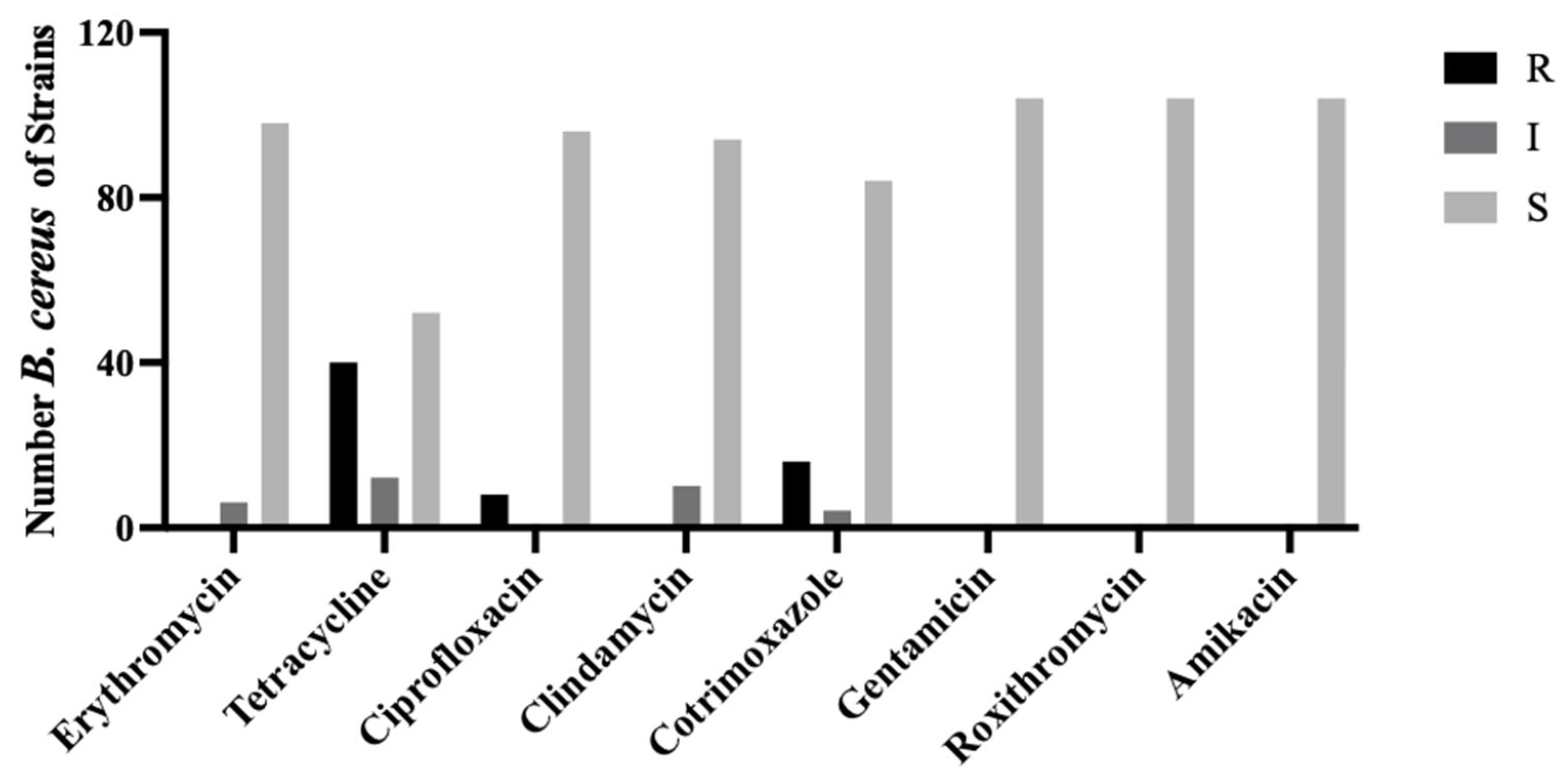
Figure 1 shows that 104 strains of Bacillus cereus were tested for resistance to eight antibiotics. The strains showed the strongest resistance to tetracycline at 38.46%, followed by cotrimoxazole and ciprofloxacin with resistance rates of 15.38% and 7.69%, respectively. Additionally, there was strong susceptibility to erythromycin and clindamycin. All B. cereus strains were sensitive to gentamicin, amikacin, and roxithromycin.

3.3. Carriage of Virulence Genes in B. cereus

The main virulence factors carried by 104 strains of B. cereus from milk samples were analyzed, and the frequency of detection of each virulence gene is shown in Table 3. All B. cereus strains carried nheA, nheB, and entFM genes, with only 22 strains carrying the hb1D gene. The distribution of virulence genes of the strains is shown in Table 4; 99.90% of B. cereus strains carried four or more virulence factors. Among them, 16 strains carried five genes (nheA, nheB, entFM, nheC, and bceT), 4 strains simultaneously expressed nine virulence factors, and 102 strains co-expressed nheA, nheB, and nheC.

3.4. B. cereus Induces Histopathological Damage in the Liver and Kidney and Inflammatory Gene Expression in the Liver

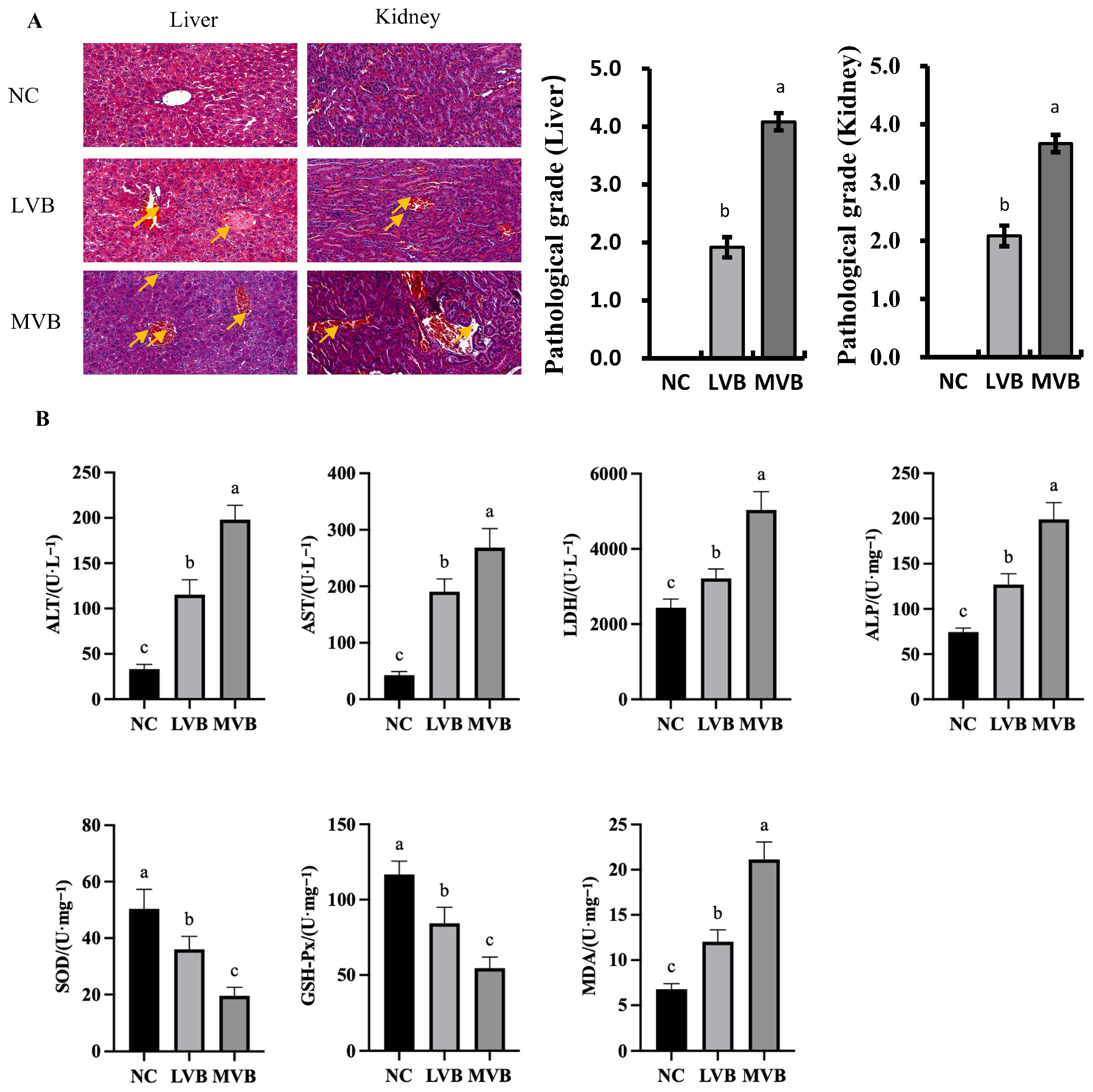
Two strains of B. cereus carry different numbers of virulence genes (one isolate carried the least virulence genes, while another carried the most) and induced inflammatory responses in the livers and kidneys of mice. Histopathological changes in the murine tissues were evaluated according to their injury degree score, including the infiltration of inflammatory cells (as the arrows shown), the vascular endothelium injury, and the disorder of sinuses and lobules in the liver and kidney. Each histological characteristic was evaluated on a scale of 0–5, as described previously [30]. According to Figure 2A, both infected groups showed infiltration of inflammatory cells in liver and kidney tissues, congestion of the tissue interstitial space, and obvious destruction of tissues, demonstrating the toxic effects of B. cereus. The destruction of the livers and kidneys was significantly enhanced in the MVB group compared to the LVB group.

3.5. Levels of Biochemical Parameters in Plasma of Mice Induced by B. cereus

Data on the biochemical parameters are shown in Figure 2B. The LVB and MVB groups were treated by different strains of B. cereus, which led to a significant increase in hepatic inflammatory responses in the mice with increased carriage of virulence factors compared to the control group. The plasma concentration of Alanine aminotransferase (ALT), Aspartate aminotransferase (AST), Lactate dehydrogenase (LDH) and Alkaline phosphatase (ALP) were significantly higher in both treatment groups than in the control group. Moreover, plasma in the MVB group demonstrated higher secretion of ALT, AST, LDH, and ALP than that in the LVB group. Among oxidative stress factors, Superoxide dismutase (SOD) and Glutathione peroxidase (GSH-Px) were significantly lower in both treatment groups (LVB and MVB group) than in the control group. Additionally, the concentrations of SOD and GSH-Px significantly decreased in the MVB group compared to the LVB group. The concentration of Malondialdehyde (MDA) in LVB and MVB plasma were significantly upregulated compared to the control group. The results of these indexes indicate that the livers of the treated mice were severely damaged, worsening with the increased carriage of virulence factors.

3.6. The Inducible Effect of B. cereus on the Expression of Inflammatory Genens and Proteins

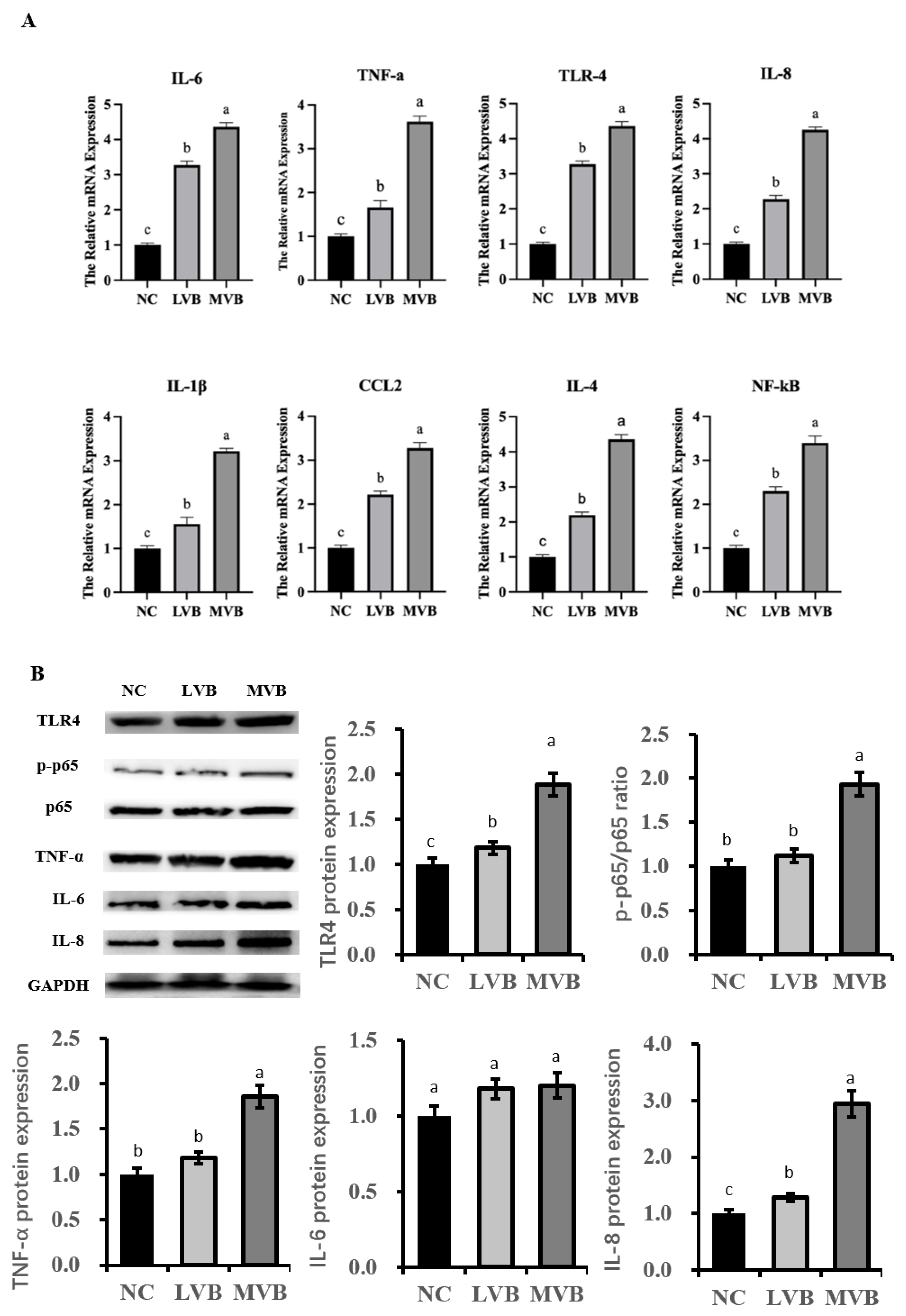
The two selected strains of B. cereus carrying different numbers of virulence genes induced significantly different expressions of inflammatory genes in mouse liver. Figure 3A shows that the relative mRNA expression of pro-inflammatory factors was significantly higher in both B. cereus-treated groups than in the control group. The expression of inflammatory genes on mouse liver in the MVB group (involving mice challenged by B. cereus containing nine virulence genes) was significantly stronger than that in the LVB group (involving mice attacked by B. cereus containing one virulence gene).
The expression of proteins related to inflammatory responses, namely TLR4, p65, TNF-α, IL-6, and IL-8, was determined to uncover the effects of B. cereus infection. Figure 3B shows that the expression of TLR4 in both the LVB and MVB groups was significantly upregulated compared to the control group (p < 0.05). Moreover, MVB had a higher abundance of TLR4 protein than the LVB group. As the active subunit of NF-κB, the ratio of phosphorylated p65 to total p65 was significantly increased in the MVB group compared to the NC and LVB groups (p < 0.05). Similarly, compared to the NC and LVG groups, the expression of TNF-α and IL-8 in the MVB group was markedly upregulated (p < 0.05). However, LVB challenge did not affect the expression of TNF-α and IL-8 compared to the control group. Notably, the abundance of IL-6 in either the LVB or MVB group did not differ from that in the control group.

4. Discussion

In this study, 108 milk samples collected from clinical mastitis cases on three dairy farms in Inner Mongolia were subjected to pathogenic bacteria isolation and characterization. The results demonstrate that the total detection rate of bacteria was 98.14%, confirming that bacterial infections remain the primary cause of mastitis in dairy cows, which aligns with previous studies [31]. B. cereus is the pathogenic bacteria species that is increasingly identified in cases of bovine mastitis and in dairy products [32]. The multi-bacterium infection rate was 81%, suggesting that mastitis treatment is complicated by the diversity of pathogens in this region. Furthermore, the detection rate of Gram-positive bacteria was higher than that of Gram-negative bacteria, with B. cereus exhibiting the highest detection rate. This finding is markedly different from the prevalent strains of bovine mastitis reported in some areas of Jiangsu Province [33,34], highlighting significant regional variations in mastitis-causing strains across China. B. cereus, an important conditional pathogen for mastitis, was detected in all three farms. Previous research has shown that B. cereus is widely distributed in the north of China, further supporting its role as a primary causative agent of mastitis in dairy cows in this region [35]. Thus, it is essential to not only timely and effectively eliminate and control common mastitis pathogens on dairy farms but also actively prevent B. cereus and other opportunistic pathogenic bacteria to mitigate the occurrence and spread of mastitis in this region. The pathogenic bacteria isolated in the current study encompass both contagious and environmental pathogens, indicating that environmental factors contribute to clinical mastitis infections and cross-infection among cattle. Therefore, farms should maintain dry bedding, remove manure promptly, and regularly disinfect the environment and milking equipment to block the growth of pathogenic bacteria and reduce the incidence of mastitis in dairy cows.
Previous studies have shown that B. cereus is one of the pathogens responsible for mastitis in dairy cows. The current study demonstrated that B. cereus, the primary pathogen of mastitis in this specific region of Inner Mongolia, was highly resistant to tetracycline, cotrimoxazole, and ciprofloxacin but sensitive to clindamycin, erythromycin, gentamicin, roxithromycin, and amikacin. B. cereus isolated from food sources was found to be resistant to cotrimoxazole, which is consistent with the findings of this study [36]. Additionally, this study revealed that B. cereus is highly resistant to ciprofloxacin, which contrasts with the results of previous studies [37]. This discrepancy might be attributed to the fact that the B. cereus in this experiment was isolated from cows suffering from mastitis that were treated with medication that may have influenced antibiotic resistance [38]. Compared with the findings of Chang et al., B. cereus showed resistance to non-β-lactam antibiotics, and the degree of resistance varied slightly among different antibiotics, likely due to differences in B. cereus strains and specific drugs used [39]. Notably, while B. cereus has gained significant attention as a probiotic due to its beneficial effects, it must also be recognized as a conditional pathogen [40]. Under certain conditions, it can cause serious diseases in animals. The presence of drug-resistant strains of B. cereus identified in the current study shows that it poses a challenge to the dairy industry and is a significant threat to public health and safety.
Virulence factors are significant in the establishment of infection and survival of B. cereus in the host organism, and the pathogenicity of B. cereus is directly related to the virulence genes it carries. The B. cereus strain has been widely utilized as a probiotic for humans, food-producing animals, plants, and environmental remediation. Paradoxically, B. cereus also functions as a significant opportunistic foodborne pathogen, implicated in both gastrointestinal and extra-gastrointestinal syndromes [41]. In this study, we analyzed the primary virulence factors carried by 104 strains of B. cereus isolated from mastitis cases. The three subunit proteins of the non-hemolytic enterotoxin (Nhe) are encoded by nheA, nheB, and nheC. Among these, NheB plays a key role in the virulence of Nhe, whereas excess NheC inhibits the virulence of Nhe. However, these three subunits exist and are expressed simultaneously in cases of maximum toxicity. The nheB gene was detected in all 52 strains of B. cereus in this study, and 98% of the strains simultaneously carried the nheA, nheB, and nheC genes. Additionally, 32 strains of B. cereus carried the hbl gene, which binds to the cell membrane sequentially through its three subunits before disrupting the cell membrane and causing cell lysis. Thus, Hbl can only be produced by B. cereus that contains and expresses the three virulence genes hblA, hblC, and hblD. Five strains of B. cereus were found to carry all three virulence genes of both nhe and hbl, and all strains carried entFM genes in addition to the nhe and hbl genes. Furthermore, 38 strains carried the bceT gene, and 32 strains carried the cytK gene. The high prevalence of the nhe, entFM, hbl, bceT, and cytK genes indicate that they are the primary virulence factors of foodborne B. cereus in China; this is largely consistent with the results of previous studies [42]. This study also aligns with the results of Cui et al., who suggested that the presence of virulence genes in B. cereus is not an isolated phenomenon but a widespread occurrence [43]. With the extensive use of feed additives and the increasing adoption of biopesticides, B. cereus may pose potential risks to human health and food safety, particularly since B. cereus virulence-producing plasmids are capable of horizontal gene transfer. Additionally, the fact that many B. cereus spores carry enterotoxin genes further highlights the potential hazards associated with the use of biological products such as B. cereus. Therefore, it is crucial to maintain a high level of vigilance and conduct more in-depth safety assessments to ensure the safe and rational use of B. cereus in production and daily life [44].
Mouse models are easy to use and cost-effective. Wang et al. showed that the pathological changes in the mammary gland tissues of mice are similar to those observed in dairy cows with mastitis [45]. The ICR mouse used in this experiment is ideal for constructing a dairy cow mastitis model. Both groups capable of inducing acute mastitis were evaluated based on histopathological changes, inflammatory cytokine production, and the extent of liver and kidney tissue damage. We observed that the liver and kidney tissues in both the LVB and MVB groups exhibited inflammatory cell infiltration, interstitial congestion, and significant structural damage. Additionally, the expression of inflammatory genes in the liver was significantly upregulated in both the LVB and MVB groups compared to the control group, and hematological parameters were also significantly altered. Elevated serum levels of TNF-α are known to induce neutrophil activation and migration, leading to mammary epithelial apoptosis in both bovine and human patients with acute clinical mastitis [46,47,48]. Moreover, inflammatory cytokines can enhance multiple functions of inflammatory cells, including cell adhesion, cell surface receptor expression, release of lysosomal components, and free radical production [49]. In the present study, the levels of pro-inflammatory cytokines IL-1β and IL-6 in the mammary glands of mice administered virulence factors were significantly elevated compared to the control group, indicating that cytokines play a critical role in mediating mammary tissue damage in mice. We further analyzed the pathogenic potential of virulence factors in a mouse mastitis model by directly injecting B. cereus suspensions containing varying numbers of virulence factors. The results demonstrated that B. cereus strains containing different levels of virulence factors induced varying degrees of tissue damage, confirming that the virulence of B. cereus is directly influenced by the virulence factors it carries.

5. Conclusions

Collectively, this investigation establishes B. cereus as the predominant etiological strain of mastitis across the Inner Mongolian dairy farms sampled, demonstrating distinct resistance and virulence gene profiles. Tetracycline resistance was observed in 38.46% of the B. cereus strains, constituting the highest resistance rate. Universal carriage of nheA, nheB, and entFM virulence determinants was identified across all isolates, with murine challenge experiments confirming virulence-gene-load-dependent pathogenicity. Strains harboring more virulence gene clusters demonstrated strengthened pathogenic potential, directly correlating with the severity of host tissue damage. These findings provide critical epidemiological evidence for developing region-specific mastitis control strategies in Inner Mongolia and emphasize the need to implement tetracycline stewardship programs to mitigate antimicrobial resistance proliferation in dairy production systems.

Supplementary Materials

The following supporting information can be downloaded at: https://www.mdpi.com/article/10.3390/vetsci12111057/s1, Figure S1: Typical figures of resistant (R), intermediary (I), and sensitive (S); Table S1: Primers used for detection of virulence genes in B. cereus.

Author Contributions

Writing—review and editing: C.Y., Writing—original draft, Visualization: C.Y., X.H. and J.Z. Methodology: C.Y., K.H.V. and S.F., Formal analysis: C.Y., Data curation: C.Y., K.H.V. and S.F., Conceptualization: T.X., C.Y. and Z.Y. Validation: X.H., J.Z., K.H.V. and S.F. Project administration: K.Z. and T.X. Funding acquisition, K.Z. All authors have read and agreed to the published version of the manuscript.

Funding

This project was financially supported by grants from the National Natural Science Foundation of China (grant 32202883); The Seed Industry Vitalization Program of Jiangsu Province: JBGS[2021]115; China Postdoctoral Science Foundation (2023M732994).

Institutional Review Board Statement

This study was performed in line with the principles of the Declaration of China. Approval was granted by the Ethics Committee of Yangzhou University (28 Februaty 2024/No. 202402057).

Informed Consent Statement

Not applicable.

Data Availability Statement

The raw data supporting the conclusions of this article will be made available by the authors on request.

Conflicts of Interest

The authors declare that they have no known competing financial interests or personal relationships that could have appeared to influence the work reported in this paper.

References

  1. Cvetnić, L.; Samardžija, M.; Duvnjak, S.; Habrun, B.; Cvetnić, M.; Jaki Tkalec, V.; Đuričić, D.; Benić, M. Multi Locus Sequence Typing and spa Typing of Staphylococcus Aureus Isolated from the Milk of Cows with Subclinical Mastitis in Croatia. Microorganisms 2021, 9, 725. [Google Scholar] [CrossRef]
  2. Jia, L.; Wang, J.; Luoreng, Z.; Wang, X.; Wei, D.; Yang, J.; Hu, Q.; Ma, Y. Progress in Expression Pattern and Molecular Regulation Mechanism of LncRNA in Bovine Mastitis. Animals 2022, 12, 1059. [Google Scholar] [CrossRef]
  3. Li, Y.; Zhu, Y.; Chu, B.; Liu, N.; Chen, S.; Wang, J.; Zou, Y. Map of Enteropathogenic Escherichia coli Targets Mitochondria and Triggers DRP-1-Mediated Mitochondrial Fission and Cell Apoptosis in Bovine Mastitis. Int. J. Mol. Sci. 2022, 23, 4907. [Google Scholar] [CrossRef]
  4. Baraki, A.; Teklue, T.; Atsbha, T.; Tesfay, T.; Wayou, S. Prevalence and Risk Factors of Bovine Mastitis in Southern Zone of Tigray, Northern Ethiopia. Vet. Med. Int. 2021, 2021, 8831117. [Google Scholar] [CrossRef] [PubMed]
  5. Belay, N.; Mohammed, N.; Seyoum, W. Bovine Mastitis: Prevalence, Risk Factors, and Bacterial Pathogens Isolated in Lactating Cows in Gamo Zone, Southern Ethiopia. Vet. Med. 2022, 13, 9–19. [Google Scholar] [CrossRef] [PubMed]
  6. Bertolini, A.B.; Prado, A.M.; Thyssen, P.J.; de Souza Ribeiro Mioni, M.; de Gouvea, F.L.R.; da Silva Leite, D.; Langoni, H.; de Figueiredo Pantoja, J.C.; Rall, V.M.; Guimarães, F.F.; et al. Prevalence of bovine mastitis-related pathogens, identified by mass spectrometry in flies (Insecta, Diptera) captured in the milking environment. Lett. Appl. Microbiol. 2022, 75, 1232–1245. [Google Scholar] [CrossRef] [PubMed]
  7. Klaas, I.C.; Zadoks, R.N. An update on environmental mastitis: Challenging perceptions. Transbound. Emerg. Dis. 2018, 65 (Suppl. S1), 166–185. [Google Scholar] [CrossRef]
  8. Jovanovic, J.; Ornelis, V.F.M.; Madder, A.; Rajkovic, A. Bacillus cereus food intoxication and toxicoinfection. Compr. Rev. Food Sci. Food Saf. 2021, 20, 3719–3761. [Google Scholar] [CrossRef]
  9. Stenfors Arnesen, L.P.; Fagerlund, A.; Granum, P.E. From soil to gut: Bacillus cereus and its food poisoning toxins. FEMS Microbiol. Rev. 2008, 32, 579–606. [Google Scholar] [CrossRef]
  10. Liu, X.Y.; Hu, Q.; Xu, F.; Ding, S.Y.; Zhu, K. Characterization of Bacillus cereus in Dairy Products in China. Toxins 2020, 12, 454. [Google Scholar] [CrossRef]
  11. Shan, Q.; Liu, N.; Wang, X.; Zhu, Y.; Yin, J.; Wang, J. Lactobacillus rhamnosus GR-1 attenuates foodborne Bacillus cereus-induced NLRP3 inflammasome activity in bovine mammary epithelial cells by protecting intercellular tight junctions. J. Anim. Sci. Biotechnol. 2022, 13, 101. [Google Scholar] [CrossRef] [PubMed]
  12. Miller, R.A.; Jian, J.; Beno, S.M.; Wiedmann, M.; Kovac, J. Intraclade Variability in Toxin Production and Cytotoxicity of Bacillus cereus Group Type Strains and Dairy-Associated Isolates. Appl. Environ. Microbiol. 2018, 84, e02479-17. [Google Scholar] [CrossRef] [PubMed]
  13. Dietrich, R.; Jessberger, N.; Ehling-Schulz, M.; Märtlbauer, E.; Granum, P.E. The Food Poisoning Toxins of Bacillus cereus. Toxins 2021, 13, 98. [Google Scholar] [CrossRef] [PubMed]
  14. Zhao, S.; Chen, J.; Fei, P.; Feng, H.; Wang, Y.; Ali, M.A.; Li, S.; Jing, H.; Yang, W. Prevalence, molecular characterization, and antibiotic susceptibility of Bacillus cereus isolated from dairy products in China. J. Dairy. Sci. 2020, 103, 3994–4001. [Google Scholar] [CrossRef]
  15. Granum, P.E. Spotlight on Bacillus cereus and its food poisoning toxins. FEMS Microbiol. Lett. 2017, 364, fnx071. [Google Scholar] [CrossRef]
  16. Dal Peraro, M.; van der Goot, F.G. Pore-forming toxins: Ancient, but never really out of fashion. Nat. Rev. Microbiol. 2016, 14, 77–92. [Google Scholar] [CrossRef]
  17. Zhu, K.; Didier, A.; Dietrich, R.; Heilkenbrinker, U.; Waltenberger, E.; Jessberger, N.; Märtlbauer, E.; Benz, R. Formation of small transmembrane pores: An intermediate stage on the way to Bacillus cereus non-hemolytic enterotoxin (Nhe) full pores in the absence of NheA. Biochem. Biophys. Res. Commun. 2016, 469, 613–618. [Google Scholar] [CrossRef]
  18. Jessberger, N.; Dietrich, R.; Schwemmer, S.; Tausch, F.; Schwenk, V.; Didier, A.; Märtlbauer, E. Binding to The Target Cell Surface Is The Crucial Step in Pore Formation of Hemolysin BL from Bacillus cereus. Toxins 2019, 11, 281. [Google Scholar] [CrossRef]
  19. Jessberger, N.; Kranzler, M.; Da Riol, C.; Schwenk, V.; Buchacher, T.; Dietrich, R.; Ehling-Schulz, M.; Märtlbauer, E. Assessing the toxic potential of enteropathogenic Bacillus cereus. Food Microbiol. 2019, 84, 103276. [Google Scholar] [CrossRef]
  20. Lücking, G.; Frenzel, E.; Rütschle, A.; Marxen, S.; Stark, T.D.; Hofmann, T.; Scherer, S.; Ehling-Schulz, M. Ces locus embedded proteins control the non-ribosomal synthesis of the cereulide toxin in emetic Bacillus cereus on multiple levels. Front. Microbiol. 2015, 6, 1101. [Google Scholar] [CrossRef]
  21. Lin, R.; Li, D.; Xu, Y.; Wei, M.; Chen, Q.; Deng, Y.; Wen, J. Chronic cereulide exposure causes intestinal inflammation and gut microbiota dysbiosis in mice. Environ. Pollut. 2021, 288, 117814. [Google Scholar] [CrossRef]
  22. Wang, P.; Zhao, X.; Qu, T.; Liang, L.; Ji, Q.; Chen, Y. Insight into Bacillus cereus Associated with Infant Foods in Beijing. Foods 2022, 11, 719. [Google Scholar] [CrossRef]
  23. Blum, S.; Heller, E.D.; Krifucks, O.; Sela, S.; Hammer-Muntz, O.; Leitner, G. Identification of a bovine mastitis Escherichia coli subset. Vet. Microbiol. 2008, 132, 135–148. [Google Scholar] [CrossRef]
  24. Laboratory Handbook on Bovine Mastitis; National Mastitis Council: New Prague, MN, USA, 2017.
  25. Frank, J.A.; Reich, C.I.; Sharma, S.; Weisbaum, J.S.; Wilson, B.A.; Olsen, G.J. Critical evaluation of two primers commonly used for amplification of bacterial 16S rRNA genes. Appl. Environ. Microbiol. 2008, 74, 2461–2470. [Google Scholar] [CrossRef]
  26. Performance Standards for Antimicrobial Disk Susceptibility Tests, 14th ed.; Clinical and Laboratory Standards Institute: Malvern, PA, USA, 2024.
  27. Zhou, Y.; Zhou, Z.; Peng, J.; Loor, J.J. Methionine and valine activate the mammalian target of rapamycin complex 1 pathway through heterodimeric amino acid taste receptor (TAS1R1/TAS1R3) and intracellular Ca(2+) in bovine mammary epithelial cells. J. Dairy. Sci. 2018, 101, 11354–11363. [Google Scholar] [CrossRef] [PubMed]
  28. Pfaffl, M.W. A new mathematical model for relative quantification in real-time RT-PCR. Nucleic Acids Res. 2001, 29, e45. [Google Scholar] [CrossRef] [PubMed]
  29. Chen, Z.; Chu, S.; Wang, X.; Sun, Y.; Xu, T.; Mao, Y.; Loor, J.J.; Yang, Z. MiR-16a Regulates Milk Fat Metabolism by Targeting Large Tumor Suppressor Kinase 1 (LATS1) in Bovine Mammary Epithelial Cells. J. Agric. Food Chem. 2019, 67, 11167–11178. [Google Scholar] [CrossRef] [PubMed]
  30. Shao, G.; Tian, Y.; Wang, H.; Liu, F.; Xie, G. Protective effects of melatonin on lipopolysaccharide-induced mastitis in mice. Int. Immunopharmacol. 2015, 29, 263–268. [Google Scholar] [CrossRef]
  31. Paape, M.J.; Bannerman, D.D.; Zhao, X.; Lee, J.W. The bovine neutrophil: Structure and function in blood and milk. Vet. Res. 2003, 34, 597–627. [Google Scholar] [CrossRef]
  32. Owusu-Kwarteng, J.; Wuni, A.; Akabanda, F.; Tano-Debrah, K.; Jespersen, L. Prevalence, virulence factor genes and antibiotic resistance of Bacillus cereus sensu lato isolated from dairy farms and traditional dairy products. BMC Microbiol. 2017, 17, 65. [Google Scholar] [CrossRef]
  33. Xu, T.; Wu, X.; Cao, H.; Pei, T.; Zhou, Y.; Yang, Y.; Yang, Z. The Characteristics of Multilocus Sequence Typing, Virulence Genes and Drug Resistance of Klebsiella pneumoniae Isolated from Cattle in Northern Jiangsu, China. Animals 2022, 12, 2627. [Google Scholar] [CrossRef] [PubMed]
  34. Cao, W.; Xu, Y.; Huang, Y.; Xu, T. Isolation of Pathogenic Bacteria from Dairy Cow Mastitis and Correlation of Biofilm Formation and Drug Resistance of Klebsiella pneumoniae in Jiangsu, China. Agriculture 2023, 13, 1984. [Google Scholar] [CrossRef]
  35. Gao, T.; Ding, Y.; Wu, Q.; Wang, J.; Zhang, J.; Yu, S.; Yu, P.; Liu, C.; Kong, L.; Feng, Z.; et al. Prevalence, Virulence Genes, Antimicrobial Susceptibility, and Genetic Diversity of Bacillus cereus Isolated From Pasteurized Milk in China. Front. Microbiol. 2018, 9, 533. [Google Scholar] [CrossRef]
  36. Wang, P.; Chen, L.; Qiao, Y.; Hu, H.; Cai, X.; Chen, C.; Zhang, Z. Virulence genes and antimicrobial resistance of Bacillus cereus in prepackaged pastries sold in Taizhou from 2020 to 2022. Wei Sheng Yan Jiu 2024, 53, 55–59. [Google Scholar] [CrossRef]
  37. Eid, R.H.; Aref, N.E.; Ibrahim, E.S. Phenotypic diagnosis and genotypic identification of Bacillus cereus causing subclinical mastitis in cows. Vet. World 2023, 16, 888–894. [Google Scholar] [CrossRef]
  38. Yu, S.; Yu, P.; Wang, J.; Li, C.; Guo, H.; Liu, C.; Kong, L.; Yu, L.; Wu, S.; Lei, T.; et al. A Study on Prevalence and Characterization of Bacillus cereus in Ready-to-Eat Foods in China. Front. Microbiol. 2019, 10, 3043. [Google Scholar] [CrossRef]
  39. Chang, Y.; Xie, Q.; Yang, J.; Ma, L.; Feng, H. The prevalence and characterization of Bacillus cereus isolated from raw and pasteurized buffalo milk in southwestern China. J. Dairy. Sci. 2021, 104, 3980–3989. [Google Scholar] [CrossRef]
  40. Navaneethan, Y.; Effarizah, M.E. Prevalence, toxigenic profiles, multidrug resistance, and biofilm formation of Bacillus cereus isolated from ready-to eat cooked rice in Penang, Malaysia. Food Control 2021, 121, 107553. [Google Scholar] [CrossRef]
  41. Cui, Y.; Märtlbauer, E.; Dietrich, R.; Luo, H.; Ding, S.; Zhu, K. Multifaceted toxin profile, an approach toward a better understanding of probiotic Bacillus cereus. Crit. Rev. Toxicol. 2019, 49, 342–356. [Google Scholar] [CrossRef]
  42. Fang, R.; Cui, J.; Cui, T.; Guo, H.; Ono, H.K.; Park, C.H.; Okamura, M.; Nakane, A.; Hu, D.L. Staphylococcal Enterotoxin C Is an Important Virulence Factor for Mastitis. Toxins 2019, 11, 141. [Google Scholar] [CrossRef]
  43. Cui, Y.; Liu, X.; Dietrich, R.; Märtlbauer, E.; Cao, J.; Ding, S.; Zhu, K. Characterization of Bacillus cereus isolates from local dairy farms in China. FEMS Microbiol. Lett. 2016, 363, fnw096. [Google Scholar] [CrossRef] [PubMed]
  44. Zheng, Z.; Ye, L.; Xiong, W.; Hu, Q.; Chen, K.; Sun, R.; Chen, S. Prevalence and genomic characterization of the Bacillus cereus group strains contamination in food products in Southern China. Sci. Total Environ. 2024, 921, 170903. [Google Scholar] [CrossRef] [PubMed]
  45. Wang, D.; Wei, Y.; Shi, L.; Khan, M.Z.; Fan, L.; Wang, Y.; Yu, Y. Genome-wide DNA methylation pattern in a mouse model reveals two novel genes associated with Staphylococcus aureus mastitis. Asian-Australas. J. Anim. Sci. 2020, 33, 203–211. [Google Scholar] [CrossRef] [PubMed]
  46. Bauer, D.; Redmon, N.; Mazzio, E.; Soliman, K.F. Apigenin inhibits TNFα/IL-1α-induced CCL2 release through IKBK-epsilon signaling in MDA-MB-231 human breast cancer cells. PLoS ONE 2017, 12, e0175558. [Google Scholar] [CrossRef]
  47. Vieira, S.M.; Lemos, H.P.; Grespan, R.; Napimoga, M.H.; Dal-Secco, D.; Freitas, A.; Cunha, T.M.; Verri, W.A., Jr.; Souza-Junior, D.A.; Jamur, M.C.; et al. A crucial role for TNF-alpha in mediating neutrophil influx induced by endogenously generated or exogenous chemokines, KC/CXCL1 and LIX/CXCL5. Br. J. Pharmacol. 2009, 158, 779–789. [Google Scholar] [CrossRef]
  48. Nakajima, Y.; Mikami, O.; Yoshioka, M.; Motoi, Y.; Ito, T.; Ishikawa, Y.; Fuse, M.; Nakano, K.; Yasukawa, K. Elevated levels of tumor necrosis factor-alpha (TNF-alpha) and interleukin-6 (IL-6) activities in the sera and milk of cows with naturally occurring coliform mastitis. Res. Vet. Sci. 1997, 62, 297–298. [Google Scholar] [CrossRef]
  49. Maity, S.; Ambatipudi, K. Mammary microbial dysbiosis leads to the zoonosis of bovine mastitis: A One-Health perspective. FEMS Microbiol. Ecol. 2020, 97, fiaa241. [Google Scholar] [CrossRef]
Figure 1. Susceptibility of B. cereus to different antibiotics. Using 4 kinds of 8 antibiotics to analyze the susceptibility of 104 B. cereus. Black, dark gray, and light gray represent for drug resistance levels with resistant (R), intermediate (I), and sensitive (S).
Vetsci 12 01057 g001
Figure 2. Phenotypic and biochemical parameters detected in mice infected with B. cereus. (A) Histopathological analysis and evaluation of the inflammatory score of two strains of B. cereus with the least (LVB) or most (MVB) number of virulence genes carried on the liver and kidney tissue of infected mice. Inflammatory scores were calculated according to the sum of the vascular endothelium injury and the disorder of sinuses and lobules in the liver and kidney, and the number of infiltration cells. Arrows indicate typical inflammatory cells infiltrated. (B) Effects of two strains of B. cereus on ALT, AST, LDH, ALP, SOD, GSH-Px, and MDA in mice. All data are presented as the mean value ± Standard Error of the Mean (SEM), and n = 6 in each group. The letters in superscript indicate that the difference between groups was significant (p < α, where α = 0.05).
Vetsci 12 01057 g002
Figure 3. Effect of two strains of B. cereus with least (LVB) or most (MVB) numbers of carried virulence genes on inflammatory gene (A) and protein (B) expression in the liver of mice. All data are presented as the mean value ± Standard Error of the Mean (SEM), and n = 6 in each group. The letters in superscript indicate that the difference between groups was significant (p < α, where α = 0.05).
Vetsci 12 01057 g003
Table 1. Detection and distribution analysis of pathogenic bacteria in clinical mastitis.
ItemsFarm AFarm BFarm CTotal
BacteriaNoneBacteriaNoneBacteriaNoneBacteriaNone
Milk Samples (No.)520462801062
Rate (%)48.15042.591.867.4098.141.86
Table 2. Detection and distribution analysis of pathogenic bacteria in clinical mastitis.
Name of BacteriaNumber of DetectionsDetection RateFarm AFarm BFarm C
Bacillus cereus10430.58%57398
Staphylococcus aureus7421.76%38306
Bacillus subtilis267.65%12104
Rhizobium267.65%2420
Bacillus sphaericus144.12%761
Bacillus pusillus123.54%570
Pseudomonas82.35%800
Streptococcus agalactiae41.17%400
Copperhead41.17%040
Enterococcus faecalis20.59%200
Arthrobacter20.59%020
Actinobacillus20.59%200
Others6218.24%38168
Total340100%19711627
Table 3. Different types of virulence factors carried by B. cereus.
Carrying Virulence GenesNumber of B. cereus StrainsDetection Rate
nheA104100%
nheB104100%
entFM104100%
nheC10298.1%
cytK3230.8%
hblC4240.4%
hblA3836.5%
hblD2221.2%
bceT3836.5%
ces2625%
EM12625%
Table 4. Profile of virulence factors carried by B. cereus.
Carrying Virulence GenesAmount of B. cereus Strains
nheA, nheB, entFM2
nheA, nheB, entFM, nheC10
nheA, nheB, entFM, nheC, hblA4
nheA, nheB, entFM, nheC, hblC8
nheA, nheB, entFM, nheC, cytK6
nheA, nheB, entFM, nheC, bceT16
nheA, nheB, entFM, nheC, cytK, hblC2
nheA, nheB, entFM, nheC, hblA, hblC2
nheA, nheB, entFM, nheC, hblC, hblD2
nheA, nheB, entFM, nheC, hblC, cytK4
nheA, nheB, entFM, nheC, hblA, cytK, bceT6
nheA, nheB, entFM, nheC, hblA, ces, EM18
nheA, nheB, entFM, nheC, bceT, ces, EM16
nheA, nheB, entFM, nheC, hblA, hblC, hblD2
nheA, nheB, entFM, nheC, hblA, hblC, cytK2
nheA, nheB, entFM, nheC, hblC, hblD, cytK2
nheA, nheB, entFM, nheC, hblA, bceT, ces, EM14
nheA, nheB, entFM, nheC, hblC, hblD, ces, EM18
nheA, nheB, entFM, nheC, hblA, hblC, cytK, bceT2
nheA, nheB, entFM, nheC, hblA, hblC, hblD, cytK4
nheA, nheB, entFM, nheC, hblA, hblC, hblD, cytK, bceT4
Disclaimer/Publisher’s Note: The statements, opinions and data contained in all publications are solely those of the individual author(s) and contributor(s) and not of MDPI and/or the editor(s). MDPI and/or the editor(s) disclaim responsibility for any injury to people or property resulting from any ideas, methods, instructions or products referred to in the content.