
Curcumin Mitigates Microplastic-Induced Damage in Livestock and Poultry: Mechanistic Insights and Strategies for Sustainable Farming
 ,
,  ,
,
Simple Summary
Abstract
1. Introduction
2. Methodology
3. Result and Discussion
3.1. Sources and Composition of MNPs

| Exposure Pathways | MNP Type | Source | Key Findings |
|---|---|---|---|
| Feed Production | Polyethylene (PE) | Plastic mulch films and irrigation pipes | PE-MPs (0.8–45 μm) detected in agricultural soil-crop systems; 0.1–1% accumulation in maize roots [57] |
| Water Systems | Polyethylene (PE) | Plastic water pipes and storage tanks | PE particles dominate (85%) in agricultural water systems; 24,000 MPs/L from plastic bottles [58,59] |
| Housing Environment | Polypropylene (PP) | Plastic feeders and flooring | PP fragments (50–500 μm) prevalent in barn air and dust [60] |
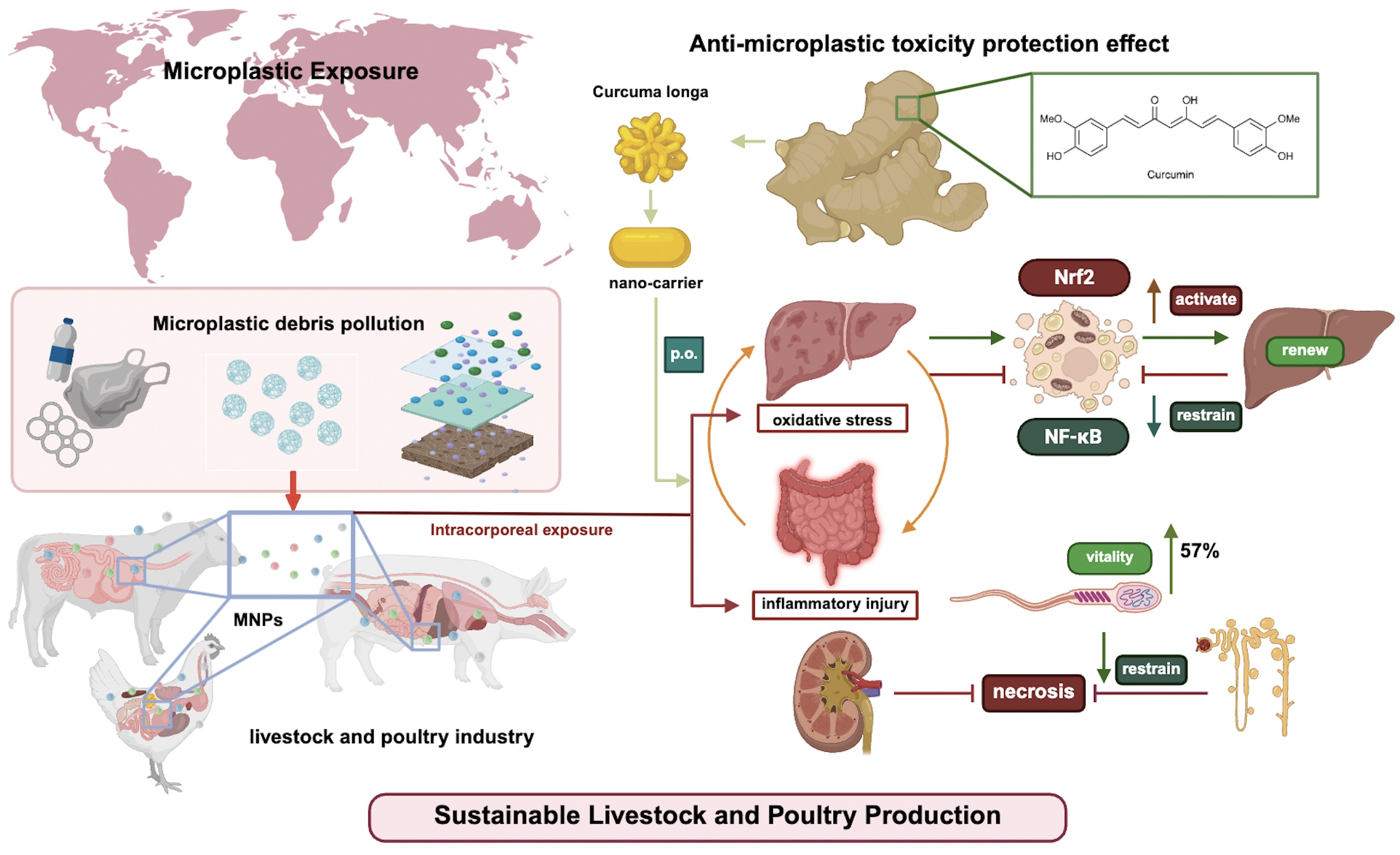
| Reproductive System | Polytetrafluoroethylene (PTFE) | Non-stick feed equipment coatings | PTFE exposure linked to reduced sperm motility (64%) and testicular damage (57%) [61] |
| Manure Management | Polyvinyl chloride (PVC) | Plastic manure storage systems | PVC MPs (1–5 mm) detected in 92% of compost samples [62] |
| Veterinary Product | Polystyrene (PS) | Plastic syringes and packaging | PS MPs (100–300 nm) in 78% of injectable veterinary products [61] |
3.2. The Organ-Specific Protective Effect of Curcumin on the Biological Toxicity of MNPs
3.2.1. Digestive System Toxicity
3.2.2. Neurotoxic Toxicity
3.2.3. Curcumin Attenuates Reproductive Toxicity Induced by MNPs
3.2.4. Osteolysis Toxicity
3.2.5. Immunotoxicity
3.2.6. Tumor Metastasis
3.2.7. Other Complications
3.3. Nanodelivery Advances of Curcumin
| Species | Optimal Dose (mg/kg feed) | Bioavailability (%) | Key Target Tissue | Residual Clearance (days) | Reference |
|---|---|---|---|---|---|
| Broilers | 300–350 | 22.4 ± 3.1 | Liver > Gizzard | 5.2 ± 0.8 | Jagannathan et al. (2012) [110] Zhang et al. (2018) [111] |
| Swine | 200–250 | 8.7 ± 1.5 | Kidney > Adipose | 9.1 ± 1.2 | Ghosh et al. (2014) [112] |
| Dairy Cattle | 150–200 | 3.1 ± 0.9 | Rumen > Milk | 14.3 ± 2.4 | Moudgil et al. (2022) [113] |
3.4. Evaluation of the Protective Potential of Curcumin for Exposure to Environmental Microplastics in Livestock and Poultry Production and Breeding
3.4.1. Mechanistic Insights and Translational Cautions
3.4.2. Nano-Curcumin Formulations: Opportunities and Constraints
3.4.3. Operational Considerations Under Field Conditions
3.4.4. Integrated Challenges and Future Trajectory
4. Conclusions
Supplementary Materials
Author Contributions
Funding
Institutional Review Board Statement
Informed Consent Statement
Data Availability Statement
Acknowledgments
Conflicts of Interest
References
- de Souza Machado, A.A.; Kloas, W.; Zarfl, C.; Hempel, S.; Rillig, M.C. Microplastics as an emerging threat to terrestrial ecosystems. Glob. Change Biol. 2018, 24, 1405–1416. [Google Scholar] [CrossRef] [Scilit]
- Han, M.; Liang, J.; Wang, K.; Si, Q.; Zhu, C.; Zhao, Y.; Khan, N.A.K.; Abdullah, A.L.B.; Shau-Hwai, A.T.; Li, Y.M.; et al. Integrin A5B1-mediated endocytosis of polystyrene nanoplastics: Implications for human lung disease and therapeutic targets. Sci. Total Environ. 2024, 953, 176017. [Google Scholar] [CrossRef] [Scilit]
- Zhang, S.; Zhang, H.; Li, Y.; Sun, Z.; Chen, Y. Recent advances on transport and transformation mechanism of nanoplastics in lung cells. Sci. Total Environ. 2024, 952, 175881. [Google Scholar] [CrossRef] [Scilit]
- Ramachandraiah, K.; Ameer, K.; Jiang, G.; Hong, G.-P. Micro- and nanoplastic contamination in livestock production: Entry pathways, potential effects and analytical challenges. Sci. Total Environ. 2022, 844, 157234. [Google Scholar] [CrossRef] [Scilit] [PubMed]
- Corte Pause, F.; Urli, S.; Crociati, M.; Stradaioli, G.; Baufeld, A. Connecting the Dots: Livestock Animals as Missing Links in the Chain of Microplastic Contamination and Human Health. Animals 2024, 14, 350. [Google Scholar] [CrossRef] [Scilit]
- Wang, J.; Chen, Z.-L.; Liang, C.-G.; Yang, H.-Y.; Wu, X.-F.; Sun, H.-M. Toxicological Impacts of Polypropylene Nanoparticles Similar in Size to Nanoplastics in Plastic-Bottle Injections on Human Umbilical Vein Endothelial Cells. Toxics 2025, 13, 802. [Google Scholar] [CrossRef] [Scilit] [PubMed]
- Hsu, W.-H.; Chen, Y.-Z.; Chiang, Y.-T.; Chang, Y.-T.; Wang, Y.-W.; Hsu, K.-T.; Hsu, Y.-Y.; Wu, P.-T.; Lee, B.-H. Polystyrene nanoplastics disrupt the intestinal microenvironment by altering bacteria-host interactions through extracellular vesicle-delivered microRNAs. Nat. Commun. 2025, 16, 5026. [Google Scholar] [CrossRef] [Scilit] [PubMed]
- Kong, F.; Fang, L.; Gui, Y.; Lan, H.; Zhao, P.; Zhang, Y.; Jiang, L.; Zhang, S.; Tong, X. Polyethylene and Polyvinyl Chloride Nanoplastics in Human Follicular Fluid and Seminal Plasma: Impact on Fertilization and Sperm Quality. ACS Nano 2025, 19, 27159–27172. [Google Scholar] [CrossRef] [Scilit]
- Nicoliche, T.; Bartolomeo, C.S.; Lemes, R.M.R.; Pereira, G.C.; Nunes, T.A.; Oliveira, R.B.; Nicastro, A.L.M.; Soares, É.N.; da Cunha Lima, B.F.; Rodrigues, B.M.; et al. Antiviral, anti-inflammatory and antioxidant effects of curcumin and curcuminoids in SH-SY5Y cells infected by SARS-CoV-2. Sci. Rep. 2024, 14, 10696. [Google Scholar] [CrossRef] [Scilit]
- Shen, M.; Chen, L.; Jiang, J.; Wang, Z.; Gong, Q.; Zhang, X.; Ke, X.; Qu, Y. Curcumin modulates β-catenin stabilization via targeting proteasomal deubiquitinating enzyme USP14. Pharmacol. Res. 2025, 216, 107745. [Google Scholar] [CrossRef] [Scilit]
- Aggarwal, B.B.; Harikumar, K.B. Potential therapeutic effects of curcumin, the anti-inflammatory agent, against neurodegenerative, cardiovascular, pulmonary, metabolic, autoimmune and neoplastic diseases. Int. J. Biochem. Cell Biol. 2009, 41, 40–59. [Google Scholar] [CrossRef] [Scilit] [PubMed]
- Gupta, C.; Kaushik, S.; Himanshu; Jain, S.; Dhanwani, I.; Mansi; Garg, S.; Paul, A.; Pant, P.; Gupta, N. Bioaccumulation and toxicity of polystyrene nanoplastics on marine and terrestrial organisms with possible remediation strategies: A review. Environ. Adv. 2022, 8, 100227. [Google Scholar] [CrossRef] [Scilit]
- Jiang, X.; Liu, H.; You, Y.; Zhong, G.; Ruan, Z.; Liao, J.; Zhang, H.; Pan, J.; Tang, Z.; Hu, L. Multi-omics reveals the protective effects of curcumin against AFB1-induced oxidative stress and inflammatory damage in duckling intestines. Comp. Biochem. Physiol. Part C Toxicol. Pharmacol. 2023, 276, 109815. [Google Scholar] [CrossRef] [Scilit]
- Sarawi, W.S.; Alhusaini, A.M.; Alghibiwi, H.K.; Alsaab, J.S.; Hasan, I.H. Roles of Nrf2/HO-1 and ICAM-1 in the Protective Effect of Nano-Curcumin against Copper-Induced Lung Injury. Int. J. Mol. Sci. 2023, 24, 13975. [Google Scholar] [CrossRef] [Scilit]
- Wei, L.; Li, S.; Ma, Y.; Ye, S.; Yuan, Y.; Zeng, Y.; Raza, T.; Xiao, F. Curcumin attenuates diphenyl phosphate-induced apoptosis in GC-2spd(ts) cells through activated autophagy via the Nrf2/P53 pathway. Environ. Toxicol. 2023, 39, 2032–2042. [Google Scholar] [CrossRef] [Scilit] [PubMed]
- Wu, P.; Huang, J.; Zheng, Y.; Yang, Y.; Zhang, Y.; He, F.; Chen, H.; Quan, G.; Yan, J.; Li, T.; et al. Environmental occurrences, fate, and impacts of microplastics. Ecotoxicol. Environ. Saf. 2019, 184, 109612. [Google Scholar] [CrossRef] [Scilit]
- Hirt, N.; Body-Malapel, M. Immunotoxicity and intestinal effects of nano- and microplastics: A review of the literature. Part. Fibre Toxicol. 2020, 17, 57. [Google Scholar] [CrossRef] [Scilit]
- Engelhardt, M.B.; Wagner, D.; Zarebanadkouki, M.; Meides, N.; Schulbert, C.; Löder, M.G.J.; Helfricht, N.; Agarwal, S.; Carminati, A.; Strohriegl, P.; et al. Following Changes at the Solid/Liquid Interface for Large Microplastic Particles by Streaming Potential. Chem.-Methods 2025, e202500102. [Google Scholar] [CrossRef] [Scilit]
- Cristaldi, A.; Fiore, M.; Zuccarello, P.; Oliveri Conti, G.; Grasso, A.; Nicolosi, I.; Copat, C.; Ferrante, M. Efficiency of Wastewater Treatment Plants (WWTPs) for Microplastic Removal: A Systematic Review. Int. J. Environ. Res. Public Health 2020, 17, 8014. [Google Scholar] [CrossRef] [Scilit] [PubMed]
- Lange, M.L.; Brenninger, F.A.; Cao, C.; Richter, X.-Y.L. The impact of microplastics on small organism dispersal: Mechanisms, risks, and research gaps. Evol. Ecol. 2015, 1–13. [Google Scholar] [CrossRef] [Scilit]
- Li, W.; Tse, H.; Fok, L. Plastic waste in the marine environment: A review of sources, occurrence and effects. Sci. Total Environ. 2016, 566–567, 333–349. [Google Scholar] [CrossRef] [Scilit] [PubMed]
- Zou, Y.; Zhang, Y.; Feng, H.; Liu, X.; Guo, J.; Zou, H.; Chen, C.; Huang, S. Occurrence, fate, and ecological impacts of microplastics in soil: A comparative analysis of conventional, biodegradable microplastics, and tire wear particles. Environ. Pollut. 2025, 386, 127151. [Google Scholar] [CrossRef] [Scilit]
- Xia, C.; Lam, S.S.; Zhong, H.; Fabbri, E.; Sonne, C. Assess and reduce toxic chemicals in bioplastics. Science 2022, 378, 842. [Google Scholar] [CrossRef] [Scilit]
- Shen, M.; Song, B.; Zeng, G.; Zhang, Y.; Huang, W.; Wen, X.; Tang, W. Are biodegradable plastics a promising solution to solve the global plastic pollution? Environ. Pollut. 2020, 263 Pt A, 114469. [Google Scholar] [CrossRef] [Scilit]
- Sussarellu, R.; Suquet, M.; Thomas, Y.; Lambert, C.; Fabioux, C.; Pernet, M.E.J.; Le Goïc, N.; Quillien, V.; Mingant, C.; Epelboin, Y.; et al. Oyster reproduction is affected by exposure to polystyrene microplastics. Proc. Natl. Acad. Sci. USA 2016, 113, 2430–2435. [Google Scholar] [CrossRef] [Scilit]
- van Raamsdonk, L.W.D.; van der Zande, M.; Koelmans, A.A.; Hoogenboom, R.L.A.P.; Peters, R.J.B.; Groot, M.J.; Peijnenburg, A.A.C.M.; Weesepoel, Y.J.A. Current Insights into Monitoring, Bioaccumulation, and Potential Health Effects of Microplastics Present in the Food Chain. Foods 2020, 9, 72. [Google Scholar] [CrossRef] [Scilit] [PubMed]
- Yang, L.; Zhang, Y.; Kang, S.; Wang, Z.; Wu, C. Microplastics in freshwater sediment: A review on methods, occurrence, and sources. Sci. Total Environ. 2021, 754, 141948. [Google Scholar] [CrossRef] [Scilit]
- Sun, X.; Meng, L.; Liang, J.; Li, Q.; Du, J.; Zhu, M.; Zhao, Y.; Zheng, S. Microplastic Distribution Patterns in Fish and Implications for Safe Consumption. Environ. Sci. Technol. 2025, 59, 17393–17402. [Google Scholar] [CrossRef] [Scilit]
- Schröter, L.; Ventura, N. Nanoplastic Toxicity: Insights and Challenges from Experimental Model Systems. Small 2022, 18, e2201680. [Google Scholar] [CrossRef] [Scilit] [PubMed]
- Yee, M.S.-L.; Hii, L.-W.; Looi, C.K.; Lim, W.-M.; Wong, S.-F.; Kok, Y.-Y.; Tan, B.-K.; Wong, C.-Y.; Leong, C.-O. Impact of Microplastics and Nanoplastics on Human Health. Nanomaterials 2021, 11, 496. [Google Scholar] [CrossRef] [Scilit]
- Prata, J.C.; da Costa, J.P.; Lopes, I.; Duarte, A.C.; Rocha-Santos, T. Environmental exposure to microplastics: An overview on possible human health effects. Sci. Total Environ. 2020, 702, 134455. [Google Scholar] [CrossRef] [Scilit]
- Du, J.; Xu, S.; Zhou, Q.; Li, H.; Fu, L.; Tang, J.; Wang, Y.; Peng, X.; Xu, Y.; Du, X. A review of microplastics in the aquatic environmental: Distribution, transport, ecotoxicology, and toxicological mechanisms. Environ. Sci. Pollut. Res. 2020, 27, 11494–11505. [Google Scholar] [CrossRef] [Scilit]
- Van Cauwenberghe, L.; Janssen, C.R. Microplastics in bivalves cultured for human consumption. Environ. Pollut. 2014, 193, 65–70. [Google Scholar] [CrossRef] [Scilit]
- Wu, R.-T.; Cai, Y.-F.; Chen, Y.-X.; Yang, Y.-W.; Xing, S.-C.; Liao, X.-D. Occurrence of microplastic in livestock and poultry manure in South China. Environ. Pollut. 2021, 277, 116790. [Google Scholar] [CrossRef] [Scilit]
- Bilal, M.; Taj, M.; Ul Hassan, H.; Yaqub, A.; Shah, M.I.A.; Sohail, M.; Rafiq, N.; Atique, U.; Abbas, M.; Sultana, S.; et al. First Report on Microplastics Quantification in Poultry Chicken and Potential Human Health Risks in Pakistan. Toxics 2023, 11, 612. [Google Scholar] [CrossRef] [Scilit]
- Shi, B.; Patel, M.; Yu, D.; Yan, J.; Li, Z.; Petriw, D.; Pruyn, T.; Smyth, K.; Passeport, E.; Miller, R.D.; et al. Automatic quantification and classification of microplastics in scanning electron micrographs via deep learning. Sci. Total Environ. 2022, 825, 153903. [Google Scholar] [CrossRef] [Scilit]
- Pelegrini, K.; Pereira, T.C.B.; Maraschin, T.G.; Teodoro, L.D.S.; Basso, N.R.D.S.; De Galland, G.L.B.; Ligabue, R.A.; Bogo, M.R. Micro- and nanoplastic toxicity: A review on size, type, source, and test-organism implications. Sci. Total Environ. 2023, 878, 162954. [Google Scholar] [CrossRef] [Scilit] [PubMed]
- Wagner, M.; Scherer, C.; Alvarez-Muñoz, D.; Brennholt, N.; Bourrain, X.; Buchinger, S.; Fries, E.; Grosbois, C.; Klasmeier, J.; Marti, T.; et al. Microplastics in freshwater ecosystems: What we know and what we need to know. Environ. Sci. Eur. 2014, 26, 12. [Google Scholar] [CrossRef] [Scilit] [PubMed]
- Xiong, X.; Zhang, K.; Chen, X.; Shi, H.; Luo, Z.; Wu, C. Sources and distribution of microplastics in China’s largest inland lake—Qinghai Lake. Environ. Pollut. 2018, 235, 899–906. [Google Scholar] [CrossRef] [Scilit] [PubMed]
- Djouina, M.; Vignal, C.; Dehaut, A.; Caboche, S.; Hirt, N.; Waxin, C.; Himber, C.; Beury, D.; Hot, D.; Dubuquoy, L.; et al. Oral exposure to polyethylene microplastics alters gut morphology, immune response, and microbiota composition in mice. Environ. Res. 2022, 212, 113230. [Google Scholar] [CrossRef] [Scilit] [PubMed]
- Zhou, H.; Ren, Y.; Li, Z.; Xu, M.; Wang, Y.; Ge, R.; Kong, X.; Zheng, L.; Duan, H. Electrocatalytic upcycling of polyethylene terephthalate to commodity chemicals and H2 fuel. Nat. Commun. 2021, 12, 4679. [Google Scholar] [CrossRef] [Scilit]
- Lin, S.; Zhang, H.; Wang, C.; Su, X.-L.; Song, Y.; Wu, P.; Yang, Z.; Wong, M.-H.; Cai, Z.; Zheng, C. Metabolomics Reveal Nanoplastic-Induced Mitochondrial Damage in Human Liver and Lung Cells. Environ. Sci. Technol. 2022, 56, 12483–12493. [Google Scholar] [CrossRef] [Scilit]
- Charboneau, J.P.; Koger, S.M. Plastics, Pesticides and PBDEs: Endocrine Disruption and Developmental Disabilities. J. Dev. Phys. Disabil. 2008, 20, 115–128. [Google Scholar] [CrossRef] [Scilit]
- Pflugmacher, S.; Tallinen, S.; Kim, Y.J.; Kim, S.; Esterhuizen, M. Ageing affects microplastic toxicity over time: Effects of aged polycarbonate on germination, growth, and oxidative stress of Lepidium sativum. Sci. Total Environ. 2021, 790, 148166. [Google Scholar] [CrossRef] [Scilit]
- Moghadam, Z.A.; Mirlohi, M.; Pourzamani, H.; Malekpour, A. Bisphenol A in “BPA free” baby feeding bottles. J. Res. Med. Sci. 2012, 17, 1089–1091. [Google Scholar] [PubMed]
- Aslanturk, A.; Uzunhisarcikli, M. Protective potential of curcumin or taurine on nephrotoxicity caused by bisphenol A. Environ. Sci. Pollut. Res. 2020, 27, 23994–24003. [Google Scholar] [CrossRef] [Scilit] [PubMed]
- El Henafy, H.M.A.; Ibrahim, M.A.; El Aziz, S.A.A.; Gouda, E.M. Oxidative Stress and DNA methylation in male rat pups provoked by the transplacental and translactational exposure to bisphenol A. Environ. Sci. Pollut. Res. 2019, 27, 4513–4519. [Google Scholar] [CrossRef] [Scilit] [PubMed]
- Tarapore, P.; Hennessy, M.; Song, D.; Ying, J.; Ouyang, B.; Govindarajah, V.; Leung, Y.-K.; Ho, S.-M. High butter-fat diet and bisphenol A additively impair male rat spermatogenesis. Reprod. Toxicol. 2017, 68, 191–199. [Google Scholar] [CrossRef] [Scilit]
- Wang, J.; Zhu, W.; Zhang, X.; Liu, S.; Ma, J.; Xing, D. Charge-specific impacts of polystyrene nanoplastics on acidogenesis and biofilm adaptation in Ethanoligenens harbinense. Bioresour. Technol. 2025, 439, 133389. [Google Scholar] [CrossRef] [Scilit]
- Pivokonsky, M.; Cermakova, L.; Novotna, K.; Peer, P.; Cajthaml, T.; Janda, V. Occurrence of microplastics in raw and treated drinking water. Sci. Total Environ. 2018, 643, 1644–1651. [Google Scholar] [CrossRef] [Scilit]
- Ahmadi, Z.; Ravandi, S.A.H.; Haghighat, F.; Dabirian, F. Enhancement of the mechanical properties of PAN nanofiber/carbon nanotube composite mats produced via needleless electrospinning system. Fibers Polym. 2020, 21, 1200–1211. [Google Scholar] [CrossRef] [Scilit]
- Guangwei, X.; Rongzhu, L.; Wenrong, X.; Suhua, W.; Xiaowu, Z.; Shizhong, W.; Ye, Z.; Aschner, M.; Kulkarni, S.K.; Bishnoi, M. Curcumin pretreatment protects against acute acrylonitrile-induced oxidative damage in rats. Toxicology 2010, 267, 140–146. [Google Scholar] [CrossRef] [Scilit]
- Wang, S.; Xing, G.; Li, F.; Yang, B.; Zhang, Y.; Aschner, M.; Lu, R. Fasting Enhances the Acute Toxicity of Acrylonitrile in Mice via Induction of CYP2E1. Toxics 2022, 10, 337. [Google Scholar] [CrossRef] [Scilit]
- Du, J.; Li, Z.; Guo, J.; Du, K.; Chen, Z.; Bai, Y. Development of a magnetic separation method for rapid isolation and enrichment of bacteria in raw pork using chitosan functionalized magnetic Fe3O4@MIL-100(Fe) composites. J. Food Sci. 2024, 89, 6628–6637. [Google Scholar] [CrossRef] [Scilit] [PubMed]
- Singh, S.; Tiwari, R.R. Micro/nanoplastics and human health: A review of the evidence, consequences, and toxicity assessment. Food Chem. Toxicol. 2025, 203, 115595. [Google Scholar] [CrossRef] [Scilit] [PubMed]
- Hwang, J.; Choi, D.; Han, S.; Choi, J.; Hong, J. An assessment of the toxicity of polypropylene microplastics in human derived cells. Sci. Total Environ. 2019, 684, 657–669. [Google Scholar] [CrossRef] [Scilit]
- Zhang, Y.; Yang, S.; Zeng, Y.; Chen, Y.; Liu, H.; Yan, X.; Pu, S. A new quantitative insight: Interaction of polyethylene microplastics with soil-microbiome-crop. J. Hazard. Mater. 2023, 460, 132302. [Google Scholar] [CrossRef] [Scilit] [PubMed]
- Qian, N.; Gao, X.; Lang, X.; Deng, H.; Bratu, T.M.; Chen, Q.; Stapleton, P.; Yan, B.; Min, W. Rapid single-particle chemical imaging of nanoplastics by SRS microscopy. Proc. Natl. Acad. Sci. USA 2024, 121, e2300582121. [Google Scholar] [CrossRef] [Scilit]
- Doyle, D.; Sundh, H.; Almroth, B.C. Microplastic exposure in aquatic invertebrates can cause significant negative effects compared to natural particles—A meta-analysis. Environ. Pollut. 2022, 315, 120434. [Google Scholar] [CrossRef] [Scilit]
- Zhang, C.; Zhang, G.; Sun, K.; Ren, J.; Zhou, J.; Liu, X.; Lin, F.; Yang, H.; Cao, J.; Nie, L.; et al. Association of mixed exposure to microplastics with sperm dysfunction: A multi-site study in China. EBioMedicine 2024, 108, 105369. [Google Scholar] [CrossRef] [Scilit]
- Zhang, J.; Liu, L.; Dai, X.; Li, B.; Zhang, S.; Yu, Y. Thyroid and parathyroid function disorders induced by short-term exposure of microplastics and nanoplastics: Exploration of toxic mechanisms and early warning biomarkers. J. Hazard. Mater. 2024, 476, 134960. [Google Scholar] [CrossRef] [Scilit]
- Fu, H.; Zhu, L.; Mao, L.; Zhang, L.; Zhang, Y.; Chang, Y.; Liu, X.; Jiang, H. Combined ecotoxicological effects of different-sized polyethylene microplastics and imidacloprid on the earthworms (Eisenia fetida). Sci. Total Environ. 2023, 870, 161795. [Google Scholar] [CrossRef] [Scilit]
- Ismail, O.I.; El-Meligy, M.M.S. Curcumin ameliorated low dose-Bisphenol A induced gastric toxicity in adult albino rats. Sci. Rep. 2022, 12, 10201. [Google Scholar] [CrossRef] [Scilit] [PubMed]
- Amr, I.M.I.; El Hay, O.M.M.A.; Hasan, M.G.M.; Diab, M.; Ibrahim, A.H.; Taha, A.M.; Elmetwally, S.A.F.; Awad, M.M.Y. Curcumin and Silymarin Amelioration of the Bisphenol-A induced Hepatotoxic Effects in Male Albino Rats: A structural, Biochemical and Molecular Experimental Study. Int. J. Med. Arts 2022, 4, 2141–2148. [Google Scholar] [CrossRef] [Scilit]
- Jin, Y.; Lu, L.; Tu, W.; Luo, T.; Fu, Z. Impacts of polystyrene microplastic on the gut barrier, microbiota and metabolism of mice. Sci. Total Environ. 2019, 649, 308–317. [Google Scholar] [CrossRef] [Scilit] [PubMed]
- Hong, T.; Jiang, X.; Zou, J.; Yang, J.; Zhang, H.; Mai, H.; Ling, W.; Feng, D. Hepatoprotective effect of curcumin against bisphenol A-induced hepatic steatosis via modulating gut microbiota dysbiosis and related gut-liver axis activation in CD-1 mice. J. Nutr. Biochem. 2022, 109, 109103. [Google Scholar] [CrossRef] [Scilit]
- Feng, X.; Gu, J.; Zhou, Y. Primary total hip arthroplasty failure: Aseptic loosening remains the most common cause of revision. Am. J. Transl. Res. 2022, 14, 7080–7089. [Google Scholar]
- Elswefy, S.E.-S.; Abdallah, F.R.; Wahba, A.S.; Hasan, R.A.; Atteia, H.H. Antifibrotic effect of curcumin, N-acetyl cysteine and propolis extract against bisphenol A-induced hepatotoxicity in rats: Prophylaxis versus co-treatment. Life Sci. 2020, 260, 118245. [Google Scholar] [CrossRef] [Scilit]
- Wang, Y.; Wang, S.; Feng, X.N.; Yan, L.C.; Zheng, S.S.; Wang, Y.; Zhao, Y.H. The impact of exposure route for class-based compounds: A comparative approach of lethal toxicity data in rodent models. Drug Chem. Toxicol. 2017, 41, 95–104. [Google Scholar] [CrossRef] [Scilit]
- Fallahnezhad, S.; Ghorbani-Taherdehi, F.; Sahebkar, A.; Nadim, A.; Kafashzadeh, M.; Kafashzadeh, M.; Gorji-Valokola, M. Potential neuroprotective effect of nanomicellar curcumin on learning and memory functions following subacute exposure to bisphenol A in adult male rats. Metab. Brain Dis. 2023, 38, 2691–2720. [Google Scholar] [CrossRef] [Scilit]
- Tiwari, S.K.; Agarwal, S.; Tripathi, A.; Chaturvedi, R.K. Bisphenol-A Mediated Inhibition of Hippocampal Neurogenesis Attenuated by Curcumin via Canonical Wnt Pathway. Mol. Neurobiol. 2016, 53, 3010–3029. [Google Scholar] [CrossRef] [Scilit]
- Głombik, K.; Basta-Kaim, A.; Sikora-Polaczek, M.; Kubera, M.; Starowicz, G.; Styrna, J. Curcumin influences semen quality parameters and reverses the di(2-ethylhexyl)phthalate (DEHP)-induced testicular damage in mice. Pharmacol. Rep. 2014, 66, 782–787. [Google Scholar] [CrossRef] [Scilit]
- Abd El-Fattah, A.A.; Fahim, A.T.; Sadik, N.A.H.; Ali, B.M. Resveratrol and curcumin ameliorate di-(2-ethylhexyl) phthalate induced testicular injury in rats. Gen. Comp. Endocrinol. 2016, 225, 45–54. [Google Scholar] [CrossRef] [Scilit]
- Osanloo, F.; Salehipour, M.; Khodarahmi, P. The role of curcumin in protection of induced TDS (testicular dysgensis syndrome) testicular cells by phthalate in mice. New Cell. Mol. Biotechnol. J. 2017, 7, 69–77. [Google Scholar]
- Liang, F.; Xi, J.; Chen, X.; Huang, J.; Jin, D.; Zhu, X. Curcumin decreases dibutyl phthalate-induced renal dysfunction in Kunming mice via inhibiting oxidative stress and apoptosis. Hum. Exp. Toxicol. 2021, 40, 1528–1536. [Google Scholar] [CrossRef] [Scilit]
- Rihani, L. Protective role of Curcumin in Di-n-butyl phthalate-induced damage on reproductive parameters in male Rabbits. South Asian J. Exp. Biol. 2022, 12, 702–707. [Google Scholar] [CrossRef] [Scilit]
- An, S.; Han, F.; Hu, Y.; Liu, Y.; Li, J.; Wang, L. Curcumin Inhibits Polyethylene-Induced Osteolysis via Repressing NF-κB Signaling Pathway Activation. Cell. Physiol. Biochem. 2018, 50, 1100–1112. [Google Scholar] [CrossRef] [Scilit] [PubMed]
- Cheng, T.; Zhao, Y.; Li, B.; Cheng, M.; Wang, J.; Zhang, X. Curcumin Attenuation of Wear Particle-Induced Osteolysis via RANKL Signaling Pathway Suppression in Mouse Calvarial Model. Mediat. Inflamm. 2017, 2017, 5784374. [Google Scholar] [CrossRef] [Scilit]
- Liu, Y.-W.; An, S.-B.; Yang, T.; Xiao, Y.-J.; Wang, L.; Hu, Y.-H. Protection Effect of Curcumin for Macrophage-Involved Polyethylene Wear Particle-Induced Inflammatory Osteolysis by Increasing the Cholesterol Efflux. Med. Sci. Monit. 2019, 25, 10–20. [Google Scholar] [CrossRef] [Scilit] [PubMed]
- Wang, J.; Dong, S. ICAM-1 and IL-8 are expressed by DEHP and suppressed by curcumin through ERK and p38 MAPK in human umbilical vein endothelial cells. Inflammation 2011, 35, 859–870. [Google Scholar] [CrossRef] [Scilit] [PubMed]
- Wang, X.; Yan, X.; Yang, Y.; Yang, W.; Zhang, Y.; Wang, J.; Ye, D.; Wu, Y.; Ma, P.; Yan, B. Dibutyl phthalate-mediated oxidative stress induces splenic injury in mice and the attenuating effects of vitamin E and curcumin. Food Chem. Toxicol. 2020, 136, 110955. [Google Scholar] [CrossRef] [Scilit]
- Tsai, C.-F.; Hsieh, T.-H.; Lee, J.-N.; Hsu, C.-Y.; Wang, Y.-C.; Kuo, K.-K.; Wu, H.-L.; Chiu, C.-C.; Tsai, E.-M.; Kuo, P.-L. Curcumin Suppresses Phthalate-Induced Metastasis and the Proportion of Cancer Stem Cell (CSC)-like Cells via the Inhibition of AhR/ERK/SK1 Signaling in Hepatocellular Carcinoma. J. Agric. Food Chem. 2015, 63, 10388–10398. [Google Scholar] [CrossRef] [Scilit]
- Li, X.; Xie, W.; Xie, C.; Huang, C.; Zhu, J.; Liang, Z.; Deng, F.; Zhu, M.; Zhu, W.; Wu, R.; et al. Curcumin modulates miR-19/PTEN/AKT/p53 axis to suppress bisphenol A-induced MCF-7 breast cancer cell proliferation. Phytother. Res. 2014, 28, 1553–1560. [Google Scholar] [CrossRef] [Scilit]
- Turgut, Y.; Yurdakok-Dikmen, B.; Uyar, R.; Birer, M.; Filazi, A.; Acarturk, F. Effects of electrospun fiber curcumin on bisphenol A exposed Caco-2 cells. Drug Chem. Toxicol. 2021, 45, 2613–2625. [Google Scholar] [CrossRef] [Scilit]
- Heydari, S.; Ghollasi, M.; Ghiasi, M.; Behzadi, P. Evaluation of the effect of curcumin on the expression of matrix metalloproteinase genes in RAW264.7 cell line treated with Diethylhexyl Phthalate. J. Appl. Biotechnol. Rep. 2023, 10, 926–933. [Google Scholar] [CrossRef]
- Valokola, M.G.; Karimi, G.; Razavi, B.M.; Kianfar, M.; Jafarian, A.H.; Jaafari, M.R.; Imenshahidi, M. The protective activity of nanomicelle curcumin in bisphenol A-induced cardiotoxicity following subacute exposure in rats. Environ. Toxicol. 2018, 34, 319–329. [Google Scholar] [CrossRef] [Scilit]
- Apaydin, F.G.; Aslanturk, A.; Uzunhisarcikli, M.; Bas, H.; Kalender, S.; Kalender, Y. Histopathological and biochemical studies on the effect of curcumin and taurine against bisphenol A toxicity in male rats. Environ. Sci. Pollut. Res. 2019, 26, 12302–12310. [Google Scholar] [CrossRef] [Scilit]
- Geng, S.; Wang, S.; Zhu, W.; Xie, C.; Li, X.; Wu, J.; Zhu, J.; Jiang, Y.; Yang, X.; Li, Y.; et al. Curcumin suppresses JNK pathway to attenuate BPA-induced insulin resistance in LO2 cells. Biomed. Pharmacother. 2018, 97, 1538–1543. [Google Scholar] [CrossRef] [Scilit] [PubMed]
- Geng, S.; Wang, S.; Zhu, W.; Xie, C.; Li, X.; Wu, J.; Zhu, J.; Jiang, Y.; Yang, X.; Li, Y.; et al. Curcumin attenuates BPA-induced insulin resistance in HepG2 cells through suppression of JNK/p38 pathways. Toxicol. Lett. 2017, 272, 75–83. [Google Scholar] [CrossRef] [Scilit]
- Sherif, N.A.E.-H.; El-Banna, A.; Abdel-Moneim, R.A.; Sobh, Z.K.; Balah, M.I.F. The possible thyroid disruptive effect of di-(2-ethyl hexyl) phthalate and the potential protective role of selenium and curcumin nanoparticles: A toxicological and histological study. Toxicol. Res. 2021, 11, 108–121. [Google Scholar] [CrossRef] [Scilit] [PubMed]
- Chang, R.; Chen, L.; Qamar, M.; Wen, Y.; Li, L.; Zhang, J.; Li, X.; Assadpour, E.; Esatbeyoglu, T.; Kharazmi, M.S.; et al. The bioavailability, metabolism and microbial modulation of curcumin-loaded nanodelivery systems. Adv. Colloid Interface Sci. 2023, 318, 102933. [Google Scholar] [CrossRef] [Scilit]
- Jiang, C.; Shi, Q.; Yang, J.; Ren, H.; Zhang, L.; Chen, S.; Si, J.; Liu, Y.; Sha, D.; Xu, B.; et al. Ceria nanozyme coordination with curcumin for treatment of sepsis-induced cardiac injury by inhibiting ferroptosis and inflammation. J. Adv. Res. 2023, 63, 159–170. [Google Scholar] [CrossRef] [Scilit]
- Zhang, W.; Sun, X.; Fan, X.; Li, M.; He, G. Pickering emulsions stabilized by hydrophobically modified alginate nanoparticles: Preparation and pH-responsive performance in vitro. J. Dispers. Sci. Technol. 2017, 39, 367–374. [Google Scholar] [CrossRef] [Scilit]
- Shehzad, A.; Lee, J.; Huh, T.-L.; Lee, Y.S. Curcumin Induces Apoptosis in human colorectal carcinoma (HCT-15) cells by regulating expression of Prp4 and p53. Mol. Cells 2013, 35, 526–532. [Google Scholar] [CrossRef] [Scilit]
- Yu, F.; Tu, Y.; Luo, S.; Xiao, X.; Yao, W.; Jiang, M.; Jiang, X.; Yang, R.; Yuan, Y. Dual-Drug Backboned Polyprodrug with a Predefined Drug Combination for Synergistic Chemotherapy. Nano Lett. 2021, 21, 2216–2223. [Google Scholar] [CrossRef] [Scilit]
- Raduly, F.M.; Rădițoiu, V.; Rădițoiu, A.; Frone, A.N.; Nicolae, C.A.; Răut, I.; Constantin, M.; Grapin, M. Multifunctional Finishing of Cotton Fabric with Curcumin Derivatives Coatings Obtained by Sol–Gel Method. Gels 2023, 9, 369. [Google Scholar] [CrossRef] [Scilit] [PubMed]
- Hazzah, H.A.; Farid, R.M.; Nasra, M.M.A.; Zakaria, M.; Gawish, Y.; El-Massik, M.A.; Abdallah, O.Y. A new approach for treatment of precancerous lesions with curcumin solid–lipid nanoparticle-loaded gels: In vitro and clinical evaluation. Drug Deliv. 2015, 23, 1409–1419. [Google Scholar] [CrossRef] [Scilit] [PubMed]
- Iriventi, P.; Gupta, N.V.; Osmani, R.A.M.; Balamuralidhara, V. Design & development of nanosponge loaded topical gel of curcumin and caffeine mixture for augmented treatment of psoriasis. DARU J. Pharm. Sci. 2020, 28, 489–506. [Google Scholar] [CrossRef] [Scilit]
- Lou, J.; Hu, W.; Tian, R.; Zhang, H.; Jia, Y.; Zhang, J.; Zhang, L. Optimization and evaluation of a thermoresponsive ophthalmic in situ gel containing curcumin-loaded albumin nanoparticles. Int. J. Nanomed. 2014, 9, 2517–2525. [Google Scholar] [CrossRef] [Scilit]
- Li, C.; Li, J.; Fan, Y.; Wang, D.; Zhan, M.; Shen, M.; Shi, X. Co-delivery of Dexamethasone and a MicroRNA-155 Inhibitor Using Dendrimer-Entrapped Gold Nanoparticles for Acute Lung Injury Therapy. Biomacromolecules 2021, 22, 5108–5117. [Google Scholar] [CrossRef] [Scilit]
- Nosrati, H.; Seidi, F.; Hosseinmirzaei, A.; Mousazadeh, N.; Mohammadi, A.; Ghaffarlou, M.; Danafar, H.; Conde, J.; Sharafi, A. Prodrug Polymeric Nanoconjugates Encapsulating Gold Nanoparticles for Enhanced X-Ray Radiation Therapy in Breast Cancer. Adv. Healthc. Mater. 2021, 11, 2102321. [Google Scholar] [CrossRef] [Scilit] [PubMed]
- Zou, Y.; Wang, P.; Zhang, A.; Qin, Z.; Li, Y.; Xianyu, Y.; Zhang, H. Covalent Organic Framework-Incorporated Nanofibrous Membrane as an Intelligent Platform for Wound Dressing. ACS Appl. Mater. Interfaces 2022, 14, 8680–8692. [Google Scholar] [CrossRef] [Scilit]
- Carvalho, S.G.; Araujo, V.H.S.; dos Santos, A.M.; Duarte, J.L.; Silvestre, A.L.P.; Fonseca-Santos, B.; Villanova, J.C.O.; Gremião, M.P.D.; Chorilli, M. Advances and challenges in nanocarriers and nanomedicines for veterinary application. Int. J. Pharm. 2020, 580, 119214. [Google Scholar] [CrossRef] [Scilit]
- Buya, A.B.; Mahlangu, P.; Witika, B.A. From lab to industrial development of lipid nanocarriers using quality by design approach. Int. J. Pharm. X 2024, 8, 100266. [Google Scholar] [CrossRef] [Scilit] [PubMed]
- EFSA Scientific Committee; Hardy, A.; Benford, D.; Halldorsson, T.; Jeger, M.J.; Knutsen, H.K.; More, S.; Naegeli, H.; Noteborn, H.; Ockleford, C.; et al. Guidance on risk assessment of the application of nanoscience and nanotechnologies in the food and feed chain: Part 1, human and animal health. EFSA J. 2018, 16, e05327. [Google Scholar] [CrossRef] [Scilit]
- Buzea, C.; Pacheco, I.I.; Robbie, K. Nanomaterials and nanoparticles: Sources and toxicity. Biointerphases 2007, 2, MR17–MR71. [Google Scholar] [CrossRef] [Scilit]
- Havelikar, U.; Ghorpade, K.B.; Kumar, A.; Patel, A.; Singh, M.; Banjare, N.; Gupta, P.N. Comprehensive insights into mechanism of nanotoxicity, assessment methods and regulatory challenges of nanomedicines. Discov. Nano 2024, 19, 165. [Google Scholar] [CrossRef] [Scilit]
- Luss, A.L.; Bagrov, D.V.; Yagolovich, A.V.; Kukovyakina, E.V.; Khan, I.I.; Pokrovsky, V.S.; Shestovskaya, M.V.; Gasparian, M.E.; Dolgikh, D.A.; Kuskov, A.N. Toxicity Evaluation and Controlled-Release of Curcumin-Loaded Amphiphilic Poly-N-vinylpyrrolidone Nanoparticles: In Vitro and In Vivo Models. Pharmaceutics 2023, 16, 8. [Google Scholar] [CrossRef] [Scilit]
- Fonseca-Gomes, J.; Loureiro, J.A.; Tanqueiro, S.R.; Mouro, F.M.; Ruivo, P.; Carvalho, T.; Sebastião, A.M.; Diógenes, M.J.; Pereira, M.C. In vivo Bio-Distribution and Toxicity Evaluation of Polymeric and Lipid-Based Nanoparticles: A Potential Approach for Chronic Diseases Treatment. Int. J. Nanomed. 2020, 15, 8609–8621. [Google Scholar] [CrossRef] [Scilit] [PubMed]
- Jagannathan, R.; Abraham, P.M.; Poddar, P. Temperature-dependent spectroscopic evidences of curcumin in aqueous medium: A mechanistic study of its solubility and stability. J. Phys. Chem. B 2012, 116, 14533–14540. [Google Scholar] [CrossRef] [Scilit]
- Zhang, K.; Chen, M.; Du, Z.-Y.; Zheng, X.; Li, D.-L.; Zhou, R.-P. Use of curcumin in diagnosis, prevention, and treatment of Alzheimer’s disease. Neural Regen. Res. 2018, 13, 742–752. [Google Scholar] [CrossRef] [Scilit]
- Ghosh, S.S.; Bie, J.; Wang, J.; Ghosh, S. Oral supplementation with non-absorbable antibiotics or curcumin attenuates western diet-induced atherosclerosis and glucose intolerance in LDLR−/− mice—Role of intestinal permeability and macrophage activation. PLoS ONE 2014, 9, e108577. [Google Scholar] [CrossRef] [Scilit]
- Moudgil, K.D.; Venkatesha, S.H. The Anti-Inflammatory and Immunomodulatory Activities of Natural Products to Control Autoimmune Inflammation. Int. J. Mol. Sci. 2022, 24, 95. [Google Scholar] [CrossRef] [Scilit]
- Mashayekhi-Sardoo, H.; Sepahi, S.; Ghorani-Azam, A.; Askarpour, H.; Johnston, T.P.; Sahebkar, A. Protective effect of curcumin against microplastic and nanoplastics toxicity. Int. J. Environ. Health Res. 2024, 35, 1314–1353. [Google Scholar] [CrossRef] [Scilit] [PubMed]
- Bertoncini-Silva, C.; Vlad, A.; Ricciarelli, R.; Fassini, P.G.; Suen, V.M.M.; Zingg, J.-M. Enhancing the Bioavailability and Bioactivity of Curcumin for Disease Prevention and Treatment. Antioxidants 2024, 13, 331. [Google Scholar] [CrossRef] [Scilit]
- Moniruzzaman, M.; Min, T. Curcumin, Curcumin Nanoparticles and Curcumin Nanospheres: A Review on Their Pharmacodynamics Based on Monogastric Farm Animal, Poultry and Fish Nutrition. Pharmaceutics 2020, 12, 447. [Google Scholar] [CrossRef] [Scilit]
- Moniruzzaman, M.; Kim, D.; Kim, H.; Kim, N.; Chin, S.; Karthikeyan, A.; Han, K.; Min, T. Evaluation of dietary curcumin nanospheres as phytobiotics on growth performance, serum biochemistry, nutritional composition, meat quality, gastrointestinal health, and fecal condition of finishing pigs. Front. Vet. Sci. 2023, 10, 1127309. [Google Scholar] [CrossRef] [Scilit]
- Zhang, L.; Zhang, J.; Yan, E.; He, J.; Zhong, X.; Zhang, L.; Wang, C.; Wang, T. Dietary Supplemented Curcumin Improves Meat Quality and Antioxidant Status of Intrauterine Growth Retardation Growing Pigs via Nrf2 Signal Pathway. Animals 2020, 10, 539. [Google Scholar] [CrossRef] [Scilit] [PubMed]
- Hafez, M.H.; El-Kazaz, S.E.; Alharthi, B.; Ghamry, H.I.; Alshehri, M.A.; Sayed, S.; Shukry, M.; El-Sayed, Y.S. The Impact of Curcumin on Growth Performance, Growth-Related Gene Expression, Oxidative Stress, and Immunological Biomarkers in Broiler Chickens at Different Stocking Densities. Animals 2022, 12, 958. [Google Scholar] [CrossRef] [Scilit] [PubMed]
Disclaimer/Publisher’s Note: The statements, opinions and data contained in all publications are solely those of the individual author(s) and contributor(s) and not of MDPI and/or the editor(s). MDPI and/or the editor(s) disclaim responsibility for any injury to people or property resulting from any ideas, methods, instructions or products referred to in the content. |
© 2025 by the authors. Licensee MDPI, Basel, Switzerland. This article is an open access article distributed under the terms and conditions of the Creative Commons Attribution (CC BY) license (https://creativecommons.org/licenses/by/4.0/).
Share and Cite
Shi, Y.; Su, Z.; Zhu, S.; Zhao, X.; Zhou, J.; Wang, P.; Xia, H.; Tong, X.; Lv, F.; Gu, J. Curcumin Mitigates Microplastic-Induced Damage in Livestock and Poultry: Mechanistic Insights and Strategies for Sustainable Farming. Vet. Sci. 2025, 12, 1043. https://doi.org/10.3390/vetsci12111043
Shi Y, Su Z, Zhu S, Zhao X, Zhou J, Wang P, Xia H, Tong X, Lv F, Gu J. Curcumin Mitigates Microplastic-Induced Damage in Livestock and Poultry: Mechanistic Insights and Strategies for Sustainable Farming. Veterinary Sciences. 2025; 12(11):1043. https://doi.org/10.3390/vetsci12111043
Chicago/Turabian StyleShi, Yicheng, Zhiyu Su, Shiying Zhu, Xinrui Zhao, Jiatao Zhou, Panting Wang, Han Xia, Xishuai Tong, Fang Lv, and Jianhong Gu. 2025. "Curcumin Mitigates Microplastic-Induced Damage in Livestock and Poultry: Mechanistic Insights and Strategies for Sustainable Farming" Veterinary Sciences 12, no. 11: 1043. https://doi.org/10.3390/vetsci12111043
APA StyleShi, Y., Su, Z., Zhu, S., Zhao, X., Zhou, J., Wang, P., Xia, H., Tong, X., Lv, F., & Gu, J. (2025). Curcumin Mitigates Microplastic-Induced Damage in Livestock and Poultry: Mechanistic Insights and Strategies for Sustainable Farming. Veterinary Sciences, 12(11), 1043. https://doi.org/10.3390/vetsci12111043