1. Summary
Deception can be defined as the intentional attempt to mislead others and disseminate false information [
1,
2]. It is considered a complex brain behavior that is often accompanied with emotional responses like guilt, anxiety and cognitive conflict [
3]. Understanding the brain signals of these behaviors is essential for advancing the scientific understanding of deceptive behavior, especially with the huge advancement in neuroimaging techniques.
Over the years, advances in neuroimaging techniques such as electroencephalography (EEG), functional near-infrared spectroscopy (fNIRS) and functional magnetic resonance imaging (fMRI) have expanded the scope of lie detection methods beyond traditional polygraph-based approaches [
4]. Among the available neuroimaging techniques, EEG has been widely used due to its non-invasive nature and high temporal resolution which enables real-time monitoring of neural activities associated with deception, such as decision-making and cognitive conflict [
5,
6]. However, despite progress in this field, EEG-based deception research still faces important challenges, particularly with respect to dataset availability, experimental realism, and the accurate interpretation of EEG signals. In many existing studies, deception is modeled as a binary classification problem that distinguishes only between truthful and deceptive behaviors. While this formulation is useful for controlled classification tasks, it does not fully capture the variability and complexity of deceptive behavior, since different forms of deception may impose different levels of cognitive load and may involve different behavioral strategies [
7]. Moreover, a strict truth-versus-lie representation may oversimplify real-world communication, where deception can exist on a spectrum rather than as a simple dichotomy [
8]. This limitation may reduce the ability of existing datasets to represent diverse deceptive strategies in realistic settings [
9]. Consequently, there remains a need for EEG-based deception datasets that can capture multiple forms of deceptive behavior under a controlled and well-defined experimental paradigm.
Although several EEG studies have investigated deception detection, most available datasets focus mainly on distinguishing truthful from deceptive responses [
8,
9,
10,
11,
12]. Existing EEG-based deception datasets have contributed significantly to the development of computational methods for deception detection; however, they commonly represent deception as either a binary truth/lie problem or as task-specific truth and lie conditions. Such datasets are valuable for binary classification, concealed-information detection, and response-monitoring studies, but they do not explicitly separate deception into multiple behavioral strategies within a unified dataset. Therefore, the relevance of the proposed dataset lies in its ability to support a more detailed investigation of deception by modeling different deception-related roles rather than treating deception as a single homogeneous class.
The motivation behind this work is to collect and present an EEG dataset that better reflects the complexity of deceptive behavior while maintaining a controlled experimental structure. The proposed dataset was developed to represent different forms of deception using predefined behavioral roles, while ensuring consistency in the experimental scenario, participant instructions, question structure, and recording procedure. By providing a clear and explicit distinction between deceptive behaviors, the dataset aims to support the analysis of neural activity associated with different levels of cognitive load and deception-related decision-making. This approach expands EEG-based deception detection research beyond the conventional honest-versus-deceptive classification setting and enables a more realistic analysis of deceptive behavior.
To the best of our knowledge, the presented dataset is the first EEG dataset that explicitly incorporates four deception-related behavioral roles within a unified mock-crime interrogation framework. Specifically, the dataset includes four distinct classes: honest, bluffer, liar, and deceiver. These classes were defined according to different forms of deception described in the literature, including omission, distortion, half-truths, and blatant lies [
13,
14]. Similarly, Appling et al. [
15] identified four deception strategies: falsification, exaggeration, omission, and misleading communication. Although these studies were conducted mainly in interpersonal or communication contexts, they provide a theoretical foundation for distinguishing between multiple deception strategies in the proposed EEG-based experimental design. Accordingly, the deception roles used in this dataset were defined as follows: The bluffer role represents deception through omission, where crucial information is withheld and only partial truths or half-truths are presented [
13,
15]. This role is also related to evasion, in which the individual attempts to redirect the topic or avoid directly answering a question [
14]. The liar role represents blatant lying, in which the individual provides information that is entirely false or directly contradicts the truth [
14]. This form of deception is also referred to as falsification, where information is fabricated with the intent to deceive [
13,
15]. Finally, the deceiver role represents distortive and manipulative deception, where the individual alters truthful information by exaggerating, minimizing, or reshaping facts to present a misleading version of the truth [
14]. This type of deception is related to distortion and manipulation, in which facts are twisted to influence the interpretation of the message [
13,
15].
Table 1 compares the proposed dataset with representative EEG-based deception datasets reported in the literature. The comparison highlights key differences in participants, population statistics, experimental paradigms, and class labels. As shown in the table, most existing datasets rely on binary truth/lie labels or task-specific truth and lie conditions. In contrast, the proposed dataset introduces four behavioral roles in a mock-crime interrogation setting, which provides a more detailed representation of deceptive behavior and increases the dataset’s potential impact for multi-class EEG-based deception detection, cognitive-load analysis, and machine learning model evaluation.
The main contribution of this study is the development of a publicly available EEG-based deception dataset designed to support a more detailed analysis of deceptive behavior. Unlike most existing EEG deception datasets that focus on binary truth/lie classification, the proposed dataset introduces a multi-role deception framework based on four behavioral classes: honest, bluffer, liar, and deceiver. This design enables researchers to investigate how different deception strategies are reflected in EEG signals and provides a benchmark for developing models that can move beyond simple binary deception detection. Specifically, the key contributions of the proposed dataset are summarized as follows:
It provides a multi-class EEG deception dataset that distinguishes between honest behavior and three deception-related roles: bluffer, liar, and deceiver.
It adopts a controlled mock-crime interrogation scenario, ensuring consistency in participant roles, question structure, experimental instructions, and recording conditions.
It enables the investigation of EEG patterns associated with different deception strategies and varying cognitive demands across time, frequency, and spatial domains.
It offers a benchmark resource for evaluating signal-processing methods, machine learning classifiers, and deep learning models for multi-class EEG-based deception detection.
It addresses an important gap in the literature by providing a dataset that supports a more realistic and fine-grained representation of deceptive behavior compared with conventional binary truth/lie datasets.
2. Methods
This section describes the experimental paradigm, role design, question construction process, and EEG recording procedure adopted for the collection of the proposed deception dataset.
2.1. Experimental Paradigm (Mock-Crime Scenario)
To evoke deceptive behavior under controlled yet realistic conditions, a mock-crime scenario was designed. The paradigm simulates a theft scenario that occurs in a laboratory environment, where participants are interrogated for their involvement in stealing an object from the lab.
The mock-crime interrogation paradigm was selected because mock-crime and concealed-information designs are well-established in EEG/ERP, psychophysiological, and neuroimaging deception research [
20,
21,
22,
23,
24]. Such paradigms provide controlled exposure to crime-relevant information and allow the experimenter to define the participant’s knowledge state, role, and response requirements. This level of control is particularly important for EEG recording, where standardized timing, consistent stimuli, and comparable cognitive phases are required for temporal segmentation and cross-role analysis. Moreover, the selected approach prompts cognitive processes that are associated with deception, including decision-making, conflict monitoring, emotional regulation, and increased cognitive load while maintaining experimental control [
25,
26].
In the present study, the participants were divided into innocent and guilty groups. Guilty participants were instructed to steal an item from the lab and hide it, whereas innocent participants were not involved in the theft or aware of it. The standardized interrogation format ensured that all participants were exposed to the same questions and response alternatives, while the assigned role determined the intended behavioral strategy. Therefore, during the EEG recording, all participants were subjected to the same interrogation protocol.
2.2. Role Definition and Behavioral Design
To include variability in deceptive behavior and expand the classic truthful–deceptive classification, participants were assigned predefined behavioral roles. Roles are assigned randomly through a shuffled draw to reduce selection bias and participants must adhere to their assigned roles throughout the experiment.
To promote adherence and consistency of roles, participants received a detailed written and verbal description of their roles, including examples of appropriate responses that fit their roles. Moreover, before recording, a short practice question was conducted to ensure that the participants understood the assigned role and the recording flow. During the experiment, the experimenter monitored the responses to ensure consistency.
The four behavioral roles that were adopted in this study were conceptually derived from previous studies that classified different types of deception [
13,
14,
15]. Although the labels “Bluffer”, “Liar”, and “Deceiver” are specific experimental operationalizations for this study, each role maps onto theoretically recognized deception strategies described in previous studies [
13,
14,
15]. The roles are defined as follows:
- 1.
Honest (Innocent Participant): Participants who have no involvement in the theft and are unaware of the crime. They are instructed to answer all questions honestly and truthfully in a straightforward manner.
- 2.
Bluffer: Participants who acted as witnesses to the theft and have partial involvement. They are instructed to answer in an evasive manner, avoiding any direct accusations and/or denial of involvement.
- 3.
Liar: Participants who committed the theft and directly denied any involvement in it. They are instructed to respond to all questions in a way that suggests that they had no hand in the crime in a firm and defensive manner.
- 4.
Deceiver: Participants who committed the theft and provided misleading information without directly lying. They are instructed to provide vague or misleading responses while trying to accuse someone else.
Although the role labels adopted in this dataset are operational definitions specific to the present experimental paradigm, their separation is supported by neuroscientific and experimental evidence showing that deception is not a unitary cognitive process [
27,
28]. Neuroimaging studies have shown that different forms of deception may recruit partly distinct neural systems, particularly when lies differ in spontaneity, rehearsal, coherence, or strategic intent [
27,
28]. Experimental studies also indicate that direct lying involves executive-control processes related to suppressing truthful responses, selecting deceptive responses, and monitoring conflict [
29]. In contrast, concealment-based deception, such as pretending not to know or withholding crime-relevant knowledge, has been associated with neural responses related to concealed information, response inhibition, and conflict monitoring [
20,
28,
30]. More strategic forms of deception, including misleading communication without direct falsification, have also been differentiated experimentally from simple lying and truthful responding, particularly in social-interaction paradigms where the intention to deceive and the manipulation of another person’s beliefs play a central role [
31,
32,
33,
34]. Therefore, the present dataset distinguishes four role conditions to capture these behaviorally and cognitively different deception-related strategies: honest, representing straightforward truthful responding; bluffer, representing concealment, omission, and evasive responding; liar, representing direct falsification; and deceiver, representing misleading or manipulative communication without direct denial.
2.3. Cognitive-Load Interpretation of the Four Behavioral Roles
The four behavioral roles adopted in this dataset differ not only in their response labels but also in the cognitive operations required to produce role-consistent answers.
The honest role represents straightforward truthful responding and therefore serves as the lowest deception-related cognitive-load condition in the present paradigm. In this role, the participant does not need to suppress crime-relevant knowledge or construct a misleading response.
The bluffer role represents concealment, omission, and evasive responding. This role requires the participant to manage partial knowledge of the event while avoiding direct disclosure or direct accusation. Therefore, the bluffer condition may involve monitoring of known information, selective withholding of details, and maintenance of a response strategy that remains plausible without fully revealing the truth. This type of response differs from direct lying because it may preserve some truthful elements while omitting or redirecting critical information.
The liar role represents direct falsification. In this condition, the participant knows the truthful answer but selects a response that directly contradicts it. This process is associated with increased cognitive demand because it requires suppression of the truthful response, selection of an alternative deceptive response, and monitoring of the conflict between the known truth and the produced answer. Previous behavioral and neuroscientific studies have shown that deceptive responses are generally more cognitively demanding than truthful responses and that this demand is related to executive control and response inhibition [
35,
36,
37,
38].
The deceiver role represents misleading or manipulative communication without direct denial. This role is cognitively distinct from direct lying because the participant must reshape or strategically present information while maintaining plausibility and attempting to influence the interpretation of the listener. Therefore, this role may involve not only response inhibition and conflict monitoring, but also strategic decision-making, perspective taking, and evaluation of how the response may be interpreted by others [
31,
32].
These cognitive differences may affect EEG responses because each role places different demands on attention, memory retrieval, response inhibition, conflict monitoring, and decision preparation. Frontal and fronto-central EEG activity may be particularly relevant to conditions involving executive control and conflict monitoring, while centro-parietal activity may be relevant when concealed or crime-relevant information is recognized or maintained. In the time–frequency domain, deception-related decision processes may also affect theta, alpha, and beta activity, reflecting changes in cognitive control, attentional engagement, and conflict adjustment [
27,
38,
39]. Accordingly, EEG differences among the four roles should be interpreted as reflecting differences in the cognitive and decision-making demands imposed by each role, rather than only the presence or absence of deception.
2.4. Question Design and Interrogation Protocol
A preliminary design phase was conducted to ensure that the interrogation questions and response options were behaviorally consistent with each assigned role. During this phase, a separate group of 21 participants was consulted to assess common response patterns, linguistic strategies, and behavioral tendencies associated with truthful and deceptive communication.
Each participant in the questionnaire was assigned a specific role and provided with a detailed role description. Then, they were asked to suggest the responses they deemed fit to interrogation-style questions based on their assigned roles. The insights derived from this phase helped us construct a standardized set of 14 questions, where each question included four predefined answers corresponding to each role.
Table 2 below shows the statistical demographics of the subjects who participated in the questionnaire.
The present EEG experiment should not be interpreted as a questionnaire-based paradigm. The preliminary questionnaire was used only as a design step to refine the interrogation questions and construct standardized response options that were behaviorally consistent with each assigned role. The EEG data were collected using a controlled mock-crime interrogation paradigm in which participants were assigned predefined roles, enacted or witnessed the mock-crime scenario according to their assigned roles, received role-specific instructions, completed a practice trial, and answered standardized interrogation questions during EEG recording.
Participants who took part in the preliminary design phase were entirely distinct from those who participated in the main EEG recording experiment. The preliminary phase included 21 participants and was used only to assess common response patterns and support the construction of the standardized interrogation questions and role-specific response options. These participants did not take part in the EEG recording sessions. The main EEG experiment included a separate group of 51 participants.
Table 3 below shows a sample of the questions used in the interrogation, together with the four predefined answers. The complete set of interrogation questions is provided in the accompanying dataset (see
Questions.pdf).
2.5. Experimental Procedure
2.5.1. Participants
The EEG experiment involved a total of 51 participants (45 males, 6 females), aged between 19 and 25 years. The participants were organized into 17 experimental sessions.
Table 4 below shows the demographic statistics of the participants; all participants were healthy adults with no reported neurological or psychiatric conditions and provided written informed consent prior to participation.
2.5.2. Group Formation and Role Assignment
For the EEG experiment, participants were organized into 17 sessions, each consisting of three participants. Role assignment was performed using a random draw within each session under a constrained group structure. Each session included one innocent participant, one bluffer, and one thief. The thief participant completed two deceptive role conditions, namely the liar and deceiver roles, across separate trials. Thus, no separate formal counter-balancing procedure was applied across independent participants. Instead, balanced role representation was achieved through the fixed session structure, which ensured that each session contributed EEG recordings for the honest, bluffer, liar, and deceiver roles under the same interrogation protocol. Innocent participants remained unaware of the theft until the interrogation phase.
After assignment of the role and completion of the mock crime, participants received clear instructions on the experimental protocol and the answer style they should follow to maintain consistency throughout the session and play their roles strictly. This group-based experiment design ensured a controlled and realistic deception scenario, as well as allowing the collection of EEG signals under different conditions.
2.6. Recording Environment and Setup
The experiments were conducted in a quiet laboratory with white walls and stable lighting conditions to avoid any distractions. The room was kept at a comfortable temperature of 24 °C using central air conditioning.
Only one participant was recorded at a time to avoid distractions. Each participant was instructed to sit upright on a comfortable chair, seated 80 cm from the computer screen. Participants were also instructed to remain still, minimize eye and body movement, and try to avoid excessive blinking throughout the recording to reduce as many artifacts as possible.
The interrogation questions were presented to the participants following a predefined protocol, as described in
Section 2.4. All participants experienced the same recording environment and conditions, regardless of their assigned role, to ensure consistency between sessions.
2.7. EEG Hardware and Acquisition Parameters
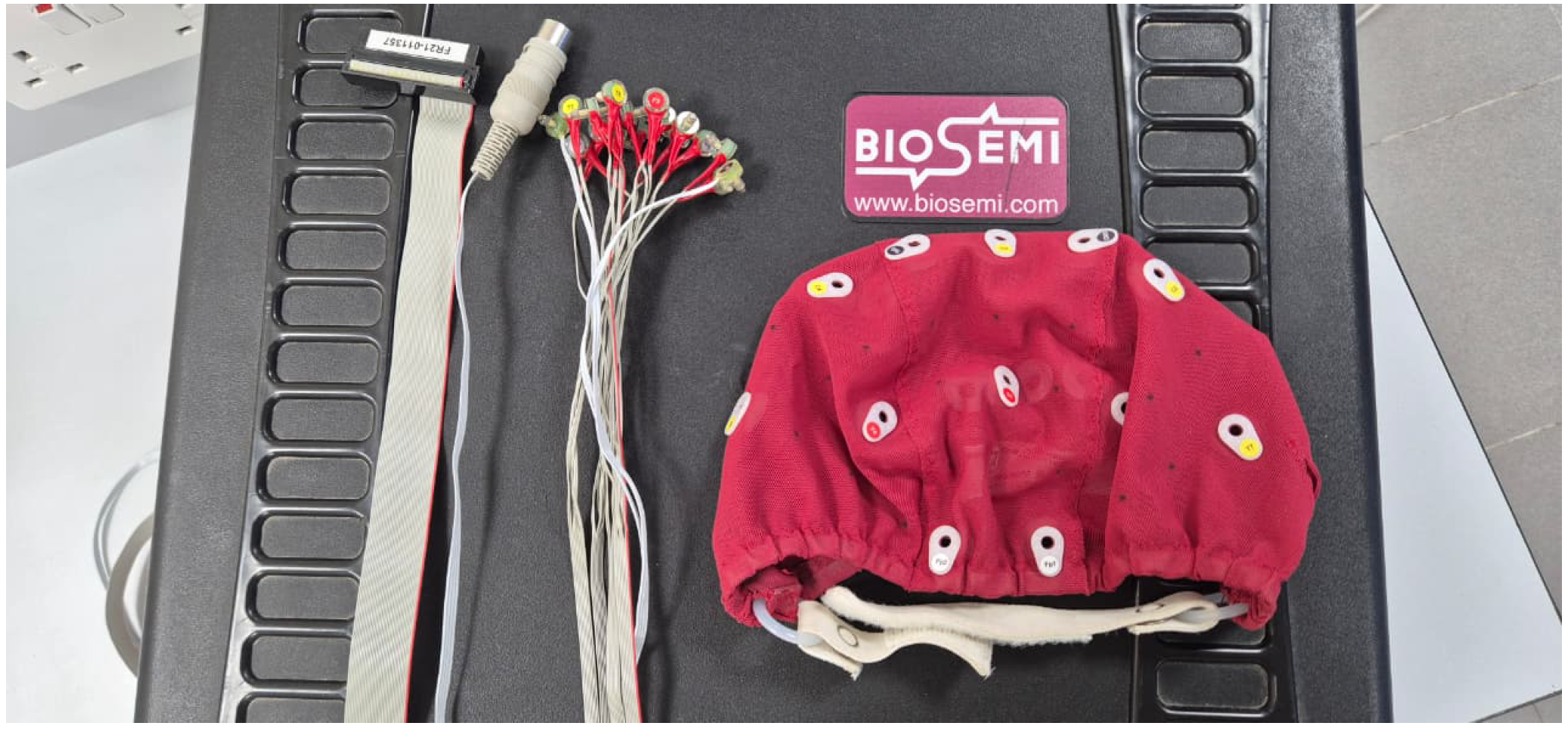
The EEG data were recorded using the Biosemi ActiveTwo EEG Recording System (Biosemi B.V., Amsterdam, The Netherlands) at a sampling frequency of 2048 Hz using 16 EEG electrodes. These electrodes are positioned in a cap on the scalp of each participant according to the international 10-20 electrode placement system.
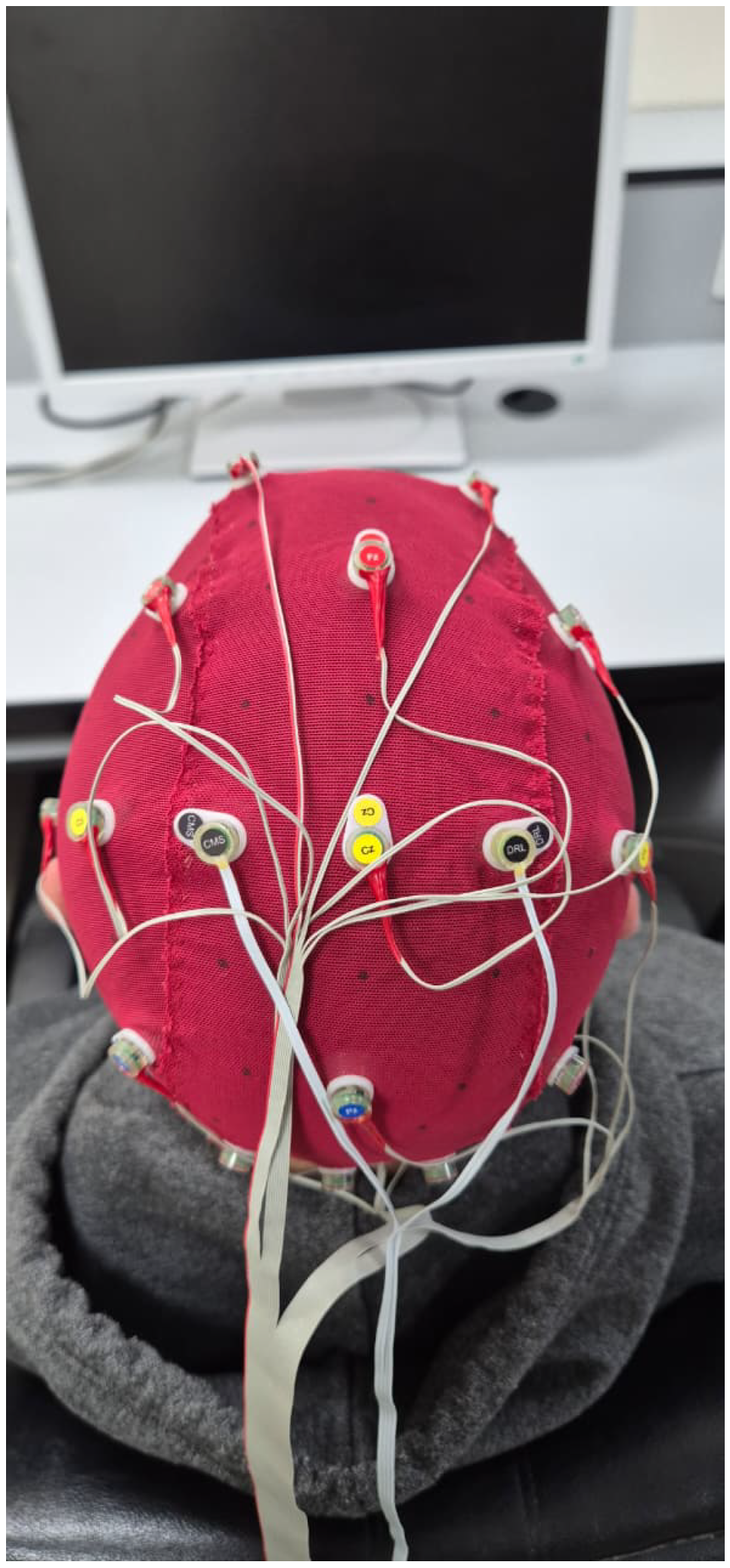
Figure 1 below shows both the elastic cap used during the recording of the EEG signals and the EEG electrodes used. The 16 electrodes used are (C3, C4, Fp1, Fp2, F4, Fz, F3, T7, Cz, T8, P4, Pz, P3, O1, Oz and O2). Moreover, the EEG electrodes are referenced to the Common Mode Sense (CMS)/Driven Right Leg (DRL) for noise cancellation, and the DC offset for each electrode was below 25mV during the sessions to maintain the signal integrity.
Figure 2 shows one of the participants wearing the elastic cap with the electrodes mounted in their exact places.
2.8. Experimental Task and Trial Structure
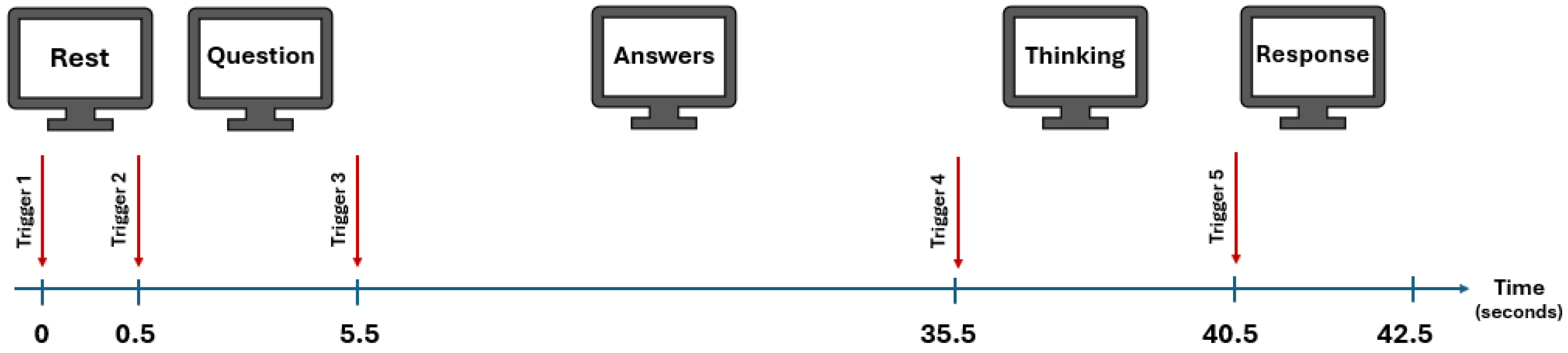
The experimental task was implemented using PsychoPy software (version 2024.2.4), where each trial followed the same structure to ensure consistency across all participants and recording sessions. Each trial begins with a
0.5 s rest period, allowing the participant to relax and prepare before the question is presented. Then, a question is displayed on the screen for
5 s, where the participant can read the question without providing any response. The
30 s answers phase was used as a fixed response-review interval rather than as an assumed continuous reading period. Participants were instructed to read all four options and identify the response that best matched their assigned role. The duration was intentionally kept fixed across trials and participants to accommodate individual differences in reading speed, role interpretation, and response comparison, while avoiding time pressure. This study did not record whether each participant actively used the full 30 s interval; therefore, this phase was not interpreted as a uniform decision-making interval across participants. The subsequent 5 s thinking phase was introduced to provide a standardized post-reading interval in which the answer options were removed from the screen and instead a white screen that says
“Think of all the answers and pick the most suitable one” is displayed. This phase reduced visual scanning and reading-related eye movements and allowed participants to maintain or confirm their selected role-consistent response immediately before the auditory cue and verbal answer. Because participants may have formed a preliminary decision during the answers phase, the thinking phase was interpreted as a decision-confirmation and response-preparation interval rather than as the sole period of initial decision formation. An auditory beep then signals the response phase, where the participant verbally selects one of the 4 answers within a
2 s time window. The participants verbally responded using the labels A, B, C, or D. The verbal responses were manually recorded by the experimenter on a paper scoring sheet that contains the list of questions and the corresponding answer options.
Figure 3 shows the timing structure followed in each trial in the recordings.
The multiple-choice response format was deliberately adopted to improve experimental standardization and reduce artifacts during EEG recording. Each question was associated with four predefined answer options, with each option corresponding to one of the behavioral roles. This design ensured that all participants were exposed to the same response alternatives and reduced variability associated with spontaneous open-ended verbal responses. In addition, participants verbally responded only by stating the selected option label, A, B, C, or D, during the response phase. This minimized speech duration and restricted overt verbal production to a short, predefined time window, thereby reducing speech-related and movement-related artifacts during the preceding cognitive phases.
After each trial, a transition screen appears with the message “Press next when ready”, allowing participants to rest and take a moment before proceeding to the following trial. This sequence was repeated for all interrogation questions within a session.
It is worth mentioning that prior to the main interrogation, each session started with a practice trial (Question Q00). It followed the exact same structure as the other questions, but was designed to familiarize participants with the procedure and the role they should follow in answering the questions. This question was not included in the final dataset, and the participants’ responses to Q00 were not analyzed.
To accurately align EEG signals with task events, event markers were sent from PsychoPy to BioSemi through a USB trigger interface. Specifically, the generated triggers were used to mark the beginning and end events of each of the five phases within each recorded trail, as illustrated in
Figure 3. These triggers allow EEG data to be precisely segmented during analysis and ensure that neural activity is correctly mapped with its associated phase.
2.9. Quality Control and Artifact Inspection
To ensure data quality, all recorded EEG signals were manually inspected prior to analysis. Each recording was visually examined for any anomalies, including noise, electrode disconnections, or artifacts related to eye blinks, muscle activity, or movement. Trials that were distorted or unstable were excluded from the final dataset.
3. Dataset Description
3.1. Data Organization and Storage Structure
The raw EEG data along with the embedded triggers, discussed in
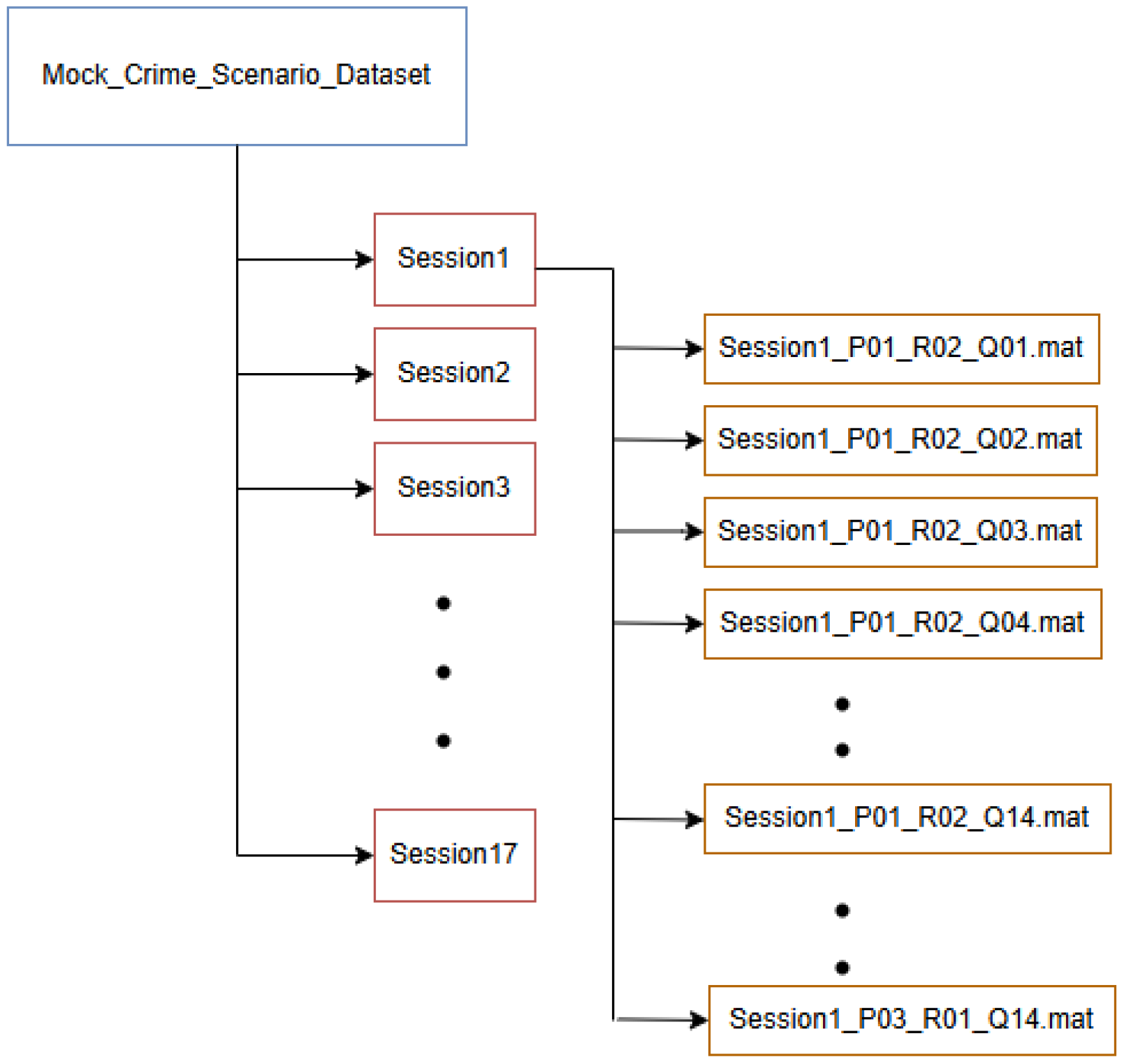
Section 2.8, were saved as .mat files and organized into a structured directory for clarity and reproducibility. In particular, the recorded raw EEG data were saved in a main folder titled “Mock_Crime_Scenario _Dataset”, containing 17 sub-folders, each representing a unique session. Each session is labeled as “Session” followed by the session number (e.g., “Session4”). Within each session, all EEG trial files corresponding to participants in that session are stored directly, with 56 .mat files per session The naming format for the trial files is “Sessionx_Py_Rk_Qz”, where
Sessionx denotes the session, with x being an integer from 1 to 17.
Py denotes the participant id, with y being an integer from 01 to 51, where the numbers represent the order of the participants during the recording of the sessions.
Rk denotes the participant role, with k representing the role (e.g., R01 for honest, R02 for bluffer, R03 for liar, and R04 for deceiver).
Qz denotes the question number, with z being an integer from 01 to 14.
For example, the file named “Session1_P01_R02_Q04” contains the EEG recording for the bluffer participant in session 1 during the fourth question in the trial.
Figure 4 below shows the hierarchical structure of the recorded dataset.
3.2. Structure of Each Trial File
Each trial was stored as a .mat file containing the fields listed in
Table 5. In particular, the data field contains a matrix of size (channels × samples), where each row corresponds to an EEG channel and each column corresponds to a time sample, representing the EEG signals recorded during that trial. Each trial begins with a 0.5 s rest phase, followed by the question, answers, thinking, and response phases. The temporal boundaries of these phases are specified by sample indices stored in the events field, as shown in
Table 5. The channel field stores the names and order of the EEG channels used in the recording, while the sampling_rate field specifies the sampling frequency of the recorded signals.
4. Data Validation
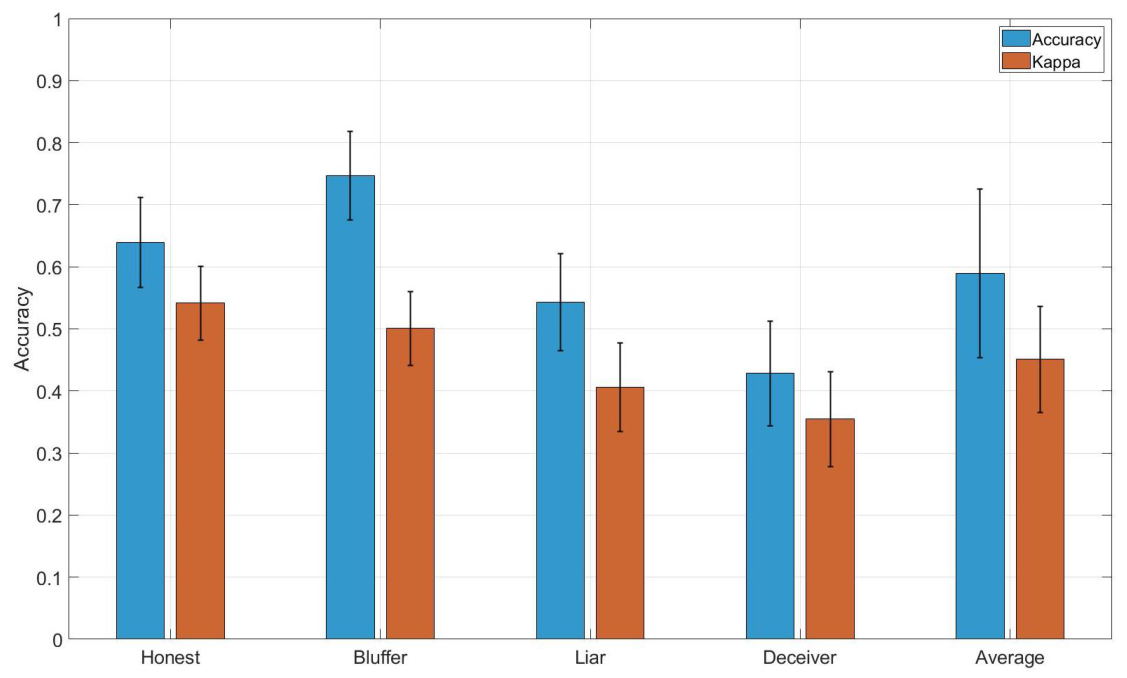
To validate the proposed dataset, we used a conventional feature extraction pipeline together with a traditional machine learning classifier to decode the four behavioral deception roles considered in this study. The goal was to provide a preliminary role-classification benchmark and to assess whether the recorded EEG signals contained discriminative information related to the assigned behavioral roles. For the validation analysis, the thinking phase was selected because it provided a short standardized interval after the answer options were removed and before the verbal response. This interval minimized contamination from reading, visual scanning, and overt speech. However, the extracted EEG activity should be interpreted as reflecting post-reading decision confirmation, role-consistent response maintenance, and response preparation, rather than the complete decision-formation process, since participants may have formed preliminary choices during the preceding answers phase. Specifically, for each question, the EEG signals recorded during the thinking phase were selected and preprocessed. Data were downsampled to 256 Hz, band-pass filtered between 0.5 and 32.5 Hz, and re-referenced to the electrode, which was excluded from further analysis.
To reduce inter-trial variability, baseline correction was applied using a 500 ms baseline rest segment at the beginning of each trial. Artifact removal was then performed using automatic Blind Source Separation (BSS) methods in EEGLAB [
40], specifically SOBI-based EMG and EOG attenuation functions.
The preprocessed EEG signals were segmented into 256-sample windows using a sliding-window approach. For each segment, the Short Time Fourier Transform (STFT) was computed for each EEG channel, producing 15 time–frequency maps. Then, each map was used to extract 12 time–frequency features, following [
41,
42], resulting in a 180-dimensional feature vector per window.
These feature vectors were used to train and evaluate a Random Forest classifier. Performance was assessed using a
cross-validation procedure. We note that this validation scheme was not fully subject-independent, since training and testing folds were formed at the feature-vector level and the same thief participant contributed recordings for both the liar and deceiver role conditions across separate trials. Therefore, the reported classification results should be interpreted as an initial dataset validation and role-discrimination benchmark, rather than as evidence of fully subject-independent generalization performance. As shown in
Figure 5, the average accuracy ± STD and kappa ± STD across all roles were
and
, respectively.
To further explore regional EEG characteristics across deception-related conditions, we performed an exploratory scalp-region analysis using Session 4 as an illustrative example. Session 4 contained 56 trials, with 14 trials for each behavioral role. The honest role corresponded to participant P12, the bluffer role to participant P11, and the liar and deceiver roles to participant P10. Therefore, this analysis was considered descriptive and exploratory, rather than subject-independent.
The EEG signals from the thinking phase were downsampled to 256 Hz, band-pass filtered between 0.5 and 32.5 Hz, re-referenced to Cz, and baseline corrected using the rest segment. Since Cz was used as the reference electrode, it was excluded from the regional analysis. The remaining electrodes were grouped into five scalp regions: frontal electrodes, including Fp1, Fp2, F3, Fz, and F4; central electrodes, including C3 and C4; temporal electrodes, including T7 and T8; parietal electrodes, including P3, Pz, and P4; and occipital electrodes, including O1, Oz, and O2. Regional spectral features were computed by averaging channel-level power values within each region. The exploratory analysis focused on theta, alpha, and beta activity within the 4–30 Hz range.
Table 6 summarizes the dominant regional pattern for each role in Session 4. The honest condition showed the highest 4–30 Hz regional power over the parietal region, with theta-dominant activity. The bluffer condition showed the highest regional power over the temporal region, with a stronger alpha contribution. Both the liar and deceiver conditions showed the highest regional power over the frontal region, with theta-dominant activity. These frontal patterns are consistent with previous deception studies implicating frontal and prefrontal regions in executive control, inhibition, and deceptive responding [
27,
38], while prior work also supports the involvement of anterior cingulate, frontoparietal, and centro-parietal activity in conflict monitoring and concealed-information processing [
20,
21,
30,
43].
5. Limitations and Future Directions
Although the proposed dataset provides a controlled multi-class EEG resource for studying deception-related behavioral roles, several limitations should be considered when interpreting and using the data.
First, the participant sample consisted mainly of young adults and was gender-imbalanced. Therefore, the dataset does not fully represent broader age, gender, cultural, or clinical populations. Future datasets can address this limitation by recruiting larger and more demographically balanced cohorts.
Second, the four class labels used in this dataset, namely honest, bluffer, liar, and deceiver, are operational behavioral roles defined within the present mock-crime interrogation paradigm. They should not be interpreted as universal or clinically established deception categories. The role definitions were designed to capture different deception-related strategies under controlled experimental conditions, but additional paradigms and independent replications are needed to examine how these role patterns generalize to other deception contexts.
Third, the role structure introduced partial participant dependence across classes. In each session, the thief participant completed both the liar and deceiver conditions across separate trials. Therefore, these two role conditions were not fully independent at the participant level. This design allowed controlled comparison of two deceptive strategies performed by the same guilty participant, but it also limits strict subject-independent interpretation across all four classes. Future studies can assign independent participants to each deception-related role or apply counter-balanced designs that separate role effects from participant-specific neural patterns.
Fourth, the standardized multiple-choice interrogation format improved timing control, reduced speech-related artifacts, and ensured comparable response options across roles. However, it also constrained the spontaneity of participants’ responses. In addition, the 30 s answers phase was used as a fixed response-review interval, and participants may have selected their answers before the end of that interval. Consequently, the 5 s thinking phase should be interpreted as a decision-confirmation and response-preparation period rather than the sole period of initial decision formation. Future work can include response-time logging, confidence ratings, subjective cognitive-load measures, and trial-level role-adherence ratings to better characterize the decision process.
Fifth, the dataset was recorded using a 16-channel EEG montage. This setup supports scalp-level channel and regional analyses with limited spatial resolution. High spatial resolution is required for precise cortical source localization. Future studies can employ higher-density EEG systems, additional artifact-monitoring channels, eye tracking, or multimodal neuroimaging methods such as EEG–fNIRS to improve spatial interpretation and artifact characterization.
Sixth, the validation analysis was intended as an initial benchmark demonstrating that the dataset contains discriminative EEG information related to the four behavioral roles. The reported classification results should not be interpreted as definitive evidence of fully subject-independent generalization. More rigorous benchmark protocols, such as leave-one-subject-out, leave-one-session-out, and nested cross-validation schemes, are needed for future model evaluation. Providing standardized train–test splits can also improve reproducibility and comparability across studies.
Finally, the present dataset emphasizes controlled mock-crime interrogation under standardized timing and response conditions. Complementary experimental designs, including interactive card-based or sender–receiver paradigms, can extend this work by examining spontaneous, competitive, and socially adaptive deception. Combining controlled multi-class role paradigms with richer behavioral annotations and more advanced EEG analyses can support future deception detection research based on multi-class neural patterns rather than conventional binary truth-versus-lie classification.
Author Contributions
Conceptualization, Methodology, Funding Acquisition, Supervision, Validation, and Writing—Original Draft Preparation, R.A.; Software, Data Collection, Data Curation, and Writing—Original Draft Preparation, L.M.A.; Software, Visualization, Investigation, and Data Curation, O.H.; Writing—Reviewing and Editing, Resources, Validation, and Project Administration, R.A. All authors have read and agreed to the published version of the manuscript.
Funding
This research received no external funding.
Institutional Review Board Statement
This study was approved by the Institutional Review Board (IRB) at the German Jordanian University (IRB protocol # IRB SEEIT 01/2025) and was conducted in accordance with the ethical principles outlined in the Declaration of Helsinki.
Informed Consent Statement
The study was conducted in compliance with the ethical standards outlined in the Declaration of Helsinki. All participants in the experiment provided written informed consent, allowing the recording and use of their EEG signals for research purposes. The subjects were briefed on the study’s objectives, methods, duration, procedures, and their roles. Prior to the recording session, each subject was guided through the experimental process to ensure a full understanding of the steps involved. All collected data were anonymized before release, and no personally identifiable information is included in the dataset.
Data Availability Statement
Acknowledgments
The authors gratefully acknowledge the subjects who voluntarily participated in the experiments of this study.
Conflicts of Interest
The authors declare no conflicts of interest.
References
- Kang, Q.; Li, F.; Gao, J. Exploring the functional Brain Network of Deception in source-level EEG via partial mutual information. Electronics 2023, 12, 1633. [Google Scholar] [CrossRef]
- Hermawan, A.T.; Zaeni, I.A.E.; Wibawa, A.P.; Gunawan, G.; Hartono, N.; Kristian, Y. EEG-Based Lie Detection Using Autoencoder Deep Learning with Muse II Brain Sensing. Int. J. Robot. Control Syst. 2024, 4, 1403–1428. [Google Scholar] [CrossRef]
- Prome, S.A.; Ragavan, N.A.; Islam, M.R.; Asirvatham, D.; Jegathesan, A.J. Deception detection using machine learning (ML) and deep learning (DL) techniques: A systematic review. Nat. Lang. Process. J. 2024, 6, 100057. [Google Scholar] [CrossRef]
- Kang, Q.; Li, Y.; Li, X.; Tian, M.; Xiang, Y.; Li, F.; Peng, S.; Xiong, Y.; Yang, Y.; Xiong, N.; et al. Characterization of Cortical Connectivity in the Deception State With a Data-Driven Network Model Based on EEG Signal. IEEE J. Biomed. Health Inform. 2025, 29, 5561–5574. [Google Scholar] [CrossRef] [PubMed]
- Yuan, Z.; Lin, X. Mapping of the brain activation associated with deception using fused EEG and fNIRS. In Proceedings of the Neural Imaging and Sensing 2019; SPIE: Bellingham, WA, USA, 2019; Volume 10865, pp. 26–41. [Google Scholar]
- Mashatan, S.; Ghassemi, F. Functional connectivity analysis in EEG source space during deception. Front. Biomed. Technol. 2022, 9, 191–198. [Google Scholar]
- Yan, N. Capper No Cap: Cognitive Load Approach in the Context of Deception Stakes, Age, and Forensic Settings. Lect. Notes Educ. Psychol. Public Media 2024, 36, 1–11. [Google Scholar] [CrossRef]
- Morrison, K.; McCornack, S.A. Can We Be Honest? Cognition, Intention, Speech Production, and the Future of Deception Research. J. Lang. Soc. Psychol. 2026, 45, 122–146. [Google Scholar]
- Žabčíková, M.; Koudelkova, Z.; Jašek, R. Concealed information detection using EEG for lie recognition by ERP P300 in response to visual stimuli: A review. WSEAS Trans. Inf. Sci. Appl. 2022, 17, 171–179. [Google Scholar] [CrossRef]
- Avola, D.; Bilal, M.Y.; Emam, E.; Lakasz, C.; Pannone, D.; Ranaldi, A. Bi-GRU Based Deception Detection using EEG Signals. arXiv 2025, arXiv:2507.13718. [Google Scholar]
- Alazrai, R.; Alqasem, F.; Alaarag, S.; Yousef, K.M.A.; Daoud, M.I. A bispectrum-based approach for detecting deception using EEG signals. In Proceedings of the 2018 IEEE 20th International Conference on e-Health Networking, Applications and Services (Healthcom), Ostrava, Czech Republic, 7–20 September 2018; pp. 1–6. [Google Scholar]
- Chen, Y.; Fazli, S.; Wallraven, C. An EEG Dataset of Neural Signatures in a Competitive Two-Player Game Encouraging Deceptive Behavior. Sci. Data 2024, 11, 389. [Google Scholar] [CrossRef] [PubMed]
- Peterson, C. Deception in intimate relationships. Int. J. Psychol. 1996, 31, 279–288. [Google Scholar] [CrossRef]
- Fan, X. Deception from Parents to Romantic Partners. Master’s Thesis, University of Arkansas, Fayetteville, AR, USA, 2018. [Google Scholar]
- Appling, D.S.; Briscoe, E.J.; Hutto, C.J. Discriminative models for predicting deception strategies. In Proceedings of the 24th International Conference on World Wide Web, Florence, Italy, 18–22 May 2015; pp. 947–952. [Google Scholar]
- Aslan, M.; Baykara, M.; Alakus, T.B. LieWaves: Dataset for lie detection based on EEG signals and wavelets. Med. Biol. Eng. Comput. 2024, 62, 1571–1588. [Google Scholar] [CrossRef] [PubMed]
- Gupta, V.; Agarwal, M.; Arora, M.; Chakraborty, T.; Singh, R.; Vatsa, M. Bag-of-lies: A multimodal dataset for deception detection. In Proceedings of the IEEE/CVF Conference on Computer Vision and Pattern Recognition Workshops, Long Beach, CA, USA, 16–17 June 2019; pp. 83–90. [Google Scholar]
- Wang, Y.; Ng, W.C.; Ng, K.S.; Yu, K.; Wu, T.; Li, X. An electroencephalography network and connectivity analysis for deception in instructed lying tasks. PLoS ONE 2015, 10, e0116522. [Google Scholar] [CrossRef] [PubMed]
- Gao, J.; Min, X.; Kang, Q.; Si, H.; Zhan, H.; Manyande, A.; Tian, X.; Dong, Y.; Zheng, H.; Song, J. Effective connectivity in cortical networks during deception: A lie detection study based on EEG. IEEE J. Biomed. Health Inform. 2022, 26, 3755–3766. [Google Scholar] [CrossRef] [PubMed]
- Farwell, L.A.; Donchin, E. The truth will out: Interrogative polygraphy (“lie detection”) with event-related brain potentials. Psychophysiology 1991, 28, 531–547. [Google Scholar] [PubMed]
- Meijer, E.H.; Selle, N.K.; Elber, L.; Ben-Shakhar, G. Memory detection with the Concealed Information Test: A meta analysis of skin conductance, respiration, heart rate, and P300 data. Psychophysiology 2014, 51, 879–904. [Google Scholar] [CrossRef] [PubMed]
- Hahm, J.; Ji, H.K.; Jeong, J.Y.; Oh, D.H.; Kim, S.H.; Sim, K.B.; Lee, J.H. Detection of concealed information: Combining a virtual mock crime with a P300-based Guilty Knowledge Test. Cyberpsychol. Behav. 2009, 12, 269–275. [Google Scholar] [CrossRef] [PubMed]
- Lui, M.; Rosenfeld, J.P. Detection of deception about multiple, concealed, mock crime items, based on a spatial-temporal analysis of ERP amplitude and scalp distribution. Psychophysiology 2008, 45, 721–730. [Google Scholar] [PubMed]
- Andrew Kozel, F.; Johnson, K.A.; Grenesko, E.L.; Laken, S.J.; Kose, S.; Lu, X.; Pollina, D.; Ryan, A.; George, M.S. Functional MRI detection of deception after committing a mock sabotage crime. J. Forensic Sci. 2009, 54, 220–231. [Google Scholar]
- Navarrete, E.; De Pedis, M.; Lorenzoni, A. Verbal deception in picture naming. Q. J. Exp. Psychol. 2023, 76, 2390–2400. [Google Scholar] [CrossRef]
- Scheuble, V.; Beauducel, A. Cognitive processes during deception about attitudes revisited: A replication study. Soc. Cogn. Affect. Neurosci. 2020, 15, 839–848. [Google Scholar] [CrossRef] [PubMed]
- Ganis, G.; Kosslyn, S.M.; Stose, S.; Thompson, W.; Yurgelun-Todd, D.A. Neural correlates of different types of deception: An fMRI investigation. Cereb. Cortex 2003, 13, 830–836. [Google Scholar] [CrossRef] [PubMed]
- Abe, N.; Okuda, J.; Suzuki, M.; Sasaki, H.; Matsuda, T.; Mori, E.; Tsukada, M.; Fujii, T. Neural correlates of true memory, false memory, and deception. Cereb. Cortex 2008, 18, 2811–2819. [Google Scholar] [CrossRef] [PubMed]
- Johnson, R., Jr.; Barnhardt, J.; Zhu, J. The contribution of executive processes to deceptive responding. Neuropsychologia 2004, 42, 878–901. [Google Scholar] [CrossRef] [PubMed]
- Abe, N.; Suzuki, M.; Tsukiura, T.; Mori, E.; Yamaguchi, K.; Itoh, M.; Fujii, T. Dissociable roles of prefrontal and anterior cingulate cortices in deception. Cereb. Cortex 2006, 16, 192–199. [Google Scholar] [PubMed]
- Sip, K.E.; Skewes, J.C.; Marchant, J.L.; McGregor, W.B.; Roepstorff, A.; Frith, C.D. What if I get busted? Deception, choice, and decision-making in social interaction. Front. Neurosci. 2012, 6, 58. [Google Scholar] [CrossRef] [PubMed]
- Volz, K.G.; Vogeley, K.; Tittgemeyer, M.; von Cramon, D.Y.; Sutter, M. The neural basis of deception in strategic interactions. Front. Behav. Neurosci. 2015, 9, 27. [Google Scholar] [CrossRef] [PubMed]
- Yin, L.; Reuter, M.; Weber, B. Let the man choose what to do: Neural correlates of spontaneous lying and truth-telling. Brain Cogn. 2016, 102, 13–25. [Google Scholar] [CrossRef] [PubMed]
- Kireev, M.; Korotkov, A.; Medvedeva, N.; Masharipov, R.; Medvedev, S. Deceptive but not honest manipulative actions are associated with increased interaction between middle and inferior frontal gyri. Front. Neurosci. 2017, 11, 482. [Google Scholar] [CrossRef] [PubMed]
- Vrij, A.; Fisher, R.; Mann, S.; Leal, S. Detecting deception by manipulating cognitive load. Trends Cogn. Sci. 2006, 10, 141–142. [Google Scholar] [CrossRef] [PubMed]
- Suchotzki, K.; Verschuere, B.; Van Bockstaele, B.; Ben-Shakhar, G.; Crombez, G. Lying takes time: A meta-analysis on reaction time measures of deception. Psychol. Bull. 2017, 143, 428. [Google Scholar] [CrossRef] [PubMed]
- Debey, E.; Ridderinkhof, R.K.; De Houwer, J.; De Schryver, M.; Verschuere, B. Suppressing the truth as a mechanism of deception: Delta plots reveal the role of response inhibition in lying. Conscious. Cogn. 2015, 37, 148–159. [Google Scholar] [CrossRef] [PubMed]
- Christ, S.E.; Van Essen, D.C.; Watson, J.M.; Brubaker, L.E.; McDermott, K.B. The contributions of prefrontal cortex and executive control to deception: Evidence from activation likelihood estimate meta-analyses. Cereb. Cortex 2009, 19, 1557–1566. [Google Scholar] [PubMed]
- Wu, J.; Huang, J.; Li, J.; Chen, X.; Xiao, Y. The role of conflict processing mechanism in deception responses. Sci. Rep. 2022, 12, 18300. [Google Scholar] [CrossRef] [PubMed]
- Delorme, A.; Makeig, S. EEGLAB: An open source toolbox for analysis of single-trial EEG dynamics including independent component analysis. J. Neurosci. Methods 2004, 134, 9–21. [Google Scholar] [CrossRef] [PubMed]
- Alazrai, R.; Al-Saqqaf, A.; Al-Hawari, F.; Alwanni, H.; Daoud, M.I. A Time-Frequency Distribution-Based Approach for Decoding Visually Imagined Objects Using EEG Signals. IEEE Access 2020, 8, 138955–138972. [Google Scholar] [CrossRef]
- Alazrai, R.; Al-Rawi, S.; Daoud, M.I. A Time-Frequency Distribution Based Approach for Detecting Tonic Cold Pain using EEG Signals. In Proceedings of the 2019 IEEE 19th International Conference on Bioinformatics and Bioengineering (BIBE), Athens, Greece, 28–30 October 2019; pp. 589–592. [Google Scholar] [CrossRef]
- Lisofsky, N.; Kazzer, P.; Heekeren, H.R.; Prehn, K. Investigating socio-cognitive processes in deception: A quantitative meta-analysis of neuroimaging studies. Neuropsychologia 2014, 61, 113–122. [Google Scholar] [PubMed]
| Disclaimer/Publisher’s Note: The statements, opinions and data contained in all publications are solely those of the individual author(s) and contributor(s) and not of MDPI and/or the editor(s). MDPI and/or the editor(s) disclaim responsibility for any injury to people or property resulting from any ideas, methods, instructions or products referred to in the content. |