
The Influence of AI Competency and Soft Skills on Innovative University Competency: An Integrated SEM–Artificial Neural Network (SEM–ANN) Model


Abstract
1. Introduction
2. Literature Review
2.1. Theoretical Foundations
2.2. AI Competency
2.3. Soft Skills
2.4. Strategic Intelligence
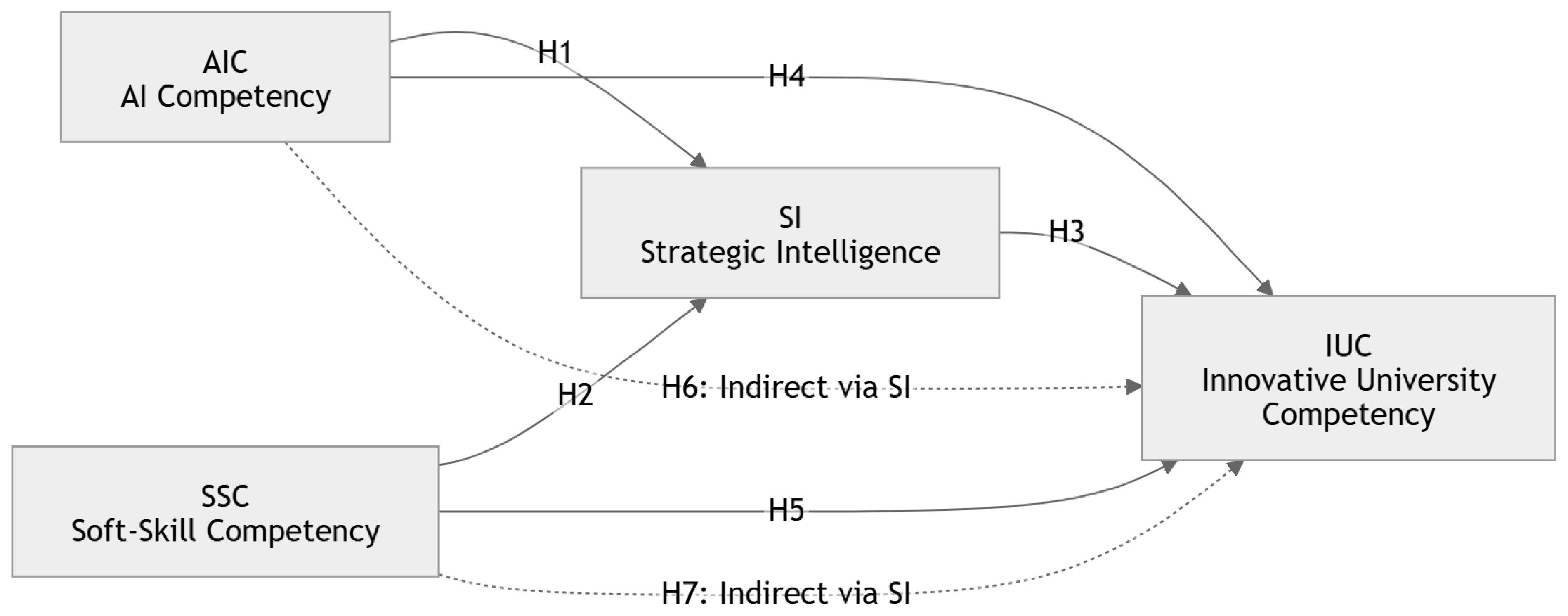
2.5. Conceptual Model
3. Research Methodology
3.1. Research Design
3.2. Ethical Approval and Stakeholder Sample
3.3. Research Instrument and Scales
3.4. Familiarization with the Data
3.5. Data Analysis/Validity Assessment
4. Presentation, Analysis, and Discussion of Findings
4.1. Demographic Information
4.2. SEM Analysis
4.2.1. Comprehensive Interpretation of Model Fit Indices
- Chi-square (χ2) and χ2/df Ratio
- 2.
- Comparative Fit Index (CFI)
- 3.
- Tucker–Lewis Index (TLI)
- 4.
- Incremental Fit Index (IFI)
- 5.
- Root Mean Square Error of Approximation (RMSEA)
- 6.
- Standardized Root Mean Square Residual (SRMR)
4.2.2. Confirmatory Factor Analysis (CFA)
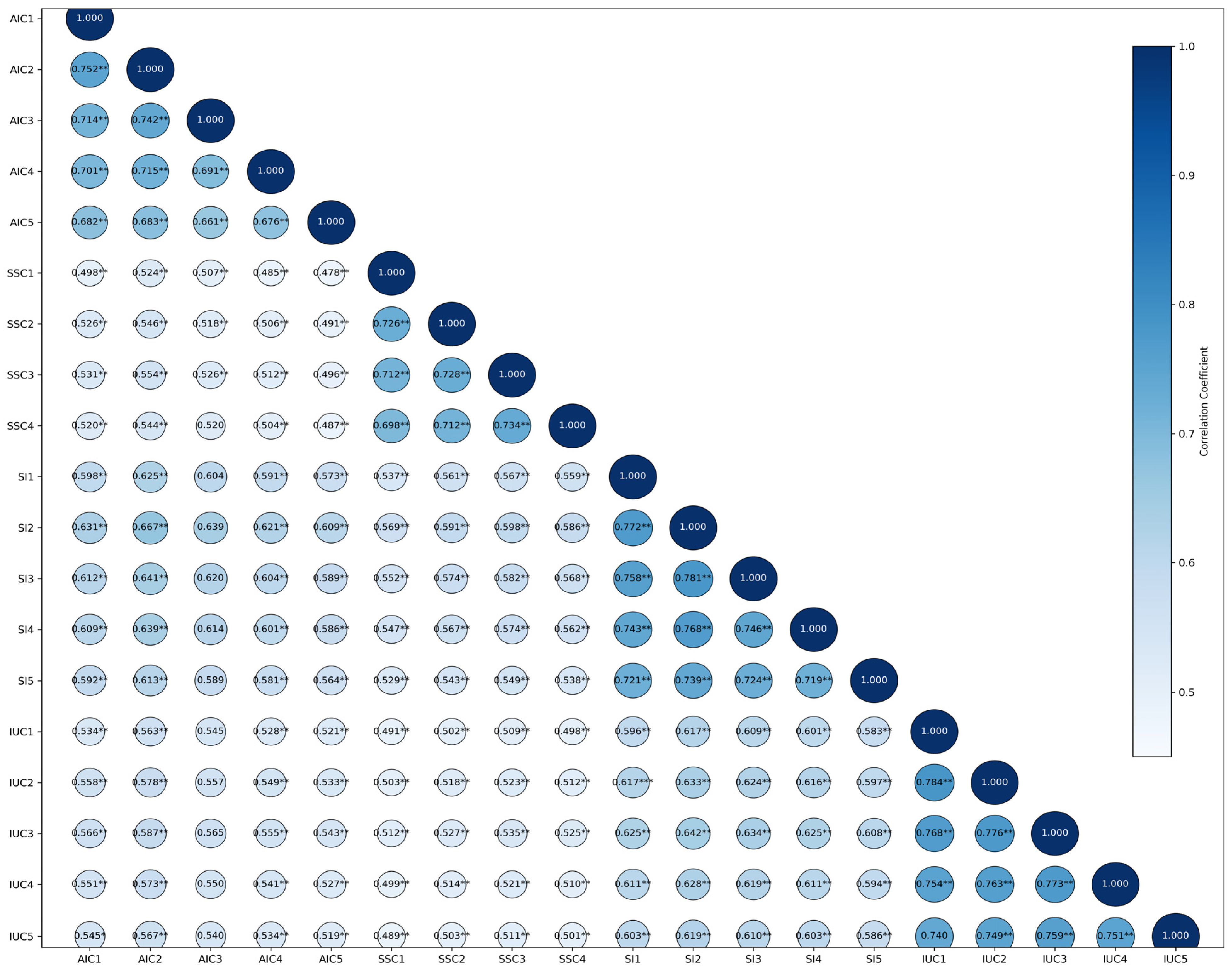
4.2.3. Correlation Coefficient Matrix
4.2.4. Reliability and Validity Assessment
- Reliability Analysis
- 2.
- Validity Analysis
4.2.5. Fit Indices for the Structural Equation Model (SEM)
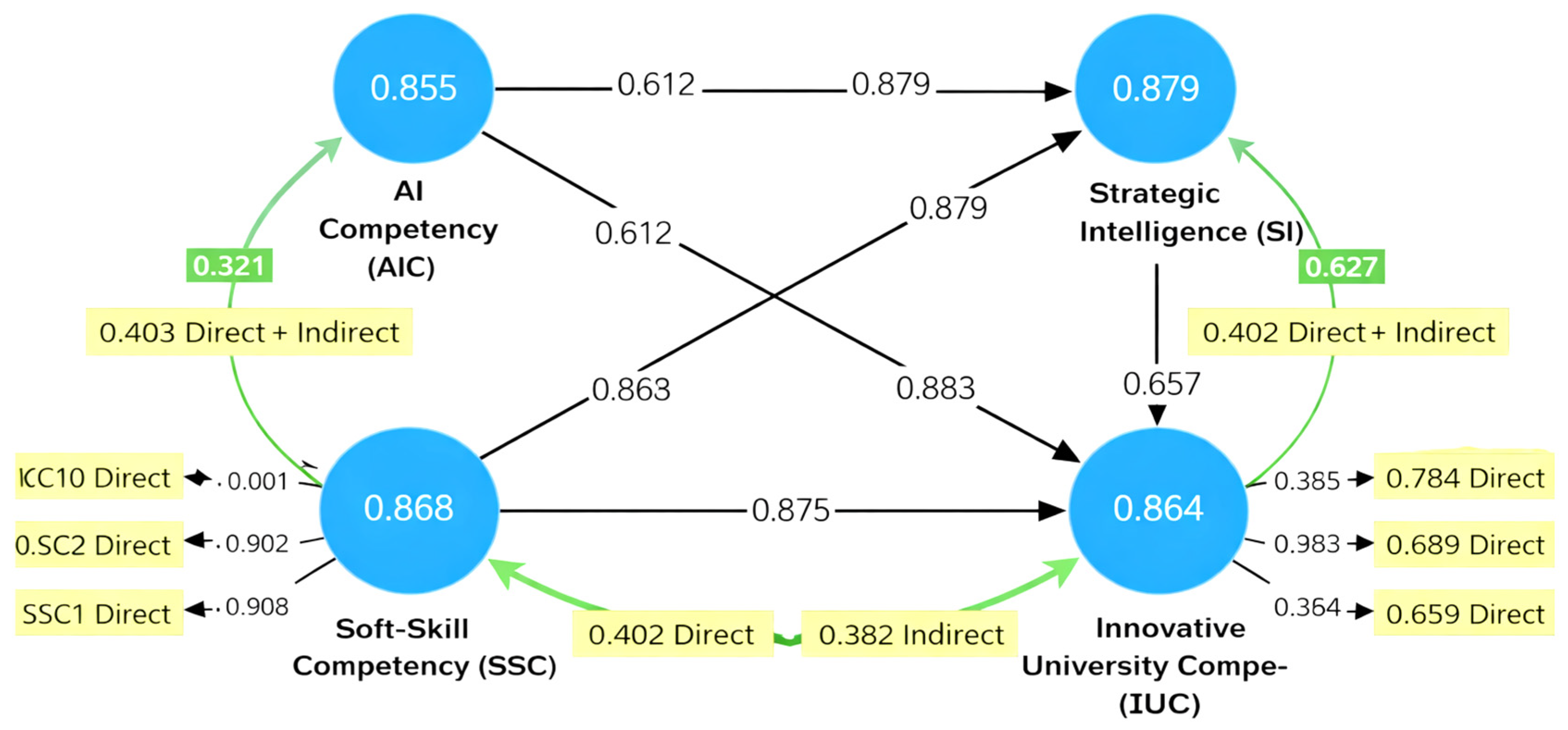
4.2.6. Path Analysis: Direct, Indirect, and Total Effects
4.3. Integration of SEM and ANN
4.3.1. ANN Model Design and Mathematical Formulation
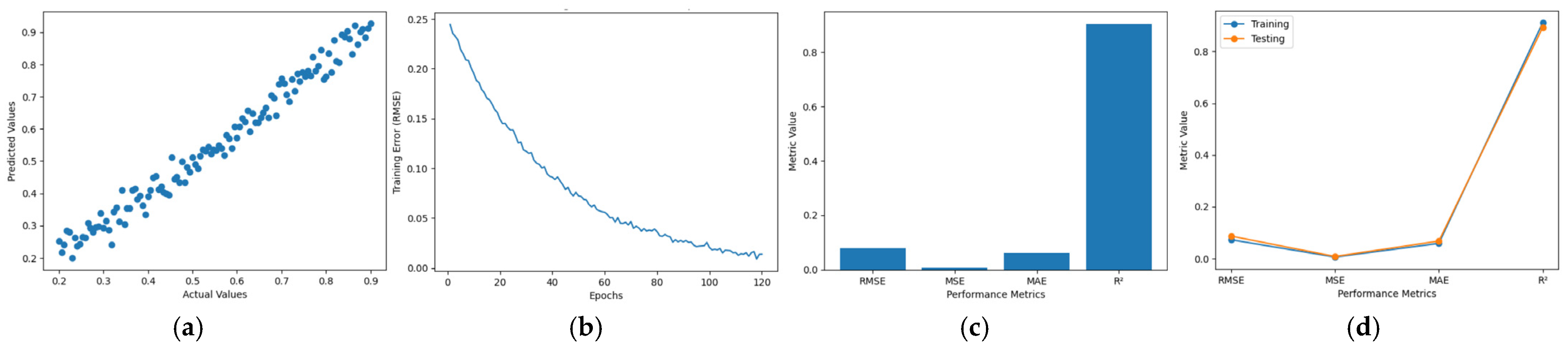
4.3.2. ANN Predictive Analysis and Variable Importance
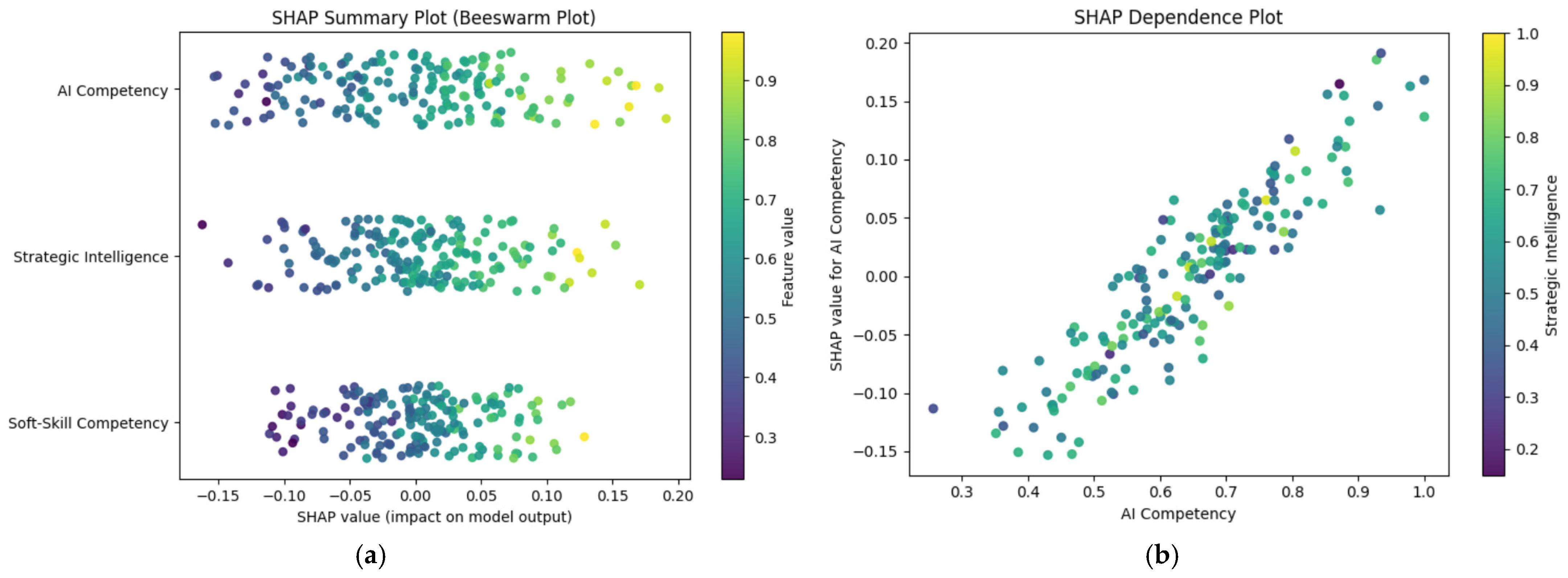
4.3.3. Feature Importance Analysis Using SHAP
4.3.4. Comparison Between SEM and ANN Analysis
5. Discussions
6. Conclusions
Author Contributions
Funding
Institutional Review Board Statement
Data Availability Statement
Acknowledgments
Conflicts of Interest
References
- Tan, X.; Cheng, G.; Ling, M.H. Investigating the mediating role of TPACK on teachers’ AI competency and their teaching performance in higher education. Comput. Educ. Artif. Intell. 2025, 9, 100461. [Google Scholar] [CrossRef]
- Monticelli, J.M.; Fossatti, P.; de Quadros da Silva, L.; Soster Luz, C.B. Innovative university: Evidence from university management. Int. J. Educ. Manag. 2024, 38, 509–524. [Google Scholar] [CrossRef]
- Adabor, E.S.; Addy, E.; Assyne, N.; Antwi-Boasiako, E. Enhancing sustainable academic course delivery using AI in technical universities: An empirical analysis using adaptive learning theory. Sustain. Futures 2025, 10, 100828. [Google Scholar] [CrossRef]
- Luthfi, Z.F.; Prasetiyo, W.H.; Sari, B.I.; Waldi, A.; Muttaqiin, A. Dataset of AI adoption usage, expectations, attitudes, perceptions, and motivations for learning in higher education. Data Brief 2025, 63, 112106. [Google Scholar] [CrossRef] [PubMed]
- Ding, N.; Chen, M.; Hu, L. The impact of personality traits and AI literacy on the adoption intentions of AI among design faculty in Chinese higher education. Acta Psychol. 2025, 260, 105709. [Google Scholar] [CrossRef]
- Haq, F.; Suki, N.M.; Zaigham, H.; Masood, A.; Rajput, A. Exploring AI adoption and SME performance in resource-constrained environments: A TOE–RBV perspective with mediation and moderation effects. J. Digit. Econ. 2025; in press. [CrossRef]
- Le, T.T.; Lin, P.T.; Duc, D.T.V.; Dang, T.Q.; Nguyen, L.T. Optimizing and restructuring resources for sustainable firm performance in the AI era: The role of dynamic capabilities and circular manufacturing. Sustain. Futures 2025, 10, 101441. [Google Scholar] [CrossRef]
- Trindade, M.A.; Edirisinghe, G.S.; Luo, L. Teaching mathematical concepts in management with generative artificial intelligence: The power of human oversight in AI-driven learning. Int. J. Manag. Educ. 2025, 23, 101104. [Google Scholar] [CrossRef]
- Arora, N.; Chakraborty, I.; Nishimura, Y. AI–human hybrids for marketing research: Leveraging large language models (LLMs) as collaborators. J. Mark. 2025, 89, 43–70. [Google Scholar] [CrossRef]
- Garg, V.; Gabaldon, J.; Niranjan, S.; Hawkins, T.G. Impact of strategic performance measures on performance: The role of artificial intelligence and machine learning. Transp. Res. Part E Logist. Transp. Rev. 2025, 198, 104073. [Google Scholar] [CrossRef]
- Mehrabi, S.; Mahdad, M.; Bijman, J.; Cholez, C.; Mesa, J.C.P.; Giagnocavo, C. Microfoundations of dynamic capabilities enabling scaling pathways of sustainability-oriented innovation business models. Bus. Strategy Environ. 2025, 34, 849–871. [Google Scholar] [CrossRef]
- Donaldson, C. From classroom to industry: Entrepreneurship students’ perceptions of a subject-based open innovation challenge. Int. J. Manag. Educ. 2025, 23, 101130. [Google Scholar] [CrossRef]
- Wamba, S.F.; Queiroz, M.M.; Randhawa, K.; Gupta, G. Generative artificial intelligence and the challenges to adding value ethically. Technovation 2025, 144, 103235. [Google Scholar] [CrossRef]
- Akter, S.; Hossain, M.A.; Sajib, S.; Sultana, S.; Rahman, M.; Vrontis, D.; McCarthy, G. A framework for AI-powered service innovation capability: Review and agenda for future research. Technovation 2023, 125, 102768. [Google Scholar] [CrossRef]
- Wang, S.; Sun, Z.; Li, M.; Zhang, H.; Metwally, A.H.S. Leveraging TikTok for active learning in management education: An extended technology acceptance model approach. Int. J. Manag. Educ. 2024, 22, 101009. [Google Scholar] [CrossRef]
- Chowdhury, S.; Dey, P.; Joel-Edgar, S.; Bhattacharya, S.; Rodriguez-Espindola, O.; Abadie, A.; Truong, L. Unlocking the value of artificial intelligence in human resource management through AI capability framework. Hum. Resour. Manag. Rev. 2023, 33, 100899. [Google Scholar] [CrossRef]
- Huang, M.H.; Rust, R.T. A strategic framework for artificial intelligence in marketing. J. Acad. Mark. Sci. 2021, 49, 30–50. [Google Scholar] [CrossRef]
- Ray, M.E.; Rudolph, M.J.; Daugherty, K.K. Bloom’s taxonomy in health professions education: Associations with exam scores, clinical reasoning, and instructional effectiveness. Curr. Pharm. Teach. Learn. 2025, 17, 102444. [Google Scholar] [CrossRef] [PubMed]
- Zhou, Z.; Ironsi, C.S.; Chune, R. Leveraging interactive digital tools for online business education: Improving academic performances. Int. J. Manag. Educ. 2025, 23, 101135. [Google Scholar] [CrossRef]
- Sturm, S.; Hohenstein, N.O.; Hartmann, E. Linking entrepreneurial orientation and supply chain resilience to strengthen business performance: An empirical analysis. Int. J. Oper. Prod. Manag. 2023, 43, 1357–1386. [Google Scholar] [CrossRef]
- Bali, M.M.E.I.; Kumalasani, M.P.; Yunilasari, D. Artificial intelligence in higher education: Perspicacity relation between educators and students. J. Innov. Educ. Cult. Res. 2022, 3, 146–152. [Google Scholar] [CrossRef]
- Zafari, M.; Bazargani, J.S.; Sadeghi-Niaraki, A.; Choi, S. Artificial intelligence applications in K–12 education: A systematic literature review. IEEE Access 2022, 10, 61905–61921. [Google Scholar] [CrossRef]
- Bearman, M.; Ryan, J.; Ajjawi, R. Discourses of artificial intelligence in higher education: A critical literature review. High. Educ. 2023, 86, 369–385. [Google Scholar] [CrossRef]
- Gayed, J.M.; Carlon, M.K.J.; Oriola, A.M.; Cross, J.S. Exploring an AI-based writing assistant’s impact on English language learners. Comput. Educ. Artif. Intell. 2022, 3, 100055. [Google Scholar] [CrossRef]
- Yaseen, H.; Mohammad, A.S.; Ashal, N.; Abusaimeh, H.; Ali, A.; Sharabati, A.-A. The impact of adaptive learning technologies, personalized feedback, and interactive AI tools on student engagement: The moderating role of digital literacy. Sustainability 2025, 17, 1133. [Google Scholar] [CrossRef]
- Chiu, T.K.F. The impact of generative AI on practices, policies and research direction in education: A case of ChatGPT and Midjourney. Interact. Learn. Environ. 2024, 32, 6187–6203. [Google Scholar] [CrossRef]
- Stöhr, C.; Ou, A.W.; Malmström, H. Perceptions and usage of AI chatbots among students in higher education across genders, academic levels and fields of study. Comput. Educ. Artif. Intell. 2024, 7, 100259. [Google Scholar] [CrossRef]
- Kelly, A.; Sullivan, M.; Strampel, K. Generative artificial intelligence: University student awareness, experience, and confidence in use across disciplines. J. Univ. Teach. Learn. Pract. 2023, 20, 12. [Google Scholar] [CrossRef]
- Chiu, T.K.F. A classification tool to foster self-regulated learning with generative artificial intelligence by applying self-determination theory: A case of ChatGPT. Educ. Technol. Res. Dev. 2024, 72, 2401–2416. [Google Scholar] [CrossRef]
- Saxena, N.K.; Chauhan, B.K.; Gouri, S.; Kumar, A.; Gupta, A. Knowledge-based recommendation for subject allocation using artificial neural network in higher education. IEEE Trans. Educ. 2023, 66, 500–508. [Google Scholar] [CrossRef]
- Jing, S.; Liu, X.; Gong, X.; Zhao, H. System dynamics-based analysis on factors influencing artificial intelligence talents training. IEEE J. Radio Freq. Identif. 2022, 6, 753–757. [Google Scholar] [CrossRef]
- Orih, D.; Heyeres, M.; Morgan, R.; Udah, H.; Tsey, K. A systematic review of soft skills interventions within curricula from school to university level. Front. Educ. 2024, 9, 1383297. [Google Scholar] [CrossRef]
- Mohammed, F.S.; Ozdamli, F. A systematic literature review of soft skills in information technology education. Behav. Sci. 2024, 14, 894. [Google Scholar] [CrossRef]
- López-Serrano, A.; McGowan, N.; Moreno-Ger, P. Teaching soft skills in higher education through serious games: Validation of the Compete! gamification. Smart Learn. Environ. 2025, 12, 49. [Google Scholar] [CrossRef]
- Aibekkyzy, S.P.; Atmaca, T.; Sarsenbaikyzy, S.G.; Kadyrovna, S.K. Pedagogical approaches to teaching soft skills in higher education contexts. Cogent Educ. 2025, 12, 2571683. [Google Scholar] [CrossRef]
- Marín, M.A.F.V. Strategic Intelligence Management and Decision Process: An Integrated Approach in an Exponential Digital Change Environment; IGI Global: Hershey, PA, USA, 2020; pp. 65–85. [Google Scholar] [CrossRef]
- Vecchiato, R. Strategic planning and organizational flexibility in turbulent environments. Foresight 2015, 17, 257–273. [Google Scholar] [CrossRef]
- Alnoukari, M.; Hanano, A. Integration of business intelligence with corporate strategic management. J. Intell. Stud. Bus. 2017, 7, 5–16. [Google Scholar] [CrossRef]
- YahiMarzouk, Y.; Jin, J. Impact of environmental scanning on organizational resilience and competitive advantage. Contin. Resil. Rev. 2022, 4, 192–223. [Google Scholar] [CrossRef]
- Ibn-Mohammed, T.; Mustapha, K.B.; Godsell, J.; Adamu, Z.; Babatunde, K.A.; Akintade, D.D.; Koh, S.C.L. A critical analysis of the impacts of COVID-19 on the global economy and ecosystems and opportunities for circular economy strategies. Resour. Conserv. Recycl. 2021, 164, 105169. [Google Scholar] [CrossRef]
- Emrouznejad, A.; Abbasi, S.; Sıcakyüz, Ç. Supply chain risk management: A content analysis-based review of existing and emerging topics. Supply Chain Anal. 2023, 3, 100031. [Google Scholar] [CrossRef]
- Sinnaiah, T.; Adam, S.; Mahadi, B. A strategic management process: The role of decision-making style and organisational performance. J. Work-Appl. Manag. 2023, 15, 37–50. [Google Scholar] [CrossRef]
- Qehaja, A.B. Strategic integration of artificial intelligence solutions to transform teaching practices in higher education. Foresight 2025, 27, 970–991. [Google Scholar] [CrossRef]
- Kakizawa, Y. Improved chi-squared tests for a composite hypothesis. J. Multivar. Anal. 2012, 107, 141–161. [Google Scholar] [CrossRef]
- Sarstedt, M.; Hair, J.F.; Pick, B.; Liengaard, B.D.; Radomir, L.; Ringle, C.M. Progress in PLS-SEM use in marketing research. Psychol. Mark. 2022, 39, 1035–1064. [Google Scholar] [CrossRef]
- AlGerafi, M.A.M.; Zhou, Y.; Alfadda, H.; Wijaya, T.T. Understanding the factors influencing higher education students’ intention to adopt artificial intelligence-based robots. IEEE Access 2023, 11, 99752–99764. [Google Scholar] [CrossRef]
- Atienza-Barba, M.; del Río-Rama, M.C.; Meseguer-Martínez, Á.; Barba-Sánchez, V. Artificial intelligence and organizational agility: An analysis of scientific production and future trends. Eur. Res. Manag. Bus. Econ. 2024, 30, 100253. [Google Scholar] [CrossRef]
- Ahmad, S.; Zulkurnain, N.N.A.; Khairushalimi, F.I. Assessing the Fitness of a Measurement Model Using Confirmatory Factor Analysis (CFA). Int. J. Innov. Appl. Stud. 2016, 17, 159–168. [Google Scholar]
- Gao, C.; Shi, D.; Maydeu-Olivares, A. Estimating the Maximum Likelihood Root Mean Square Error of Approximation (RMSEA) with Non-normal Data: A Monte-Carlo Study. Struct. Equ. Model. A Multidiscip. J. 2019, 27, 192–201. [Google Scholar] [CrossRef]
- Wang, K.; Xu, Y.; Wang, C.; Tan, M.; Chen, P. A Corrected Goodness-of-Fit Index (CGFI) for Model Evaluation in Structural Equation Modeling. Struct. Equ. Model. A Multidiscip. J. 2020, 27, 735–749. [Google Scholar] [CrossRef]
- Juma’at, E.J.; Sani, A.M.; Mohamad, N. Reliability and Validity of Instruments Measuring Technology Scale in Adoption of Artificial Intelligent. Int. J. Res. Innov. Soc. Sci. 2025, IX, 5404–5415. [Google Scholar] [CrossRef]
- Xu, S.; Wang, Y.; Luo, W. Hybrid SEM-ANN model for predicting undergraduates’ e-learning continuance intention based on perceived educational and emotional support. PLoS ONE 2024, 19, e0308630. [Google Scholar] [CrossRef] [PubMed]
- Yuan, Y.; Zhou, C.; Wu, J.; Deng, F.; Liu, W.; Sun, M.; Li, L. An Interpretable Deep Learning Framework for River Water Quality Prediction—A Case Study of the Poyang Lake Basin. Water 2025, 17, 2496. [Google Scholar] [CrossRef]



| Context | Key Characteristics | Theoretical Lens | Advantages | Disadvantages | Refs. |
|---|---|---|---|---|---|
| Human Capital Development | Emphasizes knowledge, skills, and competencies as drivers of productivity | HCT | Strong foundation for linking skills to performance | Limited focus on technological integration | [8] |
| AI-based Learning Systems | AI-driven simulations, real-time feedback, dynamic learning environments | DCT, HCT | Enhances experiential learning and decision-making skills | Requires high computational resources and infrastructure | [9,10,11,12,13] |
| Entrepreneurship Education | AI integration in business and management education | DCT | Improves strategic thinking and opportunity recognition | Limited empirical validation in real-world outcomes | [14,15,16] |
| Generative AI in Education | AI supports learning tasks across Bloom’s taxonomy | HCT | Facilitates personalized and scalable learning | Weak performance in higher-order cognitive skills | [17,18,19] |
| Experiential Learning with AI | Real-time market simulations and entrepreneurial training | DCT, RBV | Bridges theory and practice effectively | Lack of longitudinal impact assessment | [20,21,22] |
| AI Technologies in Education | ML, NLP, and generative AI applications in teaching and administration | RBV | Enhances efficiency and automation | Over-reliance may reduce critical thinking | [23,24] |
| Sociotechnical Transformation | AI is reshaping institutional structures and learning roles | DCT | Promotes innovation in pedagogy and engagement | Complexity in implementation and governance | [25,26,27] |
| AI Tools & Student Learning | Adaptive learning, AI writing assistants, engagement tools | HCT | Improves accessibility and learning outcomes | Raises concerns about academic integrity | [28,29,30] |
| AI Literacy & Ethics | Focus on ethical awareness and digital responsibility | HCT | Promotes responsible AI use | Low literacy levels hinder effectiveness | [31,32] |
| Institutional AI Applications | AI for administration and resource optimization | RBV | Improves operational efficiency | Requires systemic institutional reform | [33,34] |
| Soft Skills Development | Curriculum-integrated soft skills training | HCT | Enhances employability and innovation capacity | Difficult to measure quantitatively | [35,36] |
| Serious Games & Creativity | Soft skills via simulations and creativity programs | DCT | Supports human-centered innovation | Limited scalability across institutions | [37,38] |
| Organizational Capability | Soft skills as mediators of technical impact | RBV, HCT | Strengthens team dynamics and collaboration | Context-dependent effectiveness | [39] |
| Strategic Intelligence | Data-driven decision-making and environmental scanning | DCT | Enhances forecasting and risk management | Requires high-quality data and analytical capability | [40,41,42,43,44,45,46] |
| Strategic Intelligence in Universities | SI as a meta-capability aligning AI and innovation | DCT | Integrates strategy with technology and human capital | Still underexplored empirically | [47] |
| Demographic Variables | Categories | Frequency | Percent (%) |
|---|---|---|---|
| Gender | Male | 211 | 44.4 |
| Female | 264 | 55.6 | |
| Age (years) | Below 30 | 93 | 19.6 |
| 31–45 | 251 | 52.8 | |
| 46–60 | 131 | 27.6 | |
| Employment Position | Academic Staff (Lecturer/Researcher) | 295 | 62.1 |
| Administrative/Managerial Staff | 180 | 37.9 | |
| Years of Service | Less than 5 years | 120 | 25.3 |
| 6–10 years | 205 | 43.2 | |
| More than 10 years | 150 | 31.5 | |
| Faculty Group | Social Science (MBS, EDU, HUSO) | 238 | 50.1 |
| Science (SCI, ENG, ICT) | 237 | 49.9 | |
| Type of University Function | Teaching-oriented | 189 | 39.8 |
| Research-intensive | 208 | 43.8 | |
| Autonomous/Hybrid | 78 | 16.4 |
| Fit Index | Statistic Value | Criteria | Conclusions |
|---|---|---|---|
| Chi-square (χ2) | 1287.462 | Non-significant desirable (sensitive to N) | Acceptable |
| χ2/df | 1.95 | ≤3.00 = Acceptable | Good |
| CFI | 0.953 | ≥0.90 (acceptable); ≥0.95 (excellent) | Excellent |
| TLI | 0.945 | ≥0.90 (acceptable); ≥0.95 (excellent) | Good |
| GFI | 0.924 | ≥0.90 | Good |
| AGFI | 0.901 | ≥0.90 | Acceptable |
| RMSEA | 0.046 | ≤0.08 (adequate); ≤0.05 (close fit) | Good |
| SRMR | 0.051 | ≤0.08 | Acceptable |
| Construct | Observed Variable | Standardized Loading (λ) | t-Value | Conclusion |
|---|---|---|---|---|
| AI Competency (AIC) | AIC1 | 0.823 | 13.42 | Significant |
| AIC2 | 0.854 | 14.06 | Significant | |
| AIC3 | 0.807 | 12.78 | Significant | |
| AIC4 | 0.783 | 11.96 | Significant | |
| AIC5 | 0.796 | 12.11 | Significant | |
| Soft-Skill Competency (SSC) | SSC1 | 0.791 | 12.67 | Significant |
| SSC2 | 0.836 | 13.29 | Significant | |
| SSC3 | 0.807 | 12.74 | Significant | |
| SSC4 | 0.853 | 13.56 | Significant | |
| SSC5 | 0.878 | 14.22 | Significant | |
| Strategic Intelligence (SI) | SI1 | 0.831 | 13.84 | Significant |
| SI2 | 0.869 | 14.37 | Significant | |
| SI3 | 0.804 | 13.06 | Significant | |
| SI4 | 0.872 | 14.48 | Significant | |
| SI5 | 0.851 | 13.92 | Significant | |
| Innovative University Competency (IUC) | IUC1 | 0.817 | 13.22 | Significant |
| IUC2 | 0.861 | 13.97 | Significant | |
| IUC3 | 0.799 | 12.81 | Significant | |
| IUC4 | 0.834 | 13.48 | Significant | |
| IUC5 | 0.808 | 12.89 | Significant |
| Construct | Cronbach’s Alpha (α) | CR | AVE | √AVE | Threshold Criteria |
|---|---|---|---|---|---|
| AI Competency (AIC) | 0.921 | 0.943 | 0.671 | 0.8192 | α > 0.700; CR > 0.700; AVE > 0.500; √AVE > r |
| Soft-Skill Competency (SSC) | 0.932 | 0.947 | 0.684 | 0.826 | α > 0.700; CR > 0.700; AVE > 0.500; √AVE > r |
| Strategic Intelligence (SI) | 0.938 | 0.951 | 0.703 | 0.838 | α > 0.700; CR > 0.700; AVE > 0.500; √AVE > r |
| Innovative University Competency (IUC) | 0.928 | 0.941 | 0.660 | 0.812 | α > 0.700; CR > 0.700; AVE > 0.500; √AVE > r |
| Fit Index | Statistic Value | Acceptable Criteria | Conclusion |
|---|---|---|---|
| Chi-square (χ2) | 1347.215 | Non-significant desirable (sensitive to sample size) | Acceptable |
| Chi-square/df (χ2/df) | 1.95 | <3.00 = Acceptable; <2.00 = Good | Good |
| CFI | 0.953 | ≥0.90 = Acceptable; ≥0.95 = Excellent | Excellent |
| TLI | 0.945 | ≥0.90 = Acceptable; ≥0.95 = Excellent | Good |
| IFI | 0.954 | ≥0.90 = Acceptable; ≥0.95 = Excellent | Excellent |
| GFI | 0.924 | ≥0.90 = Acceptable | Good |
| AGFI | 0.901 | ≥0.90 = Acceptable | Acceptable |
| RMSEA | 0.046 | ≤0.08 = Acceptable; ≤0.05 = Close fit | Good |
| SRMR | 0.051 | ≤0.08 = Acceptable; ≤0.05 = Excellent | Good |
| NFI | 0.928 | ≥0.90 = Acceptable | Good |
| PNFI | 0.814 | ≥0.50 = Acceptable | Good |
| PCFI | 0.832 | ≥0.50 = Acceptable | Good |
| Path (From → To) | Direct Effect (β) | Indirect Path (s) | Indirect Effect (β) | Total Effect (β) | Conclusion |
|---|---|---|---|---|---|
| AI Competency (AIC) → Innovative University Competency (IUC) | 0.321674 | AIC → SI→ IUC = 0.612347 × 0.657184 | 0.402213 | 0.723887 | Supported |
| Soft-Skill Competency (SSC) → Innovative University Competency (IUC) | 0.274851 | SSC → SI → IUC = 0.583192 × 0.657184 | 0.383764 | 0.658615 | Supported |
| Strategic Intelligence (SI) → Innovative University Competency (IUC) | 0.657184 | — | — | 0.657184 | Supported |
| AI Competency (AIC) → Strategic Intelligence (SI) | 0.612347 | — | — | 0.612347 | Supported |
| Soft-Skill Competency (SSC) → Strategic Intelligence (SI) | 0.583192 | — | — | 0.583192 | Supported |
| Dataset | RMSE | MSE | MAE | R2 |
|---|---|---|---|---|
| Training | 0.072 | 0.0052 | 0.058 | 0.912 |
| Testing | 0.086 | 0.0074 | 0.067 | 0.894 |
| Average (10 runs) | 0.079 | 0.0063 | 0.062 | 0.903 |
| Criteria | SEM (Structural Equation Modeling) | ANN (Artificial Neural Network) |
|---|---|---|
| Primary Purpose | Theory testing and hypothesis validation | Prediction and pattern recognition |
| Model Type | Parametric, linear | Non-parametric, nonlinear |
| Assumptions | Requires normality, linearity | No strict assumptions |
| Relationships | Linear causal relationships | Captures complex nonlinear relationships |
| Output | Path coefficients, significance levels | Prediction accuracy, variable importance |
| Strength | Explains relationships between constructs | Enhances predictive performance |
| Limitation | Limited in handling nonlinearity | Less interpretable (black-box nature) |
| Role in Study | Validates the theoretical framework | Improves the prediction and ranking of factors |
| Predictor | Mean SHAP Value | Normalized Importance (%) | Rank |
|---|---|---|---|
| AI Competency (AIC) | 0.412 | 100 | 1 |
| Strategic Intelligence (SI) | 0.348 | 84.5 | 2 |
| Soft-Skill Competency (SSC) | 0.301 | 73.1 | 3 |
Disclaimer/Publisher’s Note: The statements, opinions and data contained in all publications are solely those of the individual author(s) and contributor(s) and not of MDPI and/or the editor(s). MDPI and/or the editor(s) disclaim responsibility for any injury to people or property resulting from any ideas, methods, instructions or products referred to in the content. |
© 2026 by the authors. Licensee MDPI, Basel, Switzerland. This article is an open access article distributed under the terms and conditions of the Creative Commons Attribution (CC BY) license.
Share and Cite
Wisaeng, K.; Kaewkiriya, T. The Influence of AI Competency and Soft Skills on Innovative University Competency: An Integrated SEM–Artificial Neural Network (SEM–ANN) Model. Data 2026, 11, 95. https://doi.org/10.3390/data11050095
Wisaeng K, Kaewkiriya T. The Influence of AI Competency and Soft Skills on Innovative University Competency: An Integrated SEM–Artificial Neural Network (SEM–ANN) Model. Data. 2026; 11(5):95. https://doi.org/10.3390/data11050095
Chicago/Turabian StyleWisaeng, Kittipol, and Thongchai Kaewkiriya. 2026. "The Influence of AI Competency and Soft Skills on Innovative University Competency: An Integrated SEM–Artificial Neural Network (SEM–ANN) Model" Data 11, no. 5: 95. https://doi.org/10.3390/data11050095
APA StyleWisaeng, K., & Kaewkiriya, T. (2026). The Influence of AI Competency and Soft Skills on Innovative University Competency: An Integrated SEM–Artificial Neural Network (SEM–ANN) Model. Data, 11(5), 95. https://doi.org/10.3390/data11050095