1. Introduction
The radio spectrum is a limited natural resource, whose efficient utilization represents one of the key technological and economic challenges of our time. Optimizing spectrum usage has a direct impact on the reliability of wireless communications, the effective allocation of network resources, and the fair distribution of frequency bands, while also providing significant economic and societal benefits. Dynamic spectrum access and automated anomaly detection are prominent research and industrial directions, the successful realization of which requires the availability of large-scale, representative datasets collected under real-world conditions.
At present, however, there is only limited access to open, standardized, and measurement-based benchmark datasets that would enable the objective and reproducible comparison of different algorithms and methods in the field of radio spectrum analytics. Most published datasets are based on artificially generated simulations, which often fail to capture the complexity, variability, and spatial characteristics of actual spectrum usage.
To directly address this critical gap, our research establishes a new, representative benchmark database grounded in real-world measurements. Unlike existing simulation-based datasets, this resource provides reproducible, large-scale evidence of actual spectrum usage, thereby enabling objective algorithmic comparison and fostering reproducible research in radio spectrum analytics. The dataset was designed for broad applicability across various spectrum analytics tasks, including anomaly detection, service identification, machine learning-based signal classification and analysis and signal-to-noise separation.
Our paper presents the methodology of data collection, the structure of the dataset, the annotation process and the analysis of the resulting labels. By doing so, we contribute to a more transparent and reproducible research direction in radio spectrum analytics and promote comparable algorithmic development within both the scientific and industrial communities.
2. Related Work
The efficient utilization of the radio spectrum has been addressed from multiple perspectives, ranging from measurement-based modeling of channel occupancy to the design of automated anomaly detection algorithms. However, despite the rapid progress in artificial intelligence and signal processing methods, the availability of standardized, real-world benchmark datasets for spectrum analytics remains limited.
Early studies focused on measurement-driven modeling of spectrum occupancy. Ref. [
1] proposed semi-Markov models to capture WLAN channel dynamics in the 2.4 GHz ISM band, highlighting the importance of realistic traffic representations derived from actual measurements. Similarly, ref. [
2] investigated spectrum occupancy in the Very High Frequency (VHF) band using empirical duty-cycle analysis, providing evidence of strong spatio-temporal variations in spectrum usage. These works underline the necessity of measurement-informed spectrum management strategies, but they do not directly provide open benchmark datasets. In parallel, the emergence of machine learning-based anomaly detection has offered new perspectives on spectrum monitoring. The SAIFE framework, based on adversarial autoencoders, demonstrated that unsupervised feature extraction can successfully identify and localize anomalies using Power Spectral Density data [
3]. Other approaches employ recurrent neural networks or predictive coding networks to interpret spectrum spectrograms as time-dependent image sequences, showing high effectiveness in detecting interference, jamming, and other anomalies in real time [
4,
5]. CNN-based models have also proven capable of discriminating radar signals from LTE and WLAN interference with near-perfect accuracy [
6]. Furthermore, variational autoencoders and hybrid encoder–classifier pipelines have shown superior performance in handling rarely occurring anomalies or partially labeled datasets [
7,
8,
9]. Despite these advances, most published datasets rely on simulated or highly constrained measurement settings, hampering reproducibility and preventing meaningful cross-comparison.
From a broader spectrum management perspective, the cognitive radio and dynamic spectrum access (DSA) paradigms provide the conceptual framework for adaptive allocation of spectral resources. Early works by [
10] and subsequent studies such as [
11] have explored policy-driven and probabilistic spectrum sharing mechanisms. More recently, reinforcement learning and deep learning-based spectrum allocation strategies have been investigated, with DQN and other DRL algorithms demonstrating improved adaptability in dynamic environments [
12,
13,
14]. Foundation models for spectrum management, such as Spectrum FM, further illustrate the shift toward large-scale, self-supervised learning that can support multiple downstream tasks including anomaly detection and modulation classification [
15,
16].
A complementary line of research focuses on benchmark construction for anomaly detection. Emmott et al. systematically analyzed how anomalies can be embedded into real datasets with controllable difficulty, frequency, and clustering properties, thus enabling rigorous and reproducible benchmarking [
17,
18]. However, such efforts remain scarce in the wireless domain. While datasets such as WASD and others [
19,
20] address anomalies in wideband LTE, 5G, or radio environments, they primarily focus on narrow tasks such as object detection of illegal signals and jamming, rather than broad-spectrum analytics tasks such as service identification or signal–noise separation.
In summary, while the literature provides rich methodological advances—spanning measurement-based modeling, anomaly detection with autoencoders, and dynamic spectrum access strategies—the absence of open, standardized, and measurement-based benchmark datasets for radio spectrum analysis is a critical bottleneck. Our work directly addresses this gap by introducing a comprehensive, real-world dataset designed to support anomaly detection, service identification, machine learning-based frequency analysis, and related spectrum analytics tasks in a reproducible and comparable manner.
3. Measurement Methodology
Spectrum measurements were performed according to a standardized and carefully validated protocol designed to ensure reproducibility and accuracy. The procedure specified frequency ranges, sampling configurations, and calibration routines, thereby minimizing systematic errors and enabling reliable long-term comparisons. Data collection was done under operating conditions that represented real-world broadcasting environments, and the collected datasets were stored in standard formats for later analysis.
3.1. The Monitoring System and Used Measuring Devices
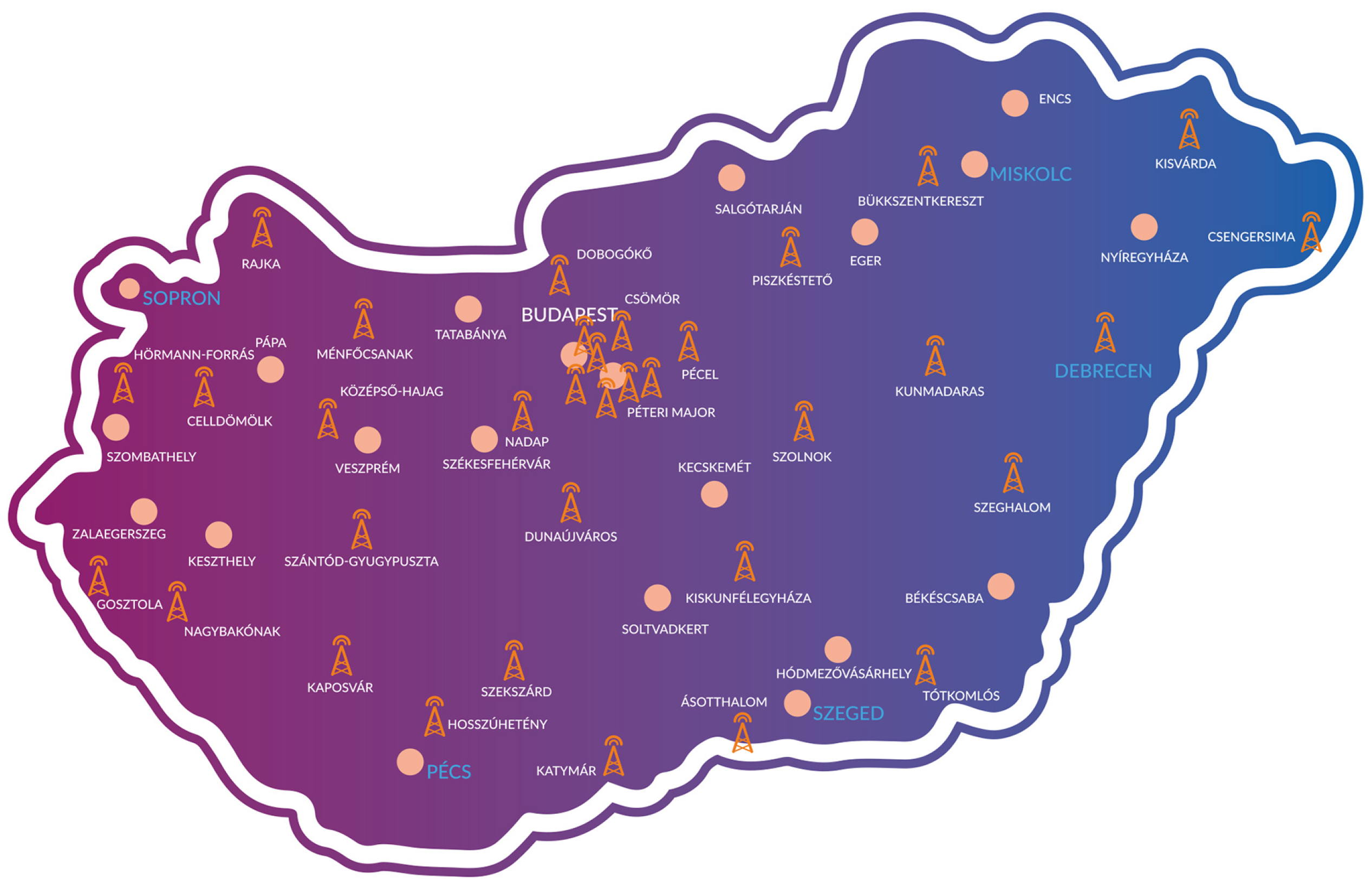
The empirical data were collected through the fixed monitoring infrastructure of the Radio Monitoring Department of the Hungarian National Media and Infocommunications Authority (NMHH). The nationwide network consists of 66 permanently deployed VHF (Very High Frequency) band monitoring stations, including 31 fully equipped facilities and 35 supplementary stations. As illustrated in
Figure 1, the spatial distribution of these sites ensures extensive national coverage across the VHF band. Beyond the fixed infrastructure, the monitoring system is complemented by mobile units, UAV-mounted devices (Unmanned Aerial Vehicle), satellite-based elements, and HF (High Frequency) monitoring stations, further extending its operational capabilities.
Each station is equipped with multiple receivers, spectrum analyzers, and dedicated measurement instruments, selected according to the station type and operational objectives. For spectrum surveillance tasks, the deployed instrumentation includes:
Rohde & Schwarz EB500;
Rohde & Schwarz DDF550;
Rohde & Schwarz DDF255;
Rohde & Schwarz ESMB;
Rohde & Schwarz EM550;
Narda SignalShark;
CRFS Rfeye;
IZT R3000.
In the context of this work, measurements targeted the VHF band (87.5–108 MHz, for sound broadcasting) and the UHF band (470–694 MHz, for DVB-T broadcasting). Spectral data were acquired using Rohde & Schwarz EB500 and Narda SignalShark spectrum analyzers. During the campaigns, measurements were performed on designated channels, with instrument parameters aligned to the technical characteristics of the broadcasting systems, such as channel bandwidth and frequency step. The recorded spectral data capture the time–frequency representation of the received signals and were systematically stored in .csv format for subsequent analysis. Data acquisition was conducted with a frequency step size of 5 kHz, ensuring sufficient resolution for post-processing and anomaly detection tasks.
3.2. Measurement Setup and Data Acquisition
Two fundamental parameters governed the data acquisition process: the time step, i.e., the temporal interval between consecutive measurements, and the frequency step, i.e., the frequency spacing between adjacent bins. These parameters directly influence the structure and interpretability of the generated datasets. Smaller frequency steps, for example, result in denser spectral images, whereas larger steps yield more compact but less detailed representations. To avoid inconsistencies across measurement sessions and to ensure compatibility with machine learning models, standardized values were applied based on expert recommendations. The corresponding frequency and time step values, as well as the resulting data volumes in gigabytes, are summarized in
Table 1.
Several normalization strategies were evaluated to standardize the spectral amplitude values. Conventional z-score normalization was discarded because the statistical properties of the spectral distributions varied substantially across measurement sources, resulting in inconsistent scaling and preventing the establishment of a uniform reference baseline. Consequently, min–max normalization was employed, mapping all amplitudes to the interval dBμV/m. These bounds were selected to balance measurement realism with dataset unification: contributions below dBμV/m are negligible in practical spectrum monitoring, whereas levels above 100 dBμV/m are not encountered under realistic conditions. This approach provides a consistent and physically meaningful reference range, enabling robust comparison and unified processing across heterogeneous measurement sessions.
3.3. Measurement Results
The measurement data acquired by the NMHH spectrum monitoring infrastructure are systematically stored in .csv format to facilitate reproducibility and standardized processing.
The general structure of the dataset is illustrated by the matrix in Equation (
1), where columns correspond to discrete frequency bins and rows represent successive time stamps, with
denoting the frequencies,
the measurement instants, and
the measured field-strength values. The resolution of the measurement grid is determined by the system configuration, with the corresponding values provided in
Table 1. Each matrix element captures the measured field strength at the given time–frequency coordinate, expressed in dBμV/m, thereby providing a consistent and well-defined representation of the spectral environment.
4. Preparing the Dataset
Following the measurements, the results are stored in .csv format. However, these raw data are not directly suitable for training machine learning models, as their information content is difficult to interpret in their original form. To enable annotation, a visual representation of the measurement results is required, which facilitates the reliable detection of anomalies.
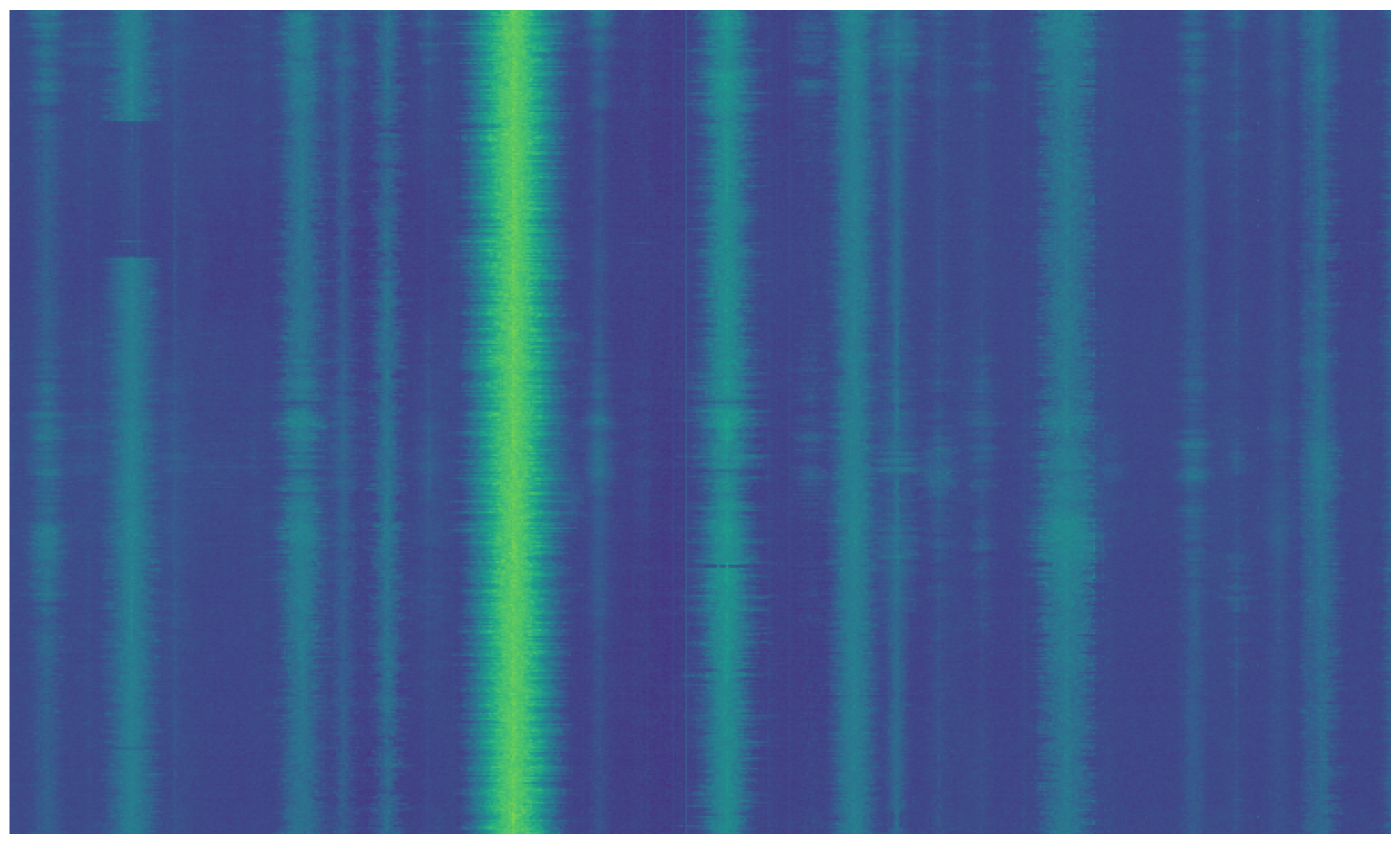
For the improved interpretability and visualization of the spectral data matrix, a waterfall diagram is recommended, as illustrated in
Figure 2. This three-dimensional representation depicts the frequency axis (x-axis) in increasing order from left to right, while the time axis (y-axis) progresses downward, where the upper regions correspond to more recent measurements and the lower regions to earlier time instances. The spectral intensity is encoded by the color scale, which reflects the measured signal strength.
4.1. Anomaly Annotation Methodology
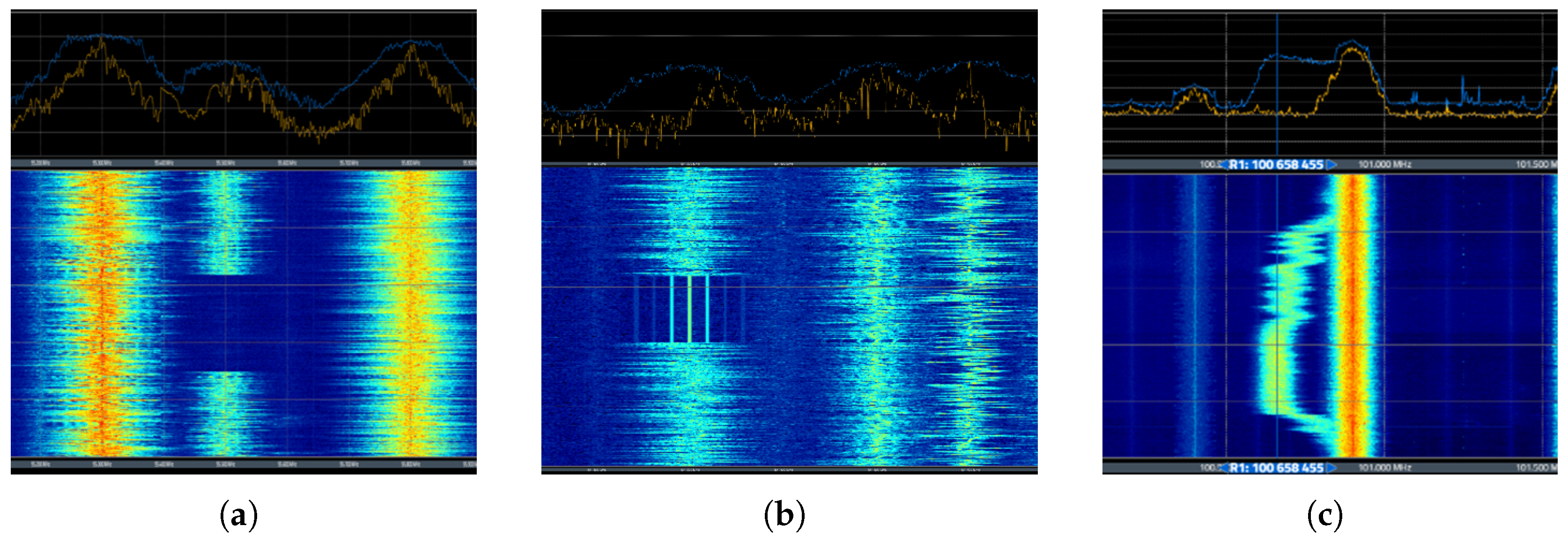
Within the VHF band (–108 MHz), several types of anomalies can be observed, including:
Interruption or initiation of a radio transmission;
Interruption or initiation of signal modulation;
Variations in received signal strength;
Other irregular events.
These phenomena are illustrated in
Figure 3. Variations in signal strength are most often caused by atmospheric or meteorological effects and typically do not result in a significant degradation of reception quality; therefore, they are not always considered critical for further analysis. In contrast, the remaining three classes of anomalies carry greater significance. The unexpected termination of a radio transmission may indicate a technical or operational issue, which is particularly relevant as service providers under Hungarian regulation [
22] are legally obliged to make use of their licensed spectrum resources. Similarly, the cessation of modulation can be associated with service disruptions. Conversely, the sudden initiation of a radio transmission may also signal the unauthorized operation of a transmitter, which must be identified and eliminated. Finally, the category of “other anomalies” encompasses disturbances typically caused by malfunctioning electronic devices or interference sources of uncertain origin.
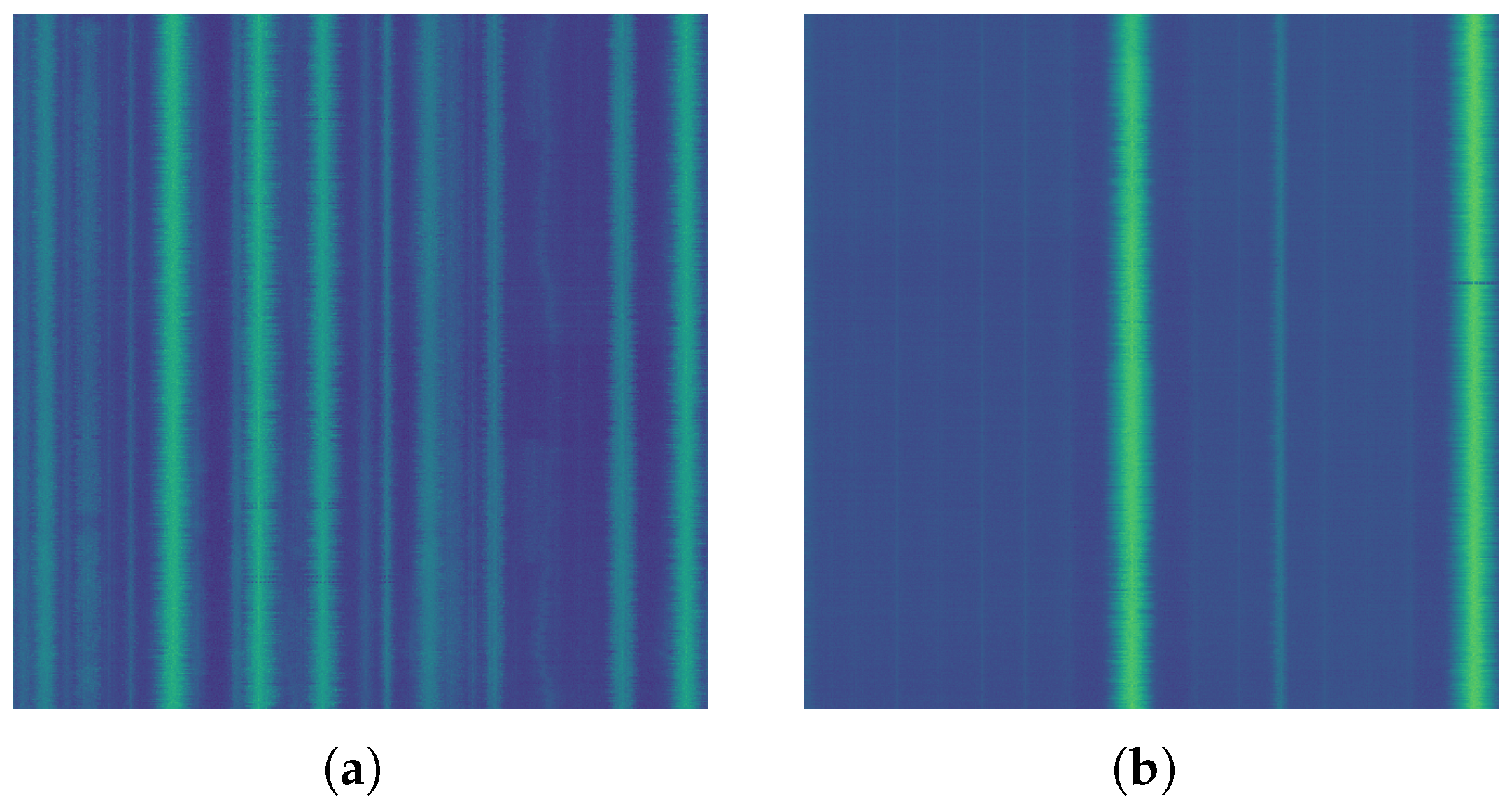
At present, the identification of anomalies within spectrum data remains a manual process. This procedure is inherently time-consuming, which underlines the need for automation. In many cases, even domain experts are unable to provide a definitive classification of an anomaly, as also highlighted in the study “Anomaly detection in the 87.5 MHz–108 MHz broadcasting frequency band using an autoencoder based method” [
23]. An illustrative example is shown in
Figure 4.
Ambiguity frequently arises due to favorable atmospheric conditions, under which the signal of a distant transmitter may unexpectedly appear at a given measurement location, despite normally being undetectable. Furthermore, diurnal variations in the thickness of atmospheric layers can introduce spectral phenomena that resemble anomalies, yet do not cause actual interference.
To mitigate this ambiguity and ensure a consistent dataset, the annotation process was governed by the following criteria:
Variations in signal strength were not considered anomalies, as they are typically caused by meteorological or propagation effects without significant impact on service quality.
Transmission outages were classified as anomalies only if their duration exceeded 10 min, shorter interruptions being disregarded.
Newly appearing radio transmissions were considered anomalies only if they persisted for a minimum of 10 min, thereby excluding transient events.
In this study, the annotation process was performed by domain experts with extensive experience in spectrum monitoring. Each expert received an identical subset of spectrogram data, segmented into patches of size 640 × 640 pixels. For every patch, the annotators identified anomalies by assigning a class label corresponding to the anomaly type and marking the affected region with a bounding box. The labelled anomaly classes included artifacts related to carrier, transmission and modulation irregularities. Due to the varying durations of these irregularities, start and outage events were identified separately corresponding to the beginning and disappearance of a signal. This procedure produced three independent multiclass object detection annotation sets for a total of 90 patches, derived from six distinct spectrogram recordings.
To augment the dataset with a larger volume of localization data, two other experts annotated an additional set of patches, assigning bounding boxes to anomalies without specifying the anomaly type. This resulted in a total of 6226 labelled patches from 28 distinct spectrogram recordings. It is important to note that in this set, approximately only 5% of the analysed patches contain anomalies. However, the negative patches (i.e., those inspected by the annotators where no anomalies were identified) still provide valuable information and can be leveraged for various applications. When utilizing these negative patches, users are advised to employ mitigation strategies for the severe class imbalance during training; otherwise, this imbalance can significantly degrade the recall of detection models. Specifically, implementing techniques such as data resampling or utilizing specialized loss functions like Focal Loss is highly recommended to prevent bias toward the majority class.
Beyond the primary task of anomaly detection, 147 spectrogram patches were also annotated for a more fundamental purpose: signal segmentation. For these images, annotators were instructed to draw bounding boxes around all visible broadcast signal regions, effectively distinguishing them from the background noise. This supplementary dataset enables research into tasks such as robust signal detection and can serve as a valuable pre-training objective for models designed to learn a general representation before tackling the more specific challenge of anomaly detection.
As is common in subjective annotation tasks, the procedures did not yield perfectly consistent results. Considerable variability was observed both in the placement of bounding boxes and in the subjective interpretation of certain ambiguous cases, such as when a signal only weakened instead of disappearing completely, or when an irregularity was very brief. Nevertheless, this expert-based labelling represents the closest approximation to a gold standard currently available in this domain, serving as a reliable reference for subsequent analysis and model development.
The following section presents a detailed analysis of the collected multiclass anomaly annotations, emphasizing key statistical and qualitative characteristics of the dataset. Furthermore, we outline potential post-processing and aggregation strategies designed to enhance data quality and consistency. These methods aim to support a wide range of data mining and machine learning applications.
4.2. Analysis of Inter-Annotator Agreement
Throughout this section, the annotators are referred to as Annotators A, B, and C.
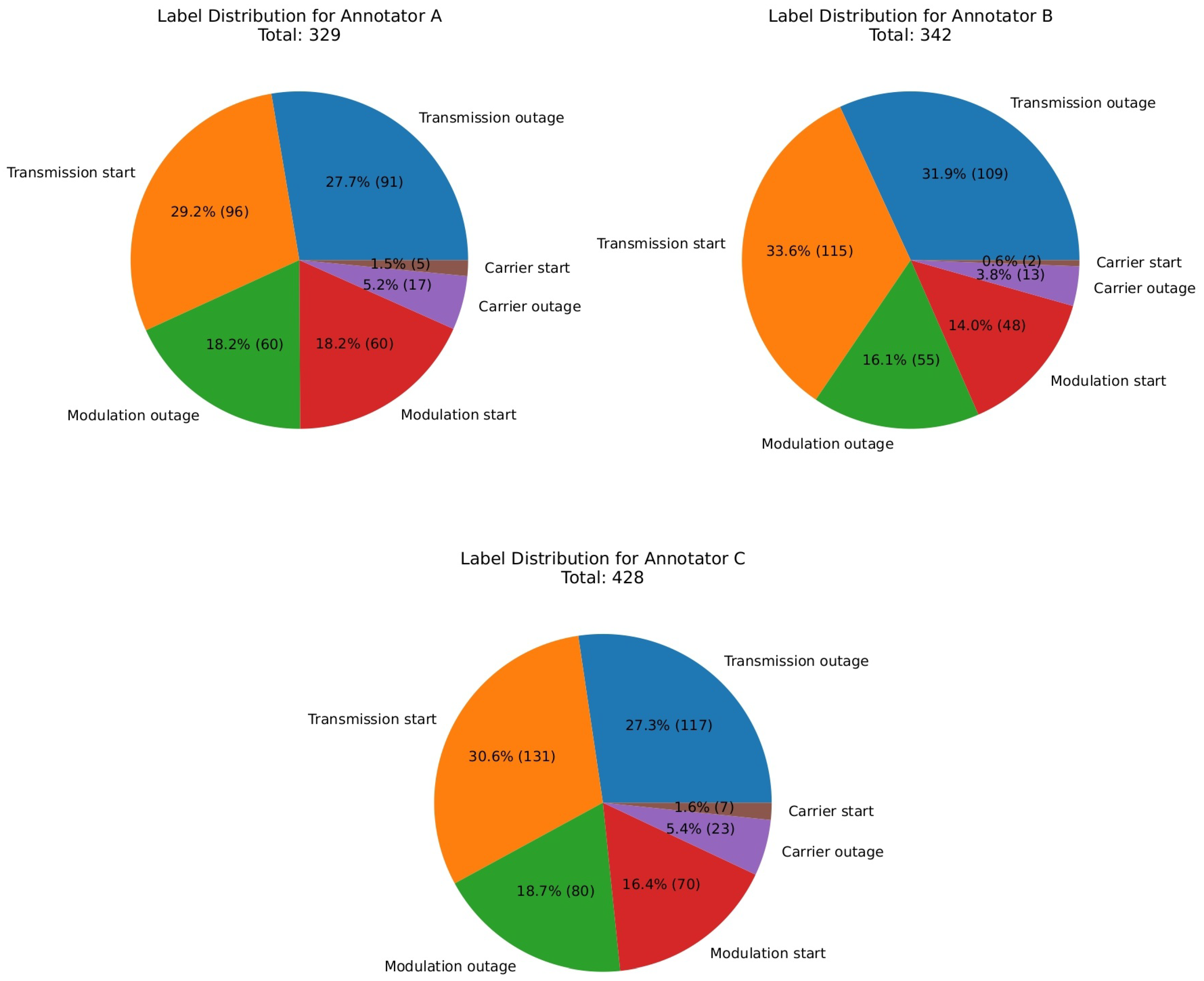
Figure 5 shows the distribution of anomaly classes identified by each annotator. The data reveals significant differences in the detection distributions and sensitivities of the annotators, a factor that must be accounted for when aggregating the dataset for machine learning models.
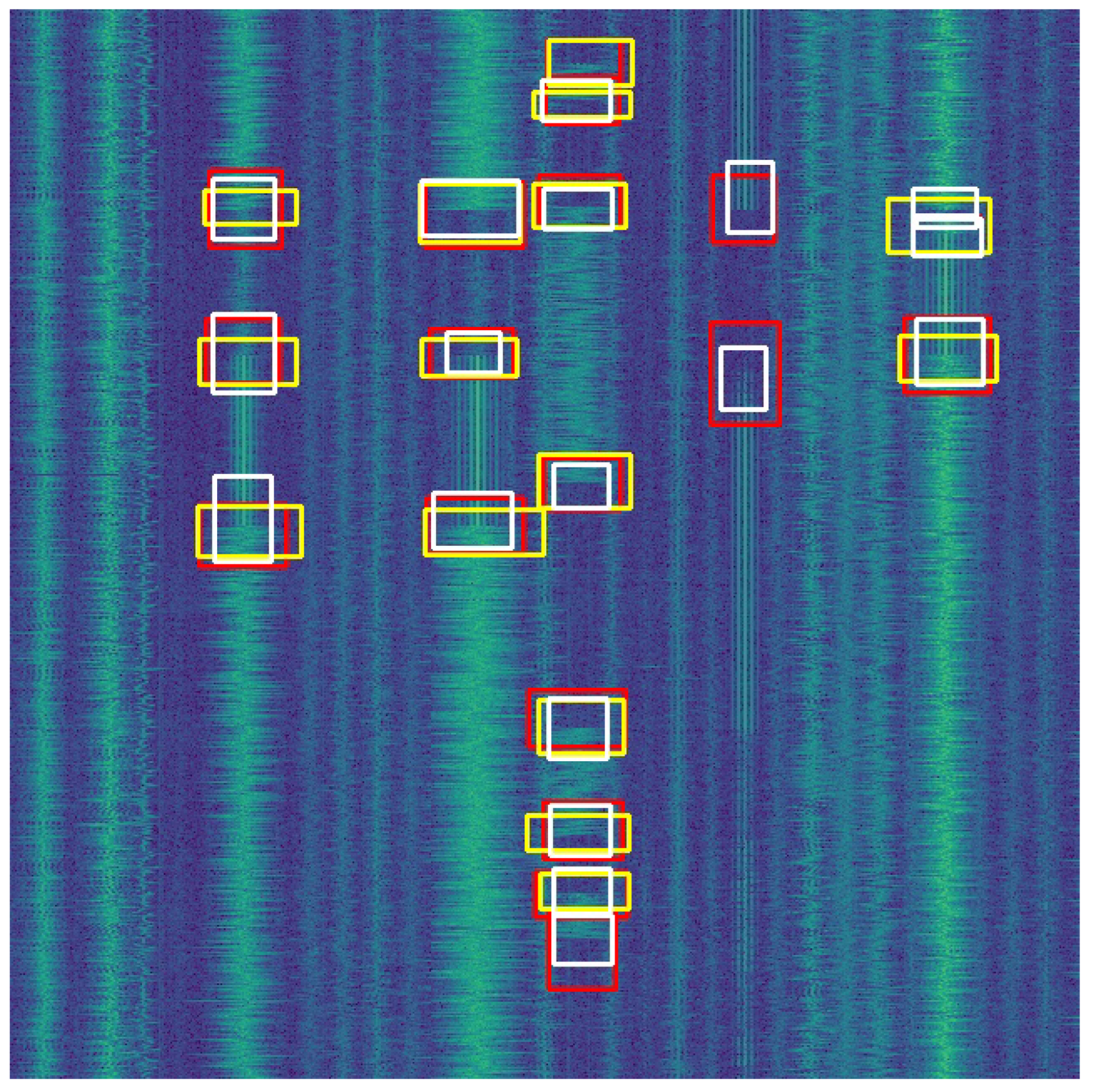
Specific challenges arise when attempting to aggregate or pair the annotations for a given image. It is possible that annotators do not find the same number of anomalies, assign them different labels, or produce annotations with overlapping bounding boxes (see examples in
Figure 6). To systematically address this, we employ a matching algorithm for both analysis and aggregation of the labels.
The applied matching algorithm assumes that every anomaly is found by at least one annotator and that there are no false-positive annotations. The algorithm determines distinct anomaly instances and quantifies the agreement between annotators on these instances using a greedy method based on the Intersection over Union (IoU) scores of the bounding boxes.
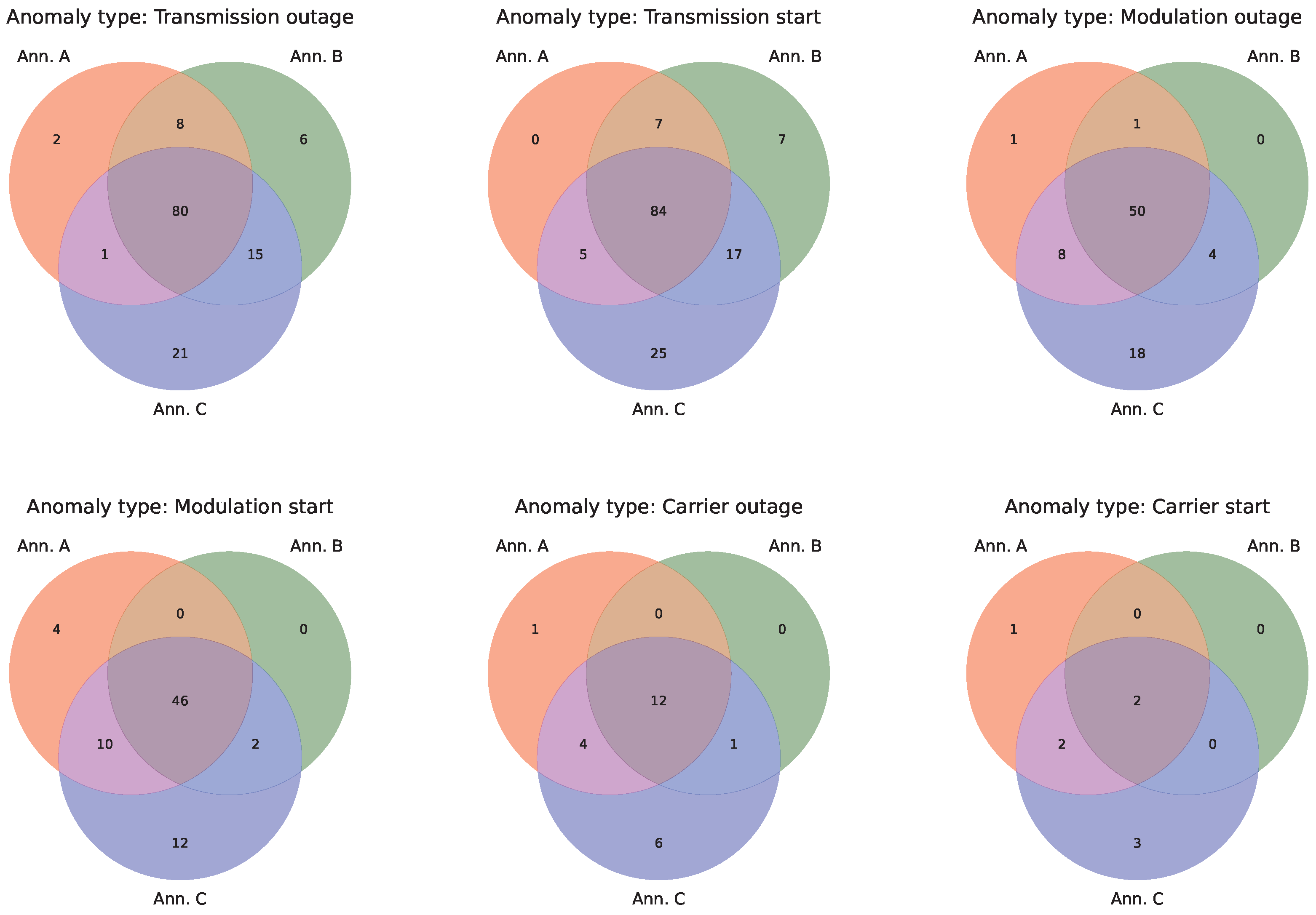
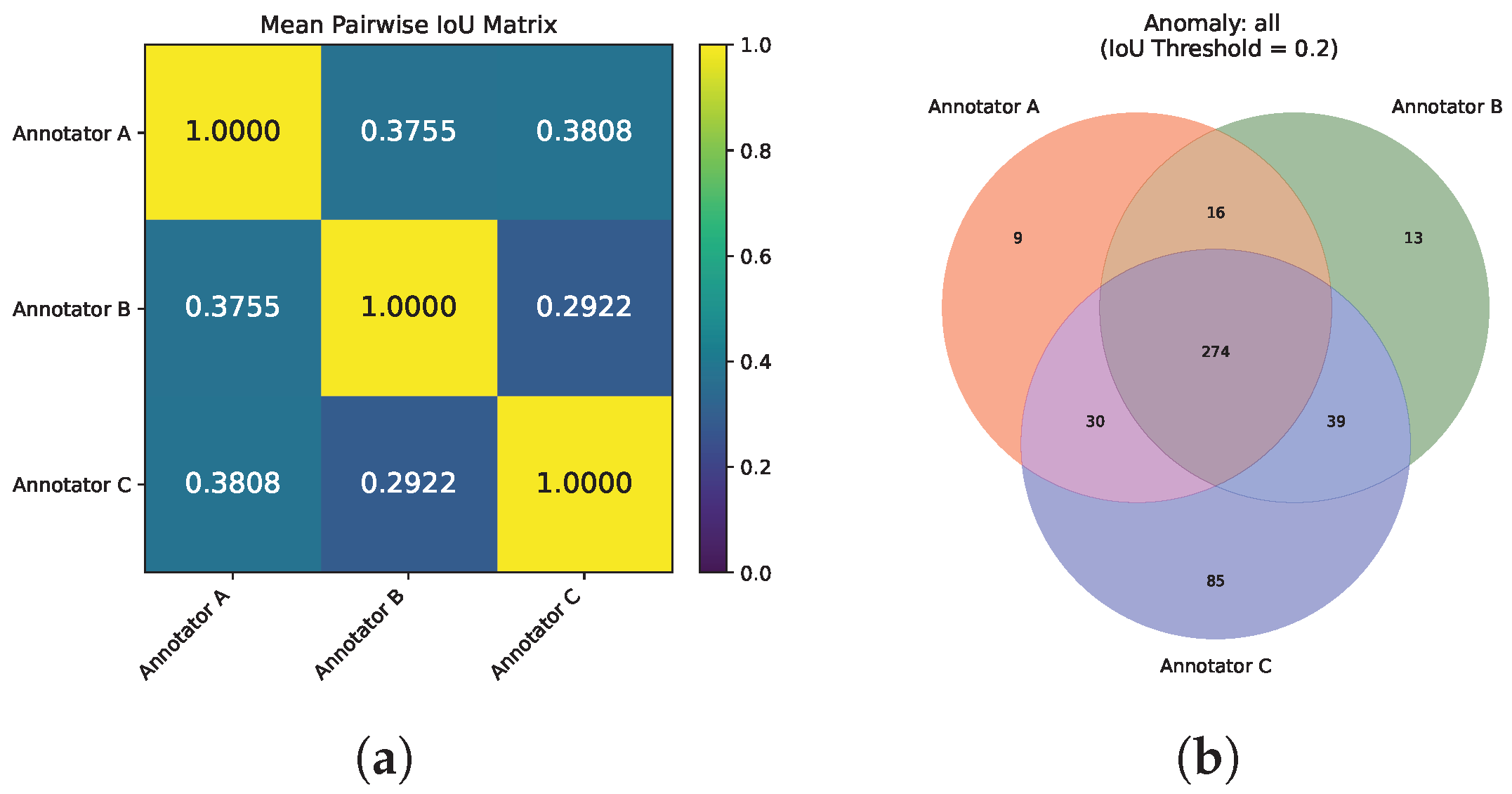
The agreement on anomaly detection is visualized in the Venn diagrams shown in
Figure 7 and
Figure 8. Over 58% of the anomalies were identified by all three experts, and over 77% were found by at least two.
Figure 8 presents the inter-annotator agreement matrix, calculated using the average IoU score of their matched and unmatched bounding boxes. The intersection values were calculated by the intersection area of the matched box pairs. Areas of the unmatched boxes contributed to the union.
To quantify the level of agreement between annotators, we computed a Fleiss’ kappa score of 0.183, which indicates slight agreement beyond chance. In this calculation, each instance corresponds to an anomaly identified by at least one annotator, and the two classification categories are “detected” and “undetected.” The relatively low agreement is likely due to Annotator B exhibiting higher sensitivity than the other annotators, resulting in a greater number of detections and, consequently, less overall consensus.
In contrast to the variability in detection, the agreement on class labeling was exceptionally high. For all 274 instances detected by all three annotators, the assigned class labels were unanimous.
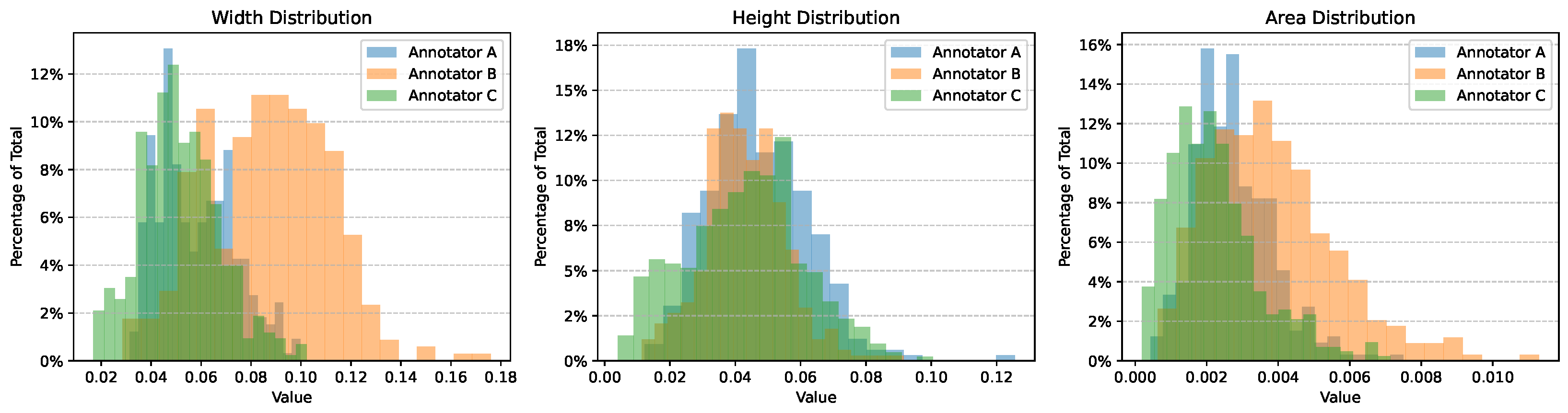
Note that while the centers of the found boxes are supposed to be accurate and should remain untouched, the size of the bounding box might be the source of variance.
Figure 9 displays that Annotator B tends to assign wider boxes to the anomalies. This issue can be corrected in the postprocessing phase by normalizing both the width and height values of the boxes of each annotator to the mean values across the entire annotation set. Applying such a normalization step enhances inter-annotator agreement metrics, like IoU and Fleiss’ kappa, creating a more harmonized dataset that can improve the performance of subsequently trained models.
For the final aggregation of annotations, one can take many approaches. After applying the matching algorithm to identify distinct anomalies, multiple bounding boxes may exist for the same event. Straightforward aggregation methods include taking the intersection, union, or a common bounding box of the matched annotations. Other potential labeling techniques include calculating the mean of the bounding box centers and applying a Gaussian blur. However, the optimal post-processing technique often depends on the specific machine learning use case.
5. Availability and Use Cases
The datasets introduced in this study are publicly available through the Zenodo repository: the Hungarian FM Spectrum Measurements Dataset [
24], the Hungarian DVB-T Spectrum Measurements Dataset [
25], the RF Spectrum Measurements at 428 MHz [
26], and the Annotated FM Spectrum Images for Signal Detection (640 × 640) [
27]. These resources contain complete measurement data in .csv format, together with the corresponding annotated images generated during the expert analysis.
The dataset is released as a static version, ensuring reproducibility of the reported results. Users are encouraged to apply the dataset for benchmarking, comparative studies, and the development of machine learning models.
The annotated instances allow for various supervised machine learning tasks such as signal detection or anomaly detection, while the large amount of raw spectrogram is useful for general purpose representation learning in the domain. However, the low inter-annotator consistency in the anomaly labels introduces inherent label noise, which can impact supervised model training. Models trained uncritically on these annotations may struggle to converge or might learn the high-sensitivity biases of specific annotators, potentially leading to increased false-positive rates. To handle this uncertainty, users leveraging this dataset must carefully select an appropriate label aggregation strategy based on their target application. For instance, using a “majority vote” consensus can improve model precision, whereas taking the “union” of all annotations prioritizes high recall. Additionally, employing noise-robust loss functions or label smoothing techniques is recommended to mitigate the impact of this subjective labeling ambiguity during model training.
Regarding usage restrictions, the dataset is made available exclusively for non-commercial research purposes. Any use outside this scope requires explicit permission from the authors. Proper citation of this article is mandatory in all derivative works that make use of the dataset or its annotations.
6. Conclusions and Future Work
The study presents a benchmark dataset based on measurement data, which was established to support research in radio spectrum analytics. The measurement procedure and annotation were presented in detail, based on Hungary’s national spectrum monitoring system. The measurements were taken in the VHF band 8, followed by a multi-stage expert annotation process. A detailed statistical analysis of the agreement among experts highlighted both the limitations and challenges of expert annotation. The resulting dataset—with raw .csv format measurements, annotated spectrum plots, and segmentation labels to support signal recognition—provides a stable foundation for the development, validation, and comparison of modern spectrum monitoring methods.
In contrast to simulated or artificially generated data, the presented dataset contains real environmental phenomena, propagation disturbances, service events and interferences. This enables the development of machine learning models that are better adapted to the actual spectrum dynamics. Open access also contributes to the transparency and reproducibility of research, as it allows for the comparison of algorithms in a consistent and repeatable environment.
Looking to the future, the dataset opens up numerous possibilities for research. These may include, among others:
Supervised anomaly detection methods using bounding box-based labels;
Weakly supervised or semi-supervised learning methods, exploiting large numbers of unannotated samples;
Representation learning techniques that learn from raw spectral data and can be fine-tuned for upstream and downstream tasks;
Domain adaptation and generalization studies under different propagation and weather conditions;
Common signal segmentation and anomaly detection models, supported by additional segmentation labels.
It is important to note that development in this area could accelerate significantly if additional authorities, research groups, and industry publish other similar datasets. Data collected in different geographical, infrastructural, and meteorological environments would enable the development of more generalizable and reliable machine learning models. Such a broader open benchmark ecosystem would create transparent and objective comparison opportunities for spectrum monitoring algorithms in the long term.
Author Contributions
Conceptualization, C.H., S.L.T. and A.L. (András Lukács); methodology, S.L.T., L.M. and A.L. (András Lukács); software, S.L.T., L.M. and B.B.; validation, S.L.T., L.M. and B.B.; formal analysis, S.L.T., L.M. and B.B.; investigation, S.L.T., L.M. and Z.N.; resources, A.L. (András Lapsánszky), P.V. and C.H.; data curation, S.L.T., L.M., B.B. and Z.N.; writing—original draft preparation, S.L.T.; writing—review and editing, S.L.T., L.M., B.B., Z.N., C.H. and A.L. (András Lukács); visualization, S.L.T., L.M. and B.B.; project administration, P.V. and C.H. All authors have read and agreed to the published version of the manuscript.
Funding
This research received no external funding.
Data Availability Statement
The datasets presented in this study are openly available in Zenodo at the DOIs listed in the References section.
Conflicts of Interest
Zoltán Németh and Csaba Huszty were employed by ENTEL Engineering Research & Consulting Ltd., Budapest, Hungary. The remaining authors declare that the research was conducted in the absence of any commercial or financial relationships that could be construed as a potential conflict of interest.
References
- Geirhofer, S.; Tong, L.; Sadler, B.M. A measurement-based model for dynamic spectrum access in WLAN channels. In MILCOM 2006–2006 IEEE Military Communications Conference; IEEE: New York, NY, USA, 2006; pp. 1–7. [Google Scholar]
- Chantaveerod, A.; Woradit, K.; Pochaiya, C. Spectrum occupancy model based on empirical data for FM radio broadcasting in suburban environments. Sensors 2021, 21, 4015. [Google Scholar] [CrossRef] [PubMed]
- Rajendran, S.; Meert, W.; Lenders, V.; Pollin, S. Unsupervised wireless spectrum anomaly detection with interpretable features. IEEE Trans. Cogn. Commun. Netw. 2019, 5, 637–647. [Google Scholar] [CrossRef]
- O’Shea, T.J.; Clancy, T.C.; McGwier, R.W. Recurrent neural radio anomaly detection. arXiv 2016, arXiv:1611.00301. [Google Scholar] [CrossRef]
- Tandiya, N.; Jauhar, A.; Marojevic, V.; Reed, J.H. Deep predictive coding neural network for RF anomaly detection in wireless networks. In 2018 IEEE International Conference on Communications Workshops (ICC Workshops); IEEE: New York, NY, USA, 2018; pp. 1–6. [Google Scholar]
- Selim, A.; Paisana, F.; Arokkiam, J.A.; Zhang, Y.; Doyle, L.; DaSilva, L.A. Spectrum monitoring for radar bands using deep convolutional neural networks. In GLOBECOM 2017–2017 IEEE Global Communications Conference; IEEE: New York, NY, USA, 2017; pp. 1–6. [Google Scholar]
- Tian, Y. Unsupervised spectrum anomaly detection using variational autoencoders. Intell. Comput. 2022, 1, 9865016. [Google Scholar]
- Li, Z.; Xiao, Z.; Wang, B.; Zhao, B.Y.; Zheng, H. Scaling deep learning models for spectrum anomaly detection. In Proceedings of the 20th ACM International Symposium on Mobile Ad Hoc Networking and Computing (MobiHoc ’19); Association for Computing Machinery: New York, NY, USA, 2019; pp. 291–300. [Google Scholar]
- Toma, A.; Krayani, A.; Marcenaro, L.; Gao, Y.; Regazzoni, C.S. Deep learning for spectrum anomaly detection in cognitive mmWave radios. Eurasip J. Wirel. Commun. Netw. 2020, 2020, 118. [Google Scholar]
- Mitola, J.; Maguire, G.Q. Cognitive radio: Making software radios more personal. IEEE Pers. Commun. 1999, 6, 13–18. [Google Scholar] [CrossRef]
- Ghosh, G.; Das, P.; Chatterjee, S. Cognitive radio and dynamic spectrum access: A study. Int. J.-Next-Gener. Netw. 2015, 6, 43. [Google Scholar] [CrossRef]
- Ukpong, U.C.; Idowu-Bismark, O.; Adetiba, E.; Kala, J.R.; Owolabi, E.; Oshin, O.; Abayomi, A.; Dare, O.E. Deep reinforcement learning for dynamic spectrum access in TV white space cognitive radio networks. ICT Express 2025, 11, 42–50. [Google Scholar]
- Cullen, A.C. Prediction frameworks for dynamic spectrum allocation: A survey. Artif. Intell. Rev. 2023, 56, 5473–5501. [Google Scholar] [CrossRef]
- Yi, D. Research on dynamic spectrum allocation algorithm in cognitive radio networks. In Proceedings of the Fourth International Conference on High Performance Computing and Communication Engineering (HPCCE 2024); SPIE: Bellingham, WA, USA, 2025; Volume 13630, pp. 72–77. [Google Scholar]
- Zhou, F.; Liu, C.; Zhang, H.; Wu, W.; Wu, Q.; Quek, T.Q.S.; Chae, C.-B. SpectrumFM: A foundation model for intelligent spectrum management. IEEE J. Sel. Areas Commun. 2025, 44, 4471–4488. [Google Scholar] [CrossRef]
- Gbenga-Ilori, A.; Imoize, A.L.; Noor, K.; Adebolu-Ololade, P.O. Artificial intelligence empowering dynamic spectrum access in cognitive radio networks. Signals 2025, 6, 126. [Google Scholar]
- Emmott, A.; Das, S.; Dietterich, T.; Fern, A.; Wong, W.K. Systematic construction of anomaly detection benchmarks from real data. In Proceedings of the ACM SIGKDD Workshop on outlier Detection and Description, Chicago, IL, USA, 11 August 2013; pp. 1–9. [Google Scholar]
- Emmott, A.F. A Meta-Analysis of Anomaly Detection Benchmarks. Ph.D. Thesis, School of Electrical Engineering and Computer Science, Oregon State University, Corvallis, OR, USA, 2016. [Google Scholar]
- Moharam, M.H.; Hany, O.; Hany, A.; Mahmoud, A.; Mohamed, M.; Saeed, S. Anomaly detection using machine learning and digital twin concepts in radio environments. Sci. Rep. 2025, 15, 18352. [Google Scholar] [CrossRef] [PubMed]
- O’Shea, T.J. Radio spectrum analytics. In Proceedings of the International Symposium on Advanced Radio Technologies (ISART), Westminster, CO, USA, 1–3 August 2016. [Google Scholar]
- National Media and Infocommunications Authority (NMHH). NMHH Safeguards the Tranquility of Everyday Life. 2024. Available online: https://nmhh.hu/cikk/212302/Az_NMHH_orzi_a_hetkoznapok_nyugalmat (accessed on 30 August 2025).
- Act C of 2003 on Electronic Communications. 2003. Available online: https://net.jogtar.hu/jogszabaly?docid=a0300100.tv (accessed on 13 September 2025).
- Takács, S.L. Anomaly Detection in the 87.5 MHz–108 MHz Broadcasting Frequency Band Using an Autoencoder-Based Method. In Proceedings of the XXVIII PEME Conference; Professors for European Hungary Association: Budapest, Hungary, 2024; pp. 278–285. Available online: https://peme.hu/wp-content/uploads/2025/01/PEME-XXVIII.-Konf.-kotet.pdf (accessed on 8 March 2026).
- Takács, S.L. Hungarian FM Spectrum Measurements Dataset; Zenodo: Geneva, Switzerland, 2026. [Google Scholar] [CrossRef]
- Takács, S.L. Hungarian DVB-T Spectrum Measurements Dataset; Zenodo: Geneva, Switzerland, 2026. [Google Scholar] [CrossRef]
- Takács, S.L. RF Spectrum Measurements at 428 MHz (CSV Dataset); Zenodo: Geneva, Switzerland, 2026. [Google Scholar] [CrossRef]
- Takács, S.L. Annotated FM Spectrum Images for Signal Detection (640 × 640); Zenodo: Geneva, Switzerland, 2026. [Google Scholar] [CrossRef]
| Disclaimer/Publisher’s Note: The statements, opinions and data contained in all publications are solely those of the individual author(s) and contributor(s) and not of MDPI and/or the editor(s). MDPI and/or the editor(s) disclaim responsibility for any injury to people or property resulting from any ideas, methods, instructions or products referred to in the content. |




 ,
,