


Abstract
Digital technologies for storing, processing, and extracting knowledge from data have significantly influenced educational institutions, leading to the adoption, evaluation, and adaptation of new learning models. This data descriptor presents a dataset collected from junior high school students during Computer Science lessons focused on creating geometric constructions using the Scratch visual programming environment. The dataset includes 56 recorded student files consisting mainly of student feedback collected after using gamification through digital quizzes for evaluation and self-assessment, addressing psychological aspects, motivation, participation, and collaboration. The dataset presents a balanced distribution in terms of respondent characteristics and will be of interest to researchers involved in the application of gamification elements in the learning process, researchers studying comprehensive education programs, and teachers interested in innovative teaching practices in their subjects.
Dataset: https://doi.org/10.5281/zenodo.18035618 or “https://zenodo.org/records/18035618 (accessed on 20 January 2026)”.
Dataset License: CC-BY 4.0
1. Introduction
The presentation of this dataset includes data related to the results of integrating gamification elements into learning, in parameters such as stress, psychological aspects, participation, and the perception of learning as a participatory and social process.
The research begins with the presentation of relevant studies that mainly refer to students and present the effectiveness of gamification across different parameters. These studies led to the presentation of this dataset as an innovative data resource in terms of country of origin, level of education, learning subject, the cross-curricular possibilities it offers, and the perception of gamification as a critical factor in the areas of psychology, entertainment, and social participation throughout the school years.
Recent studies have presented the challenges in higher education regarding designing gamification-based courses and implementing them in Learning Management Systems (LMSs) [1]. The integration of digital quizzes and augmented reality technologies into courses that were previously taught in a traditional manner can redefine teaching practices [2]. Educators within this environment can observe the degree of student engagement in smart learning environments [3]. Playful methods require more active student participation [4]. Learning through video games affects students’ verbal level [5]. Moreover, learning in online or offline environments can be seen as decisive in terms of self-confidence as well as students’ emotions [6]. Gaming as a teaching method can also be applied in business simulation environments [7]. At the design level, the GNPL framework includes a model of four principles: goal setting, activity design, implementation, and evaluation, as applied to games [8]. Moreover, by comparing gamified and traditional teaching methods, differences become evident [9]. A field of comparison can be the comparison of scores between groups that used Kahoot and those that did not [10]. This learning method is studied with the aim of reducing stress symptoms among students [11]. In similar approaches, a procedural-scaffolding group is used; that is, a group of students who were guided through learning [12]. Literature reviews include mainly qualitative data on gamification and e-learning from the perspectives of students and teachers, but without experimental primary data [13].
The above studies offer significant contributions to the subject under consideration. The present dataset contributes to these studies by recording the learning behavior of participants and the skills they acquire through the integration of the game into a learning process related to the creation of programs in a visual programming environment [14]. In this research, the experimental framework is publicly available for reuse and comparative analysis, along with a dataset that records the views of the participants in detail.
The objectives of this work are to describe a dataset collected from junior high school students and to explore their learning behavior in a gamified educational context. More specifically, this research presents a dataset that includes the responses of 56 students to an electronic questionnaire after their participation in solving a digital knowledge quiz on programming in a visual environment. Initially, the students were divided into four groups and completed the electronic knowledge quiz individually on their PCs. They then completed the feedback questionnaire. The dataset includes participants’ feedback on the degree of acceptance of the playful learning process, their feelings during the process, and the activation of motivation. It consists of twelve questions, six of which are Likert-scale, five are closed-ended, and one is multiple-choice. The Likert-scale questions use a response scale from 1 to 5, with 1 indicating zero acceptance and 5 indicating maximum acceptance. The responses were collected using an electronic Google Form and then exported to an Excel file, from which the CSV file of the dataset was generated.
Participation of students in playful processes from a young age may foster learners who experience reduced stress in their everyday lives, who perceive learning not as a boring activity but as an entertaining process, who have the ability to self-assess and self-regulate, who collaborate and participate, who set goals, and who are motivated to achieve them.
The research provides:
- Description of the dataset;
- Description of the methods applied for data collection;
The description of the dataset is provided in Table 1 below.
Table 1.
Characteristics of the dataset.
2. Data Description
The dataset includes student registration information and responses to Likert-scale and closed-ended questions collected during the learning process in the context of the Computer Science course [14]. The research is part of a more general research framework for the integration of gamification in learning, in formal education (e.g., schools) and in informal education (e.g., cultural points of interest such as the Historical Bridge of Arta, Greece, etc.).
The structure of the dataset contains the raw data in a single data file, as described in Table 2.
Table 2.
Dataset description.
The data file has been anonymized. The dataset contains registration data from 56 junior high school students collected in 2025, related to the teaching of the Computer Science subject and, more specifically, to the creation of geometric shapes using the Scratch visual programming environment. In total, 44% of the participants were girls, and 56% were boys.
The file contains 57 rows and 12 columns. The first row includes the titles of each question. The following tables present the themes of the study as stored in the dataset and provide additional descriptions for each theme. Table 3, Table 4, and Table 5 are grouped based on the exploration of the psychology and emotions of the respondents, the activation of motivation and the creation of goals through a participatory and social process, and technical issues related to solving the digital quiz.
Table 3.
Playful process and emotions.
Table 4.
Motivations and involvement.
Table 5.
Technical issues.
Table 3 presents data on the degree of acceptance of the playful process as an innovative method of course evaluation and as an entertaining process. Furthermore, it presents the feelings generated in each student during the use of the digital quiz with multiple-choice questions, including feelings of competition, stress, anticipation, curiosity, or other emotions. Through this set of data, the process can be highlighted as an experience that is far from stressful and that includes elements related to students’ feelings when playing an electronic game. It is also recorded whether students find it interesting to use this method in other lessons.
Table 4 presents the degree to which rewards through points lead users to repeat the quiz, the activation of incentives to collect more personal points, and the goal of achieving first place or collecting more points than others. These themes indicate the involvement and participation of each student in the process as a participatory and social experience. Also recorded is the inclusion of a direct question asking students whether they would repeat the quiz.
Table 5 presents data collected through closed-ended questions addressing various technical issues, such as the time allowed to answer each question, the use of a nickname for anonymization during the quiz, and the immediate display of the correct answer after each question so that users know whether they have answered correctly or incorrectly, a feature that relates to feedback or reward mechanisms. These technical issues can be explored in terms of the extent to which they affect the development of a sense of participation in the game, stress reduction, as well as the provision of quick feedback during the solving of the digital quiz.
Table 6 presents a snapshot of the first 10 responses. The questionnaire was distributed using an electronic Google Form. All questions were mandatory, and it was possible to record all types of responses, whether positive or negative, regarding the process. The questions were adapted to the age of the respondents.
Table 6.
Snapshot of first 10 responses.
Table 7 presents the mean and standard deviation of selected responses. The participants, in answering the following Likert-scale questions, reported high satisfaction, with the mean for each question being above 4.2. This indicates general acceptance of the playful activity in the learning process. The same is reflected in the standard deviation, which is close to 1 and not very large, although some disagreements among participants are evident.
Table 7.
Mean and Standard Deviation.
3. Methods
This section presents the method used to collect and process the data so that it is ready for analysis and publication.
3.1. Data Collection
As is the case with most research projects conducted in educational institutions, the data were anonymized. Once anonymized, the data were published for use in future research.
The 56 students participated in the process in four groups, using individual computers in the school’s IT laboratory. The digital quiz included a total of 10 questions related to the repeat command. More specifically, the questions addressed the contribution of the repeat block to the creation of smaller programs, whether the use of the repeat block is necessary to create shapes, how to calculate angles when creating polygons, the exact degrees of rotation required for the creation of specific shapes (e.g., triangle, decagon, circle), and the extensibility and debugging of programs. While solving the electronic quiz, information about each student’s points, individual ranking, and overall ranking was displayed on the interactive screen in the classroom. The students completed the quiz using pseudonyms and then answered an electronic feedback questionnaire.
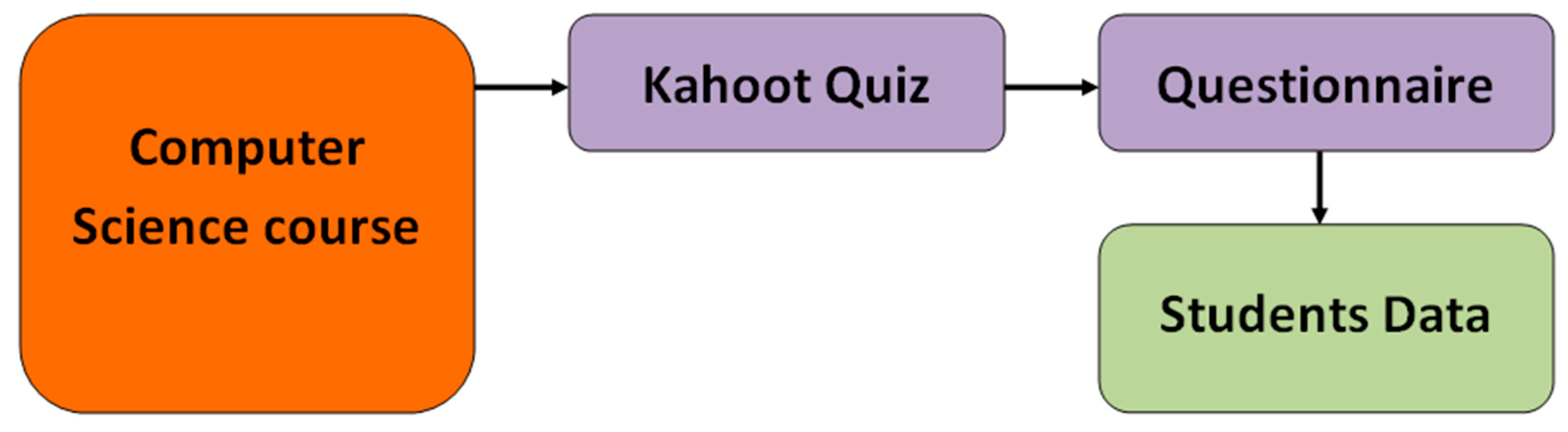
The questionnaire was distributed using an electronic Google Form. There was no time limit for completion, and the average completion time was approximately 5 min. It was completed immediately after the playful process using an individual computer in order to capture the students’ recent experience as accurately as possible. The dataset collection process is presented in Figure 1.
Figure 1.
Dataset collection process.
3.2. Data Anonymization
The students were informed that their answers would be used to produce a dataset, that their anonymity would be preserved, and that the research was conducted for educational purposes.
The students were divided into four groups and responded individually within the classroom to ensure anonymity.
Regarding the Google Form, no personal data were requested, and each participant was required to complete the questionnaire once by answering all questions. The Google electronic form was connected to an electronic spreadsheet where the respondents’ answers were initially stored per row. The file was then downloaded and converted to a .CSV file so that it was in an appropriate format according to the instructions of the Zenodo platform. To further anonymize the responses, the timestamp of each response automatically generated by the Google Form was removed.
3.3. Merging of Datasets
The datasets were merged into a single .CSV file, where each row corresponds to the responses of one survey participant. More specifically, the anonymous dataset includes data collected through Likert-scale questions, multiple-choice questions, and closed-ended questions.
4. Applications and Evaluation Metrics
The data were collected through a questionnaire distributed via Google Forms, which was specifically created for this study, and analyzed to assess their validity and quality. The questions were written taking into account the age of the students so that they were easy to read and understand, and the same care was taken with the answer options.
The questions were distributed as follows: six Likert-scale questions with a scale from 1 to 5 (where 1 = Not at all, 2 = Moderate, 3 = Quite, 4 = Much, and 5 = Very much), five closed-ended questions (Yes–No, Positive–Negative), and one multiple-choice question. The questionnaire allowed each respondent to provide either positive or negative responses to the process.
Descriptive statistical measures, such as the mean and standard deviation, were used to capture the general trends of the responses. The questionnaire completion rate was evaluated based on student participation and reached 100%.
5. User Notes
This dataset can be used to conduct research on the integration of gamification in the learning process. Although this research framework focuses on Computer Science and geometric constructions through Scratch, its use can also be investigated in other related subjects, such as Geometry, Technology, Linear Drawing, and Visual Arts.
This method can be tested across learning subjects in order to examine students’ learning behaviors. It can also be investigated whether digital quizzes contribute to stress management during the learning process, as well as to the creation of a positive classroom climate. At the same time, it can be examined whether electronic quizzes, through their playful nature, contribute to the development of participatory and collaborative activities, as well as to the activation of students’ motivation to achieve smaller or larger goals. It can also be used by researchers who design curricula and outline future educational policy in order to consider incorporating similar activities into instructional practices.
Author Contributions
Conceptualization, N.G. and F.B.; methodology, F.B. and E.K.; validation, E.K.; investigation, N.E.N.; resources, K.S. and N.E.N.; data curation, K.S.; writing—original draft preparation, F.B., N.E.N. and E.K.; writing—review and editing, N.G. and K.S.; visualization, F.B.; supervision, N.G.; All authors have read and agreed to the published version of the manuscript.
Funding
This research received no external funding.
Informed Consent Statement
Informed consent was obtained from all subjects involved in the study.
Data Availability Statement
The dataset is freely available at https://doi.org/10.5281/zenodo.18035618 (accessed on 20 January 2026) or https://zenodo.org/records/18035618 (accessed on 20 January 2026).
Conflicts of Interest
The authors declare no conflicts of interest.
References
- Ferdiansyah, H.; Rafi, M.F.; Utama, A.P.; Aprilia, T.; Slamet, J. Assessing learning outcomes and self-directed learning through gamification in LMS. Soc. Sci. Humanit. Open 2025, 12, 101696. [Google Scholar] [CrossRef] [Scilit]
- Othman, S.Y.; Gallab, E.; Eltaybani, S.; Mohamed, A.M. Effect of using gamification and augmented reality in mechanical ventilation unit of critical care nursing on nurse students’ knowledge, motivation, and self-efficacy: A randomized controlled trial. Nurse Educ. Today 2024, 142, 106329. [Google Scholar] [CrossRef] [Scilit] [PubMed]
- Daniels, M.; Kelly, É.; Flynn, S.; Kelly, J. Advancing Project Leadership Education through AI-enhanced game-based learning. Proj. Leadersh. Soc. 2025, 6, 100189. [Google Scholar] [CrossRef] [Scilit]
- Warden, C.A.; Chen, J.F.; Stanworth, J.O. A Mobile Serious Game about Diabetes Self-Management: Design and Evaluation. Heliyon 2024, 10, e37755. [Google Scholar] [CrossRef] [Scilit] [PubMed]
- Al-Jamili, O.; Aziz, M.; Mohammed, F.; Almogahed, A.; Alawadhi, A. Evaluating the Efficacy of Computer Games-Based Learning Intervention in Enhancing English Speaking Proficiency. Heliyon 2024, 10, e36440. [Google Scholar] [CrossRef] [Scilit] [PubMed]
- Wei, H.; Luo, Y. Uncovering the State of Academic Motivation, Achievement Emotion, Self-Confidence, and Achievement Goals in Online/Offline Language Instruction. Learn. Motiv. 2025, 89, 102085. [Google Scholar] [CrossRef] [Scilit]
- Pitic, D.; Irimiaș, T. Enhancing Students’ Engagement through a Business Simulation Game: A Qualitative Study within a Higher Education Management Course. Int. J. Manag. Educ. 2023, 21, 100839. [Google Scholar] [CrossRef] [Scilit]
- Khosrawi-Rad, B.; Keller, P.F.; Benner, D.; Grogorick, L.; Borchers, A.; Janson, A.; Leimeister, J.M.; Robra-Bissantz, S. Promoting Students’ Motivation in Language Education with Gamified Pedagogical Conversational Agents. Comput. Educ. 2025, 238, 105374. [Google Scholar] [CrossRef] [Scilit]
- Wang, C.-C.; Chang, S.-C.; Yu, Y.H. Using Gamification to Enhance Learning: A College Course Case Study. Entertain. Comput. 2025, 54, 100942. [Google Scholar] [CrossRef] [Scilit]
- Navarro-Castillo, Y.; Pablo-Lerchundi, I.; Morales-Alonso, G. Kahoot! as a Tool to Enhance Learning for Engineering Students in Economics & Management Courses. Int. J. Manag. Educ. 2025, 23, 101173. [Google Scholar] [CrossRef] [Scilit]
- Alsswey, A.; Malak, M.Z. Effect of Using Gamification of “Kahoot!” as a Learning Method on Stress Symptoms, Anxiety Symptoms, Self-Efficacy, and Academic Achievement among University Students. Learn. Motiv. 2024, 87, 101993. [Google Scholar] [CrossRef] [Scilit]
- Yu, J.; Kim, H.; Zheng, X.; Li, Z.; Zhu, X. Effects of Scaffolding and Inner Speech on Learning Motivation, Flexible Thinking, and Academic Achievement in the Technology-Enhanced Learning Environment. Learn. Motiv. 2024, 86, 101982. [Google Scholar] [CrossRef] [Scilit]
- Gomaa, Y.; Moussa, S.; Lahoud, C.; Abel, M.-H. Exploring Recommender Systems for Assisting Teachers in E-Learning Gamification. ProcediaComput. Sci. 2024, 246, 2312–2321. [Google Scholar] [CrossRef] [Scilit]
- Bosmos, F.; Kosta, E.; Sakkas, K.; Ntagka, N.E.; Giannakeas, N. Questionnaire on the use of Gamification in Education [Data set]. Zenodo 2025. [Google Scholar] [CrossRef]

Disclaimer/Publisher’s Note: The statements, opinions and data contained in all publications are solely those of the individual author(s) and contributor(s) and not of MDPI and/or the editor(s). MDPI and/or the editor(s) disclaim responsibility for any injury to people or property resulting from any ideas, methods, instructions or products referred to in the content. |
© 2026 by the authors. Licensee MDPI, Basel, Switzerland. This article is an open access article distributed under the terms and conditions of the Creative Commons Attribution (CC BY) license.