1. Introduction
The rapid expansion of the low and non-alcoholic beverage sector has stimulated extensive research into the formulation and processing of alcohol-free spirits with complex and authentic sensory profiles [
1,
2,
3]. Among these products, non-alcoholic gins have attracted particular attention due to their reliance on botanical-derived volatile compounds to recreate the sensory identity of conventional gin while excluding ethanol. From both technological and sensory perspectives, aroma represents the most critical quality attribute in these products, as ethanol normally plays a central role in dissolving, stabilizing, and modulating the perception of volatile compounds [
4,
5,
6,
7].
In traditional gin production, ethanol acts as an efficient solvent for terpenes, esters, and other hydrophobic aroma compounds extracted from botanicals such as juniper, coriander, and citrus peels [
8,
9,
10]. In non-alcoholic systems, the absence or near absence of ethanol significantly alters extraction efficiency, partition coefficients, and aroma release during consumption, leading to reduced aromatic intensity and complexity [
4,
5,
6,
7]. This limitation is further supported by recent studies on flavor chemistry and aroma perception in low- and non-alcoholic beverage matrices [
1,
2,
6,
7].
Since aroma development in plant-based beverage matrices depends not only on free volatile compounds but also on non-volatile aroma precursors [
11], maceration is a key unit operation in the production of aromatized beverages, enabling the transfer of volatile and semi-volatile compounds from plant matrices into a liquid phase via diffusion-driven mass transfer [
12,
13,
14]. From a process engineering standpoint, maceration efficiency is governed by solvent polarity, plant matrix structure, temperature, and contact time [
13,
14]. Among these variables, maceration time plays a fundamental role in determining extraction kinetics and selectivity, influencing not only the concentration of desirable aroma compounds but also the co-extraction of non-volatile components that may modulate aroma perception through matrix interactions [
12,
13].
In this context, the use of fruits such as orange and raspberry represents a promising strategy to enhance aroma complexity in non-alcoholic gin systems. Orange (
Citrus sinensis) is particularly relevant due to its high content of monoterpenes and oxygenated derivatives, including limonene, citral, nerol, and linalool, which are associated with fresh, citric, and floral sensory attributes [
15,
16,
17]. These compounds, characterized by low sensory thresholds and high volatility, are especially effective in compensating for the reduced aroma release observed in ethanol-free matrices. Additionally, maceration with orange peels or pulp provides a direct and efficient means to enrich the volatile fraction, enhancing perceived freshness and the intensity of citrus and fresh aromatic notes associated with highly volatile monoterpenes [
15,
17].
Conversely, raspberry (
Rubus idaeus L.) contributes a distinct aromatic dimension characterized by sweet, red fruit, and complex fruity notes, driven by compounds such as raspberry ketone (frambinone), α- and β-ionone, linalool, and fruity esters [
18,
19,
20,
21]. In contrast to citrus volatiles, raspberry-derived compounds tend to exhibit lower volatility but greater persistence, contributing to aromatic depth, roundness, and complexity. Furthermore, raspberries contain phenolic compounds and organic acids that can influence aroma perception indirectly through interactions with volatile compounds, affecting volatility and release mechanisms [
18,
19,
20].
Previous studies on fruit maceration and fruit-based beverages have shown that maceration time exerts a non-linear effect on aroma development [
12,
13,
22]. Short maceration times favor the extraction of highly volatile, low-molecular-weight compounds associated with fresh, fruity, and floral notes, whereas prolonged maceration promotes the extraction of less volatile phenolics and oxygenated compounds, potentially leading to reduced freshness, increased astringency, and partial degradation of key aroma compounds due to oxidation processes [
13,
22]. Although these phenomena have been widely described in alcoholic systems such as wines and liqueurs, their behavior in non-alcoholic gin matrices remains insufficiently characterized.
In alcohol-free systems, these effects are expected to be even more pronounced, as the absence of ethanol reduces the solubility of hydrophobic compounds and modifies equilibrium partitioning between phases [
4,
5,
6,
7]. As a consequence, aroma perception becomes highly sensitive to processing variables, including maceration conditions and raw material selection [
1,
2,
6,
7]. Despite the increasing commercial relevance of non-alcoholic spirits, systematic studies addressing aroma enhancement through fruit maceration, particularly combining citrus and berry ingredients, are still scarce.
Although research on low- and non-alcoholic beverages has increased in recent years, specific studies addressing aroma enhancement in dealcoholized gin (0.0% alcohol) through fruit maceration remain scarce. Therefore, the present study draws on literature related to aroma chemistry, fruit-derived volatile compounds, maceration processes, and sensory analysis in botanical and fruit-based beverage matrices.
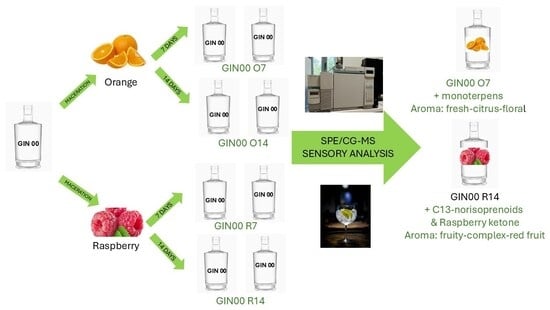
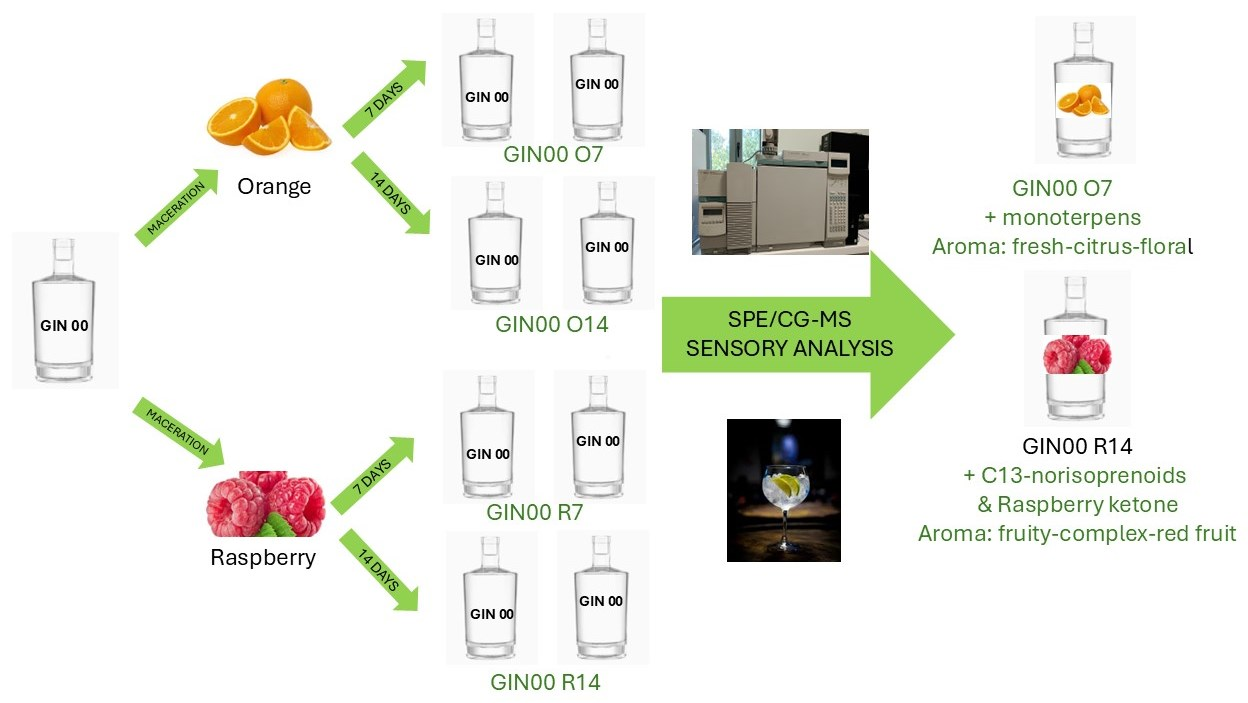
The objective of this study was to improve the aromatic profile of dealcoholized gin (0.0% alcohol) through post-production maceration with raspberry and orange, assessing the effect of fruit addition and maceration time (7 and 14 days) on both volatile composition and sensory perception, in order to identify the conditions associated with desirable aroma characteristics while preserving the typical juniper-based profile.
2. Material and Methods
2.1. Non-Alcoholic Gin Samples
A commercially available dealcoholized gin (0.0% alcohol) was selected as the base matrix for this study. The product was purchased from a retail outlet in Spain and was representative of commercially available alcohol-free gin products. The sample was obtained in its original unopened bottle and stored under controlled conditions (ambient temperature, protected from light) until experimentation. Prior to maceration, the sample was equilibrated to room temperature and gently homogenized to ensure consistency.
2.2. Fruit Samples (Raspberry and Orange)
Fresh raspberries (Rubus idaeus L.) and oranges (Citrus sinensis L.) were used as the maceration matrices. Both fruits were acquired from local commercial suppliers in Spain at commercial maturity and selected based on visual uniformity, absence of physical damage, and lack of visible spoilage.
Upon arrival at the laboratory, raspberries were manually sorted to remove defective fruits and foreign material, while oranges were inspected and selected following the same criteria. The raspberries were gently washed with potable water, drained, and blotted dry using absorbent paper to remove excess surface moisture. Oranges were thoroughly washed under running potable water, dried, and manually peeled. Only the edible portion (pulp) was used for maceration in order to standardize the extraction process and to avoid the incorporation of bitter compounds naturally present in the peel, such as limonoids and flavonoids, which could negatively influence the sensory quality of the final product.
After preparation, both raspberries and oranges were used immediately for maceration experiments to minimize enzymatic degradation, oxidation processes, and potential losses of volatile compounds.
2.3. Maceration Process
Maceration experiments were carried out using raspberry (
Rubus idaeus L.) and orange (
Citrus sinensis L.) as aroma-enhancing matrices in dealcoholized gin (0.0% alcohol). Fruit addition was performed at a concentration of 10% (
w/
v), within the range commonly reported for fruit maceration in beverage systems (5–15%
w/
v), which ensures efficient extraction of volatile compounds while preventing excessive dilution and over-extraction of non-volatile components that may negatively affect sensory attributes [
12,
13].
For each treatment, the appropriate amount of prepared fruit was added to the base gin in airtight glass containers to minimize oxidation and volatile losses. In the case of orange, only the pulp fraction was used in order to favor the extraction of citrus terpenes and oxygenated compounds associated with fresh and citrus aromas, while minimizing the extraction of bitter peel-derived compounds that could adversely affect the sensory profile of the final product.
Maceration was conducted at room temperature (20 ± 2 °C) under dark conditions to prevent photodegradation of sensitive compounds. The selected maceration times (7 and 14 days) were chosen to represent short and extended extraction periods commonly reported in fruit maceration studies, allowing evaluation of the effect of extraction duration on aroma development. Accordingly, 7 days was considered a short extraction period favoring highly volatile compounds such as monoterpenes and esters, whereas 14 days represented an extended extraction period expected to enhance the extraction of less volatile compounds such as oxygenated terpenes and sesquiterpenes.
During the maceration period, samples were gently homogenized once per day by manual agitation to ensure uniform mass transfer between the liquid phase and the fruit matrix. After each maceration period, samples were filtered by gravity through qualitative filter paper (Whatman No. 1, GE Healthcare, Buckinghamshire, UK) to remove fruit solids. The filtered liquid phase was then stored under refrigeration (4 °C) in airtight containers until analysis.
2.4. Volatile Compound Analysis
The volatile compounds present in the non-alcoholic gin samples were analyzed according to the method proposed by Sánchez-Palomo et al. (2006) [
23]. For each treatment, two independent macerations were prepared under identical conditions and considered as experimental replicates (
n = 2). Each maceration replicate was independently extracted and analyzed in duplicate by GC–MS in order to evaluate analytical repeatability. Thus, four analytical determinations were obtained for each treatment; however, the independent maceration replicate was considered the experimental unit for statistical interpretation.
Briefly, 100 mL of each sample was spiked with 40 μL of 4-nonanol (1 g/L) as an internal standard and passed at a constant flow rate of 2 mL·min−1 through original LiChrolut® EN SPE cartridges (500 mg sorbent, 6 mL reservoir volume; Merck KGaA, Darmstadt, Germany), obtained from previously purchased sealed laboratory stock. The cartridges contained an ethyl vinylbenzene-divinylbenzene polymeric sorbent and were previously conditioned according to the manufacturer’s recommendations. After sample loading, retained hydrophilic compounds were removed by washing the cartridges with Milli-Q water. Subsequently, the free volatile compounds were eluted using 10 mL of dichloromethane. After elution with 10 mL of dichloromethane, the organic extract was dried over anhydrous sodium sulfate to remove residual water, concentrated under a gentle stream of nitrogen to a final volume of approximately 200 μL, and stored at −20 °C until chromatographic analysis.
Identification and quantification of volatile compounds were carried out using a gas chromatograph (Agilent 6890N) coupled to a mass selective detector (Agilent 5973 Inert), equipped with a DB-Wax capillary column (60 m × 0.25 mm i.d. × 0.25 μm film thickness) (J&W Scientific, Agilent Technologies, Santa Clara, CA, USA). Samples were injected in splitless mode, with a splitless time of 0.5 min. Injector and transfer line temperatures were set at 250 °C and 280 °C, respectively. Mass spectra were recorded in full-scan mode over a mass range of 40–450 amu, with an ionization energy of 70 eV under electron impact conditions. Helium was used as the carrier gas at a constant flow rate of 1 mL·min−1. The oven temperature program was as follows: initial temperature 70 °C, held for 5 min, increased at 1 °C·min−1 to 95 °C (held for 10 min), followed by an increase at 2 °C·min−1 to 190 °C, maintained for 40 min. Volatile compounds were identified by comparing their retention times and mass spectra with those of authentic reference standards when commercially available (Sigma-Aldrich and Fluka brands, Merck KGaA, Darmstadt, Germany). When standards were not available, identification was based on comparison of mass spectra with data from commercial spectral libraries (Wiley and NBS75K). Quantification was performed semi-quantitatively using the internal standard method, assuming a response factor equal to one for all identified compounds.
2.5. Quantitative Descriptive Sensory Analysis (QDA)
According to the regulations of the University of Castilla-La Mancha (UCLM), sensory descriptive analysis involving adult volunteers and non-invasive food evaluation does not require prior approval by the Research Ethics Committee. All panelists participated voluntarily and provided informed consent before the sensory evaluation. The study was conducted in accordance with ethical standards, and the rights and privacy of all participants were protected.
Sensory evaluation was conducted in a standardized tasting room compliant with UNE-EN ISO 8589:2010 [
24], with controlled temperature (20 ± 2 °C), neutral lighting, adequate ventilation, and individual booths to minimize external interference. Eight women and 5 men (aged 40 to 63 years old) of the Food Technology Area participated voluntarily in the study and were selected and qualified according to UNE-EN ISO 8586:2014 [
25] criteria. During the training phase, panelists were first asked to freely generate descriptors describing the sensory differences among non-alcoholic gins, with special emphasis on aroma attributes; subsequently, through moderated consensus sessions, synonyms, hedonic terms, and potentially confusing or ambiguous descriptors were eliminated, and a final list of well-defined attributes representative of non-alcoholic gin aroma, flavor, and mouthfeel was established in accordance with UNE-EN ISO 13299:2016 [
26] guidelines. Samples were prepared immediately before evaluation and served as 30 mL aliquots at 20 ± 1 °C in standardized clear tasting glasses, coded with random three-digit numbers and presented following a balanced randomized design. Each attribute was evaluated independently using a 10 cm unstructured linear scale, anchored on the left with “attribute not perceptible” and on the right with “attribute clearly perceptible”; panelists marked perceived intensity levels, which were subsequently converted into numerical values (0–10) for statistical analysis.
2.6. Statistical Analysis
All experimental data, including volatile compound concentrations obtained by GC–MS and sensory descriptor intensities from the QDA, were subjected to statistical evaluation in order to assess the effects of fruit addition and maceration time. A two-way analysis of variance (ANOVA) was performed considering fruit type (raspberry vs. orange) and maceration time (7 and 14 days) as fixed factors, as well as their interaction. This approach allowed the evaluation of the individual and combined influence of both variables on the chemical and sensory profiles of the samples. For volatile compound data, each treatment included two independent macerations and duplicate extraction/GC–MS analyses of each maceration. The four determinations per treatment were used to describe combined experimental and analytical variability. Since analytical duplicates are not fully independent experimental units, the statistical results for volatile compounds should be interpreted as exploratory and descriptive of the main trends associated with fruit type and maceration time.
In addition to univariate analysis, multivariate statistical analysis was applied to explore relationships between samples, volatile compounds, and sensory attributes. A principal component analysis (PCA) was performed using the combined matrix of volatile and sensory variables after autoscaling (mean-centering and variance standardization). Samples, volatile compounds and sensory descriptors were simultaneously projected in the PCA biplot. This approach facilitated the identification of underlying patterns and associations between chemical composition and sensory perception.
All statistical analyses were conducted using IBM SPSS Statistics software (version 29.0, IBM Corp., Armonk, NY, USA).
3. Results and Discussion
3.1. Volatile Compounds
The mean concentrations (µg/L) and relative standard deviations of the volatile compounds identified in the different studied gins are shown in
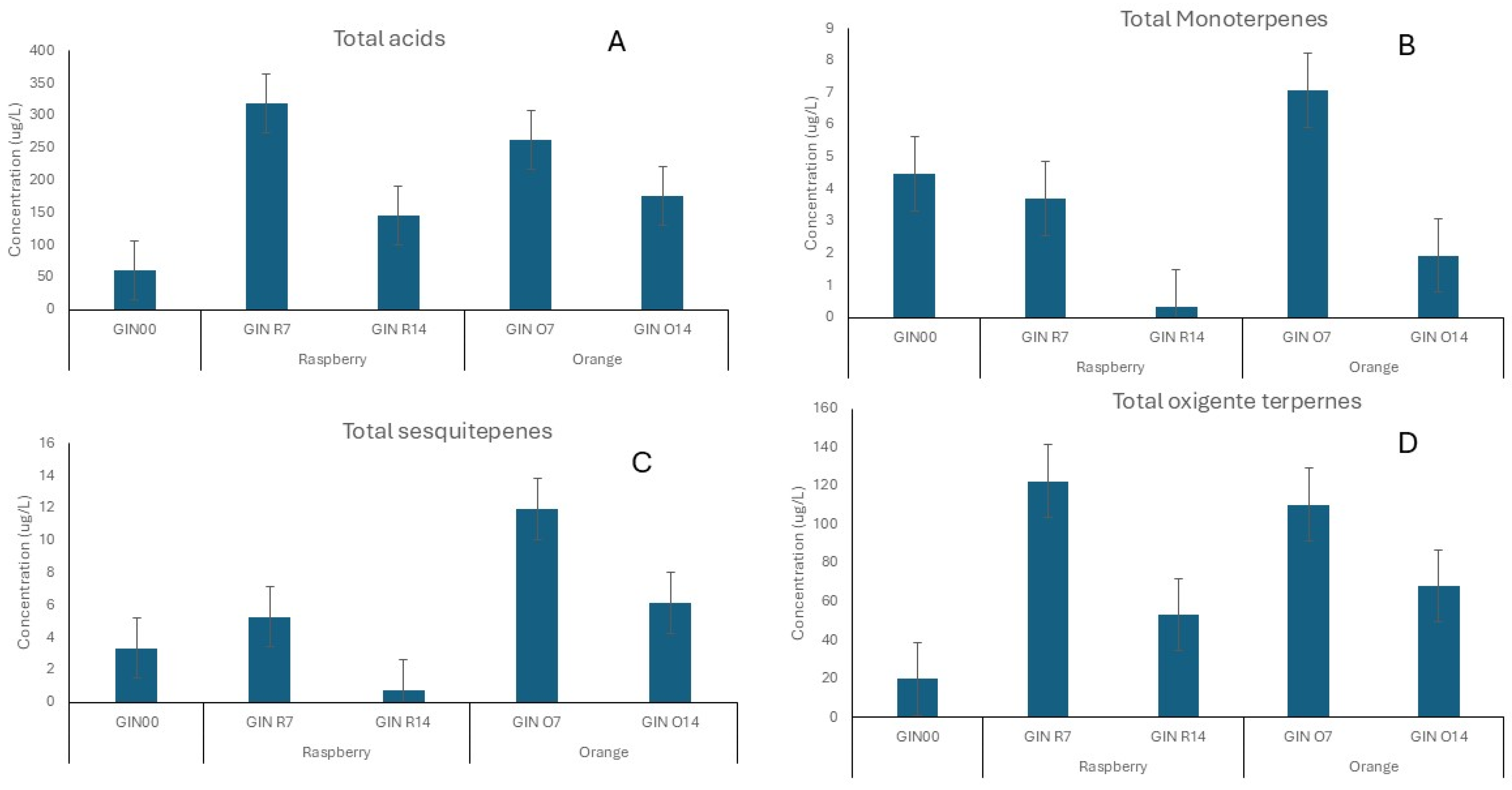
Table 1. Values were calculated from two independent maceration replicates, each analyzed in duplicate by extraction/GC–MS. Analytical duplicates were used to assess repeatability, while independent macerations were considered the experimental replicates for statistical interpretation. The results of the two-way ANOVA are also included. In addition, the distribution of the main chemical families is summarized in
Figure 1A–D. Overall, the results highlight significant differences associated with both the type of fruit used for maceration and the duration of the maceration process, indicating a clear influence of these factors on the aroma profile of dealcoholized gin (0.0% alcohol), within the limitations of the experimental design.
The dealcoholized gin (0.0% alcohol) (GIN00) exhibited a volatile profile dominated by terpene compounds, particularly monoterpenes, oxygenated terpenes, and sesquiterpenes (
Figure 1B–D), which are characteristic of juniper and other traditional gin botanicals [
8,
9,
10]. These families constitute the structural aromatic backbone of gin, contributing to resinous, balsamic, citrus, and slightly spicy notes [
8,
10]. Moreover, oxygenated terpenes (
Figure 1D) represented a major fraction of the volatile composition, consistent with the presence of key aroma-active compounds such as linalool, geraniol, and α-terpineol, which are associated with floral and citrus nuances [
8,
15,
16,
17,
18]. However, in the absence of ethanol, the overall aromatic intensity and complexity may be reduced due to limitations in the solubility and volatility of hydrophobic compounds [
4,
5,
6,
7].
Organic acids (
Figure 1A) were also present in relatively high concentrations, especially benzoic and sorbic acids, which may influence aroma perception by modifying volatility and matrix interactions, as previously reported in alcohol-free systems [
4,
6,
7].
The results indicate that the effect of fruit type and maceration time cannot be interpreted independently, as both factors interact strongly to determine the final volatile composition of the dealcoholized gin (0.0% alcohol) (
Table 1). The significant interaction term (F × T) indicates that the extraction kinetics and aroma development were dependent on the botanical matrix, a behavior previously reported in fruit-based maceration systems [
12,
13].
In the case of orange maceration, the volatile profile was characterized by a rapid extraction of monoterpenes (
Figure 1B), particularly at 7 days, where the highest total concentration for this family was observed. However, increasing maceration time to 14 days resulted in a decrease in total monoterpenes, suggesting volatilization losses, oxidation, or transformation processes. This behavior is consistent with the high volatility and reactivity of citrus terpenes, which are typically extracted rapidly and may decline over prolonged maceration or maturation [
15,
16,
17].
Conversely, raspberry maceration showed a different sensory evolution. Although several raspberry-related volatile compounds and oxygenated terpenes were detected at higher concentrations after 7 days, the red fruit descriptor was more clearly perceived after 14 days. This suggests that the sensory expression of raspberry aroma was not exclusively determined by the concentration of individual marker compounds but also by the overall balance among volatile compounds, matrix interactions, and possible changes in aroma release during maceration [
18,
19,
20].
A similar trend was observed for sesquiterpenes (
Figure 1C), which increased notably with maceration time, especially in orange samples at 14 days. This suggests that extended maceration promotes the extraction or relative enrichment of less volatile compounds that contribute to balsamic, woody, and structural notes, reinforcing the aromatic backbone of gin; similar process-dependent behavior of less volatile terpenoid fractions has been described in gin production [
9].
Additionally, total organic acids (
Figure 1A) showed a strong increase with maceration time in both fruit matrices, particularly in raspberry samples at 7 days, where the highest values were observed. Although these compounds can contribute to complexity, excessive accumulation may reduce aroma perception by decreasing volatility and enhancing matrix effects, as previously described [
6,
7,
12].
These results suggest that the most suitable maceration strategy depends on the desired sensory outcome. Orange maceration appears more suitable for short extraction times when fresh and citrus notes are desired, whereas raspberry maceration may benefit from longer contact times to enhance the perception of red fruit notes, despite the decrease observed in some individual volatile compounds.
3.2. Sensory Profile
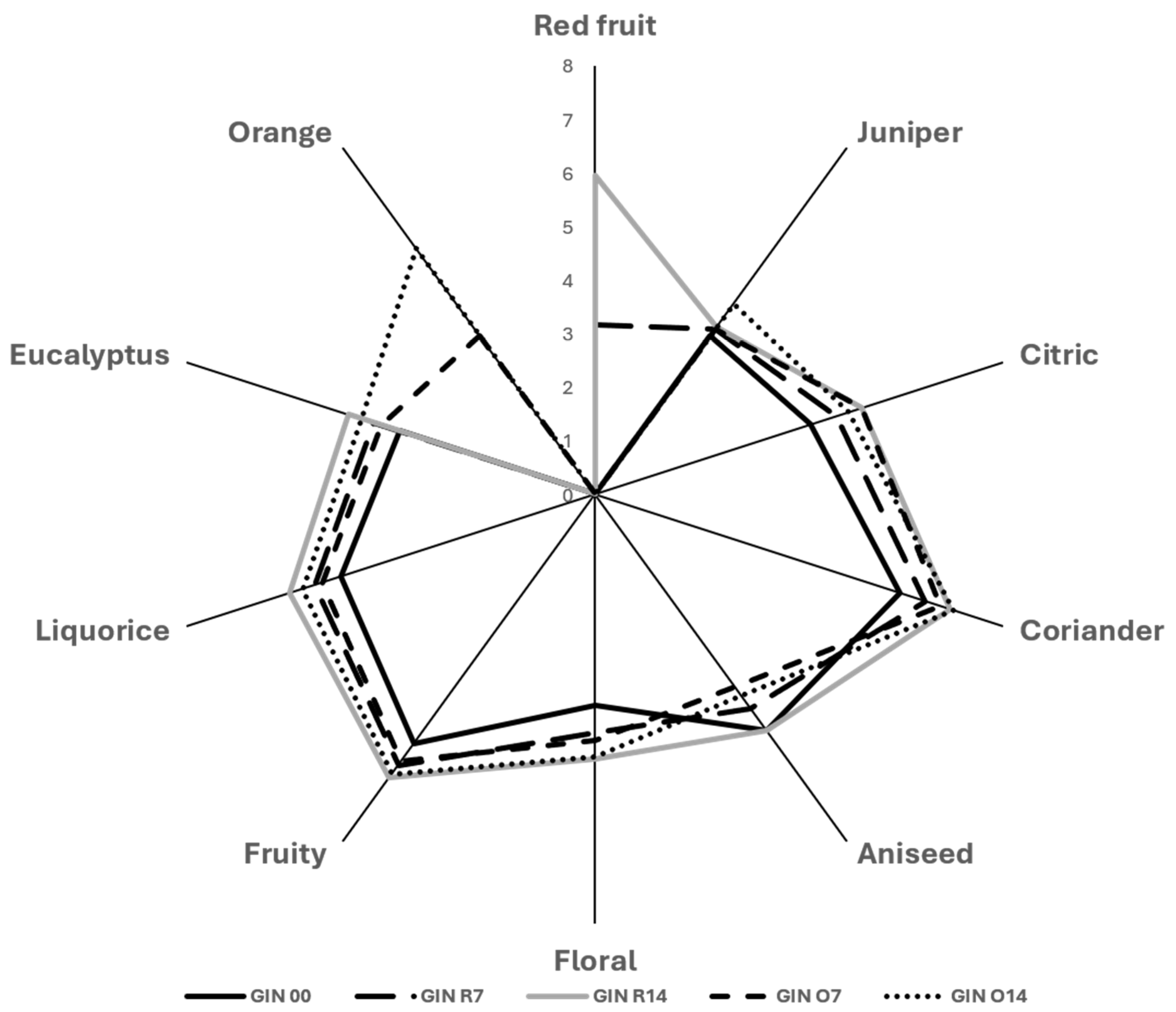
Table 2 presents the mean values and standard deviations of the scores assigned by the panelists to each sensory attribute describing the aroma profile of the gin samples under study, together with the results of the two-way analysis of variance (ANOVA). In addition, the overall sensory profiles are visualized using a spider plot (
Figure 2), which allows a clearer comparison of the effect of fruit type and maceration time on aroma perception.
The sensory profile of dealcoholized gin (0.0% alcohol) samples, characterized by juniper, citric, coriander, aniseed, floral, fruity, and licorice descriptors, is consistent with the typical sensory vocabulary reported for gin in the literature. Sensory and compositional studies on gin indicate that descriptors such as juniper, citrus, aniseed, spice, and licorice are closely related to the botanical-derived volatile profile of gin products [
8,
10,
27,
28,
29].
The dominance of juniper-related attributes is a defining feature of gin, as juniper berries are the mandatory botanical in its production and contribute significantly to the characteristic aroma of the spirit. These sensory perceptions are mainly associated with monoterpenes such as α-pinene and β-pinene, which provide piney, resinous, and balsamic notes typical of the gin base [
8,
10,
27].
The presence of citric and floral descriptors is also widely reported in gin sensory profiles and is linked to the occurrence of oxygenated monoterpenes such as limonene, linalool, and geraniol, which are derived from citrus peels and botanicals such as coriander seeds. In particular, linalool has been identified as one of the key aroma-active compounds in gin with high odor activity values, strongly contributing to floral and citrus perceptions [
8,
27,
29].
The coriander and spicy notes frequently reported in gin are associated with terpene alcohols (linalool, terpinen-4-ol) and aldehydes, which contribute to complex citrus-spicy nuances. Similarly, aniseed and licorice descriptors are linked to phenylpropanoid compounds such as anethole or estragole, as well as to sesquiterpenes that provide sweet and balsamic character [
8,
27].
Regarding fruity and floral notes, these are typically related to the presence of esters, C13-norisoprenoids, and oxygenated terpenes, which contribute to sweet, ripe fruit and aromatic complexity in gin and other botanical beverages. In fruit-enhanced or modern gins, these descriptors become more prominent due to the addition of botanicals or fruits rich in aroma-active compounds [
8,
18,
19,
20,
27].
The combined effect of fruit maceration (orange vs. raspberry) and maceration time (7 vs. 14 days) on the sensory profile reveals a clear modulation of aroma attributes, which is clearly visualized in the spider plot (
Figure 2). Although ANOVA results indicate a lack of statistically significant differences (n.s.) for most traditional gin descriptors, a consistent pattern can be observed when considering the global sensory profiles.
In general, maceration with both fruits led to a progressive increase in some fruit-related sensory notes with increasing time, particularly evident when comparing GIN00 with the 14-day samples. This trend should be interpreted as a sensory integration effect rather than as a uniform increase in all individual volatile compounds, since several highly volatile compounds decreased after prolonged maceration. Thus, the overall expansion of the sensory profiles observed in
Figure 2 reflects the combined effect of compound extraction, aroma balance, and matrix interactions over time [
4,
6,
7].
When comparing fruit types, orange maceration clearly reinforced orange-related sensory notes. Although some citrus-related volatile compounds were more abundant after 7 days, the orange descriptor reached its highest intensity after 14 days. This suggests that the perceived orange aroma was influenced not only by the concentration of highly volatile monoterpenes but also by the overall sensory balance and possible aroma integration during maceration [
15,
16,
17].
In contrast, raspberry maceration contributed more markedly to fruity, floral, and red fruit attributes, especially at 14 days, where a clear expansion of these descriptors is observed in the spider plot (
Figure 2). This evolution is consistent with the importance of raspberry-specific volatiles and norisoprenoids, although the sensory expression of raspberry aroma appears to depend on the balance among compounds rather than on the concentration of individual markers alone [
18,
19,
20].
Interestingly, descriptors associated with the structural character of gin (juniper, coriander, licorice) remain relatively stable across samples, as reflected by their similar relative intensities in
Figure 2. This indicates that fruit maceration does not mask but rather complements the botanical base. This stability is consistent with the persistence of sesquiterpenes observed in
Figure 1C, which contribute to the structural aromatic backbone of the gin.
3.3. Multivariate Characterization of Gin Aroma Based on Volatile and Sensory Data
In order to better interpret the complex relationships between chemical composition and sensory perception, Principal Component Analysis (PCA) was applied to the combined dataset of volatile compounds (
Table 1) and sensory attributes (
Table 2). Multivariate approaches are widely used for the characterization of aroma profiles and relationships between chemical and sensory variables in beverages [
30]. The use of PCA allowed a substantial reduction in data dimensionality and provided a more intuitive and visual representation of the main patterns of variation among samples. Specifically, this multivariate approach helped identify the volatile compounds and sensory descriptors most associated with sample differentiation, as well as the relationships between them. By projecting both variables (compounds and attributes) and samples onto the same bidimensional space, PCA facilitated the interpretation of how fruit type and maceration time influence aroma formation, highlighting the compounds driving citrus, floral, or fruity notes and their contribution to the overall sensory profile.
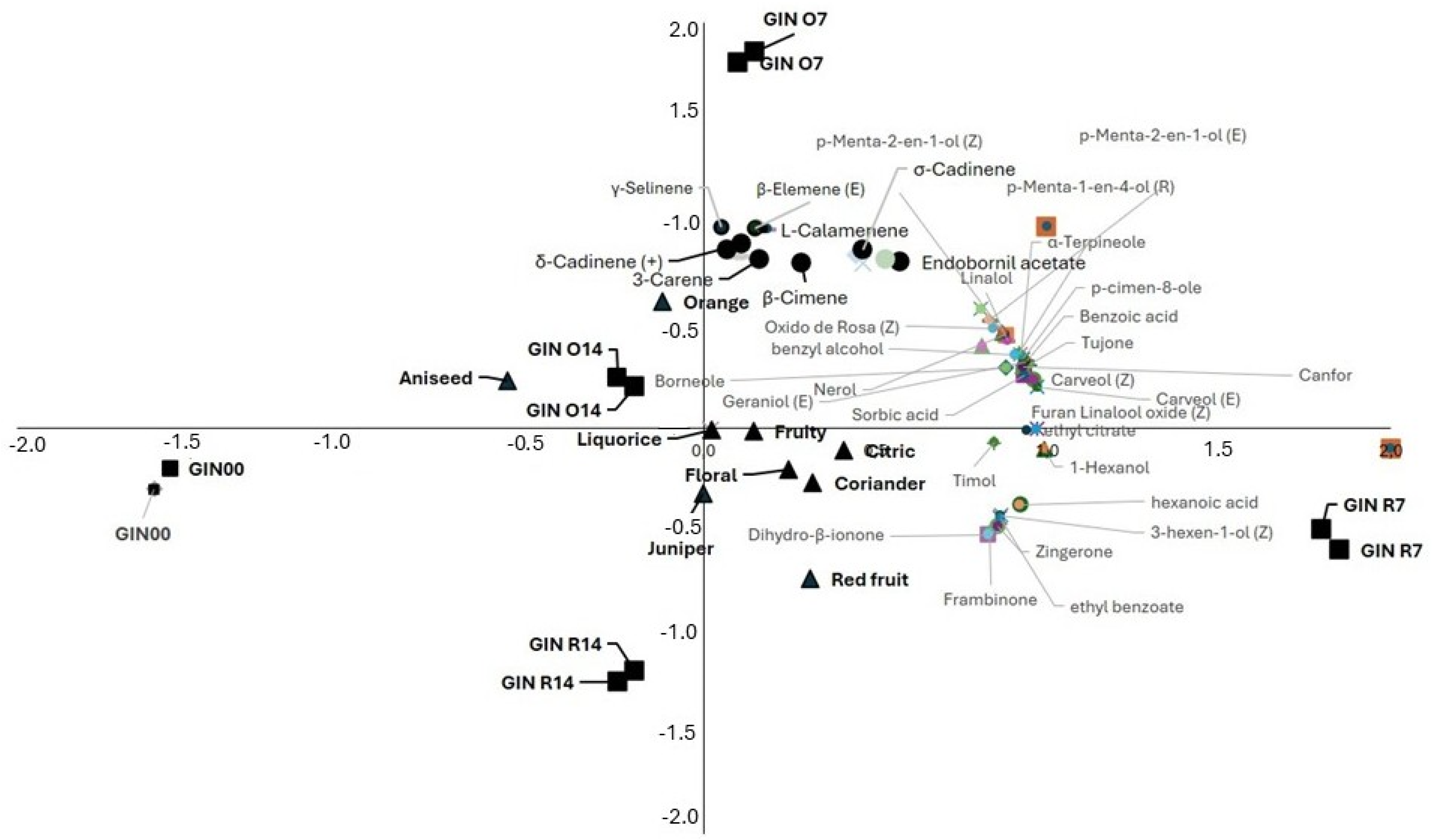
The two-dimensional model explains a large proportion of the total variability, with PC1 accounting for 51.4% and PC2 for 28.6% of the variance, resulting in a cumulative explanation of approximately 80.0% of the total variance.
Figure 3 shows the simultaneous projection of the gin samples under study, the volatile compounds with loading coefficients higher than 0.8, and the sensory descriptors on the plane defined by the first two principal components. The distribution of samples in the PCA space shows a clear separation driven by both fruit type and maceration time, in agreement with the results obtained for volatile compounds and sensory descriptors. The samples are primarily separated along PC2, which reflects the contrast between citrus-dominated profiles (orange) and fruit-driven profiles (raspberry), while PC1 represents the balance between fresh terpene-related attributes and heavier or more complex compounds extracted over time.
The control sample GIN00 is positioned in a relatively central and negative region of PC1, indicating a more neutral aromatic profile dominated by the botanical gin base, as previously described. This position is consistent with its volatile composition, characterized by moderate levels of monoterpenes, linalool, α-terpineol and sesquiterpenes, and cadinene derivatives, and with its sensory profile, where descriptors such as juniper, coriander and licorice are present but without strong citrus or fruit-related notes.
A clear separation of samples along PC2 reflects the influence of fruit type. Orange-treated samples (GIN O) are located in the positive region of PC2, associated with high loadings of monoterpene hydrocarbons and oxygenated terpenes, such as γ-terpinene, α-terpinolene, linalool, and α-terpineol, compounds commonly associated with gin botanical profiles and process-dependent volatile evolution [
8,
9]. These compounds are directly linked to sensory descriptors such as citric, floral, and orange, which show higher values in these samples. This supports the interpretation that orange maceration shifts the samples toward a fresh, citrus-dominated aromatic space.
In contrast, raspberry-treated samples (GIN R) are located in the negative region of PC2, associated with compounds such as raspberry ketone, zingerone, and dihydro-β-ionone, which are characteristic of berry aroma [
18,
19,
20]. These compounds correspond to the strong appearance of the “red fruit” descriptor, which is exclusively present in raspberry samples and increases with time. This pattern suggests that raspberry-macerated samples were associated with a fruitier, sweeter, and more complex aromatic region.
The effect of maceration time was also evident, although its interpretation differed between chemical and sensory variables. In general, 7-day samples were associated with higher concentrations of several highly volatile compounds and specific aroma markers, whereas 14-day samples showed a sensory profile that appeared more integrated and, in some cases, more strongly associated with fruit-related descriptors.
For raspberry samples, GIN R7 showed higher concentrations of some raspberry-related volatile markers, including raspberry ketone, zingerone, and dihydro-β-ionone. Nevertheless, the red fruit descriptor increased after 14 days, suggesting that longer maceration favored the sensory expression or integration of raspberry aroma, even though some individual marker compounds decreased in concentration [
18,
19,
20].
4. Limitations
While this study provides valuable insights into the influence of fruit maceration on the volatile and sensory profile of dealcoholized gin (0.0% alcohol), several aspects should be considered when interpreting the results. First, the experimental design was limited to two fruit matrices, orange and raspberry, and two maceration times, 7 and 14 days. Therefore, the present study should be considered as an initial comparative approach rather than a full optimization study. Further research, including additional fruit types, different fruit concentrations, intermediate and longer maceration times, storage conditions, and processing variables such as temperature, should be carried out. In this context, factorial experimental designs or Response Surface Methodology would be useful to define suitable processing conditions for aroma enhancement in dealcoholized gin (0.0% alcohol).
The study was conducted using specific raw materials, raspberry and orange, whose chemical composition may vary depending on cultivar, origin, ripeness, and processing conditions. Therefore, the extraction patterns and aroma profiles observed in this work may differ when other fruit varieties, batches, or growing conditions are used.
Additionally, although the analysis focused on the quantification of a wide range of volatile compounds and their grouping into chemical families, not all aroma-active compounds were evaluated in terms of odor activity values. Consequently, the relative contribution of individual compounds to the overall aroma perception was inferred from their concentration and previous literature rather than directly quantified.
The chemical characterization was focused on volatile compounds related to aroma. Other relevant product parameters, including color stability, phenolic composition, antioxidant capacity, pH, titratable acidity, soluble solids, and density, were not determined. These analyses should be included in future studies to obtain a more complete characterization of fruit-macerated dealcoholized gin (0.0% alcohol).
Another limitation concerns the sensory analysis, which, although useful for describing global aroma trends, was performed using a trained panel under controlled conditions and may not fully reflect consumer perception. Moreover, the lack of statistically significant differences in several descriptors suggests that subtle sensory variations may not have been fully captured by the panel size or evaluation scale. Future studies should therefore include consumer acceptance tests in addition to descriptive sensory analysis.
The samples were evaluated immediately after maceration, and no storage study was performed. Consequently, short- and medium-term stability studies are necessary to assess the evolution of volatile composition and sensory attributes during storage, as well as the persistence of the aroma improvements observed after maceration.
In addition, the interaction between volatile compounds and the dealcoholized matrix may differ from that occurring in traditional alcoholic gin. Since ethanol significantly affects the solubility, volatility, and perception of aroma compounds, the behavior of these compounds in alcohol-free systems may not be directly comparable to conventional products.
Finally, this study was conducted at a laboratory scale under controlled maceration conditions. Therefore, the extraction kinetics and compositional changes observed may differ under industrial production conditions. Additional studies addressing process economics, industrial scalability, microbiological stability, and shelf-life evaluation will be required before the proposed approach can be implemented at an industrial level.
5. Conclusions
The results obtained in this study provide comprehensive insight into the potential of fruit maceration as a strategy to enhance the aromatic profile of dealcoholized gin (0.0% alcohol). Both fruit type and maceration time played a key role in defining the final volatile and sensory characteristics of the samples. Orange maceration enhanced fresh and citrus notes, particularly after short maceration times, whereas raspberry contributed to fruity complexity and aromatic depth, especially after longer maceration. These findings highlight fruit maceration as a simple and effective approach to improving the aroma profile and sensory quality of dealcoholized gin (0.0% alcohol), while allowing modulation of its aroma according to the desired product profile. Further studies, including additional fruits, fruit concentrations, intermediate and longer maceration times, storage conditions, and factorial experimental designs or Response Surface Methodology, would be useful to define suitable processing conditions for aroma enhancement in dealcoholized gin (0.0% alcohol).
Author Contributions
M.O.A.: Writing—original draft and data curation. Á.M.-A.: Methodology and formal analysis. E.S.-P.: Writing—review and editing, visualization, resources, methodology, investigation, and conceptualization. M.Á.G.-V.: Writing—review and editing, visualization, supervision, and resources. All authors have read and agreed to the published version of the manuscript.
Funding
This research was funded by the University of Castilla-La Mancha (UCLM), grant number 2025-GRIN-38446.
Institutional Review Board Statement
In accordance with Spanish regulations, ethics approval is generally required for biomedical research involving human participants, identifiable personal data, human biological samples, genetic data, or clinical interventions, as established by Law 14/2007 of 3 July on Biomedical Research. The present study consisted only of a non-invasive sensory descriptive evaluation of food/beverage samples by adult volunteer panelists and did not involve biomedical intervention, clinical procedures, human biological samples, genetic data, or the collection or processing of identifiable personal data. Therefore, this study does not fall within the scope requiring formal ethics committee approval under Law 14/2007. The study was also conducted in accordance with Regulation (EU) 2016/679, General Data Protection Regulation (GDPR), and Organic Law 3/2018 of 5 December on the Protection of Personal Data and Guarantee of Digital Rights (LOPDGDD, Spain). All sensory data were handled anonymously and confidentially, and no personally identifiable information was collected or processed. Therefore, formal ethics committee approval was not required for this research.
Informed Consent Statement
Informed consent was obtained from all participants involved in the sensory evaluation. Participants were informed about the nature and purpose of the study prior to their participation. The study was conducted in accordance with the ethical principles outlined in the Declaration of Helsinki, the Belmont Report, the CIOMS Guidelines, and the International Conference on Harmonization in Good Clinical Practice (ICH-GCP).
Data Availability Statement
The data supporting the findings of this study are included in the article. Additional raw data are available on request from the corresponding author due to privacy and ethical restrictions related to the sensory evaluation data obtained from human participants.
Acknowledgments
The authors are grateful for financial support from the UCLM under the project 2025-GRIN-38446.
Conflicts of Interest
The authors declare that they have no known competing financial interests or personal relationships that could have appeared to influence the work reported in this paper.
References
- Rettberg, N.; Lafontaine, S.; Schubert, C.; Dennenlöhr, J.; Knoke, L.; Diniz Fischer, P.; Fuchs, J.; Thörner, S. Effect of production technique on pilsner-style non-alcoholic beer (NAB) chemistry and flavor. Beverages 2022, 8, 4. [Google Scholar] [CrossRef] [Scilit]
- Pater, A.; Januszek, M.; Satora, P. Comparison of the chemical and aroma composition of low-alcohol beers produced by Saccharomyces cerevisiae var. chevalieri and different mashing profiles. Appl. Sci. 2024, 14, 4979. [Google Scholar] [CrossRef] [Scilit]
- Karaoğlan, S.Y.; Dostálek, P. Application of unconventional microorganisms for the production of non-alcoholic beer. Front. Microbiol. 2026, 17, 1830878. [Google Scholar] [CrossRef] [Scilit] [PubMed]
- Wang, Z.; Cadwallader, K.R. Ethanol’s pharmacodynamic effect on odorant detection in distilled spirits models. Beverages 2024, 10, 116. [Google Scholar] [CrossRef] [Scilit]
- Osorio Alises, M.; Sánchez-Palomo, E.; González Viñas, M.A. Enhancing the aroma of dealcoholized la mancha tempranillo rosé wines with their aromatic distillates. Beverages 2024, 10, 123. [Google Scholar] [CrossRef] [Scilit]
- Liu, J.; Vaag, P.; Delgado, A.; Ramsey, I.; Chatzinikolaou, C.; Harholt, J.; Liu, Q.; Oladokun, O. The impact of ethanol on the sensory perception and aroma release of alcohol-free beers. BrewingScience 2024, 77, 102–106. [Google Scholar] [CrossRef]
- Lu, J.; Zheng, J.; Zhao, D.; Xu, Y.; Chen, S. The effect of ethanol on the compound thresholds and aroma perception in Chinese Baijiu. Molecules 2025, 30, 933. [Google Scholar] [CrossRef] [Scilit] [PubMed]
- Dou, Y.; Mäkinen, M.; Jänis, J. Analysis of volatile and nonvolatile constituents in gin by direct-infusion ultrahigh-resolution ESI/APPI FT-ICR mass spectrometry. J. Agric. Food Chem. 2023, 71, 7082–7089. [Google Scholar] [CrossRef] [Scilit] [PubMed]
- Parr, H.; Sutherland, R.; Fisk, I. Tracking dry gin volatile organic compounds over distillation: A time course study. J. Inst. Brew. 2024, 130, 93–111. [Google Scholar] [CrossRef] [Scilit]
- Pauley, M.; Hill, A. Sources of variance in the volatile contribution of juniper to gin. J. Inst. Brew. 2025, 131, 114–123. [Google Scholar] [CrossRef] [Scilit]
- Ferreira, V.; López, R. The actual and potential aroma of winemaking grapes. Biomolecules 2019, 9, 818. [Google Scholar] [CrossRef] [Scilit] [PubMed]
- Keșa, A.-L.; Pop, C.R.; Mudura, E.; Salanță, L.C.; Pasqualone, A.; Dărab, C.; Burja-Udrea, C.; Zhao, H.; Coldea, T.E. Strategies to improve the potential functionality of fruit-based fermented beverages. Plants 2021, 10, 2263. [Google Scholar] [CrossRef] [Scilit] [PubMed]
- Wang, F.; Wang, X.; Zhao, Q.; Zhao, Y.; Liu, Y.; Du, G.; Zhao, P. Research progress on aroma-enhancing techniques for fruit wine brewing: A review. Food Sci. 2023, 44, 244–252. [Google Scholar] [CrossRef]
- Chemat, F.; Rombaut, N.; Sicaire, A.-G.; Meullemiestre, A.; Fabiano-Tixier, A.-S.; Abert-Vian, M. Ultrasound-assisted extraction of food and natural products: Mechanisms, techniques, combinations, protocols and applications. Ultrason. Sonochem. 2017, 34, 540–560. [Google Scholar] [CrossRef] [Scilit] [PubMed]
- Yabacı Karaoğlan, S. Maturation-dependent changes in volatile aroma profile and β-glucosidase activity in Kozan Misket orange (Citrus sinensis L.). Metabolites 2025, 15, 689. [Google Scholar] [CrossRef] [Scilit] [PubMed]
- Cui, C.; Sun, L.; Huang, X.; Nie, Z.; Zhu, Y.; Wang, L.; Yang, Y.; Xing, X.; Ke, F. Integrated metabolomic and transcriptomic analyses reveal aroma diversity and its regulatory networks in aromatic acidic citrus. Front. Plant Sci. 2026, 17, 1785725. [Google Scholar] [CrossRef] [Scilit] [PubMed]
- González-Mas, M.C.; Rambla, J.L.; López-Gresa, M.P.; Blázquez, M.A.; Granell, A. Volatile compounds in citrus essential oils: A comprehensive review. Front. Plant Sci. 2019, 10, 12. [Google Scholar] [CrossRef] [Scilit] [PubMed]
- Farneti, B.; Khomenko, I.; Ajelli, M.; Wells, K.E.; Betta, E.; Aprea, E.; Giongo, L.; Biasioli, F. Volatilomics of raspberry fruit germplasm by combining chromatographic and direct-injection mass spectrometric techniques. Front. Mol. Biosci. 2023, 10, 1155564. [Google Scholar] [CrossRef] [Scilit] [PubMed]
- Ljujić, J.; Anđelković, B.; Sofrenić, I.; Simić, K.; Vujisić, L.; Batić, N.; Ivanović, S.; Gođevac, D. Aroma profiling and sensory association of six raspberry cultivars using HS-SPME/GC-MS and OPLS-HDA. Foods 2025, 14, 3599. [Google Scholar] [CrossRef] [Scilit] [PubMed]
- Aprea, E.; Biasioli, F.; Gasperi, F. Volatile compounds of raspberry fruit: From analytical methods to biological role and sensory impact. Molecules 2015, 20, 2445–2474. [Google Scholar] [CrossRef] [Scilit] [PubMed]
- Winterhalter, P.; Rouseff, R. Carotenoid-Derived Aroma Compounds; American Chemical Society: Washington, DC, USA, 2002. [Google Scholar] [CrossRef] [Scilit]
- Sánchez-Palomo, E.; González-Viñas, M.A.; Díaz-Maroto, M.C.; Soriano-Pérez, A.; Pérez-Coello, M.S. Aroma potential of albillo wines and effect of skin-contact treatment. Food Chem. 2007, 103, 631–640. [Google Scholar] [CrossRef] [Scilit]
- Sánchez-Palomo, E.; Pérez-Coello, M.S.; Díaz-Maroto, M.C.; González-Viñas, M.A.; Cabezudo, M.D. Contribution of free and glycosidically-bound volatile compounds to the aroma of Muscat ‘à petit grains’ wines and effect of skin contact. Food Chem. 2006, 95, 279–289. [Google Scholar] [CrossRef] [Scilit]
- UNE-EN ISO 8589:2010; Sensory Analysis—General Guidance for the Design of Test Rooms. International Organization for Standardization: Geneva, Switzerland, 2010.
- UNE-EN ISO 8586:2014; Sensory Analysis—General Guidelines for the Selection, Training and Monitoring of Selected Assessors and Expert Sensory Assessors. International Organization for Standardization: Geneva, Switzerland, 2014.
- UNE-EN ISO 13299:2016; Sensory Analysis—Methodology—General Guidance for Establishing a Sensory Profile. International Organization for Standardization: Geneva, Switzerland, 2016.
- Buck, N.; Goblirsch, T.; Beauchamp, J.; Ortner, E. Key aroma compounds in two Bavarian gins. Appl. Sci. 2020, 10, 7269. [Google Scholar] [CrossRef] [Scilit]
- Dussort, P.; Deprêtre, N.; Bou-Maroun, E.; Fant, C.; Guichard, E.; Brunerie, P.; Le Fur, Y.; Le Quéré, J.-L. An original approach for gas chromatography–olfactometry detection frequency analysis: Application to gin. Food Res. Int. 2012, 49, 253–262. [Google Scholar] [CrossRef] [Scilit]
- Riu-Aumatell, M.; Vichi, S.; Mora-Pons, M.; López-Tamames, E.; Buxaderas, S. Sensory characterization of dry gins with different volatile profiles. J. Food Sci. 2008, 76, S286–S293. [Google Scholar] [CrossRef] [Scilit] [PubMed]
- Câmara, J.S.; Alves, M.A.; Marques, J.C. Multivariate analysis for the classification and differentiation of madeira wines according to main grape varieties. Talanta 2006, 68, 1512–1521. [Google Scholar] [CrossRef] [Scilit] [PubMed]
| Disclaimer/Publisher’s Note: The statements, opinions and data contained in all publications are solely those of the individual author(s) and contributor(s) and not of MDPI and/or the editor(s). MDPI and/or the editor(s) disclaim responsibility for any injury to people or property resulting from any ideas, methods, instructions or products referred to in the content. |




 ,
,