
Review

Sensory Evaluation and Methodological Standardization in PDO/PGI Wine Certification: A Comparative Analysis of European Practices, Accreditation Frameworks, and the Portuguese Context

1
ALABE—Associação dos Laboratórios de Enologia, Rua de Ferreira Borges, 27, 4050-253 Porto, Portugal
2
Chemistry Research Center (CQ-VR), Department of Agronomy, School of Agrarian and Veterinary Sciences, University of Trás-os-Montes and Alto Douro, 5000-801 Vila Real, Portugal
3
Center for Computational and Stochastic Mathematics (CEMAT), Department of Mathematics, University of Trás-os-Montes and Alto Douro, 5000-801 Vila Real, Portugal
*
Author to whom correspondence should be addressed.
Beverages 2026, 12(7), 77; https://doi.org/10.3390/beverages12070077
Submission received: 20 May 2026 / Revised: 20 June 2026 / Accepted: 29 June 2026 / Published: 3 July 2026

Highlights

  • European PDO/PGI wine sensory certification systems exhibit substantial methodological heterogeneity.
  • The framework proposed for harmonized sensory conformity assessments is based on quality assurance principles.
  • The standardization of assessment procedures supports transparency while preserving regional typicity.
  • Future research should advance cross-border calibration, digital traceability, and typicity validation.

Abstract
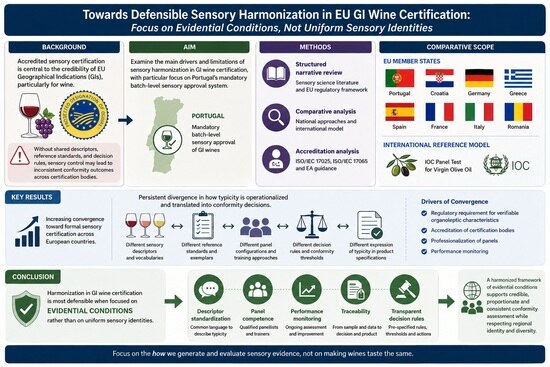
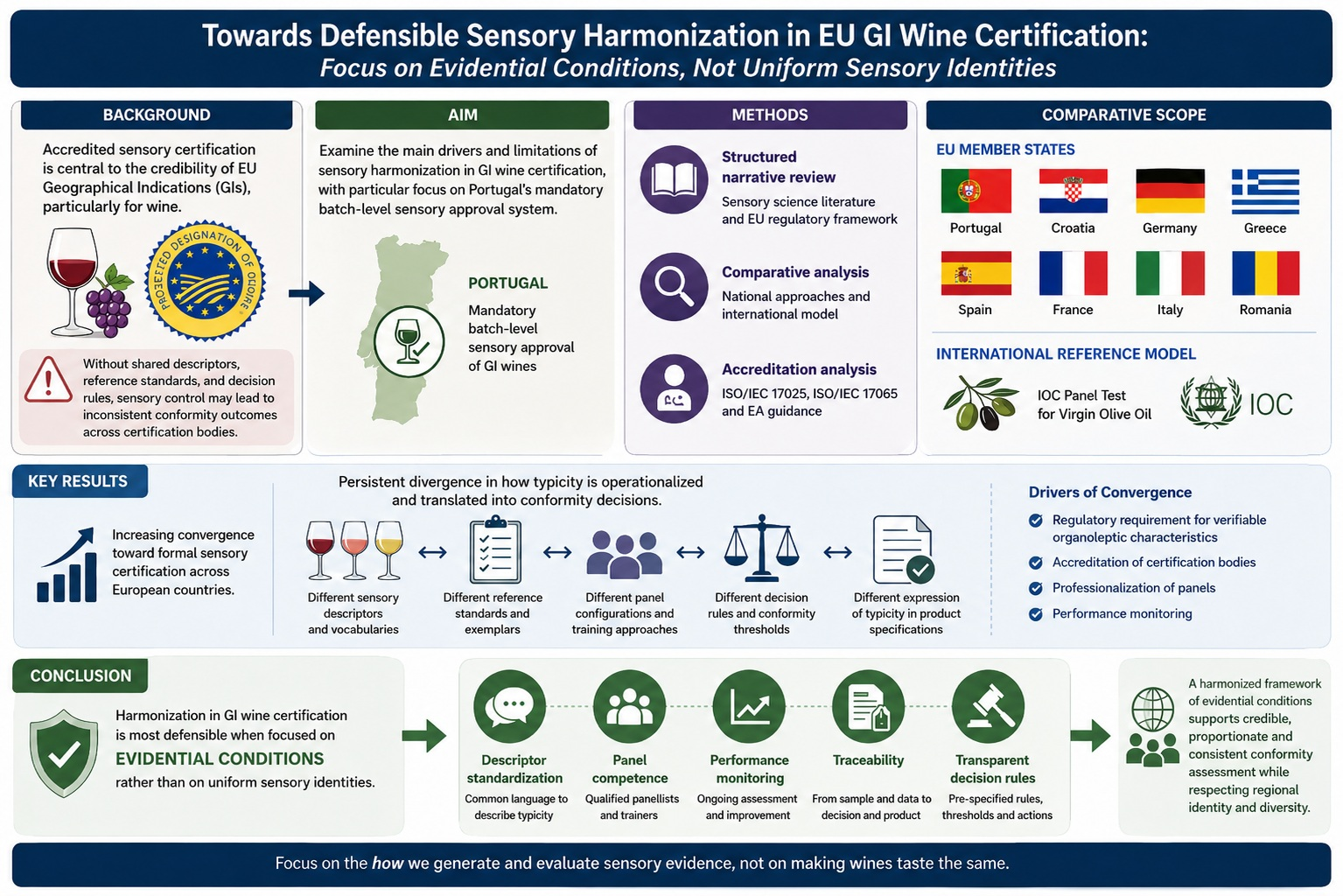
Accredited sensory certification is increasingly central to the credibility of EU Geographical Indications (GIs), particularly for wine, where typicity and regional identity complicate harmonization. In the absence of shared descriptors, reference standards, and decision rules, sensory control may produce inconsistent conformity outcomes across certification bodies. This study examines the main drivers and limitations of sensory harmonization in GI wine certification, with particular focus on Portugal’s mandatory batch-level sensory approval system. Using a structured narrative review and comparative analysis, it integrates sensory science literature with the EU regulatory framework requiring verifiable organoleptic characteristics in product specifications. National approaches from Portugal, Croatia, France, Germany, Greece, Italy, Romania and Spain are compared, alongside the harmonized IOC Panel Test model for virgin olive oil. Accreditation is analyzed through International Organization for Standardization standards ISO/IEC 17025 and ISO/IEC 17065, as well as EA guidance. Results show increasing convergence toward formal sensory certification but persistent divergence in how typicity is operationalized and translated into conformity decisions. The study proposes a conceptual framework in which harmonization focuses on evidential conditions rather than uniform sensory identities.

Graphical Abstract

1. Introduction

1.1. Drivers of Harmonization in GI Sensory Certification

Accredited sensory certification is increasingly central to the credibility of European Union (EU) Geographical Indications (GI). However, harmonization remains incomplete, especially for wine, where typicity and regional identity make standardization technically and culturally complex.
Over the past decade, efforts to formalize sensory certification have intensified, yet remain methodologically inconsistent across jurisdictions. For example, researchers in Spain developed a formal sensory panel method for the Protected Designation of Origin (PDO) Idiazabal cheese, in which trained experts score multiple attributes on a scale that reflects how closely they match the established quality standard for that PDO [1]. Assessors use reference standards during training to determine expected characteristics and known defects, ensuring consistent evaluation of typicity. Similar efforts have extended to wines and other foods: the Rioja Alavesa region developed a standardized testing method for its young red wines (accredited in 2008) [2], and the Alicante PDO trained and validated a tasting panel in 2015 [3]. More recently, the Galiza region in Spain developed a unified method for the five Galician wine PDOs [4,5]. These cases illustrate a broader trend toward harmonized sensory evaluation in GI product certification.
A central unresolved issue in PDO certification is the difficulty of reliably assessing sensory compliance, largely due to the lack of universally accepted evaluation methods [6,7]. Although some solutions have been proposed for panel preparation and sensory certification in Portugal and Greece [8,9], these are not easily transferable to other contexts. Pérez-Elortondo, Symoneaux, Etaio, Coulon-Leroy, Maître and Zannoni [6] identified significant inconsistencies in Spain, France, and Italy, which together account for nearly 70% of European Union PDO registrations.
Assessing typicity alongside minimum sensory conformity plays a central role in governing PDO wine systems under the European Union (EU) geographical indications regime. Despite being a formal requirement in the regulatory framework, sensory control still lacks a harmonized European methodology for consistently translating product specifications into reproducible conformity assessment decisions.
This limitation is particularly evident in the Portuguese context, where mandatory sensory evaluation forms an integral part of the certification process, as established under the current legal framework [10], and is implemented by regional certification bodies (CVR) and public institutes (IP). However, the absence of standardized and validated organoleptic methodologies introduces challenges in ensuring decision reproducibility, metrological traceability, and inter-panel comparability.
These challenges are particularly significant when sensory evaluation is conducted within accredited conformity assessment systems, raising questions regarding compliance with international standards such as ISO/IEC 17025 and ISO/IEC 17065, as well as the requirements set by the European co-operation for Accreditation framework for impartiality, consistency, and technical competence [11,12,13].

1.2. Typicity and the Role of Reference Groups

The annual verification of compliance or certification for PDO wines aims to confirm both the absence of faults and the wine’s “typicity” [14]. Typicity represents the extent to which a wine reflects the characteristic sensory profile associated with its designation of origin, as collectively recognized by a panel of knowledgeable assessors. These characteristics encompass technical, cultural, social, and, in particular, sensory elements, collectively referred to as sensory “typicity” [15,16]. “Typicality” represents the degree to which a product exemplifies its category. Wines within a given PDO are not identical but are expected to share common sensory traits. Typicality may be evaluated by comparing how closely a given sample aligns, in sensory terms, with an agreed reference profile or conceptual prototype. Identifying relevant sensory characteristics and developing appropriate methods for wine typicity must rely on consensus within a qualified human reference group with expertise in sensory analysis and a clear understanding of the prototype wine [17].
PDO products exhibit unique attributes influenced by multiple factors, with sensory qualities being particularly significant for differentiation. However, the specific sensory markers distinguishing individual PDOs are often poorly defined. This ambiguity leads to vague sensory certification criteria and reliance on generic evaluation frameworks rather than region-specific standards [8]. One way to improve reliability, as proposed by Alpeza et al. [18], is to use internal panels composed of permanent, professionally trained assessors.

1.3. Typicity, Origin, and the Accreditation Challenge

Regional typicity lies at the heart of Protected Designation of Origin (PDO)/Protected Geographic Indication (PGI) wine certification. Within geographical indication systems, wines are expected not only to be free from sensory defects but also to express characteristics considered representative of their origin [14,15,16,17]. However, translating this concept into reproducible conformity assessment remains challenging.
Typicity is frequently associated with terroir, encompassing the combined influence of environmental conditions, grape variety, viticultural practices, and winemaking traditions [19,20,21]. Although numerous studies have demonstrated that wines from different regions can exhibit distinct chemical and sensory characteristics, identifying universally valid sensory markers remains difficult [19,22]. Even experienced wine professionals do not consistently recognize regional origin solely through sensory evaluation, and the degree to which typicity can be objectively assessed remains debated [20,23,24,25,26].
These challenges are compounded by the dual role of geographical indications. On one hand, PDO and PGI schemes operate as scientific claims that certain sensory characteristics are linked to origin [19,20]. On the other hand, they function as institutional mechanisms that provide consumers with confidence regarding authenticity and provenance [27,28,29]. Product origin frequently influences perceived quality and purchasing decisions, even when sensory superiority has not been independently demonstrated [20,27,28,29]. As a result, sensory conformity occupies an intermediate position between scientific evidence and consumer trust.
From a governance perspective, certification systems do not attempt to guarantee identical sensory characteristics across all wines produced within a given designation. Natural variability resulting from climatic conditions, vineyard management, disease pressure, and winemaking practices makes complete uniformity neither realistic nor desirable [19,20,21]. Instead, certification seeks to verify that wines meet minimum quality requirements and remain broadly consistent with the sensory expectations associated with their geographical indication.
This context places particular importance on accreditation and assessor competence. Because sensory decisions directly influence certification outcomes, confidence in those decisions depends not only on the expertise of panel members but also on the existence of documented methodologies, traceable procedures, performance monitoring, and transparent decision rules [11,13,30]. Consequently, the challenge facing PDO/PGI wine certification is not merely the recognition of typicity itself, but the development of sufficiently robust systems to assess and document typicity in a manner that is technically defensible, reproducible, and compatible with modern accreditation frameworks.

1.4. Objectives of the Review

Despite the growing importance of sensory evaluation within PDO/PGI wine certification systems, substantial differences remain in how sensory conformity is defined, assessed, documented, and translated into certification decisions across Europe. These differences raise questions regarding comparability, transparency, and alignment with accreditation requirements.
This review aims to (i) compare sensory certification practices across selected European wine-producing countries; (ii) analyze the interaction between sensory evaluation and accreditation frameworks, particularly ISO/IEC 17025, ISO/IEC 17065, and EA guidance; (iii) identify the principal barriers to methodological harmonization; and (iv) propose an operational framework for harmonized sensory certification that preserves regional typicity while improving the reliability, traceability, and defensibility of conformity decisions.

2. Methodological Approach

This study was conducted as a structured narrative review combined with a comparative analysis of regulatory, accreditation, and sensory certification frameworks applicable to PDO/PGI wines. The objective was not to perform a systematic review of all available literature, but rather to integrate scientific, regulatory, accreditation, and institutional perspectives relevant to sensory conformity assessment within geographical indication systems.
The review incorporated four complementary categories of sources: (i) peer-reviewed scientific literature addressing wine sensory evaluation, typicity, terroir, and panel performance; (ii) scientific and technical references concerning sensory methodology, assessor competence, and sensory quality assurance; (iii) regulatory and accreditation documents; and (iv) official institutional documentation describing national PDO/PGI wine certification systems.
Scientific literature was identified through targeted searches in Scopus, Web of Science, and Google Scholar, complemented by citation tracking and examination of key reference works widely recognized in the fields of wine sensory science, typicity assessment, and sensory certification. Search terms included combinations of “PDO”, “PGI”, “Geographical Indications”, “wine certification”, “sensory evaluation”, “typicity”, “sensory panel”, “conformity assessment”, “accreditation”, and related terms. Particular consideration was given to publications addressing typicity, geographical indications, sensory conformity assessment, panel performance, accreditation, and methodological harmonization. The review primarily considered documents published between 2000 and 2025, although earlier references were retained when considered historically relevant or foundational to the development of wine sensory science and conformity assessment. Foundational references included widely recognized works by Jackson, Lawless and Heymann, Schlich, and other authors whose contributions have significantly influenced contemporary approaches to wine sensory evaluation, sensory methodology, panel management, and conformity assessment.
Regulatory and accreditation sources were obtained from EUR-Lex, the European co-operation for Accreditation (EA), the International Organization of Vine and Wine (OIV), ISO standards, national accreditation bodies, certification authorities, and official governmental sources. The analysis focused particularly on documents relevant to the implementation of sensory evaluation within accredited conformity assessment systems, including Regulation (EU) 2024/1143, ISO/IEC 17025, ISO/IEC 17065, and associated EA guidance documents.
Countries were selected using purposive criteria that combined wine-sector relevance, availability of regulatory and methodological documentation, and the presence of sensory certification systems offering useful perspectives on accreditation and harmonization challenges. Portugal was examined in greater detail because it is one of the few European systems that require mandatory batch-level sensory approval prior to market release. Romania was also included because of its relevance within the European wine sector and the existence of a formal PDO/PGI certification framework, although the availability of methodological documentation was more limited than for Portugal, Spain, Italy, or Croatia. The selected countries were not intended to represent all European PDO/PGI certification systems, but rather to illustrate a range of institutional, methodological, and accreditation approaches relevant to the objectives of the review.
Given the regulatory and applied nature of the topic, normative, accreditation, and institutional documents were considered primary sources of evidence alongside peer-reviewed scientific literature. The purpose of the review was not to provide an exhaustive inventory of all national certification systems, but rather to identify common challenges, methodological differences, emerging harmonization initiatives, and opportunities for future convergence within European PDO/PGI wine sensory certification.

3. EU Regulatory Framework and Accreditation Architecture

3.1. Regulatory Evolution and Current Legal Framework

To understand these challenges, it is necessary to examine the regulatory and accreditation architecture that underpins sensory certification in the EU.
Regulation (EU) No 1151/2012 [31], frequently cited in earlier literature on PDO sensory control, has been repealed and replaced by Regulation (EU) 2024/1143 [32], which now governs the definition, verification, and control of product specifications within the EU quality schemes framework.
The regulatory foundations of PDO/PGI wine sensory certification have evolved considerably over the past decades. Table 1 summarizes the principal EU legislative instruments that have shaped this evolution and influenced current conformity assessment requirements.
This regulatory evolution reveals a progressive strengthening of traceability, product specification requirements, and conformity assessment mechanisms within the European GI framework, providing a stronger foundation for accreditation-based sensory certification systems.
Despite this structured framework, its practical implementation in sensory evaluation remains uneven across Member States.
At the scheme level, Regulation (EU) 1308/2013 establishes the common market organization for wine and provides the legal basis for EU wine PDO/PGI protection, including the requirement to submit technical specifications that contain sensory descriptions [33]. These specifications are the cornerstone of conformity assessment because they define the identity of the GI wine and the conditions under which the designation may be used. However, sensory descriptions are typically concise and qualitative, creating an implementation gap: certification bodies must translate narrative descriptors into operational decision criteria without oversimplifying typicity [4,5]. Although the regulation provides the legal foundation for PDO/PGI wines, it leaves considerable discretion regarding how sensory conformity is assessed and documented in practice.
Regulation (EU) 2024/1143 reinforces this approach by requiring product specifications to define key product attributes clearly and to ensure that these can be effectively verified through appropriate control procedures [32]. Article 49 stipulates that the product specification must include at least “a description of the product, including (…) the main physical, chemical, microbiological or organoleptic characteristics of the product”. In regulatory terms, verifiability does not imply reducing typicity to a single score; rather, it requires that the method used to reach a conformity decision be documented, justified, and applied consistently. Consequently, accreditation is a key mechanism for demonstrating that sensory conformity assessments are conducted consistently, transparently, and technically defensibly.

3.2. Accreditation Logic and Panel Competence Requirements

The requirement for organoleptic examination of wines, historically set out in Regulation (EC) No 607/2009 [34], is now embedded within the broader regulatory framework established by Regulation (EU) No 1308/2013 [33] and its implementing acts, and complemented by the quality schemes provisions of Regulation (EU) 2024/1143 [32]. Although Regulation (EC) No 607/2009 historically required an organoleptic examination of wines, its provisions remain generic and have been functionally absorbed into subsequent legislation, leaving the content and operationalization of sensory control largely unspecified at the EU level.
Recent guidance from the European co-operation for Accreditation further strengthens operational implementation. EA-3/02 M:2026 provides mandatory policy requirements for national accreditation bodies when accrediting certification bodies that certify Protected Designation of Origin (PDO), Protected Geographical Indication (PGI), and Traditional Specialty Guaranteed (TSG) products under EN ISO/IEC 17065 [12], explicitly linking GI certification to Regulation (EU) 2024/1143.
ISO/IEC 17065 defines competence, impartiality, and process requirements for certification bodies issuing conformity decisions for PDO/PGI products, and requires that all testing activities be demonstrably competent and traceable [12]. ISO/IEC 17025 outlines the general criteria laboratories must meet to demonstrate technical competence, including the reliability of testing procedures and the validity of results, while EA-4/09 G:2022 operationalizes these principles for sensory testing by specifying how panel competence, training, monitoring, and method control must be evidenced in accredited sensory activities [11,13].
Within the ISO/IEC 17025 framework, tasting panels can be understood as analytical instruments that generate measurement data. Consequently, competence cannot be treated as a one-off qualification. It must be maintained over time through performance monitoring, method validation, and evidence-based quality control [11,13]. Outcomes in sensory testing depend directly on the evaluations provided by panel members; therefore, investigating panel performance is essential to obtain robust results. The starting point of any assessor evaluation is the selection of a method aligned with the objective (general aptitude or product-specific competencies) [35]. This perspective reinforces the need to treat panel performance as a measurable and continuously controlled component of the certification process.
For wine-related product analysis, the International Organization of Vine and Wine (OIV) is the international body responsible for defining official methods for relevant parameters and, therefore, for methods subject to accreditation under ISO/IEC 17025 [11]. The primary reference for applying ISO/IEC 17025 criteria to PDO food products, and more broadly to food and non-food products in sensory laboratories, is the European guideline EA 4/09 [13]. This guideline is not an official standard; it serves as an informative resource and lacks detailed sensory-specific guidance (terminology, reference standards, criteria for panel training and performance). Additionally, responsibilities for determining whether a product meets sensory requirements are not clearly defined, and inspection bodies often lack explicit criteria for assessing outcomes [6].
Table 2 highlights the principal accreditation instruments that support the implementation of PDO/PGI sensory certification. Together, these documents define the competence requirements applicable to laboratories, certification bodies, and sensory panels involved in conformity assessment.

3.3. Key Regulatory Instruments and Their Operational Implications

Sensory certification is influenced by a complex system of overlapping legal and accreditation frameworks and operates through a sequential logic: (i) EU law defines the GI scheme and the minimum contents of product specifications; (ii) national bodies implement official control and certification; and (iii) accreditation standards ensure that conformity assessment is performed competently, consistently, and transparently. Although this architecture is formally coherent, its practical translation into sensory decision-making remains uneven and is a major driver of cross-country heterogeneity [6,7].
In practice, the legal and accreditation architecture can only function if it is translated into operational decision procedures. This includes defining who performs the evaluation, how evidence is recorded, and how conformity decisions are justified. This translation is where tensions emerge, especially for expert panels whose role is to recognize overall typicity rather than to produce laboratory-style measurements. Rather than attempting to unify sensory identity across regions, harmonization efforts should focus on aligning the conditions under which sensory evidence is generated and evaluated.
These regulatory requirements create a practical translation problem. Qualitative specification language must be converted into operational descriptors and decision rules that support transparent conformity decisions while still respecting regional diversity [6,21].
The interaction between regulatory obligations, accreditation requirements, and operational sensory control practices is summarized in Table 3.

3.4. Methodological Harmonization, Descriptor Selection, and Panel Competence

A major barrier to harmonization in PDO/PGI wine certification is the lack of robust, widely accepted methodologies for sensory evaluation. Unlike sectors such as virgin olive oil, where internationally harmonized sensory methods already exist [45,46], wine certification continues to rely on heterogeneous practices that vary among countries, certification bodies, and product categories [6,21].
From an accreditation perspective, harmonization requires more than adopting common scorecards. It involves defining appropriate descriptors, establishing reference standards, selecting and training assessors, validating methods, and implementing continuous performance monitoring [11,47,48]. Harmonizing descriptor definitions and sensory references is particularly important because product specifications frequently describe organoleptic characteristics in qualitative terms that must subsequently be translated into operational assessment criteria [32,47,48].
The development of reliable sensory methodologies remains a priority for both certification bodies and accreditation authorities [49,50,51]. Once a method has been established, organizations generally follow a structured sequence involving assessor selection, basic and product-specific training, qualification, method validation, and routine quality control. Accreditation according to ISO/IEC 17025 is only feasible when methods demonstrate acceptable levels of repeatability, reproducibility, and discrimination [11].
Numerous standards and guidelines address assessor selection and training [52,53,54,55,56,57,58,59,60,61], while several studies have proposed quantitative indicators for monitoring panel performance [62,63,64,65,66,67,68,69]. Nevertheless, practical guidance tailored to specific PDO food products and wines remains limited [1,70], leading many organizations to develop internal procedures. This situation contributes to variability in how sensory conformity is evaluated and documented.
A further challenge concerns the relationship between product specifications and sensory assessment tools. Accreditation bodies have observed that scorecards do not always adequately reflect the sensory attributes described in approved product specifications, despite the regulatory requirement that such characteristics be verifiable [6,32]. Consequently, the selection of descriptors and decision criteria becomes a critical methodological step. Questions remain regarding which attributes should be included, how they should be evaluated, and how sensory evidence should be translated into conformity decisions [6,71].
Panel competence represents another key element in this process. Reliable sensory evaluation depends on assessors who demonstrate sensory acuity, consistency, and sustained engagement over time [72,73,74]. Selection criteria vary according to panel type, but effective systems generally combine recruitment, training, qualification, monitoring, and periodic requalification. Human variability, together with environmental and psychological influences, reinforces the importance of standardized procedures and controlled testing conditions [72,73,74,75,76,77].
Ultimately, harmonization requires balancing standardization and flexibility. Excessively rigid methodologies may fail to accommodate the diversity of wine styles and regional traditions, whereas excessive flexibility undermines comparability and accreditation objectives. The challenge, therefore, lies not in imposing a single sensory model but in establishing common methodological principles that support transparent, reproducible, and scientifically defensible conformity decisions across PDO/PGI certification systems.

3.5. Harmonization Lessons from Olive Oil and Trans-Sector Comparisons

Internationally harmonized quantitative descriptive methods exist for products such as virgin olive oil, whereas no comparable harmonized sensory methodology currently exists for wine PDO products, resulting in diverse practices across Europe [6,21].
To comply with European regulations and verify whether wines meet the expected sensory characteristics, descriptive analysis is considered essential. However, both accredited laboratories and PDO Regulatory Council tasting panels often apply their own procedures, which may differ substantially, resulting in a lack of a consensual, standardized approach. This reinforces the need to harmonize methodology, technical criteria, reference standards, and attribute-specific lexicons [6,15,47]. More recently, generic guidelines for the sensory analysis of PDO food products have been proposed, emphasizing, as a preliminary step, the description of the sensory characteristics to be assessed and the use of appropriate terminology [48].
Analytical methods for the physicochemical and organoleptic evaluation of olive oils are detailed in the updated Regulation (EEC) No. 2568/91 [78,79]. Attribute intensity is assessed by trained tasting panels under controlled conditions, and the IOC ‘Panel Test’ is the official classification method, using 8–10 tasters collectively as a multisensory analytical instrument [46]. Although statistically robust, reproducibility across panels remains challenging due to inter-individual subjectivity [80]. A comparable model is used in wine sensory evaluation (particularly in GI-related quality control and certification) where expert panels assess defined sensory attributes under standardized conditions, but panel-to-panel variability remains a key limitation [9,75,81].
The experience of sensory certification for virgin olive oil provides a concrete benchmark for understanding how methodological harmonization can be achieved in practice. Although some EU Member States have suggested removing organoleptic assessment from the standard set of analyses for Virgin Olive Oil (VOO), the report recommends its continuation with improvements. It proposes two key measures: (1) development of reference samples for training tasters, and (2) organization of regular cross-national tasting sessions. These suggestions align with researchers who advocate the use of certified reference materials as an effective means of harmonizing inter- and intra-panel assessments, leading to more consistent and reliable results [78,82,83,84].

3.6. The Portuguese Context: Institutions, Practice, and Gaps

These structural tensions become particularly evident when examined within specific national systems. Portugal is used as an illustrative case to examine how institutional arrangements and methodological choices interact within the EU regulatory framework for sensory certification. In practice, this interaction depends on translating legal product specifications into operational procedures. It also requires ensuring panel competence and maintaining transparent, defensible decision records that can withstand both administrative scrutiny and market contestation.

3.7. Institutional Responsibilities and Regulatory Anchoring

In Portugal, all wines undergo sensory evaluation as part of the certification process, which is supported by a structured accreditation framework. Sensory laboratories are accredited by the Portuguese National Accreditation Body (IPAC) under ISO/IEC 17025, while certification bodies responsible for PDO control operate in compliance with ISO/IEC 17065, as required by Regulation (EU) 1308/2013 [11,12,33]. Although accreditation may apply to selected methods, good laboratory practices are expected across all sensory activities, relying on validated methods and qualified expert panels to assess quality and typicity [7,21]. Panel training and qualification, conducted in accordance with ISO 8586 and EA-4/09 G:2022 [13], are prerequisites for systematic evaluation and must be supported by continuous performance monitoring to ensure individual and panel reliability [13,58,85].
The wine control and certification bodies in Portugal (11 Regional Wine Commissions (CVRs) and 3 Public Institutes (IPs)) correspond to the 30 PDOs. They are accredited by the national accreditation body, Instituto Português de Acreditação (IPAC), in accordance with ISO/IEC 17065:2012. The former CVR Açores has been reconstituted as the Instituto da Vinha e do Vinho dos Açores, IPRA [86]. These accreditations were obtained between 2016 and 2019, and all remain valid [87].
Regional Wine Commissions (CVRs), public institutions, and other bodies responsible for wine certification play a central role in regulating and promoting the quality of wines produced in Portugal. Sensory evaluation is a key pillar of this system, with trained assessors and expert panels classifying wines by appearance, aroma, and taste. However, ensuring the consistency and reliability of sensory decisions requires effective control and monitoring mechanisms, which remain uneven across Portuguese institutions due to persistent methodological and criteria-related heterogeneity.

3.8. Conformity Control Bodies and the “Panel-as-Laboratory” Debate

In Portugal, official control of the conformity of PDO/PGI products to technical specifications is carried out by delegated bodies, such as the Regional Wine Commissions (CVRs) and Public Institutes. Their primary function is to certify the wines of the region under their jurisdiction. Control of sensory characteristics (and physico-chemical properties) is part of official control. In Spain, conformity control can be carried out directly by the competent authority, by delegated bodies, or by independent private bodies (the latter is not authorized in Portugal). In most Spanish PDOs/PGIs, control is carried out by regulatory councils (RCs), which are delegated bodies. Regulation (EU) 2019/34 [38] stipulates that these organizations must be accredited in accordance with ISO/IEC 17065:2012 [12]. ISO/IEC 17065:2012 [12] states that when a certification body carries out assessment activities, it shall comply with applicable international standards and scheme documents; for testing, it must fulfill the applicable requirements of ISO/IEC 17025:2017 [11].
To verify organoleptic suitability, Portuguese regulatory councils have tasting panels whose members may be internal, external, or mixed, with varied qualifications. These panels are composed primarily of recognized professionals in the sector, mainly in enology and wine production, with extensive knowledge of wines from the corresponding PDO. However, Fernández-González et al. [4] argue that the organoleptic tests carried out by these tasting panels cannot strictly be considered laboratory tests, as their objective is not descriptive, quantitative analysis, but rather to verify whether the wine meets the organoleptic characteristics of the PDO and to ensure the absence of defects. This constitutes a mechanism for control, monitoring, and assurance, based on collective judgments and professional experience. The author further notes that this assurance mechanism is widely accepted, and its necessity is not in question. However, regulatory uncertainty remains regarding the requirements applicable to tasting panels under ISO/IEC 17065:2012 [12]. In practice, ISO/IEC 17025 [11] is not fully applicable to sensory panels, while no alternative standardized methodology exists for the organoleptic evaluation of PDO/PGI wines. This situation points to a structural misalignment between accreditation frameworks and the specific nature of sensory evaluation, particularly for typicity-based judgments. As highlighted by Fernández-González et al. [4], there is a clear need to define baseline criteria and operational rules for assessing organoleptic suitability, an approach already being formalized in some regional contexts, such as Galicia [88].
The main unresolved issue concerns the verification of organoleptic suitability, particularly whether tasting panels can legitimately be classified as sensory laboratories and whether ISO 17025 and EA-4/09 G apply. EA-4/09 G “complements ISO/IEC 17025 and provides specific guidance for the accreditation of sensory analysis laboratories” [13]. The Spanish National Accreditation Body (ENAC) guide G-ENAC-02 provides an aligned interpretation [89]. Within this framework, Regulatory Council (RC) tasting panels are expected to comply with several ISO/IEC 17025-derived requirements; however, some concerns have been raised that laboratory-style, attribute-by-attribute methods may undermine holistic recognition of typicity and underuse tasters’ expertise and sensory memory [5].

3.9. Portuguese Certification Structure and Outcomes at the Batch Level

In practice, organoleptic assessment of PDO/PGI wines is carried out through various operational approaches, reflecting both national regulatory frameworks and PDO-specific traditions. As a result, methodologies may differ not only across countries but also between certification schemes within the same country. Sensory panels are generally composed of professionals with experience in the wine sector and recognized expertise in regional wines, whose evaluative capacity is grounded in accumulated practice and familiarity with PDO-specific sensory profiles.
A wine certification body’s panel conducts several tasting sessions throughout the year, in which a group of tasters evaluates sets of wine samples using a tasting form (which may vary by wine type). Assessment is carried out jointly by the group, which reduces individual deviations. Each certification body establishes acceptance criteria; in Portugal, this means a minimum tolerable score on the adopted scale. Conformity is based on a minimum score (usually the mean or median of all tasters), which may derive from the sum of various attributes, with or without weighting, or from a single quality score.
If a sample does not meet this criterion, typically due to a defect or failure to reach the minimum for a quality designation (e.g., “Reserva”), the wine is considered non-compliant. The consequences depend on each PDO/PGI, the timing of control, and the intensity of operator monitoring. In some PDOs/PGIs, the batch cannot be marketed as PDO/PGI and, if possible, must be corrected for re-examination. In others, it may still be marketed, but the producer must present corrective measures for future production and control.
In Portugal, all PDO wine certifying bodies verify 100% of wine batches, and this verification must be positive before market placement; otherwise, the operator must correct the batch (if possible) using authorized oenological practices or market it as non-PDO wine. In short, the control exercised by an accredited wine certification body over its PDO/PGI products consists of verifying the suitability of wine batches for both chemical and sensory quality, i.e., their compliance with the requirements set out in the corresponding PDO/PGI specifications.
Current practice reveals substantial heterogeneity in sensory control methods and panel management across PDOs, reflecting differences in institutional traditions, technical capacity, and regulatory interpretation. These variations affect how sensory attributes are selected, assessed, and translated into conformity decisions, raising questions about the comparability and robustness of outcomes across certification bodies. At this stage, the issue is therefore less about defining a single sensory identity than about understanding how methodological choices condition the consistency, defensibility, and comparability of sensory control outcomes across PDO systems.
This context highlights a recurrent tension: while harmonization efforts aim to reduce variability and improve comparability, certification bodies must still accommodate regional typicity and the practical constraints of routine control. Portugal, therefore, exemplifies the broader EU challenge of aligning accreditation-driven repeatability with typicity-driven expert judgment.
This makes Portugal a particularly relevant case for understanding the practical limits of harmonization under real certification conditions.

4. Sensory Certification of Wines in Other Countries

The sensory certification of wines under PDO is a vital process that ensures quality, authenticity, and compliance with specific regional standards. While the underlying goal across countries remains the same (preserving traditional wine qualities and guaranteeing consumers access to authentic wines), the approaches to sensory evaluation vary widely. These differences reflect each country’s legal frameworks, cultural traditions, and regional priorities, highlighting both shared practices and divergent strategies in wine certification.

4.1. Comparative Dimensions: What Varies Across Countries

Although all systems aim to prevent the fraudulent use of geographical indications (GI) and exclude wines that do not comply with specifications, national approaches diverge in several practical respects. These include: (i) the primary function of sensory control (defect barrier versus typicity/quality governance); (ii) decision scales and thresholds (binary conformity, short ordinal scales, or point systems); (iii) panel structure and training logic; (iv) documentation and traceability requirements; and (v) the extent to which re-testing and appeal procedures are formalized [6,18,19].
From an accreditation perspective, these differences matter because they influence the type of evidence produced. Systems oriented toward laboratory-style testing tend to generate structured, attribute-based datasets compatible with ISO/IEC 17025 logic, while systems rooted in expert judgment generate holistic decisions, in which the core issue is how to document competence and consistency without undermining typicity [5,13].
Romania was included in the comparative review because a formal PDO/PGI wine certification system incorporating sensory evaluation was identified. However, the level of publicly available methodological documentation was substantially lower than in Spain, Italy, Croatia, or Portugal, limiting the depth of comparative analysis.
Table 4 reveals that all reviewed countries require sensory evaluation as part of PDO/PGI certification, but substantial differences remain regarding panel composition, decision scales, documentation requirements, appeal mechanisms, and accreditation practices. Spain, Italy, and Portugal exhibit the highest degree of procedural formalization, whereas Croatia and Germany place greater emphasis on structured assessor training and performance control. Romania illustrates a different model in which sensory evaluation is strongly integrated with certification and traceability systems, although comparatively little methodological information is publicly available. Collectively, these differences suggest that harmonization challenges arise less from the legal requirement to perform sensory evaluation than from the diverse ways in which conformity decisions are operationalized and documented across certification systems.

4.2. Croatia

Legal basis: In Croatia, sensory certification of PDO wines is governed by national legislation that requires organoleptic evaluation as part of conformity assessment and the protection of geographical indications.
Panel composition: Sensory evaluation is conducted by panels composed of seven assessors, including at least five qualified experts. Panel composition is designed to ensure adequate expertise while accounting for physiological variability among assessors.
Decision methodology: PDO wines are evaluated using a 100-point scoring system covering visual, olfactory, and gustatory attributes. Ten sensory parameters are assessed using predefined quality descriptors ranging from “excellent” to “inadequate”. Final certification decisions are based on the overall score obtained. For non-PDO wines, a simplified conformity-oriented approach based on binary judgments is also used.
Accreditation and quality assurance: Panel operations follows ISO 8589 principles and incorporates regular training, proficiency testing, and performance monitoring. Specialized software is used to support data collection and analysis, contributing to consistency and traceability.
Strengths and limitations: The Croatian system benefits from a structured scoring methodology, formal panel training, and regular quality control procedures. However, its methodological framework remains primarily national in scope, with limited evidence of integration into broader European harmonization initiatives [18,90].

4.3. France

Legal basis: Sensory certification in France is conducted within the Appellation d’Origine Contrôlée (AOC) system.
Panel composition: Evaluations are conducted by expert tasting panels that verify compliance with AOC requirements.
Decision methodology: The French approach focuses primarily on identifying defective or clearly non-conforming wines rather than performing detailed quality ranking or quantitative sensory characterization. Sensory evaluations are not conducted annually for all wines and are primarily intended to exclude faulty products.
Accreditation and quality assurance: Sensory evaluation forms part of the broader quality control framework supporting AOC certification, although published information regarding panel monitoring procedures is relatively limited.
Strengths and limitations: The French system provides an effective barrier to defective wines. However, its emphasis on exclusion rather than on detailed sensory characterization provides less information for quality differentiation and typicity assessment [19,91].

4.4. Germany

Legal basis: Germany operates a legally established wine certification system dating back to the Wine Law reforms of 1971. Sensory assessment forms an integral component of PDO certification for Qualitätswein and Prädikatswein categories.
Panel composition: Evaluation is performed by trained expert assessors with demonstrated competence in wine sensory analysis. Continuous training and monitoring are considered essential components of the system.
Decision methodology: Wines are assessed using a five-point scale that considers defects, varietal typicality, sensory quality, and compliance with category expectations. Emphasis is placed on the relationship between sensory quality and grape maturity.
Accreditation and quality assurance: The system relies on assessor training, proficiency testing, and performance monitoring to improve consistency and reproducibility. Nevertheless, final decisions continue to depend substantially on expert judgment.
Strengths and limitations: The German model combines a long-established legal framework with a strong emphasis on assessor competence. However, despite extensive quality assurance measures, sensory evaluation remains highly dependent on individual expertise and therefore retains an unavoidable subjective component [19].

4.5. Greece

Legal basis: In Greece, sensory certification of PDO and PGI wines is coordinated by ELGO–DIMITRA in collaboration with regional authorities responsible for geographical indication control.
Panel composition: Assessments are performed by trained professional assessors with expertise in Greek wine styles and regional sensory characteristics.
Decision methodology: Evaluation focuses on the principal organoleptic attributes of clarity, aroma, taste, and overall quality. Certification decisions are based on conformity with the sensory expectations associated with each designation.
Accreditation and quality assurance: The Greek system places considerable emphasis on continuous monitoring of assessor performance to maintain panel consistency and reliability over time.
Strengths and limitations: A notable strength of the Greek framework is its focus on maintaining assessor competence through ongoing monitoring. However, relatively limited published methodological documentation makes detailed comparison with other European systems more difficult [92].

4.6. Italy

Legal basis: Italy applies sensory certification through the DOC and DOCG systems, supported by the Ministerial Decree of 12 March 2019, which defines official procedures for organoleptic evaluation of DOP and IGP wines.
Panel composition: Assessments are conducted by official tasting commissions associated with local chambers of commerce and certification authorities.
Decision methodology: Wine samples are evaluated using standardized sensory forms covering visual, olfactory, and gustatory attributes. Outcomes are classified as “conforming”, “reviewable”, or “non-conforming”.
Accreditation and quality assurance: The Italian framework provides structured documentation procedures, standardized forms, traceability requirements, and formal appeal mechanisms through the National Appeal Commission.
Strengths and limitations: Italy offers one of the most codified and traceable sensory certification systems in Europe, particularly in terms of documentation and appeals. However, parts of the framework retain historical structures that are not fully aligned with modern accreditation-oriented approaches [6,93].

4.7. Romania

Legal basis: Romania operates a national system for the protection and certification of wines with Protected Designation of Origin (PDO) and Protected Geographical Indication (PGI), coordinated by the National Office of Vine and Wine Products (ONVPV), the body responsible for certification and traceability of geographical indications in the wine sector [94].
Panel composition: Publicly available information on panel composition is limited. However, sensory evaluation is an integral component of the certification process and is carried out in accordance with ONVPV procedures and national wine legislation [94].
Decision methodology: Since the certification system’s establishment, several sensory evaluation approaches have been used. Historical evidence indicates the use of a 7-point evaluation sheet, followed by the adoption of OIV-based scorecards using a 100-point scale for still and sparkling wines. Sensory evaluation is performed as part of the certification procedure required to authorize the commercial use of PDO and PGI designations [94].
Accreditation and quality assurance: The Romanian system places strong emphasis on traceability, integrating certification procedures with vineyard registers, winery authorization systems, digital databases, and certification records. Recent developments have focused on the digitalization of certification workflows and strengthening links between sensory evaluation and authenticity verification [94].
Strengths and limitations: A notable strength of the Romanian system is the integration of sensory evaluation within a broader certification and traceability framework. However, compared with countries such as Spain, Italy, or Croatia, relatively limited scientific literature is available describing panel management procedures, assessor qualification protocols, performance monitoring, or accreditation-related implementation details. Consequently, direct comparison with other European systems remains challenging [94].

4.8. Spain

Legal basis: PDO wine certification in Spain is implemented through regional regulatory frameworks administered by Regulatory Councils and competent authorities.
Panel composition: Panel composition varies among regions, although evaluations are generally conducted by trained expert assessors with specific knowledge of regional wine styles.
Decision methodology: Methodologies differ among PDOs. Some systems use structured scoring scales, whereas others emphasize comparison against predefined sensory profiles. In the Basque Country, for example, the sensory control methodology for Txakoli de Bizkaia is tailored to the specific attributes of this wine and uses decision trees to support evaluations. In Castilla–La Mancha, wines are evaluated using a seven-point scale for visual, olfactory, and gustatory attributes.
Accreditation and quality assurance: Spain has developed some of the most advanced harmonization initiatives currently reported in the literature. Projects in Galicia seek to standardize assessor qualification, panel composition, sensory procedures, and documentation practices in alignment with the requirements of ISO/IEC 17065.
Strengths and limitations: The Spanish system is characterized by strong methodological innovation and active harmonization efforts. However, substantial regional variability remains, limiting full comparability among PDO certification schemes [4,5,8,88,95].

5. Comparative Synthesis and Accreditation Convergence

The comparative analysis presented in this review supports several observations regarding the future harmonization of sensory certification for PDO/PGI wines. The following recommendations represent the authors’ interpretation of the reviewed evidence.
Across the reviewed countries, sensory certification systems share the common objective of safeguarding the authenticity and quality of PDO wines, yet diverge markedly in how sensory outcomes are produced, justified, and legitimized. While some systems rely on relatively structured and standardized sensory procedures, others reflect hybrid approaches in which strong local traditions coexist with increasing pressures for harmonization. These differences highlight the persistent challenge of reconciling methodological objectivity with the inherently subjective nature of sensory perception and suggest that system credibility depends less on the choice of sensory scale than on how panel competence, method control, traceability, and decision rules are evidenced [11,13].
Because typicity is inherently linked to differentiation and territorial specificity, it is not amenable to full harmonization. However, convergence in accreditation and competence requirements appears both realistic and necessary to support the mutual recognition of GI conformity decisions. EA guidance documents already provide an operational framework for such alignment through shared expectations regarding panel selection and training, performance monitoring, documentation standards, and transparency of sensory decision-making, while allowing national adaptations that preserve territorial identity. This challenge is particularly relevant for wine, where typicity operates simultaneously as a sensory construct, a market signal, and a cultural asset [20,27].
The comparative dimensions discussed above, including decision models, panel structure, and sensory control objectives, are summarized in Table 5. Collectively, these findings suggest that future harmonization efforts should focus less on standardizing sensory outcomes and more on ensuring that conformity decisions are generated through transparent, competent, and demonstrably reliable sensory assessment systems.

6. Toward a Unified Methodology: Governance, Evidence, and Limits

Taken together, the diversity of sensory control methods and panel management practices across PDOs highlights the need for greater alignment of criteria and technical references at both national (Portugal) and European levels. Substantial differences in organoleptic control requirements risk undermining comparability across conformity decisions and may lead to unequal competitive conditions among PDOs operating in the same market.
In this context, harmonization should not be understood as the imposition of a uniform sensory identity. Instead, it should be framed as the definition of shared evidential conditions for sensory conformity. From a governance and accreditation perspective, harmonized sensory protocols offer clear advantages: they enhance consistency and reproducibility by reducing subjective variability, support regulatory compliance through validated methods and documented procedures compatible with ISO/IEC 17025 and ISO/IEC 17065, and improve data comparability and transparency across products, regions, and vintages [1,98].
Equally important, harmonization strengthens the protection of typicity and authenticity by ensuring that trained panels operate with shared descriptor lexicons, reference standards (including defects), and transparent decision rules. In this sense, panels function not as arbiters of taste but as calibrated instruments of conformity assessment. Experiences such as the ITACyL initiative in Spanish PDO wine committees demonstrate that structured standardization is both feasible and effective when grounded in scientific methodology and institutional coordination [99].
Without such alignment, PDO/PGI products risk losing sensory distinctiveness and becoming increasingly difficult to differentiate from generic alternatives, thereby weakening the credibility of the GI system and eroding consumer trust [48].
A realistic European pathway is therefore to harmonize the evidence conditions of sensory conformity (training, monitoring, traceability, and decision criteria) rather than attempting to impose a single sensory identity on all PDO wines [6,27].
The analysis supports a key policy inference: the EU can strengthen GI credibility by harmonizing not the typicity itself but the governance conditions under which typicity-related conformity decisions are made (competence, monitoring, documentation, and traceability). This approach preserves territorial specificity while improving transparency, reproducibility, and mutual recognition across Member States.

7. Proposed Framework for Harmonized Sensory Certification

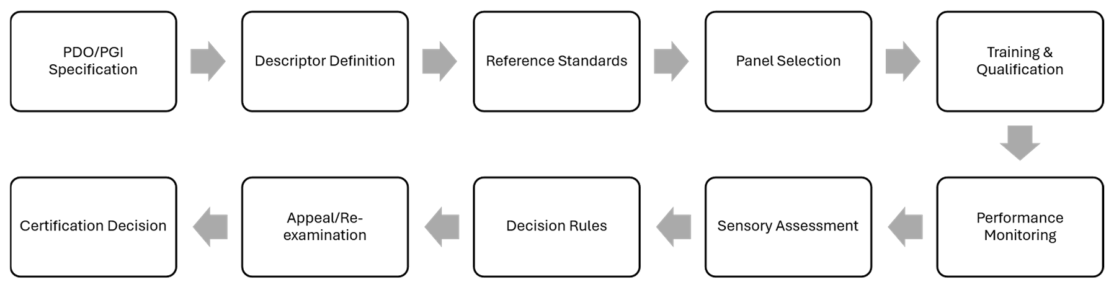
Figure 1 summarizes the proposed pathway and illustrates how sensory evidence can be progressively transformed into a defensible certification decision.
The comparative analysis presented in this review suggests that harmonization should not seek to impose uniform sensory identities across PDO/PGI wines. Such an objective would conflict with the fundamental rationale of geographical indications, which is to preserve regional diversity and product distinctiveness. Rather, harmonization should focus on ensuring that sensory conformity decisions are generated through transparent, competent, and demonstrably reliable assessment systems.
Instead, harmonization should focus on the conditions under which sensory evidence is generated, interpreted, and translated into conformity decisions. The proposed pathway can be organized around five complementary pillars, as illustrated in Figure 1.
First, descriptor harmonization should be promoted through standardized sensory lexicons directly linked to product specifications. Second, reference wines and sensory standards should be developed to support calibration, training, and inter-panel comparability. Third, assessor qualification, monitoring, and periodic requalification procedures should be harmonized in accordance with the ISO/IEC 17025 competence principles, the ISO/IEC 17065 requirements, and the EA guidance documents. Fourth, transparent decision rules should be established, including conformity thresholds, treatment of uncertainty, re-testing procedures, and appeal mechanisms. Finally, regular inter-laboratory proficiency testing and cross-border calibration exercises should be implemented among certification bodies.
Practical recommendations for certification bodies include descriptor standardization, the use of sensory reference materials, regular assessor monitoring, documented appeal procedures, systematic archiving of sensory decisions, and participation in inter-laboratory harmonization activities.
Under this framework, harmonization would occur at the level of evidence generation and decision-making processes rather than at the level of sensory identity itself. Such an approach preserves regional distinctiveness while improving transparency, traceability, consistency, and confidence in certification outcomes across European PDO/PGI systems.

8. Limitations

Several limitations should be considered when interpreting the findings of this review.
First, this study was conducted as a structured narrative review rather than as a systematic review or meta-analysis. Although efforts were made to identify relevant scientific, regulatory, and accreditation sources, some publications or national documents may not have been captured.
Second, the availability and level of detail of documentation varied considerably among countries. While relatively extensive information was available for countries such as Portugal, Spain, Italy, and Croatia, publicly accessible methodological information was more limited for other jurisdictions, restricting the depth of comparison.
Third, the review relied primarily on published literature, regulatory texts, accreditation guidance documents, and official reports. Direct interviews with certification bodies, accreditation authorities, panel leaders, or regulatory agencies were not conducted.
Fourth, linguistic and institutional differences among countries may have affected access to national documentation and interpretation of certification practices.
Fifth, the countries included in the comparative analysis were selected using purposive criteria and were not intended to represent all European PDO/PGI wine certification systems. Consequently, the findings should be interpreted as illustrative of a range of regulatory, methodological, and accreditation approaches rather than as a comprehensive assessment of all European jurisdictions.
Finally, the study focuses on regulatory frameworks, methodological approaches, and accreditation requirements rather than on empirical comparisons of panel performance. Consequently, the review does not allow direct conclusions regarding the relative effectiveness or accuracy of individual national certification systems. Future research incorporating empirical performance data, inter-laboratory studies, and stakeholder interviews would help complement the regulatory and methodological perspective presented here.

9. Conclusions

Sensory evaluation remains a fundamental component of PDO/PGI wine certification in Europe, providing a mechanism to verify conformity with product specifications and to support the credibility of geographical indications. However, the comparative analysis presented in this review demonstrates that substantial differences persist among national certification systems regarding panel composition, assessment methodologies, decision rules, accreditation practices, and traceability requirements.
These differences do not arise from the absence of regulatory obligations, since all reviewed systems incorporate sensory evaluation in some form, but rather from differences in how conformity decisions are operationalized, documented, and supported by evidence. The findings indicate that complete harmonization of sensory identities is neither feasible nor desirable, given the intrinsic diversity of regional wine traditions and expressions of typicity.
Instead, harmonization efforts should focus on the conditions under which sensory evidence is generated and interpreted. The framework proposed in this review emphasizes descriptor standardization, reference materials, assessor qualification and monitoring, transparent decision rules, decision traceability, and inter-laboratory harmonization as key elements for improving the consistency and defensibility of certification outcomes [11,13,47].
From a practical perspective, certification bodies may benefit from greater use of sensory reference standards, routine performance monitoring, documented appeal procedures, and systematic archiving of sensory decisions. Such measures could strengthen transparency, comparability, and stakeholder confidence while preserving the regional distinctiveness that geographical indications are intended to protect.
Future research should focus on cross-border calibration exercises, digital tools for sensory traceability, and the validation of typicity-related sensory markers to support accreditation-oriented conformity assessment [6,7]. Such efforts could contribute to a more transparent, comparable, and accreditation-oriented approach to PDO/PGI sensory certification while preserving the diversity that geographical indications are intended to protect.

Funding

This work was supported by national funds through FCT–the Portuguese Foundation for Science and Technology under the projects UID/00616/2025–Chemistry Research Center (https://doi.org/10.54499/UID/00616/2025), UIDB/04621/2020, and UIDP/04621/2020 -CEMAT/IST-ID. Additional support was provided by the StrengthS4WineChaiN Project (NORTE2030-FEDER-01786100), co-financed by the European Regional Development Fund (ERDF) under the Northern Regional Program 2021–2027 [NORTE2030].

Institutional Review Board Statement

Not applicable.

Informed Consent Statement

Not applicable.

Data Availability Statement

No new data were created or analyzed in this study. Data sharing is not applicable to this article.

Acknowledgments

Acknowledgments are due to ALABE—Associação dos Laboratórios de Enologia for making this study possible. Without the support, this work would not have been viable.

Conflicts of Interest

The authors declare no conflicts of interest.

Abbreviations

The following abbreviations are used in this manuscript:
AOCAppellation d’Origine Contrôlée
CVRComissão Vitivinícola Regional
CMOCommon Market Organization
DOCGDenominazione di Origine Controllata e Garantita
DOPDenominazione di Origine Protetta
EAEuropean co-operation for Accreditation
ELGO–DIMITRAHellenic Agricultural Organization “DIMITRA”
ENACEntidad Nacional de Acreditación
EUEuropean Union
GIGeographical Indication
HACCPHazard Analysis and Critical Control Points
IGPIndicazione Geografica Protetta
IOCInternational Olive Council
IPInstituto Público
IPACInstituto Português de Acreditação
IPRAInstituto da Vinha e do Vinho dos Açores
ISOInternational Organization for Standardization
IECInternational Electrotechnical Commission
ITACyLInstituto Tecnológico Agrario de Castilla y León
IVVInstituto da Vinha e do Vinho
OIVInternational Organisation of Vine and Wine
ONVPVOficiul National al Viei si Produselor Vitivinicole
PDOProtected Designation of Origin
PGIProtected Geographical Indication
QbAQualitätswein bestimmter Anbaugebiete
RCRegulatory Council
TSGTraditional Specialty Guaranteed
VOOVirgin Olive Oil

References

  1. Elortondo, F.J.P.; Ojeda, M.; Albisu, M.; Salmerón, J.; Etayo, I.; Molina, M. Food quality certification: An approach for the development of accredited sensory evaluation methods. Food Qual. Prefer. 2007, 18, 425–439. [Google Scholar] [CrossRef]
  2. Etaio, I.; Albisu, M.; Ojeda Atxiaga, M.; Fernandez Gil, P.; Salmeron, J.; Pérez-Elortondo, F. Sensory Quality Control for Food Certification: A Case Study on Wine. Method Development. Food Control 2010, 21, 533–541. [Google Scholar] [CrossRef]
  3. Issa-Issa, H.; Noguera-Artiaga, L.; Sendra, E.; Pérez-López, A.J.; Burló, F.; Carbonell-Barrachina, Á.A.; López-Lluch, D. Volatile Composition, Sensory Profile, and Consumers’ Acceptance of Fondillón. J. Food Qual. 2019, 2019, 5981762. [Google Scholar] [CrossRef]
  4. Fernández-González, A.J.; Núñez Fernández, A.; Prado, J.C. Sensory Assessment of Wines: Development of a Unified Method in the Five Galician Wine Protected Designations of Origin. In Proceedings of the 17th International Conference on Industrial Engineering and Industrial Management (ICIEIM)—XXVII Congreso de Ingeniería de Organización (CIO2023); Springer: Cham, Switzerland, 2024; pp. 300–305. [Google Scholar]
  5. González, A.J.F. Problemática de la evaluación sensorial de los vinos con DOP/IGP en el contexto de la acreditación por ENAC: La experiencia de los consejos reguladores vitivinícolas de Galicia. Enólogos 2025, 154, 75–82. [Google Scholar]
  6. Pérez-Elortondo, F.J.; Symoneaux, R.; Etaio, I.; Coulon-Leroy, C.; Maître, I.; Zannoni, M. Current status and perspectives of the official sensory control methods in protected designation of origin food products and wines. Food Control 2018, 88, 159–168. [Google Scholar] [CrossRef]
  7. Gomis-Bellmunt, A.; Claret, A.; Puig-Pujol, A.; Pérez-Elortondo, F.J.; Guerrero, L. Development of a Descriptive Profile and References for the Assessment of Taste and Mouthfeel Descriptors of Protected Designation of Origin Wines. Foods 2022, 11, 2970. [Google Scholar] [CrossRef] [PubMed]
  8. Etaio, I.; Gil, P.F.; Ojeda, M.; Albisu, M.; Salmerón, J.; Pérez Elortondo, F.J. Improvement of sensory quality control in PDO products: An example with txakoli white wine from Bizkaia. Food Qual. Prefer. 2012, 23, 138–147. [Google Scholar] [CrossRef]
  9. Pinto, M.M. Evaluating uncertainty in sensory analysis. A case study of the panel of tasters of the Dão Regional Wine Commission. Ciênc. Téc. Vitivinícola 2021, 36, 22–31. [Google Scholar] [CrossRef]
  10. Diário da República. Decreto-Lei n.° 61/2020, de 18 de Agosto: Estabelece o Regime Jurídico Aplicável ao Setor Vitivinícola; Diário da República: Lisboa, Portugal, 2020. [Google Scholar]
  11. ISO/IEC 17025:2017; General Requirements for the Competence of Testing and Calibration Laboratories. ISO: Geneva, Switzerland, 2017.
  12. ISO/IEC 17065:2012; Conformity Assessment—Requirements for Bodies Certifying Products, Processes and Services. ISO: Geneva, Switzerland, 2012.
  13. EA. EA-4/09 G: 2022 Accreditation for Sensory Testing Laboratories; European Accreditation: Utrecht, The Netherlands, 2022. [Google Scholar]
  14. Casabianca, F.; Sylvander, B.; Beranger, C.; Coulon, J.B.; Roncin, F. Terroir et typicité: Deux concepts-clés des appellations d’origine contrôlées. Essai de définitions scientifiques et opérationnelles. In Proceedings of the Colloque International de Restitution des Travaux de Recherche Sur Les Indications et Appellations d’Origine Géographiques, Paris, France, 17 November 2005. [Google Scholar]
  15. Maitre, I.; Symoneaux, R.; Jourjon, F.; Mehinagic, E. Sensory typicality of wines: How scientists have recently dealt with this subject. Food Qual. Prefer. 2010, 21, 726–731. [Google Scholar] [CrossRef]
  16. Maître, I.; Lawrence, G.; Symoneaux, R.; Jourjon, F.; Mehinagic, E. How to define sensory typicity in Wine? In Proceedings of the Possible Application of Sensory Methodologies to Protected Designation of Origin Products; European Sensory Science Society—WG PDO Seminar: Bern, Switzerland, 2012. [Google Scholar]
  17. Nicod, H.; Kieser, S.; Bremaud, D.; Nante, A. L’expertise sensorielle: Leurre ou réalité. In Proceedings of the Le Sensolier, Les Expertises Sensorielles: Nature et Acquisition; Le Sensolier: Paris, France, 2006. [Google Scholar]
  18. Alpeza, I.; Linke, I.; Runje, B. How to Improve the Monitoring of Subjective Analytical Methods and Assessors—The Case of Wine. Teh. Glas. 2022, 16, 530–536. [Google Scholar] [CrossRef]
  19. Jackson, R.S. Chapter 10—Wine laws, authentication, and geography. In Wine Science, 5th ed.; Jackson, R.S., Ed.; Academic Press: San Diego, CA, USA, 2020; pp. 813–881. [Google Scholar]
  20. Souza Gonzaga, L.; Capone, D.L.; Bastian, S.E.P.; Jeffery, D.W. Defining wine typicity: Sensory characterisation and consumer perspectives. Aust. J. Grape Wine Res. 2021, 27, 246–256. [Google Scholar] [CrossRef]
  21. Gomis-Bellmunt, A.; Claret, A.; Guerrero, L.; Pérez-Elortondo, F.J. Sensory evaluation of Protected Designation of origin Wines: Development of olfactive descriptive profile and references. Food Res. Int. 2024, 176, 113828. [Google Scholar] [CrossRef] [PubMed]
  22. Catarino, S.; Madeira, M.; Monteiro, F.; Caldeira, I.; Bruno De Sousa, R.; Curvelo-Garcia, A. Mineral Composition through Soil-Wine System of Portuguese Vineyards and Its Potential for Wine Traceability. Beverages 2018, 4, 85. [Google Scholar] [CrossRef]
  23. McCloskey, L.P.; Sylvan, M.; Arrhenius, S.P. Descriptive Analysis for Wine Quality Experts Determining Appellations by Chardonnay Wine Aroma. J. Sens. Stud. 1996, 11, 49–67. [Google Scholar] [CrossRef]
  24. Marciniak, M.; Reynolds, A.; Brown, R.; Jollineau, M.; Kotsaki, E. Applications of Geospatial Technologies to Understand Terroir Effects in an Ontario Riesling Vineyard. Am. J. Enol. Vitic. 2017, 68, ajev.2016.16083. [Google Scholar] [CrossRef]
  25. Douglas, D.; Cliff, M.; Reynolds, A. Canadian terroir: Characterization of Riesling wines from the Niagara Peninsula. Food Res. Int. 2001, 34, 559–563. [Google Scholar] [CrossRef]
  26. Schlosser, J.; Reynolds, A.G.; King, M.; Cliff, M. Canadian terroir: Sensory characterization of Chardonnay in the Niagara Peninsula. Food Res. Int. 2005, 38, 11–18. [Google Scholar] [CrossRef]
  27. Huysmans, M.; Van Noord, D.; Höhn, G.L. Do Geographical Indications Certify Origin and Quality? Springer Nature: Cham, Switzerland, 2025; pp. 13–23. [Google Scholar]
  28. Teuber, R. Consumers’ and producers’ expectations towards geographical indications. Br. Food J. 2011, 113, 900–918. [Google Scholar] [CrossRef]
  29. Verbeke, W.; Pieniak, Z.; Guerrero, L.; Hersleth, M. Consumers’ Awareness and Attitudinal Determinants of European Union Quality Label Use on Traditional Foods. Bio-Based Appl. Econ. 2012, 1, 213–229. [Google Scholar] [CrossRef]
  30. IFST. Setting standards in sensory analysis. Food Sci. Technol. 2021, 35, 13–16. [Google Scholar] [CrossRef]
  31. OJEU. Regulation (EU) No 1151/2012 of the European Parliament and of the Council of 21 November 2012 on quality schemes for agricultural products and foodstuffs. Off. J. Eur. Union 2012, L343, 1–28. [Google Scholar]
  32. OJEU. Regulation (EU) 2024/1143 of the European Parliament and of the Council of 11 April 2024 on geographical indications for wine, spirit drinks and agricultural products, as well as traditional specialities guaranteed and optional quality terms for agricultural products, amending Regulations (EU) No 1308/2013, (EU) 2019/787 and (EU) 2019/1753 and repealing Regulation (EU) No 1151/2012. Off. J. Eur. Union 2024, L 2024/1143, 1–76. [Google Scholar] [CrossRef]
  33. OJEU. Regulation (EU) No. 1308/2013 of the European Parliament and of the Council of 17 December 2013 Establishing a Common Organisation of the Markets in agricultural Products and Repealing Council Regulations (EEC) No. 922/72, (EEC) No. 234/79, (EC) No. 1037/2001 and (EC) No. 1234/2007. Off. J. Eur. Union 2013, 347, 671–854. [Google Scholar]
  34. OJEU. Commission regulation (EC) No 607/2009 of 14 July 2009 laying down certain detailed rules for the implementation of Council Regulation (EC) No 479/2008 as regards protected designations of origin and geographical indications, traditional terms, labelling and presentation of certain wine sector products. Off. J. Eur. Union 2009, L193, 60–139. [Google Scholar]
  35. Sipos, L.; Nyitrai, Á.; Hitka, G.; Friedrich, L.F.; Kókai, Z. Sensory Panel Performance Evaluation. Comprehensive Review of Practical Approaches. Appl. Sci. 2021, 11, 11977. [Google Scholar] [CrossRef]
  36. EA. EA-3/02 M: 2026 EA Policy for the Accreditation of Certification Bodies Providing Certification of PDO, PGI and TSG; European Accreditation: Utrecht, The Netherlands, 2026. [Google Scholar]
  37. OJEU. Commission Delegated Regulation (EU) 2019/33 of 17 October 2018 supplementing Regulation (EU) No 1308/2013 of the European Parliament and of the Council as regards applications for protection of designations of origin, geographical indications and traditional terms in the wine sector, the objection procedure, restrictions of use, amendments to product specifications, cancellation of protection, and labelling and presentation. Off. J. Eur. Union 2019, 9, 2–45. [Google Scholar]
  38. OJEU. Commission implementing regulation (EU) 2019/34—Of 17 October 2018 laying down rules for the application of Regulation (EU) No 1308/2013 of the European Parliament and of the Council as regards applications for protection of designations of origin, geographical indications and traditional terms in the wine sector, the objection procedure, amendments to product specifications, the register of protected names, cancellation of protection and use of symbols, and of Regulation (EU) No 1306/2013 of the European Parliament and of the Council as regards an appropriate system of checks. Off. J. Eur. Union 2019, 9, 46–76. [Google Scholar]
  39. OJEU. Regulation (EC) No 178/2002 of the European Parliament and of the Council of 28 January 2002 laying down the general principles and requirements of food law, establishing the European Food Safety Authority and laying down procedures in matters of food safety. Off. J. Eur. Union 2002, 31, 1–24. [Google Scholar]
  40. OJEU. Regulation (EC) No 852/2004 of the European Parliament and of the Council of 29 April 2004 on the hygiene of foodstuffs. Off. J. Eur. Union 2004, 139, 1–54. [Google Scholar] [CrossRef]
  41. OJEU. Regulation (EU) No 1169/2011 of the European Parliament and of the Council of 25 October 2011 on the provision of food information to consumers, amending Regulations (EC) No 1924/2006 and (EC) No 1925/2006 of the European Parliament and of the Council, and repealing Commission Directive 87/250/EEC, Council Directive 90/496/EEC, Commission Directive 1999/10/EC, Directive 2000/13/EC of the European Parliament and of the Council, Commission Directives 2002/67/EC and 2008/5/EC and Commission Regulation (EC) No 608/2004 Text with EEA relevance. Off. J. Eur. Union 2011, L304, 18–63. [Google Scholar]
  42. ISO 9001:2015; Quality Management Systems—Requirements. ISO: Geneva, Switzerland, 2015.
  43. ISO 22000:2018; Food Safety Management Systems—Requirements for Any Organization in the Food Chain. ISO: Geneva, Switzerland, 2018.
  44. Foundation FSSC. FSSC 22000 Scheme; Foundation FSSC: Gorinchem, The Netherlands, 2023. [Google Scholar]
  45. IOC. Method for the Organoleptic Assessment of Extra Virgin Olive Oil Applying to Use a Designation of Origin; COI/T.20/Doc.22; IOC: Madrid, Spain, 2015. [Google Scholar]
  46. IOC. Sensory Analysis of Olive Oil. In Method for the Organoleptic Assessment of Virgin Olive Oil; COI/T.20/Doc. No 15/Rev.10; International Olive Council (IOC): Madrid, Spain, 2018. [Google Scholar]
  47. Etaio, I.; Sáenz-Navajas, M.P. Vino. In Analisis Sensorial de Alimentos y Respuesta del Consumidor, 1st ed.; Pérez-Elortondo, F.J., Salvador, M.D., Eds.; Editorial Acribia S.A.: Zaragoza, Spain, 2022. [Google Scholar]
  48. Pérez-Elortondo, F.J.; Zannoni, M. Guidelines for Sensory Analysis of Protected Designation of Origin Food Products and Wines, 1st ed.; Editorial Acribia S.A.: Zaragoza, Spain, 2021. [Google Scholar]
  49. Etaio, I.; Albisu, M.; Ojeda, M.; Gil, P.F.; Salmerón, J.; Pérez Elortondo, F.J. Sensory quality control for food certification: A case study on wine. Panel training and qualification, method validation and monitoring. Food Control 2010, 21, 542–548. [Google Scholar] [CrossRef]
  50. Feria-Morales, A.M. Examining the case of green coffee to illustrate the limitations of grading systems/expert tasters in sensory evaluation for quality control. Food Qual. Prefer. 2002, 13, 355–367. [Google Scholar] [CrossRef]
  51. Alonso, I.E. Análisis Sensorial del Vino Tinto Joven de Rioja Alavesa: Descripción y Evaluación de la Calidad. Ph.D. Thesis, Universidad del País Vasco/Euskal Herriko Unibertsitatea (UPV/EHU), Vitoria-Gasteiz, Spain, 2009. [Google Scholar]
  52. ASTM. Guidelines for the Selection and Training of Sensory Panel Members; ASTM: West Conshohocken, PA, USA, 1981. [Google Scholar]
  53. ASTM. Standard Guide for Selection, Evaluation, and Training of Observers; ASTM Committee E-18 on Sensory Evaluation of Materials Products; ASTM: West Conshohocken, PA, USA, 2003. [Google Scholar]
  54. Bressan, L.; Behling, R.W. The selection and training of judges for discrimination testing [Fragrance oils, household products]. Food Technol. 1977, 31, 62–67. [Google Scholar]
  55. IOC. Guide for the Selection, Training and Quality Control of Virgin Olive Oil Tasters—Qualifications of Tasters, Panel Leaders and Trainers; COI/T.20/Doc. No 14/Rev. 9; IOC: Madrid, Spain, 2024. [Google Scholar]
  56. ISO 5495:2005; Sensory Analysis. Methodology. Paired Comparison Test. ISO: Geneva, Switzerland, 2005.
  57. ISO 8587:2006; Sensory Analysis. Methodology. Ranking. ISO: Geneva, Switzerland, 2006.
  58. ISO 8586:2023; Sensory Analysis. Selection and Training of Sensory Assessors. ISO: Geneva, Switzerland, 2023.
  59. Issanchou, S.; Lesschaeve, I.; KÖSter, E.P. Screening Individual Ability to Perform Descriptive Analysis of Food Products: Basic Statements and Application to a Camembert Cheese Descriptive Panel. J. Sens. Stud. 1995, 10, 349–368. [Google Scholar] [CrossRef]
  60. Lyon, D.H. Guidelines for the Selection and Training of Assessors for Descriptive Sensory Analysis; CCFRA: Chipping Campden, UK, 2002. [Google Scholar]
  61. Muñoz, A.M.; Civille, V.G.; Carr, B.T. Sensory Evaluation in Quality Control; Van Nostrand Reinhold: New York, NY, USA, 1992. [Google Scholar]
  62. Brien, C.J.; May, P.; Mayo, O. Analysis of Judge Performance in Wine-Quality Evaluations. J. Food Sci. 1987, 52, 1273–1279. [Google Scholar] [CrossRef]
  63. Bárcenas, P.; Elortondo, F.J.P.; Albisu, M. Selection and Screening of a Descriptive Panel for Ewes Milk Cheese Sensory Profiling. J. Sens. Stud. 2000, 15, 79–99. [Google Scholar] [CrossRef]
  64. Findlay, C.J.; Castura, J.C.; Schlich, P.; Lesschaeve, I. Use of feedback calibration to reduce the training time for wine panels. Food Qual. Prefer. 2006, 17, 266–276. [Google Scholar] [CrossRef]
  65. King, M.C.; Hall, J.; Cliff, M.A. A Comparison of Methods For Evaluating The Performance of a Trained Sensory Panel. J. Sens. Stud. 2001, 16, 567–581. [Google Scholar] [CrossRef]
  66. Kwan, W.-O.; Kowalski, B.R. Data analysis of sensory scores, evaluations of panelists and wine score cards. J. Food Sci. 1980, 45, 213–216. [Google Scholar] [CrossRef]
  67. Latreille, J.; Mauger, E.; Ambroisine, L.; Tenenhaus, M.; Vincent, M.; Navarro, S.; Guinot, C. Measurement of the reliability of sensory panel performances. Food Qual. Prefer. 2006, 17, 369–375. [Google Scholar] [CrossRef]
  68. Rossi, F. Assessing sensory panelist performance using repeatability and reproducibility measures. Food Qual. Prefer. 2001, 12, 467–479. [Google Scholar] [CrossRef]
  69. Scaman, C.H.; Dou, J.; Cliff, M.A.; Yuksel, D.; King, M.C. Evaluation of Wine Competition Judge Performance Using Principal Component Similarity Analysis. J. Sens. Stud. 2001, 16, 287–300. [Google Scholar] [CrossRef]
  70. Torre, P. Análisis sensorial del espárrago de Navarra con denominación específica: Un caso práctico. In Proceedings of the Ponencias CS2002, I Encuentro Internacional Ciencias Sensoriales y de la Percepción; Rubes Editorial S.L.: Barcelona, Spain, 2002; pp. 14–17. [Google Scholar]
  71. Costell, E. A comparison of sensory methods in quality control. Food Qual. Prefer. 2002, 13, 341–353. [Google Scholar] [CrossRef]
  72. Meilgaard, M.C.; Carr, B.T. Sensory Evaluation Techniques, 4th ed.; CRC Press: Boca Raton, FL, USA, 2006. [Google Scholar]
  73. Stone, H.; Bleibaum, R.N.; Thomas, H.A. Sensory Evaluation Practices, 6th ed.; Academic Press, Inc.: San Diego, CA, USA, 2020. [Google Scholar]
  74. Maurya, N.K. Selection and Performance of Sensory Panelists: A Comprehensive Review of Factors Influencing Sensory Evaluation Outcomes. Nutr. Food Process. 2024, 7, 1–7. [Google Scholar] [CrossRef] [PubMed]
  75. Ligas, I.; Kotseridis, Y. Introducing a Standardized Sensory Analysis Method for Wine: A Methodology for the Recruitment, Selection, Training, and Monitoring of Assessors—Implementation on the Greek Variety “Agiorgitiko”. Beverages 2024, 10, 63. [Google Scholar] [CrossRef]
  76. OIV. Review of Sensory Analysis of Wine. Available online: https://www.oiv.int/node/1631 (accessed on 30 May 2025).
  77. Bagozi, A.; Bianchini, D. Food Certification through Collaborative Sensory Analysis Methods and Tools. In Proceedings of the 32nd Symposium of Advanced Database Systems; CEUR-WS.org: Bonn, Germany, 2024; pp. 392–400. [Google Scholar]
  78. Ortega-Gavilán, F.; García-Mesa, J.A.; Marzal-Fernández, J.C.; Moreno-Ballesteros, F.J.; Rodríguez-García, F.P.; González-Casado, A.; Cuadros-Rodríguez, L. Innovative and thorough practice to certify reference materials for sensory defects of olive oil. Food Chem. 2022, 380, 132195. [Google Scholar] [CrossRef] [PubMed]
  79. OJEU. Commission Regulation (EEC) No 2568/91 of 11 July 1991 on the characteristics of olive oil and olive-residue oil and on the relevant methods of analysis. Off. J. Eur. Union 2016, L 248, 1–83. [Google Scholar]
  80. Morales, M.T.; Aparicio-Ruiz, R.; Aparicio, R. Chromatographic Methodologies: Compounds for Olive Oil Odor Issues. In Handbook of Olive Oil: Analysis and Properties; Aparicio, R., Harwood, J., Eds.; Springer: Boston, MA, USA, 2013; pp. 261–309. [Google Scholar]
  81. Ortega-Heras, M.; Curiel-Fernández, M.; Pérez-Magariño, S.; González-Sanjosé, M.L. Generation of wine sensory descriptors by a one-step method based on free profile and their use to establish the typicity of PDO wines. LWT 2024, 203, 116410. [Google Scholar] [CrossRef]
  82. IOC. Sensory Analysis of Olive Oil. Guide for the Selection, Training and Quality Control of Virgin Olive Oil Taster-Qualifications of Taster, Panel Leaders and Trainers; COI/T.20/Doc. No 14/Rev. 7; International Olive Council (IOC): Madrid, Spain, 2021. [Google Scholar]
  83. Aparicio-Ruiz, R.; Morales, M.T.; Aparicio, R. Does Authenticity of Virgin Olive Oil Sensory Quality Require Input from Chemistry? Eur. J. Lipid Sci. Technol. 2019, 121, 1900202. [Google Scholar] [CrossRef]
  84. Aparicio, R.; Conte, L.S.; Fiebig, H.-J. Olive Oil Authentication. In Handbook of Olive Oil: Analysis and Properties; Aparicio, R., Harwood, J., Eds.; Springer: Boston, MA, USA, 2013; pp. 589–653. [Google Scholar]
  85. Ojeda Atxiaga, M.; Fernández-Gil, M.P.; Etaio, I.; Albisu, M.; Salmerón, J.; Pérez Elortondo, F.J. Seguimiento y control de evaluadores sensoriales expertos de productos con Denominación de Origen Protegida. In Proceedings of the VII Congreso Virtual Iberoamericano sobre Gestión de Calidad en Laboratorios (IBEROLAB), Online, 1 February 2014. [Google Scholar]
  86. Diário Da República. Decreto Legislativo Regional n.º 5/2025/A, de 16 de Janeiro—Primeira Alteração ao Decreto Legislativo Regional n.º 6/2022/A, de 22 de Março, que cria o Instituto da Vinha e do Vinho dos Açores, IPRA; Diário Da República: Lisboa, Portugal, 2025. [Google Scholar]
  87. IVV, I.P. Lista das Entidades Certificadoras Acreditadas. Available online: https://www.ivv.gov.pt/np4/501/ (accessed on 26 April 2025).
  88. Ministerio de Agricultura, Pesca Y Alimentación. DOG 223 do 23/11/2023—ORDEM de 14 de Novembro de 2023 Pela Que se Estabelece a Normativa Para a Verificação da Aptidão dos Vinhos das Denominações de Origem Protegidas de Âmbito Galego Pelos Seus Conselhos Reguladores. Available online: https://www.xunta.gal/dog/Publicados/2023/20231123/AnuncioG0426-161123-0002_pt.html (accessed on 29 April 2025).
  89. ENAC. G-ENAC-02: Guide for the Accreditation of Sensory Analysis Laboratories; ENAC: Madrid, Spain, 2018. [Google Scholar]
  90. ISO 8589:2007; Sensory Analysis—General Guidance for the Design of Test Rooms. ISO: Geneva, Switzerland, 2007.
  91. Marquet, P. L’importance des facteurs naturels et humains dans le développement des Appellations d’Origine Françaises. In Proceedings of the Symposium Denominaciones de Origen Históricas, Jerez de la Frontera, Spain, 16 March 1987; p. 2. [Google Scholar]
  92. The Wine Lab Consortium. UNIT 8—Greece GI and Greek PDO and PGI Wines. Available online: https://training.thewinelab.eu/training-area/8-policies-and-regulations/pdo-pdi-wines/unit-8-greece-gi-and-greek-pdo-and-pgi-wines/ (accessed on 6 June 2025).
  93. Ministero Dell’agricoltura, della Sovranità Alimentare e delle Foreste. Decreto 12 marzo 2019. Disciplina Degli Esami Analitici per i Vini DOP e IGP, Degli Esami Organolettici e Dell’attività Delle Commissioni di Degustazione per i Vini DOP e del Finanziamento Dell’attività Della Commissione di Degustazione di Appello; MASAF: Rome, Italy, 2019.
  94. Heizer, R.; Heizer, M.; Constantinescu, D.; Dobrei, A.; Dobrei, A. Enhancing the traceability of Romanian wines with protected designation of origin, protected geographical indication and varietal wines. J. Hortic. For. Biotechnol. 2024, 28, 318–324. [Google Scholar]
  95. Dirección General de Alimentación; Consejería de Agricultura, Agua y Desarrollo Rural. Pliego de Condiciones de la Indicación Geográfica Protegida Castilla. Available online: https://www.mapa.gob.es/images/es/castilla_2021_11_09_tcm30-210942.pdf (accessed on 7 June 2025).
  96. Fregoni, M. The new millennium opens for the wines of Italy. Ital. Wines Spirits 1992, 16, 9–18. [Google Scholar]
  97. Corrado, R.; Odorici, V. Winemakers and Wineries in the Evolution of the Italian Wine Industry: 1997–2006. J. Wine Res. 2009, 20, 111–124. [Google Scholar] [CrossRef]
  98. Lawless, H.T. Protected Designation of Origin (PDO) and Sensory Quality Scoring. Historical Perspectives. Available online: https://blogs.cornell.edu/sensoryevaluationcenter/2016/04/11/protected-designation-of-origin-and-sensory-quality-scoring-historical-perspectives/#:~:text=In%20answer%20to%20the%20last,wines%2C%20only%20much%20more%20complex (accessed on 9 June 2025).
  99. ITACyL. Project 2017–2020: Normalización del análisis sensorial en comités de cata de vinos D.O.P.—Goals of implementing ISO 17025 criteria and objective descriptors in wine PDO panels. Available online: https://www.itacyl.es/en/investigacion-e-innovacion/i-i-alimentaria/proyectos/-/asset_publisher/0eEhRzqwHdyF/content/desarrollo-de-herramientas-analiticas-para-la-normalizacion-del-analisis-sensorial-realizado-por-los-comites-de-catas-de-vinos-de-las-dop-de-castilla-#:~:text=1.,la%20norma%20ISO%2017025%20mediante (accessed on 2 May 2026).
Figure 1. Conceptual pathway for harmonized PDO/PGI wine sensory certification. The framework emphasizes harmonization of evidential conditions rather than harmonization of sensory identities.
Beverages 12 00077 g001
Table 1. Evolution of the EU Regulatory Framework Relevant to PDO/PGI Wine Certification.
YearLegal ActStatusMain Contribution
2009Regulation (EC) No 607/2009Partially applicable (legacy)Introduced the requirement for organoleptic examination of wines.
2013Regulation (EU) No 1308/2013In forceEstablished the Common Market Organization (CMO) and legal basis for PDO/PGI wines.
2019Commission Delegated Regulation (EU) 2019/33In forceDetailed PDO/PGI provisions, labeling rules and traditional terms.
2019Commission Implementing Regulation (EU) 2019/34In forceDefined oenological practices, analytical methods and official controls.
2024Regulation (EU) 2024/1143In forceCurrent framework for EU quality schemes and PDO/PGI conformity verification.
Table 2. Accreditation Framework Supporting PDO/PGI Sensory Certification.
ReferenceScopeRelevance for Sensory Certification
ISO/IEC 17025:2017 [11]Testing laboratoriesEstablishes competence requirements for sensory laboratories and panel management.
ISO/IEC 17065:2012 [12]Certification bodiesDefines competence, impartiality, and consistency requirements for certification bodies.
EA-4/09 G:2022 [13]Sensory testing guidanceProvides guidance for applying ISO/IEC 17025 [11] to sensory activities.
EA-3/02 M:2026 [36]Accreditation policyEstablishes accreditation requirements for GI certification bodies under Regulation (EU) 2024/1143 [32].
Table 3. Key EU regulations and international standards shaping the sensory certification of PDO/PGI wines.
TopicRegulation/StandardScopeWhat It Regulates in PracticeImpact on the Producer
Wine Market OrganizationRegulation (EU) No 1308/2013 [33]MandatoryWine categories, oenological practices, production, marketing, and basic labelingDefines what wine is, how it may be produced, and how it may be placed on the market
Quality schemes (PDO/PGI)Regulation (EU) 2024/1143 [32]MandatoryRegistration, protection, control, and certification of PDOs/PGIsProvides the legal framework for origin-based certification (replacing Reg. 1151/2012) [31]
Complementary acts (wine sector)Commission Delegated Regulation (EU) 2019/33 [37]MandatoryTechnical rules on PDO/PGI, labeling, and traditional termsApplies insofar as compatible with Regulation (EU) 2024/1143 [32]
Oenological practices and analytical methodsCommission Implementing Regulation (EU) 2019/34 [38]MandatoryAuthorized substances, analytical methods, and controlsDefines how wine is analyzed and officially controlled
Food safety—general principlesRegulation (EC) No 178/2002 [39]MandatoryTraceability is the responsibility of the food business operator.The producer is legally responsible for the wine
Hygiene and HACCPRegulation (EC) No 852/2004 [40]MandatoryFood hygiene requirementsRequires Hazard Analysis and Critical Control Points (HACCP) implementation at the winery level
Consumer informationRegulation (EU) No 1169/2011 [41]MandatoryLabeling, allergens, nutritional informationDirect impact on wine labeling
Product certificationISO/IEC 17065 [12]Indirect (via certification bodies)Requirements for product certification bodiesPDO/PGI control bodies operate under this standard
Laboratory testingISO/IEC 17025 [11]Indirect (via laboratories)Competence of testing laboratoriesAnalyses must be carried out by accredited laboratories
Sensory evaluationPDO/PGI product specificationMandatory (for PDO/PGI wines)Sensory profile and conformity criteriaOfficial sensory assessment determines certification
Quality managementISO 9001 [42]VoluntaryQuality management systemStrengthens internal organization and process control
Food safety managementISO 22000 [43]/FSSC 22000 [44]VoluntaryIntegrated food safety managementParticularly relevant for export-oriented wineries
Table 4. Comparative Characteristics of PDO/PGI Wine Sensory Certification Systems.
CountryLegal BasisPanel CompositionDecision ScaleAccreditation/
Quality Assurance
Appeal/
Retest
Main StrengthsMain Limitations
CroatiaNational PDO legislation7 assessors (minimum 5 experts)100-point scale; binary system for non-PDO winesISO 8589-based operation; training and proficiency testingLimited public informationStructured scoring methodology; regular panel monitoringLimited evidence of broader European harmonization
FranceAOC systemExpert tasting panelsMainly conformity/defect detectionNational AOC control frameworkLimited public informationEfficient exclusion of defective winesLess emphasis on formal quality differentiation and typicity scoring
GermanyGerman Wine LawTrained expert assessors5-point scaleContinuous training and proficiency testingLimited public informationStrong emphasis on assessor competence and consistencyHigh dependence on expert judgment
GreeceELGO–DIMITRA and regional authoritiesTrained professional assessorsConformity-oriented assessment of sensory attributesContinuous assessor monitoringLimited public informationStrong focus on preserving regional typicityLimited methodological documentation available
ItalyMinisterial Decree (2019) + DOC/DOCG frameworkOfficial tasting commissionsConforming/Reviewable/Non-conformingFormalized documentation and traceability proceduresNational Appeal CommissionHighly codified procedures; strong traceability and appeal mechanismsSome structures remain rooted in historical practices
PortugalNational PDO legislation + Regulation (EU) No 1308/2013Internal, external, or mixed expert panels (CVRs/IPs)Variable; usually quality scores with minimum thresholdsISO/IEC 17065 certification bodies; ISO/IEC ISO/IEC 17025 sensory laboratoriesVaries among PDOs100% batch control before market release; strong accreditation frameworkSignificant methodological heterogeneity among certification bodies
RomaniaONVPV national certification frameworkLimited publicly available informationHistorical 7-point system; currently OIV-based 100-point scorecardsIntegrated certification and digital traceability systemNot clearly documentedStrong integration of sensory evaluation, certification, and traceabilityLimited published information on panel management, proficiency testing, and accreditation implementation
SpainRegional PDO frameworks and Regulatory CouncilsRegional expert panelsVariable; 5–7-point scales and profile-based approachesIncreasing alignment with ISO/IEC 17065; harmonization projects (e.g., Galicia)Present in some PDO systemsMost advanced harmonization initiatives currently reportedSignificant regional variability
Table 5. Cross-country comparison of sensory certification approaches for PDO/PGI wines.
CountryPrimary Sensory GoalDecision ModelPanel EmphasisNotable Feature
CroatiaQuality assessment and specification compliance100-point system; additional “Yes/No” decision for non-PDO winesTraining, proficiency testing, and software-assisted monitoringHighly structured system with strong emphasis on repeatability and assessor performance control [18].
FranceVerification of conformity and fault detectionPeriodic/non-systematic sensory controlsExpert judgment and conformity verificationFocus on conformity verification rather than routine scoring; methodological details vary among sectors [19,91].
GermanyDefect detection, typicity assessment, and overall quality evaluation5-point scoring scaleIntensive assessor training and performance monitoringStrong reliance on assessor expertise combined with measures to reduce subjectivity [19].
GreeceCompliance with PDO/PGI requirementsCategory-based evaluation systemContinuous assessor monitoringInstitutional framework places particular emphasis on assessor consistency and ongoing performance control [92]
ItalyConformity assessment using codified sensory proceduresConforming/reviewable/non-conforming classificationOfficial tasting commissionsStandardized assessment forms, formal appeal procedures, and regulatory integration [6,93,96,97].
PortugalBatch-level conformity assessment and typicity verificationPositive pre-market approval based on minimum score criteria (mean or median)Expert panels with recognized sector experienceAll PDO batches require positive sensory approval before market placement under accredited certification bodies [9,87].
RomaniaCompliance with PDO/PGI specifications and typicity verificationExpert panel evaluation linked to GI product specificationsRegulatory conformity assessment by authorized expert panelsFormal PDO/PGI certification framework with mandatory sensory assessment, although publicly available methodological documentation remains comparatively limited [94].
SpainVariable according to PDO and regional certification systemApproaches ranging from decision trees to structured scoring scalesRegional calibration and harmonization initiativesCoexistence of highly tailored regional methods and ongoing harmonization projects [4,5,8,88,95]
Disclaimer/Publisher’s Note: The statements, opinions and data contained in all publications are solely those of the individual author(s) and contributor(s) and not of MDPI and/or the editor(s). MDPI and/or the editor(s) disclaim responsibility for any injury to people or property resulting from any ideas, methods, instructions or products referred to in the content.