Review

Analytical Tools in Wine Quality Control

by
Reginaldo Divino Carmo
1,
Júlio César Gonzaga da Silva
1,
Isac Nilton Sousa Neves
1,
Isaac Yves Lopes de Macêdo
1,
Henric Pietro Vicente Gil
2,
Karen Leticia Souza
3,
Diogo Pedrosa Correa da Silva
4,
Tracy Martina Marques Martins
5,
Ricardo Menegatti
1 and
Eric de Souza Gil
1,*
1
Faculty of Pharmacy, Federal University of Goiás, Goiânia 74605-170, GO, Brazil
2
Institute of Tropical Pathology and Public Health, Federal University of Goiás, Goiânia 74605-050, GO, Brazil
3
Faculty of Social Sciences, Federal University of Goiás, Goiânia 74605-080, GO, Brazil
4
School of Agronomy, Federal University of Goiás, Goiânia 74605-010, GO, Brazil
5
Faculty of Medicine, Federal University of Pará, Altamira 68377-120, PA, Brazil
*
Author to whom correspondence should be addressed.
Beverages 2026, 12(6), 69; https://doi.org/10.3390/beverages12060069 (registering DOI)
Submission received: 24 April 2026 / Revised: 20 May 2026 / Accepted: 2 June 2026 / Published: 5 June 2026

Abstract

The demand for reliable, rapid, and low-cost tools for quality control analysis has driven the development and application of different instrumental approaches in the wine industry. Thus, this review aims to gather and discuss the most relevant analytical methodologies reported in the literature, with emphasis on spectroscopic, chromatographic, electroanalytical, and sensor-based techniques, including electronic noses and tongues, as well as the integration of these techniques with chemometric tools. The studied methods demonstrate, in varying levels of precision, the potential for determining chemical composition, detecting contaminants and adulterations, evaluating attributes related to sensory quality, and monitoring fermentation and aging processes. Advances in non-destructive methods with high analytical throughput are highlighted, as these approaches have gained relevance due to their applicability in routine analyses which is desired for process control. Despite the progress observed, challenges related to sensitivity, selectivity, matrix effects, and method standardization still persist, limiting their industrial implementation. Finally, this review identifies research gaps, therefore pointing to perspectives for the development of standardization routines for the different methodologies, and the integration of analytical methods in the decision-making framework of the winemaking industry.

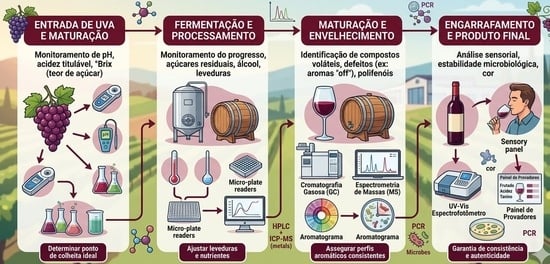
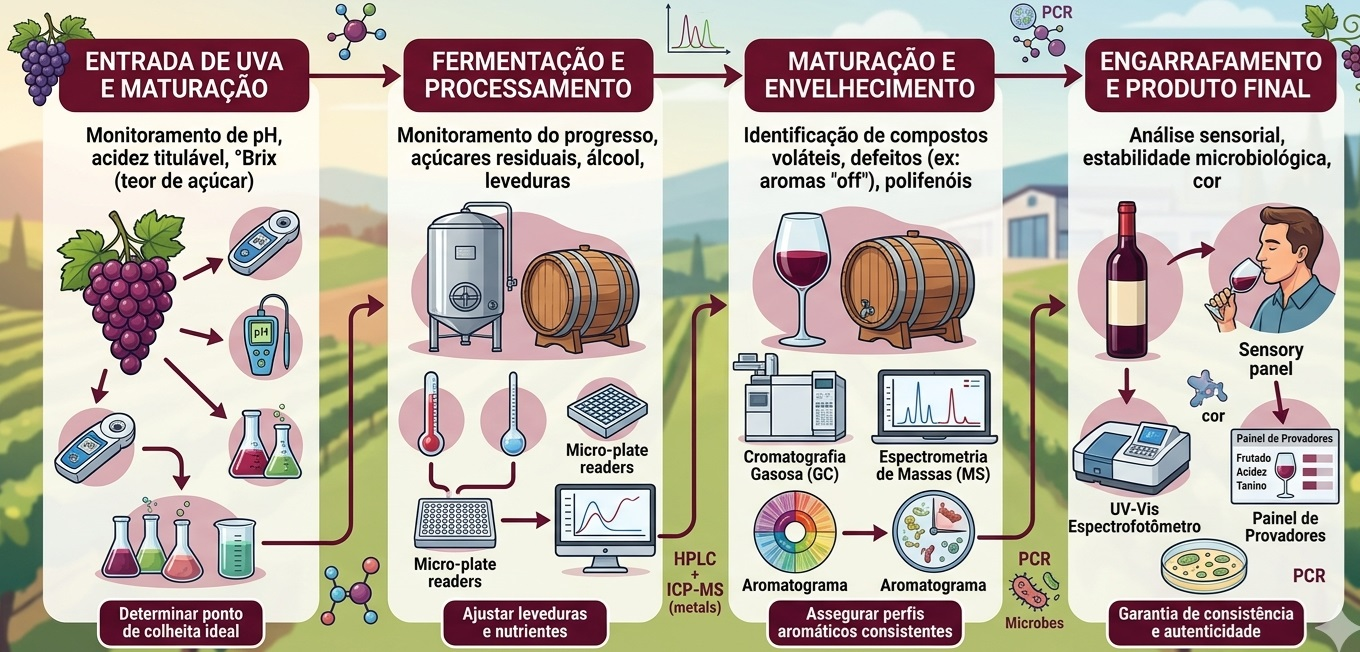
Graphical Abstract

1. Introduction

Wine, since ancient times, has been one of the most consumed beverages around the world. Its appeal is a result of the high diversity and complexity of flavors, which is shaped by a mix of ampelographic, edaphoclimatic and human factors [1].
Hence, the pricing of wines has achieved a considerably broad range, thereby rendering it a prime target for fraud. To curb illicit activities, international regulatory frameworks have become increasingly stringent. In fact, several key OIV quality parameters, such as ethanol, sulfites, reducing sugars, total and volatile acidity, pH, color, and soluble solids, must be strictly monitored. Furthermore, to guarantee product safety and compliance, routine quality control protocols must encompass the determination of glycerol, sucrose, biogenic amines, heavy metals, cyanide, benzoic acid, methanol, pesticides, mycotoxins, ethyl carbamate, and pathogenic microorganisms [2,3,4,5,6].
These fascinating quality attributes are governed by its complex composition, a highly complex matrix wherein alcohols, sugars, polysaccharides, organic acids, minerals, proteins, polyphenols and volatile compounds interact chemically and physicochemically, producing a myriad of sensorial perceptions [6,7,8,9,10,11].
Within this matrix, the vast class of polyphenols, including catechins, flavonoids, tannins, coumarins, stilbenes, and hydroxycinnamic acids, modulates wine color, flavor, taste, and astringency, while also exerting direct and indirect antioxidant, cardioprotective, neuroprotective, and antimicrobial effects [9,12,13,14].
Since polyphenolic profiles are highly susceptible to edaphoclimatic variations, the vintage remains pivotal in dictating both wine quality and market value. Given that color parameters are closely tied to this polyphenolic composition, they have been extensively investigated for age-prediction purposes. Specifically, the relationship between early polymeric pigments and malvidin-3-glucoside has emerged as a promising, practical chemical marker for the rapid and simple age assessment of dry red wines [15]. Consequently, both targeted and non-targeted profiling of distinct phenolic classes have been widely explored as robust strategies for wine authentication [16].
To unravel these intricate interactions and safeguard product integrity, the evaluation of wine authenticity has increasingly relied on the integration of advanced analytical techniques with robust chemometric tools [1,4,6].
Among the instrumental analyses explored and applied in the wine sector, spectrometric, chromatographic, capillary electrophoresis, and electrochemical techniques stand out as current and future trends in the wine industry. Newer approaches include digital imaging methods, microfluidic devices and microchip-based technologies, often bolstered by statistics, chemometrics, and/or machine learning insights [1,3,15,17,18,19,20,21,22].
The present review will include the following topics: Section 3.1 Classical OIV Methods (very briefly); Section 3.2 Separation Methods in Wine Analysis, Section 3.2.1 Liquid Chromatography, Section 3.2.2 Gas Chromatography, Section 3.2.3 Capillary Electrophoresis; Section 3.3 Spectrometric Methods in Wine Analysis, Section 3.3.1 Ultraviolet-visible Spectroscopy, Section 3.3.2 Medium Infrared, Section 3.3.3 Near-Infrared, Section 3.3.4 Raman Spectroscopy, Section 3.3.5 Atomic spectroscopy, Section 3.3.6 Nuclear Magnetic Resonance, Section 3.3.7 Mass Spectrometry; Section 3.4 Wine electroanalysis; Section 3.4.1 Potentiometric Methods, Section 3.4.2 Voltammetric methods, Section 3.4.3 Electrochemical methods and redox status of wines, Section 3.4.4 Electrochemical (Bio)sensors and sensorial attributes, Section 3.4.5 Electronic tongues and electronic noses in enology; Electronic tongues for wine classification, including: electronic noses for wine classification, electronic noses for wine aging monitoring, electronic noses and electronic tongues for wine defect.

2. Materials and Methods

This review was based on the following keyword combinations:
Wine AND Quality Control; Wine AND Chromatographic Methods; Wine and Spectrometric Methods; Wine AND Voltammetric Methods; Wine AND Electroanalytical; Wine AND Quality Parameters; Wine AND Analytical Tools AND Authenticity; Wine AND Analytical Methods; Wine AND Electroanalysis; Wine AND NIR; Wine AND UV; Wine AND Mass Spectrometry; Wine AND Microfluidic.

3. Analytical Methods in Wine Chain

3.1. Classical OIV Methods

The International Organization of Vine and Wine (OIV) advocates the verification of mandatory quality and authenticity parameters for wine. These regulatory requirements are performed using official reference methods, which are predominantly based on classical wet-chemical analyses. These procedures are published and periodically updated in the Compendium of International Methods of Wine and Must Analysis. Some relevant examples include the use of redox titrimetry to quantify sulfite content and total reducing sugars, as well as acid–base titrimetry to determine total and volatile acidity. Another example is the combination of distillation and densitometry to evaluate alcoholic strength [1,2,3,4,5,6].

3.2. Separation Methods in Wine Analysis

Chromatographic techniques applied to enological matrices have emerged as indispensable tools for ensuring both quality and authenticity. The literature shows how chromatographic techniques are crucial in the quality control evaluation and classification of premium alcoholic beverages, including cognacs and wines. Given the complexity of wine—which encompasses more than a thousand different compounds and whose concentrations can vary widely from 100 g per liter to 0.1 ng per liter [23]—detailed characterization requires techniques with high selectivity and sensitivity. Consequently, chromatographic methodologies enhance the accuracy of quality control protocols, facilitating the precise identification of counterfeit products, adulterations, or vinification anomalies [24], while enabling the isolation, identification, and quantification of diverse chemical compounds.
A remarkable diversity of volatile substances directly affects the flavor and aroma, which are crucial attributes to its sensory identity. Wine aroma comes from its volatile components, including esters, alcohols, acids, lactones, carbonyl compounds, volatile phenols, and volatiles containing sulfur and nitrogen [23]. In addition, non-volatile constituents—including polyphenols, amino acids, and biogenic amines—impact both sensory profile and the chemical and physical stability [23].
To overcome the intrinsic limitations of single-method approaches, combining complementary analytical techniques is essential to generate comprehensive and reliable compositional profiles. This multi-analytical framework enables the trace-level detection of contaminants, pesticide residues, and undesirable compounds, thereby ensuring consumer safety and strict compliance with international regulatory standards [25,26]. Although older methods such as gravimetry, titrimetry, and colorimetry, are still used for some analyses, chromatography has brought major advances to wine analysis. Almost all chemical compounds present in wines can be analyzed through chromatography, whether by direct injection or prior derivatization [23].
As a rule of thumb, chromatographic techniques are hyphenated, meaning they are always coupled to a detection system. They can be classified according to this detection system and according to the physical state of the mobile phase, into gas (GC) and liquid chromatography (HPLC), as well as capillary electrophoresis (CE) (Figure 1).

3.2.1. Liquid Chromatography

Liquid chromatography, especially High Performance Chromatography (HPLC) combined with detectors such as UV-Vis, DAD, and mass spectrometry (MS and MS/MS), and Comprehensive Two-Dimensional Liquid Chromatography (LC × LC), are widely used to obtain the molecular profile of wine samples, including the identification and quantification of compounds such as organic acids, sugars, alcohols, phenolic compounds (anthocyanins, flavonols, catechins), amino acids, and biogenic amines [23].
HPLC offers usually high separation capacity, robustness, precision, and high reproducibility. In addition, the selectivity and sensitivity of those hyphenated techniques can be improved by the application of chemometric methods such as Principal Component Analysis (PCA) and Partial Least Squares Discriminant Analysis (PLS-DA); this helps extract important information, contributing to the assurance of wine quality and authenticity [24,25,26,27].
The HPLC-UV is cheap and simple for routine sugar/acid checks but lacks sensitivity and suffers from compound overlapping. Yet, LC-MS/MS and LC × LC, offer ultra-sensitive trace detection and unmatched separation for complex polyphenols, but are highly expensive and complex. Therefore, Wineries typically choose UV detectors for daily operational decisions (like monitoring fermentation), while an MS detection system or LC × LC is generally reserved for application in advanced research, authentication, and food safety compliance [23,24,25,26,27,28].
The analysis of biogenic amines (BAs) and amino acids (AAs) through hyphenated liquid chromatography is crucial for assessing wine quality [24,28].
Amino acids act as precursors to crucial aroma and flavor compounds and are vital for yeast nutrition [28]. Thus, the relation between amino acid profile and aromatic potential is a useful approach to monitor the enological processes [24].
Biogenic amines, in turn, have economic impact, as they can cause intoxication, especially for people with intolerance; they also serve as indicators of food quality or deterioration. For example, the concentration monitoring of putrescine, cadaverine, histamine, tyramine, phenylethylamine are of utmost importance for evaluating quality, safety, and potential effects on consumer health [28].
Studies demonstrate the development and validation of HPLC-MS/MS methods with pre-column derivatization, using dansyl chloride to simultaneously quantify 22 amino acids and 12 biogenic amines in enological samples, in which the collum was chosen due to the chloride reactivity with primary and secondary amino groups—producing highly absorbent and fluorescent derivatives that are easily captured by both spectroscopic and mass detection systems [24].
In fact, HPLC-derivatized columns aligned to fluorescence detection is a widely used technique for the analysis of biogenic amines in wines. Such agents react with amines, creating derivatives that are easily detected by chromatographic systems such as fluorescence [29]. Similarly, HPLC linked to UV-Vis spectroscopy (HPLC-UV-Vis) is widely applied to generate multidimensional fingerprints (absorbance × retention time × wavelength). When integrated with chemometrics, these combined analytical outputs provide a powerful framework to model chemical parameters, correlate compositional profiles with sensory data, and evaluate the effects of winemaking practices or environmental factors on production [24,25].
Beyond nitrogenous compounds, and owing to the technological and regulatory value, the chromatographic analysis of phenolic profiles represents another indispensable tool for wine qualification and authenticity. Phenolics are the most influential sensory factors in red wine, directly dictating structural attributes such as astringency, bitterness, color, and overall flavor, as well as the biological role of these compounds as dietary antioxidants and antimutagenic agents [30,31]. Furthermore, because the phenolic fingerprint directly reflects specific grape-growing conditions and winemaking interventions, it serves as a reliable investigative basis to authenticate a wine’s vintage year, variety, and geographic origin [31,32,33,34,35].
Reverse-phase HPLC (RP-HPLC), usually packed with spherical silica particles bonded to octadecyl chains (C18), is the benchmark for analyzing monomeric phenolic compounds in wine [30]. Proper sample preparation prior to injection can improve extraction and concentration of these compounds, balancing run time, recovery, and artifact formation. Methods such as liquid–liquid extraction (LLE) and solid-phase extraction (SPE) may vary in effectiveness across different phenolic classes. When the sample is injected directly, high column resolution and an appropriate elution gradient are essential to minimize interferences. However, both cleanup procedures and long elution programs can prolong analysis, making it less viable for rapid quality control [30].
Despite these trade-offs, targeted RP-HPLC applications provide definitive regional and chemical insights. For instance, a study evaluating native red wines from Turkey successfully separated 14 major phenolic compounds, including gallic acid, catechin, and resveratrol, in a single run. This method optimized separation using a Zorbax Eclipse XDB-C18 column operated at a 1 mL/min flow rate, utilizing a mobile phase gradient of methanol and water acidified with 0.2% formic acid. Coupled with simultaneous UV-Vis and fluorescence detection, this validated protocol delivered the precision, accuracy, and sensitivity required to correlate polyphenol profiles directly with the total antioxidant capacity of the wines [31].
Beyond monomeric phenolics, RP-HPLC is instrumental in analyzing oak-derived ellagitannins, which modulate wine texture and serve as chemical markers to verify aging duration, winemaking practices, and authenticity (e.g., French vs. American oak) [33]. A newly developed analytical method presents major advantages over previous techniques: the extraction was simplified to a single step, using solid-phase extraction (SPE) with Sephadex LH-20, eliminating the need for preliminary steps with reversed-phase materials. To avoid the co-elution of ellagitannins, the method eliminates the need for additional steps with reversed-phase materials. This process facilitates the recovery of ellagitannins, especially acutissimins, which are more difficult to extract due to their polarity. Elution of the compounds from the column is carried out with a combination of methanol and ethyl acetate, improving recovery of the less polar ellagitannins. Chromatographic separation of the compounds is performed with a fused-core C18 column, preventing major ellagitannins such as vescalagin and roburin E from overlapping, which improves the accuracy of quantification [33].
Additionally, the proposed methodology also allows simultaneous analysis of gallic and ellagic acids, which are other important phenolic compounds found in wine. This makes the method more efficient, as all these compounds can be analyzed in the same chromatographic run, saving time and resources. It is therefore a more advantageous method, being simpler, faster, and more precise [33].
Comprehensive two-dimensional liquid chromatography (LC × LC) provides unmatched solving power to separate the thousands of co-eluting organic compounds present in wine, such as glycerol, sugars, organic acids, amino acids, aliphatic alcohols, and complex polyphenols. However, to accelerate screening and sample classification, chemometric workflows have become indispensable. For target peak identification in scenarios with limited sample history, unsupervised models like the Similarity Index can isolate variance without prior classification, whereas supervised methods like the Fisher Ratio leverage known sample classes to identify chemical markers responsible for distinguishing geographical origins [27].
HPLC can also be used for isocratic separation and quantification of the main organic components found in wine and grape must. One method uses a dual cation-exchange column system, eliminating the need for complex sample preparation and requiring only filtration through a 0.45 µm membrane before injection into the HPLC system. The total analysis time is less than 40 min. In its statistical evaluation, the developed HPLC method demonstrated consistent, precise, and reliable results, with repeated analyses of the same sample maintaining performance over time. Analytical throughput increased, since a larger number of samples could be analyzed in a shorter period. This stable and reproducible framework significantly enhances laboratory throughput, delivering a comprehensive profile of multiple target analytes in a single run without sacrificing analytical precision [34].
When multi-wavelength detectors are coupled to these chromatographic systems, advanced mathematical parsing is required to clarify complex wine chemistry. Data profiles obtained from multiple samples are typically arranged into a three-dimensional tensor (samples × retention time × wavelengths) and processed via Parallel Factor Analysis (PARAFAC2) [25]. Combined with mathematical preprocessing, such as smoothing and baseline correction, PARAFAC2 successfully resolves sample-to-sample chromatographic retention time shifts. By decomposing the complex tensor into pure mathematical profiles of individual chromatograms, UV-Vis spectra, and relative concentrations, this targeted approach refines the characterization of wine composition and aids in the optimization of industrial winemaking processes [25].
High-performance thin-layer chromatography (HPTLC) and micro-planar chromatography (μ-PLC) are other separation methods that are highly useful for quality control of wine during the production process. These methods provide a robust, accessible, and rapid framework for both small- and medium-sized wineries, enabling the profiling of key wine components and offering cost-effectiveness. HPTLC and μ-PLC are high-throughput alternatives for wine quality control, allowing direct analysis of diluted samples to monitor fermentation and detect adulteration [32].
The HPTLC allows simultaneous analysis of up to 20 samples per plate, while μ-PLC uses simple, accessible, and easy-to-operate equipment, even for individuals without technical training. The HPTLC method can be applied directly in μ-PLC without modifications, reinforcing the potential of these techniques as low-cost tools for wineries.
The plates used in the analyses also showed high tolerance to samples, allowing the direct use of diluted wine without the need for complex preparation steps. Therefore, these are two promising and accessible solutions for quality control in the wine industry, especially for small- and medium-sized wineries [35].

3.2.2. Gas Chromatography

Gas chromatography (GC) is the premier analytical tool for characterizing the volatile fraction of wine, which governs its complex aromatic and organoleptic profile. As an intricate hydroalcoholic matrix containing over a thousand constituents, wine requires the high separation capacity of GC to resolve volatile, thermally stable compounds across wide concentration ranges. This technique successfully targets diverse aroma classes, including esters, alcohols, acids, lactones, carbonyl compounds, volatile phenols, terpenes, and sulfur- or nitrogen-containing molecules. Investigating these trace components is essential because olfactory relevance does not strictly correlate with chemical abundance; due to the high sensitivity of the human olfactory system, molecules present at trace levels often exert a disproportionately high impact on the final bouquet [23].
Consequently, one of the most powerful applications of GC in wine characterization is its coupling with olfactometry (GC-O). This hybrid approach combines the separation power of GC with sensory evaluation performed by one or more trained assessors. GC-O enables the detection of odor-active compounds that effectively impact olfactory perception even at very low concentrations. In many cases, compounds present at trace levels have greater sensory influence than substances found in larger amounts [36,37,38,39].
In a conventional GC-O system, the effluent from the chromatographic column is typically split into two streams: one directed to an analytical detector, such as mass spectrometry (MS) or flame ionization detection (FID), and the other to an olfactory port, where a trained assessor smells the compounds as they elute, recording odor descriptors, intensity, and sometimes duration for each perceived compound [37,38].
To quantify the sensory contribution of odorants, GC-O can employ different methods, such as detection frequency methods, dilution-to-threshold methods like Aroma Extract Dilution Analysis (AEDA), and direct intensity methods. AEDA, for example, quantifies odor potency as the highest dilution at which an odor is still perceived [37].
The analytical power of quantitative GC-O is routinely leveraged to establish direct correlations between volatile profiles and ultimate wine quality [36]. For instance, a comprehensive study mapped the aromatic composition of 25 premium Spanish red wines, successfully characterizing up to 65 distinct odorants, including the identification of (Z)-2-nonenal in these matrices [38]. The study demonstrated that perceived sensory quality was rarely governed by an isolated compound. Instead, it depended on complex olfactometric vectors composed of multiple synergistic molecules. Furthermore, the integration of specific off-flavor markers—such as 2-methoxy-3,5-dimethylpyrazine, 4-ethylphenol, 3-ethylphenol, 2,4,6-trichloroanisole, and o-cresol—revealed that these negative odorants exert a powerful suppressive effect, masking pleasant fruity notes and severely depreciating the wine’s final sensory score [38].
GC coupled with mass spectrometry (GC-MS) is the standard technique for volatile profiling, relying on the comparison of mass spectra and retention indices against commercial databases and chemical standards [39]. GC-MS offers high sensitivity for the identification and quantification of volatile compounds. A recent example is the detection and quantification of potent ethyl esters such as ethyl 2-, 3-, and 4-methylpentanoate and ethyl cyclohexanoate, which have extremely low odor thresholds. These esters, formed slowly by esterification of acids with ethanol, are relevant in sweet wines, where they can be major contributors to sweet–fruity notes [40].
To bridge the gap between this chemical quantification and olfactory perception, data is regularly evaluated through the Odor Activity Value (OAV), defined as the ratio between a compound’s concentration and its specific odor threshold [39]. Volatiles exhibiting OAV greater than 1 are categorized as primary aroma contributors. Nonetheless, sub-threshold compounds (OAV between 0.1 and 1) cannot be disregarded, as they actively modulate the overall sensory profile through interactive perceptual phenomena like synergy or masking [39].
Achieving the sensitivity required for these calculations strictly depends on sample preparation, which isolates volatile targets from the complex hydroalcoholic wine matrix [36,40]. Conventional approaches like liquid–liquid extraction (LLE), solid-phase extraction (SPE), and classic headspace systems (static and dynamic headspace, SHS/DHS) are widely deployed, each presenting specific trade-offs regarding solvent consumption and volatility bias. To overcome these limitations, modern solventless alternatives such as solid-phase microextraction (SPME) and stir-bar sorptive extraction (SBSE) offer superior enrichment factors, enabling the precise, ultra-trace quantification of low-abundance volatile compounds [40].
Moreover, various mass spectrometry technologies are employed. Among these, Single-Quadrupole Mass Spectrometry is commonly used for compound identification and quantification. With Ion-Trap Mass Spectrometry (GC-ITMS), selectivity improves due to ion-processing techniques [41]. Time-of-Flight Mass Spectrometry (GC-TOF-MS) provides high acquisition speed and sensitivity, making it particularly useful for analyzing complex profiles [26]. Finally, High-Resolution Mass Spectrometry (HRMS), such as GC-QTOF-MS (Gas Chromatography coupled to Quadrupole Time-of-Flight MS), drastically reduces spectral interferences and offers high selectivity and sensitivity even for compounds present at very low concentrations, ensuring accuracy in complex analyses [26].
Due to the complexity of the wine matrix, chromatographic co-elutions frequently challenge conventional systems. To overcome these peak-capacity limitations, comprehensive two-dimensional gas chromatography (GC × GC) is increasingly deployed. By linking two columns with orthogonal stationary phases through a modulator, GC × GC drastically enhances peak capacity, successfully resolving overlapping signals to isolate minor, low-abundance volatile compounds. When hyphenated with mass spectrometry (GC × GC-MS), this platform yields an extremely detailed molecular mapping of the headspace, serving as a powerful tool to unravel chemical complexities that elude one-dimensional steps.
This advanced separation resolution is particularly vital for identifying specific odor-active markers that govern the sensory quality of fine wines. While conventional GC-MS and GC-O frameworks routinely monitor major volatile classes, such as esters, higher alcohols, volatile phenols, and terpenes, GC × GC-MS excels in tracking highly potent micro-constituents like norisoprenoids. Among these, β-damascenone stands out; despite its presence at ultra-trace levels, this compound acts as a critical aromatic driver, underpinning the sweet fruity and floral notes that define premium wine profiles [42].
In addition to mapping desirable profiles, GC also allows for the detection of undesirable compounds responsible for giving off aromas. Examples include certain fatty acids (butanoic, hexanoic, octanoic acids), methoxypyrazines (such as 3-isobutyl-2-methoxypyrazine), and volatile phenols (4-ethylphenol, 4-ethylguaiacol). The presence and concentration of these compounds can serve as markers of microbiological or storage-related issues [39].
Studies have used GC-O data to build models that predict the quality of red wines based on the presence of off-odors and fruity odorants [38]. GC analysis also makes it possible to understand how factors such as grape variety, terroir, yeast strain, fermentation temperature, and aging techniques influence the volatile profile of wine [37]. This enables clear links to be drawn between chemical composition and sensory perception, especially when combined with sensory evaluation methods such as Quantitative Descriptive Analysis (QDA).
GC can be used to monitor the formation and evolution of volatile compounds during wine fermentation and aging [43]. This is vital for quality control, allowing interventions when necessary and optimizing production techniques to achieve the desired aroma profile. Recent studies have shown that integrating GC data with sensory analyses is a powerful approach for predicting wine quality, identifying the compounds that contribute most to positive and negative attributes [38]. Additionally, advanced techniques such as GC-QTOF-MS can be used to detect contaminants, such as pesticide residues and undesirable phenols, contributing to the safety and consumer acceptance of the final product [26].
Some representative examples of chromatographic methods applied to wine analysis are shown in Table 1.

3.2.3. Capillary Electrophoresis

Beyond chromatographic platforms, the analysis of wine by microchip electrophoresis—with special emphasis on providing background information to achieve the differentiation of wines according to botanical origin, provenance, vintage and quality or assure wine authentication—was reviewed. Most of the approaches have been focusing on wine compounds such as phenols, organic acids, inorganic species, aldehydes, sugars, alcohols, proteins and neuroactive amines [44,45].
Three polyphenolic acids (gallic, caffeic, and syringic acids, and three flavonoids, kaempferol, quercetin and myricetin) were separated and determined by CE in red wine from Brazil’s region Vale do São Francisco. The limit of detections and relative standard deviations were lower than 2.24 mg L−1 and 3.50%, respectively [46].
The application of CE relies mainly on polyphenols and protein determinations. The polyphenol determinations are intrinsically related to the quality and the antioxidant properties of wine [45,46]. The second aspect is mostly concerned with microbiological contaminations at vineyards and enological practices [45].
A CE method allows the fast (25 min) and simultaneous determination of twenty polyphenols in Spanish wines, using a 30 mM sodium tetraborate buffer (pH 9.2) containing 5% isopropanol as electrolyte and +25 kV capillary [47].
In addition to small molecules, CE was applied to evaluate the wine protein profiles. It was noticed that protein peaks were protease-sensitive, suggesting stability of wine regarding protease degradation. Furthermore, since the vintage, the winemaking conditions, and distinct varietals exert an effect on the magnitude of CE peak signals, CE emerges as a potential tool for wine authenticity [45,48].

3.3. Spectrometric Methods in Wine Analysis

Spectroscopic methods for wine and grape analysis, including atomic spectroscopy (AAS, ICP) and molecular techniques such as ultraviolet/visible and infrared spectrophotometry, represent a streamlined, high-throughput alternative to traditional hyphenated separation methods, with several of these technologies heavily utilized in international research [3].
While mass spectrometry (MS) and nuclear magnetic resonance (NMR) are advanced tools used in this field, they are generally considered high-resolution, complex techniques, rather than streamlined, direct optical methods [3].

3.3.1. Ultraviolet-Visible Spectrometry

Ultraviolet-visible (UV-Vis) absorption spectroscopy serves as a fundamental high-throughput screening tool for winemaking matrices, relying on the characteristic electronic transitions of their primary chromophores. While high-energy transitions of carbonyl groups in organic acids yield absorption maxima at 202 and 230 nm, the structurally diverse phenolic fraction absorbs across a broader 220–550 nm range. This allows for rapid, baseline profiling of benzoic acids (235–305 nm), hydroxycinnamic derivatives (227–245 nm; 310–332 nm), flavonols (250–270 nm; 350–390 nm), and anthocyanins (267–275 nm; 475–545 nm). Although these spectral signatures can drastically minimize analysis time and easily discriminate broad varietal typologies, such as verifying the diagnostic absence of anthocyanins in white wines, the primary limitation of direct UV-Vis measurements is its inherently low selectivity. Severe band overlap, particularly among flavanol monomers, polymers, and tannins within the 280–290 nm region, hinders the quantification of individual compounds without prior chromatographic separation.
To bypass this resolution barrier and capture non-chromophoric macronutrients, modern enological screening extends into near- and mid-infrared (NIR/MIR) vibrational domains. Here, overtones and combination bands resolve fluctuations in sugars (~1200 nm), the aqueous matrix (950–1460 nm), and fundamental ethanol-carbohydrate interactions (2302 nm). Rather than relying on isolated wavelength data, the true utility of molecular spectroscopy is unlocked when coupled with multivariate chemometric tools. This synergy transforms a rapid, non-destructive, and cost-effective sensor into a robust predictive platform capable of tracking oxidative aging kinetics, monitoring fermentation sugars, detecting exogenous colorant adulteration, and characterizing stable polymeric pigments during storage [49,50,51,52,53,54,55,56,57,58,59].

3.3.2. Medium Infrared

Parallel to UV-Vis platforms, infrared spectroscopy is widely used in wine production due to its non-destructive nature, minimal sample preparation times and rapid data acquisition [60,61]. Its application is based on the molecular vibrations that occur in the infrared radiation region; when a sample is irradiated with IR light, characteristic bonds such as C–H, O–H, C=O, and N–H, among other structural information, can be detected [60].
Mid-infrared (mid-IR) domains range from 4000 to 400 cm−1 and can be segmented into: the stretching region (4000–2500 cm−1), the triple-bond region (2500–2000 cm−1), the double-bond region (2000–1500 cm−1), and the fingerprint region (1500–400 cm−1) [60,61]. For organic acids such as tartrate and malate, C=O stretching vibrations are expected near 1720 cm−1; for citrate, approximately 1400 cm−1; and for volatile acids, C–H vibrations appear near 1375 cm−1. For glycerol, the main range used for quantification in wine samples—based on studies combining mid-IR with partial least squares regression—appears near 1229–929 cm−1; for ethanol and sugars, C–H related vibrations appear in the range of approximately 2300–2100 cm−1 [61,62].
To circumvent these resolution limitations, the state-of-the-art relies on the synergy between Fourier-transform infrared (FTIR) spectroscopy and advanced chemometric modeling. Rather than monitoring isolated peaks, multi-component matrices are resolved simultaneously via data-driven regressions and variable selection algorithms (e.g., PLS, SVR, and Fisher discriminant selection). This chemometric integration upgrades FTIR from a qualitative fingerprinting tool into a highly robust, quantitative, and multi-parametric platform. Consequently, it achieves the simultaneous determination of primary sugars, alcohol, glycerol, and volatile acidity, while providing the multidimensional sensitivity necessary for geographical traceability, quality parameter verification, and origin authentication [63,64,65,66].

3.3.3. Near-Infrared

In enological matrix screening, near-infrared (NIR) and mid-infrared (MIR) spectroscopies offer complementary spectral windows, though they face distinct challenges regarding solvent interference. The MIR domain is heavily masked by strong aqueous fundamental absorptions (1716–1543 and 3626–2970 cm−1), compelling researchers to either exclude these high-noise regions during multivariate modeling or rely strictly on the highly descriptive fingerprint zone (1600–929 cm−1) to monitor C–O, C–C, and C–H bond vibrations [3,67]. In turn, the NIR spectrum of wine is fundamentally dictated by intense O–H overtone and combination bands of water and ethanol, centered around 1450 and 1940 nm (6900 and 5150 cm−1), respectively.
The region from approximately 5000 to 3626 cm−1 does not contain much useful information, being often excluded due to the noise introduced into the IR spectra from these regions [3].
The advantages described include practicality, low cost, and being a non-destructive, rapid technique that requires no sample preparation and that can be used for both quantitative and qualitative analyses. Nevertheless, since NIR spectroscopy lacks the sensitivity required for trace analytes, resolving complex matrices relies heavily on fusing multi-wavelength data streams with multivariate chemometrics [68,69].
The discriminatory power of rapid optical tools coupled with chemometric approaches enables precise geographical provenance verification and distinguishes Protected Designation of Origin (PDO) products with classification rates that often outperform conventional benchtop FTIR-ATR methodologies [68,69,70].
When properly calibrated against reference chemical and sensory data, chemometric-assisted NIR spectroscopy can be extended to predict qualitative commercial attributes, including flavor persistence, astringency, and oxidative defects [70,71,72]. The practical viability of this approach is clearly validated in vineyard management, where the deployment of handheld, portable NIR devices allows for non-destructive, in situ monitoring of grape quality. Instead of relying on laboratory-bound, destructive assays, these field-ready sensors can simultaneously quantify total phenols, flavonoids, anthocyanins, and condensed tannins across diverse red grape cultivars. Hence, the synergy between matrix-specific chemometrics and portable instrumentation effectively bridges immediate agronomic field metrics with post-harvest processing and downstream quality assurance [68].
NIR combined with chemometrics was also effective to evaluate through the chemical composition and coloration, the type of grape in must and wines. The Croatian grape, ‘Maraština’ from Dalmatia was the case study [70].

3.3.4. Raman Spectroscopy

Also belonging the vibrational group, Raman spectroscopy stands out as a highly efficient, non-invasive tool in the alcoholic beverage industry, enabling product authentication and quality control directly through clear glass containers without compromising sample integrity [73,74]. In terms of constituent quantification, the technique allows for the precise determination of alcohol content in beverages by focusing on the ethanol band at 880 cm−1 [74]. It also monitors free and total sulphite concentrations—a critical additive for microbiological and sensory control—by targeting specific spectral regions associated with S–O stretching (770–1700 cm−1) and O–H/S–H stretching (2000–2400 cm−1) [75].
When combined with Fourier Transform and chemometric tools, the methodology enhances traceability, achieving up to 100% accuracy in validating geographical origin, identifying grape varieties, and differentiating wine vintages and aging times [76,77]. In this context, the technique was also applied to the differentiation of white wines when combined with chemometrics. Initial validations achieved 100% accuracy for geographic differentiation of wine type and 100% differentiation by vintage [77].
Furthermore, the use of low-cost, portable devices facilitates the rapid determination of bioactive compounds such as polyphenols, anthocyanins, and tannins, establishing this technology as a viable solution for real-time, field analysis during processing, transportation, and commercialization [67,73].

3.3.5. Atomic Spectroscopy

Atomic spectroscopic techniques, such as flame atomic absorption spectroscopy (AAS) [78] and electrothermal AAS [79], are predominantly utilized for the determination of mineral and metal content in wines. Beyond routine regulatory compliance, multi-elemental analysis can establish the geographical authenticity of wine when combined with multivariate statistical methods and the evaluation of provenance soils. This fingerprinting approach operates on the premise that the provenance soil is the primary contributor to a wine’s trace element profile [80,81]. For instance, the determination of 40 elements via inductively coupled plasma-mass spectrometry (ICP-MS)—where 20 specific elements carried geographic data—yielded a remarkably high success rate in classifying wines from distinct origins [80,81]. Furthermore, combining principal component analysis (PCA) with linear discriminant analysis (LDA) successfully demonstrated a direct correlation between the elemental composition of wines and their native soils, fulfilling a critical prerequisite for origin verification methodologies [82]. Quadrupole-based ICP-MS has also been implemented to analyze the isotopic ratios 11B/10B and 87Sr/86Sr of wines and soils of four major South African wine-producing regions and to establish a fingerprint for origin verification of the wines. While the 11B/10B ratios utilized as independent variables in LDA alongside trace element concentrations provided a highly successful classification method, the 87Sr/86Sr ratios showed limited potential as indicators of origin [82].

3.3.6. Nuclear Magnetic Resonance

Proton nuclear magnetic resonance (H1 NMR) has been widely used in metabolomics studies involving wine. The technique offers advantages such as being non-destructive, robust, and reproducible. NMR combined with chemometrics has been used to evaluate factors such as temperature and bottle-opening time, which directly influence the physicochemical composition of wines [83].
The NMR technique is also applied in the context of food safety, since products derived from red grape pomace have a high risk of contamination by mycotoxins produced by the fungus Aspergillus carbonarius. In this regard, methods for removing ochratoxin A have been evaluated through NMR to assess metabolic variations in red wines resulting from ochratoxin A removal processes [84].
NMR has applications in evaluating the fermentation process, monitoring alcohol content, and characterizing polysaccharides. Similar applications have been achieved using benchtop NMR equipment to monitor the wine fermentation process [85,86].
Using NMR, the methanol content in samples of apple wine was quantified, demonstrating a faster, simpler, and more advantageous approach compared to gas chromatography–mass spectrometry, while showing similar results between the techniques [87].
Therefore, such high resolution and conclusive, but expensive techniques can be applied for wine authentication, origin tracking, and adulteration detection.

3.3.7. Mass Spectrometry

Through mass spectrometry coupled with liquid or gas chromatography, the aging characteristics of wine can be monitored. In this way, volatile and polar compounds released from wood during the aging period can be tracked and quantified [88].
The technique also has applications in tracing wine production. By combining experimental techniques such as isotope ratio mass spectrometry, high-resolution mass spectrometry, and NMR, it is possible to determine the origin of the wine, its chemical composition, climate- and location-related information, as well as the quantification of secondary metabolites [89].
Using this technique, the aromatic characteristics of wine can be analyzed in combination with chemometrics. Thus, gas chromatography coupled with mass spectrometry contributes to guiding vineyard management practices with the aim of optimizing metabolomics [90].
To ensure quality control, mass spectrometry coupled with liquid chromatography has been used to monitor residues of up to 48 types of pesticides present in wines [91].
Some representative applications of spectrometric methods in wine analysis are presented in Table 2.

3.4. Wine Electroanalysis

The electrochemical methods are well recognized as fast and cost-effective tools, meeting the required analytical parameters for wine analysis. Since wine is a noticeable source of antioxidants and other electroactive species, their electrochemical characterization might be promising for quality purposes. In fact, the electroanalytical techniques provide valuable data related to antioxidant activity, polyphenolic profile, as well as heavy metals and sulfite determinations [92,93,94,95].
Furthermore, the coupling of electrochemical sensors and biosensors to flow and microfluidic systems, bolstered by chemometrics and machine learning techniques, broadens the scope of applications for wine electroanalysis. The literature presents many paper, in which, electrochemical biosensors and nanomaterial-based sensors sensitive to glucose, alcohol, malic and lactic acids, phenolic compounds, proteins and other wine targets were developed [96].
Electronic devices able to mimic human noses and tongues were developed through the combination of various electrochemical sensors. Thanks to the great advances in this field, electronic noses and tongues have been successfully used for authenticity assays [96,97].
In turn, the electroanalytical methods for wine analysis could be divided in two main classes, potentiometry and voltammetry. For each class, we will present relevant examples of specific electrochemical sensors and their applications.

3.4.1. Potentiometric Methods

Owing to the great variety of ion-selective electrodes, the potentiometric methods have proven to be powerful tools in enology. The determination of (Cl, F, Br, I, S, NO3−, CO3− …) and cationic (K+, Ca2+, NH4+, …) species have been extensively described [98].
For instance, a novel paper-based electronic tongue, composed of electrodes sensitive to sodium, calcium, and ammonia and a cross-sensitive, anion-selective electrode, was able to classify wines produced from different varieties of grapes (Chardonnay, Americanas, Malbec, Merlot) using a sample volume of only 40 μL [99].
Regarding specific macro-elements, the K+ determination in different wine and grape juice samples, reached a detection limit of 75 ± 12 mg L−1, through a microfluidic system coupled to potentiometric detection. The resulting linear range from 250 to 4000 mg L−1, covers all the concentrations expected for potassium in must and wine samples [100].
The determination of heavy metals has also been on target. The measurement of the labile and total copper cations in white wine was achieved by stripping potentiometry. Under optimized conditions, Hg2+ was found to be a more suitable oxidant than O2 for the determination of the labile concentrations, requiring the use of medium exchange. Yet, for lead, O2 exhibited highest oxidant activity for the stripping step, allowing the direct measurement in the wine without the need for medium exchange. However, the higher concentration of polyphenolic compounds in red wines leads to matrix-induced complexation effects on both lead and copper cations [101].
Besides the use of ion-selective electrodes, the total acidity determination, one of the most important quality parameters of wine, has been performed by potentiometric titration [98,102,103].
A copper electrode was applied for the determination of total acidity and citric acid quantification. The determination of citric acid was possible in the presence of 30-fold amounts of tartaric, acetic, malic, succinic acids and a 10-fold amount of oxalic acid after the separation of organic carboxylic acids on an AV-17-8 anion exchanger. The percentage of citric acid in the total acidity, and the shape of the curves of potentiometric titration were proposed for revealing the adulteration of the acid composition of wines [104].
Also, of paramount importance for wine quality, the redox state influences color, aroma, and its stability. In this context, Methional and phenylacetaldehyde were evaluated by potentiometric titration, taking into account the relationship between oxygen consumption in the medium under normal and forced aging conditions, and the production of these undesirable aroma compounds [105].
The redox status is related mostly to polyphenol content and other minor antioxidants. The overall phenolic antioxidants were quantified in some red and white varieties of Croatian wines by derivative potentiometric titration [106].
The application of potentiometric titration was also used on the evaluation of antioxidant activity and oxidation state of white and red table wines. The correlation with the content of monomeric, oligomeric and polymeric forms of phenolic compounds were established. A direct effect of the oxidation state of phenolic substances on their antioxidant activity was also stated, showing it to be a useful criterion to assess the antioxidant properties of wines [107].
However, a drawback of potentiometric redox titrations in enology is the fact that most of the intrinsic compounds undergo irreversible redox processes, leading to mixed potentials rather than ideal Nernstian responses. Moreover, their application is limited by adsorption effects and kinetics delay on commercial electrodes, thus leading to the misunderstanding of results [108].
In this context, the electrogeneration of oxidants at electrode surfaces has been pursued as an alternative. The derivative potentiometric titration with electrogenerated chlorine was investigated for the determination of the antioxidative capacity of 11 Croatian wines, being observed to be a good agreement with conventional techniques [109].
A similar approach was proposed for catechin as a model, in which electrogenerated iodine was used as the oxidant catalyst [110].
The redox titrations were evaluated on the stability of white wines undergoing oxidation, as well as the efficiency of antioxidant additives, i.e., ascorbic acid and sulfite. It was found the higher activity of ascorbic acid, and lack of synergic effect, when both were employed. Moreover, the resistance to oxidation was shown to be an additional tool for wine distinction [105].

3.4.2. Voltammetric Methods

The term, “Food Electroanalysis”, has become popular in recent years [95,111,112]. Owing to its broad applicability in both qualitative and quantitative analysis, voltammetry is the flagship electrochemical technique in enology [93,113,114].
In fact, most of the minor enological compounds are inorganic [115] and organic electroactive species, while the “soul of wine” resides in its polyphenolic profile. The polyphenolic profile is based on a complex mix of phenolic acids, flavonols, anthocyanins, catechins, and proanthocyanidins, among hundreds of other chemical classes, that exert a crucial contribution to the wine taste, color, and aging stability [116].
Despite their significant contribution to stability and sensory attributes, polyphenols possess antioxidant properties and benefits for human health. It is worth noting that voltammetry was the first electrochemical technique used for the determination and characterization of polyphenols in wine [117].
The main voltammetric methods are divided into two non-pulsed and two pulsed techniques, namely in order: linear (LV), cyclic (CV), differential pulse (DPV), and square wave (SWV) voltammetry. Though linear and cyclic voltammetry are the simplest techniques, they lack resolution due to capacitive interferences. Thus, the peaks obtained from linear or cyclic voltammograms tend to be larger and sometimes to merge [94,112,118].
In a comparative study, the total phenol determination of port wines reached values 50% greater with CV, when compared to DPV. This can be explained by the greater ability of DPV to minimize sulfur dioxide (SO2) interference and mitigate capacitive contribution [118].
Another important interfering factor is ascorbic acid, which commonly occurs in fruits and beverages at concentrations of 6 to 60 mg/100 mL. Furthermore, although it appears in much lower concentrations in wine, its oxidation peak occurs at approximately 0.5 V on conventional platinum and glassy carbon electrodes, which is a very close value to that observed for catechol-like polyphenols [119].
Notwithstanding, the simultaneous detection of polyphenols and SO2, is highly relevant in enology. Nevertheless, it is a great challenge if performed by CV at commercial electrodes [120].
To increase the analytical reliability, the coupling of voltammetric and chemometric approaches have been exploited. A disposable carbon paste electrode was proposed to predict chemical composition and wine oxygen consumption rates of 16 red wines by PLS-modeling of the corresponding linear voltammograms.
Some target analytes, SO2, metals and polyphenols were also confirmed by HPLC analysis. It was possible to prove that monomeric and polymerized anthocyanins can be predicted from the first and second wave of the first derivative of voltammograms, respectively—therefore highlighting the usefulness of this cheaper and faster technique [121].
The selectivity and sensitivity of voltammetric methods are also driven not only by pulsed techniques, but also by the working electrode. The carbon-based electrodes are the primary option in wine electroanalysis, due to the intrinsic affinity between organic compounds and carbon surface. Consequently, the improvement of carbon-based electrodes has been on focus. Different nanomaterials, catalysts, biological recognizing agents, and other selective modifiers have been proposed in the development of electrochemical sensors. The current advancements were recently reviewed [116].
For instance, glassy carbon electrodes and disposable screen-printed carbon electrodes unmodified and modified with single- and multi-walled carbon nanotubes were applied to evaluate the phenolic profile of different red wines, using SWV. As expected, the carbon nanotube-modified electrodes showed the best results. The tentative attribution of each SWV peaks were proposed. Whereas the first peak was ascribed to catechol and galloyl moieties on the flavonoid B-ring, the second peak to malvidin anthocyanins oxidation, and the third peak to other phenol moieties of flavonoids [122]. It is worth mentioning that electro-oxidation often leads to the formation of an insulating film on the electrode surface, reducing its active area. This can result in abnormally low total polyphenol content in wines, and is even more critical for screen-printed carbon electrodes, where peak decay can exceed 70%. Mechanical polishing and electrochemical treatments in alkaline solutions to remove this encrusted layer are common practices [123].
Another remarkable example was the high sensitivity towards SO2, exhibited by inkjet printed with electrode gold nanoparticles mixed with silver. This modified electrode allows the ultra-fast CV determination of SO2 in presence of polyphenols. Thus, the low cost and reliability of this low-cost sensor device combined with the simplicity of CV technique is very promising for the wine industry [120].
Therefore, the voltammetric methods in enology are especially applied to polyphenols, but also to a myriad of inorganic and other organic targets, and in any step of wine production, from the grape to the glass of wine.
Most of the studies concerned with polyphenolic compounds are focused on two main objectives: the antioxidant status, and sensorial attributes.

3.4.3. Electrochemical Methods and Redox Status of Wines

The redox status of wines is mostly related to the total polyphenol content, whereas voltammetric approaches using carbon-based electrodes and biosensors have deserved special attention [93,94,95,96].
The redox state expresses the oxidative stability of wine and its antioxidant power; the latter justifies the appeal of this alcoholic beverage in relation to its health benefits [93,94,95,96].
The antioxidant power of wines can be assessed by means of electrochemical index (EI) [93,94,95,96].
The “Blasco EI” was developed at Escarpa group Lab, at Alcala University, Spain. This prior proposal was applied to total natural antioxidant content in food samples, through voltammetric analysis. It works by applying different fixed potentials to a sample to oxidize all its antioxidant compounds, with the resulting anodic currents used to calculate an index that correlates to total antioxidant or polyphenolic content.
According to their applied potential, natural antioxidants are grouped into three levels: the first group includes any electroactive species that undergo oxidation at 0.8 V, the condition with the lowest selectivity; the intermediate level refers to species that undergo oxidation at 0.5 V; finally, the third group (0.3 V) is assigned to species with the highest antioxidant power, i.e., fractions that are very easily oxidized [96].
Yet, the “Lino EI proposal” was developed by Lafam group, at Federal University of Goiás, Brazil. This proposal considers the thermodynamic and kinetic parameters, namely, the anodic peak potentials (Epa) and corresponding current peaks (Ipa). Otherwise, the lower the Epa, the higher the reducing character, and the higher the Ipa, the higher the concentration of antioxidants, and the faster the electron transference. The EI is calculated following Equation (1):
EI = Ipa1/Epa1 + Ipa2/Epa2 + … + Ipan/Epan,
The main drawbacks are related to the reproducibility of electrode area surface and the eventual merging of anodic peaks, when species with very close but non-equal peak potential are present in the sample. Therefore, this proposal is more useful to stratify samples of the same matrix nature, with it being recommended to use a probe or standard reference [93].
A portable device with miniaturized disposable electrodes, based on LV, was applied to monitor the oxidative state during the winemaking processes. This study evaluated the redox behavior of four single-varietal wines, namely Pinot Gris, Chardonnay, Vermentino, and Sangiovese, at different stages of production. Due to the distinct phenolic profiles inherent to each grape variety, the resulting voltammetric fingerprints were highly distinguishable. This approach provided critical insights into phenolic dynamics, reinforcing voltammetry as a robust tool for wine authentication and typicity screening. Furthermore, this monitoring protocol successfully determined the optimal duration for specific winemaking steps; for instance, skin maceration for the red varietal (Sangiovese) reached a concentration plateau within one month. As anticipated, the total phenolic content of Sangiovese was significantly higher than those observed for Chardonnay, Pinot Gris, and Vermentino. Consequently, this portable analytical tool demonstrates great promise for the in situ, real-time tracking of phenolic variations during alcoholic fermentation, enabling winemakers to make precise process adjustments to optimize color stability and flavor profiles [124].
Following the same objective, the redox changes associated with controlled oxidation were measured by means of LC, the simplest voltammetric technique. As proof of concept, the oxidative behavior of thirteen commercial white wines was sampled and evaluated. The rate of O2 consumption of individual wines and the total charge obtained for LC exhibited a reasonable correlation (R2 = 0.69), and the correlation was higher for wines with higher proportions of easily oxidable phenolic profiles. Finally, the study proposed an LV ‘wine oxidation signature’ obtained from the subtraction of voltammograms of oxidized wines and corresponding non-oxidized controls [125].
Screening and quantification of antioxidants, antioxidant power, and redox state of natural products and foodstuffs have also been the target of electrochemical sensors and biosensors. Therefore, the literature presents many direct and indirect methods for antioxidant analysis and total phenol determination based on electrochemical sensors and biosensors [126].

3.4.4. Electrochemical (Bio)Sensors and Sensorial Attributes

Obtaining premium wines depends on meticulous attention to each stage of the winemaking process. In this sense, the automation and monitoring of the chemical and physical parameters of winemaking is common practice. This includes electrochemical sensors and biosensors, which are fast and low-cost tools, allied to robustness and other analytical requirements for winemaking monitoring. These analytical tools can be applied in the maceration, fermentation, and aging stages to monitor color evolution and redox status. The resulting sensing data guide the application of physical and chemical treatments focusing quality parameters such as glucose, alcohol, organic acids, phenolic compounds, proteins, aroma components, biogenic amines, food preservatives and some yeasts, that may impact the stability and the organoleptic properties [96,127,128,129,130].
Another perspective on wine quality is related to compliance with current safety standards. Indeed, there are established limits for sulfites, methanol, heavy metals (Pb, Cd…), Arsenic, Mycotoxins (Ochratoxin A), Sorbic acid, Ethyl carbamate, and volatile acidity, among other relevant contaminants [131,132,133,134,135].
Concerning safety, early diagnosis is always imperative, and (bio)sensors are always a promising alternative [129].
Furthermore, integrating chemometric tools to interpret multi-signal data obtained from optimized electrochemical sensor arrays represents the pinnacle of this research field. Today, the development of miniaturized devices interfaced with smartphones has successfully transitioned electronic tongues (E-tongues) and electronic noses (E-noses) from laboratory concepts into practical, field-deployable realities [136].
Some representative examples of (bio)sensors for wine monitoring are presented in Table 1.

3.4.5. Electronic Tongues and Electronic Noses in Enology

The aroma and flavor attributes drive consumer acceptance and have a key importance in wine pricing [137].
The sensorial evaluation has traditionally relied on human tasting panels, which have a subjective character. Hence, its replacement by instrumental methods have been pursued [137,138].
Nevertheless, correlating key sensory attributes with individual signals obtained from conventional analytical instruments often results in inconsistent predictions. To overcome this limitation, extensive research has been directed toward developing advanced analytical systems capable of robustly discriminating against the organoleptic profiles of wine [138].
In fact, the creation of artificial devices that are at least minimally comparable to human sensory organs, endowed with countless receptor cells, is utopic. However, the demands for environmentally friendly, prompt and low-cost methods, with minimal sample preparation, are of paramount importance. Yet, most of the current methods applied to the wine sector do not meet such requisites [138,139,140]. In turn, expecting synergies between (bio)sensors and chemometrics to decipher analytical signals is a reasonable and feasible idea [141].
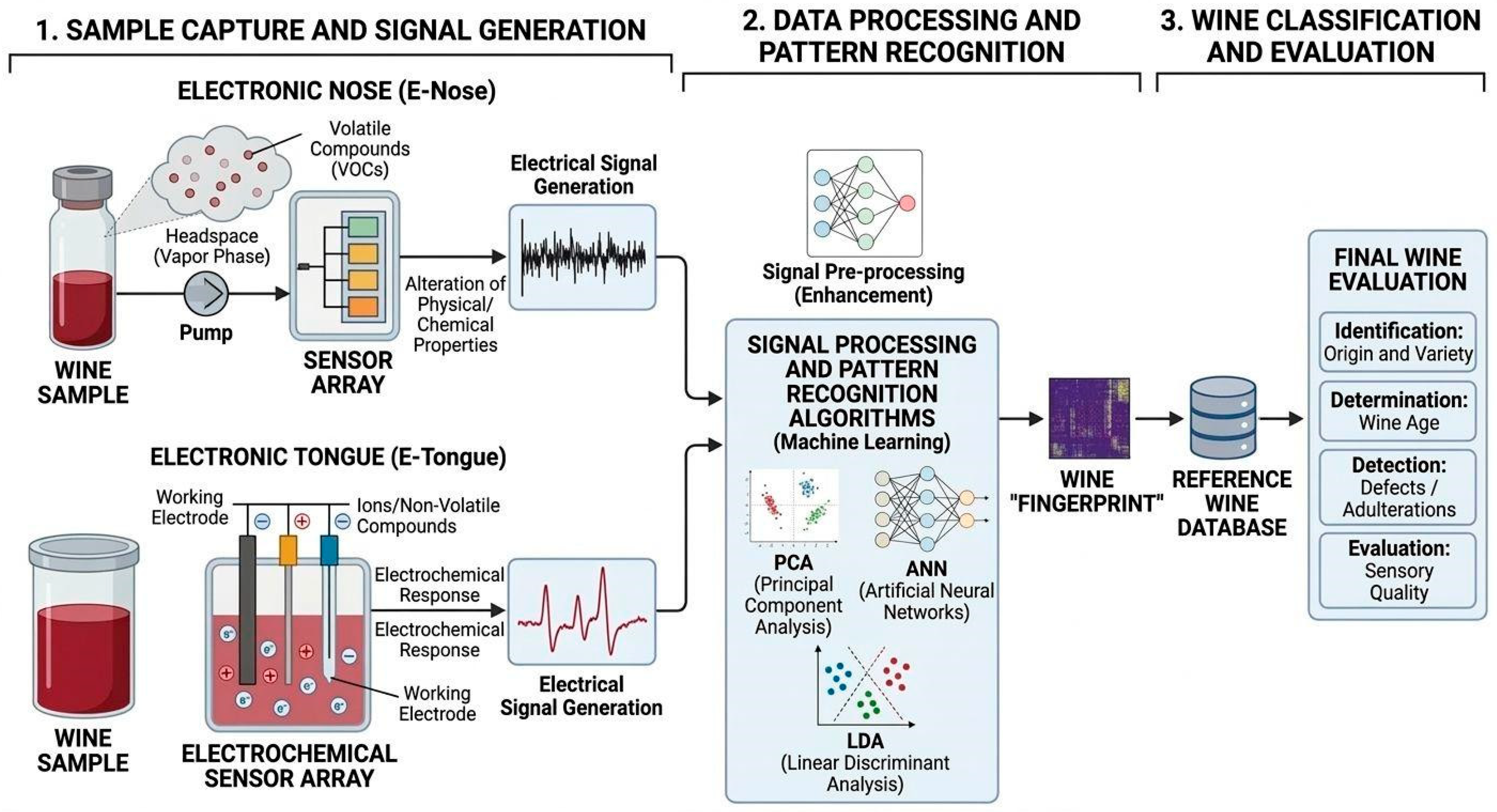
Combining different recognition agents in the same matrix provides a dataset that can be transduced and processed using advanced statistical approaches, solving complex analyses in intricate sample matrices [142]. In this context, electronic tongues and noses represent a holistic approach developed to mimic human senses, emerging as complementary tools to conventional analytical instruments and human sensory analysis panels [138,139,141]. These arrays of sensors with cross-sensitivity coupled to a pattern recognition software or advanced data treatment can create a fingerprint to discriminate samples that are otherwise impossible to classify. Hence, the assertive choice of well-selected sensors might allow an unlimited number of applications in viticulture and the wine industry [140,142].
In the vineyard, the ideal harvest time is crucial for obtaining excellent samples of raw grapes. Typically, this time is determined by measuring the sugar content using the Brix index. However, the production of primary aromas and polyphenols is equally relevant, given that great wines are only produced in exceptional vintages [137].
Since sugar content, astringency (polyphenol content) and acidity—all palate attributes—are the main parameters explored in harvest decisions, electronic tongues come to mind first. In turn, electronic noses are powerful devices to mimic the challenging job of sensorial panelists (Figure 2).
Some representative examples of (bio)sensors applied to wine sciences are exhibited in Table 3.
Electronic Tongues for Wine Classification
One other useful application of electronic tongues and electronic noses is concerned with wine classification, both for quality control and to avoid fraudulent actions [138,140,141].
The coupling of the Bio-electronic tongue, which signals organic acids levels and AI, was developed for wine classification. The biosensor arrays were based on lactate oxidase, sarcosine oxidase, and fumarase/sarcosine oxidase in the three sensing channels. The PCA and self-organized maps (SOMs) were applied in the evaluation of 31 commercial wines. The best results for wine classification were obtained with biosensor/SOM combination [163].
A potentiometric tongue based on enzymes (glucose oxidase, tyrosinase, laccase, and lyase) linked covalently in (PVC) membranes was developed for simultaneous analysis of relevant wine compounds. The performance was enhanced by introducing electron mediators (gold nanoparticles or copper phthalocyanine) into the PVC membrane. The individual biosensors exhibited a linear behavior for the respective enzymatic targets glucose, catechol, cysteine, or tartaric acid) with a limit of detection lower than 0.1 mM (CV < 3%) for all the compounds. PLS provided information about chemical parameters, whereas the principal component (PC) analysis allowed the discrimination of monovarietal white wines (PC1 77%; PC2 15%) and red wines (PC1 63%; PC2 30%) [164].
The voltammetric electronic tongue formed by an array of two metallic electrodes and four bulk-modified graphite composite electrodes was reported. The voltammograms were collected by using a six-channel potentiostat. The CV signals were further treated by a pool of advanced treatment tools, namely Fourier transform (FFT) for signal compression; genetic algorithms (GAs) as a feature selection tool, and linear discriminant analysis (LDA) and partial least squares regression (PLS) for the qualitative and quantitative modeling of the data. The electronic tongue was proposed as a tool towards the discrimination of oak barrels type and also to mimic sensory panels [165].
An electronic tongue based on an array of four voltammetric enzyme-modified (bio)sensors was reported to identify 20 rosé cava wines. The CV responses were preprocessed by a windowed slicing integral method to compress and extract significant features from the recorded data. The stratification was done according to different phenolic indexes patterns and by advanced data treatment, i.e., PCA and an Artificial Neural Network model [166,167].
The CV and total phenolic determination were also evaluated by an electronic tongue based on four graphite epoxy modified biosensors [165]. Afterwards, the same research group developed six graphite–epoxy-modified sensors for sugar determination and authentication, also in Cava wines [168].
Electronic Noses for Wine Classification
A low-cost electronic nose for the identification of distinct varieties of wine. The classification capability was carried out by treating the signals using PCA and a k-means clustering algorithm. Significant relationships were found between the different varieties of analyzed samples (n = 21) and corresponding treated data. The maximal accuracy of 100% was obtained using the k-means algorithm for binary classification. Therefore, the device proves to be very promising for the classification and quality control of wines [169].
An electronic nose based on the integration of a metal oxide gas sensor into an open digital microfluidic system was reported. A hydrophobic porous microchannel provided selective detection of aromatic characteristics. Two transient response features extracted from a drop of each sample were mapped onto a 2D graph for rapid segregation of different wines [170].
Electronic Noses for Wine Aging Monitoring
An electronic nose based on a tin oxide (SnO2) multisensor array fabricated via radiofrequency (RF) sputtering onto an alumina substrate and doped with chromium and indium was developed to monitor the wine aging process. The study took into account two approaches: type of oak barrel and cellars. Thus, the first experimental set was performed at the same experimental cellar, using the same wine aged in different types of oak barrel (French and American oak).
The second approach, several wines of the same grape variety were aged in different wine cellars in French and American oak. In both cases the sample collection was carried out at 0, 3, 6 and 12 months. The PCA and probabilistic neural networks were employed to build a recognition pattern. A classification success rate of 97% and 84% was achieved in detection of the different aging processes. The methodology was also proposed in application to detect frauds [171].
Electronic Noses and Electronic Tongues for Wine Defect
An electronic nose (E-nose) system based on metal oxide semiconductor (MOS) gas sensors was applied to evaluate wine spoilage thresholds using acetic acid as a volatile marker. The experimental database comprised 235 wine measurements categorized into three distinct groups: high quality (n = 51), average quality (n = 43) and low quality (n = 141), alongside 65 ethanol control samples. The dataset was useful to support E-Nose applications in routine tasks of wine quality control [172].
Concurrently, a voltammetric sensor array was developed to detect 4-ethylphenol, 4-ethylguaiacol, and 4-ethylcatechol, which are key chemical indicators of the Brett (Brettanomyces) defect in wine. Cyclic voltammetry (CV) signals were acquired using an electronic tongue composed of six modified graphite–epoxy composite electrodes. To optimize data processing, the CV curves were compressed using Discrete Wavelet Transform (DWT), while chemometric tools and artificial neural networks (ANNs) were implemented to construct the quantitative prediction model. Calibration curves for each phenolic compound were established across a concentration range of 0 to 25 mg L−1 using a factorial design. The resulting predictive model demonstrated high accuracy, yielding correlation coefficients R of 0.958 between the training and validation subsets [173,174].

4. Conclusions

This review highlights significant advances in the application of analytical methodologies in wine analysis, with emphasis on electrochemical, spectroscopic, and spectrometric techniques combined with chemometric tools. The literature demonstrates that these approaches are as rapid, sensitive, and sustainable as conventional analytical methods, with capability to be employed in quality control, authenticity assessment, and monitoring of winemaking processes.
Electrochemical sensors, electronic tongues and noses, as well as voltammetric techniques, have been shown to identify relevant chemical parameters, such as phenolic compounds, organic acids, metals, contaminants, and oxidation-related markers. When integrated with multivariate data analysis, these methodologies offer enhanced discriminatory power and predictive capability, enabling possible applications on areas ranging from fermentation monitoring to geographic origin authentication and spoilage detection.
In parallel, advanced spectroscopic and spectrometric techniques, such as nuclear magnetic resonance and mass spectrometry, enable a comprehensive and non-targeted characterization of wine composition. These approaches have contributed to metabolomic and flavoromic studies, deepening the understanding of the chemical complexity of wine and its relationship with technological practices and sensory attributes.
Despite the observed advances, challenges remain regarding method standardization, analytical validation, and the transference of emerging technologies to industrial routine applications and in situ analyses. In this context, the establishment of harmonized protocols and international guidelines is essential to ensure the reliability, reproducibility, and comparability of the data obtained.
Overall, the integration of modern analytical techniques with chemometric strategies represents a promising pathway for the future of enology research. Continued efforts toward method integration, sensor miniaturization, and real-time monitoring are expected to further expand available analytical capabilities and drive innovation in the wine sector.

Author Contributions

R.D.C. and E.d.S.G. reviewed the literature data on the electroanalytical methods; J.C.G.d.S., T.M.M.M. and R.M. reviewed the literature data on the spectrometric methods; I.N.S.N., I.Y.L.d.M. and R.M. reviewed the literature data on the separation methods; H.P.V.G., K.L.S., D.P.C.d.S. and E.d.S.G. performed the final editing of the review. All authors have read and agreed to the published version of the manuscript.

Funding

This research received no external funding.

Institutional Review Board Statement

Not applicable.

Informed Consent Statement

Not applicable.

Data Availability Statement

No new data was created in this review.

Acknowledgments

The authors acknowledge the financial support of the Coordenação de Aperfeiçoamento de Pessoal de Nível Superior—Brasil (CAPES), the Fundação de Amparo a Pesquisa de Goiás (FAPEG), and the Conselho Nacional de Desenvolvimento Científico e Tecnológico (CNPQ). During the preparation of this manuscript/study, the author(s) used Gemini (version 1.5 Pro, Google, Mountain View, CA, USA) for the purposes of elaboration of Figure 1 and Figure 2, and grammar polishing. The authors have reviewed and edited the output and take full responsibility for the content of this publication.

Conflicts of Interest

The authors declare no conflicts of interest.

References

  1. Koljančić, N.; Furdíková, K.; Gomes, A.A.; Špánik, I. Wine authentication: Current progress and state of the art. Trends Food Sci. Technol. 2024, 150, 104598. [Google Scholar] [CrossRef]
  2. Luque de Castro, M.D.; González-Rodríguez, J.; Pérez-Juan, P. Analytical methods in wineries: Is it time to change? Food Rev. Int. 2005, 21, 231–265. [Google Scholar] [CrossRef]
  3. Villiers, A.; Alberts, P.; Tredoux, A.G.J.; Nieuwoudt, H.H. Analytical techniques for wine analysis: An African perspective; a review. Anal. Chim. Acta 2012, 730, 2–23. [Google Scholar] [CrossRef]
  4. Giosanu, D.; Vîjan, L.E.; Deliu, I. The analyse of physico-chemical parameters means to appreciate the typicity of some red wines. Food Environ. Saf. J. 2017, 10, 31–36. [Google Scholar]
  5. Pomarici, E.; Sardone, R. EU wine policy in the framework of the CAP: Post-2020 challenges. Agric. Food Econ. 2020, 8, 17. [Google Scholar] [CrossRef]
  6. Reynolds, A.G. Managing Wine Quality Volume One: Viticulture and Wine Quality, 2nd ed.; Woodhead Publishing: Cambridge, UK, 2021. [Google Scholar]
  7. King, E.S.; Dunn, R.L.; Heymann, H. The influence of alcohol on the sensory perception of red wines. Food Qual. Prefer. 2013, 28, 235–243. [Google Scholar] [CrossRef]
  8. Parr, W.V.; Grose, C.; Hedderley, D.; Medel Maraboli, M.; Masters, O.; Araujo, L.D.; Valentin, D. Perception of quality and complexity in wine and their links to varietal typicality. Food Res. Int. 2020, 137, 109423. [Google Scholar] [CrossRef]
  9. Gutiérrez-Escobar, R.; Aliaño-González, M.J.; Cantos-Villar, E. Wine polyphenol content and its influence on wine quality and properties: A review. Molecules 2021, 26, 718. [Google Scholar] [CrossRef]
  10. Jones-Moore, H.R.; Jelley, R.E.; Marangon, M.; Fedrizzi, B. The interactions of wine polysaccharides with aroma compounds, tannins, and proteins, and their importance to winemaking. Food Hydrocoll. 2022, 123, 107150. [Google Scholar] [CrossRef]
  11. Zhai, H.Y.; Li, S.Y.; Zhao, X.; Lan, Y.B.; Zhang, X.K.; Shi, Y.; Duan, C.Q. The compositional characteristics, influencing factors, effects on wine quality and relevant analytical methods of wine polysaccharides: A review. Food Chem. 2023, 403, 134467. [Google Scholar] [CrossRef]
  12. Kennedy, J.A.; Ferrier, J.; Harbertson, J.F.; des Gachons, C.P. Analysis of tannins in red wine using multiple methods: Correlation with perceived astringency. Am. J. Enol. Vitic. 2006, 57, 481–485. [Google Scholar] [CrossRef]
  13. Vidal, L.; Giménez, A.; Medina, K.; Boido, E.; Ares, G. How do consumers describe wine astringency? Food Res. Int. 2015, 78, 321–326. [Google Scholar] [CrossRef]
  14. Ćorković, I.; Pichler, A.; Šimunović, J.; Kopjar, M. A comprehensive review on polyphenols of white wine: Impact on wine quality and potential health benefits. Molecules 2024, 29, 5074. [Google Scholar] [CrossRef]
  15. Fikselová, M.; Benešová, L.; Jakabová, S.; Mezey, J.; Čapla, J.; Golian, J. Chemometric Approach Application in Modern Wine Studies. Beverages 2024, 10, 84. [Google Scholar] [CrossRef]
  16. Hjertholm, F.; Goetz, R.; Schneider, P.A.A.; Petersen, M.A.; Bro, R.; Quintanilla-Casas, B. Uncorking white wine liking: Combining analytical chemistry and chemometrics with crowd-sourced data to predict quality ratings. Food Chem. 2025, 492, 145376. [Google Scholar] [CrossRef]
  17. Cozzolino, D.; Dambergs, R.G. Instrumental analysis of grape, must and wine. In Managing Wine Quality, 1st ed.; Reynolds, A.G., Ed.; Woodhead Publishing: Cambridge, UK, 2010; Volume 2, pp. 134–161. [Google Scholar]
  18. Alañón, M.E.; Pérez-Coello, M.S.; Marina, M.L. Wine science in the metabolomics era. TrAC Trends Anal. Chem. 2015, 74, 1–20. [Google Scholar] [CrossRef]
  19. Lima, C.M.; Fernandes, D.D.S.; Pereira, G.E.; Gomes, A.A.; Araujo, M.C.U.; Diniz, P.H.G.D. Digital image-based tracing of geographic origin, winemaker, and grape type for red wine authentication. Food Chem. 2020, 312, 126060. [Google Scholar] [CrossRef]
  20. Bhardwaj, P.; Tiwari, P.; Olejar, K.; Parr, W.; Kulasiri, D. A machine learning application in wine quality prediction. Mach. Learn. Appl. 2022, 8, 100261. [Google Scholar] [CrossRef]
  21. Liu, S.Y.; Ruiz Vega, A.; Dizy, M. Assessing ultrapremium red wine quality using PLS-SEM. LWT Food Sci. Technol. 2023, 177, 114560. [Google Scholar] [CrossRef]
  22. Popîrdă, A.; Luchian, C.E.; Cotea, V.V.; Colibaba, L.C.; Scutarașu, E.C.; Toader, A.M. A review of representative methods used in wine authentication. Agriculture 2021, 11, 225. [Google Scholar] [CrossRef]
  23. Guasch, J.; Busto, O. WINE: Gas and liquid chromatography. Encycl. Sep. Sci. 2000, 881, 4490–4498. [Google Scholar]
  24. Ianeselli, A.; Longo, E.; Poggesi, S.; Montali, M.; Boselli, E. A complete analysis pipeline for the processing, alignment and quantification of HPLC–UV wine chromatograms. Chromatographia 2024, 87, 159–166. [Google Scholar] [CrossRef]
  25. Navarro-Abril, A.; Saurina, J.; Sentellas, S. Simultaneous determination of amino acids and biogenic amines by LC–MS for assessing wine quality. Beverages 2022, 8, 69. [Google Scholar] [CrossRef]
  26. Andrade, R.H.S.; Nascimento, L.S.; Pereira, G.E.; Hallwass, F. Anthocyanic composition of Brazilian red wines and use of HPLC-UV–Vis associated to chemometrics to distinguish wines from different regions. Microchem. J. 2013, 110, 256–262. [Google Scholar] [CrossRef]
  27. Rodríguez-Cabo, T.; Rodríguez, I.; Ramil, M.; Silva, A.; Cela, R. Multiclass semi-volatile compounds determination in wine by GC–TOF–MS. J. Chromatogr. A 2016, 1442, 107–117. [Google Scholar] [CrossRef] [PubMed]
  28. Bailey, H.P.; Rutan, S.C. Comparison of chemometric methods for the screening of comprehensive two-dimensional liquid chromatographic analysis of wine. Anal. Chim. Acta 2013, 770, 18–28. [Google Scholar] [CrossRef] [PubMed]
  29. Kelly, M.T.; Blaise, A.; Larroque, M. Rapid automated HPLC method for simultaneous determination of amino acids and biogenic amines in wine, fruit and honey. J. Chromatogr. A 2010, 1217, 7385–7392. [Google Scholar] [CrossRef] [PubMed]
  30. Peña-Gallego, A.; Hernández-Orte, P.; Cacho, J.; Ferreira, V. High-performance liquid chromatography analysis of amines in must and wine: A review. Food Rev. Int. 2012, 28, 71–96. [Google Scholar] [CrossRef]
  31. Castellari, M.; Sartini, E.; Fabiani, A.; Arfelli, G.; Amati, A. Analysis of wine phenolics by high-performance liquid chromatography using a monolithic type column. J. Chromatogr. A 2002, 973, 221–227. [Google Scholar] [CrossRef]
  32. Porgali, E.; Büyüktuncel, E. Determination of phenolic composition and antioxidant capacity of native red wines by HPLC and spectrophotometric methods. Food Res. Int. 2012, 45, 145–154. [Google Scholar] [CrossRef]
  33. Kalogiouri, N.P.; Samanidou, V.F. Liquid chromatographic methods coupled to chemometrics: Workflow for the investigation of wine phenolic composition affected by environmental factors. Environ. Sci. Pollut. Res. 2021, 28, 59150–59164. [Google Scholar] [CrossRef] [PubMed]
  34. Navarro, M.; Kontoudakis, N.; Canals, J.M.; García-Romero, E.; Gómez-Alonso, S.; Zamora, F.; Hermosín-Gutiérrez, I. Improved method for extraction and chromatographic analysis of ellagitannins in oak-aged wine. Food Chem. 2017, 226, 23–31. [Google Scholar] [CrossRef] [PubMed]
  35. Frayne, R.F. Direct analysis of the major organic components in grape must and wine using high performance liquid chromatography. Am. J. Enol. Vitic. 1986, 37, 281–287. [Google Scholar] [CrossRef]
  36. Kirchert, S.; Kaiser, R.E.; Morlock, G.E. In-process quality control of wine by planar chromatography versus micro planar chromatography. J. Chromatogr. A 2019, 1588, 137–149. [Google Scholar] [CrossRef]
  37. Ortega-Heras, M.; González-SanJosé, M.L.; Beltrán, S. Aroma composition of wine studied by different extraction methods. Anal. Chim. Acta 2002, 458, 85–93. [Google Scholar] [CrossRef]
  38. Plutowska, B.; Wardencki, W. Application of GC–O in analysis and quality assessment of alcoholic beverages: A review. Food Chem. 2008, 107, 449–463. [Google Scholar] [CrossRef]
  39. Ferreira, V.; Juan, F.S.; Escudero, A.; Culleré, L.; Fernández-Zurbano, P.; Saenz-Navajas, M.P.; Cacho, J. Modeling quality of premium Spanish red wines from gas chromatography–olfactometry data. J. Agric. Food Chem. 2009, 57, 7490–7498. [Google Scholar] [CrossRef]
  40. Zhao, P.; Gao, J.; Qian, M.; Li, H. Characterization of key aroma compounds in Chinese Syrah wine by GC–O–MS and aroma reconstitution studies. Molecules 2017, 22, 1045. [Google Scholar] [CrossRef]
  41. Campo, E.; Cacho, J.; Ferreira, V. Solid phase extraction, multidimensional gas chromatography mass spectrometry determination of four novel aroma powerful ethyl esters. Assessment of their occurrence and importance in wine and other alcoholic beverages. J. Chromatogr. A 2007, 1140, 180–188. [Google Scholar] [CrossRef]
  42. Guadalupe, Z.; Martínez-Pinilla, O.; Garrido, Á.; Carrillo, J.D.; Ayestarán, B. Quantitative determination of wine polysaccharides by GC–MS and SEC. Food Chem. 2012, 131, 367–374. [Google Scholar] [CrossRef]
  43. Welke, J.E.; Hernandes, K.C.; Nicolli, K.P.; Barbará, J.A.; Biasoto, A.C.T.; Zini, C.A. Role of gas chromatography and olfactometry in understanding wine aroma: Multidimensional analysis achievements. J. Sep. Sci. 2021, 44, 135–168. [Google Scholar] [CrossRef]
  44. Ortega, C.; López, R.; Cacho, J.; Ferreira, V. Fast analysis of important wine volatile compounds by GC–FID of dichloromethane microextracts. J. Chromatogr. A 2001, 923, 205–214. [Google Scholar] [CrossRef]
  45. Gomez, F.J.V.; Silva, M.F. Microchip electrophoresis for wine analysis. Anal. Bioanal. Chem. 2016, 408, 8643–8653. [Google Scholar] [CrossRef]
  46. Coelho, C.; Bagala, F.; Gougeon, R.D.; Schmitt-Kopplin, P. Capillary Electrophoresis in Wine Science. Methods Mol. Biol. 2016, 1483, 509–523. [Google Scholar] [PubMed]
  47. Dias, F.S.; Klassen, A.; Tavares, M.F.M.; David, J.M. Fast determination of phenolic compounds in Brazilian wines from Vale do São Francisco region by CE. Chromatographia 2013, 76, 559–563. [Google Scholar] [CrossRef]
  48. Franquet-Griell, H.; Checa, A.; Núñez, O.; Saurina, J.; Hernández-Cassou, S.; Puignou, L. Determination of polyphenols in Spanish wines by capillary zone electrophoresis. Application to wine characterization using chemometrics. J. Agric. Food Chem. 2012, 60, 8340–8349. [Google Scholar] [CrossRef]
  49. Dizy, M.; Bisson, L.F. White Wine Protein Analysis by Capillary Zone Electrophoresis. Am. J. Enol. Vitic. 1999, 50, 120–127. [Google Scholar] [CrossRef]
  50. Geană, E.I.; Ciucure, C.T.; Apetrei, C.; Artem, V. Application of Spectroscopic UV-Vis and FT-IR Screening Techniques Coupled with Multivariate Statistical Analysis for Red Wine Authentication: Varietal and Vintage Year Discrimination. Molecules 2019, 24, 4166. [Google Scholar] [CrossRef]
  51. Uríčková, V.; Sádecká, J. Determining geographical origin of alcoholic beverages using UV, Vis and IR. Spectrochim. Acta A Mol. Biomol. Spectrosc. 2015, 148, 131–137. [Google Scholar] [CrossRef]
  52. Martelo-Vidal, M.J.; Vázquez, M. Evaluation of UV, visible and NIR spectroscopy for wine compound analysis. Czech J. Food Sci. 2014, 32, 37–47. [Google Scholar] [CrossRef]
  53. Ferreiro-González, M.; Roldán, A.; Barbero, G.F. FT-IR, Vis spectroscopy, color and multivariate analysis for controlling ageing processes in Spanish wines. Food Chem. 2019, 277, 6–11. [Google Scholar] [CrossRef]
  54. Pereira, A.C.; Reis, M.S.; Saraiva, P.M.; Marques, J.C. Madeira wine ageing prediction based on different analytical techniques: UV–vis, GC-MS, HPLC-DAD. Chemom. Intell. Lab. Syst. 2011, 105, 43–55. [Google Scholar] [CrossRef]
  55. Roig, B.; Thomas, O. UV monitoring of sugars during winemaking. Carbohydr. Res. 2003, 338, 79–83. [Google Scholar] [CrossRef]
  56. Ríos-Reina, R.; García-González, D.L. UV-Vis spectroscopy for detecting grape-must caramel. Food Chem. 2020, 323, 126792. [Google Scholar] [CrossRef]
  57. Sen, I.; Tokatli, F. Differentiation of wines using UV-Vis spectra and color characteristics. J. Food Compos. Anal. 2016, 45, 101–107. [Google Scholar] [CrossRef]
  58. Versari, A.; Parpinello, G.P.; Mattioli, A.U. Colour components and pigments in red wines by UV-Vis methods. S. Afr. J. Enol. Vitic. 2007, 28, 6–10. [Google Scholar]
  59. Johnson, J.B.; Timofeev, R.; Kazak, A.; Grishin, Y.; Solovyova, L.; Rudenko, M. A study of UV spectral features in wine and correlation with phenolic constituents. J. Food Sci. 2024, 16, 16. [Google Scholar] [CrossRef] [PubMed]
  60. Aznar, O.; Checa, A.; Oliver, R.; Hernández-Cassou, S.; Saurina, J. Determination of polyphenols in wines by liquid chromatography with UV spectrophotometric detection. J. Chromatogr. A 2011, 1218, 527–535. [Google Scholar] [CrossRef]
  61. Cozzolino, D. The role of visible and infrared spectroscopy combined with chemometrics to measure phenolic compounds in grape and wine samples. Molecules 2015, 20, 726–737. [Google Scholar] [CrossRef]
  62. Ranaweera, K.R.; Capone, D.L.; Bastian, S.E.P.; Cozzolino, D.; Jeffery, D.W. A review of wine authentication using spectroscopic approaches and chemometrics. Molecules 2021, 26, 4334. [Google Scholar] [CrossRef] [PubMed]
  63. Bauer, R.; Nieuwoudt, H.; Bauer, F.F.; Kossman, J.; Koch, K.R.; Esbensen Kim, H. FTIR spectroscopy for grape and wine analysis. Anal. Chem. 2008, 80, 1371–1379. [Google Scholar] [CrossRef]
  64. Dong, R.; Sun, J.; Cui, P.; Shi, J.; Li, Y.; Ma, X. Quantitative and classification analysis of red wine by infrared spectra and GC–MS with a new variable selection method. J. Food Compos. Anal. 2023, 120, 105325. [Google Scholar] [CrossRef]
  65. Schindler, R.; Vonach, R.; Lendl, B.; Kellner, R. Rapid automated wine analysis using SI-FTIR spectrometry. Fresenius’ J. Anal. Chem. 1998, 362, 130–136. [Google Scholar] [CrossRef]
  66. Basalekou, M.; Pappas, C.; Tarantilis, P.A.; Kallithraka, S. Wine authenticity and traceability with the use of FT-IR. Beverages 2020, 6, 30. [Google Scholar] [CrossRef]
  67. Ma, X.; Pang, J.; Dong, R.; Tang, C.; Shu, Y.; Li, Y. Rapid prediction of multiple wine quality parameters using infrared spectroscopy. J. Food Compos. Anal. 2020, 91, 103509. [Google Scholar] [CrossRef]
  68. Gallego, A.L.; de Francisco, R.; Arroyo, J. Rapid measurement of phenolic compounds in red wine using Raman spectroscopy. IEEE Trans. Instrum. Meas. 2011, 60, 507–512. [Google Scholar] [CrossRef]
  69. Rouxinol, M.I.; Martins, M.R.; Murta, G.C.; Barroso, J.M.; Rato, A.E. Quality assessment of red wine grapes using NIR spectroscopy. Agronomy 2022, 12, 637. [Google Scholar] [CrossRef]
  70. Ríos-Reina, R.; García-González, D.L.; Callejón, R.M.; Amigo, J.M. NIR spectroscopy for typification of Spanish vinegars. Food Control 2018, 89, 108–116. [Google Scholar] [CrossRef]
  71. Kljusurić, J.G.; Boban, A.; Mucalo, A.; Budić-Leto, I. Novel application of NIR spectroscopy for non-destructive determination of ‘Maraština’ wine parameters. Foods 2022, 11, 1172. [Google Scholar] [CrossRef] [PubMed]
  72. Cayuela, J.A.; Puertas, B.; Cantos-Villar, E. Assessing wine sensory attributes using Vis/NIR. Eur. Food Res. Technol. 2017, 243, 941–953. [Google Scholar] [CrossRef]
  73. Chandrasekaran, I.; Panigrahi, S.S.; Wang, H. Potential of Near-Infrared Spectroscopy and Hyperspectral Imaging for Quality and Safety Assessment of Fruits. Food Anal. Methods 2019, 12, 2438–2458. [Google Scholar] [CrossRef]
  74. Sun, Y.; Tang, H.; Zou, X.; Meng, G.; Wu, N. Raman spectroscopy for food quality and safety monitoring: A review. Curr. Opin. Food Sci. 2022, 47, 100910. [Google Scholar] [CrossRef]
  75. Nordon, A.; Mills, A.; Burn, R.W. Comparison of non-invasive NIR and Raman spectrometries for alcohol content of spirits. Anal. Chim. Acta 2005, 548, 148–158. [Google Scholar] [CrossRef]
  76. Villar, A.; Merino, S.; Boto, R.A.; Aizpurua, J.; Garcia-Etxarri, A.; Azkune, M.; Zubia, J. Sulfites detection by SERS: Feasibility study. Spectrochim. Acta A Mol. Biomol. Spectrosc. 2023, 300, 122899. [Google Scholar] [CrossRef]
  77. Mandrile, L.; Zeppa, G.; Giovannozzi, A.M.; Rossi, A.M. Controlling protected designation of origin of wine by Raman spectroscopy. Food Chem. 2016, 211, 260–267. [Google Scholar] [CrossRef] [PubMed]
  78. Magdas, D.A.; Guyon, F.; Feher, I.; Pinzaru, S.C. Wine discrimination based on chemometric analysis of untargeted markers using FT-Raman spectroscopy. Food Control 2018, 85, 385–391. [Google Scholar] [CrossRef]
  79. Onianwa, P.C.; Adetola, I.G.; Iwegbue, C.M.A.; Ojo, M.F.; Tella, O.O. Trace heavy metals composition of some Nigerian beverages and food drinks. Food Chem. 1999, 66, 275–279. [Google Scholar] [CrossRef]
  80. Dessuy, M.B.; Vale, M.G.R.; Souza, A.S.; Ferreira, S.L.C.; Welz, B.; Katskov, D.A. Method development for the determination of lead in wine using electrothermal atomic absorption spectrometry comparing platform and filter furnace atomizers and different chemical modifiers. Talanta 2008, 74, 1321–1326. [Google Scholar] [CrossRef]
  81. Coetzee, P.P.; Vanhaecke, F. Classifying wine according to geographical origin via quadrupole-based ICP-mass spectrometry measurements of boron isotope ratios. Anal. Bioanal. Chem. 2005, 383, 977–984. [Google Scholar] [CrossRef]
  82. Coetzee, P.P.; Steffens, F.E.; Eiselen, R.J.; Augustyn, O.P.; Balcaen, L.; Vanhaecke, F. Multi-element analysis of South African wines by ICP-MS and their classification according to geographical origin. J. Agric. Food Chem. 2005, 53, 5060–5066. [Google Scholar] [CrossRef]
  83. Van der Linde, G.; Fischer, J.L.; Coetzee, P.P. Multi-element analysis of South African wines and their provenance soils by ICP-MS and their classification according to geographical origin using multivariate statistics. S. Afr. J. Enol. Vitic. 2010, 31, 143–151. [Google Scholar] [CrossRef]
  84. García-Aguilera, M.E.; Delgado-Altamirano, R.; Villalón, N.; Ruiz-Terán, F.; García-Garnica, M.M.; Ocaña-Ríos, I.; Rodríguez de San Miguel, E.; Esturau-Escofet, N. Study of the stability of wine samples for 1H-NMR metabolomic profile analysis through chemometrics methods. Molecules 2023, 28, 5962. [Google Scholar] [CrossRef]
  85. Coco, L.D.; Girelli, C.R.; Gambacorta, L.; Solfrizzo, M.; Fanizzi, F.P. 1H NMR spectroscopy Primitivo red wine screening after grape pomace repassage for possible toxin contamination removal. Foods 2025, 14, 734. [Google Scholar] [CrossRef]
  86. Cordeiro, A.R.; Bezerra, I.L.; Santana-Filho, A.P.; Benedetti, P.R.; Ingberman, M.; Sassaki, G.L. Wine fermentation process evaluation through NMR analysis: Polysaccharides, ethanol quantification and biological activity. Food Chem. 2024, 451, 139531. [Google Scholar] [CrossRef] [PubMed]
  87. Phuong, J.; Salgado, B.; Heiß, J.; Steimers, E.; Nickolaus, P.; Keller, L.; Fischer, U.; von Harbou, E.; Holland, D.J.; Jirasek, F.; et al. Real-time monitoring of fermentation processes in wine production with benchtop 1H NMR spectroscopy. Food Res. Int. 2025, 203, 115741. [Google Scholar] [CrossRef]
  88. Convertini, R.; Patz, C.; Kumar, K.; May, B.; Andlauer, W.; Schweiggert, R. 1H NMR spectrometry for methanol quantification in apple wines and ciders as optimised by comparison to SIDA-HS-GC-MS. Food Chem. 2022, 387, 132912. [Google Scholar] [CrossRef] [PubMed]
  89. Flamini, R.; Panighel, A.; De Marchi, F. Mass spectrometry in the study of wood compounds released in barrel-aged wine and spirits. Mass Spectrom. Rev. 2023, 42, 1174–1220. [Google Scholar] [CrossRef] [PubMed]
  90. Kercher, M.M.; Caballero, B.F.O.; Maraschin, M.; Moura, S. Recent uses and applications of NMR, isotope ratio MS and high-resolution MS for authenticity and geographical origin of wines. Food Sci. Biotechnol. 2025, 34, 2433–2444. [Google Scholar] [CrossRef]
  91. Welke, J.E.; Hernandes, K.C.; Lago, L.O.; Silveira, R.D.; Marques, A.T.B.; Zini, C.A. Flavoromic analysis of wines using gas chromatography, mass spectrometry and sensory techniques. J. Chromatogr. A 2024, 1734, 465264. [Google Scholar] [CrossRef]
  92. Pérez-Mayan, L.; Ramil, M.; Cela, R.; Rodríguez, I. Determination of pesticide residues in wine by SPE on-line coupled to liquid chromatography tandem mass spectrometry. J. Food Compos. Anal. 2021, 104, 104184. [Google Scholar] [CrossRef]
  93. Sánchez-Arribas, A.; Martínez-Fernández, M.; Chicharro, M. The role of electroanalytical techniques in analysis of polyphenols in wine. TrAC Trends Anal. Chem. 2012, 34, 78–96. [Google Scholar] [CrossRef]
  94. Lino, F.M.A.; de Sá, L.Z.; Torres, I.M.S.; Rocha, M.L.; Dinis, T.C.P.; Ghedini, P.C.; Somerset, V.S.; Gil, E.S. Voltammetric and spectrometric determination of antioxidant capacity of selected wines. Electrochim. Acta 2014, 128, 25–31. [Google Scholar] [CrossRef]
  95. Kilmartin, P.A. Electrochemistry applied to the analysis of wine: A mini-review. Electrochem. Commun. 2016, 67, 39–42. [Google Scholar] [CrossRef]
  96. Chiorcea-Paquim, A.M.; Enache, T.A.; Gil, E.S.; Oliveira-Brett, A.M. Natural phenolic antioxidants electrochemistry: Towards a new food science methodology. Compr. Rev. Food Sci. Food Saf. 2020, 19, 1680–1726. [Google Scholar] [CrossRef]
  97. Vasilescu, A.; Fanjul-Bolado, P.; Titoiu, A.M.; Porumb, R.; Epure, P. Progress in electrochemical (bio)sensors for monitoring wine production. Chemosensors 2019, 7, 66. [Google Scholar] [CrossRef]
  98. Geană, E.I.; Ciucure, C.T.; Apetrei, C. Electrochemical sensors coupled with multivariate statistical analysis as screening tools for wine authentication issues: A review. Chemosensors 2020, 8, 59. [Google Scholar] [CrossRef]
  99. Pérez-Olmos, R.; Herrero, R.; Lima, J.L.F.C.; Lopes, T.I.M.S.; Rangel, A.O.S.S. Bibliographic study of potentiometric methods of wine and must analysis. J. Int. Sci. Vigne Vin 1995, 29, 159–169. [Google Scholar] [CrossRef]
  100. Nery, E.W.; Kubota, L.T. Integrated, paper-based potentiometric electronic tongue for the analysis of beer and wine. Anal. Chim. Acta 2016, 918, 60–68. [Google Scholar] [CrossRef] [PubMed]
  101. Calvo-López, A.; Martinez-Bassedas, E.; Puyol, M.; Alonso-Chamarro, J. Monitoring of total potassium in winemaking processes using a potentiometric analytical microsystem. Food Chem. 2021, 345, 128779. [Google Scholar] [CrossRef]
  102. Green, A.; Clark, A.; Scollary, G. Determination of free and total copper and lead in wine by stripping potentiometry. Fresenius’ J. Anal. Chem. 1997, 358, 711–717. [Google Scholar] [CrossRef]
  103. Budić-Leto, I.; Mešin, N.; Kljusurić, J.G.; Pezo, I.; Bralić, M. Comparative study of the total acidity determination in wine by potentiometric and volumetric titration. Agric. Conspec. Sci. 2009, 74, 61–65. [Google Scholar]
  104. Dietrich, A.V.; Curbani, L.; Parker, T.A.; Garcia, J.; Schultz, L.D.; Borges, E.M. Determination of titratable acidity in wine using potentiometric, conductometric, and photometric methods. J. Chem. Educ. 2017, 94, 1296–1302. [Google Scholar] [CrossRef]
  105. Zakharova, E.A.; Moskaleva, M.L.; Akeneev, Y.A.; Moiseeva, E.S.; Slepchenko, G.B.; Pikula, N.P. Potentiometric determination of the total acidity and concentration of citric acid in wines. J. Anal. Chem. 2011, 66, 848–853. [Google Scholar] [CrossRef]
  106. Ferreira, A.C.S.; Oliveira, C.; Pinho, P.G.; Hogg, T. Development of a potentiometric method to measure the resistance to oxidation of white wines and the antioxidant power of their constituents. J. Agric. Food Chem. 2002, 50, 2121–2124. [Google Scholar] [CrossRef]
  107. Piljac, J.; Martinez, S.; Valek, L.; Stipcevic, T.; Ganic, K.K. A comparison of methods used to define the phenolic content and antioxidant activity of Croatian wines. Food Technol. Biotechnol. 2005, 43, 271–276. [Google Scholar]
  108. Solovyova, L.M.; Grishin, Y.V.; Kazak, A.N.; Oleinikov, N.N.; Chetyrbok, P.V. The possibility of using potentiometric titration to determine the antioxidant properties of wines. J. Phys. Conf. Ser. 2020, 1703, 012048. [Google Scholar] [CrossRef]
  109. Durliat, H.; Comtat, M. Critical evaluation of potentiometric redox titrations in enology. Anal. Chim. Acta 2005, 545, 173–181. [Google Scholar] [CrossRef]
  110. Martinez, S.; Valek, L.; Piljac, J.; Metikoš-Huković, M. Determination of wine antioxidant capacity by derivative potentiometric titration with electrogenerated chlorine. Eur. Food Res. Technol. 2005, 220, 658–661. [Google Scholar] [CrossRef]
  111. Castaignède, V.; Durliat, H.; Comtat, M. Amperometric and potentiometric determination of catechin as model of polyphenols in wines. Anal. Lett. 2003, 36, 1707–1720. [Google Scholar] [CrossRef]
  112. Escarpa, A. Food electroanalysis: Sense and simplicity. Chem. Rec. 2011, 12, 72–91. [Google Scholar] [CrossRef] [PubMed]
  113. Gil, E.S.; Couto, R.O. Flavonoid electrochemistry: A review on electroanalytical applications. Rev. Bras. Farmacogn. 2013, 23, 542–558. [Google Scholar] [CrossRef]
  114. Blasco, A.J.; Rogerio, M.C.; González, M.C.; Escarpa, A. “Electrochemical Index” as a screening method to determine “total polyphenolics” in foods: A proposal. Anal. Chim. Acta 2005, 539, 237–244. [Google Scholar] [CrossRef]
  115. Buenaventura, T.M.A.; Catangay, C.J.L.; Dolendo, C.D.C.; Soriano, A.N.; Lardizabal, D.D.; Rubi, R.V.C. The role of voltammetric analysis in the wine industry. Eng. Proc. 2023, 56, 152. [Google Scholar]
  116. Yadav, P.K.; Sharma, R.M. The role of voltammetric methods in determination of metals in alcoholic beverages: A critical review. Arab. J. Forensic Sci. Forensic Med. 2019, 1, 1232–1247. [Google Scholar] [CrossRef]
  117. Xhensiana, N.; Nensi, I.; Kledi, X.; Jiri, K.; Ondrej, Z.; Muhamed, F.; Besnik, B. Electrochemical determination of wine polyphenols using carbon electrodes: A review. Electroanalysis 2024, 36, e202400084. [Google Scholar] [CrossRef]
  118. Hernanz-Vila, D.; Jara-Palacios, M.J.; Escudero-Gilete, M.L.; Heredia, F.J. Applications of voltammetric analysis to wine. In Applications of Voltammetry, 1st ed.; Stoytcheva, M., Zlatev, R., Eds.; IntechOpen: London, UK, 2017; pp. 109–127. [Google Scholar]
  119. Vilas-Boas, A.; Valderrama, P.; Fontes, N.; Geraldo, D.; Bento, F. Evaluation of total polyphenol content of wines by means of voltammetric techniques: Cyclic voltammetry vs differential pulse voltammetry. Food Chem. 2019, 276, 719–725. [Google Scholar] [CrossRef] [PubMed]
  120. Pisoschi, A.M.; Pop, A.; Negulescu, G.P.; Pisoschi, A. Determination of ascorbic acid content of some fruit juices and wine by voltammetry performed at Pt and carbon paste electrodes. Molecules 2011, 16, 1349–1365. [Google Scholar] [CrossRef]
  121. Schneider, M.; Türke, A.; Fischer, W.J.; Kilmartin, P.A. Determination of the wine preservative sulphur dioxide with cyclic voltammetry using inkjet printed electrodes. Food Chem. 2014, 164, 428–432. [Google Scholar] [CrossRef]
  122. Ferreira, C.; Sáenz-Navajas, M.P.; Carrascón, V.; Naes, T.; Fernández-Zurbano, P.; Ferreira, V. An assessment of voltammetry on disposable screen-printed electrodes to predict wine chemical composition and oxygen consumption rates. Food Chem. 2021, 365, 130405. [Google Scholar] [CrossRef]
  123. Newair, E.F.; Kilmartin, P.A.; Garcia, F. Square wave voltammetric analysis of polyphenol content and antioxidant capacity of red wines using glassy carbon and disposable carbon nanotubes modified screen-printed electrodes. Eur. Food Res. Technol. 2018, 244, 1225–1237. [Google Scholar] [CrossRef]
  124. Rocha, P.; Vilas-Boas, A.; Fontes, N.; Geraldo, D. Evaluation of polyphenols in wine by voltammetric techniques with screen-printed carbon electrodes. Electroanalysis 2020, 32, 159–165. [Google Scholar] [CrossRef]
  125. Jeremic, J.; Ricci, A.; Tacconi, G.; Lagarde-Pascal, C.; Parpinello, G.P.; Versari, A. Monitoring oxidative status in winemaking by untargeted linear sweep voltammetry. Foods 2020, 9, 728. [Google Scholar] [CrossRef]
  126. Gonzalez, A.; Vidal, S.; Ugliano, M. Untargeted voltammetric approaches for characterization of oxidation patterns in white wines. Food Chem. 2018, 269, 1–8. [Google Scholar] [CrossRef]
  127. Munteanu, I.G.; Apetrei, C. A review on electrochemical sensors and biosensors used in assessing antioxidant activity. Antioxidants 2022, 11, 584. [Google Scholar] [CrossRef]
  128. Luong, J.H.; Bouvrette, P.; Male, K.B. Developments and applications of biosensors in food analysis. Trends Biotechnol. 1997, 15, 369–377. [Google Scholar] [CrossRef]
  129. Mello, L.D.; Kubota, L.T. Review of the use of biosensors as analytical tools in the food and drink industries. Food Chem. 2002, 77, 237–256. [Google Scholar] [CrossRef]
  130. Domínguez-Renedo, O.; Navarro-Cuñado, A.M.; Meléndez-Álvarez, M.E.; Alonso-Lomillo, M.A. Current state of electrochemical sensors in wine analysis for early diagnosis. TrAC Trends Anal. Chem. 2023, 168, 117349. [Google Scholar] [CrossRef]
  131. Gallego-Martínez, J.J.; Cañete-Carmona, E.; Gersnoviez, A.; Brox, M.; Sánchez-Gil, J.J.; Martín-Fernández, C. Devices for monitoring oenological processes: A review. Measurement 2024, 235, 114922. [Google Scholar] [CrossRef]
  132. Catarino, S.; Curvelo-Garcia, A.S.; Sousa, R.B. Contaminant elements in wines: A review. Ciênc. Tec. Vitiv. 2008, 23, 3–19. [Google Scholar]
  133. International Code of Oenological Practices. Available online: https://www.oiv.int (accessed on 5 December 2025).
  134. Instrução Normativa nº 14, de 8 de Fevereiro de 2018. Available online: https://www.gov.br/agricultura/pt-br/assuntos/inspecao/produtos-vegetal/legislacao-de-produtos-origem-vegetal/bebidas (accessed on 5 December 2025).
  135. Instrução Normativa nº 160, de 1º de Julho de 2022. Available online: https://anvisalegis.datalegis.net/action/ActionDatalegis.php?acao=abrirTextoAto&tipo=INM&numeroAto=00000160&seqAto=000&valorAno=2022&orgao=ANVISA/MS&codTipo=&desItem=&desItemFim=&cod_menu=1696&cod_modulo=134&pesquisa=true (accessed on 5 December 2025).
  136. Decreto nº 12709, de 31 de Outubro de 2025. Available online: https://legislacao.presidencia.gov.br/atos/?tipo=DEC&numero=12709&ano=2025&data=31/10/2025&ato=844cXQU9UNZpWTb82 (accessed on 5 December 2025).
  137. Liu, J.; Xu, Y.; Liu, S.; Yu, S.; Yu, Z.; Low, S.S. Application and progress of chemometrics in voltammetric biosensing. Biosensors 2022, 12, 494. [Google Scholar] [CrossRef] [PubMed]
  138. Baietto, M.; Wilson, A.D. Electronic-nose applications for fruit identification, ripeness and quality grading. Sensors 2015, 15, 899–931. [Google Scholar] [CrossRef]
  139. Smyth, H.; Cozzolino, D. Instrumental methods (spectroscopy, electronic nose, and tongue) as tools to predict taste and aroma in beverages: Advantages and limitations. Chem. Rev. 2013, 113, 1429–1440. [Google Scholar] [CrossRef]
  140. Röck, F.; Barsan, N.; Weimar, U. Electronic nose: Current status and future trends. Chem. Rev. 2008, 108, 705–725. [Google Scholar] [CrossRef]
  141. Garcia-Hernandez, C.; Garcia-Cabezon, C.; Rodriguez-Mendez, M.L.; Martin-Pedrosa, F. Electronic tongue technology applied to the analysis of grapes and wines: A comprehensive review from its origins. Chemosensors 2025, 13, 188. [Google Scholar] [CrossRef]
  142. Cetó, X.; Pérez, S.; Prieto-Simón, B. Fundamentals and application of voltammetric electronic tongues in quantitative analysis. TrAC Trends Anal. Chem. 2022, 157, 116765. [Google Scholar] [CrossRef]
  143. Rodriguez-Méndez, M.L.; Medina Plaza, C.; García-Hernández, C.; De Saja, J.A.; Barajas-Tola, E.; Fernández-Escudero, J.A.; Medrano, G. Analysis of grapes and wines using a voltammetric bioelectronic tongue: Correlation with the phenolic and sugar content. In Proceedings of the IEEE Sensors, Valencia, Spain, 2–5 November 2014; IEEE: Piscataway, NJ, USA, 2014; pp. 2139–2142. [Google Scholar]
  144. Costa, J.J.; Moreira, F.T.C.; Soares, S.; Brandão, E.; Mateus, N.; De Freitas, V.; Sales, M.G.F. Wine astringent compounds monitored by an electrochemical biosensor. Food Chem. 2022, 395, 133587. [Google Scholar] [CrossRef]
  145. Gamella, M.; Campuzano, S.; Reviejo, A.J.; Pingarrón, J.M. Electrochemical estimation of the polyphenol index in wines using a laccase biosensor. J. Agric. Food Chem. 2006, 54, 7960–7961. [Google Scholar] [CrossRef] [PubMed]
  146. Molinero-Abad, B.; Alonso-Lomillo, M.A.; Domínguez-Renedo, O.; Arcos-Martínez, M.J. Sulfite oxidase biosensors based on tetrathiafulvalene-modified screen-printed carbon electrodes for sulfite determination in wine. Anal. Chim. Acta 2014, 812, 41–44. [Google Scholar] [CrossRef] [PubMed]
  147. Kalimuthu, P.; Tkac, J.; Kappler, U.; Davis, J.J.; Bernhardt, P.V. Highly sensitive and stable electrochemical sulfite biosensor incorporating bacterial sulfite dehydrogenase. Anal. Chem. 2010, 82, 7374–7379. [Google Scholar] [CrossRef]
  148. Azevedo, A.M.; Prazeres, D.M.F.; Cabral, J.M.S.; Fonseca, L.P. Ethanol biosensors based on alcohol oxidase. Biosens. Bioelectron. 2005, 21, 235–247. [Google Scholar] [CrossRef]
  149. Wen, G.; Wen, X.; Shuang, S.; Choi, M.M.F. Whole-cell biosensor for determination of methanol. Sens. Actuators B Chem. 2014, 201, 586–591. [Google Scholar] [CrossRef]
  150. Samphao, A.; Butmee, P.; Saejueng, P.; Pukahuta, C.; Švorc, L.; Kalcher, K. Monitoring of glucose and ethanol during wine fermentation by bienzymatic biosensor. J. Electroanal. Chem. 2018, 816, 179–188. [Google Scholar] [CrossRef]
  151. Goriushkina, T.B.; Soldatkin, A.P.; Dzyadevych, S.V. Application of amperometric biosensors for analysis of ethanol, glucose, and lactate in wine. J. Agric. Food Chem. 2009, 57, 6528–6535. [Google Scholar] [CrossRef]
  152. Lourenço, A.S.; Nascimento, R.F.; Silva, A.C.; Ribeiro, W.F.; Araujo, M.C.U.; Oliveira, S.C.B.; Nascimento, V.B. Voltammetric determination of tartaric acid in wines by electrocatalytic oxidation on a cobalt(II)-phthalocyanine-modified electrode associated with multiway calibration. Anal. Chim. Acta 2018, 1008, 29–37. [Google Scholar] [CrossRef] [PubMed]
  153. Sales, M.; Amaral, C.; Delerue-Matos, C. Determination of tartaric acid in wines by FIA with tubular tartrate-selective electrodes. Fresenius’ J. Anal. Chem. 2001, 369, 446–450. [Google Scholar] [CrossRef] [PubMed]
  154. Matthews, C.J.; Andrews, E.S.V.; Patrick, W.M. Enzyme-based amperometric biosensors for malic acid—A review. Anal. Chim. Acta 2021, 1156, 338218. [Google Scholar] [CrossRef]
  155. Esti, M.; Volpe, G.; Micheli, L.; Delibato, E.; Compagnone, D.; Moscone, D.; Palleschi, G. Electrochemical biosensors for monitoring malolactic fermentation in red wine using two strains of Oenococcus oeni. Anal. Chim. Acta 2004, 513, 357–364. [Google Scholar] [CrossRef]
  156. Bucur, B.; Mallat, E.; Gurban, A.M.; Gocheva, Y.; Velasco, C.; Marty, J.L.; Noguer, T. Strategies to develop malic acid biosensors based on malate quinone oxidoreductase (MQO). Biosens. Bioelectron. 2006, 21, 2290–2297. [Google Scholar] [CrossRef]
  157. Moore, E.; Pravda, M.; Guilbault, G.G. Development of a biosensor for quantitative detection of 2,4,6-trichloroanisole using screen-printed electrodes. Anal. Chim. Acta 2003, 484, 15–24. [Google Scholar] [CrossRef]
  158. Nekrasov, N.; Kudriavtseva, A.; Knezevic, N.; Kireev, D.; Emelianov, A.V.; Orlov, A.V.; Gadjanski, I.; Nikitin, P.I.; Akinwande, D.; Bobrinetskiy, I. Real-time detection of ochratoxin A in wine through insight of aptamer conformation in conjunction with graphene field-effect transistor. Biosens. Bioelectron. 2022, 200, 113890. [Google Scholar] [CrossRef]
  159. Valera, E.; Ramón-Azcón, J.; Barranco, A.; Alfaro, B.; Sánchez-Baeza, F.; Marco, M.-P.; Rodríguez, Á. Determination of atrazine residues in red wine samples: A conductimetric solution. Food Chem. 2010, 123, 308–314. [Google Scholar] [CrossRef]
  160. Tubía, I.; Paredes, J.; Pérez-Lorenzo, E.; Arana, S. Antibody biosensors for spoilage yeast detection based on impedance spectroscopy. Biosens. Bioelectron. 2018, 102, 432–438. [Google Scholar] [CrossRef]
  161. Draisci, R.; Volpe, G.; Lucentini, L.; Cecilia, A.; Federico, R.; Palleschi, G. Determination of biogenic amines with an electrochemical biosensor and its application to salted anchovies. Food Chem. 1998, 62, 225–232. [Google Scholar] [CrossRef]
  162. Ngwekazi, A.; Arendse, C.; Baker, P. Electrochemical detection of histamine in red wine using CB modified electrodes. ChemElectroChem 2025, 12, e202400634. [Google Scholar] [CrossRef]
  163. Butwong, N.; Khajonklin, J.; Thongbor, A.; Luong, J.H.T. Electrochemical sensing of histamine using a glassy carbon electrode modified with multiwalled carbon nanotubes decorated with Ag–Ag2O nanoparticles. Mikrochim. Acta 2019, 186, 714. [Google Scholar] [CrossRef]
  164. Milovanovic, M.; Žeravík, J.; Obořil, M.; Pelcová, M.; Lacina, K.; Cakar, U.; Petrovic, A.; Glatz, Z.; Skládal, P. A novel method for classification of wine based on organic acids. Food Chem. 2019, 284, 296–302. [Google Scholar] [CrossRef] [PubMed]
  165. Pettinelli, S.; Pérez-Gonzàlez, C.; Salvo-Comino, C.; Mencarelli, F.; Garcia-Cabezón, C.; Rodriguez-Mendez, M.L. High-performance bioelectronic tongue for simultaneous analysis of phenols, sugars and organic acids in wines. J. Sci. Food Agric. 2025, 105, 1430–1438. [Google Scholar] [CrossRef]
  166. Cetó, X.; Céspedes, F.; del Valle, M. Bioelectronic tongue for the quantification of total polyphenol content in wine. Talanta 2012, 99, 544–551. [Google Scholar] [CrossRef] [PubMed]
  167. Cetó, X.; Capdevila, J.; Mínguez, S.; del Valle, M. Voltammetric bioelectronic tongue for the analysis of phenolic compounds in rosé cava wines. Food Res. Int. 2014, 55, 455–461. [Google Scholar] [CrossRef]
  168. Giménez-Gómez, P.; Escudé-Pujol, R.; Capdevila, F.; Puig-Pujol, A.; Jiménez-Jorquera, C.; Gutiérrez-Capitán, M. Portable electronic tongue based on microsensors for the analysis of cava wines. Sensors 2016, 16, 1796. [Google Scholar] [CrossRef]
  169. Cetó, X.; Capdevila, J.; Puig-Pujol, A.; del Valle, M. Cava wine authentication employing a voltammetric electronic tongue. Electroanalysis 2014, 26, 1504–1512. [Google Scholar] [CrossRef]
  170. Celdrán, A.C.; Oates, M.J.; Cabrera, C.M.; Pangua, C.; Tardaguila, J.; Ruiz-Canales, A. Low-cost electronic nose for wine variety identification through machine learning algorithms. Agronomy 2022, 12, 2627. [Google Scholar] [CrossRef]
  171. Paknahad, M.; Ahmadi, A.; Rousseau, J.; Nejad, H.R.; Hoorfar, M. On-chip electronic nose for wine tasting: A digital microfluidic approach. IEEE Sens. J. 2017, 17, 4322–4329. [Google Scholar] [CrossRef]
  172. Lozano, J.; Arroyo, T.; Santos, J.P.; Cabellos, J.M.; Horrillo, M.C. Electronic nose for wine ageing detection. Sens. Actuators B Chem. 2008, 133, 180–186. [Google Scholar] [CrossRef]
  173. Gamboa, J.C.R.; Albarracin, E.; da Silva, A.J.; Ferreira, T.A.E. Electronic nose dataset for detection of wine spoilage thresholds. Data Brief 2019, 25, 104202. [Google Scholar] [CrossRef]
  174. González-Calabuig, A.; Del Valle, M. Voltammetric electronic tongue to identify Brett character in wines: On-site quantification of its ethylphenol metabolites. Talanta 2018, 179, 70–74. [Google Scholar] [CrossRef] [PubMed]
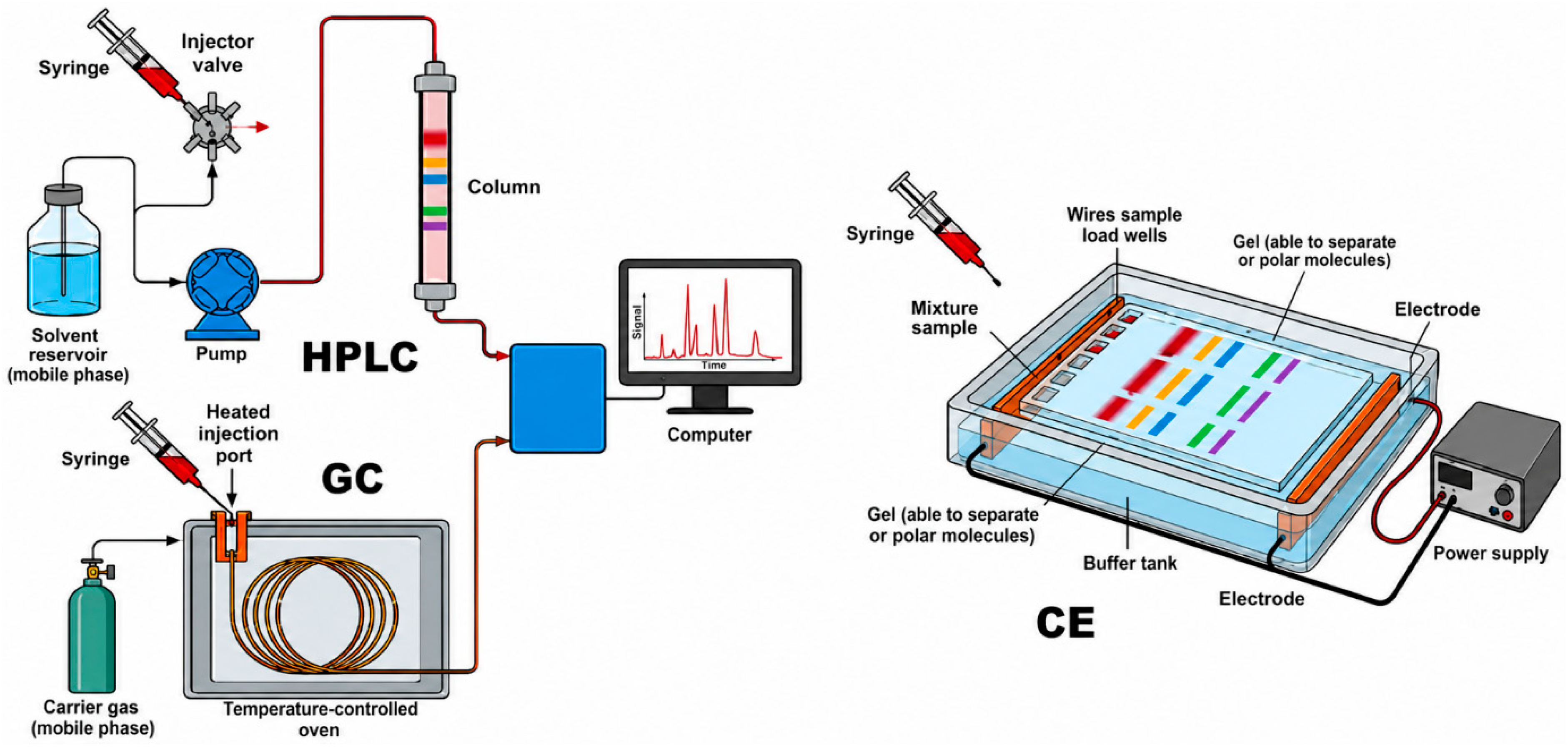
Figure 1. Schematic representation of the main separation techniques used in wine analysis: high-performance liquid chromatography (HPLC), gas chromatography (GC), and capillary electrophoresis (CE). During the preparation of this manuscript/study, the author(s) used Gemini (version 1.5 Pro, Google, Mountain View, CA, USA) for the purposes of elaboration. The authors have reviewed and edited the output and take full responsibility for the content of this publication.
Beverages 12 00069 g001
Figure 2. Schematic illustration of the application of electronic noses and electronic tongues in wine analysis, encompassing volatile and electrochemical compound detection, signal processing through pattern recognition algorithms, and wine classification based on quality and authenticity parameters. During the preparation of this manuscript/study, the author(s) used Gemini (Google, Mountain View, CA, USA) for the purposes of elaboration. The authors have reviewed and edited the output and take full responsibility for the content of this publication.
Beverages 12 00069 g002
Table 1. Chromatographic techniques for evaluation of chemical targets in wine.
TechniqueAnalyteSampleMain ResultsReference
GC-O/GC-MS/HS-GC-FIDAroma componentsSyrah wine (China)β-damascenone and ethyl octanoate, as major aroma components[39]
GC-O + PLSOff-flavorsPremium red wines (Spain)79% of variance explained; defects showed negative correlations[38]
GC-MS/GC-FIDVolatile fractionsWhite, rosé and red winesFirst identification of benzofuranone in wine[36]
GC-EI-QTOF-MSPesticides, off-flavorsWine (general)Limits of quantification at ng/mL; post-run screening[26]
GC × GC-MS (heart-cut)ethyl estersWine, whisky, cognacDetection limit < 1 ng/L; up to 350× odor threshold[40]
GC–Ion Trap MSSotolon, maltol, furaneolWine (general)Detection limit 0.5–1 µg/L; precision 4–5%[41]
GC-FIDMajor volatile compoundsWine (general)RSD ~ 5.5%; r2 up to 0.9998[43]
HPLC-DAD-FLDGallic acid, trans-resveratrolRed wineHigh levels detected (mg/L)[31]
HPLC-UV-Vis (PARAFAC2)EpicatechinWhite wineAuthentic winemaking sources[25]
HPLC-MS/MSProlineSparkling wineQuality classification[24]
HPLC-MS/MSBiogenic aminesWineSanitary quality assessment[24]
HPLC (cation exchange)Tartaric acidMust/wineAcidity preservation[34]
HPLC-DAD-ESI-MS/MSEllagitannins (vescalagin)Oak-aged red wineStability and sensory quality[33]
HPTLCGluconic acidMust/wineIndicator of Botrytis contamination[35]
μ-PLCGlucose/fructosemust/wineFermentation control/fraud detection/Microbiological quality[35]
Table 2. Spectrometric methods for evaluation of chemical targets in wine.
AnalysisTargetLoDLoQReference
UV-VISSugars in wine5.3 g/L3.6 g/L[54]
UV-VISGrape-must caramel in high-quality wine and balsamic vinegars0.05% v/v0.16% v/v[55]
UV-VIS/colorimetryDifferentiation of wines--[56]
UV-VISCharacterization of color components and polymeric pigments of commercial red wines--[58]
UV-VISDetermination of polyphenols in wines0.015 to 1.5 mg/L-[59]
VIS:IR/ChemometryPhenolics in grape and wineReviewReview[60]
Spectroscopy:ChemometryWine authenticationReviewReview[61]
FTIRGrape and wine analysisAlcohol (vol %) 7.4 to 14.0
Glycerol (g/L) 5.20 to 27.80
-[62]
Spectroscopy:ChemometryWine authenticationReviewReview[61]
RamanFood quality assurance and safety monitoringReviewReview[73]
RamanSulfites detection--[75]
1H-NMR/ChemometryStudy of the stability of wine samples--[83]
1H NMRInvestigation of Primitivo red wine subjected to grape pomace repassage to verify potential detoxification effects.--[84]
NMRWine fermentation process evaluation--[85]
1H NMRReal-time monitoring of fermentation processes in wine production--[86]
1H NMR/SIDA-HS-GC-MSMethanol in wines and ciders--[87]
MSStudy of wood compounds
released in the barrel-aged wine and spirits
Review Review[88]
NMRAuthenticity and geographical origin of wines, isotope ratioReviewReview[89]
GC-MS/sensory techniquesFlavoromic analysis of wines--[90]
HPLC:Tandem MSDetermination of pesticide residues in wine-<2.5 μg/L[91]
Table 3. Electrochemical (bio)sensors for evaluation of specific targets in wine (prepared by the authors).
Recognizing AgentTargetLinear RangeLoDReference
Salivary α-amylase or proline-rich protein (PRP)Polyphenols/astringent compounds0.17 to 4.7 µM0.6 µM[143]
LaccaseTotal Polyphenols-2.6 μg/L[144]
Sulfite oxidaseSulfite6.0 to 82.6 μM6 μM[145]
Starkeya novella Sulfite dehydrogenaseSulfite1 to 6 μM44 pM[146]
Alcohol oxidaseEthanolreviewreview[147]
Whole-cellMethanol0.050–2.5 mM0.05 mM[148]
Bi-enzymatic. Glucose oxidase and Alcohol dehydrogenaseGlucose/Ethanol0.3 to 7.8 mM
0.1 to 0.7 M
0.1 mM
0.06 M
[149]
Glucose oxidase Alcohol oxidase Lactate oxidaseGlucose/Ethanol/Lactate0.04 to 2.5 mM
0.3 to 20 mM
0.008–1 mM
-[150]
Co(II)-phthalocyanineTartaric acid10 to 100 μM7.3 μM[151]
PVC membrane with R4N+ Tartrate anion exchangerTartaric acid-0.5 mM[152]
A reviewMalic Acidreviewreview[153]
Oenococcus oeniMalic and Lactic acid0.05 to 0.4 mM
5 μM to 1 mM
3 μM
2 μM
[154]
Malate quinone oxidoreductaseMalic Acid5 to 150 μM5 μM[155]
Hapten B-APTCA0.05 to 10 ppm29 ppt[156]
AptamerOchratoxin A6 pM to7 nM1.4 pM[157]
AntibodyAtrazine in: wine and grape 0.3 to 2000 μg/L0.034 μg/L
50 μg/kg
[158]
Antibodyspoilage yeast species-102 CFU/mL[159]
Diamine oxidaseBiogenic amines1 to 50 μM0.5 μM[160]
Cucurbiturils CB [7]Histamine1.7 to 8.3 nM0.45 nM[161]
MWCNTsHistamine5 to 200 mg0.18 μM[162]
Disclaimer/Publisher’s Note: The statements, opinions and data contained in all publications are solely those of the individual author(s) and contributor(s) and not of MDPI and/or the editor(s). MDPI and/or the editor(s) disclaim responsibility for any injury to people or property resulting from any ideas, methods, instructions or products referred to in the content.