


Highlights
- Aging potential of traditional-method sparkling wines was evaluated through CO2 retention.
- Shelf life was defined by the legal pressure threshold of 3.5 bar at 20 °C.
- A predictive model was developed for CO2-related shelf life estimation.
- Key physicochemical and closure-related factors governing CO2 retention were integrated.
- Modern crown caps outperform cork-lined closures for long-term CO2 preservation.
Abstract
Today, billions of bottles are aging in the cellars of traditional-method sparkling wine regions prior to their release on the market. Given the fundamental role of carbon dioxide (CO2) in both the production and sensory perception of sparkling wines, it is essential to understand and control all stages that influence its pressure and concentration in the bottle throughout the winemaking process. This study addressed the central question of how long traditional-method sparkling wine bottles can age in cellars while maintaining sufficient CO2 pressure. By considering their capacity to retain the minimum CO2 pressure of 3.5 bar at 20 °C, as required by European regulations, a predictive formula for the shelf life of older vintages was proposed and discussed, integrating the multiple relevant parameters that govern CO2 retention. Moreover, based on previously published datasets, a comparison was carried out between CO2 losses measured for a range of modern crown caps and those observed in collections of older champagne vintages sealed with cork-lined crown caps. The results clearly show that modern crown caps preserve dissolved CO2 far more effectively in traditional-method sparkling wines than the cork-lined closures commonly used during the last century, leading to substantially longer predicted shelf lives.
Keywords:
sparkling wines; traditional method; carbon dioxide; pressure; aging on lees; crown caps; shelf life 1. Introduction
Driven by steadily increasing global demand, the consumption of sparkling wines has risen sharply since the turn of the century [1], now reaching nearly 2.5 billion bottles per year within a global market valued at over USD 40 billion [2,3,4]. With Prosecco representing the largest sparkling wine category worldwide in terms of volume, Italy is currently the leading producer of sparkling wines, followed by France and Germany [3].
The earliest written documents tracing the origin of sparkling wines date back to the early 1660s [5,6,7,8]. In December 1662, the English scientist Christopher Merret (1614–1695) presented a paper entitled Some Observations concerning the Ordering of Wines to the newly formed Royal Society of London [5,6]. He reported that the addition of molasses to barrels of still wines not only increased their alcohol content but also rendered them slightly effervescent. Although unaware of its significance at the time, Merret’s observation laid the foundations of what is now known as the Traditional Method for producing premium sparkling wines.
In traditional method sparkling wines, dissolved CO2 is generated through a secondary in-bottle fermentation initiated by the addition of yeasts and fermentable sugars to a still base wine, which is subsequently sealed in thick-walled glass bottles with either a crown cap or a cork stopper [9,10]. Today, after more than three centuries of technical refinements, sparkling wines produced in this manner are labeled méthode traditionnelle. This process involves several key steps, comprehensively described in the overviews by Kemp et al. [9] and Liger-Belair [10].
Furthermore, given the crucial role of CO2 as the “reservoir of effervescence” in sparkling wines, a minimum CO2 pressure in the bottle is legally required before traditional-method sparkling wines may be released onto the market. According to the definition established by the International Organization of Vine and Wine (OIV), which also constitutes a legal text, “sparkling wines are characterized on uncorking by the production of a more or less persistent effervescence resulting from the release of CO2 (the excess pressure of this gas in the bottle is at least 3.5 bar at 20 °C) of exclusively endogenous origin” [3]. However, because bottle pressure and effervescence are defining features of sparkling wines, the gradual decline in both CO2 pressure and dissolved CO2 during aging on lees—clearly evidenced in remarkable vertical collections of Champagne bottles [11,12]—raises the fundamental question of how long traditional-method sparkling wines can be aged while still maintaining sufficient pressure and dissolved CO2 to meet regulatory requirements.
In this article, we guide the reader step by step through the scientific principles and experimental evidence required to address this question with the highest possible level of clarity. We begin with a detailed examination of the secondary in-bottle alcoholic fermentation, the key process underlying the build-up of CO2 pressure in sealed traditional-method sparkling wine bottles. We then introduce and explain previously published datasets documenting CO2 pressure losses and subsequent dissolved CO2 concentrations in exceptional collections of champagne bottles. These data provide the foundation for the development of predictive models that integrate molecular diffusion, thermodynamic equilibrium, and key physicochemical parameters. We subsequently illustrate how these models can be used to estimate the shelf life of aged traditional-method sparkling wines, with particular emphasis on compliance with European regulations requiring a minimum CO2 pressure of 3.5 bar at 20 °C. Finally, by comparing CO2 losses measured for a range of modern crown caps with those observed in older vintages sealed decades ago using cork-lined crown caps, we highlight the critical influence of bottle size, crown cap permeability, and aging temperature on the long-term retention of dissolved CO2 during lees aging.
2. The prise de mousse: A Critical Step in Traditional-Method Sparkling Wine Production
2.1. Quantifying CO2 in the Sealed Bottles During the prise de mousse
In traditional-method sparkling wines, secondary fermentation—referred to as prise de mousse [13]—is initiated by inoculating selected Saccharomyces cerevisiae strains, together with the addition of fermentable sugar (sucrose), into a blend of still wines. These base wines, typically containing approximately 11% ethanol by volume, are obtained from the first alcoholic fermentation of grape must [14,15,16]. The resulting blend is then transferred into thick-walled glass bottles hermetically sealed with either crown caps or natural cork stoppers, the latter being predominantly used for prestige cuvées [11]. The bottles are subsequently stored in cellars under cool temperature conditions (typically 12–14 °C), thereby facilitating a gradual secondary fermentation within a closed system. This in-bottle fermentation produces additional ethanol and carbon dioxide, the latter being responsible for the characteristic effervescence observed in the tasting glass [14,15,16].
With the classical addition of 25 g L−1 of sucrose to the blend, a subsequent production of approximately 12.1 g L−1 of ethanol is achieved, corresponding to nearly 15 mL of ethanol per liter, or an increase of roughly 1.5% by volume [13,14,15,16]. Upon completion of the prise de mousse, the additional ethanol produced increases the alcohol content of the bottled wine to approximately 12.5% (v/v). Moreover, adding nearly 25 g L−1 of sucrose to the blend leads to the formation of about 11.9 g L−1 of CO2 during secondary fermentation (i.e., n ≈ 0.27 mol −1 of CO2 after completion of the prise de mousse, assuming a fermentation efficiency close to 95%). Considering the molar mass of CO2 (44 g mol−1) and the molar volume of an ideal gas (≈24 L mol−1 at 12 °C), this corresponds to nearly 5 L of gas-phase CO2 physically contained in a standard 75 cL bottle [14,15,16].
The defining characteristic of all sparkling wines is therefore the retention of carbon dioxide (CO2) in significant concentrations within the liquid, achieved by maintaining the wine under pressure in a sealed bottle. However, the large-scale industrial production of sparkling wines—and carbonated beverages more broadly—relies on a fundamental physical principle, called Henry’s law, which states that the concentration of CO2 dissolved in wine is directly proportional to the partial pressure of CO2 in the gas phase in the sealed bottle, as expressed by the following relationship [17]:
where denotes the moles of CO2 dissolved in the wine, the wine volume in the sealed bottle, the temperature-dependent Henry’s constant for CO2 in wine [18], and the partial pressure of gas-phase CO2.
The Henry’s constant is therefore a critical parameter, as it relates the concentration of dissolved CO2 in the beverage to the partial pressure of CO2 in the sealed container. Over recent decades, numerous empirical and semi-empirical models have been developed to estimate the Henry’s constant of CO2 in aqueous mixtures relevant to the sparkling beverage industry. These models encompass a broad range of systems, from simple carbonated waters to more complex alcoholic sparkling beverages, such as sparkling wines and beers [18]. In the late 1970s, based on a series of dedicated experimental studies, the following relationship was proposed, enabling the determination of the Henry’s constant of CO2 in wine as a function of its temperature, ethanol content, and sugar concentration [19]:
where is expressed in g L−1 bar−1, T is the wine temperature (in °C), a is the ethanol content (in % v/v), and b is the sugar concentration (in g L−1).
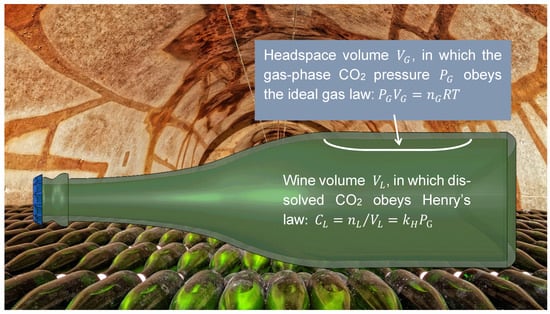
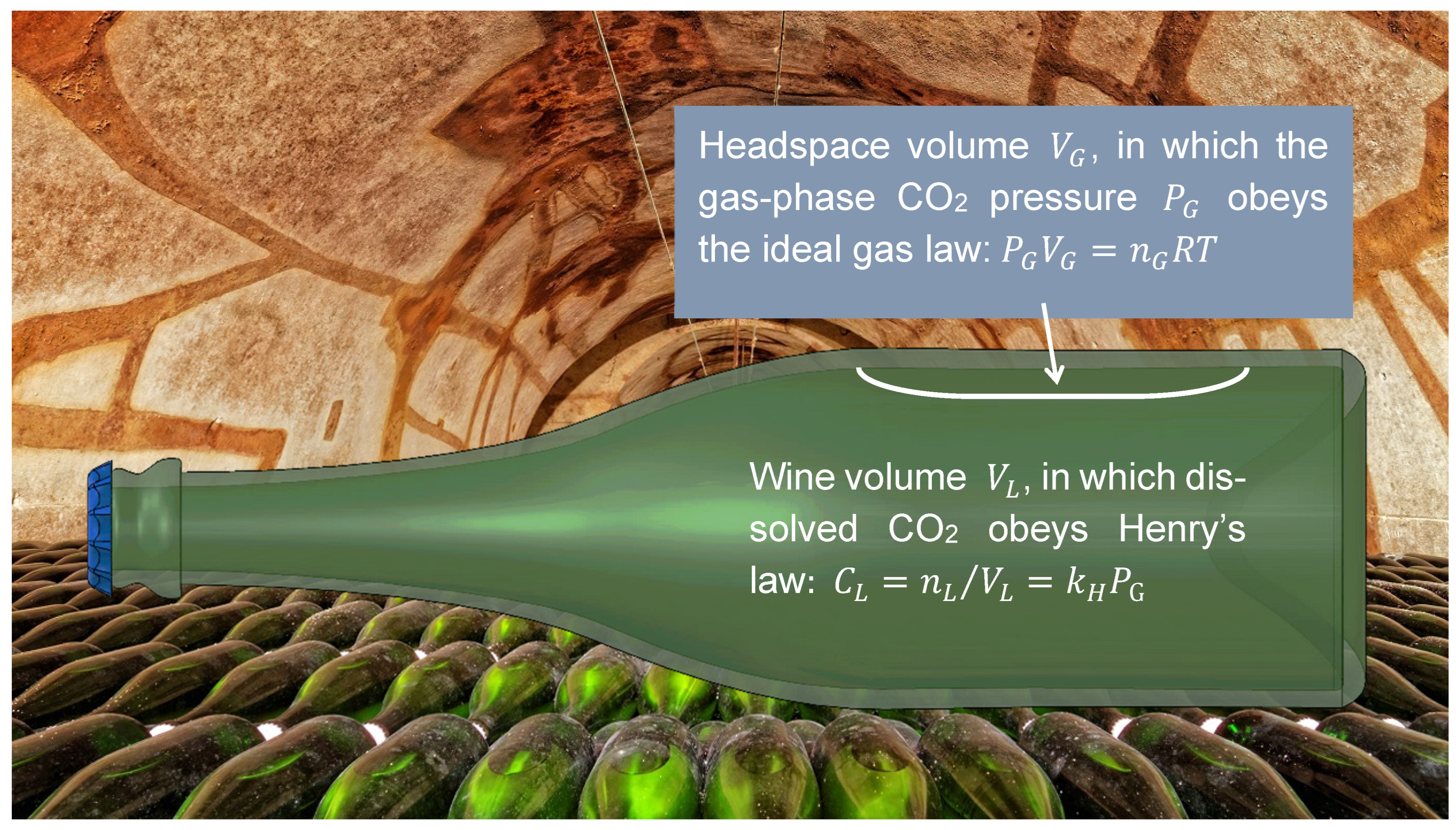
In sealed bottles, a gas-filled volume (the headspace, commonly referred to as “the bubble” in the Champagne region) coexists with the liquid volume of wine, as illustrated in Figure 1. Within the pressure range typically encountered in sealed bottles (a few bars, regardless of bottle size), the behavior of gaseous CO2 in the headspace is well described by the ideal gas law,
where is the mole number of moles of gas-phase CO2 in the headspace, and R is the ideal gas constant ().
Figure 1.
Schematic representation of a sparkling wine bottle sealed with a crown cap during the prise de mousse, illustrating the key parameters governing the thermodynamic equilibrium between dissolved and gaseous CO2.
Otherwise, in hermetically sealed bottles, the total number of moles of CO2 produced by yeast during the prise de mousse () is conserved and partitioned between the headspace ( moles) and the liquid wine ( moles), such that:
This framework allowed the prediction of CO2 distribution between the gas and liquid phases, providing a quantitative basis for understanding pressure development and CO2 retention [12]. By combining the previously described equations, the gas-phase CO2 pressure and the dissolved CO2 concentration in the wine at the end of the prise de mousse (denoted and , respectively) can be expressed as functions of the relevant system parameters, according to the following relationships. Here denotes the dimensionless ratio of the wine volume to the gaseous headspace (), and all other parameters are expressed in SI (International System) units [12]:
The prise de mousse is generally completed (i.e., all fermentable sugars have been consumed by the yeast) within approximately two months [9,17]. Consequently, according to Equation (2), at a cellar temperature of approximately 12 °C, the Henry’s constant for CO2 in a sugar-free wine containing 12.5% ethanol by volume is .
2.2. The Action of the Bottle Format
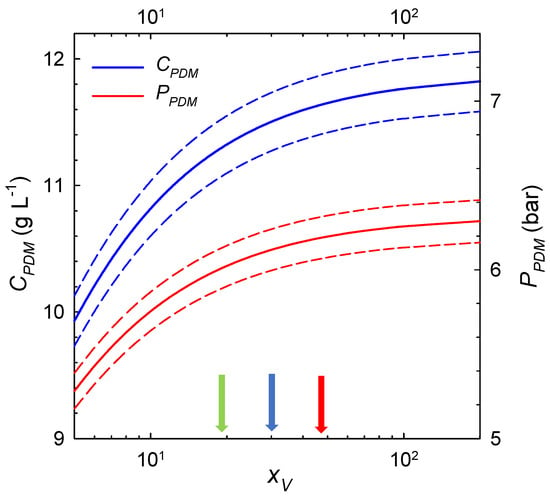
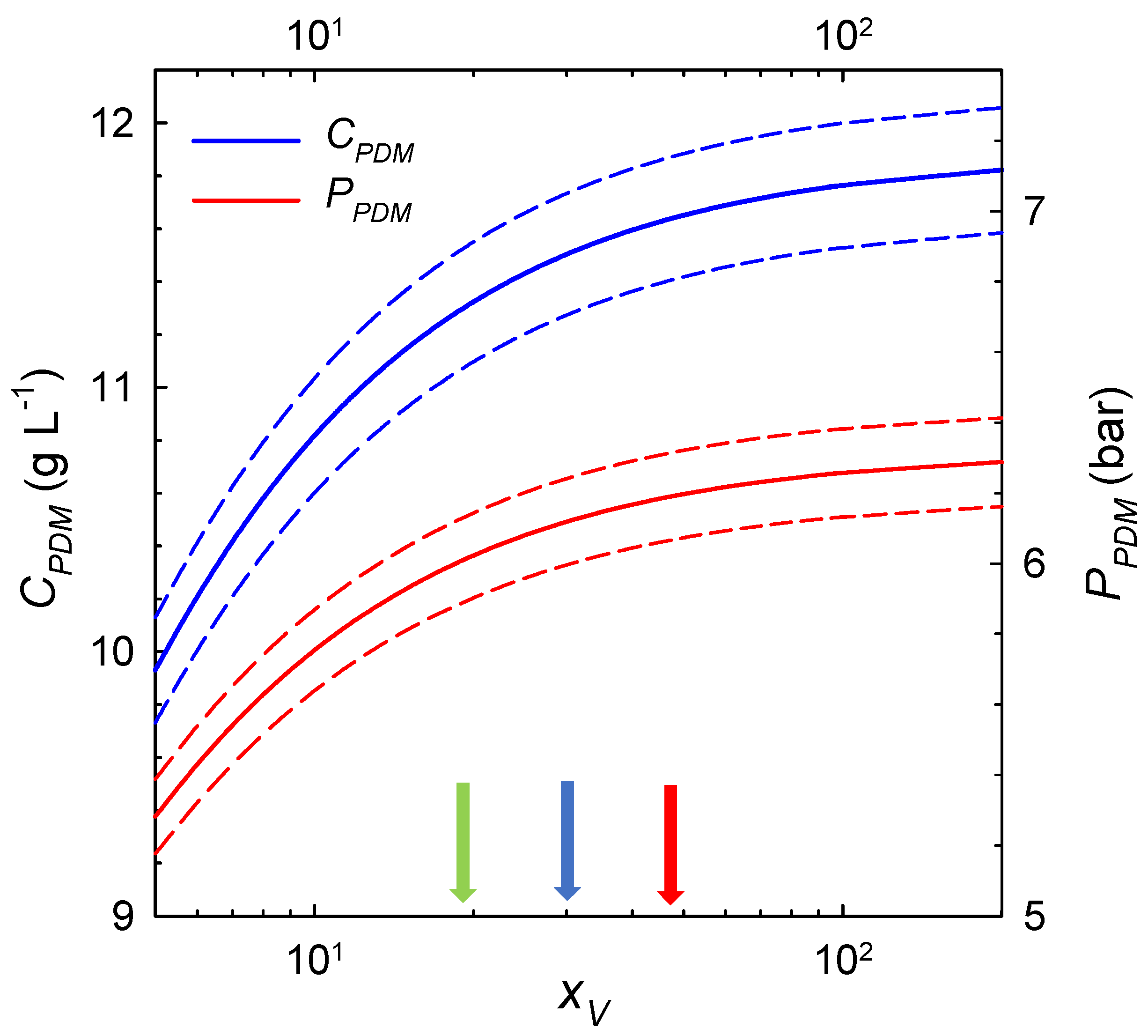
In traditional-method sparkling winemaking, the three bottle formats most commonly used for the prise de mousse are the 37.5 cL half-bottle, the standard 75 cL bottle, and the 150 cL magnum. Nevertheless, their gaseous headspace volumes differ slightly, even when all bottles are sealed with identical crown caps: 2 cL for the half-bottle, 2.5 cL for the standard bottle, and 3.3 cL for the magnum. Knowing the corresponding volume ratio for each format, the system of equations described above allows the precise determination of both the dissolved CO2 concentration (in mol m−3) and the gas-phase CO2 pressure (in Pa) at the completion of the prise de mousse, as a function of the relevant system parameters. For 37.5 cL half-bottles (), after a second in-bottle fermentation initiated at 12 °C in a blend supplemented with 25±0.5 g L−1 of sucrose, Equation (5) yield and . For standard 75 cL bottles (), the corresponding values are and , whereas for 150 cL magnums (), the values increase slightly to and . These theoretical values of pressure and CO2 concentration are fully consistent with the experimental values measured in bottles of various sizes [10,16].
Interestingly, the larger the volume ratio , the higher the resulting dissolved CO2 concentration and the corresponding gas-phase CO2 pressure at the completion of the prise de mousse, as illustrated in Figure 2.
Figure 2.
Concentration of dissolved CO2 (blue solid line, with dashed line indicating uncertainty) and corresponding gas-phase CO2 pressure (red solid line, with dashed line indicating uncertainty) at the end of the prise de mousse initiated with 25 ± 0.5 g L−1 of sucrose, plotted as a function of the dimensionless volume ratio between wine and gaseous headspace; Green, blue, and red arrows indicate values for the 37.5 cL half-bottle, 75 cL standard bottle, and 150 cL magnum, respectively.
3. Prolonged Aging on Lees and Shelf Life Prediction of Old Vintages
3.1. The Issue of CO2 During Prolonged Aging
Once the prise de mousse is complete, traditional-method sparkling wines are not yet ready for release. A mandatory period of maturation follows, during which the wine remains in contact with the dead yeast cells—commonly referred to as “aging on lees” [20,21,22]. In the case of non-vintage Champagne wines, for example, this aging period must last at least 15 months, whereas vintage Champagne requires a minimum of three years of lees aging. During this aging period, the yeasts undergo autolysis. Through this process, they release a variety of organic compounds that modify the wine’s organoleptic profile, contributing to increased roundness as well as the characteristic aromas, flavours and foaming properties associated with lees aging [20,21,22,23,24].
However, a common misconception persists among many wine consumers that sparkling wines should not be aged much beyond the legally mandated minimum period on lees. In reality, the most prestigious cuvées of traditional-method sparkling wines can mature in bottle for several decades, sealed either with crown caps [12] or, in some cases, with premium natural cork stoppers [11]. Yeast autolysis, which typically begins between two and four months after the second in-bottle fermentation [25], enables traditional-method sparkling wines to develop distinctive flavor and aroma profiles through a range of complex proteolytic processes [26,27,28]. The structural evolution of the lees in three series of traditional-method sparkling wines during long-term aging under realistic enological conditions has been investigated using high-pressure freezing combined with transmission electron microscopy [29]. It was found that the stratified structure of the yeast cell wall gradually disappeared during aging. To fully realize the beneficial effects of autolysis, extended aging on lees is necessary to develop the complex and highly sought-after aromas characteristic of traditional-method sparkling wines [21,30]. Yeast autolysis therefore represents a critical stage in the production of traditional-method sparkling wines, serving as a source of polysaccharides, mannoproteins, and proteins, as recently documented by Pons-Mercadé et al. across nine consecutive vintages [31]. Moreover, the release of proteins, polysaccharides, and mannoproteins has been shown to contribute significantly to foam stability [32,33,34,35]. In addition, polysaccharides and mannoproteins positively influence the sensory profile by enhancing mouthfeel [36], while certain peptides and proteins may also contribute to perceived sweetness [37].
Today, billions of bottles of varying sizes are aging in the cellars of traditional-method sparkling wine regions prior to release [12], including several million bottles of prestigious pre-2000 cuvées subject to prolonged lees aging [11,12]. Extended aging poses a particular challenge for exceptional vintages that may remain on lees for decades, as crown caps and corks are not completely impermeable to gas exchange [38,39,40,41,42,43,44,45,46,47]. In accordance with Fick’s law, gaseous species can slowly diffuse along partial pressure gradients through the closure [32]. At the end of the prise de mousse, CO2 pressure in a sealed bottle reaches nearly 6 bar at 12 °C, with slight variations depending on the ratio of wine volume to headspace and thus on bottle size (Equation (3)). During aging on lees, the high internal CO2 pressure relative to ambient levels (≈420 ppm) drives slow diffusion through the closure, while thermodynamic equilibrium between gas-phase and dissolved CO2 causes both headspace pressure and dissolved CO2 concentration to gradually decline [42]. However, this loss of CO2 pressure may become critical if it falls below the legal minimum of 3.5 bar at 20 °C required by European regulations.
Various techniques adapted from food packaging and wine analysis have been applied to quantify gas permeation through crown caps and cork stoppers [40,41,43,48,49,50,51,52,53]. X-ray tomography has been used for the non-destructive visualization of internal cork defects that may increase the risk of wine leakage and to identify potential pathways for gas transfer through cork stoppers [54,55,56]. More recently, the diffusion of gas-phase CO2 through macro- and micro-agglomerated corks used in Champagne and other sparkling wines has been studied using a manometric technique [44]. These studies indicate that smaller cork particle size, higher adhesive content, and greater compression enhance the stopper’s gas-barrier properties.
Based on recent experimental observations, the following sections aim to highlight and provide a deeper understanding of the inevitable decrease in CO2 during prolonged aging on lees in traditional-method sparkling wines. Furthermore, a model that integrates molecular diffusion with the ideal gas law and the thermodynamic equilibrium of CO2 in a sealed bottle enables a precise assessment of the contribution of each relevant parameter during lees aging.
3.2. Recent Advances from Exceptional Vertical Champagne Collections
3.2.1. A Vertical Collection of Dom Pérignon Bottles
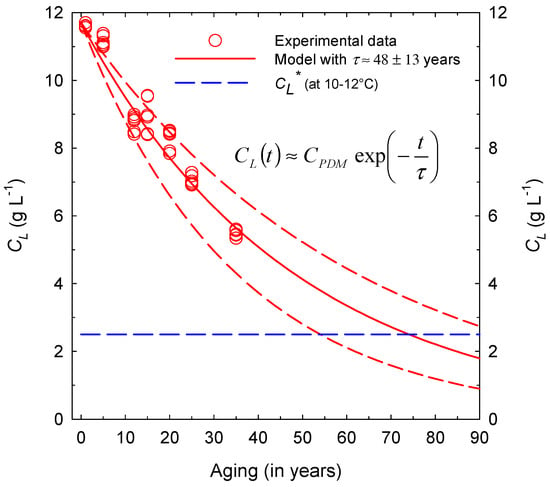
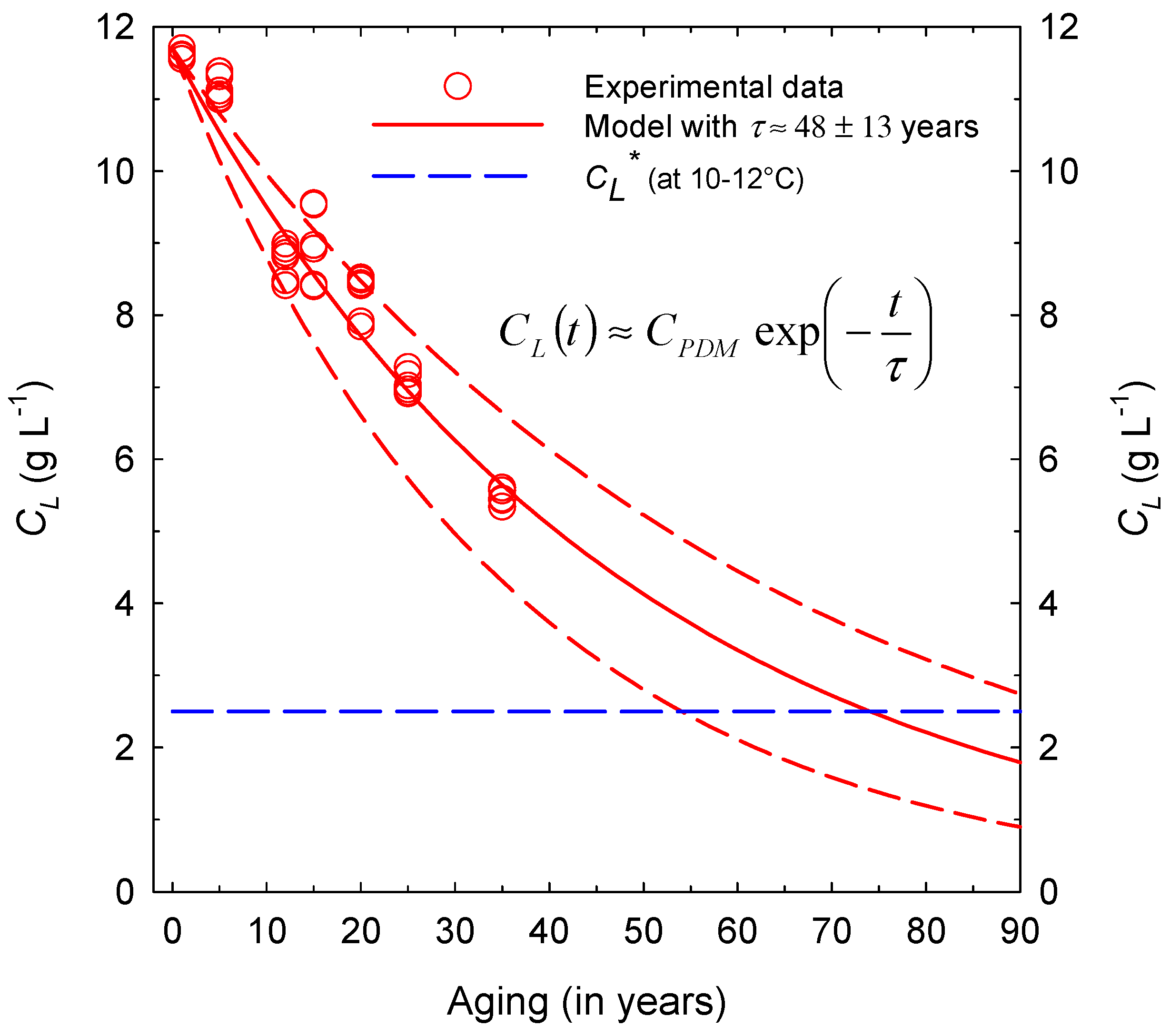
A few years ago, measurements of dissolved CO2 were carried out on an exceptional vertical collection of seven vintages from a prestige cuvée, spanning increasing durations of lees aging: 1, 5, 12, 15, 20, 25, and 35 years. These bottles were provided by Champagne Dom Pérignon (Épernay, France) [11]. For all seven vintages, a standard dosage of 24 ± 0.5 g L−1 of sucrose was added to the blend for the second in-bottle fermentation. During the prise de mousse and subsequent aging on lees at 12 °C, identical standard 75 cL bottles (with bottlenecks showing a narrow diameter of 26 mm) were sealed with premium traditional cork stoppers (Amorim & Irmãos, Santa Maria de Lamas, Portugal). To allow for statistical analysis, dissolved CO2 measurements were performed on six distinct bottles for each vintage. Further details regarding this dataset are provided in ref. [11].
As shown in Figure 3, dissolved CO2 decreased steadily during lees aging, with losses reaching approximately 6 g L−1 for the oldest vintage after 35 years. This decline for the prestige cuvée was well described by an exponential decay model, characterized by a timescale of τ ≈ 48 ± 13 years [11]. It is important to note that the gradual decline in dissolved CO2 concentration during extended aging on lees has notable sensory consequences. Specifically, this reduction results in a decreased frequency of bubble formation and smaller CO2 bubbles in tasting glasses [57]. It is therefore noteworthy to mention that, owing to the progressive reduction in a vintage’s effervescence potential over time, the so-called “carbonic bite” will gradually diminish during tasting, thereby modifying the overall processes that contribute to aroma perception [58,59,60,61,62].
Figure 3.
Decreasing concentrations of dissolved CO2 measured in 7 vintages of Champagne Dom Pérignon that underwent progressively longer aging on lees (red circles), compared with an exponential-decay model with a characteristic timescale τ ≈ 48 ± 13 years (red solid line, with dashed line indicating uncertainty); The horizontal blue dashed line indicates the critical dissolved CO2 concentration below which bubble nucleation becomes thermodynamically impossible in tasting glasses at 10–12 °C (redrawn from ref. [11]).
3.2.2. A Vertical Collection of Champagne Castelnau Bottles and Magnums
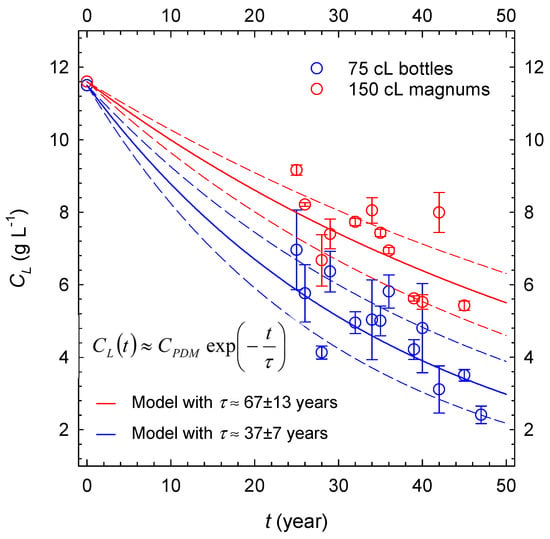
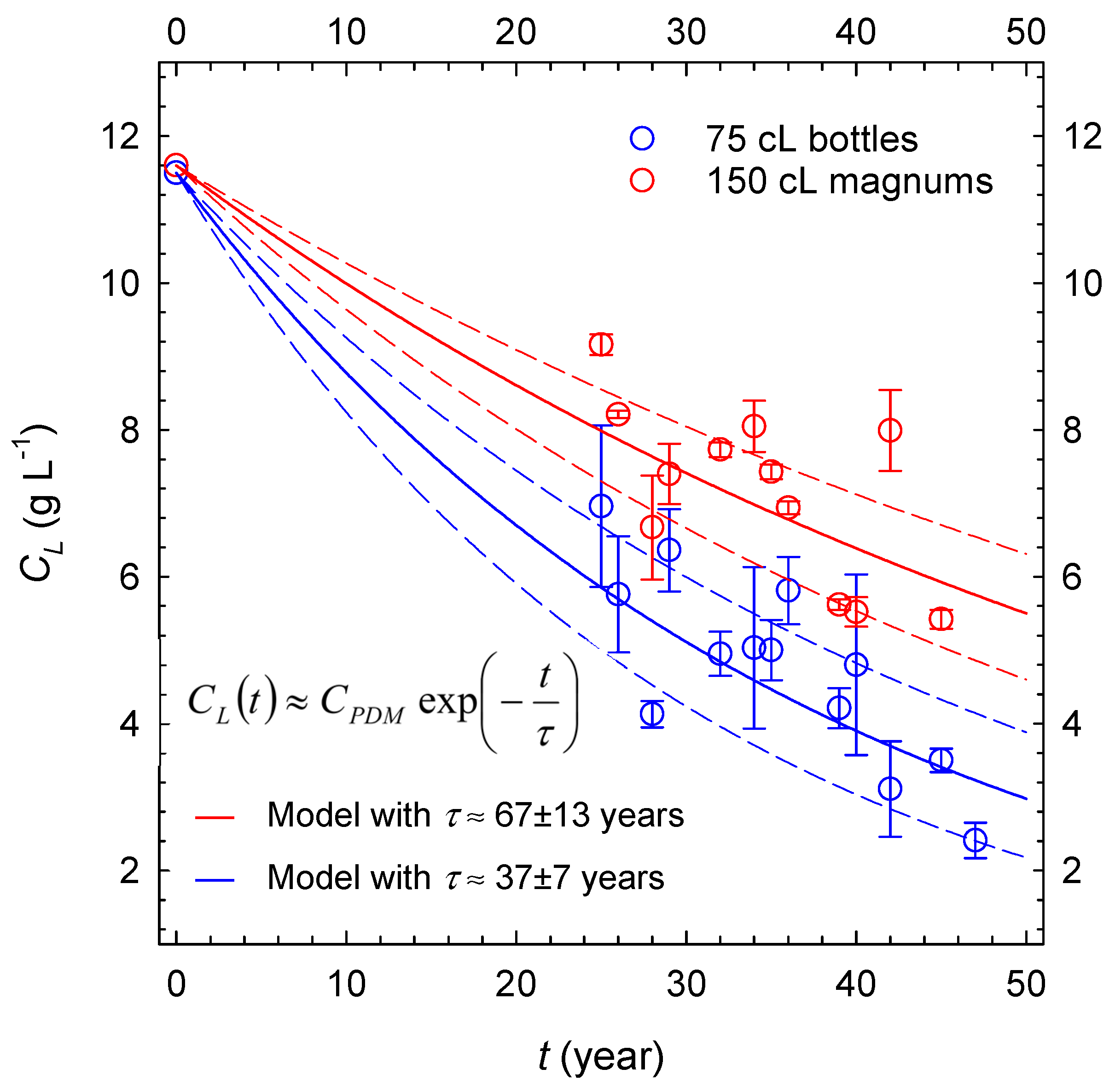
Combined measurements of dissolved CO2 concentrations and gas-phase CO2 pressures were performed on 13 consecutive vintages of Champagne Castelnau (Reims, France), produced prior to the 2000s and aged on lees for 25 (1996) to 47 years (1974) [12]. To evaluate the influence of bottle volume, standard 75 cL bottles were compared with 150 cL magnums, except for the 1974 vintage, which was available only in 75 cL. Despite variations in base wine blends, both formats featured identical 29 mm bottlenecks and were sealed with standard crown caps fitted with agglomerated cork discs—the predominant closure for traditional-method sparkling wines before the 2000s. All bottles were aged under uniform cellar conditions (12–14 °C), and a dosage of 25 g L−1 sucrose was added for the second in-bottle fermentation. To enable statistical analysis, measurements of dissolved CO2 were carried out on three bottles and three magnums for each vintage. More details about this dataset can be found in ref. [12].
Following the second in-bottle fermentation, ethanol typically reached nearly 12.5% (v/v), while dissolved CO2 concentrations were 11.5 g L−1 in 75 cL bottles and 11.6 g L−1 in 150 cL magnums, according to Equation (5). As shown in Figure 4, dissolved CO2 gradually decreased during aging, with the greatest loss observed in the oldest vintage (1974 elaborated in standard 75 cL bottles), which lost nearly 9 g L−1 after 47 years. A similar trend was observed in magnums, but the rate of CO2 loss was substantially slower, demonstrating that magnums retain dissolved CO2 more effectively during prolonged aging on lees than standard bottles.
Figure 4.
Decrease in dissolved CO2 across 13 Champagne Castelnau vintages aged on lees for 25–47 years in 75 cL bottles and 150 cL magnums; dashed lines denote uncertainties in the exponential timescales (redrawn from ref. [12]); At , the initial dissolved CO2 concentrations reached in bottles and magnums at the end of the prise de mousse were theoretically determined using Equation (3) assuming a second in-bottle fermentation initiated with 25 g L−1 sucrose.
As observed for successive vintages of Champagne Dom Pérignon, the gradual decrease in dissolved CO2 during prolonged lees aging of Champagne Castelnau is well described by exponential decay functions, albeit with markedly different characteristic timescales depending on bottle size. In standard 75 cL bottles, the characteristic exponential timescale is , whereas in 150 cL magnums it is significantly longer, [12]. These long-term observations clearly demonstrate that bottle size plays a critical role in the gradual loss of dissolved CO2 in traditional-method sparkling wines during aging on lees.
To better interpret these experimental results, a model describing the decay of gas-phase CO2 pressure and dissolved CO2 in sealed bottles is presented below, along with a discussion of the factors influencing aging duration in cellars for traditional-method sparkling wines.
3.3. A Simple Model for the Losses of CO2 During Aging on Lees
Since molecular diffusion governs the transfer of gas-phase CO2 through crown caps or cork stoppers, a model based on Fick’s first law has been proposed to predict the temporal evolution of CO2 pressure () and the corresponding dissolved CO2 concentration in wine () during aging on lees [12]. Assuming that the mass transfer coefficient for gas-phase CO2 through the bottle closure (denoted K) remains constant over time, the following multivariable exponential-decay models were developed to describe the temporal evolution of CO2 pressure and the corresponding dissolved CO2 concentration in sealed bottles, with all parameters expressed in SI units [12]:
where and are the CO2 pressure and dissolved CO2 concentration in wine at the end of the prise de mousse, t is the aging time, and τ is the characteristic timescale of the exponential decay, determined by the properties of the bottle, wine, and closure system.
Further details regarding the stepwise determination of Equation (6) can be found in ref. [12]. Most interestingly, this system of equations indicates that experimentally determining the exponential timescales from long-term measurements of dissolved CO2 or pressure decay in sealed bottles provides an effective indirect method for estimating the mass transfer coefficient K for CO2 through any type of crown cap or cork stopper, according to the following relationship:
Applying this equation to the exponential timescales determined for the successive vintages of Champagne Castelnau yielded an overall CO2 mass transfer coefficient of m3 s−1 for crown caps fitted with cork discs, which were commonly used prior to the 2000s [12]. Applying the same approach to the dataset from successive vintages of Champagne Dom Pérignon yielded a mass transfer coefficient of m3 s−1 for traditional high-quality cork stoppers, demonstrating that these closures provide a more effective barrier to CO2 leakage during aging on lees than the crown caps with cork discs commonly used prior to the 2000s.
4. Discussion
4.1. Is There a Maximum Legal Lees-Aging Period for Aged Vintages?
4.1.1. From Lees Aging to Disgorging: Managing CO2 Pressure in Marketable Bottles
Because European regulations require a minimum excess CO2 pressure of 3.5 bar at 20 °C [3], the shelf life of traditional-method sparkling wine bottles can be evaluated in terms of their ability to maintain an internal CO2 pressure above this legal threshold (denoted ). Inevitably, due to the progressive exponential decline in pressure during aging on lees, a maximum permissible aging duration exists beyond which the pressure will inevitably fall below this limit.
Moreover, between the end of lees aging and the release of the cork-finished bottle to the market, the disgorging step induces an additional loss of CO2 pressure, further constraining the allowable total aging time. Disgorging is the post-lees-aging process used to remove yeast sediment from the bottles. The bottle necks are first frozen—typically in a brine or glycol bath at nearly 25 °C—forming an ice plug that traps the sediment [14,15,63]. The crown caps or corks are then removed, and the internal pressure ejects the frozen plug. Finally, a specific dosage, known as the liqueur d’expédition and consisting of a mixture of wine and sugar [64], is added to replace the lost volume. Adding sugar at this step determines the wine’s sweetness category, classified according to European regulations (in g L−1) [65]:
- Brut Nature: <3
- Extra-Brut: 3–6
- Brut: 6–12
- Extra-Dry: 12–17
- Sec: 17–32
- Demi-Sec: 32–50
- Doux: >50
From a CO2 perspective, the gas-phase CO2 pressure in the sealed bottle drops immediately upon opening during disgorging. Importantly, the headspace volume , which initially contained CO2 under pressure, is irreversibly lost, breaking the thermodynamic equilibrium in the bottle. When the bottle is then quickly recorked with a cork stopper, the moles of CO2 corresponding to the evacuated headspace must be subtracted from the total CO2 balance. Dissolved and gaseous CO2 then re-establish Henry’s equilibrium, but with a new gas-phase pressure in the recorked bottle (denoted ) slightly lower than the pressure just before disgorging, given by [66]:
where denotes the CO2 pressure in the bottle after aging on lees (i.e., just before disgorging), is the new headspace volume in the bottle after dosage, and is the Henry’s constant of CO2 in the wine after dosage and recorking.
After dosage and recorking, because the cork is inserted approximately 2.5 cm into the bottleneck, the headspace volume of the recorked bottle () is slightly smaller than the original headspace volume () present when the bottle was sealed with a crown cap during the prise de mousse and lees aging. In addition, the Henry’s constant () slightly differs from the previous value, as the dosage—composed of sugar and aged wine added before recorking—reduces CO2 solubility by increasing the sugar concentration b in Equation (2). This effect of dosage on Henry’s constant, and thus on CO2 pressure in the recorked bottle, has largely been overlooked in earlier studies [9,10,11,12]. Further details on the evolution of dissolved and gas-phase CO2 during the disgorging step can be found in a recent review by Liger-Belair [66], which also considers the consequences of moderate gushing episodes.
Moreover, aging on lees is of course not carried out at 20 °C, but rather at typical cellar temperatures closer to 12 °C. A temperature correction must therefore be applied to determine the minimum legal CO2 pressure at cellar temperature corresponding to the regulatory threshold of 3.5 bar at 20 °C (after disgorging). By applying Henry’s law with 20 °C as the reference temperature, the relationship between the relevant parameters as a function of wine temperature T can be expressed as follows [18]:
Nevertheless, because CO2 is highly soluble in the liquid phase and the gaseous headspace is negligible compared with the wine volume (), the total CO2 content of a sealed bottle is dominated by the dissolved fraction (). As a result, the concentration of dissolved CO2 varies only marginally with temperature (i.e., ). Consequently, Equation (9) can therefore be rewritten to express the CO2 pressure at temperature T as a function of its value at the reference temperature of 20 °C [18]:
According to Equation (2), at 12 °C, the Henry’s constant for CO2 in a sugar-free wine containing 12.5% (v/v) ethanol—typical of lees aging—is . At 20 °C, the same equation gives . Consequently, the minimum legal CO2 pressure at 12 °C corresponds to bar. Thus, taking the disgorging step into account, the critical CO2 pressure in a bottle still sealed with a crown cap prior to disgorging (denoted ), and which will result in a CO2 pressure equal to the regulatory threshold of bar at 20 °C in the recorked bottle after disgorging, can therefore be estimated as follows:
Thus, the shelf life of older vintages can be predicted by replacing in Equation (6) with and extracting the corresponding aging time at which this critical pressure is reached. Ultimately, the maximum allowable aging time on lees at cellar temperature (≈12 °C), denoted , beyond which the CO2 pressure in the bottle would drop below the critical value of bar after disgorging (at 12 °C), can be expressed as follows:
Using Equation (12), the shelf life of a bottle can thus be predicted from its ability to maintain, after disgorging, a CO2 pressure above the minimum regulatory threshold ( bar at 20 °C). For second in-bottle fermentations typically initiated with 25 g L−1 of saccharose, Table 1 summarizes the key parameters governing CO2 retention in traditional-method sparkling wines produced and aged at 12 °C in 37.5 cL half-bottles, 75 cL bottles, and 150 cL magnums. All formats share identical 29 mm bottlenecks and were sealed with the same type of crown caps fitted with thin cork discs commonly used before the 2000s. Together, these parameters allow prediction of the maximum shelf life beyond which CO2 pressure falls below the legal limit of 3.5 bar at 20 °C.
Table 1.
For prolonged aging on lees at 12 °C in 37.5 cL half-bottles, 75 cL standard bottles, and 150 cL magnums (all sealed with identical crown caps fitted with a thin cork disc), the table compares the relevant parameters that govern CO2 loss and ultimately determine the predicted shelf life beyond which the CO2 pressure drops below the minimum 3.5 bar at 20 °C required by European regulations. These predictions apply here to standard Zero Dosage traditional-method sparkling wines after disgorging (i.e., without added sugar in the liqueur d’expédition, implying ).
As clearly shown in Table 1, the potential shelf life of older vintages is strongly influenced by bottle size—an essential parameter that traditional method sparkling wine makers must consider when crafting prestigious cuvées intended for release many decades later. Notably, owing to their superior ability to retain CO2 above the minimum pressure mandated by European regulations, traditional-method sparkling wines produced in 150 cL magnums can sustain more than twice the maximum aging time on lees compared with those produced in standard 75 cL bottles.
4.1.2. The Combined Influence of Temperature and Crown Cap Permeability
Today, modern crown caps used to seal traditional-method sparkling wines during secondary fermentation no longer contain cork liners, thereby eliminating the potential risk of cork taint and providing a more hermetic seal than crown caps fitted with cork liners commonly used prior to the 2000s. Several manufacturers currently produce crown caps with synthetic liners for the secondary alcoholic fermentation and the subsequent lees aging of traditional-method sparkling wines [67].
In most studies on traditional-method sparkling wines, the CO2 permeability of crown caps during lees aging is expressed as the volume of CO2 lost per day (cm3 day−1), measured at 1 bar and 20 °C. The relationship between the volumetric CO2 gas loss and the CO2 mass transfer coefficient of the crown cap can be determined using the equation below, derived from Fick’s law:
where denotes the rate at which the number of CO2 moles escapes from the sealed bottle during lees aging in response to the difference in CO2 partial pressure between the bottle () and the cellar atmosphere ().
Combining the latter equation with the ideal gas law leads to the following relationship between the volumetric CO2 gas loss, denoted , and the CO2 mass transfer coefficient K of the crown cap:
where is the ambient pressure in the cellar (usually close to 1 bar if not too far above seal level).
Finally, with being negligible compared with the partial pressure of CO2 in the sealed bottle, the CO2 mass transfer coefficient of can easily be determined as follows (in m3 s−1):
where the numerical factor 1.16 × 10⁻¹¹ accounts for the conversion to m3 s−1 of the volumetric CO2 gas loss, which is usually expressed in cm3 day−1 by most crown cap manufacturers.
Recently, a study has been conducted in collaboration between our laboratory at the University of Reims Champagne-Ardenne and the crown cap manufacturer PE.DI (Dizy, France), which offers a wide range of crown caps with different CO2 permeabilities [47]. For the first time, the volumetric CO2 fluxes through different crown cap models were determined in situ by tracking the mass loss of several batches of standard 75 cL bottles sealed with synthetic-liner crown caps of varying permeability (called TOP, TOP+3, TOP+, TOP Z and TOP S) during five years of lees aging. Thollin et al. [47], in their description of this collaborative study, reported a cellar temperature of 13 °C during lees aging. Consequently, the CO2 mass transfer coefficient K of crown caps must be determined using Equation (15), by taking into account the CO2 partial pressure reached at the end of the secondary fermentation (for a tirage containing 25 g L−1 sucrose and a cellar temperature of 13 °C). Applying Equation (5) shows that a CO2 partial pressure of 6.3 bar is reached once the prise de mousse is completed in standard 75 cL bottles. Table 2 summarizes the corresponding CO2 mass transfer coefficients for these closures.
Table 2.
Bottle and wine parameters used to determine the CO2 mass transfer coefficients of various crown cap models from experimentally measured volumetric CO2 fluxes in batches of standard 75 cL bottles (all with 29 mm neck diameters) sealed with different crown cap models from PE.DI (Dizy, France) and aged on lees for five years in a 13 °C cellar.
It is worth noting that, based on the volumetric CO2 gas losses derived from the data reported by Thollin et al. [47], the resulting CO2 mass transfer coefficients of modern crown caps with synthetic liners are consistently lower than those of crown caps with cork liners commonly used prior to the 2000s. It is also important to note that the CO2 mass transfer coefficients, K, given in Table 2 clearly depend on the permeability of the liner but are assumed to be independent of wine temperature. The resulting volumetric CO2 gas losses during lees aging, as given in Equation (14), are temperature-dependent only because the CO2 partial pressure in the bottle () is indeed temperature-dependent (but not K).
Having determined the CO2 mass transfer coefficients for each crown cap model presented in Table 2, the maximum lees-aging durations beyond which the CO2 pressure falls below the critical threshold required by European regulations after disgorging can now be estimated, using Equation (12), for each cap model as a function of cellar temperature T during aging. To this end, the temperature dependence of the Henry’s law constants of CO2 in wine, both before and after disgorging (i.e., and ), must also be taken into account by correctly using Equation (2).
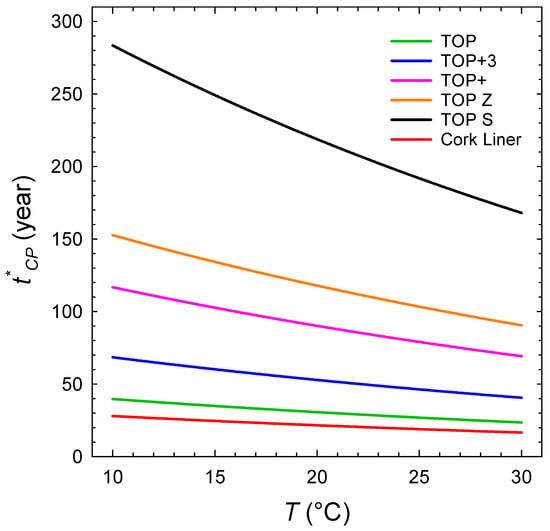
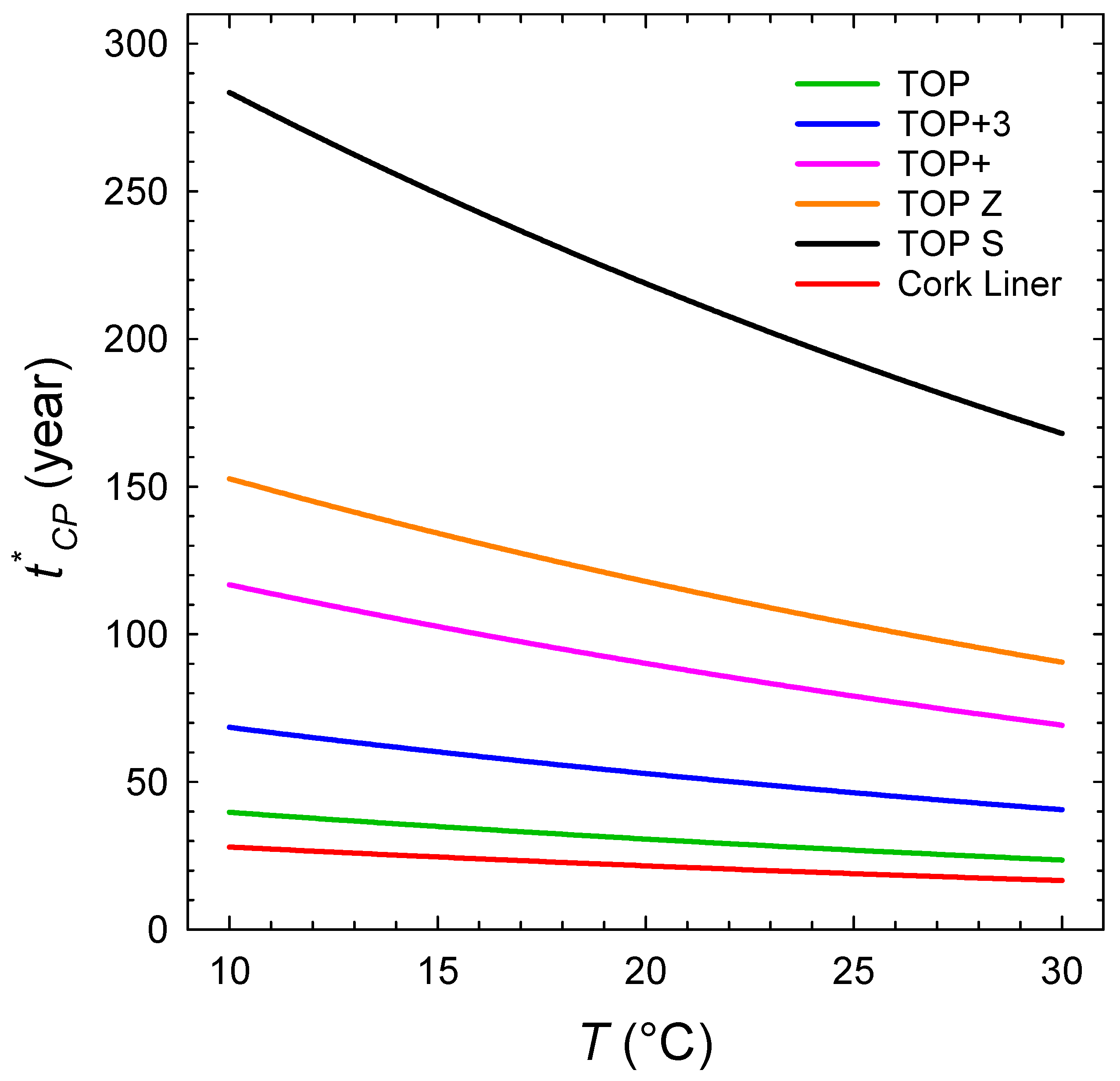
Ultimately, by combining Equations (2), (5) and (10)–(12), the maximum allowable lees-aging time () for each cap model, as a function of cellar temperature (T), can be determined. Beyond this duration depending on both temperature and crown cap permeability, the CO2 pressure in the bottle would fall below the critical value of 3.5 bar at 20 °C after disgorging, as shown in Figure 5.
Figure 5.
Predicted shelf life (in years) beyond which the CO2 pressure falls below the minimum threshold of 3.5 bar at 20 °C required by European regulations, as a function of cellar temperature during lees aging and crown cap type (from the PE.DI collection). These predictions apply here to standard Zero Dosage traditional-method sparkling wines after disgorging (i.e., without added sugar in the liqueur d’expedition, implying ).
As shown in Figure 5, for a given crown cap model, the higher the cellar temperature, the shorter the potential shelf life beyond which the CO2 pressure falls below the minimum threshold of 3.5 bar at 20 °C required by European regulations. This can be explained by the fact that increasing cellar temperature raises the CO2 pressure in the sealed bottle (through a decrease in the Henry’s law constant of CO2), thereby enhancing CO2 losses due to a greater difference in CO2 partial pressure between the bottle and the cellar atmosphere.
Moreover, it clearly emerges from Figure 5 that modern crown caps retain CO2 far more effectively in traditional-method sparkling wines than crown caps fitted with cork liners used in the last century (which still seal tens of thousands of prestigious bottles stored in the cellars of major Champagne and sparkling wine houses).
4.2. The Issue of Dissolved CO2 in Tasting Glasses
With effervescence being the defining sensory hallmark of sparkling wine [57,68], the shelf life of aged Champagne and other traditional-method vintages can also be assessed based on their ability to generate CO2 bubbles and provide a pleasing mouthfeel when served. However, bubble formation is fundamentally determined by the concentration of dissolved CO2. This raises a key question: What is the dissolved CO2 concentration in a bottle that has just reached the minimum legal pressure of 3.5 bar at 20 °C following disgorging, recorking, and preparation for market release and tasting?
Just before tasting, and while the bottle is still corked, the concentration of dissolved CO2 in the wine follows Henry’s equilibrium and may be written as . Consider, for example, a Brut-labelled sparkling wine with 12.5% ethanol by volume and 6 g L−1 of residual sugar after dosage. From Equation (2), the Henry’s constant for CO2 in such a wine at 20 °C is g L−1 bar−1. Therefore, once the bottle has reached the minimum legal pressure of 3.5 bar required by European regulations, the dissolved CO2 concentration is g L−1. However, serving sparkling wine in a glass induces significant losses of dissolved CO2. When 100 mL of a standard commercial Champagne are poured at a tasting temperature close to 12 °C into a vertically oriented flute, approximately 30% of the dissolved CO2 is lost due to flow-induced turbulence during the pour [69]. As a result, after service in the glass, the dissolved CO2 concentration drops to g L−1.
As widely documented, bubbles in sparkling wines, beers, and other carbonated beverages repeatedly originate from preexisting gaseous nuclei trapped in particles suspended in the liquid or in micro-crevices on the glass wall intentionally created by the glassmaker to promote heterogeneous bubble nucleation [10,57,68,70,71,72]. However, below a critical dissolved CO2 concentration (expressed hereafter in the SI units), these preexisting nuclei become thermodynamically unable to nucleate CO2 bubbles during tasting [10,11,12]:
with being the ambient pressure (in Pa), γ being the surface tension of the wine (in N m−1), and r being the radius of curvature of gaseous germs acting as bubble nucleation sites (in m).
If the level of dissolved CO2 drops below , the entrapped air bubble cannot overcome the Laplace pressure barrier and thus fails to nucleate CO2 bubbles during tasting. Although depends on tasting temperature, ambient pressure, and the initial radius of the preexisting gaseous nucleus, we consider here typical tasting conditions: 12 °C, near sea level (ambient pressure close to 1 bar ≈ 105 Pa), and with pre-existing gaseous nuclei of characteristic radius [10,11]. Under these conditions, the critical concentration is . In a tasting glass, the dissolved CO2 concentration must therefore exceed this threshold to sustain heterogeneous bubble nucleation.
It is worth emphasizing that this critical concentration required to trigger visible effervescence in sparkling wines, should not be confused with the minimum dissolved CO2 concentration of approximately 1.2 g L−1 needed for the sensory perception of carbonation and “bite,” as highlighted by McMahon et al. [73]. With a dissolved CO2 concentration of about 3.6 g L−1 after serving, a bottle that has reached the minimum legal pressure of 3.5 bar at 20 °C therefore still comfortably exceeds the 1.2 g L−1 sensory threshold, and also remains well above the 2.5 g L−1 limit required for effervescence to occur in a tasting glass.
5. Limitations
It is worth noting that the various parameters appearing in the exponential timescale τ of Equation (6) are assumed to remain constant during aging. As a first approximation, it is reasonable to assume that the cellar temperature, as well as the volumes of wine and gaseous headspace in sealed bottles, remain constant throughout the aging on lees. Nevertheless, slight seasonal temperature variations of 2–3 °C may occur. Over very long aging periods, minor evaporation from the bottles can also lead to small changes in wine volume and headspace, which may slightly affect the validity of this approach.
Furthermore, the mass transfer coefficient (K) of a crown cap or cork stopper may also change over time. Indeed, the overall appearance of corks visibly evolves during aging. Corks sealing the youngest vintages retain a characteristic mushroom shape, with the lower portion largely regaining its original diameter after insertion into the bottleneck, demonstrating the resilience of cork cells. In contrast, corks sealing older vintages show little ability to recover their original shape and have completely lost their natural elasticity. Liger-Belair et al. [11] reported that the oldest corks used to seal a 35-year-old vintage even appeared to have shrunk into the bottleneck. Such structural changes during aging on lees could affect the transport of gaseous CO2 from the bottle headspace to the ambient air, either through the cork cells themselves or via the interface between cork and bottleneck. Similarly, prolonged aging may induce structural changes in crown cap seals, potentially modifying their gas permeability and ultimately impacting the validity of the present model.
6. Conclusions and Prospects
This study addresses how long traditional-method sparkling wines can age while maintaining sufficient CO2 pressure and dissolved CO2. A predictive formula for the shelf life of older vintages was developed, integrating all relevant parameters to ensure compliance with the minimum CO2 pressure of 3.5 bar at 20 °C required by European regulations. Furthermore, the broad applicability of the exponential-decay model for CO2 pressure and dissolved CO2 developed here should be emphasized. Regardless of bottle format or the type of crown cap or cork used during the second in-bottle fermentation and subsequent aging on lees, precise knowledge of the CO2 mass transfer coefficient K, together with other key bottle and wine parameters, enables accurate prediction of the progressive CO2 loss before the bottles reach the market.
Based on the comparison between CO2 losses for a range of modern crown caps and those measured in bottles from older vintages sealed with cork-lined crown caps, it clearly emerges that modern crown caps retain CO2 far more effectively in traditional-method sparkling wines than cork-lined crown caps used in the last century. Otherwise, because effervescence defines the sensory identity of sparkling wine, the shelf life of aged traditional-method vintages was also assessed by their ability to maintain CO2 bubbles and the characteristic carbonation mouthfeel when served.
In future complementary research, the model will also be confronted with additional analytical datasets from other wine libraries in order to further assess its performance with respect to wine aging temperature, as well as the choice between crown caps and cork closures used to seal bottles during the secondary fermentation and lees aging of traditional-method sparkling wines.
The next stage of this work on the aging of traditional-method sparkling wines on their lees will be to model accurately, in situ, the gradual ingress of oxygen through crown caps or cork stoppers—an ingress that accompanies CO2 losses and drives the progressive evolution of wine aroma through slow oxidative processes.
Author Contributions
G.L.-B., V.T. and C.C. conceived and designed research. V.T. and C.C. performed the experiments. G.L.-B., V.T. and C.C. analyzed data. G.L.-B. performed the models. G.L.-B. wrote the paper. All authors discussed the results and commented on the manuscript. All authors have read and agreed to the published version of the manuscript.
Funding
This research received no external funding.
Institutional Review Board Statement
Not applicable.
Informed Consent Statement
Not applicable.
Data Availability Statement
The data supporting the findings of this study are available from the corresponding author upon reasonable request.
Acknowledgments
The authors are indebted to Vincent Chaperon and Daniel Carvajal Perez from Champagne Dom Pérignon (Épernay, Marne), and to Carine Bailleul from Champagne Castelnau (Reims, Marne) for providing exceptional collections of old vintages from their respective wine libraries (or “oenothèques”). Significant advances in understanding CO2-related phenomena in traditional-method sparkling wines have been made possible thanks to access to these remarkable historical cuvées. The authors are also indebted to l’Union des Œnologues de France for moral and financial support.
Conflicts of Interest
Virginie Thollin runs her own consulting company (SARL VT). She contributed to the writing and conceptual development of certain parts of this work. It is clear that the involvement of Virginie Thollin in this work did not, in any way, affect the authenticity or objectivity of the experimental results, the interpretation of data, the writing of this article or the decision to submit it for publication. Moreover, we certify that SARL VT has not provided any financial compensation to Clara Cilindre, Gérard Liger-Belair, or their laboratory.
Nomenclature
| a | Level of ethanol in the liquid phase (i.e., in the wine), in % by volume |
| b | Concentration of sugar in the liquid phase (i.e., the wine), in g L−1 |
| Concentration of dissolved CO2 in the liquid phase (i.e., the wine), in mol m−3 | |
| Concentration of dissolved CO2 in the recorked bottle, after disgorging and dosage, in mol m−3 | |
| Concentration of dissolved CO2 after the prise de mousse is completed, in mol m−3 | |
| Critical concentration of dissolved CO2 in the liquid phase required to enable bubble nucleation from a gas cavity, in mol m−3 | |
| Henry’s constant of CO2 in wine (i.e., its solubility), in mol m−3 Pa−1 | |
| Henry’s constant of CO2 in wine in the recorked bottle after dosage and disgorging, in mol m−3 Pa−1 | |
| K | Mass transfer coefficient for gas-phase CO2 through the closure system used to seal the bottle during on lees, in m3 s−1 |
| n | CO2 mole number produced per liter of wine in the sealed bottle, following Equation (1), after the prise de mousse is achieved, in mol L−1 |
| Total CO2 mole number trapped in the sealed bottle, in mol | |
| Mole number of dissolved CO2 in the liquid phase, in mol | |
| Mole number of gas-phase CO2 in the bottle headspace, in mol | |
| Gas-phase CO2 pressure in the bottle headspace, in Pa | |
| Minimum gas-phase CO2 pressure required by European regulations in the sealed bottle after disgorging, ≈3.5 bar at 20 °C (3.5 × 10⁵ Pa) | |
| Minimum gas-phase CO2 pressure required by European in the bottle sealed before disgorging, in Pa | |
| Gas-phase CO2 pressure in the bottle headspace after the prise de mousse is completed, in Pa | |
| Gas-phase CO2 pressure in the recorked bottle, after disgorging and dosage, in Pa | |
| Gas-phase CO2 pressure in the atmosphere of the cellar where bottles and magnums have aged for several decades, in Pa | |
| Radius of curvature of the pre-existing air bubble immersed in the liquid phase and acting as a bubble nucleation site, in m | |
| R | Ideal gas constant, = 8.31 J K−1 mol−1 |
| t | Time, in s |
| Maximum aging duration on lees beyond which the CO2 pressure in the bottle would drop below the critical pressure after disgorging, in s | |
| T | Temperature, in K |
| Volume of gas phase found in the headspace in the sealed bottles during the second in-bottle fermentation, in m3 | |
| Gaseous headspace volume in the recorked bottle, after disgorging, in m3 | |
| Volume of the liquid phase in the sealed bottle (i.e., volume of wine), in m3 | |
| Molar volume of an ideal gas (), in m3 mol−1 | |
| Dimensionless ratio of the wine volume to the gaseous headspace () | |
| τ | Time scale of the exponential decay-type model, in s |
| γ | Surface tension of wine, ≈45–50 mN m−1 (for a wine with 12–13% ethanol by volume) [10] |
References
- Perpetuini, G.; Tofalo, R. Editorial: Sparkling wines: Current trends and future evolution. Front. Microbiol. 2023, 14, 1199578. [Google Scholar] [CrossRef] [Scilit]
- Alexandre, H. Production Methods. In New Frontiers in Sparkling Wine Production; Tofalo, R., Alexandre, H., Eds.; Nova Science Publishers: Hauppauge, NY, USA, 2024; pp. 1–25. [Google Scholar]
- OIV Focus: The Global Sparkling Wine Market. Available online: https://www.oiv.int/sites/default/files/2024-04/OIV_STATE_OF_THE_WORLD_VINE_AND_WINE_SECTOR_IN_2023.pdf (accessed on 5 July 2025).
- Cravero, M.C. Innovations in Sparkling Wine Production: A Review on the Sensory Aspects and the Consumer’s Point of View. Beverages 2023, 9, 80. [Google Scholar] [CrossRef] [Scilit]
- Stevenson, T. Christies World Encyclopedia of Champagne and Sparkling Wines; Absolute Press: Bath, UK, 1998. [Google Scholar]
- Liger-Belair, G. Uncorked, the Science of Champagne, rev. ed.; Princeton University Press: Princeton, NJ, USA, 2013. [Google Scholar]
- Phillips, R. Alcohol: A History; University of North Carolina Press: Chapel Hill, NC, USA, 2014. [Google Scholar]
- Gonzales Viejo, C.; Torrico, D.D.; Dunshea, F.R.; Fuentes, S. Bubbles, foam formation, stability and consumer perception of carbonated drinks: A review of current, new and emerging technologies for rapid assessment and control. Foods 2019, 8, 596. [Google Scholar] [CrossRef] [Scilit] [PubMed]
- Kemp, B.; Alexandre, H.; Robillard, B.; Marchal, R. Effect of production phase on bottle-fermented sparkling wine quality. J. Agric. Food Chem. 2015, 63, 19–38. [Google Scholar] [CrossRef] [Scilit] [PubMed]
- Liger-Belair, G. Effervescence in Champagne and sparkling wines: From grape harvest to bubble rise. Eur. Phys. J. Spec. Top. 2017, 226, 3–116. [Google Scholar] [CrossRef] [Scilit]
- Liger-Belair, G.; Carvajal-Pérez, D.; Cilindre, C.; Facque, J.; Brevot, M.; Litoux-Desrues, F.; Chaperon, V.; Geoffroy, R. Evidence for moderate losses of dissolved CO2 during aging on lees of a champagne prestige cuvee. J. Food Eng. 2018, 233, 40–48. [Google Scholar] [CrossRef] [Scilit]
- Liger-Belair, G.; Khenniche, C.; Poteau, C.; Bailleul, C.; Thollin, V.; Cilindre, C. Losses of yeast-fermented carbon dioxide during prolonged champagne aging: Yes, the bottle size does matter! ACS Omega 2023, 8, 22844–22853. [Google Scholar] [CrossRef] [Scilit]
- Valade, M. La prise de mousse: Historique. Vign. Champen. 1999, 120, 63–77. [Google Scholar]
- Duteurtre, B. Le Champagne: De la Tradition à la Science; Lavoisier: Paris, France, 2016. [Google Scholar]
- Liger-Belair, G. Un Monde de Bulles: Le Champagne ou la Science de L’effervescence; Ellipses: Paris, France, 2020. [Google Scholar]
- Liger-Belair, G.; Cilindre, C. Recent progress in the analytical chemistry of champagne and sparkling wines. Annu. Rev. Anal. Chem. 2021, 14, 21–46. [Google Scholar] [CrossRef] [Scilit]
- Smith, F.L.; Harvey, A.H. Avoid Common Pitfalls when using Henry’s Law. Chem. Eng. Prog. 2007, 103, 33–39. [Google Scholar]
- Liger-Belair, G. Carbon dioxide solubility in sugar and water-ethanol solutions for applications to sparkling drinks. ACS Food Sci. Technol. 2025, 5, 36–49. [Google Scholar] [CrossRef] [Scilit]
- Lonvaud-Funel, A.; Matsumoto, N. The solubility coefficient of carbonic acid in wines. Vitis 1979, 18, 137–147. [Google Scholar]
- Leroy, M.J.; Charpentier, M.; Duteurtre, B.; Feuillat, M.; Charpentier, C. Yeast Autolysis during Champagne Aging. Am. J. Enol. Vitic. 1990, 41, 21–28. [Google Scholar] [CrossRef] [Scilit]
- Alexandre, H.; Guilloux-Benatier, M. Yeast autolysis in sparkling wines: A review. Aust. J. Grape Wine Res. 2006, 12, 119–127. [Google Scholar] [CrossRef] [Scilit]
- Alexandre, H. Yeasts and Sparkling Wine Production. In Yeasts in the Production of Wine; Springer: New York, NY, USA, 2019; pp. 395–432. [Google Scholar]
- Moreno-Arribas, M.V.; Pueyo, E.; Nieto, F.J.; Martin-Avarez, P.J.; Polo, M.C. Influence of the polysaccharides and the nitrogen compounds on foaming properties of sparkling wines. Food Chem. 2000, 70, 309–317. [Google Scholar] [CrossRef] [Scilit]
- Nunez, Y.P.; Carrascosa, A.V.; Gonzalez, R.; Polo, M.C.; Martinez-Rodriguez, A.J. Effect of accelerated autolysis of yeast on the composition and foaming properties of sparkling wines elaborated by a champenoise method. J. Sci. Food Agric. 2005, 53, 7232–7237. [Google Scholar] [CrossRef] [Scilit]
- Todd, B.E.N.; Fleet, G.H.; Henschke, P.A. Promotion of autolysis through the interaction of killer and sensitive yeasts: Potential application in sparkling wine production. Am. J. Enol. Vitic. 2000, 51, 65–72. [Google Scholar] [CrossRef] [Scilit]
- Gnoinski, G.B.; Schmidt, S.A.; Close, D.C.; Goemann, K.; Pinfold, T.L.; Kerslake, F.L. Novel methods to manipulate autolysis in sparkling wines: Effects on yeast. Molecules 2021, 26, 387. [Google Scholar] [CrossRef] [Scilit] [PubMed]
- Babayan, T.L.; Bezrukov, M.G. Autolysis in Yeasts. Acta Biotechnol. 1985, 5, 129–136. [Google Scholar] [CrossRef] [Scilit]
- Marti-Raga, M.; Martin, V.; Gil, M.; Sancho, M.; Zamora, F.; Mas, A.; Beltran, G. Contribution of yeast and base wine supplementation to sparkling wine composition. J. Sci. Food Agric. 2016, 96, 4962–4972. [Google Scholar] [CrossRef] [Scilit]
- Tudela, R.; Gallardo-Chacón, J.J.; Rius, N.; López-Tamames, E.; Buxaderas, S. Ultrastructural changes of sparkling wine lees during long-term aging in real enological conditions. FEMS Yeast Res. 2012, 12, 466–476. [Google Scholar] [CrossRef] [Scilit]
- Buxaderas, S.; López-Tamames, E. Sparkling wines: Features and trends from tradition. Adv. Food Nutr. Res. 2012, 66, 1–45. [Google Scholar] [PubMed]
- Pons-Mercadé, P.; Giménez, P.; Vilomara, G.; Conde, M.; Cantos, A.; Rozès, N.; Ferrer, S.; Canals, J.M.; Zamora, F. Monitoring yeast autolysis in sparkling wines from nine consecutive vintages produced by the traditional method. Aust. J. Grape Wine Res. 2022, 28, 347–357. [Google Scholar] [CrossRef] [Scilit]
- Martínez-Rodríguez, A.J.; Carrascosa, A.V.; Barcenilla, J.M.; Pozo-Bayón, M.A.; Polo, M.C. Autolytic capacity and foam analysis as additional criteria for the selection of yeast strains for sparkling wine production. Food Microbiol. 2001, 18, 183–191. [Google Scholar] [CrossRef] [Scilit]
- Cilindre, C.; Fasoli, E.; D’Amato, A.; Liger-Belair, G.; Righetti, P.G. It’s time to pop a cork on champagne’s proteome! J. Proteom. 2014, 105, 351–362. [Google Scholar] [CrossRef] [Scilit]
- Condé, B.C.; Bouchard, E.; Culbert, J.A.; Wilkinson, K.L.; Fuentes, S.; Howell, K.S. Soluble protein and amino acid content affects the foam quality of sparkling wine. J. Agric. Food Chem. 2017, 65, 9110–9119. [Google Scholar] [CrossRef] [Scilit] [PubMed]
- Kemp, B.; Condé, B.; Jégou, S.; Howell, K.; Vasserot, Y.; Marchal, R. Chemical compounds and mechanisms involved in the formation and stabilization of foam in sparkling wines. Crit. Rev. Food Sci. Nutr. 2019, 59, 2072–2094. [Google Scholar] [CrossRef] [Scilit]
- Gawel, R.; Smith, P.A.; Cicerale, S.; Keast, R. The mouthfeel of white wine. Crit. Rev. Food Sci. Nutr. 2018, 58, 2939–2956. [Google Scholar] [CrossRef] [Scilit] [PubMed]
- Marchal, A.; Marullo, P.; Moine, V.; Dubourdieu, D. Influence of yeast macromolecules on sweetness in dry wines: Role of the Saccharomyces cerevisiae protein Hsp12. J. Agric. Food Chem. 2011, 59, 2004–2010. [Google Scholar] [CrossRef] [Scilit]
- Vasserot, Y.; Jacopin, C.; Jeandet, P. Effect of bottle capacity and bottle-cap permeability to oxygen on dimethylsulfide formation in Champagne wines during aging on the lees. Am. J. Enol. Vitic. 2001, 52, 54–55. [Google Scholar] [CrossRef] [Scilit]
- Bunner, D.; Landrieux, A.; Valade, M.; Langleron, E.; Tribaut-Sohier, I.; Moncomble, D.; Viaux, L.; Bourdelet Walter, L.; Chaperon, V.; Gouez, B. La mesure de l’oxygène dans les bouteilles par chimiluminescence. Vign. Champen. 2010, 131, 84–101. [Google Scholar]
- Karbowiak, T.; Gougeon, R.D.; Alinc, J.-B.; Brachais, L.; Bebeaufort, F.; Voilley, A.; Chassagne, D. Wine oxydation and the role of cork. Crit. Rev. Food Sci. Nutr. 2010, 50, 20–52. [Google Scholar] [CrossRef] [Scilit]
- Faria, D.P.; Fonseca, A.L.; Pereira, H.; Teodoro, O. Permeability of cork to gases. J. Agric. Food Chem. 2011, 59, 3590–3597. [Google Scholar] [CrossRef] [Scilit] [PubMed]
- Liger-Belair, G.; Villaume, S. Losses of dissolved CO2 through the cork stopper during champagne aging: Toward a multiparameter modeling. J. Agric. Food Chem. 2011, 59, 4051–4056. [Google Scholar] [CrossRef] [Scilit]
- Lequin, S.; Chassagne, D.; Karbowiak, T.; Simon, J.-M.; Paulin, C.; Bellat, J.-P. Diffusion of oxygen in cork. J. Agric. Food Chem. 2012, 60, 3348–3356. [Google Scholar] [CrossRef] [Scilit] [PubMed]
- Crouvisier Urion, K.; Bellat, J.-P.; Liger-Belair, G.; Gougeon, R.D.; Karbowiak, T. Unravelling CO2 transfer through cork stoppers for Champagne and sparkling wines. Food Packag. Shelf Life 2021, 27, 100618. [Google Scholar] [CrossRef] [Scilit]
- Jolly, N.; Minnaar, P.; Booyse, M.; Gerber, P. Bottle fermented sparkling wine: Cork or crown closures during the second fermentation? S. Afr. J. Enol. Vitic. 2021, 42, 136–153. [Google Scholar] [CrossRef] [Scilit]
- Thollin, V.; Liger-Belair, G.; Cilindre, C.; Di Crescenzo, R. Champagne et vins effervescents: La première capsule de tirage dopée aux sulfites. Rev. Oenol. 2021, 181, 50–53. [Google Scholar]
- Thollin, V.; Robillard, B.; Di Crescenzo, R.; Barbier, J.E.; Cilindre, C.; Liger-Belair, G. Une première approche in situ de la perméabilité aux échanges gazeux des capsules de tirage pour vins effervescents. Rev. Fr. D’Œnol. 2024, 320, 26–31. [Google Scholar]
- Lopes, P.; Saucier, C.; Teissedre, P.-L.; Glories, Y. Main routes of oxygen ingress through different closures into wine bottles. J. Agric. Food Chem. 2007, 55, 5167–5170. [Google Scholar] [CrossRef] [Scilit]
- Lagorce-Tachon, A.; Karbowiak, T.; Paulin, C.; Simon, J.M.; Gougeon, R.D.; Bellat, J.-P. Diffusion of oxygen through cork stopper: Is it a Knudsen or a Fickian mechanism? J. Agric. Food Chem. 2014, 62, 9180–9185. [Google Scholar] [CrossRef] [Scilit] [PubMed]
- Teodoro, O. The permeation of cork revisited. J. Agric. Food Chem. 2016, 64, 4182–4184. [Google Scholar] [CrossRef] [Scilit]
- Crouvisier Urion, K.; Bellat, J.-P.; Gougeon, R.D.; Karbowiak, T. Gas transfer through wine closures: A critical review. Trends Food Sci. Technol. 2018, 78, 255–269. [Google Scholar] [CrossRef] [Scilit]
- Karbowiak, T.; Crouvisier Urion, K.; Lagorce-Tachon, A.; Ballester, J.; Geoffroy, A.; Roullier-Gall, C.; Chanut, J.; Gougeon, R.D.; Schmitt-Kopplin, P.; Bellat, J.-P. Wine aging: A bottleneck story. npj Sci. Food 2019, 3, 14. [Google Scholar] [CrossRef] [Scilit]
- Chanut, J.; Bellat, J.-P.; Gougeon, R.D.; Karbowiak, T. A key to wine conservation lies in the glass–cork interface. PNAS Nexus 2023, 2, pgad344. [Google Scholar] [CrossRef] [Scilit]
- Lagorce-Tachon, A.; Karbowiak, T.; Loupiac, C.; Gaudry, A.; Ott, F.; Alba-Simionesco, C.; Gougeon, R.D.; Alcantara, V.; Mannes, D.; Kaestner, A.; et al. The corked viewed from the inside. J. Food Eng. 2015, 149, 214–221. [Google Scholar] [CrossRef] [Scilit]
- Oliveira, V.; Lopes, P.; Cabral, M.; Pereira, H. Influence of cork defects in the oxygen ingress through wine stoppers: Insights with X-ray tomography. J. Food Eng. 2015, 165, 66–73. [Google Scholar] [CrossRef] [Scilit]
- Crouvisier Urion, K.; Chanu, J.; Lagorce-Tachon, A.; Winckler, P.; Wang, Z.; Verboven, V.; Nicolai, B.; Lherminier, J.; Ferret, E.; Gougeon, R.D.; et al. Four hundred years of cork imaging: New advances in the characterization of the cork structure. Sci. Rep. 2019, 9, 19682. [Google Scholar] [CrossRef] [Scilit]
- Liger-Belair, G.; Lecasse, F. Decoding the visual aesthetics of bubble trains in sparkling drinks. Curr. Opin. Food Sci. 2025, 66, 101360. [Google Scholar] [CrossRef] [Scilit]
- Cain, W.S.; Murphy, C.L. Interaction between chemoreceptive modalities of odour and irritation. Nature 1980, 284, 255–257. [Google Scholar] [CrossRef] [Scilit]
- Cometto-Muñiz, J.E.; Garcia-Medina, M.R.; Calviño, A.M.; Noriega, G. Interactions between CO2 oral pungency and taste. Perception 1987, 16, 629–640. [Google Scholar] [CrossRef] [Scilit]
- Wise, P.M.; Wysocki, C.J.; Radil, T. Time-intensity ratings of nasal irritation from carbon dioxide. Chem. Senses 2003, 28, 751–760. [Google Scholar] [CrossRef] [Scilit]
- Dunkel, A.; Hofmann, T. Carbonic anhydrase IV mediates the fizz of carbonated beverages. Angew. Chem. Int. Ed. Engl. 2010, 49, 2975–2977. [Google Scholar] [CrossRef] [Scilit]
- Wise, P.M.; Wolf, M.; Thom, S.R.; Bryant, B. The influence of bubbles on the perception carbonation bite. PLoS ONE 2013, 8, e71488. [Google Scholar] [CrossRef] [Scilit] [PubMed]
- Valade, M.; Humbert, F. Comment met-on les bulles dans le champagne? Editions France Agricole: Paris, France, 2020. [Google Scholar]
- Kemp, B.; Hogan, C.; Xu, S.; Dowling, L.; Inglis, D. The Impact of Wine Style and Sugar Addition in liqueur d’expedition (dosage) Solutions on Traditional Method Sparkling Wine Composition. Beverages 2017, 3, 7. [Google Scholar] [CrossRef] [Scilit]
- UMC: Union des Maisons de Champagne Depuis 1882. Available online: https://maisons-champagne.com/en/ (accessed on 5 July 2025).
- Liger-Belair, G. A new perspective on carbon dioxide in the production of traditional-method sparkling wines. ACS Food Sci. Technol. 2026, 6, 890–900. [Google Scholar] [CrossRef] [Scilit]
- Tribaut-Sohier, I.; Valade, M.; Moncomble, D. Les capsules de tirage: Leur caractérisation par mesure des transferts d’oxygène par chimiluminescence. Vign. Champen. 2014, 135, 32–50. [Google Scholar]
- Liger-Belair, G.; Cilindre, C.; Beaumont, F.; Polidori, G. Understanding the tasting of champagne and other sparkling wines from a scientific perspective. Food Res. Int. 2024, 191, 114678. [Google Scholar] [CrossRef] [Scilit] [PubMed]
- Liger-Belair, G.; Bourget, M.; Villaume, S.; Jeandet, P.; Pron, H.; Polidori, G. On the losses of dissolved CO2 during champagne serving. J. Agric. Food Chem. 2010, 58, 8768–8775. [Google Scholar] [CrossRef] [Scilit]
- Uzel, S.; Chappell, M.A.; Payne, S.J. Modeling the cycles of growth and detachment of bubbles in carbonated beverages. J. Phys. Chem. B 2006, 110, 7579–7586. [Google Scholar] [CrossRef] [Scilit] [PubMed]
- Lee, W.T.; McKechnie, J.S.; Devereux, M.G. Bubble nucleation in stout beers. Phys. Rev. E 2011, 83, 051609. [Google Scholar] [CrossRef] [Scilit]
- Beaumont, F.; Bogard, F.; Murer, S.; Polidori, G. New Insights on the Effect of Forced Laser-Etched Nucleation on the Unsteady Evolution of Two-Phase Flow in a Beer Glass. Exp. Tech. 2024, 48, 31–39. [Google Scholar] [CrossRef] [Scilit]
- McMahon, K.M.; Culver, C.; Ross, C.F. The production and consumer perception of sparkling wines of different carbonation levels. J. Wine Res. 2017, 28, 123–134. [Google Scholar] [CrossRef] [Scilit]

Disclaimer/Publisher’s Note: The statements, opinions and data contained in all publications are solely those of the individual author(s) and contributor(s) and not of MDPI and/or the editor(s). MDPI and/or the editor(s) disclaim responsibility for any injury to people or property resulting from any ideas, methods, instructions or products referred to in the content. |
© 2026 by the authors. Licensee MDPI, Basel, Switzerland. This article is an open access article distributed under the terms and conditions of the Creative Commons Attribution (CC BY) license.