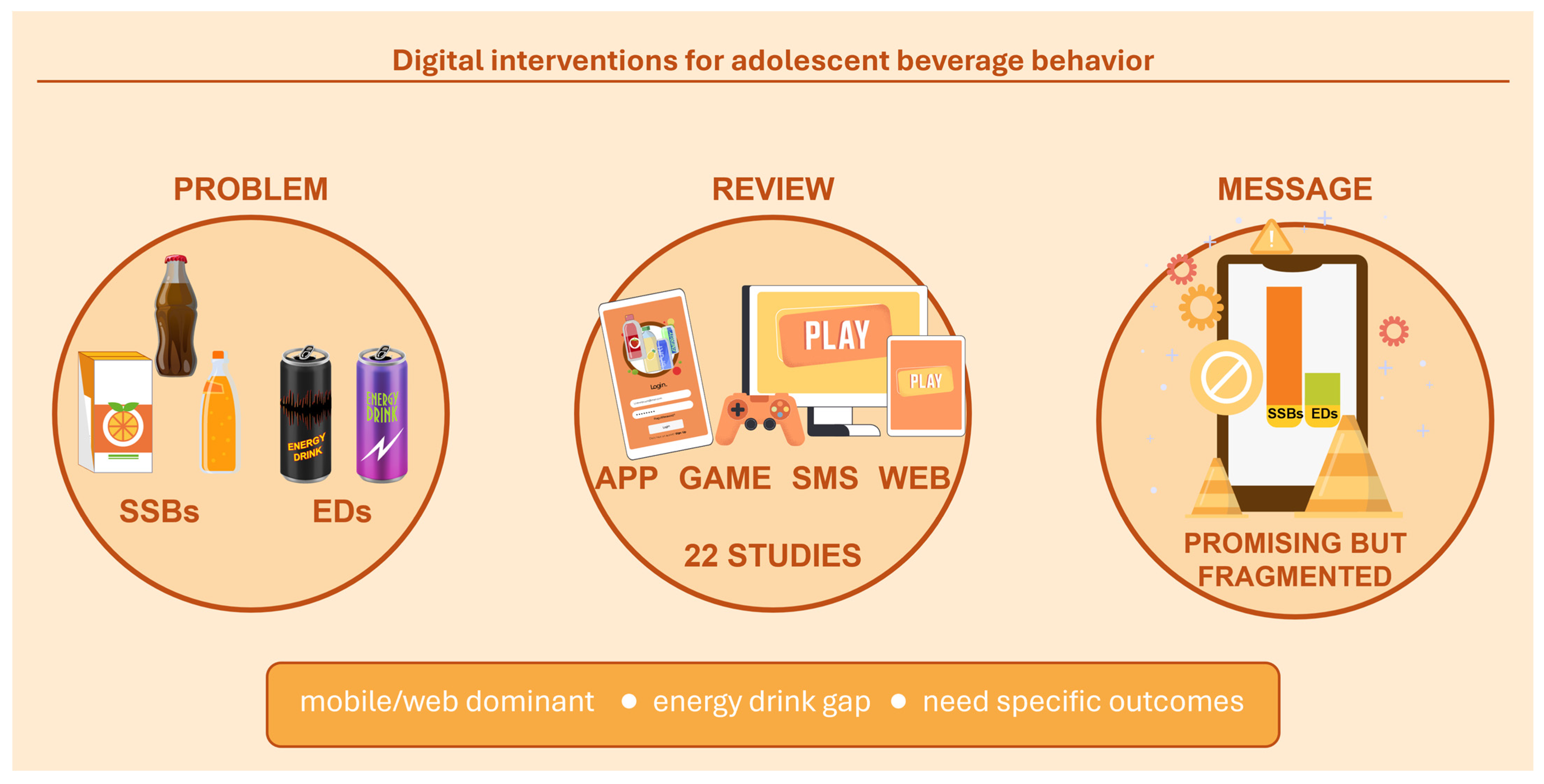

Digital Interventions Targeting Sugar-Sweetened Beverage and Energy Drink Consumption in Adolescents: A Promising but Fragmented Field


Abstract
1. Introduction
1.1. Adolescence and Beverage Consumption Patterns
1.2. Health Concerns Related to Sugar-Sweetened Beverages and Energy Drinks
1.3. Why Digital Interventions May Be Relevant for Adolescents
2. Materials and Methods
2.1. Study Design
2.2. Search Strategy
2.3. Eligibility Criteria
2.4. Study Selection
2.5. Data Extraction and Analytical Classification
2.6. Data Synthesis
3. Results
3.1. Characteristics of the Included Studies

| Study | General Characteristics | Study Design and Setting | Participant Characteristics | Type of Digital Intervention | Beverage-Related Outcomes Assessed |
|---|---|---|---|---|---|
| Ezendam et al., 2011 [27] | School-based digital energy-balance intervention conducted in the Netherlands | Cluster randomized controlled trial; secondary school setting | Adolescents aged 12–13 years | Web-based computer-tailored intervention (FATaintPHAT) | SSB intake, specifically odds of consuming > 400 mL/day |
| Nollen et al., 2014 [28] | Pilot obesity-prevention study targeting at-risk youth in the United States | Randomized pilot trial; community-based setting | Low-income racial/ethnic-minority girls aged 9–14 years | Mobile technology-based intervention with real-time goal setting, self-monitoring, prompts, feedback, and reinforcement | SSB intake |
| Smith et al., 2014 [41] | Protocol of a school-based obesity-prevention intervention for adolescent boys in Australia | Group/cluster randomized controlled trial protocol; school setting | Adolescent boys from schools in low-income communities | Smartphone-assisted multicomponent intervention integrated with school-based delivery | Planned assessment of SSB intake within broader dietary outcomes |
| Quintiliani et al., 2014 [42] | Family-based obesity-prevention study conducted in public housing in the United States | Cluster randomized trial; community/public housing setting | Mother–daughter dyads living in public housing; daughters aged approximately 8–15 years | Multilevel intervention including mobile phone/text messaging support | Soft drink/soda consumption, including regular or diet soda, as part of broader dietary outcomes |
| Mâsse et al., 2015 [38] | Secondary analysis of adherence to a digital lifestyle intervention in Canada | Secondary analysis of a web-based intervention; home/family setting | 160 adolescents with overweight/obesity and one parent | Web-based lifestyle behavior intervention | Sugar-sweetened beverage reduction goals and household soft drink availability within broader dietary behavior targets |
| Escárcega-Centeno et al., 2015 [24] | Educational digital study focused specifically on sugary drinks in Mexico | Development/intervention study in an educational context | Users/students in an educational intervention context; participant characteristics not extensively detailed | Augmented reality mobile application (Augmented-Sugar Intake) | Knowledge and understanding of sugar content in SSBs |
| Smith et al., 2014 [34] | Full trial of a smartphone-supported obesity-prevention intervention in Australia | Cluster randomized controlled trial; school setting | Adolescent boys from schools in low-income communities | Smartphone-supported multicomponent school-based intervention (ATLAS) | SSB intake assessed within broader lifestyle outcomes |
| Lubans et al., 2016 [32] | Protocol extending smartphone-supported school-based health interventions in Australia | Cluster randomized controlled trial protocol; school setting | Secondary school adolescents | School-based intervention including smartphone and web-based components, teacher delivery, and physical activity sessions | Planned assessment of sugar-sweetened beverage consumption alongside other lifestyle outcomes |
| Chen et al., 2017 [43] | Pilot weight-management study in adolescents in the United States | Pilot intervention study; clinical/community setting | 40 adolescents with overweight/obesity | Mobile phone technology-based weight-management intervention | Servings of soda and sweetened drinks within a broader weight-management intervention |
| Jones et al., 2014 [40] | Web-based healthy weight regulation and eating disorder prevention study in US high school students | School-based intervention study; high school setting | High school students | Universal and targeted web-based intervention | Soda consumption |
| Kapitány-Fövény et al., 2018 [23] | Mobile prevention study in Hungary addressing health risk behaviors | Questionnaire/evaluation study; school setting | 386 students | Interactive mobile phone application/serious game (Once Upon a High) | Energy drink consumption |
| Da Silva et al., 2019 [29] | Adapted computer-based healthy eating intervention conducted in Brazil | School cluster-randomized controlled trial | 720 adolescents in grades 7–9 | Computer-based/web-based intervention (StayingFit Brazil) | Soft drink consumption |
| Zoellner et al., 2019 [31] | Protocol of a beverage-focused intervention for rural adolescents in the United States | Cluster randomized controlled trial protocol; middle school setting | Appalachian middle-school students and caregivers | Multilevel school-based intervention with digital and SMS caregiver support (Kids SIPsmartER) | Planned assessment of SSB consumption and beverage-related literacy/behaviors |
| Mâsse et al., 2020 [33] | Protocol of an mHealth intervention for youth with overweight/obesity in Canada | Randomized controlled trial protocol; home/family digital setting | Children/adolescents with overweight or obesity and parents | Gamified mHealth application with health coaching and parent involvement (Aim2Be) | Planned assessment of SSB-related dietary behaviors |
| Teesson et al., 2020 [35] | Large-scale eHealth protocol targeting multiple lifestyle risk behaviors in Australia | Cluster randomized controlled trial protocol; school setting | Adolescents aged 12–17 years | School-based eHealth program with app/online components (Health4Life) | Planned assessment of SSB consumption as one of six lifestyle risk behaviors |
| Lin and Mâsse, 2021 [37] | Secondary analysis examining engagement with an mHealth intervention in Canada | Secondary engagement/profile analysis of app users; home/family setting | 301 adolescents (mean age approximately 14.8 years) and their families | Lifestyle behavior modification app for adolescents and parents (Aim2Be) | SSB intake and related behavior change/self-efficacy targets |
| Caon et al., 2022 [36] | Digital dietary behavior study within a European adolescent health project | Secondary/descriptive analysis; school/community digital setting | Adolescents from three European countries | Mobile food record/e-diary app | SSB intake/recording and healthy drinking habits |
| Bjerregaard et al., 2024 [26] | Large digitally delivered dietary intervention embedded in a national cohort in Denmark | Multifactorial randomized controlled trial nested within the Danish National Birth Cohort | 7890 adolescents from the Danish National Birth Cohort | SMS chatbot digital educational program | SSB intake |
| O’Dean et al., 2024 [39] | Mediation analysis of a school-based digital intervention targeting multiple lifestyle risks in Australia | Secondary analysis of a cluster randomized controlled trial; school setting | Year 7 students from Australian schools | School-based digital multiple health behavior intervention (Health4Life) | Sugar-sweetened beverage consumption/risk indicator within a six-risk-behavior framework |
| Zoellner et al., 2024 [30] | Outcomes paper of a beverage-focused intervention in rural United States | Cluster randomized controlled trial; middle school and caregiver setting | 526 students and caregivers from Appalachian middle schools | School-based multilevel intervention with digital/SMS caregiver support (Kids SIPsmartER) | Student and caregiver SSB consumption |
| Proctor et al., 2025 [44] | Pilot study integrating an app into a community nutrition program in the United States | Randomized pilot study; school/community program setting | Adolescents in grades 6–8 | Image-assisted dietary assessment and education app integrated into SNAP-Ed (PortionSize Ed) | Sugary drink intake within broader diet quality outcomes |
| Seiterö et al., 2025 [25] | Stand-alone mHealth multiple behavior change intervention in Sweden | Randomized controlled trial; school/digital setting | High school students aged approximately 15–20 years | Mobile phone-delivered multiple health behavior change intervention (LIFE4YOUth) | Beverage-related outcomes assessed within broader unhealthy dietary indicators |
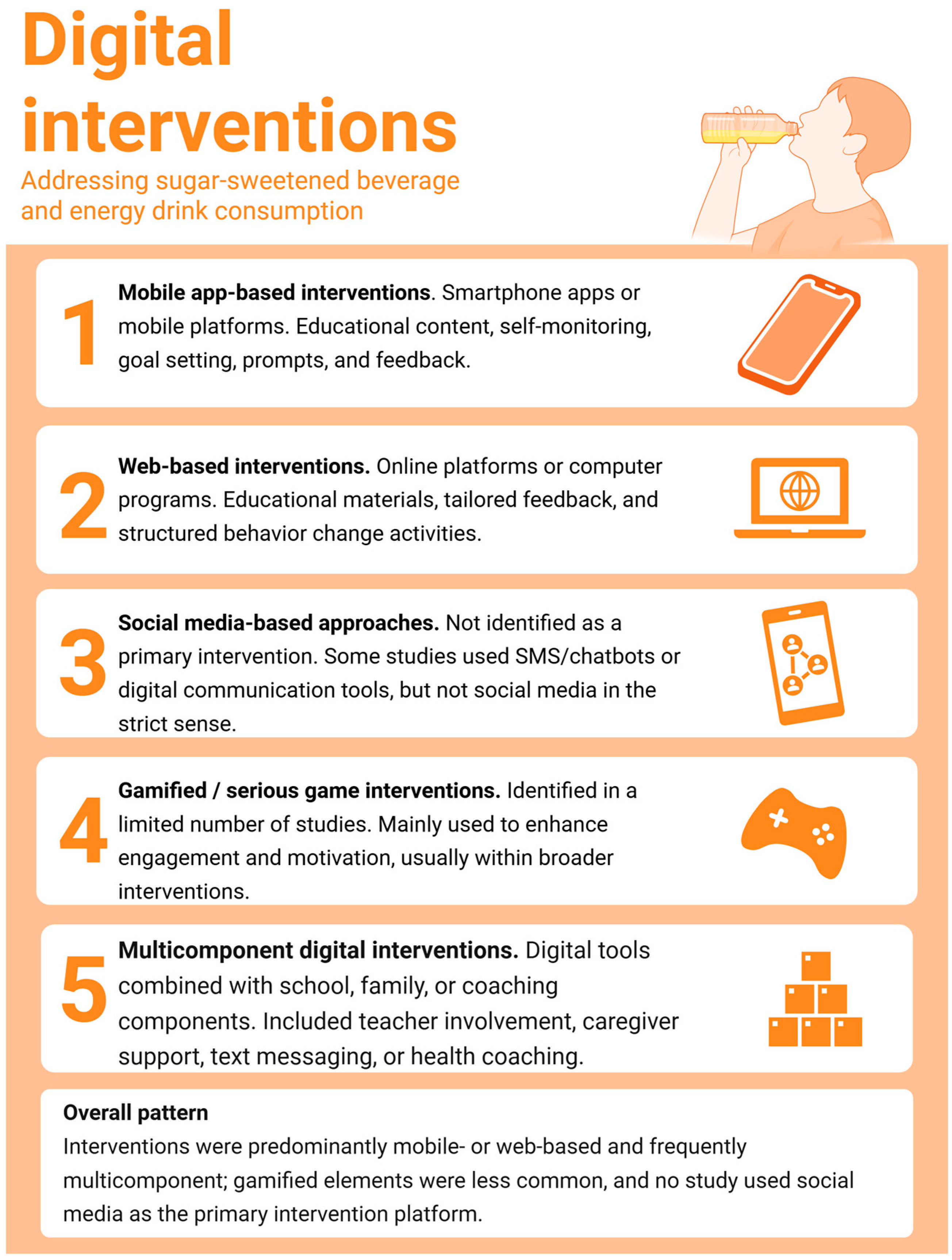
3.2. Types of Digital Interventions Identified
3.3. Analytical Classification of the Identified Interventions
4. Discussion
5. Limitations
6. Conclusions
Funding
Institutional Review Board Statement
Informed Consent Statement
Data Availability Statement
Conflicts of Interest
References
- Ajibo, C.; Van Griethuysen, A.; Visram, S.; Lake, A.A. Consumption of energy drinks by children and young people: A systematic review examining evidence of physical effects and consumer attitudes. Public Health 2024, 227, 274–281. [Google Scholar] [CrossRef]
- Malik, V.S.; Pan, A.; Willett, W.C.; Hu, F.B. Sugar-sweetened beverages and weight gain in children and adults: A systematic review and meta-analysis. Am. J. Clin. Nutr. 2013, 98, 1084–1102. [Google Scholar] [CrossRef]
- Calcaterra, V.; Cena, H.; Magenes, V.C.; Vincenti, A.; Comola, G.; Beretta, A.; Di Napoli, I.; Zuccotti, G. Sugar-sweetened beverages and metabolic risk in children and adolescents with obesity: A narrative review. Nutrients 2023, 15, 702. [Google Scholar] [CrossRef]
- Lara-Castor, L.; Micha, R.; Cudhea, F.; Miller, V.; Shi, P.; Zhang, J.; Sharib, J.R.; Erndt-Marino, J.; Cash, S.B.; Barquera, S.; et al. Intake of sugar sweetened beverages among children and adolescents in 185 countries between 1990 and 2018: Population based study. BMJ 2024, 386, e079234. [Google Scholar] [CrossRef]
- Biswas, T.; Townsend, N.; Huda, M.M.; Maravilla, J.; Begum, T.; Pervin, S.; Ghosh, A.; Mahumud, R.A.; Islam, S.; Anwar, N.; et al. Prevalence of multiple non-communicable diseases risk factors among adolescents in 140 countries: A population-based study. eClinicalMedicine 2022, 52, 101591. [Google Scholar] [CrossRef]
- Nianogo, R.A.; Arah, O.A. Forecasting obesity and type 2 diabetes incidence and burden: The ViLA-obesity simulation model. Front. Public Health 2022, 10, 818816. [Google Scholar] [CrossRef]
- Sina, E.; Boakye, D.; Christianson, L.; Ahrens, W.; Hebestreit, A. Social Media and children’s and adolescents’ diets: A systematic review of the underlying social and physiological mechanisms. Adv. Nutr. 2022, 13, 913–937. [Google Scholar] [CrossRef]
- Grossman, D.C.; Bibbins-Domingo, K.; Curry, S.J.; Barry, M.J.; Davidson, K.W.; Doubeni, C.A.; Epling, J.W.; Kemper, A.R.; Krist, A.H.; Kurth, A.E.; et al. Screening for obesity in children and adolescents us preventive services task force recommendation statement. J. Am. Med. Assoc. 2017, 317, 2417–2426. [Google Scholar] [CrossRef]
- Verduci, E.; Di Profio, E.; Fiore, G.; Zuccotti, G. Integrated approaches to combatting childhood obesity. Ann. Nutr. Metab. 2022, 78, 8–19. [Google Scholar] [CrossRef] [PubMed]
- Malik, V.S.; Hu, F.B. Fructose and cardiometabolic health what the evidence from sugar-sweetened beverages tells us. J. Am. Coll. Cardiol. 2015, 66, 1615–1624. [Google Scholar] [CrossRef] [PubMed]
- Abbasalizad Farhangi, M.; Mohammadi Tofigh, A.; Jahangiri, L.; Nikniaz, Z.; Nikniaz, L. Sugar-sweetened beverages intake and the risk of obesity in children: An updated systematic review and dose–response meta-analysis. Pediatr. Obes. 2022, 17, e12914. [Google Scholar] [CrossRef]
- De Ruyter, J.C.; Olthof, M.R.; Seidell, J.C.; Katan, M.B. A trial of sugar-free or sugar-sweetened beverages and body weight in children. N. Engl. J. Med. 2012, 367, 1397–1406. [Google Scholar] [CrossRef]
- Ebbeling, C.B.; Feldman, H.A.; Chomitz, V.R.; Antonelli, T.A.; Gortmaker, S.L.; Osganian, S.K.; Ludwig, D.S. A randomized trial of sugar-sweetened beverages and adolescent body weight. N. Engl. J. Med. 2012, 367, 1407–1416. [Google Scholar] [CrossRef]
- Lee, D.; Chiavaroli, L.; Ayoub-Charette, S.; Khan, T.A.; Zurbau, A.; Au-Yeung, F.; Cheung, A.; Liu, Q.; Qi, X.; Ahmed, A.; et al. Important food sources of fructose-containing sugars and non-alcoholic fatty liver disease: A systematic review and meta-analysis of controlled trials. Nutrients 2022, 14, 2846. [Google Scholar] [CrossRef] [PubMed]
- Armfield, J.M.; Spencer, A.J.; Roberts-Thomson, K.F.; Plastow, K. Water fluoridation and the association of sugar-sweetened beverage consumption and dental caries in Australian children. Am. J. Public Health 2013, 103, 494–500. [Google Scholar] [CrossRef]
- Chi, D.L.; Scott, J.M. Added sugar and dental caries in children: A scientific update and future steps. Dent. Clin. N. Am. 2019, 63, 17–33. [Google Scholar] [CrossRef]
- Von Fraunhofer, J.A.; Rogers, M.M. Dissolution of dental enamel in soft drinks. Gen. Dent. 2004, 52, 308–312. [Google Scholar]
- Temple, J.L.; Bernard, C.; Lipshultz, S.E.; Czachor, J.D.; Westphal, J.A.; Mestre, M.A. The safety of ingested caffeine: A comprehensive review. Front. Psychiatry 2017, 8, 257730. [Google Scholar] [CrossRef] [PubMed]
- Tomanic, M.; Paunovic, K.; Lackovic, M.; Djurdjevic, K.; Nestorovic, M.; Jakovljevic, A.; Markovic, M. Energy drinks and sleep among adolescents. Nutrients 2022, 14, 3813. [Google Scholar] [CrossRef] [PubMed]
- West, N.X.; Sanz, M.; Lussi, A.; Bartlett, D.; Bouchard, P.; Bourgeois, D. Prevalence of dentine hypersensitivity and study of associated factors: A European population-based cross-sectional study. J. Dent. 2013, 41, 841–851. [Google Scholar] [CrossRef] [PubMed]
- Rose, T.; Barker, M.; Maria Jacob, C.; Morrison, L.; Lawrence, W.; Strommer, S.; Vogel, C.; Woods-Townsend, K.; Farrell, D.; Inskip, H.; et al. A Systematic review of digital interventions for improving the diet and physical activity behaviors of adolescents. J. Adolesc. Health 2017, 61, 669–677. [Google Scholar] [CrossRef] [PubMed]
- Rousseau, A. Reciprocal relationships between adolescents’ incidental exposure to climate-related social media content and online climate change engagement. Commun. Res. 2024, 51, 415–438. [Google Scholar] [CrossRef]
- Kapitány-Fövény, M.; Vagdalt, E.; Ruttkay, Z.; Urbán, R.; Richman, M.J.; Demetrovics, Z. Potential of an interactive drug prevention mobile phone app (once upon a high): Questionnaire study among students. JMIR Serious Games 2018, 6, e19. [Google Scholar] [CrossRef]
- Escárcega-Centeno, D.; Hérnandez-Briones, A.; Ochoa-Ortiz, E.; Gutiérrez-Gómez, Y. Augmented-sugar intake: A mobile application to teach population about sugar sweetened beverages. In Proceedings of the International Conference on Virtual and Augmented Reality in Education (VARE), Monterrey, Mexico, 19–21 November 2015; pp. 275–280. [Google Scholar]
- Seiteroe, A.; Henriksson, P.; Thomas, K.; Henriksson, H.; Löf, M.; Bendtsen, M.; Müssener, U. Effectiveness of a mobile phone-delivered multiple health behavior change intervention (LIFE4YOUth) in adolescents: Randomized controlled trial. J. Med. Internet Res. 2025, 27, e69425. [Google Scholar] [CrossRef]
- Bjerregaard, A.; Zoughbie, D.; Hansen, J.; Granström, C.; Strom, M.; Halldórsson, P.; Meder, I.; Willett, W.; Ding, E.; Olsen, S. An SMS chatbot digital educational program to increase healthy eating behaviors in adolescence: A multifactorial randomized controlled trial among 7,890 participants in the Danish National Birth Cohort. PLoS Med. 2024, 21, e1004383. [Google Scholar] [CrossRef] [PubMed]
- Ezendam, N.; Brug, J.; Oenema, A. Evaluation of the web-based computer-tailored FATaintPHAT Intervention to promote energy balance among adolescents results from a school cluster randomized trial. Arch. Pediatr. Adolesc. Med. 2012, 166, 248–255. [Google Scholar] [CrossRef]
- Nollen, N.; Mayo, M.; Carlson, S.; Rapoff, M.; Goggin, K.; Ellerbeck, E. Mobile technology for obesity prevention a randomized pilot study in racial- and ethnic-minority girls. Am. J. Prev. Med. 2014, 46, 404–408. [Google Scholar] [CrossRef]
- Da Silva, K.B.B.; Ortelan, N.; Murta, S.G.; Sartori, I.; Couto, R.D.; Fiaccone, R.L.; Barreto, M.L.; Bell, M.J.; Taylor, C.B.; De Cássia Ribeiro-Silva, R. Evaluation of the computer-based intervention program stayingfit Brazil to promote healthy eating habits: The results from a school cluster-randomized controlled trial. Int. J. Environ. Res. Public Health 2019, 16, 1674. [Google Scholar] [CrossRef]
- Zoellner, J.M.; You, W.; Porter, K.; Kirkpatrick, B.; Reid, A.; Brock, D.; Chow, P.; Ritterband, L. Kids SIPsmartER reduces sugar-sweetened beverages among Appalachian middle-school students and their caregivers: A cluster randomized controlled trial. Int. J. Behav. Nutr. Phys. Act. 2024, 21, 46. [Google Scholar] [CrossRef]
- Zoellner, J.; Porter, K.; You, W.; Chow, P.; Ritterband, L.; Yuhas, M.; Loyd, A.; McCormick, B.; Brock, D. Kids SIPsmartER, a cluster randomized controlled trial and multi-level intervention to improve sugar-sweetened beverages behaviors among Appalachian middle-school students: Rationale, design & methods. Contemp. Clin. Trials 2019, 83, 64–80. [Google Scholar] [CrossRef]
- Lubans, D.R.; Smith, J.J.; Peralta, L.R.; Plotnikoff, R.C.; Okely, A.D.; Salmon, J.; Eather, N.; Dewar, D.L.; Kennedy, S.; Lonsdale, C.; et al. A school-based intervention incorporating smartphone technology to improve health-related fitness among adolescents: Rationale and study protocol for the NEAT and ATLAS 2.0 cluster randomised controlled trial and dissemination study. BMJ Open 2016, 6, e010448. [Google Scholar] [CrossRef] [PubMed]
- Mâsse, L.; Vlaar, J.; Macdonald, J.; Bradbury, J.; Warshawski, T.; Buckler, E.; Hamilton, J.; Ho, J.; Buchholz, A.; Morrison, K.; et al. Aim2Be mHealth intervention for children with overweight and obesity: Study protocol for a randomized controlled trial. Trials 2020, 21, 132. [Google Scholar] [CrossRef]
- Smith, J.; Morgan, P.; Plotnikoff, R.; Dally, K.; Salmon, J.; Okely, A.; Finn, T.; Lubans, D. Smart-phone obesity prevention trial for adolescent boys in low-income communities: The ATLAS RCT. Pediatrics 2014, 134, E723–E731. [Google Scholar] [CrossRef]
- Teesson, M.; Champion, K.; Newton, N.; Kay-Lambkin, F.; Chapman, C.; Thornton, L.; Slade, T.; Sunderland, M.; Mills, K.; Gardner, L.; et al. Study protocol of the Health4Life initiative: A cluster randomised controlled trial of an eHealth school-based program targeting multiple lifestyle risk behaviours among young Australians. BMJ Open 2020, 10, e035662. [Google Scholar] [CrossRef] [PubMed]
- Caon, M.; Prinelli, F.; Angelini, L.; Carrino, S.; Mugellini, E.; Orte, S.; Serrano, J.; Atkinson, S.; Martin, A.; Adorni, F.; et al. PEGASO e-Diary: User engagement and dietary behavior change of a mobile food record for adolescents. Front. Nutr. 2022, 9, 727480. [Google Scholar] [CrossRef] [PubMed]
- Lin, Y.; Mâsse, L.C. A look at engagement profiles and behavior change: A profile analysis examinin engagement with the Aim2Be lifestyle behavior modification app for teens and their families. Prev. Med. Rep. 2021, 24, 101565. [Google Scholar] [CrossRef]
- Mâsse, L.; Watts, A.; Barr, S.; Tu, A.; Panagiotopoulos, C.; Geller, J.; Chanoine, J. Individual and household predictors of adolescents’ adherence to a web-based intervention. Ann. Behav. Med. 2015, 49, 371–383. [Google Scholar] [CrossRef]
- O’Dean, S.; Sunderland, M.; Smout, S.; Slade, T.; Chapman, C.; Gardner, L.; Thornton, L.; Newton, N.; Teesson, M.; Champion, K. Potential mediators of a school-based digital intervention targeting six lifestyle risk behaviours in a cluster randomised controlled trial of Australianadolescents. Prev. Sci. 2024, 25, 347–357. [Google Scholar] [CrossRef]
- Jones, M.; Lynch, K.; Kass, A.; Burrows, A.; Williams, J.; Wilfley, D.; Taylor, C. Healthy weight regulation and eating disorder prevention in high school students: A universal and targeted web-based intervention. J. Med. Internet Res. 2014, 16, e57. [Google Scholar] [CrossRef]
- Smith, J.; Morgan, P.; Plotnikoff, R.; Dally, K.; Salmon, J.; Okely, A.; Finn, T.; Babic, M.; Skinner, G.; Lubans, D. Rationale and study protocol for the ‘Active Teen Leaders Avoiding Screen-time’ (ATLAS) group randomized controlled trial: An obesity prevention intervention for adolescent boys from schools in low-income communities. Contemp. Clin. Trials 2014, 37, 106–119. [Google Scholar] [CrossRef]
- Quintiliani, L.M.; DeBiasse, M.A.; Branco, J.M.; Bhosrekar, S.G.; Rorie, J.A.L.; Bowen, D.J. Enhancing physical and social environments to reduce obesity among public housing residents: Rationale, trial design, and baseline data for the healthy families study. Contemp. Clin. Trials 2014, 39, 201–210. [Google Scholar] [CrossRef]
- Chen, J.L.; Guedes, C.M.; Cooper, B.A.; Lung, A.E. Short-term efficacy of an innovative mobile phone technology-based intervention for weight management for overweight and obese adolescents: Pilot Study. Interact. J. Med. Res. 2017, 6, e12. [Google Scholar] [CrossRef]
- Proctor, E.; Aveiro, K.; Pagano, I.; Wilkens, L.; Park, L.; Spencer, L.; Butel, J.; Martin, C.; Apolzan, J.; Novotny, R.; et al. Integration of the PortionSize Ed App into SNAP-Ed for improving diet quality among adolescents in Hawaii: A randomized pilot study. Nutrients 2025, 17, 3145. [Google Scholar] [CrossRef] [PubMed]
- Silva, P. Enhancing adolescent food literacy through mediterranean diet principles: From evidence to practice. Nutrients 2025, 17, 1371. [Google Scholar] [CrossRef]
- Silva, P. Teaching taste: The TASTE–MED conceptual framework for a multisensory mediterranean approach to food literacy in adolescence. Nutrients 2026, 18, 635. [Google Scholar] [CrossRef]
- Melo, G.; Santo, R.; Clavel, E.; Prous, M.; Koehler, K.; Vidal-Alaball, J.; van der Waerden, J.; Gobina, I.; Lopez-gil, J.; Lima, R.; et al. Digital dietary interventions for healthy adolescents: A systematic review of behavior change techniques, engagement strategies, and adherence. Clin. Nutr. 2025, 45, 176–192. [Google Scholar] [CrossRef] [PubMed]
- Raeside, R. Advancing adolescent health promotion in the digital era. Health Promot. Int. 2025, 40, daae172. [Google Scholar] [CrossRef]
- World Health Organization. Guideline: Sugars Intake for Adults and Children; World Health Organization: Geneva, Switzerland, 2015. [Google Scholar]
- de Moraes, M.M.; Oliveira, B.; Afonso, C.; Santos, C.; Torres, D.; Lopes, C.; Miranda, R.C.d.; Rauber, F.; Antoniazzi, L.; Levy, R.B.; et al. Dietary patterns in Portuguese children and adolescent Population: The UPPER Project. Nutrients 2021, 13, 3851. [Google Scholar] [CrossRef]
- Martins, A.; Ferreira, C.; Sousa, D.; Costa, S. Consumption patterns of energy drinks in Portuguese adolescents from a city in northern Portugal. Acta Médica Port. 2018, 31, 207–212. [Google Scholar] [CrossRef]
- Ramalho, S.; Saint-Maurice, P.F.; Silva, D.; Mansilha, H.F.; Silva, C.; Gonçalves, S.; Machado, P.; Conceição, E. APOLO-Teens, a web-based intervention for treatment-seeking adolescents with overweight or obesity: Study protocol and baseline characterization of a Portuguese sample. Eat. Weight Disord.-Stud. Anorex. Bulim. Obes. 2020, 25, 453–463. [Google Scholar] [CrossRef] [PubMed]
- Sousa, P.; Duarte, E.; Ferreira, R.; Esperança, A.; Frontini, R.; Santos-Rocha, R.; Luís, L.; Dias, S.S.; Marques, N. An mHealth intervention programme to promote healthy behaviours and prevent adolescent obesity (TeenPower): A study protocol. J. Adv. Nurs. 2019, 75, 683–691. [Google Scholar] [CrossRef] [PubMed]
- Sousa, P.; Martinho, R.; Reis, C.I.; Dias, S.S.; Gaspar, P.J.S.; Dixe, M.D.A.; Luis, L.S.; Ferreira, R. Controlled trial of an mHealth intervention to promote healthy behaviours in adolescence (TeenPower): Effectiveness analysis. J. Adv. Nurs. 2020, 76, 1057–1068. [Google Scholar] [CrossRef] [PubMed]

| Study | Primary Intervention Focus | Digital Delivery Mode | Behavior Change Strategy | Ecological Level of Delivery | Beverage Outcome Specificity |
|---|---|---|---|---|---|
| Ezendam et al., 2011 [27] | Beverage-inclusive dietary/energy-balance intervention | Web-based | Computer-tailored education and feedback | School-level | Direct beverage intake outcome |
| Nollen et al., 2014 [28] | Beverage-inclusive dietary intervention within obesity prevention | Mobile app-based –based | Goal setting, self-monitoring, prompts, and feedback | Individual-level | Direct beverage intake outcome |
| Smith et al., 2014 [41] | Multi-behavior lifestyle intervention | Multi-component digital | Education, self-monitoring, school-mediated support | School-level | Embedded beverage outcome within broader dietary measures |
| Quintiliani et al., 2014 [42] | Beverage-inclusive dietary intervention within family-based obesity prevention | Multi-component digital | Family support, education, and text-message reinforcement | Multilevel | Direct beverage intake outcome |
| Jones et al., 2014 [40] | Beverage-inclusive dietary intervention within healthy weight regulation | Web-based | Education and tailored behavior change support | School-level | Direct beverage intake outcome |
| Mâsse et al., 2015 [38] | Beverage-inclusive dietary intervention within obesity management | Web-based | Self-monitoring, behavioral goal setting, and family support | Family-level | Beverage-related behavioral outcome |
| Escárcega-Centeno et al., 2015 [24] | Knowledge/literacy-focused intervention | Mobile app–based | Education and awareness-building | Individual-level | Beverage-related knowledge/literacy outcome |
| Smith et al., 2014 [34] | Multi-behavior lifestyle intervention | Multi-component digital | Education, self-monitoring, school-mediated support | School-level | Embedded beverage outcome within broader dietary measures |
| Lubans et al., 2016 [32] | Multi-behavior lifestyle intervention | Multi-component digital | Education, goal setting, school-mediated support, and behavior change support | School-level | Embedded beverage outcome within broader dietary measures |
| Chen et al., 2017 [43] | Beverage-inclusive dietary intervention within weight management | Mobile app–based | Self-monitoring, goal setting, and feedback | Individual-level | Direct beverage intake outcome |
| Kapitány-Fövény et al., 2018 [23] | Beverage-specific/risk-behavior intervention | Gamified/serious game–based | Education and gamified engagement | School-level | Direct beverage intake outcome |
| Silva et al., 2019 [29] | Beverage-inclusive dietary intervention | Web-based | Education and structured behavior change activities | School-level | Direct beverage intake outcome |
| Zoellner et al., 2019 [31] | Beverage-specific intervention | Multi-component digital | Education, caregiver support, and digital reinforcement | Multilevel | Direct beverage intake outcome |
| Mâsse et al., 2020 [33] | Multi-behavior lifestyle intervention | Mobile app–based | Gamification, self-monitoring, health coaching, and family support | Family-level | Embedded beverage outcome within broader dietary measures |
| Teesson et al., 2020 [35] | Multi-behavior lifestyle intervention | Multi-component digital | Education and multiple risk-behavior prevention | School-level | Embedded beverage outcome within broader lifestyle measures |
| Lin & Mâsse, 2021 [37] | Multi-behavior lifestyle intervention | Mobile app–based | Engagement support, self-monitoring, and family-supported behavior change | Family-level | Beverage-related behavioral outcome |
| Caon et al., 2022 [36] | Beverage-inclusive dietary intervention | Digital self-monitoring/recording tool | Dietary recording, self-monitoring, and feedback support | Individual-level | Beverage-related behavioral outcome |
| Bjerregaard et al., 2024 [26] | Beverage-inclusive dietary intervention within healthy eating promotion | SMS/chatbot-based | Education, prompting, and digital reinforcement | Individual-level | Direct beverage intake outcome |
| O’Dean et al., 2024 [39] | Multi-behavior lifestyle intervention | Multi-component digital | Education and mediation of behavior change mechanisms | School-level | Embedded beverage outcome within broader lifestyle measures |
| Zoellner et al., 2024 [30] | Beverage-specific intervention | Multi-component digital | Education, caregiver support, and digital reinforcement | Multilevel | Direct beverage intake outcome |
| Proctor et al., 2025 [44] | Beverage-inclusive dietary intervention | Digital self-monitoring/recording tool | Dietary recording, education, and feedback | School-level | Direct beverage intake outcome |
| Seiterö et al., 2025 [25] | Multi-behavior lifestyle intervention | Mobile app–based | Behavior changes support, self-monitoring, and digital prompts | Individual-level | Embedded beverage outcome within broader unhealthy dietary indicators |
Disclaimer/Publisher’s Note: The statements, opinions and data contained in all publications are solely those of the individual author(s) and contributor(s) and not of MDPI and/or the editor(s). MDPI and/or the editor(s) disclaim responsibility for any injury to people or property resulting from any ideas, methods, instructions or products referred to in the content. |
© 2026 by the author. Licensee MDPI, Basel, Switzerland. This article is an open access article distributed under the terms and conditions of the Creative Commons Attribution (CC BY) license.
Share and Cite
Silva, P. Digital Interventions Targeting Sugar-Sweetened Beverage and Energy Drink Consumption in Adolescents: A Promising but Fragmented Field. Beverages 2026, 12, 55. https://doi.org/10.3390/beverages12050055
Silva P. Digital Interventions Targeting Sugar-Sweetened Beverage and Energy Drink Consumption in Adolescents: A Promising but Fragmented Field. Beverages. 2026; 12(5):55. https://doi.org/10.3390/beverages12050055
Chicago/Turabian StyleSilva, Paula. 2026. "Digital Interventions Targeting Sugar-Sweetened Beverage and Energy Drink Consumption in Adolescents: A Promising but Fragmented Field" Beverages 12, no. 5: 55. https://doi.org/10.3390/beverages12050055
APA StyleSilva, P. (2026). Digital Interventions Targeting Sugar-Sweetened Beverage and Energy Drink Consumption in Adolescents: A Promising but Fragmented Field. Beverages, 12(5), 55. https://doi.org/10.3390/beverages12050055