
Molecular and Physiological Analysis of Saccharomyces cerevisiae Strains Associated with Taberna, an Alcoholic Beverage from the Sap of Coyol Palm (Acrocomia aculeata Jacq. Lodd. Ex Mart.)

 , , and
Abstract
1. Introduction
2. Materials and Methods
2.1. Biological Material
2.2. Assessment of Macroscopic Morphology and Sexual Reproduction in S. cerevisiae Isolates
2.3. Physiological Characterization S. cerevisiae Isolates
Carbohydrate Fermentation Tests
2.4. Molecular Characterization
2.5. Statistical Analysis
3. Results
3.1. Assessment of Macroscopic Morphology and Formation of Asci and Ascospores
3.2. Physiological Characterization
3.3. Molecular Characterization
4. Discussion
5. Limitations
6. Conclusions
Supplementary Materials
Author Contributions
Funding
Institutional Review Board Statement
Informed Consent Statement
Data Availability Statement
Acknowledgments
Conflicts of Interest
References
- Santiago-Urbina, J.; Ruíz-Terán, F. Microbiology and biochemistry of traditional palm wine produced around the world. Int. Food Res. J. 2014, 21, 1261–1269. [Google Scholar]
- Santiago-Urbina, J.; Verdugo-Valdez, A.G.; Ruiz-Terán, F. Physicochemical and microbiological changes during taping of palm sap to produce an alcoholic beverage called “Taberna”, which is produced in the south east of Mexico. Food Control 2013, 33, 58–62. [Google Scholar] [CrossRef]
- Ambrocio-Ríos, J.A.; Orantes-García, C.; Sánchez-Cortés, M.S.; Verdugo-Valdez, A.G. Use of the Coyol palm for the production of “Taberna”, a traditional fermented beverage in México. Front. Sustain. Food Syst. 2021, 5, 695494. [Google Scholar] [CrossRef]
- Lappe-Oliveras, P.; Arredondo, R.; Valadez-Blanco, R.; Martínez-Monterrosa, A.; Ojeda, C.I.; Terrazas, R.M.; Huerta-Beristain, G.; Astudillo-Melgar Flores, M.S.; Giles-Gómez, M.; Escalante, A. Mexican traditional alcoholic beverages: Production process, history, economy, social, and scientific importance. In Microbiology and Health Benefits of Traditional Alcoholic Beverages; Academic Press: London, UK, 2025; pp. 145–240. [Google Scholar]
- De Albuquerque-Sales, A.C.; García-Jaimes, L.M.; Batista-Machado, M.; Aparecido-Sanchez, E.; Campelo, P.H.; dos Santos-Barroso, H.; Schuch-Boeira, L.; de Araujo-Bezerra, J. Fermented beverages based on Hylocereus lemairei (Hook.) fruits: Chemical characterization and antioxidant capacity evaluation. Res. Soc. Dev. 2021, 10, e12010615490. [Google Scholar] [CrossRef]
- Knezevic, T.; Villarreal, P.; Cubilñlos, F.A.; Varela, C. The Southern Hemisphere yeast frontier: From nature dwellers to accomplished fermenters. FEMS Yeast Res. 2025, 25, foaf063. [Google Scholar] [CrossRef]
- Fazio, N.A.; Albertin, W.; Masneuf-Pomarede, I.; Randazzo, C.L.; Caggia, C. Structure of culturable indigenous yeast population and genetic diversity of Saccharomyces cerevisiae and non-Saccharomyces yeast during spontaneous fermentation of Etna vineyards grapes. Int. J. Food Microbiol. 2025, 440, 111282. [Google Scholar] [CrossRef]
- Blanco, P.; García-Luque, E.; González, R.; Soto, E.; Juste, J.M.M.; Cao, R. Diversity of Saccharomyces cerevisiae Yeast Strains in Granxa D’Outeiro Winery (DOP Ribeiro, NW Spain): Oenological Potential. Fermentation 2024, 10, 475. [Google Scholar] [CrossRef]
- Xu, L.; Wang, D.; Chen, J.; Li, B.; Li, Q.; Liu, P.; Qin, Y.; Dai, Z.; Fan, F.; Zhang, X. Metabolic engineering of Saccharomyces cerevisiae for gram-scale diosgenin production. Metab. Eng. 2022, 70, 115–128. [Google Scholar] [CrossRef] [PubMed]
- Ji, X.-X.; Zhang, Q.; Yang, B.-X.; Song, Q.-R.; Sun, Z.-Y.; Xie, C.-Y.; Tang, Y.-Q. Response mechanism of ethanol-tolerant Saccharomyces cerevisiae strain ES-42 to increased ethanol during continuous ethanol fermentation. Microb. Cell Factories 2025, 24, 33. [Google Scholar] [CrossRef] [PubMed]
- Wilson, A.W.; Eberhardt, U.; Nguyen, N.; Noffsinger, C.R.; Swenie, R.A.; Loucks, J.L.; Perry, B.A.; Herrera, M.; Osmundson, R.W.; DeLong-Duhon, S.; et al. Does One Size Fit All? Variations in the DNA Barcode Gaps of Macrofungal Genera. J. Fungi 2023, 9, 788. [Google Scholar] [CrossRef]
- Paloi, S.; Luangsa-ard, J.J.; Mhuatong, W.; Stadler, M.; Kobmoo, N. Intragenomic variation in nuclear ribosomal markers and its implications in species delimitation, identification and barcoding in fungi. Fungal Biol. Rev. 2022, 42, 1–33. [Google Scholar] [CrossRef]
- Bradshaw, M.; Aime, C.M.; Rokas, A.; Maust, A.; Moparthi, S.; Jellings, K.; Pane, A.M.; Hendricks, D.; Pandey, B.; Li, Y.; et al. Extensive intragenomic variation in the internal transcribed spacer region of fungi. iScience 2023, 26, 107317. [Google Scholar] [CrossRef]
- Sharp, N.; Smith, D.R.; Driscoll, G.; Sun, K.; Vickerman, C.M.; Martin, S.C.T. Contribution of Spontaneous Mutations to Quantitative and Molecular Variation at the Highly Repetitive rDNA Locus in Yeast. Genome Biol. Evol. 2023, 15, evad179. [Google Scholar] [CrossRef]
- Sultanov, D.; Hochwagen, A. Varying strength of selection contributes to the intragenomic diversity of rRNA genes. Nat. Commun. 2022, 13, 7245. [Google Scholar] [CrossRef]
- Yarrow, D. Method of isolation, maintenance and identification of yeasts. In The Yeast. A Taxonomic Study; Kurtzman, C.P., Fell, J.W., Boekhout, T., Eds.; Elsevier Science Publishers: Amsterdam, The Netherlands, 1998; pp. 77–100. [Google Scholar]
- Esteve-Zarzoso, B.; Belloch, C.; Uruburu, F.; Querol, A. Identification of yeasts by RFLP analysis of the 5.8S rRNA gene and the two ribosomal internal transcribed spacers. Int. J. Syst. Bacteriol. 1999, 49, 329–337. [Google Scholar] [CrossRef] [PubMed]
- Corbu, V.M.; Csutak, O. Molecular and Physiological Diversity of Indigenous Yeasts Isolated from Spontaneously Fermented Wine Wort from Ilfov County, Romania. Microorganisms 2022, 11, 37. [Google Scholar] [CrossRef]
- Pérez-Brito, D.; Tapia-Tusell, R.; Quijano-Ramayo, A.; Larqué-Saavedra, A.; Lappe, P. Molecular Characterization of Kluyveromyces marxianus Strains Isolated from Agave fourcroydes (Lem.) in Yucatán, México. Mol. Biotechnol. 2007, 37, 181–186. [Google Scholar] [CrossRef] [PubMed]
- Tawas-Penagos, M.; Percino-Daniel, R.; Narváez-Zapata, J.A.; Quezada-Romero, R.; Gschaedler-Mathis, A.C.; Verdugo-Valdez, A.G. Intraspecific Diversity of Saccharomyces cerevisiae Associated with Traditional Fermented Beverages in Chiapas, Mexico. Fermentation 2025, 11, 697. [Google Scholar] [CrossRef]
- Kurtzman, C.P.; Fell, J.W.; Boekhout, T.; Robert, V. Methods for isolation, phenotypic characterization and maintenance of yeast. In The Yeasts. A Taxonomy, 5th ed.; Kurtzman, C.P., Fell, J.W., Teun, B., Eds.; Elsevier: Amsterdam, The Netherlands, 2011; pp. 87–110. [Google Scholar]
- Mc Clary, D.O.; Nulty, W.L.; Miller, G.R. Effect of potassium versus sodium in the sporulation of Saccharomyces. J. Bacteriol. 1959, 78, 362–368. [Google Scholar] [CrossRef] [PubMed]
- Lachance, M. Yeast communities in a natural tequila fermentation. Antonie Leeuwenhoek 1995, 68, 151–160. [Google Scholar] [CrossRef]
- De Almeida, J.; de Figueiredo, L.; Lacerda, C.; Freitas, R. Physiological and genetic characterization of indigenous Saccharomyces cerevisiae for potential use in productions of fermented maize-based-beverages. Braz. J. Microbiol. 2020, 51, 1297–1307. [Google Scholar] [CrossRef] [PubMed]
- Zhu, X.; Zeng, Y.; Zhao, X.; Zou, S.; Hee, Y.W.; Liang, Y. A genetic screen in combination with biochemical analysis in Saccharomyces cerevisiae indicates that phenazine-1-carboxylic acid is harmful to vesicular trafficking and autophagy. Sci. Rep. 2017, 7, 1967. [Google Scholar] [CrossRef]
- Danchik, C.; Casadevall, A. Role of Cell Surface Hydrophobicity in the Pathogenesis of Medically-Significant Fungi. Front. Cell. Infect. Microbiol. 2021, 10, 594973. [Google Scholar] [CrossRef]
- Díaz-Muñóz, C.; Verce, M.; De Vuyst, L.; Weckx, S. Phylogenomics of Saccharomyces cerevisiae cocoa strain reveals adaptation to a West African fermented food population. iScience 2022, 25, 105309. [Google Scholar] [CrossRef]
- Durant, M.; Mucelli, X.; Huang, L.S. Meiotic cytokinesis in Saccharomyces cerevisiae: Spores that just need closure. J. Fungi 2024, 10, 132. [Google Scholar] [CrossRef]
- Knight, S.; Goddard, M.R. Sporulation in soil as an overwinter survival strategy in Saccharomyces cerevisiae. FEMS Yeast Res. 2015, 16, fov102. [Google Scholar] [CrossRef]
- Bai, F.Y.; Han, D.Y.; Duan, S.F.; Wang, Q.M. The ecology and evolution of the Baker’s Yeast Saccharomyces cerevisiae. Genes 2022, 13, 230. [Google Scholar] [CrossRef]
- Singh, M.K.; Shin, Y.; Ju, S.; Han, S.; Choe, W.; Yoon, K.-S.; Kim, S.S.; Kang, I. Heat Shock Response and Heat Shock Proteins: Current Understanding and Future Opportunities in Human Diseases. Int. J. Mol. Sci. 2024, 25, 4209. [Google Scholar] [CrossRef] [PubMed]
- Harrison, M.C.; Opulente, D.A.; Wolters, J.F.; Shen, X.X.; Zhou, X.; Groenewald, M.; Hittinger, C.T.; Rokas, A.; LaBella, A.L. Exploring Saccharomycotina Yeast Ecology Through an Ecological Ontology Framework. Yeast 2024, 41, 615–628. [Google Scholar] [CrossRef]
- Kruasuwan, W.; Puseenam, A.; Am-in, S.; Trakarnpaiboon, S.; Sornlek, W.; Kanokarn, K.; Jindamorakot, S.; Tanapongpipat, S.; Bai, F.Y.; Roongsawang, N. Evaluation of thermotolerant and ethanol-tolerant Saccharomyces cerevisiae as an alternative strain for bioethanol production industrial feedstocks. Biotechnology 2023, 13, 23. [Google Scholar] [CrossRef] [PubMed]
- Zhang, M.L.; Zhang, H.; He, Y.X.; Wu, Z.H.; Xu, K. Improving thermotolerance of Saccharomyces cerevisiae by precise regulation of the expression of small HSP. RSC Adv. 2023, 13, 36254–36260. [Google Scholar] [CrossRef]
- Logan, C.J.; Staton, C.C.; Oliver, J.T.; Bouffard, J.; Kazmirchuck, T.D.D.; Magi, M.; Brett, C.L. Thermotolerance in Saccharomyces cerevisiae as a model to study extracellular vesicle biology. J. Extracell. Vesicle 2024, 13, e12431. [Google Scholar] [CrossRef]
- Chen, A.; Qu, T.; Herrero, J.R.; Li, J.; Du, G.; Chen, J. Osmotic tolerance in Saccharomyces cerevisiae: Implications for food and bioethanol industries. Food Biosci. 2024, 60, 104451. [Google Scholar] [CrossRef]
- Guyot, S.; Pottier, L.; Bertheau, L.; Dumont, J.; Dorelle Hondjuila Miokono, E.; Dupont, S.; Ragon, M.; Denimal, E.; Marin, A.; Hallsworth, J.E.; et al. Increased xenotolerance of Saccharomyces cerevisiae during an osmotic pressure ramp over several generations. Microb. Biotechnol. 2021, 14, 1445–1461. [Google Scholar] [CrossRef]
- Alexander, M.R.; Tyers, M.; Perret, M.; Craig, B.M.; Fang, K.S.; Gustin, M.C. Regulation of Cell cycle progression by Swe1p and Hog1p following hypertonic stress. Mol. Biol. Cell 2001, 12, 53–62. [Google Scholar] [CrossRef]
- Mohanty, A.; Alhaj Sulaiman, A.; Moovarkumudalvan, B.; Ali, R.; Aouida, M.; Ramotar, D. The Yeast Permease Agp2 Senses Cycloheximide and Undergoes Degradation That Requires the Small Protein Brp1-Cellular Fate of Agp2 in Response to Cycloheximide. Int. J. Mol. Sci. 2023, 24, 6975. [Google Scholar] [CrossRef]
- Geronimo, R.A.C.; Ishiwata-Kimata, Y.; Funahashi, Y.; Izawa, S.; Kimata, Y. Impairment in global protein synthesis uncouples UPR gene induction from HAC1 mRNA splicing in Saccharomyces cerevisiae. Front. Microbiol. 2025, 16, 1629132. [Google Scholar] [CrossRef]
- Olazabal, L.; Dapzol, Q.; Albertin, W.; Miot-Sertier, C.; Deleris-Bou, M.; Boisramé, A.; Dols-Lafargue, M. Brettanomyces bruxellensis Strains Display Variable Resistance to Cycloheximide: Consequences on the Monitoring of Wine. Microorganisms 2025, 13, 2597. [Google Scholar] [CrossRef]
- Funasaka, M.; Ota, M.; Yamada, Y. In Saccharomyces cerevisiae ρ0 Cells, UME6 Contributes to the Activation of ABC Transporter Genes and Pleiotropic Drug Resistance via RPD3 and PDR3. Microbiol. Res. 2024, 15, 734–745. [Google Scholar] [CrossRef]
- Djeni, T.N.; Keisam, S.; Kouame, K.H.; Assohoun-Djeni, C.N.; Ake, F.D.M.; Amoikon, L.S.T.; Tuikhar, N.; Labala, R.K.; Dje, M.; Jeyaram, K. Dynamics of microbial populations and metabolites of fermenting saps throughout the tapping process of iron and oil palm trees in Côte d’Ivore. Front. Microbiol. 2022, 13, 954917. [Google Scholar] [CrossRef] [PubMed]
- Hernández-Vásquez, C.I.; García-García, J.H.; Pérez-Ortega, E.R.; Martínez-Segundo, A.G.; Damas-Buenrostro, L.C.; Pereyra-Alférez, B. Expression patterns of Mal genes and association with differential maltose and maltotriose transport rate of two Saccharomyces pastorianus yeasts. Appl. Environ. Microbiol. 2024, 90, e00397-24. [Google Scholar] [CrossRef]
- Yang, X.; Meng, L.; Li, X.; Jiang, H.Y.; Hu, X.P.; Li, C.F. Role of Elm1, Tos3, and Sak1 Protein Kinases in the Maltose Metabolism of baker’s yeast. Front. Microbiol. 2021, 12, 665261. [Google Scholar] [CrossRef]
- Álvarez-Cao, M.E.; Cerdán, M.E.; González-Siso, M.I.; Becerra, M. Optimization of Saccharomyces cerevisiae α-galactosidase production and application in the degradation of raffinose family oligosaccharides. Microb. Cell Factories 2019, 18, 172. [Google Scholar] [CrossRef] [PubMed]
- Cieślik, J.; Bakuła, Z.; Roeske, K.; Kuryłek, A.; Okrasińska, A.; Bielecki, J.; Wróblewska, M.; Jagielski, T. Typing of clinical and reference strains of Saccharomyces cerevisiae using pulsed-field gel electrophoresis and MALDI-TOF MS. Sci. Rep. 2025, 15, 17053. [Google Scholar] [CrossRef]
- Nisiotou, A.; Gyftogianni, E.; Banilas, G. Evaluation of Different Molecular Markers for Genotyping Non-Saccharomyces Wine Yeast Species. Microbiol. Res. 2022, 13, 643–654. [Google Scholar] [CrossRef]
- Kijpornyongpan, T.; Noble, M.C.; Piątek, M.; Lutz, M.; Aime, M.C. Elucidation of intragenomic variation of ribosomal DNA sequences in the enigmatic fungal genus Ceraceosorus, including a newly described species Ceraceosorus americanus. IMA Fungus 2024, 15, 42. [Google Scholar] [CrossRef]
- Molinar, T.; Sultanov, D.; Klein, H.; Hochwagen, A. Fork-barrier-independent roles of topoisomerase I in the ribosomal DNA. Genetics 2025, 230, iyaf052. [Google Scholar] [CrossRef] [PubMed]
- Johansen, P.G.; Owusu-Kwarteng, J.; Parkouda, C.; Padonou, S.W.; Jespersen, L. Occurrence and Importance of Yeasts in Indigenous Fermented Food and Beverages Produced in Sub-Saharan Africa. Front. Microbiol. 2019, 10, 1789. [Google Scholar] [CrossRef]
- Castillo, M.; Silva, E.D.; Câmara, J.S.; Khadem, M. Molecular Identification and VOMs Characterization of Saccharomyces cerevisiae Strains Isolated from Madeira Region Winery Environments. Processes 2020, 8, 1058. [Google Scholar] [CrossRef]
- Loegler, V.; Thiele, P.; Teyssonniere, E.; Tsouris, A.; Brach, G.; Cruaud, C.; Payen, E.; Engelen, S.; Dunham, M.J.; Hou, J.; et al. From genotype to phenotype with 1,086 near telomere-to-telomere yeast genomes. Nature 2025, 648, 649–658. [Google Scholar] [CrossRef]
- Kang, K.; Bergdahl, B.; Machado, D.; Dato, L.; Han, T.L.; Li, J.; Villas-Boas, S.; Herrgard, M.J.; Föster, J.; Panagiotou, G. Linking genetic, metabolic, and phenotypic diversity among Saccharomyces cerevisiae strains using multi-omics associations. GigaScience 2019, 8, giz015. [Google Scholar] [CrossRef]
- My, R.; Pankaj, A.; Bizzotto, E.; Frizzarin, M.; Antoniali, P.; Campanaro, S.; Favaro, L. Unveiling the fitness of Saccharomyces cerevisiae for lignocellulosic bioethanol: A genomic exploration through fermentation stress test. New Biotechnol. 2025, 85, 63–74. [Google Scholar] [CrossRef] [PubMed]
- Skryabin, K.G.; Eldarov, M.A.; Larionov, V.L.; Bayev, A.A.; Klootwijk, J.; de Regt, V.C.H.F.; Veldman, G.M.; Planta, R.J.; D’Alfonso, A.; Micheli, G.; et al. rDNA transcription, replication and stability in Saccharomyces cerevisiae. Semin. Cell Dev. Biol. 2024, 159–160, 1–9. [Google Scholar] [CrossRef]
- Aldrete-Tapia, J.A.; Escalante-Minakata, P.; Martínez-Peniche, R.A.; Tamplin, M.L.; Hernández-Iturriaga, M. Yeast and bacterial diversity, dynamics and fermentative kinetics during small-scale tequila spontaneous fermentation. Food Microbiol. 2020, 86, 103339. [Google Scholar] [CrossRef] [PubMed]
- Oluwole, O.; Familola, O.; Cheikyoussef, A.; Raposo, A.; Kosoko, S.; Ibironke, O.; Raheem, D.; Saravia, A. Fermented traditional wine from palm trees: Microbial, nutritional attributes and health impacts. Front. Food Sci. Technol. 2023, 3, 1225762. [Google Scholar] [CrossRef]

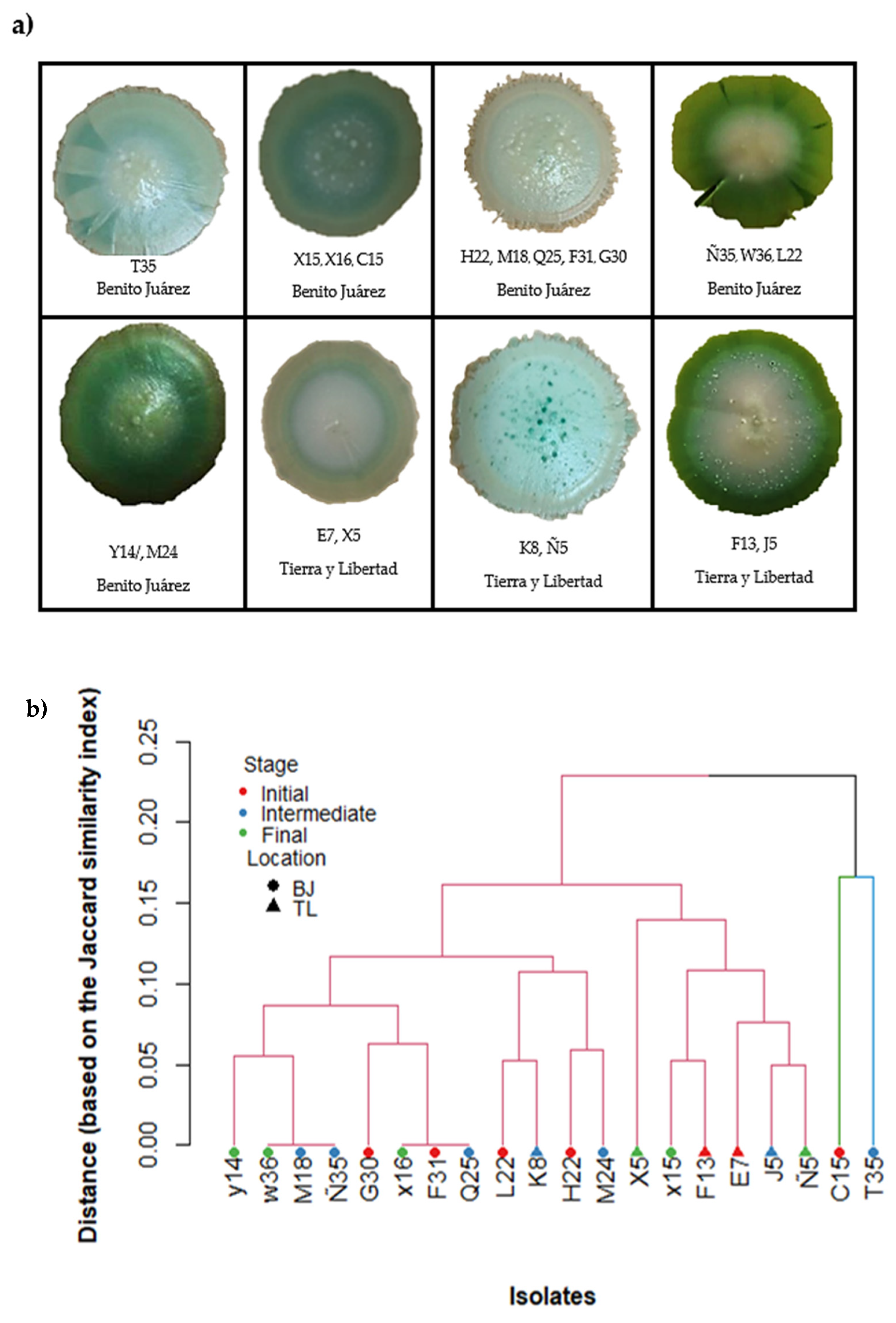





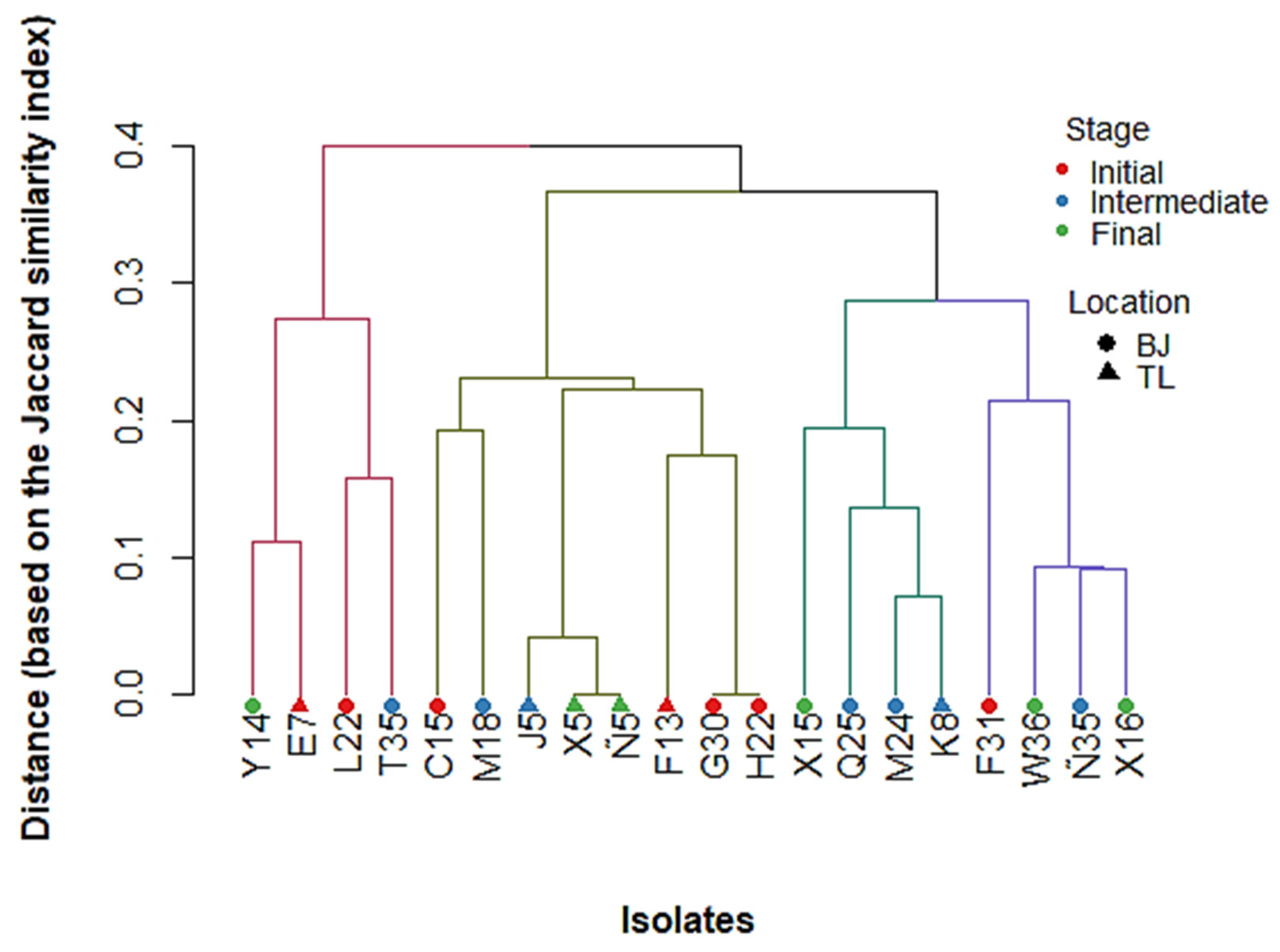
| Isolates | Locality | Stage |
|---|---|---|
| G30, H22, L22, F31, C15 | Benito Juarez, Villaflores, Chiapas | Initial |
| T35, Q25, M18, M24, Ñ35 | Intermediate | |
| W36, X15, X16, Y14 | Final | |
| E7, F13 | Tierra y Libertad, Jiquipilas, Chiapas | Initial |
| J5, K8 | Intermediate | |
| X5, Ñ5 | Final |
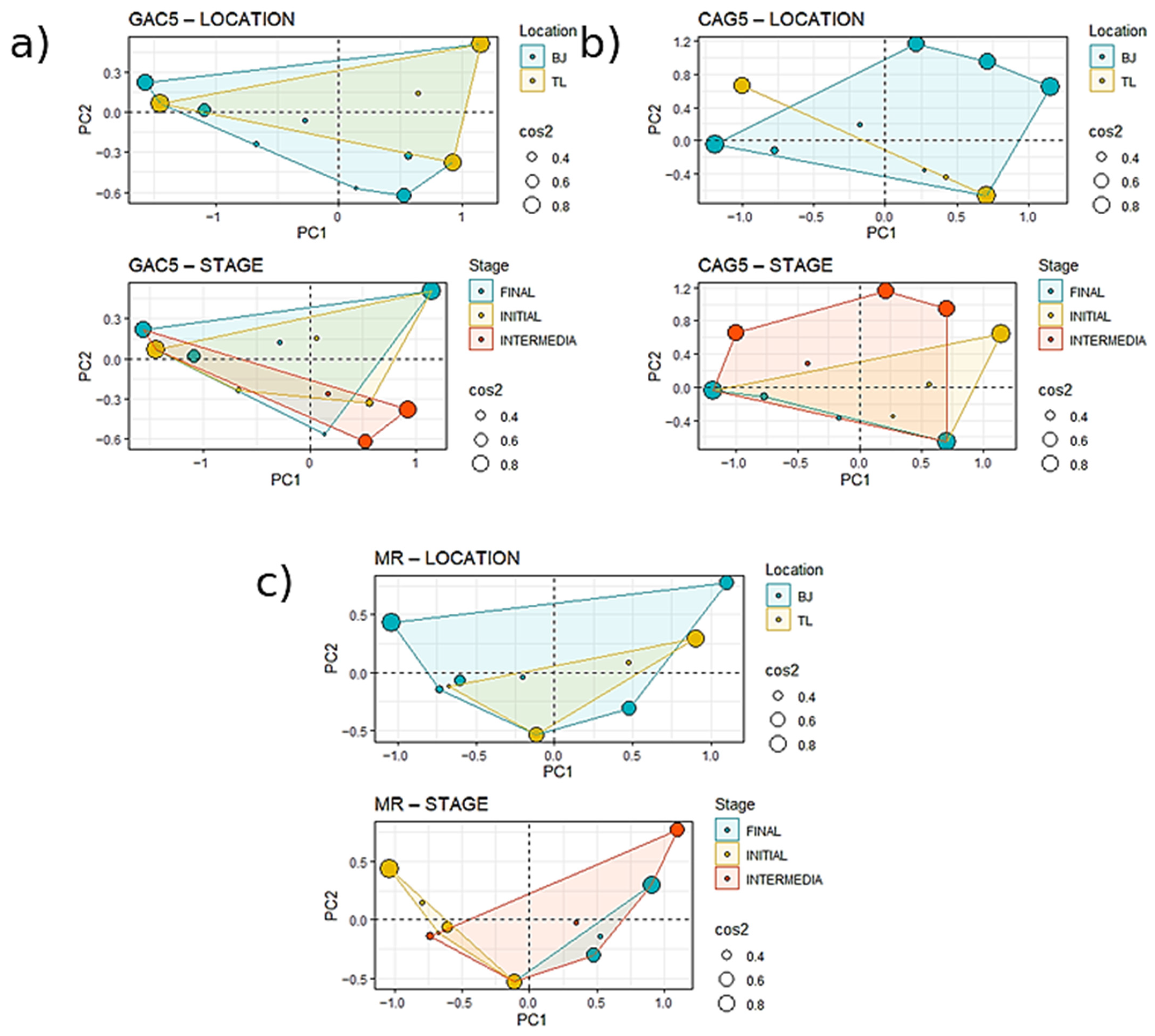
| S. cerevisiae Isolates | Microsatellites | NTS | G. P. | ||
|---|---|---|---|---|---|
| (CAG)5 | (GAC)5 | MR | TaqI | ||
| BENITO JUÁREZ | |||||
| Initial stage (1–4 d) | |||||
| G30 | A | A | A | A | A |
| H22 | A | A | A | A | A |
| L22 | B | A | A | A | B |
| F31 | C | B | A | A | C |
| C15 | D | C | A | A | D |
| Intermediate stage (5–10 d) | |||||
| T35 | B | D | B | A | E |
| Q25 | E | E | C | A | F |
| M18 | F | F | D | A | G |
| M24 | F | E | E | A | H |
| Ñ35 | G | E | D | A | I |
| Final stage (11–15 d) | |||||
| W36 | H | E | D | A | J |
| X15 | I | G | F | A | K |
| X16 | B | E | F | A | L |
| Y14 | G | H | F | B | M |
| TIERRA Y LIBERTAD | |||||
| Initial stage (1–4 d) | |||||
| E7 | B | H | D | C | N |
| F13 | A | H | G | C | O |
| Intermediate stage (5–10 d) | |||||
| J5 | J | I | H | C | P |
| K8 | J | I | H | C | Q |
| Final stage (11–15 d) | |||||
| X5 | A | H | H | C | R |
| Ñ5 | A | H | H | C | R |
Disclaimer/Publisher’s Note: The statements, opinions and data contained in all publications are solely those of the individual author(s) and contributor(s) and not of MDPI and/or the editor(s). MDPI and/or the editor(s) disclaim responsibility for any injury to people or property resulting from any ideas, methods, instructions or products referred to in the content. |
© 2026 by the authors. Licensee MDPI, Basel, Switzerland. This article is an open access article distributed under the terms and conditions of the Creative Commons Attribution (CC BY) license.
Share and Cite
Tawas-Penagos, M.; Narváez-Zapata, J.A.; Lappe-Oliveras, P.; Verdugo-Valdez, A.G. Molecular and Physiological Analysis of Saccharomyces cerevisiae Strains Associated with Taberna, an Alcoholic Beverage from the Sap of Coyol Palm (Acrocomia aculeata Jacq. Lodd. Ex Mart.). Beverages 2026, 12, 57. https://doi.org/10.3390/beverages12050057
Tawas-Penagos M, Narváez-Zapata JA, Lappe-Oliveras P, Verdugo-Valdez AG. Molecular and Physiological Analysis of Saccharomyces cerevisiae Strains Associated with Taberna, an Alcoholic Beverage from the Sap of Coyol Palm (Acrocomia aculeata Jacq. Lodd. Ex Mart.). Beverages. 2026; 12(5):57. https://doi.org/10.3390/beverages12050057
Chicago/Turabian StyleTawas-Penagos, Maritza, José Alberto Narváez-Zapata, Patricia Lappe-Oliveras, and Alma Gabriela Verdugo-Valdez. 2026. "Molecular and Physiological Analysis of Saccharomyces cerevisiae Strains Associated with Taberna, an Alcoholic Beverage from the Sap of Coyol Palm (Acrocomia aculeata Jacq. Lodd. Ex Mart.)" Beverages 12, no. 5: 57. https://doi.org/10.3390/beverages12050057
APA StyleTawas-Penagos, M., Narváez-Zapata, J. A., Lappe-Oliveras, P., & Verdugo-Valdez, A. G. (2026). Molecular and Physiological Analysis of Saccharomyces cerevisiae Strains Associated with Taberna, an Alcoholic Beverage from the Sap of Coyol Palm (Acrocomia aculeata Jacq. Lodd. Ex Mart.). Beverages, 12(5), 57. https://doi.org/10.3390/beverages12050057