

New Fermented Beverage from Orange Peel By-Products Containing Bioactive Flavanones

 , , and
Abstract
1. Introduction
2. Materials and Methods
2.1. Chemicals and Reagents
2.2. Plant Material and Beverage Preparation
2.3. Physicochemical Parameters
2.4. Analysis of Sugars, Ethanol, and Acetic Acid Content
2.5. Qualitative and Quantitative Analysis of Flavanones
2.6. Statistical Analysis
3. Results and Discussion
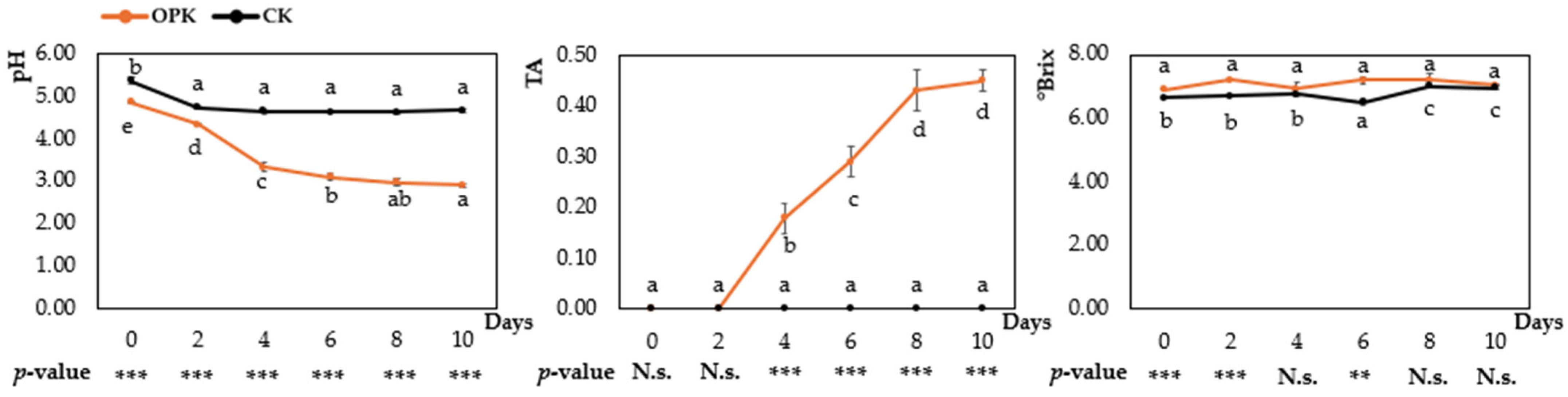
3.1. Physicochemical Parameters
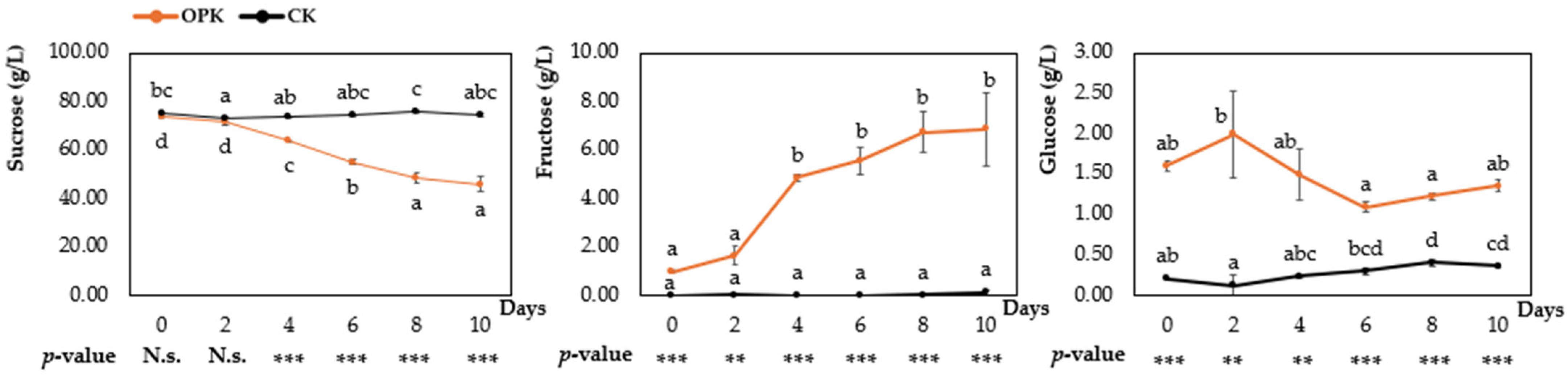
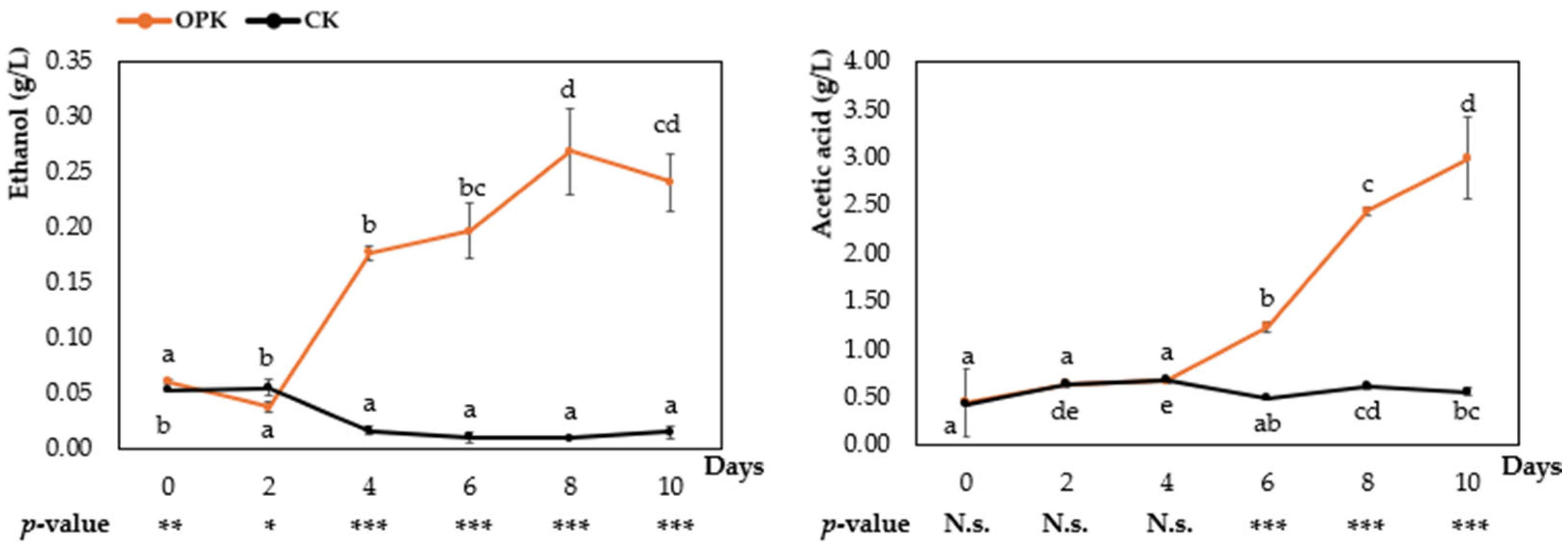
3.2. Sugars, Ethanol, and Acetic Acid Content
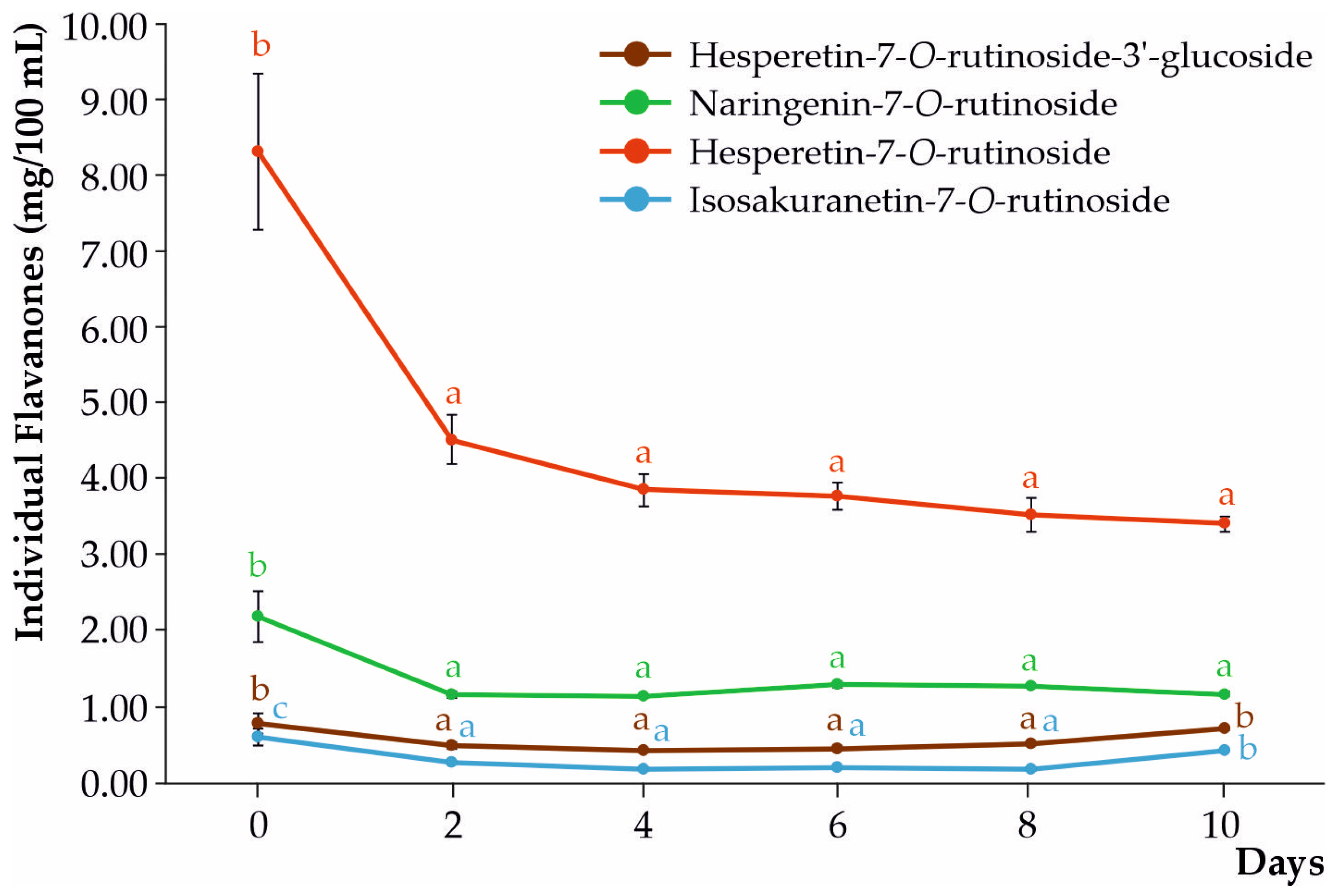
3.3. Qualitative and Quantitative Analysis of Flavanones by HPLC-DAD-ESI/MSn
4. Limitation
5. Conclusions
Author Contributions
Funding
Institutional Review Board Statement
Informed Consent Statement
Data Availability Statement
Acknowledgments
Conflicts of Interest
References
- Liang, Z.; Huang, Y.; Zhang, P.; Fang, Z. Impact of Fermentation on the Structure and Antioxidant Activity of Selective Phenolic Compounds. Food Biosci. 2023, 56, 103147. [Google Scholar] [CrossRef]
- Klawpiyapamornkun, T.; Uttarotai, T.; Wangkarn, S.; Sirisa-ard, P.; Kiatkarun, S.; Tragoolpua, Y.; Bovonsombut, S. Enhancing the Chemical Composition of Kombucha Fermentation by Adding Indian Gooseberry as a Substrate. Fermentation 2023, 9, 291. [Google Scholar] [CrossRef]
- Morales, D.; Gutiérrez-Pensado, R.; Bravo, F.I.; Muguerza, B. Novel Kombucha Beverages with Antioxidant Activity Based on Fruits as Alternative Substrates. LWT-Food Sci. Technol. 2023, 189, 115482. [Google Scholar] [CrossRef]
- Medina, S.; Medrano-Padial, C.; Guillén, S.; Pérez-Través, L.; Pérez-Novas, I.; Periago, P.; García-Viguera, C.; Domínguez-Perles, R. SCOBY-Based, Innovative, and Sustainable Production of Gallic Acid from Sucrose towards Multipurpose Applications. Sci. Rep. 2025, 15, 40536. [Google Scholar] [CrossRef]
- Ojo, A.O.; de Smidt, O. Microbial Composition, Bioactive Compounds, Potential Benefits and Risks Associated with Kombucha: A Concise Review. Fermentation 2023, 9, 472. [Google Scholar] [CrossRef]
- Ayed, L.; Ben Abid, S.; Hamdi, M. Development of a Beverage from Red Grape Juice Fermented with the Kombucha Consortium. Ann. Microbiol. 2017, 67, 111–121. [Google Scholar] [CrossRef]
- Regulation-1169/2011-EN-Food Information to Consumers Regulation-EUR-Lex. Available online: https://eur-lex.europa.eu/eli/reg/2011/1169/oj/eng (accessed on 3 March 2026).
- Kitwetcharoen, H.; Chamnipa, N.; Thanonkeo, S.; Klanrit, P.; Tippayawat, P.; Klanrit, P.; Klanrit, P.; Yamada, M.; Thanonkeo, P. Enhancing Kombucha Functionality: Utilizing Dried Pineapple Peels and Cores as an Alternative Ingredient for Improved Antioxidant and Antimicrobial Properties. LWT-Food Sci. Technol. 2025, 216, 117358. [Google Scholar] [CrossRef]
- Hafizi Fisol, A.; Aziman, N. Development of Kombucha Beverage by Using Fruit. APS Proc. 2023, 6, 183–189. [Google Scholar] [CrossRef]
- Cardoso, R.R.; Neto, R.O.; dos Santos D’Almeida, C.T.; do Nascimento, T.P.; Pressete, C.G.; Azevedo, L.; Martino, H.S.D.; Cameron, L.C.; Ferreira, M.S.L.; Barros, F.A.R. Kombuchas from Green and Black Teas Have Different Phenolic Profile, Which Impacts Their Antioxidant Capacities, Antibacterial and Antiproliferative Activities. Food Res. Int. 2020, 128, 108782. [Google Scholar] [CrossRef]
- Jansen, C.A.; Zanzarin, D.M.; Março, P.H.; Porto, C.; do Prado, R.M.; Carvalhaes, F.; Pilau, E.J. Metabolomic Kinetics Investigation of Camellia Sinensis Kombucha Using Mass Spectrometry and Bioinformatics Approaches. Heliyon 2024, 10, e28937. [Google Scholar] [CrossRef]
- Joevanda, S.; Salsabilla, N.; Qiftiah, M.; Sani, K.F.; Sukmadani Rusdi, M.; Efendi, M.R. Formulation of an Antibacterial Peel-Off Gel Mask from Kombucha Fermented with Gerga Orange Peel Infusion (Citrus x aurantium L.). Indones. J. Pharm. Educ. 2024, 4, 461–472. [Google Scholar] [CrossRef]
- Cánovas, B.M.; Pérez-Novas, I.; García-Viguera, C.; Domínguez-Perles, R.; Medina, S. Assessment of Winery By-Products as Ingredients as a Base of “3S” (Safe, Salubrious, and Sustainable) Fermented Beverages Rich in Bioactive Anthocyanins. Foods 2025, 14, 2514. [Google Scholar] [CrossRef] [PubMed]
- Cánovas, B.M.; García-Viguera, C.; Medina, S.; Domínguez-Perles, R. ‘Kombucha’-like Beverage of Broccoli By-Products: A New Dietary Source of Bioactive Sulforaphane. Beverages 2023, 9, 88. [Google Scholar] [CrossRef]
- Nandan, A.; Tripathi, A.D.; Khan, J.M.; Mahto, D.K.; Agarwal, A. Functional Profiling of Dried Citrus Sinensis and Citrus Limetta Peels: A Multivariate and Spectroscopic Insight into Waste Valorization. Sustain. Chem. Pharm. 2025, 48, 10225. [Google Scholar] [CrossRef]
- Nowalid, W.F.W.M.; Yahya, I.H.; Abd Hamid, H. Valorisation of Citrus Sinensis Peel Biomass into Functional Slice Jam: Optimisation Using Central Composite Design and Quality Characterisation. Food Chem. Adv. 2025, 9, 101116. [Google Scholar] [CrossRef]
- Razola-Díaz, M.d.C.; De Montijo-Prieto, S.; Guerra-Hernández, E.J.; Jiménez-Valera, M.; Ruiz-Bravo, A.; Gómez-Caravaca, A.M.; Verardo, V. Fermentation of Orange Peels by Lactic Acid Bacteria: Impact on Phenolic Composition and Antioxidant Activity. Foods 2024, 13, 1212. [Google Scholar] [CrossRef]
- Carranza-Méndez, R.C.; Chávez-González, M.L.; Sepúlveda-Torre, L.; Aguilar, C.N.; Govea-Salas, M.; Ramos-González, R. Production of Single Cell Protein from Orange Peel Residues by Candida Utilis. Biocatal. Agric. Biotechnol. 2022, 40, 102298. [Google Scholar] [CrossRef]
- Salar, F.J.; Agulló, V.; García-Viguera, C.; Domínguez-Perles, R. Stevia vs. Sucrose: Influence on the Phytochemical Content of a Citrus–Maqui Beverage—A Shelf Life Study. Foods 2020, 9, 219. [Google Scholar] [CrossRef]
- Padmanabhan, S.K.; Lionetto, F.; Nisi, R.; Stoppa, M.; Licciulli, A. Sustainable Production of Stiff and Crystalline Bacterial Cellulose from Orange Peel Extract. Sustainability 2022, 14, 2247. [Google Scholar] [CrossRef]
- Singh, B.; Singh, J.P.; Kaur, A.; Singh, N. Phenolic Composition, Antioxidant Potential and Health Benefits of Citrus Peel. Food Res. Int. 2020, 132, 109114. [Google Scholar] [CrossRef]
- Magwaza, L.S.; Opara, U.L.; Cronje, P.J.R.; Landahl, S.; Ortiz, J.O.; Terry, L.A. Rapid Methods for Extracting and Quantifying Phenolic Compounds in Citrus Rinds. Food Sci. Nutr. 2016, 4, 4–10. [Google Scholar] [CrossRef]
- Liu, X.; Lin, C.; Ma, X.; Tan, Y.; Wang, J.; Zeng, M. Functional Characterization of a Flavonoid Glycosyltransferase in Sweet Orange (Citrus sinensis). Front. Plant Sci. 2018, 9, 166. [Google Scholar] [CrossRef] [PubMed]
- Cichon, N.; Szelenberger, R.; Stela, M.; Podogrocki, M.; Gorniak, L.; Bijak, M. Flavanones as Modulators of Gut Microbiota and Cognitive Function. Molecules 2025, 30, 2203. [Google Scholar] [CrossRef] [PubMed]
- Samota, M.K.; Kaur, M.; Sharma, M.; Sarita; Krishnan, V.; Thakur, J.; Rawat, M.; Phogat, B.; Guru, P.N. Hesperidin from Citrus Peel Waste: Extraction and Its Health Implications. Qual. Assur. Saf. Crops Foods 2023, 15, 71–99. [Google Scholar] [CrossRef]
- Wulansari, N.T.; Padmiswari, A.A.I.M.; Sintyadewi, P.R. Chemical Characteristics during the Fermentation Process of Siam Kintamani Orange Peel (Citrus nobilis) Probiotic Drink. J. Pijar Mipa 2023, 18, 804–808. [Google Scholar] [CrossRef]
- Hontana-Moreno, N.; Morales, D. Biological Activities of Novel Kombuchas Based on Alternative Ingredients to Replace Tea Leaves. Pharmaceuticals 2025, 18, 1722. [Google Scholar] [CrossRef]
- Grondalska, J.; Kolniak-Ostek, J. Evaluation of Anti-Inflammatory, Antidiabetic, Antioxidant, and Anticholinergic Activities, as Well as Chemical Composition and Polyphenolic Compounds in Novel SCOBY-Fermented Juices. Molecules 2025, 30, 1940. [Google Scholar] [CrossRef]
- Redding, M.; Bolten, S.; Gu, G.; Luo, Y.; Micallef, S.A.; Millner, P.; Nou, X. Growth and Inactivation of Listeria Monocytogenes in Sterile Extracts of Fruits and Vegetables: Impact of the Intrinsic Factors PH, Sugar and Organic Acid Content. Int. J. Food Microbiol. 2023, 386, 110043. [Google Scholar] [CrossRef]
- Chakravorty, S.; Bhattacharya, S.; Chatzinotas, A.; Chakraborty, W.; Bhattacharya, D.; Gachhui, R. Kombucha Tea Fermentation: Microbial and Biochemical Dynamics. Int. J. Food Microbiol. 2016, 220, 63–72. [Google Scholar] [CrossRef]
- Lestari, K.A.P.; Wulansari, S.A. Antibacterial Potention and PH Analysis of Kombucha with Anna Apple (Malus domestica) Peel as Its Substrate. Biota 2022, 15, 51–59. [Google Scholar] [CrossRef]
- Pathanibul, P.; Boonjun, P.; Sae-Heng, S. Development of Kombucha from Black Tea and Dried Orange Peel Tea. Int. Conf. Creat. Manag. Educ. Technol. Sci. 2023, 2, 90–103. [Google Scholar] [CrossRef]
- Cohen, G.; Sela, D.A.; Nolden, A.A. Sucrose Concentration and Fermentation Temperature Impact the Sensory Characteristics and Liking of Kombucha. Foods 2023, 12, 3116. [Google Scholar] [CrossRef]
- Kumalawati, D.A.; Dewi, R.S.; Fitriani, N.R.; Muchtar, S.Z.; Leonardo, J.; Astuti Taslim, N.; Romano, R.; Santini, A.; Nurkolis, F. Sea Grape (Caulerpa racemosa) Kombucha: A Comprehensive Study of Metagenomic and Metabolomic Profiling, Its Molecular Mechanism of Action as an Antioxidative Agent, and the Impact of Fermentation Time. Beverages 2025, 11, 134. [Google Scholar] [CrossRef]
- Rodriguez Rey, J.; Tran, T.; Aumeunier, A.; Rieu, A.; Verdier, F.; Martin, A.; Alexandre, H.; Tourdot-Maréchal, R.; Grandvalet, C. Exploring the Role of Production and Release of Proteins for Microbial Interactions in Kombucha. LWT-Food Sci. Technol. 2024, 198, 116016. [Google Scholar] [CrossRef]
- Chen, A.; Li, J.; Yao, A.; Du, G.; Li, J.; Chen, J. Advancing Kombucha Fermentation: Microbial Interactions, Functional Metabolites, and Innovative Optimization Strategies. Food Chem. 2025, 494, 146121. [Google Scholar] [CrossRef] [PubMed]
- Ponomarova, O.; Gabrielli, N.; Sévin, D.C.; Mülleder, M.; Zirngibl, K.; Bulyha, K.; Andrejev, S.; Kafkia, E.; Typas, A.; Sauer, U.; et al. Yeast Creates a Niche for Symbiotic Lactic Acid Bacteria through Nitrogen Overflow. Cell Syst. 2017, 5, 345–357.e6. [Google Scholar] [CrossRef]
- Dartora, B.; Hickert, L.R.; Fabricio, M.F.; Ayub, M.A.Z.; Furlan, J.M.; Wagner, R.; Perez, K.J.; Sant’Anna, V. Understanding the Effect of Fermentation Time on Physicochemical Characteristics, Sensory Attributes, and Volatile Compounds in Green Tea Kombucha. Food Res. Int. 2023, 174, 113569. [Google Scholar] [CrossRef]
- Tran, T.; Grandvalet, C.; Verdier, F.; Martin, A.; Alexandre, H.; Tourdot-Maréchal, R. Microbial Dynamics between Yeasts and Acetic Acid Bacteria in Kombucha: Impacts on the Chemical Composition of the Beverage. Foods 2020, 9, 963. [Google Scholar] [CrossRef]
- Ministério da Agricultura P e.A (mapa) Brasil. Instrução Normativa n. 41, de 17 de Setembro de 2019. Estabelece o Padrão de Identidade e Qualidade Da Kombucha Em Todo o Território Nacional; 2019 Ed. 181, Seção 1; Diário Ofcial da União: Brasilia, Brazil, 2019; p. 13.
- Tejedor-Calvo, E.; Morales, D. Chemical and Aromatic Changes during Fermentation of Kombucha Beverages Produced Using Strawberry Tree (Arbutus unedo) Fruits. Fermentation 2023, 9, 326. [Google Scholar] [CrossRef]
- Lai, C.; Liang, Y.; Zhang, L.; Huang, J.; Kaliaperumal, K.; Jiang, Y.; Zhang, J. Variations of Bioactive Phytochemicals and Antioxidant Capacity of Navel Orange Peel in Response to Different Drying Methods. Antioxidants 2022, 11, 1543. [Google Scholar] [CrossRef]
- Noronha, M.C.; Cardoso, R.R.; dos Santos D’Almeida, C.T.; Vieira do Carmo, M.A.; Azevedo, L.; Maltarollo, V.G.; Júnior, J.I.R.; Eller, M.R.; Cameron, L.C.; Ferreira, M.S.L.; et al. Black Tea Kombucha: Physicochemical, Microbiological and Comprehensive Phenolic Profile Changes during Fermentation, and Antimalarial Activity. Food Chem. 2022, 384, 132515. [Google Scholar] [CrossRef]
- Liu, R.; Tao, Y.; Xu, T.; Wu, T.; Yu, Q.; Pan, S.; Xu, X. Antioxidant Activity Increased Due to Dynamic Changes of Flavonoids in Orange Peel during Aspergillus Niger Fermentation. Int. J. Food Sci. Technol. 2023, 58, 3329–3336. [Google Scholar] [CrossRef]
- Thai Huynh, N.; Van Camp, J.; Smagghe, G.; Raes, K.; Thanh Ward, T.; Phu District, T.; Chi Minh City, H. Improved Release and Metabolism of Flavonoids by Steered Fermentation Processes: A Review. Int. J. Mol. Sci. 2014, 15, 19369–19388. [Google Scholar] [CrossRef] [PubMed]
- König, A.; Sadova, N.; Dornmayr, M.; Schwarzinger, B.; Neuhauser, C.; Stadlbauer, V.; Wallner, M.; Woischitzschläger, J.; Müller, A.; Tona, R.; et al. Combined Acid Hydrolysis and Fermentation Improves Bioactivity of Citrus Flavonoids in Vitro and in Vivo. Commun. Biol. 2023, 6, 1083. [Google Scholar] [CrossRef] [PubMed]
- La Torre, C.; Pino, R.; Fazio, A.; Plastina, P.; Loizzo, M.R. Synergistic Bioactive Potential of Combined Fermented Kombucha and Water Kefir. Beverages 2025, 11, 65. [Google Scholar] [CrossRef]
- Shi, S.; Wei, Y.; Lin, X.; Liang, H.; Zhang, S.; Chen, Y.; Dong, L.; Ji, C. Microbial Metabolic Transformation and Antioxidant Activity Evaluation of Polyphenols in Kombucha. Food Biosci. 2023, 51, 102287. [Google Scholar] [CrossRef]
- Liang, W.; Wang, X.; Zhang, L.; Jiao, S.; Song, H.; Sun, J.; Wang, D. Changes and Biotransformation Mechanism of Main Functional Compounds during Kombucha Fermentation by the Pure Cultured Tea Fungus. Food Chem. 2024, 458, 140242. [Google Scholar] [CrossRef]
- Wang, Y.; Wang, R.; Zhang, Z.; Chen, Y.; Sun, M.; Qiao, J.; Du, Z. Analysis of Chemical Constituents of Traditional Chinese Medicine Jianqu before and after Fermentation Based on LC-MS/MS. Molecules 2022, 28, 53. [Google Scholar] [CrossRef]
- Braune, A. Flavonoid-Converting Capabilities of Clostridium Butyricum. Appl. Microbiol. Biotechnol. 2025, 109, 53. [Google Scholar] [CrossRef]
- Picos-Salas, M.A.; Cabanillas-Bojórquez, L.A.; Leyva-López, N.; Elizalde-Romero, C.A.; de Jesús Bernal-Millán, M.; Contreras-Angulo, L.A.; Lizárraga-Verdugo, E.R.; Beltrán-Ontiveros, S.A.; Montoya-Inzunza, L.A.; Heredia, J.B.; et al. Flavanones: Bioavailability and Role in Modulation of Oxidative Stress and Inflammation in Cancer, Type-2 Diabetes, and Cardiovascular Diseases. Phytochem. Rev. 2025, 25, 489–513. [Google Scholar] [CrossRef]



| Parameter | Values |
|---|---|
| pH | 2.54 |
| TA (% of acetic acid) | 0.54 |
| TSS (°Brix) | 2.20 |
| Sucrose (g/L) | 4.87 |
| Glucose (g/L) | 0.99 |
| Fructose (g/L) | 3.38 |
| Ethanol (g/L) | 0.42 |
| Acetic acid (g/L) | 4.40 |
Disclaimer/Publisher’s Note: The statements, opinions and data contained in all publications are solely those of the individual author(s) and contributor(s) and not of MDPI and/or the editor(s). MDPI and/or the editor(s) disclaim responsibility for any injury to people or property resulting from any ideas, methods, instructions or products referred to in the content. |
© 2026 by the authors. Licensee MDPI, Basel, Switzerland. This article is an open access article distributed under the terms and conditions of the Creative Commons Attribution (CC BY) license.
Share and Cite
Cánovas, B.M.; Fuentes, D.; Bodea, I.M.; Garre, A.; García-Viguera, C.; Medina, S. New Fermented Beverage from Orange Peel By-Products Containing Bioactive Flavanones. Beverages 2026, 12, 50. https://doi.org/10.3390/beverages12050050
Cánovas BM, Fuentes D, Bodea IM, Garre A, García-Viguera C, Medina S. New Fermented Beverage from Orange Peel By-Products Containing Bioactive Flavanones. Beverages. 2026; 12(5):50. https://doi.org/10.3390/beverages12050050
Chicago/Turabian StyleCánovas, Berta María, Dolores Fuentes, Ioana M. Bodea, Alberto Garre, Cristina García-Viguera, and Sonia Medina. 2026. "New Fermented Beverage from Orange Peel By-Products Containing Bioactive Flavanones" Beverages 12, no. 5: 50. https://doi.org/10.3390/beverages12050050
APA StyleCánovas, B. M., Fuentes, D., Bodea, I. M., Garre, A., García-Viguera, C., & Medina, S. (2026). New Fermented Beverage from Orange Peel By-Products Containing Bioactive Flavanones. Beverages, 12(5), 50. https://doi.org/10.3390/beverages12050050