
Article

Investigation of Millet-Based Beer Fermentation and the Volatile Compounds Formed

1
Department of Food Science and Human Nutrition, University of Florida, Gainesville, FL 32611, USA
2
Department of Chemistry, Coastal Carolina University, Conway, SC 29528, USA
3
Department of Mathematics and Statistics, Coastal Carolina University, Conway, SC 29526, USA
*
Author to whom correspondence should be addressed.
Beverages 2026, 12(3), 37; https://doi.org/10.3390/beverages12030037
Submission received: 13 December 2025 / Revised: 28 January 2026 / Accepted: 5 March 2026 / Published: 16 March 2026

Abstract

There has continued to be an increase in the production of gluten-free products, including beer. This interest is a combination of responses to both consumers addressing food sensitivities as well as personal preferences. Beer produced from gluten-free grains has a distinct flavor that differs greatly from traditional barley beer. Recently, the use of millet to produce gluten-free beer has increased with larger-scale malting of millet. It is the goal of this project to investigate the chemical composition of the millet beer aroma. The fermentation of millet-based beers was compared to sorghum and barley beers. Beyond this, the impact of common yeast strains on the fermentation of millet-based beers weas also investigated. All brews were regularly monitored for pH, gravity, total titratable acidity, total polyphenols, and free amino nitrogen. In addition, the aroma profile was sampled using Solid-Phase Microextraction (SPME) with chemical separation and identification and quantification using Gas Chromatography with Mass Spectroscopy (GC-MS). The analysis showed the production of acceptable beers; however, the fermentation there is obvious needed to optimize brewing conditions. In addition, the amount of total volatile compounds was found to be significantly different than beer produced using malted barley.

1. Introduction

Fermentation is one of the oldest preservation techniques utilized by mankind; without this processing technique, beer would not exist. Beer has been consumed by mankind for over 8000 years [1]. With this long history, beer is one of the most widely consumed alcoholic beverages [1]. Beer is an alcoholic beverage made from four simple ingredients: water, hops, yeast, and malted grain, traditionally barley [2]. Unfortunately, malted barley and other cereal grains (wheat, triticale, and rye) contain the protein gluten [3] which can cause damage to the intestinal lining of an individual diagnosed with the autoimmune disease known as celiac disease [4]. The only way to manage this disease is to follow a gluten-free diet [1,5]. In order to produce gluten-free beer, brewers need to utilize gluten-free grains such as millet, sorghum, and buckwheat [6]. It is estimated that the gluten-free beer market reached approximately 10.2 billion USD in 2024 [7].
Millet is one of several alternative grains that has been receiving increased attention by brewers for the production of gluten-free beers [8]. Millet has received significant attention due to its high nutritional value which is associated with the levels of dietary fiber, protein, starch composition, and mineral concentrations [9]. The United Nations (UN) has also highlighted millet as a crop of global importance for food security, a designation that reflects both its nutritional profile and agronomic resilience [10]. Millet has considerable heat and drought tolerance, allowing significant production across a range of growing conditions in areas including India, Africa, and Asia [11]. Millet can also grow well in nutrient-poor or degraded soils, unlike many other staple grains [11]. Millet’s global production is reported to be approximately 29 metric tons for 2024/2025 which is a 3% reduction from the previous year [12]. Global harvests are significant, and interest is accelerating as the Food and Agriculture Organization of the United Nations (FAO) champions evidence-based partnerships to expand markets, improve value chains, and increase farmer adoption [13].
While millet has served as a stable crop, it has also served as the primary grain used for alcohol fermentation in eastern Africa [14]. Millet is used as a replacement for sorghum and malted barley to brew African craft beer [15,16,17]. The resulting beer is traditionally referred to as opaque beer [15,16]. The most utilized millet varieties for brewing are finger millet (Eleusine coracana L. Gaertn) and pearl millet (Pennisetum glaucum L.) [15]. The rise in millet’s importance is mirrored in beverage innovation, with craft breweries around the world incorporating millet and sorghum into gluten-free, regionally adapted beers that integrate historic brewing traditions into the evolving craft beer movement [18]. Across the United States, craft brewers are increasingly experimenting with millet for gluten-free and locally sourced beers, echoing the worldwide initiative to broaden grain diversity in brewing [18].
There continues to be a growing demand for new and improved gluten-free beer from alternative grains [19,20]. This includes tropical grains like millet [21]. Brewing with traditional ingredients such as malted barley has been well established, but less information is available about alternative grains including millet. Further investigation into alternative grains like millet is important to help improve upon the overall quality and flavor profile of gluten-free beers. Research looking into millet’s potential use for brewing European-type lager has been explored. That research showed that unlike sorghum, which takes longer to filter, the millet filters faster, as well as having better foam properties [22].
Beer is one of the oldest fermented beverages still being consumed throughout the world. It is also one of the most complex matrices to study due to the number of metabolic and chemical reactions that occur during the fermentation process [23]. An investigation into the production of millet-based beers was undertaken to address two research goals: (1) investigate millet’s fermentability as well as the quality of beer produced; and (2) investigate the impact of four common yeast strains on the volatile compounds produced.

2. Materials and Methods

2.1. Chemicals

All chemicals were purchased at the highest purity available and used without further treatment or purification. Sodium chloride (NaCl) was purchased from BDH (Radnar, PA, USA). Ethyl caproate, 2-heptanol, and guaiacol were purchased from TCI (Tokyo, Japan). Potassium iodate, ninhydrin, ethyl butyrate, butyl acetate, isoamyl acetate, ethyl caproate, hexyl acetate, 1-octanol, nonanal, ethyl octanoate, and ethyl decanoate, were purchased from Alfa Aesar (Haverhill, MA, USA). Ferric ammonium citrate, ammonium hydroxide (28–30% as NH3), sodium phosphate dibasic heptahydrate, monopotassium phosphate, fructose, and 95% ethanol were purchased from VWR (Solon, OH, USA). Sodium hydroxide (NaOH) was purchased as pellets from Fisher Scientific (Fair Lawn, NJ, USA). Carboxymethylcellulose sodium salt was purchased from Spectrum Chemical MFG Corp. (New Brunswick, NJ, USA). Ethylenediamine tetraacetic acid (EDTA) was purchased from Sigma-Aldrich (St Louis, MO, USA). Finally, glycine was purchased from EMD Chemical Inc. (Gibbstown, NJ, USA).

2.2. Yeast

This study employed four commercial ale yeast strains to represent a broad spectrum of commercial beer styles: Safe-Ale US-05 (American Ale), Wyeast 1098 (British Ale), Wyeast 1010 (American Wheat), and Wyeast 1214 (Belgian Abbey). All yeasts were purchased in dry packets, and 2 g were added without further propagation. No yeast cell counts or viability assessments were performed prior to pitching. All yeast strains were pitched individually directly into the fermenters.
Four yeast strains were chosen because they represent the spectrum of beer styles commonly sold commercially. As shown in Table 1, the table describes each yeast strain based upon their ability to flocculate, ester production, and examples of beer styles that they are commonly used to make.
Yeast flocculation refers to the yeast’s capacity to aggregate into multicellular clumps that eventually settle out of the wort [25]. The manufacturer grades this ability on a simple three-point scale: low, medium, and high. Strains rated as high flocculants fall together readily, but they can sometimes leave unfermented sugars and flavor byproducts, such as diacetyl, in the final beer [25]. Medium flocculants strike a balance: they remain in suspension longer yet ultimately settle once the fermentable sugars are largely depleted, producing a clearer product [25]. Low flocculants, on the other hand, tend to stay in suspension even after fermentation, yielding a hazier or less crystalline appearance; these are often selected for wheat beers [25].

2.3. Brewing

Small-Scale Experimental Brewing: Each experimental beer was brewed using a ~38 L (10-gal) Worthog electric brewing system (High Gravity Fermentation, Tulsa, OK, USA), where 6.3 kg of pale millet malt (Grouse Malting & Roasting Co., Wellington, CO, USA) had been milled using a Barley Crusher Malt mill to just-open grain. The grain was mashed into 15 L of deionized (DI) water at 85 °C. During mashing, 6 mL of Termamyl SC DS Thermo-Stable Amylase Enzyme (Novonesis, Wausau, WI, USA) was added, and temperature was maintained for 45 min; the mash temperature was then cooled to 77 °C and 6 mL of SEBAmyl L Endo-Alpha Amylase Enzyme (Novonesis, Wausau, WI, USA), was stirred in, and temperature was maintained for an additional 45 min. An additional 7.6 L of water was used during sparge. The wort was boiled for sixty minutes. The wort was allowed to cool 40 °C and then transferred into the sterile ~3.8 L fermentation vessels. Fermentation was undertaken in triplicate where 3 L of wort was transferred into separate fermentation vessels which were sealed with an air lock. Two grams of a single yeast strain were pitched into each fermentation vessel (n = 3). The beer was allowed to ferment at room temperature (22 °C) for two weeks. Samples were taken at the following time points: 0, 7 and 14 days. Samples were stored at 4 °C prior to analysis.

2.4. Chemical Analysis

2.4.1. Refractive Index Derived Extract Estimates) °Plato

The refractive index derived extract estimates (°Plato) of the beer were measured using a hand-held refractometer calibrated with DI water.

2.4.2. Total Acidity (TA)

Total acidity was measured using the official method described by the American Society of Brewing Chemist in method Beer-8 [26]. The initial pH of the sample was taken using a calibrated pH meter, and then the solution was titrated with 0.1 M sodium hydroxide to a pH of 8.20.

2.4.3. pH

pH was determined using the official method described by the American Society of Brewing Chemist (ASBC) Official Method Beer-9 using a two-point calibration curve (pH 4 and 7) [27].

2.4.4. Color

Color was measured using the official method described by the American Society of Brewing Chemist in method Beer-10 [28]. The beer was placed into a 1 cm cuvette, and the absorbance was measured at 430 nm.

2.4.5. Free Amino Nitrogen (FAN)

Free amino nitrogen was quantified using the official method described by the American Society of Brewing Chemist (ASBC) Official Method Beer-31 [29]. This method reacts nitrogen with ninhydrin in the presence of potassium iodate to form a colored solution. The absorbance is measured at 570 nm.

2.4.6. Total Polyphenols

Total polyphenols were quantified using the American Society of Brewing Chemist (ASBC) Official Method Beer-35 [30]. Polyphenols present in the samples are reacted with ferric ions in an alkaline solution to produce a red color which is measured at 600 nm.

2.5. Gas Chromatography Analysis

2.5.1. Volatile Organic Compounds Extraction

Volatile constituents in the beer samples were analyzed using gas chromatography–mass spectrometry (GC-MS). Headspace solid-phase microextraction (HS-SPME) was employed to extract and concentrate these analytes. A 50/30 μm Divinylbenzene/Carboxen/Polydimethylsiloxane (DVB/Carboxen/PDMS) fiber (Supelco, Bellefonte, PA, USA) was chosen because it adsorbs a broad spectrum of organic compounds from beer matrices. Ten milliliter aliquots of beer were placed in sealed headspace vials; an internal standard solution (2-heptanol (200 mg L−1) and guaiacol (100 mg L−1) dissolved in ethanol) were added to the vial, along with 3 g NaCl to promote volatilization. The sealed vials were equilibrated at 40 °C for 10 min, then the fiber was exposed for 30 min at the same temperature while the vials were agitated at 300 rpm. After extraction, the fiber was directly transferred to the GC-MS injector for analysis.

2.5.2. Volatile Organic Compound Analysis

Gas chromatography–mass spectrometry was used to identify volatile compounds in both control and experimental beer samples. Analyses were performed on a Shimadzu 2010 Plus Series GC coupled to a QP2010 SE mass selective detector (MSD) (Shimadzu Scientific Instruments, Columbia, MD, USA). A narrow bore deactivated glass insert introduced samples in splitless mode; the injector was held at 250 °C, and volatile compounds were desorbed from the fiber for two minutes. Separation was achieved on a nonpolar DB5-MS column (30 m × 0.25 mm ID × 0.25 µm film) with helium as the carrier gas flowing at 1.0 mL min−1 (linear velocity 35.7 cm s−1). The column temperature program started at 30 °C (2 min hold), ramped to 70 °C at 10 °C min−1 (1 min hold), then to 220 °C at 4 °C min−1, followed by a final ramp to 270 °C at 20 °C min−1 with a 6 min hold. The MSD operated at 200 °C and scanned ions from m/z 35 to 500. Peaks were identified by comparing measured linear retention indices (LRIs), pure compound standards, and fragmentation spectra against those in the Wiley 2014 mass spectral library [20].

2.5.3. Identification

Volatile compounds were identified based upon their LRI values using nonpolar (Rxi-5Sil) columns (30 m × 0.25 mm i.d., 0.25 μm film; J&W, Folsom, CA, USA). LRI values were calculated using the equation shown below (2). The LRI values were compared to literature values. Aliphatic hydrocarbon standards were analyzed in the same manner using a Rxi-5Sil column to calculate RI:
R I = 100   ( t R ( u n k n o w n t R ( n ) t R N t R ( n ) + n )
where linear retention index, n, is the number of carbon atoms in the n-alkane eluting immediately before the analyte, N is the number of atoms in the n-alkane eluting immediately after the analyte, and t is the retention time [31,32].

2.5.4. Compound Response

GC-MS peak area of each identified compound was normalized against the peak area of the internal standard 2-heptanol in each chromatogram. This relative response was compiled for each compound and used in statistical analysis.

2.5.5. Compound Quantification

A subset of nine compounds which have been found to be present in beers brewed from both malt and malted sorghum at statistically different amounts were selected for quantification (Table 2) [20]. These compounds (butyl acetate, isoamyl acetate ethyl hexanoate (caproate), hexyl acetate, 1-octanol, nonanal, ethyl octanoate (caprylate), ethyl decanoate (caprate)) were quantified using the calculation of response factors, calculated by evaluation of a set of linear calibration standards.

2.6. Statistical Analysis

Statistical analyses were conducted using the open-source software, R Version 4.3.3, including the tidyverse suite of packages. Relative response was averaged across all replicates for each compound and transformed using log base 10 due to the strong right skew. To explore potential differences in relative areas between the grains with American ale, single-factor ANOVA was run after ensuring the assumptions of normality and equal variance are met. The magnitude of differences present is understood using the effect size η 2 and post hoc 95% Tukey HSD confidence intervals. Similarly, to understand the effects of yeast on relative areas, a two factor ANOVA with yeast and grain and their interaction was run. Effect sizes for the main effects of yeast and grain along with their interaction are reported as η p a r t i a l 2 .

3. Results and Discussion

This work on millet-based beers was undertaken to address two research goals: (1) investigate millet’s fermentability as well as the quality of beer produced; and (2) investigate the impact of four common yeast strains on the volatile compounds produced.
Measuring common beer characteristics is important to determine how the physical characteristics of gluten-free beers compare to traditionally made beer using malted barley. To help focus the investigation on the fermentability, a series of brews were done with the American Ale yeast. Table 3 shows the physical characteristics of beer made using millet and American Ale yeast. The characteristics measured were density (°Plato), pH, calculated alcohol content (ABV%), total acidity, total polyphenols, free amino nitrogen, and color.

3.1. pH

It is common in the brewing industry to measure pH in order to monitor the fermentation process throughout all stages of the brewing process [36]. pH measurement is commonly utilized due to the simplicity of the measurement. This simple pH measurement is extremely important to ensuring food safety [37]. It is well established that the pH of the wort will fall rapidly in the early stages of the fermentation process as the yeast create a hostile environment for other microbes; however, as the fermentation process continues to progress, the decrease in pH will slow down [38,39]. As shown in Table 3, the pH of the wort was higher initially but quickly decreased after seven days of fermentation, and in the last seven days of the fermentation, the decrease in pH was subtle, if at all. The pH of the beers produced in this experiment fell outside of acceptable levels for traditional beer (4.1–4.5) [2] and lower than those produced by others [3,40]. Sour beers like the Belgian lambic generally fall between 3.2 and 3.6 [41]; however, this beer finished around 3.99 (0.36). Conversely, it should be noted that this study was primarily concerned with fermentability of millet and no pH adjustment of brew water, wort, or hop additions. So, while these brews fell outside of the acceptable range, an optimization of brewing conditions should result in values found in traditional beers.

3.2. Extract

Refractive index derived extract estimates were measured pre-, during, and post-fermentation as density and were reported in °Plato as shown in Table 3. The formation of alcohol by yeast is considered to be the most important biochemical reaction occurring during fermentation [8]. The change in refractive index-derived extract estimates over time shows that the yeasts were able to convert the available fermentable sugars into ethanol. Alcohol is calculated based upon the starting gravity and the apparent ending gravity. Based upon theoretical yields of 0.51 g of ethanol produced per g of consumed sugar [42], the theoretical alcohol range should have been higher with values ranging between ABV% 4.8 and 5.8%. The concentration of alcohol produces is also an indicator of the suitability of fermentation substrate as well as the yeast strain utilized [8]. A previous study conducted by Agu (1995) [22] conducted a comparison study looking at millet, sorghum, and malted barley. This study showed that despite all three of the grains starting at approximately the same specific gravity of 1.042, the millet had the lowest overall reduction in gravity which resulted in the smallest amount of alcohol produced: 3.23 ABV% vs. sorghum 3.92 ABV% and malted barley 4.63 ABV% [22]. Agu attributed the lower alcohol production in millet to kernel size effects; however, the similarity in initial wort gravities suggests that factors affecting fermentability, rather than extract generation, were likely responsible for the observed differences in alcohol yield [22].

3.3. Total Acidity (TA)

Unlike pH, which measures hydrogen ions (H+), total acidity (TA) measures all of the acids within the matrix were tested [36]. While pH which is utilized by the Food and Drug Administration (FDA) as a safety measurement [43], TA is a better indicator of the taste [36]. As shown in Table 3, TA was measured at the beginning, middle, and end of the fermentation process. This showed a decrease in TA which is expected to occur during the fermentation process as the yeast begin to produce a variety of organic acids. During the fermentation process, yeast will produce small concentrations of acetic acid and other organic acids (citric, malic, fumaric, succinic, lactic and formic); the concentration of these acids within the beer can vary widely [44,45,46]. The distribution and concentration of these different organic acids will have an impact on the final flavor. The total acidity was comparable to other millet beers [40,47].

3.4. Total Polyphenols Content (TPC)

Beer contains high concentrations of polyphenols. The main contributors of polyphenols in beer are the hops (20–30%) and the grain (70–80%) [48,49,50]. The composition and type of polyphenols serve as quality indicators of the brewing process [6], influencing the beer’s taste, aroma, color, foam stability, and shelf-life [48]. The primary group of polyphenols found in beer are phenolic acids, tannins, flavones and flavonols [51]. TPC was determined to be 162 mg/L gallic acid-equivalent. These results are similar to Vyawhare et al. (2025), who looked at difference ratios of millet adjuncts with malted barley [52].

3.5. Free Amino Nitrogen (FAN)

Free amino nitrogen is metabolized by the yeast for several metabolic processes like cellular growth, repair, replication, as well as the fermentation process [53]. FAN levels have often been utilized as a predictor for healthy yeast growth, viability, vitality, the overall fermentation, and the overall quality and stability of the resulting beer [54]. FAN levels vary from batch to batch [39,55]. In order to achieve a satisfactory fermentation, the wort must contain at least 130 mg/L, while the minimum range needed by yeast ranges between 100 and 140 mg/L [39,55]. The ideal range is higher at 200–250 mg/L of FAN [39,55]. The concentration of available FAN as shown in Table 3 was above the recommended lower limit for fermentation [39,55].
The results for this study were higher than those achieved by Sebestyén et al. (2013) at 136 mg/L [3]. It should be noted that their study was unable to achieve their desired results of greater than 140 mg/L, likely due to degrading expoproteases and exopeptidases being inhibited [3]. Eneje et al. (2001) [21] and Zarnkow et al. (2010) [56]’s findings more closely aligned with our findings ranging between 146 and 158 mg/L. The slightly lower FAN levels could lead to a reduced fermentation rate or reduced ester formation but would still likely result in a successful brew [57].
It was expected that the FAN levels would drop following the fermentation process. However, it was observed that these brews were turbid, and even at the end of the fermentation they remained cloudy, which would pass through the 0.45 µm filters. Turbidity or opaque beers are common when it comes to the production of alternative grain beers like millet and sorghum [22]. The turbidity or ‘haze’ associated with these beers could also be associated with protein–polyphenol interactions [58]. It is possible that this turbidity allowed for more nitrogen to be introduced to beer as fermentation occurred, resulting in no decrease in FAN as expected, but a slight increase was observed. It is also possible that the impact of this turbidity artificially increased the absorbance values in the analytical method. Regardless, the millet had a sufficient amount of FAN to support the fermentation. However, work remains to optimize the mash.

3.6. Color

The beer color ranged from 5 (wort) to 10 (final beer) SRM. This is in line with the common pale millet malt used and the target beer styles. The color is primarily determined by the type of malt used. Pale millet was selected here to help focus the investigation on the impact of the grain itself without potential impacts from intense malting. The color measured is darker than when using pale barley or sorghum but is in line with previous studies [22,59]. This is also likely due to the fact that millet has a higher concentration of tannins then malted barley [22]. It is also likely that the color values observed could have been increased by turbidity, as a result of ultrafine particles that were not trapped in the filtering of the sample.

3.7. Volatile Composition

Beer is a complex beverage traditionally made using only four ingredients: water, malted grain (traditionally barley), hops, and yeast [20]. Volatile compounds generated during fermentation result from the selected yeast strain, the wort composition, and the brewing process [60]. Detecting and quantifying these compounds with gas chromatography-mass spectrometry (GC-MS) is a well-established practice for predicting beer’s flavor and aroma profiles [31]. Beer flavor derives from a complex mixture of volatile, semi-volatile, and non-volatile compounds and the interactions between them. Beer is composed of hundreds of volatile and semi-volatile compounds that will ultimately affect the taste and aroma of the beer produced [61]. The sensory characteristics of beer made using malted barley have been thoroughly researched over the years, especially when it comes to determining the volatile and semi-volatile composition [62,63].

3.7.1. Characterizing the Volatile Composition of Millet Beer

Beer is composed of volatile compounds from a number of different organic groups such as higher alcohol (fusel), acids, esters, etc. The resulting millet beer using American Ale yeast was analyzed for their volatile aromatic profile, and the results are summarized in Table 4. The volatile compounds are grouped together based upon their organic groups.
Higher (fusel) alcohols is another organic group that has been shown to play an important role in the aromatic composition of beer when levels do not exceed 300 mg/L [65]. Excessive amounts of higher alcohol can negatively impact the aroma of the beer and potentially impart a solvent-like note. Similar higher alcohols were identified in this study as compared to Yang et al. (2025) [9]. However, in this study, eleven higher alcohols were identified compared to their six. It should be noted that previous studies focused on utilizing millet as a brewing adjunct where the work presented here used a millet-only grain bill.
In comparison to ethanol, esters are found in beer at traces amounts [62]. Nevertheless, ester play an important role in overall acceptance of the beer, due to the impact they have on the overall aroma of the final product. The reason for this is that esters have a low odor threshold [66,67] in comparison to other organic groups like acids [66]. However, excessive amounts of esters can be considered a defect in the beer. Like Yang et al. (2025) [9], similar ester compounds (ethyl acetate, isoamyl acetate, ethyl hexanoate, and ethyl octanoate) were found. However, in this study a greater number of ester compounds were identified; this could be due to the fact that malted millet was utilized in this study versus un-malted millet, as well as a different strain of yeast.
American Ale yeast is a versatile yeast strain that can be used in several different styles of beer ranging from American Pales Ales (APA), Indian Pale Ales (IPAs), to porters, stouts, and more. Table 4 shows the volatile compounds identified in a millet beer brewed using an American Ale yeast. This particular yeast strain is described by the manufacturer (Fermentis) as being low-ester-producing without producing phenolic compounds (POF-) [24]. Phenolic compound’s ability to influence the beer’s taste has been well documented [68,69]. As observed in Table 4, four phenolic compounds were identified: 4-ethylguaiacol (4-EG), 4-vinylguaiacol (4-VG), 4-ethylphenol (4-EP), and 4-methoxyphenol (mequinol). As previously discussed, the majority of phenolic compounds found in beer are the result of raw ingredients, either hops or the grain used [70]. Ferulic acid and p-courmaric acid are two of the most common phenolic acids found in cereal grains [70]. Ferulic acid can range significantly within different cultivars of millet 41–1445 µg/g free [71,72]. Traditionally, the release of ferulic acid is controlled during the malting and mashing process [73]. For beers brewed with malted barley, that is achievable. However, the use of millet in beer manufacturing does have its issues, which are primarily due to its high gelatinization temperature [21]. Millet’s gelatinization temperature ranges from 54 to 80 °C [21,74] vs. malted barley’s range between 57 and 66 °C depending on the size of the starch granules [74,75]. The difference in temperatures utilized will result in the decarboxylated of ferulic acid into 4-VG [73]. Due to the lower sensory threshold (0.3 mg/L) for 4-VG [66], it is likely that this compound would be perceived by a consumer panel. Yang et al. (2025) also found 4-VG by HS-SPME analysis in their resulting beer as well [9].
The total composition of the volatiles present in these millet-based beers was compared to both sorghum-based beers and malt beers. Figure 1 shows the violin plots of these comparisons. Results indicate very strong evidence for a difference in mean relative area between the three grains used with American Ale (F2, 2530 = 48.69, p < 0.0001). The magnitude of the effect is considered small to medium according to η 2 . The 95% post hoc Tukey HSD comparisons indicate that barley (p < 0.0001) and sorghum (p < 0.0001) have significantly higher averages than millet, while barley and sorghum are not different from each other (p = 0.946). This difference may, in part, be a function of the lower degree of fermentation characterized by the smaller change in specific gravity.

3.7.2. Comparison of Key Volatile Compounds Based upon Different Yeast Strains

The second objective of this experiment was to look at the influence grain type has on the production of certain volatile compounds. It is well documented that different strains of yeast will produce varying concentrations of the same volatile compound in different beers [8,19]. To further expand upon previous research, we examine how grain type impacts the production of specific volatile compounds produced by different yeast strains [19]. As before, the observed differences were not in composition but in relative concentration.
The nine compounds selected for comparison was due to previous work by Budner et al. [19,20], where these specific compounds were found to be statistically different between malted barley and sorghum. To further expand upon that work, millet was also compared. Table 5 summarizes the relative response values of the nine target compounds produced by the four different yeast strains using three different grains. Statistical analyses were run looking at the individual results for each yeast strain as well as the summation of the concentration of the nine compounds, analyzed as overall totals, which are shown in Table 5. Statistical differences (p < 0.05) were observed for the overall totals of the nine compounds of interest for Belgian Abby and English Ale yeasts. Differences were observed between barley vs. millet and sorghum. No statistical differences were observed between the American Ale and the American Wheat.
Volatile compounds, especially esters, can vary greatly due to several factors such as yeast strain utilized, wort gravity, FAN levels, temperature, oxygen, and pitch rate [53,62,76].
Volatile compounds can have a positive, negative or neutral effect on the aroma profile of beer. As shown in Table 5, the relative concentration of the three different grains sources shows that the concentration for the different volatile compounds vary between the different grain sources. Based upon previous research from this laboratory, sorghum produced fewer volatile compounds in comparison to malted barley. Although millet generally had a lower relative concentration in comparison to malted barley, it was generally higher than sorghum. This could be due to the FAN levels in millet being higher than sorghum. Previous researchers, including this research team, have shown that FAN levels for sorghum are considerably lower than those of malted barley [20,77,78]. FAN levels are associated with the production of medium chain fatty acid esters (MCFA) such as hexanoate, octanoate, and decanoate [79]. In comparison, due to millet’s higher FAN levels, it had a generally higher relative concentration of MCFA esters verse sorghum. However, it did tend to be less than that of malted barley.

4. Limitations

The primary limitation of this study is that the mashing process used in this study, while it followed recommendations of leading maltsters, was not optimized. Improvements in beer quality and consistency can be made upon mash optimization. It should also be noted that the brewing and subsequent fermentations were done on a laboratory scale. Minor differences should be anticipated following scaling for production.
Brewers should be aware of the potential shortcomings of using alternative grains such as millet and sorghum to produce gluten-free beer. In contrast to sorghum, which generally requires supplemental nitrogen to reach adequate fermentable nitrogen (FAN) levels, millet can reach the desired FAN range of 100–140 mg L−1 [3,21,39,55] when brewing conditions are optimized. In comparison to brewing with malted barley, millet has a lower concentration of naturally present enzymes resulting in lower yields. Thus, additional external enzymes should be added.
Malted millet usually has a lower SRM than malted barley; however, the higher mashing temperatures needed to achieve gelatinization can promote Maillard browning, often producing a darker color as observed in these experiments.
Also, the high gelatinization temperature of millet can allow for significant changes in the phenolic composition. This higher temperature can allow for increased inclusion of organic acids including ferulic acid. These acids at higher temperatures can undergo decarboxylation to produce increases in phenolic compounds such as 4-VG [73]. This increase in phenolic composition would likely impact final beer perception.

5. Conclusions

The analysis of beer brewed from millet was undertaken to determine fermentability as well as the chemical composition of the major fermentation compounds. Overall, the millet beer produced an acceptable beer, with acceptable values of FAN. However, optimization of brewing conditions can improve a number of beer parameters. As with previous studies, the volatile composition of these millet-based beers provided a wide range of different compounds. The investigation into the impact of four different yeast strains on the concentration of ethyl butyrate, butyl acetate, isoamyl acetate, ethyl caproate, hexyl acetate, 1-octanol, nonanal, ethyl octanoate, and ethyl decanoate was undertaken. There are differences between the concentration of these key compounds as a result of the different yeast strains. Overall, the concentration of these key VOCs was lower in barley beers. The composition of these key VOCs was also similar to those found in sorghum-based beers. Further work is needed to connect these measured differences to the perceived flavors of the beers.

Author Contributions

Conceptualization: K.A.T.-W.; Data Curation: L.R., K.C., R.V. and L.F.; Formal Analysis: K.A.T.-W. and L.B.; Funding Acquisition: D.B.; Investigation: L.R., K.C., R.V., L.F. and L.B.; Methodology: D.B.; Supervision: D.B.; Writing—Original Draft: K.A.T.-W., D.Y. and D.B.; Writing—Review and Editing: K.A.T.-W., D.Y. and D.B. All authors have read and agreed to the published version of the manuscript.

Funding

This work was funded primarily by Coastal Carolina University Department of Chemistry and Gupta College of Science with additional support from South Carolina INBRE (NIH 5P20GM103499).

Institutional Review Board Statement

Not applicable.

Informed Consent Statement

Not applicable.

Data Availability Statement

Data available on request, inquiries can be directed to the corresponding author.

Conflicts of Interest

The authors declare no conflicts of interest.

Abbreviations

The following abbreviations are used in this manuscript:
ABVAlcohol by volume
ANOVAAnalysis of variance
DIDistilled water
DVB/Carboxen/PDMS Divinylbenzene/Carboxen/Polydimethylsiloxane
EDTA Ethylenediamine tetraacetic acid
FANFree amino nitrogen
GC-MSGas chromatography-mass spectrometer
HS-SPMEHead space-solid phase microextraction
LRILinear retention index
NaCLSodium chloride (salt)
NaOHSodium hydroxide
SPMESolid phase microextraction
TATotal acidity
TPCTotal polyphenol content
VOCVolatile organic compounds
FDAFood and Drug Administration
MCFAMedium chain fatty acid esters
4-EG4-ethylguaiacol
4-VG4-vinylguaiacol
4-EP4-ethylphenol
APAAmerican Pales Ale
IPAsIndian Pale Ales

References

  1. Rubio-Flores, M.; Serna-Saldivar, S.O. Technological and Engineering Trends for Production of Gluten-Free Beers. Food Eng. Rev. 2016, 8, 468–482. [Google Scholar] [CrossRef]
  2. Kunze, W. Technology and Brewing and Malting, 3rd ed.; VLB Berlin: Berlin, Germany, 2004. [Google Scholar]
  3. Sebestyén, A.; Kiss, Z.; Vecseri-Hegyes, B.; Kun-Farkas, G.; Hoschke, Á. Experiences with laboratory and pilot plant preparation of millet and buckwheat beer. Acta Aliment. 2013, 42, 81–89. [Google Scholar] [CrossRef]
  4. Fasano, A.; Catassi, C. Clinical practice. Celiac disease. N. Engl. J. Med. 2012, 367, 2419–2426. [Google Scholar] [CrossRef] [PubMed]
  5. Hager, A.-S.; Taylor, J.P.; Waters, D.M.; Arendt, E.K. Gluten free beer–A review. Trends Food Sci. Technol. 2014, 36, 44–54. [Google Scholar] [CrossRef]
  6. Mitić, S.S.; Paunović, D.Đ.; Pavlović, A.N.; Tošić, S.B.; Stojković, M.B.; Mitić, M.N. Phenolic Profiles and Total Antioxidant Capacity of Marketed Beers in Serbia. Int. J. Food Prop. 2014, 17, 908–922. [Google Scholar] [CrossRef]
  7. ReAnIn. Gluten-Free Beer Market; Research Analysis Insight (ReAnIn): Bangalore, India, 2025; p. 336. [Google Scholar]
  8. Zarnkow, M.; Faltermaier, A.; Back, W.; Gastl, M.; Arendt, E.K. Evaluation of different yeast strains on the quality of beer produced from malted proso millet (Panicum miliaceum L.). Eur. Food Res. Technol. 2010, 231, 287–295. [Google Scholar] [CrossRef]
  9. Yang, Z.; Liu, H.; Ma, C.; Pema, Y.; Li, Y.; Fang, W. Suitability of unmalted finger millet from China for beer brewing. J. Sci. Food Agric. 2025, 105, 6773–6780. [Google Scholar] [CrossRef]
  10. Mutsaka, F.; Keaten, J. UN Eyes Revival of Millets as Global Grain Uncertainty Grows; Associated Press: New York, NY, USA, 2023. [Google Scholar]
  11. Millets Global Crop Conservation Strategy. Available online: https://www.croptrust.org/news-events/campaigns/crop-conservation-strategies/millets (accessed on 14 November 2025).
  12. USDA. Production—Millet. Available online: https://www.fas.usda.gov/data/production/commodity/0459100 (accessed on 14 November 2025).
  13. Global Effort to Harness Science and Partnerships to Transform Millets. Available online: https://www.fao.org/plant-production-protection/news-and-events/news/news-detail/global-effort-to-harness-science-and-partnerships-to-transform-millets/en (accessed on 14 November 2025).
  14. Kubo, R. The reason for the preferential use of finger millet (Eleusine coracana) in eastern African brewing. J. Inst. Brew. 2016, 122, 175–180. [Google Scholar] [CrossRef]
  15. Cadenas, R.; Caballero, I.; Nimubona, D.; Blanco, C.A. Brewing with Starchy Adjuncts: Its Influence on the Sensory and Nutritional Properties of Beer. Foods 2021, 10, 1726. [Google Scholar] [CrossRef]
  16. Embashu, W.; Nantanga, K.K.M. Malts: Quality and phenolic content of pearl millet and sorghum varieties for brewing nonalcoholic beverages and opaque beers. Cereal Chem. 2019, 96, 765–774. [Google Scholar] [CrossRef]
  17. Agu, R.C.; Palmer, G.H. Evaluation of the potentials of millet, sorghum and barley with similar nitrogen contents malted at their optimum germination temperatures for use in brewing. J. Inst. Brew. 2013, 119, 258–264. [Google Scholar] [CrossRef]
  18. Edgerton, S. 10 Craft Breweries Using Millets and Soghum. Available online: https://foodtank.com/news/2018/10/10-craft-breweries-using-millets-and-sorghum (accessed on 14 November 2025).
  19. Budner, D.; Carr, J.; Serafini, B.; Tucker, S.; Dieckman-Meyer, E.; Bell, L.; Thompson-Witrick, K.A. Targeted Study of the Effect of Yeast Strain on Volatile Compounds Produced in Sorghum Beer. Foods 2024, 13, 3626. [Google Scholar] [CrossRef]
  20. Budner, D.; Carr, J.; Serafini, B.; Tucker, S.; Dieckman-Meyer, E.; Bell, L.; Thompson-Witrick, K.A. Statistical Significant Differences between Aroma Profiles of Beer Brewed from Sorghum. Beverages 2021, 7, 56. [Google Scholar] [CrossRef]
  21. Eneje, L.O.; Obiekezie, S.O.; Aloh, C.U.; Agu, R.C. Effect of milling and mashing procedures on millet (Pennisetum maiwa) malt wort properties. Process Biochem. 2001, 36, 723–727. [Google Scholar] [CrossRef]
  22. Agu, R.C. Comparative study of experimental beers brewed from millet, sorghum and barley malts. Process Biochem. 1995, 30, 311–315. [Google Scholar] [CrossRef]
  23. He, Y.; Dong, J.; Yin, H.; Zhao, Y.; Chen, R.; Wan, X.; Chen, P.; Hou, X.; Liu, J.; Chen, L. Wort composition and its impact on the flavour-active higher alcohol and ester formation of beer–A review. J. Inst. Brew. 2014, 120, 157–163. [Google Scholar] [CrossRef]
  24. Fermentis SafeAleTM US-05. Available online: https://fermentis.com/en/product/safale-us-05/ (accessed on 12 May 2025).
  25. Verstrepen, K.J.; Derdelinckx, G.; Verachtert, H.; Delvaux, F.R. Yeast flocculation: What brewers should know. Appl. Microbiol. Biotechnol. 2003, 61, 197–205. [Google Scholar] [CrossRef]
  26. ASBC. Beer 8. Total Acidityas ‘Titratable Acidity’. In ASBC Methods of Analysis; American Society of Brewing Chemists (ASBC): St. Paul, MN, USA, 1958; reviewed 1975, 2013, 2016. [Google Scholar]
  27. ASBC. Beer 9. pH (Hydrogen Ion Concentration). In ASBC Methods of Analysis; American Society of Brewing Chemists (ASBC): St. Paul, MN, USA, 2018. [Google Scholar] [CrossRef]
  28. ASBC. Beer 10. Color. In ASBC Methods of Analysis; American Society of Brewing Chemists (ASBC): St. Paul, MN, USA, 2002; reviewed 2015. [Google Scholar]
  29. ASBC. Beer 31. Free Amino Nitrogen (International Method). In ASBC Methods of Analysis; American Society of Brewing Chemists (ASBC): St. Paul, MN, USA, 1976. [Google Scholar] [CrossRef]
  30. ASBC. Beer 35. Total Polyphenols (International Method). In ASBC Methods of Analysis; American Society of Brewing Chemists (ASBC): St. Paul, MN, USA, 2015. [Google Scholar] [CrossRef]
  31. Thompson-Witrick, K.A.; Rouseff, R.L.; Cadwallader, K.R.; Duncan, S.E.; Eigel, W.N.; Tanko, J.M.; O’Keefe, S.F. Comparison of Two Extraction Techniques, Solid-Phase Microextraction Versus Continuous Liquid–Liquid Extraction/Solvent-Assisted Flavor Evaporation, for the Analysis of Flavor Compounds in Gueuze Lambic Beer. J. Food Sci. 2015, 80, C571–C576. [Google Scholar] [CrossRef] [PubMed]
  32. Rojas Santiago, E. Profiling Flavors and Fragrances in Complex Matrices Using Linear Retention Indices Without Sample Preparatio; Agilent Technologies Application Note; Agilent Technologies, Inc.: Santa Clara, CA, USA, 2019. [Google Scholar]
  33. Kim, S.; Chen, J.; Cheng, T.; Gindulyte, A.; He, J.; He, S.; Li, Q.; Shoemaker, B.A.; Thiessen, P.A.; Yu, B.; et al. PubChem 2025 update. Nucleic Acids Res. 2024, 53, D1516–D1525. [Google Scholar] [CrossRef]
  34. ASBC. Beer Flavor Database; American Society of Brewing Chemist (ASBC): St. Paul, MN, USA, 2012. [Google Scholar]
  35. Murnane, S.S.; Lehocky, A.H.; Owens, P.D.; American Industrial Hygiene Association. Odor Thresholds for Chemicals with Established Health Standards, 2nd ed.; AIHA: Falls Church, VA, USA, 2013. [Google Scholar]
  36. Thermo Fisher Scientific. pH and Beermaking Fast and Accurate pH Testing is Important Throughout the Brewing Process; Thermo Fisher Scientific: Waltham, MA, USA, 2022; p. 8. [Google Scholar]
  37. Rachon, G.; Rothera, H.; O’Reilly, S.; Betts, G. Survival of Escherichia coli O157, Salmonella Enteritidis, Bacillus cereus and Clostridium botulinum in non-alcoholic beers. J. Inst. Brew. 2024, 130, 250–263. [Google Scholar] [CrossRef]
  38. Coote, N.; Kirsop, B.H. Factors Responisble for the Decrease in pH During Beer Fermentations. J. Inst. Brew. 1976, 82, 149–153. [Google Scholar] [CrossRef]
  39. Stewart, G.G.; Russell, I.; Anstruther, A. Handbook of Brewing, 3rd ed.; CRC Press: Boca Raton, FL, USA, 2017. [Google Scholar]
  40. Kharel, G.P.; DKarki, D.B.; Bhattarai, T. Brewing Potential of Nepalese Finger Millet Malt. In Proceedings of the Food Concerence, Kathmandu, Nepal, 13–14 June 2014; pp. 165–175. [Google Scholar]
  41. Thompson-Witrick, K.; Duncan, S.E.; Hurley, K.E.; O’Keefe, S.F. Acid and Volatiles of Commercially-Available Lambic Beers. Beverages 2017, 3, 12. [Google Scholar] [CrossRef]
  42. MacIntosh, A.J.; Josey, M.; Speers, R.A. An Examination of Substrate and Product Kinetics during Brewing Fermentations. J. Am. Soc. Brew. Chem. 2016, 74, 250–257. [Google Scholar] [CrossRef]
  43. CAESWEB. Understanding pH and Its Importance in Food Safety. Available online: https://site.extension.uga.edu/foodscienceandtechnology/understanding-ph-and-its-importance-in-food-safety/ (accessed on 6 November 2025).
  44. Bell, D.J.; Blake, J.D.; Prazak, M.; Rowell, D.; Wilson, P.N. Studies on Yeast Differentiation Using Organic Acid Metabolities Part 1. Development of Methodology Using High-Performance Liquid Chromatography. J. Inst. Brew. 1991, 97, 297–305. [Google Scholar] [CrossRef]
  45. Coote, N.; Kirsop, B.H. The Content of Some Organic Acids in Beer and Other Fermented Media. J. Inst. Brew. 1974, 80, 474–483. [Google Scholar] [CrossRef]
  46. Klopper, W.J.; Angelino, S.A.G.F.; Tuning, B.; Vermeire, H.A. Organic Acids in Glycerol in Beer. J. Inst. Brew. 1986, 92, 225–228. [Google Scholar] [CrossRef]
  47. Dileep, K.C.; Sharma, R.; Kumar, S. Exploring non-conventional yeasts to brew finger millet low-alcoholic beer. Food Biosci. 2025, 71, 107246. [Google Scholar] [CrossRef]
  48. Ambra, R.; Pastore, G.; Lucchetti, S. The Role of Bioactive Phenolic Compounds on the Impact of Beer on Health. Molecules 2021, 26, 486. [Google Scholar] [CrossRef] [PubMed]
  49. Becker, H.; Gerhäuser, C. Phenolic compounds in beer. In Beer in Health and Disease Prevention; Elsevier Academic Press: London, UK, 2008; pp. 124–144. [Google Scholar]
  50. Cela, N.; Galgano, F.; Perretti, G.; Di Cairano, M.; Tolve, R.; Condelli, N. Assessment of brewing attitude of unmalted cereals and pseudocereals for gluten free beer production. Food Chem. 2022, 384, 132621. [Google Scholar] [CrossRef]
  51. Wannenmacher, J.; Gastl, M.; Becker, T. Phenolic Substances in Beer: Structural Diversity, Reactive Potential and Relevance for Brewing Process and Beer Quality. Compr. Rev. Food Sci. Food Saf. 2018, 17, 953–988. [Google Scholar] [CrossRef]
  52. Vyawhare, I.R.; Pathare, A.M.; Singhal, R.S.; Gokhale, J.S. Evaluation of malted pearl millet, foxtail millet and their blends as brewing adjuncts. J. Cereal Sci. 2025, 126, 104274. [Google Scholar] [CrossRef]
  53. Hill, A.E.; Stewart, G.G. Free Amino Nitrogen in Brewing. Fermentation 2019, 5, 22. [Google Scholar] [CrossRef]
  54. Pugh, T.A.; Maurer, J.M.; Pringle, A.T. The impact of wort nitrogen limitation on yeast fermentation performance and diacetyl. MBAA Tech. Q. 1998, 34, 185–189. [Google Scholar]
  55. Butzke, C.E. Survey of yeast assimilable nitrogen status in musts from California, Oregon, and Washington. Am. J. Enol. Vitic. 1998, 49, 220–224. [Google Scholar] [CrossRef]
  56. Zarnkow, M.; Back, W.; Gastl, M.; Arendt, E.K. Impact of Proso Millet (Panicum miliaceum L.) Varieties on Malting Quality. J. Am. Soc. Brew. Chem. 2010, 68, 152–159. [Google Scholar] [CrossRef]
  57. Pitts, E.; Witrick, K. Using Malt Total Nitrogen (TN) as a Malt Quality Metric. ACS Food Sci. Technol. 2021, 1, 1764–1769. [Google Scholar] [CrossRef]
  58. Yang, J.-I.; Lee, Y.-C.; Siebert, K.J. Study of Colloidal Instability of Millet Wine. J. Am. Soc. Brew. Chem. 2006, 64, 86–93. [Google Scholar] [CrossRef]
  59. Pathare, A.M.; Vyawhare, I.R.; Singhal, R.S.; Gokhale, J.S. Malted finger millet is an effective and economical adjunct in brewing. Food Biosci. 2025, 68, 106367. [Google Scholar] [CrossRef]
  60. Thompson-Witrick, K.A.; Pitts, E. Nitrogen Content in Craft Malts: Effects on Total Ester Concentration in Beer. J. Am. Soc. Brew. Chem. 2020, 78, 308–313. [Google Scholar] [CrossRef]
  61. Habschied, K.; Košir, I.J.; Krstanović, V.; Kumrić, G.; Mastanjević, K. Beer Polyphenols—Bitterness, Astringency, and Off-Flavors. Beverages 2021, 7, 38. [Google Scholar] [CrossRef]
  62. Pires, E.J.; Teixeira, J.A.; Branyik, T.; Vicente, A.A. Yeast: The soul of beer’s aroma—A review of flavour-active esters and higher alcohols produced by the brewing yeast. Appl. Microbiol. Biotechnol. 2014, 98, 1937–1949. [Google Scholar] [CrossRef]
  63. Wendrick, N.A.; Lee, J.K.; Chen, M.; Ribeiro, P.H.R.L.F.; Barrett, C.E.; Zotarelli, L.; Thompson-Witrick, K.; MacIntosh, A.J. Evaluation of Florida-grown Barley for Brewing Applications: Yield, Fermentability, and Volatile Compounds. J. Am. Soc. Brew. Chem. 2024, 82, 3 204–213. [Google Scholar] [CrossRef]
  64. Escalera, A.A.; Patricio Morillo, P.C.; Budner, D.; Thompson-Witrick, K.A.; MacIntosh, A.J. Chemical and Sensory Attributes of Different Ethanol Reduction Methods in Muscadine Wine Production. Beverages 2025, 11, 146. [Google Scholar] [CrossRef]
  65. Alves, V.; Gonçalves, J.; Figueira, J.A.; Ornelas, L.P.; Branco, R.N.; Câmara, J.S.; Pereira, J.A.M. Beer volatile fingerprinting at different brewing steps. Food Chem. 2020, 326, 126856. [Google Scholar] [CrossRef] [PubMed]
  66. Meilgaard, M.C. Flavor chemistry of beer: Part II: Flavor and threshold of 239 aroma volatiles. Tech. Quart. Master Brew. Ass. Am. 1975, 12, 151–16868. [Google Scholar]
  67. Meilgaard, M.C. Flavor Chemistry of beer: Part I: Flavor Interaction between principal volatiles. Tech. Quart. Master Brewers Ass. Am. 1975, 12, 107. [Google Scholar]
  68. Vanbeneden, N.; Van Roey, T.; Willems, F.; Delvaux, F.; Delvaux, F.R. Release of phenolic flavour precursors during wort production: Influence of process parameters and grist composition on ferulic acid release during brewing. Food Chem. 2008, 111, 83–91. [Google Scholar] [CrossRef]
  69. Obata, Y.; Koshika, M. Studies on the Sunlight Flavor of Beer: Part VII. Correlation of the Occurrence of the Sunlight Flavor of Beer to Humulone, Lupulone and Related Compounds (2). Bull. Agric. Chem. Soc. Jpn. 1960, 24, 644–646. [Google Scholar] [CrossRef]
  70. Lentz, M. The Impact of Simple Phenolic Compounds on Beer Aroma and Flavor. Fermentation 2018, 4, 20. [Google Scholar] [CrossRef]
  71. Patil, P.; Singh, S.P.; Patel, P. Functional properties and health benefits of finger millet (Eleusine coracana L.): A review. J. Phytopharm. 2023, 12, 196–202. [Google Scholar] [CrossRef]
  72. Tomar, T.; Sachdeva, A.; Dutta, J.; Al Tawaha, A.R.M.; Karnwal, A.; Malik, T.; Selvaraj, M. Fermentation dynamics of millet beverages: Microbial interactions, nutritional enhancements, and health implications. Food Chem. X 2025, 25, 102199. [Google Scholar] [CrossRef]
  73. Coghe, S.; Benoot, K.; Delvaux, F.; Vanderhaegen, B.; Delvaux, F.R. Ferulic acid release and 4-vinylguaiacol formation during brewing and fermentation: Indications for feruloyl esterase activity in Saccharomyces cerevisiae. J. Agric. Food Chem. 2004, 52, 602–608. [Google Scholar] [CrossRef]
  74. Cela, N.; Condelli, N.; Caruso, M.C.; Perretti, G.; Di Cairano, M.; Tolve, R.; Galgano, F. Gluten-Free Brewing: Issues and Perspectives. Fermentation 2020, 6, 53. [Google Scholar] [CrossRef]
  75. De Schepper, C.F.; Courtin, C.M. High mashing thickness negatively influences gelatinisation of small and large starch granules and starch conversion efficiency during barley malt brewing. Food Hydrocoll. 2022, 131, 107745. [Google Scholar] [CrossRef]
  76. Olaniran, A.; Maharaj, Y.; Pillay, B. Effects of fermentation temperature on the composition of beer volatile compounds, organoleptic quality and spent yeast density. Electron. J. Biotechnol. 2011, 14, 5. [Google Scholar] [CrossRef][Green Version]
  77. Dabija, A.; Ciocan, M.E.; Chetrariu, A.; Codină, G.G. Maize and Sorghum as Raw Materials for Brewing, a Review. Appl. Sci. 2021, 11, 3139. [Google Scholar] [CrossRef]
  78. Taylor, J.R.N.; Dlamini, B.C.; Kruger, J. 125th Anniversary Review: The science of the tropical cereals sorghum, maize and rice in relation to lager beer brewing. J. Inst. Brew. 2013, 119, 1–14. [Google Scholar] [CrossRef]
  79. Saerens, S.M.; Delvaux, F.; Verstrepen, K.J.; Van Dijck, P.; Thevelein, J.M.; Delvaux, F.R. Parameters affecting ethyl ester production by Saccharomyces cerevisiae during fermentation. Appl. Environ. Microbiol. 2008, 74, 454–461. [Google Scholar] [CrossRef]
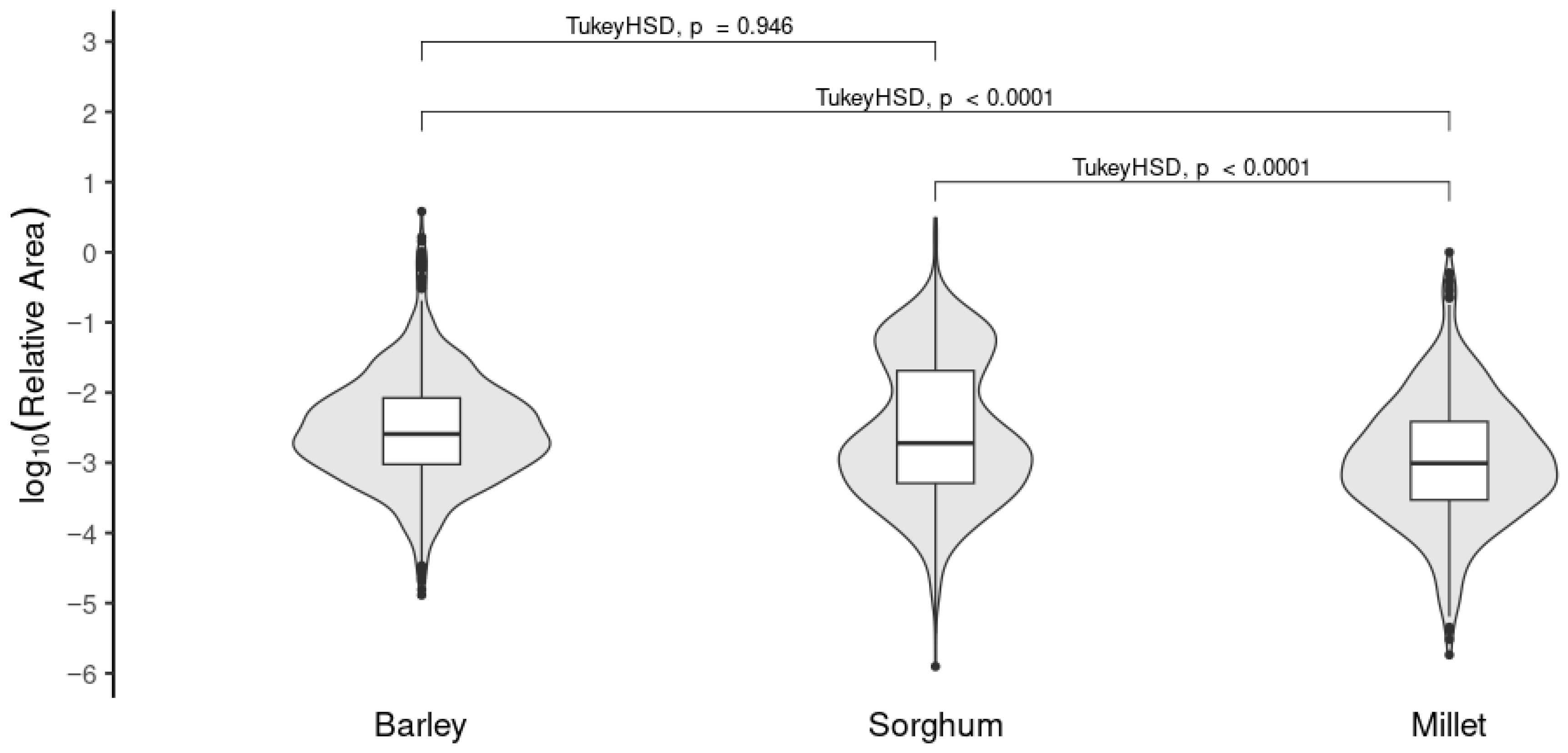
Figure 1. A violin plot relating the total concentration of volatile compounds measured in millet-based, sorghum-based, and malt beers. Relative area is averaged across all replicates for each compound and transformed using log base 10 due to the heavy right skew present in the data.
Beverages 12 00037 g001
Table 1. Yeast characteristics of the four strains utilized.
Yeast StrainFlocculationEster ProductionApparent
Attenuation (%)
Beer Styles Used
American AleLow/MediumLow78–82American Pale Ale, American Amber Ale
American WheatLowLow74–78American Wheat Ale, Kölsch
Belgian AbbeyLow/MediumMedium74–78Belgian Tripel, Belgian Dark Strong Ale
British AleMediumLow73–75English IPA, British Golden Ale
Table was created utilizing the specification data from the manufacturer’s website (https://wyeastlab.com) [24] and was taken from Budner et al. [19].
Table 2. Key compounds of interest along odor descriptors and threshold values.
CompoundOdor Descriptor [33]Odor Threshold Values * (mg/L)References
Butyl acetateBanana, sweet, paint thinner, plastic glue7.5–12[34]
Isoamyl acetateSweet, banana0.5–0.7[34,35]
Hexyl acetateSweet, aromatic, perfumed3.5[34]
1-OctanolCoconut, walnut, oily0.9[34]
Ethyl hexanoate (caproate)Fruity, sweet0.17–0.25[34]
NonanalFat, citrus, green0.018[34]
Ethyl octanoate (caprylate)Fruity0.3–0.9[34]
Ethyl decanoate (caprate)Capric, fruity, apple0.57[34]
Odor descriptors were taken from Kim et al. 2024 [33]. * Reported thresholds are for beer as reported by the ASBC flavor database (2012) [34] and Murane et al. 2013 [35].
Table 3. The measured common brewing measurements of millet beers brewed with an American Ale yeast.
pHRE (°P)Total Acidity (mol/L)Total Polyphenols (mg GAE/L)FAN (mg/L)Color (°SRM)
Wort5.24 (±0.18)13.5 (±4.7)0.012 (±0.01)162 (±53)178.2 (±113.2)5.03 (±5.71)
Day 73.88 (±0.66)9.5 (±3.5)0.023 (±0.01)111 (±27)168.5 (±87.7)13.43 (±7.71)
Finished Beer (Day 14)3.99 (±0.36)9.5 (±3.5)0.027 (±0.03)134 (±42)193.4 (±164)10.20 (±3.25)
N = 3 Mean (±Standard deviation). GAE: gallic acid equivalent. RE: refractive index derived extract estimates.
Table 4. Volatile composition of a millet beer fermented utilizing an American Ale yeast. The amount present in this study is represented by the chromatographic area of the peak relative to the 2-heptanol internal standard.
CompoundLRIOdor DescriptorRelative Response
Acids
Butanoic acid799NA7.40 × 10−3 (±5.14 × 10⁻³)
2-Methylbutanoic acid825Sweaty, rancid, unpleasant sour6.49 × 10−3 (±3.17 × 10⁻³)
Hexanoic acid940Goaty, fatty acid, vegetable oil, Sweaty3.57 × 10−2 (±2.33 × 10⁻²)
Heptanoic acid1016Rancid, faint tallow odor1.66 × 10−2 (±1.25 × 10⁻²)
2-Ethylhexanoic acid1045Mild odor2.09 × 10−3 (±5.20 × 10⁻⁴)
Octanoic acid1160Sweat, cheese6.35 × 10−2 (±3.51 × 10⁻²)
Decanoic acid1404Rancid fat4.34 × 10−2 (±6.55 × 10⁻²)
Alcohols
2-Butanol610Sweet3.82 × 10−4 (±1.21 × 10⁻⁴)
2-Methylpentanol NA7.36 × 10−2 (±9.46 × 10⁻²)
Isoamyl Alcohol (3-methyl-1-Butanol)744Floral, fruity6.62 × 10−1 (±7.66 × 10⁻¹)
5-Methyl-2-hexanol840NA1.00 × 100 (±0.05 × 100)
Heptanol892Fatty3.74 × 10−3 (±1.78 × 10⁻³)
4-Ethyl-2-octanol918NA1.03 × 10−3 (±3.04 × 10⁻⁴)
2-Ethylhexanol947Sweet, fatty-floral2.91 × 10−3 (±1.73 × 10⁻³)
Octanol988Floral, fruity, citrus2.73 × 10−2 (±2.53 × 10⁻²)
2-Nonanol1021Coconut3.52 × 10−2 (±2.47 × 10⁻²)
Phenethyl alcohol1050Alcohol, honey, roses, sweet2.67 × 10−1 (±5.83 × 10⁻¹)
Decanol1247Fat2.77 × 10−2 (±1.84 × 10⁻²)
Aldehydes
3-Methylbutanal704Malty, cherry, almond, chocolate, apple, cheese, unripe banana2.11 × 10−2 (±1.03 × 10⁻³)
2-Methylbutanal707Green grass, fruity, cheese, sour/medicinal, almond, apple-like, malty1.64 × 10−3 (±1.03 × 10⁻³)
Nonanal1025Orange–rose, floral, waxy, green1.04 × 10−2 (±4.96 × 10⁻³)
Decanal1154Floral–fatty, citrus3.01 × 10−2 (±4.65 × 10⁻²)
Esters
Ethyl acetate612Fruity5.23 × 10−2 (±4.70 × 10⁻²)
Ethyl isobutyrate750Apple, sweet, citrus, fruity, pineapple8.85 × 10−4 (±3.39 × 10⁻⁴)
Butyl acetate757Fruity, sweet3.27 × 10−2 (±6.01 × 10⁻²)
Ethyl butanoate778Butter, sweet, perfumed, fruity4.92 × 10−3 (±6.21 × 10⁻³)
Isoamyl acetate817Banana3.44 × 10−1 (±4.25 × 10⁻¹)
Ethyl hexanoate911Apple peel, fruit2.76 × 10−1 (±2.23 × 10⁻¹)
Hexyl acetate (ethanoate)925Sweet–fruity, pearl-like odor5.87 × 10−2 (±5.92 × 10⁻²)
Heptyl acetate1033Pear, fruity, aromatic, sweet6.19 × 10−3 (±9.27 × 10⁻⁴)
Ethyl octanoate1138Fruit, fat4.50 × 10−1 (±4.67 × 10⁻¹)
Octyl acetate1157Coconut, vegetable oil, aromatic7.03 × 10−3 (±6.57 × 10⁻³)
Isopentyl hexanoate (caproate)1214Fatty acids, fruity, solvent, perfumed, tropical fruits1.15 × 10−3 (±1.16 × 10⁻³)
β-Phenethyl acetate1224Rose, honey, tobacco6.51 × 10−2 (±1.18 × 10⁻¹)
Ethyl nonanaote1271NA5.80 × 10−3 (±9.07 × 10⁻³)
2-Methylpropyl octanoate (isobutyl octanoate)1350NA3.88 × 10−3 (±4.29 × 10⁻³)
Ethyl 9-decanoate1407Caprylic, fruity, apple8.25 × 10−3 (±4.89 × 10⁻³)
Ethyl decanoate1421Grape1.31 × 10−1 (±1.75 × 10⁻¹)
Isoamyl octanoate1510Fruity, spicy, orange, pear, melon3.06 × 10−3 (±5.32 × 10⁻³)
Ethyl dodecanoate1752Caprylic, soapy, estery4.79 × 10−3 (±8.41 × 10⁻³)
Ketones
2-Heptanone828Banana, slightly spicy odor1.17 × 10−1 (±1.02 × 10⁻¹)
4-Methyl-2-heptanone858NA1.89 × 10−4 (±3.24 × 10⁻⁵)
2,6-Dimethylheptan-4-one (isobutyl ketone)886Peppermint, mild, sweet2.13 × 10−3 (±1.27 × 10⁻³)
2-Nonanone1007Ketone, varnish, stale4.78 × 10−2 (±4.89 × 10⁻²)
6-Tetradecanone1604NA4.79 × 10−3 (±8.41 × 10⁻³)
Phenols
4-Methyoxyphenol (Mequinol)1007Caramel and phenol1.22 × 10−1 (±8.13 × 10⁻²)
4-Ethylphenol1094Woody, phenolic, medicinal2.04 × 10−2 (±1.39 × 10⁻²)
4-Ethyl-2-methoxyphenol (4-Ethylguaiacol)1242Phenolic, sweet, medicinal8.62 × 10−3 (±8.32 × 10⁻³)
2-Methoxy-4-vinylphenol (4-vinylguaiacol)1289smoky, spicy, cloves, vanilla-like, phenolic, clove-like, bitter8.13 × 10−3 (±8.61 × 10⁻³)
Other
Styrene828Sweet, balsamic1.36 × 10−1 (±2.52 × 10⁻²)
Eucalyptol946Eucalyptus, bittersweet8.45 × 10−4 (±4.39 × 10⁻⁴)
N = 9; Mean (±STD); odor descriptors were obtained from the following references Kim et al. 2024 [33], ASBC Beer Flavor Database [36], and Escalera, A. et al. 2025 [64]; NA: not applicable.
Table 5. Comparison of key aromatic compound concentrations found in millet, barley, or sorghum beers brewed with four different yeast strains.
MilletBarley *Sorghum *
American Ale
Ethyl butyrate G2.55 (±3.5)9.54 (±0.5) × 10−24.09 (±2.4) × 10−3
Butyl acetate G 4.24 (±5.9)5.99 (±9.0) × 10−24.18 (±2.8) × 10−2
Isoamyl acetate G 5.16 (±7.1)1.21 (0.0006)1.59 (±1.6) × 10−2
Ethyl hexanoate (caproate) G 1.07 (±1.4)3.62 (±0.0043) × 10−16.27 (±5.1) × 10−3
Hexyl acetate G 7.21 (±2.0) × 10−37.09 (±2.5) × 10−31.73 (±2.1) × 10−4
1-Octanol G 9.91 (±5.7) × 10−21.43 (±0.022) × 10−12.32 (±1.6) × 10−3
Nonanal 1.67 (±0.37) × 10−2 A3.89 (±8.4) × 10−3 B5.74 (±5.3) × 10−3 AB
Ethyl octanoate G 4.99 (±0.72) × 10−11.69 (±0.0029)4.02 (±2.7) × 10−2
Ethyl decanoate G 1.92 (±1.5) × 10−11.11 (±0.0071)2.24 (±1.9) × 10−2
Overall Total G46.67 (79.15)4.70 (±3.93)1.39 × 10⁻¹ (±9.17 × 10⁻²)
English Ale
Ethyl butyrate6.68 (±5.5) × 10−3 B8.57 (±5.2) × 10−2 A7.06 (±3.4) × 10−3 B
Butyl acetate G1.24 (±2.15) × 10−26.61 (±3.3) × 10−22.97 (±1.4) × 10−2
Isoamyl acetate 1.98 (±1.7) × 10−1 AB1.37 (±0.8) A4.34 (±3.1) × 10−2 B
Ethyl hexanoate (caproate) G 6.74 (±4.1) × 10−22.50 (±1.7) × 10−11.30 (±0.8) × 10−2
Hexyl acetate 6.30 (±0.86) × 10−3 AB1.31 (±0.7) × 10−2 A3.33 (±5.7) × 10−4 B
1-Octanol G5.33 (±4.0) × 10−21.78 (±1.2) × 10−11.74 (±3.1) × 10−3
Nonanal G6.27 (±5.4) × 10−39.83 (±1.2) × 10−37.61 (±4.4) × 10−3
Ethyl octanoate 3.91 (±4.4) × 10−1 B1.57 (±0.6) A1.36 (±1.2) × 10−1 B
Ethyl decanoate 6.96 (±1.0) × 10−2 B1.62 (±0.4) A7.41 (±5.7) × 10−2 B
Overall Total8.11 (±7.12) × 10−1 B5.17 (±2.12) A3.13 (±2.24) × 10−1 B
Belgian Abby
Ethyl butyrate3.45 (±0.16) × 10−2 B2.19 (±1.0) × 10−1 A6.65 (±4.2) × 10−3 B
Butyl acetate G2.59 (±2.2) × 10−24.54 (±0.3) × 10−23.60 (±1.6) × 10−2
Isoamyl acetate 5.70 (±4.2) × 10−1 B2.37 (±1.1) A1.15 (±0.7) × 10−2 B
Ethyl hexanoate (caproate) 7.62 (±9.1) × 10−2 B1.06 (±0.3) A7.06 (±4.0) × 10−3 B
Hexyl acetate G6.58 (±6.9) × 10−31.43 (±0.4) × 10−23.80 (±6.5) × 10−4
1-Octanol 7.68 (±9.3) × 10−2 B2.38 (±0.3) × 10−1 A2.67 (±2.4) × 10−3 B
Nonanal G4.01 (±8.3) × 10−34.90 (±0.03) × 10−36.63 (±2.2) × 10−3
Ethyl octanoate 4.47 (±2.5) × 10−1 B3.35 (±0.1) A7.43 (±5.3) × 10−2 B
Ethyl decanoate 3.51 (±0.68) × 10−1 B2.87 (±0.1) A4.14 (±4.3) × 10−2 B
Overall Total9.87 (±5.61) × 10−1 B10.18 (±1.57) A1.87 (±1.09) × 10−1 B
American Wheat
Ethyl butyrate G3.18 (±3.2) × 10−21.15 (±1.0) × 10−11.28 (±1.3) × 10−1
Butyl acetate G2.22 (±1.5) × 10−25.48 (±3.1) × 10−23.42 (±3.6) × 10−1
Isoamyl acetate G 7.53 (±6.7) × 10−11.49 (±1.3)4.77 (±5.0) × 10−1
Ethyl hexanoate (caproate) G 1.60 (±1.2) × 10−12.66 (±2.3) × 10−14.60 (±5.0) × 10−1
Hexyl acetate G1.00 (±1.4) × 10−11.08 (±0.9) × 10−21.67 (±1.9) × 10−4
1-Octanol G1.34 (±0.94) × 10−11.28 (±1.1) × 10−1n.d.
Nonanal G8.90 (±8.2) × 10−34.30 (±3.5) × 10−32.33 (±2.0) × 10−3
Ethyl octanoate G3.95 (±3.2) × 10−12.17 (±1.8)7.91 (±5.7) × 10−2
Ethyl decanoate G1.99 (±2.2) × 10−11.57 (±1.3)2.81 (±1.7) × 10−2
Overall Total G1.80 (±1.57)5.81 (±4.97)1.03 (±1.50)
N = 3; Mean (±STD); based upon the response value in relation to the internal standard (2-heptanol). n.d.: not detected. * Data was taken from previously published data Budner et al. (2021) [20]. Values bearing different letters are statistically significant (p < 0.05). G: no statistical differences were observed. Overall total values represent the mean of replicate-level summed responses across the nine compounds analyzed for each yeast strain and therefore may not equal the sum of individual compound means.
Disclaimer/Publisher’s Note: The statements, opinions and data contained in all publications are solely those of the individual author(s) and contributor(s) and not of MDPI and/or the editor(s). MDPI and/or the editor(s) disclaim responsibility for any injury to people or property resulting from any ideas, methods, instructions or products referred to in the content.